1.1.1 - Professional Auditor Scope
Professional Auditor Scope
What you’ll learn
- DOMAIN: Documentation Review → Auditor role boundaries — distinguish what the auditor may validate versus what the auditor may not infer, create, or repair.
- DOMAIN: Code Validation → Supportability judgment — decide whether documentation supports reported professional services without acting as a coder of undocumented intent.
- DOMAIN: Medical Necessity and Compliance → Defensible conclusions — phrase findings as supported, unsupported, insufficiently documented, or requiring clarification.
- DOMAIN: Reporting and Education → Audit communication — convert record review into a bounded, evidence-based finding with appropriate escalation.
- DOMAIN: Audit Methodology → Rule application sequence — apply a repeatable framework: identify task, extract record facts, select governing rule, conclude supportability, document risk.
- Documentation Review → Role of the auditor → Determine what the record actually supports
- Code Validation → Documentation-to-code support → Validate billed CPT, HCPCS Level II, and ICD-10-CM based on evidence present
- Medical Necessity and Compliance → Scope limits and ethical boundaries → Avoid overreaching conclusions
- Audit Methodology → Structured audit reasoning → Use a consistent decision pathway
- Reporting and Education → Findings and follow-up → Recommend clarification, education, or escalation when appropriate
Why it matters
- CPMA items often test not just coding knowledge, but whether the auditor stays within scope when the note is incomplete, conflicting, or tempting to “fix.”
- Many wrong answers are clinically plausible but audit-invalid because they assume facts not documented.
- Scope errors create compliance risk: overcalling support, undercalling support, or making legal/clinical conclusions beyond the evidence.
- A defensible audit starts with role discipline: validate what is documented, cite the governing rule, and recommend clarification when needed.
Exam takeaway: Use this pathway to decide whether to validate, clarify, or escalate without exceeding the auditor role.
flowchart TD
A[Audit question received] --> B{Is the fact documented?}
B -->|Yes| C[Compare record to billed code or finding]
B -->|No| D[Do not infer or create documentation]
C --> E{Rule supports service?}
E -->|Yes| F[Supported or partially supported]
E -->|No| G[Unsupported, overcoded, or incorrect modifier/edit issue]
D --> H[Recommend clarification, education, or escalation]
F --> I[Report defensible conclusion with citation]
G --> I
At the start of this course, the highest-yield habit is to think like the auditor shown in Fig 1: evidence first, rules second, conclusion third.
Key Terms & Must-Know Facts
1.1.1.1 Key terms
- Supportability: whether the record supports the reported code or audit conclusion.
- Documentation sufficiency: whether required elements are present to defend the billed service.
- Professional service audit: review of physician or other qualified healthcare professional documentation and reported services.
- Clarification: compliant follow-up when documentation is ambiguous or incomplete.
- Unsupported service: billed service not backed by the record as documented.
- Partially supported: some, but not all, billed components are supported.
- Overcoded: service level exceeds documentation support.
- Undercoded: service documented more extensively than reported, when supported by rules and evidence.
- Medical necessity: support that a service was reasonable and necessary under applicable standards or policy.
- NCCI edit logic: bundling or edit principles that affect code pair reporting.
- Modifier-dependent service: service requiring documentation support for a modifier to be defensible.
- Defensible finding: conclusion grounded in documentation and authoritative guidance.
- Escalation: referral of high-risk, ambiguous, or policy-sensitive issues to compliance or designated leadership.
1.1.1.2 Must-know facts
- The auditor validates documented facts; the auditor does not create missing facts.
- Clinical plausibility does not equal documentation support.
- Paid claims can still be unsupported.
- A modifier is not justified merely because it was appended.
- Ambiguity usually triggers clarification or limitation of conclusion, not assumption.
- The correct CPMA answer often turns on the single phrase “not documented.”
- Payer-specific rules may change the outcome; if the scenario states a policy, use that policy.
- Auditors report risk and supportability; they do not diagnose, treat, or allege fraud without adequate evidence.
| Term | What it means in audit practice | Common exam confusion |
|---|---|---|
| Supported | Documentation and rules support the billed service | Assuming “paid” means supported |
| Unsupported | Required documentation or rule basis is absent | Confusing missing details with minor style issues |
| Partially supported | Some billed elements are supported, others are not | Treating the whole claim as all-or-nothing |
| Clarification needed | Record is ambiguous, conflicting, or incomplete for a firm conclusion | Guessing what the provider “must have meant” |
| Out-of-role conclusion | Statement exceeds audit evidence or authority | Making diagnosis, treatment, or fraud conclusions |
| Defensible citation | Finding tied to CPT, ICD-10-CM, payer policy, or compliance authority | Using habit or office custom instead of authority |
Core content
1.1.1.3 Foundational role: what the professional auditor is actually deciding
A Explanation
The core decision conflict is this: Are you being asked to validate what was documented, or are you drifting into deciding what should have happened clinically? The resolving rule is simple: a CPMA auditor evaluates supportability of reported professional services using the medical record, claim details, official guidance, and any stated payer policy. The auditor does not diagnose the patient, choose treatment, fill in missing history, or repair the note after the fact.
WHY THIS IS TESTED: exam stems frequently include a medically believable story that tempts you to accept a billed service even though the required support is absent. Choose the answer that stays inside the audit role; reject the answer that converts plausibility into support.
In practice, your questions are bounded: What service was reported? What diagnoses were linked? What documentation is present? What rule governs this service? Does the evidence support the claim as billed, partially support it, or fail to support it? If the record is incomplete or contradictory, your next step is not to “finish” the documentation; it is to note the limitation and recommend clarification or escalation.
B Worked example
A 67-year-old man with diabetes, hypertension, and chronic kidney disease is seen in a family medicine office for dizziness. The claim reports a high-level office visit and a same-day procedure modifier. The note contains medication review, vital signs, a brief assessment, and a plan to increase hydration. A detailed neurologic exam is not documented, and the procedure note is missing. A mildly elevated glucose value is listed, which distracts from the missing support. The most appropriate audit reasoning is: identify task — validate the reported professional services and modifier; extract key facts — office visit note present, procedure note absent, modifier billed, no documented procedure details; apply rule — billed procedures and modifiers need documentation support; eliminate distractors — do not assume the procedure occurred because the patient’s presentation could have warranted it; verify — conclude the E/M may be reviewable on its own, but the procedure/modifier as billed are unsupported or require clarification depending on the record set available.
C Exam trap
D Checkpoint
Question: During a professional services audit, which action is most appropriate when the provider’s note does not document a billed procedure that appears clinically plausible based on the patient’s complaint?
- Conclude the procedure is supported because the patient’s presentation commonly leads to that service.
- Conclude the service is unsupported as documented and recommend clarification if additional record sources may exist.
- Rewrite the note to include standard procedure elements and then validate the code.
- Ignore the missing procedure note because payment indicates acceptance.
Answer: B
- A: Tempting because clinical plausibility feels relevant; wrong because plausibility does not replace documentation.
- B: Tempting because it seems conservative; right because it stays within role and recognizes possible record incompleteness without inventing support.
- C: Tempting because standardized documentation requirements are familiar; wrong because auditors do not create or rewrite documentation.
- D: Tempting because many learners equate payment with validity; wrong because paid claims can still be unsupported.
1.1.1.4 Scope boundaries: what the auditor must not do
A Explanation
The second foundational conflict is choosing between interpreting evidence and crossing into prohibited acts. The single resolving rule: the auditor may analyze, compare, classify, and report; the auditor may not diagnose, prescribe, perform clinical decision-making, backfill the note, or issue legal conclusions beyond the evidence. See Fig 2.
WHY THIS IS TESTED: CPMA stems often hide the right answer among aggressive-sounding options that appear decisive but are actually out-of-role. The exam rewards disciplined restraint, especially when the record is weak.
Out-of-role conclusions include statements such as “the patient definitely had condition X despite missing provider documentation,” “the physician committed fraud,” or “the correct treatment should have been Y.” Even if you suspect a pattern, the bounded audit response is to document the unsupported or insufficiently documented service, state the compliance concern, and escalate per policy when warranted. This protects both the integrity of the audit and the defensibility of the finding.
This topic also foreshadows the upcoming lesson on Out-Of-Role Conclusions: today the goal is to identify the boundary; later you will practice finer distinctions in escalation language.
Exam takeaway: Pick answers that classify and communicate risk, not answers that diagnose, treat, or create documentation.
flowchart LR
A[Allowed] --> A1[Validate documentation]
A --> A2[Assess code and modifier support]
A --> A3[Apply edits and policy]
A --> A4[Report findings and education]
B[Prohibited] --> B1[Diagnose patient]
B --> B2[Choose treatment]
B --> B3[Create missing note content]
B --> B4[Declare fraud without adequate evidence]
B Worked example
A 42-year-old woman with obesity and migraine history presents to an urgent care clinic with severe headache and photophobia. The note documents symptoms, a focused exam, and medication administration, but the claim also includes a diagnosis code for a condition not explicitly documented. A tempting clue is that the symptoms could fit that diagnosis. Another distracting detail is that the patient reports similar prior episodes. The reasoning chain: identify task — validate diagnosis support; extract key facts — symptoms documented, diagnosis not clearly stated by the provider, medication administered; apply rule — auditors cannot assign or defend a diagnosis based on their own clinical interpretation when provider documentation does not support it; eliminate distractors — prior similar episodes do not convert symptoms into a documented diagnosis; verify — conclude the diagnosis code is unsupported as billed, while the separately documented service may still be reviewable.
C Exam trap
D Checkpoint
Question: Which conclusion most clearly exceeds the CPMA auditor’s role?
- The diagnosis code is unsupported because the provider documented symptoms but not the reported condition.
- The modifier requires clarification because distinct procedural documentation is incomplete.
- The physician committed fraud by selecting a higher-paying diagnosis code.
- The service may be partially supported, depending on whether additional record components are available.
Answer: C
- A: Tempting because it is a strong statement; right-to-consider but not the best answer because it remains within documentation support analysis.
- B: Tempting because it avoids a final answer; wrong as the best choice because requesting clarification is often appropriate, not out-of-role.
- C: Tempting because intentional misconduct may come to mind with high-risk billing; correct because alleging fraud exceeds the evidence unless supported by formal investigation-level facts.
- D: Tempting because it sounds noncommittal; wrong as the best choice because partial support is a valid audit conclusion when facts justify it.
- The auditor may validate documented services, but may not create missing ______.
- True or False: A paid claim is automatically supported.
- Name the 3 prohibited overreaches most often tested: diagnose, treat, and ______.
1.1.1.5 Application: record facts vs assumptions in supportability review
A Explanation
Now move from role definition to action. The practical conflict is choosing between documented evidence and assumed missing elements. The single rule that resolves it: when auditing supportability, only documented and attributable record facts count. That means signed notes, procedure details, diagnosis statements, time where required, and modifier-supporting distinctions must be present in the record set available for audit. See Fig 3.
WHY THIS IS TESTED: exam items often add noise such as age, comorbidities, abnormal labs, or classic symptoms to make the undocumented element feel obvious. Your task is to separate what is clinically suggestive from what is audit-usable.
As an auditor, you should ask: Which fact supports the billed line? Which fact is absent? Does a missing fact eliminate only part of the claim or all of it? This is where “supported versus unsupported” begins, but the important scope point is that you do not bridge gaps with assumptions. If the note says “procedure tolerated well” but never identifies the procedure performed, site, or distinctness needed for a modifier, the service is not rescued by context alone.
Use a fact inventory. List what is present, who documented it, and whether it directly maps to the reported service. If a fact matters only because the learner knows medicine, but the provider did not document it, it is an assumption, not evidence.
Exam takeaway: Separate documented evidence from tempting assumptions by mapping each billed line to a specific record element.
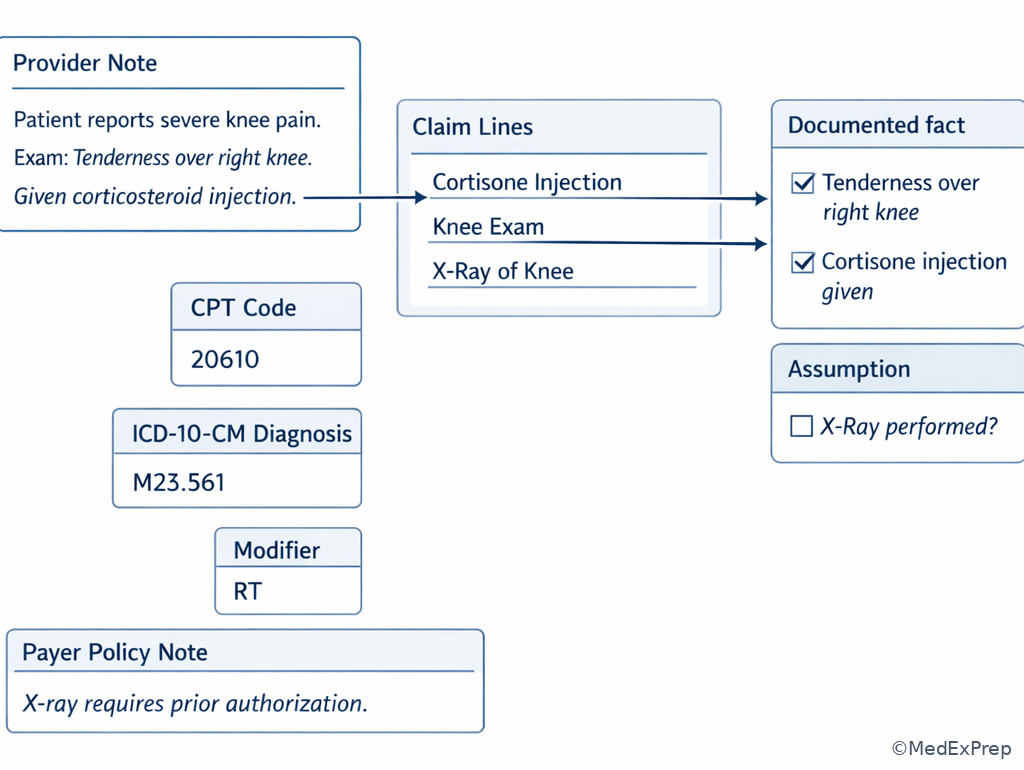
B Worked example
A 58-year-old woman with COPD and osteoporosis is seen by an orthopedic surgeon after a fall. The claim reports an office visit, an injection code, a supply item, and a diagnosis code for fracture. The note documents shoulder pain, x-ray review, and conservative treatment discussion. A nursing intake sheet mentions “possible fracture,” and an old problem list includes prior fracture history. The distracting clue is obvious trauma, which makes fracture coding and injection billing feel likely. Reasoning chain: identify task — validate each billed professional service and diagnosis; extract key facts — pain documented, prior fracture history present, current fracture not confirmed by provider, injection procedure not documented; apply rule — current diagnosis and procedure require direct support, not intake speculation or old problem list carryforward; eliminate distractors — trauma history alone does not prove fracture coding or injection performance; verify — office visit may be supported, but the fracture diagnosis and injection line are unsupported as documented.
C Exam trap
D Checkpoint
Question: An auditor reviews a claim with a billed procedure and modifier. The note references “tolerated well” but contains no procedure name, site, or distinctness details. What is the most appropriate interpretation?
- The modifier is supported because the phrase implies a separate service occurred.
- The procedure and modifier are supported because such details are routine and may be assumed.
- The documentation is insufficient to support the billed procedure/modifier as submitted.
- The claim must be fully supported if the diagnosis code is appropriate for the complaint.
Answer: C
- A: Tempting because “tolerated well” sounds procedural; wrong because it does not identify the specific service or modifier basis.
- B: Tempting because routine workflows may suggest omitted details existed; wrong because routine is not evidence.
- C: Tempting because it may feel strict; right because required support cannot be inferred from vague wording.
- D: Tempting because diagnosis relevance matters for medical necessity; wrong because an appropriate diagnosis does not prove the procedure was documented.
1.1.1.6 Application: choosing the correct audit response when the record is incomplete or ambiguous
A Explanation
The next conflict is choosing among unsupported, partially supported, and clarification needed. The single rule: use the strongest conclusion the available evidence supports, but no stronger. If a billed element is clearly absent, unsupported may be appropriate. If some elements are present and others are not, partially supported may be more accurate. If the record is ambiguous, contradictory, or appears incomplete, clarification or limitation of conclusion may be the best audit response rather than a guessed final answer. See Fig 4.
WHY THIS IS TESTED: the exam rewards precision. Overcalling unsupported when the issue is truly ambiguity can be as flawed as overcalling support when documentation is missing.
Examples: a separate procedure note referenced but not included in the audited packet may justify clarification. A diagnosis stated once but contradicted elsewhere may justify ambiguity language and escalation. A modifier billed with no distinct procedural documentation usually supports a more direct unsupported finding. The auditor’s skill is to classify the type of gap correctly.
Exam takeaway: Match the finding label to the type of documentation gap rather than forcing every case into supported versus unsupported only.
flowchart TD
A[Review billed element] --> B{Required support present?}
B -->|Yes| C[Supported]
B -->|No| D{Some support present?}
D -->|Yes| E[Partially supported]
D -->|No| F{Packet incomplete or record ambiguous?}
F -->|Yes| G[Clarification or limited conclusion]
F -->|No| H[Unsupported] B Worked example
A 73-year-old man with coronary artery disease, atrial fibrillation, and hearing loss is audited for a cardiology follow-up. The claim includes an E/M service and an ECG interpretation. The physician note states, “ECG reviewed; no acute change,” but the tracing and separate interpretation are absent from the reviewed packet. A distractor is the patient’s long cardiac history, which makes ECG work unsurprising. Another distractor is that the note sounds like interpretation occurred. Reasoning chain: identify task — validate the separately billed professional interpretation; extract key facts — physician references ECG review, but supporting interpretation record is not in the packet; apply rule — if a separately billed service appears referenced but documentation set may be incomplete, do not assume support and do not automatically overstate unsupported; eliminate distractors — cardiac history and clinician wording do not replace the needed record; verify — the strongest defensible response is clarification or limited conclusion pending complete records, not blind acceptance.
C Exam trap
D Checkpoint
Question: Which finding is most appropriate when the chart packet appears incomplete and the available note references a separate document that could affect supportability?
- Supported, because the provider would not reference a document unless it existed.
- Clarification or limited conclusion pending review of the referenced document.
- Fraudulent billing pattern requiring immediate legal conclusion.
- Automatically undercoded, because the provider likely did more work than documented.
Answer: B
- A: Tempting because provider reference seems credible; wrong because referenced documentation must still be reviewed.
- B: Tempting because it avoids overstatement; right because it matches the evidence without assumption.
- C: Tempting because missing records may feel serious; wrong because legal conclusions exceed the facts given.
- D: Tempting because incomplete packets can hide additional work; wrong because likely work is not documented support.
- If some but not all billed elements are backed by the record, the finding is ______ supported.
- True or False: Ambiguous documentation should always be treated as fully unsupported with no qualification.
- If a separate note is referenced but not available, the safest immediate audit action is ______ or limited conclusion.
1.1.1.7 Integration: communicating a defensible audit finding and recommendation
A Explanation
The final conflict is choosing between a vague observation and a defensible audit statement. The single rule: an audit finding should tie the claim issue to the record evidence, governing authority, supportability conclusion, and next-step recommendation. This is where scope discipline becomes visible in reporting. See Fig 5.
WHY THIS IS TESTED: CPMA questions often ask for the “best audit response,” not just the right internal thought. The correct answer is usually the one that is evidence-based, bounded, and operationally useful.
A strong finding often follows a sequence: identify the billed service or code, cite the missing or conflicting documentation element, reference the applicable rule or instruction, state the resulting supportability classification, and recommend clarification, provider education, repayment review, policy review, or escalation as appropriate. The key is proportionality. A single unsupported modifier may call for education and correction. A repeated pattern across sampled claims may warrant broader escalation. But even then, the auditor reports pattern risk and evidence; the auditor does not leap to intent-based accusations.
Good reporting language also preserves uncertainty correctly. If the packet was incomplete, say so. If the note was ambiguous, say which phrase created ambiguity. If payer policy matters, name that dependency instead of pretending a universal rule.
Exam takeaway: The best audit response links claim, record evidence, rule, conclusion, and recommendation in one bounded statement.
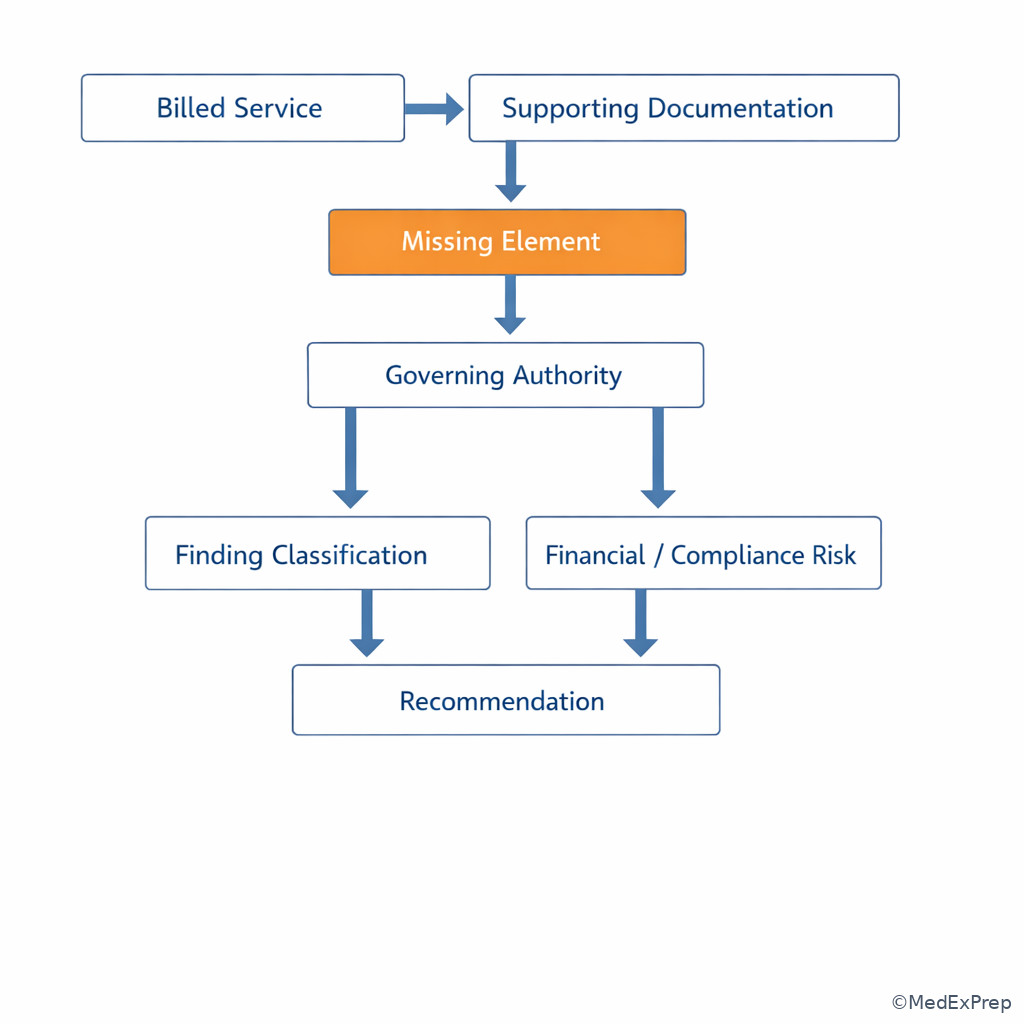
B Worked example
A 51-year-old established patient with rheumatoid arthritis and depression has an office rheumatology follow-up. The claim includes a visit level, drug administration service, and diagnosis linkage. The note supports the visit and the chronic condition management, but the administration route and dose details are incomplete. A medication list shows the drug name, tempting the reviewer to accept the administration code. A slightly elevated inflammatory marker distracts toward medical necessity rather than documentation sufficiency. Reasoning chain: identify task — determine supportability and write the finding; extract key facts — visit documentation present, diagnosis documented, administration details incomplete; apply rule — administration services need documentation support beyond medication presence on a list; eliminate distractors — abnormal labs and chronic disease severity do not fill in route/dose elements; verify — report the E/M as supported, the administration line as unsupported or clarification-limited depending on record completeness, cite the missing elements, and recommend targeted documentation education.
C Exam trap
D Checkpoint
Question: Which audit finding statement is most defensible?
- The provider likely performed the billed service, so no finding is necessary.
- The claim is fraudulent and should be referred directly to law enforcement.
- The billed administration service is not supported by the documentation reviewed because route/dose details are absent; recommend clarification if additional records exist and provider education on required procedure documentation.
- The patient’s chronic illness severity proves the service should remain billed as submitted.
Answer: C
- A: Tempting because the context suggests the service may have happened; wrong because “likely” is not a documentation-based finding.
- B: Tempting because unsupported billing sounds serious; wrong because the conclusion exceeds evidence and skips proportional compliance process.
- C: Tempting because it is detailed; right because it ties the missing element to a bounded recommendation.
- D: Tempting because severity affects necessity; wrong because necessity cannot substitute for missing procedure documentation.
Exam Traps & Differentiators
Most common wrong answer and why: “Support the code because the clinical scenario makes sense.” This is tempting because many stems are written to feel medically coherent. The discriminator is whether the provider documented the fact required to support the reported code, modifier, or diagnosis.
| Looks similar | But isn’t | How to tell on exam day |
|---|---|---|
| Clinically plausible service | Documented supported service | If the support element is not in the record, reject the service as billed or limit the conclusion |
| Compliance concern | Fraud conclusion | Auditors report risk and escalate; they do not allege fraud without adequate evidence and process |
| Incomplete packet | Clearly unsupported documentation | If the note references missing components, clarification may be stronger than a final unsupported finding |
| Diagnosis consistent with symptoms | Provider-documented diagnosis support | Symptom fit is not enough; the diagnosis must be documented appropriately |
| One unsupported line item | Entire encounter unsupported | Audit each billed element separately unless the missing documentation affects all lines |
If the stem says... think:
- “The procedure likely occurred” → think not enough; find the procedure documentation.
- “The symptoms strongly suggest the diagnosis” → think provider documentation still controls diagnosis support.
- “The chart packet may be incomplete” → think clarification or limited conclusion before overstatement.
- “The claim was paid” → think payment does not validate supportability.
- “There is a concerning pattern” → think document risk and escalate; do not leap to legal conclusions.
- “A modifier was billed” → think modifier documentation must stand on its own.
Exam takeaway: Separate plausible clinical reasoning from defensible audit reasoning when choosing the best answer.
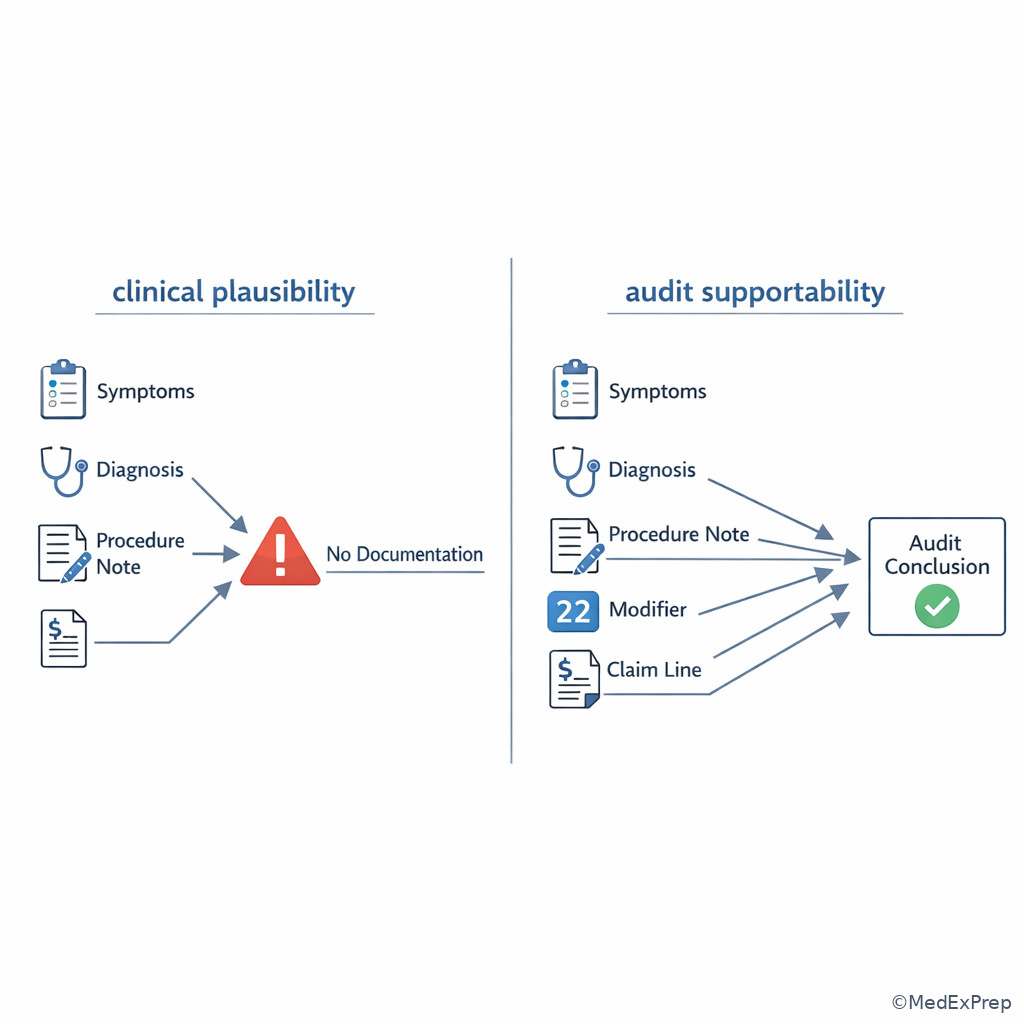
Tables
| Audit situation | Best role-consistent response | Reject this response |
|---|---|---|
| Diagnosis not documented, symptoms present | Report diagnosis support issue based on documentation | Assign the diagnosis based on symptom pattern |
| Procedure billed, note absent | Unsupported as documented or clarification if packet incomplete | Assume procedure occurred because complaint fits |
| Modifier billed, distinctness unclear | Request evidence of modifier support or report unsupported modifier | Accept modifier because it was submitted |
| Repeated documentation weakness across claims | Trend, educate, and escalate per compliance process | State fraud as a final conclusion without further basis |
| Conflicting record statements | Limit conclusion and identify ambiguity | Choose the statement that best fits reimbursement |
| Payer policy explicitly stated in scenario | Apply the stated policy | Invent a universal rule that overrides it |
| Category | Supported | Partially supported | Unsupported / clarification-limited |
|---|---|---|---|
| E/M service | Required documentation supports billed level/method | Some work documented, but billed level exceeds support | Documentation missing key basis or record incomplete |
| Procedure | Procedure note/elements present | Main service documented, add-on or units not fully supported | No procedure details or separate note available |
| Diagnosis | Provider documents condition appropriately | Some linked conditions supported, others not | Only symptoms/history suggest the diagnosis |
| Modifier | Distinctness/repeat/global exception documented | Base service supported, modifier basis weak | No modifier-specific support in record |
| Medical necessity | Documentation and policy basis align | Some lines justified, others not | Necessity unsupported or policy not met; clarify if policy facts missing |
| Finding type | Defining feature | Best documentation phrase |
|---|---|---|
| Supported | Record and rule align | “Documentation reviewed supports the reported service.” |
| Partially supported | Only some billed components are defendable | “Documentation supports X but not Y.” |
| Unsupported | Required support absent | “Documentation reviewed does not support the billed service as submitted.” |
| Insufficient documentation | Record lacks required detail to validate | “Documentation is insufficient to support the reported line item.” |
| Clarification needed | Ambiguous/conflicting/incomplete packet | “Available documentation is insufficient for a final conclusion pending clarification.” |
| Escalation indicated | Pattern, high risk, or policy-sensitive issue | “Pattern warrants compliance review and targeted education.” |
Exam takeaway: Use comparison logic to reject answers that sound decisive but rely on undocumented assumptions.
flowchart TB
A[Documented fact] --> B[Supportable conclusion]
C[Clinical plausibility only] --> D[Do not defend billed line]
E[Ambiguous or incomplete packet] --> F[Clarification or limited conclusion]
G[Pattern across claims] --> H[Education and escalation]
Exam takeaway: Audit line items independently so one weak element does not automatically decide the whole encounter.
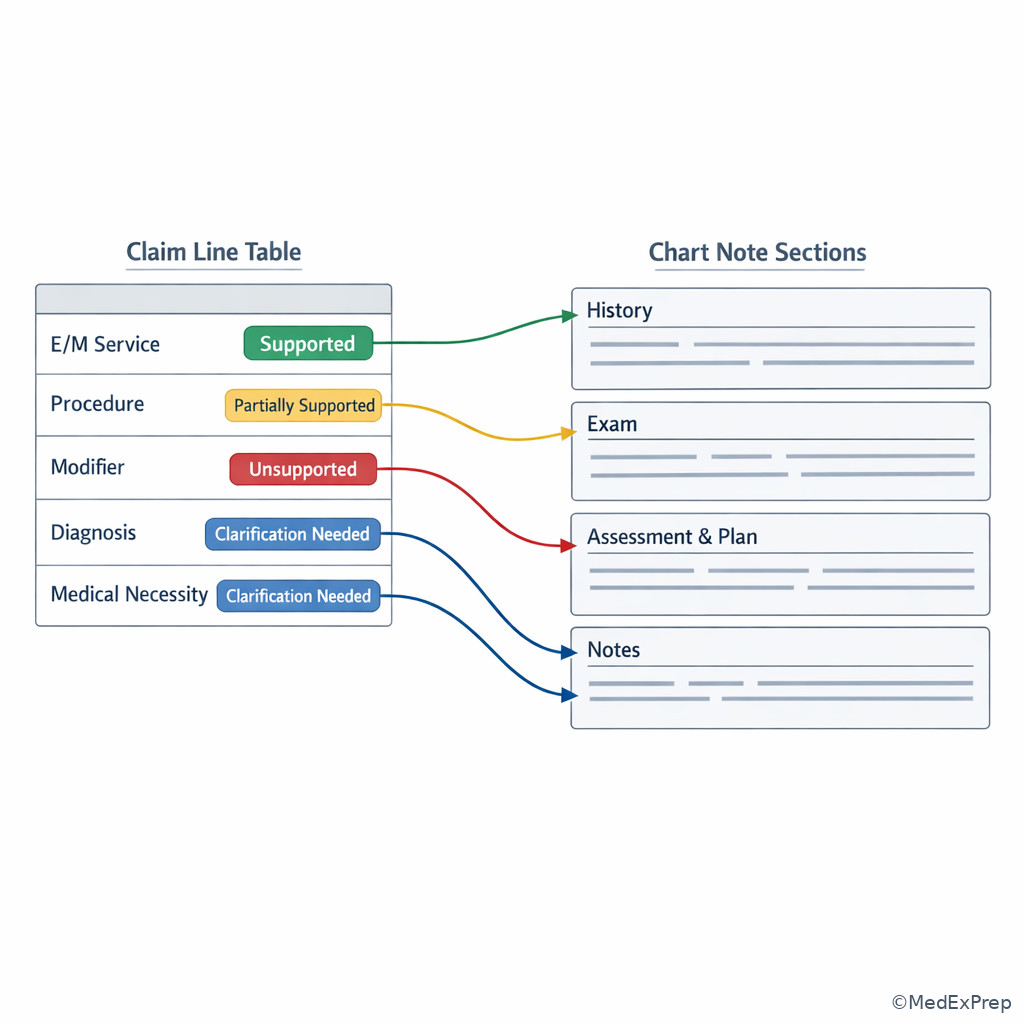
Algorithm / Approach
Exam takeaway: Start with the record, not your clinical assumptions, and end with the narrowest defensible finding.
See Fig 6 for the exam-safe sequence. This algorithm is your default whenever a stem feels noisy or clinically persuasive.
Rapid Review
- Auditor role → validate supportability, not clinical correctness
- Clinical plausibility → never equals documentation support
- Paid claim → does not prove compliant billing
- Undocumented procedure → cannot be defended by symptom severity
- Undocumented diagnosis → symptoms may support symptom coding, not the unstated condition
- Modifier billed → separate modifier-specific documentation still required
- Incomplete packet → consider clarification before overcalling unsupported
- Conflicting statements → limit the conclusion to what is clearly defensible
- Pattern risk → escalate through compliance process, not legal accusation
- One weak claim line → does not automatically invalidate all other supported lines
- Payer-specific rule stated → use that rule, not office habit
- Best audit answer → evidence + authority + bounded recommendation
Self-check quiz
1. A 46-year-old woman with hypertension and seasonal allergies has a professional claim audited after an office visit for cough. The note documents symptoms and assessment, but the billed diagnosis is a more specific condition not stated by the provider. Which is the most appropriate audit conclusion?
- The diagnosis is supported because the symptoms strongly suggest it.
- The diagnosis is unsupported as billed because provider documentation does not state it.
- The diagnosis is supported if the patient received treatment commonly used for it.
- The diagnosis must be retained because deleting it would change reimbursement.
2. A 70-year-old man with diabetes and peripheral neuropathy has a billed office procedure during a podiatry visit. The note contains the office visit documentation but no procedure note. Which principle is most important for the auditor to apply?
- Routine office workflows can fill in missing procedural details.
- Payment history overrides missing documentation.
- Documented support is required for the billed procedure line.
- The patient’s chronic conditions make the procedure inherently supported.
3. A 63-year-old woman with COPD and osteoporosis is seen for shoulder pain after a fall. The claim includes an office visit and injection. The note documents evaluation and x-ray review, but no injection details. A medication list contains an injectable drug. What is the most appropriate next audit conclusion?
- Support both lines because the medication list implies administration occurred.
- Support the injection but downcode the diagnosis.
- Support the visit if documented, and classify the injection line as unsupported or clarification-limited based on record completeness.
- Deny the entire claim because one billed line lacks support.
4. A 74-year-old man with coronary artery disease and atrial fibrillation has an E/M visit and separately billed ECG interpretation. The physician note says “ECG reviewed,” but the tracing and interpretation are not in the packet. The audit request states outside documents may not have been included. What is the best next step?
- Conclude the ECG interpretation is supported because the physician referenced it.
- Issue a limited conclusion or seek clarification regarding the missing ECG documentation.
- Assume the ECG was not performed and mark it permanently unsupported.
- Replace the ECG code with a lower-paying alternative.
5. A 52-year-old patient with rheumatoid arthritis and depression is audited for an office visit with drug administration. The note supports chronic disease management, but route and dose of the billed administration are absent. Which audit report statement is best?
- The entire encounter is unsupported because one component is incomplete.
- The administration service is not supported by the documentation reviewed; recommend clarification if additional records exist and provider education on required elements.
- The administration is supported because the drug appears on the medication list.
- The patient’s disease severity justifies the billed service.
6. A 61-year-old woman with obesity, asthma, and anxiety presents to urgent care with chest tightness. The claim includes a high-level E/M, nebulizer treatment, and diagnosis code for asthma exacerbation. The note documents chest tightness, wheezing, and medication response, but the provider never states “asthma exacerbation”; instead, the assessment reads “shortness of breath, likely bronchospasm.” A treatment sheet documents nebulizer administration. Which finding is most defensible?
- Support all lines because the symptoms and treatment clearly indicate asthma exacerbation.
- Support the nebulizer administration if documented, but question the specific diagnosis code if provider documentation does not support it as stated.
- Reject the entire encounter because the diagnosis wording is imperfect.
- Replace the diagnosis with the most clinically likely code based on the auditor’s interpretation.
7. A multispecialty group audit shows the same modifier billed on 18 of 20 reviewed claims from one provider. Several notes document separate services clearly; several others do not. The compliance manager asks for the final conclusion. What is the best auditor response?
- State that fraud has been established because the modifier appears frequently.
- Support the modifier on every claim because a pattern of use suggests clinical necessity.
- Report claim-specific support findings, identify the pattern as compliance risk, and recommend targeted education or escalation according to policy.
- Ignore the frequency pattern because each claim must stand alone with no broader interpretation.
8. A 68-year-old man with chronic kidney disease, diabetes, and heart failure is seen for follow-up. The claim includes an office visit, a same-day procedure, and modifier -25. The E/M note supports medication management and worsening edema. A separate procedure note is missing from the packet, but the plan says “procedure completed today; see note.” Which is the most appropriate audit position?
- Support modifier -25 and the procedure because the plan references the missing note.
- Mark the entire claim unsupported because the packet is incomplete.
- Support the E/M if independently documented; issue a limited conclusion or clarification request regarding the procedure and modifier pending the separate note.
- Delete the E/M because same-day procedures always absorb office visits.
Answer key
1.1.1.8 1. Answer: B
Why B is correct: the auditor validates diagnosis support based on provider documentation, not symptom inference alone. The mechanism is documentation-to-code support: if the condition was not documented as reported, the diagnosis code is unsupported as billed for this scenario.
- A: Tempting because symptoms may strongly fit the diagnosis; incorrect because the single discriminating clue is that the provider did not document the billed condition.
- B: Tempting because it may feel rigid; correct because the key clue is absence of provider-documented diagnosis support.
- C: Tempting because treatment may imply intent; incorrect because treatment does not substitute for documented diagnosis language.
- D: Tempting because reimbursement impact feels important; incorrect because audit validity is not determined by payment effect.
Source: CPT Professional Edition; ICD-10-CM Official Guidelines for Coding and Reporting; AAPC CPMA-aligned audit principles on documentation support.
1.1.1.9 2. Answer: C
Why C is correct: professional service lines require documentation support. The mechanism tested is line-item validation: each billed procedure must be tied to documentation showing it was performed and supported.
- A: Tempting because routine procedures often use standard workflows; incorrect because routine workflow is not evidence in the audited record.
- B: Tempting because payment can falsely reassure; incorrect because payment does not override documentation deficiencies.
- C: Tempting because it sounds basic; correct because the missing procedure note is the discriminating clue.
- D: Tempting because chronic disease may make the procedure likely; incorrect because comorbidity does not document the billed service.
Source: CPT Professional Edition; CMS Medicare Program Integrity Manual principles on documentation support for billed services.
1.1.1.10 3. Answer: C
Why C is correct: the E/M and injection line should be analyzed separately. The note supports evaluation, but the injection lacks direct documentation. Mechanism: independent line-item review prevents both overacceptance and overdenial.
- A: Tempting because the medication list suggests the drug may have been used; incorrect because the discriminating clue is no injection details.
- B: Tempting because learners may look for some correction action; incorrect because the diagnosis is not the key problem in the stem.
- C: Tempting because it preserves supported work while addressing the weak line; correct because the single clue is documented E/M present but injection procedure absent.
- D: Tempting because one unsupported line feels serious; incorrect because one weak element does not automatically invalidate the whole encounter.
Source: CPT Professional Edition; CMS documentation standards for professional claims; standard audit methodology for line-by-line review.
1.1.1.11 4. Answer: B
Why B is correct: the scenario signals possible packet incompleteness. The mechanism is limitation of conclusion: when a referenced record component may exist but is not included, the auditor should avoid unsupported assumptions in either direction.
- A: Tempting because provider reference suggests the work occurred; incorrect because the discriminating clue is that the actual supporting documentation is not in the packet.
- B: Tempting because it appears cautious; correct because the stem explicitly mentions possible missing documents.
- C: Tempting because auditors should not assume support; incorrect because the incompleteness clue makes a final unsupported conclusion too strong at this stage.
- D: Tempting because code revision feels practical; incorrect because the auditor does not invent an alternative code when support for the billed interpretation is missing.
Source: CPT Professional Edition; CMS documentation retention and support principles; compliance best practice for limited conclusions when records are incomplete.
1.1.1.12 5. Answer: B
Why B is correct: the administration line lacks route and dose support, so the best report is a bounded finding tied to the exact missing elements with a proportional recommendation. Mechanism: defensible reporting requires evidence gap + conclusion + next step.
- A: Tempting because one incomplete service can feel fatal; incorrect because the office visit itself may still be supported.
- B: Tempting because it is specific and balanced; correct because the discriminating clue is the missing administration details despite otherwise documented management.
- C: Tempting because medication presence suggests administration; incorrect because a medication list is not a procedure note.
- D: Tempting because disease severity supports necessity; incorrect because necessity does not replace missing administration elements.
Source: CPT Professional Edition; CMS professional services documentation guidance; standard compliance reporting framework.
1.1.1.13 6. Answer: B
Why B is correct: the treatment sheet supports the nebulizer administration if properly documented, but the specific diagnosis code for asthma exacerbation may not be supported if the provider documented only shortness of breath/likely bronchospasm rather than the billed diagnosis. Mechanism: separate diagnosis support from procedure support within the same encounter.
- A: Tempting because symptoms, wheezing, and response to treatment look like asthma exacerbation; incorrect because the discriminating clue is the provider’s actual documented assessment wording.
- B: Tempting because it requires a split analysis; correct because the stem gives direct support for administration but not necessarily for the exact diagnosis billed.
- C: Tempting because diagnosis wording matters; incorrect because imperfect diagnosis support does not automatically invalidate documented treatment.
- D: Tempting because the auditor may feel able to interpret the clinical picture; incorrect because auditors do not replace provider diagnosis documentation with their own clinical coding judgment.
Source: ICD-10-CM Official Guidelines for Coding and Reporting; CPT Professional Edition; professional audit principles on separate support analysis.
1.1.1.14 7. Answer: C
Why C is correct: the auditor should report claim-specific findings and identify the broader pattern as compliance risk requiring education or escalation by policy. Mechanism: pattern recognition informs risk management, but does not itself prove intent or justify blanket support.
- A: Tempting because repeated weak documentation can feel intentional; incorrect because the discriminating clue is that the sample includes mixed support, not direct evidence establishing fraud.
- B: Tempting because consistent modifier use may reflect a true specialty pattern; incorrect because several notes do not document modifier support.
- C: Tempting because it is nuanced; correct because the key clue is mixed claim-level support plus repeated use, which calls for both claim review and compliance follow-up.
- D: Tempting because each claim must indeed be reviewed individually; incorrect because the frequency pattern remains relevant to education and escalation.
Source: CMS Program Integrity and compliance guidance; CPT modifier documentation principles; audit methodology for trend and pattern analysis.
1.1.1.15 8. Answer: C
Why C is correct: the E/M may be independently supportable, but the procedure and modifier -25 depend on the missing separate procedure note. The mechanism is proportional, line-specific analysis plus limitation of conclusion when referenced documents are absent from the packet.
- A: Tempting because the plan references completion of the procedure; incorrect because the discriminating clue is that the actual procedure note is missing.
- B: Tempting because incompleteness affects a key line; incorrect because the E/M note itself may still support the visit independently.
- C: Tempting because it preserves nuance; correct because the single clue is independent E/M documentation with referenced but unavailable procedure documentation.
- D: Tempting because same-day procedure E/M rules are frequently tested; incorrect because office visits are not always absorbed, and modifier decisions depend on documented significant, separately identifiable work.
Source: CPT Professional Edition; CMS modifier guidance; professional audit practice for incomplete record packets and same-day service review.
Keep going with the full CPMA Prep Course (CPMA)
You just studied the way members do, in the same lesson interface. Full access unlocks every lesson, the question bank and flashcards for a full year.
One payment · 1 year of access · No auto-renewal