1.1.1 - CPHON Blueprint Map
1.1.1 CPHON Blueprint Map
What you'll learn
- Blueprint Domain: Professional role orientation → Subskill: Translate broad exam scope into studyable nursing domains
- Blueprint Domain: Clinical decision-making → Subskill: Recognize how CPHON questions test safe RN prioritization rather than provider-level diagnosis
- Blueprint Domain: Treatment toxicity and supportive care → Subskill: Sort future topics into monitoring, intervention, education, documentation, and escalation tasks
- Blueprint Domain: Safety and scope → Subskill: Identify “hold, verify, notify” situations likely to appear across the course
- Blueprint Domain: Exam readiness strategy → Subskill: Build a blueprint-based study plan by chapter, section, and high-yield nursing action type
Blueprint mapping
- Domain: Professional practice and safe care delivery → Objective: Practice within pediatric hematology/oncology RN scope
- Domain: Assessment and monitoring → Objective: Recognize changing status, trends, and urgent findings requiring escalation
- Domain: Treatment and supportive care → Objective: Administer and monitor therapies safely per protocol
- Domain: Family education and coordination → Objective: Teach, document, and coordinate care using developmentally appropriate communication
- Domain: Emergencies and prioritization → Objective: Select the safest next nursing action using ABCs, safety, and time sensitivity
Why it matters
- The CPHON exam rewards nurses who can identify the safest next nursing action, not those who think like the prescribing provider.
- A blueprint map prevents overstudying low-yield details and missing heavily recurring patterns such as escalation, toxicity surveillance, central-line safety, transfusion safety, and family teaching.
- Many wrong answers are attractive because they are clinically useful later but not the highest-priority action now; the blueprint helps you anticipate that test style.
- Knowing where content fits lets you connect future lessons, so a stem about fever, low ANC, and a central line is immediately recognized as infection prevention + emergency prioritization + RN scope.
Exam takeaway: Organize topics by the nursing action being tested so stems become easier to decode.
flowchart TD
A[CPHON Blueprint] --> B[Assess and Monitor]
A --> C[Implement Safe Care]
A --> D[Teach and Support Family]
A --> E[Document and Coordinate]
A --> F[Escalate Urgent Findings]
B --> B1[Trends labs symptoms lines]
C --> C1[Medication transfusion precautions]
D --> D1[Developmental education adherence]
E --> E1[Handoff protocol follow-through]
F --> F1[Hold verify notify rapid response]
Use this lesson as your course map. See Fig 1 for the simplest way to think about the exam: most questions are really asking which nursing action category applies first.
Key Terms & Must-Know Facts
1.1.1.1 Key terms
- Blueprint: The exam content framework used to organize tested competencies
- RN scope: Assessment, monitoring, implementation, teaching, documentation, escalation
- Escalation: Prompt notification or activation of higher-level support when findings are unsafe or exceed RN authority
- Prioritization: Choosing the most urgent nursing action using ABCs, safety, and time sensitivity
- Protocol-based care: Actions guided by institutional chemotherapy, transfusion, central-line, or neutropenia procedures
- Supportive care: Symptom relief and complication prevention during treatment
- Toxicity surveillance: Ongoing nursing assessment for treatment-related harm
- Family-centered care: Care that includes caregivers, developmental needs, and education readiness
- Trend interpretation: Using changes over time, not isolated values alone, to guide nursing action
- Hold unsafe therapy: Do not proceed when policy, verification failure, or patient instability makes treatment unsafe
- Board-style stem: A clinical vignette that asks for the most appropriate next nursing action
- Distractor: A plausible but lower-priority or out-of-scope action
1.1.1.2 Must-know facts
- The exam tests nursing judgment, not independent medical diagnosis.
- When findings exceed RN scope, the safest frame is often hold, verify, notify.
- Many correct answers begin with assess first unless there is an immediate airway, breathing, circulation, or severe safety threat.
- Pediatric context matters: age, developmental stage, family participation, size-based safety, and line access change the right nursing response.
- Questions often hide the tested issue inside “noise” such as old lab abnormalities, stable chronic symptoms, or an irrelevant comorbidity.
- Across the course, recurrent test domains include infection prevention, transfusion safety, central line care, toxicity monitoring, oncologic emergencies, and education.
- Protocol-neutral wording is safest when practice varies by institution.
- The exam prefers actions an RN can actually perform: assess, monitor, implement ordered care, teach, document, escalate.
| Blueprint lens | What the exam is really asking | Typical RN action words |
|---|---|---|
| Assessment | What finding matters most right now? | Assess, inspect, auscultate, verify, trend, compare |
| Safety | Is it safe to continue? | Hold, stop, protect, double-check, use precautions |
| Prioritization | What comes first? | Prioritize, intervene, escalate, reassess |
| Monitoring | What should the nurse watch for next? | Monitor, trend, document response |
| Education | What should child/family know before discharge or therapy? | Teach, reinforce, confirm understanding |
| Coordination | Who must be notified or involved? | Notify, hand off, activate protocol, coordinate |
Core content
1.1.1.3 Foundational map: what the CPHON exam is testing
A Explanation
The first decision conflict is simple: Is the stem testing disease memorization, or is it testing nursing action? On CPHON, the better choice is usually the nursing action. A child with fever, tachycardia, and a central line may tempt you to think about organism names or definitive diagnosis, but the test usually wants the safest RN response: recognize risk, follow febrile neutropenia or sepsis pathway, obtain required assessments/cultures per protocol, and escalate promptly. The resolving rule is this: if the question asks what the nurse should do, choose the action within RN scope that best protects the patient now. WHY THIS IS TESTED: exam writers want to know whether you can separate clinical recognition from provider-level decision-making.
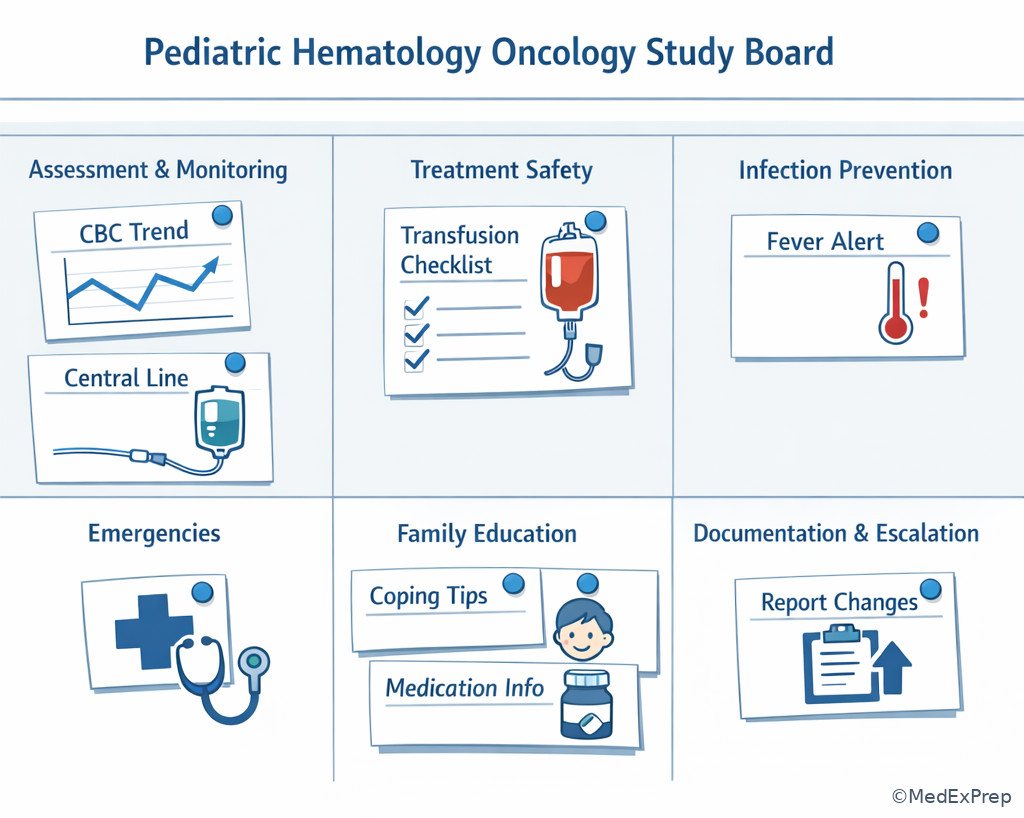
The blueprint for this course is best understood as a repeated set of nursing tasks across different diseases and treatments. Instead of memorizing by diagnosis alone, organize content into five recurring functions: assess, monitor, implement safe care, teach, and escalate. That approach reduces overload because leukemia induction, transfusion reactions, tumor lysis syndrome, and mucositis all still funnel through those same nursing tasks. See Fig 2.
Exam takeaway: Reframe every future topic into assess, act safely, teach, document, or escalate.
flowchart LR
A[Future lesson] --> B{What is being tested?}
B --> C[Assessment and monitoring]
B --> D[Priority intervention]
B --> E[Education and support]
B --> F[Medication or transfusion safety]
B --> G[Escalation and coordination]
C --> C1[Symptoms labs trends]
D --> D1[Immediate nursing response]
E --> E1[Family teaching developmental cues]
F --> F1[Verification precautions reaction monitoring]
G --> G1[Notify provider rapid response protocol] Exam takeaway: A visual study map helps you sort content by nursing decision type rather than by isolated facts.
B Worked example
A 9-year-old receiving treatment for acute leukemia is in clinic for chemotherapy. History includes prior nausea, mild asthma, and a stable chronic anemia pattern. Today the stem says the child has a tunneled central line, temperature 38.4°C, heart rate 132/min, appears tired, and the parent mentions poor sleep after a school event. ANC from yesterday was low; hemoglobin is also low but similar to baseline. The question asks for the most appropriate nursing action.
Identify task: This is not asking for the cancer diagnosis or treatment plan. It is asking for a nursing priority. Extract key facts: fever, tachycardia, immunocompromised context, central line, and planned chemotherapy. Poor sleep is noise; chronic anemia is distracting because it is not the new danger. Apply rule: suspected infection/emergency risk means assess, protect, and escalate per protocol; unsafe therapy may need to be held pending evaluation. Eliminate distractors: teaching about sleep hygiene, discussing long-term regimen options, or focusing on baseline anemia are all lower priority. Verify: the safest answer is the option that addresses urgent assessment and protocol-based escalation within RN scope.
C Exam trap
Common wrong answer: Choose the most disease-specific or academically detailed option.
Why it is tempting: Specialty exams feel like they should reward advanced medical knowledge, so learners overvalue diagnosis labels, regimen names, or pathophysiology details.
Single clue that eliminates it: If the stem asks what the nurse should do now, and one option is a direct safety or assessment action within RN scope, that option outranks provider-level reasoning.
D Checkpoint
Question: A board-style item asks which nursing action is most appropriate for a child with new fever during chemotherapy. Which test-taking approach is best?
- A. First identify the likely malignancy subtype before choosing an action.
- B. First ask which option is within RN scope and addresses the greatest immediate safety risk.
- C. First choose the option with the most detailed medical terminology.
- D. First choose the intervention that would be useful if the child remains stable later in the shift.
Answer: B
- A is tempting because disease recognition matters in practice, but wrong because the exam more often prioritizes immediate nursing action over provider-level diagnostic classification.
- B is tempting because it sounds broad, and right because scope plus immediate safety risk is the core discriminator in many CPHON stems.
- C is tempting because expert language can look authoritative, but wrong because board items reward safe action, not impressive wording.
- D is tempting because supportive care often matters, but wrong because later-useful actions lose to current threats.
Nursing Priority: Assess first the immediate safety issue and what the question is truly asking. Intervene with the safest in-scope action. Delegate routine comfort measures or standard room setup as allowed by policy, but interpretation of urgent findings stays with the RN. Escalate when instability, suspected sepsis, reaction, or unsafe therapy is present.
1.1.1.4 Scope-centered reading: what answers belong to the RN
A Explanation
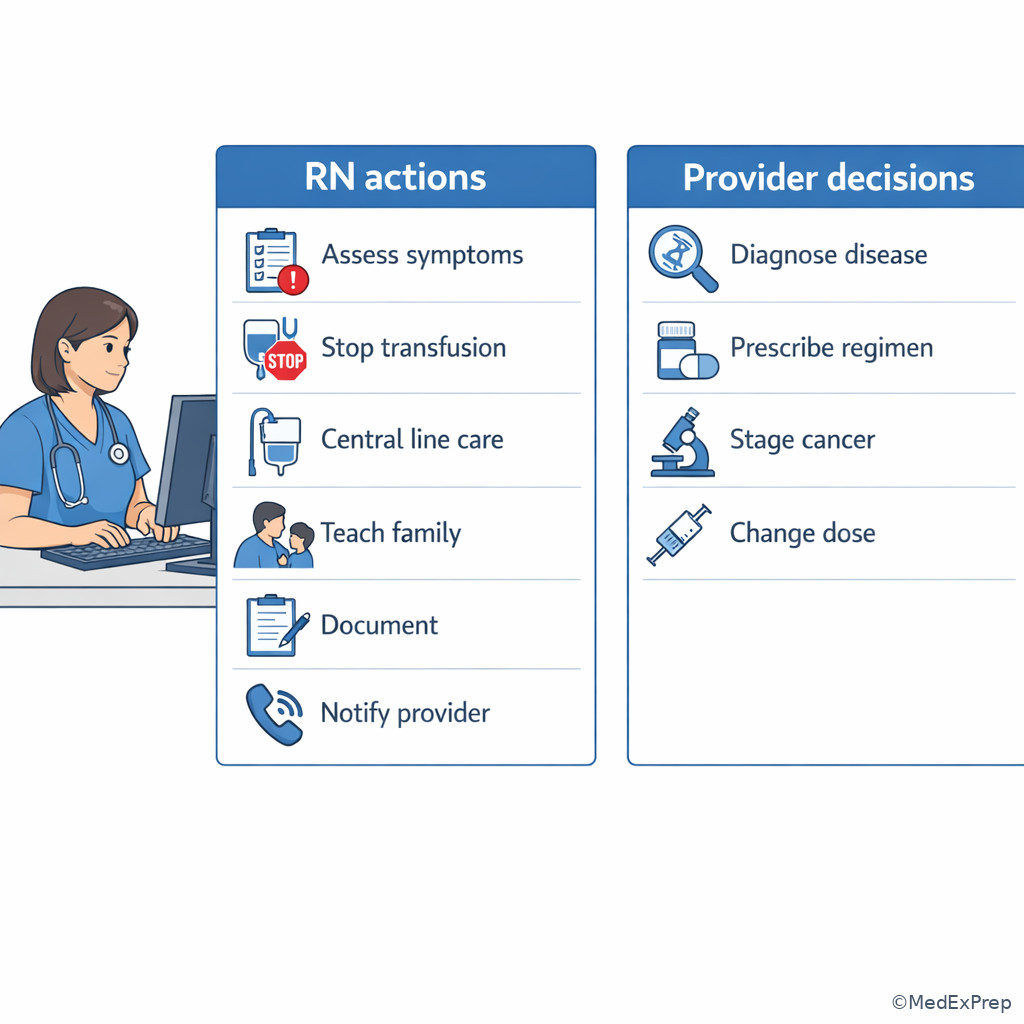
The next conflict is act versus overstep. CPHON stems often place a provider-level option next to a strong nursing option. The rule that resolves it: the RN assesses, monitors, implements ordered/protocol-based care, teaches, documents, and escalates; the RN does not independently diagnose, prescribe, stage disease, or select regimens. This matters because many high-scoring distractors are not absurd—they are actions a physician or advanced practice clinician might take, but they are not the nurse’s answer on this exam.
Scope questions are not only about saying “notify the provider.” The better answer often includes a nursing action before notification, such as stopping a transfusion, assessing airway status, holding unsafe chemotherapy until verification is complete, or obtaining required focused data per protocol. The key is sequencing. If there is a severe reaction or instability, intervene within RN scope first and escalate immediately; if there is a mismatch in orders or missing verification, hold and clarify before proceeding. See Fig 3.
Exam takeaway: When two options sound clinically smart, choose the one the RN can safely perform without overstepping role boundaries.
flowchart TD
A[Answer option] --> B{Within RN scope?}
B -->|Yes| C{Immediate threat present?}
B -->|No| D[Reject option]
C -->|Yes| E[Stabilize or hold unsafe therapy]
C -->|No| F[Assess verify teach or monitor]
E --> G[Notify provider or activate response]
F --> G
G --> H[Document and reassess] Exam takeaway: Visual cues help separate nursing responsibilities from provider-only decisions under exam pressure.
B Worked example
An 11-year-old with relapsed lymphoma, obesity, and controlled seizure disorder arrives for outpatient chemotherapy. The order set appears complete, but the body surface area on today’s worksheet differs from the previous cycle, and a parent says, “He grew a little, so I assume it’s fine.” The child is cheerful, afebrile, and asks whether treatment will change because of school sports. One answer option says to recalculate and independently adjust the dose; another says to proceed because pharmacy verified it; another says to hold administration, verify current weight/BSA per protocol, and clarify the discrepancy with the authorized provider/pharmacy team.
Identify task: safe chemotherapy administration. Extract key facts: discrepancy in a high-risk medication safety variable; patient appears stable; parent reassurance is noise. Apply rule: the RN does not independently change chemotherapy doses and should not ignore a verification discrepancy. Eliminate distractors: education about sports is appropriate later but not first; proceeding because “someone else checked it” violates independent nursing verification responsibilities. Verify: hold unsafe therapy and clarify per protocol.
C Exam trap
Common wrong answer: “Fix” the discrepancy yourself by changing the dose or interpreting the order as acceptable.
Why it is tempting: Experienced nurses often think operationally and want to keep care moving.
Single clue that eliminates it: Any option requiring independent dose selection, diagnosis, or regimen change is outside RN scope even if the reasoning sounds clinically sensible.
D Checkpoint
Question: Which option best fits the RN role on the CPHON exam when a treatment-safety discrepancy is identified?
- A. Independently adjust the therapy using the most recent measurements.
- B. Proceed because a discrepancy is acceptable if the child is clinically stable.
- C. Hold the unsafe therapy, verify the discrepancy, and notify the appropriate provider or team per protocol.
- D. Delay action until the next scheduled interdisciplinary meeting.
Answer: C
- A is tempting because recalculation is a real safety skill, but wrong because the RN verifies and clarifies rather than independently changing ordered therapy.
- B is tempting because stability reduces urgency, but wrong because stability does not make high-risk treatment discrepancies safe.
- C is tempting because it may feel slower, and right because it preserves safety and stays within RN scope.
- D is tempting because teamwork matters, but wrong because treatment discrepancies require prompt action, not delayed discussion.
Nursing Priority: Assess first whether a discrepancy or instability creates immediate harm. Intervene by holding unsafe therapy and following verification steps. Delegate non-interpretive tasks such as obtaining supplies if policy allows, but verification judgment remains with the RN. Escalate all unresolved treatment, transfusion, or line-safety concerns immediately.
- The most common exam mistake in specialty questions is confusing nursing action with provider-level decision-making.
- True or False: If the patient is stable, it is acceptable to proceed with chemotherapy despite a verification discrepancy. False.
- Name the 3 words that often signal the safest response when treatment is not clearly safe: Hold, verify, notify.
1.1.1.5 Blueprint domains you will see throughout the course
A Explanation
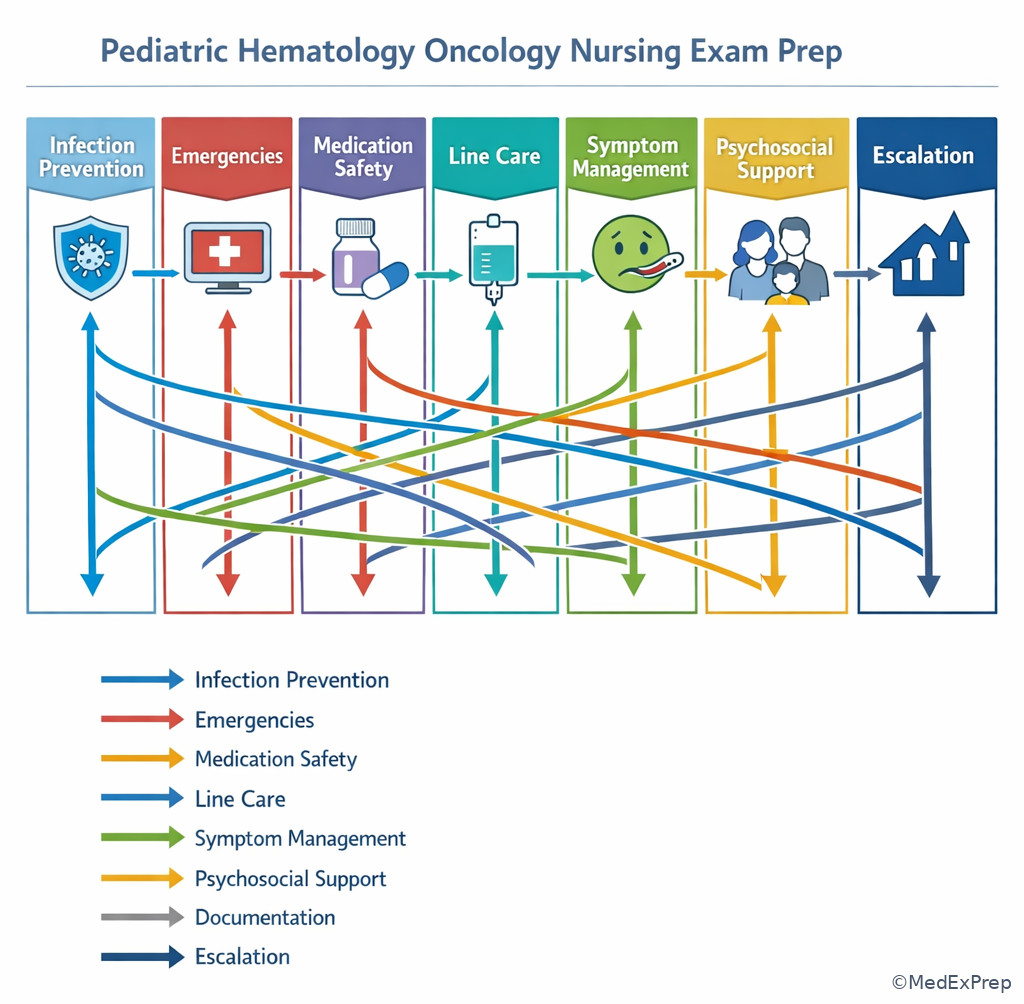
The third conflict is study by diagnosis versus study by domain. Foundational learners often over-organize around diseases alone: leukemia, lymphoma, sickle cell disease, brain tumors. But CPHON success comes faster when you overlay domain thinking: infection prevention, oncologic emergencies, medication safety, transfusion reactions, line complications, symptom management, psychosocial care, and professional practice. WHY THIS IS TESTED: one blueprint domain can appear inside many disease contexts, and the exam expects transfer of judgment across settings.
For example, “fever” may belong to benign hematology neutropenia, induction leukemia, stem cell transplant, or outpatient infusion follow-up. The disease context changes details, but the tested nursing process still centers on risk recognition, focused assessment, protocol activation, cultures/labs per order set, supportive measures, and escalation. The same is true for bleeding, pain, mucositis, nausea, central line occlusion, or transfusion symptoms. See Fig 4.
Exam takeaway: The same nursing decision patterns recur across diseases, treatments, and care settings.
flowchart TB
A[Hematology Disorders] --> X[Assessment and supportive care]
B[Oncology Concepts] --> X
C[Treatment Modalities] --> Y[Safety verification and toxicity monitoring]
D[Supportive Care Essentials] --> Z[Symptom management and education]
E[Emergencies and Toxicities] --> W[Prioritization and escalation]
F[Transfusion Medication Line Safety] --> Y
G[Psychosocial Palliative Survivorship] --> V[Family-centered teaching and coordination]
H[Professional Practice] --> W
Exam takeaway: Seeing repeated domains across chapters helps you transfer nursing judgment instead of memorizing isolated topics.
B Worked example
A 15-year-old with osteosarcoma, anxiety, and a history of delayed nausea calls the triage line after outpatient treatment. The stem mentions mild chronic neuropathy from prior therapy, a sibling with strep throat, and poor oral intake today. The child now reports temperature 38.1°C at home and chills. One option focuses on antiemetic teaching, another on neuropathy documentation, another on fever-risk instructions and urgent evaluation per neutropenia/infection pathway.
Identify task: determine which blueprint domain is active. Extract key facts: fever + oncology treatment + possible exposure + poor intake. Neuropathy and nausea are real but not the current dominant domain. Apply rule: infection prevention/emergency prioritization outranks routine symptom teaching. Eliminate distractors: antiemetics and chronic neuropathy management are valid domains but wrong priority for this call. Verify: the right response comes from the infection domain, not the symptom management domain.
C Exam trap
Common wrong answer: Follow the domain tied to the patient’s chief chronic complaint rather than the newest urgent clue.
Why it is tempting: Learners anchor on the known diagnosis or longstanding toxicity.
Single clue that eliminates it: New fever, respiratory change, bleeding, reaction signs, or neurologic change usually shifts the stem into a higher-acuity blueprint domain.
D Checkpoint
Question: Which statement best reflects how to use the blueprint during study and on exam day?
- A. Memorize each diagnosis separately because cross-topic transfer is limited.
- B. Focus only on psychosocial care because technical safety content is usually provider-managed.
- C. Learn recurring domains such as infection, toxicity, safety, education, and escalation that can appear in many disease contexts.
- D. Assume the exam will provide enough clues that prioritization frameworks are optional.
Answer: C
- A is tempting because disease labels feel concrete, but wrong because the exam repeatedly tests transferable nursing judgment across diagnoses.
- B is tempting because psychosocial care is important, but wrong because safety and technical monitoring are major tested areas.
- C is tempting because it sounds abstract, and right because recurring domains are the most efficient and accurate blueprint lens.
- D is tempting because some clues are obvious, but wrong because prioritization frameworks are exactly what separate strong answer choices from close distractors.
Nursing Priority: Assess first which domain the symptom belongs to right now. Intervene according to that domain’s urgent pathway. Delegate routine follow-up teaching tasks only after immediate safety needs are addressed. Escalate when the active domain includes fever, instability, new bleeding, reaction signs, or concerning neurologic/respiratory change.
1.1.1.6 How board-style questions hide the real priority
A Explanation
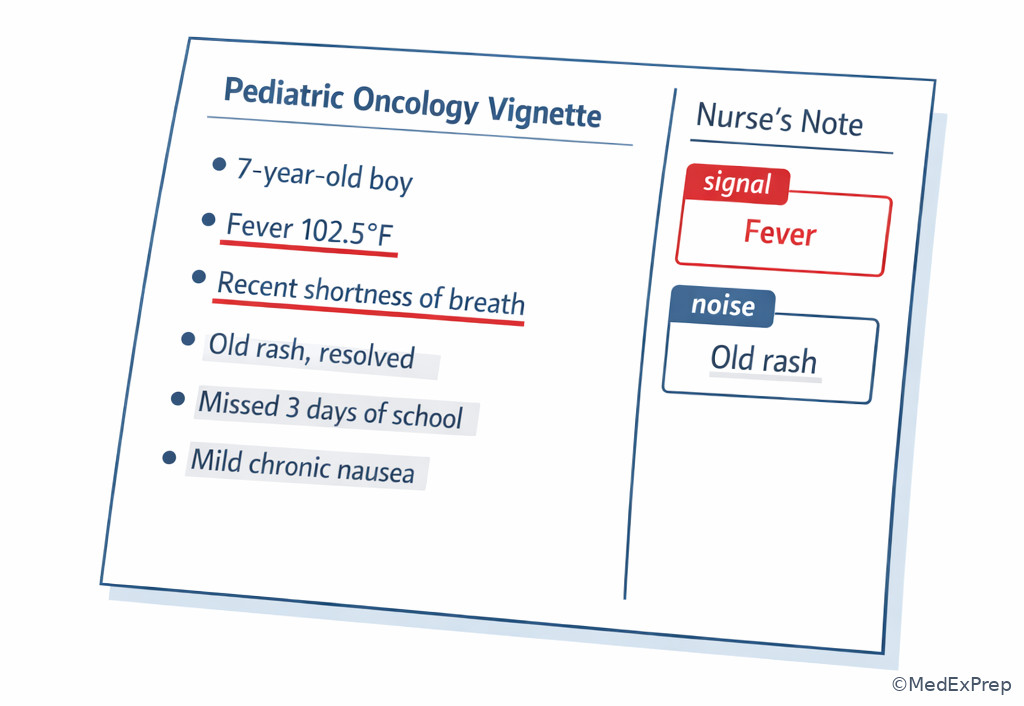
The fourth conflict is noise versus signal. CPHON items often include realistic distractions: a chronic low hemoglobin, a parent concern, a minor rash from last week, school absence, appetite changes, or a comorbidity that is true but not central. Your job is to locate the single clue that changes priority. WHY THIS IS TESTED: strong nurses must function in data-rich environments and still identify the most time-sensitive risk.
Board items commonly separate options using one discriminator: timing, severity, trend, therapy stage, line status, or scope. For example, “mouth pain” may support routine oral care teaching, but “mouth pain with inability to swallow fluids and reduced urine output” shifts to hydration risk and escalation. “Fatigue” may be chronic, but “fatigue with new tachycardia, pallor, and dizziness during transfusion” shifts to reaction assessment. The exam is not trying to trick you randomly; it is testing whether you recognize the one detail that upgrades urgency or changes the rule. See Fig 5.
Exam takeaway: The correct answer usually turns on one urgency clue, not the longest list of symptoms.
flowchart LR
A[Board-style stem] --> B[New or worsening clue]
A --> C[Stable chronic data]
A --> D[Family or social detail]
A --> E[Distracting lab or history]
B --> F[Priority action]
C --> G[Lower priority]
D --> G
E --> G
F --> H[Assess or act now within scope]
Exam takeaway: Highlighting the urgent signal helps prevent fixation on vivid but lower-priority details.
B Worked example
A 6-year-old with neuroblastoma, autism spectrum disorder, and chronic constipation is admitted after chemotherapy. The parent reports poor appetite for 2 days, one episode of emesis, and the child’s distress with loud alarms. The nurse notes a central line, temperature 37.9°C, new cough, respiratory rate 32/min, oxygen saturation 90% on room air, and mild abdominal fullness. One option is to begin constipation teaching; another is to ask child life to reduce sensory stress; another is to raise the head of bed, assess respiratory status, apply oxygen per protocol, and urgently notify the provider/response team.
Identify task: priority nursing action. Extract key facts: new cough, tachypnea, hypoxemia. Autism and constipation are real but not the current priority. Apply rule: breathing problems outrank GI teaching and environmental support. Eliminate distractors: child life involvement may help later; constipation management is appropriate but lower priority. Verify: the correct answer is the ABC-focused intervention/escalation option.
C Exam trap
Common wrong answer: Choose the option that addresses the most emotionally vivid family concern.
Why it is tempting: Family-centered care is central to pediatric nursing, so learners may over-prioritize distress cues.
Single clue that eliminates it: Any active airway or breathing compromise outranks psychosocial support measures, even when both are needed.
D Checkpoint
Question: In a long vignette, which clue most often determines the best answer?
- A. The most emotionally memorable caregiver statement
- B. The newest finding that changes safety, stability, or protocol status
- C. The oldest abnormal laboratory value in the chart
- D. The detail that is most unique to the cancer diagnosis
Answer: B
- A is tempting because pediatric care values family concerns, but wrong because urgency is driven by clinical safety, not memorability.
- B is tempting because it forces prioritization, and right because new or worsening threats usually control the answer choice.
- C is tempting because lab data feel objective, but wrong because isolated old values may not represent the current danger.
- D is tempting because diagnosis-specific features matter, but wrong because the exam more often hinges on immediate nursing implications than rare disease trivia.
Nursing Priority: Assess first for airway, breathing, circulation, and severe safety threats hidden in the stem. Intervene on the unstable system before routine teaching or comfort tasks. Delegate low-risk supportive tasks after the RN secures the priority assessment and response. Escalate immediately for respiratory compromise, hemodynamic change, or suspected emergent toxicity/reaction.
- True or False: The longest option is often correct. False.
- The single stem clue that should catch your eye first is usually the new or worsening finding.
- Name the 3 priority filters for noisy stems: ABCs, safety, time sensitivity.
1.1.1.7 Building a study plan from the blueprint
A Explanation
The final conflict is studying everything equally versus studying by exam return on time. A blueprint map helps you allocate effort to the patterns that repeat: infection risk, chemotherapy/biotherapy safety, transfusion reactions, central-line problems, symptom management, oncologic emergencies, documentation, and role boundaries. WHY THIS IS TESTED: certification preparation is not only knowledge acquisition; it is controlled retrieval of the most testable nursing judgments under pressure.
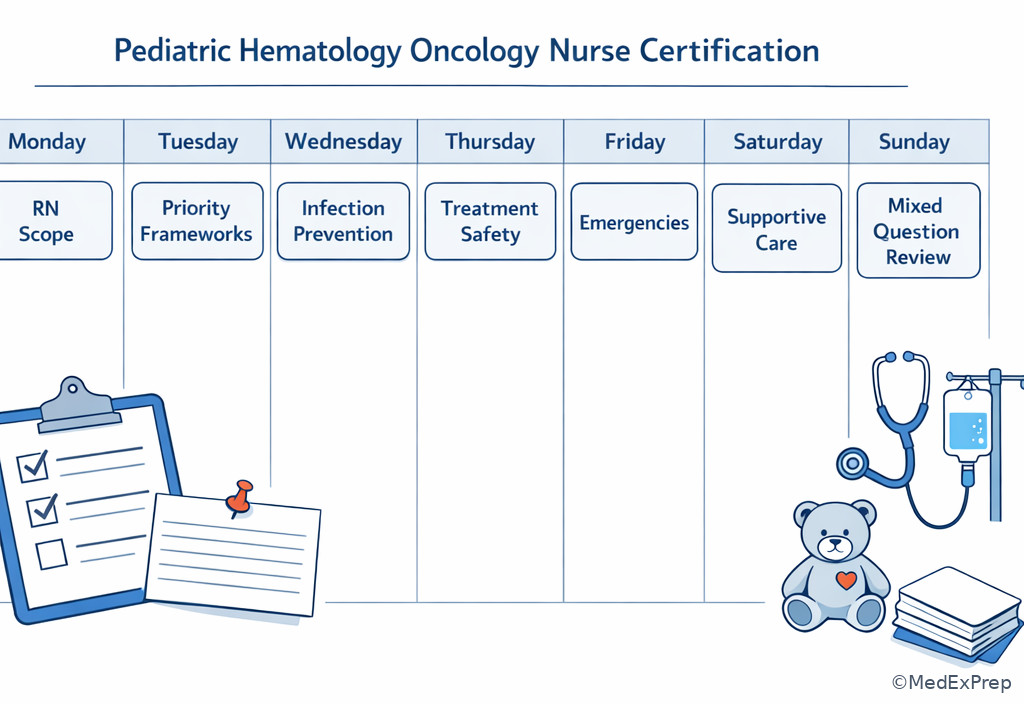
For foundational learners, build study in layers. Layer 1: learn the role boundaries and priority frameworks. Layer 2: attach major supportive care and safety domains. Layer 3: add disease contexts only to the degree needed for nursing assessment and monitoring. Layer 4: practice mixed vignettes where one clue changes the correct action. This course follows that design intentionally, starting with this blueprint map and moving next into RN scope and prioritization. See Fig 6.
Exam takeaway: Study role and priority frameworks before disease detail so mixed clinical questions become manageable.
flowchart TD
A[Study plan] --> B[Layer 1 RN scope]
A --> C[Layer 2 Priority frameworks]
A --> D[Layer 3 Repeating domains]
A --> E[Layer 4 Mixed case practice]
D --> D1[Infection]
D --> D2[Transfusion and meds]
D --> D3[Lines]
D --> D4[Emergencies]
D --> D5[Supportive care]
Exam takeaway: Scheduling study by domain and question type improves retention and exam transfer.
B Worked example
A new CPHON candidate works full time on an inpatient unit and says, “I spent two weeks memorizing tumor staging details, but I still miss transfusion and febrile neutropenia questions.” The nurse also reports feeling strong in family communication but weak in prioritization when multiple findings are present. The best study shift is not “read more oncology textbooks at random.” Identify task: build an exam-aligned study plan. Extract key facts: weak areas are safety and prioritization; overinvestment in low-return details. Apply rule: blueprint-based study should target recurring nursing action domains first. Eliminate distractors: continuing to memorize provider-level detail or only doing easy recall cards will not fix action-based misses. Verify: the best plan front-loads role boundaries, priority frameworks, infection/emergency patterns, and mixed vignettes.
C Exam trap
Common wrong answer: Study the rarest disease details first because specialty certification must be highly subspecialized.
Why it is tempting: Rare facts feel advanced and therefore valuable.
Single clue that eliminates it: The exam repeatedly returns to high-frequency nursing decisions: safety, assessment, monitoring, education, and escalation.
D Checkpoint
Question: Which study sequence best matches the blueprint approach taught in this lesson?
- A. Start with rare tumor details, then review role boundaries if time remains.
- B. Start with RN scope and prioritization, then attach repeating safety/supportive care domains, then do mixed cases.
- C. Focus only on question banks and skip framework study.
- D. Study chapters in alphabetical order to avoid bias.
Answer: B
- A is tempting because specialty content can feel impressive, but wrong because low-frequency detail does not build the decision framework needed for most questions.
- B is tempting because it is structured, and right because it follows the layered blueprint plan most likely to improve exam performance.
- C is tempting because practice questions are useful, but wrong because without frameworks learners repeat the same reasoning errors.
- D is tempting because it sounds organized, but wrong because alphabetical order has no relationship to exam yield.
Nursing Priority: Assess first your own weak category: scope, prioritization, safety domain, or mixed application. Intervene by targeting high-yield recurring patterns before niche details. Delegate simple study logistics to planners/apps, but keep active reasoning practice with the RN learner. Escalate your study intensity toward mixed-case practice when framework knowledge is present but errors persist.
Exam Traps & Differentiators
Most common wrong answer and why: Choosing a medically impressive or disease-specific option instead of the safest in-scope nursing action. This is tempting because specialty certification feels like it should reward advanced disease knowledge. In reality, the exam repeatedly asks what the pediatric hematology/oncology RN should assess, implement, monitor, teach, document, or escalate.
| Looks similar | Actually different | Single discriminator |
|---|---|---|
| Recognizing a complication | Diagnosing the disease | RN recognizes unsafe findings and escalates; does not independently diagnose |
| Verifying medication safety | Changing the ordered dose | RN may calculate/check and hold, but not independently alter the regimen |
| Teaching and routine symptom care | Emergency response | ABCs and severe safety threats outrank education |
| Chronic baseline abnormality | New unstable finding | New or worsening status changes priority |
| Valid intervention | Valid intervention at the wrong priority | The right action later is still the wrong answer if something more urgent comes first |
If the stem says... think...
- “Most appropriate nursing action” → scope first, then ABCs/safety/time sensitivity
- “Requires immediate clarification” → hold unsafe therapy, verify discrepancy, notify appropriate team
- “Best initial response” → what the RN can do now before or while escalating
- “New fever, dyspnea, bleeding, reaction signs, or neurologic change” → urgent pathway, not routine teaching
- “Parent mentions...” with another acute assessment clue present → caregiver concern matters, but acute physiologic instability outranks
- “Stable chronic symptom” plus one new abnormal trend → the new trend usually drives the answer
Exam takeaway: Many wrong answers are appropriate actions at the wrong priority, not obviously bad nursing care.
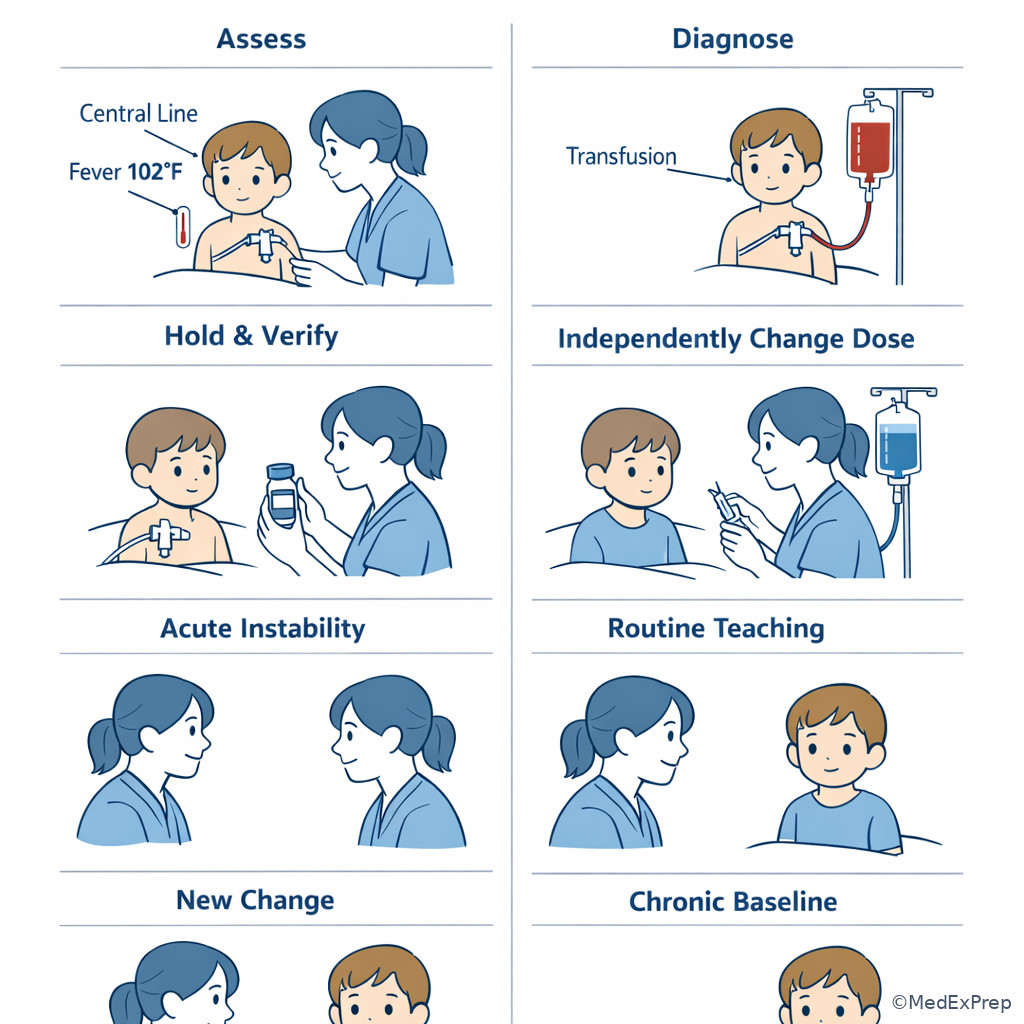
Related future traps will appear in RN Scope Boundaries and Priority Decision Frameworks. That pair is especially confusable: one asks can the RN do this?; the other asks what should the RN do first? If you miss those distinctions now, later toxicity and emergency questions become harder than they need to be.
Tables
| High-yield blueprint study targets | What to know | Why it is repeatedly tested |
|---|---|---|
| Infection prevention / fever pathways | Urgent assessment, protocol activation, line implications, family instructions | High-acuity and cross-cutting across diagnoses |
| Chemotherapy and hazardous drug safety | Verification, PPE, administration precautions, extravasation awareness | High-risk nursing responsibility |
| Transfusion safety | Prechecks, reaction recognition, stop-support-notify sequence | Classic priority and sequencing questions |
| Central line care | Access, maintenance, infection clues, occlusion/breakage response | Frequent pediatric oncology nursing task |
| Oncologic emergencies | Recognize early warning signs and escalate | Time-sensitive safety testing |
| Symptom/supportive care | Pain, mucositis, nausea, hydration, fatigue, constipation/diarrhea | Common everyday care decisions |
| Psychosocial/family teaching | Developmental communication, caregiver support, adherence barriers | Pediatric-specific exam domain |
| Question style | Best approach | Wrong approach to avoid |
|---|---|---|
| Most appropriate nursing action | Pick the safest in-scope immediate action | Choose provider-level decision or future plan |
| Priority assessment | Use ABCs and acuity clues | Start with complete but low-yield data gathering |
| Requires immediate clarification | Hold and verify unsafe discrepancy | Proceed because others already checked |
| Family teaching question | Give developmentally appropriate, safety-centered instruction | Use provider-only counseling or vague reassurance |
| Monitoring question | Trend the finding that predicts deterioration | Focus on static low-priority details |
| Differential testing pattern | Common wrong answer | What rules it out |
|---|---|---|
| RN action vs provider action | Independently adjust treatment | Outside RN scope |
| Assess first vs intervene now | More data before addressing airway/breathing threat | ABCs outrank additional assessment when compromise is clear |
| Routine care vs emergency pathway | Teaching or comfort measures first | New fever, dyspnea, bleeding, reaction, or neurologic change |
| Chronic symptom vs acute change | Manage baseline issue first | New worsening sign changes priority |
| Useful action later vs best action now | Education or documentation before stabilization | Time sensitivity and safety sequence |
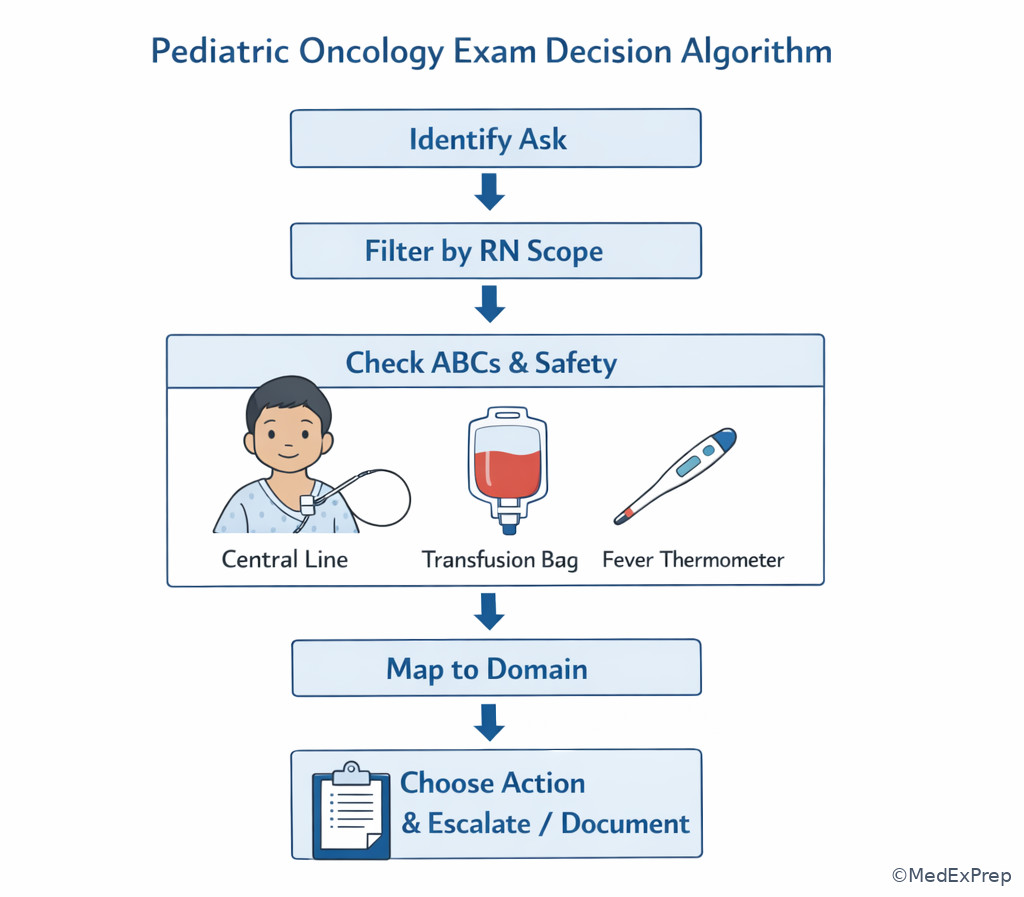
Algorithm / Approach
Exam takeaway: A fixed sequence prevents being pulled toward lower-priority but plausible interventions.
Rapid Review
- Blueprint map → organize by nursing action type, not diagnosis alone
- RN scope → assess/monitor/implement/teach/document/escalate; do not diagnose or prescribe
- Unsafe therapy discrepancy → hold, verify, notify
- Long vignette → one new unstable clue usually drives the answer
- Emotionally vivid family detail → important, but not above ABC compromise
- Stable chronic abnormality → lower priority than new worsening change
- Best initial action → what the RN can do now within protocol
- Question-bank misses despite reading → likely framework problem, not fact shortage
- Cross-topic success → map symptoms to repeating domains: infection, safety, toxicity, line, symptom care
- Board distractor → often a correct action at the wrong priority
- Provider-sounding option → reject unless the stem explicitly asks about notification/escalation
- Pediatric context → developmental stage and family teaching modify delivery, not core safety priorities
- Study order → scope first, priority second, domains third, mixed cases fourth
Self-check quiz
1.1.1.8 Question 1
A pediatric oncology RN is answering a practice question about a child with new fever before chemotherapy. Which option best reflects the CPHON blueprint approach?
- A. Select the intervention that the nurse can perform safely within protocol and that addresses the most immediate risk.
- B. Select the option that identifies the most likely malignancy subtype causing fever.
- C. Select the longest option because it is likely the most comprehensive.
- D. Select the option that would be most useful after the child has remained stable for several hours.
1.1.1.9 Question 2
An RN reviewing chemotherapy preparation notes sees a weight-based discrepancy for a 13-year-old with lymphoma, obesity, and mild asthma who is otherwise stable and asking about sports restrictions. Which nursing action best fits the exam blueprint?
- A. Independently recalculate and change the chemotherapy dose so treatment is not delayed.
- B. Proceed because the patient is stable and pharmacy likely checked the calculation.
- C. Hold administration, verify the discrepancy per protocol, and notify the authorized team.
- D. Focus first on discharge teaching because the child is afebrile and in no distress.
1.1.1.10 Question 3
A 7-year-old with acute lymphoblastic leukemia, a tunneled central line, and eczema presents to clinic with temperature 38.5°C, heart rate 136/min, and fatigue. The parent reports the child also missed school and had trouble sleeping. Which is the most appropriate nursing action?
- A. Provide sleep-hygiene teaching and reassess later because fatigue may be due to poor sleep.
- B. Follow the fever/infection pathway, obtain focused assessment data per protocol, and escalate promptly.
- C. Ask the provider to diagnose the source of infection before beginning any nursing actions.
- D. Reinforce eczema skin care because skin breakdown can increase infection risk.
1.1.1.11 Question 4
A 5-year-old with neuroblastoma, chronic constipation, and sensory sensitivity is admitted after chemotherapy. The child has a new cough, respiratory rate 34/min, oxygen saturation 89% on room air, and mild abdominal distention. Which nursing action is the best initial response?
- A. Raise the head of bed, assess respiratory status, support oxygenation per protocol, and urgently escalate.
- B. Begin constipation interventions because abdominal distention may be the primary cause of discomfort.
- C. Ask child life to reduce environmental stimulation before any physical assessment.
- D. Document the findings and wait for the next scheduled provider rounds.
1.1.1.12 Question 5
A 16-year-old with osteosarcoma, anxiety, and chronic chemotherapy-induced neuropathy calls from home after treatment. The adolescent reports chills and an oral temperature of 38.2°C; the parent also mentions mild baseline tingling in the feet and poor appetite. Which blueprint domain should drive the nurse’s response first?
- A. Chronic toxicity counseling
- B. Infection prevention and urgent evaluation
- C. Nutrition teaching
- D. School reintegration planning
1.1.1.13 Question 6
A pediatric hematology/oncology RN receives four tasks at shift start. Which requires immediate clarification because it most directly exceeds RN role or safety boundaries?
- A. A request to independently lower a chemotherapy dose for a child whose current weight differs from the prior cycle worksheet.
- B. A request to assess a child’s mucositis pain score before administering ordered supportive medication.
- C. A request to reinforce fever precautions with a parent before discharge.
- D. A request to document central line dressing integrity after a sterile change.
1.1.1.14 Question 7
A 10-year-old with relapsed leukemia, a central line, and mild baseline anemia is receiving a blood product. Ten minutes into the infusion, the child reports chest tightness and appears anxious; the parent says the child often becomes nervous during procedures. Which nursing action best reflects the blueprint’s priority logic?
- A. Stop the transfusion, assess airway/breathing/circulation, maintain access per protocol, and escalate urgently.
- B. Coach slow breathing and continue the transfusion because anxiety is common during procedures.
- C. Document the event and reassess after the transfusion is complete.
- D. Ask the provider to determine whether this is a true transfusion reaction before taking action.
1.1.1.15 Question 8
A nurse preparing a weekly study plan says, “I keep missing mixed-priority questions even though I know disease facts.” The nurse works in outpatient infusion, feels comfortable with family teaching, and tends to overfocus on rare tumor details. Which study adjustment is most appropriate?
- A. Spend more time memorizing uncommon malignancy subtypes before reviewing safety frameworks.
- B. Shift to RN scope, priority frameworks, and recurring high-yield domains before doing mixed case practice.
- C. Stop using practice questions and rely only on textbook reading.
- D. Study only psychosocial chapters because communication confidence is already a strength.
Answer key
1.1.1.16 Question 1 Answer: A
- A: Tempting because it sounds broad but practical. Correct because the blueprint repeatedly tests the safest in-scope nursing action that addresses immediate risk. Single stem clue: the question asks for the blueprint approach, not disease identification. Priority rationale: safety and nursing process come before academic classification. Sources: NCSBN clinical judgment framework; ANA scope and standards.
- B: Tempting because fever can point toward disease/treatment context. Incorrect because identifying malignancy subtype is not the first nursing priority in a “what should the nurse do” item. Single clue: action-oriented wording. Sources: ANA; Saunders NCLEX review.
- C: Tempting because longer options can feel more complete. Incorrect because testwise length is not a valid safety principle; the exam rewards priority, not verbosity. Single clue: no clinical rule supports choosing by option length. Sources: NCSBN test-taking principles; Saunders.
- D: Tempting because later supportive care may indeed be helpful. Incorrect because future usefulness loses to immediate risk management. Single clue: “new fever” implies current risk. Sources: Lewis; NCSBN.
1.1.1.17 Question 2 Answer: C
- A: Tempting because recalculation is part of medication safety. Incorrect because the RN verifies but does not independently change chemotherapy dosing. Single stem clue: weight-based discrepancy in high-risk therapy. Priority rationale: safety and scope override efficiency. Sources: ANA standards; hazardous drug and chemotherapy safety principles in Lewis and specialty oncology nursing texts.
- B: Tempting because teamwork and prior checks matter. Incorrect because the RN still has an independent verification responsibility when a discrepancy is seen. Single clue: the discrepancy is current and unresolved. Sources: ANA; Saunders medication safety guidance.
- C: Tempting because it delays care, which can feel uncomfortable. Correct because the nurse must hold unsafe therapy, verify, and notify the authorized team per protocol. Single stem clue: high-risk discrepancy without instability requiring a different first move. Sources: ANA scope; oncology nursing safety principles.
- D: Tempting because teaching is always valuable. Incorrect because education is lower priority than medication safety verification. Single stem clue: unresolved chemotherapy discrepancy. Sources: NCSBN priority framework; Saunders.
1.1.1.18 Question 3 Answer: B
- A: Tempting because poor sleep can contribute to fatigue. Incorrect because fever and tachycardia in an immunocompromised child with a central line shift priority to infection evaluation. Single stem clue: temperature 38.5°C. Priority rationale: ABCs/safety and possible infection outrank routine education. Sources: Lewis; Saunders; NCSBN prioritization guidance.
- B: Tempting because it is protocol-centered rather than disease-centered. Correct because this is the best nursing response within scope to a potential high-risk infection scenario. Single stem clue: fever + central line + oncology treatment. Sources: pediatric oncology nursing standards; ANA.
- C: Tempting because diagnosis matters to treatment planning. Incorrect because nursing assessment and escalation should begin without waiting for a provider to “diagnose the source” first. Single stem clue: the nurse can act within protocol now. Sources: ANA scope; NCSBN.
- D: Tempting because eczema can contribute to skin breakdown. Incorrect because it addresses a secondary issue while ignoring an urgent infection red flag. Single stem clue: acute fever, not chronic skin care, drives priority. Sources: Saunders; Lewis.
1.1.1.19 Question 4 Answer: A
- A: Tempting because it addresses several issues at once. Correct because breathing compromise is the top priority, and the RN should support oxygenation and escalate within protocol. Single stem clue: oxygen saturation 89% on room air. Priority rationale: Breathing is above GI or psychosocial concerns in the ABC hierarchy. Sources: NCSBN ABC prioritization; Lewis; ANA.
- B: Tempting because abdominal distention and constipation are real concerns. Incorrect because they do not outrank hypoxemia. Single stem clue: low oxygen saturation. Sources: NCSBN; Saunders.
- C: Tempting because sensory regulation helps this child specifically. Incorrect because psychosocial and environmental support must follow initial respiratory stabilization. Single stem clue: respiratory rate 34/min with hypoxemia. Sources: ANA; Lewis.
- D: Tempting because documentation is always required. Incorrect because documentation never replaces immediate response to an acute change. Single stem clue: current respiratory instability. Sources: NCSBN; ANA.
1.1.1.20 Question 5 Answer: B
- A: Tempting because chronic neuropathy is a common treatment toxicity and deserves teaching. Incorrect because it is baseline and does not explain the urgent current risk. Single stem clue: chills with fever. Priority rationale: acute infection concern outranks chronic toxicity counseling. Sources: Lewis; pediatric oncology nursing texts.
- B: Tempting because it moves attention away from the chronic complaint. Correct because fever/chills after treatment place infection prevention and urgent evaluation first. Single stem clue: oral temperature 38.2°C. Sources: ANA; NCSBN; Saunders.
- C: Tempting because poor appetite is clinically relevant. Incorrect because nutrition teaching is lower priority during a potential febrile emergency. Single stem clue: fever changes the active domain. Sources: Saunders; NCSBN.
- D: Tempting because adolescents need school and social support. Incorrect because long-term planning is inappropriate as the first response to a possible urgent infection. Single stem clue: acute chills. Sources: ANA; Lewis.
1.1.1.21 Question 6 Answer: A
- A: Tempting because nurses do use current weights and calculations in safety checks. Correct because independently lowering a chemotherapy dose exceeds RN scope and also raises an immediate treatment-safety issue requiring clarification. Single stem clue: “independently lower a chemotherapy dose.” Priority rationale: scope and safety boundaries require immediate clarification before action. Sources: ANA scope and standards; oncology medication safety guidance.
- B: Tempting because pain assessment occurs before medication administration. Incorrect because this is an appropriate RN action within scope. Single stem clue: assess before giving ordered supportive medication. Sources: ANA; Saunders.
- C: Tempting because discharge teaching may feel less urgent than technical tasks. Incorrect because parent teaching is clearly within RN role. Single stem clue: reinforce precautions, not prescribe treatment. Sources: ANA; NCSBN.
- D: Tempting because documentation can seem clerical. Incorrect because documenting line dressing status is a standard nursing responsibility. Single stem clue: post-procedure documentation within routine RN care. Sources: ANA documentation standards.
1.1.1.22 Question 7 Answer: A
- A: Tempting because it is action-heavy. Correct because chest tightness during transfusion must be treated as a possible acute reaction: stop, assess ABCs, maintain access per protocol, and escalate. Single stem clue: chest tightness 10 minutes into infusion. Priority rationale: circulation/respiratory safety outranks assumptions about anxiety. Sources: Lewis; transfusion safety standards; ANA.
- B: Tempting because the parent reports procedure-related anxiety. Incorrect because anxiety is a distractor; continuing the infusion despite possible reaction signs is unsafe. Single stem clue: symptom onset during transfusion. Sources: transfusion safety guidance; NCSBN.
- C: Tempting because reassessment and documentation are required parts of care. Incorrect because they follow immediate intervention rather than replace it. Single stem clue: acute symptom during active infusion. Sources: ANA; Lewis.
- D: Tempting because provider evaluation is necessary. Incorrect because the RN must take the immediate safety action before waiting for diagnostic confirmation. Single stem clue: urgent reaction timing. Sources: NCSBN ABCs; transfusion standards.
1.1.1.23 Question 8 Answer: B
- A: Tempting because rare disease detail can feel advanced. Incorrect because the problem described is not lack of rare facts; it is failure in mixed-priority nursing judgment. Single stem clue: “I keep missing mixed-priority questions.” Priority rationale: address the highest-yield deficit first. Sources: Saunders test strategy principles; NCSBN clinical judgment approach.
- B: Tempting because it sounds less glamorous than rare oncology content. Correct because scope, prioritization, and recurring domains are the core frameworks needed before mixed case practice. Single stem clue: the learner overfocuses on rare tumor details and misses action-based questions. Sources: NCSBN; ANA; specialty nursing education principles.
- C: Tempting because repeated misses can make question banks frustrating. Incorrect because eliminating practice questions removes the very setting where mixed-priority reasoning is trained. Single stem clue: the issue is framework use, not the existence of practice items. Sources: Saunders; NCLEX-style preparation methods.
- D: Tempting because confidence often encourages continued practice in strong areas. Incorrect because study time should target weaknesses, and communication is already a relative strength here. Single stem clue: “feels comfortable with family teaching.” Sources: nursing education best practices; Saunders.
Keep going with the full CPHON Prep Course (CPHON)
You just studied the way members do, in the same lesson interface. Full access unlocks every lesson, the question bank and flashcards for a full year.
One payment · 1 year of access · No auto-renewal