1.1.1 - RN Scope In CPEN Care
Why it matters
- Many CPEN questions are really scope questions disguised as airway, shock, trauma, toxicology, or disposition questions.
- The exam rewards the safest RN action: stabilize, monitor, verify, and escalate rather than acting like an independent prescriber or diagnostician.
- Pediatric patients can deteriorate quickly; delayed escalation is a frequent hidden error in board-style stems.
- Family-centered communication, mandated reporting, and protocol adherence are not optional extras; they are core emergency nursing responsibilities.
Key Terms & Must-Know Facts
1.1.1.1 Key terms
- Scope of practice — legal and professional boundaries of RN actions
- Standing order — preapproved intervention allowed by protocol/policy
- Protocol — standardized pathway guiding approved nursing actions
- Escalation — prompt notification or team activation for instability or deterioration
- Reassessment — repeat focused evaluation after any intervention or change
- ABCs — airway, breathing, circulation prioritization
- PALS-consistent priorities — pediatric resuscitation-aligned stabilization approach
- Mandated reporting — required reporting of suspected abuse or neglect per law/policy
- Family-centered care — include caregivers when safe and appropriate
- Independent diagnosis — outside RN role in this exam context
- Definitive management — provider-level treatment decision beyond RN authority unless covered by protocol
- Length-based tool — pediatric sizing/dosing aid such as Broselow when applicable
- Clinical deterioration — worsening respiratory, circulatory, neurologic, or perfusion status
1.1.1.2 Must-know facts
- The best RN answer is often the safest immediate action within scope, not the final medical diagnosis.
- If a child has signs of respiratory failure, shock, sepsis, or neurologic decline, escalate immediately.
- You may implement approved protocols, oxygen, monitoring, fluid bolus, glucose check, seizure precautions, or isolation depending on the scenario and policy.
- You should not prescribe, independently diagnose, or choose provider-only definitive treatment when not protocol-based.
- Weight-based medication logic must be verified; never use unsafe shortcuts.
- After any intervention, reassessment is a testable required step.
- Suspected maltreatment requires recognition, objective documentation, safety action, and mandated reporting per policy.
- When institutional variation exists, the safest answer includes protocol adherence and timely notification.
| High-yield RN action type | Usually within scope | Needs order/protocol confirmation | Outside RN scope in exam framing |
|---|---|---|---|
| Assessment | Rapid assessment, focused reassessment, pain scale, neuro checks | Specialized assessments per local pathway | Independent medical diagnosis |
| Airway/breathing support | Positioning, oxygen, suction setup, monitoring, bag-mask support per role/policy | Respiratory therapy collaboration, escalation to airway team | Independent intubation if not within role/policy |
| Circulatory support | IV/IO prep per role, fluid administration per order/protocol, monitor perfusion | Blood products, vasoactive infusion initiation per order | Selecting definitive hemodynamic management independently |
| Medications | Administer per valid order/protocol, verify weight-based dose | Titration and double-checks per policy | Prescribing or changing regimen independently |
| Diagnostics | Point-of-care checks if allowed, specimen collection, ECG setup | Standing-order labs/imaging pathways | Ordering imaging independently without protocol |
| Legal/safety | Document objectively, report concerns, protect patient safety | Chain-of-command activation | Providing forensic/legal determinations beyond role |
Exam takeaway: Choose the answer that stabilizes and escalates safely rather than diagnosing or prescribing.
flowchart TD
A[Board stem asks for next step] --> B{Is there an immediate threat to airway, breathing, circulation, neurologic status, or safety?}
B -->|Yes| C[Perform immediate RN stabilization within protocol]
C --> D[Reassess response]
D --> E[Notify or activate provider/team]
B -->|No| F{Is the action covered by order or protocol?}
F -->|Yes| G[Perform intervention and monitor]
F -->|No| H[Clarify, escalate, and continue assessment]
H --> I[Do not diagnose or prescribe independently]
See Fig 1 for the core exam logic: life threat first, protocol next, escalation when needed.
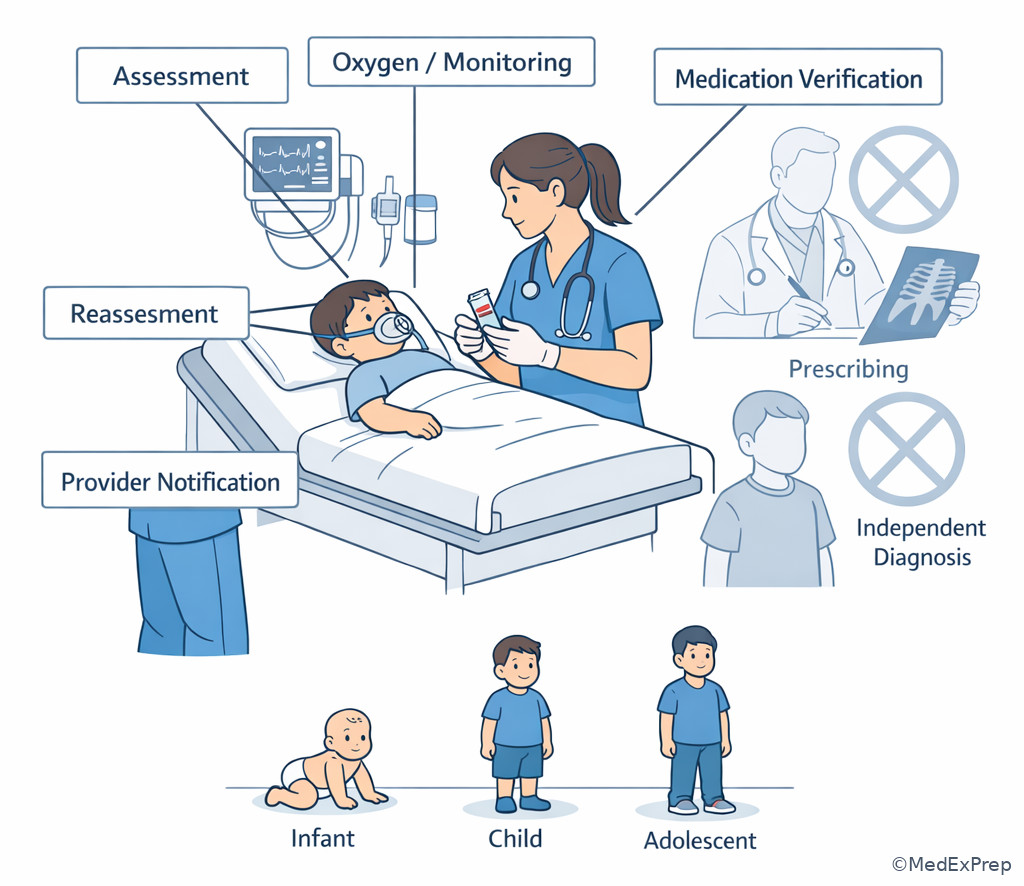
Exam takeaway: Focus on assessment, intervention within protocol, monitoring, and escalation rather than provider-only decisions.
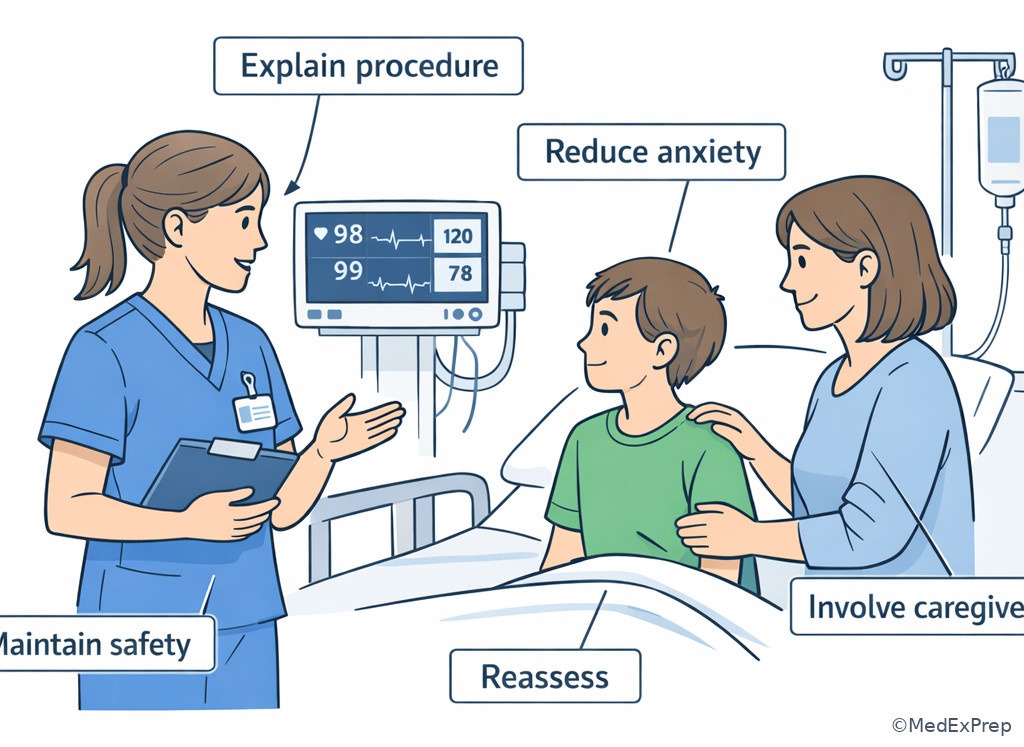
Exam takeaway: Safe RN care includes caregiver inclusion, clear explanations, and developmentally appropriate support.
Core content
1.1.1.3 Foundational role boundary: what the CPEN exam expects the RN to do first
A Explanation
On CPEN-style items, the real conflict is usually act now within RN scope versus wait for a provider or overreach beyond scope. The rule that resolves the conflict is simple: if the child is unstable, perform the immediate stabilizing action that is already within nursing scope or protocol, then reassess and escalate. If the child is not unstable and the action requires provider authorization, clarify and notify rather than guessing. WHY THIS IS TESTED: exam writers want to see whether you can distinguish safe urgency from unsafe independence.
Examples of high-yield in-scope actions include placing the child on continuous monitoring, applying oxygen, obtaining a bedside glucose if protocol allows, initiating seizure precautions, checking weight or length-based estimates, preparing emergency equipment, documenting findings objectively, and activating the rapid response, trauma, or resuscitation pathway when deterioration is present. Common out-of-scope errors include independently deciding the diagnosis, selecting the final treatment plan without an order/protocol, writing medication orders, or discharging the child independently.
Key rule: If one answer stabilizes airway, breathing, circulation, neurologic status, or safety now and another answer reaches for provider-level diagnosis or prescribing, choose the stabilizing RN action.
Recall: This is the first topic in the course, so it builds the frame for the upcoming ABCDES Primary Survey and Pediatric Triage and Acuity. In those topics, you will apply this same role boundary under time pressure.
B Worked example
A 4-year-old with asthma and autism spectrum disorder arrives with cough and fever after two days of URI symptoms. The child is anxious, clinging to the parent, with mild subcostal retractions, pulse oximetry 89% on room air, and a distracting rash from chronic eczema noted on the chart. A new nurse says, “We should wait for the provider to diagnose whether this is pneumonia or asthma before doing anything.”
Reasoning chain: Identify task: most appropriate nursing action now. Extract key facts: pediatric patient, low oxygen saturation, visible work of breathing, caregiver at bedside, anxious child. Apply rule: respiratory threat beats diagnostic uncertainty. Eliminate distractors: waiting for diagnosis delays breathing support; writing for bronchodilator or antibiotics is outside RN prescribing authority; sending for imaging before stabilization is wrong priority. Verify: apply oxygen per protocol, place on monitor, position for comfort, prepare respiratory support, and notify provider/team while reassessing breathing effort and saturation.
C Exam trap
Common wrong answer: “Determine the most likely diagnosis before intervening.” Why it is tempting: test takers want certainty and confuse nursing prioritization with provider diagnostic workflow. Single clue that eliminates it: the child is hypoxemic with increased work of breathing, which requires immediate stabilization first.
D Checkpoint
A 10-year-old with type 1 diabetes, ADHD, and recent vomiting becomes pale and minimally responsive in triage. A parent reports “he probably just needs to lie down,” and his fingerstick history is unknown. Which action is most appropriate first for the RN?
- Obtain a rapid bedside glucose if protocol allows while initiating immediate monitoring and escalation
- Ask the provider to come evaluate before touching the patient
- Document the parent’s statement and wait for full history
- Explain that a diagnosis is needed before treatment decisions can be made
Answer: A.
- A: Tempting because it combines action and data gathering; correct because altered mental status plus diabetes creates an immediate nursing-scope need to assess and stabilize rapidly.
- B: Tempting because provider notification matters; wrong because waiting without initial assessment delays care in an unstable child.
- C: Tempting because documentation is always required; wrong because charting is not the priority over ABCs and reversible causes.
- D: Tempting because diagnoses do guide therapy; wrong because nurses treat instability and gather critical data before the final diagnosis is established.
Nursing Priority: Assess first with ABCs and level of responsiveness. Intervene with monitoring, oxygen, bedside tests, positioning, and protocol-based actions. Delegate routine room setup or supply gathering to support staff if appropriate, but the RN keeps the unstable assessment, medication verification, and reassessment. Escalate immediately for altered mental status, hypoxemia, poor perfusion, seizure, or rapid decline.
1.1.1.4 Protocols, orders, and reassessment: when action is allowed and when clarification is safer
A Explanation
The decision conflict here is implement a known protocol versus perform an unverified action that only sounds helpful. The single rule is: if a nursing action is authorized by standing order, emergency pathway, or established policy, you may act and then reassess. If authorization is unclear, the safest answer is to continue assessment, verify the order, and notify the provider/team. WHY THIS IS TESTED: CPEN items often hide the distinction between a strong nurse and an unsafe improviser.
In practice, this means you can begin actions commonly embedded in ED pathways: cardiac-respiratory monitoring, oxygen, pulse oximetry, point-of-care glucose, IV access attempts, seizure precautions, isolation precautions, weight verification, and selected medication administration after order/protocol verification. The exam will punish shortcuts such as estimating a dose without weight confirmation, bypassing a required independent double-check, or “assuming” a common medication can be given because it is usually used in that condition.
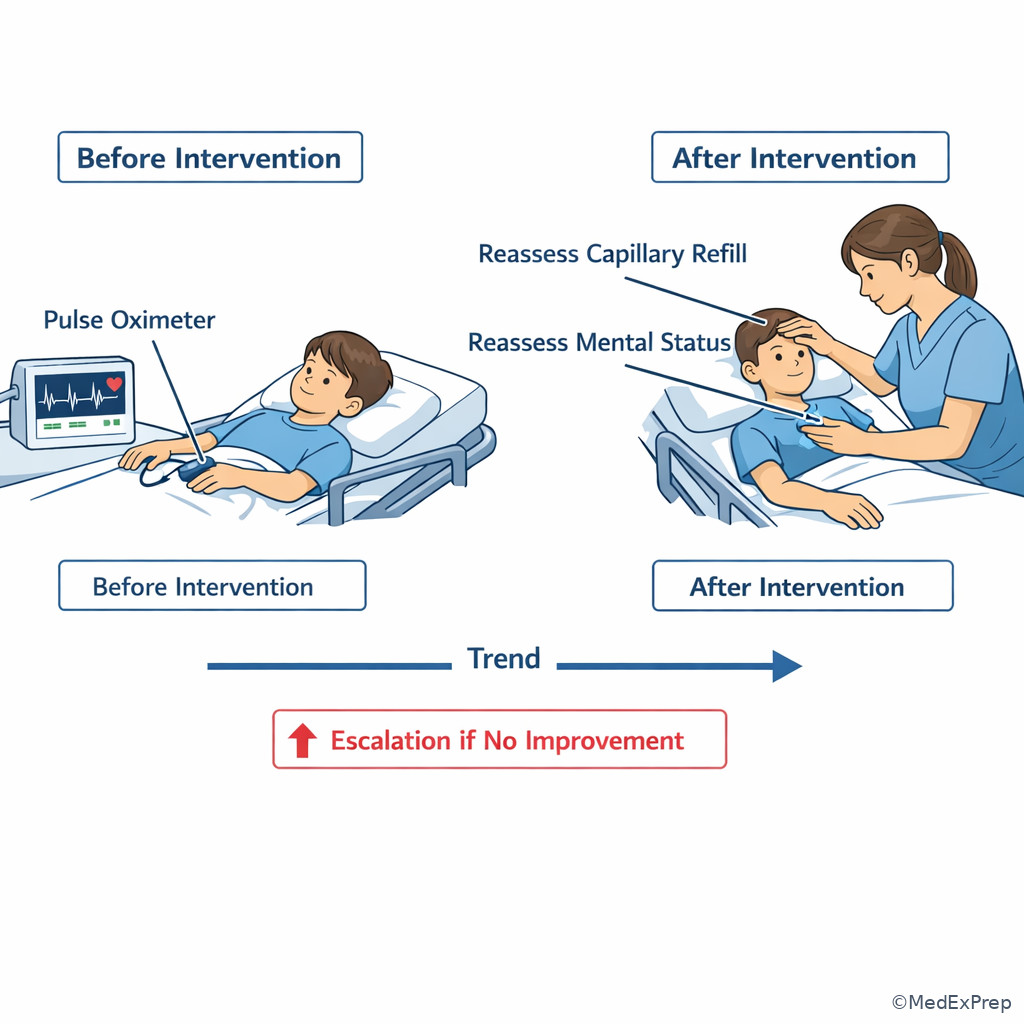
Reassessment is not an optional extra step. If you intervene, you must evaluate response. Improvement in work of breathing, perfusion, pain, neurologic status, blood glucose, or fever after action helps direct the next nursing step and determines urgency of escalation. See Fig 2.
Key rule: Protocol authorizes action; uncertainty requires clarification. Never replace weight-based verification with memory or adult dosing habits.
Memory anchor: ACT-VERIFY-RECHECK = Act if authorized, Confirm weight/order, Track response. If not authorized: verify first, then recheck after the intervention.
Exam takeaway: The best answer often pairs a protocol-based intervention with explicit reassessment and escalation.
flowchart LR
A[Recognize problem] --> B[Check order or standing protocol]
B --> C{Authorized?}
C -->|Yes| D[Verify weight allergies route monitoring]
D --> E[Perform intervention]
E --> F[Reassess response]
F --> G{Improving?}
G -->|Yes| H[Continue monitoring and document]
G -->|No| I[Escalate to provider or team]
C -->|No| J[Clarify order and continue assessment]
B Worked example
An 18-month-old with bronchiolitis, eczema, and a history of prematurity presents with tachypnea and poor oral intake. The triage note includes a tempting clue: “Parent reports home albuterol helped once last winter.” The child weighs 9.8 kg, has moderate retractions, nasal flaring, and oxygen saturation 90% on room air. The unit has a bronchiolitis supportive care pathway and standard oxygen/monitoring protocols.
Reasoning chain: Identify task: best initial nursing action within scope. Extract key facts: toddler, respiratory distress, low oxygen saturation, poor intake, existing supportive pathway. Apply rule: protocol-based stabilization is appropriate; independent selection of nonprotocol medication based on past anecdote is not. Eliminate distractors: independently deciding to give a bronchodilator because a parent thinks it worked is unsafe; waiting for a provider before applying oxygen is wrong priority; documenting intake history without intervention is incomplete. Verify: initiate oxygen and monitoring per pathway, suction support as appropriate per protocol, reassess effort and saturation, and notify provider/team.
C Exam trap
Common wrong answer: “Administer the medication that seemed to help during a previous illness.” Why it is tempting: family history feels clinically relevant and the intervention sounds active. Single clue that eliminates it: the scenario tells you what is protocol-authorized now; prior anecdotal response does not replace current orders/pathways.
D Checkpoint
A 6-year-old with vomiting, celiac disease, and a history of febrile seizures appears drowsy after a day of poor intake. Which action best matches safe RN scope?
- Estimate an antiemetic dose from memory so treatment is not delayed
- Verify the child’s weight, check protocol eligibility, and obtain/confirm the order before administration
- Tell the caregiver that antiemetics are always indicated in children with dehydration
- Wait until laboratory confirmation of the cause of vomiting before initiating any monitoring
Answer: B.
- A: Tempting because rapid treatment matters; wrong because unverified weight-based dosing is unsafe and outside best nursing medication practice.
- B: Tempting because it feels slower; correct because it protects dosing accuracy while still moving care forward within protocol and scope.
- C: Tempting because it sounds reassuring; wrong because it makes an absolute treatment claim outside RN decision authority and ignores contraindications/policy.
- D: Tempting because diagnosis can refine therapy; wrong because monitoring and supportive assessment should not be delayed in a symptomatic child.
- Fill in the blank: After any protocol-based intervention, the next required step is ________. Reassessment.
- True or False: A familiar medication can be given from memory if the nurse has administered it many times before. False.
- Name 3 verification items before pediatric medication administration: weight, allergies, route/monitoring requirements.
Nursing Priority: Assess the current severity and whether a protocol applies. Intervene only within approved pathways and verified orders. Delegate nonclinical support tasks such as obtaining supplies or assisting with room setup when appropriate, but the RN retains medication verification, initial assessment, and reassessment. Escalate when authorization is unclear and delay would endanger the child, or when the child worsens despite the intervention.
1.1.1.5 Application to instability: recognize when escalation is part of the answer
A Explanation
The decision conflict is often continue routine care versus activate higher-level help now. The single resolving clue is evidence of instability or worsening despite initial nursing action. WHY THIS IS TESTED: board questions frequently present an option that is technically reasonable but too low priority because the child needs immediate escalation.
Escalation in CPEN care can mean notifying the provider urgently, activating a rapid response or resuscitation team, moving the child to a higher-acuity area, obtaining respiratory therapy assistance, or following sepsis, trauma, stroke, or mental health safety pathways per institutional process. The RN is expected to recognize triggers: increasing work of breathing, hypoxemia not improving, weak pulses, delayed capillary refill, hypotension as a late sign, altered mental status, recurrent seizure activity, severe mechanism of injury, or unsafe behavioral/maltreatment concerns. See Fig 3.
Do not confuse escalation with loss of nursing role. Escalation is nursing action. The exam often rewards the answer that combines immediate bedside support with simultaneous team activation. In pediatric emergencies, waiting for complete data before calling for help is a frequent error.
High-Yield Connection: This concept is tested alongside ABCDES Primary Survey and Pediatric Triage and Acuity. Know both the trigger for escalation and the first supportive action while help is coming.
Exam takeaway: When instability is present, escalation is not optional—it is part of the correct nursing action.
flowchart TD
A[Child in ED] --> B{Stable or unstable?}
B -->|Stable| C[Continue focused assessment and protocol care]
B -->|Unstable or worsening| D[Immediate support within RN scope]
D --> E[Call provider / rapid response / resuscitation team]
E --> F[Prepare equipment and meds per protocol]
F --> G[Frequent reassessment and documentation]
B Worked example
A 13-year-old with sickle cell disease and asthma presents with chest pain and fever. He looks tired but says the pain is “only a 4.” He recently started antibiotics for otitis media, which is a distracting clue. Vital signs show tachycardia, borderline oxygen saturation, and increased respiratory rate. During assessment he becomes more somnolent and speaks in short phrases.
Reasoning chain: Identify task: best immediate nursing response. Extract key facts: chronic high-risk condition, fever, chest symptoms, respiratory change, mental status worsening. Apply rule: deterioration plus respiratory concern requires immediate escalation and bedside support. Eliminate distractors: focusing first on detailed pain reassessment misses the ABC change; waiting for chest x-ray results delays escalation; offering oral fluids is lower priority and possibly unsafe. Verify: place on full monitoring, support oxygenation per protocol, notify/activate appropriate team, prepare for higher-level interventions, and trend response closely.
C Exam trap
Common wrong answer: “Continue collecting more history because the child is still talking.” Why it is tempting: talking can falsely reassure the test taker. Single clue that eliminates it: the child is becoming somnolent and speaking only in short phrases, which signals worsening respiratory status and need for escalation.
D Checkpoint
An 8-month-old with RSV, prematurity, and congenital heart disease has worsening retractions despite suctioning and oxygen per protocol. Which nursing action is most appropriate?
- Continue to observe because infants often look worse before they improve
- Escalate to the provider/team immediately while maintaining support and reassessing
- Ask the caregiver if this breathing pattern is normal at home and base the plan on that answer
- Delay escalation until a complete respiratory viral panel returns
Answer: B.
- A: Tempting because bronchiolitis often fluctuates; wrong because worsening distress despite intervention is an escalation trigger.
- B: Tempting because it may feel like “calling too early”; correct because failed initial support plus high-risk history requires prompt escalation.
- C: Tempting because caregiver baseline is useful; wrong because baseline information does not override current objective deterioration.
- D: Tempting because viral diagnosis may seem clarifying; wrong because management priority is the child’s work of breathing, not test completion.
Nursing Priority: Assess work of breathing, oxygenation, perfusion, and mental status first. Intervene with immediate supportive measures within protocol while help is mobilized. Delegate supply gathering, monitor setup help, or caregiver support tasks appropriately, but the RN keeps the deteriorating reassessment and communication loop. Escalate for no improvement, increased effort, mental status change, poor perfusion, or any severe safety concern.
1.1.1.6 Safety, child protection, and documentation: scope includes legal and ethical action
A Explanation
The decision conflict is just chart the medical problem versus recognize broader safety duties. The rule that resolves it is: when child maltreatment, neglect, unsafe discharge, concerning caregiver behavior, or inconsistent history is present, the RN must act for safety, document objectively, and follow mandated reporting and institutional escalation procedures. WHY THIS IS TESTED: CPEN expects nurses to understand that protecting the child is part of emergency care, not a separate social issue.
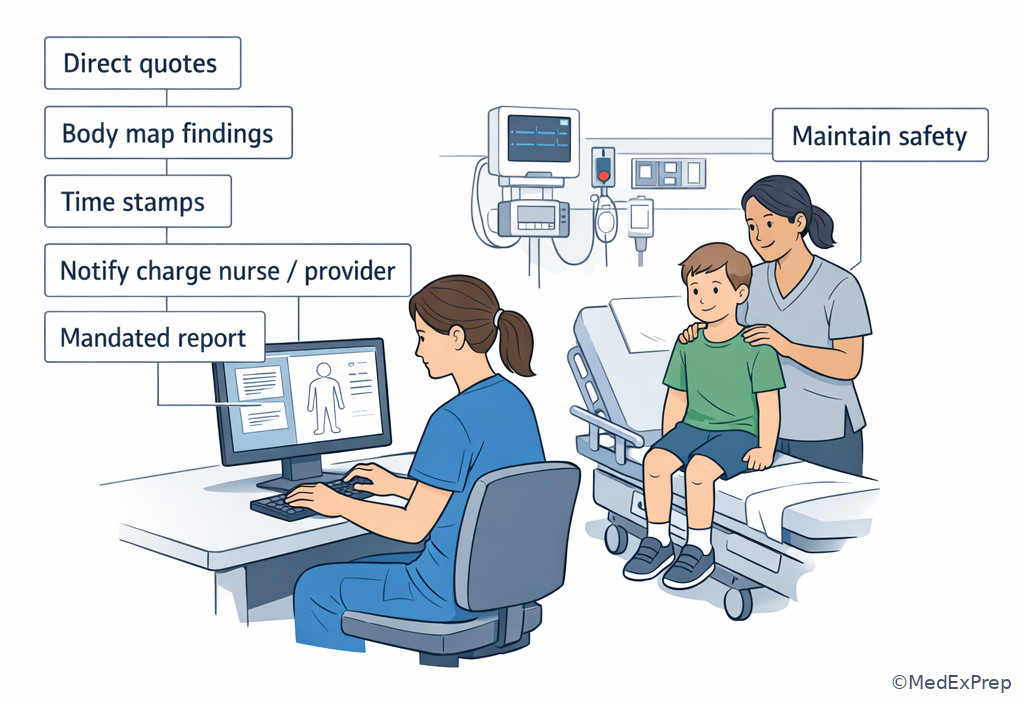
Objective documentation matters. Record direct observations, quotes, timing, who was present, visible findings, and actions taken. Avoid diagnosing abuse in the chart; instead document the concern, protect the child, and report per law/policy. If discharge seems unsafe, the RN does not independently discharge or “let it go” because the ED is busy. The RN escalates through the appropriate chain and maintains safety precautions. Family-centered care still applies, but it does not override the child’s safety.
This section also covers privacy, chain-of-command use, and policy-based responses to refusal of needed emergency care, elopement risk, or behavioral danger. In exam stems, the safest action usually combines objective documentation with immediate notification of the proper team. See Fig 4.
Memory anchor: SAFE = See objective findings, Act to protect, File/report per policy, Escalate to the team.
High-Yield Connection: This concept is frequently paired with behavioral health, trauma, and discharge teaching topics. Know both the clinical stabilization piece and the child-safety reporting responsibility.
Exam takeaway: In suspected maltreatment, protect the child, document facts and quotes, and report per policy rather than making independent legal conclusions.
B Worked example
A 7-year-old presents with abdominal pain and a forearm bruise after “falling off the couch,” according to a caregiver. The child has developmental delay and is unusually quiet. The history changes twice, and the child winces when the caregiver moves closer. A distracting lab value shows mildly elevated ketones after poor intake. The caregiver asks to leave before full evaluation because “we need to pick up a sibling.”
Reasoning chain: Identify task: safest nursing action within scope. Extract key facts: inconsistent history, possible fear response, unexplained injury, potential unsafe departure. Apply rule: safety concern requires objective documentation and escalation; the RN must not ignore the concern or independently decide disposition. Eliminate distractors: reassuring the caregiver and allowing rapid departure is unsafe; directly accusing the caregiver is not the correct professional approach; focusing on ketones alone misses the major safety issue. Verify: document quotes and findings objectively, notify the provider/charge nurse/social work per policy, maintain child safety, and follow mandated reporting procedures.
C Exam trap
Common wrong answer: “Document that the child was abused.” Why it is tempting: it sounds decisive and advocacy-focused. Single clue that eliminates it: the RN’s role is objective observation, safety action, and reporting—not independent legal or medical conclusion wording in the chart.
D Checkpoint
An adolescent presents after a possible assault and asks that no one be told. The caregiver is in the waiting room. Which nursing action is most appropriate?
- Promise absolute secrecy so the adolescent continues talking
- Document objective statements and findings, maintain privacy and safety, and follow reporting/policy requirements
- Tell the adolescent to explain everything directly to law enforcement before any nursing documentation
- Delay all action until the provider decides whether the event meets reporting criteria
Answer: B.
- A: Tempting because rapport matters; wrong because nurses cannot promise secrecy when mandatory reporting or safety concerns may apply.
- B: Tempting because it feels procedural; correct because it matches RN duties of safety, privacy, objective documentation, and policy-based escalation.
- C: Tempting because legal reporting matters; wrong because the RN must first preserve safety and document appropriately within clinical workflow.
- D: Tempting because provider input matters; wrong because the RN has an independent duty to recognize and escalate safety concerns promptly.
- True or False: The RN should chart “abuse confirmed” if the pattern appears suspicious. False.
- Fill in the blank: In suspected neglect, first protect the child, then document ________ and ________. findings and quotes.
- Name the 3 action domains in a safety concern: protect, document, report.
Nursing Priority: Assess immediate danger to the child and anyone in the room. Intervene by maintaining safety, preserving appropriate privacy/evidence per policy, and documenting exactly what you see and hear. Delegate only nonconfidential support tasks; the RN retains the interview, documentation, and reporting chain. Escalate immediately for unsafe discharge risk, suspected abuse/neglect, sexual assault pathway needs, or any caregiver behavior threatening the child.
1.1.1.7 Integration: choosing between similar answer choices under RN scope pressure
A Explanation
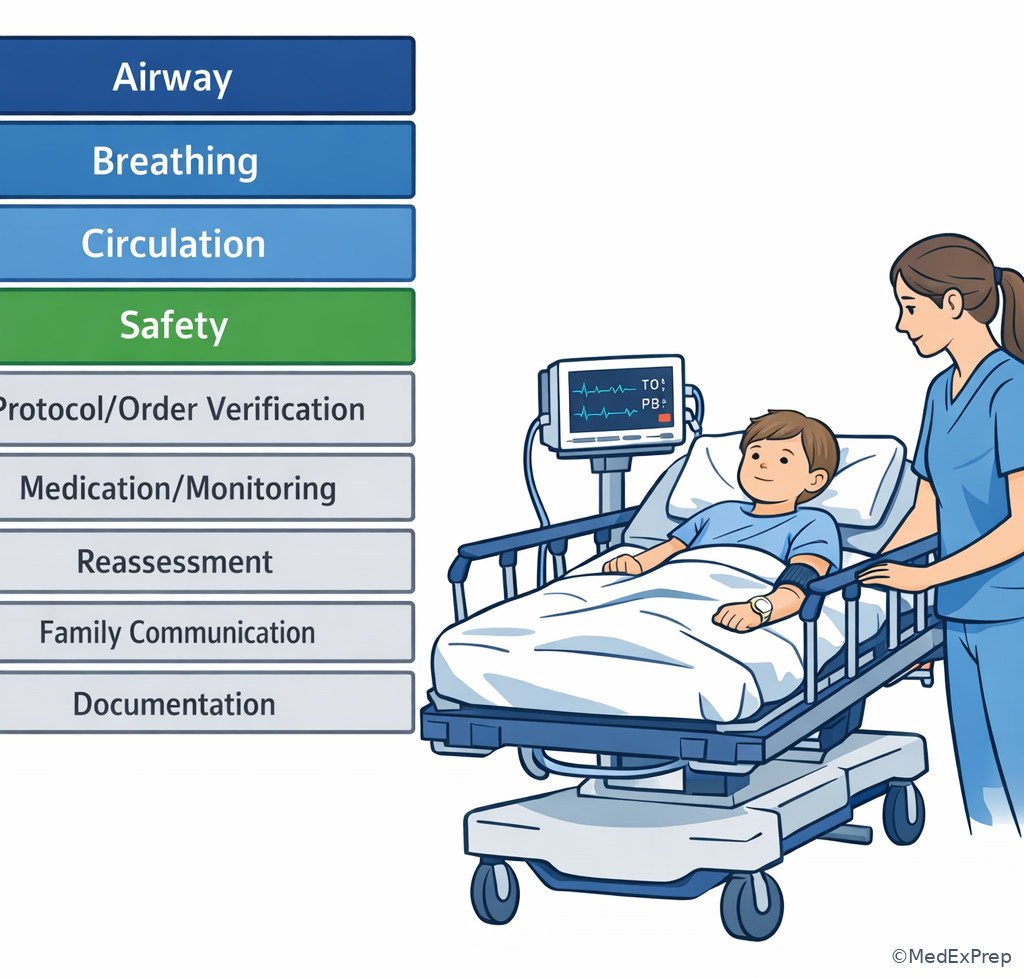
Now the conflict becomes more subtle: several answer choices may all be reasonable nursing actions, but only one is the best next step. The resolving rule is to use a priority stack: ABCs/safety first, then protocol-based intervention, then reassessment, then communication/documentation. If two options are both correct in general, choose the one that addresses the highest threat or the missing prerequisite. WHY THIS IS TESTED: CPEN distractors are rarely absurd; they are usually correct actions at the wrong priority.
For example, parent teaching is important, but not before stabilization. Pain reassessment is important, but not before oxygen for severe distress. Obtaining a complete history is valuable, but not before addressing hypoglycemia or active seizure. Calling the provider matters, but not instead of starting the immediate, allowed intervention. Conversely, if an intervention requires verification or authorization, “call the provider” may become the right answer because the nurse must not bypass safety checks.
This is where board-style discipline matters: identify the task, pull out one discriminator, and reject the nearly-right answers. See Fig 5 for the comparison logic and Fig 6 for a room-level mental model.
Memory anchor: SPAR = Stabilize, Protocol/permission, Assess again, Relay/escalate. If an option skips an earlier SPAR step, it is usually not the best answer.
Exam takeaway: When multiple options are reasonable, pick the one that addresses the highest-priority threat without crossing scope boundaries.
flowchart TD
A[Several options look reasonable] --> B[Check for ABC or safety threat]
B --> C[Remove provider-only actions]
C --> D[Check if order or protocol is required]
D --> E[Choose immediate authorized action]
E --> F[Reassess and communicate outcome]
Exam takeaway: The bedside sequence is stabilize first, verify authorization, reassess response, then advance communication and documentation.
B Worked example
A 15-year-old with depression, asthma, and obesity arrives after ingesting “some pills” 40 minutes ago. She is tearful, mildly tachycardic, and asks whether she can text her friend. The medication bottles are not yet identified. One answer choice says to obtain a full psychosocial history; another says to place her in a monitored setting, assess airway and mental status, secure potentially dangerous belongings, and notify the appropriate team. A tempting wrong clue is that she is speaking clearly and appears cooperative.
Reasoning chain: Identify task: best immediate nursing action. Extract key facts: possible overdose, self-harm risk, unknown ingestion, early presentation, currently cooperative but at risk. Apply rule: safety and physiologic monitoring outrank detailed history; unknown ingestion requires monitoring and escalation. Eliminate distractors: detailed psychosocial history is important later, but not before ensuring safety and monitoring; asking the adolescent to commit to a safety contract is insufficient; independently deciding decontamination is provider/protocol dependent. Verify: monitored environment, safety precautions, focused assessment, poison center/provider/team notification per policy, and ongoing reassessment.
C Exam trap
Common wrong answer: “Complete the full history before moving the patient.” Why it is tempting: overdose evaluation requires details. Single clue that eliminates it: unknown ingestion with self-harm risk makes physiologic and environmental safety the immediate priority.
D Checkpoint
A toddler with vomiting and diarrhea is crying weakly, has dry mucous membranes, and delayed capillary refill. Which option is the best next nursing step?
- Give discharge teaching on oral hydration strategies immediately
- Start focused monitoring, obtain weight, initiate protocol-based dehydration care, and reassess perfusion
- Wait for a provider to diagnose the degree of dehydration before placing the child on a monitor
- Ask the caregiver to count urine diapers at home and call later if the child worsens
Answer: B.
- A: Tempting because oral hydration education is helpful; wrong because poor perfusion signs make discharge teaching premature.
- B: Tempting because it is multi-step; correct because it matches pediatric emergency priorities of assessment, protocol care, and reassessment.
- C: Tempting because providers do classify severity; wrong because the RN should not delay basic supportive assessment and stabilization.
- D: Tempting because urine output matters; wrong because current perfusion findings require immediate ED action, not home advice.
Nursing Priority: Assess which threat is highest right now: airway, breathing, circulation, neuro, or safety. Intervene with the highest-priority in-scope action first, then verify/advance to lower-priority needs. Delegate supportive logistics appropriately, but the RN keeps unstable decision-making, toxicology safety oversight, and reassessment. Escalate for unknown ingestion, suicidality, worsening perfusion, or any uncertainty that could endanger the child.
Exam Traps & Differentiators
Common traps & distractors: The most common wrong answer is a clinically sensible action performed at the wrong priority or outside scope. The stem rarely rewards passivity, but it also rarely rewards acting like the provider.
Most common wrong answer and why: “Wait for the provider to decide” is tempting because it feels safe. It is wrong when an immediate RN intervention exists within protocol, especially for ABC compromise, altered mental status, pain/safety emergencies, or clear deterioration.
| Looks similar | Actually means | Choose this when | Reject this when |
|---|---|---|---|
| Notify provider | Communication step | No immediate bedside action is needed or action requires authorization | The child has an immediate threat and you can stabilize now |
| Apply protocol-based intervention | Authorized nursing care | Standing orders/pathways clearly allow it | Weight/order/authorization is unclear and the action is not emergent or protocol-based |
| Complete full history | Information gathering | Child is stable and immediate threats are addressed | Respiratory distress, shock signs, seizure, overdose, or safety risk is present |
| Document findings | Required professional action | After or alongside stabilization and safety steps | It delays ABC support or urgent escalation |
| Teach caregiver | Family-centered care | Child is stable enough to receive education | The child remains unstable or disposition is not yet safe |
| If the stem says... | Think... |
|---|---|
| “Worsening despite oxygen/suction/initial support” | Escalation is part of the right answer |
| “Unknown weight” before medication | Verify weight or use approved length-based tool per policy before dosing |
| “Inconsistent story” or “caregiver wants to leave quickly” | Child safety, objective documentation, mandated reporting pathway |
| “Speaking but tiring” or “somnolent” | Do not be reassured by partial compensation; reassess and escalate |
| “No order/protocol stated” | Clarify before nonemergent intervention; do not improvise |
| “Best next step” with several good actions | Pick the option that addresses ABCs or safety first |
Related trap from upcoming topics: in ABCDES Primary Survey, a detailed history can again be a trap when the airway or breathing problem is visible. In Pediatric Triage and Acuity, the wrong answer often overvalues chief complaint wording and undervalues appearance, work of breathing, and circulation.
Tables
| Scenario type | Immediate RN assessment focus | Likely in-scope first actions | Must not delay for |
|---|---|---|---|
| Respiratory distress | Work of breathing, oxygenation, mental status | Positioning, oxygen, monitoring, protocol pathway, escalation | Definitive diagnosis or imaging |
| Poor perfusion/dehydration | Capillary refill, pulses, mental status, urine history | Monitoring, weight, IV access prep, protocol fluids, reassessment | Long teaching or discharge planning |
| Altered mental status | Airway protection, glucose, seizure activity, perfusion | Bedside glucose, monitoring, safety, escalation | Lengthy history gathering |
| Suspected ingestion | Airway, breathing, mental status, exposure details, self-harm risk | Monitoring, safety precautions, poison center/provider notification per policy | Behavior contract or counseling before stabilization |
| Possible maltreatment | Immediate safety, injury pattern, caregiver interaction | Objective documentation, protect child, report/escalate | Confrontational accusations or independent conclusions |
| Comparison | Correct action now | Why the alternative is wrong now |
|---|---|---|
| Oxygen now vs wait for diagnosis | Oxygen now if hypoxemic/distressed and protocol allows | Diagnosis does not come before immediate breathing support |
| Verify weight/order vs estimate dose | Verify before medication administration | Estimation creates preventable pediatric dosing harm |
| Escalate worsening child vs continue observation | Escalate if worsening despite initial intervention | Observation alone delays rescue resources |
| Objective charting vs charting conclusions | Record findings, quotes, times, actions | Conclusions exceed the RN’s documentation role |
| Safety precautions vs full psychosocial interview first | Secure environment and monitor first | Interview can wait until physiologic and environmental safety is established |
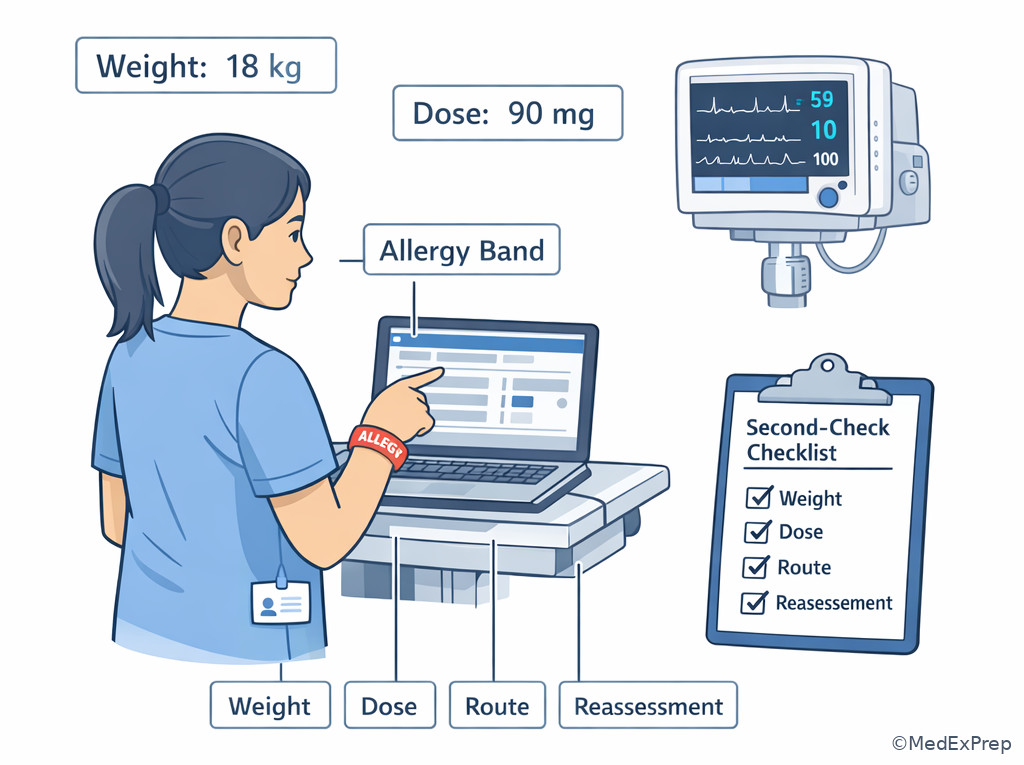
Exam takeaway: Weight, allergies, route, and monitoring are the key checkpoints before pediatric medication administration.
Exam takeaway: Board-style nursing answers are stronger when they include how the child is monitored and when the RN reassesses response.
Algorithm / Approach
Exam takeaway: Use instability, authorization, and reassessment as the three filters for most scope questions.
flowchart TD
A[Question asks best action] --> B{Immediate danger?}
B -->|Yes| C[Support ABCs or safety now]
C --> D[Activate provider/team if indicated]
B -->|No| E{Action ordered or protocol-based?}
E -->|Yes| F[Verify pediatric safety details and perform]
E -->|No| G[Clarify order and continue assessment]
F --> H[Reassess and document]
D --> H
G --> H Rapid Review
- Immediate hypoxemia → oxygen/monitoring before diagnostic certainty
- Unknown pediatric medication dose → verify weight/order before giving
- Worsening after initial intervention → escalation becomes part of the correct answer
- Possible maltreatment → objective charting and reporting, not conclusory labeling
- Several good options → choose the one that addresses ABCs or safety first
- Provider notification alone → insufficient when a bedside nursing action is available now
- Detailed history first → wrong if the child is unstable or high risk
- Speaking child who looks tired → not reassuring if mental status or work of breathing is worsening
- Family request that conflicts with safety → protect child and escalate through policy
- Protocol-based action → stronger than improvisation, even if improvisation sounds experienced
- Documentation → never substitute for stabilization, but never omit after action
- Unknown ingestion → safety, monitoring, and escalation outrank counseling details
Memory anchor: \(RN = Recognize\), Nurse, Notify. Recognize the threat, Nurse the child with in-scope action, Notify/escalate when indicated.
Self-check quiz
1. A 5-year-old with asthma, eczema, and mild developmental delay arrives with audible wheeze and oxygen saturation of 88% on room air. The parent is still completing registration. Which nursing action is most appropriate first?
- Apply oxygen, place the child on continuous monitoring, and notify the provider/team per protocol
- Wait for the provider to decide whether the wheeze is asthma or pneumonia
- Obtain a detailed allergy history before any intervention
- Complete discharge teaching on inhaler technique
2. A 3-year-old with vomiting, repaired VSD, and recent otitis media has an antiemetic order entered. The weight in the chart is from six months ago, and the child appears thinner today. Which action is most appropriate before medication administration?
- Use the prior weight because small children do not change enough to affect dosing
- Verify the current weight or approved length-based estimate per policy before giving the medication
- Ask the caregiver to guess the child’s weight and use that value
- Hold all monitoring until the medication is administered
3. An 11-month-old with bronchiolitis, prematurity, and poor feeding has moderate retractions and pulse oximetry 90% after suctioning. The caregiver says, “She always breathes fast when she cries.” Which nursing action is the best next step?
- Continue observation only because the caregiver reports this is typical
- Initiate protocol-based oxygen/monitoring support, reassess, and escalate because distress persists
- Delay further action until the chest x-ray result is available
- Ask the caregiver to feed the infant to see whether the breathing settles
4. A 14-year-old with depression, ADHD, and obesity reports taking an unknown number of tablets 30 minutes ago. She is awake, texting, mildly tachycardic, and says she regrets telling anyone. Which action is most appropriate now?
- Move her to a monitored, safe environment, assess airway and mental status, secure belongings, and notify the appropriate team
- Begin a full therapeutic conversation and postpone monitoring so she feels trusted
- Tell her she can go home if she promises not to repeat the behavior
- Wait until the exact pills are identified before starting any nursing interventions
5. A 6-year-old with autism, constipation, and a healing forearm bruise presents with abdominal pain. The caregiver gives two different explanations for the bruise and asks to leave before evaluation is complete. Which nursing action requires immediate priority?
- Document “caregiver abuse” in the chart to ensure action occurs
- Objectively document the findings and statements, maintain safety, and notify the provider/charge nurse per policy
- Allow discharge because the child’s abdominal pain does not yet appear severe
- Confront the caregiver directly and demand a consistent explanation
6. A 9-year-old with sickle cell disease and asthma develops chest pain, fever, tachypnea, and increasing fatigue. Oxygen is already in place, but he is now harder to arouse. Which nursing action is the best next step?
- Increase monitoring, reassess airway/breathing, and urgently escalate to the provider/resuscitation pathway while preparing for advanced support
- Obtain a more detailed pain history before contacting the provider so the report is complete
- Encourage oral fluids while waiting for laboratory confirmation
- Document the change and recheck in 30 minutes
7. A 2-year-old with diarrhea, poor intake, and congenital kidney disease has delayed capillary refill and weak peripheral pulses. A new team member suggests waiting for the provider because “the child is still awake.” Which response best reflects the RN role?
- Wait, because alert children cannot be in clinically important shock
- Begin protocol-based assessment and support for poor perfusion, obtain accurate weight, monitor continuously, and escalate promptly
- Give discharge hydration instructions while the provider finishes another case
- Independently diagnose decompensated shock and order the definitive treatment plan
8. A 16-year-old presents after possible sexual assault, requests privacy, and has superficial arm lacerations from earlier self-harm. The caregiver demands immediate details and wants to take the teen home. Which nursing action is most appropriate?
- Provide the caregiver full details immediately because the caregiver is legally responsible
- Maintain privacy and safety, assess immediate medical and behavioral risk, document objectively, and activate the appropriate reporting/assault pathway per policy
- Promise the adolescent that nothing will be shared under any circumstances
- Tell the caregiver to leave, then independently decide whether discharge is safe
Answer key
1. Correct answer: A
- A: Tempting because it is active and protocol-based; correct because ABCs outrank diagnosis, and the single discriminating clue is oxygen saturation 88% with wheeze. Priority rationale: breathing support is first under ABCs. Source: NCSBN clinical judgment and emergency nursing prioritization principles; ANA Standards emphasize timely assessment/intervention.
- B: Tempting because diagnosis influences treatment; incorrect because waiting for the provider delays immediate nursing support for hypoxemia. The clue is current desaturation, not diagnostic uncertainty. Source: ANA Standards; pediatric emergency stabilization principles.
- C: Tempting because allergy history matters before medications; incorrect because asking extensive history before oxygen delays the priority intervention. The clue is respiratory distress requiring first-line support now. Source: NCSBN prioritization framework.
- D: Tempting because family education is important; incorrect because teaching is low priority in an unstable child. The clue is active respiratory compromise. Source: ANA Standards on prioritization and reassessment.
2. Correct answer: B
- A: Tempting because it avoids delay; incorrect because pediatric weights change enough to affect dosing safety, especially in smaller children. The clue is the outdated weight and thinner appearance. Source: ANA medication safety standards; pediatric dosing principles from standard nursing review texts.
- B: Tempting because it may feel slower; correct because current weight verification or approved length-based estimate is the required safety discriminator before weight-based medication administration. Source: NCSBN medication administration safety principles; Saunders pediatric medication review content.
- C: Tempting because caregivers often know approximate weight; incorrect because guessing is not an adequate dose-verification method when a safer process exists. The clue is the availability of verification, not lack of information. Source: ANA Standards; medication safety practice.
- D: Tempting because it sounds efficient; incorrect because monitoring should not be withheld and does not substitute for dose verification. The clue is the question asks what should happen before medication administration. Source: NCSBN nursing process priorities.
3. Correct answer: B
- A: Tempting because caregiver baseline information is useful; incorrect because persistent retractions and low saturation after suctioning indicate unresolved respiratory compromise. The discriminating clue is distress persisting after initial intervention. Source: NCSBN ABC prioritization; pediatric respiratory emergency nursing standards.
- B: Tempting because it includes several actions; correct because protocol-based support plus reassessment and escalation fits ongoing instability. The clue is 90% saturation with moderate retractions after suctioning. Source: ANA Standards and pediatric emergency care prioritization.
- C: Tempting because x-ray could clarify severity; incorrect because imaging does not come before bedside stabilization. The clue is immediate breathing work, not uncertainty of etiology. Source: NCSBN prioritization guidance.
- D: Tempting because feeding tolerance can reflect severity; incorrect because feeding a distressed infant may worsen risk and delays needed support. The clue is current work of breathing, not feeding readiness. Source: pediatric respiratory nursing practice resources.
4. Correct answer: A
- A: Tempting because it may seem formal; correct because unknown ingestion and self-harm risk require physiologic and environmental safety first. The discriminating clue is overdose within 30 minutes with unknown substance. Source: NCSBN safety framework; emergency behavioral health nursing principles.
- B: Tempting because therapeutic communication matters; incorrect because rapport does not replace safety monitoring in a toxicology-risk scenario. The clue is unknown ingestion, not a stable counseling visit. Source: ANA standards for safety and assessment.
- C: Tempting because verbal commitment may sound helpful; incorrect because “safety contracts” are not the priority intervention and do not address ingestion risk. The clue is actual toxic exposure risk. Source: psychiatric/emergency nursing safety principles.
- D: Tempting because pill identification helps management; incorrect because monitoring cannot wait for complete identification. The clue is early ingestion window and current risk. Source: poison/emergency nursing standards.
5. Correct answer: B
- A: Tempting because it sounds protective; incorrect because conclusory documentation exceeds the RN role and weakens objective charting. The discriminating clue is suspected, not legally established, maltreatment. Source: ANA documentation standards; mandated reporting principles.
- B: Tempting because it sounds procedural rather than dramatic; correct because child safety concerns require objective documentation, protection, and policy-based escalation. The clue is inconsistent history plus request to leave early. Source: child maltreatment nursing guidance; ANA Standards.
- C: Tempting because abdominal pain severity seems modest; incorrect because possible safety risk changes the priority from symptom-only thinking to child protection. The clue is unsafe context, not just pain score. Source: NCSBN safety prioritization.
- D: Tempting because direct confrontation may seem advocacy-focused; incorrect because it can jeopardize safety and is not the preferred first professional action. The clue is the need for objective, policy-based response. Source: child protection nursing standards.
6. Correct answer: A
- A: Tempting because it escalates aggressively; correct because a harder-to-arouse child with chest symptoms and tachypnea is deteriorating despite oxygen. The single discriminating clue is increasing difficulty in arousal. Priority rationale: airway/breathing/neuro deterioration requires urgent escalation and advanced support preparation. Source: NCSBN ABCs; pediatric emergency deterioration standards.
- B: Tempting because concise provider reports help; incorrect because obtaining a fuller pain history delays the higher-priority response to altered mental status. The clue is somnolence, not incomplete pain characterization. Source: ANA prioritization standards.
- C: Tempting because fluids are often helpful; incorrect because oral intake is not the immediate step in a deteriorating child with decreased alertness and respiratory compromise. The clue is reduced arousability. Source: NCSBN safety/aspiration prevention principles.
- D: Tempting because trending matters; incorrect because waiting 30 minutes ignores active deterioration. The clue is worsening now despite current therapy. Source: pediatric emergency nursing reassessment standards.
7. Correct answer: B
- A: Tempting because awake children can appear less critical; incorrect because pediatric shock can be compensated, and alertness alone does not rule out significant poor perfusion. The discriminating clue is delayed capillary refill with weak pulses. Source: pediatric perfusion assessment principles; NCSBN prioritization.
- B: Tempting because it combines multiple nursing tasks; correct because it stays within RN scope while addressing circulation, weight-based planning, monitoring, and escalation. The clue is objective poor perfusion in a high-risk child. Source: ANA Standards and pediatric emergency nursing practice.
- C: Tempting because hydration teaching is relevant; incorrect because discharge teaching is not appropriate during active poor perfusion. The clue is current circulatory compromise. Source: NCSBN ABCs and safety hierarchy.
- D: Tempting because decisive thinking is useful; incorrect because independently diagnosing and ordering definitive treatment exceeds RN scope. The clue is the question asks for the RN action, not provider management. Source: ANA scope and standards.
8. Correct answer: B
- A: Tempting because caregivers often expect information; incorrect because privacy, safety, and policy-based handling of assault and self-harm concerns must guide communication. The discriminating clue is possible sexual assault with concurrent behavioral risk. Source: ANA ethics and privacy standards; emergency sexual assault pathway principles.
- B: Tempting because it seems broad; correct because it preserves safety, respects privacy, addresses medical and behavioral urgency, documents objectively, and activates required pathways. The clue is dual risk: assault concern plus self-harm history. Source: ANA standards, NCSBN safety, and emergency nursing practice.
- C: Tempting because trust is crucial; incorrect because absolute secrecy cannot be promised when reporting, safety, or guardian/legal procedures may apply. The clue is mandatory policy context. Source: ANA ethical communication standards.
- D: Tempting because caregiver conflict may justify separation; incorrect because the RN does not independently decide definitive discharge safety and must use team/policy pathways. The clue is scope limitation on disposition decisions. Source: ANA scope and standards.
Keep going with the full CPEN Prep Course (CPEN)
You just studied the way members do, in the same lesson interface. Full access unlocks every lesson, the question bank and flashcards for a full year.
One payment · 1 year of access · No auto-renewal