1.1.1 - Inferred CPBP Domain Map
Why it matters
- Many CPBP questions are not testing trivia; they are testing whether you can identify which part of the workflow you are in before acting.
- A correct answer often depends on recognizing whether the issue is front-end data, documentation sufficiency, payer rule, claim status, or compliance escalation.
- Without a domain map, candidates confuse similar tasks: eligibility versus authorization, denial follow-up versus coding review, or patient communication versus privacy breach risk.
- The domain map becomes your exam shortcut: classify the problem, apply the governing rule, choose the compliant next step, and avoid out-of-role actions.
Key Terms & Must-Know Facts
1.1.1.1 Key terms
- Domain map: organized structure of tested content areas and subskills
- Patient access: scheduling, preregistration, registration, check-in, check-out support
- Revenue cycle: sequence from appointment setup through payment resolution
- Eligibility verification: confirmation that coverage is active and basic benefits apply
- Authorization: payer approval process for certain services when required
- Clean claim: claim submitted with complete, accurate, and processable data
- Denial: claim not payable as submitted after adjudication or review
- Rejection: claim returned before adjudication because of format or data issues
- Documentation sufficiency: record contains needed elements to support workflow and billing processes
- Escalation: routing an issue outside routine administrative authority
- Minimum necessary: limit PHI use/disclosure to what is needed for the task
- Best-next-step reasoning: identify task, extract key facts, apply rule, act, verify
- Role boundary: line between allowed administrative action and prohibited clinical/legal/coding authority
1.1.1.2 Must-know facts
- The CPBP role is workflow-centered, not diagnosis-centered.
- When policy details are unclear, the safest answer is usually to verify and escalate, not assume.
- Front-end errors commonly become back-end denials later.
- Incomplete demographics, insurance data, or authorization details can stop a clean claim before submission or payment.
- The exam rewards accurate administrative action, not convenience shortcuts.
- You may identify missing documentation; you may not invent or improperly alter it.
- You may communicate basic financial responsibility; you may not promise coverage.
- Privacy, payer rules, documentation, and claim workflow often appear in the same stem as layered distractors.
Exam takeaway: Use the domain first, then the subskill, to identify the safest next administrative action.
flowchart TD
A[CPBP Exam Scope] --> B[Business Operations Foundations]
A --> C[Patient Access and Registration]
A --> D[Claims Billing and Revenue Cycle]
A --> E[Reimbursement and Financial Basics]
A --> F[Documentation and Record Support]
A --> G[Compliance and Privacy]
A --> H[Practice Operations and Communication]
A --> I[Integrated Case Application]
C --> C1[Scheduling]
C --> C2[Registration]
C --> C3[Eligibility]
D --> D1[Claim creation]
D --> D2[Submission]
D --> D3[Status and follow-up]
F --> F1[Missing elements]
F --> F2[Record integrity]
G --> G1[HIPAA-aware workflow]
G --> G2[Escalation triggers]
Exam takeaway: Visualizing the full office workflow helps separate intake errors from downstream billing consequences.
Core content
1.1.1.3 Foundational domain structure: what the exam is really testing
A Explanation
The first decision conflict in CPBP prep is simple: Is this question asking for memorized terminology, or is it asking you to place a workflow problem into the correct domain? Most missed items happen because candidates read only the surface words. A stem may mention insurance, but the actual task is documentation sufficiency. It may mention a denial, but the best answer is a front-end correction for future claims rather than immediate rebilling. The rule that resolves the conflict is this: identify the task before acting. If the task is about collecting, verifying, routing, following up, documenting, or escalating, you are inside the CPBP domain map.
WHY THIS IS TESTED: exam writers blend business operations categories so you must distinguish where in the process the problem belongs. The inferred domain map for this course uses balanced coverage because official weighting is not confirmed. Practically, that means you should expect questions from foundations, patient access, claims workflow, reimbursement basics, documentation support, compliance-aware operations, and integrated case reasoning.
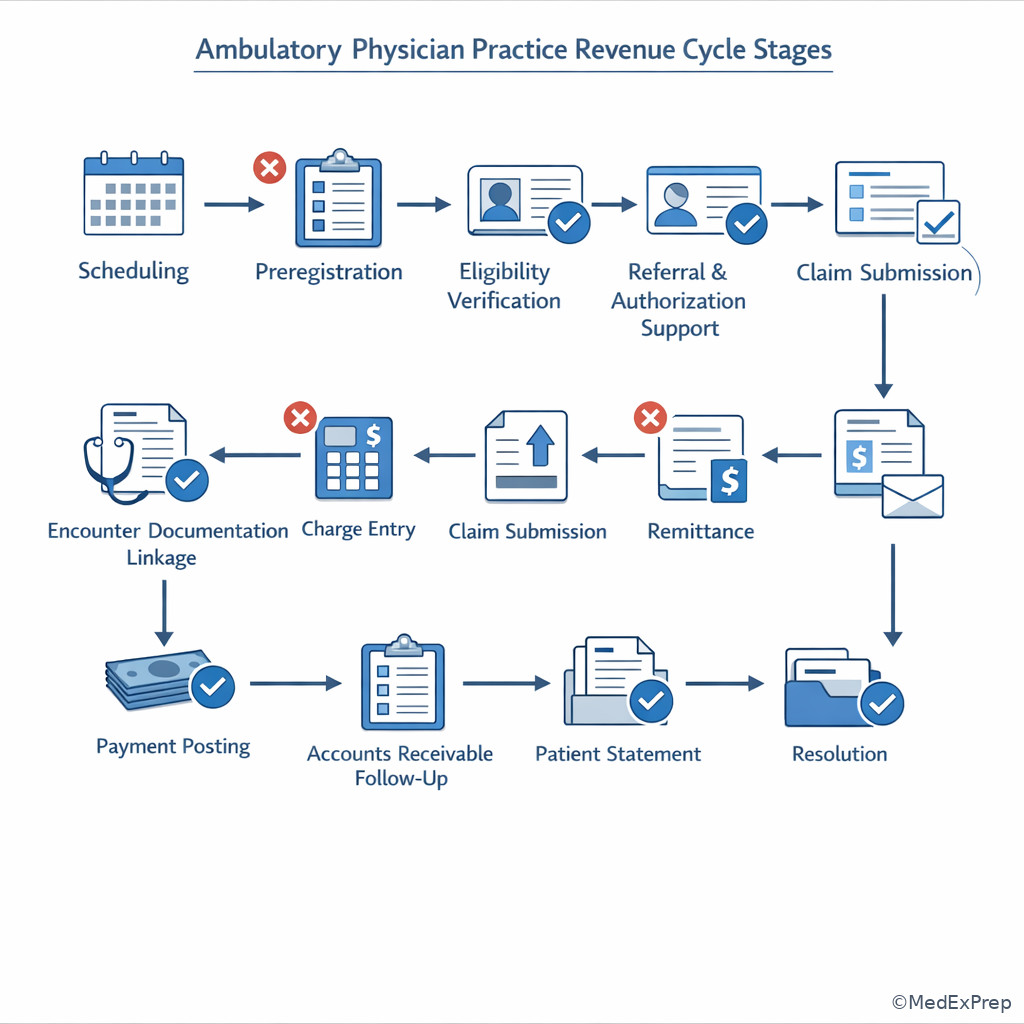
A strong exam approach is to sort stems into three buckets: front-end setup, transaction processing, and issue resolution/escalation. Front-end setup includes scheduling, registration, and verification. Transaction processing includes charges, claims, remits, posting, and routine follow-up. Issue resolution/escalation includes denials, missing documents, privacy questions, suspicious patterns, and role-boundary problems. See Fig 1 for the big-picture structure.
Key rule: When a stem feels broad, narrow it by asking, “What operational task is being tested right now?” Do not jump to payer conclusions before identifying the domain.
Recall: This is the opening topic of the course, so there is no earlier in-course lesson to retrieve. Treat this section as the master framework that later topics will plug into.
B Worked example
A 57-year-old established patient with diabetes and COPD calls a multispecialty clinic about tomorrow’s follow-up visit. The patient mentions a recent employer insurance change, says the prior card “should still be in the system,” and adds that the cardiology office once handled an authorization for another service. The scheduler also sees an old balance and a note about a scanned ID image that is unreadable. The question asks for the most appropriate initial action.
Reasoning chain: identify task → this is not yet a claim question; it is a patient-access/data-readiness problem. Extract key facts → insurance changed, old card may be outdated, unreadable ID, prior authorization mention is distracting because it involved another service. Apply rule → current demographics and current insurance must be verified before service whenever possible; old authorization information does not substitute for current eligibility or service-specific requirements. Eliminate distractors → do not promise coverage, do not assume previous authorization applies, do not wait until denial. Verify → the best action is to request updated insurance/ID information and initiate verification according to office workflow.
C Exam trap
Common wrong answer: “Proceed because the patient is established and the office already has insurance on file.”
Why it is tempting: established patients often create a false sense that prior data remains valid.
Single clue that eliminates it: the patient explicitly reports an insurance change, which turns the issue into a current verification task, not a routine check-in shortcut.
D Checkpoint
Question: A CPBP candidate sees a stem about an unreadable insurance card image, an upcoming visit, and uncertainty about whether a referral is still valid. Which first step best reflects domain-map reasoning?
- Submit the claim after the visit and see whether the payer rejects it.
- Collect updated insurance details and route any referral or authorization questions through the established workflow.
- Explain to the patient that coverage is guaranteed because prior visits were paid.
- Select a diagnosis code that seems most likely to support the visit.
Answer: B.
- A: tempting because it sounds efficient; wrong because it delays a known front-end data issue into a preventable back-end problem.
- B: tempting because it requires extra steps; right because it addresses current data validation and appropriate routing without overstepping scope.
- C: tempting because prior payment suggests continuity; wrong because past payment never guarantees current coverage.
- D: tempting because diagnosis seems related to payer approval; wrong because diagnosis selection is outside the administrative role in this context.
If you missed this: Review 1.1.1.1 Foundational domain structure: what the exam is really testing — focus on identifying the operational task before reacting to surface details.
1.1.1.4 Role boundaries: what you may do, what you must not do, and when to escalate
A Explanation
The next decision conflict is action versus authority. CPBP questions often present a problem that clearly needs solving, but one or more answer choices solve it by crossing role boundaries. The single rule that resolves the conflict is: you may support, verify, document, communicate basic process information, and escalate; you may not diagnose, independently determine medical necessity, assign codes beyond authority, alter records improperly, disclose PHI without permission, or provide legal conclusions.
This is tested because exam writers know candidates often confuse being helpful with being compliant. In real offices, pressure for speed can make the wrong answer feel practical. On the exam, the best answer protects accuracy, privacy, and role boundaries even when it takes longer. If a payer rule is unclear, coverage is disputed, or documentation appears clinically insufficient, the correct move is usually to collect facts and route the issue to the proper person rather than invent a workaround.
See Fig 2 for a choose-versus-escalate framework. Use it to reject answers that ask you to “override,” “determine,” or “guarantee” something outside administrative authority.
Boundary rule: If the option requires clinical judgment, coding authority, legal interpretation, or unauthorized disclosure, eliminate it unless the stem explicitly places that task within approved policy and delegated authority.
Memory anchor: VREE = Verify, Route, Educate on process, Escalate. When a stem pressures you to “fix” something outside scope, return to VREE.
Exam takeaway: If a task moves from administrative verification into clinical, coding, legal, or privacy authority, escalate instead of acting independently.
flowchart TD
A[Workflow problem appears] --> B{Administrative task?}
B -->|Yes| C[Collect or verify facts]
C --> D{Missing or inconsistent?}
D -->|Yes| E[Document and route]
D -->|No| F[Proceed per policy]
B -->|No or unclear| G{Clinical coding legal privacy issue?}
G -->|Yes| H[Escalate to proper resource]
G -->|Unclear| I[Confirm policy before action]
B Worked example
A 69-year-old Medicare patient with hypertension and chronic kidney disease checks out after a specialist visit. The patient asks whether the office can “just bill it as preventive” because another office said that classification avoids cost-sharing. The note is not yet finalized, and the referral coordinator is out today. A coworker suggests changing the reason for visit in the billing screen “to help the patient.” The question asks for the most appropriate response.
Reasoning chain: identify task → this is a role-boundary and documentation-integrity issue, not a customer-service shortcut. Extract key facts → unfinished documentation, patient request affecting billing category, coworker suggestion to change information, Medicare context. Apply rule → administrative staff must not alter records or independently reclassify services to affect payment. Eliminate distractors → do not promise lower patient responsibility, do not change visit type, do not give legal or coverage guarantees. Verify → explain that coverage and billing classification depend on proper documentation and payer rules, and route the issue per office policy.
C Exam trap
Common wrong answer: “Update the billing descriptor because the patient requested clarification and another office did it before.”
Why it is tempting: it appears patient-centered and operationally fast.
Single clue that eliminates it: the note is not finalized, so changing billing-facing information would be an improper workaround rather than a supported administrative correction.
D Checkpoint
Question: Which option most clearly stays within CPBP role boundaries?
- Assign the diagnosis most likely to justify the service before claim creation.
- Tell the patient the payer must cover the service because the provider recommended it.
- Document the patient question, explain that coverage depends on payer rules and finalized documentation, and route to the appropriate resource.
- Release the complete chart to a family member who says they help with the patient's bills.
Answer: C.
- A: tempting because diagnosis seems linked to payment; wrong because selecting diagnosis codes exceeds the role described here.
- B: tempting because provider recommendation sounds authoritative; wrong because medical recommendation does not equal guaranteed payer coverage.
- C: tempting because it seems less decisive; right because it keeps communication accurate and routes the issue appropriately.
- D: tempting because family involvement is common; wrong because disclosure requires proper authorization or a permitted purpose under policy.
If you missed this: Review 1.1.1.2 Role boundaries: what you may do, what you must not do, and when to escalate — focus on rejecting options that solve workflow problems by crossing authority lines.
- The safest response to unclear payer policy is to verify and escalate, not assume.
- True or False: An established patient account allows you to disclose PHI to any family member involved in payment. False.
- Name the 3 common out-of-role zones: clinical judgment, coding authority, legal/privacy interpretation.
1.1.1.5 Workflow domains and data dependencies: how one mistake travels through the revenue cycle
A Explanation
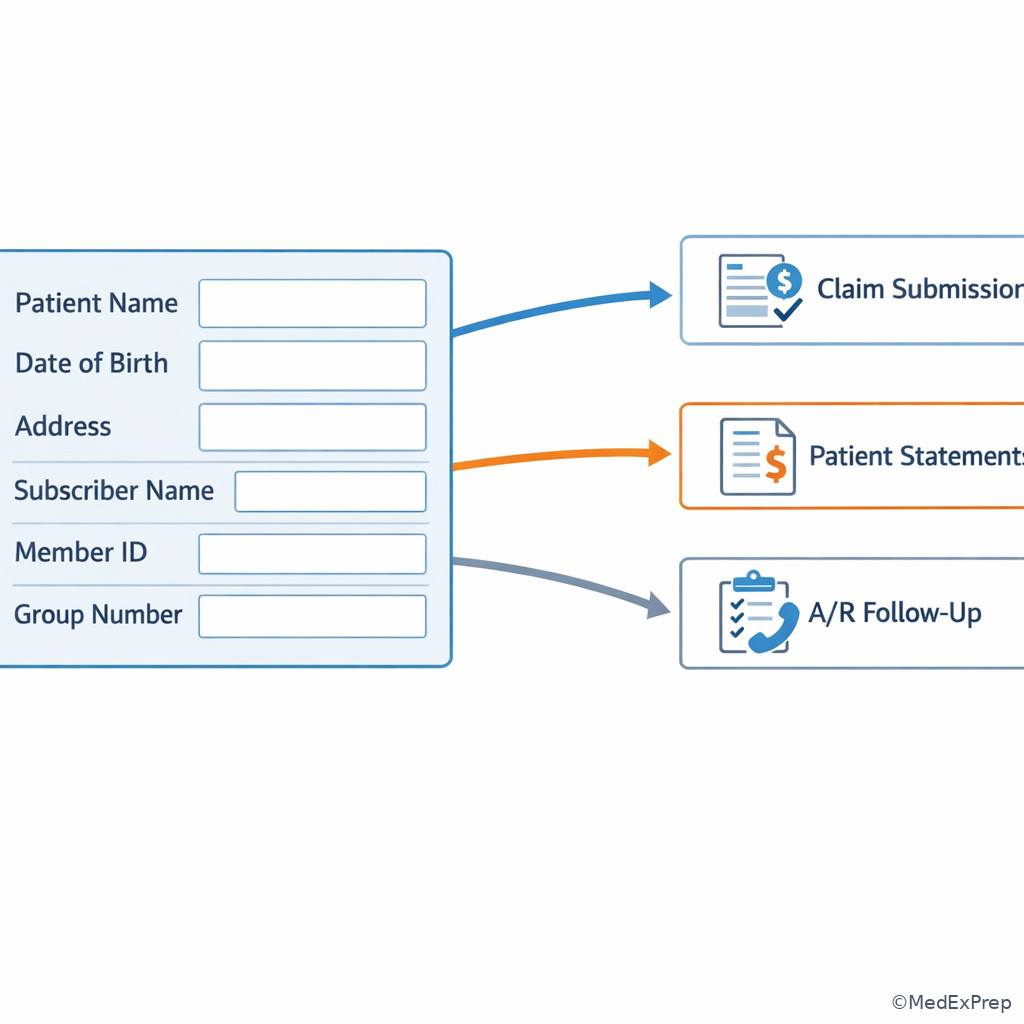
The foundational integration question is: Is this an isolated task, or is it a data dependency that will affect later stages? The rule is that early data elements are not “just front desk details”; they are upstream inputs for later claims, statements, and collections. A wrong policy number, missing subscriber relationship, absent referral note, or incomplete demographic field can block claim creation, trigger rejection, misroute patient statements, or delay follow-up.
WHY THIS IS TESTED: the exam often hides the true cause of a downstream problem upstream in the workflow. A denial may look like a payer issue when the root cause is incomplete registration. A balance dispute may appear financial when the underlying issue is inaccurate plan coordination. A clean claim depends on correct handoffs between patient access, documentation support, billing, and A/R teams.
Use the phrase data dependency as a trigger. Ask: what later process depends on this field being accurate now? See Fig 3 for the end-to-end dependency map. This lesson only introduces the framework; the upcoming topic Front-End And Back-End Flow will build it into a stepwise operational model.
High-Yield Connection: This concept is tested alongside Front-End And Back-End Flow. Know both the location of the task and the downstream claim consequence; these are frequently paired in stems.
Exam takeaway: When a claim or payment problem appears later, first ask which earlier data field or handoff likely failed.
flowchart LR
A[Scheduling and preregistration] --> B[Registration and insurance capture]
B --> C[Eligibility and benefit verification]
C --> D[Documentation linkage]
D --> E[Charge and claim creation]
E --> F[Submission and adjudication]
F --> G[Remittance and posting]
G --> H[AR follow-up]
B -. wrong plan ID .-> X[Claim rejection]
C -. missed auth need .-> Y[Denial]
B -. bad address .-> Z[Returned statement]
D -. missing supporting element .-> W[Hold or denial]
B Worked example
A 43-year-old patient with asthma and rheumatoid arthritis is seen in an orthopedic office after moving to a new address. At check-in, the staff confirms name and date of birth but skips updating the mailing address because the patient is late and says, “Everything else should be the same.” The payer later processes the claim, leaves patient cost-sharing, and the statement is mailed to the old address. The account enters early A/R aging, and the patient calls upset after receiving a collection warning at the new visit. The question asks for the most likely workflow failure that should have been prevented earlier.
Reasoning chain: identify task → this is not a collections-first issue; it is a front-end maintenance failure with back-end consequences. Extract key facts → updated address not captured, payer processed claim, patient statement misdirected, A/R aged. Apply rule → demographic accuracy is a live revenue-cycle dependency, not merely a courtesy field. Eliminate distractors → not necessarily a coding issue, not necessarily an eligibility issue because the claim paid in part, not a privacy disclosure question as framed. Verify → failure to update demographics at registration created downstream patient balance communication problems.
C Exam trap
Common wrong answer: “The main problem was failure to appeal the balance immediately.”
Why it is tempting: the visible harm appears in A/R and collections.
Single clue that eliminates it: the stem tells you the statement went to the old address, pointing to an upstream demographic maintenance miss rather than a back-end follow-up failure.
D Checkpoint
Question: Which item is best viewed as a revenue-cycle data dependency rather than an isolated clerical detail?
- The patient's preferred language for reminder calls only
- The subscriber and plan information tied to the date of service
- The color of the paper statement envelope
- The waiting room television volume
Answer: B.
- A: tempting because communication preferences matter; wrong because it does not directly govern claim adjudication in the way coverage data does.
- B: tempting because it seems basic; right because the wrong subscriber or plan data can affect claim submission, payment, and patient responsibility.
- C: tempting because patient statements are important; wrong because envelope color does not drive claim or payment processing.
- D: tempting only as an office operations concern; wrong because it has no direct billing dependency.
If you missed this: Review 1.1.1.3 Workflow domains and data dependencies: how one mistake travels through the revenue cycle — focus on tracing how front-end fields affect claim and A/R outcomes.
1.1.1.6 Applied stem reading: classify the problem before choosing the next step
A Explanation
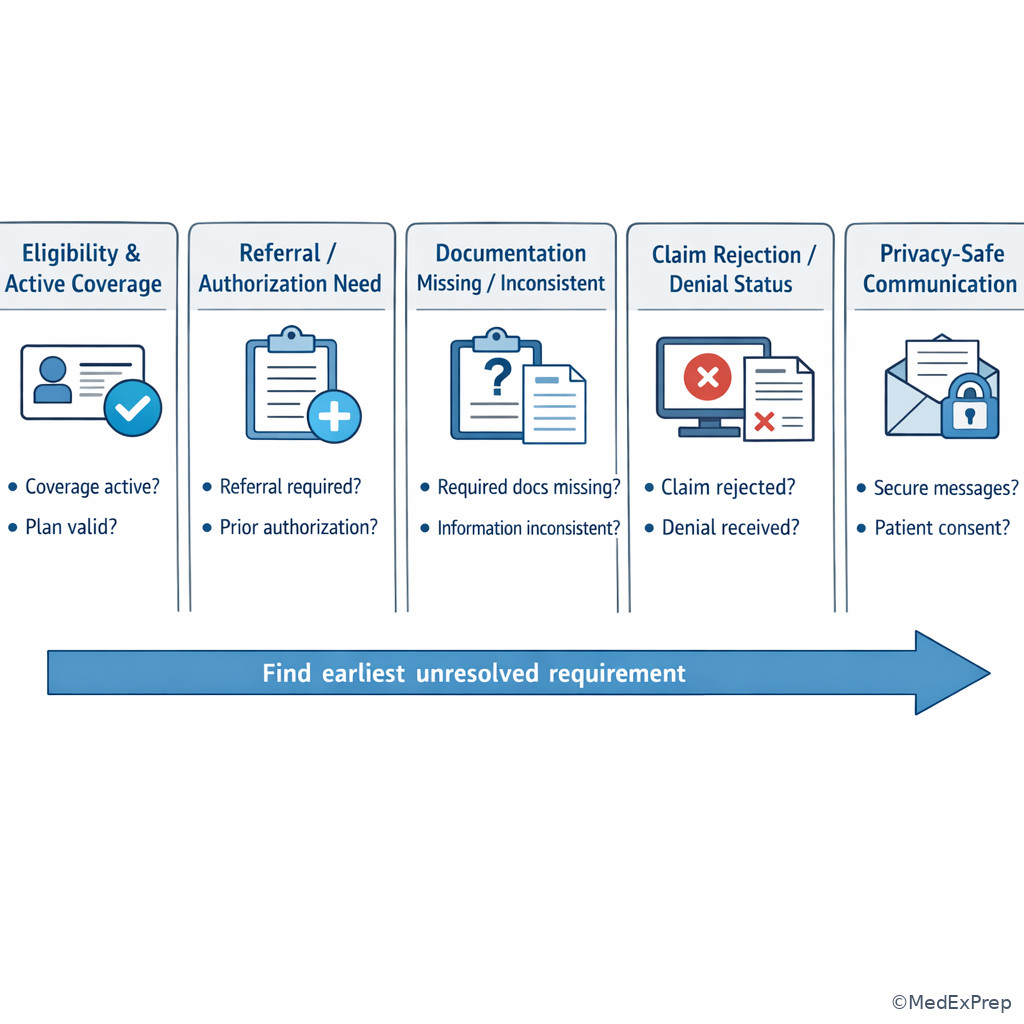
In application-level questions, the conflict is usually similar-sounding operational problems. Is this an eligibility question, an authorization question, a documentation question, or a claim status question? The single rule is: choose the answer that addresses the earliest unresolved requirement blocking compliant progress. If coverage is not verified, do not leap to claim status. If documentation is incomplete, do not promise submission timing. If a privacy concern is present, secure the communication path before sharing details.
WHY THIS IS TESTED: the CPBP exam favors best-next-step reasoning under noise. You may see age, diagnoses, prior balance, and patient frustration, but only one fact governs the next action. This is where topic mapping meets operational judgment. See Fig 4 for a comparison grid of common stem types and the first thing to check.
Recall: In the upcoming topic Best-Next-Step Reasoning, we will formalize the method as task → facts → rule → execute → verify. Here, we build on the domain map by using it as the first classification step.
Memory anchor: TFRV = Task, Facts, Rule, Verify. Use TFRV every time the stem contains mixed administrative noise.
Exam takeaway: Match each clue set to its governing workflow category before choosing an action.
B Worked example
A 34-year-old established patient with migraine and hypothyroidism presents for a nonurgent specialty follow-up. The chart contains current demographics, and eligibility was confirmed yesterday. At checkout, the patient says another office told them a referral might be required. The claim has not yet been created. The note is signed, but the referral field is blank and the payer portal message is unclear. A distracting detail in the stem mentions a small prior balance from six months ago. The question asks for the best next step.
Reasoning chain: identify task → the unresolved blocker is not the old balance and not claim status because no claim exists yet. Extract key facts → eligibility confirmed, documentation signed, potential referral requirement unclear, payer message unclear. Apply rule → when a service-specific administrative requirement is uncertain before claim submission, verify/routinely resolve that requirement through approved workflow. Eliminate distractors → do not bill first and wait, do not tell the patient the referral is unnecessary, do not focus on the old balance because it does not block this encounter. Verify → check/refine referral requirement through office workflow before downstream submission.
C Exam trap
Common wrong answer: “Work the prior patient balance first because that is the only confirmed problem.”
Why it is tempting: the balance is concrete, while the referral question feels uncertain.
Single clue that eliminates it: the stem asks for the next step for the current encounter, and an unclear service requirement can block clean claim processing immediately.
D Checkpoint
Question: A stem says eligibility is active, the note is signed, and the payer message suggests “review service requirements before billing.” Which next step best fits domain-map logic?
- Move directly to claim status follow-up.
- Verify whether a referral or authorization requirement applies to the service and route as needed.
- Assume the provider recommendation overrides payer requirements.
- Mail a patient statement for expected coinsurance before confirming the service requirement.
Answer: B.
- A: tempting because billing workflow is the eventual goal; wrong because claim status applies after submission, not before.
- B: tempting because it delays billing; right because it addresses the unresolved preclaim blocker.
- C: tempting because the provider ordered the service; wrong because payer administrative requirements still may apply.
- D: tempting because patient financial communication matters; wrong because billing communication should not replace required preclaim verification steps.
If you missed this: Review 1.1.1.4 Applied stem reading: classify the problem before choosing the next step — focus on choosing the earliest unresolved requirement rather than the loudest detail in the stem.
- If eligibility is confirmed but service requirements are unclear, think referral/authorization workflow, not claim status.
- True or False: A prior balance is always the first issue to resolve in a current encounter stem. False.
- The best-next-step rule targets the earliest unresolved requirement.
1.1.1.7 Integration view: using the domain map to avoid common distractors across the course
A Explanation
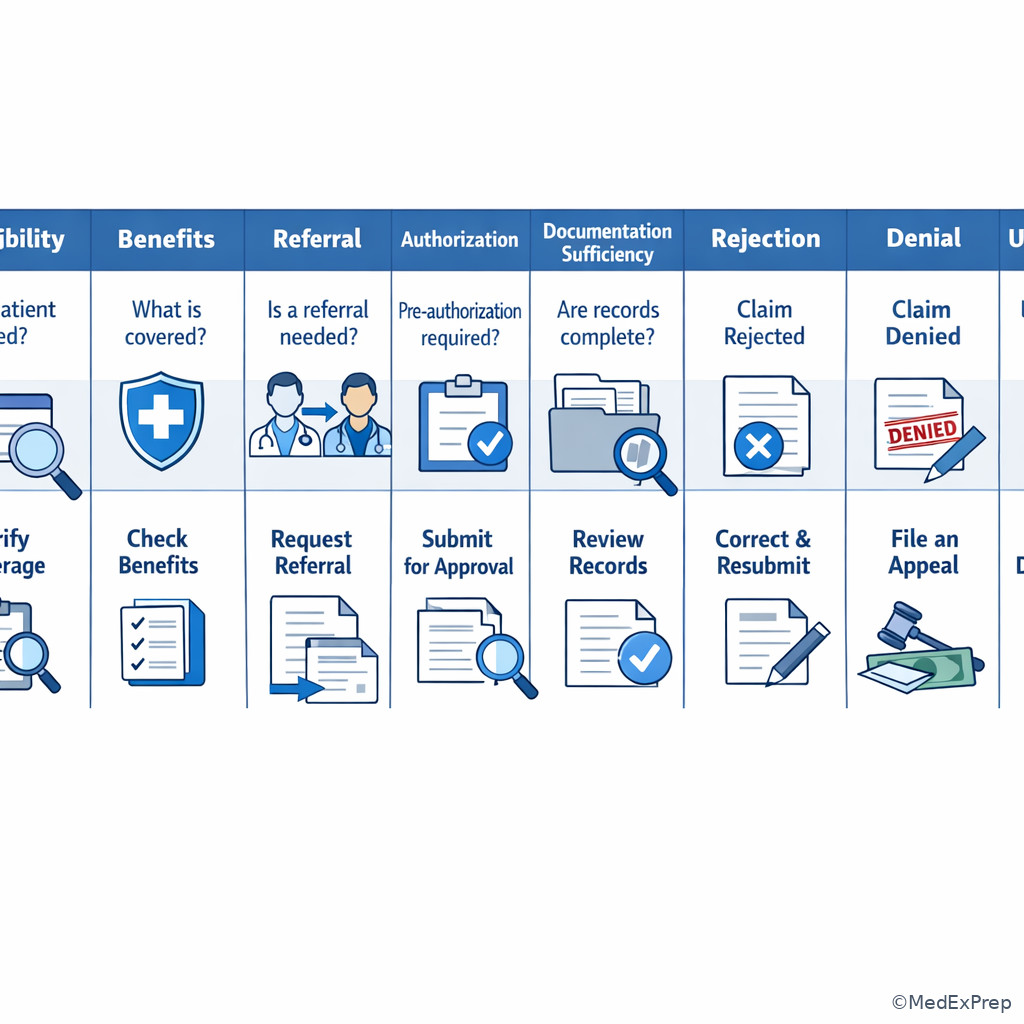
The final integration conflict is similar workflow labels that have different consequences. Candidates often blur eligibility, benefits, referral, authorization, documentation sufficiency, rejection, denial, underpayment, and privacy-safe communication. The single rule that resolves these near-miss distractors is to ask: What specific failure is being described, and at what point in the process does it matter?
Eligibility answers whether coverage appears active. Benefits helps estimate covered services and patient responsibility. Referral and authorization are service-access requirements when applicable. Documentation sufficiency supports downstream processing but does not replace payer approval. Rejections happen before adjudication due to data or format problems. Denials happen after adjudication or review because the claim cannot be paid as billed. Underpayment is different again: some payment occurred, but not the expected amount. Privacy issues may coexist with any of these but require separate communication safeguards.
WHY THIS IS TESTED: exam items often provide one correct administrative category and three close neighbors. See Fig 5 and Fig 6 for comparison visuals that compress these distinctions. These are the pairs most likely to create distractors across the rest of the course.
High-Yield Connection: This concept overlaps with future topics on Eligibility And Benefits Verification, Referral Versus Authorization, and Rejections Versus Denials. For exam day, know the trigger phrase that places the problem in the right bucket.
B Worked example
A 76-year-old patient with coronary artery disease and osteoarthritis calls after receiving a letter saying a claim was “not processed due to invalid subscriber information.” The patient also mentions the specialist office asked for an authorization last month, and the spouse wants to discuss the account while the patient is driving. The stem includes a distracting mention that the office was short-staffed on the visit date. The question asks for the best interpretation of the immediate issue.
Reasoning chain: identify task → classify the operational problem described by the notice. Extract key facts → “not processed due to invalid subscriber information” points to pre-adjudication data failure; authorization mention is older and may be unrelated; spouse disclosure raises a separate privacy concern but is not the claim classification asked first. Apply rule → invalid subscriber information usually maps to a rejection/data issue, not a denial for medical review. Eliminate distractors → not underpayment because no payment occurred, not pure authorization failure because the notice specifies subscriber data, not documentation insufficiency unless the notice states missing records. Verify → immediate issue is data-related claim rejection or equivalent front-end claim-processing failure, with privacy-safe communication handled separately.
C Exam trap
Common wrong answer: “This is a denial due to missing authorization.”
Why it is tempting: the stem mentions authorization and a specialist service, which feels highly testable.
Single clue that eliminates it: the notice specifically cites invalid subscriber information, pointing to a data-processing problem rather than a service-approval determination.
D Checkpoint
Question: Which phrase most strongly points to a data-processing issue rather than a documentation or authorization issue?
- “Coverage active but benefit details vary by service.”
- “Records requested to support review.”
- “Invalid subscriber information; claim not processed.”
- “Precertification required for this service category.”
Answer: C.
- A: tempting because benefits affect payment; wrong because it reflects coverage interpretation, not a processing failure.
- B: tempting because records can block payment; wrong because it points toward documentation review rather than subscriber data error.
- C: tempting because it sounds technical; right because it identifies a specific data element issue that prevented normal processing.
- D: tempting because service requirements are common; wrong because it describes an authorization-type issue, not invalid member data.
If you missed this: Review 1.1.1.5 Integration view: using the domain map to avoid common distractors across the course — focus on the exact trigger phrase that separates data errors from authorization, documentation, and payment problems.
Exam Traps & Differentiators
Common traps & distractors: The exam often gives you one compliant workflow answer and three tempting shortcuts. The wrong options look efficient, patient-friendly, or familiar from another domain.
- Most common wrong answer and why: assuming an established patient record can be reused without re-verification. Tempting because prior visits imply continuity; wrong because current coverage, demographics, and service requirements may have changed.
- Looks similar but isn't: eligibility versus authorization. Eligibility confirms active coverage basics; authorization is service-specific approval when required.
- Looks similar but isn't: documentation sufficiency versus coding selection. Administrative staff may identify missing elements but should not independently make unsupported coding choices.
- Looks similar but isn't: rejection versus denial. Rejection usually signals a process/data issue before full adjudication; denial indicates nonpayment after adjudication or review.
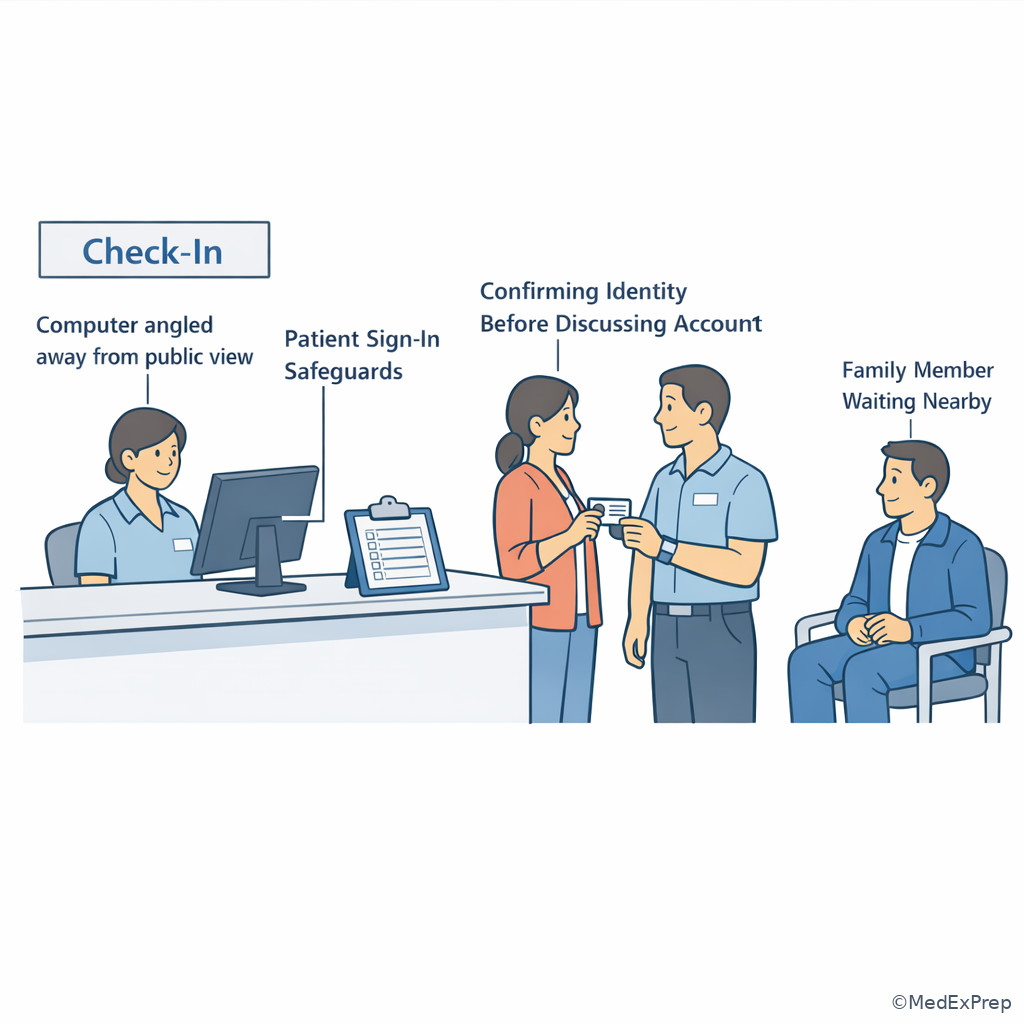
- Looks similar but isn't: patient service versus privacy compliance. Being helpful never justifies unauthorized disclosure.
| Stem says... | Think... | Best first check |
|---|---|---|
| “Insurance changed” or “new employer plan” | Current registration and eligibility workflow | Update demographics and current plan details before service |
| “Service may need approval” | Referral/authorization pathway | Verify requirement for the specific service and payer |
| “Claim not processed due to invalid member/subscriber info” | Data-processing failure | Correct subscriber/plan fields tied to the date of service |
| “Records requested” | Documentation sufficiency or audit support | Confirm required records are complete and route properly |
| “Family member asks for account details” | Privacy-safe communication check | Verify authorization/permitted disclosure before discussing |
| “Prior balance exists” in a mixed stem | Potential distractor unless it blocks current workflow | Ask whether it is the current encounter’s earliest unresolved requirement |
Related future traps appear in Front-End And Back-End Flow, where candidates confuse timing, and in Best-Next-Step Reasoning, where they chase the loudest clue instead of the governing one.
Exam takeaway: Distinguish near-match terms by the exact workflow stage and failure type described in the stem.
Exam takeaway: The correct answer usually addresses the earliest unresolved requirement while staying inside role boundaries.
flowchart TD
A[Read the stem] --> B[Identify the task]
B --> C{What is blocked?}
C -->|Current data| D[Registration or eligibility action]
C -->|Service requirement| E[Referral or authorization workflow]
C -->|Missing record element| F[Documentation review and routing]
C -->|Submitted claim issue| G[Reject denial or payment follow-up]
C -->|Disclosure concern| H[Privacy-safe communication step]
D --> I[Verify scope and policy]
E --> I
F --> I
G --> I
H --> I
I --> J[Choose compliant next step] Exam takeaway: Administrative accuracy must be paired with minimum-necessary communication safeguards at every workflow stage.
Review connection: The traps above test domain classification and role-safe action selection. If any felt unfamiliar, revisit 1.1.1.4 Applied stem reading: classify the problem before choosing the next step before attempting the Self-check quiz.
Tables
| Summary reference: CPBP inferred domains | Core question type | Typical candidate action | Common exam distractor |
|---|---|---|---|
| Business operations foundations | What workflow is being tested? | Classify task and apply general rule | Jumping to a payer-specific conclusion too early |
| Patient access/front-end | What must be collected or verified before service? | Confirm demographics, insurance, scheduling details | Assuming prior data remains current |
| Claims/billing workflow | What blocks clean claim processing? | Review claim dependencies and route issues | Confusing preclaim and postclaim tasks |
| Reimbursement/financial basics | How should balances, payment logic, or follow-up be interpreted? | Communicate basic responsibility and follow policy | Guaranteeing coverage or payment |
| Documentation/record support | Is the record sufficient for workflow? | Identify missing/inconsistent items and escalate | Improperly changing or inventing documentation |
| Compliance/privacy | Is the action permitted and role-safe? | Limit disclosure and escalate ambiguity | Prioritizing convenience over compliance |
| Practice operations/communication | What is the best coordinated next step? | Use policy-aware, professional workflow judgment | Addressing the loudest issue instead of the governing issue |
| Integrated cases/exam readiness | How do multiple domains interact? | Task → facts → rule → act → verify | Solving only one fragment of a multi-domain problem |
| Comparison | Eligibility | Authorization | Documentation sufficiency |
|---|---|---|---|
| Main question answered | Is coverage active and what basic benefits apply? | Does this service need payer approval? | Does the record contain needed support for workflow? |
| Typical timing | Before service | Before service or before claim, depending on requirement | Before claim release, review, or response to request |
| Typical trigger phrase | Active/inactive coverage, copay, deductible, plan status | Referral needed, prior approval, precertification | Missing note, unsigned record, requested records |
| Best administrative action | Verify and document results | Route/confirm requirement and status | Identify missing elements and escalate properly |
| Tempting wrong assumption | Active coverage means every service is payable | Provider order alone eliminates payer rules | Administrative staff may create missing support |
| Differential/classification clue | Likely category | Why | Immediate next administrative move |
|---|---|---|---|
| “Claim not processed due to invalid member ID” | Rejection/data error | Process blocked by claim data quality | Correct member data and resubmit per workflow |
| “Service not approved; authorization absent” | Authorization issue | Service requirement not satisfied | Verify payer requirement and route appeal/support as policy allows |
| “Records needed to support review” | Documentation sufficiency | Administrative workflow depends on complete record support | Gather and route required records through approved process |
| “Family member wants full account details” | Privacy/authorization check | Disclosure permission must be confirmed | Verify authorization/permitted disclosure before discussing |
| “Patient changed jobs and plan last month” | Registration/eligibility update | Current coverage data may no longer match visit date | Update insurance and verify current eligibility |
| “Claim paid less than contract expectation” | Underpayment follow-up | Payment occurred but amount may be incorrect | Review remittance, compare to expectation, follow policy |
Exam takeaway: Small intake fields can determine whether statements, claims, and follow-up tasks succeed later.
Algorithm / Approach
Forward reference: in Front-End And Back-End Flow, this algorithm will be connected to time-of-service versus post-service responsibilities. In Best-Next-Step Reasoning, the same structure will be used to eliminate distractors quickly.
Rapid Review
- Domain map → classify the task before judging the answer choices
- Established patient → not a substitute for current verification
- Eligibility → active coverage/basic benefits, not guaranteed payment for all services
- Authorization → service-specific requirement, not the same as active eligibility
- Documentation sufficiency → identify missing support; do not create missing support
- Rejection → data/process problem before full adjudication
- Denial → nonpayment after adjudication or review
- Underpayment → some payment posted, amount still requires analysis
- Patient-friendly shortcut → wrong if it overrides policy or role boundaries
- Family member request → privacy check before account discussion
- Old balance in stem → distractor unless it blocks the current workflow question
- Unreadable card or changed plan → front-end correction before downstream processing
- Unclear payer rule → verify current guidance and escalate appropriately
- Best next step → address earliest unresolved requirement
Memory anchor: Map before move. First map the problem to its domain; then move to the compliant next step.
Self-check quiz
1. An established patient calls to confirm tomorrow's visit and reports a new employer insurance plan started this month. The old insurance card remains in the chart. What is the most appropriate next step?
- Keep the old plan on file because the patient has been seen before.
- Collect updated insurance information and complete current verification workflow.
- Promise the visit will be covered because the patient is established.
- Wait until the claim rejects before asking for new insurance details.
2. Which action is most clearly outside the CPBP administrative role in a routine ambulatory practice scenario?
- Documenting that insurance information is missing and routing follow-up
- Explaining that payer requirements may affect patient responsibility
- Independently selecting the diagnosis code that best supports payment
- Verifying demographic information at check-in
3. A 52-year-old patient with asthma and hyperlipidemia arrives for a specialist visit. Eligibility was checked two days ago and appears active. At checkout, staff see a note that “service requirements may apply,” the provider note is signed, and the patient also asks about a small old balance. What is the best next step for the current encounter?
- Start claim status follow-up immediately
- Verify whether a referral or authorization requirement applies to this service
- Focus first on collecting the old balance because it is already known
- Tell the patient active eligibility means all service requirements are satisfied
4. A 61-year-old patient with diabetes and osteoarthritis moved recently. Registration confirmed name and date of birth but did not update the address because the visit ran late. The claim later paid with patient cost-sharing, and the patient statement went to the old address. What workflow category most likely explains the problem?
- Front-end demographic maintenance failure
- Authorization failure for the service
- Denial due to lack of clinical necessity
- Privacy breach requiring automatic reporting in all cases
5. A 44-year-old patient with hypertension and chronic sinusitis receives a payer notice stating the claim was “not processed due to invalid subscriber information.” The patient also mentions a prior authorization was discussed at another office. Which interpretation is most likely correct?
- The immediate issue is a data-processing/rejection-type problem
- The immediate issue is definitely missing authorization
- The immediate issue is an underpayment
- The immediate issue is documentation sufficiency only
6. A 70-year-old Medicare patient with chronic heart failure and arthritis asks the checkout staff to “bill it as preventive” because another office did that once. The provider note is not finalized, the spouse is requesting full account details at the desk, and the patient says coverage should be guaranteed if the doctor ordered the visit. What is the most appropriate next step?
- Change the visit classification in the billing screen to help the patient avoid cost-sharing
- Explain that finalized documentation and payer rules govern processing, avoid unauthorized disclosure, and route questions through policy
- Guarantee coverage because provider recommendation establishes medical necessity
- Discuss full account details with the spouse because they appear involved in care
7. A 38-year-old established patient with lupus and migraines is scheduled for a specialist procedure next week. The chart has an active plan from last year, a recent portal message about a possible plan change, and a note from another department mentioning a prior authorization for a different service. The patient is upset about an old balance and wants the office to “just use what worked before.” Which action is the best initial administrative move?
- Use last year's insurance and prior authorization because the patient is established
- Update current insurance information and verify service-specific requirements for the upcoming procedure
- Send the account to billing first because the old balance is the clearest problem
- Ask the provider to choose a diagnosis that will likely secure coverage
8. A 67-year-old patient with COPD and atrial fibrillation calls about a recent claim letter, says their daughter handles finances, and asks why the service was not paid. The letter states “records requested for review,” while the daughter on speakerphone asks the staff member to read the full account history. Which is the best combined interpretation and next step?
- This is purely a patient-balance issue; discuss the entire account with the daughter to speed resolution
- This is a documentation-support issue; verify disclosure permission before sharing details and route record-related follow-up per workflow
- This is definitely invalid subscriber information; correct the member ID immediately without further review
- This is a coding issue; select the diagnosis most likely to justify the service and resubmit
Answer key
1. Correct answer: B
- A: tempting because established patients often seem lower risk for intake errors; incorrect because the single discriminating clue is the new employer insurance plan started this month, making current verification necessary.
- B: tempting because it requires extra work before service; correct because the new plan creates a current front-end verification task, and updated insurance data is a downstream claim dependency.
- C: tempting because prior history can feel reassuring; incorrect because the clue new plan started this month means no coverage promise can be made.
- D: tempting because some offices fix issues after rejection; incorrect because the lesson tests denial prevention and clean-claim thinking, not reactive delay.
If you missed this: Review 1.1.1.1 Foundational domain structure: what the exam is really testing — focus on classifying insurance change as a front-end verification task.
2. Correct answer: C
- A: tempting because routing follow-up can feel passive; incorrect because documenting missing information and escalating is an allowed administrative action.
- B: tempting because discussing money can feel risky; incorrect because basic financial responsibility communication within policy is within role.
- C: tempting because diagnosis selection affects payment and may seem practical; correct because independently selecting diagnosis coding is outside the role as framed in this course.
- D: tempting because it is routine; incorrect because demographic verification is a core CPBP task.
If you missed this: Review 1.1.1.2 Role boundaries: what you may do, what you must not do, and when to escalate — focus on rejecting options that require coding authority.
3. Correct answer: B
- A: tempting because billing workflow eventually follows the visit; incorrect because the clue service requirements may apply shows a preclaim issue remains unresolved.
- B: tempting because the patient’s old balance is easier to address; correct because the current encounter’s earliest blocker is whether referral/authorization requirements apply.
- C: tempting because old balances are concrete and actionable; incorrect because the question asks for the current encounter’s best next step, and the old balance does not govern claim readiness for today.
- D: tempting because active eligibility sounds comprehensive; incorrect because active coverage does not automatically satisfy service-specific requirements.
If you missed this: Review 1.1.1.4 Applied stem reading: classify the problem before choosing the next step — focus on addressing the earliest unresolved requirement.
4. Correct answer: A
- A: tempting because address updates feel minor; correct because the clue statement went to the old address identifies a front-end demographic error with back-end consequences.
- B: tempting because payment issues often involve authorization; incorrect because the claim was paid with patient cost-sharing, and the failure described is misdirected statement communication.
- C: tempting because any payment issue may suggest medical review; incorrect because nothing in the stem points to clinical necessity review.
- D: tempting because sending mail to an old address can raise privacy concerns; incorrect for this item because the tested category is the workflow failure that caused downstream A/R problems, not automatic reportability.
If you missed this: Review 1.1.1.3 Workflow domains and data dependencies: how one mistake travels through the revenue cycle — focus on demographic fields as revenue-cycle dependencies.
5. Correct answer: A
- A: tempting because “invalid subscriber information” sounds technical and easy to overread; correct because the specific clue identifies a data-processing failure rather than a service-approval or payment-amount issue.
- B: tempting because the stem mentions prior authorization; incorrect because the discriminating phrase is not processed due to invalid subscriber information, which points elsewhere.
- C: tempting because payment disputes are common; incorrect because underpayment requires that some payment occurred, which is not what the notice says.
- D: tempting because records problems also block payment; incorrect because the notice names subscriber information, not supporting records.
If you missed this: Review 1.1.1.5 Integration view: using the domain map to avoid common distractors across the course — focus on trigger phrases that separate data errors from authorization and documentation issues.
6. Correct answer: B
- A: tempting because it seems to solve the patient’s immediate financial concern; incorrect because the note is not finalized and staff must not reclassify services to influence payment improperly.
- B: tempting because it feels less satisfying to the patient; correct because it addresses both the documentation-integrity issue and the privacy issue while staying within role boundaries.
- C: tempting because provider recommendation sounds powerful; incorrect because provider recommendation does not guarantee payer coverage, and administrative staff must not promise it.
- D: tempting because spouses often participate in care or finances; incorrect because the stem does not establish disclosure permission, making full account discussion unsafe.
If you missed this: Review 1.1.1.2 Role boundaries: what you may do, what you must not do, and when to escalate — focus on refusing shortcuts that alter records or bypass privacy safeguards.
7. Correct answer: B
- A: tempting because prior data and prior approval feel reusable; incorrect because the discriminating clues are possible plan change and authorization for a different service, which require current service-specific verification.
- B: tempting because it creates more front-end work before the procedure; correct because it addresses current insurance and the upcoming service requirement before downstream failure occurs.
- C: tempting because the old balance is concrete and emotionally urgent; incorrect because it is not the initial blocker for the upcoming procedure’s compliant processing.
- D: tempting because diagnosis support affects payment; incorrect because asking the provider to choose a diagnosis for coverage reasons shifts the issue toward improper role framing and ignores the current verification need.
If you missed this: Review 1.1.1.3 Workflow domains and data dependencies: how one mistake travels through the revenue cycle — focus on updating current plan data and matching service-specific requirements to the date of service.
8. Correct answer: B
- A: tempting because patient balance conversations are familiar and the daughter may truly help with finances; incorrect because the letter says records requested for review and disclosure permission must be verified before discussing full details.
- B: tempting because it requires handling two issues at once; correct because the stem combines a documentation-support issue with a privacy-safe communication decision.
- C: tempting because claim letters often involve member ID problems; incorrect because the discriminating clue is records requested for review, not invalid subscriber information.
- D: tempting because denied or delayed claims may push candidates toward coding fixes; incorrect because selecting diagnoses is outside role and does not match the stated issue.
If you missed this: Review 1.1.1.5 Integration view: using the domain map to avoid common distractors across the course — focus on separating documentation-review clues from privacy-disclosure decisions.
Keep going with the full CPBP Prep Course (CPBP)
You just studied the way members do, in the same lesson interface. Full access unlocks every lesson, the question bank and flashcards for a full year.
One payment · 1 year of access · No auto-renewal