1.1.1 - CPB Domain Map
CPB Domain Map
What you'll learn
- DOMAIN: Exam foundations → blueprint interpretation → map broad CPB content areas to teachable billing subskills.
- DOMAIN: Revenue cycle workflow → task recognition → identify where claim preparation, submission, posting, and follow-up fit across the exam.
- DOMAIN: Billing compliance → scope-safe decision-making → separate biller actions from coder, provider, and payer-level decisions.
- DOMAIN: Test strategy → domain prioritization → use the domain map to choose the most appropriate next billing step on exam-style scenarios.
- DOMAIN: Integrated case reasoning → cross-topic navigation → connect insurance, claim forms, remittance, denials, and patient balances into one workflow.
- Exam Foundations → Domain map interpretation → claim lifecycle, payer concepts, reimbursement, denials, posting, compliance
- Billing Workflow → Task routing objective → pre-bill review, submit, reconcile, follow up, escalate
- Compliance & Role Boundaries → Scope objective → when to hold, verify, query, or escalate rather than assume
- Integrated Problem Solving → Subskill → identify task → extract facts → apply billing rule → choose next action → verify account status
Why it matters
- The CPB exam rewards task recognition: before solving the question, you must know whether you are dealing with a claim form issue, insurance concept, remittance problem, denial, or compliance concern.
- Many wrong answers are tempting because they are correct in a different domain; the domain map helps you reject those choices quickly.
- Billing exam stems often include extra facts. A clear domain map lets you separate signal from noise and choose the next appropriate billing action.
- Understanding the map early makes later topics stick because each new lesson attaches to a familiar place in the overall revenue cycle.
Key Terms & Must-Know Facts
1.1.1.1 Key terms
- Blueprint — the tested content framework or competency outline.
- Domain — a major tested category such as claim forms, denials, or compliance.
- Subskill — a teachable task inside a broad domain.
- Clean claim — a claim with the required data elements to process without avoidable edits.
- Rejection — a claim not accepted into processing, often due to format or missing data.
- Denial — a claim processed and not paid, or not fully paid, for a stated reason.
- ERA/EOB — remittance communication used for payment posting and follow-up.
- Patient responsibility — balance assigned to the patient, such as deductible, copay, or coinsurance.
- Coordination of benefits — rules determining primary, secondary, and tertiary payer order.
- Timely filing — the claim submission deadline set by payer policy or contract.
- Escalation — routing an issue beyond biller scope for coding, provider, or compliance review.
- Scope boundary — the limit of the biller’s role in relation to coding, clinical, or legal decisions.
1.1.1.2 Must-know facts
- The CPB exam tests billing workflow decisions, not clinical diagnosis.
- When data are missing or inconsistent, the safe action is often to hold, verify, or escalate.
- Claim forms, remittance advice, payer rules, and account notes are core exam documents.
- Coverage, payment, and patient balance are related but not interchangeable.
- A rejected claim usually needs correction and resubmission; a denied claim usually needs analysis and next-step selection.
- Official rules may vary by payer or contract; when not provided, the correct exam move is to confirm current instructions.
- Billers may review coding outputs for billing consistency, but should not independently create or change codes when coding judgment is required.
- The exam often hides the real task inside noise such as demographics, dates, or non-decisive account details.
Exam takeaway: Use the domain first to identify what the question is really asking you to do.
flowchart TD
A[CPB Domain Map] --> B[Insurance and Payer Concepts]
A --> C[Claim Forms and Data]
A --> D[Submission Workflow]
A --> E[Reimbursement and Posting]
A --> F[Denials and Appeals]
A --> G[Patient Accounts and A/R]
A --> H[Compliance and Privacy]
B --> B1[Eligibility]
B --> B2[Benefits]
B --> B3[COB]
C --> C1[CMS-1500]
C --> C2[837P]
C --> C3[UB-04 basics]
D --> D1[Clean claim review]
D --> D2[Acceptance or rejection]
D --> D3[Corrected claims]
E --> E1[Allowed vs paid]
E --> E2[Adjustments]
E --> E3[Patient responsibility]
F --> F1[Rejections]
F --> F2[Denials]
F --> F3[Appeals support]
G --> G1[Statements]
G --> G2[Follow-up]
G --> G3[Collections basics]
H --> H1[Accurate representation]
H --> H2[HIPAA]
H --> H3[Escalation]
Exam takeaway: Visualize where front-end data, claims, remits, and follow-up connect so you can locate the tested task quickly.
Core content
1.1.1.3 Foundational domain buckets: what the exam is really organizing
A Explanation
The first decision conflict on the CPB exam is not “Which answer looks familiar?” It is “Which domain owns this problem?” A stem may mention eligibility, a modifier, an ERA remark, and a patient balance all at once. Your job is to choose between competing interpretations and identify the single rule that resolves the question. If the question asks for the next billing step after missing claim data, that belongs to claim preparation or submission workflow, not reimbursement. If it asks how to act after remittance review, it belongs to posting, reconciliation, or denials.
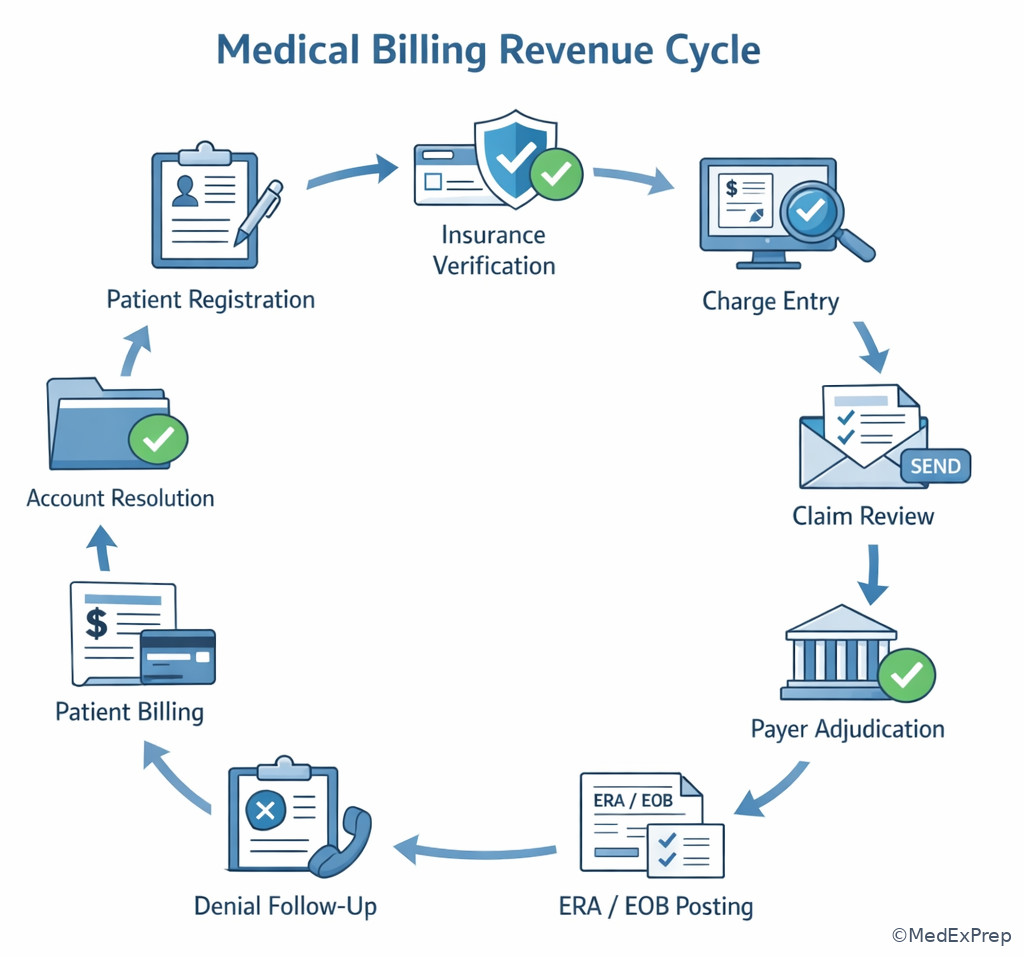
WHY THIS IS TESTED: The exam tests whether you can route a problem correctly before acting. The most common failure is solving the wrong problem: posting when you should verify eligibility, appealing when you should correct the claim, or assigning patient balance before the payer order is confirmed. See Fig 1.
At a high level, the course and exam organize into a few repeatable buckets: insurance and payer concepts, claim forms and data, claim submission workflow, reimbursement methodologies, remittance and posting, denials and appeals, patient accounts and A/R, and compliance/privacy. Broad blueprint language can sound vague, but for test-taking, convert each domain into a practical action verb: verify, prepare, submit, post, reconcile, follow up, escalate, protect compliance.
B Worked example
A multispecialty clinic is preparing a professional claim for a 67-year-old patient with diabetes and chronic kidney disease. The account notes mention a prior deductible balance, a recent address change, and a telephone inquiry from the spouse about a statement. The biller sees that the payer returned the last transmission as “subscriber ID invalid,” but the chart also contains an ERA from a different date showing coinsurance on another service. The most appropriate next billing step is to correct the demographic or subscriber data issue and resubmit the rejected claim, not to post patient responsibility from the unrelated ERA.
Reasoning chain: Identify task → this is a submission acceptance problem. Extract key facts → “subscriber ID invalid” is a claim acceptance/edit issue; the other ERA is noise. Apply rule → rejections from bad data belong to claim correction/resubmission. Eliminate distractors → posting coinsurance, billing the patient, or appealing are wrong domains. Verify → confirm corrected payer/subscriber information before resubmission.
C Exam trap
D Checkpoint
Question: A claim has not entered payer processing because the clearinghouse flagged an invalid subscriber number. Which domain best frames the next billing action?
- Payment posting and contractual adjustments
- Claim preparation/submission workflow
- Patient collections workflow
- Appeal support after adjudication
Answer: B
- A: Tempting because subscriber issues can affect payment, but wrong because no adjudication or remittance exists yet.
- B: Correct because invalid subscriber data prevents clean claim acceptance and must be corrected before processing.
- C: Tempting if the candidate assumes coverage failed, but wrong because the account has not reached patient-balance stage.
- D: Tempting because a payer problem is involved, but wrong because appeals follow adjudication, not pre-processing rejection.
1.1.1.4 The claim lifecycle as the spine of the domain map
A Explanation
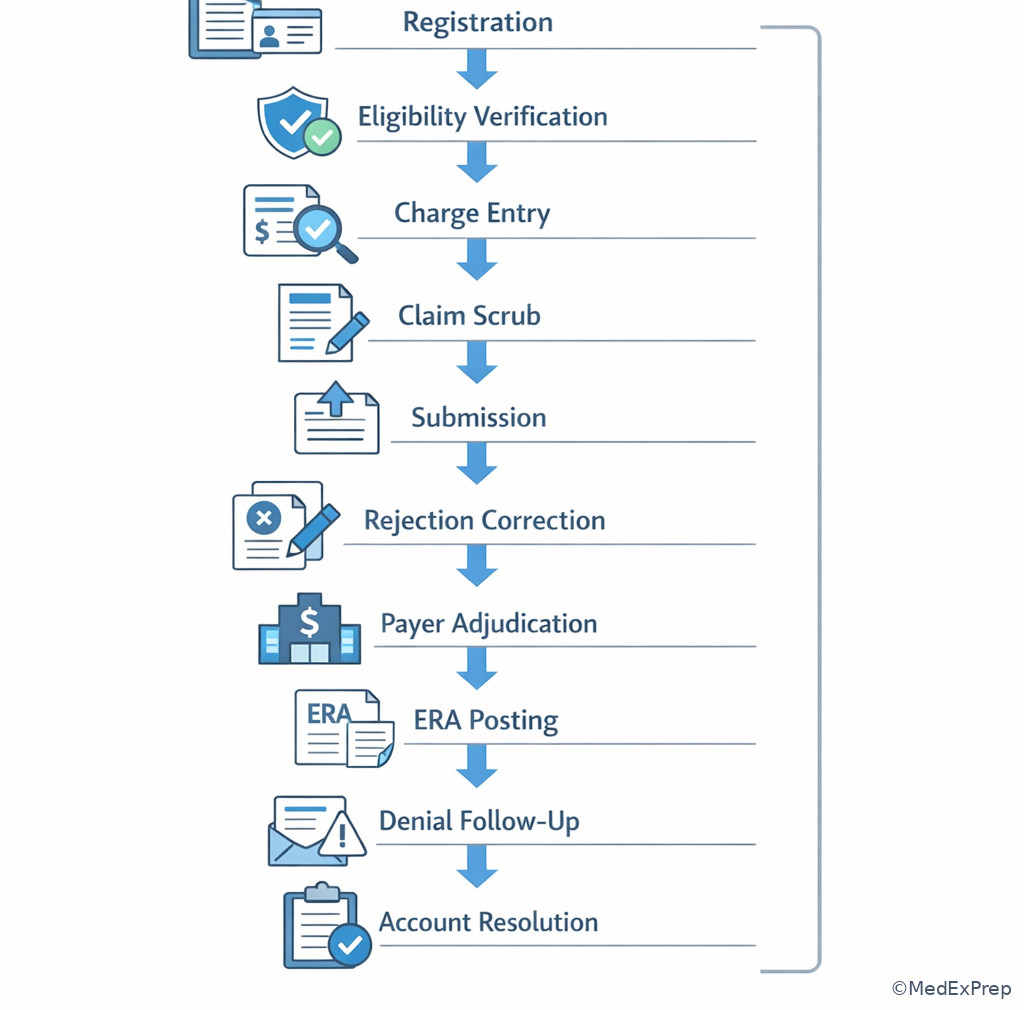
Once you know the domain, the next decision conflict is where the account sits in the revenue cycle. The exam repeatedly asks you to choose between actions that are all reasonable in general but correct only at one stage. Before submission, you verify data completeness, payer information, authorization or referral status when required, and billing consistency. After transmission, you track acceptance, rejection, or pending status. After adjudication, you post payments and adjustments, identify denials, and decide on follow-up. Only after correct insurance processing do you move the proper patient responsibility forward.
WHY THIS IS TESTED: Many stems are stage-mismatch traps. A candidate may choose an action that would be appropriate later, but not yet. The single resolving rule is: the next step must match the current lifecycle stage. See Fig 2.
This lifecycle framing also explains why broad exam content feels connected. Eligibility errors cause claim rejections; claim rejections delay payment; delayed payment can create false patient balances; poor posting can hide underpayments; weak follow-up can turn avoidable denials into A/R aging. If you map the stem to a stage, your answer should usually preserve clean-claim processing, truthful representation, and audit-ready documentation.
Exam takeaway: Match the next billing action to the account’s current stage rather than to the first familiar term in the stem.
flowchart LR
A[Registration and insurance data] --> B[Pre-bill review]
B --> C[Claim submission]
C --> D{Accepted?}
D -->|No| E[Correct and resubmit]
D -->|Yes| F[Payer adjudication]
F --> G[ERA/EOB review]
G --> H{Paid as expected?}
H -->|Yes| I[Post and bill patient if appropriate]
H -->|No denial| J[Variance or underpayment follow-up]
H -->|Denied| K[Denial analysis and next action]
K --> L[Appeal, corrected claim, or write-off per policy] Exam takeaway: Picture the account moving stage by stage so you do not choose a later-stage action too early.
B Worked example
A dermatology office reviews an account for a 43-year-old patient with hypertension and asthma. The payer portal shows “claim denied for authorization not on file,” the statement queue shows a balance, and the front desk note says the patient recently updated employment information. A tempting action is to move the balance to patient responsibility because a statement is already queued. The correct action is to stop patient billing, analyze the denial stage issue, and verify whether authorization was required and whether supporting records or internal documentation exist.
Reasoning chain: Identify task → post-adjudication denial follow-up. Extract key facts → denial exists, so the claim passed acceptance; statement queue is noise. Apply rule → do not bill patient for balances that may still be payer-responsible. Eliminate distractors → demographic update may matter later, but it does not replace denial analysis. Verify → follow payer and organizational denial workflow.
C Exam trap
D Checkpoint
Question: Which principle most reliably prevents stage-mismatch errors on CPB questions?
- Always review patient demographic notes first
- Always calculate coinsurance before reading the rest of the stem
- Identify the account’s current lifecycle stage before choosing the next action
- Move any denied amount to patient balance unless the payer says otherwise
Answer: C
- A: Tempting because demographics affect many claims, but wrong because it is not the universal first discriminator.
- B: Tempting in reimbursement topics, but wrong because many questions are not payment-calculation problems.
- C: Correct because stage recognition determines whether you should correct, post, appeal, reconcile, or bill the patient.
- D: Tempting in collections-focused thinking, but wrong because denials often need follow-up before patient transfer.
- The stage before payer adjudication is claim submission/acceptance.
- True or False: A denial and a rejection are the same stage event. False.
- Name the three broad post-adjudication tasks: post, analyze variance/denial, transfer proper patient balance.
1.1.1.5 Scope boundaries inside the map: what the biller does versus routes out
A Explanation
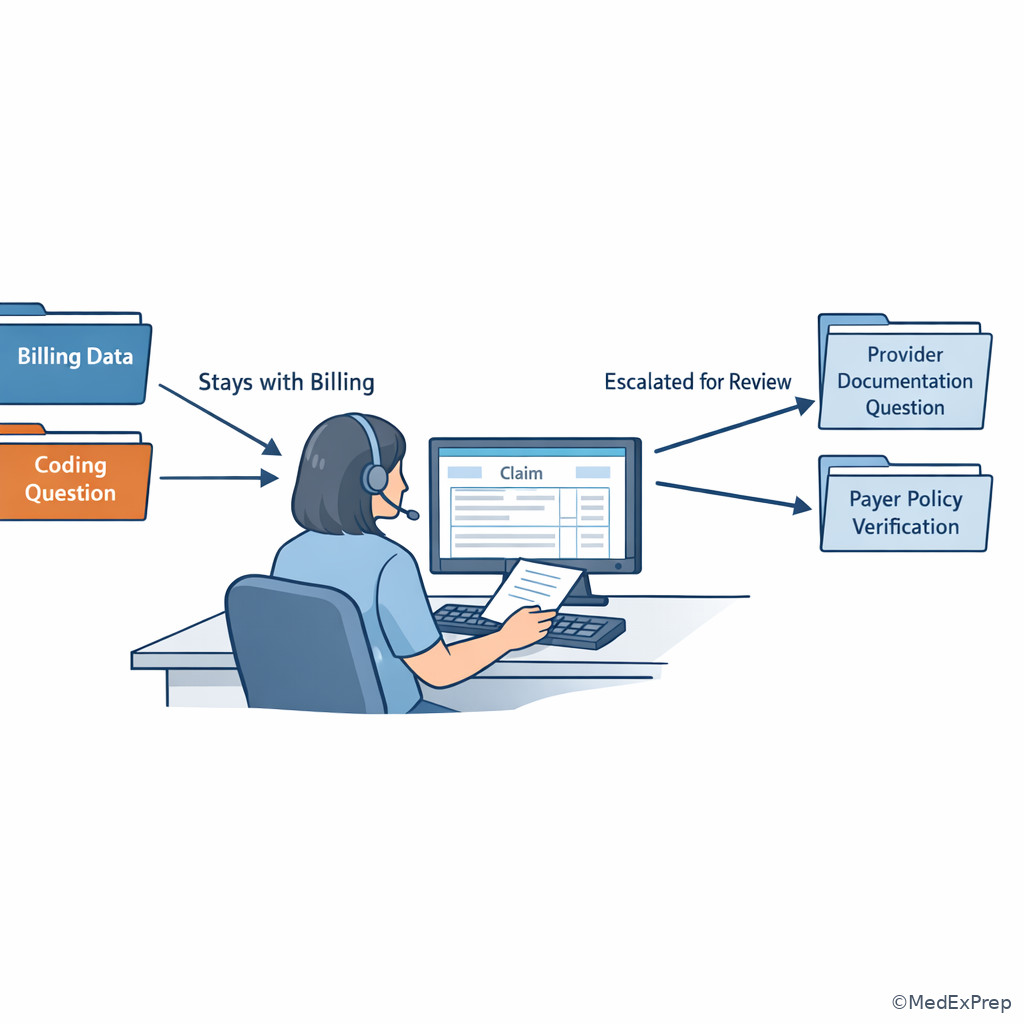
A major exam conflict is choosing between an action that seems proactive and an action that is actually scope-appropriate. The CPB candidate role is the medical biller: prepare and review claims for completeness, submit claims, post remits, analyze denials, follow up with payers, reconcile balances, and route unresolved issues correctly. The biller may identify inconsistent coding outputs or missing documentation, but should not independently change diagnosis or procedure codes when coding judgment is required. The biller should not diagnose the patient, determine medical necessity clinically, or invent payer rules.
WHY THIS IS TESTED: Exam writers use attractive “fix-it” distractors. A choice may sound efficient—change the code, select another diagnosis, assume the modifier, or decide the service was medically necessary—but those actions cross role boundaries. The single resolving rule is: if the task requires coding judgment, clinical judgment, or unsupported payer interpretation, hold and escalate through the approved workflow. See Fig 3.
This boundary is not passive. The correct biller action may still be decisive: identify the inconsistency, stop the claim from going out inaccurately, query the designated resource, verify payer instructions, and document the reason for the hold. That protects truthful claim submission and preserves documentation integrity.
Exam takeaway: When the stem requires coding, clinical, or unsupported policy judgment, the compliant answer is to hold and escalate rather than guess.
flowchart TD
A[Issue found by biller] --> B{Is it missing data or workflow data?}
B -->|Yes| C[Correct within billing workflow]
B -->|No| D{Requires coding or clinical judgment?}
D -->|Yes| E[Hold claim and escalate]
D -->|No| F{Requires payer-specific rule verification?}
F -->|Yes| G[Verify current payer instructions]
F -->|No| H[Proceed with supported billing action]
E --> I[Document hold reason and route]
G --> I Exam takeaway: Distinguish editable billing data from issues that require coder, provider, or payer clarification.
B Worked example
An orthopedics office is billing a professional claim for a 58-year-old patient with osteoarthritis and obesity. The claim includes a code set already assigned by coding staff, but the biller notices the operative note reference appears inconsistent with one line item. A coworker suggests changing the diagnosis pointer so the payer will accept the service, and the patient has already called twice asking why the claim is delayed. The most appropriate next billing step is to hold the claim and route the inconsistency to the designated coding or internal review resource, not to alter the coding output independently.
Reasoning chain: Identify task → scope boundary decision. Extract key facts → there is an inconsistency, but resolving it requires coding judgment. Apply rule → billers do not independently modify coding when coding interpretation is required. Eliminate distractors → patient pressure and delay are noise; speed does not justify unsupported claim changes. Verify → document the hold and escalation path.
C Exam trap
D Checkpoint
Question: Which action remains within the CPB biller role when a claim appears inconsistent with the available documentation?
- Assign a more suitable diagnosis code based on the note summary
- Hold the claim and route the inconsistency through the approved internal workflow
- Decide the service is medically necessary and submit with an explanatory note
- Replace the procedure code with a similar service that is more commonly paid
Answer: B
- A: Tempting because the biller wants to fix the mismatch, but wrong because original coding judgment is out of scope.
- B: Correct because the biller can identify the issue, stop the claim, and escalate appropriately.
- C: Tempting when medical necessity seems obvious, but wrong because clinical necessity is not the biller’s independent decision.
- D: Tempting as a payment-saving shortcut, but wrong because it misrepresents the documented service.
1.1.1.6 How exam stems hide the domain: signal, noise, and trigger words
A Explanation
By this point the challenge becomes practical: how do you identify the tested domain in a noisy stem? The exam often includes age, payer type, balance information, dates of service, call log notes, multiple diagnoses, and prior account events. Some of those facts matter; others are there to push you toward a familiar but wrong action. Your decision conflict is choosing between surface cues and workflow trigger words.
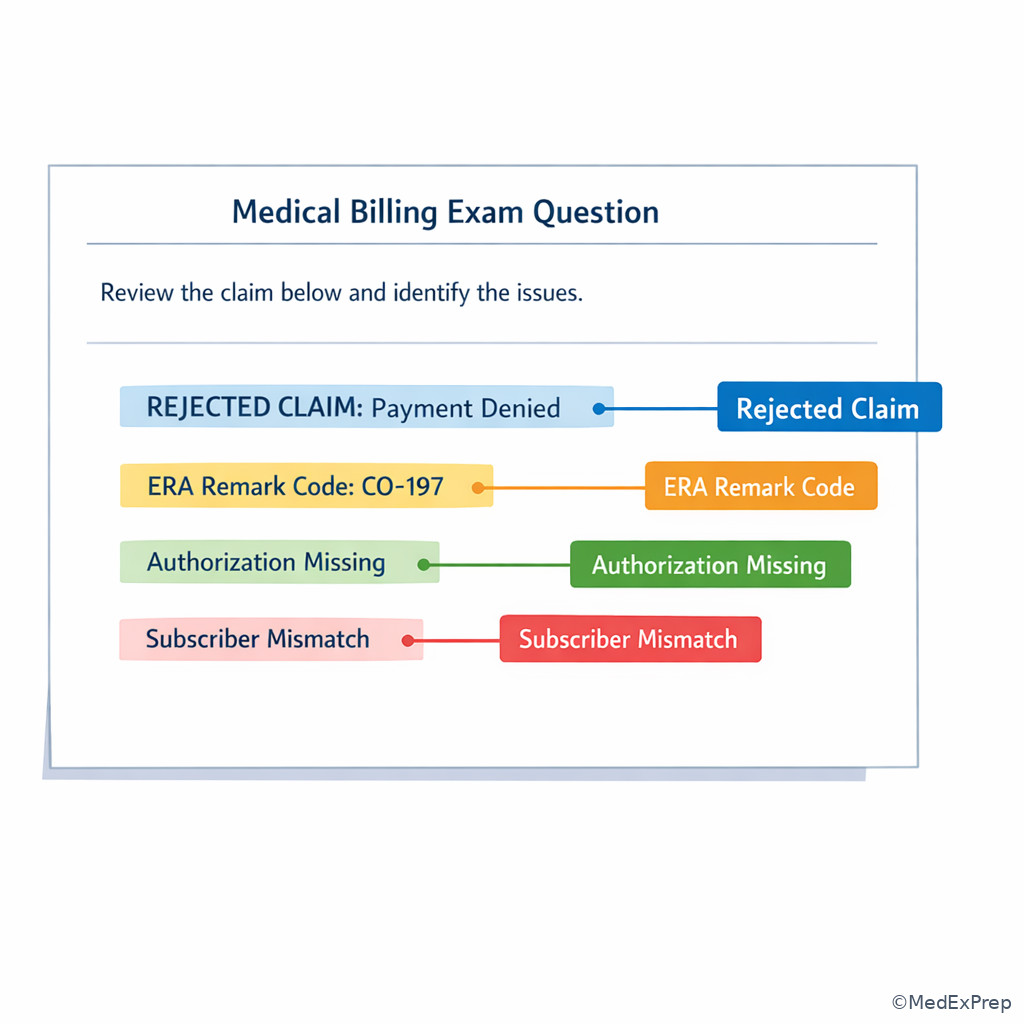
WHY THIS IS TESTED: CPB questions are rarely pure definitions. They mimic account review by forcing you to identify the operational trigger: “rejected,” “denied,” “ERA posted,” “authorization missing,” “subscriber mismatch,” “secondary on file,” “timely filing approaching,” “patient responsibility transferred,” or “requires clarification.” The single resolving rule is: trust the workflow trigger, not the loudest financial term. See Fig 4.
Examples: “Invalid member ID” means data correction before processing. “CARC/RARC on ERA” means remittance interpretation. “Patient has two active coverages” points toward coordination of benefits. “Claim filed late” points toward timely filing risk. “Provider note unclear” shifts toward escalation, not independent repair. A strong test taker highlights three items only: the current status, the specific obstacle, and the authority level required to resolve it.
Exam takeaway: A small set of trigger terms can route a long scenario to the correct billing workflow within seconds.
flowchart TD
A[Stem phrase] --> B{Trigger word}
B -->|rejected invalid ID| C[Claim data correction]
B -->|ERA CARC RARC| D[Remittance posting and action]
B -->|denied auth missing| E[Denial analysis]
B -->|primary secondary conflict| F[COB review]
B -->|timely filing limit| G[Filing risk management]
B -->|documentation unclear| H[Hold and escalate]
Exam takeaway: Mark status, obstacle, and owner to cut through distracting details in long scenarios.
B Worked example
A family practice biller reviews an account for a 29-year-old patient with migraine and hypothyroidism. The stem notes a balance of $85, an address typo corrected last month, a spouse phone message, and a payer remark that the claim was denied as duplicate. A tempting answer is to send the statement because there is an open patient balance. The correct first interpretation is denial management: investigate whether the duplicate determination reflects a true duplicate, resubmission overlap, corrected claim handling issue, or another previously processed service.
Reasoning chain: Identify task → denial category. Extract key facts → “denied as duplicate” is the trigger; address typo and spouse call are noise. Apply rule → determine the denial basis before balance transfer. Eliminate distractors → open balance does not automatically equal patient responsibility. Verify → compare prior claim history and payer records before next action.
C Exam trap
D Checkpoint
Question: A stem mentions a patient balance, a prior statement, and an ERA with CARC information. Which detail most strongly determines the tested domain?
- The existence of any balance
- The prior statement date
- The ERA with CARC information
- The patient’s age
Answer: C
- A: Tempting because balances are visible and concrete, but wrong because balance alone does not identify the workflow stage.
- B: Tempting in A/R contexts, but wrong because statement timing is secondary to the current remittance event.
- C: Correct because CARC information routes the stem to remittance interpretation and next-action analysis.
- D: Tempting if you overread demographics, but wrong because age is often non-decisive noise in billing stems.
- If the stem says “invalid member ID,” think claim data correction before processing.
- True or False: A visible patient balance always means the patient should be billed now. False.
- ERA reason codes most often route you to remittance/denial analysis.
1.1.1.7 Using the map as a test-taking framework for next-step questions
A Explanation
The final integration skill is turning the domain map into a repeatable exam framework. On the CPB exam, the best answer is usually the one that preserves truthful billing, follows workflow sequence, stays within role boundaries, and protects reimbursement opportunity without guessing. The decision conflict is often between action speed and action validity. A fast but unsupported action may feel operationally efficient; the correct answer is the supported next step.
WHY THIS IS TESTED: “Most appropriate next billing step” questions require process discipline. The single resolving rule is: choose the earliest compliant action that addresses the actual barrier and keeps the claim or account moving correctly. See Fig 5.
This leads to a practical framework: identify the task, extract the controlling facts, name the domain, check the lifecycle stage, confirm the issue is within biller scope, then choose the supported next action. If facts remain missing—authorization status unclear, payer order uncertain, coding unsupported, contract rule not given—the best answer is often to verify or escalate rather than assume. This is not indecision; it is compliant billing judgment.
Exam takeaway: The best answer is the earliest compliant action that removes the real barrier without crossing scope boundaries.
flowchart TD
A[Read the stem] --> B[Identify task]
B --> C[Extract controlling facts]
C --> D[Name domain]
D --> E[Locate lifecycle stage]
E --> F{Within biller scope?}
F -->|No| G[Hold and escalate]
F -->|Yes| H{Enough supported info?}
H -->|No| I[Verify payer or internal data]
H -->|Yes| J[Take next billing action]
J --> K[Document disposition] Exam takeaway: A short checklist prevents you from choosing a familiar answer that belongs to the wrong stage or wrong role.
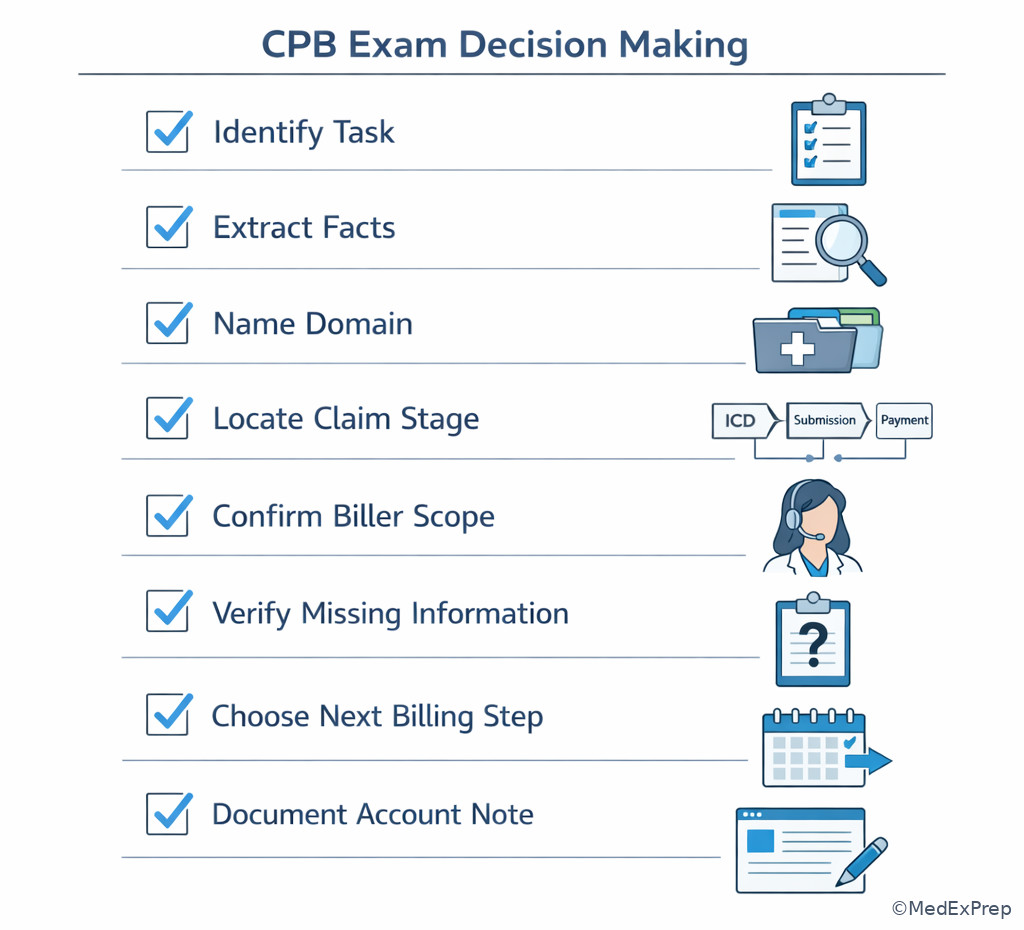
B Worked example
A cardiology practice reviews an account for a 72-year-old patient with coronary artery disease and chronic obstructive pulmonary disease. The claim was accepted, the ERA shows a partial payment with adjustment information, a secondary payer is listed in registration, and the patient already paid a copay at check-in. A tempting but wrong action is to bill the patient immediately for the remaining balance. The most appropriate next billing step is to interpret the remittance, determine what portion reflects contractual adjustment or patient responsibility, and if appropriate submit or bill according to the remaining payer sequence before issuing a patient statement.
Reasoning chain: Identify task → post-adjudication account resolution. Extract key facts → accepted claim, ERA present, secondary payer on file. Apply rule → do not bill patient until payer sequence and adjustments are resolved. Eliminate distractors → existing copay and patient age do not settle the remaining liability. Verify → post correctly, then determine whether secondary billing or patient transfer is appropriate.
C Exam trap
D Checkpoint
Question: Which answer best matches the CPB next-step framework when a stem leaves a payer rule uncertain?
- Assume the most common commercial rule and submit to avoid delay
- Choose the option that pays fastest, even if the policy detail is not stated
- Verify current payer instructions or escalate per workflow before acting
- Transfer the amount to patient responsibility until the payer responds
Answer: C
- A: Tempting because many offices rely on patterns, but wrong because the exam rewards supported action, not assumptions.
- B: Tempting under operational pressure, but wrong because speed does not outrank compliance or accuracy.
- C: Correct because uncertain payer-specific rules should be confirmed through current instructions or approved escalation paths.
- D: Tempting as a temporary resolution, but wrong because patient transfer before proper verification can misstate liability.
Exam Traps & Differentiators
- Most common wrong answer: billing the patient too early. Why: candidates see an open balance and treat it as settled liability. Eliminating clue: unresolved adjudication, secondary coverage, denial review, or missing posting step.
- Another high-frequency wrong answer: fixing coding yourself. Why: it looks like efficient claim cleanup. Eliminating clue: the issue requires coding or clinical judgment, so the biller must hold and escalate.
- Another trap: appealing a rejection. Why: both seem like payer nonpayment. Eliminating clue: the claim never entered adjudication, so correction/resubmission comes before appeal logic.
- Another trap: posting from unrelated remittance information. Why: money language feels definitive. Eliminating clue: the remittance is not tied to the service/date at issue.
Related future traps will appear in Medical Biller Scope and Out-Of-Scope Escalation: the exam often pairs a workflow question with an authority question. A choice may describe the right general domain but the wrong person performing it.
| Stem says… | Think… | Do not jump to… |
|---|---|---|
| Invalid member/subscriber ID | Claim data correction/rejection workflow | Patient billing or appeal |
| ERA with CARC/RARC | Remittance interpretation and posting/denial action | Front-end eligibility verification as the immediate step |
| Authorization not on file denial | Post-adjudication denial analysis | Automatic patient transfer |
| Two active coverages | COB and payer order review | Send patient statement first |
| Documentation unclear | Hold and escalate | Independent code or modifier changes |
| Timely filing approaching | Filing-risk management and workflow prioritization | Assuming exceptions not stated in the stem |
| Looks similar | But isn’t | Single differentiator |
|---|---|---|
| Rejection | Denial | \(Rejection = not accepted into processing\); \(denial = processed and not paid or not fully paid\) |
| Open balance | Patient-responsible balance | Open balance may still belong to payer sequencing, denial follow-up, or posting review |
| Billing correction | Coding change | Billing correction fixes supported claim data; coding change requires coding authority/judgment |
| Payer issue | Appeal issue | Not every payer problem is appeal-ready; many require correction, verification, or resubmission |
Exam takeaway: Distinguish correction, posting, follow-up, and escalation by the single claim status clue in the stem.
flowchart LR
A[Claim status clue] --> B{What happened?}
B -->|Not accepted| C[Correct and resubmit]
B -->|Paid/adjusted| D[Post and reconcile]
B -->|Denied| E[Analyze denial and next action]
B -->|Unclear documentation| F[Hold and escalate]
B -->|Coverage order conflict| G[Review COB] Tables
| Reference domain | Core question type | Typical biller action | Frequent distractor |
|---|---|---|---|
| Insurance and payer concepts | Who should pay and under what rules? | Verify eligibility, benefits, COB, referrals, authorizations as applicable | Assuming patient liability before verification |
| Claim forms and data | Is the claim complete and internally consistent? | Review fields, identifiers, provider data, service data, and required billing elements | Changing coding content independently |
| Submission workflow | What should happen after edit, rejection, or acceptance? | Correct, resubmit, track status, manage timely filing risk | Appealing before adjudication |
| Reimbursement and posting | How should allowed, paid, adjusted, and patient amounts be interpreted? | Post payments, contractual adjustments, and identify variance | Calling every unpaid amount patient due |
| Denials and appeals | What caused nonpayment and what is the next supported step? | Categorize denial and take correction, follow-up, appeal-support, or other workflow action | Treating all payer issues the same |
| Patient accounts and A/R | When should balances move and how should follow-up occur? | Confirm insurance processing, then statement, follow-up, or account resolution steps | Statementing before payer work is complete |
| Compliance and privacy | Is the action truthful, supported, and role-appropriate? | Hold, verify, minimize PHI exposure, document accurately | Guessing unsupported policy or coding fixes |
| Comparison point | Front-end problem | Back-end problem |
|---|---|---|
| Where it appears | Before or during submission | After adjudication or remittance |
| Typical clues | Missing data, invalid ID, authorization not entered, claim edit | ERA reason codes, denial language, partial payment, adjustment variance |
| Primary action | Correct, verify, resubmit | Post, analyze, appeal-support, or follow up |
| Common wrong answer | Appeal immediately | Re-register or rebill patient too soon |
| Risk if mishandled | Delayed clean claim and timely filing exposure | Underposted revenue, false patient balance, missed appeal/follow-up opportunity |
| Differential question type | Ask yourself | Best initial route |
|---|---|---|
| Data issue or policy issue? | Is required claim information missing or inconsistent? | If yes, correct/verify claim data first |
| Rejection or denial? | Did the payer actually adjudicate the claim? | If no adjudication, treat as rejection/correction path |
| Posting or patient billing? | Has all payer processing been completed, including secondary if relevant? | If not, do not move to patient billing yet |
| Billing fix or escalation? | Can billing correct it without coding or clinical judgment? | If not, hold and escalate |
| Known rule or variable rule? | Does the stem provide the payer/contract rule? | If unclear, verify current instructions |
Algorithm / Approach
Exam takeaway: Work from task to stage to scope so you choose the safest supported next billing step.
Use this algorithm whenever the stem feels broad. Start with the task, not the details. Then lock in the stage. Finally, ask whether the action is truly within the biller’s authority. See Fig 6. This sequence prevents two classic exam mistakes: solving a downstream problem before upstream cleanup is done, and crossing into coding or clinical judgment.
Rapid Review
- Blueprint domain → broad category becomes a practical billing verb.
- Claim rejection → not accepted into processing; correction/resubmission path.
- Claim denial → adjudicated and not fully paid; analysis path.
- Open balance → not automatically patient liability.
- ERA clue → routes you to posting or denial interpretation.
- Missing member ID → front-end/submission issue, not appeal issue.
- Secondary payer on file → do not rush to patient billing.
- Documentation unclear → hold and escalate, not guess.
- Coding inconsistency noticed by biller → recognition in scope, recoding out of scope.
- Payer-specific rule not stated → verify current instructions.
- Task verb “post” → think remittance and adjustments.
- Task verb “resubmit” → think correction after edit/rejection.
- Task verb “most compliant follow-up” → prefer supported verification over assumption.
- Long noisy stem → use Status–Obstacle–Owner.
Self-check quiz
1.1.1.8 Question 1
A claim is returned before payer adjudication because the subscriber identification number is invalid. The patient is a 51-year-old with hypertension and hyperlipidemia, and the account also shows an old self-pay balance from last year. Which is the most appropriate next billing step?
- Post the old self-pay balance and bill the patient for the current service
- Correct the subscriber data and resubmit the claim
- Appeal the payer’s nonpayment with supporting records
- Transfer the account to denial follow-up
1.1.1.9 Question 2
A biller reviews a claim and notices that the coding output appears inconsistent with the available documentation summary. The patient is a 63-year-old with diabetes and peripheral vascular disease, and the office manager notes that the patient called twice about the delay. Which action requires immediate clarification rather than independent biller action?
- Routing the issue through the approved coding or internal review workflow
- Holding the claim until the inconsistency is resolved
- Changing the diagnosis linkage so the claim can be submitted
- Documenting the reason the claim is on hold
1.1.1.10 Question 3
A 70-year-old patient with chronic heart failure and chronic kidney disease has a professional claim that was accepted by the payer. The ERA shows partial payment with adjustment codes, and registration lists a secondary plan. The patient paid a copay at check-in, and a prior address correction appears in the notes. What is the best next billing step?
- Send the remaining balance to patient statements immediately
- Interpret the remittance, post the payment/adjustments, and evaluate secondary billing before patient transfer
- Correct the address and resubmit the original claim
- Write off the remaining balance as contractual without reviewing payer order
1.1.1.11 Question 4
A family medicine office reviews an account for a 34-year-old with asthma and hypothyroidism. The payer portal shows “denied: duplicate claim,” but the account also includes a recent phone note about new employment and a patient statement draft for $42. Which clue most strongly determines the correct workflow?
- The patient statement draft
- The new employment note
- The duplicate denial status
- The patient’s age
1.1.1.12 Question 5
A claim for a 46-year-old patient with rheumatoid arthritis and obesity is ready to submit. The biller sees that authorization status is unclear in the system, the claim data appear otherwise complete, and the payer’s current policy is not provided in the stem. Which is the most compliant next action?
- Assume authorization is not required because the claim scrubber found no edit
- Submit the claim and wait for the payer to decide
- Verify current authorization requirements or escalate through the approved workflow before submission
- Bill the patient as self-pay until the office confirms the information
1.1.1.13 Question 6
A 67-year-old patient with COPD and atrial fibrillation has Medicare listed as primary and a commercial secondary plan in registration. The claim was accepted, and the ERA from the primary payer shows patient responsibility. The patient also has an unpaid prior-year deductible and called requesting a payment plan. Which is the most appropriate next billing step?
- Bill the patient immediately for all remaining charges because patient responsibility appears on the primary ERA
- Review whether the remaining liability should cross to the secondary payer before issuing a patient statement
- Correct the original claim as a rejection because the balance is still open
- Change the payer order if the commercial plan usually pays more
1.1.1.14 Question 7
An outpatient specialty office receives a claim edit for a 59-year-old patient with chronic pain and depression. The claim data are complete, but the note attached in the system does not clearly support one billed service line, and a coworker recommends replacing that line with a similar service that “usually goes through.” Timely filing is still open, but not close to expiring. What is the best next step?
- Replace the service line with a more commonly reimbursed code to avoid delay
- Submit now and correct later if the payer denies it
- Hold the claim and route the unsupported item for the appropriate internal review
- Delete the unsupported line without notifying anyone so the rest can bill cleanly
1.1.1.15 Question 8
A 55-year-old patient with migraine and diabetes has a claim that was denied for authorization not on file. The account also shows a recent address change, a prior copay collected at check-in, and a draft patient statement. Internal notes suggest the ordering documentation may not yet be attached. Which is the most appropriate billing disposition?
- Send the patient statement because the payer already denied the claim
- Analyze the denial and verify whether authorization documentation or workflow support exists before moving the balance
- Change the diagnosis information so the payer will reconsider automatically
- Write off the denial as patient fault because the address changed recently
Answer key
1.1.1.16 Question 1 Answer: B
A: Tempting because an old balance and current claim appear together, but incorrect for this scenario because the current service has not cleared submission workflow. The single discriminating clue is invalid subscriber identification before adjudication, which keeps the problem in correction/resubmission, not patient billing. Authoritative support: claim acceptance depends on accurate data elements and clean claim preparation standards (CMS; AAPC exam scope).
B: Correct because an invalid subscriber ID is a front-end/submission problem. The claim must be corrected and resubmitted before any adjudication-based action can occur. The single discriminating clue is returned before payer adjudication.
C: Tempting because nonpayment often leads candidates to think “appeal,” but incorrect because an appeal addresses processed claims, not rejected/unaccepted claims. The single clue is before payer adjudication.
D: Tempting because staff may use denial workqueues for many payer issues, but incorrect because this is not a denial; it is a data rejection/correction problem. The single clue is invalid subscriber number. Sources: Centers for Medicare & Medicaid Services (CMS) transaction and claim-processing guidance; AAPC CPB content focus on claim submission workflow.
1.1.1.17 Question 2 Answer: C
A: Tempting because it delays the claim, but it is actually appropriate. Routing the issue to coding or an approved internal review path stays within biller scope when coding consistency is in doubt. The single clue is coding output appears inconsistent.
B: Tempting to reject as passive, but it is correct operationally to hold the claim while a scope-limited concern is reviewed. The single clue is available documentation summary does not clearly support the output.
C: Correct answer to the question asking what requires immediate clarification rather than independent action. Changing diagnosis linkage crosses into coding judgment and can misrepresent the documented basis for the claim. The single discriminating clue is the inconsistency is in coding support, not a simple billing field.
D: Tempting to dismiss as administrative, but documenting the hold reason is part of compliant account handling. The single clue is audit trail preservation. Sources: CMS billing integrity principles; AAPC role boundaries for billers; standard revenue cycle compliance practice.
1.1.1.18 Question 3 Answer: B
A: Tempting because a remaining balance is visible after primary payment, but incorrect because a secondary plan is listed and remittance interpretation is not complete. The single clue is secondary plan in registration.
B: Correct because accepted claim plus ERA means the account is in post-adjudication workflow. The biller should post payment and adjustments, then determine whether the remaining amount should be billed to secondary before any patient transfer. The single clue is ERA shows partial payment with adjustment codes.
C: Tempting because address issues can affect claims, but incorrect here because the claim was already accepted and adjudicated; the address note is noise. The single clue is accepted by the payer.
D: Tempting if the unpaid amount looks like a contractual write-off, but incorrect because payer order and remittance details still need review. The single clue is secondary coverage still may apply. Sources: CMS remittance and Medicare coordination guidance; AAPC billing workflow emphasis on posting before patient balance transfer.
1.1.1.19 Question 4 Answer: C
A: Tempting because a statement draft feels like an active task, but incorrect because the current payer determination controls the workflow before patient billing. The single clue is denied: duplicate claim.
B: Tempting because employment changes can affect coverage, but incorrect because the stem already gives the active account status as a duplicate denial. The single clue is payer portal denial status.
C: Correct because the denial reason is the strongest workflow trigger and routes the biller to denial analysis rather than statementing or unrelated demographic review. The single clue is duplicate denial status.
D: Tempting only if you overread demographics, but age does not change the workflow domain here. The single clue is age is noise. Sources: CMS claims-processing distinctions between accepted/adjudicated outcomes and follow-up tasks; AAPC domain emphasis on denial categorization.
1.1.1.20 Question 5 Answer: C
A: Tempting because automated edits create false reassurance, but incorrect because absence of a scrubber edit is not proof that authorization rules are satisfied. The single clue is authorization status is unclear.
B: Tempting as a speed-first operational choice, but incorrect because the stem specifically withholds current payer policy, so submission would rely on assumption. The single clue is payer’s current policy is not provided.
C: Correct because when authorization requirements are unclear, the compliant billing step is to verify current requirements or escalate through the approved workflow before submission. The single clue is unclear authorization status with no policy supplied.
D: Tempting as a temporary workaround, but incorrect because self-pay conversion without proper verification can misstate payer liability. The single clue is coverage has not been ruled out. Sources: CMS and payer workflow principles on authorization/referral handling; AAPC scope emphasis on verify rather than assume.
1.1.1.21 Question 6 Answer: B
A: Tempting because the primary ERA labels an amount as patient responsibility, but incorrect in this scenario because a secondary plan is listed and may still need to process the residual liability. The single discriminating clue is commercial secondary plan in registration.
B: Correct because the biller must review whether the primary patient-responsibility amount crosses to secondary before billing the patient. The single clue is Medicare primary with secondary coverage on file.
C: Tempting if the balance seems unresolved, but incorrect because the claim was accepted and an ERA exists; this is not a rejection. The single clue is ERA from the primary payer.
D: Tempting if one payer appears more favorable, but incorrect because payer order is governed by COB rules, not by which payer pays more. The single clue is listed primary/secondary order. Sources: CMS Medicare Secondary Payer guidance; AAPC COB and patient balance determination focus.
1.1.1.22 Question 7 Answer: C
A: Tempting because it promises payment and speed, but incorrect because replacing a service line with another code crosses into unsupported coding alteration and risks inaccurate claim representation. The single clue is note does not clearly support one billed service line.
B: Tempting because some offices fix after denial, but incorrect because knowingly submitting a potentially unsupported item fails the clean-claim and compliance standard. The single clue is support is unclear before submission.
C: Correct because the biller should hold the claim and route the questionable item for proper internal review rather than guess or substitute. The single clue is documentation support is unclear, but timely filing is not yet critical.
D: Tempting because it seems to preserve the rest of the claim, but incorrect because unilateral deletion of a service line without proper workflow review can create other accuracy issues and bypass the designated process. The single clue is unsupported item requires review, not silent alteration. Sources: CMS accurate claim submission expectations; compliance guidance on truthful billing; AAPC role boundary standards.
1.1.1.23 Question 8 Answer: B
A: Tempting because the payer already denied the claim and a statement draft exists, but incorrect because denial analysis must occur first to determine whether payer liability is still in play. The single clue is authorization not on file denial with possible supporting documentation issue.
B: Correct because the biller should analyze the denial and verify whether authorization documentation, records, or workflow support exists before moving the balance to the patient. The single clue is internal notes suggest the ordering documentation may not yet be attached.
C: Tempting because changing diagnosis data may seem to help payment, but incorrect because this is a coding/clinical content alteration beyond biller scope and unrelated to the stated denial basis. The single clue is authorization denial, not diagnosis edit.
D: Tempting if the address change makes the account look unstable, but incorrect because address changes do not establish patient fault for authorization denial. The single clue is address change is noise. Sources: CMS documentation and claims-processing principles; AAPC denial workflow and scope standards.
Keep going with the full CPB Prep Course (CPB)
You just studied the way members do, in the same lesson interface. Full access unlocks every lesson, the question bank and flashcards for a full year.
One payment · 1 year of access · No auto-renewal