1.1.1 - Psychiatric History Components
Psychiatric History Components
What you'll learn
- DOMAIN: Diagnostic Reasoning → Subskill: Gather a complete psychiatric history in a board-style sequence that separates chief complaint, HPI, past psychiatric history, substance use, medical history, medications, family history, and social history.
- DOMAIN: Exam Skills and Data Interpretation → Subskill: Identify which historical detail best distinguishes primary psychiatric illness from substance-related or medical causes.
- DOMAIN: Psychiatric Emergencies → Subskill: Recognize when a history point requires immediate safety escalation rather than routine interviewing.
- DOMAIN: Management → Subskill: Recommend the most appropriate next information to obtain before presenting a patient to the supervising team.
- DOMAIN: Legal and Ethical Issues → Subskill: Know when confidentiality is limited by risk to self, risk to others, abuse concerns, or inability to provide a reliable history.
- DOMAIN: Diagnostic Reasoning → Interview structure; symptom chronology; differential-building from history
- DOMAIN: Exam Skills and Data Interpretation → Extracting timeline, impairment, and context from interview data
- DOMAIN: Psychiatric Emergencies → Early detection of suicidality, psychosis, intoxication, withdrawal, and delirium from history
- DOMAIN: Legal and Ethical Issues → Confidentiality limits; collateral need; capacity-related interviewing
Why it matters
- Many COMAT Psychiatry questions are not really asking for a diagnosis first; they are asking which history detail would make one answer clearly correct and the others wrong.
- Psychiatric diagnosis is timeline-driven. Duration, triggers, substance exposure, and degree of impairment often resolve the question before the mental status exam does.
- Safety lives in the history: suicidal intent, access to means, command hallucinations, recent violence, withdrawal risk, and fluctuating attention must be found early.
- A weak psychiatric history creates false anchors such as “depression,” “anxiety,” or “psychosis” when the real answer is delirium, intoxication, medication effect, or bipolar disorder.
Key Terms & Must-Know Facts
1.1.1.1 Key terms
- Chief complaint: Patient’s presenting concern in their own words
- History of present illness (HPI): Chronologic symptom story with onset, duration, severity, and triggers
- Past psychiatric history: Prior diagnoses, hospitalizations, suicide attempts, self-harm, and treatment response
- Substance history: Alcohol, nicotine, cannabis, stimulants, opioids, benzodiazepines, hallucinogens, recent use pattern, last use
- Medication history: Current meds, prior psych meds, adherence, adverse effects, recent changes
- Collateral history: Information from family, staff, EMS, chart, pharmacy, school, or outpatient clinicians
- Timeline: The symptom sequence over hours, days, weeks, months, or years
- Functional impairment: Effect on work, school, relationships, self-care, or legal status
- Risk assessment: Suicide, homicide, self-neglect, violence, abuse, inability to care for self
- Psychiatric review of systems: Screening for mood, anxiety, psychosis, trauma, obsessive, substance, and cognitive symptoms
- Reliability: Whether the patient’s account is trustworthy and internally consistent
- Capacity concern: Possible inability to understand, appreciate, reason, or communicate a choice
- Medical mimic: A nonpsychiatric condition causing behavioral or cognitive symptoms
1.1.1.2 Must-know facts
- In psychiatry stems, timeline is often the single most discriminating clue.
- A first episode of agitation, psychosis, or confusion requires consideration of medical and substance causes.
- Past suicide attempt is one of the strongest predictors of future suicide risk.
- Always ask about access to means; ideation alone is not enough.
- “Hearing voices” is not specific; ask content, command quality, insight, and context.
- For substance histories, ask what, how much, how often, route, and last use.
- Medication nonadherence and recently started medications are common exam pivots.
- Collateral becomes essential when the patient is intoxicated, delirious, manic, psychotic, or cognitively impaired.
- On COMAT-style stems, sudden fluctuation and impaired attention push you toward delirium, not primary psychiatric disease.
| History Component | What to Ask | Why It Matters on Exams |
|---|---|---|
| Chief complaint | “What brought you in today?” | Sets the symptom frame and may reveal patient priorities that differ from family concerns |
| HPI | Onset, duration, severity, triggers, progression | Distinguishes adjustment, acute stress, mania, delirium, intoxication, and chronic disorders |
| Past psychiatric history | Diagnoses, hospitalizations, attempts, treatment response | Best clue for recurrence patterns and level of risk |
| Substance use | Type, amount, route, frequency, last use, withdrawal history | Common board trap when symptoms are substance-induced |
| Medical history | Neurologic, endocrine, infectious, pain, sleep disorders | Identifies medical mimics of psychiatric symptoms |
| Medication history | Current, past, recent changes, adherence, adverse effects | Links symptoms to activation, sedation, akathisia, serotonin syndrome, or withdrawal |
| Family history | Mood, psychosis, suicide, substance use | Raises pretest probability for bipolar and psychotic disorders |
| Social history | Housing, supports, trauma, work, legal issues, access to weapons | Determines functional impairment, safety, and disposition |
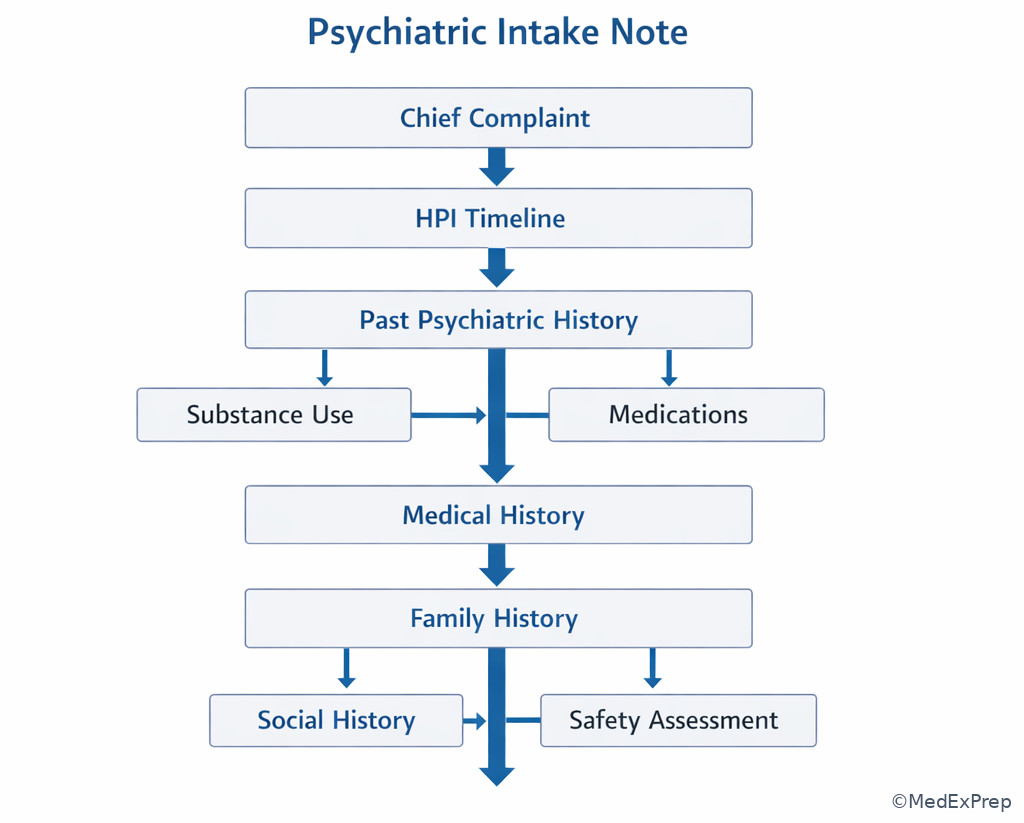
Exam takeaway: Use a fixed sequence so you do not miss timeline, safety, substance, or medical clues.
flowchart TD
A[Chief complaint] --> B[HPI timeline]
B --> C[Safety screen early]
C --> D[Past psychiatric history]
D --> E[Substance and meds]
E --> F[Medical and family history]
F --> G[Social history and function]
G --> H[Collateral if unreliable or high risk]
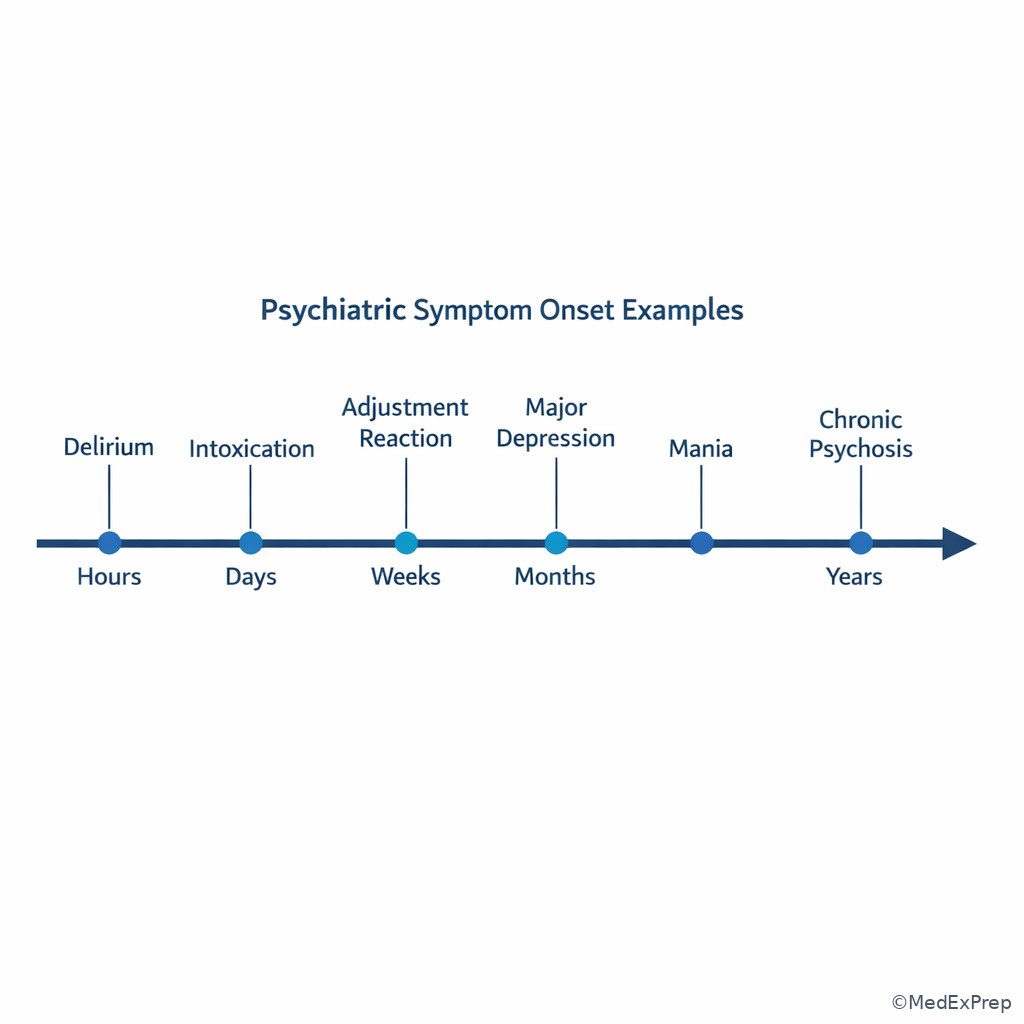
Exam takeaway: Duration and trigger often distinguish primary psychiatric illness from delirium, intoxication, and adjustment reactions.
flowchart LR
A[Hours to 1 day] --> B[Delirium or intoxication]
C[Days after stressor] --> D[Acute stress or adjustment]
E[At least 1 week with elevated energy] --> F[Mania suspicion]
G[At least 2 weeks depressed mood or anhedonia] --> H[Major depression suspicion]
I[Months to years] --> J[Chronic disorder or personality pattern]
Exam takeaway: A clean intake framework helps you retrieve the missing must-ask domain under time pressure.
Exam takeaway: Visualizing onset and duration prevents common board errors caused by vague symptom labels.
Core content
1.1.1.3 Build the interview around sequence, reliability, and timeline
A Explanation
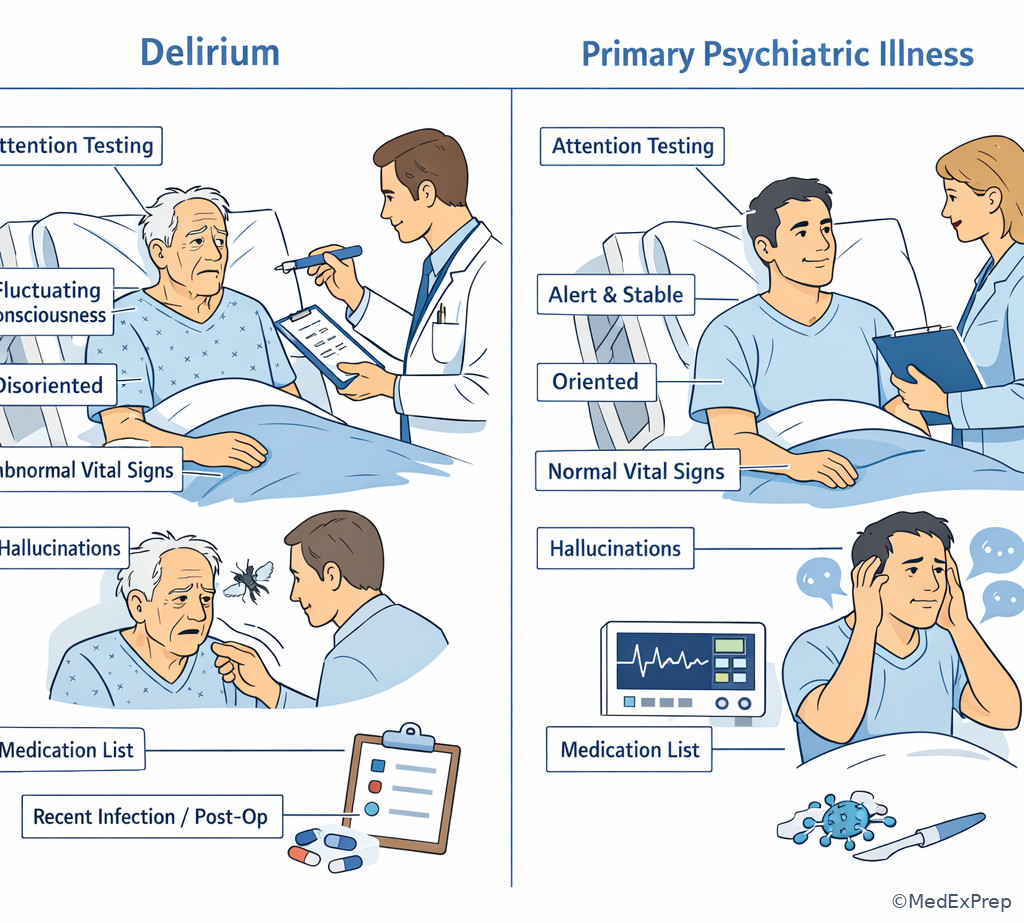
The first conflict in a psychiatry vignette is not “What is the diagnosis?” but “Can I trust this history, and what is the actual symptom sequence?” Students often chase symptom labels while ignoring chronology. Choose a diagnosis only after choosing the correct frame: sudden versus gradual, episodic versus persistent, triggered versus spontaneous, progressive versus fluctuating. The single resolving rule is this: timeline plus reliability governs the rest of the interview. If the story is disorganized, internally inconsistent, or provided by a patient who is intoxicated, delirious, manic, or frankly psychotic, reject the assumption that the history is complete and seek collateral early. See Fig 1 and Fig 2.
WHY THIS IS TESTED: Board questions hide the correct answer in onset, duration, and whether the source is reliable. A stem may mention “depression,” but the real discriminator is that symptoms began yesterday after surgery and fluctuate, which points away from primary mood disorder.
Use a repeatable opening sequence: chief complaint in the patient’s words, then HPI with onset, duration, severity, precipitants, associated symptoms, impairment, and safety. Ask the patient to tell the story from the last known baseline to now. When symptoms are vague, anchor the story to concrete events: sleep change, missed work, arrest, breakup, intoxication, hospitalization, or medication change. If the account is disorganized, do not force certainty; document that reliability is limited and plan collateral.
B Worked example
A 21-year-old man is brought by campus police for “bizarre behavior.” He has asthma and ADHD, takes albuterol and previously used mixed amphetamine salts, and recently failed two exams. His roommate says he has not slept for 4 days, has been “writing business plans all night,” and spent $2,000 online. In triage he says, “I’m depressed because no one understands my genius.” Urine toxicology is positive for cannabis. The task is to identify the most useful history frame.
Reasoning chain: Identify task: not final diagnosis yet, but the best way to structure the history. Extract key facts: decreased need for sleep, increased goal-directed activity, spending, likely unreliability due to grandiosity; cannabis is distracting noise because it does not fully explain the syndrome. Apply rule: timeline and reliability first. Eliminate distractors such as focusing immediately on depressive symptoms or assuming cannabis-induced psychosis. Verify: the next history priority is to establish chronology of sleep/energy change, prior similar episodes, medication/substance timing, and collateral from roommate/family.
C Exam trap
Common wrong answer: Jumping straight to the symptom label the patient uses, such as “depression” or “anxiety.”
Why it is tempting: The patient gives an emotionally charged complaint, and exam writers know learners often privilege self-report over pattern.
Single clue that eliminates it: A mismatch between the label and the chronology/behavior, such as several days without sleep plus spending sprees, means the history must be reorganized around a syndromic timeline.
D Checkpoint
Question: A 68-year-old woman with hypertension, osteoarthritis, and recent urinary tract infection is brought by her daughter for “sudden depression.” She became withdrawn yesterday, slept poorly, and now cannot follow the conversation consistently. Which history element is most important to clarify first?
- Recent baseline and exact time course of attention changes — Tempting because it seems nonspecific, but it is right because acute fluctuating attention suggests delirium rather than a primary mood disorder.
- Family history of major depressive disorder — Tempting because family history raises risk, but it is wrong because it does not explain abrupt fluctuation.
- Childhood trauma history — Tempting because trauma can shape psychiatric symptoms, but it is wrong because it does not address the urgent acute change.
- Long-term relationship stress — Tempting because psychosocial stress can precipitate symptoms, but it is wrong because the time course points first to a medical cause.
Answer: A. Recent baseline and exact time course of attention changes.
1.1.1.4 Prioritize safety questions early, not at the end
A Explanation
The second decision conflict is “Continue routine interviewing” versus “stop and assess immediate risk.” Many learners save suicidality for the end because it feels sensitive. On exams, that delay is wrong when the stem gives activating clues: hopelessness, command hallucinations, recent attempt, intoxication, violent threats, inability to care for self, or access to firearms. The single resolving rule is simple: any cue for imminent harm moves safety questions forward.
WHY THIS IS TESTED: Psychiatry questions reward the safest next step. If a patient reports passive sadness, you continue the interview. If a patient reports active suicidal thoughts with plan and means, you escalate and obtain urgent supervision rather than proceed as if this were a routine outpatient history.
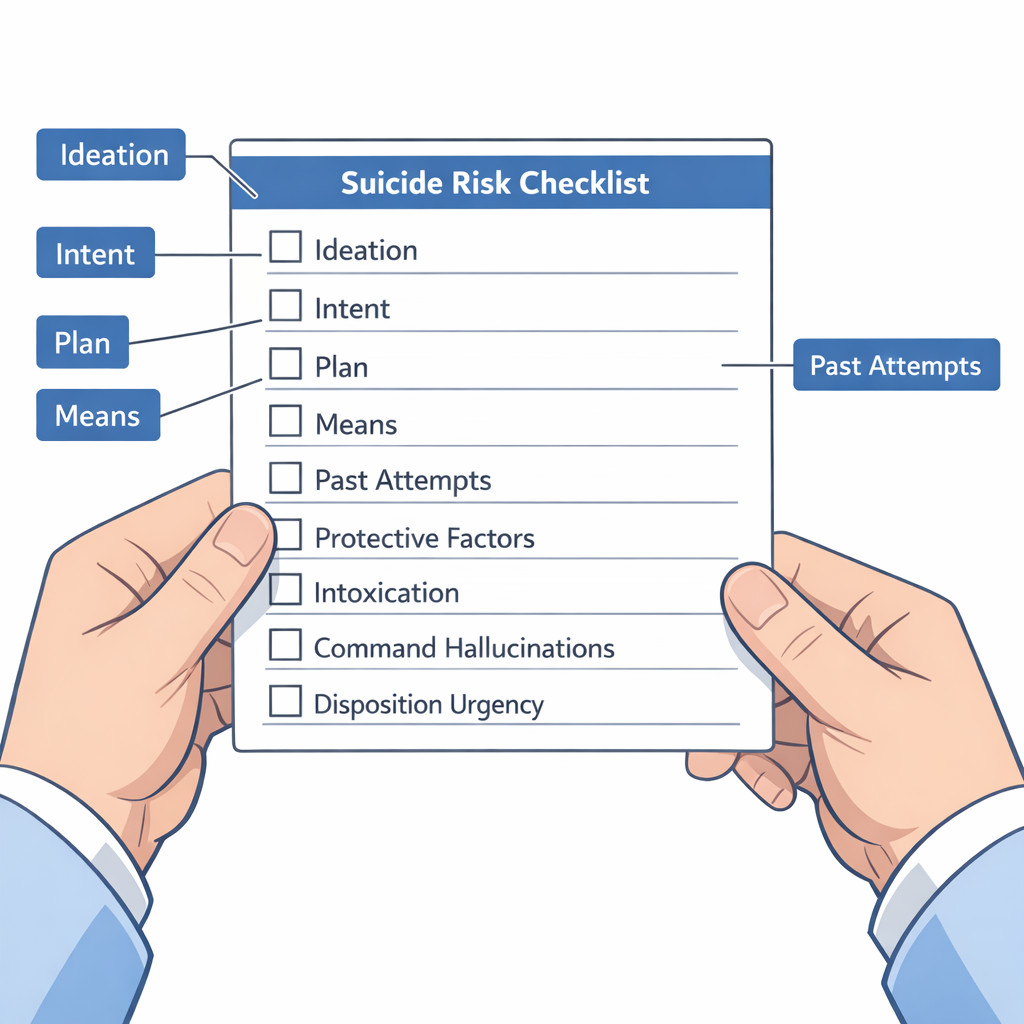
Safety history includes suicidal ideation, intent, plan, access to means, rehearsals, past attempts, non-suicidal self-injury, homicidal ideation, recent violence, command hallucinations, severe impulsivity, intoxication, withdrawal, and inability to care for basic needs. Ask directly and without euphemism. “Do you want to die?” “Have you thought about killing yourself?” “Do you have a plan?” “Do you have access to the gun/pills/rope?” Surface-level phrasing such as “You wouldn’t do anything silly, right?” is poor interviewing and poor test logic.
Risk is not defined by ideation alone. A patient with chronic passive death wishes but no plan, intact supports, and future orientation differs from one with a recent attempt, escalating intent, intoxication, and a loaded firearm at home. See Fig 3.
Exam takeaway: On risk stems, ask ideation, intent, plan, and means before exploring lower-priority details.
flowchart TD
A[Safety cue appears] --> B[Ask about suicidal or homicidal thoughts]
B --> C[Clarify intent]
C --> D[Clarify plan]
D --> E[Ask access to means]
E --> F[Past attempts or violence]
F --> G[Escalate supervision if acute risk]
Exam takeaway: A short structured risk checklist prevents missed high-lethality details such as means access and recent rehearsal.
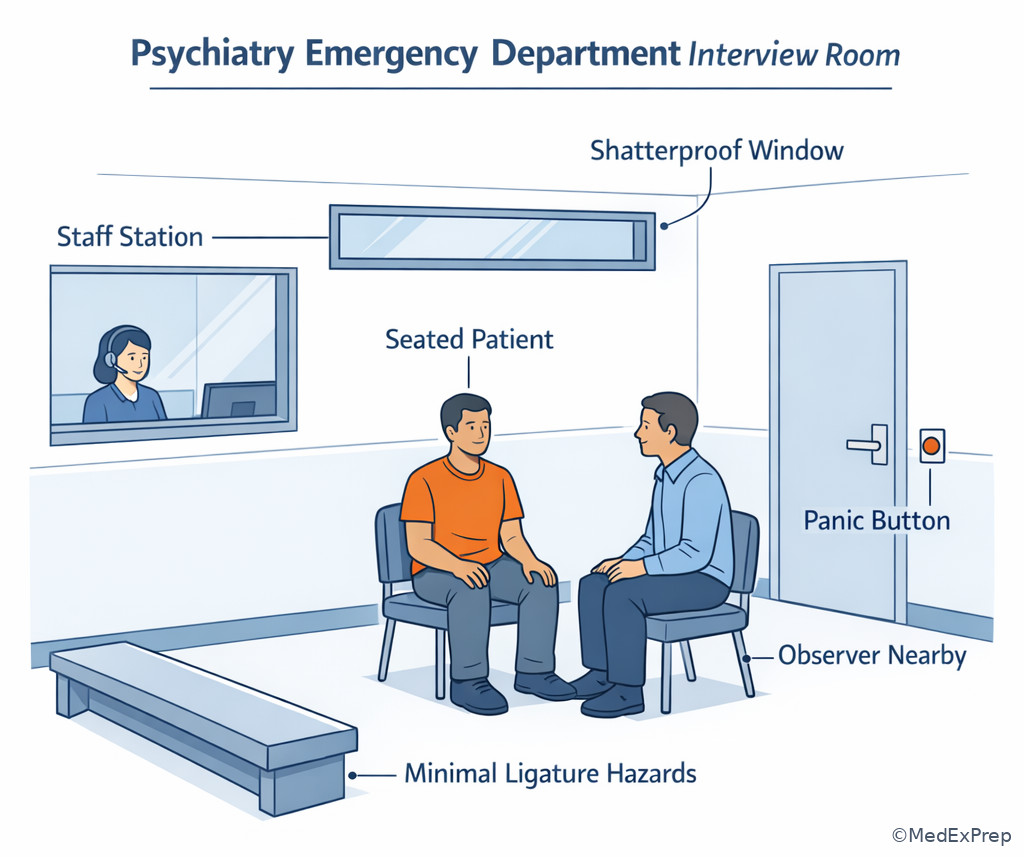
Exam takeaway: The environment and supervision level are part of the safest next step when acute risk is uncovered.
B Worked example
A 46-year-old woman with major depressive disorder, alcohol use disorder, and chronic back pain presents after her primary care physician noticed worsening hopelessness. She says, “My family would be better off without me,” and asks whether “sleeping pills and vodka” can be fatal. Her potassium is 3.3 mEq/L after recent gastroenteritis, which is distracting. She denies hearing voices. The task is the most appropriate next interview step.
Reasoning chain: Identify task: choose immediate questioning priority. Extract key facts: hopelessness, specific lethal method inquiry, alcohol use disorder, chronic pain. Apply rule: direct suicide assessment now. Eliminate distractions: mild hypokalemia is medically relevant but does not outrank active self-harm clues. Verify: clarify intent, plan, access to pills/alcohol, prior attempts, and notify the supervising team.
C Exam trap
Common wrong answer: Asking about protective factors first and stopping there.
Why it is tempting: It feels therapeutic and less confrontational, and students may fear that direct questions worsen suicidality.
Single clue that eliminates it: Explicit mention of a method or access to means means you must assess plan and intent before anything else.
D Checkpoint
Question: A 30-year-old man with PTSD and cocaine use presents after punching a wall during an argument. He says, “Sometimes I think everyone would be safer if I disappeared,” but denies a plan. Which additional question most improves immediate risk estimation?
- “Do you have access to a firearm or other lethal means?” — Tempting because it feels narrow, but it is right because means access strongly changes near-term risk.
- “Did your parents have depression?” — Tempting because family history informs long-term risk, but it is wrong because it does not clarify current danger.
- “What was your GPA in college?” — Tempting if one is exploring baseline function, but it is wrong because it adds no acute safety data.
- “Have you ever tried mindfulness exercises?” — Tempting as a treatment discussion, but it is wrong because management follows, not precedes, risk clarification.
Answer: A. Ask about access to a firearm or other lethal means.
- The strongest historical predictor of future suicide attempt is a prior attempt.
- True or False: Asking directly about suicide increases the risk of suicide. False.
- Name the 3 most immediately actionable risk details after ideation: intent, plan, means.
1.1.1.5 Use past psychiatric, medication, and substance history to avoid false primary diagnoses
A Explanation
The next major conflict is primary psychiatric disorder versus substance-induced, medication-induced, or recurrence of a known illness. Students lose points when they hear psychosis, panic, insomnia, or depressed mood and fail to ask what the patient has taken, stopped, or already been treated for. The single resolving rule is: before labeling a new syndrome, ask what changed biologically or pharmacologically.
WHY THIS IS TESTED: COMAT Psychiatry heavily rewards elimination logic. A patient with anxiety may actually have stimulant intoxication. A patient with worsening depression may have stopped lithium weeks ago. A patient with “new psychosis” may have had schizophrenia with repeated admissions, making recurrence more likely than first-break delirium.
Past psychiatric history should include prior diagnoses, hospitalizations, suicide attempts, self-injury, prior psychotherapy, medication trials, adherence, side effects, and best prior response. A board stem may give you one jewel: “improved dramatically on sertraline before stopping it 3 months ago,” or “multiple admissions for mania,” or “developed rigidity and fever after haloperidol.” These details determine both diagnosis and next step.
Substance history is not a checkbox. Ask specific substances, amount, route, frequency, withdrawal history, and last use. “Social drinking” is uninterpretable. A patient drinking a pint of vodka daily with morning tremor has a very different risk profile than one who drinks two beers on weekends. Similarly, “uses marijuana” is meaningless unless frequency, potency, and timing relative to symptoms are clear. See Fig 4.
Exam takeaway: A recent exposure change often explains psychiatric symptoms better than a new primary diagnosis.
flowchart TD
A[Psychiatric symptom appears] --> B{Recent med change or nonadherence?}
B -- Yes --> C[Consider medication effect or relapse]
B -- No --> D{Recent substance use or withdrawal?}
D -- Yes --> E[Consider intoxication or withdrawal syndrome]
D -- No --> F{Prior identical episodes?}
F -- Yes --> G[Consider recurrent primary disorder]
F -- No --> H[Widen differential to medical causes and first episode workup] Exam takeaway: Match symptom onset to last dose, dose changes, and last substance use to find the real cause.
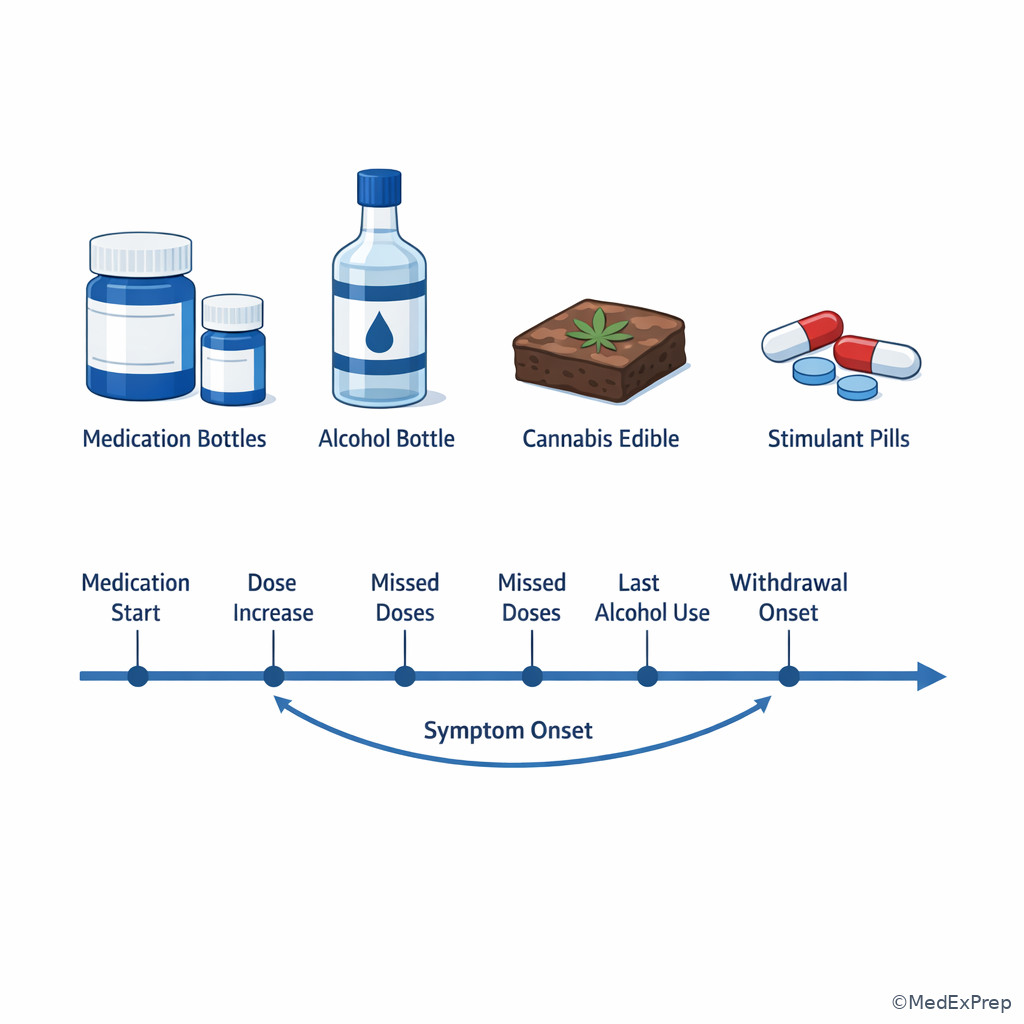
Exam takeaway: Prior response and prior episodes frequently identify the highest-yield next question in recurrence stems.
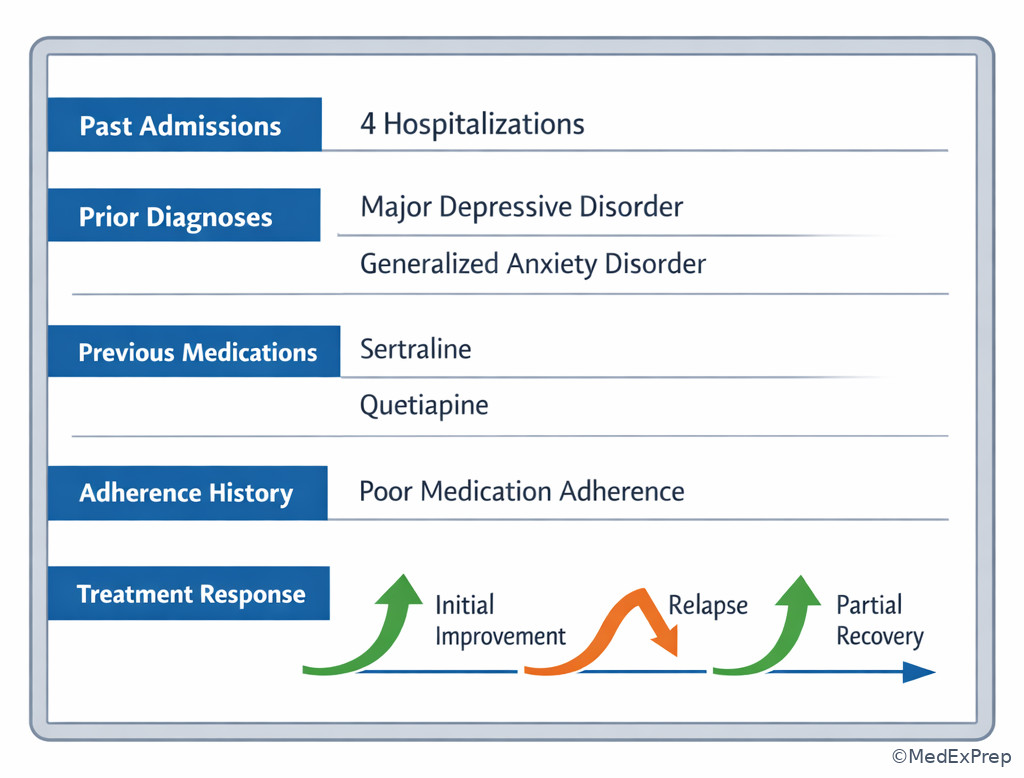
B Worked example
A 34-year-old woman with panic disorder, migraine, and recent weight loss presents with palpitations, insomnia, and “panic attacks.” She started an over-the-counter weight-loss supplement 10 days ago, drinks six coffees daily, and takes sumatriptan as needed. She reports no prior hospitalizations and no suicidality. A mild anemia on outside labs is included as noise. The task is to choose the most important additional history point.
Reasoning chain: Identify task: distinguish primary panic disorder from a substance/medication-related cause. Extract key facts: stimulant-like supplement, heavy caffeine, recent onset after exposure change, autonomic symptoms. Apply rule: clarify exact ingredients, dose, and timing of supplement and caffeine use. Eliminate distractions such as broad trauma history or family psychiatric history because the new biologic exposure is more proximate. Verify: if symptoms tightly follow stimulant use, a primary panic exacerbation becomes less likely than a substance-induced picture.
C Exam trap
Common wrong answer: Taking “denies illicit drugs” as proof that substances are irrelevant.
Why it is tempting: Learners think only illegal drugs matter and may forget alcohol, nicotine, caffeine, prescribed stimulants, steroids, and supplements.
Single clue that eliminates it: A recent over-the-counter supplement, abrupt change in drinking pattern, or stopped benzodiazepine can be the entire explanation.
D Checkpoint
Question: A 27-year-old man with bipolar disorder, ADHD, and nicotine dependence presents with insomnia, pressured speech, and irritability. He says he “ran out of one of my meds” last week but is unsure which one. Which history detail is most important to clarify?
- Whether he stopped his mood stabilizer recently — Tempting because medication adherence often matters, and it is right because abrupt nonadherence can explain symptom recurrence better than a new diagnosis.
- Whether his father had generalized anxiety disorder — Tempting because family history adds context, but it is wrong because it does not resolve the acute presentation.
- Whether he exercises regularly — Tempting because sleep and activity affect mood, but it is wrong because it is too indirect.
- Whether he has seasonal allergies — Tempting only as general history, but it is wrong because it does not narrow the syndrome.
Answer: A. Whether he stopped his mood stabilizer recently.
1.1.1.6 Social, family, and functional history change both diagnosis and disposition
A Explanation
The fourth conflict is symptoms in isolation versus symptoms in context. Two patients can report the same sadness, anxiety, or suspiciousness and require different decisions depending on family loading, trauma exposure, housing stability, work function, legal stressors, caregiver supports, and access to weapons. The single resolving rule is: functional change and context determine severity and disposition.
WHY THIS IS TESTED: Exams frequently ask for the “most appropriate next step” or “best disposition.” Those answers depend on whether the patient can feed themselves, maintain housing, care for dependents, attend work/school, and avoid harm. Social history is not decorative; it tells you whether outpatient follow-up is realistic and whether a symptom rise is mild stress or major impairment.
Social history should include living situation, employment or school, relationships, trauma, abuse exposure, legal issues, finances, military history when relevant, spiritual/cultural context if it affects care, and access to supports. Functional history should ask what the patient is no longer able to do. Family history adds pretest probability for bipolar disorder, schizophrenia spectrum disorders, suicide, and substance use disorders. When a stem says a patient has had several nights without sleep but is still showing up to work, you think differently than when the patient lost housing, emptied savings, and disappeared for days.
Exam takeaway: Symptoms matter, but inability to maintain safety or basic functioning often drives the next step.
flowchart TD
A[Psychiatric symptoms] --> B{Able to care for self?}
B -- No --> C[Urgent supervised evaluation]
B -- Yes --> D{Acute suicide or violence risk?}
D -- Yes --> C
D -- No --> E{Stable housing and supports?}
E -- No --> F[Higher concern for unsafe outpatient plan]
E -- Yes --> G[Consider routine outpatient follow-up if medically and psychiatrically stable] Exam takeaway: Ask what the patient has stopped doing; disability clues are more actionable than symptom adjectives alone.
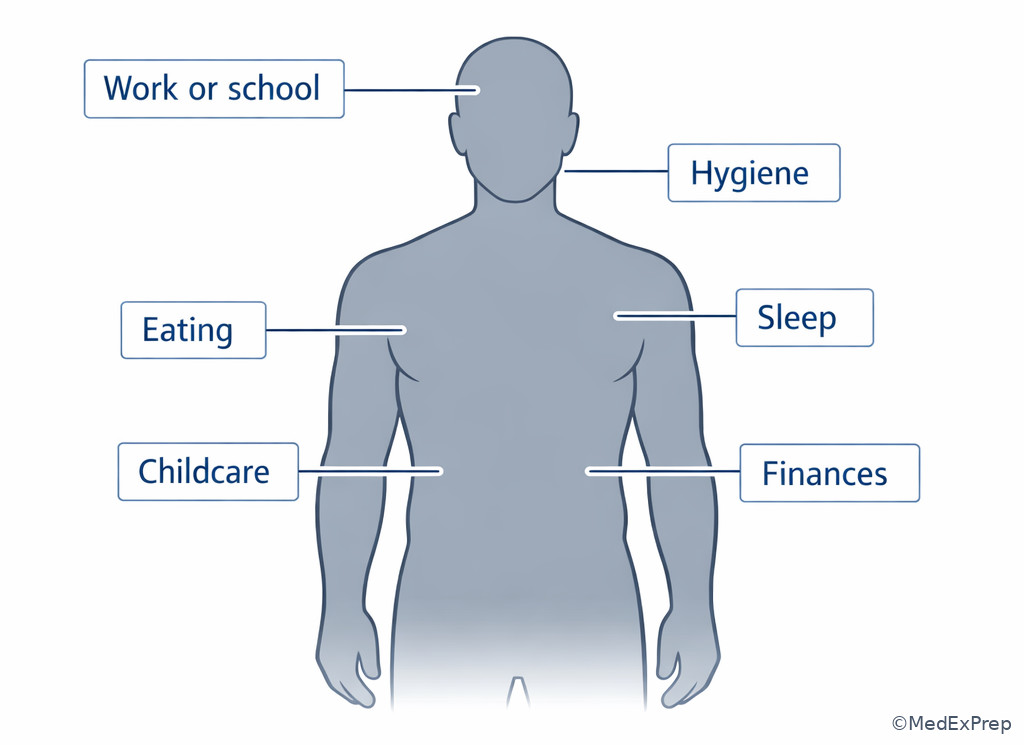
Exam takeaway: Family loading raises diagnostic probability, especially for bipolar and schizophrenia-spectrum disorders.
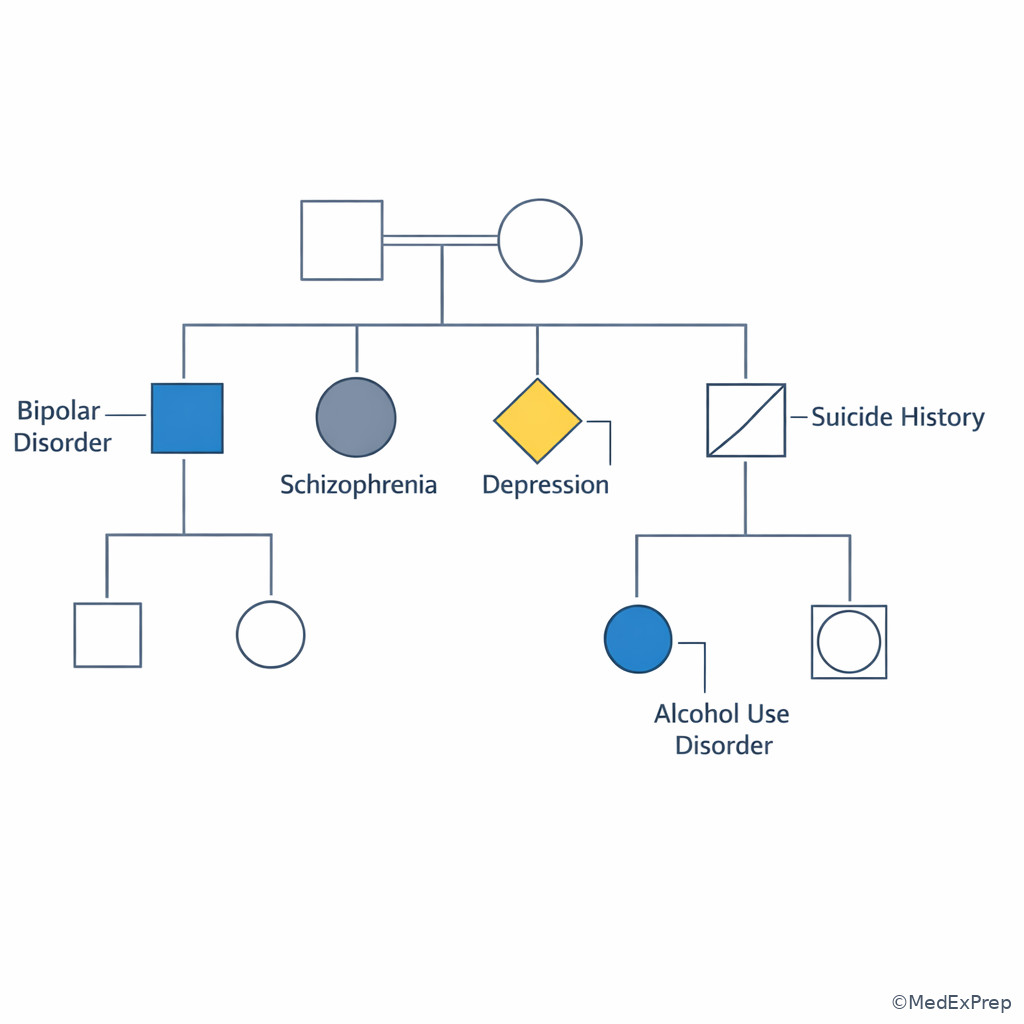
B Worked example
A 58-year-old man with recurrent depression, diabetes, and chronic kidney disease reports worsening low mood after job loss. He denies suicidal intent and says he wants help. The distracting clue is that he has mild paranoid thoughts that “neighbors gossip about me.” He has stopped showering, has not paid rent for 2 months, and has no food at home. His sister lives nearby but has not been contacted. The task is to determine what social/functional history matters most.
Reasoning chain: Identify task: severity and disposition, not just diagnosis. Extract key facts: major self-neglect, financial collapse, poor hygiene, limited current support use. Apply rule: functional impairment and ability to care for self drive urgency. Eliminate distraction: vague suspiciousness may matter, but the decisive history element is failure of basic self-care and inability to maintain housing. Verify: this is not routine outpatient interviewing; he needs urgent team review and collateral.
C Exam trap
Common wrong answer: Equating absence of explicit suicidal plan with low-acuity disposition.
Why it is tempting: Learners may over-focus on suicide wording and underweight grave disability or inability to care for self.
Single clue that eliminates it: Severe self-neglect, missed rent, and no food at home signal unsafe functioning even without a stated suicide plan.
D Checkpoint
Question: A 19-year-old college student with panic symptoms, migraines, and recent breakup presents to student health. She denies suicidality, attends class, sleeps 7 hours nightly, and has strong family support. Which history factor most supports outpatient management rather than urgent psychiatric escalation?
- Preserved attendance and self-care with supportive family — Tempting because it seems reassuring, and it is right because intact functioning and supports lower immediate disposition urgency.
- Recent breakup — Tempting because it suggests an understandable trigger, but it is wrong because stressor presence alone does not determine safety.
- Migraine history — Tempting because medical issues can affect anxiety, but it is wrong because it does not address current risk or function.
- Age under 25 years — Tempting because younger age can affect some risk frameworks, but it is wrong because it is less decisive than current functioning and supports.
Answer: A. Preserved attendance and self-care with supportive family.
- The social history detail most likely to change disposition in one step is ability to care for self safely.
- True or False: Family history usually outweighs current functional impairment in disposition decisions. False.
- Name 3 functional domains to ask about: work/school, hygiene, housing/finances.
1.1.1.7 Screen for medical mimics and know when to stop the routine psychiatric interview
A Explanation
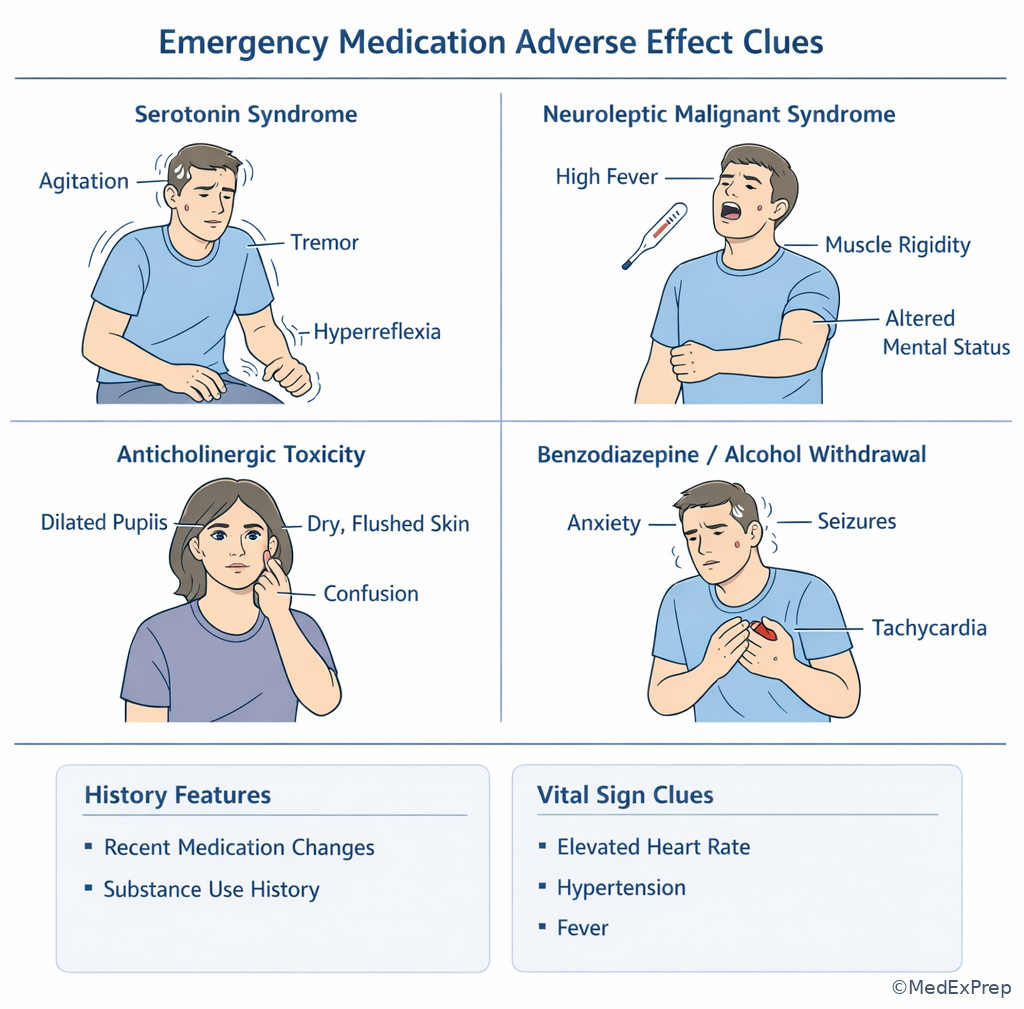
The final integration conflict is continue psychiatric questioning versus pivot to medical evaluation and urgent escalation. On COMAT Psychiatry, students are expected to recognize—not independently manage—medical syndromes that present with psychiatric symptoms. The single resolving rule is: acute onset, fluctuating attention, autonomic instability, abnormal vital signs, focal neurologic findings, or toxic exposure history should make you reject a purely psychiatric frame. See Fig 6.
WHY THIS IS TESTED: Psychiatry exams punish premature closure. A patient with agitation after medication changes may have serotonin syndrome or withdrawal, not panic disorder. An older hospitalized patient with hallucinations and waxing-waning attention likely has delirium. A first episode of psychosis after head trauma, seizure, fever, or steroid use must widen the differential.
Ask about fever, head injury, seizures, loss of consciousness, new medications, steroids, anticholinergics, intoxication, withdrawal, endocrine disease, infection, and sleep deprivation. In older adults, medically ill patients, or postoperative patients, confusion should trigger a delirium-first mindset. In younger patients, new neurologic symptoms, autonomic findings, or abrupt onset should still prompt caution. The exam-safe student action is to notify the supervising team and recommend medical workup when the history suggests a medical mimic.
Key rule: Never accept “psychiatric” as the final frame for acute behavioral change with impaired attention, fluctuating consciousness, fever, or unstable vital signs.
Exam takeaway: Acute fluctuation, abnormal vitals, or neurologic clues should redirect the workup away from a purely psychiatric diagnosis.
flowchart TD
A[Behavioral or cognitive change] --> B{Acute onset or fluctuating attention?}
B -- Yes --> C[Think delirium or toxic-metabolic cause]
B -- No --> D{Abnormal vitals, fever, or neuro findings?}
D -- Yes --> E[Think medical or medication syndrome]
D -- No --> F{Recent substance use, withdrawal, or med change?}
F -- Yes --> G[Think intoxication, withdrawal, or adverse effect]
F -- No --> H[Primary psychiatric disorder more likely] Exam takeaway: Fluctuating attention and medical instability are stronger than the presence of hallucinations alone.
Exam takeaway: Fever, rigidity, clonus, or autonomic instability on history should trigger medication-syndrome thinking before psychiatric labeling.
B Worked example
A 72-year-old man with COPD, benign prostatic hyperplasia, and recent pneumonia is brought from a rehabilitation facility for “seeing insects on the wall.” He started diphenhydramine for sleep 2 nights ago. Staff report he is worse at night and keeps pulling at his oxygen tubing. He has no prior psychiatric history. The distracting clue is that his wife died 6 months ago. The task is the most appropriate history-based interpretation.
Reasoning chain: Identify task: distinguish grief or psychosis from a medical mimic. Extract key facts: older adult, acute onset, fluctuates at night, attention and behavior changes, recent anticholinergic exposure, medical illness. Apply rule: medical mimic red flags override the bereavement clue. Eliminate distractors: grief does not explain waxing-waning attention and acute visual hallucinations in this context. Verify: recommend urgent medical evaluation for delirium and notify the supervising team.
C Exam trap
Common wrong answer: Diagnosing primary psychosis because the patient reports hallucinations.
Why it is tempting: Hallucinations feel psychiatric, and students may not notice that the stem emphasizes fluctuation and medical illness.
Single clue that eliminates it: Impaired attention or waxing-waning consciousness points to delirium until proven otherwise.
D Checkpoint
Question: A 44-year-old woman with depression, hypertension, and chronic pain presents with agitation and confusion one day after starting a new migraine medication while already taking sertraline. She is diaphoretic and restless. Which history detail most requires immediate clarification?
- The exact new medication and timing of initiation — Tempting because medication history matters, and it is right because this could identify a medication-induced emergency such as serotonin toxicity.
- Whether she had childhood separation anxiety — Tempting because anxiety history can shape coping, but it is wrong because it does not address the acute syndrome.
- Whether her mother had postpartum depression — Tempting because family history helps differential diagnosis, but it is wrong because it lacks acute relevance.
- Whether she prefers psychotherapy to medication — Tempting because treatment preference matters later, but it is wrong because the immediate concern is medical safety.
Answer: A. The exact new medication and timing of initiation.
Exam Traps & Differentiators
Common traps & distractors: The stem often gives a dramatic symptom word, but the answer turns on one quieter history clue: abrupt onset, fluctuating attention, recent med change, prior attempt, or loss of housing/self-care.
1.1.1.8 Most common wrong answer and why
Most common wrong answer: Treating the patient’s own label as the diagnosis-driving fact.
Why: “I’m depressed,” “I’m anxious,” or “I’m hearing voices” sounds decisive, but the history sequence, context, and exposures are what separate psychiatric illness from medical/substance causes.
1.1.1.9 Looks similar but isn't
| Confusable Pair | Shared Features | Single Discriminator | History Priority |
|---|---|---|---|
| Major depression vs delirium | Withdrawal, low activity, poor concentration | Delirium has acute fluctuation and impaired attention | Baseline cognition, onset over hours to days, medical triggers |
| Panic disorder vs stimulant effect | Palpitations, anxiety, insomnia, tremulousness | Symptoms linked to substance/supplement/caffeine timing | Exact exposure, dose, and last use |
| Primary psychosis vs intoxication/withdrawal | Agitation, paranoia, hallucinations | Recent use, abstinence, autonomic findings, clouded sensorium | Substance chronology and withdrawal history |
| Adjustment reaction vs major mood disorder | Sadness, anxiety, impaired sleep | Severity, duration, and level of functional impairment | Symptom duration and inability to function |
| Routine distress vs acute suicide risk | Hopelessness, tearfulness, depression | Intent, plan, means, recent attempt | Direct safety questions first |
| Grief vs delirium in older adult | Sleep changes, withdrawal, sadness, unusual perceptions | Delirium shows inattention and waxing-waning awareness | Medical illness, meds, and cognition timeline |
1.1.1.10 If the stem says ___, think ___
- If the stem says “started yesterday” + “can’t stay attentive”, think medical mimic/delirium first.
- If the stem says “asks whether pills and alcohol would work”, think plan/means assessment now.
- If the stem says “stopped meds last week”, think recurrence or withdrawal before a new diagnosis.
- If the stem says “hearing voices” but gives no timeline, think you still need content, command quality, insight, and context.
- If the stem says “denies illicit drug use” but includes supplements, caffeine, steroids, or alcohol, think substance/medication effect remains in play.
- If the stem says “denies suicide plan” but the patient has no food, has stopped hygiene, and lost housing, think grave disability can still require urgent escalation.
| Trap Clue | Tempting Wrong Answer | Why It Is Tempting | Single Eliminating Clue |
|---|---|---|---|
| “Depressed” in an older hospitalized patient | Major depressive disorder | Low mood and withdrawal seem to fit | Fluctuating attention and acute onset |
| “Panic attacks” after supplement use | Panic disorder relapse | Autonomic symptoms overlap strongly | Symptoms began after stimulant-like exposure |
| “No suicide plan” | Safe outpatient follow-up | Plan is often overemphasized as the only risk marker | Recent attempt, means access, or severe self-neglect |
| “Voices” in ED | Schizophrenia | Hallucinations feel definitive | No prior history plus fever, confusion, or substance timing |
| “Stress after breakup” | Adjustment disorder only | Visible stressor anchors the learner | Marked impairment, prior episodes, or syndrome-level mood change |
Related traps will recur in the upcoming topics Mental Status Examination and Collateral And Safety Data. In particular, confusing thought content with thought process, or treating patient self-report as sufficient in mania, psychosis, or delirium, produces predictable wrong answers across multiple chapters.
Algorithm / Approach
Rapid Review
- Timeline clue → abrupt fluctuation favors delirium over primary mood disorder
- History source → mania, psychosis, intoxication, and delirium reduce reliability
- Safety interview → ideation alone is weaker than plan plus means access
- Past attempts → strongest high-yield suicide risk historical predictor
- Substance history → “social use” is useless without amount, frequency, and last use
- Medication clue → recent start/stop/change can outrank symptom label
- Functional history → inability to maintain food, hygiene, or housing changes disposition
- Family history → most useful when bipolar or psychotic spectrum is in the differential
- Psychosis history → no prior episodes plus medical red flags should widen the workup
- Visual hallucinations in older adult → think medical or toxic cause before schizophrenia
- Chief complaint → patient wording matters, but does not overrule syndrome pattern
- Collateral need → essential when self-report is incomplete or contradicted by behavior
- Board-style next step → safest action beats most elegant diagnosis
Self-check quiz
1.1.1.11 Question 1
A 70-year-old woman with hypertension and recent hospitalization for pneumonia becomes withdrawn and “depressed” over 24 hours. She is intermittently inattentive and cannot recite the months backward. Which history feature most strongly argues against a primary depressive disorder as the main explanation?
- Acute onset with fluctuating attention
- Recent bereavement
- Family history of depression
- Poor appetite
1.1.1.12 Question 2
A 25-year-old man with recurrent depression, nicotine dependence, and remote self-harm presents for low mood after a breakup. He denies current plan. Which history element is the highest-yield predictor of future suicide risk?
- Prior suicide attempt
- Family history of anxiety
- Recent insomnia alone
- Loss of appetite
1.1.1.13 Question 3
A 32-year-old woman with panic disorder and obesity presents with palpitations and insomnia for 1 week. She has hypothyroidism, drinks four energy drinks daily, and started a “fat-burning” supplement 9 days ago. She reports chest tightness but normal ECG in triage. Which is the most appropriate next history step?
- Clarify exact supplement ingredients, dose, and timing of use
- Ask about childhood attachment style
- Ask whether she prefers cognitive behavioral therapy
- Ask whether a grandparent had bipolar disorder
1.1.1.14 Question 4
A 43-year-old man with alcohol use disorder, chronic pain, and depression says, “I don’t want to wake up tomorrow.” He smells of alcohol and asks whether the pills in his pocket would be enough. Which is the most appropriate next step in the interview?
- Ask directly about suicidal intent, plan, and access to means
- Complete the full social history before discussing safety
- Ask only about protective factors to avoid increasing distress
- Reassure him and move to medication review first
1.1.1.15 Question 5
A 28-year-old man with bipolar disorder, ADHD, and cannabis use presents with 5 days of reduced sleep, rapid speech, and irritability. He says he stopped “one of my regular meds” last week after losing insurance. Urine toxicology is positive for cannabis. Which historical detail is most important to clarify next?
- Whether the stopped medication was his mood stabilizer
- Whether he had academic problems in childhood
- Whether his uncle had panic disorder
- Whether he prefers individual or group therapy
1.1.1.16 Question 6
A 76-year-old man with COPD, benign prostatic hyperplasia, and recent urinary retention is brought in for new visual hallucinations and agitation. He started diphenhydramine 2 nights ago, is worse in the evening, and repeatedly loses track of questions. His wife died 4 months ago. Which is the most likely interpretation of the history?
- Delirium precipitated by medical illness and anticholinergic exposure
- Complicated grief with psychotic features
- Late-onset schizophrenia spectrum disorder
- Major depressive disorder with psychotic features
1.1.1.17 Question 7
A 39-year-old woman with major depression, migraine, and hypertension presents with confusion, agitation, and diaphoresis one day after an urgent care visit where a new medication was added. She takes sertraline daily and denies illicit substance use. Which history point requires immediate clarification because it most changes the differential and urgency?
- The name and timing of the newly started medication
- Her father’s history of alcohol use disorder
- Whether she has had recent interpersonal stress
- Whether she had panic attacks in college
1.1.1.18 Question 8
A 57-year-old man with recurrent depression, diabetes, and chronic kidney disease is brought by his sister for worsening sadness after job loss. He denies a suicide plan, but he has not bathed in 10 days, has no food at home, and was evicted this week. He also says neighbors are “talking about him,” though he cannot give examples. Which factor most strongly supports urgent psychiatric escalation rather than routine outpatient follow-up?
- Inability to maintain basic self-care and housing
- Recent job loss as a psychosocial stressor
- Vague suspiciousness toward neighbors
- History of diabetes and kidney disease
Answer key
1.1.1.19 Question 1 Answer: A. Acute onset with fluctuating attention
Why the correct answer is right: Depression can reduce concentration, but a 24-hour onset plus fluctuating attention is much more consistent with delirium or another medical process than a primary depressive episode. Mechanistically, delirium reflects acute cerebral dysfunction, often triggered by infection, medications, metabolic disturbance, or hospitalization. This history should redirect the next step toward medical evaluation rather than a routine psychiatric diagnosis. Sources: Harrison’s Principles of Internal Medicine; DSM-5-TR.
- A. Tempting because both depression and delirium can present with withdrawal; correct because the discriminating clue is acute fluctuation in attention, which fits delirium. The single stem clue is intermittently inattentive over 24 hours.
- B. Tempting because bereavement can cause sadness and withdrawal; incorrect because bereavement does not explain impaired attention with acute fluctuation. The discriminating clue is can’t recite months backward.
- C. Tempting because family history raises depression risk; incorrect because it is less relevant than the acute cognitive change. The discriminating clue is recent hospitalization plus sudden onset.
- D. Tempting because poor appetite appears in depression; incorrect because it lacks diagnostic specificity in an acutely ill older adult. The discriminating clue is fluctuating cognition.
1.1.1.20 Question 2 Answer: A. Prior suicide attempt
Why the correct answer is right: A prior suicide attempt is among the strongest historical predictors of future suicide risk. Mechanistically, prior suicidal behavior demonstrates capability and prior transition from thought to action, which raises concern more than nonspecific vegetative symptoms. Sources: APA Practice Guideline for the Assessment and Treatment of Patients With Suicidal Behaviors; DSM-5-TR.
- A. Tempting because it is clearly a safety variable; correct because it is the highest-yield predictor among the options. The discriminating clue is remote self-harm history.
- B. Tempting because psychiatric family history matters; incorrect because family anxiety is weaker than the patient’s own prior behavior. The discriminating clue is future-risk prediction, not general vulnerability.
- C. Tempting because insomnia worsens mood and impulsivity; incorrect because insomnia alone is less predictive than a prior attempt. The discriminating clue is which factor best predicts future risk.
- D. Tempting because appetite change suggests depression severity; incorrect because it does not outperform prior suicidal behavior. The discriminating clue is specificity for suicide risk.
1.1.1.21 Question 3 Answer: A. Clarify exact supplement ingredients, dose, and timing of use
Why the correct answer is right: Panic-like symptoms after a recent stimulant-like supplement exposure strongly suggest a substance- or medication-related cause. Mechanistically, sympathomimetic agents and heavy caffeine can produce palpitations, anxiety, insomnia, and tremulousness that mimic panic disorder. The correct history step is to define the exposure precisely before treating this as primary psychiatric worsening. Sources: First Aid for the USMLE Step 2 CK; Harrison’s Principles of Internal Medicine.
- A. Tempting because it targets the new biologic change; correct because timing and ingredients may directly explain symptoms. The discriminating clue is supplement started 9 days ago plus energy drinks.
- B. Tempting because panic disorder can be explored psychologically; incorrect because psychodynamic context does not resolve the acute exposure-linked syndrome. The discriminating clue is new stimulant-like trigger.
- C. Tempting because CBT is first-line for panic disorder; incorrect because treatment preference is not the next best step before narrowing the cause. The discriminating clue is diagnostic uncertainty due to exposure.
- D. Tempting because family bipolar history can matter if activation is present; incorrect because the current presentation is more tightly linked to substances than inherited mood disorder risk. The discriminating clue is clear recent supplement use.
1.1.1.22 Question 4 Answer: A. Ask directly about suicidal intent, plan, and access to means
Why the correct answer is right: The patient has active self-harm language, intoxication, and a potential means in his pocket. Mechanistically, intoxication increases disinhibition and short-term lethality risk. The immediate interview priority is a direct suicide assessment, not routine psychosocial exploration. Sources: APA Suicide Guideline; DSM-5-TR.
- A. Tempting because it feels urgent; correct because acute self-harm clues require direct questioning now. The discriminating clue is asks whether pills in his pocket would be enough.
- B. Tempting because social context matters; incorrect because safety outranks routine social history in acute risk. The discriminating clue is possible lethal means on hand.
- C. Tempting because protective factors are part of full assessment; incorrect because they should not replace direct assessment of plan and intent. The discriminating clue is active method-oriented language.
- D. Tempting because medication review is relevant in psychiatry; incorrect because the safest next step is risk clarification, not reassurance. The discriminating clue is intoxicated suicidal statement.
1.1.1.23 Question 5 Answer: A. Whether the stopped medication was his mood stabilizer
Why the correct answer is right: Reduced sleep, irritability, and rapid speech in a patient with bipolar disorder suggest recurrence of mania or hypomania. Mechanistically, stopping a mood stabilizer can remove relapse protection and unmask mood elevation. Cannabis is a tempting distractor but does not outweigh known bipolar recurrence risk after nonadherence. Sources: DSM-5-TR; First Aid for the USMLE Step 2 CK.
- A. Tempting because medication adherence commonly drives relapse; correct because recent discontinuation may directly explain current symptoms. The discriminating clue is stopped one regular medication last week.
- B. Tempting because ADHD history can complicate restlessness; incorrect because childhood academic problems do not explain this acute syndrome. The discriminating clue is new episode after medication lapse.
- C. Tempting because family psychiatric history can support diagnostic vulnerability; incorrect because it is weaker than a direct relapse trigger in an established bipolar patient. The discriminating clue is known bipolar disorder.
- D. Tempting because therapy modality matters later; incorrect because immediate diagnostic clarification should target the stopped medication. The discriminating clue is acute episode framing.
1.1.1.24 Question 6 Answer: A. Delirium precipitated by medical illness and anticholinergic exposure
Why the correct answer is right: Acute onset, evening worsening, visual hallucinations, and loss of attention in an older medically ill patient after anticholinergic exposure strongly indicate delirium. Mechanistically, delirium reflects acute brain dysfunction often exacerbated by anticholinergics and systemic illness. Sources: Harrison’s Principles of Internal Medicine; DSM-5-TR.
- A. Tempting because it integrates the age, medication, and fluctuating cognition; correct because those clues specifically fit delirium. The discriminating clue is repeatedly loses track of questions.
- B. Tempting because bereavement may anchor the learner to grief; incorrect because grief does not cause waxing-waning attention with acute hallucinations in this setting. The discriminating clue is started diphenhydramine 2 nights ago.
- C. Tempting because hallucinations suggest psychosis; incorrect because late-onset primary psychosis is less likely than delirium when attention is impaired and onset is abrupt. The discriminating clue is worse in the evening with inattention.
- D. Tempting because depression can occur after bereavement; incorrect because psychotic depression does not typically present with acute fluctuating attention and anticholinergic trigger. The discriminating clue is delirium pattern rather than sustained mood syndrome.
1.1.1.25 Question 7 Answer: A. The name and timing of the newly started medication
Why the correct answer is right: Sertraline plus a newly added medication in a patient with agitation, confusion, and diaphoresis raises concern for a medication-induced syndrome such as serotonin toxicity. Mechanistically, excess serotonergic activity can produce mental status changes, autonomic instability, and neuromuscular findings; the history pivot is the exact recent medication exposure. Sources: UpToDate; Harrison’s Principles of Internal Medicine.
- A. Tempting because it targets the likely mechanism; correct because recent medication interaction most changes urgency and differential. The discriminating clue is one day after a new medication was added while on sertraline.
- B. Tempting because family substance history can inform risk generally; incorrect because it does not explain this abrupt toxic presentation. The discriminating clue is acute onset after medication change.
- C. Tempting because stress can worsen psychiatric symptoms; incorrect because diaphoresis and confusion after medication initiation require a medical-syndrome frame first. The discriminating clue is autonomic symptoms.
- D. Tempting because panic history can blur the picture; incorrect because panic does not usually emerge immediately after a serotonergic medication change with this toxicity pattern. The discriminating clue is new drug plus confusion.
1.1.1.26 Question 8 Answer: A. Inability to maintain basic self-care and housing
Why the correct answer is right: Even without a stated suicide plan, severe self-neglect, lack of food, and eviction indicate grave functional impairment and possible inability to care for self safely. Mechanistically, disposition is driven not only by explicit suicidality but also by whether the patient can meet basic needs and remain safe outside a supervised setting. Sources: DSM-5-TR; APA Practice Guideline for the Psychiatric Evaluation of Adults.
- A. Tempting because it sounds like a disposition clue rather than a diagnosis clue; correct because it is the strongest reason to escalate urgently. The discriminating clue is no bathing, no food, evicted this week.
- B. Tempting because job loss is a strong stressor; incorrect because stressor presence does not by itself establish inability to remain safe. The discriminating clue is grave disability exceeds normal stress response.
- C. Tempting because suspiciousness may suggest psychosis; incorrect because the vague nature of the belief is less decisive than the profound functional collapse. The discriminating clue is he cannot care for himself regardless of psychosis certainty.
- D. Tempting because medical comorbidities increase complexity; incorrect because they do not independently determine acute psychiatric disposition here. The discriminating clue is current self-care failure.
Keep going with the full COMAT Psychiatry Prep Course (COMAT Psych)
You just studied the way members do, in the same lesson interface. Full access unlocks every lesson, the question bank and flashcards for a full year.
One payment · 1 year of access · No auto-renewal