1.1.1 - Pregnancy Dating And Gravidity
Pregnancy Dating and Gravidity
What you’ll learn
- OB-APC: Distinguish gravidity, parity, and TPAL-style obstetric history reporting.
- OB-APC: Calculate estimated due date using last menstrual period and Naegele’s rule.
- OB-APC: Identify when first-trimester ultrasound should override menstrual dating.
- OB-APC: Choose the most appropriate dating method when cycle history is uncertain or misleading.
- OB-APC: Interpret gestational age in board-style stems to guide screening, testing, and prenatal planning.
- OB-APC: Antepartum Care → Prenatal visit foundations → Establish gestational age and obstetric history
- OB-APC: Antepartum Care → Screening/diagnostic sequencing → Use correct gestational age anchor for next steps
- OB-APC: Antepartum Care → Initial prenatal assessment → Document prior pregnancy outcomes accurately
- Blueprint detail not publicly confirmed.
Why it matters
- Wrong gestational age causes wrong answers across prenatal screening, viability, fetal growth interpretation, and labor timing.
- Misreading gravida/para can make you miss prior preterm birth, prior cesarean delivery, or recurrent pregnancy loss risk.
- COMAT stems often hide the key in dating reliability: regular LMP versus uncertain dates versus first-trimester ultrasound.
- Nearly every antepartum decision later in the course depends on this foundation, including the upcoming prenatal labs and routine prenatal visit milestones.
Key Terms & Must-Know Facts
1.1.1.1 Key terms
- Gravidity: total number of pregnancies, including the current pregnancy.
- Parity: number of pregnancies reaching viable gestational age; not the number of infants.
- Nulligravida: never pregnant.
- Primigravida: pregnant once.
- Multigravida: pregnant two or more times.
- Nullipara: no prior pregnancy reaching viability.
- Primipara: one pregnancy reaching viability.
- Multipara: two or more pregnancies reaching viability.
- TPAL: term, preterm, abortions, living.
- Spontaneous abortion: pregnancy loss before fetal viability.
- Estimated due date (EDD): projected date of delivery.
- Gestational age: measured from first day of LMP, not from conception.
- Embryonic/fetal age: time from conception; about 2 weeks less than gestational age in a standard 28-day cycle.
- Naegele’s rule: LMP + 1 year - 3 months + 7 days.
- Dating ultrasound: ultrasound used to establish gestational age, especially early in pregnancy.
1.1.1.2 Must-know facts
- Count multiple gestation as one pregnancy for gravidity and parity.
- A prior term twin delivery increases parity by one, not two.
- The current pregnancy counts toward gravidity but not parity until viability is reached.
- Losses before viability count in the A of TPAL, not in term or preterm.
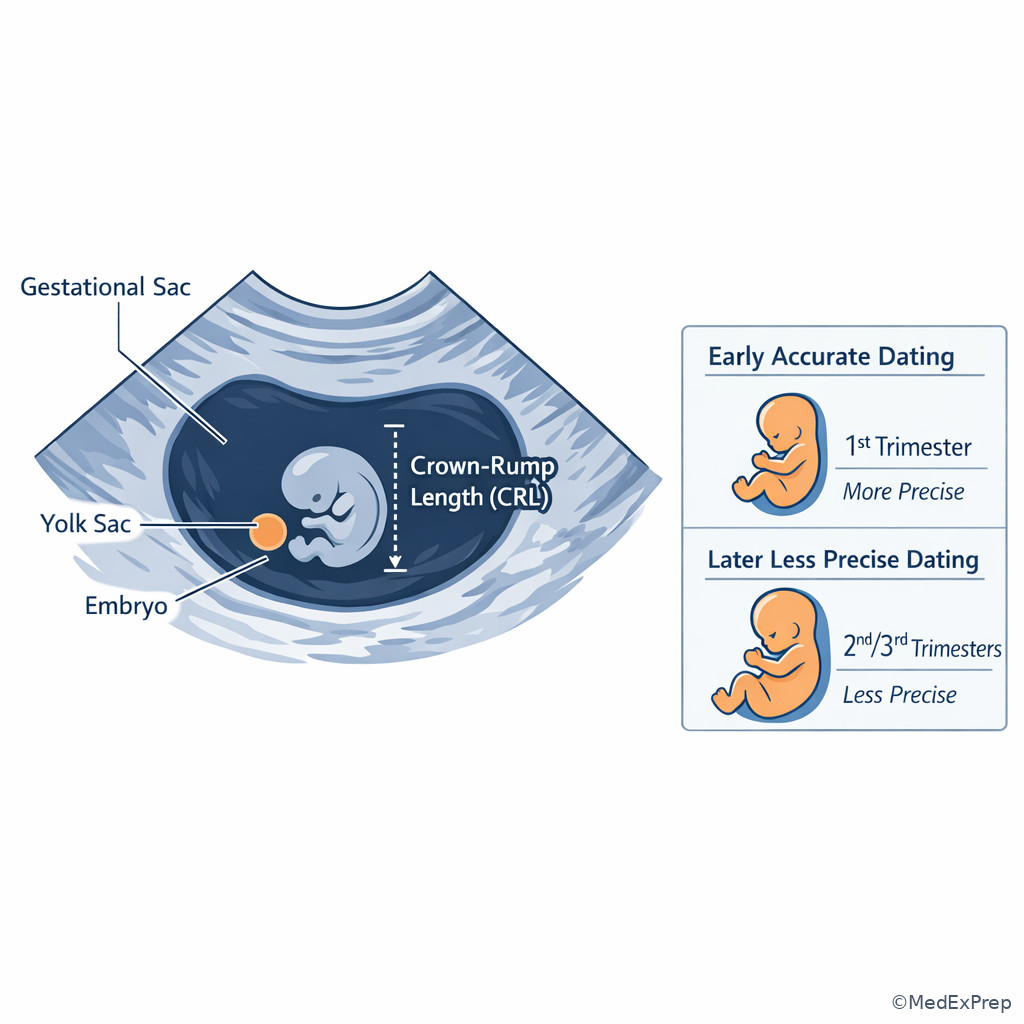
- First-trimester ultrasound is the most accurate method for dating pregnancy.
- If LMP is certain and cycles are regular, LMP-based dating is often acceptable early, but ultrasound may revise it when discrepancy is significant.
- Gestational age on OB exams is almost always from LMP-based dating conventions, not conception date.
- A patient at 8 weeks gestation conceived about 6 weeks earlier in a typical cycle.
- Documentation such as G3P1011 communicates more than “G3P1” because it encodes term/preterm/abortion/living detail.
Exam takeaway: Use reliable first-trimester ultrasound over uncertain or misleading menstrual dates.
flowchart TD
A[Positive pregnancy test] --> B{Reliable LMP with regular cycles?}
B -->|Yes| C[Calculate GA and EDD from LMP]
B -->|No| D[Use ultrasound dating]
C --> E{First trimester ultrasound matches closely?}
E -->|Yes| F[Keep established dating]
E -->|No| G[Revise EDD to ultrasound-based date]
D --> H[Use earliest accurate ultrasound as anchor] Exam takeaway: Anchor gestational age to the first day of the last menstrual period rather than the conception date.
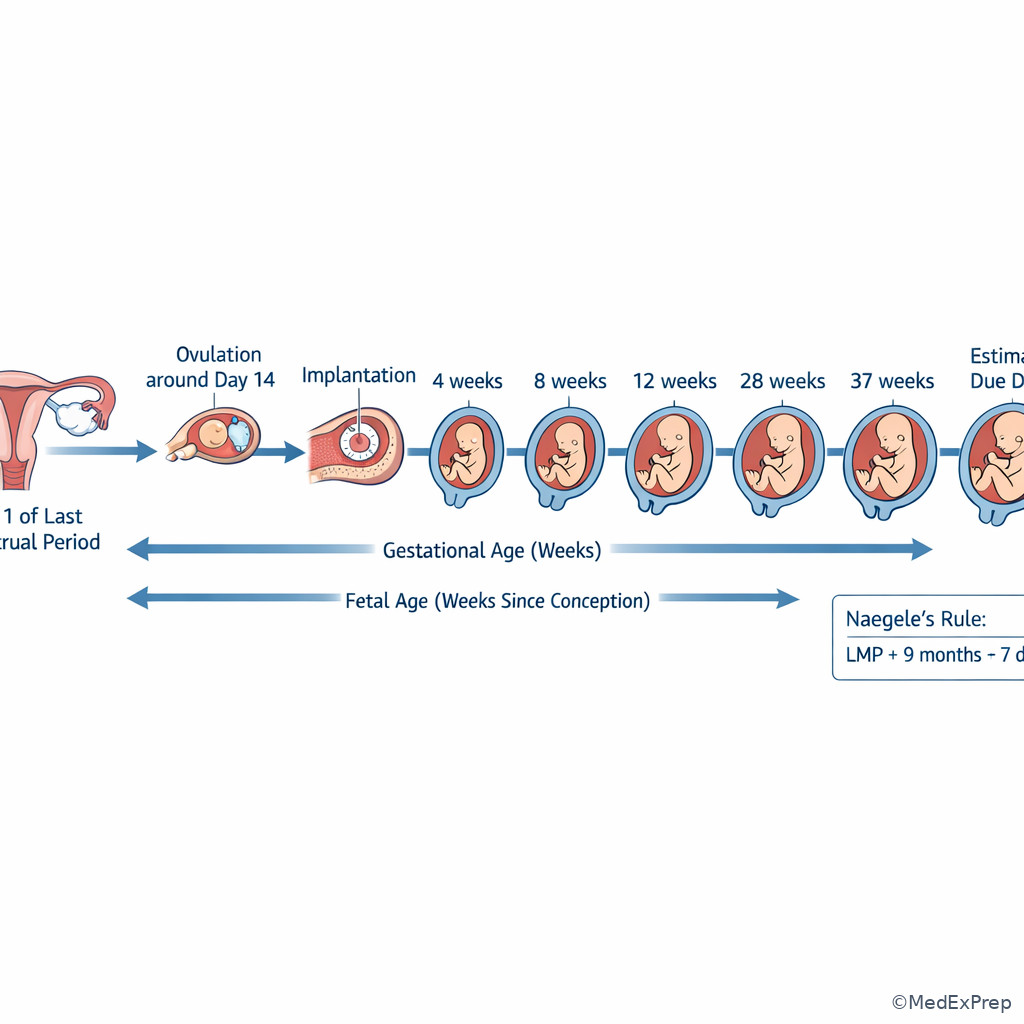
See Fig 1 for the dating hierarchy you should default to on exam stems, and see Fig 2 for the timeline distinction between gestational age and conception timing.
Core content
1.1.1.3 Foundational language: gravidity, parity, and TPAL
A Explanation
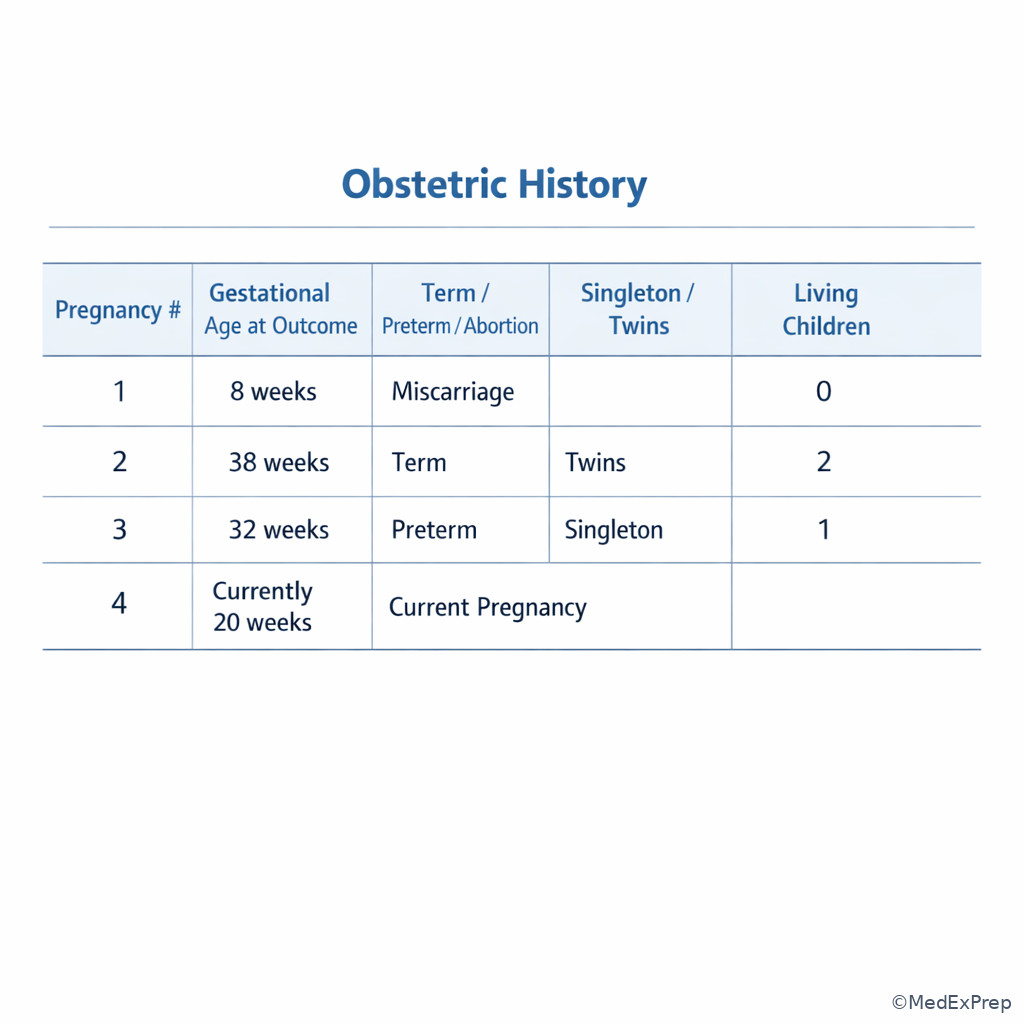
The decision conflict is simple but heavily tested: are you being asked to count pregnancies, deliveries, or living children? Gravidity counts pregnancies; parity counts pregnancies reaching viability; living counts children currently alive. The single rule that resolves most confusion is this: twins change living count by 2 but parity by only 1. A current pregnancy counts toward G but not toward P until it reaches viable gestational age.
WHY THIS IS TESTED: Students often choose an answer that counts infants instead of pregnancies, or they incorrectly place a miscarriage into parity. When a stem gives multiple prior outcomes, slow down and convert each pregnancy one by one. Treat each pregnancy as one event, then decide whether it belongs under term, preterm, abortion, or living.
Choose TPAL when the stem gives detail; reject a vague “GxPy” answer when one option reflects miscarriages or preterm births more precisely. For COMAT-style interpretation, an ectopic pregnancy or spontaneous abortion before viability goes in A; a delivery at 35 weeks goes in P for preterm; a 39-week cesarean goes in T. Stillborn versus liveborn affects L, not T/P classification.
B Worked example
A 29-year-old woman presents for her first prenatal visit. She has chronic hypertension and migraine without aura. She reports one prior spontaneous abortion at 9 weeks, one prior cesarean delivery of twins at 38 weeks, and one prior vaginal delivery at 35 weeks of a singleton now living. She is currently 10 weeks pregnant by LMP. A distracting detail in the chart notes prior infertility treatment, but no other pregnancy losses. What is the correct obstetric notation?
Reasoning chain: Identify task: convert history into gravidity and parity. Extract key facts: current pregnancy = 1; prior SAB at 9 weeks = abortion; term twin delivery = one term pregnancy, two living children; prior 35-week singleton = one preterm pregnancy, one living child. Apply rule: parity counts pregnancies reaching viability, not number of infants. Eliminate distractors that count twins as two parities or place the miscarriage into preterm. Verify: total pregnancies are current + SAB + twin pregnancy + singleton preterm pregnancy = 4. Therefore she is G4P1113.
C Exam trap
Why it is tempting: The stem mentions twins, so test-takers reflexively increase parity by 2 because two infants were delivered.
Single clue that eliminates it: Parity counts pregnancies, not babies. A twin gestation contributes one term or one preterm birth event.
D Checkpoint
Question: A 33-year-old pregnant patient has a history of one ectopic pregnancy treated medically, one term vaginal delivery of a singleton, and one preterm twin delivery at 34 weeks with both children living. She is currently pregnant again. Which is the most accurate notation?
- G4P1113 — Tempting because it counts the ectopic as an abortion and both viable pregnancies correctly; this is right because current pregnancy raises G to 4, \(term = 1\), \(preterm = 1\), \(abortions = 1\), \(living = 3\).
- G4P1213 — Tempting because twins can make the prior preterm delivery feel like two parity events; wrong because one twin pregnancy counts as one preterm pregnancy.
- G3P1113 — Tempting because learners forget the current pregnancy counts in gravidity; wrong because gravidity includes the present pregnancy.
- G4P1023 — Tempting if the ectopic is ignored or viability is counted loosely; wrong because the 34-week twin pregnancy is preterm, not term, and the ectopic contributes to abortions.
1.1.1.4 Dating basics: gestational age, conception timing, and Naegele’s rule
A Explanation
The decision conflict here is whether to count from LMP or from the patient’s presumed date of conception. On exams, choose LMP-based gestational age unless the stem specifically tells you dating has been revised by ultrasound. The single rule that resolves most stems is: gestational age starts on the first day of the last menstrual period, so conception usually occurs about 2 weeks after gestational age day 0 in a standard cycle.
WHY THIS IS TESTED: A stem may say “she conceived 6 weeks ago” and offer options corresponding to 6 or 8 weeks gestation. The exam wants you to reject conception age when the question asks for obstetric gestational age. Similarly, EDD calculations are classically tested with Naegele’s rule: add 7 days, subtract 3 months, add 1 year.
Choose Naegele’s rule when the LMP is known and cycles are regular. Reject it when the patient has uncertain recall, irregular cycles, recent hormonal contraception, postpartum amenorrhea, or breastfeeding-related cycle disruption. In those cases, menstrual dating becomes less reliable, and ultrasound dating becomes more important.
If a patient’s LMP began on January 10, the EDD is October 17 of that year. If the stem gives an exact current date, you can also estimate gestational age by counting forward from LMP. Board questions usually reward approximate calendar reasoning rather than exact day-by-day arithmetic.
B Worked example
A 24-year-old G1 patient presents with mild nausea for her first visit. She has hypothyroidism and obesity. Her LMP started on March 3, and her cycles are regular every 28 days. She thinks conception occurred around March 17 because that was the only time she had intercourse. A urine culture from urgent care showed mixed flora, a distracting clue unrelated to dating. What is the best estimated due date?
Reasoning chain: Identify task: calculate EDD, not conception date. Extract key facts: reliable LMP, regular cycles. Apply rule: Naegele’s rule. March 3 + 7 \(days = March 10\); minus 3 months = December 10; plus 1 year = December 10. Eliminate conception-based answers in mid-December or late December that use March 17 as day 0. Verify: in routine obstetrics, the first day of the LMP is the dating anchor when reliable.
C Exam trap
Why it is tempting: The patient sounds certain about when conception happened, so it feels more biologically exact.
Single clue that eliminates it: The question asks for obstetric gestational age/EDD, which is conventionally anchored to LMP unless ultrasound redates the pregnancy.
D Checkpoint
Question: A patient’s LMP began on August 22 and she has regular 28-day cycles. What is the best estimated due date using Naegele’s rule?
- May 15 — Tempting because it adds roughly 38 weeks from presumed conception; wrong because OB dating starts from LMP, not conception.
- May 29 — Tempting because late May feels close after quick mental math; correct because August 22 + 7 \(days = August 29\), minus 3 months = May 29, plus 1 year as needed.
- June 5 — Tempting if you add 7 days but forget to subtract 3 months correctly; wrong because the month shift is off.
- May 22 — Tempting because it preserves the day number from the LMP; wrong because Naegele’s rule requires the 7-day addition first.
- The current pregnancy counts toward gravidity but not parity until viability.
- True or False: A twin delivery increases parity by 2. False.
- Naegele’s rule = LMP + 7 days - 3 months + 1 year.
1.1.1.5 When LMP is unreliable: ultrasound dating and discrepancy rules
A Explanation
The decision conflict in real stems is not whether you know Naegele’s rule; it is whether you should trust the menstrual date at all. The single finding that resolves this is reliability of menstrual history plus the timing of ultrasound. First-trimester ultrasound is the most accurate method for dating, so if LMP is uncertain, cycles are irregular, or the menstrual date conflicts meaningfully with a first-trimester ultrasound, use ultrasound-based dating.
WHY THIS IS TESTED: Many COMAT questions hide the answer in a subtle reliability problem: recent oral contraceptive use, breastfeeding, polycystic ovary syndrome, postpartum irregularity, or uncertain LMP recall. In those settings, choosing LMP because “that is how dating works” is too superficial. You must reject LMP when the data source is weak.
The exam-level rule is conceptual rather than institution-specific: the earlier the ultrasound, the better the dating accuracy. A first-trimester crown-rump length is better than second-trimester biometry for establishing due date. Later ultrasounds are less reliable for dating and better used for growth assessment once an EDD has already been set. If the earliest trustworthy ultrasound differs from LMP enough to matter, the pregnancy is redated based on ultrasound.
This matters downstream. If you fail to redate correctly, you may order aneuploidy screening too late, misinterpret fundal height, call a fetus growth-restricted when dates are wrong, or misclassify preterm versus term. See Fig 1 for the hierarchy and decision structure.
Exam takeaway: Irregular cycles, uncertain recall, recent hormones, or postpartum amenorrhea should push you toward early ultrasound dating.
flowchart LR
A[Reliable dating inputs] --> B[Known LMP]
A --> C[Regular cycles]
A --> D[No recent hormonal disruption]
A --> E[Early confirming ultrasound] F[Unreliable dating inputs] --> G[Unknown LMP]
F --> H[Irregular cycles]
F --> I[Recent hormonal contraception]
F --> J[Breastfeeding or postpartum amenorrhea]
F --> K[PCOS or chronic anovulation] B --> L[Menstrual dating can be used]
C --> L
D --> L
E --> M[Keep if concordant]
G --> N[Use ultrasound dating]
H --> N
I --> N
J --> N
K --> N
Exam takeaway: A first-trimester ultrasound with crown-rump length is the most accurate common clinical dating study.
B Worked example
A 31-year-old woman presents with a positive pregnancy test. She has polycystic ovary syndrome, obesity, and cycles every 35 to 70 days. She stopped combined oral contraceptives 2 months ago. She thinks her LMP was “about 11 weeks ago,” but she is not sure. Bedside ultrasound shows a singleton intrauterine pregnancy measuring 8 weeks 3 days. A tempting distractor is her certainty that intercourse occurred 9 weeks ago during a vacation. What is the most appropriate dating method?
Reasoning chain: Identify task: choose the best dating anchor. Extract key facts: uncertain LMP, irregular cycles, recent hormonal contraception, early ultrasound available. Apply rule: first-trimester ultrasound is more accurate than unreliable menstrual dating. Eliminate conception-date answers because intercourse timing is not the standard dating anchor. Verify: the best next step is to date the pregnancy by first-trimester ultrasound and use that EDD for future care.
C Exam trap
Why it is tempting: Learners memorize the rule without integrating reliability conditions.
Single clue that eliminates it: Irregular cycles plus uncertain recall plus recent contraceptive use make menstrual dating weak, so early ultrasound should anchor the pregnancy.
D Checkpoint
Question: Which patient most strongly requires ultrasound-based dating rather than routine reliance on LMP?
- A 27-year-old with a clearly remembered LMP 6 weeks ago and regular 28-day cycles — Tempting because early dating is always important; wrong because the menstrual date is reliable here.
- A 22-year-old with irregular cycles every 40 to 90 days and uncertain LMP recall — Tempting because it sounds messy; correct because unreliable cycles and uncertain recall are classic reasons to use ultrasound.
- A 35-year-old with regular cycles and mild nausea who tracked ovulation by an app — Tempting because ovulation tracking seems precise; wrong because reliable LMP still suffices unless ultrasound meaningfully disagrees.
- A 30-year-old with regular cycles and a known LMP whose first prenatal visit is delayed until 14 weeks — Tempting because later presentation feels less certain; wrong because the key issue is reliability of the menstrual history, not simply delayed presentation.
1.1.1.6 Applying gestational age to prenatal sequencing and visit planning
A Explanation
The decision conflict now moves from “what is the date?” to “what does that date change?” The single rule is: every time-sensitive prenatal test or milestone depends on the established gestational age, not the patient’s guess. Once the EDD is assigned, all counseling and screening should use that standardized gestational age.
WHY THIS IS TESTED: COMAT questions frequently disguise a dating question as a screening question. A stem asks whether nuchal translucency, anatomy ultrasound, fundal height interpretation, or fetal viability counseling is appropriate. The real answer depends first on dating. If the pregnancy is actually 10 weeks rather than 13 weeks, your next step changes.
At a foundational level, know the broad sequence: early confirmation and dating first; then prenatal labs; then ongoing routine visits tracking maternal and fetal status. This lesson links directly to the next two topics: Initial Prenatal Laboratory Panel and Routine Prenatal Visit Priorities. Forward-reference thinking matters because an incorrect EDD cascades into poorly timed screening and false reassurance or false alarm.
Choose answers that use the established EDD consistently. Reject answers that switch between LMP-based age and ultrasound-based age mid-stem. When a question asks what matters most to monitor later, remember that fundal height, fetal growth, and post-dates management all assume the dating anchor is already correct.
B Worked example
A 26-year-old G2P0010 presents for care after moving states. She has asthma and generalized anxiety disorder. Her outside records show an LMP-based dating estimate of 13 weeks 4 days, but a documented 9-week ultrasound established the pregnancy as 11 weeks 6 days on that same calendar date. She asks whether she has “already missed” a first-trimester screening window. A distracting clue is a family history of Down syndrome in a distant relative. What should guide your timing decisions?
Reasoning chain: Identify task: determine which gestational age to use. Extract key facts: early ultrasound exists and conflicts with LMP; first-trimester ultrasound is more accurate. Apply rule: use the established early ultrasound-based EDD for all subsequent timing. Eliminate answers that continue using the LMP because records already contain a stronger dating source. Verify: the proper next step is to base counseling and test timing on the ultrasound-derived gestational age.
C Exam trap
Why it is tempting: It feels patient-centered and practical to choose the more convenient number.
Single clue that eliminates it: EDD must be assigned by the most accurate dating method, not by convenience. Once established, it anchors all subsequent screening windows.
D Checkpoint
Question: A patient had a reliable first-trimester ultrasound establishing an EDD. At 30 weeks by that dating, a later ultrasound biometry appears 2 weeks smaller. What is the most appropriate interpretation?
- Change the EDD to match the new ultrasound — Tempting because ultrasound seems objective; wrong because later ultrasound is less accurate for dating and better for growth assessment.
- Keep the established EDD and evaluate growth in relation to that date — Tempting because it requires trusting the earlier study; correct because early ultrasound sets the dating anchor.
- Recalculate the EDD from the patient’s original conception estimate — Tempting if the patient tracked ovulation; wrong because conception timing is not the standard anchor once accurate obstetric dating exists.
- Ignore both ultrasounds and use fundal height alone — Tempting as a bedside shortcut; wrong because fundal height depends on accurate gestational age rather than replacing it.
- The most accurate common dating method in pregnancy is first-trimester ultrasound.
- True or False: Later ultrasound is better than first-trimester ultrasound for establishing EDD. False.
- Name 3 clues that make LMP unreliable: irregular cycles, uncertain recall, recent hormonal contraception.
1.1.1.7 Integration: common board-style differentials and documentation choices
A Explanation
The final decision conflict is recognizing what the examiner is actually asking. Is the stem asking for gravidity/parity notation, gestational age, estimated due date, or the most appropriate next dating step? The single strategy that resolves integration-level stems is the course problem-solving framework: identify the task → determine whether the issue is counting or dating → assess reliability → apply the governing rule → verify maternal-fetal safety and future implications.
WHY THIS IS TESTED: Questions add noise: fertility treatment, multiple gestation, uncertain intercourse timing, breastfeeding, prior ectopic, or prior stillbirth. The examinee who reacts to emotionally salient details instead of classification rules gets trapped. A stillbirth after viability changes parity but not living count. IVF conception timing may seem exact, but many stems still want you to recognize that obstetric dating must be assigned consistently and documented clearly rather than re-estimated casually from memory.
Choose the answer that solves the stem’s exact task. If the stem asks for most appropriate next step, do not simply calculate an EDD if the real issue is uncertain dates requiring ultrasound. If it asks for notation, do not debate screening windows. If it asks which prior history matters for current risk, parity details such as prior preterm birth may be more important than total gravidity alone.
See Fig 3 for clues that make LMP unreliable, and see Fig 4 below for a compact summary of what counts where in obstetric history.
Exam takeaway: Count each pregnancy once, then sort it by viability and current living status.
flowchart TD
A[Pregnancy event] --> B{Current pregnancy?}
B -->|Yes| C[Counts in G only for now]
B -->|No| D{Reached viability?}
D -->|No| E[Counts in A]
D -->|Yes| F{Term or preterm?}
F -->|Term| G[Counts in T and P]
F -->|Preterm| H[Counts in P and overall parity]
G --> I[Then count living children separately]
H --> I
E --> I
I --> J[Multiple gestation can raise living count more than parity] Exam takeaway: Translating narrative pregnancy history into structured notation prevents counting errors on exam day.
B Worked example
A 37-year-old woman presents to establish prenatal care after in vitro fertilization. She has type 2 diabetes and chronic hypertension. Her prior history includes one elective abortion at 8 weeks, one term singleton stillbirth, and one live preterm singleton at 33 weeks. She is now pregnant again. A tempting clue is that IVF makes the conception date known. The chart asks for the most accurate obstetric notation and what part of the history most changes surveillance planning.
Reasoning chain: Identify task: both notation and clinically meaningful prior outcome. Extract key facts: current pregnancy + prior abortion + prior term stillbirth + prior live preterm birth = G4. Term stillbirth counts in term/parity but not living. Preterm live singleton counts in preterm and living. So notation is G4P1111. Apply second rule: prior preterm birth is a major risk-relevant historical feature for future management. Eliminate options that reduce parity because the term infant was stillborn, or that overemphasize IVF dating instead of prior obstetric outcome risk. Verify: parity is about viability, not neonatal survival.
C Exam trap
Why it is tempting: Learners conflate parity with living children when emotionally charged outcomes are described.
Single clue that eliminates it: Parity is based on pregnancy reaching viable gestation, not on neonatal survival.
D Checkpoint
Question: A 34-year-old pregnant patient has one prior elective termination at 7 weeks, one prior stillborn infant delivered at 39 weeks, and one prior live singleton delivered at 36 weeks. Which notation is most accurate?
- G4P1111 — Tempting because it counts the current pregnancy plus one term, one preterm, one abortion, and one living child; correct because the stillbirth counts in parity but not living.
- G4P1011 — Tempting because only one child is living; wrong because it ignores the prior preterm delivery and misuses living count as parity.
- G3P1111 — Tempting if the current pregnancy is forgotten; wrong because gravidity includes the current pregnancy.
- G4P0111 — Tempting if the term stillbirth is not counted as term; wrong because a 39-week delivery is term regardless of neonatal survival.
Exam Traps & Differentiators
- Counting infants instead of pregnancies — tempting in twin gestations; the ruling clue is that parity counts pregnancy events reaching viability.
- Using conception date instead of LMP — tempting when intercourse timing seems exact; the ruling clue is that obstetric gestational age begins on LMP unless ultrasound redates.
- Trusting an unreliable LMP — tempting because LMP is the classic rule; the ruling clue is irregular cycles, poor recall, recent hormones, or postpartum amenorrhea.
- Redating late from a third-trimester scan — tempting because imaging seems objective; the ruling clue is that the earliest accurate ultrasound is the best dating study.
- Equating parity with living children — tempting after stillbirth or neonatal death; the ruling clue is that parity tracks viable gestational age, not current survival.
1.1.1.8 Looks similar but isn’t
| Confusable pair | Why they look similar | Single discriminator | Exam move |
|---|---|---|---|
| Gravidity vs parity | Both summarize reproductive history | Gravidity counts all pregnancies; parity counts pregnancies reaching viability | Count current pregnancy only in G |
| Parity vs living | Both rise after delivery | Living reflects surviving children; parity reflects viable gestational outcome | Stillbirth affects P, not L |
| LMP dating vs conception dating | Both seem time-based | Obstetric gestational age starts from first day of LMP | Choose LMP unless ultrasound overrides |
| Reliable LMP vs unreliable LMP | Both provide a date | Cycle regularity and recall quality determine usefulness | Use early ultrasound when reliability is poor |
| Early ultrasound dating vs late ultrasound dating | Both use fetal measurements | Earlier ultrasound is more accurate for dating | Do not redate casually from late biometry |
If the stem says irregular cycles, think unreliable LMP and ultrasound dating.
If the stem says twins, think one pregnancy event but possibly two living children.
If the stem says stillbirth at term, think parity increases even if living count does not.
If the stem says IVF or known intercourse date, think do not abandon structured obstetric dating rules.
If the stem says later ultrasound differs from earlier established dating, think growth issue before redating issue.
If the stem says missed screening window, think verify the dating anchor first.
Tables
| Reference item | High-yield value / rule | Why it matters on exams |
|---|---|---|
| Gestational age anchor | First day of LMP | Separates obstetric age from conception age |
| Typical due date timing | 40 weeks from LMP | Used for EDD calculations |
| Naegele’s rule | LMP + 7 days - 3 months + 1 year | Classic board-style EDD tool |
| Most accurate common dating study | First-trimester ultrasound | Overrides unreliable LMP |
| Current pregnancy in G/P | Counts in G, not yet in P | Frequent notation trap |
| Twins in parity | One parity event | Prevents overcounting |
| Miscarriage/ectopic before viability | Counts in abortions | Not term or preterm |
| Stillbirth at viable gestation | Counts in parity, not living | Separates P from L |
| Dating method | Best use case | Strength | When to reject or limit it |
|---|---|---|---|
| LMP with regular cycles | Known first day of LMP, regular cycles, no cycle disruption | Simple and acceptable when reliable | Irregular cycles, uncertain recall, recent hormones, postpartum amenorrhea |
| Known conception/intercourse date | Supplementary context | Can help explain timing | Not the default obstetric dating standard in most stems |
| First-trimester ultrasound | Uncertain dates or discrepancy with LMP | Most accurate common method | Not available in all early presentations |
| Second/third trimester ultrasound | Growth and anatomy assessment | Helpful for interval assessment | Less accurate for establishing original EDD |
| History item | Counts in G? | Counts in P or TPAL term/preterm? | Counts in A? | Counts in L? |
|---|---|---|---|---|
| Current pregnancy | Yes | No, not yet | No | No |
| Elective or spontaneous abortion before viability | Yes | No | Yes | No |
| Ectopic pregnancy | Yes | No | Yes | No |
| Term singleton live birth | Yes | Yes, term | No | Yes |
| Preterm singleton live birth | Yes | Yes, preterm | No | Yes |
| Term stillbirth | Yes | Yes, term | No | No |
| Preterm twin live birth | Yes | Yes, one preterm pregnancy | No | Yes, usually 2 if both living |
Exam takeaway: Menstrual history is usable only when recall and cycle pattern make it trustworthy.
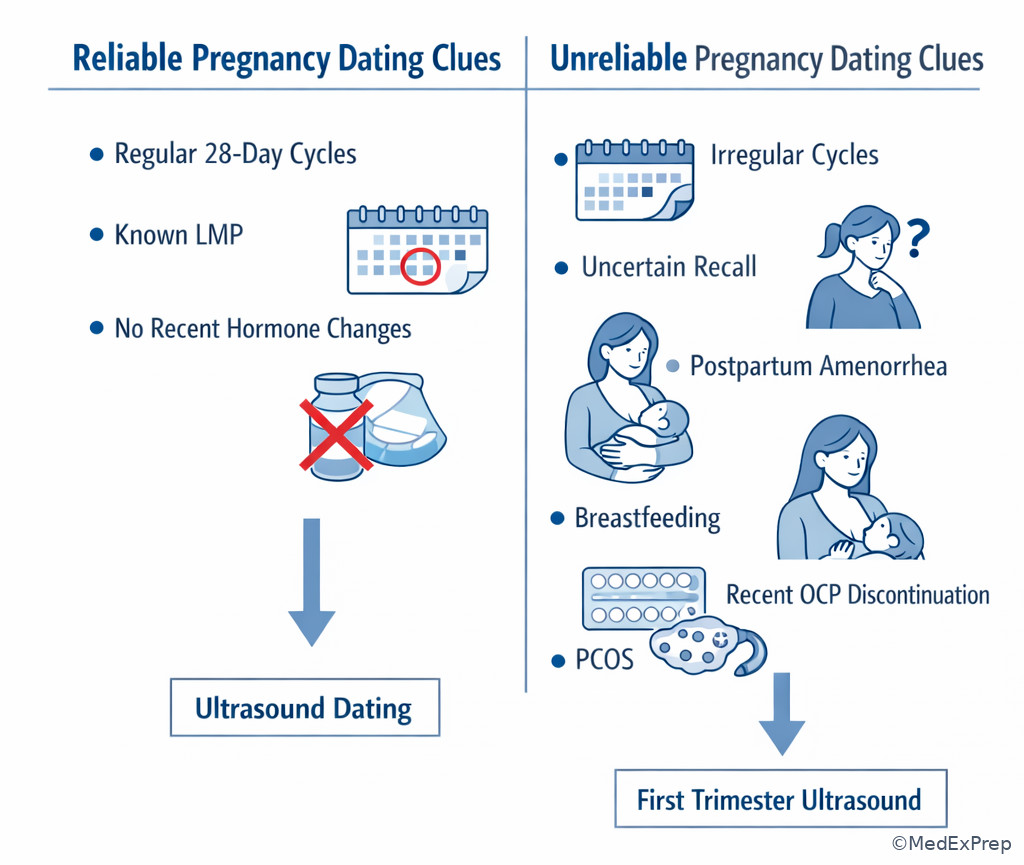
See Fig 5 when you need a rapid choose-versus-reject framework for LMP reliability.
Exam takeaway: Walking through add 7 days, subtract 3 months, add 1 year prevents avoidable arithmetic traps.
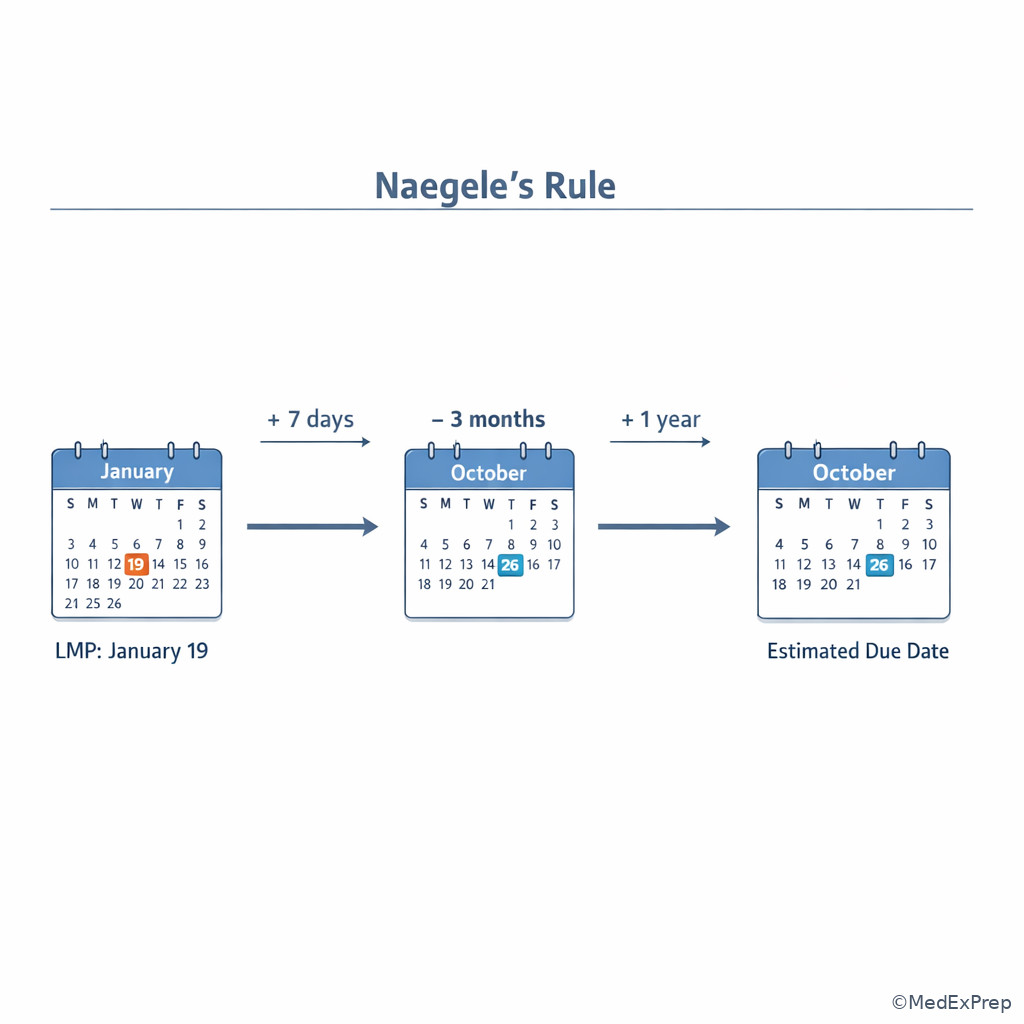
Algorithm / Approach
Exam takeaway: First decide whether the stem asks you to count pregnancies or date the current one, then apply the most reliable rule.
See Fig 6 for a compact exam-day workflow. If a question feels harder than it should, you probably skipped step 1 and answered the wrong task.
Rapid Review
- Gravidity → total pregnancies, including current pregnancy
- Parity → pregnancies reaching viability, not number of infants
- Twins → one parity event, potentially two living children
- Stillbirth at term → counts in parity, not living
- Ectopic pregnancy → counts in gravidity and abortion history, not parity
- Gestational age → measured from first day of LMP
- Conception age → usually about 2 weeks less than gestational age in a standard cycle
- Naegele’s rule → add 7 days, subtract 3 months, add 1 year
- Reliable LMP → known date plus regular cycles plus no recent hormonal disruption
- Unreliable LMP → uncertain recall, irregular cycles, PCOS, breastfeeding, recent contraception change
- Best dating study → first-trimester ultrasound
- Late ultrasound discrepancy → think growth before redating
- Current pregnancy in TPAL → not yet counted in term/preterm/abortion
- Question asks “best next step” with uncertain dates → obtain or use early ultrasound
Self-check quiz
1.1.1.9 Question 1
A 25-year-old pregnant patient has one prior miscarriage at 10 weeks and one prior term singleton live birth. She is now pregnant again. Which notation is most accurate?
- G2P1011
- G3P1011
- G3P1111
- G2P1111
1.1.1.10 Question 2
A 28-year-old patient with regular 28-day cycles reports an LMP beginning February 12. What is the best estimated due date?
- November 12
- November 19
- November 26
- December 19
1.1.1.11 Question 3
A 30-year-old G1 presents after a positive home pregnancy test. She has obesity and polycystic ovary syndrome. Her cycles occur every 35 to 60 days, and she is unsure of her LMP. She asks for the most appropriate next step to establish gestational age. Which is best?
- Date the pregnancy using her best estimate of conception from intercourse timing
- Use today as gestational day 0 until fetal movement is felt
- Obtain an early ultrasound to establish dating
- Estimate gestational age solely from fundal height
1.1.1.12 Question 4
A 32-year-old pregnant patient has one prior ectopic pregnancy treated with methotrexate, one prior term twin delivery with both children living, and one prior preterm singleton live birth at 35 weeks. She is now pregnant again. What is the most accurate notation?
- G4P1213
- G4P1113
- G5P1113
- G4P1023
1.1.1.13 Question 5
A 23-year-old G1 with regular cycles has a reliable LMP suggesting 9 weeks gestation. A first-trimester ultrasound performed for spotting is consistent with 9 weeks 1 day. She asks which date should guide future prenatal scheduling. Which is the most appropriate answer?
- Use the menstrual date only and ignore all ultrasounds
- Use the concordant established dating and keep one consistent EDD
- Wait until the anatomy scan to finalize dating
- Change the EDD at each visit based on interval fetal growth
1.1.1.14 Question 6
A 36-year-old pregnant patient conceived by assisted reproduction and presents with outside records. She has chronic hypertension and type 1 diabetes. Her chart lists an LMP-based age of 14 weeks, but a documented 8-week ultrasound from that same pregnancy established a different EDD that makes her 12 weeks 5 days today. She asks whether a time-sensitive first-trimester screening decision should be based on the old LMP or the ultrasound date. What is the most appropriate response?
- Use the LMP because gestational age is always defined from the menstrual period
- Use the 8-week ultrasound-based EDD because early ultrasound is more accurate for dating
- Average the LMP and ultrasound dates to avoid overcommitting to either
- Use the assisted reproduction conception date instead of standard obstetric dating methods
1.1.1.15 Question 7
A 34-year-old pregnant patient has one prior elective abortion at 8 weeks, one prior stillborn infant delivered at 38 weeks, and one prior live singleton delivered at 34 weeks. She now presents for prenatal care. A resident asks for the best notation to place in the chart. Which is most accurate?
- G4P1111
- G4P1011
- G4P0111
- G3P1111
1.1.1.16 Question 8
A 29-year-old G2P0010 presents after stopping progestin-only contraception 6 weeks ago. She is breastfeeding, has irregular cycles, and is unsure whether her LMP was 7 or 11 weeks ago. Ultrasound today shows a single intrauterine pregnancy measuring 8 weeks 4 days. A later follow-up scan at a much later gestation appears 10 days smaller than expected. Which approach is most appropriate?
- Keep the early ultrasound-based EDD and interpret the later scan as a growth question
- Change the EDD to match the later ultrasound because later fetal size is more current
- Return to the earlier LMP estimate because gestational age must begin from LMP
- Recalculate the EDD from the likely conception date after contraception was stopped
Answer key
1.1.1.17 Question 1 Answer: B. G3P1011
Mechanism-to-answer: Gravidity includes all pregnancies including the current one. Prior miscarriage at 10 weeks counts as one abortion. Prior term live birth counts as one term pregnancy and one living child. Therefore current pregnancy + miscarriage + prior term birth = G3; \(TPAL = 1011\).
- A. G2P1011 — Tempting because the prior outcomes are counted correctly; incorrect because it forgets that the current pregnancy increases gravidity. Discriminating clue: “She is now pregnant again.” Source: Cunningham et al.; ACOG.
- B. G3P1011 — Tempting because it uses the current pregnancy plus prior miscarriage plus prior term birth; correct for this exact history. Discriminating clue: one prior loss before viability and one prior term birth. Source: Cunningham et al.; ACOG.
- C. G3P1111 — Tempting if the miscarriage is mistakenly treated as a viable delivery event; incorrect because a 10-week miscarriage does not count in parity. Discriminating clue: 10 weeks is before viability. Source: Beckmann et al.; ACOG.
- D. G2P1111 — Tempting if both the current pregnancy and miscarriage are mishandled; incorrect because both gravidity and abortion count are wrong. Discriminating clue: the history contains three total pregnancies. Source: Cunningham et al.
1.1.1.18 Question 2 Answer: B. November 19
Mechanism-to-answer: Apply Naegele’s rule to the first day of the LMP. February 12 + 7 \(days = February 19\); minus 3 months = November 19.
- A. November 12 — Tempting because it preserves the original day of the month; incorrect because Naegele’s rule requires adding 7 days first. Discriminating clue: LMP began February 12, not conception date. Source: ACOG; Cunningham et al.
- B. November 19 — Tempting and correct because it follows Naegele’s rule accurately. Discriminating clue: regular cycles with a known LMP support classic EDD calculation. Source: ACOG.
- C. November 26 — Tempting if you add two weeks rather than one; incorrect because the rule is +7 days, not +14 days. Discriminating clue: precise calendar arithmetic. Source: Beckmann et al.
- D. December 19 — Tempting if you forget the 3-month subtraction; incorrect because that would extend the pregnancy beyond standard 40-week dating. Discriminating clue: Naegele’s rule includes month subtraction. Source: ACOG.
1.1.1.19 Question 3 Answer: C. Obtain an early ultrasound to establish dating
Mechanism-to-answer: Irregular cycles and uncertain LMP make menstrual dating unreliable. First-trimester ultrasound is the most accurate common dating method and should anchor gestational age in this setting.
- A. Date the pregnancy using her best estimate of conception from intercourse timing — Tempting because patients often remember intercourse better than LMP; incorrect because conception timing is not the standard dating method in a patient with uncertain dates. Discriminating clue: uncertain LMP and irregular cycles. Source: ACOG Committee Opinion on estimating due date.
- B. Use today as gestational day 0 until fetal movement is felt — Tempting because quick estimation feels practical; incorrect because gestational age is not reset arbitrarily and fetal movement is not a dating tool. Discriminating clue: the question asks for the most appropriate step to establish accurate dating. Source: Cunningham et al.
- C. Obtain an early ultrasound to establish dating — Tempting because it directly resolves the uncertainty; correct because early ultrasound is most accurate when LMP is unreliable. Discriminating clue: PCOS with highly irregular cycles. Source: ACOG.
- D. Estimate gestational age solely from fundal height — Tempting because fundal height is common in prenatal care; incorrect because it is too imprecise for initial dating and depends on established gestational age. Discriminating clue: early pregnancy dating question, not routine follow-up measurement. Source: Beckmann et al.; ACOG.
1.1.1.20 Question 4 Answer: B. G4P1113
Mechanism-to-answer: Current pregnancy + ectopic + term twin pregnancy + preterm singleton pregnancy = G4. Ectopic counts in abortions. Term twin delivery counts as one term pregnancy, not two. Preterm singleton counts as one preterm pregnancy. Living children are two from the twins plus one from the singleton = 3.
- A. G4P1213 — Tempting because twins may be overcounted as two parity events; incorrect because parity counts pregnancies, not infants. Discriminating clue: one prior twin gestation. Source: Cunningham et al.; ACOG.
- B. G4P1113 — Tempting and correct because it counts one term viable pregnancy, one preterm viable pregnancy, one abortion, and three living children. Discriminating clue: ectopic before viability plus one twin pregnancy. Source: Beckmann et al.
- C. G5P1113 — Tempting if twins are incorrectly added to gravidity as two pregnancies; incorrect because gravidity counts pregnancy events, not fetuses. Discriminating clue: twin gestation is one pregnancy. Source: Cunningham et al.
- D. G4P1023 — Tempting if the preterm birth is misread as abortion or the ectopic is ignored; incorrect because the 35-week birth is preterm and viable. Discriminating clue: delivery at 35 weeks reached viability. Source: ACOG; Beckmann et al.
1.1.1.21 Question 5 Answer: B. Use the concordant established dating and keep one consistent EDD
Mechanism-to-answer: When a reliable LMP and first-trimester ultrasound agree, the pregnancy has concordant dating. The correct action is to keep one consistent EDD and use it for future prenatal planning rather than constantly revising dates.
- A. Use the menstrual date only and ignore all ultrasounds — Tempting because LMP is the classic rule; incorrect because ultrasound is not ignored, and concordance strengthens the established dating. Discriminating clue: first-trimester ultrasound matches the LMP closely. Source: ACOG.
- B. Use the concordant established dating and keep one consistent EDD — Tempting and correct because consistency is the goal once the dating source is confirmed. Discriminating clue: reliable LMP plus concordant early ultrasound. Source: ACOG Committee Opinion on estimating due date.
- C. Wait until the anatomy scan to finalize dating — Tempting because later ultrasound gives more anatomy detail; incorrect because later scans are less accurate for dating than first-trimester scans. Discriminating clue: an early dating study already exists. Source: Cunningham et al.
- D. Change the EDD at each visit based on interval fetal growth — Tempting because fetal growth changes over time; incorrect because EDD should not drift with each scan. Discriminating clue: dating and growth are separate uses of ultrasound. Source: ACOG.
1.1.1.22 Question 6 Answer: B. Use the 8-week ultrasound-based EDD because early ultrasound is more accurate for dating
Mechanism-to-answer: A documented first-trimester ultrasound is more accurate for dating than an LMP that conflicts with it. The proper next step is to use the early ultrasound-based EDD to determine whether she is in or out of a time-sensitive screening window.
- A. Use the LMP because gestational age is always defined from the menstrual period — Tempting because gestational age is conceptually counted from LMP; incorrect because a conflicting early ultrasound can supersede LMP when it is more accurate. Discriminating clue: documented 8-week ultrasound conflict. Source: ACOG Committee Opinion on methods for estimating the due date.
- B. Use the 8-week ultrasound-based EDD because early ultrasound is more accurate for dating — Tempting and correct because early ultrasound is the best common dating tool. Discriminating clue: first-trimester study already established an alternate EDD. Source: ACOG; Cunningham et al.
- C. Average the LMP and ultrasound dates to avoid overcommitting to either — Tempting because averaging sounds balanced; incorrect because obstetric dating is not determined by averaging discordant estimates. Discriminating clue: the earliest accurate study should anchor the pregnancy. Source: ACOG.
- D. Use the assisted reproduction conception date instead of standard obstetric dating methods — Tempting because assisted reproduction seems exact; incorrect in this stem because the chart already contains a documented early ultrasound-based EDD that should be used consistently in obstetric practice. Discriminating clue: question asks which established pregnancy date should guide care now. Source: Cunningham et al.; ACOG.
1.1.1.23 Question 7 Answer: A. G4P1111
Mechanism-to-answer: Current pregnancy makes G4. The elective abortion at 8 weeks counts in abortions. The 38-week stillbirth counts as a term pregnancy because parity depends on viable gestational outcome, not survival. The 34-week live birth counts as one preterm pregnancy and one living child. Thus TPAL = 1111.
- A. G4P1111 — Tempting and correct because it correctly counts one term, one preterm, one abortion, and one living child. Discriminating clue: term stillbirth counts in parity. Source: Beckmann et al.; Cunningham et al.
- B. G4P1011 — Tempting because only one child is alive; incorrect because parity is not the same as living count and the prior preterm live birth must be included. Discriminating clue: 34-week delivery reached viability. Source: ACOG.
- C. G4P0111 — Tempting if the stillbirth is excluded from term births; incorrect because 38 weeks is term regardless of neonatal status. Discriminating clue: gestational age at delivery, not infant survival, determines T/P placement. Source: Cunningham et al.
- D. G3P1111 — Tempting if the current pregnancy is ignored; incorrect because gravidity includes the present pregnancy. Discriminating clue: “She now presents for prenatal care.” Source: Beckmann et al.
1.1.1.24 Question 8 Answer: A. Keep the early ultrasound-based EDD and interpret the later scan as a growth question
Mechanism-to-answer: This patient has multiple reasons for unreliable LMP: breastfeeding, irregular cycles, recent contraceptive change, and uncertain recall. The early ultrasound at 8 weeks 4 days is the best dating anchor. A much later scan that appears smaller should prompt growth interpretation rather than redating.
- A. Keep the early ultrasound-based EDD and interpret the later scan as a growth question — Tempting and correct because the earliest accurate ultrasound should remain the dating anchor. Discriminating clue: highly unreliable LMP with an early ultrasound already available. Source: ACOG; Cunningham et al.
- B. Change the EDD to match the later ultrasound because later fetal size is more current — Tempting because newer data often seem better; incorrect because later scans are less accurate for dating and better for assessing growth. Discriminating clue: established early ultrasound dating. Source: ACOG Committee Opinion on estimating due date.
- C. Return to the earlier LMP estimate because gestational age must begin from LMP — Tempting due to memorized definitions; incorrect because her LMP is unreliable in several distinct ways. Discriminating clue: breastfeeding and uncertain LMP with irregular cycles. Source: ACOG.
- D. Recalculate the EDD from the likely conception date after contraception was stopped — Tempting because contraception timing narrows the window; incorrect because conception estimates do not replace a valid early obstetric dating study. Discriminating clue: direct first-trimester ultrasound data already exist. Source: Beckmann et al.; Cunningham et al.
Keep going with the full COMAT OB/GYN Prep Course (COMAT OB)
You just studied the way members do, in the same lesson interface. Full access unlocks every lesson, the question bank and flashcards for a full year.
One payment · 1 year of access · No auto-renewal