1.1.1 - CMSO Role Scope
CMSO Role Scope
What you’ll learn
- Operations Foundations: Distinguish the CMSO role from decision-making authority held by leaders, committees, counsel, and clinicians.
- Compliance, Privacy, and Documentation: Identify what information the medical staff office may collect, validate, organize, protect, and route.
- Operational Decision-Making: Choose the safest next step when a file contains ambiguity, missing data, or role-boundary pressure.
- Governance and Committee Support: Recognize where the CMSO supports process versus where authorized bodies make final determinations.
- Error Prevention: Apply stop-document-escalate logic when information is incomplete, inconsistent, high risk, or outside policy.
Blueprint mapping
- Inferred Domain: Operations Foundations - Objective - Define CMSO role scope and limits.
- Inferred Domain: Credentialing and Practitioner Lifecycle - Objective - Identify support tasks versus approval authority.
- Inferred Domain: Governance, Committees, and Medical Staff Structure - Objective - Route decisions to the correct body or leader.
- Inferred Domain: Compliance, Privacy, Confidentiality, and Documentation Integrity - Objective - Protect records and avoid unauthorized disclosures or unsupported actions.
- Inferred Domain: Operational Judgment and Prioritization - Objective - Stop processing and escalate when risk or ambiguity exceeds delegated authority.
Why it matters
- CMSO exam items often hide the real task: not “what seems helpful,” but “what is the most appropriate action within role and policy.”
- Role-boundary errors are high-yield because deadline pressure, physician status, and committee timing make wrong actions look efficient.
- Accurate support work depends on knowing when to continue processing, when to pause, and when to escalate; this protects the organization and the practitioner.
- Many operational questions test authority lines indirectly: if you know who may verify, route, recommend, approve, disclose, or interpret, you can eliminate tempting distractors quickly.
Key Terms & Must-Know Facts
1.1.1.1 Key terms
- Role scope: The set of authorized responsibilities attached to the CMSO function.
- Delegated task: Work assigned within policy that does not transfer final authority.
- Primary source verification (PSV): Verification from the original issuing source or approved equivalent.
- Credentialing file: The organized record used to support review of appointment, reappointment, or privileges.
- Privileging support: Administrative coordination of privilege requests and supporting evidence.
- Escalation: Routing a concern to the authorized leader or process because it exceeds role or policy.
- Unsupported processing: Continuing workflow without required evidence, required approvals, or policy basis.
- Confidential information: Practitioner, peer review, committee, or credentialing information limited to authorized need-to-know access.
- Documentation integrity: Accuracy, traceability, date integrity, and lawful correction of records.
- Final authority: The body or leader empowered to approve, deny, interpret, or decide.
- Need-to-know: Access limited to a legitimate operational or authorized purpose.
- Red flag: Missing, expired, inconsistent, altered, adverse, or suspicious information requiring scrutiny.
1.1.1.2 Must-know facts
- The CMSO supports processes; the CMSO does not independently grant privileges or final appointment decisions.
- If information is incomplete, inconsistent, expired, or potentially fraudulent, stop unsupported processing and escalate.
- Being under deadline does not authorize bypassing bylaws, policy, PSV, or approval steps.
- Unauthorized disclosure is a role-boundary error even when the requester seems influential or urgent.
- Document what was found, source, date, action taken, and where the issue was routed.
- When policy interpretation is ambiguous, follow written policy as far as it is clear and refer unresolved interpretation to the appropriate authority.
- Committee support includes preparation, tracking, and records management; it does not include changing committee intent after the fact.
- Accurate process support means neutral administration, not advocacy for a preferred applicant outcome.
Exam takeaway: Separate support work from approval authority to eliminate many role-boundary distractors quickly.
flowchart TD
A[CMSO receives task] --> B{Task is administrative and policy-based?}
B -->|Yes| C[Collect verify organize track document route]
B -->|No or unclear| D[Pause and check policy]
D --> E{Final authority needed?}
E -->|Yes| F[Escalate to chair committee leadership legal compliance or governing body]
E -->|No| G[Resume within delegated scope]
C --> H[Maintain confidentiality and traceability]
Use the map in Fig 1 as your default exam lens: first ask whether the action is administrative support or final decision authority.
| Role activity | Usually within CMSO scope | Usually outside CMSO final authority |
|---|---|---|
| Collect application materials | Yes | No |
| Perform PSV and track status | Yes | No |
| Interpret ambiguous legal language definitively | No | Yes |
| Prepare committee agenda and packet | Yes | No |
| Grant or deny privileges | No | Yes |
| Change minutes to match someone’s recollection without process | No | Yes |
| Identify discrepancy and route for review | Yes | No |
| Release peer review documents to unauthorized parties | No | Yes |
Exam takeaway: Visualize the handoff points where the CMSO prepares, tracks, and routes but does not decide.
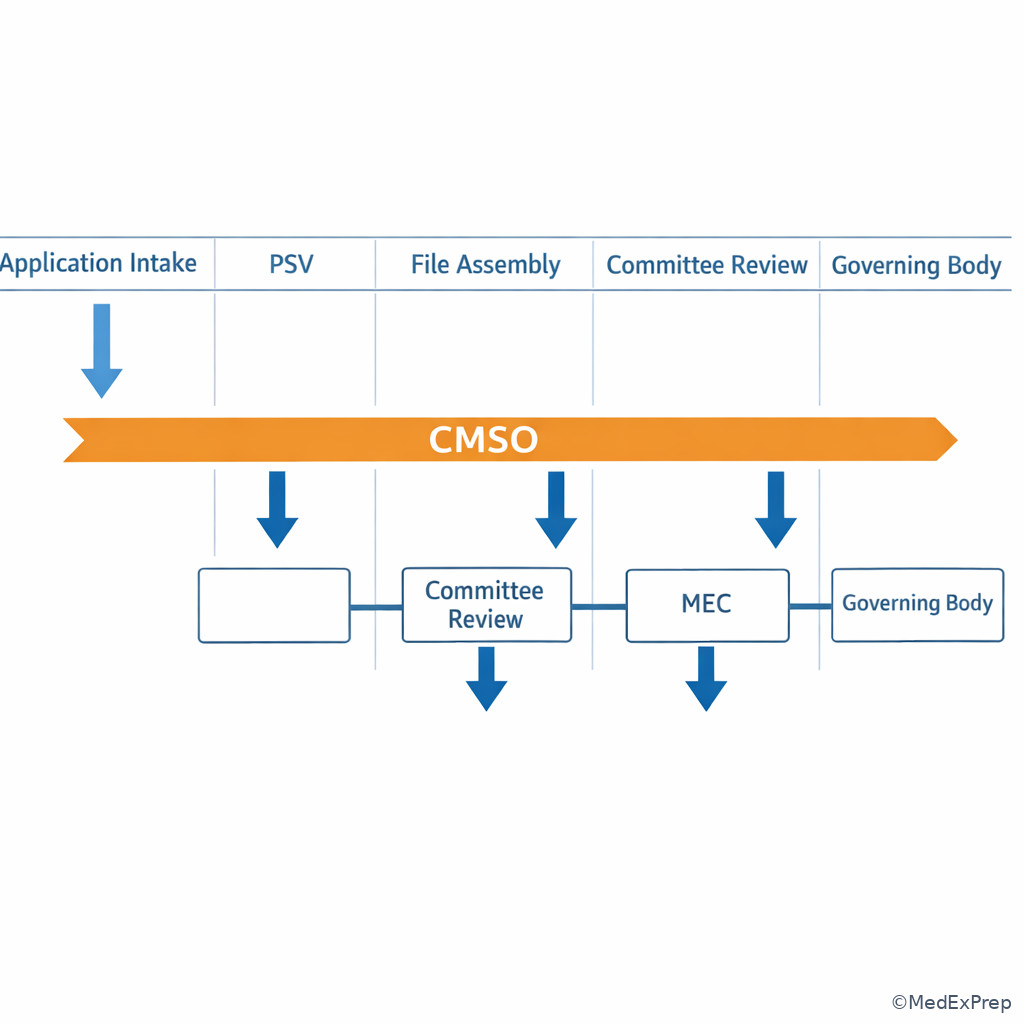
Core content
1.1.1.3 Foundational role identity: support function versus final authority
A Explanation
The central decision conflict in this topic is simple but heavily tested: Should you act, or should you route? The single rule that resolves most questions is this: if the action involves collecting, validating, organizing, documenting, tracking, or preparing information under written policy, it is usually within scope; if it involves making the final determination, legal interpretation, competence judgment, or unauthorized disclosure, it is outside scope.
WHY THIS IS TESTED: exam stems often make an out-of-role action look efficient, collegial, or time-sensitive. The safest answer is not the fastest one; it is the action that preserves policy compliance and decision integrity.
Choose support tasks when the workflow calls for assembling files, confirming required elements, preparing rosters, maintaining expirables, creating committee packets, recording approved actions accurately, and communicating status through approved channels. Reject actions that substitute your judgment for the judgment of department leaders, credentials committees, MEC, governing body, legal counsel, compliance, or clinicians. A common mistake is confusing proximity to the process with ownership of the decision. Working closest to the file does not create authority over the outcome.
On exam day, treat terms like best next step, most appropriate action, and requires immediate clarification as prompts to identify the boundary first. If the requester asks you to “just approve it,” “move it through,” “interpret the rule,” or “send the peer review file,” pause. Your role is to protect the process, not rescue it by improvisation. See Fig 1.
B Worked example
A 54-year-old surgeon applying for reappointment has an upcoming governing body meeting in 48 hours. He also serves on a high-profile service line committee and personally emails the medical staff office asking you to “go ahead and mark my privileges approved because the department chair already supports me.” The file contains most PSV, an unrelated CME certificate from last week, and one missing peer reference. The tempting clue is the surgeon’s influence and the near meeting date. The distracting fact is the updated CME certificate, which makes the file look current overall.
Reasoning chain: Identify task - this is not a routine filing question; it asks for a status action with approval implications. Extract key facts - missing required element, no final committee or governing body action yet, requester is the applicant, and deadline pressure is present. Apply rule - CMSO may track and communicate status, but may not mark privileges approved without authorized action. Eliminate distractors - “helpful” shortcuts fail because support does not equal decision authority. Verify - best next step is to document the missing item, keep status accurate, and route according to policy for review or deferment handling.
C Exam trap
Common wrong answer: Update the database to reflect “anticipated approval” so the meeting can proceed smoothly.
Why it is tempting: Candidates confuse administrative access to the system with authority to change decision status, especially when a respected practitioner and time pressure are in the stem.
Single clue that eliminates it: No authorized approving body has acted yet, so any status implying approval would be unsupported processing.
D Checkpoint
Question: A department chair calls and asks the CMSO to “enter the approval now and we’ll ratify it later” because a practitioner’s start date is tomorrow. What is the most appropriate action?
- Enter the approval because the chair’s intent is clear and ratification is expected.
- Hold the status as pending, document the request, and route according to bylaws/policy.
- Call IT to create temporary privileges in the system because operations needs immediate access.
- Ask the practitioner to begin seeing patients while the office completes the paperwork.
Answer: B
- A: Tempting because the chair is influential and likely involved in review; wrong because intent is not the same as authorized action.
- B: Tempting because it seems slower; right because it preserves status accuracy and routes the issue through proper authority.
- C: Tempting because “temporary” sounds operationally flexible; wrong because the CMSO does not create privileges outside policy and authority.
- D: Tempting because it solves scheduling pressure; wrong because starting practice without proper status/authorization is a major boundary error.
Exam takeaway: Match the question’s action verb to the correct authority holder before choosing the next step.
flowchart LR
A[Collect track verify organize] --> B[CMSO]
C[Review qualifications recommend] --> D[Department or committee]
E[Interpret legal ambiguity] --> F[Legal counsel or authorized leadership]
G[Approve appointment or privileges] --> H[MEC and or governing body per policy]
I[Disclose protected records] --> J[Authorized process only]
When a stem uses verbs like approve, deny, interpret, or release, use Fig 2 to identify the authority ladder before reading the options.
Memory anchor: SVDR = Support, Verify, Document, Route. If the task goes beyond SVDR into deciding, disclosing, or redefining policy, it is a stop-and-escalate item.
1.1.1.4 Foundational operational tasks inside scope
A Explanation
Many learners memorize what is forbidden but miss what is safely allowed. That creates hesitation on straightforward exam questions. The tested conflict here is: Should the CMSO take action now, or is even this task too close to decision-making? The rule is to choose actions that are ministerial, traceable, and policy-based: receiving applications, screening for completeness, performing PSV, entering neutral status updates, tracking expirables, assembling review packets, preparing agendas, maintaining rosters, documenting factual committee actions, and issuing notices through approved processes.
WHY THIS IS TESTED: CMSO questions reward precise operational confidence. The exam expects you to know that compliance does not mean inaction; it means acting correctly within delegated limits.
Choose these tasks when the stem is about process support, data integrity, record maintenance, communication routing, or committee logistics. Reject the idea that every judgment call is prohibited. For example, noting that a license expires before the meeting date is not a competence judgment; it is a factual processing observation. Flagging a discrepancy between an application answer and PSV results is not a denial decision; it is an integrity control. Preparing a list of files that are pending because references are missing is not punitive; it is status management.
The discriminating rule is whether the action changes the practitioner’s substantive standing or merely manages the process using verified facts. If it changes standing, authority is likely elsewhere. If it preserves workflow integrity without exceeding policy, it is usually within scope. See Fig 2.
B Worked example
A hospitalist reappointment file is due for credentials committee review this week. The practitioner has hypertension and diabetes listed on an unrelated wellness form in the HR record, which is irrelevant noise. The file shows current license PSV, current DEA, malpractice coverage, and all peer references received, but board certification expiration is approaching in 60 days. A vice president asks whether you should “wait to mention it until after the meeting so the file is not delayed.”
Reasoning chain: Identify task - a file readiness and tracking issue. Extract key facts - current status now, approaching expiration, committee timing, request to suppress factual tracking. Apply rule - tracking expirables and presenting accurate status are within scope; withholding relevant factual status is not. Eliminate distractors - because the board certification is not yet expired, you do not deny or change privileges yourself; but you do record and communicate status according to policy. Verify - best action is to keep the record accurate, note the approaching expiration as appropriate, and proceed or route per policy.
C Exam trap
Common wrong answer: Delay entering the approaching expiration because only expired items matter.
Why it is tempting: Candidates overcorrect away from decision-making and think any forward-looking status note is “judgment.”
Single clue that eliminates it: Tracking expirables is expressly administrative and factual; it supports timely review rather than changes status independently.
D Checkpoint
Question: Which action is most clearly within CMSO role scope?
- Determining that a practitioner is clinically competent because references are strong.
- Entering a committee recommendation exactly as approved in the minutes and routing follow-up notices.
- Interpreting a disputed bylaw phrase and instructing leaders which legal meaning controls.
- Sharing peer review material with a department manager who is curious about a case trend.
Answer: B
- A: Tempting because files contain competence-related information; wrong because final competence judgments belong to authorized reviewers.
- B: Tempting because it may feel ministerial and easy to overlook; right because accurate documentation and routing of approved actions are classic support tasks.
- C: Tempting because CMSOs work closely with bylaws; wrong because definitive legal interpretation exceeds routine administrative support.
- D: Tempting because the manager may seem operationally involved; wrong because access still depends on authorization and need-to-know.
- The CMSO may perform PSV, but may not independently grant __________.
- True or False: Deadline pressure expands role scope.
- Name the 3 safest default actions when a task is still within scope: collect, verify, and __________.
Recall: This is the first topic in the role-boundaries sequence. In the upcoming topic Allowed Vs Disallowed Actions, we build this broad boundary into a more granular action checklist you can use to eliminate close-call distractors under time pressure.
Exam takeaway: Sort each option by whether it preserves workflow facts or changes the practitioner’s substantive status.
flowchart TB
A[Task appears in stem] --> B{Does it only manage verified facts and workflow?}
B -->|Yes| C[In scope: track status perform PSV assemble file record approved action]
B -->|No| D{Does it approve interpret disclose or judge competence?}
D -->|Yes| E[Out of scope: escalate]
D -->|Unclear| F[Check written policy and route ambiguity]
Use the sorter in Fig 3 whenever all answer choices sound “reasonable.” The winner is the option that preserves facts without changing status.
High-Yield Connection: This concept is tested alongside Documentation Integrity Controls and Minutes And Action Records. Know both the boundary of your role and the requirement to capture actions exactly as approved; these are frequently paired in stems about post-meeting follow-up.
1.1.1.5 Applied boundary decisions under pressure
A Explanation
Once the exam establishes your basic role, it raises the difficulty by adding urgency, hierarchy, or ambiguity. The decision conflict becomes: Do you satisfy the urgent request, or protect the process? The single finding that resolves the conflict is whether the requested shortcut would bypass required evidence, approval, confidentiality, or policy steps. If yes, reject the shortcut even when the requester is senior, the practitioner is important, or patient access concerns are mentioned abstractly.
WHY THIS IS TESTED: the CMSO role exists inside systems that value access, speed, and relationships; exam writers exploit that tension. The competent response is not passive resistance but disciplined, documented escalation.
Board-style stems often include a strong distractor such as “the chair verbally confirmed support,” “the CEO wants it done today,” or “the committee packet closes in an hour.” Those details matter for communication and prioritization, but they do not erase required process controls. The CMSO can expedite reminders, clarify what is missing, route urgently, and document time-sensitive escalation. The CMSO cannot invent approvals, suppress discrepancies, backdate receipt, or release restricted material to solve the pressure problem.
When an option sounds like “just this once,” that is usually your warning sign. Choose the answer that preserves data integrity and routes the exception to the authority that can lawfully or policy-consistently act. See Fig 4.
B Worked example
A newly recruited anesthesiologist is scheduled to begin coverage Monday. It is Friday afternoon. The chief operating officer asks whether you can “finalize the file now and fix the remaining items next week” because weekend coverage is tight. The file has current state license verification and malpractice coverage, but one training verification remains outstanding and there is an unexplained gap in work history. The practitioner also submitted a polished cover letter and several glowing text messages from colleagues, which are distracting but not substitutes for required documentation.
Reasoning chain: Identify task - file completion under urgent start-date pressure. Extract key facts - missing required verification, unresolved gap, request to finalize first and fix later. Apply rule - you may identify, document, and escalate urgent issues; you may not treat incomplete verification as complete. Eliminate distractors - informal endorsements and business urgency do not replace verification standards. Verify - best next step is to document incomplete items, notify the appropriate leader/process, and follow policy for any authorized exception pathway if one exists.
C Exam trap
Common wrong answer: Mark the file complete because the missing item is likely to arrive and patient care coverage is important.
Why it is tempting: Candidates equate operational urgency with implied authority to accept risk temporarily.
Single clue that eliminates it: The file still contains unresolved required verification, so “complete” would be factually false.
D Checkpoint
Question: A senior executive asks for peer review details from a credentials file “just to understand the situation before the meeting.” What is the most appropriate action?
- Provide the materials because senior leadership has a legitimate operational interest.
- Provide a verbal summary only, because spoken information is less formal than releasing documents.
- Confirm the request against authorized access rules and route through approved disclosure process before sharing anything.
- Send the documents but mark them confidential to show caution.
Answer: C
- A: Tempting because leaders may have broad responsibilities; wrong because access still depends on authorization and policy, not title alone.
- B: Tempting because it feels less risky than transmitting documents; wrong because unauthorized disclosure can occur verbally too.
- C: Tempting because it seems procedural; right because need-to-know and approved disclosure routes govern protected information.
- D: Tempting because a confidentiality label sounds protective; wrong because labeling does not cure unauthorized access.
Exam takeaway: Under pressure, choose the option that protects process truthfulness and escalates exceptions rather than masking them.
flowchart TD
A[Urgent request] --> B{Would action make the record inaccurate or bypass a requirement?}
B -->|Yes| C[Do not process as requested]
C --> D[Document missing or restricted element]
D --> E[Escalate through authorized path]
B -->|No| F[Proceed within scope and track completion] Exam takeaway: Time pressure should trigger tighter process discipline, not shortcuts that distort file status.
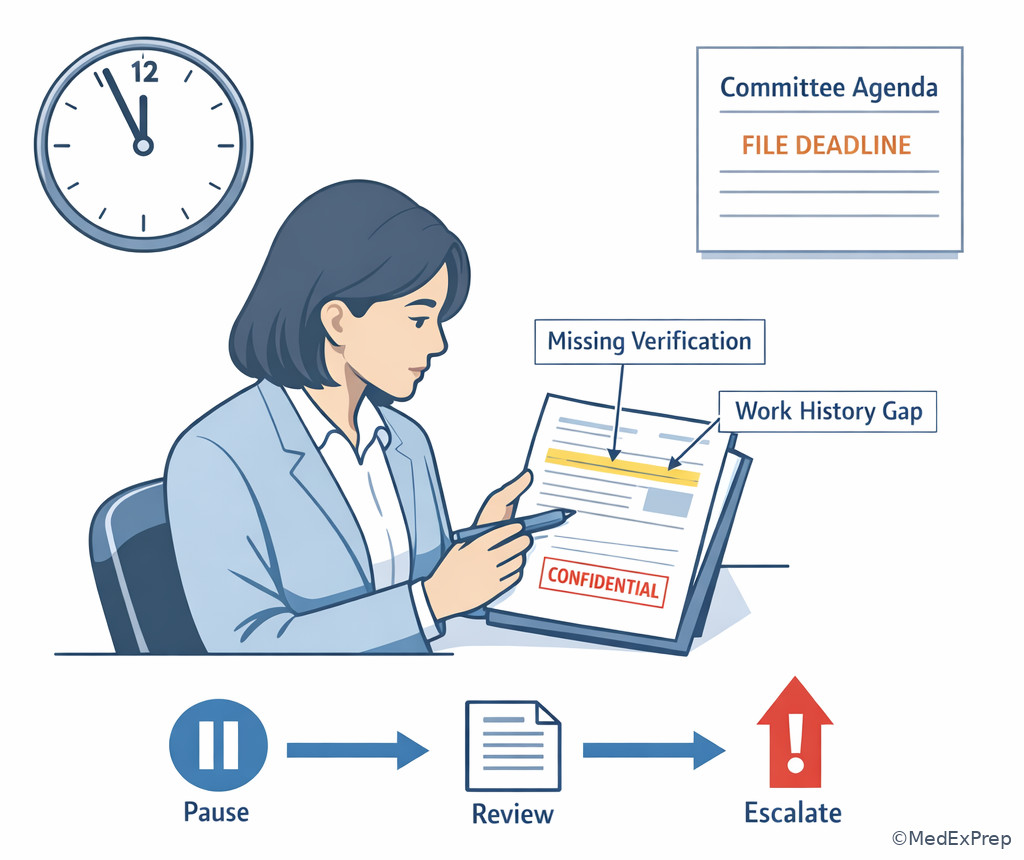
1.1.1.6 Integration: stop, document, and escalate when the role boundary is crossed
A Explanation
The highest-yield integration skill is knowing when a routine workflow becomes a stop point. The decision conflict is: Can I keep the file moving while noting the issue, or must I stop unsupported processing now? The rule is to stop when the issue makes continued processing unreliable, unauthorized, or policy-inconsistent: missing required elements, expired credentials affecting status, contradictory information, suspected misrepresentation, unclear authority, or requests for unauthorized disclosure. At that moment, the CMSO’s job shifts from processing to controlled escalation.
WHY THIS IS TESTED: exam items reward safe boundaries, not heroic improvisation. The organization is protected when the record shows what was found, when it was found, what action was taken, and to whom it was escalated.
“Stop” does not mean abandon the file. It means stop the unsupported part of the workflow, preserve the current factual status, capture the discrepancy accurately, and route to the correct authority. “Document” means contemporaneous, factual, traceable entries rather than retrospective reconstruction. “Escalate” means sending the issue to the person or body empowered to decide, interpret, or direct next steps. If local policy varies, the exam-safe answer remains the same: follow written policy as far as it goes, and refer unresolved ambiguity through the designated chain.
This topic leads directly into the upcoming lesson on Escalation Triggers And Stops, where the trigger list becomes more specific. For now, master the threshold concept: once continuing would require guesswork, false completeness, unauthorized disclosure, or unauthorized authority, the correct next step is no longer ordinary processing. See Fig 5.
B Worked example
A practitioner’s application states that no prior disciplinary action has occurred. During PSV, you receive source information suggesting a prior action under a slightly different name variation. The practitioner’s file is otherwise well organized, the committee meeting is tomorrow, and a department chief tells you, “It is probably someone else; just bring the file and we’ll sort it out verbally.” A recent immunization record appears in the file, which is irrelevant noise but makes the file look administratively complete.
Reasoning chain: Identify task - discrepancy handling with possible identity or disclosure implications. Extract key facts - application answer conflicts with source information; name variation raises risk of misidentification; leadership suggests informal handling; meeting is imminent. Apply rule - a material discrepancy affecting truthfulness or identity is a stop-document-escalate issue, not a verbal footnote. Eliminate distractors - committee convenience is not a basis to treat a discrepancy as resolved. Verify - the best action is to document the discrepancy, preserve pending status as appropriate, and escalate through the designated review path before unsupported processing continues.
C Exam trap
Common wrong answer: Add a note that the discrepancy will be “discussed at committee” and proceed as usual.
Why it is tempting: Candidates assume escalation can occur without first stopping the unsupported step.
Single clue that eliminates it: The discrepancy directly affects application integrity, so normal processing cannot simply continue on assumption.
D Checkpoint
Question: Which situation most clearly requires stop-document-escalate rather than routine processing?
- A reference letter arrives one day after the internal packet deadline but before committee review.
- A current license PSV is received in the usual format from the standard source.
- An application answer conflicts with verified source information about prior sanctions.
- A committee chair asks for an updated roster before a meeting.
Answer: C
- A: Tempting because timing problems matter operationally; wrong because lateness alone may be routable workflow management, not necessarily a red-flag integrity stop.
- B: Tempting because PSV always deserves attention; wrong because this is normal processing, not a discrepancy or unauthorized action.
- C: Tempting because candidates may want to “wait for committee”; right because verified conflict with application content creates a material discrepancy requiring controlled escalation.
- D: Tempting because chair requests can feel high stakes; wrong because preparing a roster is routine support.
- When information is incomplete, inconsistent, expired, or high risk, the first verb is __________.
- True or False: You may continue processing while planning to verify later if the meeting is tomorrow.
- Name the 3 parts of the default escalation response: stop, document, and __________.
High-Yield Connection: This concept overlaps heavily with Application Red Flags, PSV Discrepancy Handling, and Secure Communication Practices. Exam writers commonly combine a discrepancy with a disclosure request or time pressure to test whether you preserve both integrity and confidentiality.
Memory anchor: STOP = See the red flag, Trace it in the record, Own only your scope, Pass it to the proper authority.
Exam takeaway: Red-flag information changes your job from processing the file to controlling risk and routing authority correctly.
flowchart TD
A[Red flag appears] --> B{Missing expired inconsistent adverse suspicious or restricted?}
B -->|Yes| C[Stop unsupported processing]
C --> D[Document source date issue and action]
D --> E[Escalate to designated authority]
E --> F[Track outcome and maintain confidentiality]
B -->|No| G[Continue routine workflow]
The trigger map in Fig 5 is the lesson’s core exam algorithm: once a red flag appears, your role becomes controlled risk handling, not workaround creation.
Exam takeaway: Need-to-know and authorized process control access even when the requester is senior or the issue is urgent.
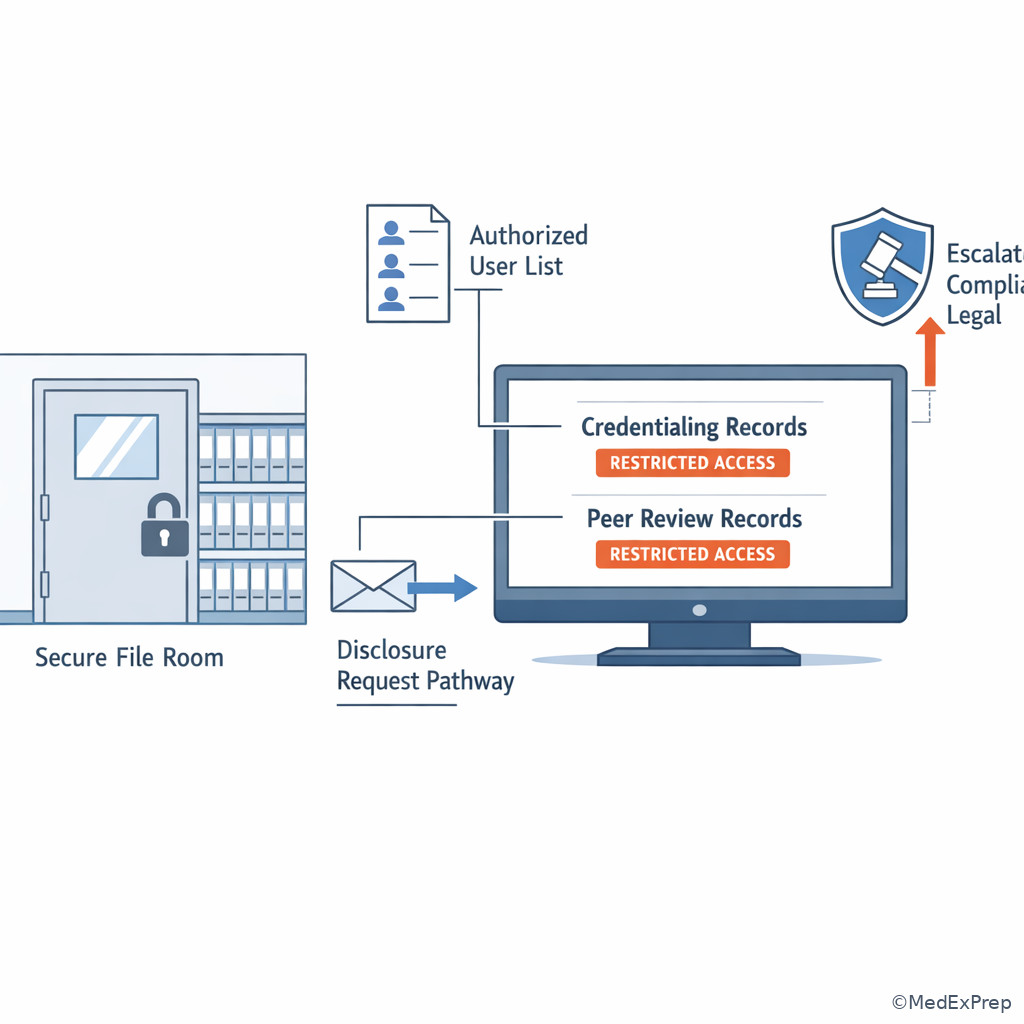
Exam Traps & Differentiators
Common traps & distractors: The exam often pairs a plausible operational goal with an impermissible shortcut. Your job is to spot the single detail that converts “helpful” into “out of scope.”
1.1.1.7 Most common wrong answer and why
Wrong answer pattern: “Go ahead and process it because leadership support exists and the missing piece can be fixed later.”
Why it fails: support from a leader, verbal assurance, or expected future completion does not convert an incomplete or restricted action into an authorized one.
1.1.1.8 Looks similar but isn’t
| Looks similar | Within scope | Not within scope | Single discriminator |
|---|---|---|---|
| Status entry | Enter factual pending/complete status based on verified record | Enter approved status before authorized action | Whether an authorized body has actually acted |
| Bylaw use | Apply written procedure as written | Issue definitive legal interpretation of ambiguity | Whether interpretation exceeds plain administrative application |
| Committee support | Prepare agenda, packet, roster, notices, minutes | Change recommendation or vote substance independently | Whether the action alters committee intent |
| Confidentiality handling | Share information through authorized need-to-know path | Release because requester is senior or curious | Authorization, not rank |
| Discrepancy handling | Flag, document, and escalate discrepancy | Ignore or defer until after approval steps | Whether continued processing would be unsupported |
1.1.1.9 If the stem says ___, think ___
- If the stem says “just mark it approved”, think final authority problem.
- If the stem says “we can fix it after the meeting”, think unsupported processing risk.
- If the stem says “the executive only wants to understand”, think need-to-know and authorized disclosure.
- If the stem says “the chair verbally confirmed”, think intent is not formal action.
- If the stem says “there is a discrepancy, but the file is otherwise complete”, think material red flag may still require stop-document-escalate.
- If the stem says “policy is unclear”, think follow what is written and route unresolved interpretation.
Exam takeaway: The safest answer preserves factual status, confidentiality, and traceable escalation when authority is not yours.
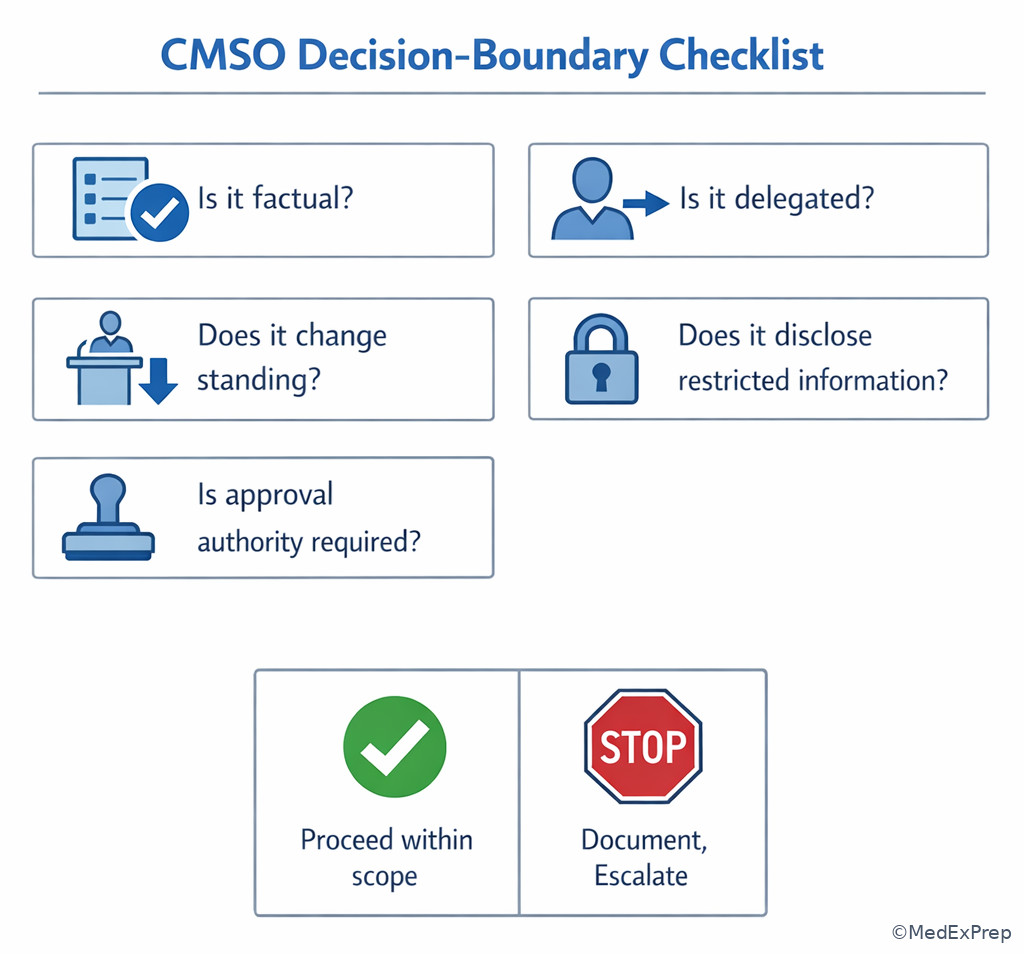
Keep Fig 6 in mind when answer choices are all operationally plausible; the winner is the one that preserves boundaries without inventing authority.
| Related topic pair | Why students confuse them | How to separate them |
|---|---|---|
| CMSO Role Scope vs Allowed Vs Disallowed Actions | Both ask “can I do this?” | Role Scope gives the big boundary; Allowed/Disallowed gives the item-level checklist. |
| CMSO Role Scope vs Escalation Triggers And Stops | Both involve boundary crossing | Role Scope defines who should act; Escalation Triggers define when ordinary processing must stop. |
| Role Scope vs Documentation Integrity Controls | Both mention records and status updates | Role Scope asks whether you may act at all; Documentation Integrity asks how to record the action accurately. |
| Role Scope vs Confidential Information Handling | Both involve access requests | Role Scope asks whether disclosure is your role; Confidentiality asks whether disclosure is authorized and limited. |
Algorithm / Approach
| Question stem signal | What to ask yourself | Best exam instinct |
|---|---|---|
| “Most appropriate action” | Is the action within delegated support scope? | Choose factual process support or escalation, not final decision-making. |
| “Requires immediate clarification” | Is there ambiguity, discrepancy, or unauthorized request? | Pause unsupported processing and clarify through policy/authority. |
| “Best next step before committee” | Is the file actually ready, or only almost ready? | Preserve truthful status; do not convert pending to complete. |
| “Senior leader requests records” | Is access authorized and need-to-know established? | Use authorized disclosure pathway, not rank-based release. |
| “Policy is unclear” | What can be applied as written, and what needs interpretation? | Apply the clear part; escalate unresolved interpretation. |
Rapid Review
- Support task - factual collection, verification, tracking, organization, or routing.
- Final authority - approval, denial, competence judgment, or formal interpretation belongs elsewhere.
- Status entry - accurate if it reflects verified reality; wrong if it predicts future approval.
- Deadline pressure - changes urgency, not role scope.
- Executive request - does not bypass need-to-know or disclosure controls.
- Verbal assurance - weaker than formal action and never a substitute for required approval steps.
- Approaching expiration - track and communicate; do not independently change standing unless policy directs a factual status update.
- Material discrepancy - stop unsupported processing and escalate.
- Committee support - prepare and record; do not rewrite substance.
- Policy ambiguity - apply written text only as far as clear; route unresolved interpretation.
- Confidential file - access by authorization and purpose, not curiosity or rank.
- Traceable action - date, source, issue, action taken, recipient.
- Helpful shortcut - reject if it makes the record inaccurate or bypasses a required control.
- CMSO exam instinct - preserve process truthfulness over speed.
Self-check quiz
1. A practitioner asks the medical staff office to confirm whether her application packet has all required references. Which action is most appropriate within CMSO role scope?
- Review the file for completeness, report factual status, and identify missing items.
- Determine that strong references already in the file prove competence and clear the application for approval.
- Interpret an ambiguous policy exception and waive one missing reference.
- Approve temporary privileges so the practitioner can start while references are pending.
2. Which action most clearly falls outside the CMSO’s final authority?
- Preparing a credentials committee agenda and distributing the packet through approved channels.
- Tracking expirable items and sending reminders based on policy timelines.
- Entering an authorized committee recommendation into the tracking system.
- Granting requested privileges because all verifications appear satisfactory.
3. A 46-year-old physician applying for appointment has a complete file except for one missing training verification. He has current license verification, malpractice coverage, and glowing peer references. The department chief emails, “Mark him complete so he can make this month’s committee.” What is the most appropriate next step?
- Mark the file complete because the missing item is unlikely to change the outcome.
- Keep the file in pending status, document the missing verification, and route urgently per policy.
- Remove the training section from the checklist because the file is otherwise strong.
- Enter anticipated approval because the chief supports the application.
4. A senior vice president requests peer review details from a credentials file before an executive meeting. The practitioner is a high-volume specialist, and the request is labeled urgent. What is the most appropriate action?
- Send the full file immediately because the requester is an executive.
- Provide a verbal summary since that is less formal than releasing documents.
- Confirm authorization and need-to-know, then use the approved disclosure pathway before sharing anything.
- Send only the most recent peer review item because limited disclosure is automatically acceptable.
5. During PSV, a 58-year-old practitioner’s application answer stating “no prior sanctions” appears inconsistent with source information showing a possible prior action under a name variation. Committee meets tomorrow. What is the most appropriate next step?
- Proceed with the file and let the committee discuss the issue informally.
- Document the discrepancy, stop unsupported processing, and escalate through the designated review path.
- Delete the inconsistent source result until identity is fully resolved.
- Ask the practitioner to explain it verbally and treat that explanation as sufficient resolution.
6. A 39-year-old hospitalist with an upcoming start date calls repeatedly asking for “a quick courtesy update” to the system so IT access can be activated. The file has complete PSV except that the governing body has not yet taken final action, and a department chair has verbally expressed support. Which is the most appropriate action?
- Update the system to approved because all substantive review is essentially finished.
- Activate access temporarily and note that formal approval is pending.
- Maintain the pending status, document the request, and communicate the current factual stage without implying approval.
- Ask the chair to send another email so the file has stronger support for an early status change.
7. A 61-year-old surgeon’s reappointment file contains current licensure and references, but one quality report referenced in policy has not yet been uploaded. The MEC packet closes in one hour, and the service line leader says the report is always favorable and will be added later. What is the most appropriate action?
- Include the file as complete because the missing report is expected to be favorable.
- Exclude the file from all future consideration because any missing item requires denial.
- Record the file accurately as incomplete or pending per policy and route the timing issue to the authorized reviewers.
- Rewrite the packet checklist so quality reports are optional for surgeons.
8. A 50-year-old practitioner disputes a bylaw provision and asks the CMSO to “tell everyone the rule clearly allows my request.” The relevant text is ambiguous, legal counsel is not copied, and committee materials are due today. Which action is most appropriate?
- Issue a definitive interpretation based on common practice so the committee can proceed.
- Apply any clear procedural steps from the written text, document the ambiguity, and route unresolved interpretation to the appropriate authority.
- Tell the practitioner the request is denied because ambiguity always favors restriction.
- Change prior committee language to align with the practitioner’s interpretation.
Answer key
1. Correct answer: A
- A: Tempting because it sounds administrative and limited; correct because factual completeness review and missing-item identification are core support tasks within scope. Single clue: the question asks about required references and packet status, not approval authority.
- B: Tempting because strong references can feel like evidence of readiness; incorrect because concluding competence and clearing for approval exceeds support scope. Single clue: “prove competence” converts file support into substantive judgment.
- C: Tempting because CMSOs work with policies daily; incorrect because waiving an ambiguous requirement is not routine administrative application. Single clue: “waive” signals authority beyond scope.
- D: Tempting because it seems operationally practical; incorrect because granting privileges is not a CMSO final-authority function. Single clue: “approve temporary privileges” is an approval act, not support work.
2. Correct answer: D
- A: Tempting because agendas and packets are visible leadership-adjacent tasks; incorrect because committee preparation is standard support work. Single clue: no substantive decision is being made.
- B: Tempting because expirables tracking can affect urgency; incorrect because tracking reminders are administrative controls, not final authority. Single clue: the action is factual and policy-based.
- C: Tempting because entering recommendations can feel consequential; incorrect because recording an already authorized recommendation is within scope. Single clue: the recommendation is already authorized.
- D: Tempting because the verifications seem reassuring; correct because satisfactory materials do not empower the CMSO to grant privileges. Single clue: “granting requested privileges” is the decision itself.
3. Correct answer: B
- A: Tempting because one missing item may seem minor compared with an otherwise strong file; incorrect because “unlikely to matter” is not a valid substitute for required verification. Single clue: one required training verification is still missing.
- B: Tempting because it feels slower under deadline pressure; correct because it preserves truthful status, documents the gap, and routes urgently without overstating completion. Single clue: the file is not complete yet.
- C: Tempting because checklist flexibility may seem efficient; incorrect because the CMSO cannot unilaterally remove a required element. Single clue: removing a requirement changes policy application, not mere workflow.
- D: Tempting because the department chief’s support sounds authoritative; incorrect because support is not the same as factual completeness or formal approval. Single clue: “anticipated approval” misstates current status.
4. Correct answer: C
- A: Tempting because senior executives may appear broadly entitled to sensitive information; incorrect because title alone does not establish authorized access to protected peer review information. Single clue: the request involves peer review details.
- B: Tempting because verbal sharing can seem less formal; incorrect because unauthorized disclosure can be oral as well as written. Single clue: the issue is authorization, not format.
- C: Tempting because it seems procedural rather than decisive; correct because access must be checked against need-to-know and approved disclosure rules before any sharing occurs. Single clue: confidentiality controls govern the request.
- D: Tempting because partial disclosure sounds safer; incorrect because limiting volume does not cure lack of authorization. Single clue: any peer review disclosure still requires approved access.
5. Correct answer: B
- A: Tempting because committee review may sound like the natural place to resolve concerns; incorrect because a material discrepancy affecting application integrity should not be carried forward as routine processing. Single clue: source information conflicts with the application.
- B: Tempting because it may delay the file; correct because a verified discrepancy requires controlled handling: document, stop unsupported processing, and escalate. Single clue: possible prior sanctions contradict the application answer.
- C: Tempting because identity uncertainty may make the source feel unreliable; incorrect because deleting evidence destroys traceability rather than resolving the discrepancy. Single clue: the issue needs investigation, not suppression.
- D: Tempting because practitioner explanation seems efficient; incorrect because verbal explanation alone does not resolve a verified discrepancy without proper follow-up. Single clue: source conflict remains material regardless of immediate oral explanation.
6. Correct answer: C
- A: Tempting because all substantive review may appear nearly complete; incorrect because governing body action has not yet occurred, so approved status would be inaccurate. Single clue: final action is still pending.
- B: Tempting because temporary access seems operationally modest; incorrect because operational access tied to unapproved status may functionally bypass the approval process. Single clue: there is no final authorized action yet.
- C: Tempting because it may frustrate the practitioner; correct because it preserves factual pending status, documents the request, and communicates current stage without implying authority that does not exist. Single clue: verbal support from the chair is not equivalent to governing body approval.
- D: Tempting because another email from the chair feels like stronger documentation; incorrect because more support does not replace the missing formal action. Single clue: the missing element is formal approval, not enthusiasm.
7. Correct answer: C
- A: Tempting because the service line leader predicts a favorable report; incorrect because expected content does not make a missing required document present. Single clue: the policy-referenced quality report is not yet in the file.
- B: Tempting because missing items can feel serious; incorrect because a missing item does not automatically mean denial by the CMSO. Single clue: the CMSO manages accurate status and routing, not final denial.
- C: Tempting because it is less dramatic than the other options; correct because it keeps the file’s status truthful and routes timing/exception issues to the authorized reviewers. Single clue: accurate classification and routing are the CMSO’s proper role.
- D: Tempting because local flexibility may seem helpful under pressure; incorrect because rewriting the checklist changes requirements outside the CMSO’s authority. Single clue: altering requirements is a policy/authority action, not administrative support.
8. Correct answer: B
- A: Tempting because common practice can appear practical when time is short; incorrect because definitive interpretation of ambiguous bylaw text exceeds ordinary administrative application. Single clue: the text is explicitly ambiguous.
- B: Tempting because it may seem less decisive; correct because the CMSO may apply clear written procedure while routing unresolved interpretive questions to the appropriate authority. Single clue: some text may be clear, but the ambiguity itself requires escalation.
- C: Tempting because conservative restriction can feel safer; incorrect because the CMSO does not deny requests simply because interpretation is difficult. Single clue: denial is a substantive decision beyond the role.
- D: Tempting because prior language may seem modifiable for consistency; incorrect because changing committee language independently alters the record and bypasses proper process. Single clue: record modification without process is outside role and threatens documentation integrity.
Keep going with the full CMSO Prep Course (CMSO)
You just studied the way members do, in the same lesson interface. Full access unlocks every lesson, the question bank and flashcards for a full year.
One payment · 1 year of access · No auto-renewal