1.1.1 - Candidate Role Boundaries
Candidate Role Boundaries
What you'll learn
- DOMAIN: Role and Scope - Objective: Distinguish what a CHPOP candidate may do, recognize, document, or communicate versus what must be referred, clarified, or escalated.
- DOMAIN: Scenario-Based Judgment - Objective: Apply boundary rules to realistic stems and choose the safest role-appropriate next step.
- DOMAIN: Documentation and Communication - Objective: Identify what facts to record objectively when authority limits, uncertainty, or safety concerns appear.
- DOMAIN: Ethics and Safety - Objective: Use safety, confidentiality, and policy awareness as tie-breakers when options look close.
- DOMAIN: Problem-Solving Framework - Objective: Use identify task → extract facts → identify governing rule → choose action → verify scope alignment.
- Domain: CHPOP Role and Scope → Subskill: candidate role boundaries in realistic workflows
- Domain: Professional Practice → Subskill: documentation, ethics, confidentiality, and communication within role
- Domain: Scenario-Based Judgment → Subskill: safest next step when authority is limited or unclear
- Domain: Operational Procedures → Subskill: policy-aware escalation and clarification
Why it matters
- Many CHPOP stems are not testing obscure facts; they are testing whether you stay inside role when a tempting option asks you to act like a prescriber, supervisor, or policy-maker.
- Boundary questions often use good-sounding distractors that appear efficient or decisive but fail because they require authority the candidate does not clearly have.
- When the stem is ambiguous, the exam rewards the option that protects safety, documents facts accurately, and escalates appropriately rather than the option that assumes hidden authority.
- Strong boundary recognition improves performance across ethics, documentation, confidentiality, safety, workflow, and escalation topics.
Key rule: If an option requires independent authorization, final diagnosis, policy-setting, or override authority not clearly assigned to the CHPOP role, it is usually wrong even when it sounds proactive.
Exam takeaway: Choose the option that stays within role, protects safety, and escalates when authority is missing.
flowchart TD
A[Read the stem] --> B{What is the task?}
B --> C[Identify requested action]
C --> D{Is authority clearly within role?}
D -->|Yes| E[Proceed with role-appropriate action]
D -->|No or unclear| F[Document facts and concern]
F --> G[Clarify, consult, or escalate]
G --> H[Follow policy-aware safe next step]
Use this lesson-wide logic repeatedly. See Fig 1.
Key Terms & Must-Know Facts
1.1.1.1 Key terms
- Role boundary: The limit of actions, judgments, and authority appropriate to the CHPOP candidate role.
- Scope-aware action: A next step that fits role, policy, safety, and documentation expectations.
- Escalation: Moving a concern to someone with the authority to decide or intervene.
- Consultation: Seeking input or guidance without transferring full responsibility for all follow-up.
- Referral: Directing the matter to the appropriate professional or service when it lies outside role.
- Clarification: Obtaining missing or conflicting information before proceeding.
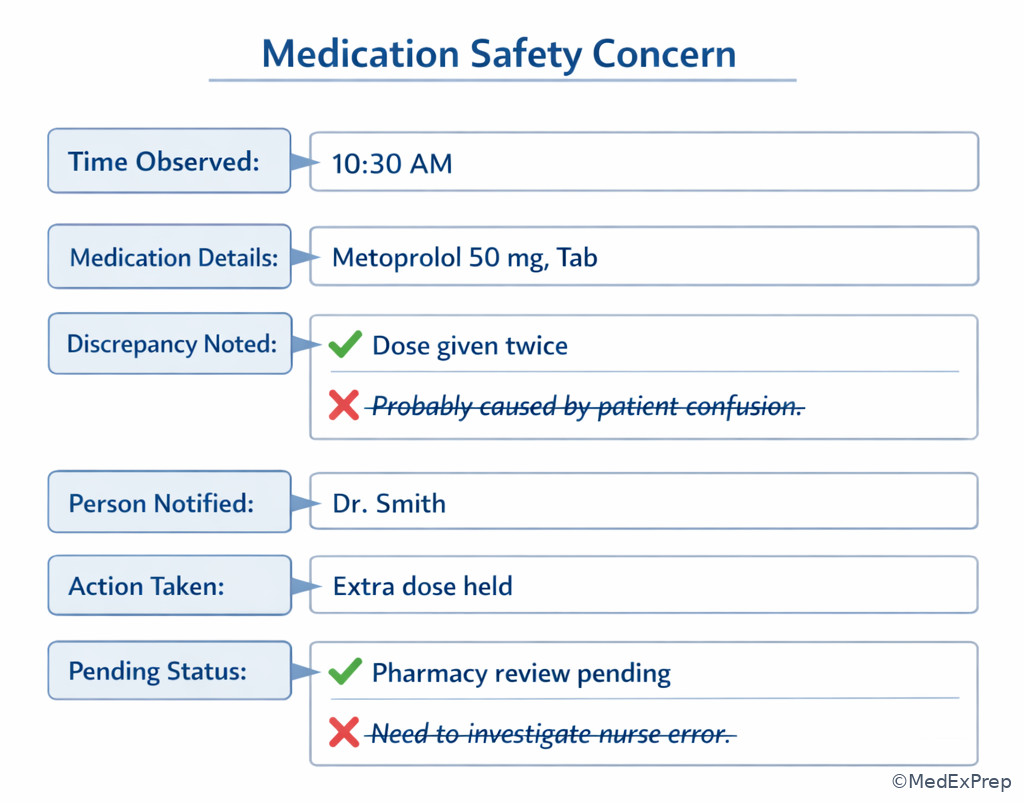
- Objective documentation: Recording observable facts, timestamps, communications, and actions without speculation.
- Policy-aware reasoning: Recognizing that local procedures may vary and avoiding assumptions when policy is not stated.
- Safety default: The conservative action chosen when uncertainty creates risk.
- Out-of-role signal: A clue that the option expects authority beyond the candidate role.
- Boundary violation: Taking an action outside documented role or authority.
- Chain of communication: The appropriate sequence of notifying, documenting, and following up.
1.1.1.2 Must-know facts
- The exam tests role-appropriate judgment, not unsupported heroics.
- When authority is unclear, clarify or escalate; do not invent permission.
- Documentation should focus on facts, concern, action taken, and who was notified.
- Safety concerns often outrank efficiency concerns.
- A fast answer is wrong if it requires authority the stem never gives you.
- When local policy is not provided, choose the answer that is conservative, safe, and broadly policy-compatible.
- Confidentiality still applies during escalation; share only what is necessary.
- Reject options that say or imply independently authorize, override, or set policy unless the stem clearly assigns that responsibility.
| Term | What it means on exam day | Best immediate action |
|---|---|---|
| Clarify | Information is incomplete, inconsistent, or ambiguous | Pause, gather missing facts, document, then proceed or escalate |
| Consult | You need role-appropriate input before acting | Contact appropriate person and record guidance received |
| Escalate | Risk, urgency, or authority limit prevents independent handling | Notify the responsible authority promptly |
| Refer | The issue belongs to another role or service line | Direct to proper channel and document handoff |
| Hold/Do not proceed | Proceeding could be unsafe or unauthorized | Stop workflow step until clarified |
Exam takeaway: Use a visual checklist of authority, safety, policy, and documentation before acting on close-call stems.
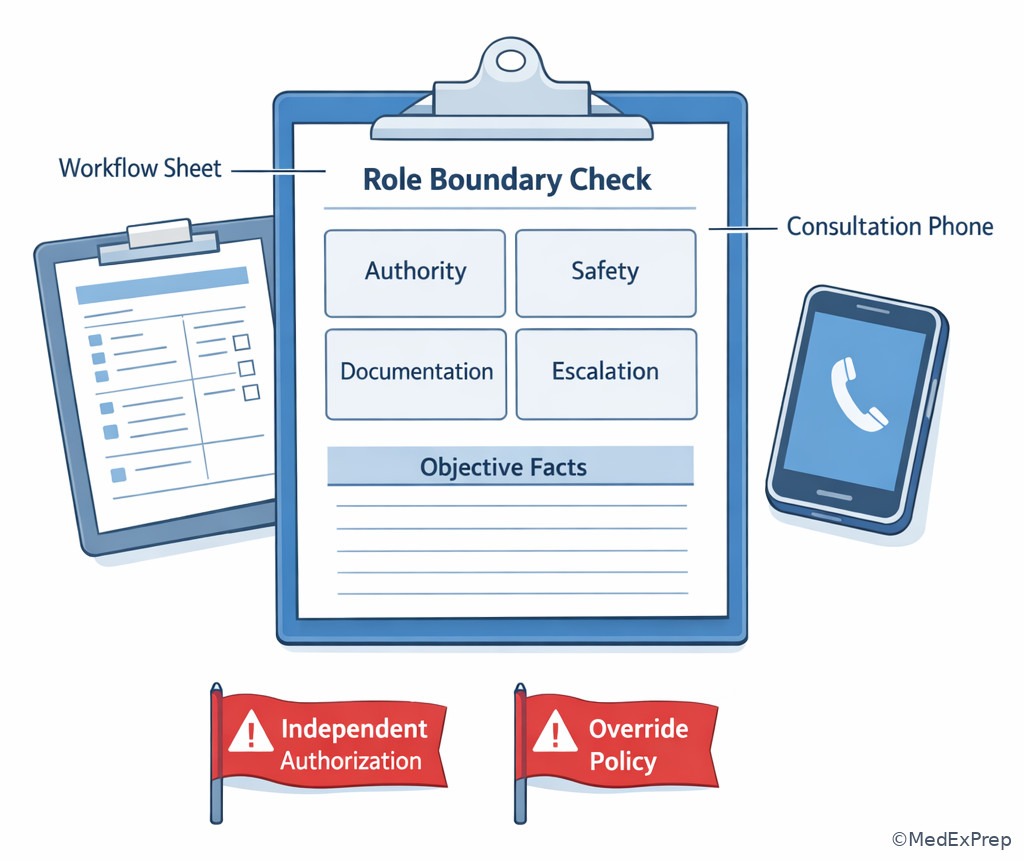
Before selecting an answer, mentally run the checklist shown in See Fig 2.
Core content
1.1.1.3 Foundational boundary rule: what the CHPOP candidate is being tested to do
A Explanation
The central decision conflict in this lesson is simple: Do I act directly, or do I choose a role-appropriate step such as clarifying, documenting, consulting, or escalating? The single rule that resolves many questions is this: act only within authority clearly supported by the stem and the role; otherwise choose the safest bounded action. On CHPOP-style items, the candidate is expected to interpret facts, recognize risk, document accurately, communicate appropriately, and identify when another person or policy must guide the next move. The candidate is not expected to function as an independent prescriber, legal authority, executive policy-maker, or unrestricted clinical decision-maker unless the stem explicitly and credibly assigns that duty.
WHY THIS IS TESTED: Exam writers want to see whether you can resist attractive distractors that sound decisive but exceed role boundaries. A common stem pattern gives you a problem that clearly needs action, then offers one answer that solves it too independently. The correct answer often sounds less dramatic: pause, verify facts, document the concern, notify the appropriate person, and follow established procedures.
Think in choose-vs-reject terms. Choose options that preserve safety, respect role limits, and keep documentation objective. Reject options that assume authority, speculate beyond known facts, promise outcomes beyond your role, or skip required communication. This is especially important when the stem includes urgency, interpersonal pressure, or incomplete information. The exam often adds these pressures precisely to see whether you abandon boundary discipline.
Recall: This is the first topic in the course, so build your baseline here: later lessons on Out-Of-Role Signals and Role-Appropriate Next Steps will sharpen how to recognize the clues and what exact action to choose after boundary recognition.
Memory anchor: FADS = Facts first, Authority check, Document objectively, Safety/escalation. Use FADS whenever an option feels “too proactive.”
Pharmacist Action: NOTICE: verbs like authorize, override, diagnose, approve, or set policy. SAY: “I need to verify the facts and follow the appropriate escalation path.” MONITOR: risk level and whether a delay creates immediate harm. HOLD/CLARIFY/ESCALATE: hold when proceeding would require authority not clearly granted.
B Worked example
A pharmacy operations candidate reviews a medication profile for a 74-year-old patient receiving warfarin 5 mg by mouth daily, trimethoprim-sulfamethoxazole DS by mouth twice daily, and amiodarone 200 mg by mouth daily. The patient also has CKD stage 3 and heart failure. A coworker says, “Just reduce the warfarin dose in the system now so the patient is protected.” The profile also shows a mildly elevated calcium level, which is distracting but not central. The tempting clue is the obvious interaction, which makes independent dose change sound appealing.
Reasoning chain: Identify task → not merely interaction recognition, but deciding the candidate’s next role-appropriate action. Extract key facts → major interaction risk, multiple comorbidities, current warfarin dose, pressure from coworker, no explicit authority to change therapy. Apply rule → significant safety concern exists, but independent dose adjustment exceeds the bounded candidate role unless authority is explicitly given. Eliminate distractors → “change dose now” is tempting because it appears protective, but it assumes prescriptive or authorized adjustment authority. “Ignore because INR not provided” is wrong because clear risk still requires action. Verify → best response is to document the concern and promptly notify or escalate to the appropriate authorized clinician or supervising pharmacist according to workflow.
C Exam trap
Common wrong answer: “Immediately change the medication order or dose to prevent harm.” WHY IT IS TEMPTING: The student correctly detects a safety issue and wants to act decisively. The SINGLE CLUE that eliminates it: The stem never gives the CHPOP candidate independent authority to alter the therapy; the correct move is escalation plus documentation, not unauthorized order modification.
D Checkpoint
Question: A CHPOP candidate identifies that a medication profile contains digoxin 0.25 mg by mouth daily and clarithromycin 500 mg by mouth twice daily in an older adult with reduced renal function. Which action is most consistent with role and safety?
- Reduce digoxin to 0.125 mg daily and document the adjustment.
- Continue processing because the prescriber likely accounted for the interaction.
- Document the interaction concern and escalate to the appropriate authorized clinician or supervising pharmacist.
- Advise the patient to stop clarithromycin until follow-up next week.
Answer: C
- A: Tempting because the dose sounds clinically reasonable; wrong because independent medication adjustment is not clearly within the candidate’s authority.
- B: Tempting because it avoids overstepping; wrong because known risk still requires role-appropriate action rather than passive acceptance.
- C: Correct because it addresses safety while staying within role and preserving a clear documentation trail.
- D: Tempting because stopping the interacting drug sounds protective; wrong because directing therapy discontinuation exceeds the bounded action described here.
1.1.1.4 Boundary language in stems: verbs that signal permission versus verbs that signal overreach
A Explanation
Many boundary questions can be solved by reading the action verb carefully. The exam often hides the real discriminator in the wording: document, communicate, verify, clarify, notify, consult, escalate usually fit within role more comfortably than authorize, independently initiate, override, approve, diagnose, prescribe, set policy. The decision conflict is choosing between an answer that sounds efficient and one that matches the action vocabulary of the role. The single rule: when the option’s verb implies authority beyond the candidate role, reject it unless the stem explicitly grants that authority.
WHY THIS IS TESTED: Students often focus on the content domain and miss the governance domain. For example, seeing an adverse interaction may push the student toward the “clinically best” therapeutic decision rather than the “exam-best” role-consistent action. CHPOP questions reward disciplined reading: you are being tested not just on what should happen eventually, but on what you should do next.
Use a two-column mental split. First ask, “Which options are procedurally allowed?” Then ask, “Among allowed options, which best protects safety?” This order matters. A therapeutically smart answer can still be wrong if the role cannot directly execute it. Also watch for hidden absolutes. Options that promise resolution without mentioning communication or documentation may be too broad. Options that acknowledge local policy variation tend to be more realistic and safer when the stem does not provide institution-specific procedures.
See Fig 3 for a compact compare-and-sort pattern.
Exam takeaway: The action verb often decides the question before the content detail does.
flowchart LR
A[Role-appropriate verbs] --> A1[verify]
A --> A2[clarify]
A --> A3[document]
A --> A4[notify]
A --> A5[consult]
A --> A6[escalate]
B[Overreach verbs] --> B1[authorize]
B --> B2[override]
B --> B3[prescribe]
B --> B4[diagnose]
B --> B5[set policy]
High-Yield Connection: This concept is tested alongside documentation and communication topics later in the course. Know both the right verb and the right record for exam day; stems often pair a boundary issue with an objective-documentation issue.
Pharmacist Action: NOTICE: whether the option’s verb implies independent therapy change or policy authority. SAY: “I can verify, document, and escalate this concern.” MONITOR: whether delay creates near-term patient harm. HOLD/CLARIFY/ESCALATE: escalate immediately if the issue is urgent and the candidate lacks direct action authority.
B Worked example
A candidate reviewing an order queue sees methotrexate 10 mg by mouth daily for rheumatoid arthritis in a 63-year-old with psoriasis, folic acid use, and mild hepatic disease. A note from a family member mentions confusion about “once weekly,” but the order is active as daily. The distracting detail is the folic acid, which may make the student focus on routine methotrexate counseling rather than the boundary question. The tempting clue is the obvious dosing error, which makes canceling or rewriting the order feel necessary.
Reasoning chain: Identify task → choose the most appropriate next step within role. Extract key facts → high-risk medication, possible frequency error, patient vulnerability, no authority stated to change the order. Apply rule → candidate should not independently rewrite or void the therapy. Eliminate distractors → “correct to weekly” sounds clinically sharp but exceeds role. “Dispense and tell patient weekly” is unsafe because the record remains wrong. Verify → hold progression as allowed by workflow, document discrepancy objectively, and urgently notify the appropriate authorized professional.
C Exam trap
Common wrong answer: “Correct the obvious error directly because patient safety comes first.” WHY IT IS TEMPTING: Safety urgency is real, and students equate urgency with unlimited authority. The SINGLE CLUE that eliminates it: Safety changes priority, not role boundary; the safest within-role action is urgent hold plus escalation, not unauthorized correction.
D Checkpoint
Question: Which option most strongly signals overreach when a CHPOP candidate is interpreting an unsafe medication scenario?
- Document the discrepancy and notify the responsible party.
- Clarify the intended dose before proceeding.
- Independently approve a corrected regimen and continue processing.
- Escalate using the established communication pathway.
Answer: C
- A: Tempting because it may feel passive; actually appropriate because it preserves facts and initiates communication.
- B: Tempting because it may delay action; appropriate because clarification is often the correct first bounded step.
- C: Correct choice for overreach because “independently approve” implies authority not established by the stem.
- D: Tempting because escalation can seem excessive; appropriate when risk or authority limits are present.
- The safest default when authority is unclear is to clarify or escalate.
- True or False: If a safety problem is obvious, the CHPOP candidate should directly change the order. False.
- Name the 3 highest-yield safe verbs: document, clarify, escalate.
1.1.1.5 Applying boundaries in realistic workflow pressure: urgency, hierarchy, and incomplete information
A Explanation
Foundational understanding becomes application when the stem adds pressure. Common pressure elements include a waiting patient, a rushed clinician, a senior coworker insisting on a shortcut, a partial record, or an urgent-looking medication issue. The decision conflict is no longer just “act versus escalate,” but “do I let urgency or hierarchy push me beyond role?” The single rule is this: urgency changes how fast you escalate, not whether you may exceed role.
WHY THIS IS TESTED: Realistic exam stems mimic the moment where good candidates can make bad decisions under pressure. The wrong answers are built to sound efficient: “to avoid delay, just…” or “because the supervisor is unavailable, proceed…” These are classic traps. When the stem lacks required information or authority, you do not repair the system by pretending you have more authority than you do. Instead, you choose the safest bounded action with the fastest appropriate communication.
Incomplete information is especially important. Missing data can itself be a reason to pause and clarify. For example, if renal function, allergy history, intended frequency, or policy requirements are not available, the correct answer may be to obtain that information rather than guess. The exam often tests whether you recognize that missing information is not a nuisance detail; it is the core fact. Likewise, hierarchy pressure does not remove documentation duties. If someone higher in the workflow asks you to bypass a check or proceed despite a discrepancy, the exam generally favors the answer that documents and escalates rather than silently complies.
See Fig 4 for a practical urgency-versus-authority comparison.
Exam takeaway: Urgency and hierarchy increase escalation speed, not independent authority.
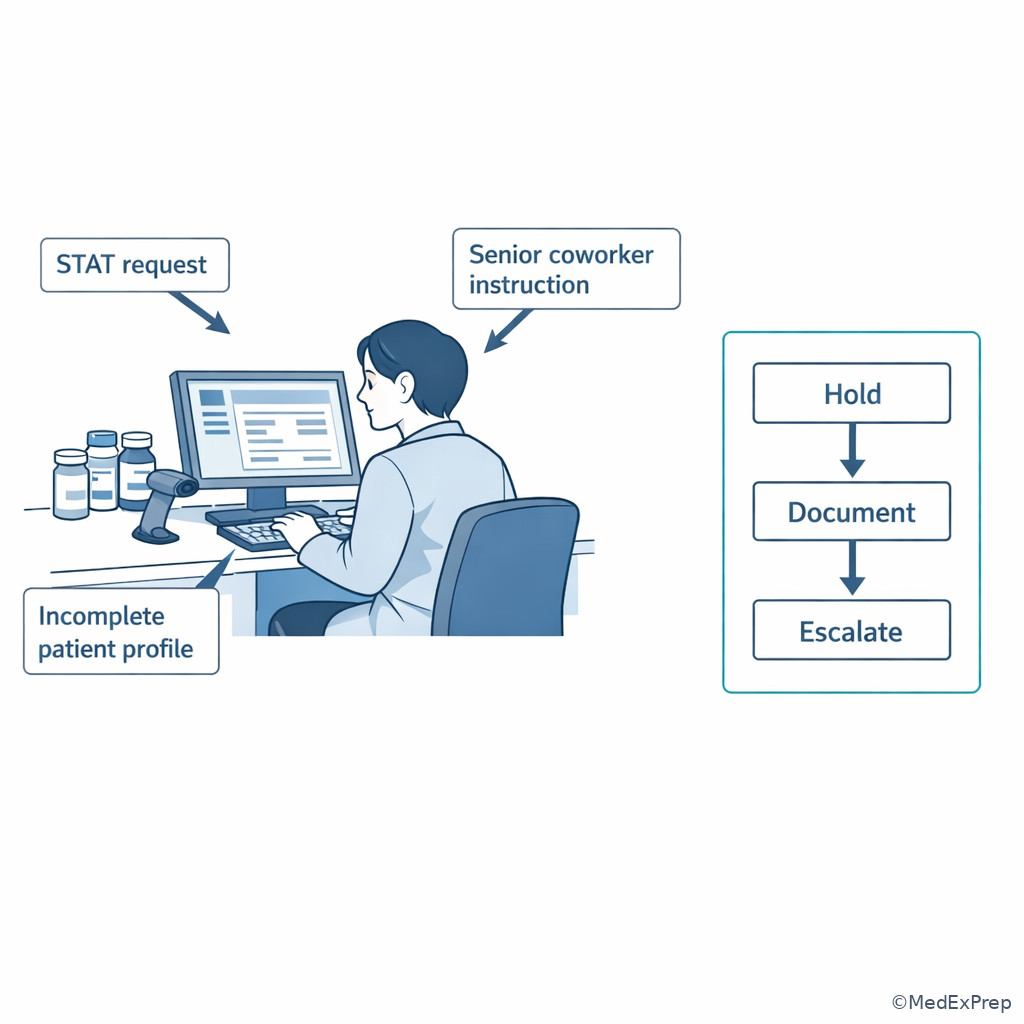
Common pitfall: “I knew it was urgent, so I had to do something myself.” On the exam, that reasoning fails when the action chosen requires unauthorized authority. Urgent escalation is still action.
High-Yield Connection: This concept overlaps with later topics on Immediate Safety Priorities and Consultation Referral Escalation. The pair frequently tested together is recognize risk plus choose the bounded responder.
Pharmacist Action: NOTICE: pressure words such as urgent, stat, waiting, supervisor said, or no time. SAY: “This may be urgent, so I am escalating now.” MONITOR: time-sensitive harm while maintaining the hold on unauthorized action. HOLD/CLARIFY/ESCALATE: immediate escalation when risk is high or data are missing for safe continuation.
B Worked example
A 69-year-old patient with atrial fibrillation, diabetes, and CKD stage 4 presents for discharge medications. The profile includes apixaban 5 mg by mouth twice daily and ketoconazole 200 mg by mouth daily. A hurried team member says, “The ride is here; just send it.” The patient also reports occasional heartburn, a distracting detail. Another note lists body weight and age but no clear recent renal trend in the displayed screen. The tempting clue is operational pressure: discharge delay feels undesirable.
Reasoning chain: Identify task → not “fix anticoagulation myself,” but choose the best next step within role under discharge pressure. Extract key facts → significant interaction potential, high-risk medication, severe kidney disease, incomplete immediately visible data, pressure to bypass delay. Apply rule → urgency means faster clarification/escalation, not independent regimen change. Eliminate distractors → dispensing without action ignores risk; changing dose independently exceeds authority; counseling alone does not solve the unresolved discrepancy. Verify → hold processing if permitted by workflow, document the concern, and urgently contact the authorized decision-maker.
C Exam trap
Common wrong answer: “Proceed now and leave a note for later follow-up.” WHY IT IS TEMPTING: It appears to balance workflow efficiency with some documentation. The SINGLE CLUE that eliminates it: The unresolved issue is safety-relevant now; delayed follow-up does not address the immediate risk created by proceeding.
D Checkpoint
Question: A candidate encounters a likely high-risk discrepancy in a waiting patient’s medication profile, but a senior coworker instructs them to continue processing to avoid delay. What is the most appropriate next step?
- Continue processing because hierarchy determines the next action.
- Pause, document the discrepancy, and escalate through the appropriate chain because urgency does not expand authority.
- Delete the conflicting medication from the active profile and note that the coworker requested it.
- Tell the patient to halve the dose until someone reviews it.
Answer: B
- A: Tempting because workflow hierarchy matters; wrong because hierarchy does not erase safety obligations or role limits.
- B: Correct because it addresses the urgent risk without stepping beyond role.
- C: Tempting because it creates a visible record of action; wrong because deleting or modifying therapy independently is unauthorized.
- D: Tempting because it seems like interim harm reduction; wrong because patient-specific dosing direction exceeds the bounded candidate role here.
1.1.1.6 Integration: documentation, confidentiality, and escalation as the safe boundary package
A Explanation
The most testable integration point is that boundaries are not just about what you cannot do. They are also about what you must do instead. When direct authority is absent, the safe package is usually: document objectively, protect confidentiality, notify the right person, and follow through according to policy-aware workflow. The decision conflict is choosing between a narrow answer that handles only one piece and a complete answer that captures the bounded professional response. The single rule: when you cannot directly resolve the issue, create a reliable, objective, confidential escalation path.
WHY THIS IS TESTED: Some students recognize that an option is out of role but then choose a weak alternative such as “do nothing,” “mention it casually,” or “document only if asked.” The exam expects active professional behavior within role. Objective documentation means facts, dates/times, exact concern, actions taken, and who was contacted. It does not mean assumptions about intent, blame, or diagnoses. Confidentiality means you share necessary information with the appropriate person, not broadly with uninvolved coworkers or family members without justification.
This section also creates continuity with later lessons. Out-Of-Role Signals will help you detect the trigger faster, and Role-Appropriate Next Steps will train you to choose between consultation, referral, hold, and escalation more precisely. For now, learn the integrated response pattern. If the option both stays within role and creates a clear safety communication trail, it is often the best answer.
See Fig 5 for the complete response package. Also note that the comparison tables below compress many of the close-call differences that commonly confuse candidates.
Exam takeaway: When direct action is out of role, the best answer usually combines objective documentation with targeted escalation.
flowchart TD
A[Concern identified] --> B[Objective documentation]
B --> C[Need-to-know communication]
C --> D{Within own authority?}
D -->|Yes| E[Proceed and monitor]
D -->|No| F[Escalate to authorized person]
F --> G[Document contact and status]
Memory anchor: DNER = Document, Notify, Escalate, Recheck status. Use DNER when the correct answer feels “administrative”; that is often the exam point.
Pharmacist Action: NOTICE: whether the option omits documentation or confidentiality. SAY: “I am documenting the discrepancy and notifying the appropriate clinician.” MONITOR: whether the concern is acknowledged, pending, or resolved. HOLD/CLARIFY/ESCALATE: escalate further if no timely response and patient risk remains active.
B Worked example
A candidate notices that a refill request includes simvastatin 40 mg by mouth nightly and verapamil 240 mg by mouth daily in a 77-year-old with hypertension, chronic constipation, and recent muscle complaints. The spouse at the counter asks loudly, “So is this dangerous?” A staff member suggests discussing the full details at the front desk to move the line. The distracting detail is constipation, which is not the key issue. The tempting clue is the spouse’s urgency, which may push broad disclosure.
Reasoning chain: Identify task → choose the best boundary-consistent response. Extract key facts → potential medication concern, public setting, spouse present, confidentiality issue, candidate role does not clearly include independent therapy change. Apply rule → use the document-notify-escalate package while limiting information sharing to what is appropriate. Eliminate distractors → discussing detailed protected information publicly is a confidentiality failure; changing therapy directly is an authority failure; ignoring the concern is unsafe. Verify → move the conversation to a private setting as appropriate, document the concern, and notify the authorized professional or supervising pharmacist according to workflow.
C Exam trap
Common wrong answer: “Explain the whole problem immediately in public so the family understands the risk.” WHY IT IS TEMPTING: It feels transparent and patient-centered. The SINGLE CLUE that eliminates it: Boundary-safe communication still requires confidentiality and need-to-know disclosure.
D Checkpoint
Question: When a CHPOP candidate identifies a potentially unsafe medication issue but lacks authority to independently resolve it, which bundled response is most appropriate?
- Document objective facts, protect confidentiality, notify the appropriate authorized person, and record follow-up status.
- Quietly note the issue for the next shift because escalation may be seen as overreacting.
- Give the patient a definitive recommendation and ask them to inform the prescriber later.
- Discuss the issue with any available staff member until someone agrees with the likely diagnosis.
Answer: A
- A: Correct because it captures the full safe package when direct authority is absent.
- B: Tempting because it avoids conflict; wrong because a known concern requires active response, not passive delay.
- C: Tempting because it feels helpful; wrong because definitive therapy direction exceeds the bounded role in this framing.
- D: Tempting because team discussion can help; wrong because broad, non-targeted disclosure and diagnostic framing are not the proper next step.
- The best substitute for direct authority is not silence; it is document + notify + escalate.
- True or False: Confidentiality disappears once a safety issue is identified. False.
- Name the four DNER steps: Document, Notify, Escalate, Recheck.
Exam takeaway: Confidentiality remains part of the correct answer even when escalation is urgent.
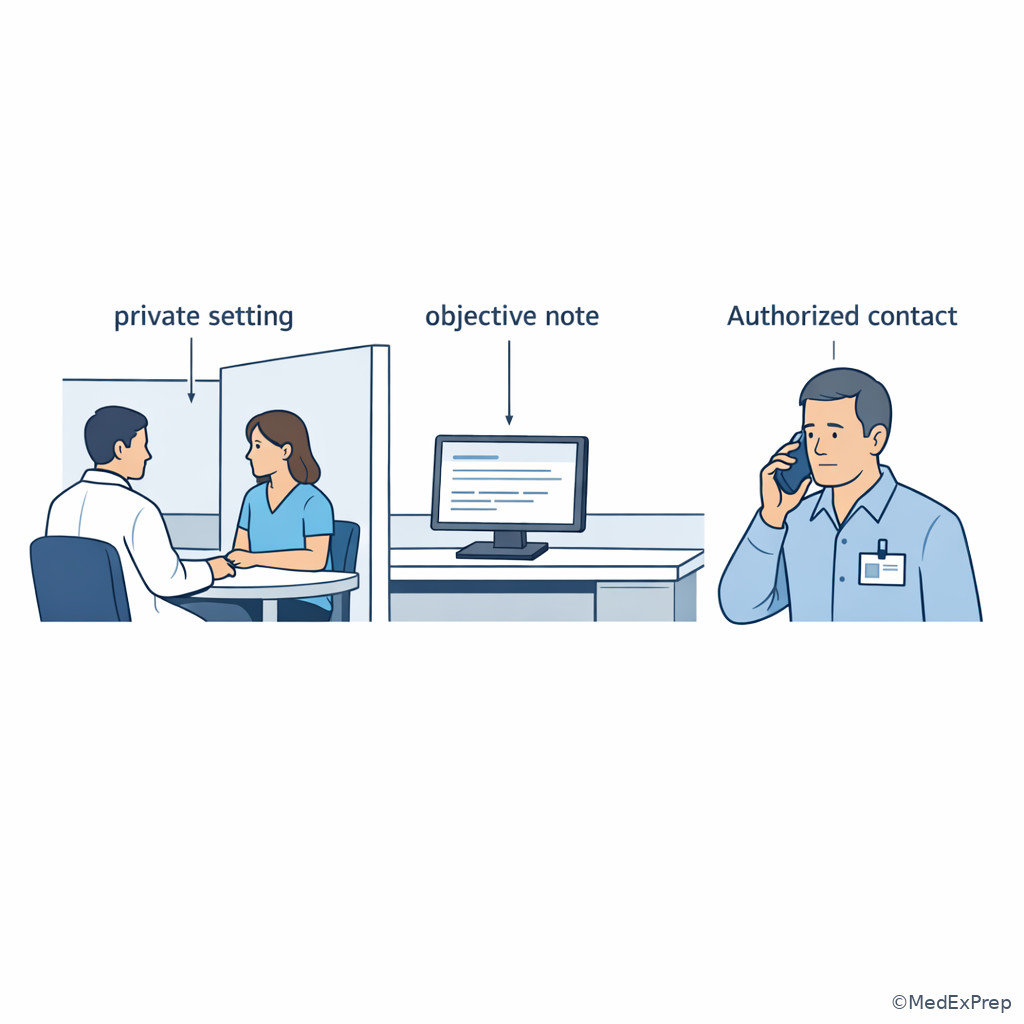
Exam takeaway: Record facts, times, contacts, and actions taken without speculation or blame.
Exam Traps & Differentiators
Common traps & distractors: The most common wrong answer is the option that solves the problem fastest by stepping outside role. It is tempting because it shows you recognized the clinical issue. The discriminator is not whether the concern is real; it is whether the candidate has authority to directly execute the proposed fix.
| Looks right because... | Actually wrong because... | Single clue that eliminates it |
|---|---|---|
| “I will change the dose now” shows urgency and safety awareness | It assumes authority not granted | No explicit authority to modify therapy |
| “I will explain everything publicly” seems transparent | It ignores confidentiality | Public setting or uninvolved listener |
| “I will continue because a senior person said so” respects hierarchy | It bypasses safety and documentation duties | Unresolved discrepancy remains active |
| “I will wait until later” avoids overreacting | It leaves a current safety concern unaddressed | Risk exists now, not later |
| “I will tell the patient my recommended change” feels patient-centered | It becomes unauthorized therapy direction | Candidate role lacks independent prescribing authority |
| Looks similar but isn't | Choose this when... | Not this when... |
|---|---|---|
| Clarify vs Escalate | Information is missing but risk is not immediately critical | Do not stop at clarification when urgent risk demands immediate higher-level attention |
| Consult vs Refer | You need input while remaining involved in next steps | Do not use referral when the issue needs direct authority transfer or formal handoff |
| Document vs Diagnose | You are recording observed facts and communication | Do not label intent, causation, or definitive diagnosis without authority |
| Hold vs Ignore | Proceeding could be unsafe or unauthorized | Do not keep workflow moving simply to preserve speed |
If the stem says...
- “independently authorize” → think out-of-role unless explicitly assigned
- “local policy is not specified” → think choose conservative, policy-compatible safety action
- “senior coworker says proceed” → think hierarchy does not erase safety obligations
- “family member asks in public” → think confidentiality still applies
- “obvious risk but no authority stated” → think document and escalate urgently
- “missing key information” → think clarification may be the point of the question
Forward reference: in the next lesson on Out-Of-Role Signals, you will learn to spot the exact wording that makes overreach options fail even faster. Then in Role-Appropriate Next Steps, you will practice choosing among clarify, hold, consult, refer, and escalate.
Tables
| Reference trigger | What it usually means | Best initial bounded response |
|---|---|---|
| Unsafe interaction identified | Known safety concern requiring attention | Document, hold if appropriate, notify authorized person |
| Order appears inconsistent | Potential error or missing information | Clarify before proceeding |
| Public disclosure pressure | Confidentiality risk | Move to private communication, share need-to-know only |
| Supervisor instructs shortcut | Hierarchy pressure with possible safety conflict | Follow safety pathway, document, escalate if needed |
| Policy not provided | Do not assume institution-specific authority | Choose conservative general principle and note local variation |
| No response to urgent concern | Closed-loop failure | Re-escalate through the next appropriate channel |
| Comparison | Safe option | Tempting wrong option | Discriminator |
|---|---|---|---|
| Warfarin interaction issue | Escalate to authorized clinician/pharmacist | Directly reduce warfarin dose | Independent dose change not assigned |
| Methotrexate daily vs weekly concern | Hold and urgently clarify | Rewrite to weekly | Candidate may detect, not independently correct |
| Confidentiality in public area | Private targeted communication | Open counter discussion | Need-to-know disclosure only |
| Urgent discharge discrepancy | Faster escalation | Proceed to avoid delay | Urgency increases speed, not authority |
| Differential / classification | Category | Exam meaning |
|---|---|---|
| Document objective facts | Within role | Expected foundational professional action |
| Notify supervising pharmacist or authorized clinician | Within role | Appropriate escalation step |
| Ask for clarification of unclear order details | Within role | Safe response to missing information |
| Independently prescribe alternative therapy | Out of role | Reject unless the stem explicitly grants authority |
| Override policy to save time | Out of role | Reject because local policy cannot be assumed or bypassed |
| Set organization-wide response rule | Out of role | Policy-setting authority is not inferable from candidate role |
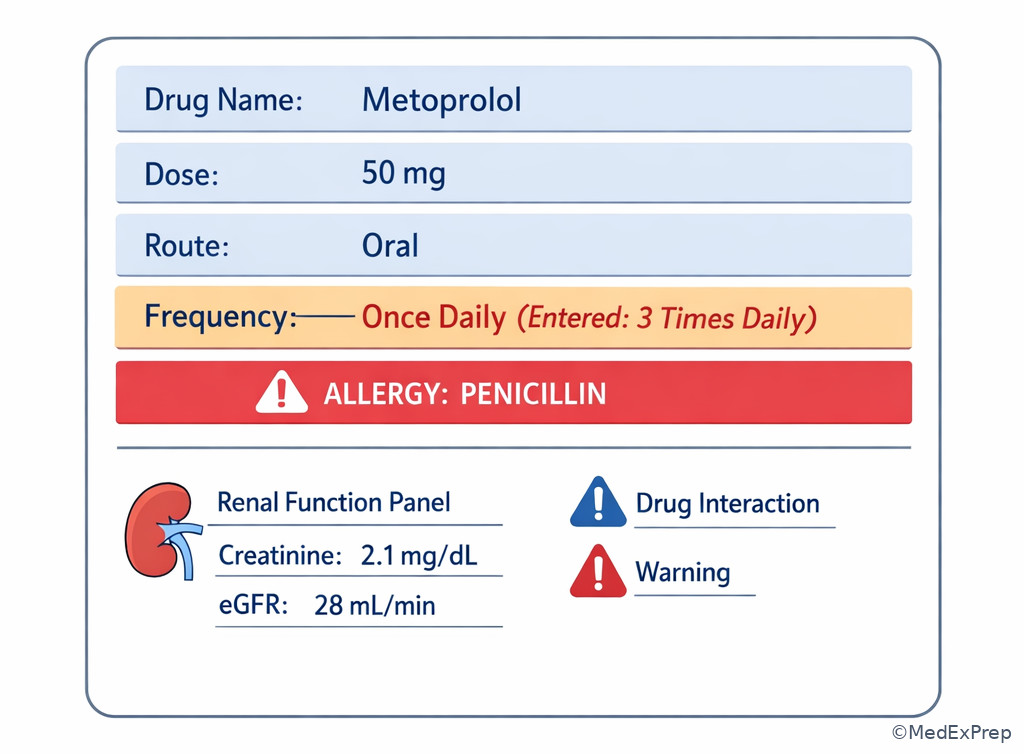
Exam takeaway: Profile cues such as interaction flags, frequency mismatch, and missing data should trigger clarify-or-escalate thinking.
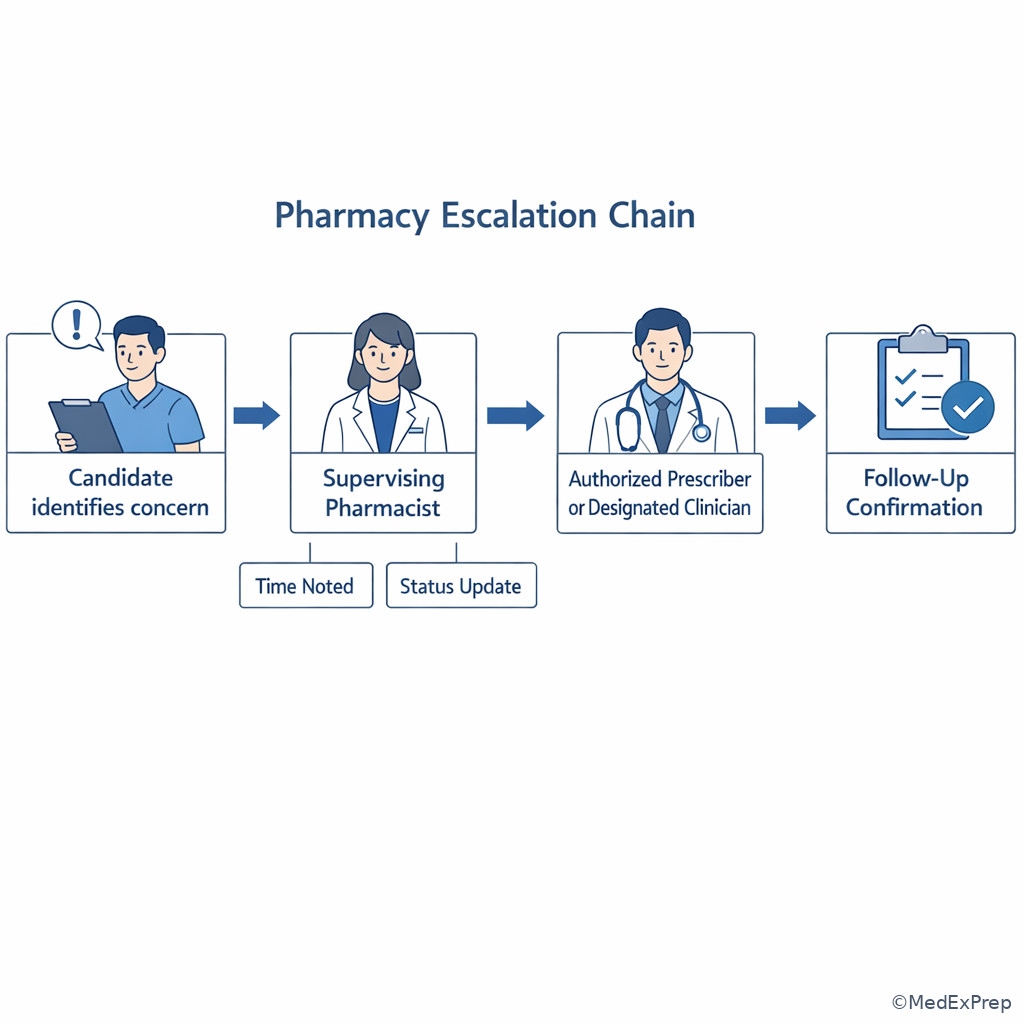
Exam takeaway: The best answer often includes both the correct recipient of escalation and proof that the loop was closed.
Algorithm / Approach
Exam takeaway: On close-call items, filter options by authority first, then choose the safest allowed action.
flowchart TD
A[Option list] --> B{Any option requires unauthorized authority?}
B -->|Yes| C[Eliminate those options]
B -->|No| D[Continue]
C --> D
D --> E{Immediate safety risk or missing critical info?}
E -->|Yes| F[Hold/clarify/escalate]
E -->|No| G[Proceed with allowed action]
F --> H[Document and close loop]
G --> H
Use See Fig 6 as your elimination sequence: authority first, then safety, then documentation/communication.
Rapid Review
- Role boundary → what you may do is narrower than what you may recognize
- Urgency → increases escalation speed, not authority
- Hierarchy pressure → not a reason to bypass safety checks
- Missing data → often the real reason to clarify before proceeding
- Objective documentation → facts, times, actions, contacts; no speculation
- Confidentiality → still applies during safety escalation
- Best verb set → document, verify, clarify, notify, escalate
- Worst verb set → authorize, override, prescribe, diagnose, set policy
- Public family question → move to private, share need-to-know only
- Unsafe profile discrepancy → hold if appropriate and route to authority
- Delayed follow-up → wrong when risk is current
- Good-sounding decisive action → reject if the stem never gives that power
- Local policy unspecified → choose conservative, broadly compatible response
- Best exam tie-breaker → safety plus scope alignment
Memory anchor: SAFE = Scope check, Act only within authority, Facts documented, Escalate when needed.
Self-check quiz
1. A candidate reviewing an outpatient profile sees amoxicillin 500 mg by mouth three times daily and a documented rash allergy to penicillin. The technician asks whether to change the antibiotic to cephalexin 500 mg by mouth four times daily so the line can move faster. Which action is most consistent with role and policy-aware practice?
- Change the antibiotic to cephalexin and document the reason.
- Document the allergy concern and notify the appropriate authorized clinician or supervising pharmacist.
- Remove the allergy from the profile because rashes are usually minor.
- Tell the patient to take the amoxicillin only if symptoms worsen.
2. A candidate reviewing a queue sees metformin 1000 mg by mouth twice daily, insulin glargine 20 units subcutaneously nightly, and a missing recent renal lab in the visible screen. Which verb most strongly suggests an answer choice is likely within role for the candidate?
- Authorize
- Prescribe
- Clarify
- Override
3. A 72-year-old patient with CKD stage 3, atrial fibrillation, and osteoarthritis is receiving warfarin 4 mg by mouth daily and trimethoprim-sulfamethoxazole DS by mouth twice daily. A nurse asks the candidate to just lower the warfarin dose in the profile because the patient is leaving in 10 minutes. Which is the most appropriate next step?
- Lower warfarin to 2 mg daily now because the interaction is significant.
- Continue without action because the prescriber likely considered the combination.
- Document the interaction concern and urgently escalate to the authorized clinician or supervising pharmacist.
- Advise the patient to skip warfarin tonight and call tomorrow.
4. A 65-year-old patient with rheumatoid arthritis, folic acid use, and mild liver disease has methotrexate 15 mg by mouth daily entered in the profile. A family member says the previous bottle said “weekly,” but the prescriber’s office is not immediately reachable. Which response best matches CHPOP role boundaries?
- Rewrite the profile to weekly because methotrexate is commonly weekly for this indication.
- Hold processing as appropriate, document the discrepancy, and urgently seek clarification through the established chain.
- Dispense as entered but counsel the family to use it weekly instead.
- Delete methotrexate from the active profile until the next clinic visit.
5. A 77-year-old patient with hypertension, constipation, and recent muscle pain has simvastatin 40 mg by mouth nightly and verapamil 240 mg by mouth daily. The spouse asks at a crowded counter whether the medicines are “dangerous together.” What is the best initial response?
- Explain the full interaction at the counter so the spouse understands the risk immediately.
- Say nothing until the next refill because confidentiality prohibits all discussion.
- Move to a private setting as appropriate, document the concern, and notify the appropriate authorized professional.
- Tell the spouse the patient should stop simvastatin tonight.
6. A 70-year-old patient with heart failure, CKD stage 4, and diabetes is set for discharge on apixaban 5 mg by mouth twice daily and ketoconazole 200 mg by mouth daily. A senior coworker says to proceed because transportation has arrived, and the profile screen does not show the most recent weight trend. Which action most requires immediate clarification rather than delayed follow-up?
- Proceed and place a note for the next shift because discharge timing is the main issue.
- Document the concern, hold as appropriate, and urgently escalate because a high-risk discrepancy is unresolved now.
- Lower apixaban independently to 2.5 mg twice daily and continue discharge processing.
- Tell the patient to take apixaban every other day until the clinic responds.
7. A 68-year-old patient with epilepsy, depression, and CKD stage 3 is receiving lamotrigine 200 mg by mouth twice daily and valproate 500 mg by mouth twice daily. A colleague suggests changing lamotrigine to 100 mg by mouth twice daily in the system because “everyone knows the interaction.” The patient is waiting, and the clinic line is busy. Which action is most consistent with CHPOP scope?
- Change the lamotrigine dose because the interaction makes the current regimen unsafe.
- Document the concern and route it to the authorized decision-maker while delaying unauthorized profile changes.
- Counsel the patient to stop valproate until the clinic can be reached.
- Continue because clinic confirmation is not immediately available.
8. A 74-year-old patient with atrial fibrillation, hypertension, and chronic pain has digoxin 0.25 mg by mouth daily, clarithromycin 500 mg by mouth twice daily, and a spouse who asks for details in a public waiting area. A rushed staff member says to explain the issue quickly and let the family decide. Which option is the best answer?
- Provide the full medication explanation publicly because family involvement speeds decision-making.
- Tell the spouse to stop digoxin until the prescriber calls back.
- Move to a private setting as appropriate, document the concern, and notify the authorized clinician or supervising pharmacist.
- Wait until the next refill cycle because any action now may exceed role.
Answer key
1. Correct answer: B
- A: Tempting because switching within a related antibiotic space sounds like practical harm prevention. Incorrect because the single discriminating clue is that the stem never grants authority to independently change therapy. Boundary-safe practice is to flag and escalate. This aligns with role-limited judgment and medication safety principles reflected in authoritative pharmacy workflow guidance and drug information references such as Lexicomp and AHFS.
- B: Correct because the candidate recognizes a safety concern, documents it objectively, and routes it to the appropriate authorized person. The discriminating clue is preserved role alignment: action is taken, but no unauthorized prescribing occurs. This fits conservative CPS-aligned reasoning and medication safety communication standards.
- C: Tempting because some learners underweight non-severe allergy histories. Incorrect because removing an allergy entry independently is itself an unauthorized profile alteration with patient-safety implications. The eliminating clue is the unilateral data change.
- D: Tempting because it sounds cautious and patient-centered. Incorrect because directing use “only if symptoms worsen” turns into unauthorized therapeutic advice inconsistent with the order. The eliminating clue is patient-specific treatment instruction beyond the bounded role.
2. Correct answer: C
- A: Tempting because authorization sounds efficient and final. Incorrect because “authorize” implies authority beyond the candidate role unless explicitly granted. The single clue is the verb itself.
- B: Tempting because prescribing would certainly resolve the problem. Incorrect because prescribing is a classic out-of-role signal in this exam framework. The discriminating clue is independent therapy initiation.
- C: Correct because “clarify” is a bounded, safety-aligned verb used when information is missing or uncertain. The single clue is that missing renal information supports clarification rather than direct modification.
- D: Tempting because overriding a barrier can sound operationally useful. Incorrect because “override” usually signals bypassing authority or policy. The single clue is that the verb assumes power to defeat an existing safeguard.
3. Correct answer: C
- A: Tempting because warfarin dose reduction is pharmacologically plausible given the interaction. Incorrect for this specific scenario because the candidate is not granted authority to independently adjust dosing. The single clue is the request to “just lower” the dose in the profile. Drug-interaction logic is valid, but the role response is escalation, consistent with Lexicomp interaction management and conservative workflow standards.
- B: Tempting because prescribers sometimes knowingly combine interacting therapies. Incorrect because a known significant interaction in a high-risk patient still requires role-appropriate action. The eliminating clue is the active safety concern plus time pressure.
- C: Correct because it combines recognition of a major interaction with urgent communication to someone who can authorize therapy changes. The discriminating clue is absence of independent dose-adjustment authority. Interaction references such as Lexicomp and AHFS support the clinical concern; the exam tests the bounded operational response.
- D: Tempting because skipping a dose may feel like interim harm reduction. Incorrect because telling the patient to alter warfarin use is still direct therapeutic instruction beyond the role described. The single clue is patient-specific medication direction.
4. Correct answer: B
- A: Tempting because methotrexate weekly dosing is a classic safety fact. Incorrect because clinically recognizing the likely error does not grant permission to rewrite the regimen. The single clue is the lack of prescriber confirmation or explicit authority. This is consistent with medication safety literature and standard high-alert medication handling principles.
- B: Correct because it uses the proper bounded response: stop unsafe progression, document the discrepancy, and seek urgent clarification through the chain. The discriminating clue is that frequency error is safety-critical but still requires authorized confirmation before profile correction.
- C: Tempting because patient counseling seems helpful. Incorrect because dispensing against an unresolved record and relying on verbal correction creates mismatch between the official order and patient directions. The single clue is unresolved documentation discordance.
- D: Tempting because removing the drug avoids accidental use. Incorrect because deleting therapy independently is also an unauthorized modification and may create downstream continuity problems. The single clue is unilateral profile alteration.
5. Correct answer: C
- A: Tempting because immediate explanation seems responsive and transparent. Incorrect because the public setting creates a confidentiality problem. The single clue is the crowded counter. The correct response preserves privacy while still addressing the concern.
- B: Tempting because it respects confidentiality strictly. Incorrect because confidentiality does not justify inaction on a possible safety issue. The single clue is that a current concern is present and needs targeted response.
- C: Correct because it integrates privacy, documentation, and escalation. The discriminating clue is the combination of public setting and unresolved medication concern. This reflects a complete boundary-safe package.
- D: Tempting because stopping simvastatin may sound like a clean interaction solution. Incorrect because instructing medication discontinuation exceeds the bounded role in this scenario. The single clue is direct therapeutic direction to the family.
6. Correct answer: B
- A: Tempting because discharge timing creates strong operational pressure. Incorrect because unresolved anticoagulant interaction risk in a high-risk patient requires immediate bounded action, not next-shift follow-up. The single clue is “unresolved now.”
- B: Correct because it recognizes a high-risk current problem, pauses progression appropriately, and escalates urgently without independent dose selection. The discriminating clue is high-risk medication plus incomplete immediately visible data. Authoritative drug references such as Lexicomp and FDA labeling support concern about interaction management; the exam tests the scope-consistent response.
- C: Tempting because the alternative apixaban dose sounds like a renal-adjustment solution. Incorrect because even if a dose question exists, independent dose selection is not assigned to the candidate. The single clue is unilateral therapy modification.
- D: Tempting because it appears to lower exposure while awaiting input. Incorrect because every-other-day apixaban instruction is unauthorized and not a standard substitute based on this stem. The single clue is patient-specific interim dosing advice.
7. Correct answer: B
- A: Tempting because the PK interaction between valproate and lamotrigine makes dose concern pharmacologically credible. Incorrect because the candidate still lacks independent authority to alter the regimen. The single clue is “change the dose in the system.” References such as Lexicomp and AHFS support the interaction; they do not transfer prescribing authority.
- B: Correct because it captures the right action sequence: recognize the interaction, document, route to the authorized decision-maker, and avoid unauthorized changes. The discriminating clue is clinic unavailability combined with patient wait time; this calls for escalation, not self-directed correction.
- C: Tempting because stopping valproate may seem to remove the interaction source. Incorrect because telling the patient to stop a chronic antiseizure medication is high-risk, unauthorized therapy direction. The single clue is direct discontinuation advice.
- D: Tempting because lack of immediate confirmation can make inaction seem safer than overreach. Incorrect because a credible safety concern still requires active bounded response. The single clue is that concern is known, not speculative.
8. Correct answer: C
- A: Tempting because family involvement can speed practical decisions. Incorrect because the public setting makes full disclosure inappropriate and the option still fails to route the issue correctly. The single clue is “public waiting area.”
- B: Tempting because stopping digoxin may feel like immediate harm reduction for a known interaction. Incorrect because this is direct patient-specific medication advice outside the candidate’s stated role. The single clue is “tell the spouse to stop.”
- C: Correct because it is the only answer that simultaneously respects confidentiality, documents objectively, and notifies the authorized person. The discriminating clue is the combination of medication safety concern plus public disclosure pressure. This is the most complete bounded response.
- D: Tempting because it avoids overstepping. Incorrect because waiting until the next refill ignores a present concern. The single clue is current exposure to an interaction, not a future theoretical issue.
Keep going with the full CHPOP Prep Course (CHPOP)
You just studied the way members do, in the same lesson interface. Full access unlocks every lesson, the question bank and flashcards for a full year.
One payment · 1 year of access · No auto-renewal