1.1.1 - Responsibility Areas Framework
Responsibility Areas Framework
What you'll learn
- RESPONSIBILITY AREA: Cross-cutting framework -> Blueprint navigation — identify the major CHES/MCHES responsibility areas and match tasks to the correct domain.
- RESPONSIBILITY AREA: Role execution -> Task discrimination — separate assessment, planning, implementation, evaluation, administration, communication, advocacy, and ethics tasks.
- RESPONSIBILITY AREA: Professional judgment -> Best-next-step reasoning — choose the action most aligned with health education practice boundaries.
- RESPONSIBILITY AREA: Applied decision-making -> Scenario interpretation — use stem clues to reject adjacent-but-wrong responsibility areas.
- RESPONSIBILITY AREA: Foundational exam strategy -> Framework recall — build a retrieval-ready map for later topics in this course.
Blueprint mapping
- Domain: Foundations of CHES/MCHES practice → responsibility area recognition → framework-level task mapping
- Domain: Professional practice → role boundaries and ethical execution → choosing actions within scope
- Domain: Program cycle reasoning → assess, plan, implement, evaluate, administer, communicate, advocate → identifying where a task belongs
Why it matters
- Many CHES/MCHES items are not testing obscure facts; they are testing whether you can recognize what kind of task the stem is asking about.
- The most common wrong answers are partly correct actions from the wrong responsibility area, such as planning when the task is assessment or evaluating when the task is implementing.
- This framework anchors the entire course: later lessons go deep into each area, but this lesson teaches the map you use first under time pressure.
- Scope awareness matters: exam stems reward the health education specialist who assesses, plans, coordinates, communicates, evaluates, and refers appropriately — not the one who acts like a clinician, attorney, or regulator.
Key Terms & Must-Know Facts
1.1.1.1 Key terms
- Responsibility area — broad domain of health education specialist practice.
- Competency — demonstrable capability within a responsibility area.
- Subskill — exam-ready task or decision nested under a competency.
- Needs assessment — identifying gaps, assets, priorities, readiness, and capacity.
- Capacity analysis — examining resources, partnerships, staffing, and infrastructure available to act.
- Program planning — converting findings into goals, objectives, strategies, and logic.
- Implementation — delivering and coordinating planned activities.
- Process evaluation — asking whether implementation happened as intended.
- Impact evaluation — asking whether short- or intermediate-term changes occurred.
- Outcome evaluation — asking whether longer-term results occurred.
- Administration — managing resources, roles, procedures, training, and systems.
- Health communication — designing and sharing messages/materials for a defined audience.
- Advocacy — influencing decision-makers, systems, or policies to improve health conditions.
- Professional boundaries — limits of what a health education specialist may appropriately do.
- Best next step — the most appropriate action now, not the most complete action eventually.
1.1.1.2 Must-know facts
- Assessment asks What is happening, for whom, and why?
- Planning asks What should we do about it?
- Implementation asks How do we deliver it now?
- Evaluation asks Did it happen, and did it work?
- Administration asks What supports the program operationally?
- Communication focuses on messages and materials; advocacy focuses on systems and decision-makers.
- Ethics and professionalism overlay every responsibility area.
- CHES/MCHES exams often test adjacent-area confusion, not just recall.
- If the stem requires diagnosis, prescribing, or individualized treatment selection, the health education specialist should refer, collaborate, or escalate.
- The single best exam answer usually matches both the right responsibility area and the candidate's scope.
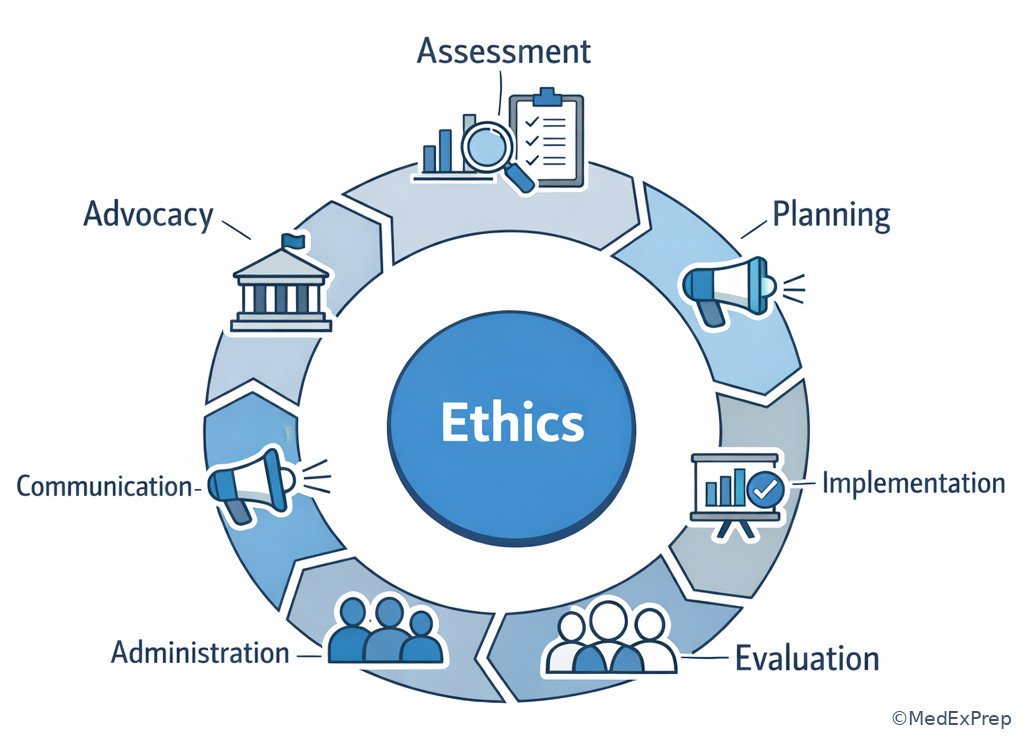
Exam takeaway: Use the program-cycle map to sort tasks before choosing the best next step.
flowchart LR
A[Assessment
What is happening?] --> B[Planning
What should be done?]
B --> C[Implementation
Deliver and coordinate]
C --> D[Evaluation
Did it happen and work?]
D --> B
E[Administration
Resources systems staff] --- B
E --- C
F[Communication
Audience messages materials] --- A
F --- C
G[Advocacy
Systems policy decision-makers] --- A
G --- B
H[Ethics and professionalism] --- A
H --- B
H --- C
H --- D
H --- E
H --- F
H --- G
Exam takeaway: Visual grouping of responsibility areas helps you recognize adjacent but distinct task types.
Core content
1.1.1.3 Foundational map: what the responsibility areas are really asking you to do
A Explanation
The first decision conflict on this topic is simple but highly tested: Are you being asked to classify a task by function, or to perform the task itself? On exam day, many stems describe a familiar public health situation and then ask for the action “most aligned” with a responsibility area. The single rule that resolves this is: name the immediate purpose of the task, not the broader program goal. If the task is collecting community survey data, convening focus groups, reviewing surveillance trends, or identifying assets and barriers, that is assessment. If the task is writing SMART objectives, selecting strategies, or building a logic model from findings, that is planning. If the task is scheduling sessions, training facilitators, or monitoring attendance, that is implementation. If the task is comparing outcomes to objectives or interpreting indicator changes, that is evaluation.
WHY THIS IS TESTED: Candidates commonly overread stems and jump to the “big picture” answer rather than the immediate operational task. Exams exploit this by making planning, implementation, and evaluation all sound useful. The winner is the choice that fits the task happening now.
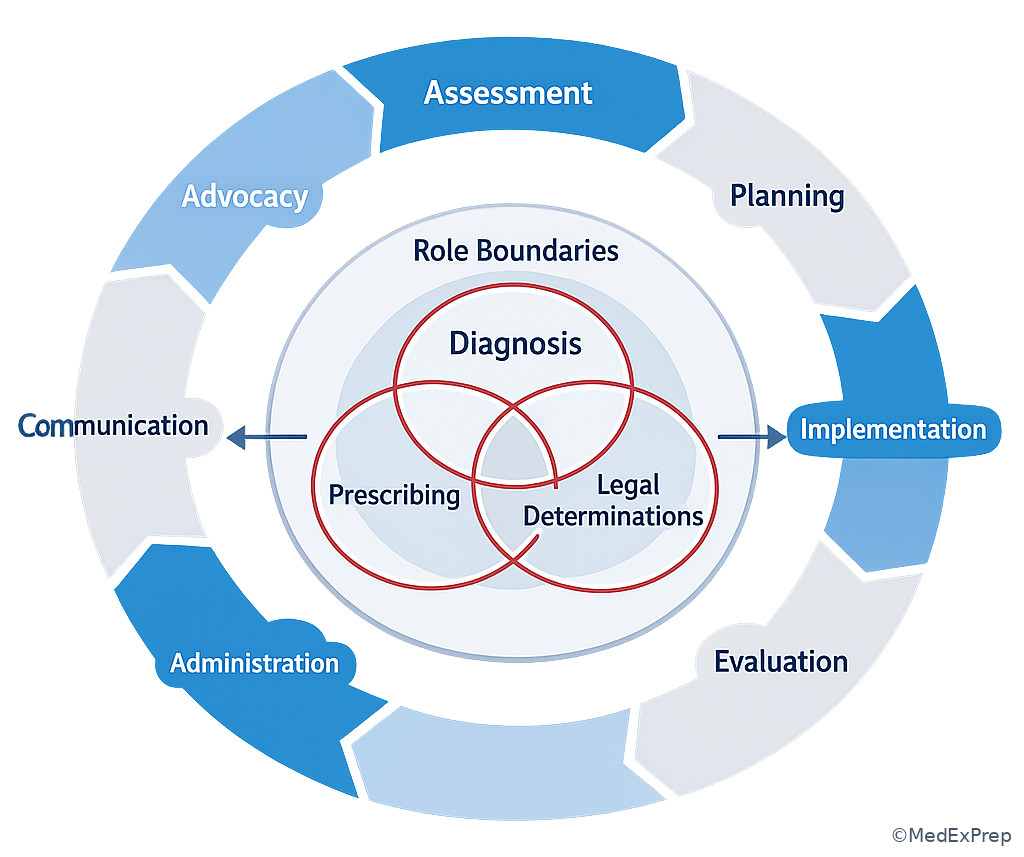
Responsibility areas are not isolated silos; they form a cycle. See Fig 1. Assessment identifies need and context. Planning converts that information into action architecture. Implementation delivers the plan. Evaluation judges performance and results. Administration supports the system throughout. Communication and advocacy operate across multiple stages, while ethics and professionalism govern all of them.
B Worked example
A county health department health education specialist is assigned to support a new hypertension prevention initiative in a rural area. Local leaders are requesting educational classes immediately. The county also has a recent rise in emergency department visits, a strong faith-based coalition, and limited bilingual staff. A supervisor asks the specialist for the most appropriate next step. A tempting clue is that the community is demanding action now, which makes “schedule classes” sound attractive.
Reasoning chain: Identify task: the program is new and the question asks for the next step before delivery. Extract key facts: there is outcome concern, community assets, staffing limitations, and no indication that needs, audience priorities, or readiness have been systematically characterized. Apply rule: before planning delivery, conduct assessment of needs, assets, barriers, and capacity. Eliminate distractors: scheduling classes is implementation too early; writing objectives is planning before enough assessment detail; comparing posttest results is evaluation before the program exists. Verify: assessment also fits the health education specialist role and supports culturally responsive planning.
C Exam trap
D Checkpoint
Question: A university wellness office asks a health education specialist to review student survey findings, conduct focus groups about sleep barriers, and identify campus resources before proposing activities. Which responsibility area is most directly being tested?
- Assessment — tempting because data collection and resource mapping are happening now; correct because the task is to define needs, barriers, and assets before designing interventions.
- Planning — tempting because the information will be used later to build a program; wrong because no goals, objectives, or strategies are yet being selected.
- Implementation — tempting because campus wellness offices often run programs; wrong because no intervention delivery or coordination is occurring.
- Evaluation — tempting because surveys and groups generate data; wrong because the data are being used to understand the problem upfront, not judge an existing program.
Answer: A. Assessment
1.1.1.4 Core distinctions: assessment versus planning versus implementation versus evaluation
A Explanation
The second foundational conflict is the core cycle itself: assessment versus planning versus implementation versus evaluation. On many items, all four sound useful. The single finding that resolves the choice is the program’s current stage and the verb in the answer option. Assessment produces understanding. Planning produces a structured response. Implementation produces delivered activities. Evaluation produces judgments about quality or results.
Use practical signals. Assessment words: identify, collect, analyze baseline data, determine priorities, map assets, assess readiness, examine barriers. Planning words: write goals, develop SMART objectives, select theory, choose strategies, design logic model, align resources. Implementation words: recruit participants, train staff, schedule sessions, maintain fidelity, coordinate partners, track participation. Evaluation words: measure indicators, compare to objectives, assess fidelity, analyze outcomes, interpret findings, report results.
WHY THIS IS TESTED: These four areas sit next to each other in the program cycle and are easy to confuse under time pressure. Test writers often place one correct phase-specific answer next to three answers that would be correct at a different stage.
B Worked example
A nonprofit serving older adults has already completed interviews, reviewed hospitalization trends, and identified medication-safety confusion as a priority. The board now asks the health education specialist to “make the program concrete.” The organization has one part-time educator, a pharmacist partner, transportation barriers, and donor pressure to show results in 3 months. A distracting clue is the availability of hospitalization data, which may make evaluation sound correct.
Reasoning chain: Identify task: the assessment has already been completed. Extract key facts: priority area is chosen; now the board wants a concrete program. Apply rule: the next responsibility area is planning — develop goals, SMART objectives, strategies, partner roles, and a feasible logic model. Eliminate distractors: more interviews repeat assessment; tracking attendance is implementation monitoring but too late for this moment; comparing medication errors after 3 months is evaluation and comes later. Verify: planning also addresses feasibility constraints like staffing and transportation.
C Exam trap
D Checkpoint
Question: A school district has completed student, parent, and teacher interviews and identified low breakfast participation as a priority. The health education specialist is now drafting specific participation targets, selecting outreach strategies, and assigning partner roles. Which responsibility area is most directly represented?
- Assessment — tempting because interviews generated the data; wrong because the current action is no longer gathering or interpreting baseline information.
- Planning — tempting because targets, strategies, and roles are being built; correct because the task is translating findings into a structured intervention plan.
- Implementation — tempting because partner roles suggest action; wrong because delivery has not yet started.
- Evaluation — tempting because targets can become measures; wrong because no program results are being judged yet.
Answer: B. Planning
- The program stage that asks “What is the problem and what assets exist?” is assessment.
- True or False: Writing SMART objectives belongs to implementation. False.
- Name the 3 core signals of evaluation: measure, compare, interpret.
Exam takeaway: Match the action verb and timing clue to the correct core responsibility area.
flowchart TD
Q[What is the task asking now?] --> A{Need baseline understanding?}
A -->|Yes| B[Assessment]
A -->|No| C{Building goals, objectives, or strategies?}
C -->|Yes| D[Planning]
C -->|No| E{Running activities, staffing, scheduling, fidelity?}
E -->|Yes| F[Implementation]
E -->|No| G[Evaluation: indicators, analysis, interpretation] | Responsibility area | Question it answers | Typical verbs | Common exam confusion |
|---|---|---|---|
| Assessment | What is happening, for whom, and why? | Identify, assess, determine, collect, analyze, map | Confused with evaluation because both use data |
| Planning | What should be done? | Develop, write, select, align, design | Confused with implementation because plans mention activities |
| Implementation | How do we deliver it? | Coordinate, train, recruit, deliver, monitor | Confused with planning when staffing/timelines appear |
| Evaluation | Did it happen and did it work? | Measure, compare, interpret, report, improve | Confused with assessment because both examine information |
1.1.1.5 Cross-cutting areas: administration, communication, advocacy, and ethics
A Explanation
After you know the core cycle, the next tested conflict is whether a task belongs to a cross-cutting area instead. Administration, communication, advocacy, and ethics can appear almost anywhere in a stem, which makes them especially tricky. The resolving rule is: if the task supports the system, it is administration; if it shapes audience-facing messages, it is communication; if it seeks policy or systems change, it is advocacy; if it asks what is right, fair, confidential, or professional, it is ethics/professionalism.
Administration is about operations: budgets, staffing, training logistics, documentation systems, procedures, timelines, partner agreements, and resource allocation. Communication is about tailoring messages, selecting channels, reviewing materials, improving readability, and disseminating information to specific audiences. Advocacy is different: it goes beyond informing and aims to influence leaders, institutions, or systems to support health. Ethics and professionalism are not a separate step after everything else; they constrain every step from the start.
WHY THIS IS TESTED: These four areas are easy to miss because their tasks often appear inside larger program scenarios. A candidate may see a brochure and think implementation, but the real tested skill is communication. A candidate may see a meeting with school board members and think planning, but the task may actually be advocacy.
See Fig 2 for the core cycle, then layer these cross-cutters on top. Administration keeps the machine running. Communication shapes how people receive information. Advocacy targets decision environments. Ethics asks whether the action respects confidentiality, autonomy, equity, truthfulness, and professional boundaries.
B Worked example
A hospital-based health education specialist is revising discharge education materials for adults with limited health literacy. The medical unit has high readmission rates, nurses report inconsistent teaching time, and a physician champion wants a stronger message about medication adherence. A tempting-but-wrong clue is the readmission rate, which may pull candidates toward evaluation. The specialist’s immediate task, however, is to revise message wording, visuals, language access, and reading level.
Reasoning chain: Identify task: modify educational materials for a defined audience. Extract key facts: limited health literacy, discharge context, inconsistent teaching time, message revision requested. Apply rule: this is communication — audience-centered message design and material adaptation. Eliminate distractors: evaluation would analyze readmission outcomes; administration would redesign staffing workflows; advocacy would seek institutional policy change; clinical treatment recommendations are out of scope. Verify: revising materials is squarely within health education practice.
C Exam trap
D Checkpoint
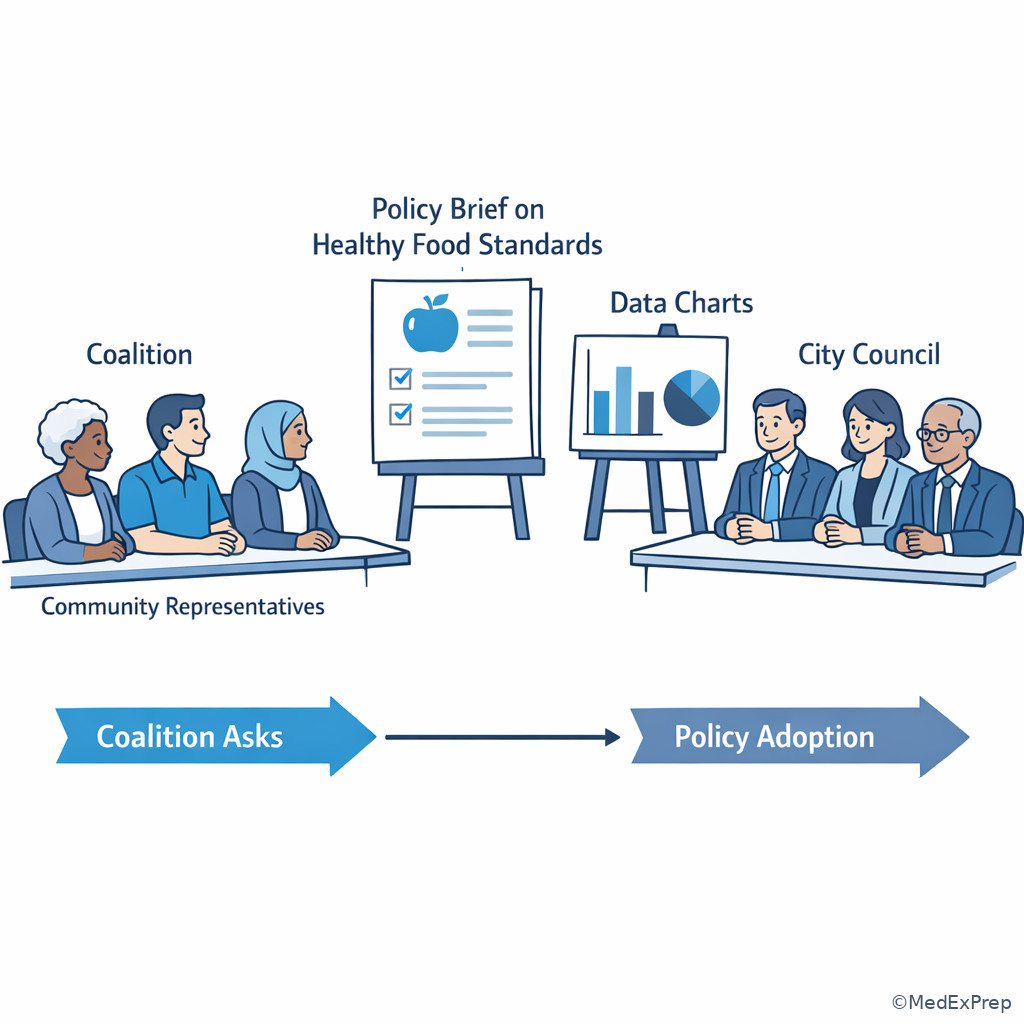
Question: A coalition member asks the health education specialist to prepare testimony for a city council hearing supporting healthier food procurement standards in municipal buildings. Which responsibility area is most directly involved?
- Communication — tempting because testimony is spoken messaging; wrong because the primary target is policy decision-making, not audience education alone.
- Advocacy — tempting because the task seeks change by influencing decision-makers; correct because the action is aimed at systems or policy support.
- Administration — tempting because municipal procedures are involved; wrong because the task is not program operations or resource management.
- Evaluation — tempting because policy arguments often use data; wrong because the immediate function is influencing policy action, not judging program performance.
Answer: B. Advocacy
Exam takeaway: If the target is audience understanding, think communication; if the target is policy or system change, think advocacy.
flowchart TD
A[Task involves message or outreach] --> B{Who is the primary target?}
B -->|Participants, community, patients, students| C[Communication]
B -->|Leaders, institutions, policymakers| D[Advocacy]
C --> E[Examples: brochures, campaigns, readability, channel selection]
D --> F[Examples: testimony, coalition asks, policy briefs, agenda change] Exam takeaway: Visualize communication tasks as audience-centered message adaptation rather than general program management.

Exam takeaway: Advocacy targets systems and decision-makers rather than only participant education.
1.1.1.6 How stems signal the right responsibility area
A Explanation
Now move from definitions to application. The real exam challenge is not memorizing labels; it is reading noisy stems and spotting the clue that decides the area. The decision conflict here is signal versus background: what detail matters most? The single rule is to prioritize task verbs, time words, target of action, and output requested.
Task verbs are the strongest signals. “Assess,” “collect,” “identify,” and “determine” point toward assessment. “Develop,” “write,” “select,” and “design” point toward planning. “Coordinate,” “deliver,” “train,” and “recruit” point toward implementation. “Measure,” “compare,” “interpret,” and “report” point toward evaluation. For cross-cutters, “budget,” “staff,” and “document” suggest administration; “revise materials” or “choose channel” suggests communication; “build coalition” or “seek policy adoption” suggests advocacy.
Time words matter too. “Before launch,” “initial step,” and “baseline” often support assessment. “After findings are reviewed” suggests planning. “During delivery” points toward implementation or process evaluation. “At 6 months” or “after the program” often signals evaluation. Outputs requested are equally useful: a community profile belongs to assessment; SMART objectives belong to planning; attendance logs belong to implementation monitoring; a findings report belongs to evaluation.
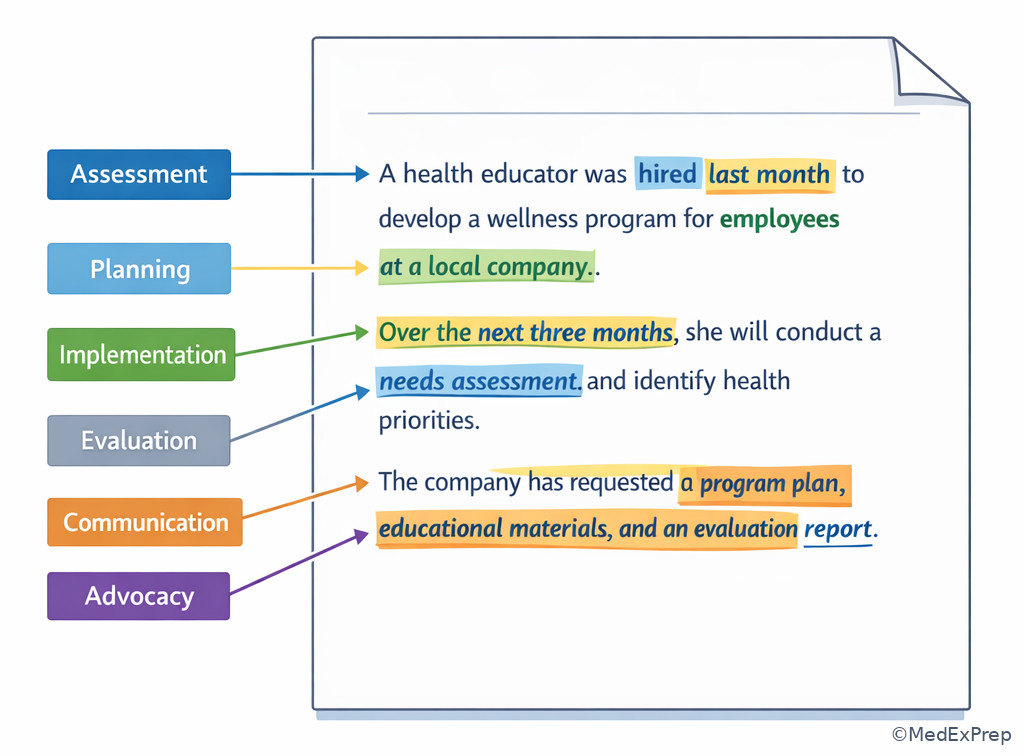
WHY THIS IS TESTED: Board-style items add noise such as comorbidities, budget pressures, partner opinions, and alarming statistics. Those details may matter later, but the tested point is often the narrow functional task. See Fig 3 for one example of using the target of action to separate close options.
B Worked example
A worksite wellness coordinator who holds CHES asks a health education specialist consultant for the best initial action after employee claims data show increased diabetes-related costs. The company also has a new CEO interested in visible results, an onsite gym with low use, and a rumor that several employees want prescription discount counseling. The consultant is told to “figure out where to start.”
Reasoning chain: Identify task: best initial action. Extract key facts: claims data show a problem, but workforce priorities, barriers, readiness, assets, and preferences are not yet clarified. The prescription clue is tempting but outside scope. Apply rule: initial action is assessment — gather employee needs, barriers, interests, and capacity information. Eliminate distractors: negotiate formulary changes sounds like advocacy/benefit design beyond the immediate step; launch a diabetes class is implementation too early; recommend medication adjustments is outside role. Verify: assessment is both appropriate and necessary before planning an evidence-informed program.
C Exam trap
D Checkpoint
Question: A community clinic has already launched a prenatal education program. The health education specialist is asked to monitor facilitator adherence to the lesson plan, track participant attendance, and note session cancellations. Which responsibility area is most directly being tested?
- Planning — tempting because lesson plans were created earlier; wrong because the current task is about delivery monitoring, not program design.
- Implementation — tempting because facilitator adherence and attendance occur during delivery; correct because the task centers on operational monitoring while the program is being run.
- Outcome evaluation — tempting because attendance can appear in reports; wrong because no longer-term result is being judged here.
- Advocacy — tempting because prenatal programs may need community support; wrong because the immediate task is not influencing systems or policy.
Answer: B. Implementation
- The stem clue “best initial action” usually pushes you toward earlier rather than later program stages.
- True or False: A request to compare post-program indicators to baseline is usually implementation. False.
- Name the 4 highest-yield stem clues: verb, timing, target, output.
Exam takeaway: Action verbs, timing words, and requested outputs usually identify the correct responsibility area faster than setting details.
flowchart LR
A[Verb] --> D[Responsibility area]
B[Timing clue] --> D
C[Requested output] --> D
E[Target of action] --> D
D --> F[Best next step]
G[Ignore noise: urgency, politics, dramatic stats] -.-> F
Exam takeaway: Annotating verb, timing, target, and output helps isolate the tested responsibility area under exam pressure.
1.1.1.7 Integration: choosing the best next step while staying within scope
A Explanation
The final integration challenge combines everything so far: What is the correct responsibility area, and is the proposed action within the health education specialist role? Some wrong options fit the right responsibility area but still exceed scope. For CHES/MCHES, the governing rule is that health education specialists assess needs, plan programs, implement and coordinate activities, evaluate findings, communicate health information, advocate, and support administration. They do not diagnose disease, prescribe treatment, select medical regimens independently, or make authoritative legal determinations.
This matters because test writers often include one option that sounds decisive and helpful but belongs to another licensed professional. The exam rewards professional judgment, not overreach. When the best response involves medical diagnosis, prescribing, psychotherapy, or legal adjudication, the health education specialist should refer, collaborate, or escalate appropriately while continuing role-consistent work such as education support, documentation, and coordination.
WHY THIS IS TESTED: CHES/MCHES credentialing assesses competent professional practice. That includes knowing what to do and what not to do. A candidate who picks an out-of-role option, even if well-intentioned, fails the professional-boundary test.
See Fig 4 for stem decoding, then add a second filter: after identifying the responsibility area, ask whether the specific action remains within role. This becomes even more important in the upcoming lesson on Scope Boundaries And Referrals.
B Worked example
A school health program receives reports that several students are vaping and experiencing anxiety symptoms. A principal asks the school-based health education specialist to identify which students have nicotine dependence and recommend the best medication plan. The district also wants a parent information night, and a counselor notes that attendance at prior wellness events was low. A tempting clue is the clear health concern, which makes decisive clinical action sound attractive.
Reasoning chain: Identify task: the request includes diagnosis and medication recommendation. Extract key facts: school setting, student risk behaviors, anxiety concerns, parent communication need, prior low attendance. Apply rule: diagnosis and medication selection are outside the health education specialist role. Best next step is to collaborate/referral to appropriate licensed professionals for clinical assessment while the specialist supports within-scope tasks such as educational planning, communication materials, and coordination. Eliminate distractors: diagnosing dependence is out of role; selecting medication is out of role; ignoring the issue to plan a general assembly misses the immediate need for appropriate referral pathways. Verify: this answer protects scope, safety, and professionalism.
C Exam trap
D Checkpoint
Question: During a community health fair, several adults ask the health education specialist which prescription medication they should start for high blood pressure based on a screening result obtained by the clinical team. What is the most appropriate action?
- Recommend the most commonly used medication class and provide dosing suggestions — tempting because participants want immediate help; wrong because prescribing guidance and regimen selection are outside scope.
- Explain general lifestyle education, encourage follow-up, and refer participants to the appropriate licensed clinician for individualized medical evaluation — tempting because it may feel less direct; correct because it stays within scope while ensuring proper clinical follow-up.
- Tell participants the screening result confirms a diagnosis of hypertension — tempting because a concerning number is present; wrong because definitive diagnosis is not made by the health education specialist in this setting.
- Ignore medication questions and continue only with event logistics — tempting because it avoids overstepping; wrong because a role-appropriate referral and educational response is still needed.
Answer: B. Explain general lifestyle education, encourage follow-up, and refer participants to the appropriate licensed clinician for individualized medical evaluation.
Exam takeaway: When a task requires diagnosis, prescribing, or individualized treatment selection, choose referral or collaboration instead of overreach.
flowchart TD
A[Identify the requested action] --> B{Within health education scope?}
B -->|Yes| C[Assess / plan / implement / evaluate / communicate / advocate / administer]
B -->|No| D[Refer or collaborate with appropriate licensed professional]
D --> E[Continue role-appropriate education, coordination, and documentation]
C --> F[Verify ethics, equity, feasibility] Exam takeaway: Health education specialists support education and coordination while routing diagnosis and treatment decisions to licensed professionals.
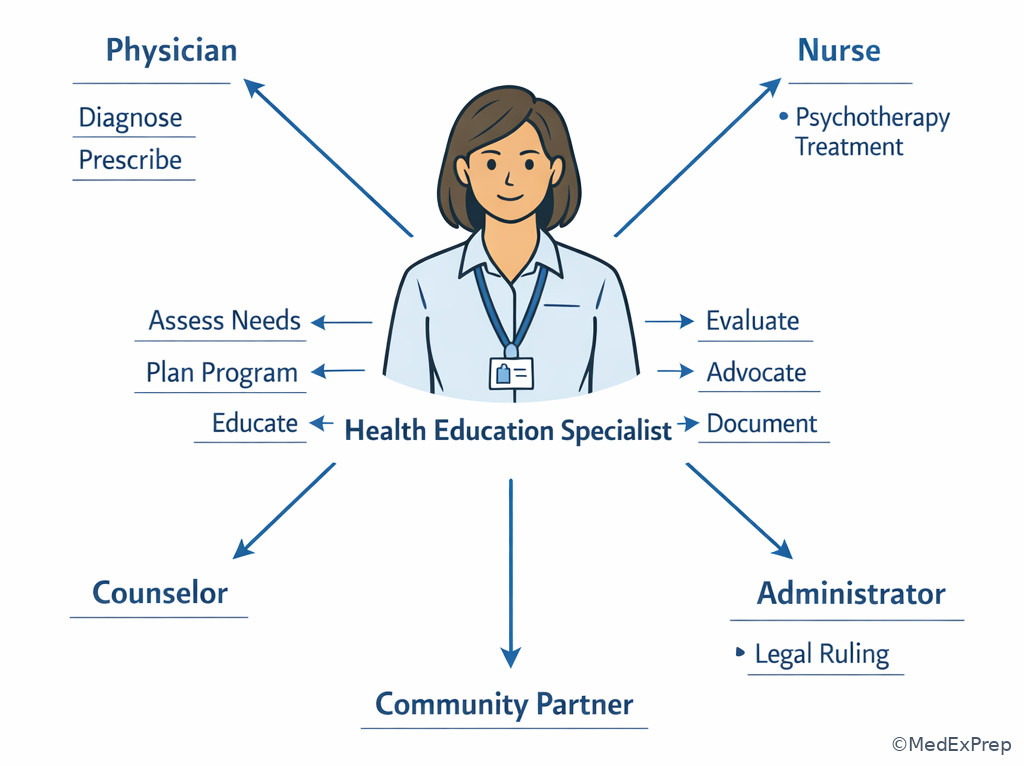
Exam takeaway: The best answer must match both the correct program stage and the professional boundary.
Exam Traps & Differentiators
1.1.1.8 Most common wrong answer and why
The most common wrong answer on this topic is a planning action chosen too early. Candidates often jump to writing objectives, selecting strategies, or creating materials before enough assessment has been done. This happens because planning feels productive and concrete. The eliminating clue is usually a missing baseline picture of needs, assets, barriers, readiness, or stakeholder perspectives.
1.1.1.9 Looks similar but isn't
| If the stem says... | Think... | Not... | Single discriminator |
|---|---|---|---|
| Conduct surveys, interviews, environmental scan | Assessment | Evaluation | Purpose is baseline understanding, not judging a finished program |
| Write SMART objectives, choose theory, build logic model | Planning | Implementation | Design work precedes delivery |
| Train facilitators, schedule sessions, track attendance | Implementation | Planning | Program is already being delivered |
| Compare posttest with baseline, interpret findings | Evaluation | Assessment | Judging program effect rather than defining the initial problem |
| Revise brochure language, choose dissemination channel | Communication | Implementation | The target is message quality and audience fit |
| Prepare policy brief, testify, mobilize coalition asks | Advocacy | Communication | The target is decision-makers and systems change |
| Assign staff roles, update documentation procedures | Administration | Implementation | The task supports operations rather than delivers content directly |
1.1.1.10 If the stem says ___, think ___
- If the stem says baseline, before launch, initial step, think assessment first.
- If the stem says objectives, strategies, logic model, theory selection, think planning.
- If the stem says recruitment, training, scheduling, fidelity, attendance, think implementation.
- If the stem says compare to objectives, determine effect, interpret findings, think evaluation.
- If the stem says readability, message tailoring, channel selection, think communication.
- If the stem says policy adoption, coalition asks, board hearing, institutional change, think advocacy.
| Confusable pair | Why it is tempting | Clue that breaks the tie |
|---|---|---|
| Assessment vs Evaluation | Both use data | Assessment asks what the problem is; evaluation asks whether the program happened or worked |
| Planning vs Implementation | Both mention activities and timelines | Planning designs the activities; implementation runs them |
| Communication vs Advocacy | Both involve messaging | Communication targets audience understanding; advocacy targets decisions or systems |
| Administration vs Implementation | Both can involve staff and schedules | Administration supports operations; implementation delivers the intervention |
| Helpful action vs In-scope action | Out-of-role answers sound decisive | If it requires diagnosis, prescribing, or legal judgment, refer/collaborate |
Related future traps: in CHES Versus MCHES Distinctions, you will see advanced leadership and systems analysis that still remain within the same role boundaries. In Scope Boundaries And Referrals, many tempting distractors will be correct actions for physicians, nurses, counselors, or attorneys — but not for the health education specialist.
Tables
| High-yield reference | Best cue | Typical output | What to reject |
|---|---|---|---|
| Assessment | Need/asset/barrier identification | Community profile, priority findings, readiness picture | Jumping straight to objectives |
| Planning | Program design from findings | Goals, SMART objectives, strategy map, logic model | Running activities before design is complete |
| Implementation | Program delivery in real time | Schedules, recruitment, training, fidelity and attendance logs | Confusing monitoring with outcome judgment |
| Evaluation | Comparison to intended process or results | Indicator analysis, interpretation, findings report | Using baseline problem-scoping language |
| Administration | Operational support | Policies, workflows, staffing plans, documentation systems | Treating support tasks as direct service delivery |
| Communication | Audience-facing message/material decision | Adapted message, materials, channel plan | Mistaking messaging for policy advocacy |
| Advocacy | Systems or policy influence | Policy brief, testimony, coalition ask | Mistaking decision-maker targeting for participant education |
| Ethics/professionalism | Confidentiality, consent, equity, truthfulness, boundaries | Safe and appropriate action choice | Overreach, coercion, stigma, or data misrepresentation |
| Task example | Closest correct area | Why a distractor looks plausible | Why the distractor is wrong |
|---|---|---|---|
| Conduct focus groups on barriers to screening | Assessment | Evaluation also uses data collection | No program performance is being judged |
| Draft objective: increase workshop completion by 20% | Planning | Implementation includes completion rates | The task is creating the target, not delivering the program |
| Monitor educator adherence to curriculum | Implementation | Process evaluation also tracks fidelity | The stem centers on delivery operations in real time |
| Interpret 6-month change in physical activity | Evaluation | Assessment also examines behavior patterns | The comparison occurs after intervention implementation |
| Revise flyer to sixth-grade reading level | Communication | Implementation distributes flyers | The tested skill is material adaptation, not delivery logistics |
| Ask county board to fund trail access improvements | Advocacy | Communication uses persuasive messaging too | The target is policy/resource change, not just audience learning |
| Differential category | Choose this when... | Reject this when... |
|---|---|---|
| Assessment | You still need problem definition, context, assets, barriers, or readiness data | The problem is already defined and the task is to build the intervention |
| Planning | You must translate assessment results into goals, objectives, strategies, or logic | The task is active delivery or post-program judgment |
| Implementation | The program exists and needs coordination, staffing, recruitment, or fidelity monitoring | The task is still choosing what the program should be |
| Evaluation | You are measuring progress, effect, or outcomes against intended targets | You are only gathering baseline information before program design |
| Communication | The main task is audience-centered message/material/channel work | The main task is policy/system influence |
| Advocacy | The main task is to influence institutions, leaders, or policy environments | The main task is participant education or material design |
| Refer/collaborate | The task asks for diagnosis, prescribing, psychotherapy treatment, or legal determination | The action is clearly within health education assessment, planning, education, evaluation, communication, advocacy, or administration |
Algorithm / Approach
Rapid Review
- Assessment → baseline need, assets, barriers, readiness
- Planning → converts findings into goals, objectives, strategies
- Implementation → live delivery, coordination, recruitment, fidelity
- Evaluation → compares indicators to targets or baseline
- Administration → supports staffing, procedures, budgets, documentation
- Communication → audience-centered message/material/channel choice
- Advocacy → decision-maker, policy, or systems target
- Ethics → overlays every area; filters truthfulness, equity, confidentiality, boundaries
- Assessment vs evaluation → problem definition versus program judgment
- Planning vs implementation → design versus delivery
- Communication vs advocacy → educate audience versus influence system
- Best initial action → usually earlier in the cycle than tempting distractors
- Role boundary violation → diagnose/prescribe/treat/legal rule = refer or collaborate
- Strongest stem clues → verb, timing, target, output
- Best answer → right area + right time + right scope
Self-check quiz
1.1.1.11 Question 1
A health education specialist reviews community survey data, conducts key informant interviews, and maps available transportation resources before recommending any intervention. Which responsibility area is most directly represented?
- Assessment
- Planning
- Implementation
- Evaluation
1.1.1.12 Question 2
A college wellness office has already identified stress as a priority. The specialist is now writing measurable objectives, selecting peer-led strategies, and outlining a logic model. Which responsibility area is the best match?
- Assessment
- Planning
- Communication
- Administration
1.1.1.13 Question 3
A community-based organization has launched a falls-prevention class for older adults. The health education specialist is asked to review facilitator checklists, confirm room setup, track attendance, and troubleshoot missed sessions. The organization also has new grant pressure and one board member wants immediate outcome data. Which is the most appropriate responsibility area for the specialist’s current task?
- Planning
- Implementation
- Outcome evaluation
- Advocacy
1.1.1.14 Question 4
A city health department wants healthier beverage standards in public buildings. A health education specialist is asked to prepare a one-page brief for elected officials, coordinate coalition talking points, and support testimony at a council meeting. The department also plans future educational materials for residents. Which responsibility area is most directly being tested now?
- Communication
- Administration
- Advocacy
- Evaluation
1.1.1.15 Question 5
A hospital outpatient program notes low completion of diabetes education visits. The specialist is asked to revise handouts for limited literacy, simplify visuals, and choose the best channels for reminder messages. The clinic director is also concerned about A1c trends and staffing shortages. Which responsibility area most directly fits the requested task?
- Communication
- Administration
- Impact evaluation
- Implementation
1.1.1.16 Question 6
A school district reports increased vaping concerns and asks its health education specialist to identify which students meet criteria for nicotine dependence and recommend medication treatment options. The district also wants a parent education night and referral resources for counseling. Which is the most appropriate next step for the specialist?
- Use screening responses to determine dependence severity and suggest pharmacotherapy choices
- Provide general education, coordinate referral pathways with appropriate licensed professionals, and support family communication materials
- Tell the principal that school staff should avoid all discussion until a district physician reviews every case
- Focus only on planning the parent night because referral issues belong entirely to clinicians
1.1.1.17 Question 7
A worksite wellness program has baseline claims data suggesting high cardiometabolic risk. Senior leadership wants visible action within 30 days. The health education specialist has access to a cafeteria partner, employee champions, and a prior needs survey from 4 years ago. One executive asks for immediate biometric-based individualized diet prescriptions to improve participation. What is the most appropriate best next step?
- Prescribe individualized diet plans using existing biometric trends so the program can launch quickly
- Conduct a current assessment of employee needs, readiness, barriers, and assets, then use findings to plan feasible strategies
- Skip assessment and begin process evaluation tools because leadership needs evidence of movement
- Prepare a policy brief for Congress on national worksite nutrition reform before addressing the local program
1.1.1.18 Question 8
A nonprofit has completed assessment and planning for a maternal health outreach initiative. During month 2 of delivery, partner attendance is inconsistent, a funder requests early success metrics, and one clinician asks the health education specialist to independently advise participants which prenatal medications are safest. Which option is the most appropriate action for the specialist right now?
- Monitor delivery fidelity and attendance, document implementation issues, and refer medication questions to the appropriate licensed clinician
- Stop implementation and rewrite all program objectives before addressing operations
- Interpret the current participation drop as evidence that the intervention is ineffective and issue an outcome report
- Answer medication questions directly because participant trust is essential for engagement
Answer key
1.1.1.19 Question 1 Answer: A. Assessment
A. Assessment is tempting because surveys, interviews, and resource mapping are classic front-end tasks, and it is correct because the stem centers on understanding needs, context, and assets before intervention selection. The single stem clue is “before recommending any intervention.” Authoritative health education planning frameworks place needs/assets identification before program design and delivery (National Commission for Health Education Credentialing; Green and Kreuter).
B. Planning is tempting because the collected information will eventually inform program design. It is incorrect for this scenario because no objectives, strategies, or logic model are yet being developed. The single clue is that the work remains data gathering rather than action design.
C. Implementation is tempting because mapping resources can sound operational. It is incorrect because no program activity is being delivered or coordinated yet. The single clue is the absence of any live intervention activity.
D. Evaluation is tempting because data review appears analytical. It is incorrect because the data are being used to define the problem upfront, not to judge an existing program’s performance. The single clue is pre-intervention timing.
1.1.1.20 Question 2 Answer: B. Planning
A. Assessment is tempting because the office already identified stress as a priority through prior data. It is incorrect because the current work is no longer discovering need; it is designing the response. The single clue is “writing measurable objectives”.
B. Planning is tempting because objectives, strategies, and logic models are all classic planning outputs, and it is correct because the stem asks about translating identified need into a structured program. The single clue is the cluster of design tasks: objectives, strategies, logic model. Planning models and NCHEC competency language consistently place these activities in program development rather than delivery.
C. Communication is tempting because peer-led strategies may include messaging. It is incorrect because the primary task is broader program design, not material/message tailoring. The single clue is that no audience-material adaptation task is described.
D. Administration is tempting because outlining a logic model can later connect to management and reporting. It is incorrect because operations, staffing, or documentation systems are not the primary focus. The single clue is the design nature of the task.
1.1.1.21 Question 3 Answer: B. Implementation
A. Planning is tempting because checklists and setup can resemble preparation. It is incorrect because the class has already launched, so the current task is not designing the intervention. The single clue is “has launched.”
B. Implementation is tempting because facilitator adherence, room setup, attendance, and troubleshooting all occur during delivery, and it is correct because the specialist is coordinating real-time program operations. The single clue is the live operational monitoring during program delivery. Program implementation literature treats fidelity and attendance tracking as delivery-phase monitoring.
C. Outcome evaluation is tempting because the board member wants immediate outcome data. It is incorrect because the specialist’s assigned task is managing delivery processes rather than judging longer-term effects. The single clue is the operational nature of the listed duties.
D. Advocacy is tempting because grant pressure can lead to external messaging or funding asks. It is incorrect because no policy or systems influence task is described. The single clue is the absence of decision-maker targeting.
1.1.1.22 Question 4 Answer: C. Advocacy
A. Communication is tempting because the specialist is preparing a brief and coordinating talking points, both of which involve messaging. It is incorrect in this scenario because the primary target is elected officials and council action, making the function policy influence rather than general audience education. The single clue is “council meeting” with policy standards.
B. Administration is tempting because coordinating coalition activity can involve logistics. It is incorrect because the dominant purpose is not operations management but influencing a decision environment. The single clue is the policy-oriented target.
C. Advocacy is tempting because the task seeks healthier beverage standards through elected officials, and it is correct because coalition messaging is being used to support systems or policy change. The single clue is that the intended endpoint is institutional adoption of standards. Public health advocacy frameworks distinguish this from routine educational communication.
D. Evaluation is tempting because policy briefs may contain evidence. It is incorrect because the specialist is not being asked to judge a program’s effect but to influence a public decision. The single clue is action toward policy adoption.
1.1.1.23 Question 5 Answer: A. Communication
A. Communication is tempting because the handouts and reminders are directly audience-facing, and it is correct because the specialist’s task is to revise materials for literacy and channel fit. The single clue is “revise handouts for limited literacy, simplify visuals, and choose channels.” Health communication standards emphasize readability, cultural relevance, and channel matching as communication functions.
B. Administration is tempting because staffing shortages are mentioned. It is incorrect because staffing is background noise, not the requested task. The single clue is that the actual assignment is material and message revision.
C. Impact evaluation is tempting because A1c trends are mentioned. It is incorrect because those trends are contextual concerns, not the current work product. The single clue is absence of comparative analysis or indicator interpretation.
D. Implementation is tempting because reminders are often deployed during live programs. It is incorrect because the tested skill is message/material design rather than delivery coordination. The single clue is the design focus of the request.
1.1.1.24 Question 6 Answer: B. Provide general education, coordinate referral pathways with appropriate licensed professionals, and support family communication materials
A. Use screening responses to determine dependence severity and suggest pharmacotherapy choices is tempting because it appears individualized and efficient. It is incorrect because dependence diagnosis and medication recommendation exceed health education specialist scope. The single clue is the request to recommend treatment options. NCHEC role boundaries and professional practice standards support referral/collaboration rather than independent clinical decision-making.
B. Provide general education, coordinate referral pathways with appropriate licensed professionals, and support family communication materials is tempting because it may feel less dramatic than direct clinical action, and it is correct because it combines within-scope education and coordination with appropriate referral for diagnosis/treatment decisions. The single clue is that the stem asks for clinical judgments beyond the specialist’s role while also presenting legitimate education tasks.
C. Tell the principal that school staff should avoid all discussion until a district physician reviews every case is tempting because it avoids overstepping. It is incorrect because the specialist can still provide general education, planning, and referral coordination within role. The single clue is that not all action is prohibited — only out-of-scope clinical judgment is.
D. Focus only on planning the parent night because referral issues belong entirely to clinicians is tempting because parent education is appropriate. It is incorrect because the immediate scenario also requires coordination of referral pathways; ignoring that need is incomplete. The single clue is the combination of clinical concern and communication need.
1.1.1.25 Question 7 Answer: B. Conduct a current assessment of employee needs, readiness, barriers, and assets, then use findings to plan feasible strategies
A. Prescribe individualized diet plans using existing biometric trends so the program can launch quickly is tempting because leadership wants rapid visible action and individualized plans sound responsive. It is incorrect because prescribing individualized medical or nutrition treatment plans can exceed the health education specialist role and because current workforce assessment is missing. The single clue is both out-of-scope individualized prescribing and outdated needs data.
B. Conduct a current assessment of employee needs, readiness, barriers, and assets, then use findings to plan feasible strategies is tempting because it seems slower under pressure, and it is correct because the best next step is still to establish current needs and context before program design. The single clue is that the only survey is from 4 years ago, making current assessment necessary. Evidence-informed planning frameworks require current, relevant data before selecting interventions.
C. Skip assessment and begin process evaluation tools because leadership needs evidence of movement is tempting because evaluation tools can signal progress to leadership. It is incorrect because process evaluation belongs after implementation begins; you cannot meaningfully evaluate delivery that has not started. The single clue is absence of an active program.
D. Prepare a policy brief for Congress on national worksite nutrition reform before addressing the local program is tempting because policy-level approaches can influence health environments. It is incorrect because it ignores the immediate local program decision and misaligns the level of action with the scenario. The single clue is that the organization needs a worksite-specific next step, not national advocacy.
1.1.1.26 Question 8 Answer: A. Monitor delivery fidelity and attendance, document implementation issues, and refer medication questions to the appropriate licensed clinician
A. Monitor delivery fidelity and attendance, document implementation issues, and refer medication questions to the appropriate licensed clinician is tempting because it addresses multiple competing pressures at once, and it is correct because the program is in month 2 of delivery, making implementation monitoring the immediate program task while medication advice must be referred. The single clue is the combination of “month 2 of delivery” and an out-of-scope medication request. This option best fits both stage and scope.
B. Stop implementation and rewrite all program objectives before addressing operations is tempting because inconsistent partner attendance may suggest planning weaknesses. It is incorrect because the program has already completed planning and is underway; operational issues should first be managed within implementation. The single clue is prior completion of assessment and planning.
C. Interpret the current participation drop as evidence that the intervention is ineffective and issue an outcome report is tempting because the funder wants early success metrics. It is incorrect because inconsistent attendance during month 2 is primarily an implementation issue, and early participation patterns do not automatically equal program ineffectiveness. The single clue is that the observed issue is delivery fidelity/participation, not validated outcome failure.
D. Answer medication questions directly because participant trust is essential for engagement is tempting because trusted relationships improve participation. It is incorrect because direct medication advice is outside the health education specialist role. The single clue is individualized medication safety guidance, which belongs to the appropriate licensed clinician.
Keep going with the full CHES / MCHES Prep Course (CHES)
You just studied the way members do, in the same lesson interface. Full access unlocks every lesson, the question bank and flashcards for a full year.
One payment · 1 year of access · No auto-renewal