1.1.1 - RN Transport Scope
RN Transport Scope
What you'll learn
- OPERATIONS/SAFETY: Distinguish RN transport scope from physician, APP, RT, paramedic, and pilot responsibilities → role boundaries
- ASSESSMENT/STABILIZATION: Choose the safest immediate RN action when patient needs, mission risks, and protocol limits compete → priority transport reasoning foundation
- COMMUNICATION: Identify when to continue protocol-based care versus when to escalate to medical control → consultation triggers
- MONITORING/REASSESSMENT: Match RN scope to continuous reassessment, equipment checks, and trend recognition → transport monitoring responsibilities
- LEGAL/ETHICAL PRACTICE: Reject common exam answers that require unsupported autonomous practice or institution-specific assumptions → scope-safe decision making
- DOMAIN: Operations/Safety → RN role boundaries in rotor-wing, fixed-wing, and ground critical care transport
- DOMAIN: Assessment/Stabilization → Immediate threats, protocol-guided nursing actions, and reassessment responsibilities
- DOMAIN: Communication → Medical control notification, concise status reporting, and escalation framing
- DOMAIN: Professional Judgment → Scope-appropriate action selection when exact official weighting is not publicly specified
Why it matters
- CFRN questions often hinge less on diagnosis and more on whether the transport RN chooses the safest role-appropriate next step.
- Many distractors are tempting because they sound decisive, but they cross into physician-only, pilot-only, or service-specific authority.
- Transport settings add altitude, vibration, noise, limited resources, and time pressure; scope-safe decisions protect both patient and crew safety.
- This topic is the base layer for all later content: before airway, shock, or trauma management, you must know what you are authorized and expected to do as the RN.
Key Terms & Must-Know Facts
1.1.1.1 Key terms
- Transport RN: Registered nurse providing care during critical care transport
- Medical control: Physician or authorized command resource providing consultation/orders per system design
- Protocol-guided care: Preapproved actions within service and medical director authorization
- Scope of practice: Legal and professional boundary for permitted RN actions
- Reassessment: Repeat evaluation after intervention, movement, or environmental change
- Escalation: Promptly contacting appropriate higher authority when patient needs exceed scope or protocol
- Crew resource management: Team communication, cross-checking, and safety-focused decision making
- Diversion: Change in transport destination or route because patient or mission safety requires it
- Packaging/restraint: Secure patient preparation for safe movement and transport
- Mission safety: Combined patient, crew, vehicle, and environmental safety considerations
- Trend recognition: Interpreting changes over time rather than isolated values
- Out-of-role signal: Stem language implying the RN should prescribe, independently authorize, or assume another professional role
1.1.1.2 Must-know facts
- The transport RN is expected to recognize, stabilize, monitor, communicate, and reassess.
- If a scenario exceeds protocol or RN authority, the exam-safe response is escalate to medical control.
- The RN does not act as independent prescriber, pilot in command, or unauthorized invasive proceduralist.
- When patient and mission priorities conflict, choose the action that best protects immediate life threats and overall transport safety.
- Reassessment is required after every major intervention, packaging change, loading phase, and environmental change.
- Do not assume local standing orders, aircraft capabilities, blood availability, or crew composition unless stated.
- A correct answer on CFRN usually stays within conservative, protocol-safe nursing practice.
- Communication is part of treatment: concise updates and early escalation are high-value nursing actions.
| Exam cue in stem | Most likely scope implication | Best RN response frame |
|---|---|---|
| Patient worsening during transport | RN must recognize trend and intervene within protocol | Assess ABCs, stabilize, reassess, communicate change |
| Need for new therapy outside protocol | May exceed RN authority | Contact medical control for guidance/orders |
| Question implies changing route or flight path | Pilot authority issue | Advocate safety concern and communicate status; pilot decides aviation operations |
| Question asks for independent medication ordering | Out of RN role | Use protocol if authorized; otherwise escalate |
| Unclear equipment capability | Institution-specific assumption trap | Choose general safety, monitoring, backup planning |
| Patient movement/loading event | Physiology may change | Repeat assessment and verify secure packaging/monitor connections |
Exam takeaway: Separate what the RN can do now from what requires protocol confirmation, team coordination, or medical control.
flowchart TD
A[Transport problem appears] --> B{Immediate ABC threat?}
B -->|Yes| C[Perform RN stabilization within protocol]
B -->|No| D[Assess trends equipment packaging environment]
C --> E[Reassess response]
D --> E
E --> F{Need exceeds protocol or scope?}
F -->|No| G[Continue monitoring communicate update]
F -->|Yes| H[Escalate to medical control or team lead]
H --> I[Document rationale and response] Exam takeaway: Visualize the RN’s core responsibilities as assessment, stabilization, monitoring, packaging, and communication across transport phases.
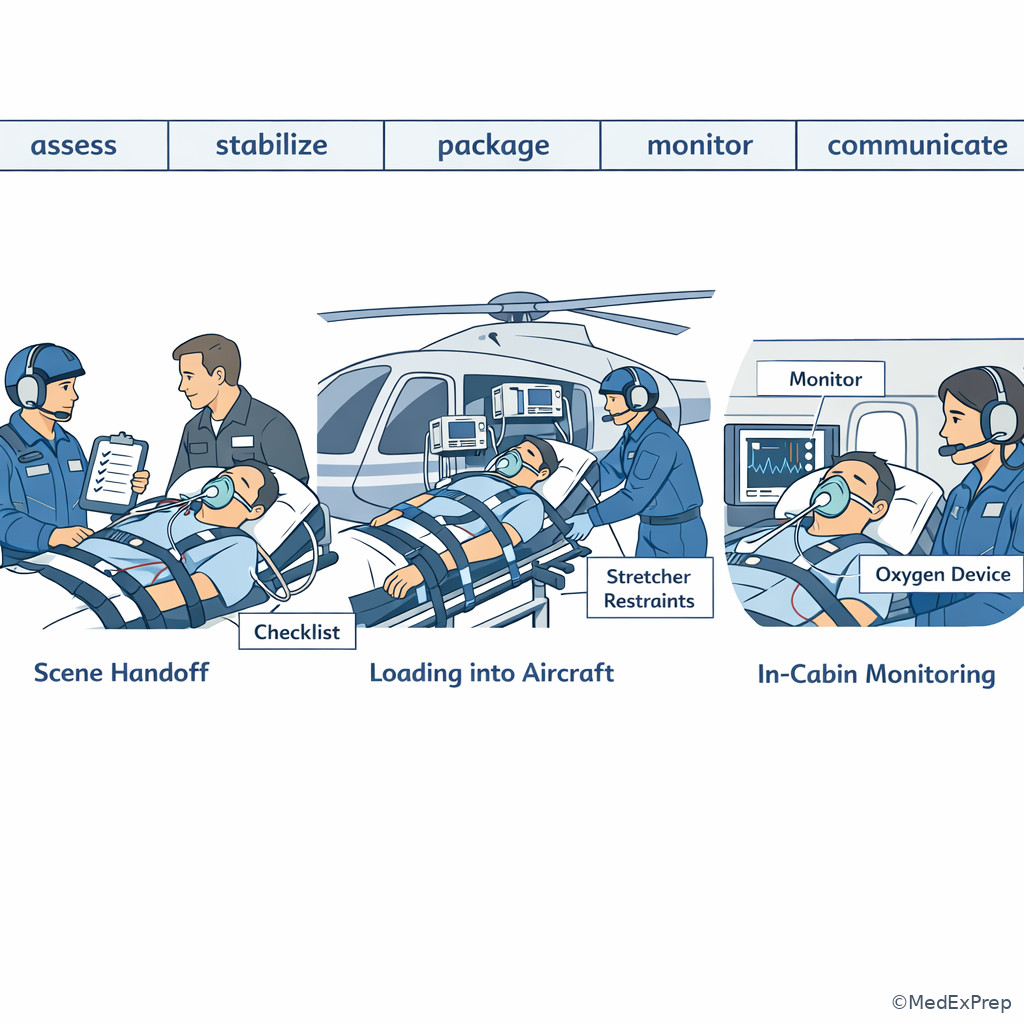
Core content
1.1.1.3 Foundational role boundary: what the transport RN owns versus what requires others
A Explanation
The decision conflict here is simple but heavily tested: Do you act now, or do you cross a scope boundary? The transport RN owns rapid assessment, protocol-guided stabilization, medication administration under orders/protocols, ventilatory support interfaces, hemodynamic monitoring, packaging, and continuous reassessment. The RN does not independently prescribe, create unsupported orders, assume pilot-in-command authority, or perform restricted procedures without authorization. The single rule that resolves many stems is this: If the intervention is within RN transport scope and addresses an immediate threat, do it; if it requires a new authorization or another professional role, escalate.
WHY THIS IS TESTED: Exam writers use authority confusion as a distractor. A bold-sounding answer may look lifesaving but still be wrong because it assumes privileges not granted in the stem.
Choose protocol-based nursing action when the stem gives enough support. Reject answers that depend on local policy guesses. If the item asks who should decide flight path, legal pronouncement, independent prescribing, or physician-level definitive management, that is an out-of-role signal. See Fig 1.
B Worked example
A 68-year-old man with COPD, coronary artery disease, and chronic kidney disease is being transported interfacility after treatment for pneumonia. During fixed-wing loading, he becomes more dyspneic and anxious. SpO2 falls from 95% to 88%, respiratory rate rises to 32/min, and one IV pump battery alarm begins sounding. The sending physician is no longer immediately available. A tempting clue is that the chart mentions he “usually needs medication adjustments during travel.”
Reasoning chain: Identify task: choose the most appropriate RN action now. Extract key facts: worsening breathing during loading, oxygenation drop, equipment issue, no immediate prescriber present. Apply rule: immediate ABC threat plus equipment concern = protocol-based nursing stabilization and reassessment, not independent medication ordering. Eliminate distractors: “write a verbal bronchodilator order” is out of role; “wait until airborne to reassess” ignores deterioration; “ask the pilot to expedite takeoff” confuses aviation authority with bedside stabilization. Verify: correct action is to address oxygenation, verify device and circuit, assess patient and packaging, correct the pump issue as able, and communicate deterioration/need for further orders if required.
C Exam trap
D Checkpoint
Question: During rotor-wing transport, a patient with GI bleeding develops increasing tachycardia and pallor. Which action is most appropriate for the transport RN?
- Independently order a higher-dose vasopressor infusion because transport delays are expected.
- Repeat focused assessment, verify current infusions and monitor function, initiate protocol-based stabilization, and notify medical control if additional therapy is needed.
- Direct the pilot to land at the nearest site regardless of operational conditions.
- Delay reassessment until a full set of labs can be obtained at the receiving hospital.
Correct answer: B.
- A: Tempting because hypotension may worsen in transit; wrong because independent ordering exceeds RN scope unless clearly protocol-authorized.
- B: Tempting because it may seem less aggressive, but it is right because it follows ABCs, nursing process, scope, and escalation principles.
- C: Tempting because diversion may help; wrong because the RN communicates the patient need, but the pilot manages aviation decisions.
- D: Tempting because more data are useful; wrong because unstable trends require immediate reassessment and action now.
1.1.1.4 Protocols, standing authority, and medical control: when to continue versus when to escalate
A Explanation
Another core decision conflict is continue under standing authority or stop and call? The single finding that resolves it is whether the needed action is already covered by protocol and whether the patient is responding as expected. If yes, continue and reassess. If no—because the patient is deteriorating, the therapy lies outside protocol, or the situation is ambiguous—contact medical control early. On CFRN items, early consultation is a strength, not a weakness.
WHY THIS IS TESTED: Many candidates overcall medical control for routine protocol care or undercall when the situation exceeds RN authority. The exam rewards the middle path: independent execution of authorized nursing actions plus prompt escalation when boundaries are reached.
Escalation triggers include failure to respond, need for destination change recommendation, need for therapy not clearly protocol-approved, worsening airway or hemodynamic instability, and conflicts between patient needs and mission limitations. Forward reference: in the upcoming Medical Control Escalation lesson, you will build the exact communication script and consultation triggers. See Fig 2.
B Worked example
A 34-year-old postpartum patient with preeclampsia, obesity, and asthma is being transported from a rural facility for higher-level care. She is receiving magnesium sulfate and oxygen. During ground transport, she develops increased work of breathing, BP 176/108 mm Hg, SpO2 92%, and diminished reflexes. A distracting detail: the sending note states that she “gets anxious in ambulances.” The tempting wrong move is to treat this as anxiety alone.
Reasoning chain: Identify task: decide whether to continue current care or escalate. Extract key facts: severe hypertension, respiratory compromise, magnesium infusion, reduced reflexes, obstetric high-risk transport. Apply rule: when current therapy may be causing harm or the patient is worsening in a way that may require therapy change outside routine continuation, the RN reassesses, manages ABCs, and escalates promptly. Eliminate distractors: “increase magnesium because seizure risk persists” ignores toxicity concern; “document and wait for arrival” ignores acute deterioration; “stop all therapy without consultation” may be too broad unless immediate safety requires it under protocol. Verify: the best action is focused reassessment, airway/breathing support, evaluation for magnesium-related deterioration per protocol, and immediate medical control/receiving team communication.
C Exam trap
D Checkpoint
Question: Which transport scenario most clearly requires prompt medical control consultation rather than simple protocol continuation?
- A stable STEMI patient remains pain free after protocol-directed monitoring and oxygen titration.
- A ventilated patient has unchanged vital signs after an already authorized sedation infusion adjustment.
- A septic patient remains hypotensive despite protocol-approved fluid bolus and reaches the limit of clearly authorized vasoactive titration.
- A trauma patient asks whether transport time will be delayed by weather.
Correct answer: C.
- A: Tempting because STEMI is high risk; wrong because the patient is stable and care remains within protocol continuation.
- B: Tempting because ventilator management feels advanced; wrong because the adjustment was already authorized and the patient is unchanged.
- C: Tempting because further escalation seems obvious, and it is right because the patient is failing current treatment at the edge of protocol authority.
- D: Tempting because weather affects transport; wrong because this is an operational communication issue, not a medical control trigger by itself.
- The safest exam response when care exceeds protocol is to escalate to medical control.
- True or False: The RN should delay ABC stabilization until after consultation. False.
- Name the 3 key escalation triggers: deterioration, ambiguity, need for nonprotocol therapy.
Exam takeaway: Continue independent nursing action only while the patient remains within protocol coverage and expected response.
flowchart TD
A[Patient change noticed] --> B[Rapid reassessment]
B --> C{Covered by protocol?}
C -->|Yes| D{Improving or stable?}
D -->|Yes| E[Continue authorized care and monitor]
D -->|No| F[Escalate to medical control]
C -->|No| F
F --> G[Report status, interventions, response]
G --> H[Document and reassess] Exam takeaway: Organize your report around patient status, interventions already taken, response, and the exact request for guidance.
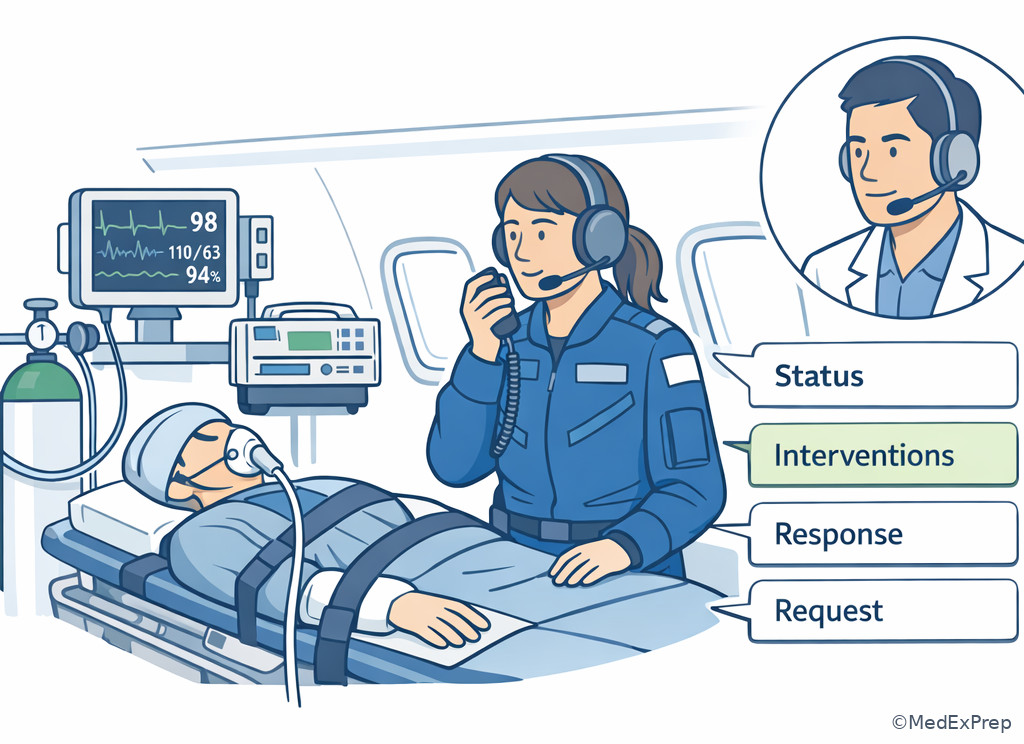
1.1.1.5 Nursing actions during transport: assessment, stabilization, monitoring, and reassessment across phases
A Explanation
Once role boundaries are clear, the next question is what exactly must the RN keep doing throughout transport? The answer is phase-based reassessment. The patient is not “packaged and done.” Scene transfer, loading, takeoff, altitude change, vibration, limited access, and unloading can each alter airway position, line security, hemodynamics, or monitor reliability. The single rule is: every intervention and every phase transition requires reassessment.
WHY THIS IS TESTED: Many wrong answers are technically reasonable interventions but fail because they skip verification. On the CFRN exam, omitted reassessment is a high-yield trap.
Assessment includes primary survey, pain/sedation status, neurologic trend, perfusion, and device function. Stabilization includes oxygenation support, hemorrhage control, infusion management, temperature support, and secure packaging. Monitoring includes trend recognition rather than isolated values. Reassessment means checking both the patient and the transport system: oxygen source, battery life, tubing, alarms, restraints, and access to rescue equipment. See Fig 3.
B Worked example
A 7-year-old child with pneumonia, repaired congenital heart disease, and mild developmental delay is being transported on high-flow oxygen after community hospital stabilization. During loading into the helicopter, the child cries, ETCO2 waveform quality drops, pulse oximetry falls from 96% to 89%, and heart rate increases. A distracting detail is a recent dose of albuterol that makes “bronchospasm recurrence” look attractive as the first explanation.
Reasoning chain: Identify task: choose the most appropriate immediate nursing action. Extract key facts: deterioration happened during movement, capnography quality changed, pulse oximetry dropped, pediatric patient with transport transition. Apply rule: phase transitions commonly create airway/interface and equipment problems; reassess device placement and patient first before assuming a new disease process. Eliminate distractors: “repeat bronchodilator immediately” may be useful later but is the wrong priority; “ignore because crying explains tachycardia” misses hypoxemia; “request immediate diversion” is premature before basic correction. Verify: correct action is to pause, assess airway position and oxygen interface, restore monitoring reliability, optimize breathing support, then reassess trend and escalate if not improved.
C Exam trap
D Checkpoint
Question: Which action best reflects the transport RN’s reassessment responsibility after patient loading?
- Assume preloading settings remain correct and focus on arrival documentation.
- Repeat targeted patient and equipment assessment, including airway interface, line security, monitor signal quality, and restraint integrity.
- Wait for a full physician evaluation at the destination before changing any monitoring setup.
- Prioritize cabin organization over patient reassessment because loading is complete.
Correct answer: B.
- A: Tempting because pretransport preparation should help; wrong because movement frequently changes physiology and equipment function.
- B: Tempting because it is systematic, and it is right because reassessment must follow each transition.
- C: Tempting because it sounds cautious; wrong because the RN is responsible for ongoing monitoring and correction now.
- D: Tempting because cabin readiness matters; wrong because the unstable or newly moved patient remains the priority.
1.1.1.6 Operational safety, packaging, and crew coordination: when patient care and mission safety compete
A Explanation
CFRN items often force a conflict between aggressive bedside care and overall mission safety. The tested decision is Which action best protects both patient and crew without leaving RN scope? The resolving rule is that the transport RN advocates for safety, communicates hazards, secures the patient and equipment, and recommends changes based on patient need—but does not override pilot authority or ignore scene/transport hazards. Safety is not separate from patient care; it is part of patient care.
WHY THIS IS TESTED: Candidates may chase a single clinical number and forget packaging, restraint, infection control, unsecured equipment, or access limits during takeoff/landing. The exam rewards nurses who think operationally.
Key operational duties include ensuring stretcher restraint, line and tube security, oxygen cylinder safety, infection-control precautions, battery/power planning, and access to rescue equipment. If conditions are unsafe, the RN should state the concern clearly, recommend the needed action, and collaborate with the crew. In aviation operations, the pilot in command makes flight decisions; the RN contributes clinical urgency and safety information. See Fig 4.
B Worked example
A 56-year-old trauma patient with rib fractures, diabetes, and alcohol use disorder is loaded for rotor-wing transport after chest tube placement. During prelift checks, the RN notices the drainage tubing is looped under the stretcher strap, one infusion pump is loosely mounted, and the patient becomes more agitated with rising respiratory rate. A tempting wrong clue is the agitation history from alcohol withdrawal, making sedation seem like the first step.
Reasoning chain: Identify task: choose the best immediate RN action when patient care and operational hazards coexist. Extract key facts: unsecured equipment, compromised chest tube path, agitation with respiratory change, imminent lift. Apply rule: secure packaging and essential life-support interfaces first, because an unsafe cabin setup can convert a manageable problem into a critical event. Eliminate distractors: “sedate first” may worsen respiratory status and ignores mechanical hazards; “ask the pilot to delay based solely on cabin discomfort” skips team communication structure; “ignore until airborne” is unsafe. Verify: correct action is to stop progression to lift if needed, secure the chest tube and equipment, reassess breathing, optimize monitoring, and communicate the clinical and operational safety concern.
C Exam trap
D Checkpoint
Question: Which statement best reflects the RN transport role when aviation safety and patient needs intersect?
- The RN independently determines the safest route and landing location because the patient is the clinical priority.
- The RN communicates the patient’s clinical urgency and safety concerns, secures the patient and equipment, and collaborates with the crew while respecting pilot operational authority.
- The RN should focus only on bedside physiology because cabin safety is not part of nursing care.
- The RN may ignore packaging concerns if vital signs are temporarily stable.
Correct answer: B.
- A: Tempting because patient needs matter; wrong because route and flight operations remain pilot responsibilities.
- B: Tempting because it sounds balanced, and it is right because CFRN scope includes clinical advocacy plus operational safety awareness.
- C: Tempting because nursing is clinically focused; wrong because transport nursing explicitly includes packaging and mission safety.
- D: Tempting because instability seems absent; wrong because stable vitals do not cancel immediate equipment or restraint hazards.
- If the stem asks you to decide the flight path, think pilot authority, not RN independent action.
- True or False: Stable vital signs make packaging errors low priority. False.
- Name 3 cabin safety checks: restraints, line/tube security, oxygen/power readiness.
1.1.1.7 Scope-based exam strategy: rejecting distractors and choosing the safest immediate action
A Explanation
The final integration step is test-taking under scope pressure. The decision conflict becomes Which of several plausible nursing actions is the best priority now? The single rule is to combine ABCs + scope + reassessment + communication. Many options are partially correct but wrong in sequence. A treatment may be reasonable later, but if it skips assessment, assumes unsupported authority, or ignores safety, it is not the best answer.
WHY THIS IS TESTED: CFRN stems are often written so that all four options are “things a nurse might do.” Your job is to find the one that fits immediate priority and legal role. Choose the option that addresses the most reversible threat within the RN role and includes escalation when required.
Common out-of-role distractors include writing new orders, performing restricted procedures without authorization, certifying death, deciding aviation operations, and assuming a resource exists because “most programs carry it.” Common sequencing distractors include calling before assessing, documenting before stabilizing, and treating a monitor number without checking patient/equipment context. See Fig 5 and Fig 6.
B Worked example
A 73-year-old woman with heart failure, atrial fibrillation, and metastatic cancer is being transported from a small ED for higher-level ICU care. She is on oxygen and a titratable infusion already started by the sending team. Mid-transport, she becomes confused and hypotensive after being repositioned. The monitor shows a poor pleth waveform, and one option on the exam says to “increase the infusion substantially and prepare to declare imminent arrest.” Another option says to reassess position, waveform quality, perfusion, and current authorized infusion limits before escalating.
Reasoning chain: Identify task: choose the most appropriate next step. Extract key facts: change followed repositioning, hypotension may be real or artifact-enhanced, authorized infusion already present, mental status changed, scope matters. Apply rule: reassess patient and equipment first while addressing circulation concerns within protocol; do not jump to unsupported dose escalation or non-RN declarations. Eliminate distractors: “declare imminent arrest” is not a nursing intervention priority; “wait for receiving physician opinion” delays care; “increase beyond stated limit” exceeds authority. Verify: the best answer is focused reassessment, correction of positioning/monitor issues, protocol-safe circulatory support, and escalation if instability persists.
C Exam trap
D Checkpoint
Question: Which option best matches the exam-safe framework for RN transport scope questions?
- Choose the answer that sounds most definitive, even if authority is not stated.
- Choose the answer that fixes a lower-priority problem first so all tasks are addressed.
- Choose the action that addresses the highest immediate threat within protocol, then reassess and escalate if needed.
- Choose the action that depends on what most transport programs probably allow.
Correct answer: C.
- A: Tempting because confidence sounds correct; wrong because unsupported authority is a classic distractor.
- B: Tempting because it seems organized; wrong because CFRN prioritizes the biggest immediate threat first.
- C: Tempting because it integrates multiple steps, and it is right because it matches ABCs, scope, and reassessment.
- D: Tempting because experienced candidates know local practice varies; wrong because the exam does not reward unstated assumptions.
Exam takeaway: Recheck both patient physiology and equipment integrity after every move, intervention, and environment change.
flowchart LR
A[Bedside handoff] --> B[Packaging]
B --> C[Loading]
C --> D[Departure]
D --> E[In transit]
E --> F[Arrival handoff]
A --- A1[Initial ABCs and devices]
B --- B1[Restraints lines oxygen power]
C --- C1[Reassess after movement]
D --- D1[Access limits and alarms]
E --- E1[Trend response]
F --- F1[Final status and communication]
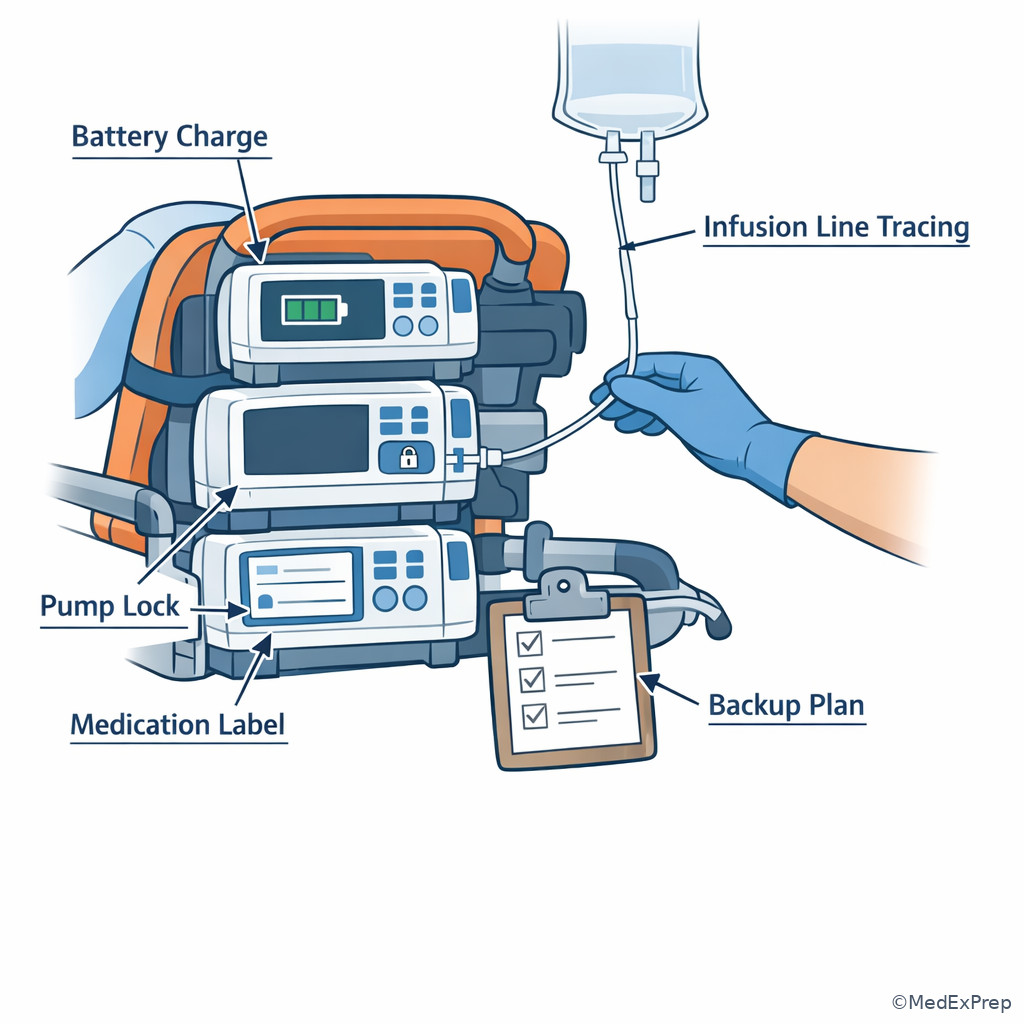
Exam takeaway: Secure restraints, lines, chest tubes, oxygen, and power before lift or movement because unstable setup can become the immediate life threat.
{"prompt":"Clean nursing-education illustration on a white background showing a transport stretcher prepared for air medical transport. Include labeled secure restraints across chest/hips/legs, chest tube tubing routed safely, oxygen cylinder secured, monitor leads organized, IV pumps mounted firmly, and clear access to airway. Emphasize packaging safety and line security, no dramatic background.","caption":"Fig 4. Packaging and cabin safety priorities\nExam takeaway: Secure restraints, lines, chest tubes, oxygen, and power before lift or movement because unstable setup can become the immediate life threat.","size":"1024x1024"} Exam takeaway: Board questions often test whether you can reject actions that belong to prescribing, aviation command, or unauthorized procedures.
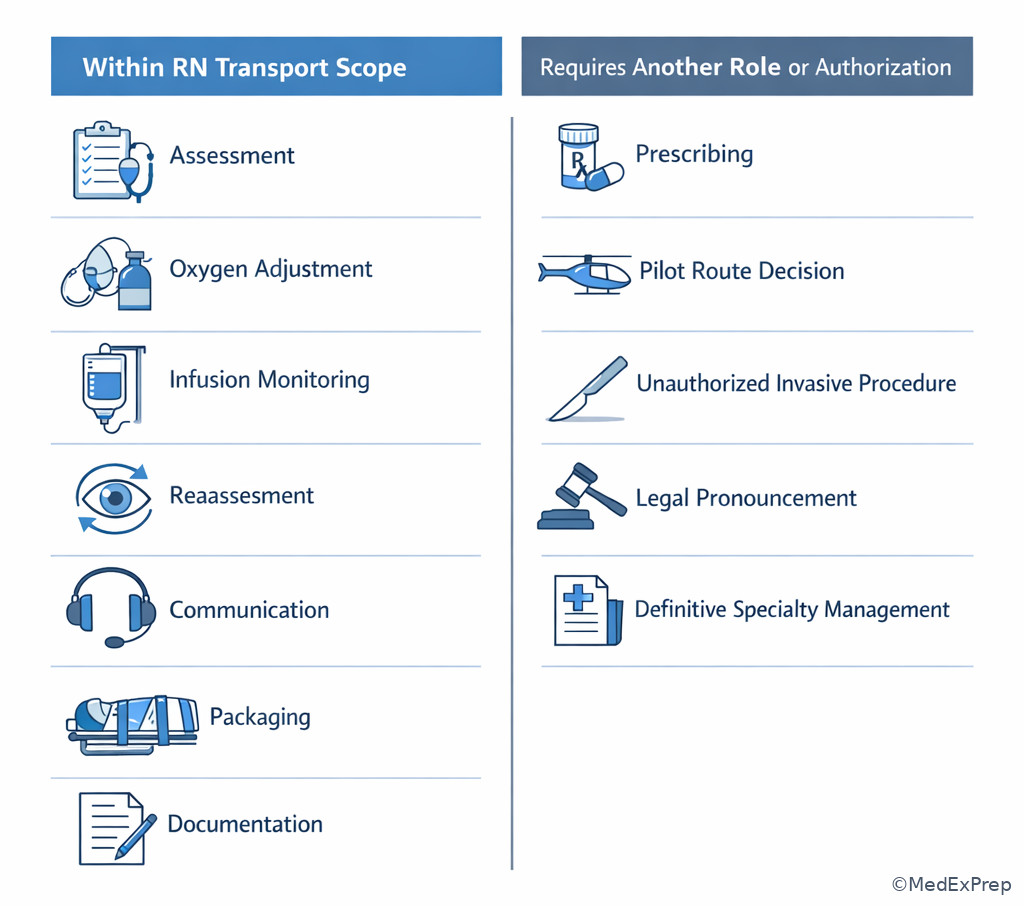
Exam takeaway: The safest first move is usually a focused ABC assessment tied to equipment verification, then protocol-based intervention and communication.
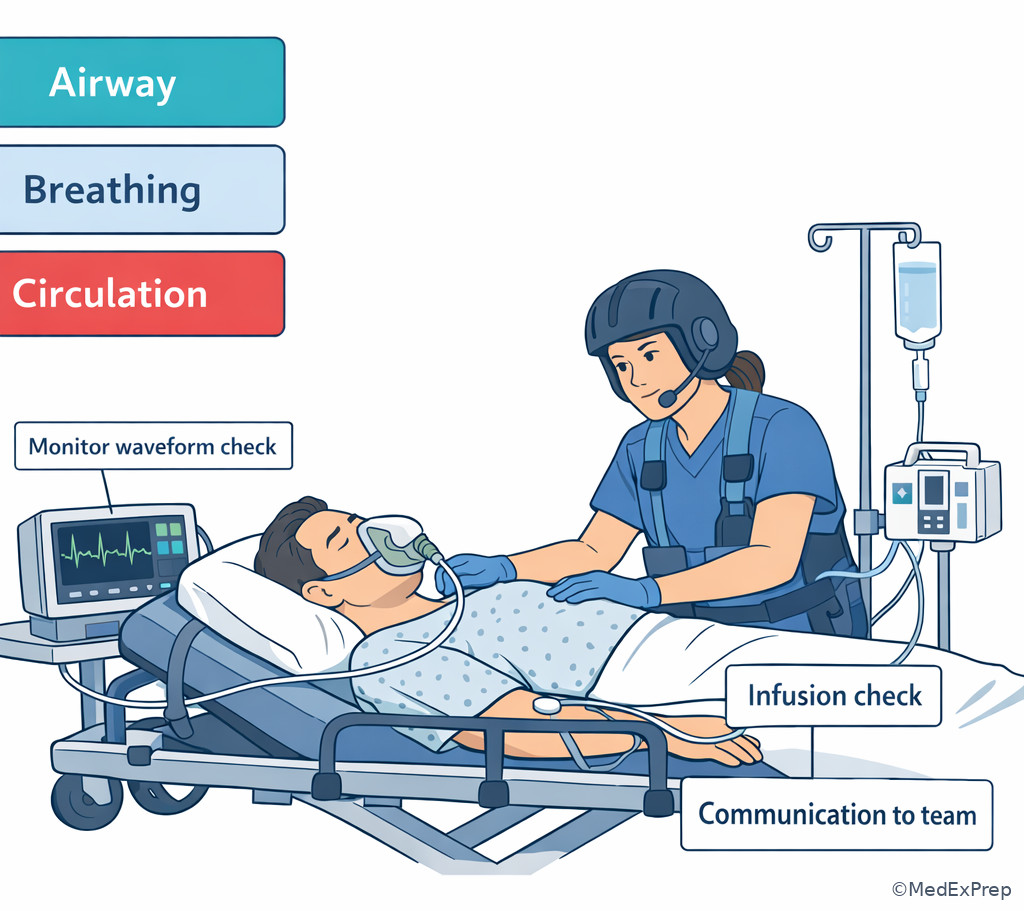
Exam takeaway: In children, crying and movement can mimic deterioration, but device position and actual work of breathing must be checked first.
{"prompt":"Clean nursing-education illustration on a white background showing a pediatric transport patient being moved onto an aircraft stretcher. Include oxygen interface, pulse oximeter, capnography sampling line, and transport RN checking mask fit and monitor quality. Labels: movement, reassessment, waveform, oxygen interface, line security.","caption":"Pediatric transport reassessment after movement\nExam takeaway: In children, crying and movement can mimic deterioration, but device position and actual work of breathing must be checked first.","size":"1024x1024"} Exam takeaway: Transport nursing includes anticipating battery, tubing, and mounting problems before they become patient events.
Exam Traps & Differentiators
Most common wrong answer and why: The most common wrong answer is the one that sounds most autonomous or aggressive. It is tempting because transport nurses work in high-acuity settings and must act quickly. It is wrong when the stem does not grant the needed authority or when the action skips ABC reassessment.
| Looks similar | Actually tested difference | Choose this | Reject this |
|---|---|---|---|
| Independent action vs escalation | Protocol coverage and response | Continue authorized care if covered and effective | Inventing new orders or delaying escalation beyond scope |
| Clinical urgency vs pilot authority | Who owns aviation decisions | Communicate urgency and recommend safety needs | Ordering route, landing, or takeoff decisions |
| Monitor change vs patient deterioration | Context after movement/intervention | Check patient plus equipment/interface | Treating the number without verifying signal quality |
| Documentation vs immediate care | Priority sequencing | Stabilize and reassess first | Charting before correcting an active threat |
| Reasonable therapy vs best next step | ABCs and timing | Address highest reversible threat now | Starting a later-phase intervention first |
If the stem says...
- “The patient worsens during loading” → think reassessment of patient and equipment after movement
- “The needed therapy is not in the protocol or authority is unclear” → think medical control escalation
- “The answer asks you to decide flight path or landing” → think pilot authority; RN advocates and communicates
- “The monitor changed right after repositioning” → think verify signal quality and interface before assuming disease progression
- “The most aggressive action is offered” → think check scope and sequence before selecting it
- “Local practice is not stated” → think do not assume capabilities or standing orders
| Confusable pair | Single clue that separates them | Why this matters for future topics |
|---|---|---|
| Priority Transport Reasoning vs RN Transport Scope | Priority asks what threat comes first; scope asks whether you may do the action yourself | Later stems will test both at once |
| Medical Control Escalation vs routine communication | Escalation involves need for new authority or failed protocol response | Useful in shock, ventilator, and obstetric topics |
| Operational safety vs bedside intervention | Unsecured equipment or unsafe conditions can become the immediate threat | Critical in aircraft safety chapters |
| Monitoring vs reassessment | Monitoring is data collection; reassessment is interpretation plus action after change | Important in hemodynamics and ventilation management |
Tables
| RN transport responsibility | Typical exam wording | Priority action |
|---|---|---|
| Primary assessment | “Most appropriate next step” in deterioration | ABCs, trend recognition, immediate stabilization |
| Medication administration under protocol | “Per orders/protocol” | Verify authorization, dose, route, response |
| Ventilation and oxygen support | “Manage interface/equipment” | Optimize oxygenation, troubleshoot, reassess |
| Packaging/restraint | “Before movement/lift” | Secure patient and equipment |
| Communication | “Notify medical control/receiving team” | Concise status + interventions + response + request |
| Documentation | “Record care and changes” | After immediate threats are addressed |
| Action type | Within RN transport scope? | Rationale |
|---|---|---|
| Repeat focused assessment after loading | Yes | Core RN responsibility |
| Titrate infusion within explicit protocol parameters | Yes | Protocol-guided nursing care |
| Independently prescribe a new medication | No | Requires prescriptive authority not assumed for RN |
| Recommend diversion due to deterioration | Yes, as advocacy/communication | RN communicates clinical need; operational decision remains collaborative/pilot-directed |
| Choose flight path or aviation clearance | No | Pilot in command authority |
| Perform unauthorized invasive procedure not stated in protocol | No | Service-restricted or physician-only action unless explicitly authorized |
| Differential situation | Best first interpretation | Discriminator |
|---|---|---|
| SpO2 drop after movement | Check patient plus interface/equipment | Timing immediately after loading/repositioning |
| Persistent instability despite protocol care | Escalate to medical control | Failure to respond within authorized range |
| Question asks for “new order” not in protocol | Out-of-role distractor | Requires prescriptive authority |
| Clinical urgency with weather/route issue | Communicate urgency, not independent aviation control | RN informs; pilot manages aircraft operations |
| Reasonable intervention offered before assessment | Wrong priority | ABCs and data verification not yet done |
| Documentation choice during active deterioration | Delay until stabilized | Safety and immediate care outrank charting |
Algorithm / Approach
Rapid Review
- RN transport scope → assess, stabilize, monitor, communicate, reassess
- Out-of-role clue → requires prescribing, unauthorized procedure, or aviation command
- Best next step → highest immediate threat within current authority
- Medical control → needed when protocol is exceeded, unclear, or failing
- Loading transition → repeat patient and equipment assessment immediately after movement
- Monitor change after repositioning → verify signal quality and interface before assuming new pathology
- Operational safety → part of nursing care, not separate from it
- Pilot authority → RN communicates urgency; pilot manages aircraft operations
- Packaging → stable vitals do not excuse unsecured lines, tubes, or restraints
- Documentation priority → after stabilization, not before
- Protocol-based autonomy → expected; unsupported autonomy → distractor
- Transport exam trap → most aggressive answer is not always most correct
- Future connection → scope answers the “may I?” question; priority reasoning answers the “what first?” question
Self-check quiz
1. A 59-year-old man with CHF and diabetes is stable during interfacility transport on a previously ordered infusion. The monitor alarms during loading, but the patient is awake, speaking, and warm. Which action is most appropriate for the transport RN?
- Independently order a new medication because monitor alarms during loading usually predict deterioration.
- Reassess the patient and equipment, confirm the alarm source, and continue protocol-based care if findings remain stable.
- Ask the pilot to delay the mission until a physician can come onboard and reevaluate the patient.
- Finish documentation before troubleshooting so the event is recorded in sequence.
2. A 42-year-old woman with asthma and hypertension is on oxygen during ground transport. She asks whether the crew can change the route to avoid bumps because she feels short of breath. Which response best reflects RN transport scope?
- Immediately redirect the vehicle route without consulting the crew because comfort is a nursing decision.
- Explain that route and operation decisions are outside RN authority, assess her respiratory status, communicate concerns to the crew, and continue appropriate nursing care.
- Ignore the complaint because mission operations are never relevant to nursing care.
- Promise that the route will be changed once the RN determines the smoothest option.
3. A 6-year-old child with bronchiolitis, repaired VSD, and mild dehydration is being loaded for air transport. After transfer to the stretcher, the pulse oximeter falls from 95% to 88%, ETCO2 tracing becomes poor, and the child is crying. Which action is the most appropriate next step?
- Administer another bronchodilator immediately because crying indicates worsening bronchospasm.
- Reassess airway position, oxygen interface, and monitor quality, then intervene based on the reassessment findings.
- Delay action because pulse oximetry in children is unreliable during crying.
- Request immediate diversion before checking the equipment because hypoxemia is present.
4. A 71-year-old septic patient with CKD and atrial fibrillation remains hypotensive after the maximum clearly protocol-authorized fluid bolus during fixed-wing transport. The patient is cooler, more confused, and urine output is minimal. Which action is most appropriate?
- Continue watching for a spontaneous response because additional calls can delay care.
- Independently start a medication not referenced in the protocol because the patient is worsening.
- Contact medical control with a concise report while maintaining current stabilization and reassessment.
- Stop all transport monitoring so communication can occur without distraction.
5. A 28-year-old postpartum patient with severe preeclampsia, obesity, and asthma is on magnesium infusion during transport. She becomes drowsier, respirations slow, and reflexes diminish. Which action is the most appropriate priority for the transport RN?
- Assess airway and breathing, evaluate the current infusion and protocol guidance, provide immediate supportive care, and escalate for additional direction as needed.
- Increase the magnesium because seizure prevention remains the top concern.
- Document the reflex change and wait for the receiving intensivist to interpret it.
- Ask the pilot to descend immediately before completing a patient reassessment.
6. A 64-year-old man with GI bleeding, CAD, and cirrhosis becomes pale and tachycardic during rotor-wing transport. One option is to increase his existing vasoactive infusion beyond the stated transport protocol ceiling. Another is to repeat focused assessment, verify infusion setup, continue authorized measures, and contact medical control. Which is the best next step?
- Increase the infusion beyond protocol because transport instability justifies immediate autonomous action.
- Repeat assessment, verify equipment and current therapy limits, continue protocol-based stabilization, and contact medical control.
- Stop the infusion entirely and observe for blood pressure recovery before calling anyone.
- Delay action until landing because any change midflight creates too much variability.
7. A 55-year-old trauma patient with rib fractures, COPD, and alcohol use disorder is ready for lift. The chest tube tubing is caught under a strap, the oxygen cylinder is secure, and the patient is increasingly agitated with a respiratory rate of 30/min. Which action best reflects the transport RN’s priority?
- Administer sedation first because agitation is the most visible problem.
- Proceed with lift because the oxygen cylinder is secure and the patient can be reassessed later.
- Correct the tubing and packaging hazard, reassess breathing, and communicate the safety concern before continuing.
- Independently cancel the flight because the RN owns all mission safety decisions.
8. A 73-year-old woman with heart failure, chronic anemia, and metastatic cancer becomes confused and hypotensive after repositioning during transport. The pleth waveform is poor, and the existing infusion is already running within ordered limits. Which action requires immediate clarification because it exceeds RN transport scope?
- Tracing the line, checking monitor accuracy, and reassessing perfusion after repositioning
- Requesting medical control guidance for further hemodynamic support if instability persists
- Independently writing a new order to exceed the current infusion parameters
- Communicating the status change and the patient’s response to the receiving team
Answer key
1.1.1.8 1. Answer: B
A: Tempting because alarms during loading can precede real deterioration, and the nursing impulse is to act quickly. Incorrect because independent ordering exceeds RN authority in this scenario; the discriminating clue is that the patient is currently stable and the source of the alarm is not yet verified. Priority framework: assess before implementing nonauthorized therapy. Source: NCSBN clinical judgment and RN scope principles; ANA Standards of Practice.
B: Tempting because it may feel less aggressive than medication escalation. Correct because ABCs and the nursing process require patient and equipment reassessment first, especially after movement; the discriminating clue is that the patient is stable while the alarm occurred during loading. Source: NCSBN prioritization framework; Lewis Medical-Surgical Nursing.
C: Tempting because physician reassessment sounds safe. Incorrect because the RN should not delay immediate assessment for an alarm-related issue that may be mechanical or easily correctable; the clue is stable patient status and no evidence that bedside physician presence is required first. Source: ANA Standards of Practice; NCSBN.
D: Tempting because accurate documentation matters. Incorrect because documentation is lower priority than troubleshooting an active monitor alarm and confirming patient stability; the clue is an unresolved alarm during a transition point. Source: NCSBN safety and prioritization principles.
1.1.1.9 2. Answer: B
A: Tempting because advocating for patient comfort is part of nursing care. Incorrect because independently changing the route exceeds the RN’s operational authority; the discriminating clue is that route decisions are mission operations, not bedside nursing commands. Source: ANA Standards of Practice; transport role boundary principles.
B: Tempting because it addresses both comfort and respiratory concern. Correct because it keeps the RN within scope: assess the patient, communicate concerns, and collaborate while respecting operational authority. The clue is the patient’s dyspnea complaint paired with a route request. Source: NCSBN communication and safety principles; ANA.
C: Tempting because the RN should not control route operations. Incorrect because ignoring the complaint would miss a potential breathing issue; the clue is reported shortness of breath, which requires nursing assessment. Source: NCSBN ABC priority framework.
D: Tempting because it appears patient-centered. Incorrect because it falsely assumes route authority the RN does not have; the clue is “determine the smoothest option,” which belongs to operational decision-makers. Source: ANA scope standards.
1.1.1.10 3. Answer: B
A: Tempting because bronchiolitis patients can worsen and crying can coincide with respiratory distress. Incorrect because the first priority after transfer-related change is reassessment of airway interface and monitoring setup; the clue is the deterioration occurred immediately after loading with a poor ETCO2 tracing. Source: NCSBN ABCs; Lewis.
B: Tempting because it is systematic rather than dramatic. Correct because movement can alter mask fit, monitor signal, or patient positioning; the discriminating clue is the timing of the desaturation and waveform change right after transfer. Source: NCSBN prioritization; pediatric respiratory assessment principles.
C: Tempting because crying does affect pulse oximetry. Incorrect because the child may also have true compromise, and poor waveform quality must be investigated rather than dismissed; the clue is combined saturation drop and poor ETCO2 tracing. Source: NCSBN safety and reassessment standards.
D: Tempting because hypoxemia can justify urgent transport change. Incorrect because diversion before checking an immediately reversible post-movement issue is premature; the clue is loading-associated change. Source: ANA nursing process; NCSBN.
1.1.1.11 4. Answer: C
A: Tempting because too many calls can fragment care. Incorrect because the patient is worsening despite reaching the maximum clearly authorized intervention; the discriminating clue is hypotension persisting after the protocol limit. Source: NCSBN escalation and patient safety principles.
B: Tempting because worsening septic shock often needs more therapy. Incorrect because starting a medication not referenced in the protocol would exceed RN authority as presented; the clue is “not referenced in the protocol.” Source: ANA scope standards; NCSBN.
C: Tempting because it adds another task during instability. Correct because early concise medical control contact is indicated once the patient reaches the edge of authorization and remains unstable; the clue is persistent hypotension with signs of poor perfusion despite authorized treatment. Source: NCSBN prioritization and communication; Lewis.
D: Tempting because focused communication matters. Incorrect because stopping monitoring would remove essential patient surveillance during instability; the clue is active deterioration. Source: ANA standards for ongoing assessment.
1.1.1.12 5. Answer: A
A: Tempting because it combines multiple steps rather than a single intervention. Correct because airway and breathing outrank all other concerns, and magnesium-related deterioration requires immediate assessment of respiratory status plus protocol review and escalation if needed. The discriminating clue is drowsiness with slowed respirations and diminished reflexes. Source: NCSBN ABC framework; obstetric nursing standards.
B: Tempting because seizure prevention is important in preeclampsia. Incorrect because the current findings raise concern for therapy-related harm or worsening respiratory compromise, making more magnesium unsafe as the priority. The clue is diminished reflexes and respiratory slowing. Source: Lewis; NCSBN.
C: Tempting because trend documentation is useful. Incorrect because documentation does not come before airway/breathing support and urgent reassessment; the clue is active respiratory compromise. Source: NCSBN prioritization.
D: Tempting because altitude can matter in transport physiology. Incorrect because the stem does not establish that descent is the first intervention, and the RN should not prioritize operational change over bedside respiratory assessment. The clue is unresolved ABC threat requiring bedside action first. Source: ANA scope standards; NCSBN.
1.1.1.13 6. Answer: B
A: Tempting because hemorrhagic instability demands fast action, and vasoactive escalation sounds decisive. Incorrect because exceeding the stated protocol ceiling requires authorization not granted here; the discriminating clue is “beyond the stated transport protocol ceiling.” Source: ANA scope standards; NCSBN.
B: Tempting because it may seem slower than dose escalation. Correct because it combines circulation-focused reassessment, equipment verification, continuation of authorized care, and timely consultation—the safest approach within scope. The clue is worsening status at the edge of allowed therapy. Source: NCSBN priority-rationale; Lewis.
C: Tempting because current therapy could contribute to instability in some cases. Incorrect because abruptly stopping support without evidence or plan could worsen perfusion; the clue is active pallor and tachycardia suggesting ongoing compromise. Source: NCSBN patient safety principles.
D: Tempting because midflight changes can be complex. Incorrect because active deterioration cannot wait for landing; the clue is current signs of worsening perfusion. Source: ANA ongoing assessment standards.
1.1.1.14 7. Answer: C
A: Tempting because agitation is obvious and sedation may eventually be needed. Incorrect because correcting the chest tube tubing and packaging hazard comes first; sedation before resolving a possible mechanical problem can worsen respiratory status and obscure assessment. The clue is tubing caught under a strap before lift. Source: NCSBN safety first; trauma transport principles.
B: Tempting because one major item—the oxygen cylinder—is already secure. Incorrect because proceeding with lift despite an identified chest tube and packaging hazard violates transport safety priorities. The clue is an unresolved line/tube hazard in a patient with respiratory change. Source: ANA standards; NCSBN.
C: Tempting because it delays lift momentarily. Correct because packaging safety is part of patient care; the RN should correct the hazard, reassess breathing, and communicate before proceeding. The clue is the caught chest tube tubing plus rising respiratory rate. Source: NCSBN prioritization; Lewis trauma nursing concepts.
D: Tempting because the safety problem feels major. Incorrect because the RN does not independently own all mission decisions; the role is to identify, communicate, and collaborate on the safety issue. The clue is “independently cancel the flight,” which crosses authority lines. Source: ANA scope standards.
1.1.1.15 8. Answer: C
A: Tempting because it may look too basic for a critically ill patient. Incorrect as a choice requiring clarification because it is appropriate nursing assessment after repositioning; the clue is poor pleth waveform after movement. Source: NCSBN ABC and reassessment standards.
B: Tempting because calling may feel premature. Incorrect as a scope violation because requesting guidance is appropriate when instability persists; the clue is ongoing hypotension with current therapy already at ordered limits. Source: ANA communication and escalation standards.
C: Tempting because worsening hypotension may seem to demand more support. Correct as the item requiring clarification because independently writing a new order exceeds RN transport scope in this scenario. The discriminating clue is “writing a new order to exceed current infusion parameters.” Source: ANA scope standards; NCSBN.
D: Tempting because it sounds administrative. Incorrect as a scope violation because communicating status change to the receiving team is an expected nursing responsibility. The clue is meaningful deterioration requiring handoff updates. Source: NCSBN communication standards.
Keep going with the full CFRN Prep Course (CFRN)
You just studied the way members do, in the same lesson interface. Full access unlocks every lesson, the question bank and flashcards for a full year.
One payment · 1 year of access · No auto-renewal