1.1.1 - Triage Acuity Principles
Triage Acuity Principles
What you'll learn
- DOMAIN: Triage/Prioritization → Initial ED sorting and urgency assignment — choose the safest acuity level from first-look findings, chief complaint, and immediate risk.
- DOMAIN: ABCs/Recognition of instability → Identify life threats at triage — separate time-sensitive instability from discomfort, chronic disease, or reassuring single data points.
- DOMAIN: Clinical judgment → Prioritize nursing actions within RN scope — decide when to room immediately, initiate protocol-based actions, and escalate.
- DOMAIN: Communication/Documentation → Triage note quality and handoff — document the cue that drove the acuity decision and communicate deterioration clearly.
- DOMAIN: Safety/Disposition planning → Reassessment triggers — identify which waiting-room patients require earlier reassessment despite an initially stable appearance.
Blueprint mapping
- DOMAIN: Emergency nursing clinical judgment → Objective: Triage and acuity assignment → Subskill: Rapid recognition of immediate versus delayed threats
- DOMAIN: ABCs and shock recognition → Objective: Rapid assessment and stabilization → Subskill: Use airway, breathing, circulation, disability, and safety cues in triage
- DOMAIN: Communication and handoff → Objective: Reassessment and escalation → Subskill: Communicate triage concern and change in status
- DOMAIN: Learner-safe interpretive mapping
Why it matters
- Triage errors are rarely about obscure diagnoses; they are usually failures to recognize time-sensitive risk behind common complaints.
- The CEN exam tests whether you choose the patient with the greatest immediate threat, not the loudest complaint or the most complete history.
- A stable-looking patient can still be high acuity if one cue signals airway compromise, shock, stroke, sepsis, toxic ingestion, or unsafe behavior.
- Triage is not a one-time label; reassessment changes priority, especially when waiting-room deterioration begins before obvious hypotension or collapse.
Exam takeaway: Start triage by identifying immediate threats before considering pain score, arrival order, or diagnosis labels.
flowchart TD
A[Patient arrives] --> B{Immediate threat?}
B -->|Airway/Breathing/Circulation/Neuro/Safety| C[High acuity now]
B -->|No immediate threat| D{Time-sensitive risk?}
D -->|Possible sepsis stroke ACS trauma overdose| E[Urgent evaluation]
D -->|No| F{Stable with resources needed?}
F -->|Yes| G[Lower acuity with reassessment]
F -->|No| H[Minimal urgency]
Use a threat-first sequence rather than a diagnosis-first sequence. See Fig 1.
Key Terms & Must-Know Facts
1.1.1.1 Key terms
- Triage: rapid sorting by urgency and resource need
- Acuity: degree of immediate risk and urgency
- First look: immediate visual assessment before full history
- ABCs: airway, breathing, circulation
- Disability: neurologic status, mentation, glucose consideration
- Exposure: visual inspection for hidden threats, temperature, bleeding
- Time-sensitive emergency: condition where delay worsens outcome
- Compensated shock: perfusion failure before hypotension appears
- Reassessment: repeat evaluation after waiting, intervention, or change
- Red flag: single cue that upgrades urgency
- Noise: distracting but non-priority data in a stem
- Escalation: urgent communication of concern to provider/team
1.1.1.2 Must-know facts
- Abnormal appearance can outweigh a near-normal vital sign set.
- Trend matters more than one isolated number.
- Chest pain is not automatically highest acuity; chest pain with diaphoresis, dyspnea, hypotension, or concerning appearance is.
- The waiting room is an extension of triage, not a holding zone exempt from reassessment.
- Severe pain alone can raise urgency, but threat to life or limb outranks pain score.
- An elderly or immunocompromised patient may have serious illness with muted vital sign abnormalities.
- Behavioral presentations still require medical safety screening and environmental safety planning.
- Children may compensate until sudden decompensation; normal blood pressure does not exclude shock.
- Documentation should name the cue that justified acuity: work of breathing, altered mentation, active bleeding, neuro deficit, unsafe behavior, or perfusion concern.
| High-yield triage cue | Why it matters | Typical nursing implication |
|---|---|---|
| Unable to speak full sentences | Suggests significant respiratory compromise | Immediate placement, pulse oximetry, oxygen per protocol, escalate |
| Sudden altered mental status | Could reflect hypoxia, stroke, hypoglycemia, tox, shock | Rapid assessment, glucose check per protocol, immediate clinician notification |
| Cool clammy skin with tachycardia | May indicate compensated shock | Do not wait for hypotension before escalation |
| Uncontrolled bleeding | Circulatory threat | Direct pressure, rapid rooming, trauma escalation as indicated |
| New unilateral weakness or aphasia | Time-sensitive neurologic emergency | Stroke alert pathway per policy, immediate timing/history collection |
| Fever with hypotension or confusion | Possible sepsis | High urgency, early sepsis pathway awareness and escalation |
Exam takeaway: Visual appearance, posture, skin signs, and speech often reveal acuity before the chart does.
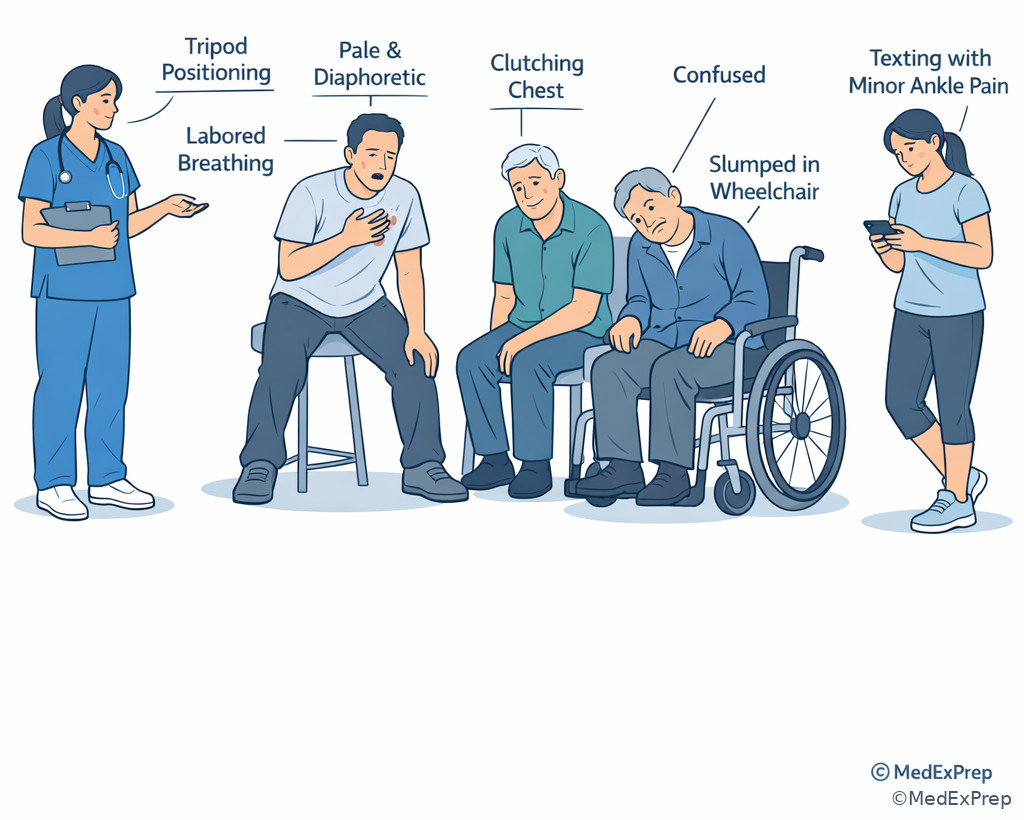
Core content
1.1.1.3 Foundational triage rule: sort by threat, not by complaint label
A Explanation
The central decision conflict in triage is this: Do I sort the patient by what they say is wrong, or by what could kill them if they wait? The correct rule is threat-first. Chief complaint helps organize the interview, but acuity is set by actual or potential compromise in airway, breathing, circulation, neurologic status, or safety. A patient saying “anxiety” may really be hypoxic; a patient saying “flu” may really be septic; a patient saying “migraine” may really have sudden focal deficit.
WHY THIS IS TESTED: exam stems often give a familiar complaint plus one hidden red flag. The red flag, not the label, decides triage. Choose a higher-acuity action when the single resolving clue shows life threat, time sensitivity, or high-risk deterioration potential.
In nursing scope, the triage task is not to make the definitive diagnosis. It is to identify whether the patient can safely wait, what immediate nursing actions are appropriate under policy, and what must be escalated. Use a rapid hierarchy: appearance, airway, work of breathing, pulse/perfusion, mentation, bleeding, mechanism/exposure, then focused history. If a clue suggests instability, room first and finish details second. Local protocols vary; confirm with your institution.
B Worked example
A 56-year-old man presents to triage with “heartburn.” He has hypertension, type 2 diabetes, and chronic GERD. He says the discomfort started while carrying groceries and is now “8 out of 10.” He is slightly diaphoretic and says he feels “a little short of breath.” Triage vital signs: BP 148/88 mm Hg, HR 104/min, RR 24/min, SpO2 95% on room air. He mentions eating spicy food earlier, which is the tempting clue.
Reasoning chain: identify task — assign urgency and priority nursing action. Extract key facts — exertional onset, diaphoresis, dyspnea, tachycardia, diabetes. Apply rule — complaint label “heartburn” does not lower risk when ischemic features are present. Eliminate distractors — chronic GERD and spicy food are noise because they do not explain diaphoresis with exertional symptoms. Verify — this patient requires prompt placement and escalation for possible ACS pathway rather than routine waiting-room placement.
C Exam trap
D Checkpoint
Question: Which patient requires the highest triage priority?
- A. A 24-year-old with 10/10 flank pain, vomiting, history of kidney stones, normal mentation, BP 138/84 mm Hg, HR 98/min
- B. A 67-year-old with weakness, fever, confusion, and BP 92/58 mm Hg after 2 days of dysuria
- C. A 31-year-old with chronic migraine, photophobia, and nausea, speaking clearly, BP 126/78 mm Hg
- D. A 48-year-old with ankle deformity after a fall, severe pain, intact distal pulse, alert and oriented
Best answer: B.
- A: tempting because severe pain and vomiting are urgent, but stable perfusion and no ABC/neuro threat make this lower priority than possible septic shock.
- B: tempting because “UTI symptoms” can sound minor, but confusion plus hypotension is the right combination for immediate concern and escalation.
- C: tempting because headache can hide serious disease, but the stem does not provide red flags that outrank hypotension with altered mentation.
- D: tempting because deformity and trauma look dramatic, but intact pulse and stable presentation place it below circulatory instability.
1.1.1.4 First-look cues and vital-sign interpretation at triage
A Explanation
The decision conflict here is whether to trust a single “acceptable” vital sign set or to upgrade acuity based on appearance and trend risk. The resolving rule: triage combines first-look findings with vital signs; normal numbers do not cancel dangerous appearance. A patient in tripod position with an oxygen saturation of 94% is still concerning. A pale, clammy patient with HR 118/min and “normal” blood pressure may be compensating. An elderly septic patient may not be frankly febrile. Children may preserve blood pressure until late.
WHY THIS IS TESTED: board-style items often give a near-normal blood pressure to tempt undertriage. The better answer comes from work of breathing, mental status, skin signs, or trend context. Use vitals as part of pattern recognition, not as permission to ignore the bedside picture.
High-yield first-look cues include inability to speak full sentences, accessory muscle use, cyanosis or pallor, mottling, diaphoresis, lethargy, agitation due to hypoxia, new confusion, severe distress, and active hemorrhage. Vital-sign interpretation is contextual: tachycardia after anxiety may be benign, but tachycardia with cool skin or delayed cap refill is not. Respiratory rate is commonly underweighted in stems and in practice; elevated RR is often an early sign of deterioration.
See Fig 2 for a fast cue map and Fig 3 for a visual comparison of stable versus unstable first-look patterns.
Exam takeaway: A single red-flag cue such as abnormal work of breathing, poor perfusion, or altered mentation can upgrade triage even before a full history.
flowchart LR
A[First look] --> B[Work of breathing]
A --> C[Mental status]
A --> D[Perfusion]
A --> E[Safety]
B --> B1[Tripod, retractions, cannot speak]
C --> C1[Confusion, lethargy, agitation]
D --> D1[Pallor, diaphoresis, active bleed]
E --> E1[Violence risk, self-harm, elopement risk]
B1 --> F[Upgrade acuity]
C1 --> F
D1 --> F
E1 --> F
Exam takeaway: Distinguish reassuring appearance from hidden instability by posture, speech, skin signs, and interaction, not by chief complaint alone.
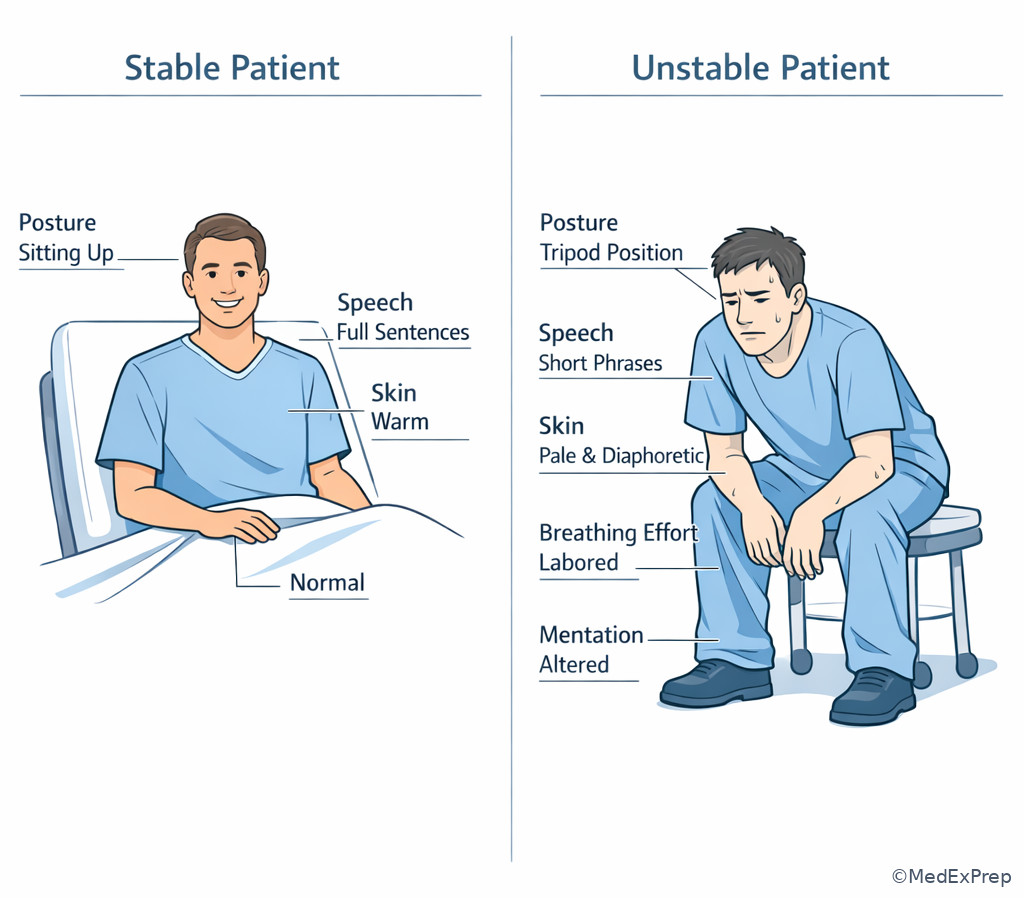
B Worked example
A 79-year-old woman presents with “weakness.” She has COPD, CKD, and takes prednisone for polymyalgia. Her daughter reports two falls and poor intake for 2 days. She is afebrile at 37.1°C, BP 118/66 mm Hg, HR 112/min, RR 28/min, SpO2 93% on room air. She looks tired, answers slowly, and has dry mucous membranes. The distracting clue is the absence of fever and a “normal” blood pressure.
Reasoning chain: identify task — determine whether she can wait. Extract key facts — advanced age, immunomodulating therapy, tachycardia, tachypnea, slow mentation, dehydration, falls. Apply rule — elderly or immunocompromised patients may have serious illness without fever or hypotension. Eliminate distractors — weakness alone sounds nonspecific, but the first-look and RR make her higher risk. Verify — this patient needs prompt evaluation and close reassessment rather than routine waiting.
C Exam trap
D Checkpoint
Question: Which triage finding most strongly supports immediate placement rather than routine waiting?
- A. Pain score of 9/10 with normal speech and normal skin signs
- B. Blood pressure 146/90 mm Hg in an anxious patient
- C. Respiratory rate 30/min with use of accessory muscles
- D. Temperature 38.0°C in an otherwise well-appearing adult
Best answer: C.
- A: tempting because severe pain deserves prompt care, but isolated pain without threat signs is not the strongest immediate cue.
- B: tempting because abnormal vital signs matter, but isolated hypertension in anxiety is usually not the key high-acuity cue.
- C: tempting because respiratory rate is easy to overlook; it is correct because abnormal work of breathing signals possible respiratory failure.
- D: tempting because fever may indicate infection, but the absence of instability cues makes it less urgent than respiratory distress.
- The most underweighted early deterioration vital sign is respiratory rate.
- True or False: Normal blood pressure excludes shock. False.
- Name 3 first-look upgrade cues: abnormal work of breathing, altered mentation, poor perfusion.
1.1.1.5 Applied triage patterns: chest pain, dyspnea, neuro change, fever, and behavioral safety
A Explanation
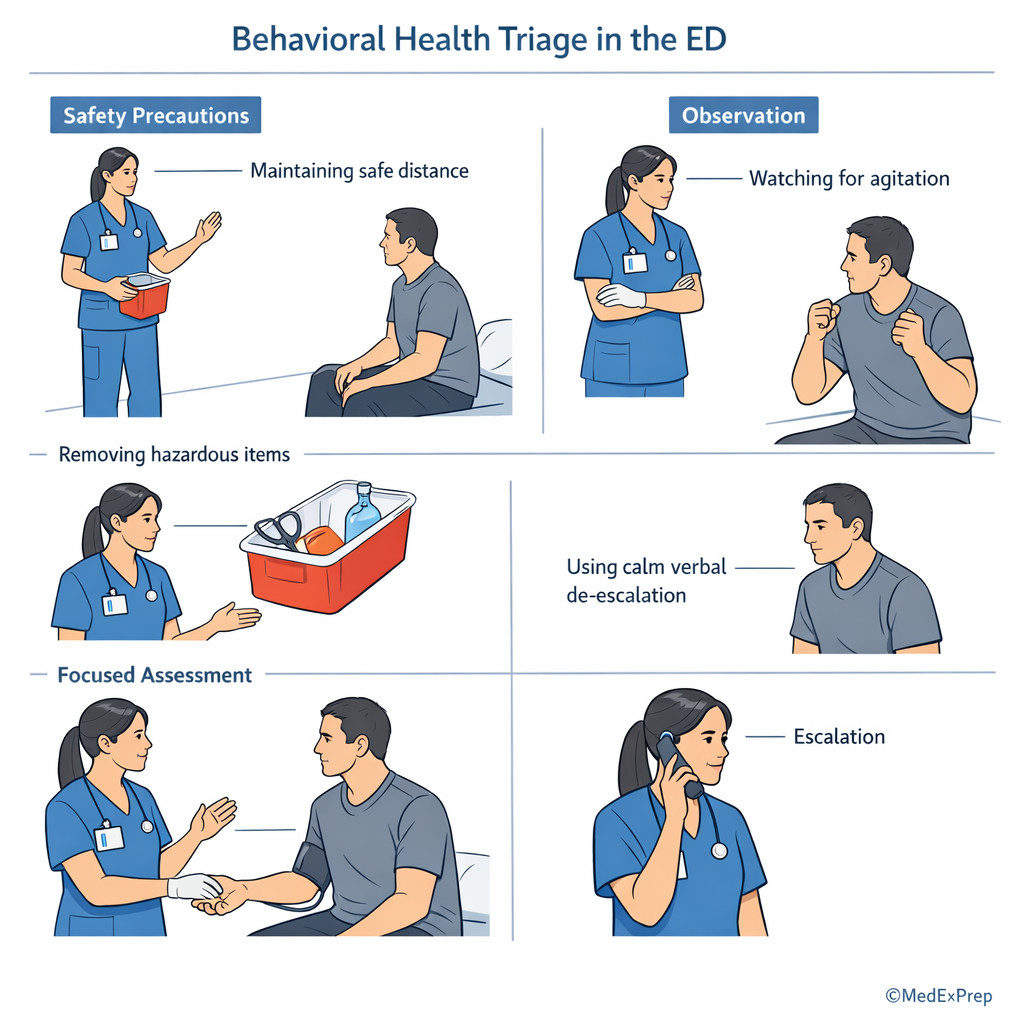
The decision conflict here is whether a common ED complaint belongs in a routine queue or a high-priority pathway. The resolving rule is to triage pattern plus risk cue, not complaint alone. Chest pain becomes more urgent with diaphoresis, dyspnea, exertional onset, syncope, or abnormal appearance. Dyspnea becomes higher risk with one-word speech, accessory muscle use, low oxygen saturation, fatigue, or altered mentation. Neuro complaints become time-sensitive when onset is sudden, focal, or associated with abnormal speech or gait. Fever becomes higher acuity when paired with hypotension, confusion, immunocompromise, rigors, or signs of poor perfusion. Behavioral complaints require simultaneous safety planning and medical screening; agitation, intoxication, overdose, hallucinations, self-harm risk, or inability to cooperate with safety all increase urgency.
WHY THIS IS TESTED: stems often place several common presentations side by side. The correct patient is the one with the single escalation cue that converts “common complaint” into “time-sensitive emergency.”
This is also where triage and scope intersect. The emergency RN does not need to name the final diagnosis at triage. The RN must identify the pathway: immediate bed, monitored evaluation, safety precautions, stroke alert activation per protocol, sepsis concern escalation, or urgent reassessment plan.
Exam takeaway: A common complaint becomes high acuity when paired with a red-flag feature that signals deterioration, time sensitivity, or unsafe behavior.
flowchart TB
A[Common complaint] --> B{Red-flag feature present?}
B -->|Chest pain + diaphoresis/dyspnea/syncope| C[Upgrade]
B -->|Dyspnea + one-word speech/retractions| C
B -->|Headache + focal deficit or sudden onset| C
B -->|Fever + confusion/hypotension/immunocompromise| C
B -->|Behavioral + suicidal intent/violence risk/overdose| C
B -->|No red flag| D[Lower acuity with reassessment] Exam takeaway: Side-by-side complaint patterns help you separate common presentations that can wait from those that require immediate escalation.
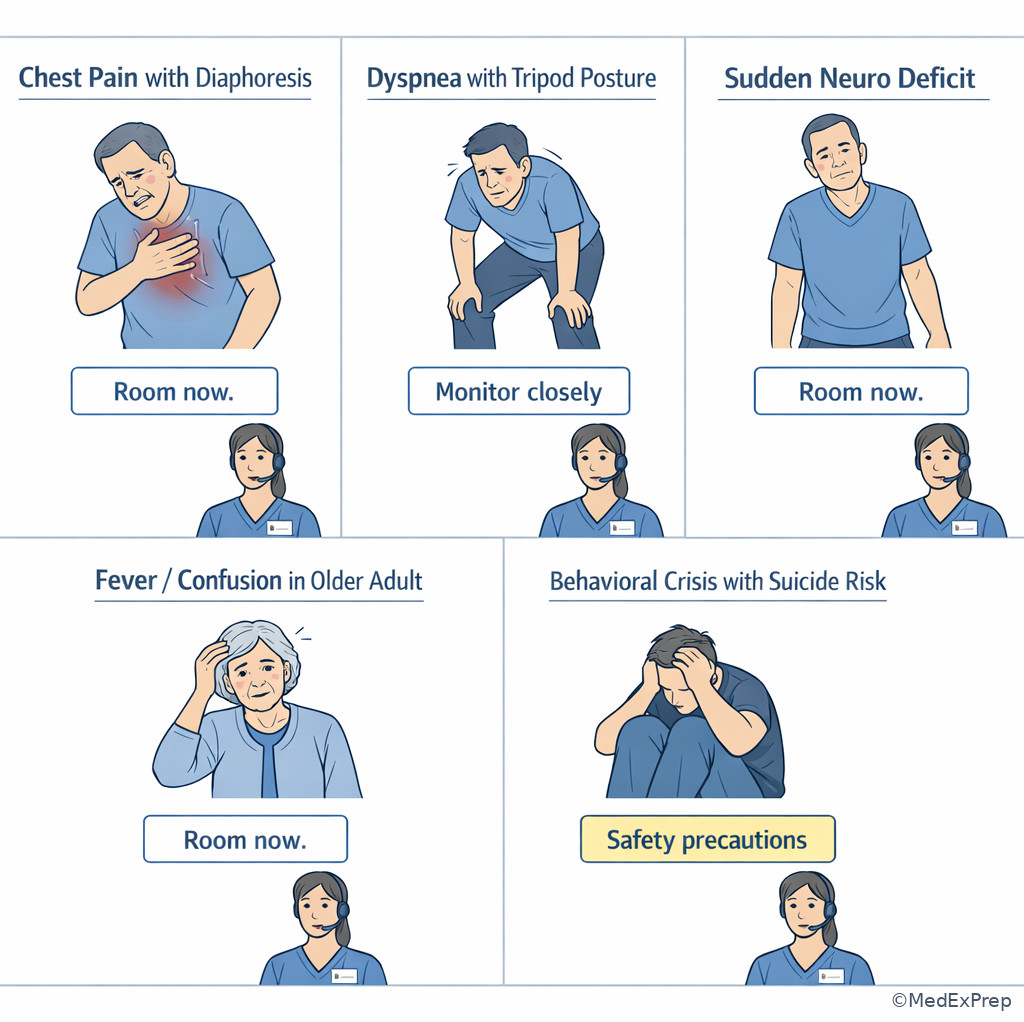
B Worked example
A 34-year-old woman presents with “panic attack.” She has asthma, generalized anxiety disorder, and recent URI symptoms. She is pacing, says she cannot catch her breath, and has tingling in her fingers. BP 132/78 mm Hg, HR 122/min, RR 32/min, SpO2 91% on room air. She has audible wheezing. The tempting-but-wrong clue is her known anxiety history and paresthesias suggesting hyperventilation syndrome.
Reasoning chain: identify task — safest triage action. Extract key facts — asthma, tachypnea, low oxygen saturation, wheezing, inability to regulate breathing. Apply rule — respiratory threat beats psychiatric label. Eliminate distractors — anxiety may coexist, but hypoxemia and wheezing prevent down-prioritization. Verify — immediate rooming and respiratory-focused care are required.
C Exam trap
D Checkpoint
Question: Which presentation most strongly supports immediate triage upgrade for a neurologic time-sensitive event?
- A. Chronic headache worsened by bright light, no weakness, no speech change
- B. Sudden slurred speech and right arm drift that began 30 minutes ago
- C. Intermittent dizziness for 3 weeks when standing quickly
- D. Tension-type headache with scalp tenderness after poor sleep
Best answer: B.
- A: tempting because headache can be serious, but the stem lacks the focal or sudden features that make it the top neurologic priority.
- B: tempting because stroke may not always be obvious; it is correct because sudden focal deficit is the key time-sensitive clue.
- C: tempting because dizziness can represent posterior circulation problems, but the chronic positional pattern is less urgent than acute focal findings.
- D: tempting because headache severity can mislead, but no focal deficit or abrupt onset is provided.
1.1.1.6 Reassessment, waiting-room risk, and documentation that defends your triage decision
A Explanation
The decision conflict is whether triage ends after initial assignment. It does not. The resolving rule is simple: every waiting patient remains under emergency nursing surveillance, and acuity can rise with new data. The exam tests whether you recognize that reassessment is a safety function, not clerical repetition. Patients with chest pain, fever, abdominal pain, dehydration, elderly weakness, behavioral changes, pregnancy concerns, trauma, and pediatric respiratory illness may worsen while waiting. Reassessment intervals vary by system, but the high-yield principle is universal: sicker patients, changing symptoms, and high-risk presentations need earlier repeat evaluation.
WHY THIS IS TESTED: a correct initial triage answer can become wrong if the patient deteriorates and the nurse fails to re-prioritize. Many stems ask what requires immediate reevaluation: increasing pain plus pallor, new vomiting plus lethargy, rising RR, repeated syncope, worsening bleeding, or new confusion.
Documentation should capture the driver of concern and the plan. Useful triage notes include symptom onset, high-risk comorbidities, abnormal appearance, vital signs, objective red flags, acuity rationale, interventions initiated, and reassessment instructions. Avoid vague documentation such as “appears fine” or “waiting comfortably” when the patient actually has a concerning risk pattern. If a patient leaves before evaluation, document condition, efforts to inform, and institutional process.
See Fig 5 for the waiting-room reassessment algorithm.
Exam takeaway: Triage is a continuous loop, and any new red flag requires immediate reprioritization and escalation.
flowchart TD
A[Patient waiting after triage] --> B[Repeat visual check and vitals]
B --> C{New symptom or worse findings?}
C -->|Yes| D[Upgrade acuity]
D --> E[Notify provider/team and room patient]
C -->|No| F[Continue planned reassessment]
F --> G[Reinforce return-now instructions] Exam takeaway: Reassessment focuses on changes in appearance, work of breathing, perfusion, and mentation rather than simply repeating numbers.
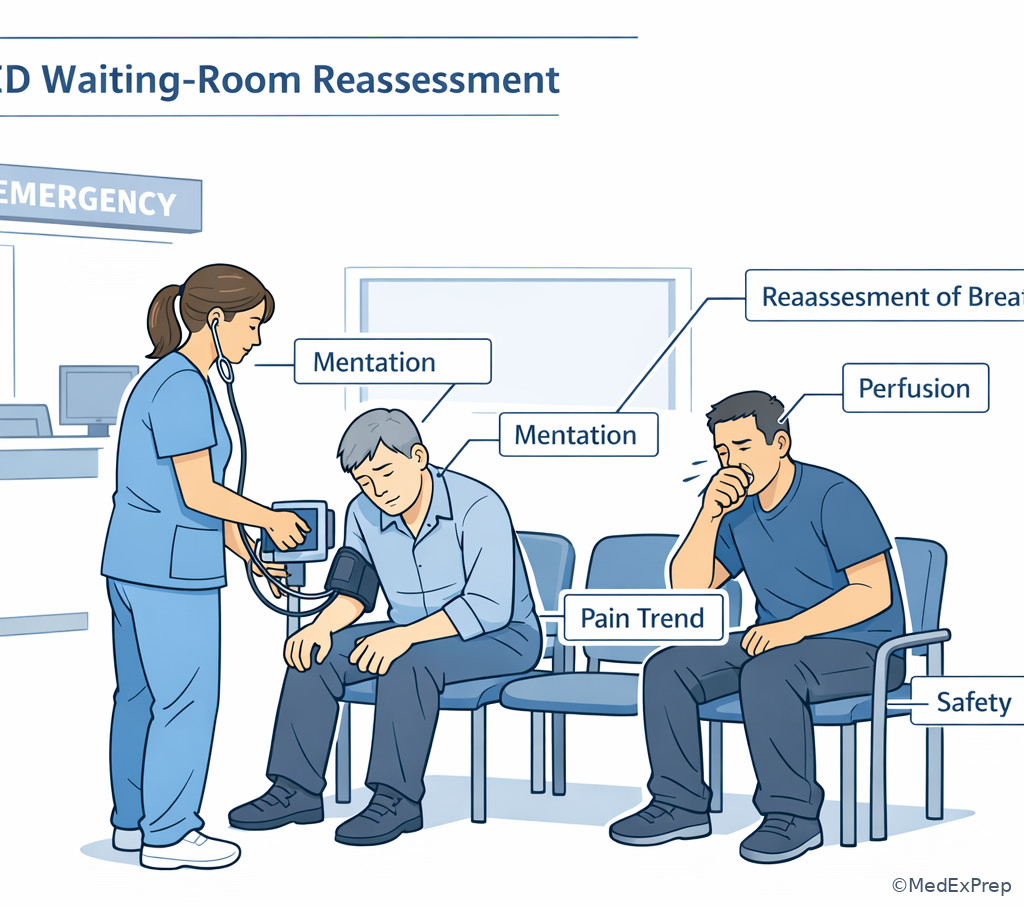
B Worked example
A 22-year-old man was initially triaged for abdominal pain and nausea. He has Crohn disease and takes immunosuppressive therapy. Forty minutes later, the waiting-room nurse notices he is pale and lying across two chairs. Repeat vitals show HR 128/min, BP 96/60 mm Hg, RR 26/min, temperature 38.4°C. The distracting clue is that he was talking and texting comfortably at arrival.
Reasoning chain: identify task — determine immediate reassessment action. Extract key facts — immunosuppression, new fever, tachycardia, tachypnea, hypotension, worsened appearance. Apply rule — triage acuity is dynamic; deterioration overrides the initial lower-priority assignment. Eliminate distractors — prior comfortable appearance is irrelevant now. Verify — immediate upgrade, rooming, and escalation are required.
C Exam trap
D Checkpoint
Question: Which waiting-room change requires immediate triage reassessment and likely acuity upgrade?
- A. A patient with wrist pain asks again how long the wait will be
- B. A patient with sore throat reports persistent pain while drinking water
- C. A patient with abdominal pain becomes pale, diaphoretic, and lightheaded when standing
- D. A patient with chronic back pain requests a blanket because the room feels cold
Best answer: C.
- A: tempting because repeated contact can signal distress, but no physiologic deterioration is described.
- B: tempting because worsening pain matters, but it lacks the instability cues seen in option C.
- C: tempting because abdominal pain is common; it is correct because pallor, diaphoresis, and presyncope indicate possible perfusion compromise.
- D: tempting because feeling cold can precede illness, but isolated comfort request does not outweigh clear perfusion warning signs.
- True or False: Triage ends once the initial category is assigned. False.
- The waiting-room patient you worry about most is the one with a change from baseline.
- Name the 3 documentation items that defend a triage decision: driver cue, action taken, reassessment plan.
1.1.1.7 Integration: choose the safest RN action, not a provider-level action
A Explanation
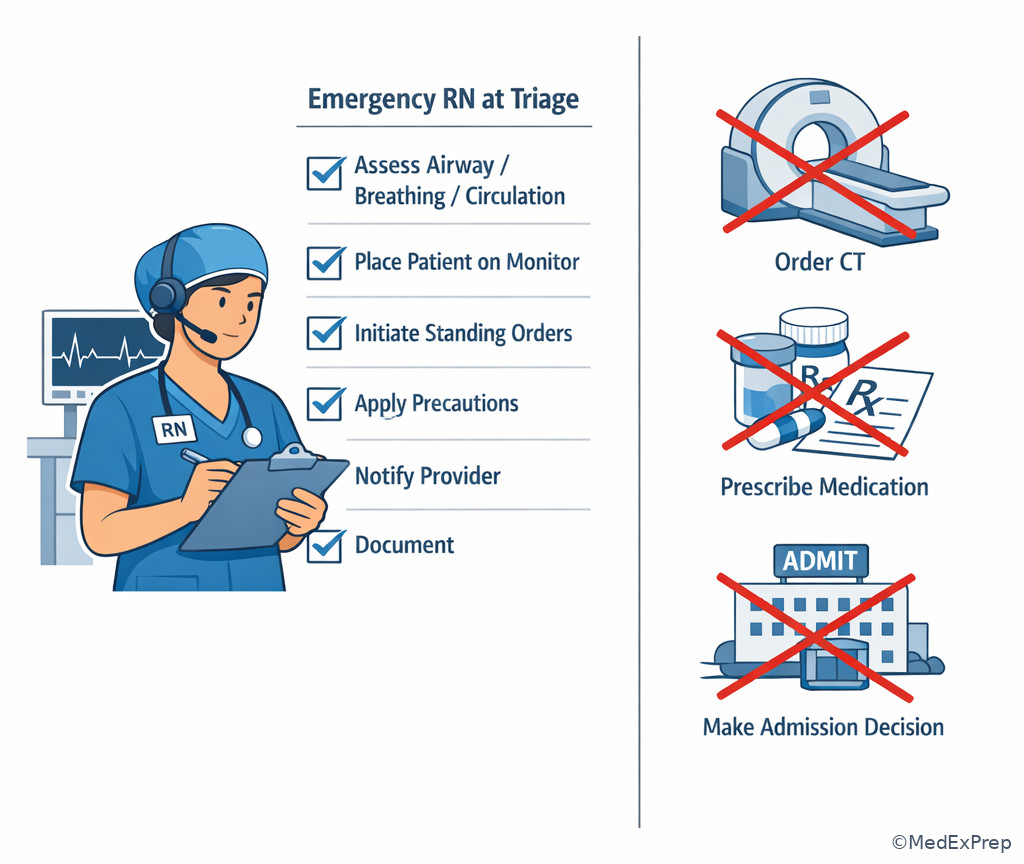
The final decision conflict is whether the best answer is a diagnostic or treatment action outside RN scope versus the safest emergency nursing action within scope. In triage questions, this matters constantly. The RN does not independently diagnose MI, stroke, sepsis, or ectopic pregnancy at triage; the RN recognizes risk, initiates approved protocol-based steps, obtains focused data, places precautions, and escalates promptly. If an option asks you to independently order a CT, decide admission, prescribe medication, or perform a provider-reserved procedure, it is usually outside role unless the question explicitly changes your role.
WHY THIS IS TESTED: CEN items reward scope-aware prioritization. The best answer is often “move the patient immediately, begin protocol-authorized actions, and notify the provider/team,” not “determine the diagnosis” or “send the patient to imaging independently.”
Use a scope filter at triage: assess, intervene within standing orders, monitor, document, communicate, reassess. Reject options that skip assessment, violate medication safety, or delay escalation in an unstable patient. Also reject options that focus on comfort before ABCs or on paperwork before bedside safety.
Exam takeaway: The best triage answer stays within RN scope by recognizing danger, initiating approved actions, and escalating without delay.
Exam takeaway: Behavioral triage requires both immediate environmental safety and medical screening for reversible causes.
B Worked example
A 68-year-old woman presents with sudden facial droop and left arm weakness that started 20 minutes ago. She has atrial fibrillation, hypertension, and recent GI bleeding. The options include independently ordering CT, initiating stroke-alert protocol per institution, obtaining a full past medical history before rooming, or asking her family to complete registration first. The distracting clue is the recent GI bleed, which may tempt the learner to focus on treatment contraindications before triage priority.
Reasoning chain: identify task — choose the most appropriate nursing action at triage. Extract key facts — sudden focal deficit, time known, high-risk history. Apply rule — the RN should trigger the time-sensitive pathway and immediate evaluation according to policy, not decide definitive treatment eligibility. Eliminate distractors — CT ordering and treatment decisions are provider-level; detailed history and registration cannot delay pathway activation. Verify — the safest answer is immediate stroke protocol activation/rooming/escalation per policy.
C Exam trap
D Checkpoint
Question: A triage nurse identifies sudden unilateral weakness and slurred speech. Which action is most appropriate within RN scope?
- A. Independently order neuroimaging before contacting the provider
- B. Place the patient in the waiting room while collecting a complete medication reconciliation
- C. Initiate the institution’s stroke triage pathway, obtain last-known-well time, and notify the team immediately
- D. Reassure the family that symptoms are probably due to anxiety until the provider arrives
Best answer: C.
- A: tempting because imaging is important, but independent ordering is generally outside RN scope unless a protocol explicitly says otherwise.
- B: tempting because medication history matters, but it is the right task at the wrong priority and delays time-sensitive evaluation.
- C: tempting because it may feel less “definitive” than imaging, but it is correct because it matches nursing scope and urgency.
- D: tempting because anxiety can mimic neurologic symptoms, but sudden focal deficit should never be dismissed at triage.
Exam Traps & Differentiators
- Most common wrong answer and why: choosing the patient with the highest pain score rather than the greatest threat. Pain is salient and memorable, but airway compromise, shock, active bleeding, altered mentation, and focal neuro deficit outrank isolated pain.
- Looks similar but isn’t: anxiety versus hypoxia, chronic headache versus sudden focal neuro event, reflux versus ischemic chest pain, intoxication versus intracranial or metabolic cause of altered mental status.
- If the stem says “speaking in short phrases,” think respiratory distress.
- If the stem says “cool, clammy, tachycardic, but normotensive,” think compensated shock risk.
- If the stem says “known anxiety” plus low SpO2 or wheezing, think medical cause first.
- If the stem says “sudden” plus facial droop, aphasia, or unilateral weakness, think stroke pathway urgency.
- If the stem says “behavioral crisis” plus overdose possibility or confusion, think safety precautions and medical screening together.
| Looks similar | Tempting interpretation | Discriminator | Triage implication |
|---|---|---|---|
| Anxiety vs asthma exacerbation | Panic attack explains tachypnea | Wheezing, low SpO2, accessory muscle use | Respiratory threat first |
| GERD vs ACS | Burning chest pain after food | Exertional onset, diaphoresis, dyspnea, high-risk history | Urgent cardiac concern |
| Migraine vs stroke | Headache history lowers concern | Sudden focal deficit or speech change | Time-sensitive neuro escalation |
| Intoxication vs medical delirium | Confusion attributed to substances | Abnormal vitals, trauma clues, glucose issue, focal findings | Medical evaluation and monitoring |
| Simple infection vs sepsis risk | Fever alone seems routine | Hypotension, confusion, tachypnea, poor perfusion | High urgency and escalation |
| Neighbor-topic confusion pair | Current lesson focus | How the exam separates them |
|---|---|---|
| Triage Acuity Principles vs Unstable Patient Recognition | Assign urgency from first cues | This lesson asks who can wait; the next topic asks which findings prove current instability |
| Triage Acuity Principles vs Competing Priority Decisions | Sort patients initially | Later questions ask you to rank several already-known patients and actions using ABCs and safety |
| Triage acuity vs definitive diagnosis | Identify threat and escalate | The correct RN answer stays within scope and triggers the right pathway |
Algorithm / Approach
| Step | Question to ask yourself | Best exam habit |
|---|---|---|
| 1 | Who looks sick before I know the diagnosis? | Read appearance and distress cues first |
| 2 | Is there an ABC, neuro, perfusion, or safety threat? | Upgrade immediately if yes |
| 3 | Which single clue changes the complaint into a time-sensitive problem? | Find the red flag, ignore the noise |
| 4 | What action is correct within RN scope? | Assess, initiate protocol, monitor, notify |
| 5 | What if the patient must wait? | Plan reassessment and document the trigger for re-triage |
Rapid Review
- Threat-first triage → chief complaint never outranks ABC/neuro/safety danger
- Respiratory distress → short phrases and accessory muscles beat a near-normal SpO2
- Compensated shock → tachycardia plus cool clammy skin can precede hypotension
- Stroke clue → sudden focal deficit outranks chronic headache history
- Sepsis concern → confusion or poor perfusion matters more than fever alone
- Behavioral triage → safety precautions and medical screening happen together
- Chest pain sorting → exertional symptoms with diaphoresis/dyspnea outrank reflux history
- Elderly presentation → serious illness may appear with muted vitals and vague complaints
- Waiting-room safety → change from baseline is the red flag, not time spent waiting
- Documentation → record the exact cue that drove the acuity decision
- RN scope → initiate approved pathway, do not independently choose provider-level diagnostics
- Correct-but-wrong-priority distractor → detailed history can wait when instability cannot
Self-check quiz
1. A 45-year-old patient arrives reporting severe shortness of breath after climbing stairs. He has obesity and hypertension. He is speaking in 2- to 3-word phrases, RR 32/min, SpO2 90% on room air, and looks anxious. Which nursing action is the most appropriate first step?
- A. Obtain a complete medication history before assigning acuity
- B. Move the patient to an immediate treatment area and begin respiratory-focused assessment/interventions per protocol
- C. Ask the patient to sit in the waiting room while registration is completed
- D. Teach pursed-lip breathing and reassess in 30 minutes
2. A 70-year-old patient presents with “not feeling right.” She has diabetes and CKD. She is pale, diaphoretic, HR 118/min, BP 104/64 mm Hg, and answers slowly. Which finding most strongly drives higher triage acuity?
- A. Age older than 65 years
- B. Pale, diaphoretic appearance with tachycardia and slowed mentation
- C. History of diabetes alone
- D. Blood pressure that is not yet hypotensive
3. A 29-year-old woman presents with “panic attack.” She has asthma and anxiety. She is restless, RR 30/min, SpO2 91% on room air, audible wheezing, and tingling in both hands. Which is the most appropriate triage action?
- A. Prioritize behavioral health placement because anxiety is the most likely cause
- B. Place the patient in a routine waiting area and encourage slow breathing
- C. Treat this as possible respiratory compromise, room promptly, and escalate per respiratory protocol
- D. Delay placement until a full psychiatric risk screen is completed
4. A 63-year-old man with hypertension, hyperlipidemia, and chronic GERD reports “burning chest pain” after dinner. He is diaphoretic, slightly short of breath, and says the pain began while carrying groceries. Vitals: BP 150/86 mm Hg, HR 106/min, RR 24/min. Which nursing priority is most appropriate?
- A. Lower acuity because the pain is burning and he has known reflux
- B. High-priority placement because exertional chest discomfort with diaphoresis and dyspnea is concerning
- C. Ask him to try an antacid first and return if symptoms persist
- D. Delay triage until a provider can determine if this is cardiac or gastrointestinal
5. A 76-year-old man with dementia and recent UTI treatment has been waiting after initial triage for generalized weakness. His daughter now reports he is more confused. Repeat vitals show HR 122/min, RR 28/min, BP 94/58 mm Hg, and temperature 38.5°C. Which action is most appropriate?
- A. Reassure the daughter that confusion is expected with dementia and continue waiting
- B. Upgrade acuity, move the patient for immediate evaluation, and notify the team of possible deterioration
- C. Repeat vital signs again in 30 minutes to confirm the trend before changing priority
- D. Document the daughter’s concern and wait for the provider to call the patient from the waiting room
6. A 58-year-old woman arrives with sudden left arm weakness and slurred speech that began 25 minutes ago. She has atrial fibrillation, peptic ulcer disease, and a prior GI bleed. Which action most appropriately reflects the triage RN role?
- A. Independently order CT imaging because stroke is likely
- B. Activate the institution’s stroke triage pathway, obtain last-known-well time, and notify the team immediately
- C. Explain that treatment eligibility is uncertain due to prior GI bleed and continue routine triage
- D. Complete a full secondary history before assigning urgent placement
7. Four patients arrive within minutes. Which patient should the triage nurse prioritize first for immediate rooming?
- A. A 19-year-old with 10/10 renal colic pain, vomiting, and stable vital signs
- B. A 42-year-old with laceration bleeding controlled by dressing, alert and normotensive
- C. A 68-year-old with weakness, cool clammy skin, HR 124/min, RR 30/min, BP 110/68 mm Hg, and increasing confusion
- D. A 33-year-old with ankle fracture, severe pain, intact pulses, and no respiratory distress
8. A 24-year-old patient presents for suicidal thoughts after drinking alcohol. He is tearful, intermittently drowsy, smells of ethanol, and says he “might have taken some pills too.” Vitals are BP 108/70 mm Hg, HR 112/min, RR 20/min, SpO2 95% on room air. Which nursing approach is most appropriate at triage?
- A. Send the patient directly to a routine psychiatric waiting area without further medical concern because suicidal ideation is the main issue
- B. Initiate safety precautions and urgent medical screening/escalation because overdose and self-harm risk may coexist
- C. Ask security to monitor from a distance while the patient remains in the main waiting room
- D. Delay intervention until the blood alcohol level is resulted
Answer key
1. Correct answer: B
- A: tempting because medication history is relevant to treatment planning, but by the nursing process and ABCs, breathing threat takes priority over detailed history. The discriminating clue is 2- to 3-word phrases with hypoxemia. Source: NCSBN clinical judgment principles; ANA Standards of Nursing Practice.
- B: correct because immediate treatment-area placement and respiratory-focused assessment address the airway/breathing threat first. The discriminating clue is significant work of breathing with SpO2 90%. Source: NCSBN; Lewis, Medical-Surgical Nursing.
- C: tempting because registration is necessary operationally, but safety and ABCs outrank throughput tasks. The discriminating clue is visible respiratory compromise. Source: ANA Standards of Practice.
- D: tempting because coaching breathing can help anxiety, but it is unsafe to delay escalation when respiratory distress is possible. The discriminating clue is short-phrase speech and low oxygen saturation. Source: NCSBN; Saunders Comprehensive Review.
2. Correct answer: B
- A: tempting because older age increases risk, but age alone does not drive acuity as strongly as current signs of poor perfusion and mental-status change. The discriminating clue is active physiologic instability. Source: Lewis; Saunders.
- B: correct because diaphoresis, pallor, tachycardia, and slowed mentation together suggest possible poor perfusion or evolving instability. The discriminating clue is the combined first-look pattern, not any single diagnosis. Source: NCSBN; ANA Standards.
- C: tempting because diabetes raises concern for multiple emergencies, but history alone is weaker than the actual bedside picture. The discriminating clue is the appearance plus mentation change. Source: Saunders.
- D: tempting because learners may anchor on “not hypotensive yet,” but normal or near-normal BP does not exclude compensated shock. The discriminating clue is tachycardia with poor appearance. Source: Lewis; NCSBN.
3. Correct answer: C
- A: tempting because the patient is restless and has known anxiety, but ABCs require ruling in respiratory compromise first. The discriminating clue is wheezing with low SpO2. Source: NCSBN; Lewis.
- B: tempting because coached breathing may help hyperventilation, but it is wrong priority when objective respiratory abnormalities are present. The discriminating clue is oxygen saturation 91% on room air. Source: ANA Standards; Saunders.
- C: correct because respiratory threat must drive triage and prompt placement even when anxiety is plausible. The discriminating clue is the combination of asthma history, wheeze, tachypnea, and hypoxemia. Source: NCSBN; Lewis.
- D: tempting because psychiatric screening is part of emergency care, but it cannot precede urgent attention to breathing. The discriminating clue is abnormal respiratory status. Source: NCSBN.
4. Correct answer: B
- A: tempting because burning pain and reflux history suggest a benign explanation, but triage must prioritize the more dangerous explanation when red flags are present. The discriminating clue is exertional onset with diaphoresis and dyspnea. Source: Lewis; Saunders.
- B: correct because the pattern is concerning for a time-sensitive cardiac event and requires high-priority placement. The discriminating clue is not the word “burning,” but the associated exertion and autonomic symptoms. Source: NCSBN; Lewis.
- C: tempting because symptom relief strategies matter, but trialing comfort measures before risk stratification delays care. The discriminating clue is high-risk associated symptoms. Source: ANA Standards.
- D: tempting because diagnosis clarification is ultimately needed, but triage priority does not wait for definitive diagnosis. The discriminating clue is that the RN role is to escalate probable threat, not settle etiology. Source: NCSBN.
5. Correct answer: B
- A: tempting because dementia can explain confusion, but worsening confusion with abnormal vitals signals new deterioration, not baseline behavior. The discriminating clue is the change plus hypotension/tachypnea. Source: NCSBN; Lewis.
- B: correct because waiting-room reassessment has revealed likely clinical deterioration requiring immediate reprioritization and escalation. The discriminating clue is new confusion with HR 122/min, RR 28/min, BP 94/58 mm Hg, and fever. Source: ANA Standards; Saunders.
- C: tempting because trends matter, but dangerous deterioration does not require a second confirmation cycle before action. The discriminating clue is current instability. Source: NCSBN.
- D: tempting because documentation is always needed, but documentation cannot replace urgent intervention and communication. The discriminating clue is worsening perfusion and mentation. Source: ANA Standards.
6. Correct answer: B
- A: tempting because imaging is central to stroke care, but independent ordering is usually a provider-level action unless a protocol explicitly authorizes it. The discriminating clue is RN scope. Source: ANA Standards; NCSBN.
- B: correct because activating the stroke triage pathway, capturing last-known-well time, and notifying the team are appropriate RN actions that match urgency. The discriminating clue is sudden focal deficit within a time-sensitive window. Source: Lewis; NCSBN.
- C: tempting because prior GI bleed may affect later treatment decisions, but it does not reduce the need for urgent stroke evaluation. The discriminating clue is time-sensitive neurologic change. Source: Saunders.
- D: tempting because history matters, but complete secondary history is the correct task at the wrong priority. The discriminating clue is that urgent pathway activation cannot wait. Source: ANA Standards.
7. Correct answer: C
- A: tempting because severe pain and vomiting feel urgent, but stable vital signs and no ABC/perfusion threat place it below a patient with signs of compensated shock. The discriminating clue is lack of instability. Source: NCSBN; Lewis.
- B: tempting because bleeding sounds dangerous, but the stem says bleeding is controlled and the patient is normotensive and alert. The discriminating clue is controlled versus uncontrolled hemorrhage. Source: Saunders.
- C: correct because cool clammy skin, tachycardia, tachypnea, and increasing confusion indicate poor perfusion even without frank hypotension. The discriminating clue is compensated shock pattern. Source: Lewis; NCSBN.
- D: tempting because fractures require timely care, but intact pulses and no respiratory distress make this lower priority than evolving instability. The discriminating clue is stable circulation to the injured limb. Source: ANA Standards.
8. Correct answer: B
- A: tempting because suicidal ideation suggests psychiatric triage needs, but possible overdose and drowsiness require urgent medical screening and safety measures too. The discriminating clue is “might have taken some pills.” Source: NCSBN; ANA Standards.
- B: correct because self-harm risk and possible ingestion can coexist, so the RN must initiate safety precautions and urgent medical evaluation/escalation. The discriminating clue is combined suicide risk, drowsiness, alcohol use, and possible pill ingestion. Source: Saunders; NCSBN.
- C: tempting because security presence sounds safe, but observation from a distance in the main waiting room is insufficient for a potentially intoxicated, suicidal, overdose-risk patient. The discriminating clue is the need for direct precautions and medical assessment. Source: ANA Standards.
- D: tempting because alcohol level can clarify context, but it cannot delay immediate safety and medical triage actions. The discriminating clue is active risk now, not pending lab confirmation. Source: NCSBN.
Keep going with the full CEN Prep Course (CEN)
You just studied the way members do, in the same lesson interface. Full access unlocks every lesson, the question bank and flashcards for a full year.
One payment · 1 year of access · No auto-renewal