1.1.1 - Candidate Role Boundaries
Candidate Role Boundaries
What you'll learn
- DOMAIN: Role and Scope -> Candidate role definition -> Boundary recognition: Distinguish what an entry-level CDCP candidate is expected to do versus what must be escalated.
- DOMAIN: Role and Scope -> Task selection -> In-scope routine actions: Identify routine actions allowed within published standards, procedures, and documentation rules.
- DOMAIN: Role and Scope -> Authority limits -> Out-of-role signals: Recognize wording in a stem that indicates the scenario exceeds the candidate role.
- DOMAIN: Professional judgment -> Decision workflow -> Conservative next step: Choose the safest next step when authority, ambiguity, or risk is unclear.
- DOMAIN: Documentation and communication -> Escalation support -> Boundary-aware documentation: State what should be documented when acting within scope or when escalating.
- DOMAIN: Role and Scope -> Candidate role definition -> Entry-level boundaries
- DOMAIN: Procedural decision-making -> Next-step selection -> Proceed vs hold vs clarify vs escalate
- DOMAIN: Documentation accuracy -> Recordkeeping priorities -> Documenting rationale and escalation
- DOMAIN: Standards interpretation -> Governing source use -> Follow official materials rather than local assumptions
Why it matters
- Many certification questions are not testing obscure facts; they are testing whether you stay inside your role when the stem tempts you to do too much.
- Boundary questions often use attractive distractors built around confidence, efficiency, or good intentions; the best answer is the one aligned with authority and procedure.
- Unsafe overreach and passive inaction are both errors. The exam rewards the candidate who takes the appropriate action, not the biggest action.
- Role boundaries connect directly to later topics on allowed actions, escalation triggers, documentation, communication, and auditability.
Key Terms & Must-Know Facts
1.1.1.1 Key terms
- Scope: The limits of actions authorized by role, standards, policy, and procedure.
- Boundary: The point where the candidate must stop, clarify, or escalate.
- Entry-level competence: Day-one safe performance using established rules, not unsupported expert judgment.
- Routine task: A standardized action clearly covered by procedure or policy.
- Escalation: Transfer of a question, risk, or decision to a person or level with authority.
- Clarification: Seeking missing or conflicting information before proceeding.
- Supervisor input: Guidance required when authority or uncertainty limits the candidate.
- Referral: Directing the matter to the appropriate authorized professional or service.
- Protocol: A prescribed operational path for a defined situation.
- Authority: Permission granted by role, law, policy, or assigned responsibility.
- Out-of-role signal: Stem wording that implies advanced judgment, independent sign-off, or authority not granted.
- Conservative next step: The safest action that stays within scope while preserving workflow and safety.
- Documentation rationale: The reason recorded for the action taken, held, clarified, or escalated.
1.1.1.2 Must-know facts
- Do not assume authority that is not explicitly granted by standards, protocol, or role expectations.
- If official requirements are unclear, do not invent local rules; confirm with official CDCP/CPS materials and local protocol.
- Entry-level competence includes applying established procedures accurately, not improvising high-risk decisions.
- The best answer may be hold and clarify, not immediate completion.
- Escalation is an active professional action, not a failure.
- Documentation should support what was observed, what action was taken, why, and to whom the issue was communicated when escalation occurs.
- Board-style traps often reward candidates who recognize one clue showing that the task exceeds role boundaries.
- When a scenario asks for final approval, diagnosis, legal opinion, or policy override, suspect out-of-role authority.
Core content
1.1.1.3 Foundational boundary rule: what the CDCP candidate is expected to do
A Explanation
The first exam conflict is simple: Should you act now, or does the action exceed your role? The resolving rule is this: an entry-level CDCP candidate is expected to apply published standards, terminology, procedures, routine calculations, documentation rules, and conservative next-step logic. The candidate is not expected to invent policy, issue specialist judgments, or take final authority in high-risk or restricted decisions. On test day, choose the answer that shows disciplined performance inside defined procedures rather than bold independent action.
WHY THIS IS TESTED: The exam wants evidence that you can function safely on day one. That means recognizing the difference between competent execution and unauthorized judgment. When two options both sound responsible, the correct one is usually the one tied to a published workflow, documentation step, or escalation path.
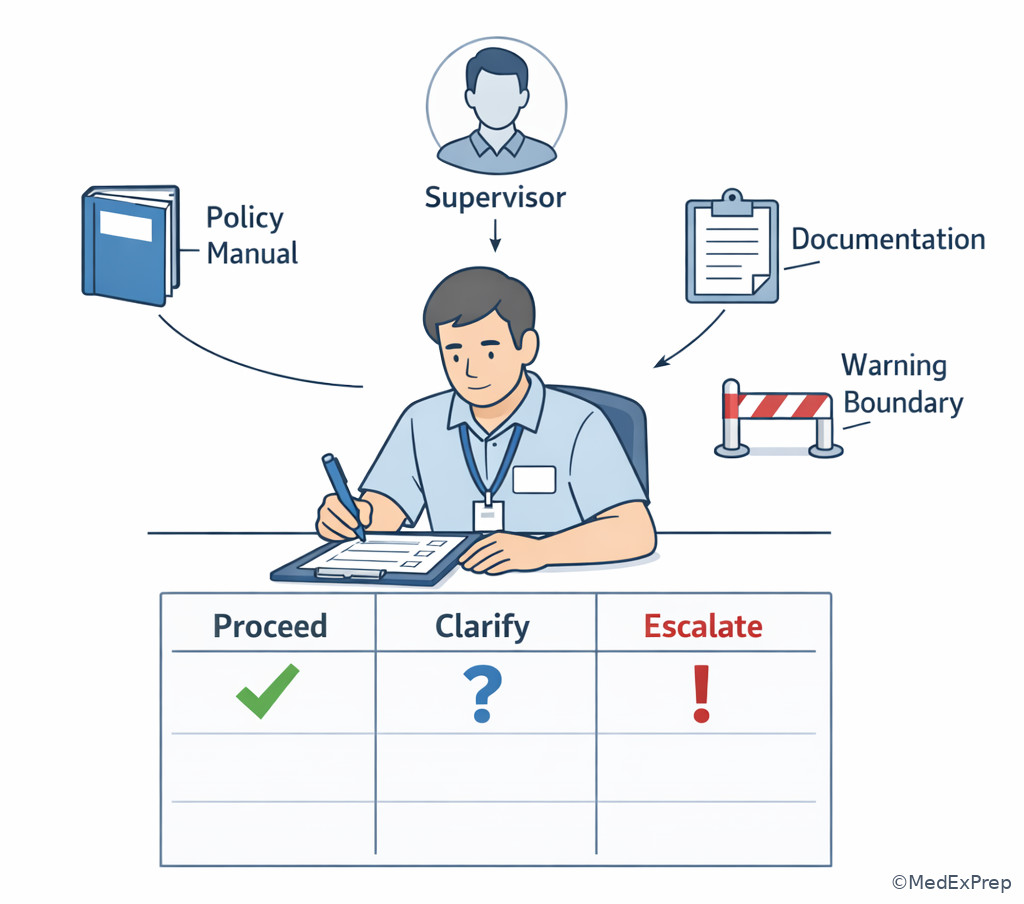
Choose an action when all three are true: the task is routine, the rules are available, and the needed authority is already within the role. Reject the action when one of those is missing. If the stem asks you to “approve,” “override,” “diagnose,” “issue a legal opinion,” or “sign off” beyond assigned authority, stop and escalate. See Fig 1.
Exam takeaway: Choose the option that stays inside routine authority and moves uncertainty to the proper escalation path.
flowchart TD
A[Task appears in stem] --> B{Is it routine and covered by procedure?}
B -->|Yes| C{Is authority already within role?}
C -->|Yes| D[Perform task using standard workflow]
C -->|No| E[Escalate or seek supervisor input]
B -->|No| F[Clarify governing rule or refer]
D --> G[Verify and document]
E --> G
F --> G Exam takeaway: Visualize the difference between routine execution, clarification, and escalation before choosing the next step.
B Worked example
A newly certified staff member is asked during a busy afternoon workflow to “just approve this exception so the file can move.” The record includes two incomplete fields, an older reference note, and a coworker says, “This is how we usually do it.” The candidate also notices that the matter may involve a requirement that varies by institution. A distracting clue is that the request sounds routine because similar files were processed earlier that day.
Reasoning chain: Identify task: the stem asks for approval of an exception. Extract key facts: incomplete record, informal coworker shortcut, possible policy variation, and request for final approval. Apply rule: approval of an exception is not the same as routine data entry or checklist completion; it implies authority. Eliminate distractors: “approve because workflow is delayed” is tempting but unsupported; “follow coworker custom” is tempting but not controlling; “complete missing fields from prior notes” is unsafe if not verified. Verify: best next step is to hold the matter, seek clarification under official procedure, and escalate to the person or role authorized to decide the exception.
C Exam trap
D Checkpoint
Question: A CDCP candidate is asked to complete a routine record update, but the request also includes a verbal instruction to waive a required verification step because “the supervisor will probably agree later.” What is the most appropriate next step?
- A. Complete the update and document that the waiver was verbal.
Tempting because documentation sounds protective; wrong because documenting an unauthorized bypass does not create authority. - B. Pause the task, follow the required verification process, or seek authorized clarification before proceeding.
Tempting because it may delay workflow; right because the missing authority and altered verification step are the key discriminators. - C. Waive the verification only for this low-risk case.
Tempting because the situation appears minor; wrong because candidates do not create risk thresholds from personal judgment. - D. Ask a coworker how similar cases are usually handled and follow that approach.
Tempting because local custom feels practical; wrong because coworker habit is not the governing source.
1.1.1.4 Out-of-role signals: phrases that should make you stop
A Explanation
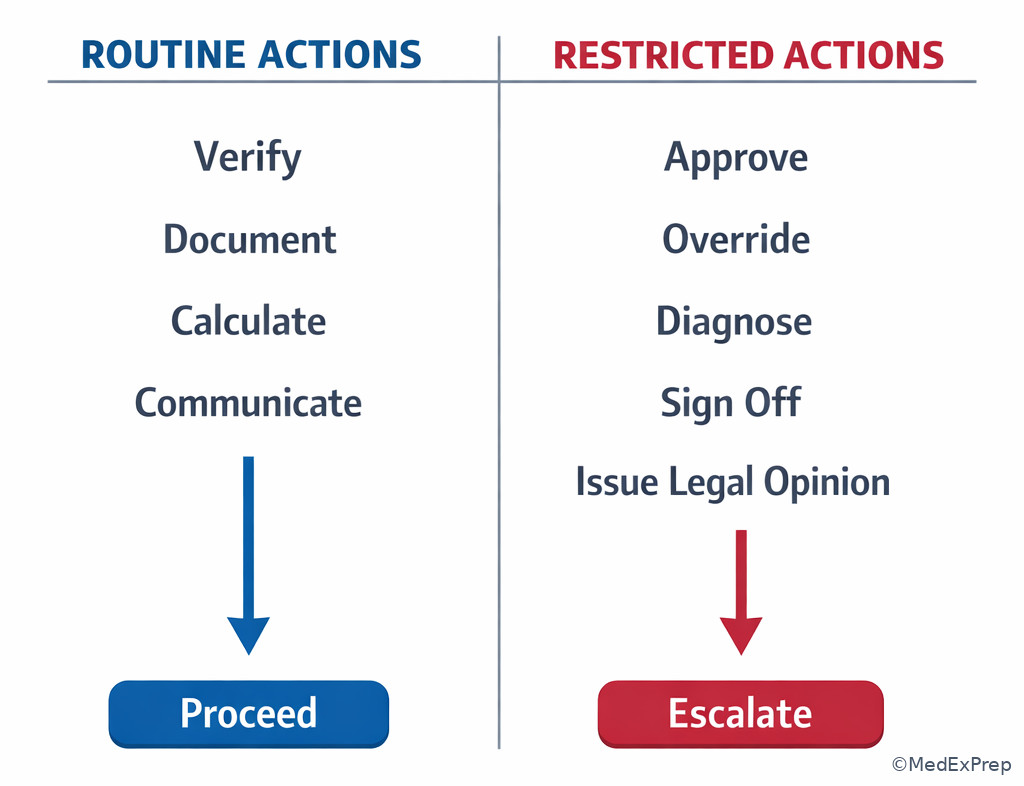
The next conflict is language recognition: Does the stem merely ask for routine execution, or does it quietly shift into restricted authority? The single resolving rule is to treat certain verbs and role cues as boundary alarms. If the action requires a legal opinion, final approval, independent diagnosis, override of policy, specialist sign-off, or unrestricted judgment, the candidate should not take that action independently. See Fig 2.
WHY THIS IS TESTED: Certification items often hide the real test inside one phrase. A long stem may distract you with dates, minor inconsistencies, prior experience, or pressure from others. But one word such as “authorize,” “sign off,” “override,” or “determine final eligibility” changes the answer completely. Your job is to spot that word and shift from doing to escalating.
Choose to proceed when the wording stays inside verification, documentation, communication, calculation, or routine application of a published rule. Reject the option when it asks for a final determination beyond role limits. If official materials or institutional policy control the decision and you do not have authority to interpret them conclusively, your next step is to consult or escalate, not to guess.
Exam takeaway: A single high-authority verb can convert an otherwise routine-looking task into a clarify-or-escalate question.
flowchart LR
A[Stem action word] --> B{Routine verb?}
B -->|Verify document calculate communicate| C[Likely in scope if procedure exists]
B -->|Approve override diagnose legal opinion sign off| D[Likely out of role]
C --> E[Confirm policy and perform]
D --> F[Hold clarify escalate] Exam takeaway: Train your eye to spot authority verbs before you evaluate the rest of the options.
B Worked example
A candidate reviewing a file is told by an experienced employee to “make the final call” because leadership is unavailable. The file includes complete identity data, one ambiguous policy note, a time-sensitive deadline, and a distracting message that the client has already been waiting for two weeks. A tempting clue is that the candidate has seen similar files before.
Reasoning chain: Identify task: the task is not just reviewing data; it is making the final call. Extract key facts: time pressure, ambiguity in policy note, no authorized leader available, prior experience does not confer authority. Apply rule: when the stem transfers final decision authority without explicit role support, the correct answer is not independent action. Eliminate distractors: “decide because delay is unfair” appeals to service; “decide because data are mostly complete” appeals to efficiency; “decide because similar cases were seen before” appeals to familiarity. Verify: best response is to preserve the record, communicate the need for authorized review, and follow institutional escalation protocol.
C Exam trap
D Checkpoint
Question: Which phrase in a stem most strongly indicates that the candidate should consider escalation rather than independent action?
- A. “Verify the date and identity fields before filing.”
Tempting because verification matters; wrong because this is a routine procedural task. - B. “Document the communication and time of contact.”
Tempting because documentation has compliance implications; wrong because documenting is within normal role expectations. - C. “Issue the final interpretation of the policy requirement.”
Tempting because the candidate may know the topic area; right because final interpretation suggests authority beyond routine application. - D. “Calculate whether the value meets the posted threshold.”
Tempting because calculations can affect downstream decisions; wrong because applying a stated threshold is usually routine when clearly defined.
- Fill in the blank: If the stem asks for final approval without explicit authority, the safest action is to ________.
- True or False: Prior experience with similar cases automatically expands the CDCP candidate role.
- Name 3 signal words that suggest the candidate should stop and reconsider role boundaries.
1.1.1.5 In-scope actions: what you should confidently do
A Explanation
Boundary discipline is not just about saying no. The exam also tests whether you know what is appropriate to do. The central conflict here is: Should you escalate immediately, or can you complete the task within scope? The rule is that routine, standards-based actions should be performed confidently when the task is clear, the procedure exists, and the authority is already granted. That includes using official terminology, applying published definitions, performing straightforward calculations, checking required elements, following a checklist, documenting observations, and communicating through established channels.
WHY THIS IS TESTED: Some candidates overcorrect after learning about scope limits and then escalate everything. That is also a problem. The exam expects you to carry out normal role functions without unnecessary handoff. Choose-vs-reject framing matters: choose independent completion of a routine procedural step; reject needless escalation when no special authority is required.
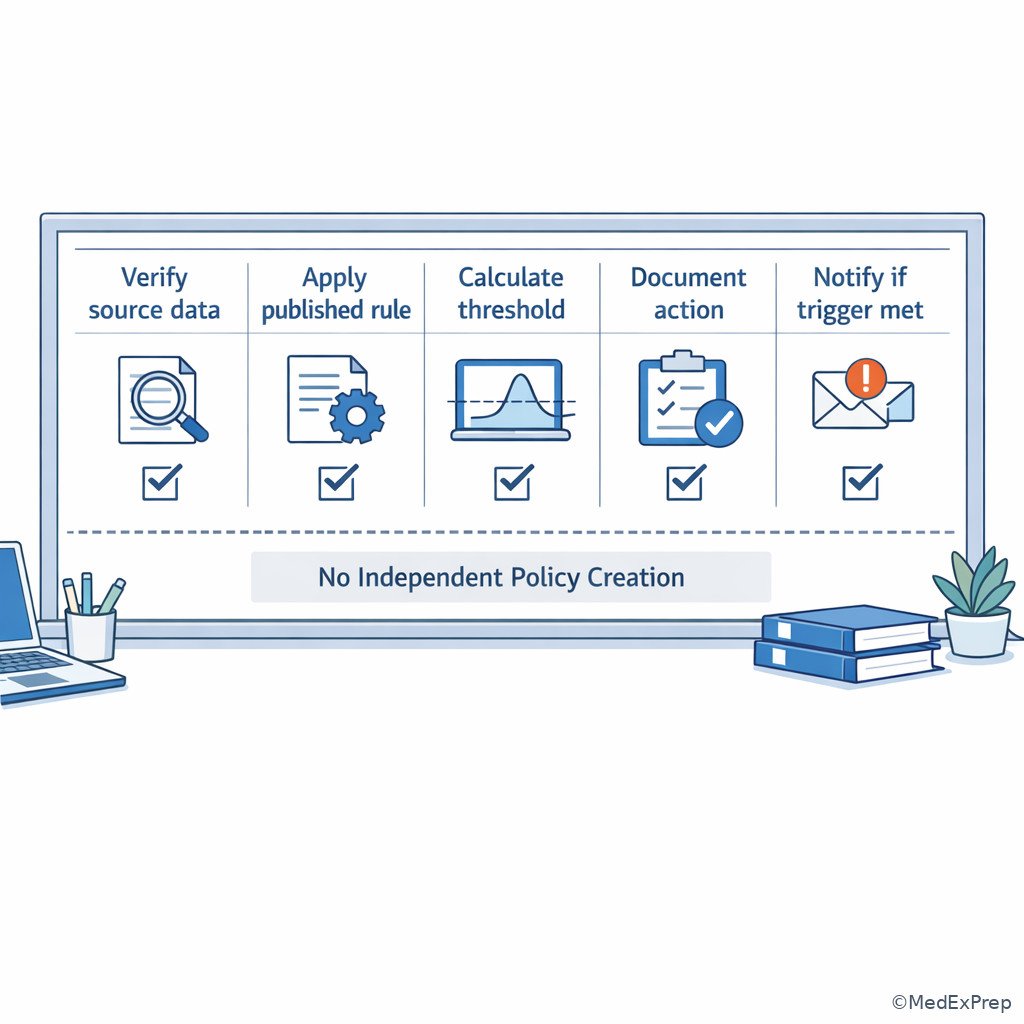
Examples of likely in-scope conduct include reconciling obvious record elements against the source, identifying missing required fields, calculating a threshold based on a stated formula, documenting factual observations, and notifying the appropriate person when a defined trigger is met. What stays out of scope is making final decisions beyond assigned authority, creating unofficial exceptions, or substituting personal interpretation for controlling guidance. See Fig 3.
Exam takeaway: Routine tasks usually involve applying stated rules, not creating new ones.
flowchart TD
A[Routine task] --> B[Use official terminology]
A --> C[Apply stated procedure]
A --> D[Perform calculation/check]
A --> E[Document required elements]
A --> F[Communicate per protocol]
B --> G[Complete within scope]
C --> G
D --> G
E --> G
F --> G
Exam takeaway: The correct answer is often the disciplined checklist-based action, not the most dramatic intervention.
B Worked example
A candidate receives a standard file requiring calculation of whether a reported value crosses a posted threshold. The record includes age, a prior unrelated comment, a minor typo in a noncritical narrative field, and a coworker suggesting that “you should wait for management to be safe.” The formula and threshold are explicitly provided in the procedure.
Reasoning chain: Identify task: apply a stated formula to decide whether the threshold is met. Extract key facts: formula exists, threshold exists, no final authorization request is present, typo is distracting but not outcome-determining. Apply rule: straightforward calculations and threshold comparisons are within scope when procedure is defined. Eliminate distractors: “escalate because any decision needs approval” is overbroad; “ignore the typo and also alter the threshold based on judgment” exceeds scope; “wait for management because the file has prior comments” confuses presence of noise with need for authority. Verify: perform the calculation, compare to the stated threshold, document the result, and notify per protocol if the threshold is met.
C Exam trap
D Checkpoint
Question: Which action is most clearly within the expected entry-level CDCP role when the governing procedure is explicit?
- A. Creating an exception to a required documentation element because the case seems straightforward.
Tempting because the missing element may appear minor; wrong because creating exceptions exceeds routine authority. - B. Issuing the definitive policy interpretation for a gray-area case.
Tempting because the candidate may know the policy language; wrong because definitive interpretation suggests final authority. - C. Applying the stated threshold formula, documenting the result, and notifying the designated contact if triggered.
Tempting because it feels mechanical; right because this is exactly the kind of routine standards-based task expected within scope. - D. Overriding the posted threshold based on practical experience with similar cases.
Tempting because experience can improve judgment; wrong because experience does not authorize rule changes.
1.1.1.6 Boundary decisions under uncertainty: hold, clarify, or escalate
A Explanation
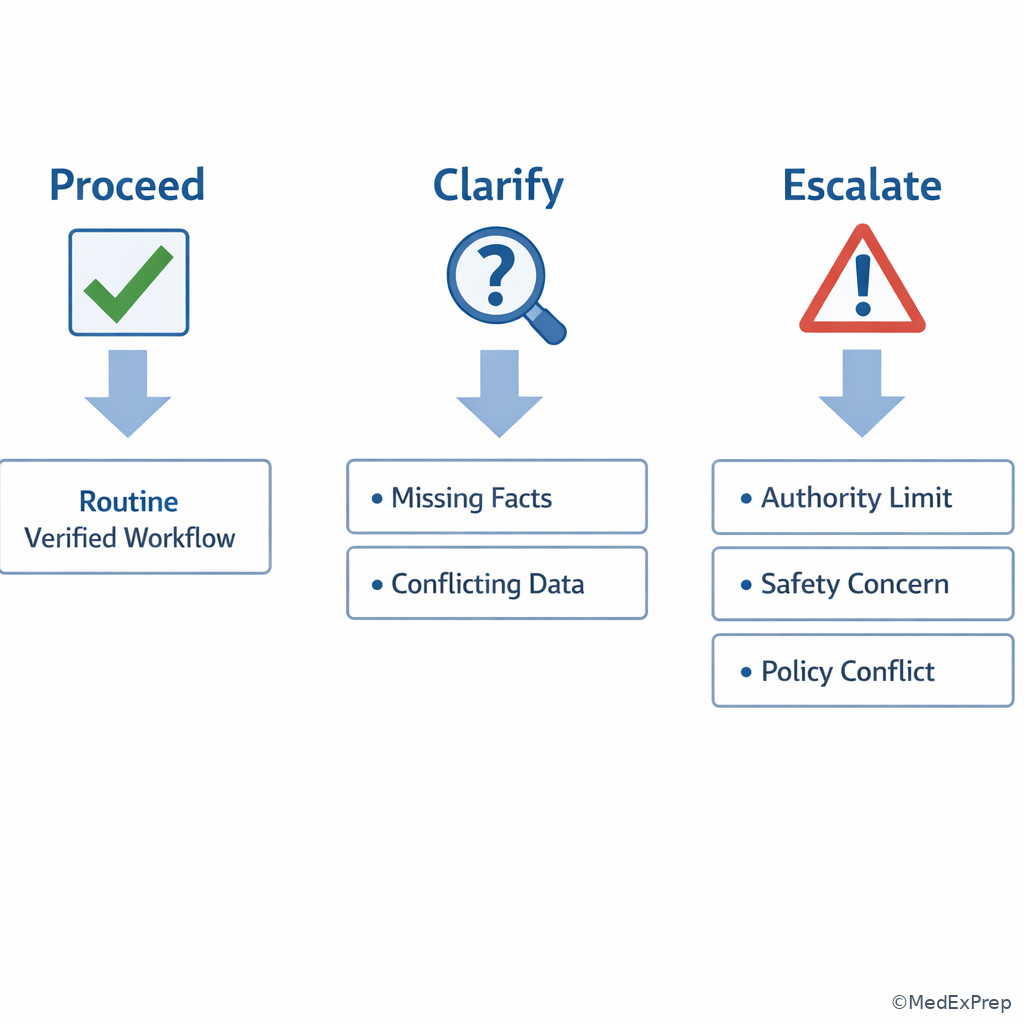
Now the decision becomes harder: the task may be partly routine, but something is missing, conflicting, or risky. The exam conflict is Should you proceed with assumptions, seek clarification, or escalate? The resolving rule is to match the response to the problem type. Hold and clarify when information is incomplete or conflicting but the matter may still be resolvable within routine workflow. Escalate when the issue involves authority limits, safety risk, policy conflict, or decisions assigned to another role. Proceed only when the key missing variable is not actually needed because the rule is still clear from available verified information.
WHY THIS IS TESTED: Many stems are designed so that the candidate can neither safely finish the task nor justify a dramatic escalation without first distinguishing uncertainty from authority. Students lose points by using escalation as a reflex when clarification would suffice, or by clarifying endlessly when the real issue is authority and needs escalation.
Choose clarification when the missing piece is factual. Reject clarification alone when the missing piece is permission. Choose escalation when the stem requires authorized judgment or risk handling beyond role. Reject proceeding when you would need to fill gaps with assumptions. See Fig 4.
Exam takeaway: The key discriminator is whether the gap is about facts, authority, or risk.
flowchart TD
A[Issue identified] --> B{What kind of gap?}
B -->|Missing or conflicting facts| C[Hold and clarify]
B -->|Authority limit or high-risk issue| D[Escalate per protocol]
B -->|No meaningful gap| E[Proceed with routine workflow]
C --> F[Verify updated information]
D --> G[Document recipient, reason, timing]
E --> H[Complete and document] Exam takeaway: Sorting the problem type first prevents both unsafe overreach and unnecessary escalation.
B Worked example
A candidate is reviewing a time-sensitive request. The identity fields are complete, but one supporting datum conflicts with a prior note entered last week. The requester says, “Use the newer value and move it through.” Another distracting detail is that the department is understaffed and several files are waiting. A tempting-but-wrong clue is that the discrepancy seems small.
Reasoning chain: Identify task: determine the appropriate next step before completing the request. Extract key facts: conflicting data, time pressure, verbal pressure to assume accuracy, and no explicit authority issue yet. Apply rule: conflicting facts create a clarification problem first, not a free pass to proceed. Eliminate distractors: “proceed because the difference is small” uses assumption; “escalate immediately to executive leadership” overshoots because the issue is factual inconsistency, not necessarily authority; “choose whichever value is most recent” is tempting but still unverified. Verify: hold the task, clarify the conflicting source information using established process, then proceed or escalate if the conflict cannot be resolved within role.
C Exam trap
D Checkpoint
Question: A candidate encounters a discrepancy between two source entries in a record, but no restricted decision is being requested. What is the most appropriate next step?
- A. Select the value that appears most plausible and proceed.
Tempting because one value may look more current; wrong because plausibility is not verification. - B. Hold the task and seek clarification using the established process.
Tempting because it slows workflow; right because the discriminator is a factual conflict without a present authority issue. - C. Issue a final interpretation and close the file.
Tempting because closure is efficient; wrong because closing on unresolved conflict exceeds safe routine handling. - D. Escalate immediately to the highest available leader without attempting clarification.
Tempting because escalation sounds safe; wrong because the stem describes a factual inconsistency that should usually be clarified first.
- Fill in the blank: A missing fact usually calls for ________; a missing authority usually calls for ________.
- True or False: Time pressure alone expands the candidate's role.
- Name the single clue that separates clarification from escalation in many stems.
1.1.1.7 Documentation and communication at the boundary
A Explanation
The final integration conflict is: Once you choose to proceed, clarify, or escalate, what must you record and communicate? The rule is that boundary-aware action is incomplete without boundary-aware documentation. The entry-level candidate should record factual observations, the action taken, the reason for that action, and relevant communication details according to procedure. Documentation is not a substitute for authority, but it is essential evidence that the candidate recognized the issue and followed the proper path.
WHY THIS IS TESTED: Exam stems frequently offer two answers that both involve escalation; the correct one is the option that also preserves auditability. The exam is not only about identifying the right next step; it is also about showing that the action can be verified later. When the candidate escalates, the record should generally support who was notified, why the issue required escalation, and when the contact occurred, if that level of detail is required by procedure.
Choose factual, objective language. Reject unsupported conclusions, guesses about intent, and undocumented verbal shortcuts. If the candidate holds a task for clarification, document the unresolved discrepancy and the action taken. If the candidate escalates, document the trigger and route. See Fig 5. This will connect directly to upcoming topics on escalation triggers and, later, to documentation language standards.
Exam takeaway: The best answer often includes what was observed, what was done, and whom you notified.
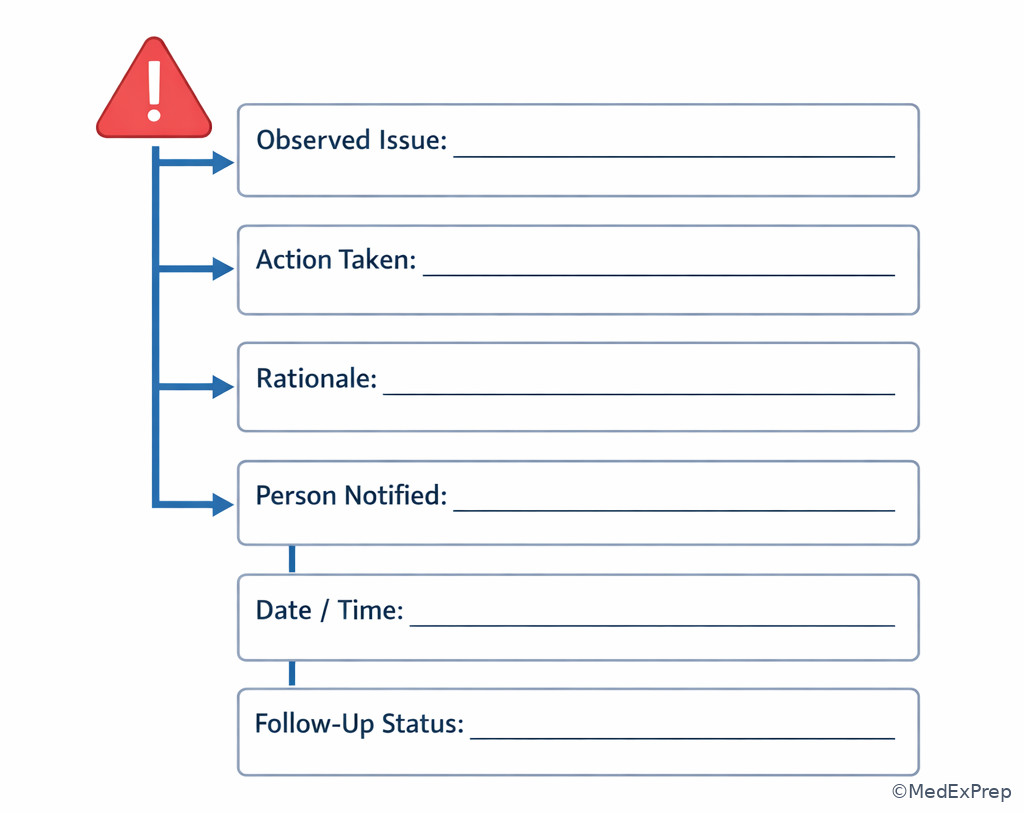
Exam takeaway: Recordkeeping is part of safe escalation, not an afterthought.
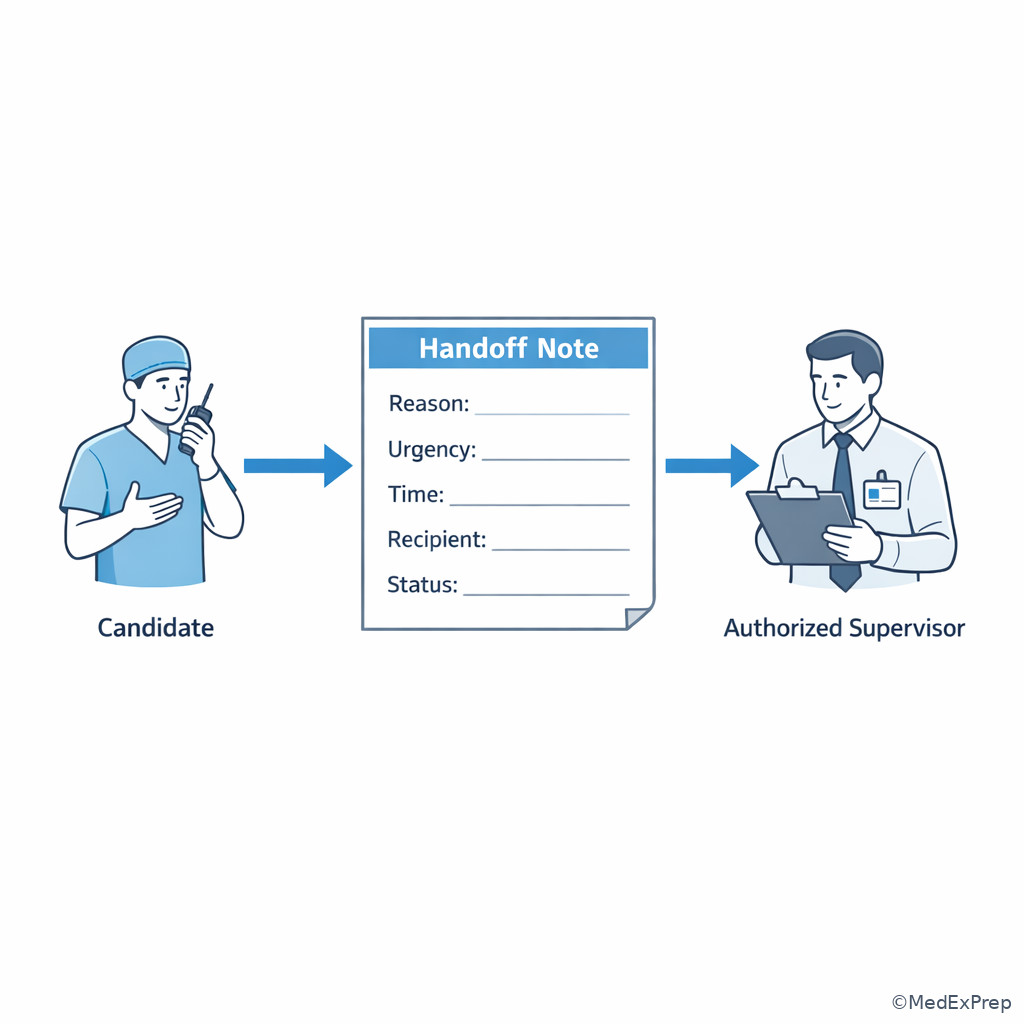
B Worked example
A candidate identifies that a request cannot be completed because a required source entry is missing and the next step may depend on supervisor authority. The candidate sends a message to the designated contact but is interrupted by another urgent task. A distracting clue is that the candidate remembers discussing a similar issue informally last month.
Reasoning chain: Identify task: choose the most appropriate completion behavior after deciding not to proceed independently. Extract key facts: missing required entry, likely authority dependence, actual communication occurred, and informal prior memory is not record evidence. Apply rule: once escalation or clarification is initiated, the record should support the issue and the communication. Eliminate distractors: “just remember it was sent” fails auditability; “document only after a final answer returns” leaves a gap; “write a conclusion that the supervisor will likely agree” inserts assumption. Verify: document the missing element, the action taken to hold or escalate, the recipient, and timing per procedure.
C Exam trap
D Checkpoint
Question: After appropriately escalating a boundary issue, which documentation approach is most appropriate?
- A. Record only that the matter was “handled.”
Tempting because it sounds concise; wrong because it lacks the factual basis and communication detail needed for traceability. - B. Record the issue observed, the action taken, and the communication details required by procedure.
Tempting because it takes more effort; right because it supports auditability and boundary-aware workflow. - C. Wait until the authorized person makes a final decision before entering anything.
Tempting because final outcomes feel more useful; wrong because the record must also show the candidate's interim action. - D. Add assumptions about why the discrepancy occurred so the next reviewer has context.
Tempting because it appears helpful; wrong because unsupported inferences reduce objectivity.
Exam Traps & Differentiators
Most common wrong answer and why: The most common wrong answer is the option where the candidate takes a bigger action than the role allows because it sounds proactive. It is tempting because decisive language often feels more professional than holding, clarifying, or escalating. The fix is to ask: Does this answer rely on authority I was never given?
| Looks similar | But isn't | Discriminator | Best response |
|---|---|---|---|
| Applying a posted threshold | Changing the threshold | Using a stated rule vs creating a new rule | Proceed with calculation if rule is explicit |
| Documenting a discrepancy | Explaining why it probably happened | Observed fact vs unsupported inference | Record facts only |
| Clarifying conflicting data | Choosing the most plausible value | Verification vs assumption | Hold and clarify |
| Notifying the designated contact | Issuing the final decision | Communication role vs decision authority | Escalate, do not decide |
| Following protocol | Following coworker custom | Controlling source vs informal habit | Use official guidance |
If the stem says ..., think ...
- If the stem says “final approval”, think authority limit.
- If the stem says “policy is unclear”, think clarify governing source before proceeding.
- If the stem says “everyone does it this way”, think informal custom is not controlling.
- If the stem says “time-sensitive”, think urgency does not expand scope.
- If the stem says “just this once”, think exception creation is a red flag.
- If the stem says “make the call”, think check whether the role actually grants that decision authority.
- Speed trap: “Move the workflow along” sounds efficient. It is tempting because delay feels harmful. The eliminating clue is a missing verification or authority step.
- Experience trap: “You have seen this before” sounds reassuring. It is tempting because familiarity mimics competence. The eliminating clue is that prior exposure does not create new authorization.
- Documentation trap: “If I document it, I can do it” sounds legally safe. It is tempting because records matter. The eliminating clue is that documentation cannot legitimize an unauthorized action.
- Escalate-everything trap: “When in doubt, escalate immediately” sounds conservative. It is tempting because it avoids overreach. The eliminating clue is a simple factual inconsistency that should first be clarified within routine workflow.
| Trap from this topic | Related upcoming topic | Why they are confused | How to separate them |
|---|---|---|---|
| Unsure whether to proceed | Allowed And Disallowed Actions | Both ask what the candidate may do | This topic sets the boundary logic; the next topic itemizes action types |
| Unsure whether to escalate | Escalation Triggers | Both involve stopping routine workflow | This topic asks whether the role permits action; the next topic asks when escalation is required |
| Need to document why you paused | Documentation Language Standards | Both involve factual note writing | This topic covers what to capture at the boundary; later topics refine wording quality |
Exam takeaway: The wrong answer is usually attractive because it is faster, bolder, or more helpful than the role actually permits.
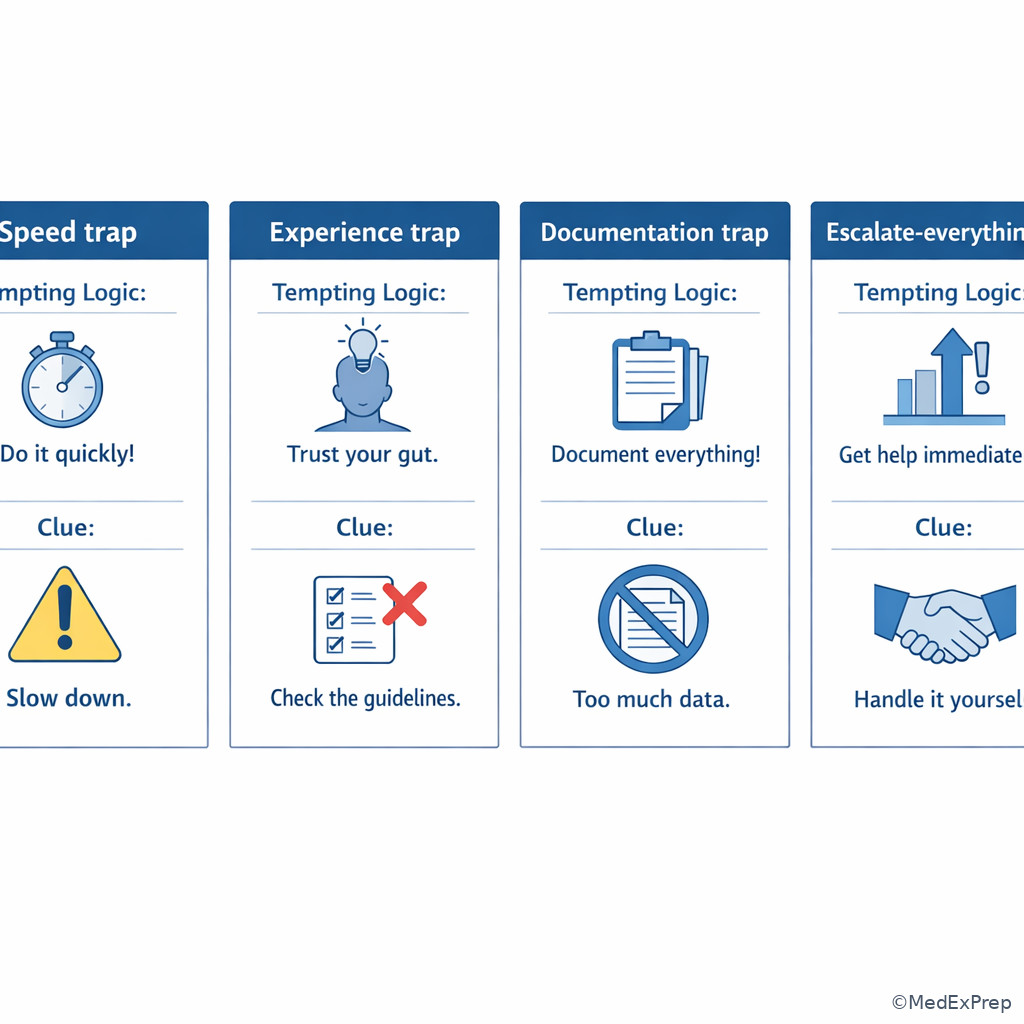
See Fig 6 for a compact comparison of why boundary distractors feel attractive on exam day.
Tables
| Key boundary fact | High-yield exam meaning |
|---|---|
| Routine task + explicit procedure + existing authority | Usually proceed within scope |
| Missing fact or conflicting source entry | Usually hold and clarify |
| Final approval or policy override request | Usually escalate |
| Coworker habit conflicts with official guidance | Follow official guidance |
| Time pressure without new authority | Does not justify bypassing required steps |
| Documentation after hold or escalation | Record issue, action, rationale, and communication details required by procedure |
| Action choice | When to choose it | When to reject it |
|---|---|---|
| Proceed | Rule is clear, task is routine, authority exists | Facts missing, data conflict, authority unclear |
| Hold and clarify | Need verified facts or source reconciliation | Issue is actually restricted authority or urgent risk beyond role |
| Escalate | Authority limit, policy conflict, significant risk, restricted decision | Simple routine step with clear procedure and no boundary issue |
| Document | Always as required by procedure after action or non-action | Never as a substitute for obtaining authority |
| Stem phrase | Classification | Likely interpretation |
|---|---|---|
| Verify required elements | Routine procedural | Usually in scope |
| Document the contact and time | Routine documentation | Usually in scope |
| Apply the posted threshold | Routine analytical | Usually in scope if formula is given |
| Issue final interpretation | Restricted authority | Escalate or seek authorized review |
| Override policy due to workflow needs | Restricted authority | Do not proceed independently |
| Sign off as responsible lead | Restricted authority | Out-of-role signal |
Algorithm / Approach
Forward reference: in the upcoming lesson on Allowed And Disallowed Actions, this approach becomes more concrete by sorting common task types into clear in-scope and out-of-scope categories.
Rapid Review
- Routine task -> safe when the rule is already stated and authority already exists.
- Final approval -> boundary alarm, not a routine completion step.
- Missing fact -> clarify before acting.
- Missing authority -> escalate, do not improvise.
- Coworker habit -> weaker than official procedure.
- Time pressure -> changes urgency, not scope.
- Prior experience -> improves recognition, not authorization.
- Documentation -> supports the action taken; it does not grant permission.
- Clarification -> best for conflicting or incomplete data.
- Escalation -> best for authority limits, policy conflict, or higher-risk decisions.
- Objective note -> facts and actions, not guesses about causes or intent.
- Best exam answer -> the most role-aligned next step, not the most aggressive one.
Self-check quiz
1. A CDCP candidate is asked to verify identity fields, check that required dates are present, and enter the result into the record. The procedure is posted and no exception is requested. What is the most appropriate interpretation?
- A. The task is likely within scope because it is a routine procedural verification.
- B. The task requires escalation because any record action has compliance implications.
- C. The task should be delayed until a supervisor can observe the process.
- D. The task is out of scope unless a coworker confirms local custom first.
2. Which stem phrase most strongly signals that the candidate should avoid independent action and consider escalation?
- A. “Document the time and recipient of the call.”
- B. “Apply the threshold listed in the procedure.”
- C. “Issue the final determination for this exception.”
- D. “Verify that the required source field is complete.”
3. A CDCP candidate receives a request to complete a standard workflow step involving a posted threshold. The file includes age data, a prior unrelated note, and one noncritical spelling error in a narrative field. A coworker suggests waiting for management because the outcome may affect later processing. What is the most appropriate next step?
- A. Apply the posted threshold, document the result, and follow the required notification path if triggered.
- B. Stop and escalate because any threshold decision is beyond entry-level role boundaries.
- C. Ignore the posted threshold and use the outcome from a similar prior case.
- D. Delay action until a supervisor provides informal verbal reassurance.
4. A candidate is reviewing a record with two conflicting source entries. No restricted decision is being requested, but the requester says the newer entry is “probably right.” The office is busy and several pending items are waiting. What is the most appropriate next step?
- A. Select the newer entry and proceed because recent information is usually preferred.
- B. Hold the task and seek clarification using the established process.
- C. Escalate directly to the highest available leader without further review.
- D. Average the two entries and document the compromise.
5. A candidate is told to “make the final call” on a file because the supervisor is in a meeting. The file is mostly complete, the requester is frustrated, and a coworker says the candidate has seen enough similar cases to decide. What is the most appropriate interpretation?
- A. Proceed because prior exposure to similar files effectively expands role authority.
- B. Proceed because the supervisor can reverse the decision later if needed.
- C. Do not make the final call independently; follow escalation or authorized review protocol.
- D. Decide only if the requester confirms the facts in writing.
6. A candidate identifies a missing required source entry and pauses the workflow. The issue may require supervisor authority if the source cannot be obtained. The candidate sends a message to the designated contact, then is interrupted by another urgent task. Which action most requires immediate clarification to remain within safe role boundaries?
- A. Document the missing entry and the time the designated contact was notified.
- B. Note that the file is pending clarification and await response per protocol.
- C. Enter an estimated source value based on a similar case so downstream work can continue.
- D. Record the issue factually and resume other authorized tasks while awaiting guidance.
7. A CDCP candidate is asked to process a routine record update. During review, the candidate notices that the written procedure and a local verbal instruction appear inconsistent. The written procedure requires verification; the verbal instruction says to bypass it for today due to backlog. The file is low urgency, and the supervisor who normally resolves conflicts is off site. What is the most appropriate next step?
- A. Follow the verbal instruction because it reflects current operational reality.
- B. Follow the written procedure or seek authorized clarification; do not independently waive the verification.
- C. Waive the verification only for low-urgency files and document that the decision was practical.
- D. Close the file without action because any policy conflict automatically makes the task impossible.
8. A candidate appropriately escalates a boundary issue involving possible authority limits. One option documents the issue and the person notified but omits the reason for escalation. Another documents the reason but not the timing. A third waits for the final decision before charting anything. A fourth records the observed issue, action taken, reason for escalation, and communication details required by procedure. Which is the best answer?
- A. Document the issue and person notified only, because the reason is obvious from context.
- B. Document the reason only, because communication details can be reconstructed later.
- C. Wait for the authorized person's final answer so the note can be complete in one entry.
- D. Record the observed issue, action taken, reason for escalation, and required communication details.
Answer key
1. Correct answer: A
- A. Tempting because it seems almost too basic to be tested; correct because routine verification of required fields using a posted procedure is a classic in-scope task. The single clue is that no exception, final approval, or policy override is requested.
- B. Tempting because compliance-related work feels high stakes; incorrect because compliance implications do not automatically make a task out of scope. The single clue is that the action is verification, not final interpretation.
- C. Tempting because supervision sounds safer; incorrect because unnecessary delay is not required for a routine authorized step. The single clue is that the procedure is already posted and clear.
- D. Tempting because local custom can seem practically important; incorrect because coworker confirmation is not needed when the governing procedure is explicit. The single clue is that the official process already exists.
2. Correct answer: C
- A. Tempting because documentation can be compliance-sensitive; incorrect because recording contact details is a routine documentation action. The single clue is the verb document.
- B. Tempting because thresholds can affect outcomes; incorrect because applying a listed threshold is usually routine when the rule is stated. The single clue is that the threshold is already listed.
- C. Tempting because the candidate may feel capable of doing it; correct because “issue the final determination” is an authority phrase that signals likely escalation or authorized review. The single clue is final determination.
- D. Tempting because source-field verification matters; incorrect because it remains a procedural check, not a restricted authority act. The single clue is verify.
3. Correct answer: A
- A. Tempting because it feels procedural rather than strategic; correct because applying a posted threshold, documenting the result, and notifying as required is exactly the kind of routine rule-based action expected within scope. The single clue is that the threshold is posted.
- B. Tempting because the result may influence later workflow; incorrect because the candidate is not making a discretionary policy decision, only applying a defined threshold. The single clue is the presence of an explicit rule.
- C. Tempting because similar prior cases can feel informative; incorrect because substituting a prior case for the posted rule is unauthorized. The single clue is that the current procedure already supplies the decision method.
- D. Tempting because verbal reassurance sounds prudent; incorrect because waiting for unnecessary reassurance delays a routine in-scope task. The single clue is that management input is not required by the posted procedure.
4. Correct answer: B
- A. Tempting because newer data often are correct; incorrect because “probably right” is not verified fact. The single clue is conflicting entries without confirmation.
- B. Tempting because it slows work; correct because a factual conflict calls for clarification through the established process. The single clue is that the issue is missing verification, not missing authority.
- C. Tempting because escalation can feel safer than risking error; incorrect because immediate top-level escalation overshoots a problem that is initially factual rather than authority-based. The single clue is absence of a restricted decision request.
- D. Tempting because compromise may seem balanced; incorrect because averaging conflicting source entries creates new information not supported by either source. The single clue is that both values require reconciliation, not combination.
5. Correct answer: C
- A. Tempting because repeated exposure creates confidence; incorrect because familiarity does not expand formal authority. The single clue is the phrase “make the final call.”
- B. Tempting because later review sounds like a safety net; incorrect because reversible error is still unauthorized action if the candidate lacked authority at the time. The single clue is that the decision would be independent and final in the moment.
- C. Tempting because it may frustrate the requester; correct because final decision authority is the key boundary issue, and the candidate should use the escalation or authorized review path. The single clue is the direct request for final determination.
- D. Tempting because written confirmation adds formality; incorrect because requester confirmation of facts does not confer authority to make the final call. The single clue is that the limitation is authority, not data format.
6. Correct answer: C
- A. Tempting because it sounds administrative; incorrect because documenting the missing entry and notification time is appropriate and within scope. The single clue is that it records observed facts and communication.
- B. Tempting because waiting can feel passive; incorrect because marking the file pending clarification is appropriate when protocol supports it. The single clue is that the file is paused, not independently altered.
- C. Tempting because it keeps downstream work moving; correct because estimating a required source value from a similar case substitutes assumption for verified data and exceeds safe routine handling. The single clue is the phrase “estimated source value.”
- D. Tempting because switching tasks may feel like avoidance; incorrect because resuming other authorized work while awaiting guidance is reasonable after proper documentation and escalation. The single clue is that no new unauthorized action is taken on the paused file.
7. Correct answer: B
- A. Tempting because local operations may appear to require flexibility; incorrect because verbal custom does not override a written required verification step unless authorized guidance says so. The single clue is the conflict between written procedure and informal instruction.
- B. Tempting because it may slow workflow; correct because the candidate should follow the written procedure or seek authorized clarification, not independently waive the verification. The single clue is that bypass authority has not been granted.
- C. Tempting because tailoring by urgency seems practical; incorrect because the candidate cannot create a low-urgency exception rule. The single clue is that the waiver would be self-created.
- D. Tempting because policy conflict feels paralyzing; incorrect because a conflict does not automatically stop all action if the written procedure can still be followed or authorized clarification can be sought. The single clue is that one controlling source still exists in writing.
8. Correct answer: D
- A. Tempting because the reason may seem inferable; incorrect because omission of the reason weakens the audit trail and leaves the basis for escalation unclear. The single clue is missing rationale.
- B. Tempting because the reason seems central; incorrect because communication details required by procedure may be essential to show timely handoff. The single clue is missing timing or recipient details.
- C. Tempting because one complete note sounds tidy; incorrect because contemporaneous documentation of the escalation action itself is needed, not just the eventual result. The single clue is delayed charting.
- D. Tempting because it is the most complete and disciplined option; correct because it captures the observed issue, action taken, reason for escalation, and communication details required by procedure. The single clue is full traceability of boundary handling.
Keep going with the full CDCP Prep Course (CDCP)
You just studied the way members do, in the same lesson interface. Full access unlocks every lesson, the question bank and flashcards for a full year.
One payment · 1 year of access · No auto-renewal