1.1.1 - Inferred Domain Map
Why it matters
- When the official blueprint is broad or incomplete, candidates still need a safe way to organize study without inventing unsupported exam rules.
- Many missed questions come from misclassifying the task: treating a boundary item like a counseling item, or a documentation item like an ethics item.
- A domain map reduces cognitive overload by telling you what kind of answer the exam is really asking for.
- On CCPP-style items, the best option is often the one that fits both the right domain and the right scope.
Key Terms & Must-Know Facts
1.1.1.1 Key terms
- Inferred domain map: a conservative, learner-safe organizing framework built when official detail is limited.
- Blueprint: the exam content structure or competency outline.
- Primary competency: the main skill a question is testing.
- Secondary competency: a supporting skill present in the same scenario.
- Scope: actions appropriate to the clinical pastoral practitioner role.
- Supportive intervention: presence, listening, spiritual assessment, care planning, or referral within role.
- Escalation: involving licensed clinicians, supervisors, safety response, or institutional resources when needed.
- Documentation domain: charting relevant assessment, intervention, response, and plan.
- Therapeutic presence: attentive, noncoercive, relational care.
- Cultural humility: ongoing stance of curiosity, respect, and self-awareness.
- Differential domain recognition: telling apart similar-looking competencies in a stem.
- Best-next-step reasoning: selecting the safest and most role-appropriate action.
1.1.1.2 Must-know facts
- The map in this lesson is inferred, not official CPS blueprint wording.
- If exact weighting is unknown, balanced review is safer than guessing percentages.
- CCPP questions often mix assessment, communication, ethics, and referral in one case.
- The main discriminator is usually the decision conflict: support vs escalate, assess vs advise, document vs interpret, collaborate vs act alone.
- Role violations are common distractors.
- Patient preference and dignity should anchor answer selection across domains.
- When safety, abuse, suicidality, or impaired decision-making appears, escalation usually outranks extended spiritual exploration.
- Documentation answers should stay objective, relevant, and within scope.
- Cultural or religious content should never be assumed from identity labels alone.
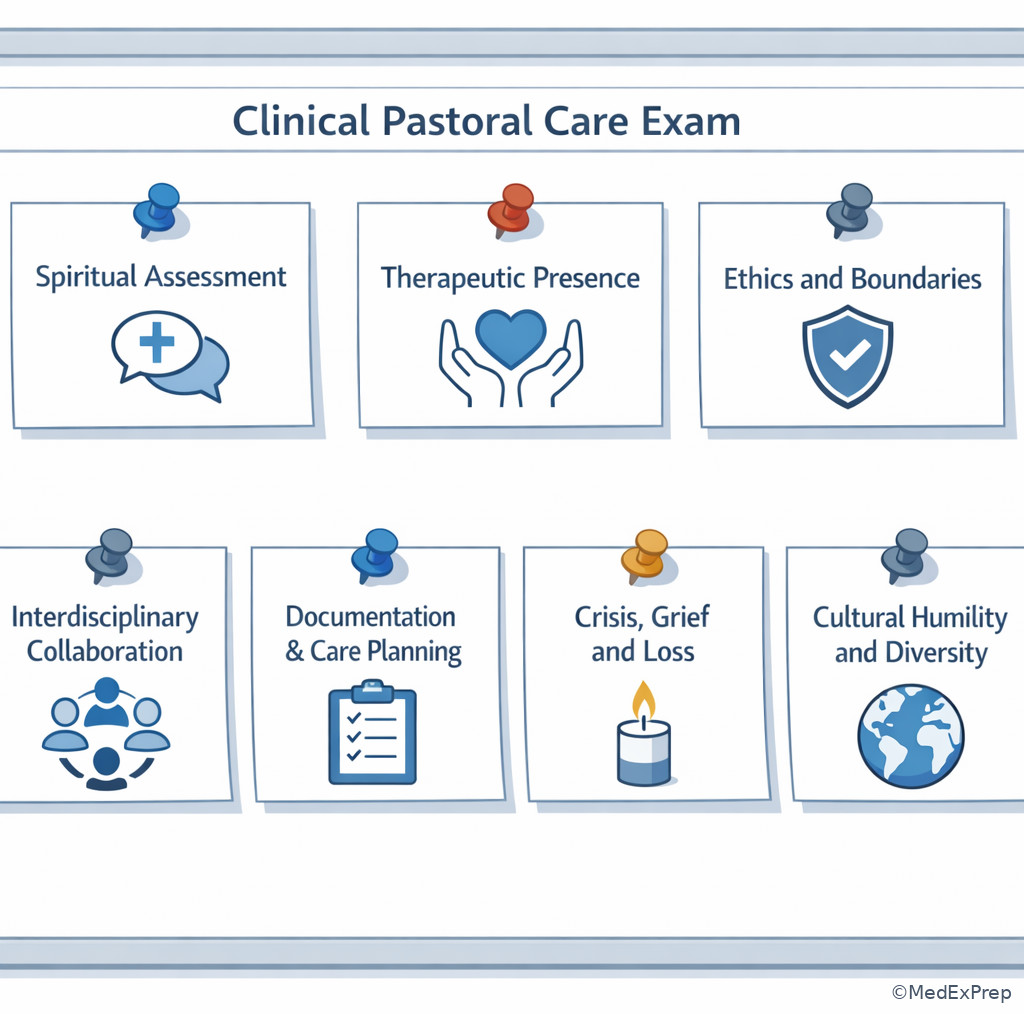
Exam takeaway: Use this map to identify the main competency being tested before reading the answer choices.
flowchart TD
A[CCPP Exam Content] --> B[Spiritual Assessment]
A --> C[Therapeutic Presence]
A --> D[Ethics and Boundaries]
A --> E[Interdisciplinary Collaboration]
A --> F[Documentation and Care Planning]
A --> G[Crisis Grief and Loss]
A --> H[Cultural Humility and Diversity]
B --> B1[Need identification]
B --> B2[Meaning coping beliefs]
C --> C1[Listening]
C --> C2[Supportive response]
D --> D1[Autonomy confidentiality]
D --> D2[Role limits]
E --> E1[Referral]
E --> E2[Team communication]
F --> F1[Objective notes]
F --> F2[Plan follow-up]
G --> G1[Acute support]
G --> G2[Risk escalation]
H --> H1[Nonassumptive care]
H --> H2[Access and inclusion]
Exam takeaway: The fastest way to a correct answer is to classify the stem by task before evaluating interventions.
flowchart TD
A[Read stem] --> B{Main problem?}
B -->|Need understanding| C[Assessment domain]
B -->|Need supportive response| D[Therapeutic presence domain]
B -->|Need safe limit or permission| E[Ethics and boundaries]
B -->|Need team action or referral| F[Collaboration and escalation]
B -->|Need chart wording or plan| G[Documentation]
B -->|Acute loss trauma danger| H[Crisis domain]
B -->|Belief culture identity access| I[Cultural humility]
E --> J{Any safety or legal trigger?}
J -->|Yes| F
J -->|No| D Exam takeaway: Visual grouping of domains helps you retrieve the right rule under time pressure.
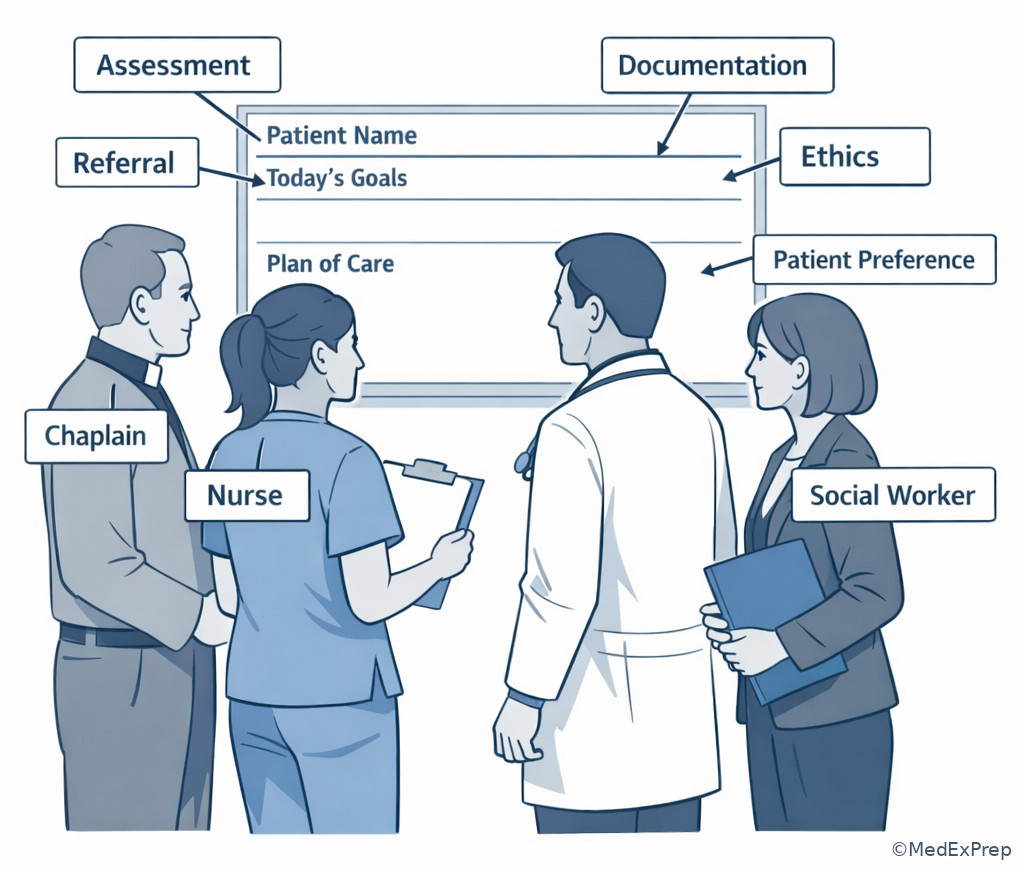
Exam takeaway: Many stems test spiritual care decisions inside a team environment, not in isolation.
Core content
1.1.1.3 Foundational domain categories: what belongs where
A Explanation
The first exam decision is often not “What should I say?” but “What kind of question is this?” Candidates lose points when they answer a domain they recognize emotionally rather than the one the stem actually tests. A patient speaking about fear before surgery may sound like a listening item, but if the question asks what should be documented, the tested domain is documentation. A family conflict may sound like crisis care, but if the key issue is the candidate trying to decide for the team, the tested domain is boundaries and collaboration.
Decision conflict: choose the domain that matches the task, and reject the domain suggested only by emotional tone. The single rule that resolves this is: classify by the action being asked of the candidate, not by the setting alone. If the question asks what information to gather, it is assessment. If it asks for the most appropriate response in the moment, it is therapeutic presence. If it asks whether something should be done, shared, or refused, it often enters ethics or boundaries. If it asks who should be involved, it is collaboration or escalation. If it asks how to record the encounter, it is documentation.
WHY THIS IS TESTED: exam writers know candidates notice obvious cues like grief, anger, religion, or conflict. The stronger candidates separate the emotional content from the underlying professional task. See Fig 1 and Fig 2.
Key rule: First identify the requested action: assess, respond, protect a boundary, collaborate, document, escalate, or adapt care to culture and belief.
B Worked example
A 68-year-old patient with metastatic lung cancer, type 2 diabetes, and hearing impairment tells the chaplain, “I think God is punishing me, and I’m not sure I want to speak to my daughter.” The nurse adds that the patient is scheduled for a procedure in one hour. The chart also notes mild hyponatremia, which is distracting but not central to the question. The stem asks: Which competency is primarily being tested if the best answer focuses on exploring the patient’s belief, meaning, and relational distress before offering advice?
Identify task: the item asks what competency is being tested. Extract key facts: guilt language, relationship rupture, pre-procedure timing, hearing impairment, and no immediate safety trigger in the stem. Apply rule: because the best answer explores belief and meaning rather than giving theological correction or notifying the whole team immediately, the primary domain is spiritual assessment, with therapeutic presence as a secondary skill. Eliminate distractors: documentation is tempting because there is a chart, but the stem is about the encounter itself; crisis is tempting because a procedure is near, but there is no urgent destabilization described; ethics is tempting because of family tension, but no consent or confidentiality conflict is present. Verify: the requested action is exploratory gathering of spiritually relevant meaning.
C Exam trap
Common wrong answer: Therapeutic presence.
Why it is tempting: the stem includes emotion, suffering, and a relational statement, which makes “empathetic response” feel immediately correct.
Single clue that eliminates it: the best answer is about eliciting and clarifying beliefs and meaning, which makes assessment primary and supportive response secondary.
D Checkpoint
Question: A stem asks, “Which action best documents the chaplain’s encounter?” The scenario includes grief, family conflict, and prayer. Which domain is primarily being tested?
- Spiritual assessment — tempting because the encounter contains grief and belief content, but incorrect because the task line asks how to chart the encounter rather than what to assess.
- Therapeutic presence — tempting because prayer and support are present, but incorrect because the candidate is not being asked what to say in the room.
- Documentation and care planning — correct because the task is recording relevant findings, interventions, response, and plan in the chart.
- Cultural humility — tempting because prayer may reflect tradition-specific needs, but incorrect because no adaptation to belief diversity or assumption check is the main task.
1.1.1.4 Scope and domain are linked, but not identical
A Explanation
A second foundational distinction is that domain classification and scope judgment are related but different. A question may belong to the crisis domain, but the correct answer is still wrong if it asks the chaplain candidate to diagnose a psychiatric condition. Likewise, a documentation question becomes a boundary question if one answer option includes judgmental language, unsupported interpretation, or disclosure beyond policy. Domain tells you the category of skill; scope tells you whether the action is professionally permitted.
Decision conflict: choose the option that fits the domain, but reject any option that exceeds role or violates policy. The single rule that resolves it is: an in-domain answer can still be wrong if it is out of scope. This is a major exam pattern because the best distractors usually sound compassionate, efficient, or decisive. They fail because they cross the line into diagnosing, coercing, promising outcomes, making legal determinations, or acting unilaterally.
WHY THIS IS TESTED: competent candidates know not only what spiritual care includes, but also where its limits are. This lesson introduces the map; the next topics will deepen role boundaries and allowed vs disallowed actions.
Recall: This is the first topic in the course, so there is no prior lesson to build from. As you move forward, keep this anchor: every later topic will fit somewhere on this inferred domain map.
High-Yield Connection: This concept is tested alongside Professional Role Boundaries and Allowed And Disallowed Actions. Know both the domain classification and the scope limit for exam day — they are frequently paired in stems.
B Worked example
A 34-year-old inpatient with bipolar disorder history, recent bereavement, and chronic pain says, “I don’t think I matter anymore.” He asks the chaplain, “Do you think I’m suicidal?” His chart mentions a medication change yesterday, which may tempt overinterpretation. The stem asks for the most appropriate next step. One option says to reassure him he is not suicidal because he sought help. Another says to perform a brief suicide risk assessment and notify the assigned clinician per policy. Another says to document “major depression with passive SI.” Another says to lead a long prayer and revisit later.
Identify task: best next step. Extract key facts: self-worth collapse, explicit suicidality question, behavioral health history, and immediate risk implications. Apply rule: the case lives in crisis and escalation, but the chaplain must stay within role. Eliminate distractors: diagnosing depression is out of scope; reassurance without escalation is unsafe; prayer may be supportive but cannot replace risk pathway activation. Verify: the correct action combines supportive presence with referral/escalation.
C Exam trap
Common wrong answer: give extended spiritual support first and assess risk later.
Why it is tempting: it sounds compassionate and stays within a familiar relational role.
Single clue that eliminates it: the patient raises possible self-harm directly, which makes immediate safety process more important than prolonged exploration.
D Checkpoint
Question: Which statement best captures the relationship between domain map and scope?
- If an option fits the domain, it is automatically correct — tempting because classification feels efficient, but wrong because scope and safety must still be checked.
- Scope matters only in ethics questions — tempting because boundaries are often taught there, but wrong because out-of-role actions can appear in any domain.
- An answer may match the domain but still be incorrect if it exceeds role — correct because domain recognition is necessary but not sufficient.
- Scope checks are needed only when law is mentioned directly — tempting because legal wording feels higher stakes, but wrong because safety and professional limits arise even without legal language.
- The first sorting question is: “What action is the stem asking me to take?”
- True or False: A supportive-sounding answer can still be wrong if it exceeds role. True.
- Name the 3 safety pivots that often override extended exploration: self-harm risk, abuse concerns, and institutional/legal escalation triggers.
Exam takeaway: After identifying the domain, pass every answer through a scope-and-safety filter before choosing.
flowchart LR
A[Potential answer] --> B{Within chaplain role?}
B -->|No| C[Reject]
B -->|Yes| D{Respects autonomy and policy?}
D -->|No| C
D -->|Yes| E{Any safety trigger requiring escalation?}
E -->|Yes| F[Support plus notify/escalate]
E -->|No| G[Proceed with appropriate spiritual care response] Exam takeaway: Supportive care is appropriate until the stem introduces a trigger that requires referral, notification, or policy-based escalation.
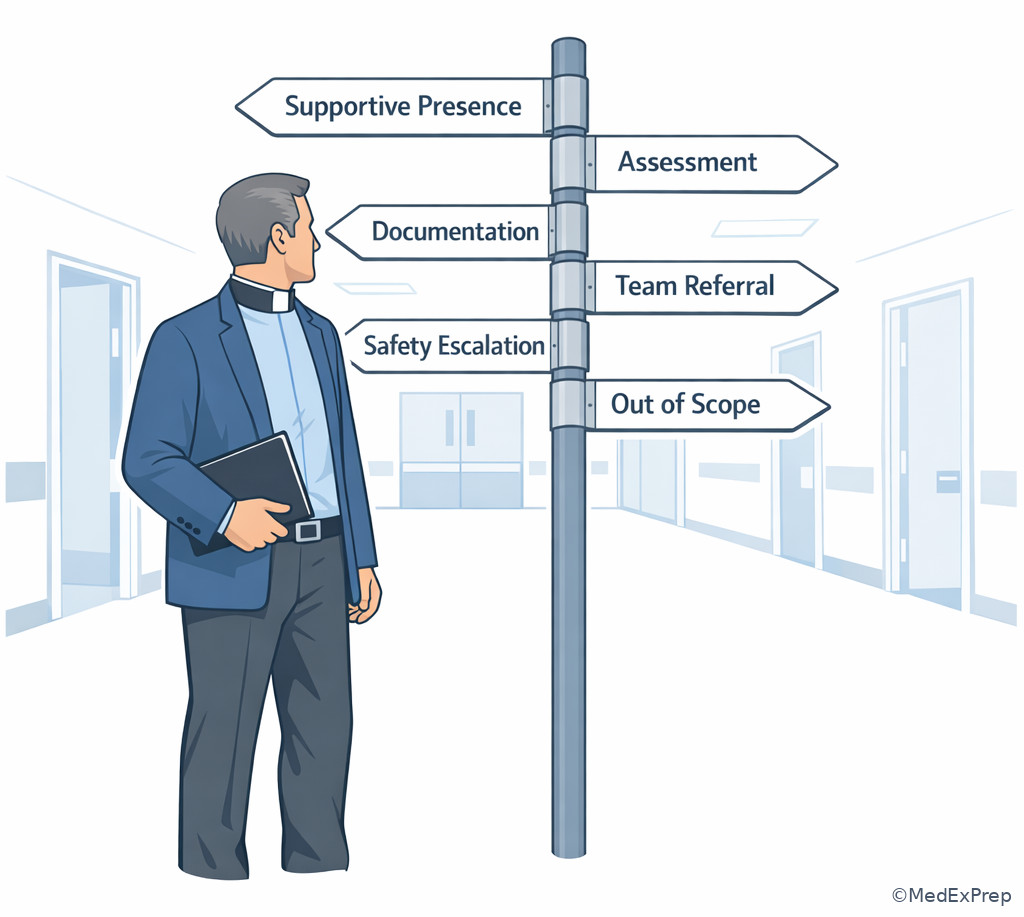
1.1.1.5 Applied classification: identify the primary competency in mixed scenarios
A Explanation
Most exam scenarios are mixed. A patient may express spiritual struggle, family conflict, mistrust of staff, and a wish for prayer in the same paragraph. The exam still expects you to identify the primary competency. The best way to do this is to ask: What must be decided before anything else can happen safely and appropriately? That answer usually reveals the primary domain.
Decision conflict: choose the skill that resolves the immediate task bottleneck, and reject nice-but-secondary actions. For example, in a family meeting where a surrogate conflict is escalating, the primary domain may be collaboration or ethics, even though empathic communication is important. In a bedside encounter where the patient’s beliefs are still unclear, assessment usually comes before intervention. In a note-writing question, the primary domain is documentation even if the underlying case involved grief, anger, or ritual needs.
WHY THIS IS TESTED: this mirrors real practice. Clinical pastoral care rarely arrives in neat categories. The exam tests prioritization under ambiguity, not just recall of definitions. See Fig 2 and Fig 3.
Memory anchor: TASK = Task line, Action requested, Safety trigger, Keep within role. Use TASK before looking at choices.
B Worked example
A 52-year-old patient in the ICU after stroke has hypertension, chronic kidney disease, and limited speech. His spouse asks the chaplain to “convince him” to accept a procedure because “he listens to spiritual people.” The patient gestures away when prayer is offered. A lab note about elevated creatinine is included as background noise. The question asks: Which competency is primarily tested by the best answer?
Identify task: classify the tested competency behind the correct response. Extract key facts: spouse pressure, patient nonverbal refusal cue, requested influence over decision, ICU setting. Apply rule: the immediate bottleneck is not prayer technique or deeper spiritual history; it is boundary and autonomy protection, with collaboration as secondary. Eliminate distractors: cultural humility is tempting if one assumes “spiritual people” means shared beliefs; therapeutic presence is tempting because prayer is mentioned; crisis is tempting due to ICU severity. The key issue, however, is improper pressure to override patient preference. Verify: primary domain is ethics and boundaries.
C Exam trap
Common wrong answer: Therapeutic presence with prayer.
Why it is tempting: prayer appears explicitly and often feels like the most spiritual answer.
Single clue that eliminates it: the patient gestures away, so honoring autonomy and not acting as a persuasion tool becomes primary.
D Checkpoint
Question: A patient expresses anger at God, distrust of the team, and uncertainty about treatment. The stem asks which information the chaplain should gather first to guide care. What is the primary domain?
- Spiritual assessment — correct because the question asks what to gather first in order to guide care.
- Ethics and boundaries — tempting because treatment uncertainty raises autonomy issues, but wrong unless the stem centers on permission, conflict, or limits.
- Documentation and care planning — tempting because care guidance implies planning, but wrong because information collection precedes charting.
- Crisis, grief, and loss — tempting because anger can signal distress, but wrong because no acute destabilization or crisis intervention task is asked.
1.1.1.6 Study planning from the domain map: how to review efficiently and safely
A Explanation
An inferred domain map is not just a labeling exercise. It becomes a study plan. When weightings are unknown, the safest approach is balanced review with extra attention to high-frequency crossover areas: assessment, therapeutic presence, ethics/boundaries, collaboration/referral, and documentation. Crisis care and cultural humility should not be isolated add-ons; they often modify the correct answer in cases that look like assessment or communication questions. A patient can need assessment, but the answer changes if there is trauma, language access, or self-harm concern.
Decision conflict: choose a study plan built on transferable decision rules, and reject a plan built only on memorizing isolated facts. The single rule that resolves this is: study by domain plus crossover trigger. For each domain, ask what conditions change the best answer: safety triggers, consent issues, family conflict, cultural assumptions, team communication needs, and documentation constraints. This creates durable recall under exam pressure.
WHY THIS IS TESTED: certification exams reward disciplined reasoning. Learners who build a map around decision conflicts are more likely to recognize near-miss distractors than learners who only memorize definitions.
High-Yield Connection: This concept overlaps strongly with Best-Next-Step Reasoning later in the course. Know both the domain map and the priority rule that shifts the answer when safety, consent, or referral cues appear.
Recall: Upcoming topics on Professional Role Boundaries and Allowed And Disallowed Actions will refine this map by showing exactly how answer choices go wrong when they exceed role, even if they seem caring.
B Worked example
A candidate notices that many missed practice items involve end-of-life scenarios. On review, those misses are not all from one cause: some ask what to say to a grieving spouse, some ask what to document, some ask when to involve palliative care or the nurse, and some test whether the chaplain should offer ritual only after checking patient preference. The candidate has asthma and works full-time nights, which is irrelevant but adds realistic noise to self-study planning. What is the best revision strategy?
Identify task: create a more accurate study plan. Extract key facts: misses cluster by setting, not by one competency. Apply rule: study by domain and crossover trigger, not by setting alone. Eliminate distractors: reviewing only grief theory misses documentation and escalation errors; reviewing only policy misses communication problems; memorizing rituals misses preference and boundary issues. Verify: the candidate should recode missed questions by primary domain and by trigger such as safety, autonomy, culture, or documentation.
C Exam trap
Common wrong answer: study by care setting only, such as “ICU questions” or “hospice questions.”
Why it is tempting: settings feel concrete and memorable.
Single clue that eliminates it: the same setting can generate different tasks, so the governing rule comes from domain plus crossover trigger, not location alone.
D Checkpoint
Question: When official weighting is unavailable, which review strategy is most defensible?
- Ignore mapping and just read cases randomly — tempting because it feels realistic, but wrong because random review hides recurring error patterns.
- Assume ethics is the highest-weighted domain and focus mostly there — tempting because boundaries are prominent, but wrong because the lesson does not provide confirmed weights.
- Use a balanced inferred domain map and track crossover triggers on missed items — correct because it is organized, conservative, and aligned with unknown weighting.
- Study only the domains that seem hardest emotionally — tempting because emotional salience feels important, but wrong because exam frequency and transferability matter more than subjective discomfort.
- The safest assumption when weighting is unknown is balanced review.
- True or False: “Hospice” is a domain. False; it is a setting that can contain multiple domains.
- Name 3 crossover triggers that can change the best answer: safety risk, autonomy/confidentiality, and cultural or access needs.
Exam takeaway: One scenario can contain several competencies, but the question task identifies which one is primary.
flowchart TD
A[One patient encounter] --> B[Assessment cue]
A --> C[Emotion and presence cue]
A --> D[Boundary cue]
A --> E[Team/referral cue]
A --> F[Documentation cue]
A --> G[Culture/belief cue]
B --> H[Question asks what to explore first]
C --> I[Question asks what to say next]
D --> J[Question asks what should not be done]
E --> K[Question asks who to involve]
F --> L[Question asks what to document]
G --> M[Question asks how to adapt care]
Exam takeaway: In dense stems, separate cues by function so the primary tested competency becomes obvious.
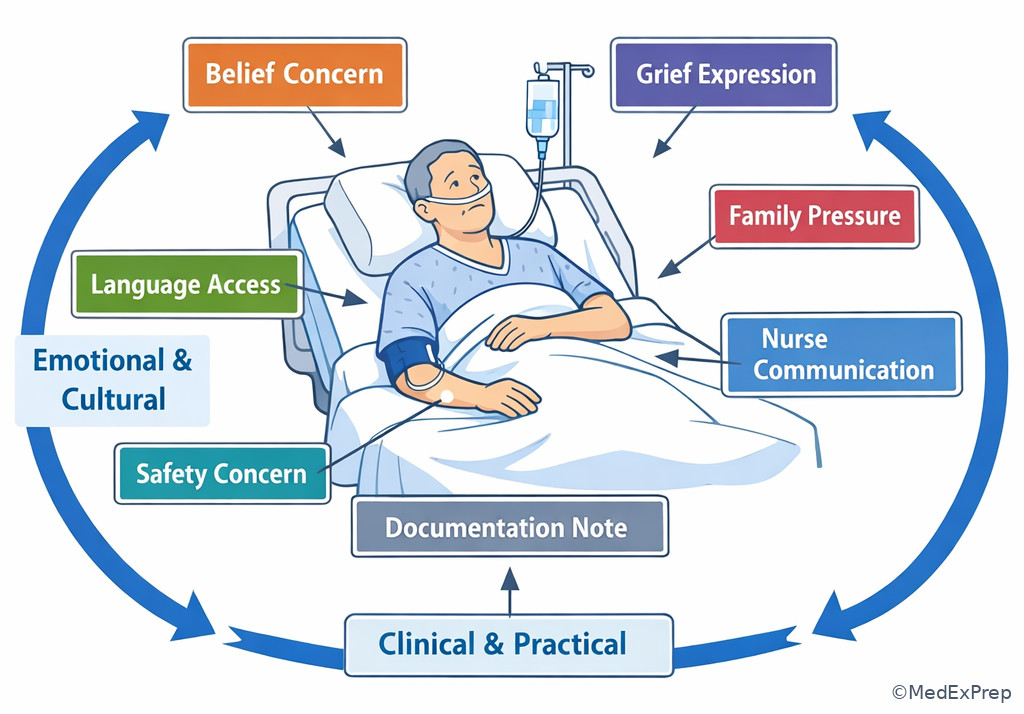
1.1.1.7 Integration: using the domain map to eliminate distractors on exam day
A Explanation
At the integration level, the inferred domain map becomes an elimination tool. Many CCPP distractors are not absurd; they are secondary-domain answers. They would be reasonable later, in a different order, or under different conditions. Your job is to reject them for this specific stem. If a patient asks for prayer after expressing spiritual guilt, prayer may be appropriate, but not before clarifying whether the patient actually wants that form of support. If family conflict is present, supportive listening may help, but if the question asks who should be notified, collaboration outranks bedside processing. If a note is being written, a beautifully empathetic spoken response is irrelevant unless the task asks what to say.
Decision conflict: choose the answer that is both primary-domain appropriate and timed correctly; reject answers that are good ideas at the wrong moment. The single rule that resolves this is: correct answers solve the task in sequence. Sequence matters because assessment often precedes intervention, safety often precedes extended processing, and documentation follows the encounter rather than substitutes for it.
WHY THIS IS TESTED: the exam rewards prioritization. High-level items are less about whether an action is ever useful and more about whether it is most appropriate now. See Fig 4.
Common distractor pattern: a compassionate action that is real but premature. Ask, “Would this be better later, after clarification, consent, or escalation?”
B Worked example
A 79-year-old hospice patient with heart failure and mild cognitive impairment tells the chaplain, “I’m afraid of dying alone.” Her son, who lives out of state, asks the chaplain to keep their conversation confidential from the team because “it will only upset everyone.” The patient then says she wants the nurse to know she feels abandoned. The stem asks for the most appropriate next step. A tempting answer is to sit longer and offer life review. Another is to call the son and negotiate family expectations. Another is to encourage the patient to write a letter. Another is to ask permission to relay the patient’s concern to the nurse and support that communication.
Identify task: best next step. Extract key facts: patient preference is explicit; son requests secrecy; nurse should know relevant care concern; no immediate safety emergency. Apply rule: primary domains are collaboration and autonomy; the correct answer must fit sequence. Eliminate distractors: life review is real but secondary; family negotiation may come later; letter-writing may be therapeutic but delays needed team communication. Verify: the answer that supports the patient’s voiced wish and appropriate team communication is best.
C Exam trap
Common wrong answer: extended life review at the bedside.
Why it is tempting: it is pastoral, meaningful, and supportive.
Single clue that eliminates it: the patient specifically wants the nurse informed, making communication support the time-sensitive next step.
D Checkpoint
Question: Which principle best explains why a plausible answer may still be wrong on the CCPP exam?
- The answer belongs to the wrong profession only if it mentions diagnosis — tempting because diagnosis is a common red flag, but wrong because timing and task mismatch also invalidate options.
- A compassionate action can be incorrect if it is not the best next step in sequence — correct because board-style items prioritize what should happen now.
- Any option mentioning collaboration is automatically preferred — tempting because teamwork is important, but wrong because some questions ask for bedside response or assessment first.
- Documentation is never the right answer when the patient is emotional — tempting because bedside care feels more humane, but wrong because some stems specifically test charting decisions.
Exam Traps & Differentiators
Most common wrong answer and why: choosing the most compassionate-sounding option without first classifying the task. This is tempting because CCPP content is relational. It is wrong when the stem actually tests documentation, escalation, or boundary protection.
Looks similar but isn’t:
| Looks like | Actually tests | Single discriminator |
|---|---|---|
| Emotional bedside encounter | Spiritual assessment | The question asks what to explore or clarify. |
| Prayer or silence at bedside | Therapeutic presence | The question asks what response is most helpful now. |
| Family pressure around treatment | Ethics and boundaries | The clue is autonomy, coercion, or role limit. |
| Need to alert team or refer | Collaboration / escalation | The question asks who should be involved or informed. |
| Chart excerpt or note wording | Documentation and care planning | The task concerns what belongs in the record. |
| Trauma, suicidal talk, abuse concern | Crisis with escalation overlay | Safety trigger outranks prolonged exploration. |
| Faith identity or language issue | Cultural humility / diversity | The key issue is nonassumptive, adapted care. |
If the stem says ___, think ___:
- “What should the chaplain explore first?” → think assessment.
- “What is the most appropriate next response?” → think therapeutic presence, unless safety or policy changes the priority.
- “The family asks the chaplain to convince the patient…” → think boundaries and autonomy.
- “Which team member should be informed / what is the next referral?” → think collaboration and escalation.
- “Which note is best?” → think documentation.
- “The patient’s culture/religion is assumed by staff” → think cultural humility.
Related traps from upcoming topics: in Professional Role Boundaries, you will learn why some empathetic answers still fail for crossing into psychotherapy, diagnosis, or coercion. In Allowed And Disallowed Actions, you will practice spotting out-of-role wording that appears attractive because it sounds decisive.
| Primary domain | Common tempting distractor | Why it tempts | What rules it out |
|---|---|---|---|
| Assessment | Immediate advice-giving | Feels helpful and efficient | Beliefs/needs are not yet clarified |
| Therapeutic presence | Detailed charting choice | Documentation is always important | The question asks what to say, not what to write |
| Ethics/boundaries | Prayer on request of family | Sounds pastoral and respectful | Patient preference or autonomy is unclear or opposed |
| Collaboration | Continue solo support only | Stays relational and nonintrusive | Team communication is the actual next step |
| Documentation | Interpretive theological statement | Seems insightful | Notes should be objective and clinically relevant |
| Crisis | Long reflective conversation | Feels pastoral | Safety trigger needs immediate escalation |
Exam takeaway: Wrong options often match a secondary domain or the wrong sequence rather than being obviously inappropriate.
flowchart TB
A[Scenario] --> B[Primary task]
A --> C[Secondary cues]
B --> D[Correct answer]
C --> E[Near-miss distractor 1]
C --> F[Near-miss distractor 2]
C --> G[Near-miss distractor 3]
E --> H[Compassionate but premature]
F --> I[In-domain but out of scope]
G --> J[Useful later but not now]
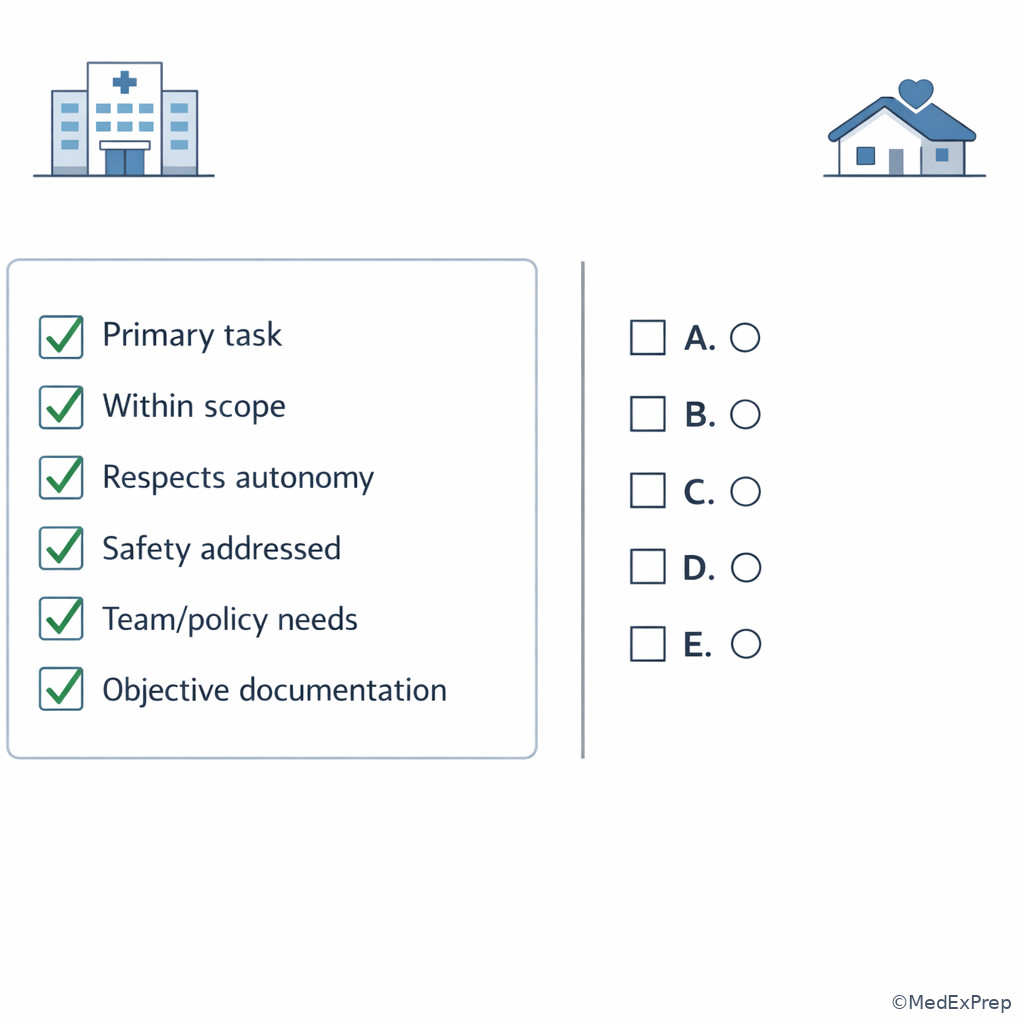
Exam takeaway: A visual checklist helps separate compassionate but wrong choices from role-appropriate best answers.
Tables
| Inferred domain | Core question type | Typical best action | High-risk wrong move |
|---|---|---|---|
| Spiritual assessment | What should be explored or clarified? | Use open, nonassumptive inquiry | Jumping to advice or ritual without assessment |
| Therapeutic presence | What response is most helpful now? | Reflect, validate, accompany, support | Arguing, fixing, or imposing meaning |
| Ethics and boundaries | What should or should not be done? | Protect autonomy, dignity, consent, limits | Coercion or acting beyond role |
| Interdisciplinary collaboration | Who should be involved? | Communicate, refer, hand off, escalate | Managing complex risk alone |
| Documentation and planning | What belongs in the chart? | Objective findings, intervention, response, plan | Judgmental or speculative wording |
| Crisis, grief, and loss | What takes priority in acute distress? | Stabilize, support, and escalate when needed | Delayed action despite safety cues |
| Cultural humility and diversity | How should care be adapted? | Ask rather than assume; honor preference | Stereotyping based on identity label |
| Question wording | Best initial lens | What to look for next |
|---|---|---|
| “Most appropriate next response” | Therapeutic presence | Unless safety, boundary, or policy cue shifts priority |
| “Best information to gather” | Assessment | Clarifying beliefs, meaning, coping, preference |
| “Requires immediate clarification” | Boundaries / safety | Coercion, consent, confidentiality, risk, out-of-role ask |
| “Most important to communicate to team” | Collaboration | Clinically relevant spiritual concern or risk issue |
| “Best documentation” | Documentation | Objective wording and follow-up plan |
| “Most culturally responsive action” | Cultural humility | Preference, access, interpreter, nonassumption |
| Confusable pair | How they overlap | Best discriminator |
|---|---|---|
| Assessment vs therapeutic presence | Both occur in bedside conversation | Gathering information vs offering a response |
| Therapeutic presence vs crisis support | Both involve distress | Presence alone vs presence plus urgent safety process |
| Ethics/boundaries vs collaboration | Both may involve family/team tension | Limit-setting question vs who-to-involve question |
| Assessment vs documentation | Same encounter may generate both | What to explore vs what to record |
| Cultural humility vs spiritual assessment | Both ask about beliefs and meaning | Nonassumption/adaptation is the central issue |
| Boundaries vs cultural humility | Tradition-specific requests may raise both | Preference-respecting adaptation vs coercion or role limit |
Algorithm / Approach
Exam takeaway: A repeatable triage workflow prevents you from chasing emotional cues instead of the actual tested task.
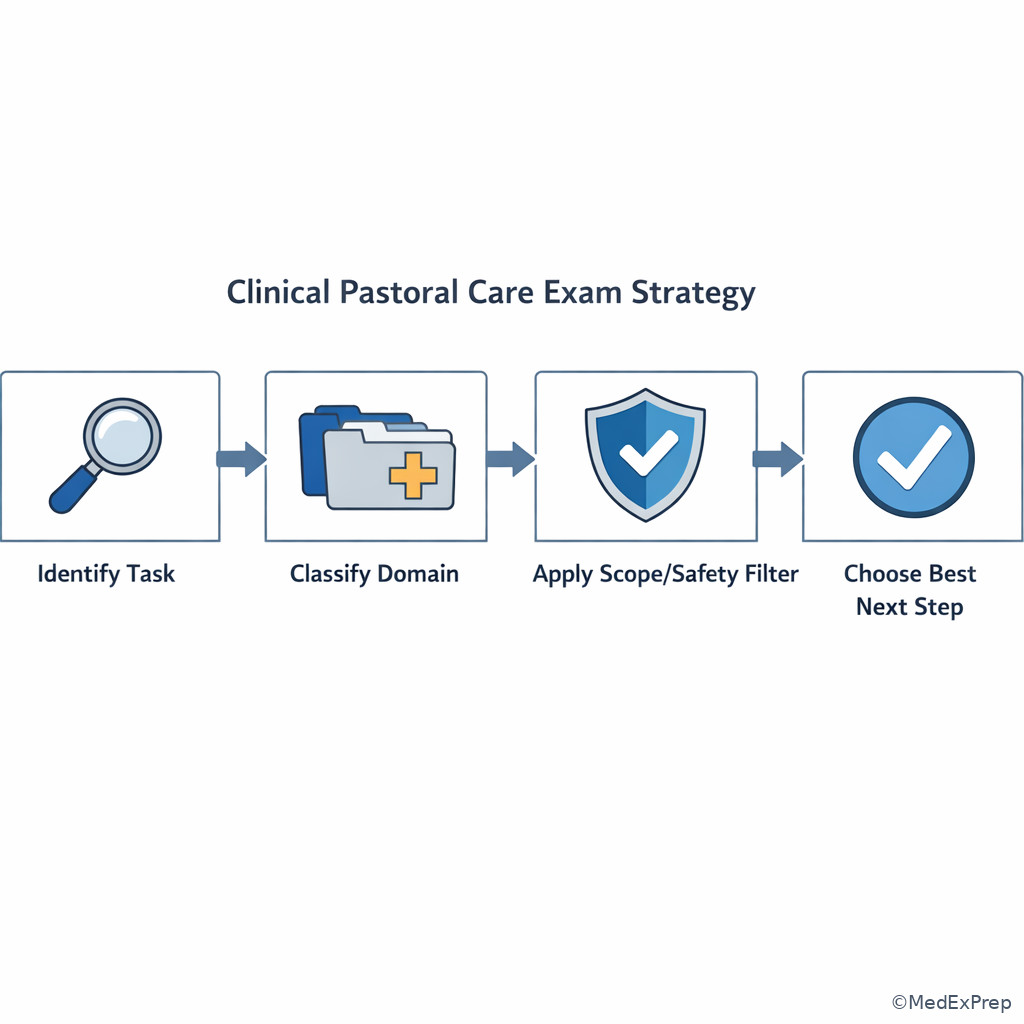
See Fig 6. Use this algorithm on every question until it becomes automatic. It is especially helpful on mixed scenarios where several answer choices sound kind, reasonable, or clinically adjacent.
Rapid Review
- Inferred domain map → organize study safely when official blueprint detail is limited.
- Primary competency → determined by the task line, not the emotional intensity of the case.
- Assessment → best answer gathers meaning, beliefs, coping, or preference before advising.
- Therapeutic presence → best answer offers supportive response when no higher-priority trigger intervenes.
- Boundaries → any coercion, diagnosis, or unilateral decision should trigger rejection.
- Collaboration → if the stem asks who to involve, do not stay in solo-care mode.
- Documentation → chart objective observations, interventions, response, and plan; avoid interpretation beyond role.
- Crisis → safety cues outrank prolonged exploratory dialogue.
- Cultural humility → ask rather than infer from labels, appearance, or family assumption.
- Near-miss distractor → often a secondary-domain action that is reasonable later, not now.
- Setting vs domain → ICU, hospice, behavioral health are contexts, not competencies.
- Sequence → assessment before intervention; safety before extended processing; charting after encounter tasks are clarified.
Memory anchor: MAPS = Match the task, Assign the domain, Pass the scope filter, Select the next step.
Self-check quiz
1. A practice item asks, “Which concern should the chaplain explore first to guide care?” The patient is a 47-year-old with heart failure and insomnia who says, “I feel abandoned by God,” while also asking whether lunch is coming late. Which inferred domain is primarily being tested?
- Spiritual assessment
- Therapeutic presence
- Documentation and care planning
- Interdisciplinary collaboration
2. A 72-year-old long-term care resident with hearing loss and arthritis asks for prayer. The stem asks, “Which response is most appropriate in the moment?” Her daughter is late to visit, and a note mentions low appetite. Which inferred domain is primarily being tested?
- Cultural humility and diversity
- Therapeutic presence
- Documentation and care planning
- Ethics and boundaries
3. A 59-year-old ICU patient with COPD and diabetes tells the chaplain, “My family wants you to persuade me to accept the surgery.” The patient then says, “I need space.” The family requests that the chaplain “use your spiritual authority.” Which domain should the candidate recognize as primary when selecting the best answer?
- Therapeutic presence
- Ethics and boundaries
- Crisis, grief, and loss
- Spiritual assessment
4. A 41-year-old patient with metastatic cancer, depression history, and recent transfer from another facility says, “I want my nurse to know I am terrified at night.” The stem asks which action is most appropriate next. The patient’s brother asks the chaplain not to tell anyone because “she trusts clergy, not staff.” Which domain is primary?
- Interdisciplinary collaboration
- Therapeutic presence
- Cultural humility and diversity
- Documentation and care planning
5. A chart-based item presents four possible note excerpts after a grief visit with a 65-year-old widower who has chronic kidney disease and mild anxiety. One option includes “patient is spiritually immature and in denial,” another includes objective observations and follow-up plan. Which domain is most directly tested?
- Ethics and boundaries
- Documentation and care planning
- Spiritual assessment
- Crisis, grief, and loss
6. A 28-year-old behavioral health inpatient with trauma history and asthma says, “I hear no reason to keep living.” He also asks whether a sacred text could be brought later. The stem asks for the most appropriate next step. Which interpretation of the stem’s primary tested domain is best?
- Therapeutic presence, because hopelessness is emotional expression
- Cultural humility, because sacred text access is requested
- Crisis with escalation overlay, because a safety trigger changes the priority sequence
- Spiritual assessment, because meaning and belief need exploration first
7. A 76-year-old hospice patient with dementia and hearing impairment appears calm while the spouse asks the chaplain to document that the patient “wants all clergy visits stopped forever.” The patient had smiled during a brief visit earlier and has not said this directly. The question asks which competency is primarily tested by the best answer. Which is best?
- Documentation and care planning
- Ethics and boundaries with autonomy concerns
- Therapeutic presence
- Interdisciplinary collaboration
8. A 63-year-old patient recovering from stroke, with limited speech and no stated religious affiliation, is visited by several relatives who assume he wants a faith-specific ritual. The nurse asks the chaplain what to do next. The patient looks away and pulls back his hand when the ritual items are shown. The stem asks for the most appropriate response by the chaplain. Which domain classification should most strongly guide answer selection?
- Cultural humility and diversity with autonomy protection
- Therapeutic presence only
- Documentation and care planning only
- Crisis, grief, and loss
Answer key
1. Correct answer: A — Spiritual assessment
- A. Spiritual assessment: tempting because the patient voices abandonment by God; correct because the task asks what concern to explore first, which is information gathering. Single clue: “explore first to guide care.”
- B. Therapeutic presence: tempting because the statement is emotional and invites empathy; incorrect for this item because the stem is not asking what to say next. Single clue: the requested action is exploration, not response.
- C. Documentation and care planning: tempting because “guide care” can sound like planning; incorrect because planning follows assessment. Single clue: the case asks about initial inquiry.
- D. Interdisciplinary collaboration: tempting because heart failure often involves team care; incorrect because no communication or referral task is being asked. Single clue: no team-involvement wording appears in the task line.
2. Correct answer: B — Therapeutic presence
- A. Cultural humility and diversity: tempting because prayer can involve religious sensitivity; incorrect because the stem asks for the most appropriate response in the moment, not adaptation to an unclear cultural difference. Single clue: direct request for response.
- B. Therapeutic presence: tempting and correct because the question asks what response is most appropriate now after a direct request for prayer. Single clue: “response … in the moment.”
- C. Documentation and care planning: tempting because clinical settings always require notes; incorrect because charting is not the immediate task. Single clue: bedside response is being tested.
- D. Ethics and boundaries: tempting because prayer requests can raise boundary questions; incorrect because nothing in the stem suggests coercion, refusal, or role conflict. Single clue: no limit-setting issue appears.
3. Correct answer: B — Ethics and boundaries
- A. Therapeutic presence: tempting because the patient needs support and space; incorrect because the family asks the chaplain to use spiritual authority to persuade, making boundary protection primary. Single clue: “persuade me” / “use your spiritual authority.”
- B. Ethics and boundaries: tempting and correct because the case turns on autonomy and refusal to be used as coercive influence. Single clue: patient states a preference for space while family seeks pressure.
- C. Crisis, grief, and loss: tempting because ICU settings feel acute; incorrect because no crisis intervention sequence or immediate danger is the main issue. Single clue: the conflict is about persuasion, not destabilization.
- D. Spiritual assessment: tempting because values may need clarification; incorrect because the immediate issue is not exploratory meaning-making but role misuse. Single clue: coercive request from family.
4. Correct answer: A — Interdisciplinary collaboration
- A. Interdisciplinary collaboration: tempting and correct because the patient explicitly wants the nurse to know something relevant to care, so facilitating team communication is the next step. Single clue: “I want my nurse to know.”
- B. Therapeutic presence: tempting because fear at night invites supportive listening; incorrect because the stem asks what to do next after the patient requests team communication. Single clue: communication need is already specified.
- C. Cultural humility and diversity: tempting because trust in clergy versus staff may reflect worldview; incorrect because the main issue is not cultural adaptation but sharing clinically relevant concern appropriately. Single clue: the patient, not just the family, identifies a team communication need.
- D. Documentation and care planning: tempting because reporting may later be documented; incorrect because informing the nurse comes before note completion. Single clue: “most appropriate next” indicates sequence.
5. Correct answer: B — Documentation and care planning
- A. Ethics and boundaries: tempting because judgmental wording may feel ethically problematic; incorrect because the item directly tests note quality and chart appropriateness. Single clue: “presents four possible note excerpts.”
- B. Documentation and care planning: tempting and correct because the task is choosing the best chart language, emphasizing objectivity and plan. Single clue: note excerpts are the answer set.
- C. Spiritual assessment: tempting because grief content emerges from the visit; incorrect because the question is not what should be asked but how to document the encounter. Single clue: charting task, not interview task.
- D. Crisis, grief, and loss: tempting because bereavement is central to the content; incorrect because grief is the setting, not the tested competency. Single clue: documentation is the action under examination.
6. Correct answer: C — Crisis with escalation overlay
- A. Therapeutic presence: tempting because hopeless statements invite empathic support; incorrect because the language raises self-harm concern, which changes the priority. Single clue: “no reason to keep living.”
- B. Cultural humility: tempting because sacred text access matters; incorrect because the request can be addressed later once safety is managed. Single clue: safety trigger outranks resource request.
- C. Crisis with escalation overlay: tempting and correct because the best answer must incorporate immediate risk awareness and appropriate notification while remaining supportive. Single clue: direct hopelessness statement in a behavioral health setting.
- D. Spiritual assessment: tempting because meaning and belief are relevant; incorrect because extended exploration is not the first priority when potential self-harm is raised. Single clue: urgency of risk cue.
7. Correct answer: B — Ethics and boundaries with autonomy concerns
- A. Documentation and care planning: tempting because the spouse asks what to document; incorrect because the deeper tested issue is whether the spouse’s statement should be accepted over unclear patient preference. Single clue: patient has not directly stated the request.
- B. Ethics and boundaries with autonomy concerns: tempting and correct because the best answer must center on honoring the patient’s wishes, not substituting spouse preference without adequate basis. Single clue: surrogate report conflicts with limited but not absent patient cues.
- C. Therapeutic presence: tempting because dementia and hospice invite supportive relational care; incorrect because the stem asks which competency guides the best answer, and the key issue is permission/autonomy. Single clue: question concerns whether a preference can be asserted for the patient.
- D. Interdisciplinary collaboration: tempting because others may need involvement; incorrect as primary because the first issue is whether the claimed patient preference is valid and should shape care. Single clue: autonomy question precedes team communication question.
8. Correct answer: A — Cultural humility and diversity with autonomy protection
- A. Cultural humility and diversity with autonomy protection: tempting and correct because the stem centers on relatives’ assumptions about ritual need and the patient’s nonverbal withdrawal, requiring nonassumptive, preference-centered care. Single clue: family assumes; patient pulls away.
- B. Therapeutic presence only: tempting because a gentle response is needed; incorrect because the core discriminator is not simply tone but avoiding imposed ritual based on assumed identity. Single clue: the issue is assumption and consent.
- C. Documentation and care planning only: tempting because the nurse asks what to do next and this may later be charted; incorrect because documentation is not the primary competency in the moment. Single clue: bedside action is being selected.
- D. Crisis, grief, and loss: tempting because family gathering and stroke recovery can be emotionally intense; incorrect because no acute crisis sequence is indicated. Single clue: the pivotal detail is ritual assumption and patient nonverbal refusal, not danger.
Keep going with the full CCPP Prep Course (CCPP)
You just studied the way members do, in the same lesson interface. Full access unlocks every lesson, the question bank and flashcards for a full year.
One payment · 1 year of access · No auto-renewal