1.1.1 - CCMA Exam Domain Map
CCMA Exam Domain Map
What you'll learn
- DOMAIN: Exam Orientation -> Blueprint navigation -> organize CCMA study by domain rather than by random facts
- DOMAIN: Clinical Patient Care -> Assistant-level workflow -> recognize common outpatient task clusters the exam tests
- DOMAIN: Safety, Law, and Professionalism -> Scope-aware decisions -> choose escalation over independent judgment when a task exceeds role limits
- DOMAIN: Diagnostic Testing/Procedures -> Support task sequencing -> place phlebotomy, ECG, waived testing, and specimen handling in the larger exam map
- DOMAIN: Administrative/Communication -> Documentation and patient flow -> connect front-office and clinical tasks into one exam strategy
- DOMAIN: Exam Orientation -> course map, competency clustering, testable subskills
- DOMAIN: Clinical Patient Care -> intake, vitals, exam prep, safety escalation
- DOMAIN: Diagnostic Testing/Procedures -> specimen collection, ECG workflow, waived testing support
- DOMAIN: Pharmacology/Medication Safety -> order verification, rights/checks, administration within authorized scope
- DOMAIN: Administrative Workflow -> scheduling, chart integrity, referrals, office operations
- DOMAIN: Law, Ethics, Professionalism, Communication -> HIPAA, consent boundaries, documentation accuracy, handoff/escalation
Why it matters
- The CCMA exam rewards candidates who can identify the best next action within assistant-level scope, not candidates who memorize isolated definitions.
- Many wrong answers are attractive because they are clinically reasonable for a licensed provider but not for a medical assistant.
- A domain map improves study efficiency: instead of reviewing 89 topics as separate islands, you group them into recurring decision patterns.
- Safety-heavy items often combine patient identification, infection control, documentation, and escalation in one stem, so knowing how domains connect is more valuable than rote recall alone.
Exam takeaway: Use the exam domain map to sort each question into the tested task before choosing an action.
flowchart TD
A[CCMA Exam] --> B[Clinical Patient Care]
A --> C[Diagnostic Testing and Procedures]
A --> D[Medication and Pharmacology Safety]
A --> E[Administrative Workflow]
A --> F[Law Ethics Professionalism]
A --> G[Communication and Education]
B --> B1[Intake vitals room prep]
B --> B2[Procedure support and safety]
C --> C1[Phlebotomy specimens ECG waived tests]
D --> D1[Orders checks storage administration within policy]
E --> E1[Scheduling chart integrity referrals office flow]
F --> F1[HIPAA consent documentation scope boundaries]
G --> G1[Patient instructions teach-back escalation handoff]
When a practice question feels broad, start by classifying it using the structure in Fig 1. That first sort often eliminates half the answer choices before you even analyze details.
Exam takeaway: A visual study map helps you connect outpatient tasks into the tested CCMA competency areas.
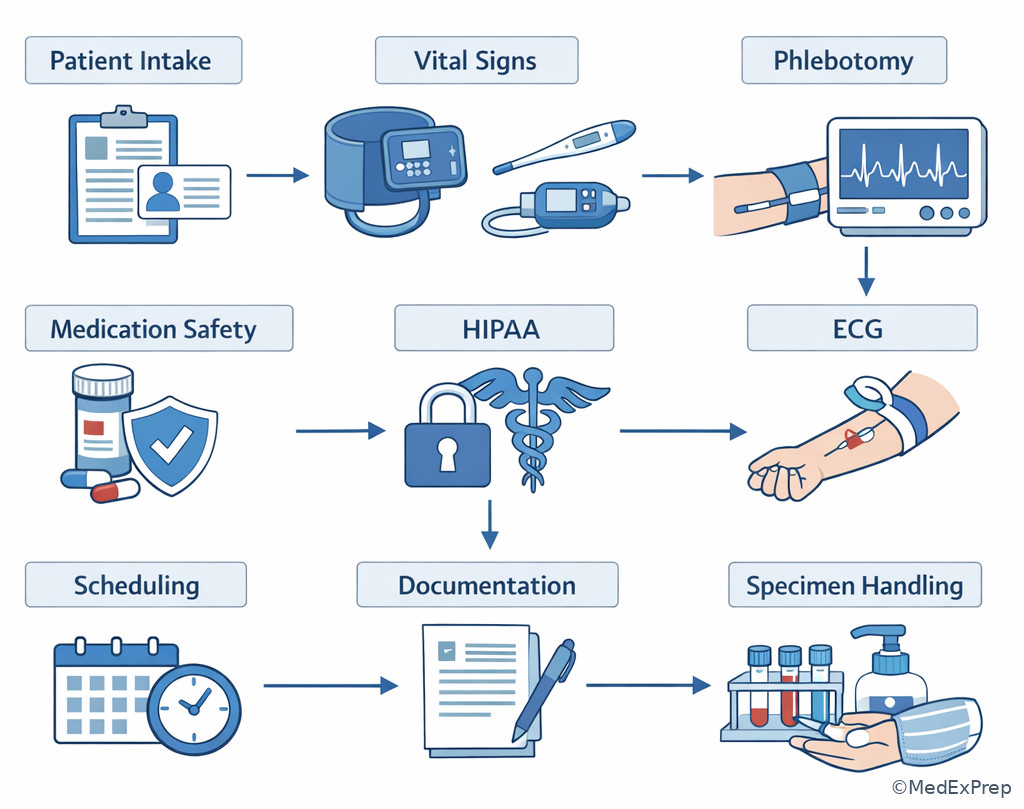
Key Terms & Must-Know Facts
1.1.1.1 Key terms
- Domain: a broad tested competency area
- Subskill: a narrower, teachable task within a domain
- Blueprint: the exam content outline used to organize preparation
- Scope of practice: what the medical assistant may do under policy, law, training, and supervision
- Delegated task: a duty assigned by an authorized provider within legal and policy limits
- Escalation: notifying the provider or following protocol when findings or tasks exceed role limits
- Specimen integrity: maintaining correct collection, labeling, handling, and transport
- Chain of workflow: the ordered sequence from patient identification to documentation
- Clinical support task: assistant-level action such as rooming, vitals, ECG acquisition, or specimen collection
- Administrative support task: scheduling, chart workflow, referrals, payment processes, records tasks
- Standard precautions: infection-control practices used for all patients
- Documentation accuracy: truthful, timely, complete charting of what was done and observed
- Best next step: the safest immediate action based on role, protocol, and the stem details
1.1.1.2 Must-know facts
- The CCMA candidate works in ambulatory/outpatient settings under supervision.
- The exam commonly tests what the medical assistant should do next, not what diagnosis to make.
- If a question asks for diagnosis, interpretation, prescribing, or treatment planning, that is a scope warning.
- Patient identification comes before specimen collection, medication administration, testing, and documentation.
- Safety beats speed when answers compete.
- Correct action often includes verify, report, document, escalate.
- Clinical and administrative tasks are both testable and often blended in the same vignette.
- Follow current facility policy and applicable law whenever state or employer rules may vary.
| Study map term | What it signals on the exam | Best candidate action |
|---|---|---|
| Outpatient workflow | Sequence and prioritization question | Choose safest ordered step |
| Within scope | Delegated support task | Perform per protocol and document |
| Outside scope | Requires licensed judgment | Notify provider; do not improvise |
| Abnormal finding | Recognition and escalation item | Report promptly per protocol |
| Missing identifier/order | Safety stop item | Pause and verify before proceeding |
| Documentation discrepancy | Legal/ethics item | Correct per policy; never falsify |
Core content
1.1.1.3 Foundational exam map: what the domains actually organize
A Explanation
The first decision conflict is simple but heavily tested in disguised form: Should you treat a question as a content-memorization item or as a workflow-domain item? The rule that resolves it is this: if the stem describes a task in clinic, start by identifying the domain the task belongs to. For CCMA prep, the major map is not random anatomy facts; it is recurring outpatient responsibilities: patient care, diagnostic support, medication safety, administrative flow, law/ethics, and communication.
WHY THIS IS TESTED: candidates often miss easy points because they focus on one clinical detail and ignore the actual competency being assessed. A stem about a dizzy patient might really be a vital-sign escalation item, not a diagnosis item. A stem about a urine cup might really be a specimen labeling and integrity item, not a microbiology item.
Choose domain-first thinking when the scenario names a task the assistant performs. Reject diagnosis-first thinking when the answer choices move beyond delegated support actions. See Fig 2 for the decision filter that separates study domains into assistant-level action types.
Exam takeaway: First decide whether the stem tests assistant workflow, safety, or a provider-only function before selecting an answer.
flowchart LR
A[Question stem] --> B{What is being tested?}
B --> C[Assistant workflow task]
B --> D[Safety or documentation issue]
B --> E[Provider judgment issue]
C --> C1[Use protocol and sequence]
D --> D1[Stop unsafe step verify escalate document]
E --> E1[Do not diagnose or prescribe notify provider]
Memory anchor: D-S-S-D = Domain - Scope - Safety rule - Document. Use it anytime a stem feels crowded.
Recall: This is the first topic in the course, so there is no prior lesson to build from. Use this lesson as the organizing frame for every later topic: each new skill will attach to one or more domains in this map.
B Worked example
A 56-year-old patient with hypertension and type 2 diabetes arrives for a follow-up visit. The provider is running behind, the front desk mentions an unsigned refill request, and the patient says, “I feel shaky and skipped lunch.” The chart also shows she is due for routine lab work, and another assistant asks you to “just tell me if her glucose sounds okay after you run it.” The task is to determine the most appropriate study-domain lens for this stem.
Reasoning chain: Identify task -> several details are noise, but the assistant-level duties are intake, possible waived testing per order/policy, recognition of symptoms, and escalation if findings are concerning. Extract key facts -> outpatient setting, possible testing workflow, provider delay, symptomatic patient, tempting clue about independent interpretation. Apply rule -> the core issue is not diagnosis; it is domain sorting plus scope. Eliminate distractors -> “interpret result and advise treatment” is outside role; “ignore symptoms because refill is administrative” is unsafe. Verify -> this stem sits at the intersection of clinical workflow, waived testing support, and scope-aware escalation.
C Exam trap
Common wrong answer: Pick the option that sounds most clinically sophisticated, such as determining what diagnosis the symptoms suggest.
Why it is tempting: Board-style stems include real symptoms, so candidates feel pressure to “solve the disease.”
Single clue that eliminates it: The question is written from the medical assistant role in an outpatient clinic, so the correct answer must stay within delegated workflow and escalation rather than independent diagnosis or treatment planning.
D Checkpoint
Question: A practice item asks what the medical assistant should do after noticing a missing second identifier on a specimen label for a fasting lipid panel. Which domain lens should the learner apply first?
- Administrative billing workflow - tempting because orders and labels relate to office processes, but wrong because the immediate issue is specimen safety and identification, not reimbursement.
- Diagnostic testing/specimen integrity - tempting because the label is attached to a laboratory order, and right because the governing rule is patient identification before specimen handling.
- Pharmacology adverse effect monitoring - tempting because fasting can make some patients feel unwell, but wrong because no medication issue is presented.
- Provider diagnostic interpretation - tempting because test results will matter later, but wrong because the current problem occurs before testing and is not an interpretation task.
Answer: B
If you missed this: Review 1.1.1.1 Foundational exam map: what the domains actually organize — focus on sorting the stem by the immediate assistant task before chasing later clinical meaning.
Practitioner Action: Assess the actual task named in the stem. Intervene with the protocol tied to that domain. Refer provider-only interpretation or treatment decisions to the licensed clinician. Document the action taken, any held step, and the reason for escalation.
1.1.1.4 Scope boundaries inside the domain map
A Explanation
The next decision conflict is perform versus escalate. Many CCMA questions are not testing whether you know a process; they are testing whether you know who should do the next part. The single rule that resolves most scope items is this: if the action requires diagnosis, interpretation for treatment, prescribing, independent triage, informed-consent explanation by the licensed provider, or changing a plan of care, the medical assistant must reject that option and notify the provider or follow facility protocol.
WHY THIS IS TESTED: novice assistants often confuse “I know what this probably means” with “I am allowed to act on it.” The exam rewards safe role discipline. You may gather data, perform delegated tasks, reinforce provider instructions already given, and report urgent findings. You may not independently decide what the finding means for treatment.
See Fig 3. The safest exam habit is to scan answer choices for out-of-role verbs: diagnose, prescribe, interpret, decide final disposition, sign consent, or override an order. Those verbs are red flags.
Exam takeaway: When an answer choice crosses from data gathering into independent clinical judgment, reject it and escalate.
flowchart TD
A[Task in stem] --> B{Assistant-level?}
B -->|Yes| C[Obtain data prepare perform delegated task]
B -->|No| D[Notify provider follow protocol]
C --> E[Document accurately]
D --> E
D --> F[Examples: diagnose prescribe interpret for treatment sign consent]
C --> G[Examples: vitals ECG acquisition specimen labeling patient prep]
Key rule: A wrong answer can be medically sensible and still be wrong because it belongs to the provider, not the assistant.
Exam takeaway: Distinguish delegated support tasks from provider-only decisions to avoid high-frequency scope traps.
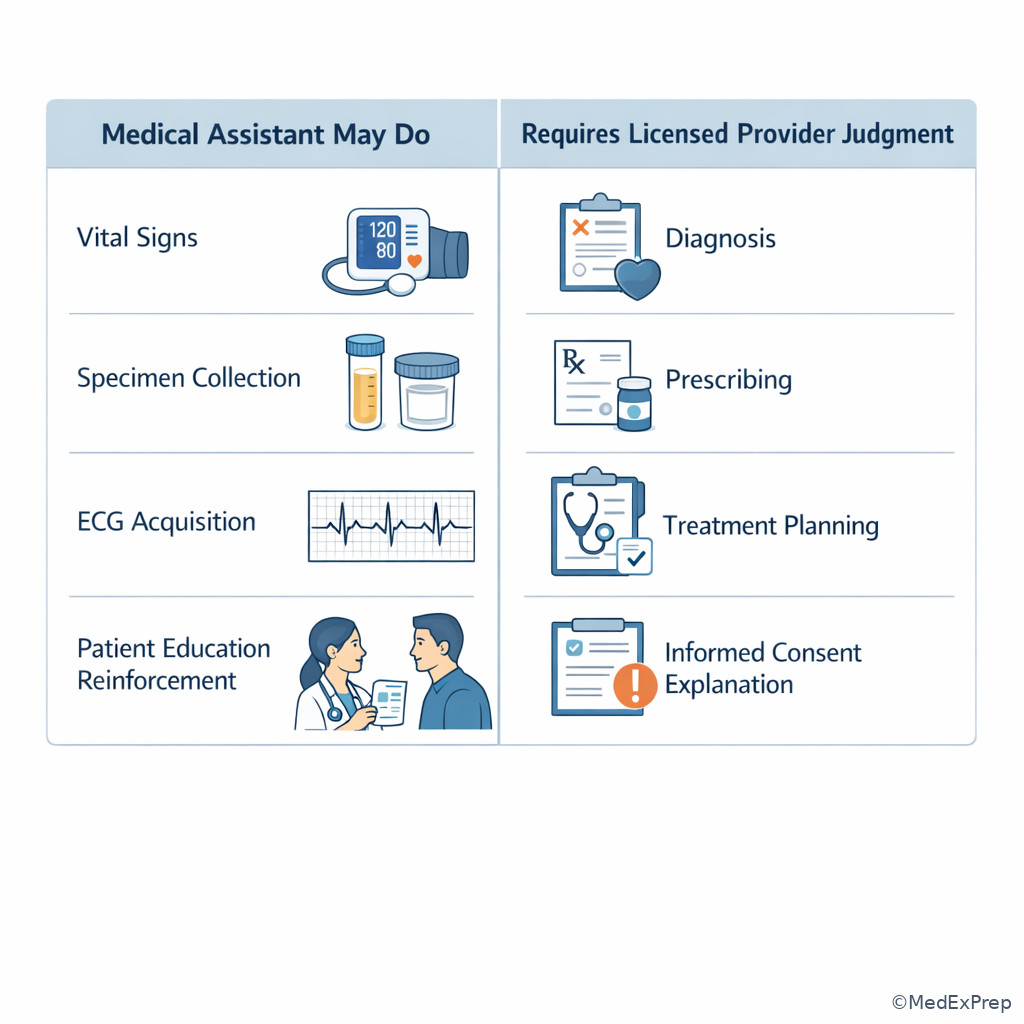
B Worked example
A 68-year-old man with COPD and coronary artery disease presents for shortness of breath. Pulse oximetry reads 89%, he appears anxious, and his daughter asks whether he is “having heart failure.” The ECG machine is available, and a new staff member says, “You know rhythms well; can you interpret it and tell the provider what this is before she comes in?” A recent note also mentions chronic ankle edema, which is a tempting-but-wrong clue toward independent diagnostic thinking.
Reasoning chain: Identify task -> recognize abnormal finding, obtain support data within role, and escalate promptly. Extract key facts -> dyspnea, low oxygen saturation, pressure to interpret, family asks for diagnosis. Apply rule -> the assistant may obtain ordered ECG, document vitals, and immediately report abnormal/urgent findings; the assistant may not diagnose heart failure or interpret the ECG for treatment decisions. Eliminate distractors -> “explain likely diagnosis to daughter” and “determine infarction type on ECG” are out of scope. Verify -> best next step stays inside role while moving care forward quickly.
C Exam trap
Common wrong answer: Interpret the ECG first so the provider gets a head start.
Why it is tempting: It feels efficient, team-oriented, and clinically advanced.
Single clue that eliminates it: The phrase “tell the provider what this is” asks for independent interpretation for clinical decision-making, which exceeds assistant-level scope.
D Checkpoint
Question: Which action best stays within CCMA scope in an outpatient office?
- Explain the likely diagnosis after reviewing the patient's symptoms - tempting because patients want answers, but wrong because diagnosis requires licensed clinician judgment.
- Adjust the timing of a prescribed medication when the patient reports dizziness - tempting because it seems like a practical safety fix, but wrong because medication changes require authorization.
- Obtain vital signs, document symptoms, and notify the provider of abnormal findings - tempting because it may feel incomplete, and right because it matches assistant-level data gathering and escalation.
- Sign the informed consent form after giving a brief explanation of the procedure risks - tempting because the assistant is present and can review paperwork, but wrong because provider explanation and consent authority are not assistant functions.
Answer: C
If you missed this: Review 1.1.1.2 Scope boundaries inside the domain map — focus on rejecting answer choices that require independent diagnosis, prescribing, interpretation, or consent authority.
Practitioner Action: Assess whether the task requested is delegated and authorized. Intervene only with assistant-level actions such as obtaining data, preparing equipment, or carrying out protocol. Refer abnormal interpretation, medication changes, consent explanation, and treatment decisions to the provider. Document the observed findings and that the provider was notified.
- True or False: If the medical assistant knows what an abnormal finding likely means, independent treatment advice is acceptable. False.
- The safest response to a provider-only task in an answer choice is to escalate/notify the provider.
- Name 3 out-of-role signals: diagnose, prescribe, interpret for treatment.
High-Yield Connection: This concept is tested alongside Medical Assistant Scope Boundaries and later with ECG Workflow Escalation. Know both the technical task you may perform and the interpretation step you may not claim.
1.1.1.5 Application map: where common CCMA question types live
A Explanation
Once you know the major domains and the scope screen, the next conflict becomes Which rule set should I activate for this scenario? This is where many learners improve quickly. Most CCMA stems cluster into a handful of practical question types: sequence, safety stop, abnormal finding escalation, documentation accuracy, specimen integrity, medication verification, and communication professionalism.
WHY THIS IS TESTED: the exam reflects real clinic workflow. A medical assistant moves between intake, room prep, venipuncture, waived testing, front-office communication, and charting. Test writers therefore combine domains on purpose. The clue that resolves the question is usually the single highest-priority rule: identify the patient, verify the order, maintain asepsis, label at bedside, protect confidentiality, or report urgent findings.
See Fig 4 for a comparison grid that compresses how common stem patterns map to actions. This type of visual is useful because several paragraphs of prose can often be reduced to one “if stem says this, think this” structure.
Exam takeaway: Most CCMA questions are solved by matching the stem to one priority rule such as identification, escalation, specimen integrity, or documentation.
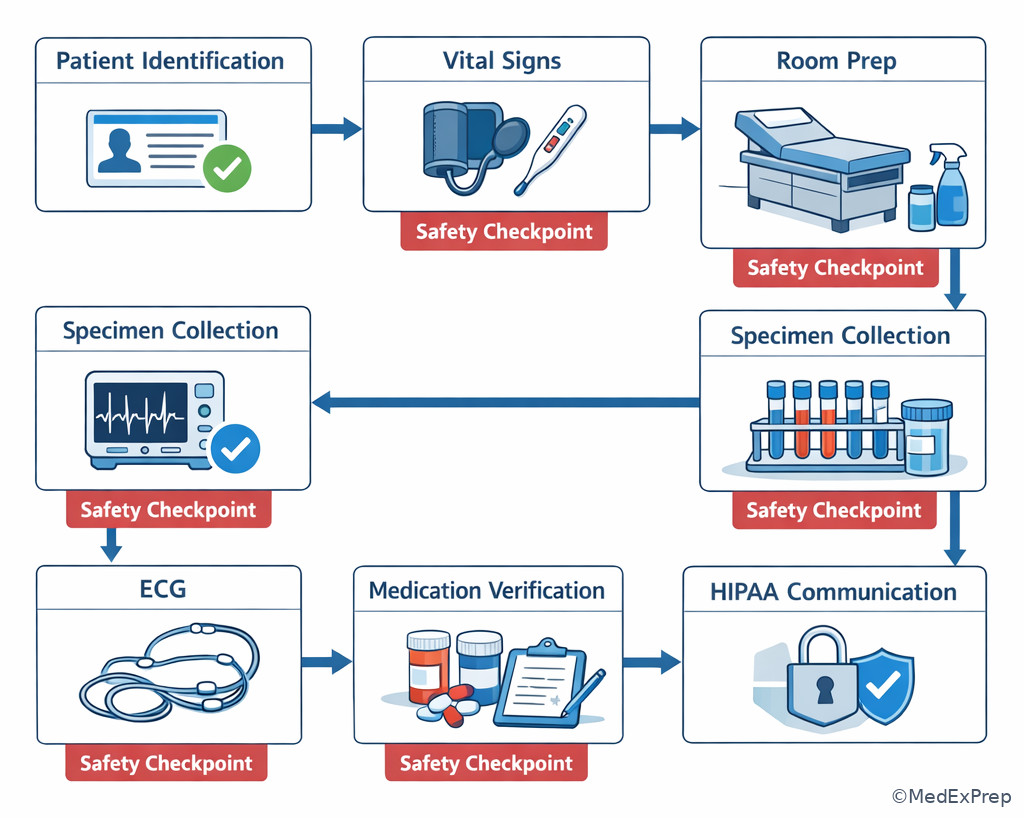
| Common stem pattern | Primary domain | Single resolving rule | Best next action |
|---|---|---|---|
| Wrong or incomplete label | Diagnostic testing/specimens | Use 2 identifiers before collection/labeling | Stop and verify |
| Abnormal vital sign or urgent symptom | Clinical patient care | Recognize and escalate | Notify provider promptly |
| Unclear medication order | Medication safety | Never guess or alter the order | Clarify per policy before administration |
| Family asks for diagnosis | Communication/law/scope | Do not independently diagnose | Refer to provider |
| Rushed room turnover and charting delay | Administrative workflow + documentation | Accurate, timely documentation only | Document what was actually done |
| Needlestick or exposure | Safety/infection control | Follow exposure-control protocol immediately | Perform first aid and report |
Exam takeaway: Safety checkpoints in specimen handling and charting often determine the correct answer more than the clinical complaint does.
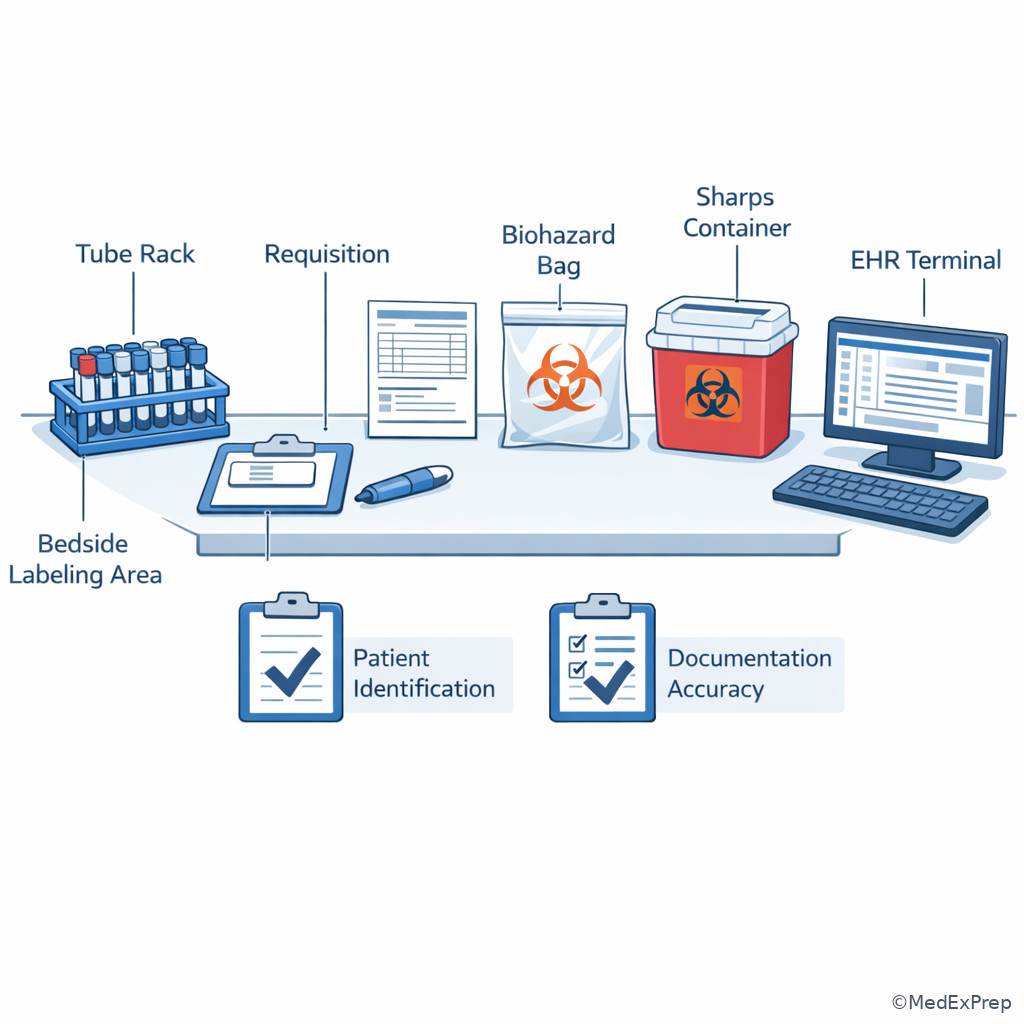
B Worked example
A 24-year-old patient with asthma and anxiety arrives for a school physical. The provider ordered a urine pregnancy test and routine immunization review. During intake, the patient says she is late for work, the waiting room is full, and another staff member offers to label the specimen cup after the patient uses the restroom “to save time.” The patient also asks whether a positive result would mean she must stop all medications immediately, which is a tempting diagnostic/management distraction.
Reasoning chain: Identify task -> this is primarily a specimen-handling and workflow-safety question. Extract key facts -> time pressure, another staff member proposes delayed labeling, patient requests treatment advice. Apply rule -> patient identification and correct specimen labeling take priority; counseling on medication changes is not independent MA decision-making. Eliminate distractors -> delayed labeling and speculative medication guidance are unsafe. Verify -> the correct action is to use proper identification and labeling workflow and refer treatment questions to the provider.
C Exam trap
Common wrong answer: Accept the delayed-labeling shortcut because the clinic is busy and the patient is in a hurry.
Why it is tempting: Time pressure is realistic, and the shortcut looks efficient without appearing reckless.
Single clue that eliminates it: Any answer that separates specimen collection from immediate correct patient identification and labeling risks misidentification and should be rejected.
D Checkpoint
Question: A learner sees a stem about a busy clinic, a missing order clarification, and a scheduled injection. Which rule should be activated first?
- Proceed because the schedule is full - tempting because workflow pressure is real, but wrong because speed never overrides order verification.
- Clarify the order before administration - tempting because it may delay care, and right because medication safety depends on complete and valid verification.
- Ask the patient to decide whether the injection seems correct - tempting because the patient may know their routine, but wrong because order validation cannot be delegated to the patient.
- Document administration now and correct details later - tempting because chart completion matters, but wrong because documentation must reflect actual completed care only.
Answer: B
If you missed this: Review 1.1.1.3 Application map: where common CCMA question types live — focus on matching the stem trigger to the highest-priority rule set.
Practitioner Action: Assess the cue that creates risk: missing identifier, unclear order, abnormal result, or privacy issue. Intervene with the matching protocol. Refer diagnostic or treatment questions to the provider. Document the verified data and any clarification or notification made.
1.1.1.6 Integration map: how domains overlap in real outpatient scenarios
A Explanation
The final foundational conflict is single-domain thinking versus integrated workflow thinking. Real exam items often test two or three domains at once. For example, a patient with chest discomfort may trigger patient care, ECG workflow, communication, documentation, and escalation. A vaccine question may involve medication verification, patient identification, documentation, and scope policy. The single resolving rule is to choose the answer that protects safety while staying inside role and maintaining workflow integrity.
WHY THIS IS TESTED: outpatient work is not siloed. A medical assistant may greet the patient, verify identity, obtain vitals, perform an ECG, document findings, and notify the provider in minutes. The exam therefore favors candidates who can integrate domains instead of memorizing them separately. See Fig 5 for the algorithm that helps you handle these multi-domain stems.
In integrated stems, ask four questions in order: What is the immediate risk? What action is within scope? What must be escalated? What must be documented? If two answers seem safe, choose the one that preserves the most critical control point: identification, infection control, urgent reporting, or accurate records.
Exam takeaway: In multi-domain stems, choose the action that preserves the key safety control point while staying within scope.
flowchart TD
A[Integrated clinic scenario] --> B{Immediate risk?}
B --> C[Urgent finding]
B --> D[Identification or specimen issue]
B --> E[Order or medication issue]
B --> F[Privacy or documentation issue]
C --> G[Report promptly and follow protocol]
D --> H[Stop verify relabel only per policy]
E --> I[Clarify before proceeding]
F --> J[Protect confidentiality and chart accurately]
G --> K[Document actions]
H --> K
I --> K
J --> K
Memory anchor: R-S-E-D = Risk - Scope - Escalate - Document. Use it when one question blends several domains.
High-Yield Connection: This concept overlaps with Outpatient Workflow Priorities, Patient Identification Standards, and Medication Error Response. On exam day, the same stem may test all three at once.
B Worked example
A 72-year-old patient with atrial fibrillation, chronic kidney disease, and hearing impairment arrives for a follow-up. He reports chest pressure while being roomed. The chart contains an unsigned medication refill message, the provider has already requested an ECG for another patient, and the patient's daughter tries to answer every question for him. An inexperienced coworker suggests finishing the refill note first because “the provider asked about that this morning.”
Reasoning chain: Identify task -> integrated urgent outpatient scenario. Extract key facts -> chest pressure is the immediate risk; hearing impairment and refill message are noise relative to urgency; daughter speaking over patient raises communication considerations; another ECG request creates workflow distraction. Apply rule -> urgent symptom recognition and prompt escalation come before nonurgent administrative tasks. An ECG may be obtained per protocol/order, but the assistant does not interpret it independently. Eliminate distractors -> completing refill paperwork first, privately guessing the cause of chest pain, or delaying to clear the queue all fail the priority test. Verify -> best action sequence is urgent reporting, support task preparation, patient safety, and accurate documentation.
C Exam trap
Common wrong answer: Finish the older administrative request first because it was mentioned earlier by the provider.
Why it is tempting: It sounds organized and responsive to team workflow.
Single clue that eliminates it: The stem includes current chest pressure, which creates an immediate patient-care priority that outranks routine administrative tasks.
D Checkpoint
Question: In a multi-domain stem, which option is most likely correct when several tasks compete?
- The option that clears the backlog fastest - tempting because outpatient clinics value efficiency, but wrong because speed is secondary to safety and scope.
- The option that interprets the data most completely - tempting because thoroughness feels clinical, but wrong when interpretation exceeds the assistant role.
- The option that addresses the highest-risk control point first - tempting because it may delay other tasks, and right because exam items prioritize safety-critical sequence.
- The option that satisfies the most people in the room - tempting because communication matters, but wrong because patient safety and protocol outrank convenience or preference.
Answer: C
If you missed this: Review 1.1.1.4 Integration map: how domains overlap in real outpatient scenarios — focus on identifying the highest-risk control point before acting on lower-priority tasks.
Practitioner Action: Assess which problem is most dangerous right now. Intervene with the immediate assistant-level step that protects safety. Refer urgent evaluation, interpretation, and treatment decisions to the provider without delay. Document symptoms reported, findings obtained, who was notified, and what support actions were completed.
- If the stem says busy clinic + missing label, think identification/specimen integrity.
- True or False: The most detailed clinical explanation is usually the best CCMA answer. False.
- Name the 4-step integrated screen: Risk, Scope, Escalate, Document.
Exam Traps & Differentiators
Most common wrong answer and why: choosing the action a licensed clinician would take rather than the action an assistant should take. This is tempting because the wrong option often sounds more knowledgeable or decisive.
| Looks similar | But isn't | Discriminator |
|---|---|---|
| Obtaining an ECG | Interpreting an ECG for infarction type | Acquisition may be delegated; diagnostic interpretation is provider-level |
| Reinforcing provider instructions | Creating new treatment advice | Reinforcement repeats authorized guidance; new recommendations exceed scope |
| Clarifying an incomplete order | Editing the order independently | Clarification protects safety; changing the order is not assistant authority |
| Documenting observed facts | Charting what should have happened | Only actual performed actions and observed findings belong in the record |
| Reporting abnormal findings | Deciding final disposition | Escalation is within scope; disposition decisions are not |
If the stem says...
- “The patient asks what the result means” -> think scope/communication boundary
- “The clinic is busy and another staff member suggests a shortcut” -> think safety stop and protocol over speed
- “The order is unclear, incomplete, or missing” -> think verify before proceeding
- “Abnormal vital sign, chest pain, dyspnea, syncope, severe reaction” -> think recognize urgent finding and escalate promptly
- “Specimen label, requisition, bedside collection, tube handling” -> think patient identification and specimen integrity
- “Family member asks for information in the room or by phone” -> think privacy and authorized communication
Related traps will become more visible when you study Medical Assistant Scope Boundaries and Outpatient Workflow Priorities. Those topics deepen the confusable pair tested here: safe delegated action versus provider-only judgment.
Exam takeaway: Common distractors often pair workflow pressure with a tempting shortcut that breaks identification, scope, or documentation rules.
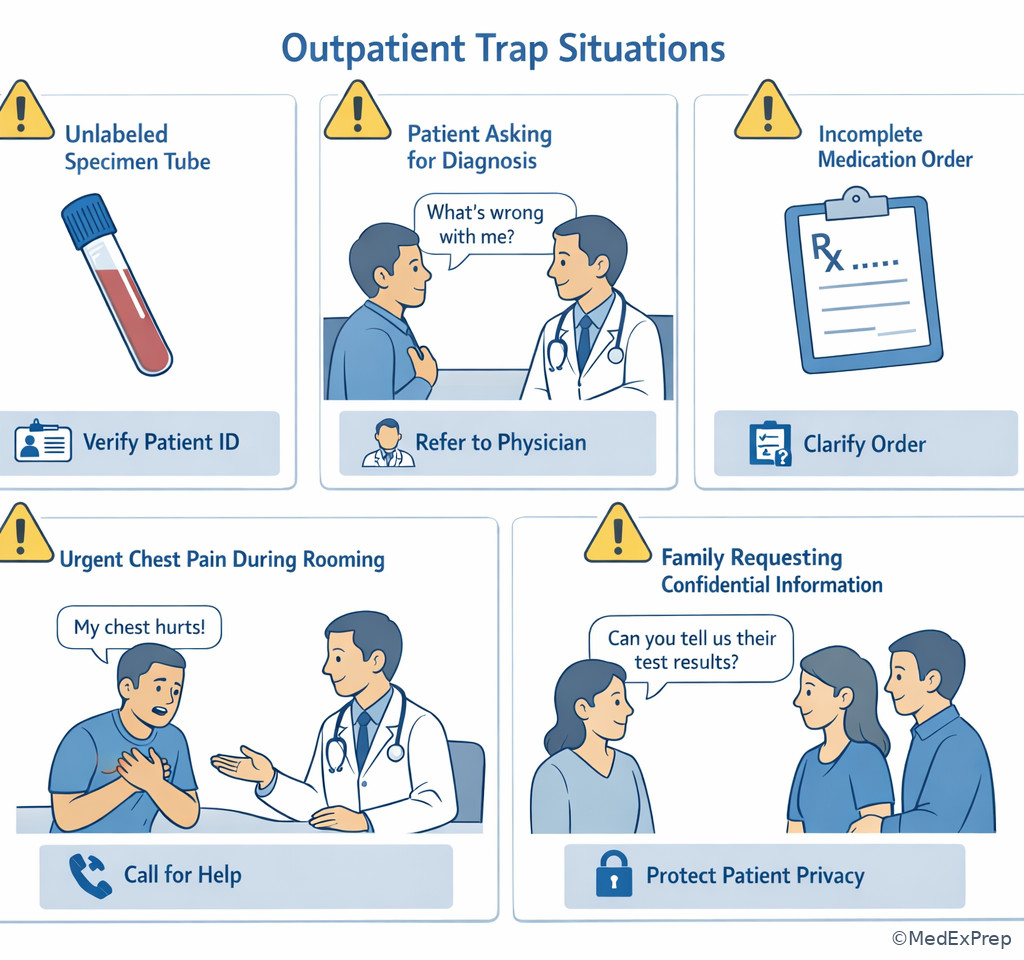
Review connection: The traps above test scope-aware best-next-step reasoning. If any felt unfamiliar, revisit 1.1.1.2 Scope boundaries inside the domain map and 1.1.1.4 Integration map: how domains overlap in real outpatient scenarios before attempting the Self-check quiz.
Algorithm / Approach
Exam takeaway: A repeatable solve sequence prevents distractors from pulling you toward unsafe shortcuts or scope violations.
flowchart LR
A[Read stem] --> B[Name the domain]
B --> C[Spot the highest-risk clue]
C --> D{Within MA scope?}
D -->|Yes| E[Perform protocol step]
D -->|No| F[Notify provider or follow escalation protocol]
E --> G[Document]
F --> G
Use the sequence in Fig 6 during practice questions until it becomes automatic. This approach matters even more in later lessons when stems add vital sign thresholds, specimen rejection details, medication checks, and ECG troubleshooting.
Rapid Review
- Domain map -> organize by task cluster, not by random memorization
- Best next step -> choose the safest immediate action, not the most advanced explanation
- Scope boundary -> assistant gathers data and reports; provider interprets for treatment
- Busy clinic stem -> speed never outranks patient identification or order verification
- Specimen question -> labeling and identifiers beat workflow convenience
- Medication question -> unclear order means clarify before proceeding
- Urgent symptom -> escalation outranks routine paperwork
- Documentation item -> chart only what was observed or performed
- Patient asks what result means -> reinforce authorized instructions or refer to provider
- Integrated stem -> protect the highest-risk control point first
- Competitive distractor -> often correct for another role, not for the MA
- Exam strategy -> Domain, Scope, Safety rule, Document
Memory anchor: STOP = Scope, Task, Order/identifier, Protect the patient. If an answer skips one of these, be suspicious.
Self-check quiz
1. A learner reviews a practice question about bedside specimen labeling with two patient identifiers. Which exam domain is most directly being tested?
- Diagnostic testing and specimen workflow
- Provider diagnostic reasoning
- Surgical consent counseling
- Medication dose adjustment
2. During rooming, a 47-year-old patient with migraine history and hypertension asks the medical assistant to explain whether today's symptoms mean a stroke. The clinic is busy, and the provider is running late. Which action is most appropriate?
- Explain the most likely diagnosis to reduce the patient's anxiety
- Obtain and document findings, then notify the provider
- Advise the patient to take an extra antihypertensive dose
- Sign the consent for urgent imaging if the patient agrees
3. A 31-year-old patient with asthma and obesity presents for a follow-up. A urine specimen has been collected, but the cup was set on the counter without a label while the patient answers a phone call. Another assistant says the patient is the only one in the room, so the label can be added later. Which is the most appropriate next step?
- Label the specimen after the patient leaves to keep the visit on time
- Discard or handle the specimen per policy and re-verify identity before recollection if required
- Send the specimen immediately because the requisition is already printed
- Ask the patient whether the cup is definitely hers and document her verbal confirmation
4. A 66-year-old patient with diabetes and chronic kidney disease arrives for a medication injection ordered earlier in the week. The order in the chart is incomplete and lacks one required element. The patient states, “I get this all the time,” and the schedule is full. Which action best fits CCMA exam expectations?
- Proceed because the patient confirms the usual medication
- Hold the administration and clarify the order per policy
- Select the dose used at the last visit and document the rationale
- Ask another assistant which version of the order is normally used
5. A 59-year-old patient with COPD and coronary artery disease reports chest tightness while being roomed for a routine appointment. Oxygen saturation is 88%, and the patient's spouse asks whether it is probably anxiety because he had a stressful drive. Which action is most appropriate?
- Reassure the spouse that stress is the most likely cause
- Complete the intake form first so the chart is ready
- Promptly report the abnormal finding and follow office escalation protocol
- Interpret the rhythm strip before contacting the provider
6. A 73-year-old patient with atrial fibrillation, hearing impairment, and recent dizziness presents for follow-up. While you obtain vital signs, the daughter asks for the patient's lab results and says she usually manages everything. The patient is alert and has not indicated permission to share information. Which is the most appropriate next step?
- Review the results with the daughter because she appears involved in care
- Ask the patient for permission before discussing protected information
- Provide a general interpretation without naming the exact results
- Hand the daughter a printed copy because family support improves compliance
7. A 52-year-old patient with obesity, type 2 diabetes, and a history of vasovagal episodes presents for fasting blood work. During venipuncture preparation, the patient becomes pale and says he feels faint. The provider is with another patient, and a coworker suggests drawing quickly before the patient “works himself up.” Which action is most appropriate?
- Proceed quickly to finish the draw before symptoms worsen
- Stop the procedure, protect the patient from injury, and follow office protocol for a symptomatic patient
- Tell the patient to take deep breaths while you continue the draw
- Complete the collection, then document that the patient tolerated it poorly
8. A 62-year-old patient with hypertension and GERD is roomed for follow-up and reports new left-sided chest pressure. At the same moment, the front desk calls about a referral authorization expiring today, and another medical assistant asks you to interpret a just-completed ECG because the provider is delayed. Which is the most appropriate next step?
- Call the insurer first because the referral deadline will pass soon
- Interpret the ECG so the provider can act faster when available
- Report the chest pressure immediately and assist with urgent workflow per protocol
- Finish the rooming questions before interrupting the provider
Answer key
1.1.1.7 1. Answer: A
A. Diagnostic testing and specimen workflow - tempting because bedside labeling and identifiers clearly belong to specimen handling, and correct because the immediate tested competency is specimen integrity and patient identification. Single clue: “bedside specimen labeling with two patient identifiers.” Source: CLSI specimen labeling and patient identification standards; Kinn's The Medical Assistant.
B. Provider diagnostic reasoning - tempting because lab specimens eventually support diagnosis, but incorrect because the question asks about collection workflow, not interpretation. Single clue: no results or diagnostic decision are present.
C. Surgical consent counseling - tempting only because identifiers also matter in consent processes, but incorrect because there is no procedure-consent scenario. Single clue: specimen label, not consent form.
D. Medication dose adjustment - tempting because patient identifiers matter before medication administration too, but incorrect because no medication issue appears in the stem. Single clue: specimen labeling language points to testing workflow.
If you missed this: Review 1.1.1.1 Foundational exam map: what the domains actually organize — focus on matching the stem's immediate task to the correct domain before solving.
1.1.1.8 2. Answer: B
A. Explain the most likely diagnosis to reduce the patient's anxiety - tempting because it sounds compassionate and efficient, but incorrect because diagnosing or independently explaining likely causes exceeds assistant scope. Single clue: the patient asks whether symptoms “mean a stroke.” Source: NHA-aligned MA role boundaries; AMT/AAMA role expectations; Kinn's The Medical Assistant.
B. Obtain and document findings, then notify the provider - tempting because it may feel less satisfying to the patient than giving an answer, and correct because it keeps the MA within scope while moving evaluation forward. Single clue: outpatient MA role plus possible urgent neurologic concern.
C. Advise the patient to take an extra antihypertensive dose - tempting because blood pressure is related to stroke risk, but incorrect because medication adjustment requires provider authorization. Single clue: independent treatment advice is outside role.
D. Sign the consent for urgent imaging if the patient agrees - tempting because the assistant may help with paperwork, but incorrect because consent explanation/authorization is not the MA's independent function. Single clue: signing consent is provider-level or policy-restricted.
If you missed this: Review 1.1.1.2 Scope boundaries inside the domain map — focus on data gathering and escalation versus diagnosis or treatment advice.
1.1.1.9 3. Answer: B
A. Label the specimen after the patient leaves to keep the visit on time - tempting because it preserves workflow speed, but incorrect because delayed labeling creates misidentification risk. Single clue: the cup sat unlabeled on the counter. Source: CLSI GP33 and specimen labeling standards; OSHA/quality safety principles.
B. Discard or handle the specimen per policy and re-verify identity before recollection if required - tempting because it slows the visit and may inconvenience the patient, and correct because specimen integrity and patient identification take priority over convenience. Single clue: unlabeled specimen outside immediate identification control.
C. Send the specimen immediately because the requisition is already printed - tempting because paperwork exists, but incorrect because a requisition does not replace proper bedside labeling and verified identity. Single clue: the specimen itself lacks a secure identifier.
D. Ask the patient whether the cup is definitely hers and document her verbal confirmation - tempting because the patient is present and cooperative, but incorrect because verbal reassurance does not correct a broken specimen-control process. Single clue: the label lapse already occurred.
If you missed this: Review 1.1.1.3 Application map: where common CCMA question types live — focus on specimen integrity outranking time pressure.
1.1.1.10 4. Answer: B
A. Proceed because the patient confirms the usual medication - tempting because returning patients often know their regimen, but incorrect because patient recollection does not replace a complete, valid order. Single clue: “order in the chart is incomplete.” Source: medication safety rights/checks; Kinn's The Medical Assistant; outpatient medication administration standards.
B. Hold the administration and clarify the order per policy - tempting because it causes delay, and correct because incomplete orders must be clarified before medication administration. Single clue: the missing required order element.
C. Select the dose used at the last visit and document the rationale - tempting because continuity can feel safe, but incorrect because the assistant cannot independently reconstruct or change the order. Single clue: prior dosing history is not current authorization.
D. Ask another assistant which version of the order is normally used - tempting because peers know office routines, but incorrect because peer recollection is not valid order clarification. Single clue: clarification must follow authorized policy/provider process.
If you missed this: Review 1.1.1.3 Application map: where common CCMA question types live — focus on unclear or incomplete order means verify before proceeding.
1.1.1.11 5. Answer: C
A. Reassure the spouse that stress is the most likely cause - tempting because anxiety can mimic cardiopulmonary symptoms, but incorrect because the MA should not dismiss urgent findings with independent explanation. Single clue: chest tightness plus oxygen saturation of 88%. Source: outpatient urgent escalation standards; basic pulse oximetry and symptom escalation guidance.
B. Complete the intake form first so the chart is ready - tempting because organized charts help the provider, but incorrect because urgent symptoms outrank routine paperwork. Single clue: low oxygen saturation indicates higher priority.
C. Promptly report the abnormal finding and follow office escalation protocol - tempting because it interrupts workflow, and correct because the abnormal symptom/vital combination requires immediate provider awareness. Single clue: symptomatic patient with SpO2 88%.
D. Interpret the rhythm strip before contacting the provider - tempting because extra data may help, but incorrect because independent interpretation is outside scope and should not delay escalation. Single clue: “before contacting the provider” delays the needed report.
If you missed this: Review 1.1.1.4 Integration map: how domains overlap in real outpatient scenarios — focus on urgent symptoms outrank routine completion tasks.
1.1.1.12 6. Answer: B
A. Review the results with the daughter because she appears involved in care - tempting because family caregivers are often heavily involved, but incorrect because apparent involvement does not equal authorization to disclose protected information. Single clue: the patient has not indicated permission. Source: HIPAA privacy principles and patient authorization standards.
B. Ask the patient for permission before discussing protected information - tempting because it adds a step, and correct because patient authorization or policy-supported permission is the key discriminator in disclosure questions. Single clue: alert patient present and able to indicate preference.
C. Provide a general interpretation without naming the exact results - tempting because it seems less specific, but incorrect because even generalized discussion can disclose protected health information or imply interpretation. Single clue: still discussing lab information without permission.
D. Hand the daughter a printed copy because family support improves compliance - tempting because written information can support care, but incorrect because disclosure still requires patient permission or proper authorization. Single clue: no permission has been established.
If you missed this: Review 1.1.1.4 Integration map: how domains overlap in real outpatient scenarios — focus on privacy control points in multi-domain stems.
1.1.1.13 7. Answer: B
A. Proceed quickly to finish the draw before symptoms worsen - tempting because repeated venipuncture can be inconvenient and fasting patients may prefer to be done quickly, but incorrect because faintness/pallor signals a safety issue requiring the procedure to stop. Single clue: “becomes pale and says he feels faint.” Source: phlebotomy safety standards and vasovagal response protocols; CLSI venipuncture guidance.
B. Stop the procedure, protect the patient from injury, and follow office protocol for a symptomatic patient - tempting because it disrupts the schedule, and correct because patient safety and fall prevention outrank task completion. Single clue: active presyncopal symptoms during draw preparation.
C. Tell the patient to take deep breaths while you continue the draw - tempting because breathing cues sometimes reduce anxiety, but incorrect because continued phlebotomy during symptomatic decline is unsafe. Single clue: the patient is already pale and feeling faint.
D. Complete the collection, then document that the patient tolerated it poorly - tempting because documentation matters and a completed sample avoids recollection, but incorrect because documenting after an unsafe continuation does not fix the error. Single clue: safety action is needed before collection, not after.
If you missed this: Review 1.1.1.4 Integration map: how domains overlap in real outpatient scenarios — focus on when immediate patient safety overrides procedure completion.
1.1.1.14 8. Answer: C
A. Call the insurer first because the referral deadline will pass soon - tempting because expired authorizations create real administrative problems, but incorrect because current chest pressure is the higher-risk control point. Single clue: new left-sided chest pressure during rooming. Source: outpatient urgent symptom escalation principles; role-based prioritization in ambulatory care.
B. Interpret the ECG so the provider can act faster when available - tempting because it appears efficient and clinically helpful, but incorrect because ECG interpretation for decision-making is outside the MA role. Single clue: another assistant asks you to “interpret” it.
C. Report the chest pressure immediately and assist with urgent workflow per protocol - tempting because it interrupts other tasks and creates workflow strain, and correct because acute symptoms with potential urgency outrank referral and routine rooming tasks. Single clue: current chest pressure in the patient being roomed.
D. Finish the rooming questions before interrupting the provider - tempting because complete intake improves documentation, but incorrect because urgent symptoms should not wait for routine completion. Single clue: symptom timing is now, not historical only.
If you missed this: Review 1.1.1.4 Integration map: how domains overlap in real outpatient scenarios — focus on identifying the highest-risk control point when administrative and clinical tasks collide.
Keep going with the full CCMA (NHA) Prep Course (CCMA)
You just studied the way members do, in the same lesson interface. Full access unlocks every lesson, the question bank and flashcards for a full year.
One payment · 1 year of access · No auto-renewal