1.1.1 - CCA Scope And Role
CCA Scope And Role
What you'll learn
- Explain the entry-level CCA candidate role and identify what is inside vs outside coder scope.
- Choose the most appropriate action when documentation supports coding, does not support coding, or requires clarification.
- Differentiate coding work from diagnosis, treatment planning, compliance investigation, and payer-driven code selection.
- Apply documentation-based reasoning to common exam stems involving unsupported assumptions, scope limits, and ethical coding.
- Recognize how setting, documentation source, and official guidance control code assignment decisions.
- Inferred AHIMA CCA domain: Classification systems/coding methodology → documentation-based code selection
- Inferred AHIMA CCA domain: Health records/documentation → recognize reportable documentation and coder limits
- Inferred AHIMA CCA domain: Compliance/ethics → avoid unsupported coding, upcoding, and privacy breaches
- Inferred AHIMA CCA domain: Reimbursement basics → understand that payment awareness does not override official coding rules
Why it matters
- Many CCA questions are not asking for a code first; they are asking whether coding is even allowed from the documentation provided.
- Common distractors test scope confusion: a coder is expected to recognize a documentation problem, not diagnose, treat, or rewrite the record.
- Ethical coding is exam-relevant: choosing a more lucrative or more specific code without support is wrong even if clinically “likely.”
- Strong scope awareness improves every later topic: indexing, tabular verification, sequencing, outpatient vs inpatient logic, and query recognition.
Key Terms & Must-Know Facts
1.1.1.1 Key terms
- Documentation-based coding: Assign codes only from provider-supported, reportable documentation.
- Supported diagnosis: Condition documented by the appropriate provider and reportable under the applicable rules.
- Unsupported assumption: Filling in a diagnosis or detail not actually documented.
- Compliant query: A clarification request when documentation is incomplete, conflicting, or nonspecific for coding purposes.
- Principal diagnosis: Inpatient condition established after study to be chiefly responsible for admission.
- First-listed diagnosis: Outpatient diagnosis chiefly responsible for the encounter or service.
- Secondary diagnosis: Additional reportable condition meeting guideline criteria.
- Code set navigation: Using Index, Tabular, notes, conventions, and setting-specific rules correctly.
- Scope of practice: What the coder is expected and permitted to do in the role.
- Upcoding: Assigning codes that overstate severity or resources without support.
- Unbundling: Reporting separate codes when rules require a combined code or bundled reporting.
- Data integrity: Accuracy, consistency, and completeness of abstracted coded data.
- PHI: Protected health information subject to privacy and confidentiality rules.
1.1.1.2 Must-know facts
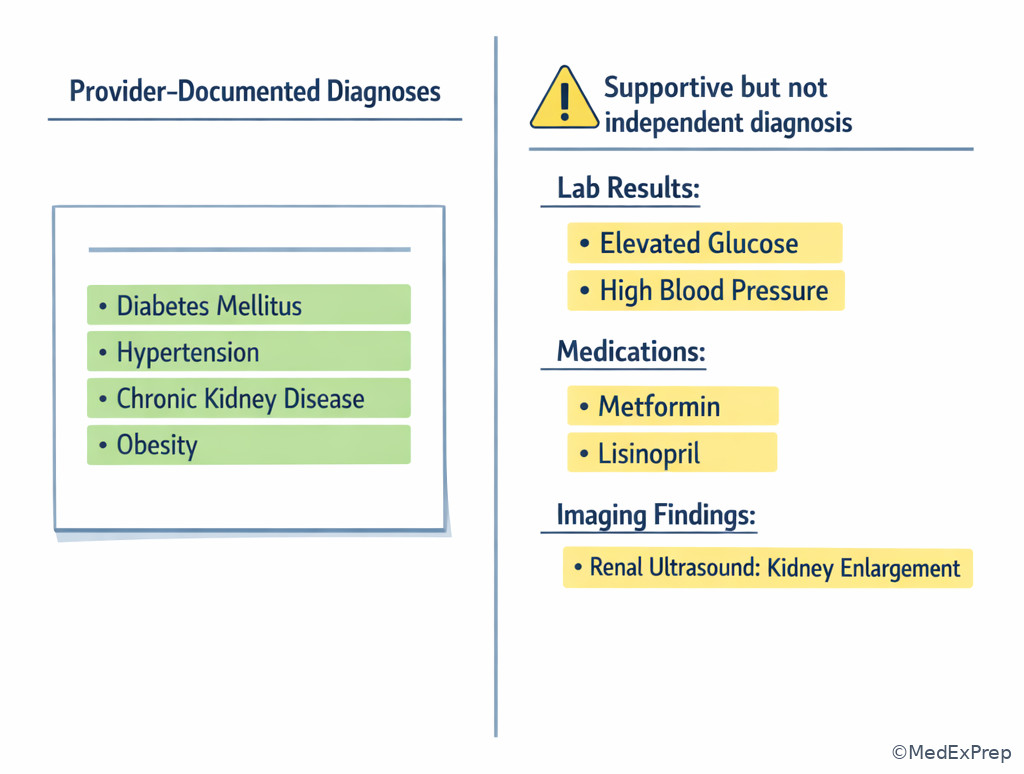
- Code what is documented and reportable; do not code what is merely suggested by labs, meds, or tests alone.
- A coder may recognize when documentation needs clarification; a coder may not independently diagnose the patient.
- Payer preference does not override official coding conventions and guidelines.
- Payment awareness is in scope conceptually; payment-driven code manipulation is not.
- When the record is incomplete or conflicting, the safe exam answer is often query/clarify/escalate rather than guess.
- Setting matters: inpatient principal diagnosis logic differs from outpatient first-listed logic.
- Privacy and confidentiality are always in scope, even when the item mainly tests coding logic.
- Official guidance comes before habit, memory, or what “usually happens clinically.”
Exam takeaway: Use this map to separate assign-code tasks from query, escalation, or out-of-scope actions.
flowchart TD
A[Read the record] --> B{Is the fact documented by an appropriate source?}
B -->|Yes| C{Is it reportable under the rules?}
C -->|Yes| D[Assign and sequence code]
C -->|No| E[Do not report it]
B -->|No| F{Can ambiguity be clarified compliantly?}
F -->|Yes| G[Query or escalate per policy]
F -->|No| H[Do not assume or create diagnosis] Exam takeaway: Visualize the coder's role as documentation review and abstraction, not diagnosis or treatment selection.
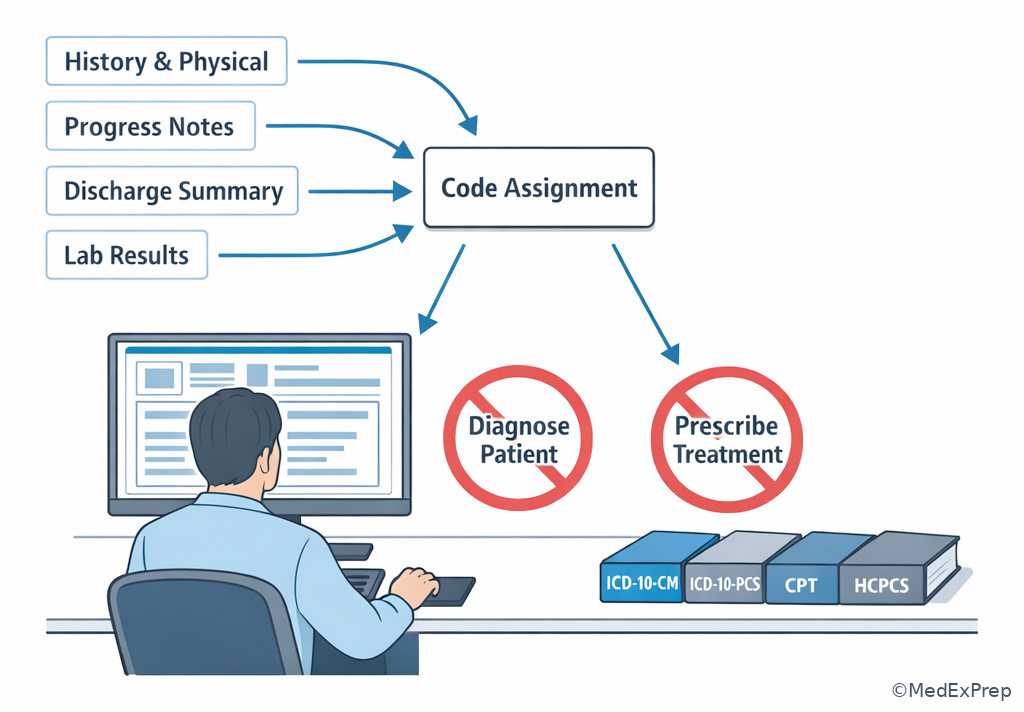
Core content
1.1.1.3 Foundational role: what the coder is expected to do
A Explanation
The first exam conflict is simple but heavily tested: assign a code versus recognize the coding task is not yet ready. An entry-level coding professional reviews the health record, identifies reportable diagnoses and procedures, applies official code-set rules, and sequences codes according to the setting. The coder does not diagnose conditions, write provider documentation, or choose codes just because they increase payment.
WHY THIS IS TESTED: Exam writers use realistic documentation noise to see whether you can separate what is documented and reportable from what is merely clinically suggestive. If the stem includes elevated troponin, insulin use, abnormal imaging, or a medication list, the key question is whether a provider actually documented the reportable diagnosis. Choose coding when documentation supports it; reject coding when the diagnosis would require inference.
For CCA scope, the default workflow is: review the task, review the record, identify documented facts, apply governing guideline, assign supported codes, and stop where support ends. See Fig 1 for the core decision pattern. Forward reference: the next lesson, Coding Problem-Solving Framework, turns this role into a repeatable exam method.
B Worked example
A 67-year-old inpatient with hypertension, chronic kidney disease stage 3, and obesity is admitted for chest pain. Troponin is mildly elevated, the ED note says “rule out NSTEMI,” cardiology notes “possible demand ischemia,” and the discharge summary states “chest pain due to GERD; myocardial infarction ruled out.” The record also lists aspirin, heparin infusion, and a stress test. The question asks for the coder’s most appropriate action regarding acute myocardial infarction coding.
Reasoning chain: Identify task: this is a documentation-support question, not a treatment question. Extract key facts: abnormal troponin and cardiac treatment are present, but the final diagnosis says MI was ruled out and attributes symptoms to GERD. Apply rule: code assignment must rest on provider documentation, not test results or treatment pattern alone. Eliminate distractors: “code NSTEMI because troponin was elevated” is tempting; “code demand ischemia because cardiology suggested it” is also tempting, but neither is the final supported diagnosis. Verify: report the supported final diagnoses and do not assign MI from clinical suspicion alone.
C Exam trap
D Checkpoint
Question: A coder reviews an outpatient record for a patient with COPD, diabetes, and a cough. Chest x-ray shows infiltrate, the medication list includes azithromycin, and the provider assessment states “cough; possible pneumonia.” What is the most appropriate coding action?
- A. Assign pneumonia because the x-ray and antibiotic support it.
- B. Assign cough as documented and do not assume pneumonia.
- C. Assign sepsis because infection treatment is underway.
- D. Assign acute lower respiratory failure because COPD and infiltrate are present.
Answer: B
- A: Tempting because the clinical picture fits pneumonia; wrong because coding cannot rest on imaging and treatment alone when the provider documented only “possible pneumonia.”
- B: Correct because it uses the documented supported symptom and rejects an unsupported diagnostic leap.
- C: Tempting because infection and treatment may suggest severity; wrong because sepsis is not documented.
- D: Tempting because COPD can confuse severity assessment; wrong because respiratory failure is not documented.
1.1.1.4 Foundational limits: what the coder must not do
A Explanation
The second foundational decision conflict is help the process versus cross the line. A coder should identify deficiencies, missing specificity, conflicting statements, and possible compliance risks. A coder must not fix those problems by inventing diagnoses, editing the physician’s meaning, selecting codes solely to optimize revenue, or disclosing PHI outside permitted use.
The exam frequently tests out-of-role actions that sound efficient. Examples include: choosing a code because the payer “usually wants it,” adding acute blood loss anemia from a low hemoglobin alone, rewriting a vague diagnosis into a more specific one, or selecting a higher-paying combination code without documentation support. Reject these. The coder’s job is not to make the chart “better”; it is to abstract what is supported, then query or escalate when needed.
WHY THIS IS TESTED: High-quality coding depends on data integrity. AHIMA-style entry-level reasoning expects you to protect the record, follow guidance, and avoid convenience shortcuts. See Fig 2 for a concise choose-vs-avoid framework.
Exam takeaway: Select clarification or supported coding, and avoid diagnosis, treatment, or payment-driven code selection.
flowchart LR
A[Documentation problem found] --> B[Choose: code supported facts]
A --> C[Choose: query or escalate]
A --> D[Avoid: diagnose from labs]
A --> E[Avoid: rewrite provider note]
A --> F[Avoid: code for higher payment only]
A --> G[Avoid: disclose PHI outside need-to-know]
B Worked example
A 72-year-old outpatient with heart failure, atrial fibrillation, and chronic anticoagulant use presents after a fall. The emergency department note states “contusion of hip; possible fracture.” Imaging later confirms a nondisplaced intertrochanteric fracture, but the provider note available to the coder before claim submission has not yet been updated. A supervisor mentions that the fracture code would better reflect resource use. The question asks for the coder’s best next step.
Reasoning chain: Identify task: determine appropriate coding action with incomplete support. Extract key facts: imaging suggests fracture, but provider documentation available for coding still says possible fracture and contusion. Apply rule: do not independently convert test findings into a final diagnosis when provider documentation is required. Eliminate distractors: coding the fracture for payment/resource logic is out of scope; coding only the contusion may still be incomplete if clarification is feasible. Verify: the best next step is compliant clarification or escalation according to policy before assigning the unsupported fracture diagnosis.
C Exam trap
D Checkpoint
Question: Which action is most clearly outside the entry-level CCA role?
- A. Recognize that conflicting diagnoses may require a compliant query.
- B. Apply official coding conventions before final code assignment.
- C. Select a more severe code because it better matches expected reimbursement.
- D. Abstract supported diagnoses from the discharge summary and progress notes.
Answer: C
- A: Tempting to reject because queries feel “advanced,” but recognizing clarification need is within coder scope.
- B: Tempting to overlook because it sounds basic; correct as an in-scope core duty, so it is not the answer.
- C: Correct because payment-driven selection without documentation/guideline support is noncompliant and outside proper role boundaries.
- D: Tempting because source hierarchy can confuse beginners; still within scope when documentation is reportable and supported.
- True or False: A coder may assign a diagnosis solely from an abnormal lab value. False.
- The safest response to missing required specificity is often query/escalate.
- Name the 3 forbidden shortcuts most often tested: diagnosing, rewriting documentation, payment-driven coding.
1.1.1.5 Application: documentation basis and safe decision points
A Explanation
Now move from role definition to record review decisions. The exam conflict here is enough support to code now versus not enough support yet. CCA-level stems frequently include multiple record elements: provider note, discharge summary, medication list, pathology, imaging, lab values, nursing documentation, and problem list. Your job is not to memorize a universal source hierarchy for every scenario; your job is to identify whether the item being coded is supported by an appropriate reportable source under standard coding guidance.
Use a disciplined question: “What exactly am I being asked to report?” If the answer is a diagnosis, ask whether that diagnosis is actually documented. If the answer is a procedure, ask whether the performed service is documented sufficiently to choose the correct code set and specificity. If the answer is sequencing, ask whether the setting changes the rule. If the answer is “best next step,” consider whether clarification is more compliant than guessing.
WHY THIS IS TESTED: The hardest beginner error is using the whole record as a cloud of evidence instead of extracting a single reportable fact. The record may suggest many things clinically; only some are codeable. See Fig 3 for a documentation-support algorithm.
Exam takeaway: When support is indirect or conflicting, clarification beats assumption.
flowchart TD
A[Question asks for code] --> B[Identify exact diagnosis or procedure]
B --> C{Explicitly documented?}
C -->|Yes| D{Specific enough and reportable?}
D -->|Yes| E[Assign code]
D -->|No| F[Query if needed by policy]
C -->|No| G{Supported only by labs, meds, test names?}
G -->|Yes| H[Do not infer]
G -->|No| I[Review remaining record and guidance]
B Worked example
A 54-year-old same-day surgery patient with type 2 diabetes, obstructive sleep apnea, and chronic opioid use undergoes arthroscopy. The anesthesia record documents postoperative hypoxia, nursing notes document oxygen saturation drops, and the discharge note states “transient hypoxia resolved.” A candidate is asked whether acute postoperative respiratory failure should be coded. A tempting wrong clue is that the patient required oxygen longer than expected.
Reasoning chain: Identify task: determine whether a serious diagnosis is supported for coding. Extract key facts: abnormal oxygen readings and extra monitoring are present, but the documented diagnosis is transient hypoxia, not respiratory failure. Apply rule: do not upgrade severity from clinical indicators alone. Eliminate distractors: postoperative respiratory failure may seem plausible because the patient has sleep apnea and opioid use; however, those comorbidities increase temptation without changing documentation support. Verify: code only what is documented and reportable; do not assign respiratory failure unless supported in the record.
C Exam trap
D Checkpoint
Question: A coder sees a medication list with insulin, metformin, and glucose monitoring supplies, but the provider note for the current visit documents only “hyperglycemia” and does not state diabetes. What is the most appropriate action?
- A. Assign diabetes mellitus because the medication profile proves it.
- B. Assign hyperglycemia as documented and do not infer diabetes from treatment history alone.
- C. Assign diabetic nephropathy because insulin implies longstanding disease.
- D. Assign personal history of diabetes because the medications suggest prior diagnosis.
Answer: B
- A: Tempting because chronic diabetes therapy strongly suggests the condition; wrong because the current documentation provided does not establish the diagnosis for coding in this question.
- B: Correct because it stays within supported documentation and rejects inference from meds alone.
- C: Tempting because comorbidity chaining is common in coding; wrong because neither diabetes nor nephropathy is documented.
- D: Tempting because candidates try to soften the inference into a history code; wrong because even the historical diagnosis is not actually documented here.
1.1.1.6 Application: setting, sequencing, and exam wording
A Explanation
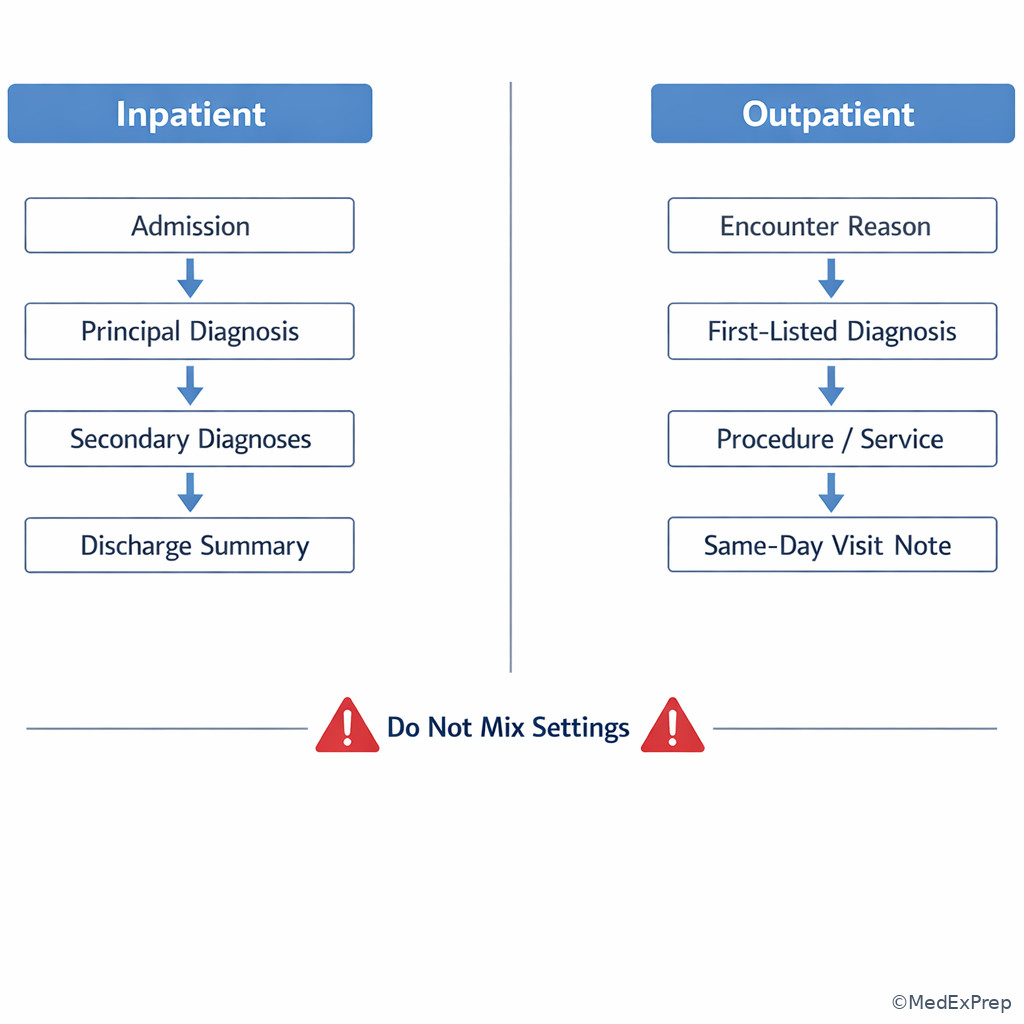
Another major scope decision is knowing what kind of coding question you are answering. Many errors come from mixing inpatient and outpatient logic or mixing diagnosis coding with procedure coding. On the CCA exam, stems may use words like principal diagnosis, first-listed diagnosis, secondary diagnosis, procedure code, modifier, or best next step. Those words tell you the rule set you need before you even look at the clinical content.
The coder’s role includes sequencing and setting awareness, but only within documentation support. If the question asks for a principal diagnosis, you are in inpatient framing. If it asks for first-listed diagnosis in the clinic, you are in outpatient framing. If the stem asks which code set or next step applies, your first job is not to choose the disease; it is to choose the governing logic. This is where many distractors in the upcoming lesson on question types will try to derail you.
WHY THIS IS TESTED: Candidates often know the condition but miss the asked task. When wording signals a setting-specific rule, that rule resolves the conflict. See Fig 4 for a fast comparison.
Exam takeaway: Distinguish the asked setting and sequencing term before selecting any code or next step.
B Worked example
A 63-year-old patient with coronary artery disease, chronic kidney disease, and tobacco dependence presents to a hospital-owned clinic for follow-up after recent hospitalization. The assessment lists stable angina and medication adjustment. The exam item asks for the first-listed diagnosis. A distracting clue is that the patient was recently admitted for acute coronary syndrome, making an inpatient mindset tempting.
Reasoning chain: Identify task: outpatient sequencing. Extract key facts: this is a clinic follow-up encounter, not an inpatient stay. Apply rule: use first-listed diagnosis logic for the reason chiefly responsible for the outpatient service. Eliminate distractors: principal diagnosis terminology belongs to inpatient coding; coding the prior admission diagnosis automatically ignores the current encounter reason. Verify: select based on documented current outpatient reason for service, not the recent hospitalization narrative alone.
C Exam trap
D Checkpoint
Question: Which stem cue most strongly tells you to think about sequencing under outpatient logic?
- A. “Condition chiefly responsible for admission after study”
- B. “Principal diagnosis”
- C. “First-listed diagnosis for today’s clinic visit”
- D. “Secondary diagnosis meeting reporting criteria during hospitalization”
Answer: C
- A: Tempting because it is a sequencing phrase; wrong because it signals inpatient principal diagnosis logic.
- B: Tempting because it is a familiar exam term; wrong because principal diagnosis is inpatient terminology.
- C: Correct because it directly names the outpatient sequencing concept.
- D: Tempting because it also involves sequencing; wrong because it refers to inpatient secondary diagnoses.
- “Principal diagnosis” belongs to inpatient logic.
- “First-listed diagnosis” belongs to outpatient logic.
- True or False: The most appropriate next step is always a code choice. False.
1.1.1.7 Integration: ethical coding, privacy, and data integrity
A Explanation
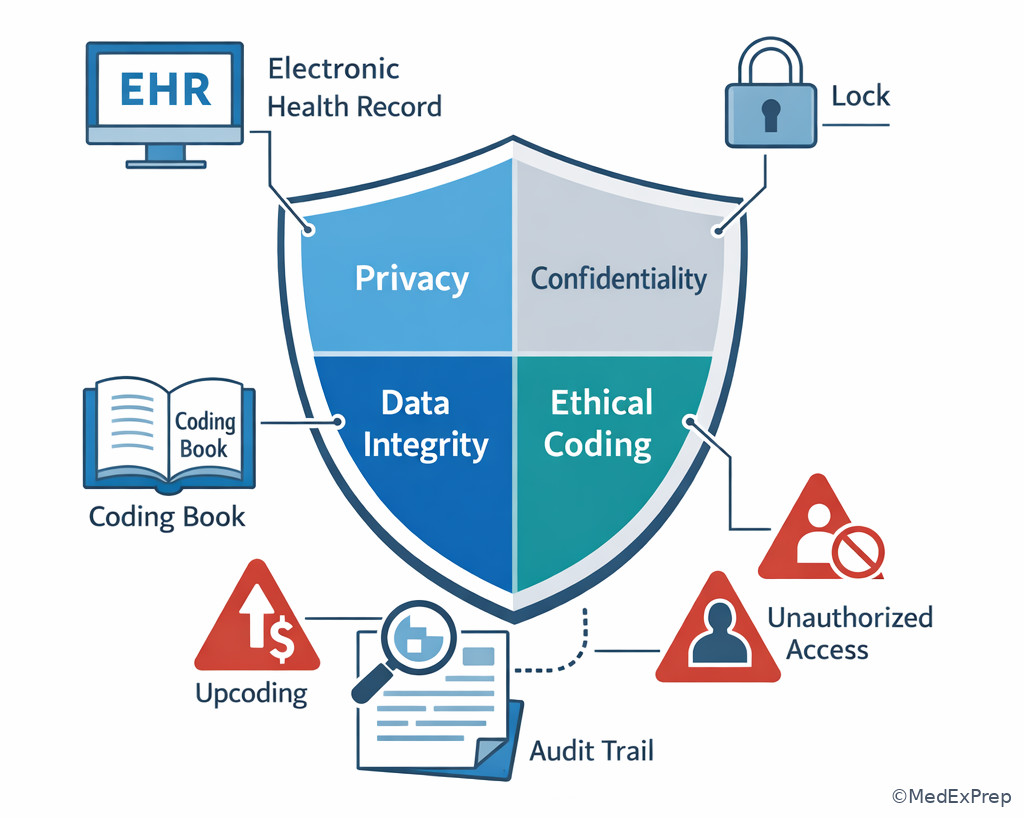
The final integration step is choosing between efficient completion and compliant completion. Ethical coding is not a side topic; it is built into scope. The coder must protect PHI, avoid upcoding and unbundling, maintain data integrity, and reject shortcuts that distort the record. In exam stems, this may appear as pressure from productivity targets, a coworker’s suggestion, a payer habit, or a provider’s casual undocumented implication.
Choose the answer that preserves documentation truth. If documentation is weak, a compliant coder does not “help” by inflating specificity. If separate codes are available but a combined code is required by the code set, unbundling is wrong. If someone asks for PHI without a valid work need, disclosure is wrong. If the question drifts into advanced denial strategy, CDI program design, or legal investigation, recognize that these are beyond the primary entry-level CCA role. The correct coding action is usually to follow official guidance and organizational policy, then escalate appropriately.
WHY THIS IS TESTED: Ethics questions rarely announce themselves. They hide inside coding decisions where the tempting answer offers speed, revenue, or certainty. See Fig 5 for the integrity framework.
Exam takeaway: When revenue, convenience, or informal requests conflict with support and rules, choose compliance.
flowchart TD
A[Request or pressure] --> B{Supported by documentation and official guidance?}
B -->|Yes| C[Proceed with coding]
B -->|No| D{Needs clarification or escalation?}
D -->|Yes| E[Query or report through policy]
D -->|No| F[Do not code or disclose]
F --> G[Protect data integrity and PHI]
B Worked example
A 49-year-old employed patient with obesity, migraines, and anxiety is seen for an outpatient infusion service. The supervisor notes that a more complex diagnosis code would better support payment and says, “The clinical picture obviously fits.” The provider documented only dehydration. At the same time, a noninvolved staff member asks to see the patient’s chart because the patient is a neighbor. The item asks for the coder’s most appropriate response.
Reasoning chain: Identify task: ethics and scope. Extract key facts: unsupported request to increase code complexity; unrelated coworker requesting chart access. Apply rule: code only documented supported diagnoses and protect PHI from non-permitted access. Eliminate distractors: choosing the higher-paying code may seem efficient, and casual internal access may seem harmless, but both violate compliance principles. Verify: retain the supported coding action, decline unsupported changes, and restrict PHI access to permitted need-to-know use.
C Exam trap
D Checkpoint
Question: Which response best reflects compliant coder action?
- A. Add the higher-paying diagnosis if treatment intensity makes it likely.
- B. Share the chart with any employee who is curious, as long as they work in healthcare.
- C. Code only the supported diagnosis and restrict PHI access to permitted work purposes.
- D. Rewrite the vague provider note into a more specific statement before coding.
Answer: C
- A: Tempting because payment and intensity often travel together; wrong because coding cannot be upgraded by likelihood alone.
- B: Tempting because the person is an employee; wrong because employment alone does not create a permitted need-to-know basis.
- C: Correct because it preserves both coding integrity and privacy limits.
- D: Tempting because specificity is good coding practice; wrong because the coder cannot author or alter provider documentation.
Exam Traps & Differentiators
- Most common wrong answer and why: “Code the likely diagnosis.” Tempting because clinical clues are rich; wrong because CCA coding decisions are documentation-based.
- Looks similar but isn't: Recognizing a query need is in scope; rewriting the diagnosis yourself is not.
- Looks similar but isn't: Understanding reimbursement basics is in scope; choosing codes to increase reimbursement is not.
- Looks similar but isn't: Reviewing the full record is in scope; creating a diagnosis from combined hints across the record is not when required support is absent.
If the stem says “abnormal lab values, treatment started, but diagnosis not documented,” think do not infer; consider clarification only if appropriate.
If the stem says “most appropriate next step,” think the answer may be query, hold, or nonreporting rather than code assignment.
If the stem says “principal diagnosis,” think inpatient logic, not outpatient first-listed logic.
If the stem says “payer wants” or “better reimbursement,” think official guidance still controls.
If the stem says “employee wants to see record” without work need, think privacy restriction.
If the stem says “problem list/med list/test result suggests condition,” think support must meet coding requirements; do not assume.
| Trap phrase in stem | Tempting interpretation | Correct coder response | Single discriminator |
|---|---|---|---|
| “Troponin elevated; treated with heparin” | Code MI | Check final documented diagnosis first | Clinical evidence does not replace provider diagnosis |
| “Imaging confirmed fracture” | Code fracture immediately | Ensure required provider support or clarify | Test result alone may be insufficient for diagnosis coding |
| “Payer prefers more specific code” | Choose payment-favorable code | Use official coding rules and support only | Payer preference does not override guidance |
| “Recent hospital stay” in clinic follow-up | Use principal diagnosis logic | Use outpatient first-listed logic | Current encounter setting controls |
| “Coworker asks to view chart” | Internal access is acceptable | Limit access to permitted need-to-know | Employment does not equal authorization |
| Looks similar | Actually in scope? | Why |
|---|---|---|
| Recognize documentation conflict | Yes | Coder must identify coding-impacting ambiguity |
| Issue compliant query per policy | Yes | Clarification awareness is part of accurate coding workflow |
| Diagnose from labs or medications | No | Creates unsupported diagnosis |
| Rewrite provider note for specificity | No | Coder cannot author provider documentation |
| Choose code for higher reimbursement | No | Violates documentation-based coding and ethics |
| Recognize need to escalate privacy concern | Yes | Privacy and confidentiality are in scope |
Exam takeaway: Learn to separate explicit provider-supported facts from tempting clinical clues that cannot be coded alone.
Tables
| Core role area | What the coder does | What the coder does not do |
|---|---|---|
| Diagnosis coding | Assign supported diagnoses using official guidance | Diagnose from labs, meds, or clinical suspicion alone |
| Procedure coding | Code documented services/procedures using the correct code set | Invent procedure details not documented |
| Sequencing | Apply inpatient vs outpatient sequencing logic | Mix rule sets across settings |
| Documentation problems | Recognize need for clarification or escalation | Rewrite or “clean up” provider documentation independently |
| Reimbursement awareness | Understand payment concepts at a basic level | Select codes solely to maximize reimbursement |
| Privacy/compliance | Protect PHI and record integrity | Share records without permitted work need |
| Question cue | Likely task | Best first mental step |
|---|---|---|
| “Most appropriate code selection” | Direct coding | Confirm explicit support and required specificity |
| “Best next step” | Workflow/clarification | Ask whether coding is allowed yet |
| “Principal diagnosis” | Inpatient sequencing | Use admission-after-study logic |
| “First-listed diagnosis” | Outpatient sequencing | Identify reason chiefly responsible for encounter |
| “Documentation does not support” | Validation/compliance | Reject inference and consider query if appropriate |
| “Requires immediate clarification” | Query trigger | Find the missing or conflicting coding-critical detail |
| Evidence in record | Coder temptation | Correct differential response |
|---|---|---|
| Abnormal lab result | Convert it into diagnosis | Check for provider-documented condition |
| Medication list | Back-code chronic disease automatically | Use only if documentation rules allow; do not infer diagnosis |
| Imaging finding | Code the radiologic impression as final diagnosis automatically | Verify required diagnostic support in documentation |
| Nursing note symptom | Assign full diagnosis from nursing interpretation | Report only what is allowed and supported under guidelines |
| Payer instruction | Change code to secure payment | Follow official coding rules first |
| Supervisor suggestion | Assume organizational preference controls | Remain documentation- and guideline-based |
Algorithm / Approach
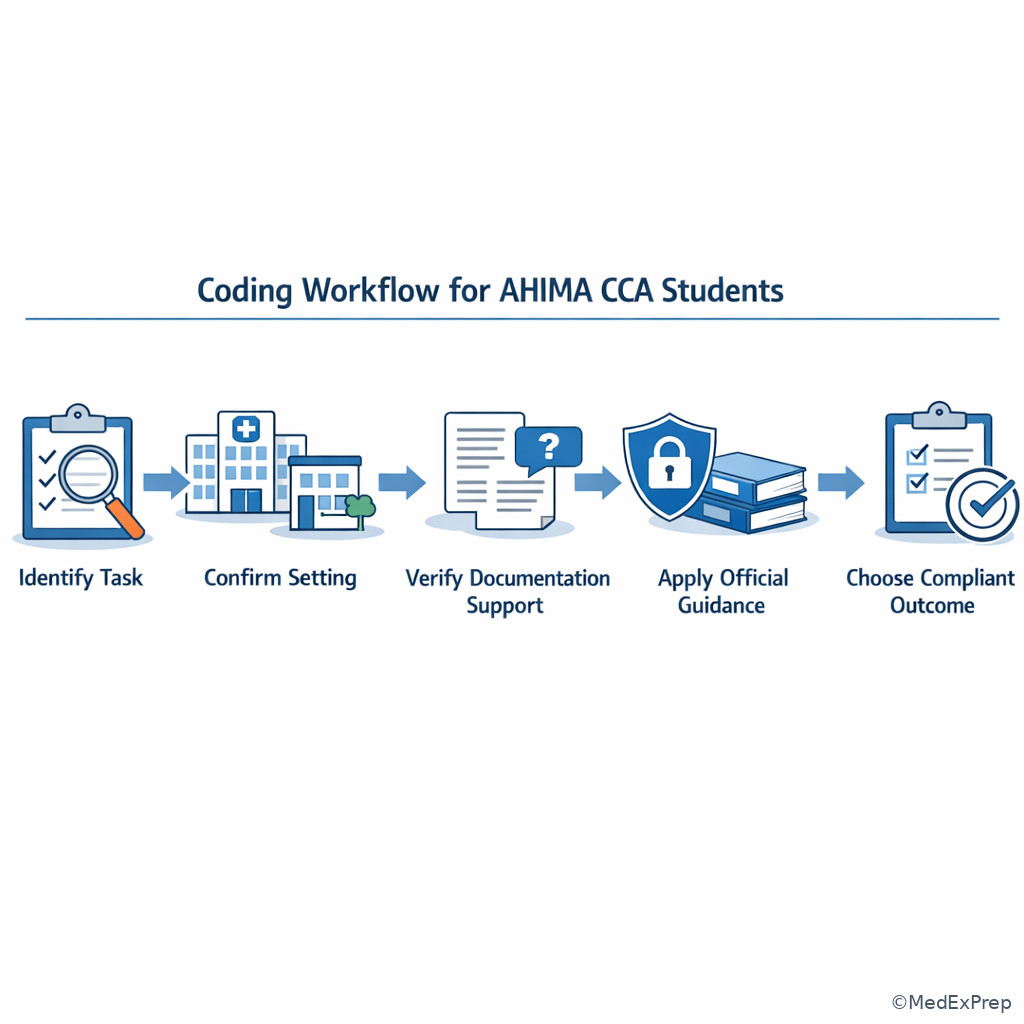
Exam takeaway: Decode the task, verify support, apply the right rule set, then code or clarify without overstepping scope.
Use this algorithm whenever the item feels noisy. Start with the action verb in the question, not with the disease name. Then match the setting, verify support, apply rules, and only then select an answer. See Fig 6 as your reusable exam-day checklist.
Exam takeaway: A structured workflow reduces unsupported assumptions and prevents scope errors on exam stems.
Rapid Review
- Supported diagnosis → provider documentation beats clinical suspicion.
- Abnormal lab → evidence to review, not automatic diagnosis code.
- Medication list → clue only; not independent authority to create disease coding.
- Best next step → may be query, escalation, or nonreporting.
- Principal diagnosis → inpatient-only sequencing language.
- First-listed diagnosis → outpatient encounter logic.
- Reimbursement awareness → conceptual only; never payment-driven code selection.
- Specificity → choose most specific supported code, not most specific imaginable code.
- Conflicting documentation → clarification signal, not permission to choose your favorite note.
- Privacy → internal access still requires work need-to-know.
- Upcoding → severity inflation without support.
- Unbundling → separate reporting when bundled logic should control.
- Scope limit → coders recognize problems; they do not diagnose or treat them.
- Question wording → command terms often decide the rule before the diagnosis does.
Exam takeaway: Accurate coding and protected information handling are tested together because both define professional role boundaries.
Self-check quiz
1. A coder reviews a clinic note for a 38-year-old patient with obesity and asthma. The provider documents “viral upper respiratory infection,” while the medication list includes albuterol and prior antibiotics. Which action is most appropriate?
- A. Add bacterial pneumonia because prior antibiotics suggest a more serious infection.
- B. Code the documented viral upper respiratory infection.
- C. Add acute respiratory failure because asthma is listed in the history.
- D. Code sepsis because infection treatment has occurred recently.
2. An employee from another department asks a coder to open a neighbor’s chart “just to see what happened.” The patient was recently treated for syncope and dehydration. What is the best response?
- A. Share the chart because the requester works for the organization.
- B. Share only the diagnosis list, not the full record.
- C. Refuse access unless there is a permitted work-related need-to-know.
- D. Print the record and leave it for the requester to review later.
3. A 71-year-old inpatient with CHF, chronic anemia, and CKD is admitted for dyspnea. BNP is elevated, chest x-ray shows pulmonary edema, and treatment includes IV diuretics. The discharge summary states “acute on chronic systolic heart failure.” A resident earlier documented “possible pneumonia,” and antibiotics were started briefly. Which diagnosis is most appropriate to code from the final documentation provided?
- A. Pneumonia because antibiotics were started and infiltrates can be subtle.
- B. Acute on chronic systolic heart failure because it is the final documented supported diagnosis.
- C. Sepsis because dyspnea and antibiotics suggest systemic infection.
- D. Respiratory failure because pulmonary edema required inpatient care.
4. A 56-year-old patient with diabetes, hypertension, and chronic pain is seen in a hospital-owned clinic after discharge from an inpatient stay. The question asks for the first-listed diagnosis for today’s encounter. Which first mental step is most appropriate?
- A. Apply principal diagnosis logic because the patient was recently hospitalized.
- B. Identify the outpatient reason chiefly responsible for today’s visit.
- C. Choose the condition with the highest expected reimbursement.
- D. Code every chronic condition before identifying the reason for the visit.
5. A 44-year-old patient with obesity and migraine presents for outpatient infusion hydration. Labs show hyperglycemia, and the medication list includes insulin, but the provider documents only “dehydration.” Which action best fits CCA scope?
- A. Add diabetes mellitus because insulin use and glucose level confirm it.
- B. Code dehydration as documented and do not create additional diagnoses from indirect evidence alone.
- C. Add diabetic ketoacidosis because infusion was medically necessary.
- D. Replace dehydration with uncontrolled diabetes for better specificity.
6. A 68-year-old inpatient with COPD, coronary disease, and malnutrition undergoes bronchoscopy. Postprocedure oxygen saturation falls, nursing notes describe respiratory distress, and the respiratory therapist documents prolonged support. The surgeon’s note states “expected postprocedural hypoxia,” while a consultant writes “monitor for respiratory failure.” What is the most appropriate coding action based on the information provided?
- A. Code acute respiratory failure because multiple clinicians were concerned and support was prolonged.
- B. Code the documented postprocedural hypoxia and do not upgrade to respiratory failure from suggestive evidence alone.
- C. Code pneumonia because bronchoscopy can precipitate infection.
- D. Query the payer to see which diagnosis is preferred for reimbursement.
7. A 60-year-old patient with obesity, OSA, and hypertension is admitted through the ED and later seen in the hospital’s observation unit before discharge the same day. The question asks for the coder’s best next step after noticing the stem alternates between “principal diagnosis” and “first-listed diagnosis.” Which response is most appropriate?
- A. Ignore the wording and choose the most clinically severe condition.
- B. Determine the encounter setting and apply the matching sequencing terminology before selecting a diagnosis.
- C. Always use principal diagnosis when a patient enters through the ED.
- D. Always use first-listed diagnosis when the stay is less than 24 hours.
8. A coder is finalizing an outpatient claim for a 52-year-old patient with chronic liver disease and anemia. A manager says a complication code would “fit the resources used better,” but the provider documented only fatigue and dehydration. At the same time, the coder notices another staff member printing the chart for personal curiosity. Which combined action is most appropriate?
- A. Add the complication code and ignore the printing issue because both actions support workflow efficiency.
- B. Keep coding limited to supported documentation and report or restrict the unauthorized PHI access concern per policy.
- C. Add the complication code only if the lab values are severe, and then counsel the coworker informally.
- D. Rewrite the provider note to match the likely complication and shred the printed copy afterward.
Answer key
1.1.1.8 1. Answer: B
- A: Tempting because prior antibiotics and respiratory symptoms can suggest a more serious infection. Incorrect for this scenario because bacterial pneumonia is not documented in the current note. Single stem clue: the provider documented “viral upper respiratory infection.”
- B: Tempting because it seems almost too simple, but it is correct because the coder should report the supported diagnosis actually documented for the encounter. Single stem clue: explicit provider documentation of viral URI.
- C: Tempting because asthma history can make respiratory severity sound plausible. Incorrect because respiratory failure is not documented and cannot be created from history alone. Single stem clue: asthma appears only as background comorbidity.
- D: Tempting because infection treatment can make sepsis feel possible. Incorrect because sepsis is not supported anywhere in the note. Single stem clue: no documented sepsis diagnosis.
Source: Official coding guidance and AHIMA-aligned documentation-based coding principles require code assignment to rest on supported provider documentation.
1.1.1.9 2. Answer: C
- A: Tempting because the requester works in the same organization. Incorrect because internal employment alone does not authorize access to PHI. Single stem clue: the request is based on curiosity, not job need.
- B: Tempting because limiting disclosure feels safer than full access. Incorrect because even partial PHI disclosure is inappropriate without permitted need-to-know. Single stem clue: no work-related purpose is stated.
- C: Correct because privacy rules require access only for permitted work purposes. Single stem clue: “just to see what happened” signals no legitimate need-to-know.
- D: Tempting because it seems like simple information handling. Incorrect because printing for unauthorized access remains a privacy violation. Single stem clue: the underlying access itself is unauthorized.
Source: HIPAA privacy principles and AHIMA ethical expectations require minimum necessary, permitted access to PHI.
1.1.1.10 3. Answer: B
- A: Tempting because antibiotics and respiratory symptoms make pneumonia plausible. Incorrect because the resident documented only “possible pneumonia,” while the discharge summary gives the supported final diagnosis. Single stem clue: discharge summary states acute on chronic systolic heart failure.
- B: Correct because final documented supported diagnosis controls the coding decision here. Single stem clue: explicit final diagnosis in discharge summary.
- C: Tempting because inpatient severity and antibiotics can trigger sepsis thinking. Incorrect because sepsis is never documented. Single stem clue: no provider-documented sepsis.
- D: Tempting because pulmonary edema causes major respiratory symptoms. Incorrect because respiratory failure is not established in the documentation provided. Single stem clue: dyspnea does not equal documented respiratory failure.
Source: Official inpatient coding principles prioritize supported final diagnoses and reject unsupported assumption from treatment pattern alone.
1.1.1.11 4. Answer: B
- A: Tempting because the patient recently had an inpatient stay. Incorrect because the current question asks for outpatient first-listed diagnosis logic. Single stem clue: “for today’s encounter” and “first-listed diagnosis.”
- B: Correct because outpatient sequencing starts with the reason chiefly responsible for the current visit. Single stem clue: clinic encounter wording.
- C: Tempting because reimbursement may feel practically important. Incorrect because payment considerations do not determine compliant sequencing. Single stem clue: the task is sequencing, not reimbursement optimization.
- D: Tempting because chronic conditions often appear in the assessment. Incorrect because you must first identify the primary reason for the outpatient service. Single stem clue: the question asks for first-listed diagnosis, not every reportable condition.
Source: Standard outpatient coding logic distinguishes first-listed diagnosis from inpatient principal diagnosis terminology.
1.1.1.12 5. Answer: B
- A: Tempting because insulin use and hyperglycemia strongly suggest diabetes. Incorrect because the coder cannot create the diagnosis from indirect evidence alone in this scenario. Single stem clue: provider documented only dehydration.
- B: Correct because it stays within supported outpatient documentation and avoids unsupported additions. Single stem clue: dehydration is the only documented diagnosis.
- C: Tempting because hydration infusion and high glucose may suggest metabolic severity. Incorrect because diabetic ketoacidosis is not documented and far exceeds the available support. Single stem clue: no DKA documentation.
- D: Tempting because it sounds more specific. Incorrect because replacing the documented diagnosis with an inferred one exceeds coder scope. Single stem clue: the provider did not document diabetes as the encounter diagnosis.
Source: Documentation-based coding principles prohibit diagnosis creation from medications and labs alone when provider documentation is required.
1.1.1.13 6. Answer: B
- A: Tempting because the patient is high-risk, multiple team members were concerned, and support was prolonged. Incorrect because concern and supportive care do not establish acute respiratory failure without documentation support. Single stem clue: surgeon documented expected postprocedural hypoxia, not respiratory failure.
- B: Correct because it uses the supported documented condition and avoids severity inflation from suggestive but nondefinitive evidence. Single stem clue: explicit documented diagnosis of postprocedural hypoxia.
- C: Tempting because bronchoscopy and respiratory symptoms can suggest infection. Incorrect because pneumonia is not documented. Single stem clue: no provider diagnosis of pneumonia.
- D: Tempting because reimbursement pressure is a classic exam distractor. Incorrect because coder action is governed by official rules, not payer preference. Single stem clue: the question asks for coding action based on documentation, not payer strategy.
Source: AHIMA-aligned coding ethics and official documentation principles prohibit upgrading to a more severe diagnosis from indirect clinical indicators alone.
1.1.1.14 7. Answer: B
- A: Tempting because severe conditions grab attention when terminology is confusing. Incorrect because setting and sequencing language must be resolved first. Single stem clue: the question highlights conflicting use of principal vs first-listed terminology.
- B: Correct because the coder must determine the encounter setting and match the sequencing rule before selecting a diagnosis. Single stem clue: alternating terminology signals a setting-rule problem.
- C: Tempting because ED presentation feels hospital-based and serious. Incorrect because ED entry alone does not universally make principal diagnosis logic the answer in every scenario. Single stem clue: observation and same-day discharge complicate the setting question.
- D: Tempting because short stays can feel outpatient-like. Incorrect because duration alone does not universally determine the terminology without considering actual setting/rules. Single stem clue: the stem tests setting confirmation, not a time shortcut.
Source: Standard coding education emphasizes identifying setting and rule family before diagnosis selection when sequencing terminology appears in the stem.
1.1.1.15 8. Answer: B
- A: Tempting because it frames both actions as efficiency. Incorrect because unsupported complication coding and ignored PHI misuse are both compliance failures. Single stem clue: provider documented only fatigue and dehydration, and the printing is for curiosity.
- B: Correct because it preserves documentation-based coding and addresses unauthorized PHI access through policy-compliant action. Single stem clue: unsupported request plus privacy concern in the same scenario.
- C: Tempting because severe labs may make the complication feel clinically likely, and informal counseling sounds practical. Incorrect because labs still do not substitute for documented diagnosis, and privacy concerns require formal policy-based handling. Single stem clue: no provider-documented complication and unauthorized printing is already occurring.
- D: Tempting because it seems to solve both issues quickly. Incorrect because rewriting provider documentation is outside scope and shredding does not undo an unauthorized access event. Single stem clue: coder cannot alter provider note.
Source: AHIMA ethical standards, HIPAA privacy principles, and official coding guidance all support documentation-based coding and restricted PHI access.
Keep going with the full CCA Prep Course (CCA)
You just studied the way members do, in the same lesson interface. Full access unlocks every lesson, the question bank and flashcards for a full year.
One payment · 1 year of access · No auto-renewal