1.1.1 - RN Burn Care Scope
RN Burn Care Scope
What you'll learn
- DOMAIN: Professional role and safe practice -> RN scope boundaries — choose nursing actions that stay within RN authority and escalate provider-level decisions appropriately.
- DOMAIN: Initial stabilization -> priority setting — apply airway, breathing, circulation, perfusion, and safety priorities to burn scenarios.
- DOMAIN: Clinical judgment -> next-best nursing action — separate the first action from a correct but lower-priority action.
- DOMAIN: Interprofessional coordination -> escalation and communication — identify findings that require immediate burn-team or provider notification.
- DOMAIN: Exam strategy -> BCEN-style reasoning — use a repeatable framework for prioritization, monitoring, education, and delegation questions.
- Exam Framework -> Scope and blueprint -> RN burn care scope
- Clinical Judgment -> Priority setting -> ABCs, escalation, and trend recognition
- Across the continuum -> Nursing role -> assess, implement, monitor, teach, escalate
Why it matters
- Many incorrect answers on burn exams are not clinically absurd; they are the right intervention at the wrong priority or outside RN scope.
- Burn patients deteriorate quickly from airway edema, shock, compartment compromise, or sepsis, so early nursing recognition and escalation are heavily tested.
- The exam rewards action sequences: assess first, intervene within protocol/order, monitor response, then escalate when findings cross a safety threshold.
- Understanding scope improves test performance across every later topic, from resuscitation to discharge teaching.
Exam takeaway: Start with ABCs and scope, then choose the highest-priority nursing action and escalate provider-level decisions.
flowchart TD
A[Burn scenario] --> B{Immediate threat?}
B -->|Airway or breathing| C[Assess and activate emergency response or protocol]
B -->|Perfusion or shock| D[Implement ordered or protocol resuscitation and monitor]
B -->|No immediate instability| E[Continue focused assessment and wound care priorities]
C --> F{Within RN scope?}
D --> F
E --> F
F -->|Yes| G[Implement, reassess, document]
F -->|No or uncertain| H[Escalate to provider or burn team promptly]
See Fig 1 for the exam frame that should sit behind nearly every question in this course.
Key Terms & Must-Know Facts
1.1.1.1 Key terms
- RN scope: what the nurse may assess, implement, monitor, teach, and escalate.
- ABCs: airway, breathing, circulation; the primary priority hierarchy.
- Escalation: timely notification or activation when findings exceed routine nursing management.
- Protocol: institution-approved pathway allowing predefined nursing actions.
- TBSA: total body surface area burned; used later for severity and fluid reasoning.
- Inhalation injury clues: signs suggesting smoke exposure or evolving airway compromise.
- Trend interpretation: comparing serial findings to detect improvement or deterioration.
- Delegation: transferring task performance, not accountability.
- Reassessment: checking response after every intervention.
- Priority action: the action most directly addressing immediate threat.
- Out-of-role signal: wording that asks the nurse to prescribe, diagnose, or independently decide provider-only treatment.
- Burn-team notification trigger: a finding requiring urgent communication.
1.1.1.2 Must-know facts
- The burn exam is written from an RN clinical judgment perspective, not a surgeon or prescriber perspective.
- The correct answer often includes notify, escalate, activate protocol, prepare, monitor, or implement ordered care rather than independently deciding definitive treatment.
- Airway risk outranks wound care, pain control, and routine documentation when immediate compromise is possible.
- A correct intervention can still be wrong if it is not the first priority.
- When a scenario includes deterioration, reassessment and escalation are more important than completing lower-priority tasks.
- Delegation questions hinge on stability, predictability, and whether assessment or judgment must remain with the RN.
- Local protocol specifics vary, but broad burn nursing priorities are stable across settings.
- Trend questions test whether the patient is improving, failing resuscitation, or developing a complication.
| Exam wording | What it usually tests | RN-safe frame |
|---|---|---|
| Most appropriate next step | Priority sequencing | Choose the highest-yield nursing action first |
| Requires immediate clarification | Unsafe order or mismatch with condition | Question, verify, or escalate before implementing |
| Priority finding | Deterioration recognition | Identify airway, breathing, perfusion, or neurologic threat |
| Most important to monitor | Response to treatment | Pick the variable linked to the active danger |
| Best teaching point | Safety and continuity | Teach warning signs, adherence, and when to seek help |
Exam takeaway: Visualize the RN role as constant reassessment, implementation, monitoring, and escalation rather than independent medical decision-making.
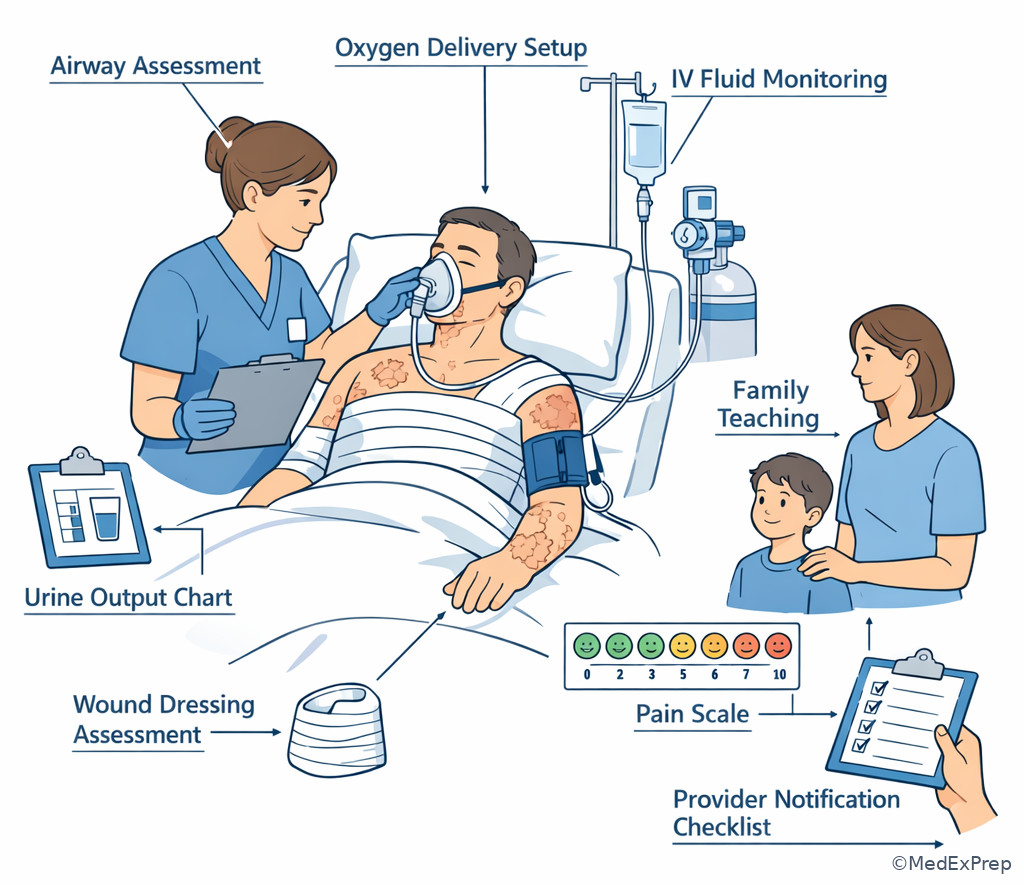
Core content
1.1.1.3 Foundational RN role: what you own, what you escalate
A Explanation
The core decision conflict is simple: Should I act independently, or should I escalate? The rule that resolves it is scope. On the CBRN exam, the RN owns focused assessment, ongoing monitoring, implementation of orders and protocols, patient/family education, safety checks, documentation, and urgent communication of deterioration. The RN does not independently prescribe fluids, decide operative plans, determine escharotomy as the final decision-maker, or diagnose in place of provider evaluation. If a stem nudges you toward a provider-level decision, the RN-safe answer is usually to recognize the problem, initiate any approved emergency steps, and notify the burn team or provider promptly.
WHY THIS IS TESTED: The testable pattern is choosing between a clinically appealing definitive treatment and the highest-priority RN action that stays within scope. Burn questions often tempt you with technically correct medical management that is not yours to decide.
Choose nursing answers that sound like this: assess breath sounds, apply oxygen per protocol/order, obtain frequent vital signs, monitor urine output, review labs, reinforce teaching, prepare equipment, request respiratory therapy support, notify the provider, activate transfer protocol. Reject answers that sound like this: prescribe, diagnose independently, determine surgery, accept transfer on behalf of a physician, override orders without clarification pathway.
Memory anchor: AIME = Assess, Implement ordered/protocol care, Monitor response, Escalate when outside scope or unsafe.
Nursing Priority: Assess first for immediate airway, breathing, perfusion, and safety threats. Intervene with protocol/order-based nursing actions. Delegate routine transport, supply gathering, and standard repeated tasks for stable patients when permitted; initial assessment and unstable trending stay with the RN. Escalate immediately for findings requiring provider-level decisions or rapid deterioration.
B Worked example
A 47-year-old man arrives after a garage fire with soot around the nares, hoarse voice, diabetes, and hypertension. He is anxious and repeatedly asks for water. SpO2 is 98% on room air, BP 132/78 mm Hg, HR 118/min. A new nurse says, “The saturation is normal, so I’ll finish the wound photos first and then page the surgeon if needed.” The task is to identify the best initial nursing action. Extract the key facts: enclosed-space fire, hoarseness, facial soot, tachycardia; the normal pulse oximeter reading is distracting because it does not rule out inhalation injury or toxic gas exposure. Apply the rule: airway risk comes before wound documentation, and the RN should escalate early rather than wait for obvious collapse. Eliminate distractors: offering oral fluids is unsafe before airway evaluation; completing photos is lower priority; independently deciding definitive airway management is out of scope. Verify the answer: initiate airway-focused assessment, apply oxygen per protocol/order, and notify the provider or burn team immediately.
C Exam trap
Common wrong answer: “Complete the full secondary survey and wound documentation before calling the provider.” WHY IT IS TEMPTING: Thorough assessment feels organized and professional. The SINGLE CLUE that eliminates it: any sign of possible inhalation injury moves airway evaluation and escalation ahead of noncritical documentation.
D Checkpoint
Question: A burn nurse receives an ED report on a patient with circumferential forearm burns, increasing pain, and numb fingers. Which action is most appropriate next?
- Elevate the extremity and reassess pulses in 2 hours.
- Notify the burn provider immediately and continue focused neurovascular checks.
- Prepare the patient for surgery without further assessment.
- Administer PRN analgesia first, then document findings at shift change.
- A: Tempting because elevation is helpful supportive care, but wrong because worsening neurovascular findings require prompt escalation now, not delayed reassessment.
- B: Correct because the RN recognizes possible perfusion compromise, performs ongoing assessment, and escalates provider-level intervention decisions.
- C: Tempting because severe circumferential burns may need procedures, but wrong because the RN does not independently determine surgery and should notify rather than jump ahead.
- D: Tempting because pain matters, but wrong because analgesia does not address the priority concern of threatened perfusion and delayed documentation is unsafe.
If you missed this: Review 1.1.1.1 Foundational RN role: what you own, what you escalate — focus on recognize-threatening-findings, then escalate provider-level decisions rather than acting independently or delaying.
1.1.1.4 Priority hierarchy: ABCs outrank task completion
A Explanation
The decision conflict here is: Do I complete the expected burn-care task, or do I interrupt it for a higher-priority threat? The rule is the ABC hierarchy with perfusion and safety immediately behind it. Burn care is full of legitimate tasks—wound cleansing, pain reassessment, intake recording, patient teaching—but on exam questions the first correct move is the one that prevents immediate deterioration. Airway clues, respiratory distress, shock patterns, altered mental status, rapidly worsening pain with ischemic concern, and sudden trend changes all outrank routine care flow.
WHY THIS IS TESTED: CBRN items commonly compare two reasonable nursing actions and ask which one comes first. The exam is not testing whether you know many tasks; it is testing whether you can order them correctly under pressure.
Use this fast sort: airway threat first; then breathing/ventilation; then circulation/perfusion; then disability/mental status and exposure details; then wound care, comfort, teaching, and longer documentation. In burn settings, a particularly common distractor is pain management. Pain control is essential, but if the stem includes hoarseness, stridor, chest restriction, hypotension, falling urine output, or neurovascular compromise, another action comes first.
See Fig 2 for a compact view of how burn nurses sort competing tasks.
Exam takeaway: When two actions are both correct, choose the one addressing airway, breathing, or perfusion before wound care, comfort, or documentation.
flowchart LR
A[Airway threat] --> B[Breathing or ventilation issue]
B --> C[Circulation or perfusion problem]
C --> D[Neurologic or safety concern]
D --> E[Wound care and pain tasks]
E --> F[Teaching and routine documentation]
Recall: This is the first lesson in the course, so there is no prior topic to build from yet. In the upcoming lesson Common Exam Task Types, we will apply this hierarchy to prioritization stems, trend items, education questions, and calculation-based choices.
Nursing Priority: Assess first whether the patient is stable enough for routine wound care or teaching. Intervene with oxygen, positioning, hemodynamic monitoring, or protocol actions before nonurgent tasks. Delegate supply gathering or routine hygiene for stable patients only. Escalate when airway signs, inadequate perfusion, or rapid trend changes appear.
B Worked example
A 72-year-old woman with COPD and chronic kidney disease has 18% TBSA flame burns and is receiving wound cleansing. She becomes more restless and says the dressing “feels too tight.” Her oxygen saturation falls from 96% to 91%, respiratory rate rises from 20 to 30/min, and the assistant asks whether to continue opening supplies for the next dressing layer. A mild glucose elevation is present and may distract from the real issue. Identify the task: best next nursing action. Extract key facts: respiratory change, restlessness, possible chest restriction or evolving respiratory compromise. Apply the rule: stop lower-priority task flow and address breathing first. Eliminate distractors: finishing the dressing is wrong priority; explaining anxiety before assessment is unsafe; waiting for scheduled respiratory rounds delays care. Verify: assess breathing immediately, support oxygenation per order/protocol, and escalate worsening respiratory status.
C Exam trap
Common wrong answer: “Finish the current wound-care step because sterile workflow should not be interrupted.” WHY IT IS TEMPTING: Burn care procedures are structured and interruption can feel inefficient. The SINGLE CLUE that eliminates it: any new respiratory deterioration overrides procedural continuity.
D Checkpoint
Question: During dressing change, which finding should the RN address first?
- Pain rating increased from 6/10 to 8/10.
- Urine output has been 35 mL/hr for the last 2 hours.
- New hoarseness and increasing work of breathing.
- Family asks when rehabilitation will start.
- A: Tempting because pain requires treatment, but wrong because airway compromise outranks analgesia.
- B: Tempting because perfusion matters, but wrong here because the airway clue is more immediate.
- C: Correct because new hoarseness plus increased work of breathing signals an airway/breathing priority.
- D: Tempting because education is important, but wrong because it is clearly nonurgent.
If you missed this: Review 1.1.1.2 Priority hierarchy: ABCs outrank task completion — focus on when airway/breathing findings interrupt otherwise appropriate care.
- The most common reason a correct nursing action is still wrong on exam day is wrong priority.
- True or False: a normal pulse oximeter reading safely excludes inhalation injury. False.
- Name the first three priority levels in a burn emergency stem: airway, breathing, circulation/perfusion.
1.1.1.5 Monitoring and reassessment: the RN value in burn care
A Explanation
The decision conflict is: Is this a one-time task, or am I being tested on what to trend next? The rule is that burn nursing is dynamic. The RN is expected to monitor response to interventions and recognize when trends are reassuring versus dangerous. A single blood pressure, urine output, respiratory pattern, pain score, or neurovascular check rarely stands alone on this exam. Questions often hinge on serial change: worsening hoarseness, decreasing urine output, rising heart rate, increasing restlessness, tighter dressings, cooler digits, or increasing sedation. The nurse’s role is not just to perform the intervention but to ask, “Did it work, and what finding would force escalation?”
WHY THIS IS TESTED: Burn patients can deteriorate between formal rounds, so the exam values vigilance. Many stems give you trend data and ask for the next action based on response—not just the initial intervention.
Monitoring must be linked to the active problem. If the issue is resuscitation, trend urine output, hemodynamics, perfusion, and mental status. If the issue is inhalation concern, trend voice, work of breathing, secretions, and oxygenation pattern. If the issue is circumferential injury, trend pulses, cap refill, skin temperature, sensation, and movement. If the issue is pain or sedation, reassess respiratory status and level of consciousness, not just the pain number. See Fig 3 for the high-yield monitoring loop.
Exam takeaway: Match each intervention to the single most important reassessment variable and escalate when the trend worsens.
flowchart TD
A[Identify risk] --> B[Pick focused monitor]
B --> C[Reassess after intervention]
C --> D{Improving?}
D -->|Yes| E[Continue current plan and document]
D -->|No| F[Escalate and reassess priorities]
High-Yield Connection: This concept is tested alongside Trend-Based Nursing Decisions and later with Perfusion Monitoring Targets. Know both the burn-specific risk and the specific variable that proves improvement or deterioration.
Nursing Priority: Assess first the trend most tied to the patient’s current threat. Intervene using ordered or protocol-based therapy. Delegate routine repeated measurements only in stable patients and according to policy; interpretation remains the RN’s job. Escalate when reassessment shows failure to improve or new instability.
B Worked example
A 29-year-old construction worker with 24% TBSA burns, obesity, and asthma is receiving resuscitation. Over 3 hours, HR rises from 112 to 126/min, urine output drops from 45 to 18 mL/hr, hands feel cool, and he asks repeatedly for more pain medication. Serum sodium is slightly low, which may pull attention away from the main problem. Identify the task: determine the most important nursing interpretation and next step. Extract key facts: falling urine output, rising HR, cool extremities—this is a worsening perfusion trend. Pain is real, but repeated pain requests can coexist with under-resuscitation. Apply the rule: monitor response, identify failure to improve, and escalate. Eliminate distractors: focusing only on opioid titration misses the perfusion pattern; waiting for the next scheduled I&O total delays care; documenting “expected burn pain” is unsafe. Verify: continue ordered monitoring, communicate the concerning trend promptly, and prepare for protocol/provider-directed adjustment.
C Exam trap
Common wrong answer: “Treat the pain complaint first because pain is the clearest patient-reported problem.” WHY IT IS TEMPTING: Pain is visible, urgent, and central to burn care. The SINGLE CLUE that eliminates it: declining urine output with rising heart rate signals a perfusion problem that can worsen rapidly.
D Checkpoint
Question: Which reassessment finding most directly indicates that the current concern is worsening perfusion rather than isolated pain?
- Persistent pain score of 8/10 despite repositioning.
- Urine output trending downward with rising heart rate.
- Family reports the patient slept poorly the night before.
- Dressings remain dry and intact.
- A: Tempting because uncontrolled pain matters, but it is not as specific for perfusion compromise as an objective output/hemodynamic trend.
- B: Correct because declining urine output plus tachycardia points to inadequate perfusion/resuscitation response.
- C: Tempting because fatigue can affect behavior, but it does not explain the circulation trend.
- D: Tempting because wound status is useful, but intact dressings do not address the perfusion question.
If you missed this: Review 1.1.1.3 Monitoring and reassessment: the RN value in burn care — focus on matching the monitor to the active threat and acting on worsening trends.
1.1.1.6 Escalation triggers and communication: when “watching” is unsafe
A Explanation
The decision conflict is: Can I continue to monitor, or must I notify now? The rule is that immediate escalation is required when the patient shows signs of evolving airway compromise, respiratory deterioration, inadequate perfusion despite current therapy, worsening neurovascular status, signs of compartment threat, serious arrhythmia concern after electrical injury, concerning sepsis pattern, or any rapid unexplained decline. The exam often punishes passive monitoring when a danger threshold has already been crossed.
WHY THIS IS TESTED: Burn nurses are expected to recognize the moment when independent troubleshooting becomes delay. The testable pattern is “continued observation” versus “immediate communication and preparation.”
Escalation is not failure; it is competent burn nursing. The strongest exam answers often bundle three RN actions: identify the red flag, continue focused monitoring, and notify the appropriate provider or team. In other words: do not abandon assessment, but do not sit on a dangerous finding. When communicating, lead with the change and the risk: “New hoarseness after enclosed-space fire,” “urine output dropped despite resuscitation trend,” “increasing pain, numbness, and weak distal pulse in circumferential burn,” “new fever with mental status change and hemodynamic instability.” See Fig 4 for a threshold-based escalation algorithm.
Exam takeaway: A red-flag finding plus a worsening trend means notify promptly while continuing focused nursing assessment and support.
flowchart TD
A[New finding] --> B{Immediate risk to airway, breathing, perfusion, or limb?}
B -->|Yes| C[Notify provider or burn team now]
B -->|No| D[Continue focused monitoring]
C --> E[Support patient and prepare for next steps]
D --> F{Trend worsening?}
F -->|Yes| C
F -->|No| G[Continue plan and document]
Memory anchor: RED FLAG = Respiratory change, Evolving edema/airway clues, Declining urine output, Falling perfusion, Limb neurovascular change, Arrhythmia concern, General decline.
High-Yield Connection: This concept overlaps with upcoming topics ABCs In Burn Nursing and Priority And Escalation Rules. On exam day, know not just the abnormal finding but the exact threshold where watchful waiting becomes unsafe.
Nursing Priority: Assess first whether the change threatens airway, breathing, circulation, or limb perfusion. Intervene with immediate supportive nursing measures within protocol/order. Delegate supportive setup tasks only after the RN has recognized and reported the change. Escalate immediately for threshold findings rather than “monitoring a little longer.”
B Worked example
A 34-year-old patient with deep burns to both lower legs, depression, and nicotine dependence reports “pins and needles” in the toes 90 minutes after dressing application. Capillary refill is slowed compared with the previous check, toes are cooler, and pain has increased despite medication. A mildly elevated temperature is present but is not the key issue. Identify the task: determine whether continued monitoring is appropriate. Extract key facts: neurovascular change after dressing and circumferential risk pattern. Apply the rule: worsening neurovascular signs require immediate escalation, not watchful waiting until the next routine assessment. Eliminate distractors: loosening or altering the dressing may be institution-specific and should follow policy or orders; analgesia alone ignores perfusion risk; documenting then reassessing later delays action. Verify: maintain focused neurovascular assessment and notify the provider or burn team immediately.
C Exam trap
Common wrong answer: “Reassess in 30 minutes because pain can increase after dressing changes.” WHY IT IS TEMPTING: Post-procedural pain is common, so waiting seems reasonable. The SINGLE CLUE that eliminates it: numbness or cool digits with slowed capillary refill points to compromised perfusion, not routine discomfort.
D Checkpoint
Question: Which finding most clearly requires immediate provider notification rather than routine monitoring?
- Patient requests additional education about scar care.
- Temperature rises from 37.0°C to 37.5°C after ambulation.
- New stridor in a patient with facial burns from an enclosed-space fire.
- Appetite remains poor at breakfast.
- A: Tempting because education matters for recovery, but it is not urgent.
- B: Tempting because temperature changes deserve observation, but this mild increase alone is not the strongest escalation trigger.
- C: Correct because new stridor signals immediate airway danger and requires urgent notification and support.
- D: Tempting because nutrition is important in burn recovery, but breakfast intake does not outrank airway compromise.
If you missed this: Review 1.1.1.4 Escalation triggers and communication: when “watching” is unsafe — focus on red-flag findings that cross from monitoring into immediate notification.
- True or False: increasing numbness in a circumferential extremity burn can be safely watched until the next scheduled full assessment. False.
- The most common exam-safe wording for a provider-level decision is notify/activate protocol/prepare.
- Name 3 escalation triggers: new stridor, falling urine output with worsening perfusion, new neurovascular deficit.
1.1.1.7 Delegation, documentation, and patient education within RN scope
A Explanation
The final integration conflict is: Which tasks can be delegated or delayed, and which must stay with the RN right now? The rule is stability plus judgment. Initial assessment, interpretation of trends, patient teaching requiring clinical judgment, response to instability, and escalation remain RN responsibilities. Predictable, low-risk, routine tasks for stable patients may be delegated according to policy and team role. Documentation is always necessary, but on exam questions it rarely comes before stabilizing the patient. Education is central across burn recovery, yet urgent physiologic threats outrank teaching in the moment.
WHY THIS IS TESTED: Many questions include four real nursing actions that are all appropriate eventually. The discriminator is which action must stay with the RN now, and which action can be assigned or done later.
For stable patients, delegated tasks may include routine vital sign collection, intake/output measurement, transport assistance, stocking supplies, simple hygiene, or reinforcing already-taught instructions within role and policy. Keep with the RN: unstable patient reassessment, interpretation of concerning trends, neurovascular checks when compromise is possible, airway-focused evaluation, fresh patient education requiring adaptation, and provider communication. Documentation follows action and reassessment in unstable scenarios. Teaching should target warning signs, follow-up, dressing safety, pain plan, mobility, and when to seek help—but the exam will still expect you to treat an airway or perfusion threat before launching into teaching.
Recall: In the upcoming topic Common Exam Task Types, you will see how delegation and “correct-but-not-first” distractors are built into board-style options. This lesson gives the scope filter you will use to solve them quickly.
Nursing Priority: Assess first patient stability and whether judgment is needed. Intervene personally for unstable patients, fresh assessments, and changing trends. Delegate predictable routine tasks for stable patients only, within policy and competence. Escalate any delegated finding that suggests deterioration, and document after immediate safety actions are addressed.
B Worked example
A 55-year-old man on hospital day 6 after a 12% TBSA burn is preparing for discharge teaching. He has stable vital signs, well-controlled pain, type 2 diabetes, and mild hearing impairment. During the session, the UAP offers to complete intake/output totals and restock dressing supplies, while a newly licensed RN asks whether the UAP can teach the patient to identify infection warning signs. A slightly elevated fasting glucose is present but stable. Identify the task: determine the appropriate delegation choice. Extract key facts: stable patient, routine nonjudgment tasks available, but discharge teaching about warning signs requires assessment of comprehension and tailored instruction. Apply the rule: routine tasks may be delegated; new clinical teaching stays with the RN. Eliminate distractors: having the UAP teach warning signs removes judgment-heavy education from the RN; delaying all teaching until the provider arrives is unnecessary. Verify: delegate routine support tasks, but the RN performs and verifies discharge teaching.
C Exam trap
Common wrong answer: “Delegate teaching because the patient is stable.” WHY IT IS TEMPTING: Stability makes many tasks seem shareable. The SINGLE CLUE that eliminates it: first-time, individualized teaching requires RN assessment of understanding and cannot be reduced to a routine task.
D Checkpoint
Question: Which task is most appropriate for the RN to keep rather than delegate?
- Restocking dressing supplies for a stable patient room.
- Measuring oral intake for a stable patient with predictable status.
- Performing focused reassessment of new hand numbness after circumferential burn dressing.
- Transporting clean linens to the bedside.
- A: Tempting because supplies matter, but this does not require RN assessment.
- B: Tempting because intake/output is important, but collection can be delegated in stable situations while interpretation remains with the RN.
- C: Correct because new numbness signals possible neurovascular compromise and requires RN assessment and judgment.
- D: Tempting because bedside readiness matters, but linen transport is a routine support task.
If you missed this: Review 1.1.1.5 Delegation, documentation, and patient education within RN scope — focus on stability plus judgment: new assessment and individualized teaching stay with the RN.
Exam Traps & Differentiators
Most common wrong answer and why: choosing the intervention that sounds most definitive rather than the intervention the RN can safely and appropriately do first. On the CBRN exam, the nurse often recognizes the problem, supports the patient, and escalates—not independently decides the final medical treatment.
| Looks similar | Why it tempts you | Why it is not the best answer here | Better exam choice |
|---|---|---|---|
| Pain treatment first | Pain is central in burn care and feels urgent | Wrong if airway, perfusion, or neurovascular compromise is also present | Address ABC/perfusion threat first, then pain |
| Complete documentation first | Documentation is required and seems thorough | Wrong when the patient is unstable or deteriorating | Stabilize, reassess, then document |
| Wait and recheck later | Some burn findings do evolve gradually | Wrong after a red-flag threshold is crossed | Notify now while continuing focused monitoring |
| Independent definitive treatment plan | Clinically knowledgeable nurses can predict what may be needed | Wrong because final medical decisions may be provider-only | Prepare, support, and escalate |
| Delegate because patient is stable | Stable patients do allow more task sharing | Wrong if the task requires fresh assessment, interpretation, or individualized teaching | Keep judgment-heavy tasks with the RN |
If the stem says facial burns, soot, hoarseness, enclosed-space fire, think airway-focused assessment and urgent escalation.
If the stem says falling urine output, rising heart rate, cool extremities, think worsening perfusion/resuscitation concern.
If the stem says increasing pain plus numbness or weak pulses in circumferential burns, think neurovascular compromise and immediate notification.
If the stem says “best next step” and several options are correct eventually, think ABCs and scope before routine care.
If the stem says provider-level action directly, think recognize, prepare, monitor, and notify rather than independently decide.
If the stem says discharge teaching for a stable patient, think RN-led tailored education, even if routine support tasks can be delegated.
Exam takeaway: In a facial-burn scenario, bedside nursing recognition of airway red flags must outrank routine wound tasks.
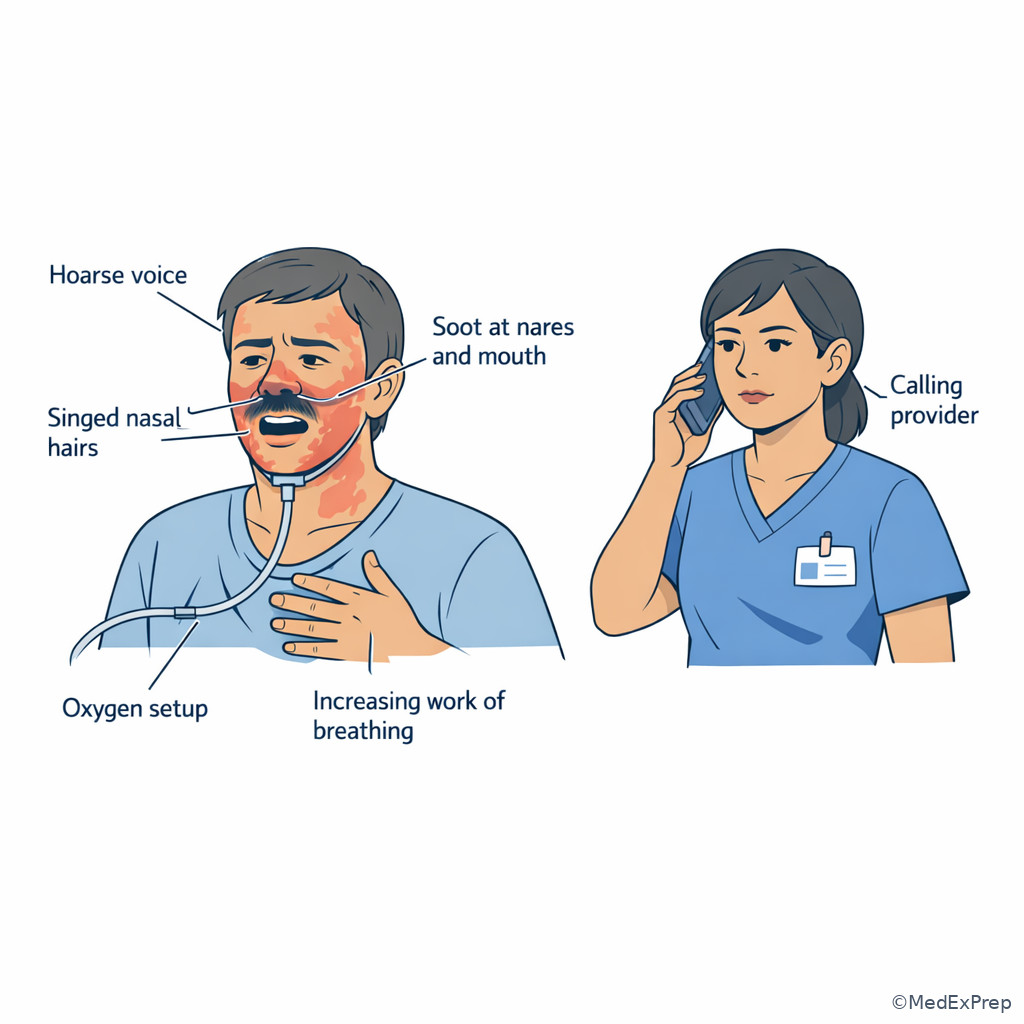
Review connection: The traps above test priority plus scope discrimination. If any felt unfamiliar, revisit 1.1.1.2 Priority hierarchy: ABCs outrank task completion and 1.1.1.4 Escalation triggers and communication: when “watching” is unsafe before attempting the Self-check quiz.
Tables
| Scope area | Usually within RN role | Requires escalation / provider-level decision |
|---|---|---|
| Assessment | Primary/secondary assessment, neurovascular checks, wound observation, trend recognition | Independent diagnostic determination in place of provider evaluation |
| Airway / breathing | Oxygen per order/protocol, positioning, monitoring, urgent notification | Independent definitive airway decision without role context |
| Circulation / fluids | Implement ordered/protocol fluids, monitor I&O, trend perfusion | Prescribe or independently adjust outside protocol/order |
| Wound care | Cleansing, topical/dressing care per policy/order, reassessment, pain monitoring | Final operative or grafting plan determination |
| Complications | Recognize red flags, continue focused support, notify promptly | Delay escalation while independently troubleshooting an emergency |
| Teaching | Discharge teaching, warning signs, home care reinforcement, psychosocial support | Independent discharge authorization if not ordered |
| Priority level | Typical task | Why it wins or loses on exam day |
|---|---|---|
| 1 | Airway support and airway-focused escalation | Wins when any sign of compromise is present |
| 2 | Breathing assessment, oxygenation support, chest restriction concern | Wins over circulation-only tasks if respiratory failure is more immediate |
| 3 | Perfusion/resuscitation monitoring and response | Wins over pain, documentation, and education |
| 4 | Focused neurologic/neurovascular reassessment | Wins when limb or neurologic compromise is the active risk |
| 5 | Wound care and pain optimization | Correct but often not first in unstable patients |
| 6 | Teaching, discharge planning, routine documentation | Important, but lower in immediate emergency sequencing |
| Differential exam pattern | Think this | Do not confuse with | Single discriminator |
|---|---|---|---|
| Normal SpO2 after enclosed-space fire | Possible inhalation/toxic exposure still needs attention | “Airway is fine because saturation is normal” | History and airway clues outweigh a single reassuring monitor value |
| More pain after dressing change | Assess whether this is expected pain or perfusion compromise | Routine post-procedure discomfort only | Numbness, coolness, delayed cap refill, weak pulses |
| Stable patient with teaching needs | RN-led individualized education | Delegating first-time teaching | Requires judgment and verification of understanding |
| Several appropriate actions listed | Choose first priority by ABCs | Choosing a correct later step | Which option addresses immediate threat |
| Definitive treatment option sounds best | Consider whether it is out of RN scope | Acting like the prescriber or surgeon | RN role is implement/monitor/escalate |
Exam takeaway: New numbness, coolness, delayed capillary refill, or weaker pulses shift the question from pain care to perfusion-focused escalation.
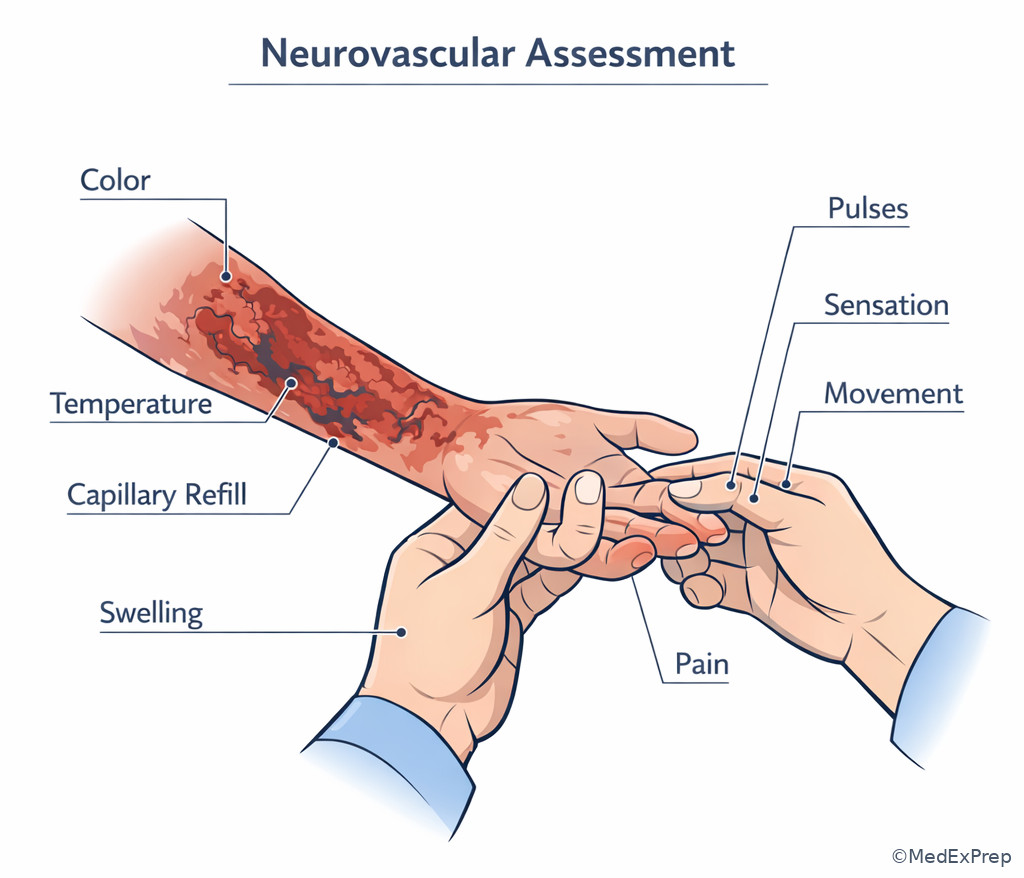
Algorithm / Approach
Exam takeaway: Use a repeatable bedside sequence—assess, prioritize, act within scope, reassess, escalate—to solve board-style burn questions.
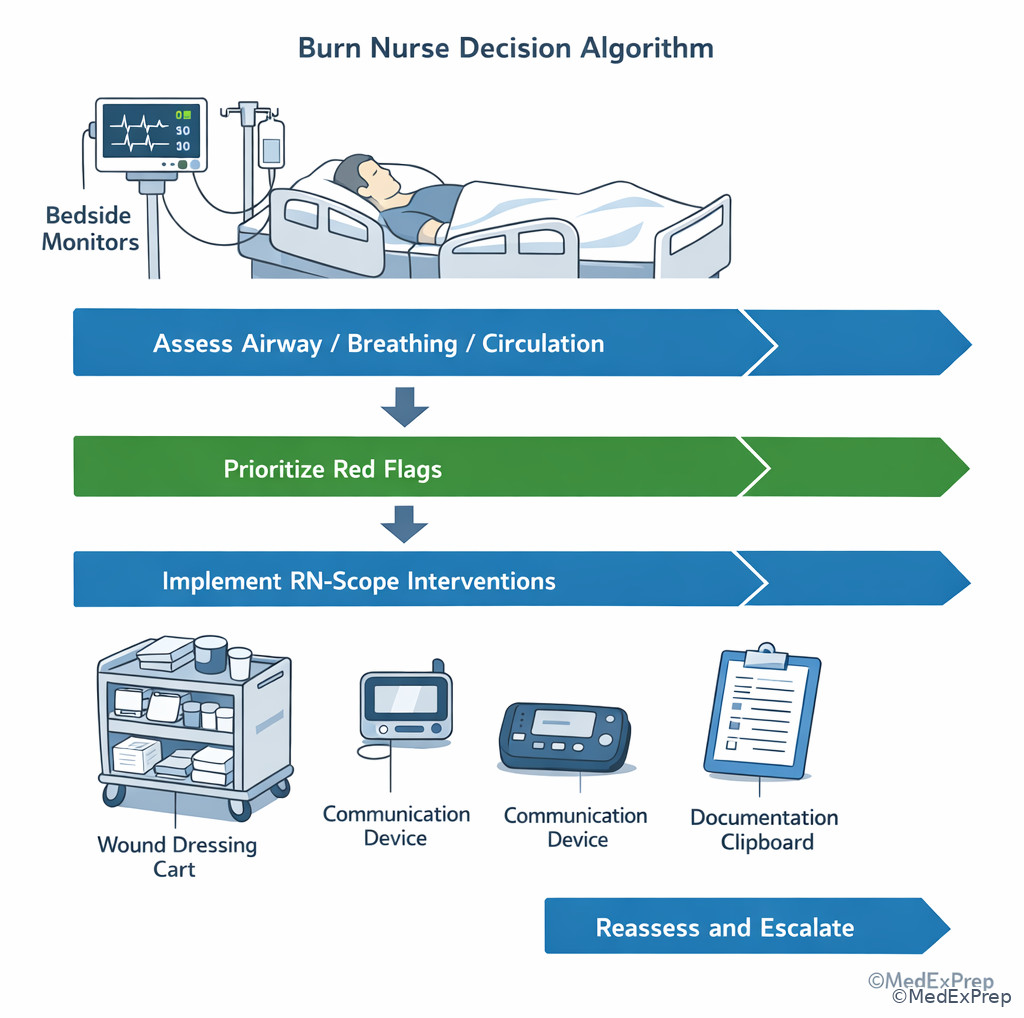
See Fig 5 when you need a one-image reminder of how to approach any RN burn care stem.
Rapid Review
- RN scope → assess, implement, monitor, teach, escalate; do not independently prescribe or decide surgery.
- Best next step → first correct action, not merely a correct eventual action.
- Airway clue after fire → outranks wound photography and oral intake.
- Normal pulse oximetry → does not erase inhalation concern when history is high-risk.
- Burn pain vs perfusion threat → numbness/coolness/weak pulses point away from isolated pain.
- Trend question → serial change beats single-value interpretation.
- Declining urine output + tachycardia → think worsening perfusion response, not just discomfort.
- New stridor → immediate notification, not extended observation.
- Stable patient delegation → routine predictable task yes; fresh assessment no.
- First-time discharge teaching → keep with RN because judgment and comprehension checks matter.
- Documentation priority → after immediate stabilization actions in unstable scenarios.
- Out-of-scope option → often eliminated even when medically logical.
Memory anchor: FIRST = Find the threat, Identify scope, Respond with RN action, See the trend, Tell the team when needed.
Self-check quiz
1.1.1.8 Question 1
A 41-year-old patient with 8% TBSA scald burns is stable, alert, and awaiting dressing care. Which action is most consistent with the RN burn care scope on this exam?
- Independently decide the topical regimen and rewrite the wound orders.
- Perform focused assessment, implement current wound orders, and reassess response.
- Determine whether the patient needs operative grafting this week.
- Authorize discharge because the burns appear minor.
1.1.1.9 Question 2
A 66-year-old man with hypertension and a 14% TBSA flame burn asks why the nurse is interrupting dressing setup after he develops new hoarseness. Which action is most appropriate?
- Continue dressing preparation because wound care is already in progress.
- Pause lower-priority tasks, assess airway status, and notify the provider promptly.
- Give discharge teaching now to reduce anxiety.
- Document the hoarseness and recheck after lunch.
1.1.1.10 Question 3
A 38-year-old patient with 22% TBSA burns, obesity, and asthma is on resuscitation orders. Over 2 hours, heart rate rises, hands become cooler, and urine output falls from 40 mL/hr to 15 mL/hr. The patient also requests more pain medication. What is the most appropriate nursing action?
- Administer analgesia first because pain is the patient’s clearest concern.
- Continue routine charting and wait for the next scheduled intake/output total.
- Recognize a concerning perfusion trend, continue focused monitoring, and notify the provider or follow protocol.
- Encourage oral fluids if the patient is thirsty.
1.1.1.11 Question 4
A 28-year-old woman with bilateral lower-leg burns reports increasing tightness after dressings are applied. She has anxiety, seasonal allergies, and mild nausea. On reassessment, toes are cooler and sensation is reduced. Which action is the best next step?
- Reassure her that discomfort is expected after dressing changes and reassess later.
- Notify the provider immediately while continuing focused neurovascular assessment.
- Document the symptoms and complete routine evening care.
- Delegate the reassessment to the UAP because the patient is awake and talking.
1.1.1.12 Question 5
A stable 52-year-old patient on burn step-down is preparing for discharge. The patient has diabetes and mild hearing loss but is oriented and cooperative. Which task should remain with the RN rather than be delegated?
- Measuring routine oral intake.
- Restocking clean dressing supplies.
- Providing individualized teaching on infection warning signs and when to call the burn team.
- Transporting extra linens to the room.
1.1.1.13 Question 6
A 49-year-old patient with facial burns from an enclosed-space house fire has soot at the mouth, COPD, and chronic pain. SpO2 is 99% on room air, but the voice is becoming hoarse and the patient is increasingly restless. Which action best reflects RN-level clinical judgment?
- Rely on the normal oxygen saturation and complete the secondary survey before calling anyone.
- Assess airway and breathing immediately, apply oxygen per protocol/order, and escalate airway concern now.
- Offer oral fluids to soothe the throat and reduce restlessness.
- Independently schedule urgent intubation because airway edema is likely.
1.1.1.14 Question 7
An RN is coordinating care for four burn patients. Which assignment requires immediate RN attention rather than delegation or delay? Patient A is stable and needs routine intake measurement. Patient B needs reinforcement of already-completed dressing instructions. Patient C reports new hand numbness and increasing pain after a circumferential dressing. Patient D asks for fresh water and a blanket.
- Patient A, because intake measurement is essential to trend care.
- Patient B, because all teaching must always be done by the RN in real time.
- Patient C, because a new neurovascular complaint in a circumferential burn requires RN assessment and likely escalation.
- Patient D, because comfort requests should be answered first to maintain trust.
1.1.1.15 Question 8
A 63-year-old man on hospital day 2 after 18% TBSA burns has coronary disease and chronic kidney disease. A UAP reports that urine output has fallen over the last 2 hours, while the patient appears more restless and the heart rate has increased. Which RN response is most appropriate?
- Ask the UAP to continue collecting data until the next full set of vital signs is due.
- Review the trend personally, assess perfusion status, and communicate the concerning change promptly.
- Tell the UAP to give the patient additional water if thirsty.
- Document that low urine output is expected after burns and continue the existing plan unchanged.
Exam takeaway: Delegate routine predictable tasks for stable patients, but keep fresh assessment, interpretation, and escalation decisions with the RN.
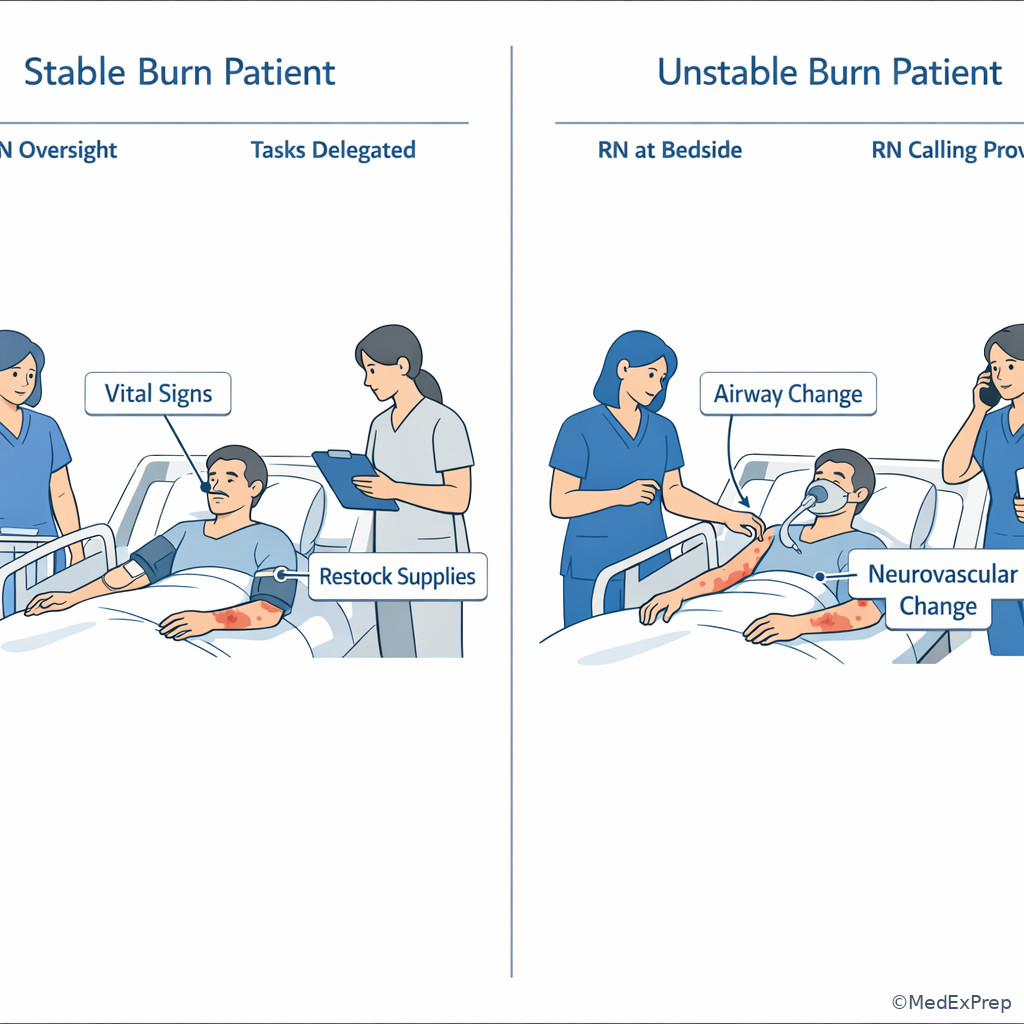
See Fig 6 for the quick visual split between stable-task delegation and unstable-patient RN ownership.
Answer key
1.1.1.16 Question 1 Answer: B
A: Tempting because wound plans are central to burn care, and experienced burn nurses often anticipate what will be used. It is incorrect because rewriting or independently deciding treatment orders goes beyond RN scope in this scenario. The single stem clue is that the question asks what fits the RN role, not what the medical plan might eventually be. Sources: NCSBN clinical judgment and role-accountability principles; ANA scope and standards.
B: Correct because focused assessment, implementing current orders, and reassessing response are core RN functions across burn settings. It follows the nursing process and stays within board-tested scope. The single stem clue is “most consistent with the RN burn care scope.” Sources: ANA Standards of Practice; Lewis Medical-Surgical Nursing.
C: Tempting because grafting is relevant in burn care, but incorrect because deciding operative timing is not an independent RN function. The single stem clue is that this is a treatment-planning decision rather than a nursing implementation task. Sources: ANA scope standards; burn-team role expectations in acute care texts.
D: Tempting because the injury seems small and discharge planning is part of nursing workflow, but incorrect because independent discharge authorization is outside routine RN authority unless clearly protocol-based and ordered. The single stem clue is “authorize discharge.” Sources: ANA Standards of Practice; NCSBN role/scope guidance.
If you missed this: Review 1.1.1.1 Foundational RN role: what you own, what you escalate — focus on implement-and-monitor versus independently deciding treatment or disposition.
1.1.1.17 Question 2 Answer: B
A: Tempting because staying on workflow during dressing care feels efficient, and wound care is important. It is incorrect because new hoarseness raises airway concern, which outranks procedural completion under ABCs. The single stem clue is new hoarseness. Sources: NCSBN prioritization framework; Lewis Medical-Surgical Nursing.
B: Correct because airway-related assessment and prompt escalation come before lower-priority tasks. This uses the ABC framework and appropriate nursing escalation. The single stem clue is again new hoarseness in a burn patient. Sources: NCSBN clinical judgment model; ANA safety standards.
C: Tempting because anxiety reduction and teaching are good nursing care, but incorrect because physiologic threats outrank education. The single stem clue is that the patient is developing a possible airway issue now. Sources: NCSBN prioritization principles.
D: Tempting because monitoring trends can matter, but incorrect because “recheck later” delays action after a red-flag airway symptom. The single stem clue is that hoarseness is new, not chronic or already addressed. Sources: ANA safety and timely communication standards.
If you missed this: Review 1.1.1.2 Priority hierarchy: ABCs outrank task completion — focus on interrupting routine tasks when airway findings appear.
1.1.1.18 Question 3 Answer: C
A: Tempting because pain is common, urgent, and visible in burn care. It is incorrect here because ABCs/circulation and perfusion trends outrank analgesia when urine output is falling and heart rate is rising. The single stem clue is urine output fell from 40 to 15 mL/hr with cooler hands. Sources: Lewis Medical-Surgical Nursing; NCSBN priority framework.
B: Tempting because charting and scheduled totals are part of resuscitation workflow. It is incorrect because waiting ignores a concerning downward trend that needs active reassessment and escalation. The single stem clue is the worsening trend over 2 hours, not a single borderline value. Sources: ANA timely response expectations; NCSBN clinical judgment.
C: Correct because it prioritizes interpretation of perfusion failure, continued monitoring, and prompt communication within RN scope. It addresses circulation before comfort measures and avoids provider-level prescribing. The single stem clue is the combined pattern of tachycardia, cool hands, and falling urine output. Sources: burn nursing monitoring principles in Lewis; ANA scope standards.
D: Tempting because thirst may accompany burns and hydration matters. It is incorrect because oral fluids are not the priority response to a significant perfusion trend in this acute setting and may not be appropriate. The single stem clue is that the question centers on worsening resuscitation indicators, not simple oral hydration. Sources: NCSBN prioritization; burn resuscitation nursing principles.
If you missed this: Review 1.1.1.3 Monitoring and reassessment: the RN value in burn care — focus on serial perfusion trends outranking symptom-only responses.
1.1.1.19 Question 4 Answer: B
A: Tempting because some discomfort is expected after dressings, and anxiety may amplify symptoms. It is incorrect because reduced sensation and cooler toes indicate possible neurovascular compromise, not routine discomfort alone. The single stem clue is cooler toes and reduced sensation. Sources: Lewis Medical-Surgical Nursing; ANA patient safety standards.
B: Correct because the RN identifies a possible perfusion problem, continues focused reassessment, and escalates promptly rather than independently changing the medical plan. The single stem clue is the combination of tightness, coolness, and sensory change. Sources: NCSBN prioritization; ANA scope and timely reporting standards.
C: Tempting because documentation is always required and evening care is routine. It is incorrect because routine care cannot take priority over a new possible limb-threatening change. The single stem clue is the evolving neurovascular deficit. Sources: NCSBN clinical judgment framework.
D: Tempting because delegation can help workflow, but incorrect because this scenario requires RN assessment and judgment in an unstable or potentially worsening situation. The single stem clue is that the reassessment concerns new compromise, not a routine stable task. Sources: ANA delegation standards; NCSBN role accountability.
If you missed this: Review 1.1.1.4 Escalation triggers and communication: when “watching” is unsafe — focus on new neurovascular findings after circumferential burn care.
1.1.1.20 Question 5 Answer: C
A: Tempting because intake data matter in burn care. It is incorrect because routine measurement for a stable patient can be delegated according to policy, while the RN interprets the data. The single stem clue is stable patient. Sources: ANA delegation standards; NCSBN role expectations.
B: Tempting because dressing supplies are central to care. It is incorrect because restocking is a predictable support task and does not require RN judgment. The single stem clue is that this is a routine environmental task. Sources: ANA delegation standards.
C: Correct because individualized teaching about infection warning signs requires assessment of understanding, adaptation to hearing loss and diabetes, and verification of comprehension. That clinical teaching responsibility remains with the RN. The single stem clue is individualized teaching. Sources: ANA Standards of Practice; NCSBN patient education/accountability principles.
D: Tempting because room readiness supports care, but incorrect because linen transport is routine and does not require nursing judgment. The single stem clue is that it is a nonclinical support task. Sources: ANA delegation standards.
If you missed this: Review 1.1.1.5 Delegation, documentation, and patient education within RN scope — focus on why individualized education remains an RN responsibility even in stable patients.
1.1.1.21 Question 6 Answer: B
A: Tempting because a normal saturation can reassure inexperienced test-takers, and the secondary survey is important. It is incorrect because pulse oximetry alone does not eliminate inhalation concern, and worsening hoarseness/restlessness are higher-priority airway clues. The single stem clue is voice becoming hoarse after enclosed-space fire. Sources: Lewis Medical-Surgical Nursing; NCSBN ABC prioritization.
B: Correct because it reflects RN-level airway prioritization, supportive intervention within scope, and immediate escalation. It does not drift into provider-only territory. The single stem clue is the combination of enclosed-space fire, facial burns, soot, and worsening hoarseness. Sources: ANA safety standards; NCSBN clinical judgment model.
C: Tempting because throat irritation may make fluids seem comforting. It is incorrect because oral intake is inappropriate when airway compromise is possible and does not address the immediate risk. The single stem clue is evolving airway concern, not isolated throat discomfort. Sources: NCSBN prioritization.
D: Tempting because early airway intervention may indeed be necessary, but incorrect because the RN does not independently schedule definitive airway procedures in this framing. The single stem clue is the out-of-scope nature of independently schedule urgent intubation. Sources: ANA scope and standards.
If you missed this: Review 1.1.1.1 Foundational RN role: what you own, what you escalate and 1.1.1.2 Priority hierarchy: ABCs outrank task completion — focus on airway-first action within RN scope.
1.1.1.22 Question 7 Answer: C
A: Tempting because intake measurement is important in burn care and can affect later decisions. It is incorrect because the patient is described as stable, making this a routine task that can be handled after immediate threats are addressed. The single stem clue is stable and routine. Sources: ANA delegation standards; NCSBN prioritization.
B: Tempting because teaching is often an RN task. It is incorrect here because the option says reinforcement of already-completed instructions, which is lower priority than a possible neurovascular emergency. The single stem clue is that Patient B needs reinforcement, not fresh unstable assessment. Sources: NCSBN priority framework.
C: Correct because new numbness plus increasing pain after a circumferential dressing suggests possible neurovascular compromise requiring direct RN assessment and likely escalation. The single stem clue is new hand numbness in this context. Sources: Lewis Medical-Surgical Nursing; ANA safety standards.
D: Tempting because comfort and trust matter in trauma care. It is incorrect because comfort needs do not outrank potential limb-threatening change. The single stem clue is that another patient has an objective possible emergency. Sources: NCSBN prioritization.
If you missed this: Review 1.1.1.5 Delegation, documentation, and patient education within RN scope — focus on unstable/unpredictable findings remain with the RN, while stable routine needs can wait or be delegated.
1.1.1.23 Question 8 Answer: B
A: Tempting because UAP data collection supports workflow and trends matter over time. It is incorrect because the RN must personally evaluate a concerning trend rather than passively wait for more deterioration. The single stem clue is falling urine output plus restlessness and tachycardia. Sources: ANA accountability standards; NCSBN clinical judgment framework.
B: Correct because the RN interprets the report, performs the needed assessment, and communicates the concerning change promptly. This is exactly how nursing surveillance functions in burn care. The single stem clue is the cluster of worsening perfusion findings. Sources: ANA Standards of Practice; Lewis Medical-Surgical Nursing.
C: Tempting because thirst may suggest volume need and the patient has kidney disease, which can confuse the picture. It is incorrect because oral water is not the appropriate immediate nursing response to this acute trend and does not replace perfusion assessment or escalation. The single stem clue is the acute deterioration pattern rather than simple hydration desire. Sources: NCSBN priority principles.
D: Tempting because some abnormal findings may be expected after burns. It is incorrect because the trend is worsening and accompanied by restlessness and tachycardia, making “expected” an unsafe interpretation. The single stem clue is change over the last 2 hours. Sources: ANA timely response standards; NCSBN clinical judgment.
If you missed this: Review 1.1.1.3 Monitoring and reassessment: the RN value in burn care — focus on personally interpreting reported trends and escalating perfusion decline.
Keep going with the full CBRN Prep Course (CBRN)
You just studied the way members do, in the same lesson interface. Full access unlocks every lesson, the question bank and flashcards for a full year.
One payment · 1 year of access · No auto-renewal