1.1.1 - Breast Cancer Risk Factors
Breast Cancer Risk Factors
What you'll learn
- D1: Assessment and Diagnosis Across the Breast Care Continuum - Risk assessment intake: Identify nonmodifiable and modifiable breast cancer risk factors relevant to RN assessment.
- D1: Screening and Early Detection - Follow-up teaching after abnormal risk history: Distinguish average-risk patterns from histories that need timely escalation or referral.
- D5: Professional Practice, Ethics, and Quality/Safety - RN scope: Choose the safest nursing action when risk concerns exceed routine education and require provider or genetics referral.
- D4: Psychosocial Care, Survivorship, and Palliative Support - Patient-centered communication: Educate patients about risk without creating false reassurance or unnecessary alarm.
- D2: Treatment Modalities and Care Coordination - Navigation: Coordinate next steps when family history, prior chest radiation, or high-risk lesions are identified.
- Domain 1 → Assessment and Diagnosis Across the Breast Care Continuum → Risk-factor recognition and screening-context assessment
- Domain 1 → Screening and Early Detection → Teaching and follow-up planning based on risk profile
- Domain 4 → Psychosocial Care, Survivorship, and Palliative/End-of-Life Support → Counseling and support around risk concerns
- Domain 5 → Professional Practice, Ethics, and Quality/Safety → RN-safe escalation, documentation, and referral coordination
Why it matters
- Risk-factor questions are common because they test whether the RN can recognize when routine screening education is enough versus when referral and escalation are needed.
- Patients often overestimate the importance of one dramatic detail and underestimate cumulative risk patterns; nursing teaching must correct both errors.
- In breast care settings, incomplete family history, missed prior chest radiation history, and failure to document high-risk lesions can delay appropriate follow-up.
- Risk conversations frequently include anxiety, guilt, literacy barriers, and cultural beliefs, so the best answer often combines assessment, education, and navigation.
Key Terms & Must-Know Facts
1.1.1.1 Key terms
- Average risk: No known major hereditary syndrome, no strong family history pattern, and no major prior high-risk exposure.
- Elevated risk: Risk higher than population baseline due to history, genetics, prior lesions, or radiation exposure.
- Nonmodifiable risk factor: Factor that cannot be changed, such as age or sex assigned at birth.
- Modifiable risk factor: Factor that may be reduced through behavior or clinical prevention strategies.
- Family history: Cancer history in biologic relatives used to assess hereditary pattern concern.
- First-degree relative: Parent, sibling, or child.
- Second-degree relative: Grandparent, aunt, uncle, niece, nephew, half-sibling.
- High-risk lesion: Pathologic finding associated with increased future breast cancer risk, such as atypical hyperplasia or lobular carcinoma in situ.
- Chest radiation at young age: Prior therapeutic radiation to the chest, especially at younger ages, associated with higher later breast cancer risk.
- Breast density: Imaging descriptor that can both increase risk modestly and reduce mammographic sensitivity.
- Nulliparity: No history of childbirth.
- Late first birth: First full-term pregnancy at older age, associated with increased risk compared with earlier first birth.
- Menarche: Onset of menstruation.
- Menopause after older age: Longer lifetime estrogen exposure contributes to risk.
- Chemoprevention: Risk-reducing medication strategy discussed by providers; the RN recognizes candidates and supports referral/education rather than prescribing.
1.1.1.2 Must-know facts
- Increasing age is one of the strongest breast cancer risk factors.
- Most patients with breast cancer do not have a strong family history.
- A positive family history matters most when cancers are early-onset, clustered, bilateral, include ovarian cancer, or include male breast cancer.
- Prior atypical ductal hyperplasia, atypical lobular hyperplasia, and lobular carcinoma in situ raise future risk.
- Prior chest radiation at a young age is a major red flag and should not be overlooked during intake.
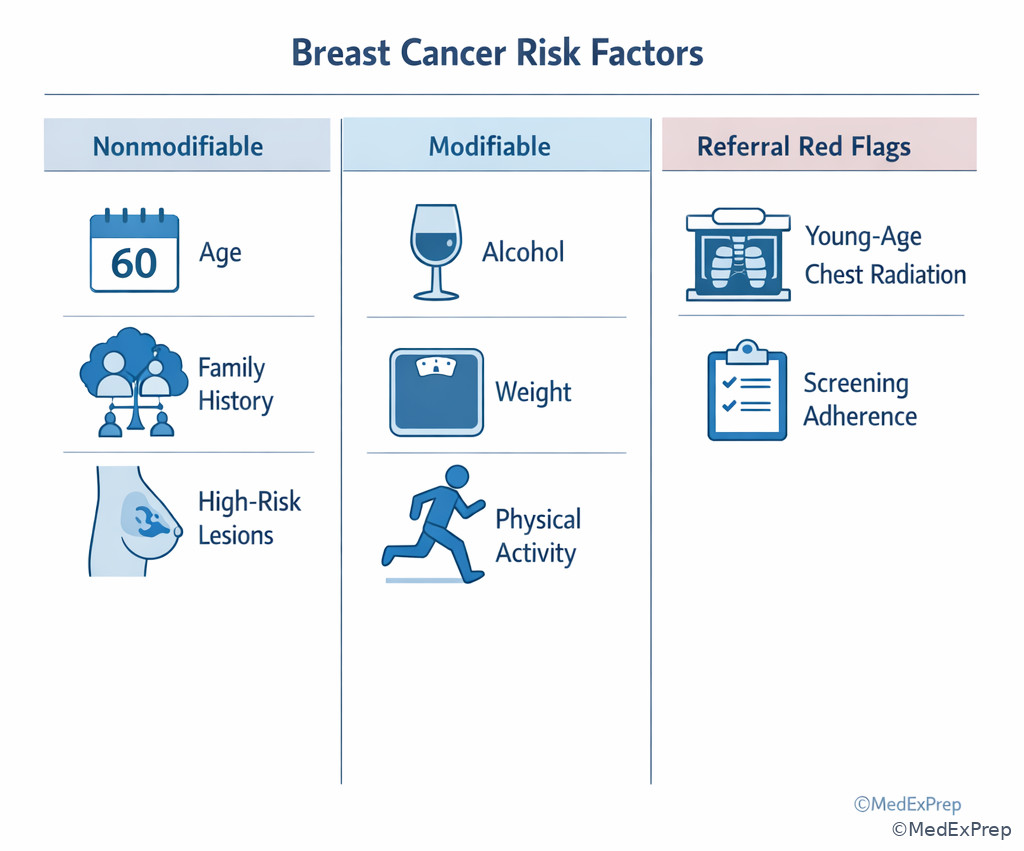
- Alcohol use, excess body weight after menopause, and physical inactivity are modifiable risks commonly tested with patient teaching.
- Breast density is not a diagnosis, but it affects both risk and screening sensitivity.
- Hormonal and reproductive history matters because longer lifetime estrogen exposure increases risk.
- The RN does not diagnose hereditary cancer syndrome but does recognize red flags and support referral.
- The best nursing action often is: assess carefully, document clearly, educate accurately, and escalate per workflow.
Core content
Exam takeaway: Sort risk factors into nonmodifiable, modifiable, and referral-trigger categories to choose the safest nursing next step.
flowchart TD
A[Breast cancer risk intake] --> B[Nonmodifiable factors]
A --> C[Modifiable factors]
A --> D[Referral red flags]
B --> B1[Age]
B --> B2[Sex assigned at birth]
B --> B3[Personal history or high-risk lesion]
B --> B4[Reproductive/hormonal exposure]
C --> C1[Alcohol]
C --> C2[Postmenopausal obesity]
C --> C3[Physical inactivity]
D --> D1[Early-onset family cancers]
D --> D2[Ovarian cancer in family]
D --> D3[Male breast cancer]
D --> D4[Young-age chest radiation]
Use this lesson-wide framework first: some factors increase baseline risk, some change screening context, and some should immediately make the nurse think about referral or escalation rather than routine reassurance. See Fig 1.
1.1.1.3 Foundational risk categories: what counts, what does not, and what changes nursing action
A Explanation
The decision conflict here is simple but highly tested: should the nurse treat the history as routine risk education, or does one specific feature move the patient into elevated-risk follow-up? The resolving rule is to sort each detail into three buckets: nonmodifiable baseline risk, modifiable risk, and referral-triggering red flags. Age, female sex, personal history of breast cancer, certain benign high-risk lesions, and prolonged hormonal exposure belong to the first bucket. Alcohol use, inactivity, and postmenopausal excess weight belong to the second. Early-onset family clustering, ovarian cancer in relatives, male breast cancer, and prior young-age chest radiation belong to the third.
WHY THIS IS TESTED: exam items often give a long history with one high-yield clue buried among lower-yield details. The task is not to calculate a formal score; it is to choose whether the RN should educate routinely, clarify the history, or escalate for timely follow-up.
B Worked example
A 52-year-old woman presents to a breast center for routine education before screening. She has hypertension and osteoarthritis, drinks two glasses of wine nightly, had menarche at age 11, had her first child at 36, and mentions that a paternal aunt had breast cancer at 74. She also reports a benign biopsy 2 years ago but does not know the pathology. Her LDL level is elevated, which she worries is her biggest breast cancer risk. The task is to identify the most appropriate nursing action.
Identify task: determine whether this history needs routine education only or additional clarification/escalation. Extract key facts: age over 50, alcohol use, early menarche, late first birth, uncertain prior biopsy pathology, and only one older relative with breast cancer. Apply rule: most listed features are risk modifiers, but the uncertain pathology is the point that could change management because a prior high-risk lesion matters more than her LDL level. Eliminate distractors: do not reassure solely based on “only one relative,” and do not focus on cholesterol as the main breast-specific risk issue. Verify: the best RN action is to clarify and obtain the prior benign biopsy pathology while also teaching modifiable risk and routine screening adherence.
C Exam trap
D Checkpoint
Question: A 49-year-old patient with obesity and controlled asthma presents for screening education. She reports menarche at age 11, first full-term pregnancy at 35, and a prior breast biopsy “that was benign,” but she does not know the exact result. What is the most appropriate nursing action?
- Provide reassurance because the biopsy was benign and continue routine teaching only.
- Clarify the prior pathology result and document whether a high-risk lesion was present.
- Advise immediate emergency evaluation because any prior breast biopsy suggests active cancer.
- Focus only on weight-loss counseling because obesity is the strongest modifiable factor in this stem.
- A: Tempting because “benign” sounds reassuring; wrong because benign pathology can still include atypia or LCIS, which changes future risk assessment.
- B: Tempting because it requires extra work; right because the unknown biopsy pathology is the discriminating clue that may alter risk follow-up.
- C: Tempting because breast history can feel urgent; wrong because no acute red-flag symptom or emergency finding is present.
- D: Tempting because weight counseling is appropriate; wrong priority because first the nurse must clarify the potentially high-impact prior pathology.
1.1.1.4 Nonmodifiable and biologic risk factors: age, sex, hormones, breast density, and personal history
A Explanation
The decision conflict here is whether a risk detail is merely background information or whether it meaningfully changes how the nurse frames education and follow-up. The single resolving rule is to prioritize factors with the strongest evidence and the greatest effect on future screening context: increasing age, female sex, personal history of breast cancer, certain high-risk lesions, prior chest radiation at a younger age, and cumulative estrogen exposure indicators such as early menarche, late menopause, nulliparity, or later first birth. Dense breasts matter, but they are frequently tested incorrectly: density modestly increases risk and also makes cancers harder to detect on mammography. It is not the same thing as a hereditary syndrome and should not be taught that way.
WHY THIS IS TESTED: stems often combine one major risk factor with several weaker ones. The test asks whether you can identify the strongest actionable clue without overstating lower-yield details.
B Worked example
A 61-year-old patient with type 2 diabetes and chronic back pain calls after receiving a mammography letter mentioning dense breasts. She has no personal cancer history, had menarche at 10, menopause at 56, no children, and had chest radiation for Hodgkin lymphoma at age 19. She is focused on the wording about density and asks whether that is the main reason she is high risk. Her hemoglobin A1c is 8.4%, which appears in the chart but is unrelated to the immediate question.
Identify task: determine the most important risk clue and the correct RN teaching point. Extract key facts: dense breasts, prolonged estrogen exposure markers, and prior chest radiation at a young age. Apply rule: young-age chest radiation is a major red flag and carries more immediate importance than density alone. Eliminate distractors: do not reduce the teaching to “density is common” and do not treat diabetes control as the primary issue in this risk discussion. Verify: the best nursing response is to explain that dense breasts matter, but prior chest radiation at age 19 is a higher-risk feature that should be clearly documented and followed per institutional high-risk pathway.
C Exam trap
D Checkpoint
Question: Which history detail should prompt the nurse to avoid routine reassurance and instead ensure high-risk follow-up is addressed?
- Menopause at age 54
- Dense breasts on mammography
- Prior mantle/chest radiation at age 18
- First childbirth at age 33
- A: Tempting because later menopause increases estrogen exposure; wrong because it is not the strongest escalation trigger among these choices.
- B: Tempting because dense breasts are commonly highlighted in screening letters; wrong because density alone is not as strong a red flag as young-age chest radiation.
- C: Tempting because it sounds severe; right because chest radiation at a young age is a major risk factor requiring careful follow-up and documentation.
- D: Tempting because later first birth increases risk; wrong because it is weaker and less urgent than prior young-age chest radiation.
- The strongest single clue in many risk stems is prior young-age chest radiation.
- True or False: Dense breasts affect both risk and screening sensitivity. True.
- Name 3 hormonal exposure clues: early menarche, late menopause, nulliparity/later first birth.
Exam takeaway: When several risk details are present, prioritize the clue that changes follow-up rather than the one that merely raises baseline risk.
flowchart LR
A[Risk clues in stem] --> B[Background increase]
A --> C[Stronger escalation clue]
B --> B1[Early menarche]
B --> B2[Late first birth]
B --> B3[Postmenopausal obesity]
B --> B4[Alcohol use]
C --> C1[Young-age chest radiation]
C --> C2[Prior atypia or LCIS]
C --> C3[Personal breast cancer history]
C --> C4[Hereditary family pattern]
When the exam asks for the best nursing action, choose the factor that most changes next-step follow-up, not merely the one that increases risk somewhat. See Fig 2.
1.1.1.5 Family history, high-risk lesions, and referral-triggering patterns
A Explanation
The decision conflict is whether the nurse should stay in general risk education mode or move into referral-support mode. The single finding that resolves this conflict is a pattern suggesting hereditary risk or a documented high-risk lesion. A single older relative with breast cancer may still be relevant, but the concern rises sharply when the stem includes early-onset breast cancer, multiple affected relatives on the same side, ovarian cancer, bilateral breast cancers, pancreatic or prostate clustering in some family patterns, or male breast cancer. Likewise, pathology terms such as atypical ductal hyperplasia, atypical lobular hyperplasia, and lobular carcinoma in situ are not “nothing happened” findings; they are future-risk markers.
WHY THIS IS TESTED: CBCN-style items expect the RN to recognize red flags, support a genetics or high-risk referral pathway, and document precise history, while avoiding provider-level diagnosis statements.
B Worked example
A 38-year-old patient seen in a breast imaging clinic after a callback asks whether she is “probably fine” because her mother never had cancer. She has lupus and migraines, had a prior biopsy showing atypical ductal hyperplasia, and reports that her father’s sister had breast cancer at 42 and her paternal grandfather’s sister had ovarian cancer. She also mentions a benign breast cyst years ago, which is the clue she keeps returning to. The stem asks for the most appropriate nursing action.
Identify task: determine whether to provide routine reassurance or initiate a higher-level referral process. Extract key facts: age 38, prior atypical ductal hyperplasia, paternal-side early-onset breast cancer, ovarian cancer in family. Apply rule: paternal family history counts, and atypical hyperplasia plus hereditary red flags should prompt referral support. Eliminate distractors: do not dismiss the family history because it is on the father’s side, and do not let the prior cyst distract from the more important atypia. Verify: the best RN action is to document the detailed history, reinforce that paternal relatives matter, and support timely genetics/high-risk referral per institutional workflow.
C Exam trap
D Checkpoint
Question: A patient asks which family history detail is most important to report because it may change follow-up beyond routine teaching. Which answer is best?
- A maternal grandmother with colon cancer at age 88
- A paternal aunt with breast cancer at age 41
- A cousin with thyroid cancer at age 50
- An uncle with basal cell skin cancer at age 70
- A: Tempting because any cancer in the family can feel relevant; wrong because this pattern is less suggestive of hereditary breast risk than the early-onset breast cancer option.
- B: Tempting because it is on the paternal side and learners may hesitate; right because early-onset breast cancer in a close biologic relative on either side is highly relevant.
- C: Tempting because it is younger age than some other options; wrong because it is less specifically tied to hereditary breast risk in this comparison.
- D: Tempting because it is still cancer; wrong because it lacks the pattern strength of early-onset breast cancer.
1.1.1.6 Modifiable risk factors and patient teaching: what the RN can act on today
A Explanation
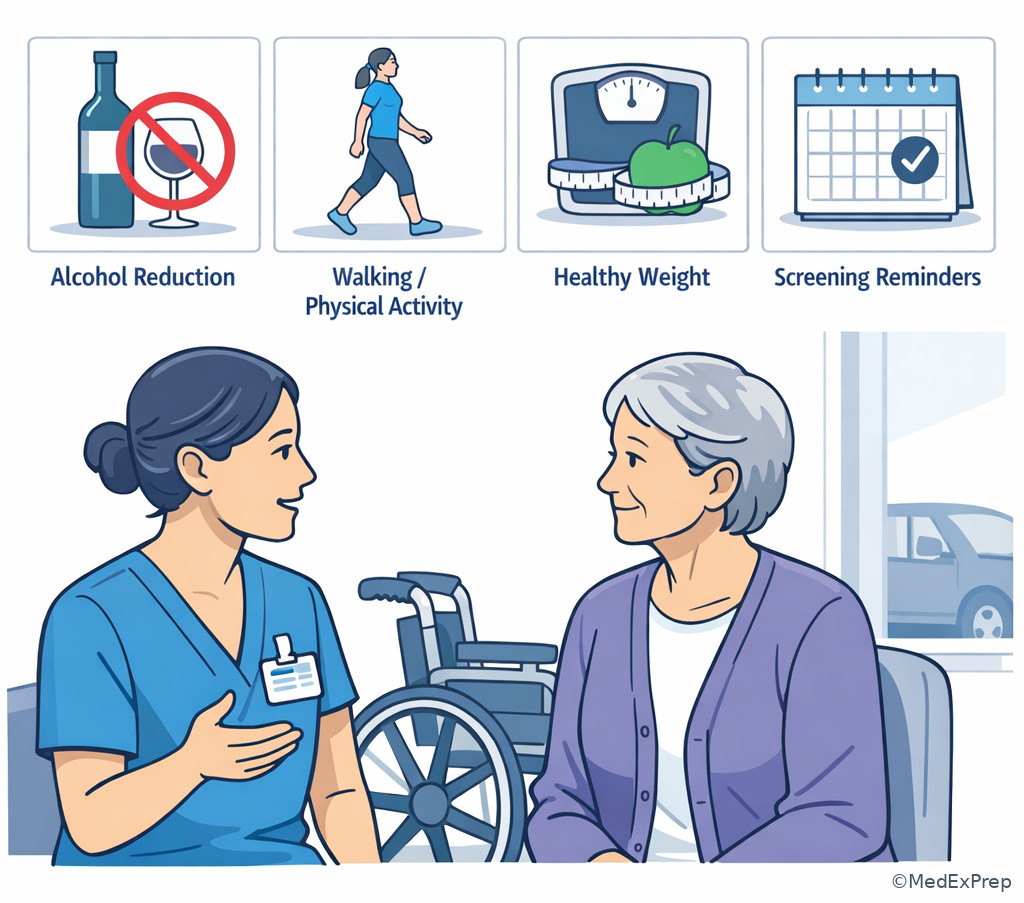
The decision conflict here is whether the visit should focus on abstract risk discussion or concrete prevention teaching the patient can use immediately. The rule is to convert modifiable risks into specific, realistic, nonjudgmental education: alcohol moderation, healthy body weight after menopause, physical activity, and adherence to screening. Some stems add hormone exposure questions, but unless the item is clearly about provider decision-making, the RN role is education, clarification, and referral rather than independently changing therapies. Patients often ask for certainty—“If I stop drinking, will I not get cancer?”—and the RN should answer with balanced language: risk can be lowered, not erased.
WHY THIS IS TESTED: exam writers want the nurse to pair correct science with patient-centered teaching, especially when barriers such as low health literacy, anxiety, transportation issues, or cultural beliefs complicate adherence.
B Worked example
A 57-year-old postmenopausal patient with hypertension and depression says she wants to “do anything” to lower her breast cancer risk. She drinks three alcoholic beverages most nights, has gained 25 pounds over 5 years, is sedentary because of knee pain, and has missed her last screening because she cares for her spouse with dementia. She asks whether switching to herbal supplements is more important than exercise. Her vitamin D level is low, which is a tempting distractor.
Identify task: choose the best RN teaching focus and next step. Extract key facts: multiple modifiable risks plus caregiver burden creating adherence barriers. Apply rule: effective risk-reduction teaching must be concrete and matched to the patient’s barriers. Eliminate distractors: do not center the visit on supplements, and do not deliver generic advice without addressing her missed screening and caregiver constraints. Verify: the best nursing action is to provide realistic teaching on alcohol reduction, activity/weight goals, and screening rescheduling while helping identify support or navigation resources for access barriers.
C Exam trap
D Checkpoint
Question: A postmenopausal patient asks which change would be a valid breast cancer risk-reduction teaching point. Which response is best?
- “Stopping all caffeine is the main evidence-based way to lower risk.”
- “Reducing alcohol use and increasing physical activity are meaningful modifiable risk steps.”
- “If you have dense breasts, lifestyle changes no longer matter.”
- “Because risk factors are mostly genetic, screening adherence is less important.”
- A: Tempting because patients often ask about diet triggers; wrong because caffeine avoidance is not the primary evidence-based risk-reduction teaching point here.
- B: Tempting because it sounds simple; right because alcohol moderation and physical activity are true modifiable risk strategies.
- C: Tempting because density can sound deterministic; wrong because modifiable risk and screening adherence still matter.
- D: Tempting because genetics are memorable; wrong because many patients benefit from both modifiable risk counseling and screening adherence.
- The most commonly tested modifiable risk behavior is alcohol use.
- True or False: A risk-reduction conversation should ignore access barriers if the science is correct. False.
- Name 3 modifiable targets: alcohol, physical activity, postmenopausal weight management.
1.1.1.7 RN scope, communication, and documentation when risk is elevated
A Explanation
The decision conflict is whether the nurse should answer the patient’s anxiety with reassurance, with a medical conclusion, or with a scope-appropriate action plan. The resolving rule is that the RN recognizes elevated risk, clarifies missing data, provides evidence-based teaching, documents exactly, and escalates or coordinates referral per institutional workflow. The RN does not diagnose hereditary cancer syndrome, declare the patient “will get cancer,” or independently prescribe preventive medication. In CBCN-style questions, the correct option often includes both communication and action: acknowledge concern, state what is known, identify what needs clarification, and arrange the next safe step.
WHY THIS IS TESTED: the exam emphasizes realistic nursing judgment across the continuum. A strong nurse answer protects safety, reduces misinformation, and stays inside scope.
B Worked example
A 44-year-old patient in a navigation visit says, “My brother had breast cancer, so I know I definitely have the gene.” She has anxiety and controlled hypothyroidism. Her chart also notes two missed appointments due to transportation problems. She asks the nurse whether she should tell her daughter they both already have hereditary breast cancer. The distracting clue is a recent benign cyst aspiration, which does not answer the current question.
Identify task: choose the safest RN response within scope. Extract key facts: male breast cancer in a first-degree relative is a major hereditary red flag, but no confirmed genetic result exists; there are active access barriers. Apply rule: the nurse should not diagnose a mutation, but should recognize the red flag, provide accurate language, and coordinate referral. Eliminate distractors: do not falsely reassure, do not confirm a genetic diagnosis, and do not ignore transportation barriers that could prevent follow-through. Verify: the best action is to acknowledge concern, explain that this family history warrants genetics/high-risk evaluation, support referral, and address transportation barriers so the plan is feasible.
C Exam trap
D Checkpoint
Question: A patient reports a brother with breast cancer and asks, “Does this mean I have hereditary breast cancer?” What is the best nursing response?
- “Yes, that confirms you carry a mutation, so we will document that diagnosis.”
- “That family history is an important red flag; I will document it and help coordinate appropriate referral for further evaluation.”
- “No, because only maternal family history affects hereditary breast risk.”
- “Family history matters less than lifestyle, so focus on exercise and do not worry about referral.”
- A: Tempting because male breast cancer is highly concerning; wrong because it exceeds RN scope by making a definitive diagnosis.
- B: Tempting because it is cautious rather than definitive; right because it recognizes the red flag, stays within scope, and advances safe follow-up.
- C: Tempting if the learner mistakenly discounts paternal or male-side history; wrong because this statement is false.
- D: Tempting because lifestyle counseling is often appropriate; wrong because this stem contains a referral-level hereditary red flag.
Exam takeaway: A structured RN intake that captures age, personal history, reproductive history, and biologic family history prevents missed high-risk clues.
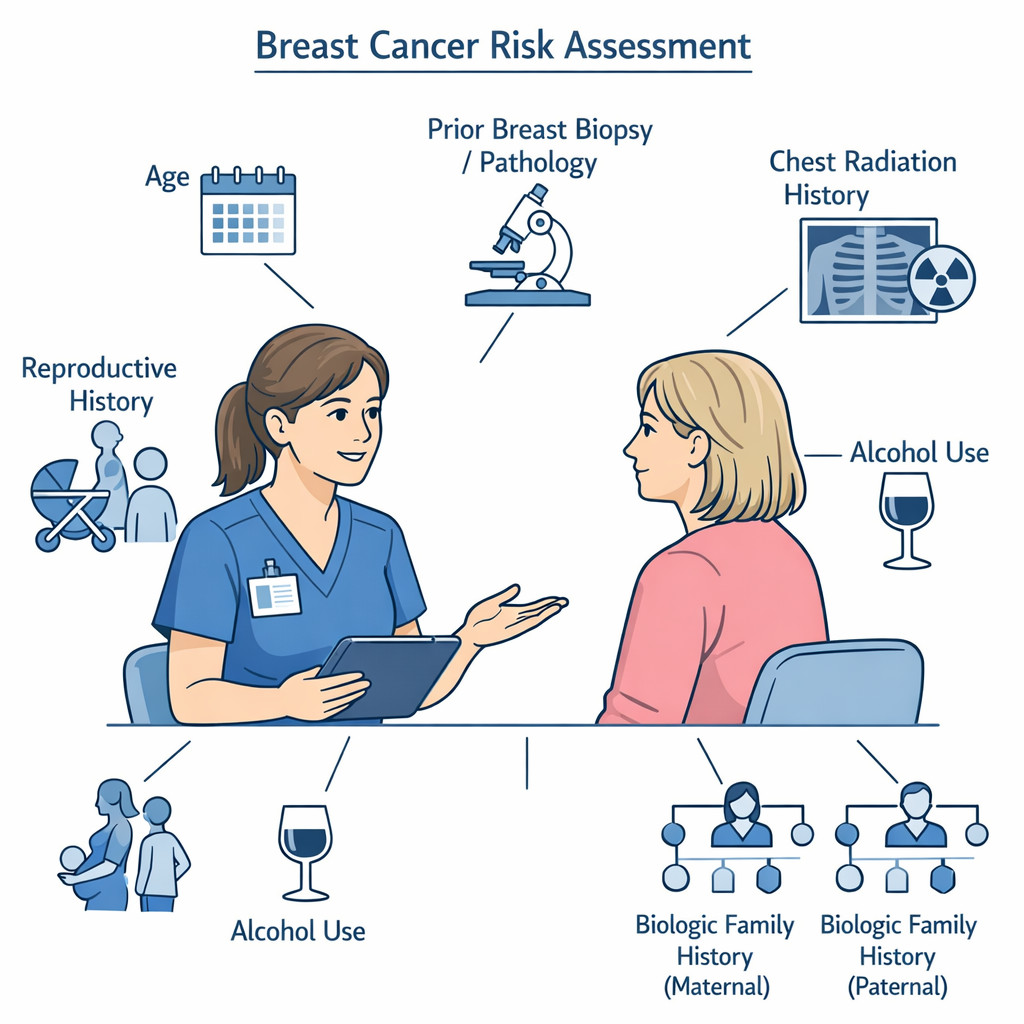
A careful intake process is itself a safety intervention. Missing one key data point can change the follow-up plan entirely. See Fig 3.
Exam takeaway: Patients understand risk best when factors are grouped into what cannot be changed, what can be changed, and what needs referral.
Exam takeaway: Early-onset breast cancer, ovarian cancer, and male breast cancer in biologic relatives should trigger careful documentation and referral workflow.
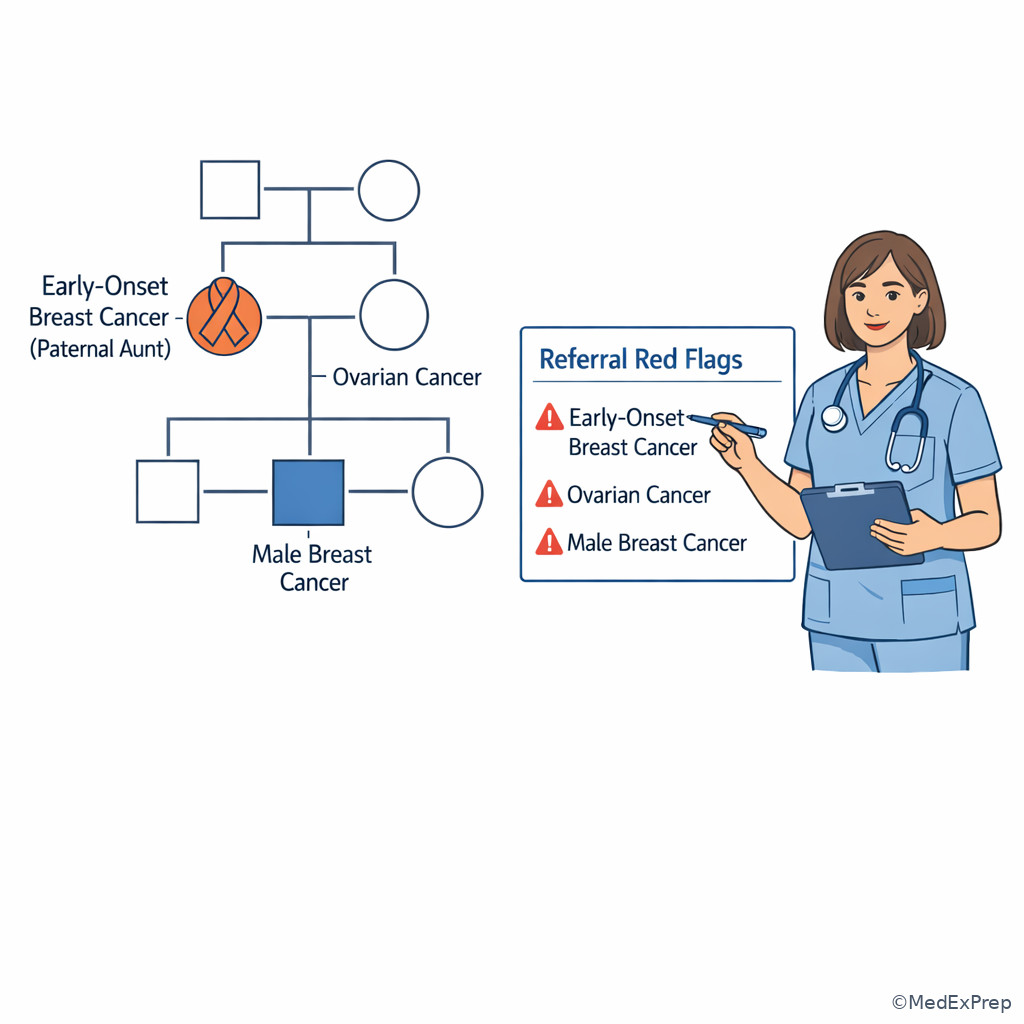
Family patterns are often easier to recognize visually than in paragraph form. Use this mental picture when deciding whether routine education is enough. See Fig 4.
Exam takeaway: Dense breasts increase risk modestly and can reduce mammographic sensitivity, so teaching must address both points.
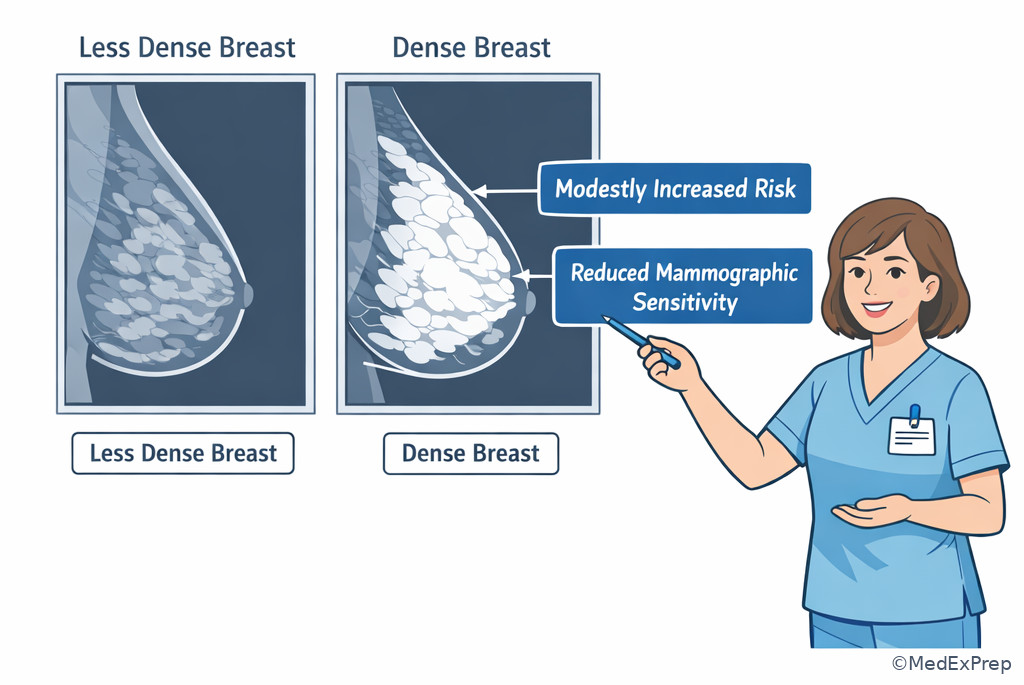
Exam takeaway: The safest answer combines clarification, education, documentation, and escalation rather than reassurance or provider-level diagnosis.
flowchart TD
A[Elevated risk clue identified] --> B[Clarify missing details]
B --> C[Teach with accurate, nonalarmist language]
C --> D[Document exact findings]
D --> E[Follow local referral or notification pathway]
E --> F[Address barriers to follow-up]
This is the nursing-action pattern that frequently wins the question stem: assess, clarify, teach, document, coordinate. See Fig 5.
Exam takeaway: Practical teaching on alcohol, activity, and weight is stronger when linked to the patient’s real barriers to screening and follow-up.
Exam takeaway: A prior biopsy labeled “benign” still needs clarification if atypia or lobular carcinoma in situ may have been present.
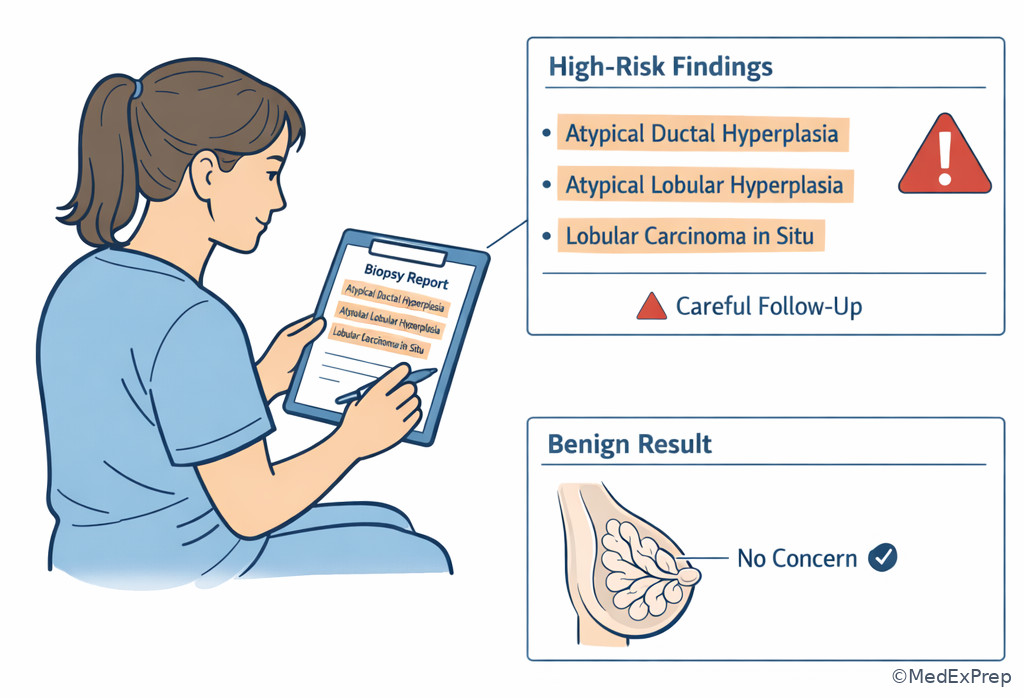
One of the most testable documentation errors is treating all prior benign biopsies as equal. They are not. See Fig 6.
Exam Traps & Differentiators
- Most common wrong answer and why: choosing a reassuring teaching statement because the patient has only one named risk factor. Many stems are designed so the true discriminator is hidden in an unknown pathology report, a paternal relative, or prior young-age chest radiation.
- Looks similar but isn't: dense breasts are not the same as hereditary cancer risk; they affect risk and detection sensitivity but do not by themselves confirm a familial syndrome.
- Looks similar but isn't: “benign biopsy” is not the same as “no increased future risk”; atypia and LCIS can be recorded in a history the patient remembers only as benign.
- Looks similar but isn't: family history on the paternal side is just as relevant biologically as family history on the maternal side.
- Looks similar but isn't: a true red flag should trigger referral support, not definitive medical statements by the RN.
| Stem says... | Think... | Best RN move |
|---|---|---|
| “My biopsy was benign, I think” | Could there have been atypia or LCIS? | Clarify pathology before reassurance |
| “Only my dad's side had breast cancer” | Paternal family history counts | Document details and assess for hereditary red flags |
| “My mammogram letter says dense breasts” | Density affects risk and detection | Teach both points; do not overcall hereditary risk |
| Prior chest radiation at age 18-20 | Major elevated-risk clue | Ensure high-risk follow-up is addressed |
| Male relative with breast cancer | Hereditary red flag | Support genetics/high-risk referral per workflow |
| Missed screening due to caregiving or transportation | Access barrier is part of the clinical problem | Coordinate practical follow-up, not education alone |
Exam takeaway: Reject answers that either over-reassure or overstep scope when the safer nursing answer is to clarify and escalate.
flowchart LR
A[Risk history question] --> B{What kind of clue?}
B -->|Lifestyle only| C[Teach modifiable risk + screening adherence]
B -->|Unknown pathology| D[Clarify records]
B -->|Hereditary pattern| E[Referral support]
B -->|Young-age chest radiation| F[High-risk follow-up]
C --> G[Do not ignore barriers]
D --> H[Do not reassure yet]
E --> I[Do not diagnose mutation]
F --> J[Do not reduce to density only] Tables
| Key fact/value type | High-yield content | Exam use |
|---|---|---|
| Strong baseline risk | Increasing age | Do not underweight age when other details are mild |
| Major personal-history factor | Prior breast cancer or high-risk lesion | Changes follow-up more than general lifestyle factors |
| Radiation red flag | Chest radiation at younger age | Prompt high-risk follow-up, not routine reassurance |
| Breast density | Modestly increases risk and lowers mammographic sensitivity | Teach both risk and detection implications |
| Hormonal exposure clues | Early menarche, late menopause, nulliparity, later first birth | Recognize cumulative estrogen exposure pattern |
| Modifiable teaching points | Alcohol, physical inactivity, postmenopausal excess weight | Translate into actionable education |
| Referral-triggering family pattern | Early-onset breast cancer, ovarian cancer, male breast cancer, clustered relatives | Support genetics/high-risk referral workflow |
| Comparison | Average-risk context | Elevated-risk context | RN implication |
|---|---|---|---|
| Family history | Single older relative without pattern | Early-onset, multiple relatives, ovarian cancer, male breast cancer | Clarify specifics; escalate if pattern suggests hereditary risk |
| Prior biopsy | Clearly benign non-high-risk finding | Atypia or LCIS, or unknown pathology | Obtain exact pathology before reassurance |
| Breast density | No major hereditary implication by itself | May coexist with other strong risk factors | Teach nuance; avoid overcalling or dismissing |
| Lifestyle | Few modifiable issues | Alcohol use, sedentary pattern, weight gain, missed screening | Provide concrete teaching and barrier-specific support |
| Radiation history | No prior therapeutic chest exposure | Young-age chest radiation | Document clearly and route for high-risk follow-up |
| Differential/classification item | Why it seems high risk | Why it is less concerning than the best answer | Discriminator |
|---|---|---|---|
| Dense breasts | Commonly highlighted in patient letters | Usually weaker than hereditary red flags or young-age radiation | Think risk + detection, not diagnosis |
| Late first birth | True risk factor | Usually background risk rather than immediate referral trigger | Less urgent than atypia or hereditary pattern |
| One older relative with breast cancer | Family history still matters | Pattern strength is lower without early onset or clustering | Age at diagnosis and family clustering |
| “Benign” biopsy, unspecified | Patient interprets as no risk | May conceal high-risk pathology | Need exact pathology terms |
| Male breast cancer in family | May be overlooked if rare | Actually more concerning than common background factors | Triggers hereditary risk concern |
| Young-age chest radiation | Sometimes omitted by patients | More actionable than many lifestyle or reproductive factors | Strong escalation clue |
| Patient statement | Best RN teaching correction |
|---|---|
| “No one on my mother's side had breast cancer, so my paternal history does not matter.” | Paternal biologic family history is relevant and should be reported with ages and cancer types. |
| “My biopsy was benign, so it cannot affect future risk.” | Some benign-appearing histories include high-risk lesions such as atypia or LCIS, so the exact pathology matters. |
| “Dense breasts mean I have hereditary breast cancer.” | Dense breasts do not diagnose hereditary risk; they affect risk modestly and reduce mammographic sensitivity. |
| “Lifestyle changes are pointless because cancer risk is fixed.” | Some risks are not modifiable, but alcohol reduction, physical activity, weight management, and screening adherence still matter. |
| “Because my brother had breast cancer, I definitely have a mutation.” | This is an important red flag that warrants referral, but the RN should not make the definitive genetic diagnosis. |
Algorithm / Approach
Exam takeaway: The best initial nursing action is usually to clarify the highest-impact risk clue before teaching or reassurance.
flowchart TD
A[Patient presents for breast risk discussion] --> B{Any major red flag?}
B -->|Yes| C[Young-age chest radiation]
B -->|Yes| D[High-risk lesion or prior breast cancer]
B -->|Yes| E[Family pattern suggesting hereditary risk]
B -->|No| F[Modifiable risk counseling + screening adherence]
C --> G[Document and escalate per protocol]
D --> G
E --> G
F --> H[Address barriers and verify teach-back]
G --> I[Coordinate referral/follow-up] Rapid Review
- Age-related risk → stronger discriminator than many lifestyle details in mixed stems
- Young-age chest radiation → think high-risk follow-up, not routine reassurance
- Paternal family history → counts fully in hereditary pattern assessment
- Dense breasts → risk plus reduced mammographic sensitivity, not automatic hereditary syndrome
- Unknown “benign” biopsy → clarify pathology before concluding low risk
- Atypical hyperplasia/LCIS history → future-risk marker, not trivial past finding
- Male breast cancer in a relative → hereditary red flag until proven otherwise
- Early-onset relative → more important than an older relative with isolated disease
- Alcohol use → common modifiable risk teaching point
- Postmenopausal excess weight → modifiable risk factor that should trigger practical counseling
- Missed screening with caregiver burden → coordination problem, not just education gap
- RN role → recognize, document, educate, escalate; do not diagnose mutation status
- Risk conversation → avoid false reassurance and avoid alarmist certainty
Self-check quiz
1. A 50-year-old patient with controlled hypertension and seasonal allergies asks which history detail is most important to report because it most strongly changes breast cancer risk follow-up. She had menarche at 11, drinks wine on weekends, and had chest radiation for Hodgkin lymphoma at age 17. What is the most appropriate nursing focus?
- Weekend alcohol use
- Early menarche
- Prior chest radiation at age 17
- Seasonal allergies
2. A 46-year-old patient with obesity and migraines says, “My aunt on my father's side had breast cancer at 39, but that should not matter.” What is the best nursing response?
- “Paternal family history is still relevant and should be documented carefully.”
- “Only your mother's side affects hereditary breast cancer risk.”
- “Your weight is the only risk factor that matters in this history.”
- “Because it was an aunt rather than a mother, it is not clinically useful.”
3. A 58-year-old postmenopausal patient with diabetes and knee osteoarthritis presents for screening teaching. She drinks two to three alcoholic beverages nightly, gained 20 pounds over 4 years, missed last year's screening because she cares for her husband with dementia, and asks whether vitamins are the best way to reduce risk. What is the most appropriate nursing action?
- Explain that supplements are the main proven prevention strategy and defer the screening discussion until later.
- Provide concrete counseling on alcohol reduction, activity/weight management, and help address the barrier that caused missed screening.
- Reassure her that because she has no family history, no risk-reduction teaching is needed.
- Advise that dense breast status must be known before any risk education can be given.
4. A 41-year-old patient with anxiety and GERD reports a prior breast biopsy “that was benign,” but she does not know the pathology. Her mother had breast cancer at 72. She wants to know whether she can assume average risk. What is the best next nursing step?
- Reassure her because benign results never alter future risk.
- Clarify and obtain the prior pathology because benign histories may include high-risk lesions.
- Tell her that because her mother was older at diagnosis, family history is irrelevant.
- Send her to the emergency department for immediate evaluation.
5. A 39-year-old patient with asthma and hypothyroidism comes to a breast clinic after abnormal screening. She reports atypical ductal hyperplasia on a prior biopsy, a paternal aunt with breast cancer at 43, and a great-aunt with ovarian cancer. She asks whether this history should simply be “watched.” What is the most appropriate nursing action?
- Document the pattern and support high-risk/genetics referral per institutional workflow.
- Explain that paternal family history does not matter if the mother is unaffected.
- Focus only on current asthma medications because the breast history is not actionable by nursing.
- Definitively tell the patient she has a BRCA mutation.
6. A 44-year-old patient with depression and limited transportation says her brother had breast cancer and asks the nurse whether she and her daughter “definitely carry the same mutation.” She has missed two recent appointments because she cannot get a ride. Which action requires immediate clarification and represents the best RN response?
- State that the family definitely carries a hereditary mutation and document that diagnosis.
- Explain that this is a significant red flag, avoid making a diagnosis, and coordinate referral while addressing transportation barriers.
- Tell her that male breast cancer in a relative is too rare to affect her own risk planning.
- Provide only general lifestyle counseling and ask her to discuss family history at her next annual visit.
7. A 62-year-old patient with hypertension and chronic insomnia receives a letter noting dense breasts. She had chest radiation for lymphoma at age 19, drinks one glass of wine nightly, and has no known family history. She asks which finding matters most for future risk planning. What is the most appropriate nursing priority?
- Center the discussion on breast density alone because it is the newest information.
- Emphasize that young-age chest radiation is a major elevated-risk clue and ensure follow-up is addressed.
- Reassure her because she has no family history.
- Focus on insomnia management because sleep is the strongest risk factor in this scenario.
8. A 53-year-old patient with obesity and hyperlipidemia presents for navigation after relocating and has fragmentary records. She reports a “benign breast biopsy,” menarche at 10, first childbirth at 37, and one sister with breast cancer at 67. She is highly anxious and asks for the most appropriate next nursing action. Which option is best?
- Conclude that she is average risk because the sister was older at diagnosis.
- Teach only about alcohol and exercise because those are modifiable, and defer record review.
- Obtain the prior biopsy pathology before giving strong reassurance because unknown benign pathology may hide a high-risk lesion.
- Tell her she almost certainly needs prophylactic surgery.
Answer key
1.1.1.8 1. Answer: C
- A: Tempting because alcohol is a true modifiable risk factor and commonly tested in patient teaching. Incorrect for this scenario because prior chest radiation at age 17 is the higher-priority clue that more strongly changes follow-up. Discriminating clue: therapeutic chest radiation during youth. Sources: NCSBN clinical judgment framework; Lewis Medical-Surgical Nursing.
- B: Tempting because early menarche is a real risk factor related to cumulative estrogen exposure. Incorrect because it is a background factor, not the strongest actionable concern in this stem. Discriminating clue: age 17 chest radiation outweighs early menarche. Sources: Lewis; ANA Standards of Practice.
- C: Tempting because it sounds more serious than the others. Correct because young-age chest radiation is a major elevated-risk factor and should shift the nurse toward careful documentation and high-risk follow-up. Discriminating clue: chest radiation at age 17. Sources: Lewis; NCSBN Guidelines.
- D: Tempting only because every history detail can look relevant in a risk stem. Incorrect because seasonal allergies do not drive breast cancer risk assessment priority. Discriminating clue: unrelated comorbidity versus major oncologic risk exposure. Sources: NCSBN Guidelines; ANA Standards.
1.1.1.9 2. Answer: A
- A: Tempting because it is simple and direct. Correct because paternal biologic family history is relevant in hereditary breast risk assessment and should be documented with age and relationship. Discriminating clue: paternal aunt with early-onset breast cancer. Sources: Lewis; ANA Standards of Practice.
- B: Tempting because many learners incorrectly default to maternal lineage when thinking about hereditary breast risk. Incorrect because hereditary patterns can come from either biologic side of the family. Discriminating clue: paternal relatives count. Sources: Lewis; NCSBN clinical judgment framework.
- C: Tempting because obesity is a genuine modifiable risk factor and lifestyle counseling is within RN scope. Incorrect because it ignores the more urgent need to correctly interpret and document the family history. Discriminating clue: family-history red flag versus general modifiable risk. Sources: NCSBN; ANA Standards.
- D: Tempting because an aunt is not first-degree and may seem less important. Incorrect because second-degree relatives can still be highly relevant, especially with early-onset disease. Discriminating clue: age 39 diagnosis. Sources: Lewis; NCSBN Guidelines.
1.1.1.10 3. Answer: B
- A: Tempting because patients frequently ask about supplements, and teaching is a valid nursing action. Incorrect because supplements are not the main evidence-based intervention here, and delaying the screening barrier discussion misses the highest-priority practical problem. Discriminating clue: missed screening due to caregiving burden plus modifiable risk behaviors. Sources: Lewis; ANA Standards.
- B: Tempting because it combines education and coordination rather than a single isolated action. Correct because nursing priority is to address actual modifiable risks and the barrier preventing screening adherence. Discriminating clue: nightly alcohol, weight gain, inactivity, and missed screening. Sources: NCSBN Guidelines; Lewis.
- C: Tempting because absence of family history can lull learners into thinking risk-reduction counseling is optional. Incorrect because family history is not required for meaningful modifiable risk teaching. Discriminating clue: multiple nonfamilial risk factors are present. Sources: ANA Standards; Lewis.
- D: Tempting because dense breasts are often part of risk discussions. Incorrect because no density information is needed to begin valid lifestyle and adherence teaching. Discriminating clue: actionable current behaviors and access barriers already exist. Sources: NCSBN; Lewis.
1.1.1.11 4. Answer: B
- A: Tempting because the word “benign” sounds final and reassuring. Incorrect because some histories patients describe as benign include atypical hyperplasia or LCIS, which affect future risk. Discriminating clue: unknown exact pathology. Sources: Lewis; NCSBN clinical judgment framework.
- B: Tempting because it requires record retrieval rather than immediate reassurance. Correct because clarifying the pathology is the safest RN action before assigning risk language. Discriminating clue: prior biopsy result is unspecified. Sources: ANA Standards; Lewis.
- C: Tempting because a later-age maternal diagnosis may seem less alarming. Incorrect because the core issue is the unknown biopsy pathology, not dismissing family history. Discriminating clue: missing personal pathology data is the higher priority. Sources: NCSBN; Lewis.
- D: Tempting because breast-history questions may feel urgent. Incorrect because no acute instability or emergency symptom is described. Discriminating clue: outpatient risk clarification, not emergency evaluation. Sources: NCSBN Guidelines; ANA Standards.
1.1.1.12 5. Answer: A
- A: Tempting because it stays within nursing scope while taking the history seriously. Correct because atypical ductal hyperplasia plus paternal early-onset breast cancer and ovarian cancer pattern warrants high-risk/genetics referral support according to workflow. Discriminating clue: combined high-risk lesion and hereditary red flags. Sources: Lewis; ANA Standards of Practice.
- B: Tempting if the learner still undervalues paternal history. Incorrect because paternal biologic relatives matter in hereditary risk assessment. Discriminating clue: paternal aunt at age 43 remains highly relevant. Sources: Lewis; NCSBN.
- C: Tempting because asthma medications are part of safe assessment and all options must be real nursing actions. Incorrect priority because the breast risk pattern is the immediate reason for the visit and requires action. Discriminating clue: prior atypia and family pattern drive the nursing decision. Sources: ANA Standards; NCSBN Guidelines.
- D: Tempting because the pattern strongly suggests possible hereditary risk. Incorrect because definitive mutation statements exceed RN scope. Discriminating clue: recognition does not equal diagnosis. Sources: ANA Standards; NCSBN clinical judgment framework.
1.1.1.13 6. Answer: B
- A: Tempting because a brother with breast cancer is a strong hereditary red flag. Incorrect because documenting a definitive mutation diagnosis without testing exceeds RN scope and violates safe communication standards. Discriminating clue: patient asks about certainty, but no test result exists. Sources: ANA Standards of Practice; NCSBN Guidelines.
- B: Tempting because it may feel less decisive than a direct answer, but it is the safest and highest-priority response. Correct because it acknowledges the red flag, preserves scope, and addresses the transportation barrier that threatens follow-through. Discriminating clue: male breast cancer in a first-degree relative plus missed appointments. Sources: NCSBN clinical judgment framework; ANA Standards.
- C: Tempting only if the learner is unfamiliar with hereditary red flags. Incorrect because male breast cancer in a biologic relative is highly relevant and should not be dismissed. Discriminating clue: brother with breast cancer. Sources: Lewis; NCSBN.
- D: Tempting because lifestyle counseling is within scope and often appropriate. Incorrect priority because the stem contains a major hereditary red flag and an access barrier requiring timely coordination now. Discriminating clue: immediate referral-level concern plus transportation issues. Sources: ANA Standards; NCSBN Guidelines.
1.1.1.14 7. Answer: B
- A: Tempting because dense breast letters often dominate patient attention and are a common exam distractor. Incorrect because dense breasts are not the strongest clue in this stem. Discriminating clue: chest radiation at age 19 is present. Sources: Lewis; NCSBN Guidelines.
- B: Tempting because it elevates an older history detail that the patient may not mention first. Correct because young-age chest radiation is a major elevated-risk factor and should drive nursing follow-up planning. Discriminating clue: prior radiation at age 19. Sources: Lewis; ANA Standards.
- C: Tempting because lack of family history is often falsely equated with low risk. Incorrect because significant nonfamilial risk factors can still create elevated risk. Discriminating clue: high-risk exposure without family history. Sources: NCSBN; Lewis.
- D: Tempting because insomnia is a real health issue and all options must be plausible nursing concerns. Incorrect because insomnia is not the key breast cancer risk discriminator here. Discriminating clue: oncologic exposure history outranks unrelated chronic symptom management. Sources: ANA Standards; NCSBN.
1.1.1.15 8. Answer: C
- A: Tempting because a sister diagnosed at 67 is less suggestive of hereditary risk than early-onset disease. Incorrect because the unresolved prior biopsy pathology is the key unanswered question before reassurance. Discriminating clue: fragmentary records and unspecified benign biopsy. Sources: Lewis; NCSBN clinical judgment framework.
- B: Tempting because alcohol/exercise counseling is a valid nursing intervention and modifiable factors are present. Incorrect priority because clarifying potentially high-impact pathology should occur before narrowing the plan to lifestyle teaching alone. Discriminating clue: unknown biopsy result may conceal atypia or LCIS. Sources: ANA Standards; Lewis.
- C: Tempting because it seems less immediately comforting to the anxious patient. Correct because safe nursing care requires obtaining the exact pathology before giving strong reassurance or risk conclusions. Discriminating clue: unknown “benign” biopsy in fragmented records. Sources: NCSBN Guidelines; Lewis.
- D: Tempting because patients may ask for strong preventive measures when anxious. Incorrect because recommending prophylactic surgery exceeds RN scope and is unsupported by the available information. Discriminating clue: provider-level treatment planning is outside nursing authority. Sources: ANA Standards of Practice; NCSBN.
Keep going with the full CBCN Prep Course (CBCN)
You just studied the way members do, in the same lesson interface. Full access unlocks every lesson, the question bank and flashcards for a full year.
One payment · 1 year of access · No auto-renewal