1.1.1 - Exam Mapping Table
Why it matters
- The exam rewards disciplined reasoning: before solving a case, you must know which framework applies and where the question belongs.
- A mapping table prevents coverage gaps by showing whether every domain/objective/subskill has both teaching exposure and assessment exposure.
- When official blueprint detail is incomplete, the safest exam-prep move is to use clearly labeled inferred domains rather than guessing official policy.
- Many distractors on certification-style exams exploit category confusion: domain vs objective, objective vs subskill, official vs inferred, or lesson coverage vs assessment coverage.
Key Terms & Must-Know Facts
1.1.1.1 Key terms
- Blueprint language: source wording from official exam documentation when available.
- Official status: directly supported by published CPS/CBBS material.
- Inferred status: study-organizing category derived from durable competencies, not presented as official policy.
- Domain: broad content category.
- Objective: what the candidate should be able to do within a domain.
- Subskill: narrow, teachable, testable capability.
- Course location: where the topic is taught in the course outline.
- Assessment coverage: where the topic is tested or checked.
- Mapping row: one complete line connecting source language to instruction and assessment.
- Coverage gap: mapped area lacks teaching or lacks assessment.
- Overreach: claiming official authority or policy not actually provided.
- Tag: standard label in the format DOMAIN: Objective -> Subskill.
- Boundary case: scenario in which missing facts prevent a firm conclusion.
1.1.1.2 Must-know facts
- Use official labels only when the source is explicitly provided.
- If official detail is incomplete, label the framework inferred, not official.
- The course-opening artifact must include: source blueprint language, official or inferred status, domain label, objective, subskill, course location, assessment coverage.
- A valid mapping row must connect content source -> learning target -> course placement -> assessment check.
- One domain can contain multiple objectives; one objective can contain multiple subskills.
- Assessment coverage is not the same as course location; both must be shown.
- The safest exam response to missing policy detail is often confirm the current handbook/policy.
- Do not invent percentages, scoring, timing, eligibility, or policy details.
Core content
1.1.1.3 Foundational structure: what belongs in the Exam Mapping Table
A Explanation
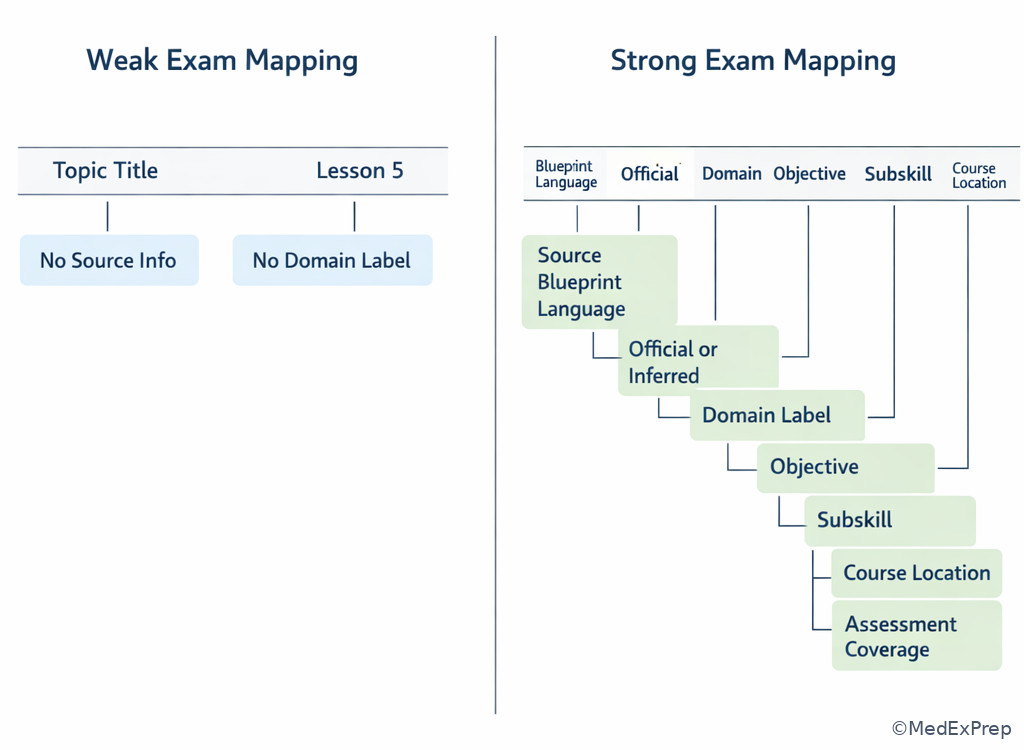
The first decision conflict is simple but heavily tested: is this table just a topic list, or is it a true mapping tool? Choose mapping tool. Reject any version that lists course topics without linking them to source language, classification status, and assessment. The single rule that resolves the conflict is this: if a row cannot tell you what source it came from, whether it is official or inferred, and where it is taught and tested, it is incomplete. This lesson is foundational because later tagging only works if the opening map is structurally sound.
WHY THIS IS TESTED: exam items often present a plausible-looking organizational artifact and ask for the most defensible next step, missing field, or correction. The trap is choosing a cosmetically neat table that does not support coverage verification.
Each required column has a distinct job. Source blueprint language anchors the row to the originating wording. Official or inferred status prevents overclaiming authority. Domain label groups related content. Objective states the performance target. Subskill converts the objective into a teachable/testable unit. Course location identifies where learners encounter it. Assessment coverage confirms it will actually be checked. See Fig 1 for the minimum logic chain.
Exam takeaway: A row is defensible only if it links source language, status, learning target, and both teaching and assessment coverage.
flowchart LR
A[Source blueprint language] --> B[Official or inferred status]
B --> C[Domain label]
C --> D[Objective]
D --> E[Subskill]
E --> F[Course location]
F --> G[Assessment coverage]
G --> H[Coverage verified]
Exam takeaway: Visually separate source, classification status, and coverage fields so missing links stand out before exam practice begins.
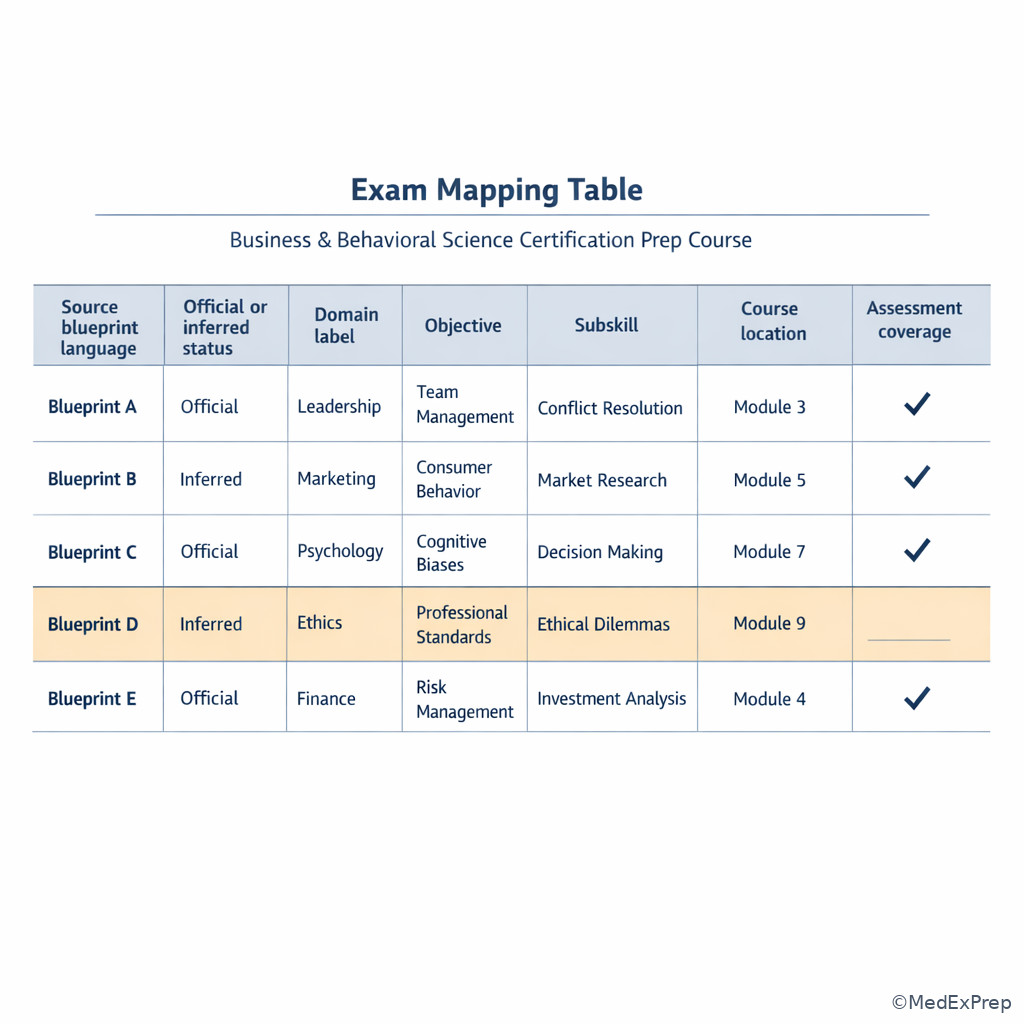
B Worked example
A course designer for a CBBS prep program reviews the first chapter. The team has a tidy spreadsheet listing 72 topics and color-coded chapter names. One designer has prior HR certification experience, another has assessment design experience, and a third mentions a candidate handbook from last year but cannot produce it. The spreadsheet includes topic titles and lesson numbers only. A tempting clue is that the file looks polished and complete. The task asks for the most appropriate next step before using it as the course’s opening blueprint artifact.
Reasoning chain: Identify task — determine whether the artifact satisfies the required mapping function. Extract key facts — only topic titles and lesson numbers are present; no source language, no official/inferred status, no objective, no subskill, no assessment coverage. Apply rule — a valid mapping table must connect source to teaching and assessment. Eliminate distractors — reformatting colors, adding percentages, or sorting alphabetically do not fix the core defect. Verify — the best answer is to add the required mapping columns and classify each row as official or inferred before using the table.
C Exam trap
D Checkpoint
Question: Which addition most directly converts a topic inventory into a defensible exam mapping table?
- Color-coding topics by chapter — tempting because it improves readability, but wrong because it does not show source authority or coverage.
- Adding domain, objective, subskill, and assessment coverage columns — tempting because it adds complexity, and correct because those fields convert a list into a mapping tool.
- Sorting rows by difficulty — tempting because exams feel tiered, but wrong because difficulty does not establish blueprint linkage.
- Adding estimated study time — tempting because it helps planning, but wrong because scheduling data do not verify instructional or assessment alignment.
Answer: B
1.1.1.4 Official vs inferred: how to classify rows without overclaiming
A Explanation
The next decision conflict is whether to fill missing official detail by inference and present it as settled fact or to label the inference openly. Choose open labeling. Reject any option that makes inferred categories look official. The single rule is: if CPS/CBBS wording is not explicitly provided, use a durable study label and mark it inferred. This protects against the exam’s favorite professionalism trap: overreaching beyond the source.
WHY THIS IS TESTED: certification items often reward the safest, most defensible action when facts are incomplete. In this context, that means preserving the distinction between what is confirmed and what is a study aid. See Fig 2 for the choose-vs-reject pathway.
In practice, official language may be broad, sparse, or unavailable in the lesson context. That does not stop you from studying. It changes how you label. For example, “Framework interpretation” can be a useful inferred subskill, but unless the official handbook uses that term, you should not present it as official blueprint text. That distinction matters because later remediation, reporting, and question tagging depend on stable labels. Using inferred labels consistently is better than inventing multiple pseudo-official names for the same construct.
Forward reference: the next lesson on Inferred CBBS Domains builds directly on this classification rule by showing how to create durable inferred domains without pretending they are official blueprint categories.
Exam takeaway: When official wording is absent, the safest choice is to label the category inferred and avoid policy overclaim.
flowchart TD
A[Need to classify topic] --> B{Published CPS/CBBS wording provided?}
B -->|Yes| C[Mark Official]
B -->|No| D[Create durable study label]
D --> E[Mark Inferred]
C --> F[Use consistently]
E --> F[Use consistently] Exam takeaway: Keep the visual distinction obvious so candidates do not mistake study scaffolds for confirmed blueprint policy.
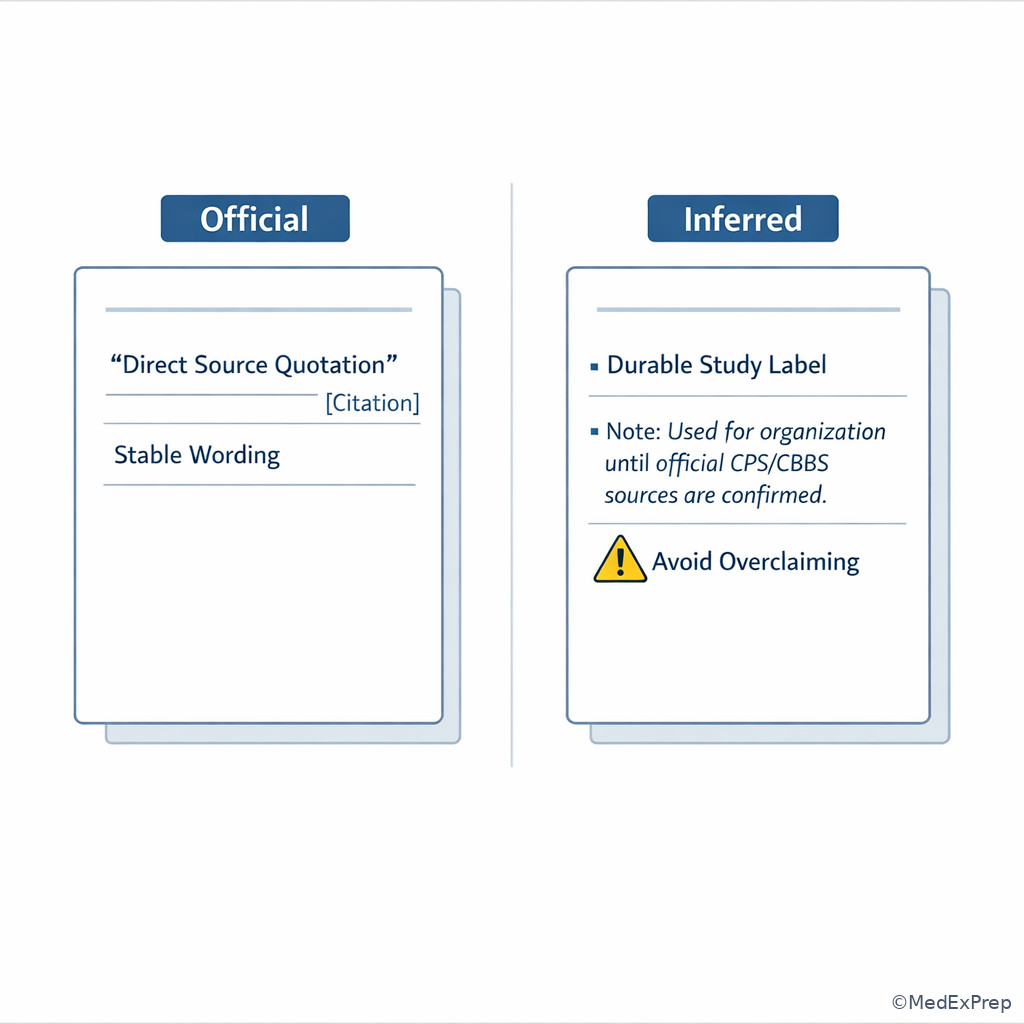
B Worked example
A training manager drafts a row labeled “Official Domain: Decision Support and Process.” The supporting source is not a CPS/CBBS handbook; it is a course outline created internally after reviewing common certification competencies. The manager also notes that candidates frequently face prioritization and verification items. A distracting detail is that the label itself seems highly reasonable and professionally worded. The question asks what requires immediate clarification before the row is shared with learners.
Reasoning chain: Identify task — find the status problem, not the content plausibility. Extract key facts — the label came from an internal outline, not an official source; the domain may still be useful. Apply rule — useful study categories can be used, but must be marked inferred. Eliminate distractors — the row does not fail because the domain is broad, because candidates face prioritization items, or because the wording is elegant. Verify — the required correction is changing status from official to inferred unless official CPS/CBBS wording is provided.
C Exam trap
D Checkpoint
Question: A row uses a domain label derived from course design notes because official blueprint detail is unavailable. What is the most defensible status label?
- Official — tempting because the label may match likely exam content, but wrong because likely is not the same as published.
- Provisional official — tempting because it sounds cautious, but wrong because it still implies unconfirmed authority.
- Inferred — tempting because it seems less authoritative, and correct because it accurately reflects the source limitation.
- Unofficial but binding — tempting because learners want certainty, but wrong because course inference does not create binding policy.
Answer: C
- The safest label when the official source is missing is inferred.
- True or False: A useful study category can be called official if it seems likely to appear on the exam. False.
- Name the two fields that prevent overclaiming: source blueprint language and official or inferred status.
1.1.1.5 Turning broad categories into teachable objectives and subskills
A Explanation
Once a row is structurally sound and correctly classified, the next conflict is whether to stop at a broad domain label or to break it into operational learning targets. Choose break it down. Reject domain-only mapping. The single rule is: if a learner or item writer could not tell what action is expected, the row needs an objective and a subskill. Domains organize; objectives direct; subskills make practice possible.
WHY THIS IS TESTED: exam-style questions often disguise vague planning as sound governance. A broad domain may look complete, but if it cannot drive teaching, item writing, or remediation, it is too blunt. See Fig 3 for the hierarchy and how one domain branches into several testable moves.
For this course, a consistent tag format matters: DOMAIN: Objective -> Subskill. Example: Inferred CBBS Framework Foundations: Construct and interpret the Exam Mapping Table -> Coverage verification. This format is more than notation. It prevents mixed levels of abstraction. “Framework interpretation” is not a domain if the surrounding labels are objectives; “coverage verification” is not broad enough to serve as the domain. The exam loves hierarchy errors because each label sounds professional on its own.
Exam takeaway: Use the same abstraction order every time so rows can drive teaching, item writing, and remediation.
flowchart TD
A[Domain: broad content category] --> B[Objective: candidate action]
B --> C1[Subskill: framework interpretation]
B --> C2[Subskill: rule selection]
B --> C3[Subskill: coverage verification]
B --> C4[Subskill: distractor recognition]
Exam takeaway: Visually nesting domain, objective, and subskill helps prevent mixing levels when building rows or tagging questions.
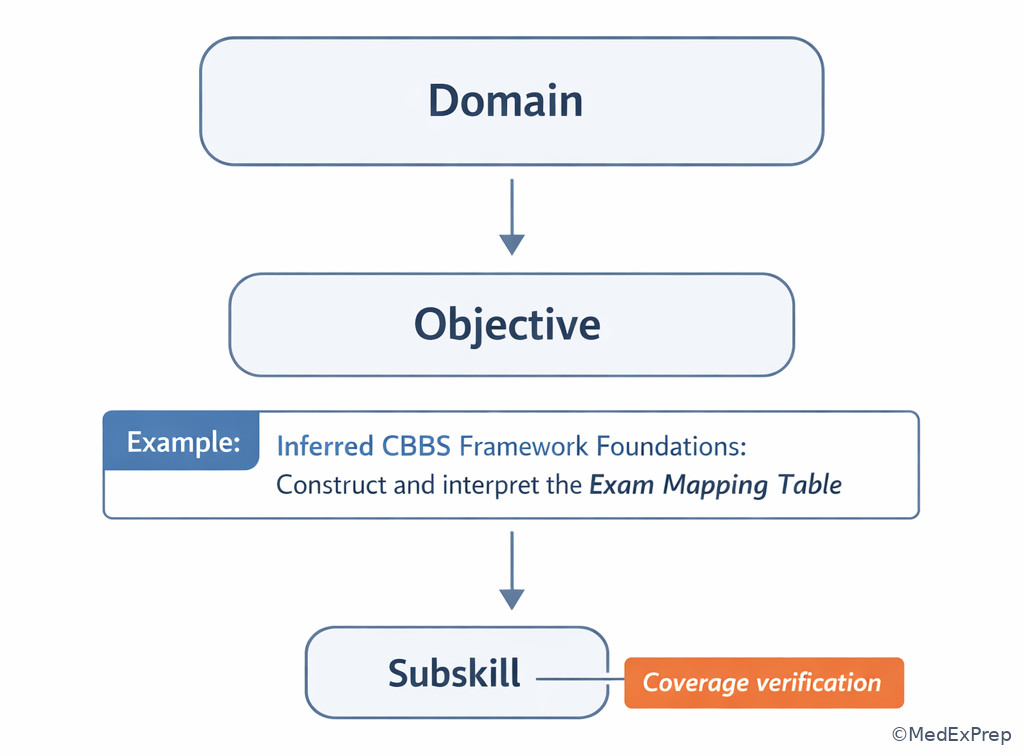
B Worked example
An item writer receives the row “Framework Foundations” and is asked to create three practice questions. The team includes a senior administrator, a learning specialist, and a consultant who prefers broad labels to avoid over-specification. The worksheet contains one irrelevant note about candidate portal color themes, and one tempting clue suggests that broad labels preserve flexibility. The question asks what should be added first to make the row usable for question writing.
Reasoning chain: Identify task — determine what missing field blocks item development. Extract key facts — only a broad label is present; no objective; no subskill; item writer must create questions. Apply rule — item writing requires a testable action and a specific subskill. Eliminate distractors — visual design notes and flexible language do not support scoring logic. Verify — the best next step is to add an objective and subskill tags so each question can target a specific capability.
C Exam trap
D Checkpoint
Question: Which tag best follows the recommended format for this course?
- Coverage verification -> Exam Mapping Table — tempting because both terms are relevant, but wrong because it reverses the hierarchy.
- Inferred CBBS Framework Foundations: Construct and interpret the Exam Mapping Table -> Coverage verification — tempting because it is longer, and correct because it follows domain, objective, then subskill.
- Exam Mapping Table Domain — tempting because it is short, but wrong because it omits objective and subskill.
- Objective: Inferred CBBS Framework Foundations — tempting because the word objective appears, but wrong because the label itself is still a domain.
Answer: B
1.1.1.6 Coverage verification: making sure every mapped area is taught and tested
A Explanation
This is the first major application step. The decision conflict is whether a row is “done” after the tag is written or only after coverage is verified. Choose only after coverage is verified. Reject the idea that labeling alone proves readiness. The single rule is: every mapped area needs at least one instructional treatment and at least one assessment opportunity.
WHY THIS IS TESTED: realistic workplace scenarios ask you to identify gaps before launch. A row with no linked assessment is educationally fragile; a row with no instruction is unfair. The exam may ask for the best correction, most important missing field, or safest next step in a quality check. See Fig 4 for the pass/fail logic.
Coverage verification is where the mapping table becomes operational. Course location answers “Where will the learner learn this?” Assessment coverage answers “Where will the learner demonstrate it?” Those are not interchangeable. A topic can appear in a lecture but not in a quiz. A question bank can accidentally test a subskill never explicitly taught. The mapping table exposes both errors. In a defensible prep course, each row should point to at least one lesson location and at least one assessment location, even if the assessment is formative.
Exam takeaway: A mapped subskill is not complete until both instruction and assessment are explicitly linked.
flowchart TD
A[Mapped row] --> B{Course location listed?}
B -->|No| C[Coverage gap: add instruction]
B -->|Yes| D{Assessment coverage listed?}
D -->|No| E[Coverage gap: add assessment]
D -->|Yes| F[Row ready for use] Exam takeaway: A visual gap check makes it easier to see whether each subskill is both taught and assessed before candidates rely on the course.
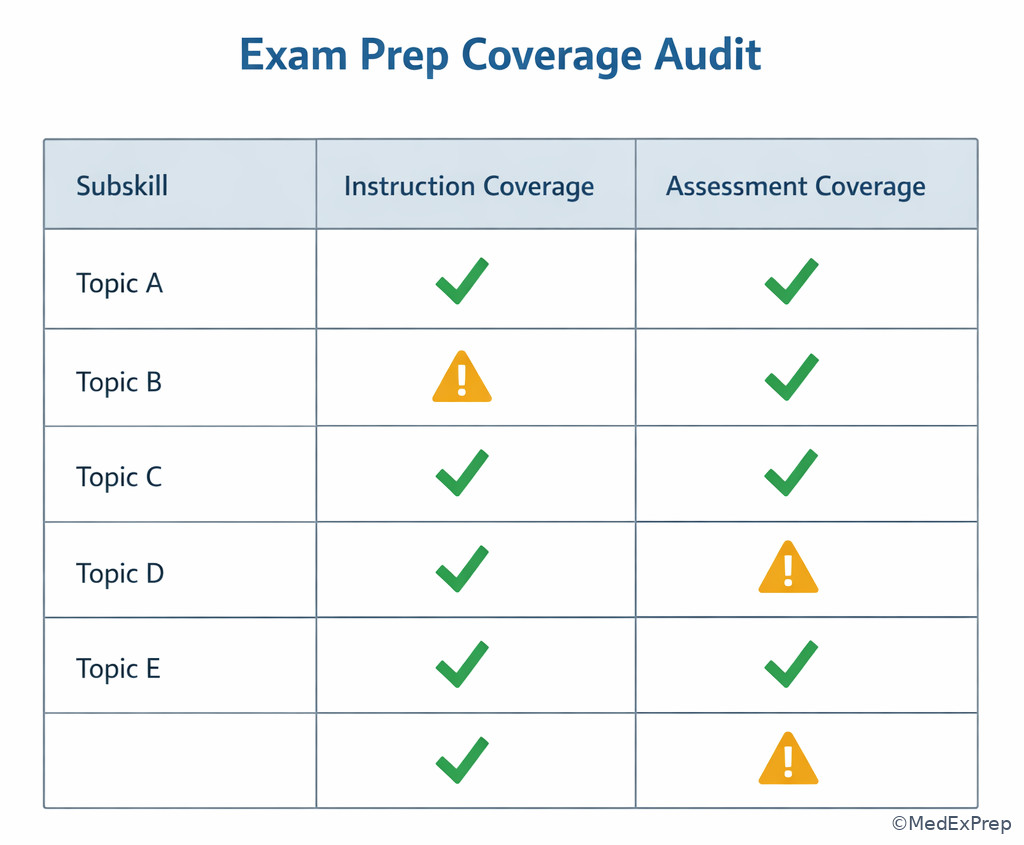
B Worked example
A CBBS prep team has fully tagged its lessons. One row reads: “Inferred CBBS Framework Foundations: Construct and interpret the Exam Mapping Table -> Coverage verification.” Course location points to this lesson. The team includes an operations analyst, a learning lead, and a compliance-minded administrator. A distracting detail mentions that the lesson has strong graphics and a downloadable summary. However, the assessment coverage field is blank. The question asks for the most defensible next step.
Reasoning chain: Identify task — detect the missing requirement before launch. Extract key facts — the row is tagged and taught; assessment coverage is absent. Apply rule — each mapped area needs both instruction and assessment. Eliminate distractors — attractive visuals, strong prose, or a downloadable summary do not substitute for testing. Verify — add an assessment item, case, or quiz checkpoint mapped to that subskill before treating the row as complete.
C Exam trap
D Checkpoint
Question: A mapping row lists source, status, domain, objective, subskill, and course location, but no assessment coverage. Which judgment is most consistent with the framework?
- The row is complete because teaching matters more than testing — tempting because instructional quality feels primary, but wrong because mapped coverage must include both.
- The row is complete if the lesson is long enough — tempting because thoroughness sounds protective, but wrong because duration does not equal assessment alignment.
- The row has a coverage gap that should be fixed before relying on it — tempting because it creates extra work, and correct because assessment coverage is a required field.
- The row should be deleted because missing assessment always invalidates the topic — tempting because it sounds strict, but wrong because the right action is usually to add the missing assessment, not erase the content.
Answer: C
- Every mapped area needs at least one instructional treatment and one assessment opportunity.
- True or False: Course location and assessment coverage can be the same column if the lesson is interactive. False.
- The two missing-coverage questions are: “Where is it taught?” and “Where is it checked?”
1.1.1.7 Boundary-aware use: what to do when details are missing, broad, or institution-specific
A Explanation
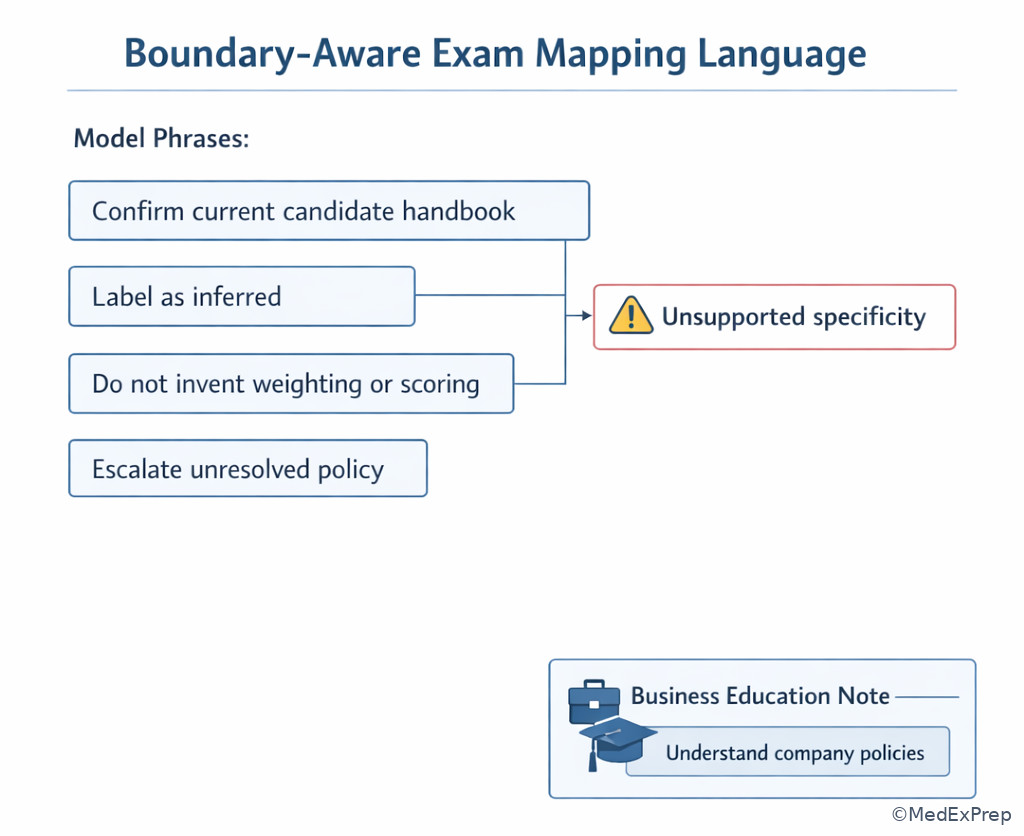
The final integration conflict is whether to fill silence with assumptions or state the governing principle and identify the missing information. Choose the second path. Reject unsupported specificity. The single rule is: when a mapping decision depends on policy, weighting, timing, or legal/institutional detail not provided, do not invent it; use learner-safe language and recommend confirmation through current official sources.
WHY THIS IS TESTED: this is the core professional judgment pattern for CBBS items. The exam does not reward bluffing. It rewards bounded reasoning: use what is given, identify what is missing, choose the safest defensible action, and escalate or confirm when authority is absent. See Fig 5.
In the Exam Mapping Table context, boundary-aware practice means not assigning percentages, scoring rules, or official claims unless the source explicitly supports them. It also means writing learner-facing notes such as “Confirm the current CPS CBBS candidate handbook” rather than pretending the course outline settles those issues. This preserves trust and keeps your study system exam-safe. You are allowed to organize, infer, and prepare; you are not allowed to fabricate official detail.
Exam-safe wording: “Official CPS/CBBS blueprint detail is not fully provided here; this domain label is inferred for study organization. Confirm the current candidate handbook for official wording, weighting, timing, and policy details.”
Exam takeaway: When official specifics are absent, the best answer is usually to state the principle, mark inference clearly, and confirm current sources.
flowchart LR
A[Question depends on unstated policy detail] --> B[Do not invent specifics]
B --> C[Use confirmed source language]
C --> D[Mark inferred elements clearly]
D --> E[Advise confirmation through current handbook/policy]
Exam takeaway: A short scripted note can keep your mapping language safe when official policy detail is limited or missing.
B Worked example
A candidate support coordinator prepares a study guide summary. She writes that the framework foundations domain is worth 12% of the exam and appears mostly in the first hour. Her team includes a project manager and a former test-taker who “remembers” seeing similar proportions in another credential. The guide otherwise correctly labels several areas as inferred. The question asks which statement requires immediate clarification before release.
Reasoning chain: Identify task — find the unsupported claim, not the valid inferred labels. Extract key facts — percentages and timing are asserted without official source support; memory from another credential is irrelevant noise. Apply rule — do not invent weighting, timing, scoring, or policy details when not confirmed. Eliminate distractors — using inferred labels is allowed when clearly marked; advising learners to confirm the handbook is good practice. Verify — the unsupported percentage/timing claim is the statement that requires correction or removal.
C Exam trap
D Checkpoint
Question: Which statement is most consistent with boundary-aware exam mapping?
- “This inferred domain is probably official because it matches other certifications.” — tempting because cross-exam similarities exist, but wrong because similarity does not verify CPS/CBBS status.
- “These percentages are estimated from educator judgment and can be treated as exam facts.” — tempting because estimates sound data-informed, but wrong because estimates are not official blueprint detail.
- “This domain label is inferred for study organization; confirm the current candidate handbook for official wording and policy detail.” — tempting because it feels less decisive, and correct because it is accurate, safe, and role-appropriate.
- “Institutional practice should override the course mapping if the team prefers it.” — tempting because local adaptation matters, but wrong because unverified local practice cannot replace official exam sources.
Answer: C
Exam Traps & Differentiators
Most common wrong answer and why: treating a clean topic list as a complete exam mapping table. It is tempting because sequence and naming create the illusion of structure. It is wrong because mapping requires source, status, learning target hierarchy, and coverage verification.
- Looks complete because it is organized — eliminate by asking whether source authority and assessment coverage are visible.
- Looks official because the wording sounds professional — eliminate by checking the actual source.
- Looks testable because the domain label is broad — eliminate by asking what specific candidate action the item would measure.
- Looks safe because someone remembers it from another exam — eliminate by requiring current source support for official claims.
| Signal in the stem | Think | Best move |
|---|---|---|
| “The spreadsheet lists all lesson titles.” | Inventory, not mapping | Add source, status, objective, subskill, and coverage fields. |
| “The label came from our internal outline.” | Useful but inferred | Mark inferred and use consistently. |
| “This row is taught in Lesson 1.” | Instruction shown, testing not yet shown | Check assessment coverage separately. |
| “A prior candidate remembers the weight.” | Unverified detail | Remove the claim or tell learners to confirm official sources. |
| “We used one broad category for flexibility.” | Hierarchy may be too vague | Add objective and subskill so the row drives items and remediation. |
| Looks similar but isn't | What it is | Why it matters on exam day |
|---|---|---|
| Course location | Where the concept is taught | Does not prove the concept is assessed. |
| Assessment coverage | Where the concept is checked | Does not by itself prove the concept was explicitly taught. |
| Official label | Supported by published CPS/CBBS source | Can be reported as official only with direct support. |
| Inferred label | Study-organizing category derived from durable concepts | Useful for course structure but must not be presented as official policy. |
| Domain | Broad content bucket | Too broad alone for precise item writing. |
| Subskill | Narrow testable unit | Critical for targeted questions and remediation. |
If the stem says...
- “Most appropriate next step before launch” → think coverage verification.
- “Requires immediate clarification” → think unsupported official claim.
- “Best tag format” → think DOMAIN: Objective -> Subskill.
- “This category was derived from course logic” → think inferred, not official.
- “Question writer cannot build items from this row” → think objective/subskill missing.
Tables
| Required table column | Purpose | Question it answers | Common omission |
|---|---|---|---|
| Source blueprint language | Anchors the row to origin | Where did this come from? | Using paraphrase only |
| Official or inferred status | Prevents overclaiming | Is this published or course-derived? | Implying official authority without source |
| Domain label | Groups content at the broad level | What bucket does this belong to? | Making it too narrow |
| Objective | States candidate performance target | What should the learner do? | Using a noun instead of an action target |
| Subskill | Creates a teachable/testable unit | What exact capability is being practiced? | Repeating the domain label |
| Course location | Shows where it is taught | Where is this covered? | Leaving location vague |
| Assessment coverage | Shows where it is checked | Where is mastery evaluated? | Assuming teaching equals assessment |
| Comparison point | Strong mapping row | Weak mapping row |
|---|---|---|
| Source support | States source wording or clearly notes inference | Uses unexplained labels |
| Status labeling | Official and inferred are distinguished | Status omitted or blurred |
| Hierarchy | Domain, objective, and subskill are distinct | Levels are mixed or duplicated |
| Instruction link | Specific lesson/chapter location listed | Only broad course area named |
| Assessment link | Quiz, case, or question-bank coverage listed | Blank or assumed |
| Exam safety | Avoids unsupported official claims | Invents weights/timing/policy |
| Problem type | How it appears | Best correction |
|---|---|---|
| Inventory-only artifact | Topics listed without source or coverage fields | Add all required mapping columns. |
| Status error | Internal category labeled official | Change to inferred unless official source is provided. |
| Hierarchy error | Subskill used as domain or domain used as objective | Rebuild the tag in domain/objective/subskill order. |
| Instruction gap | Assessment exists but teaching location is absent | Add explicit lesson coverage. |
| Assessment gap | Lesson exists but no check of mastery | Add quiz, case, or remediation item. |
| Boundary breach | Claims percentages or policy not in source | Remove claim and direct learners to confirm current official materials. |
Exam takeaway: Side-by-side comparison makes it easy to spot whether a row lacks status labeling, hierarchy, or coverage fields.
Algorithm / Approach
Rapid Review
- Topic inventory -> organized list only; not a mapping table
- Source blueprint language -> proves origin of the row
- Official status -> requires direct published support
- Inferred status -> valid study scaffold when official detail is limited
- Domain -> broad bucket, not enough alone for item writing
- Objective -> candidate action target
- Subskill -> smallest testable capability
- Course location -> where taught, not where tested
- Assessment coverage -> where checked, not where taught
- Complete row -> source + status + hierarchy + teaching + testing
- Most tempting trap -> polished structure without actual coverage evidence
- Most common hierarchy error -> using a subskill as a domain label
- Safest response to missing policy detail -> confirm current official source
- Unsupported weighting claim -> boundary breach, not useful specificity
Self-check quiz
1.1.1.8 Question 1
A course file lists chapter titles, topic numbers, and lesson names for CBBS prep. The learning lead asks which addition is most appropriate to make the file function as an exam mapping table rather than a topic inventory.
- Add source blueprint language, official or inferred status, and assessment coverage.
- Add estimated reading time for each lesson.
- Add chapter color codes and icon labels.
- Add instructor initials for content ownership.
1.1.1.9 Question 2
A domain label in the table was created by the course team because official CPS/CBBS blueprint detail was not supplied in the source packet. Which status label is most defensible?
- Official
- Inferred
- Binding local standard
- Verified by practice experience
1.1.1.10 Question 3
A 34-year-old training coordinator with prior recruiting experience and current responsibility for a CBBS prep rollout reviews a row labeled “Framework Foundations.” The row also lists this lesson as the course location. A distracting note says the lesson includes a polished summary handout and a glossary. No objective, subskill, or assessment coverage is listed. Which revision is the best next step?
- Keep the domain label but add a study-time estimate and confidence rating.
- Add an objective and subskill tag, then link at least one assessment item.
- Replace the row with only a chapter heading to avoid over-specification.
- Mark the row official because it appears early in the course.
1.1.1.11 Question 4
A program manager, an operations analyst, and a former candidate review the table before publishing it. One row is clearly taught in Lesson 1 and Lesson 2, but the assessment coverage column is blank. The manager argues that strong instruction makes testing optional at this stage. What is the most appropriate response?
- The row is complete because repeated instruction counts as assessment.
- The row should be deleted because any blank field invalidates the topic.
- The row has a coverage gap and should gain at least one mapped assessment opportunity.
- The row should be reclassified as official to strengthen its authority.
1.1.1.12 Question 5
A content developer proposes the tag “Coverage Verification: Exam Mapping Table -> Framework Foundations.” She notes that the terms all appear in the lesson and that the label sounds precise. A distracting detail is that the row already has valid source and status fields. Which concern is most important to address?
- The hierarchy is reversed because a subskill is being used as the domain.
- The row should include a study-time estimate before hierarchy is fixed.
- The row should be made broader by deleting the arrow notation.
- The row must be marked official because it uses technical language.
1.1.1.13 Question 6
A 41-year-old learning systems administrator with prior quality-assurance experience, a current deadline for course launch, and a note from leadership requesting “as much specificity as possible” drafts a table row that includes an inferred domain, a valid objective, a specific subskill, course location, and a quiz reference. She also adds “Estimated blueprint weight: 10-15%” based on educator consensus from another credential. A distracting detail is that all other fields are complete. Which edit is most appropriate?
- Keep the estimate because it is bounded and practical for study planning.
- Move the estimate into the objective field so the row remains concise.
- Remove the estimate and direct learners to confirm current official sources for weighting details.
- Convert the inferred domain to official because the rest of the row is complete.
1.1.1.14 Question 7
A 29-year-old assessment associate with project-management training and a pending audit of item coverage reviews two candidate rows. Row A has official source wording, official status, domain, objective, subskill, and course location, but no assessment coverage. Row B has inferred status correctly marked, complete hierarchy, and assessment coverage, but no source blueprint language field at all. A distracting note says Row B has better graphic formatting. Which row is more immediately salvageable with one targeted fix?
- Row A, because adding one mapped assessment link resolves its only missing requirement.
- Row B, because strong formatting compensates for missing source language.
- Both rows are equally complete because each includes most required fields.
- Neither row can be used because inferred rows are never acceptable.
1.1.1.15 Question 8
A 37-year-old candidate-support lead with prior consulting experience and responsibility for learner communications writes, “Our inferred domains reflect likely CPS/CBBS structure and should be treated as official unless updated later.” The same document correctly advises candidates to confirm the current handbook for timing and eligibility. A distracting detail is that the statement appears in a helpful FAQ section rather than the formal table. Which revision is most consistent with the governing framework?
- Retain the statement because likely structure is enough for interim official treatment.
- Revise it to say inferred domains are study aids and should not be treated as official blueprint language.
- Delete all references to inferred domains because candidates should only study official terms.
- Replace the statement with local institutional terminology if the teaching team prefers it.
Answer key
1.1.1.16 Question 1 answer: A
A. Add source blueprint language, official or inferred status, and assessment coverage. Tempting because it adds structural detail rather than cosmetic detail; correct because these fields transform a topic list into a defensible mapping artifact by showing origin, authority classification, and testing linkage. The single clue is that the file currently functions only as an inventory, not a source-to-coverage map.
B. Add estimated reading time for each lesson. Tempting because study planning matters and candidates like time estimates. Incorrect because reading time does not establish source authority, learning hierarchy, or assessment alignment. The single clue is that the task asks for a mapping table, not a study planner.
C. Add chapter color codes and icon labels. Tempting because improved navigation can make a document feel more complete. Incorrect because visual organization does not fill the required content fields. The single clue is that cosmetic changes do not show where content is tested.
D. Add instructor initials for content ownership. Tempting because accountability sounds rigorous. Incorrect because authorship does not answer any of the core mapping questions about source, status, objective, or coverage. The single clue is that ownership is administrative, not blueprint-alignment data.
1.1.1.17 Question 2 answer: B
A. Official. Tempting because the label may accurately capture durable exam content. Incorrect because accuracy or plausibility does not make a course-derived category official. The single clue is that the label was created by the course team rather than supported by provided CPS/CBBS source wording.
B. Inferred. Tempting because it feels less authoritative, but correct because it accurately reflects a study-organizing category derived when official blueprint detail is unavailable. The single clue is that the source packet did not supply the official label.
C. Binding local standard. Tempting because internal consistency matters in course design. Incorrect because local or internal practice does not create official exam status. The single clue is that the question asks about status label within the exam map, not internal workflow.
D. Verified by practice experience. Tempting because experienced practitioners often infer realistic categories. Incorrect because experience cannot substitute for published source authority. The single clue is absence of official documentation, not absence of professional judgment.
1.1.1.18 Question 3 answer: B
A. Keep the domain label but add a study-time estimate and confidence rating. Tempting because planning aids and confidence ratings feel practical. Incorrect because the main defect is missing hierarchy and assessment, not missing planning metadata. The single clue is that no objective, subskill, or assessment is listed.
B. Add an objective and subskill tag, then link at least one assessment item. Tempting because it requires more work, and correct because the row currently lacks the elements needed both for testable specificity and for coverage verification. The single clue is the combined absence of objective/subskill and assessment coverage.
C. Replace the row with only a chapter heading to avoid over-specification. Tempting because some teams fear over-fragmentation. Incorrect because this moves further away from a usable mapping structure by removing detail rather than clarifying it. The single clue is that the problem is under-specification, not excessive specificity.
D. Mark the row official because it appears early in the course. Tempting because opening topics often feel central. Incorrect because sequence within the course does not determine official source status. The single clue is that placement in Lesson 1 is irrelevant to authority classification.
1.1.1.19 Question 4 answer: C
A. The row is complete because repeated instruction counts as assessment. Tempting because strong teaching can reveal understanding informally. Incorrect because within the mapping framework, instruction and assessment are distinct coverage fields. The single clue is the blank assessment coverage column.
B. The row should be deleted because any blank field invalidates the topic. Tempting because strict quality control sounds rigorous. Incorrect because the usual correction is to fix the missing field, not discard otherwise valid content. The single clue is that the row is already clearly taught.
C. The row has a coverage gap and should gain at least one mapped assessment opportunity. Tempting because it is the most operational answer, and correct because every mapped area needs both instructional treatment and assessment exposure. The single clue is that course location exists while assessment coverage does not.
D. The row should be reclassified as official to strengthen its authority. Tempting because stronger labels may feel more legitimate. Incorrect because status classification cannot repair a missing coverage field. The single clue is that the defect concerns testing linkage, not source authority.
1.1.1.20 Question 5 answer: A
A. The hierarchy is reversed because a subskill is being used as the domain. Tempting because all the words sound correct, and correct because “Coverage Verification” is a narrower testable unit, not the broadest category in the tag. The single clue is the tag order itself.
B. The row should include a study-time estimate before hierarchy is fixed. Tempting because learners value pacing guidance. Incorrect because pacing does not solve hierarchy errors that affect item writing and remediation. The single clue is that the proposed tag already contains a structural labeling problem.
C. The row should be made broader by deleting the arrow notation. Tempting because simpler labels can feel cleaner. Incorrect because the arrow format is not the issue; it is the misuse of levels within the format. The single clue is that the terms are in the wrong order, not that the notation exists.
D. The row must be marked official because it uses technical language. Tempting because technical wording sounds authoritative. Incorrect because official status depends on published source support, not vocabulary sophistication. The single clue is that the question focuses on tag construction, not source documentation.
1.1.1.21 Question 6 answer: C
A. Keep the estimate because it is bounded and practical for study planning. Tempting because a range sounds cautious rather than absolute. Incorrect because even bounded estimates become unsupported blueprint claims when no official source is provided. The single clue is that the estimate comes from educator consensus from another credential, not CPS/CBBS documentation.
B. Move the estimate into the objective field so the row remains concise. Tempting because it preserves the information while simplifying layout. Incorrect because the problem is not field placement; it is unsupported specificity. The single clue is that the estimate itself lacks source support.
C. Remove the estimate and direct learners to confirm current official sources for weighting details. Tempting because it feels less informative, and correct because it preserves boundary-aware accuracy while still guiding learners appropriately. The single clue is that weighting detail is unstated in the provided official material.
D. Convert the inferred domain to official because the rest of the row is complete. Tempting because a complete row may feel more authoritative. Incorrect because completeness of format does not change source status. The single clue is that authority classification depends on source, not row quality.
1.1.1.22 Question 7 answer: A
A. Row A, because adding one mapped assessment link resolves its only missing requirement. Tempting because Row A is already strong on source, status, and hierarchy, and correct because its deficit is narrow and easy to repair with one targeted fix. The single clue is that only the assessment coverage field is missing.
B. Row B, because strong formatting compensates for missing source language. Tempting because polished presentation can make a tool feel more mature. Incorrect because missing source language weakens the row’s anchor and classification transparency; formatting cannot replace origin data. The single clue is the absent source field.
C. Both rows are equally complete because each includes most required fields. Tempting because both rows are closer to complete than an inventory-only document. Incorrect because Row A has a single operational gap, while Row B lacks a foundational source anchor. The single clue is that source language is a core column, not optional formatting metadata.
D. Neither row can be used because inferred rows are never acceptable. Tempting because candidates often overcorrect toward official-only language. Incorrect because inferred rows are acceptable when clearly labeled and used as study aids. The single clue is that inferred status itself is not the flaw in Row B.
1.1.1.23 Question 8 answer: B
A. Retain the statement because likely structure is enough for interim official treatment. Tempting because interim certainty can reduce learner anxiety. Incorrect because likely structure still does not justify presenting inferred categories as official. The single clue is the phrase should be treated as official.
B. Revise it to say inferred domains are study aids and should not be treated as official blueprint language. Tempting because it sounds more cautious, and correct because it preserves usefulness while maintaining source honesty and role-appropriate restraint. The single clue is that the document already demonstrates boundary-aware behavior elsewhere by advising handbook confirmation.
C. Delete all references to inferred domains because candidates should only study official terms. Tempting because official-only study sounds safer. Incorrect because inferred domains are useful and appropriate when clearly labeled; deleting them would remove needed organizational scaffolding. The single clue is that official detail is not fully available, so some inferred structure is necessary.
D. Replace the statement with local institutional terminology if the teaching team prefers it. Tempting because local language may feel familiar. Incorrect because local preference does not solve the official-versus-inferred problem and may worsen consistency. The single clue is that the governing issue is status labeling, not team preference.
Keep going with the full CBBS Prep Course (CBBS)
You just studied the way members do, in the same lesson interface. Full access unlocks every lesson, the question bank and flashcards for a full year.
One payment · 1 year of access · No auto-renewal