1.1.1 - Candidate Role Boundaries
Candidate Role Boundaries
What you'll learn
- DOMAIN 2: Core Concepts, Definitions, Principles, and Standards - Role framing -> distinguish what the CASP candidate is expected to do versus what must be escalated.
- DOMAIN 3: Scenario-Based Application and Decision Making - Practitioner perspective -> select the most defensible practitioner action in enterprise, cloud, hybrid, and regulated scenarios.
- DOMAIN 5: Distractors, Misconceptions, and Boundary Cases - Authority limits -> identify answer choices that sound decisive but exceed the cybersecurity practitioner role.
- DOMAIN 4: Calculations, Interpretation, Prioritization, and Logic - Action selection -> apply a repeatable rule: assess, recommend, document, preserve, escalate, and coordinate.
- DOMAIN 6: Readiness Assessment and Mixed Review - Exam technique -> eliminate out-of-role distractors quickly in scenario stems.
45-60 minutes
- Provisional Domain 2 -> candidate role, enterprise security scope, governance-aware decision limits
- Provisional Domain 3 -> scenario interpretation from a senior cybersecurity practitioner perspective
- Provisional Domain 5 -> boundary cases involving legal, HR, executive, audit, and law-enforcement authority
- Weighting: Provisional only; no official percentage supplied in the current course inputs
None formally. Forward links for continuity: Allowed And Disallowed Actions and Enterprise Scenario Framing.
- You should be able to choose the best practitioner action without slipping into legal, executive, HR, or vendor-admin overreach.
- You should be able to reject answer choices that are technically possible in the real world but out of scope for the exam role.
- You should be able to separate recommendation authority from final approval authority.
Why it matters
- CASP items often test judgment, not memorization; the wrong answer is frequently wrong because it exceeds the practitioner's authority, not because the security idea is bad.
- Senior practitioners assess, advise, prioritize, preserve evidence, and coordinate; they do not automatically become legal counsel, HR, executive sign-off, or the final enterprise risk acceptor.
- Boundary awareness improves both accuracy and speed: once you spot an out-of-role option, you can eliminate it even when the technical content sounds attractive.
- This topic is the foundation for the next two lessons: what actions are allowed and how enterprise scenarios are framed. See Fig 1.
Key Terms & Must-Know Facts
1.1.1.1 Key terms
- Practitioner perspective - advisory and implementation-aligned reasoning within security scope
- Risk treatment recommendation - proposing mitigation, transfer, avoidance, or acceptance pathways without being the final approver
- Escalation - routing decisions to the proper authority when the issue crosses scope or authority lines
- Evidence preservation - maintaining integrity of logs, artifacts, and chain of custody awareness during incidents
- Least privilege - granting only the access needed for the function
- Defense in depth - overlapping preventive, detective, and corrective controls
- Compensating control - alternative safeguard used when the ideal control is not feasible
- Final risk acceptance - business or executive decision to accept residual risk
- Out-of-role signal - wording that suggests legal, HR, executive, law-enforcement, or external-audit authority
- Governance alignment - making recommendations consistent with policy, standards, and regulatory obligations
- Stakeholder coordination - involving counsel, privacy, compliance, management, platform owners, or operations teams when appropriate
- Mission impact - operational consequences of security decisions on critical business or public-service functions
1.1.1.2 Must-know facts
- The CASP candidate is framed as a senior cybersecurity practitioner, not the final corporate authority.
- If an answer says to provide definitive legal advice, it is usually outside scope.
- If an answer says to approve budget or accept risk at the board level, it is usually outside scope.
- If an answer says to terminate an employee immediately, it is usually an HR overreach.
- If an answer says to file criminal charges, it is usually a law-enforcement overreach.
- Best answers often include document findings, preserve evidence, recommend next steps, and escalate appropriately.
- Technical authority does not equal governance authority.
- In ambiguous stems, choose the answer that is both security-sound and role-appropriate.
- When privacy, legal hold, or compliance implications appear, coordinate with the proper authority rather than acting unilaterally.
| Role phrase in stem | What it usually means for the answer | Exam-safe action |
|---|---|---|
| Senior cybersecurity practitioner | Technical and advisory authority | Assess, recommend, prioritize, coordinate |
| Regulated environment | Privacy and governance implications matter | Document, preserve evidence, involve compliance/counsel |
| Business owner or executive concern | Tradeoffs and residual risk must be communicated | Present options and consequences, do not unilaterally accept risk |
| Employee misconduct suspicion | Potential HR and legal boundary | Preserve evidence and escalate via approved channels |
| Potential crime or external actor | Possible law-enforcement interface | Support evidence handling and coordinate, do not charge or seize |
Exam takeaway: Start from practitioner scope, then test whether the action requires legal, executive, HR, audit, or law-enforcement authority.
flowchart TD
A[Scenario stem] --> B{Is this within cybersecurity practitioner scope?}
B -->|Yes| C[Assess posture or evidence]
C --> D[Recommend control or next step]
D --> E[Coordinate with stakeholders]
E --> F[Document and verify alignment]
B -->|No or partly| G[Preserve findings]
G --> H[Escalate to proper authority]
H --> I[Remain in advisory role] Exam takeaway: Visualize separate lanes for practitioner, legal, compliance, HR, and executive authority to avoid overreaching answer choices.
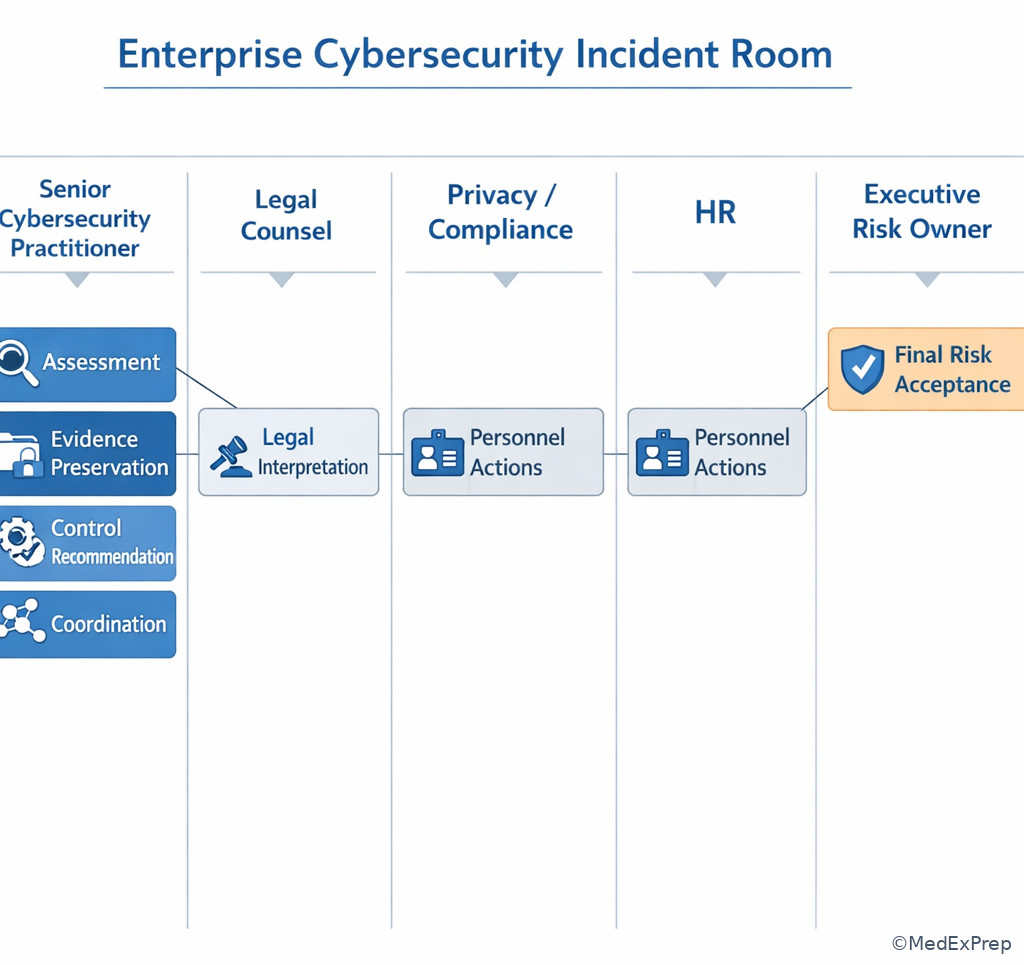
Core content
1.1.1.3 Foundational role framing: what the candidate is being asked to be
A Explanation
The first decision conflict in many CASP stems is not technical; it is positional. You must choose between an answer that reflects a senior cybersecurity practitioner and one that assumes authority the practitioner does not have. The resolving rule is simple: if the action involves assessment, interpretation, recommendation, design, prioritization, or coordination, it is usually in scope. If it involves final legal determination, unilateral budget approval, employee discipline, external audit opinion, or board-level risk acceptance, it is usually out of scope.
WHY THIS IS TESTED: exam writers want to know whether you can operate in enterprise reality, where security leaders influence decisions across technical and governance lines without personally owning every final decision. The strongest answer is often not the most aggressive one. It is the one that is technically sound and role-correct.
Choose practitioner answers when the stem asks you to interpret logs, assess controls, recommend architecture, prioritize remediation, or advise stakeholders. Reject answers that say you should personally sign off on legal, HR, or executive decisions. See Fig 2.
Exam takeaway: When two answers look technically reasonable, prefer the one that stays in advisory and security-practitioner scope.
B Worked example
A senior cybersecurity practitioner at a healthcare organization reviews a report showing repeated privileged access to a patient-record archive from an internal administrator account. The environment is hybrid cloud, the organization is under a recent external audit, and a distracting lab-like detail in the stem is that the suspicious host also failed a patch-compliance check last week. Another tempting clue is that the employee recently argued with management, making an HR-focused answer sound appealing. The question asks for the most appropriate next step.
Identify task: choose the role-appropriate immediate action. Extract key facts: suspicious access, regulated data, possible insider issue, potential evidence. Apply rule: practitioner scope includes evidence-aware triage, documentation, and escalation; it does not include firing staff or issuing legal conclusions. Eliminate distractors: “terminate the employee immediately” is HR overreach; “declare a criminal violation and contact prosecutors” is law-enforcement/legal overreach; “ignore until patching completes” fails security duty. Verify: the best answer is to preserve relevant logs and access records, document findings, recommend containment and access review, and escalate through incident-response, HR, legal, and compliance channels as required by policy.
C Exam trap
D Checkpoint
Question: A CASP stem asks what a senior cybersecurity practitioner should do after identifying a major control gap affecting a critical SaaS integration. Which is the most defensible interpretation of the role?
- Unilaterally accept the risk to maintain uptime.
- Assess the gap, recommend compensating controls, and present residual risk to the appropriate owner.
- Issue a binding legal opinion on breach-notification obligations.
- Approve emergency funding and procurement outside governance.
Answer: B
- A: Tempting because uptime pressure is real; wrong because final risk acceptance belongs to the proper business authority, not the practitioner.
- B: Tempting because it seems less decisive; right because it matches practitioner scope: assess, recommend, communicate residual risk.
- C: Tempting because breach obligations often arise during incidents; wrong because definitive legal interpretation belongs to counsel.
- D: Tempting because emergencies can justify rapid procurement; wrong because unilateral budget approval exceeds role boundaries.
1.1.1.4 Boundary triggers: signals that the stem is pulling you out of role
A Explanation
The next layer is recognizing out-of-role signals. These are words or phrases that pull the scenario toward another authority domain: “as corporate counsel,” “approve the annual budget,” “terminate the employee immediately,” “file criminal charges,” “serve as the external auditor,” or “make the final board-level risk acceptance decision.” The decision conflict is whether you should act directly on that signal or recognize it as a handoff point. The resolving rule is this: when a stem crosses into legal, HR, external audit, executive authority, or law enforcement, your best answer is usually to support the process with security findings and coordinate with the right authority rather than becoming that authority.
WHY THIS IS TESTED: boundary cases are classic certification distractors. They reward candidates who understand organizational roles, not just controls and tools. A technically savvy candidate can still miss the item by choosing an answer that is too powerful.
Out-of-role wording does not mean security stops. It means your contribution changes form: preserve evidence, assess impact, provide technical interpretation, recommend containment, and escalate. See Fig 3.
Exam takeaway: When a stem invokes legal, HR, audit, or executive power, shift from direct action to evidence-aware support and escalation.
flowchart TD
A[Answer option] --> B{Contains authority signal?}
B -->|No| C[Check if it assesses, recommends, prioritizes, or coordinates]
C --> D[Usually in scope]
B -->|Yes| E{Signal type}
E --> F[Legal or privacy]
E --> G[HR or personnel]
E --> H[Executive or board]
E --> I[External audit or law enforcement]
F --> J[Coordinate with counsel or privacy team]
G --> K[Preserve evidence and escalate through policy]
H --> L[Present risk and recommendations]
I --> M[Support process, do not become that role] B Worked example
A multinational manufacturer discovers suspicious outbound transfers from an OT-connected engineering workstation. The stem mentions an upcoming board meeting, a delayed vendor maintenance window, and a distracting clue that the user recently violated attendance policy. One answer says to “make the final board-level risk acceptance decision to keep production running.” Another says to “serve as the external auditor and certify controls are adequate.” A third says to “analyze available telemetry, recommend temporary isolation that minimizes operational disruption, preserve logs, and brief leadership on residual risk.”
Identify task: select the most appropriate role-consistent action. Extract key facts: possible incident, OT sensitivity, executive concern, operational tradeoff. Apply rule: practitioner analyzes, recommends, and briefs; executives accept risk, auditors issue audit opinions. Eliminate distractors: board-level acceptance is outside scope; external auditor role is explicitly wrong. Verify: recommending temporary isolation with evidence preservation and leadership briefing is the best match because it stays within security practice while respecting operations and governance.
C Exam trap
D Checkpoint
Question: Which answer choice contains the clearest out-of-role signal for a CASP candidate?
- Recommend a compensating control and document residual exposure.
- Correlate endpoint and network telemetry to validate suspicious activity.
- File criminal charges against the employee based on the log review.
- Advise management on the likely operational impact of isolation.
Answer: C
- A: Tempting because documentation can feel administrative; wrong to select because recommending controls is fully in scope.
- B: Tempting because telemetry analysis is highly technical; wrong to select because analysis is core practitioner work.
- C: Tempting because the evidence may strongly suggest wrongdoing; right because criminal charging is law-enforcement authority, not practitioner scope.
- D: Tempting because management advising sounds executive-adjacent; wrong to select because communicating impact to management is appropriate practitioner work.
- True or False: A senior cybersecurity practitioner can provide technical findings that inform legal review. True.
- The most common clue that an answer is out of role is a phrase that transfers final authority outside security practice.
- Name 3 out-of-role domains: legal, HR, executive.
1.1.1.5 In-scope actions: what you should confidently choose
A Explanation
Once you know what not to do, you need equal clarity about what is in scope. The practitioner role includes assessing enterprise security posture, identifying control gaps, analyzing threats and vulnerabilities, interpreting logs and telemetry, designing or evaluating architectures, recommending risk treatments, prioritizing remediation, supporting incident response, advising on governance implications, and communicating findings to technical and nontechnical stakeholders. The decision conflict is often between a dramatic answer and a disciplined one. The resolving rule: if the action is analytical, advisory, evidence-aware, risk-based, and aligned to policy, it is likely the correct direction.
WHY THIS IS TESTED: some candidates overcorrect after learning boundaries and become too passive. CASP does not want you to avoid action. It wants you to choose forceful practitioner action: contain appropriately, recommend the architecture change, prioritize the fix, advise on IAM, correlate indicators, and escalate only the part that exceeds your authority.
The phrase to remember is: act strongly inside scope, hand off cleanly outside scope. See Fig 4.
Exam takeaway: Strong CASP answers usually move from analysis to recommendation to coordination without crossing into someone else’s authority.
B Worked example
An enterprise with on-premises identity infrastructure and multiple cloud tenants reports impossible-travel alerts for a privileged administrator. The stem includes noise: the administrator recently switched phones, and a low-severity vulnerability scan also flagged an outdated printer service in another subnet. The best answer is not to revoke every administrator’s access forever or to declare the alert benign immediately. It is to validate telemetry, assess whether federated identity or session-token misuse is involved, recommend targeted containment such as step-up authentication or token revocation, preserve relevant evidence, and coordinate with identity and incident-response teams.
Identify task: choose the practitioner’s best action. Extract key facts: privileged identity, hybrid environment, suspicious authentication pattern, noisy irrelevant finding. Apply rule: telemetry analysis and IAM recommendations are in scope. Eliminate distractors: “sign off that there was no breach” is too final and legalistic; “disable all remote access enterprise-wide permanently” ignores proportionality and mission impact; “wait for HR to investigate first” delays a security action that is already within scope. Verify: targeted validation, containment recommendation, and stakeholder coordination is the most defensible practitioner response.
C Exam trap
D Checkpoint
Question: Which action is most clearly in scope for the CASP candidate role?
- Approve permanent budget reallocation for a new SIEM.
- Determine whether breach notification is legally required in all jurisdictions.
- Correlate logs, identify probable attack path, and recommend prioritized remediation.
- Issue a final external audit opinion on the control environment.
Answer: C
- A: Tempting because tool acquisition follows gap analysis; wrong because budget authority is not assumed.
- B: Tempting because security findings inform notification decisions; wrong because definitive legal obligation belongs to counsel or designated authority.
- C: Tempting because it sounds operationally detailed; right because telemetry interpretation and remediation prioritization are core practitioner functions.
- D: Tempting because security experts often know control quality best; wrong because external audit opinions are a separate role.
1.1.1.6 Escalation and coordination: when the right answer is not “do it yourself”
A Explanation
Many difficult items hinge on knowing when to escalate. The decision conflict is between “I know the right security move, so I should execute it unilaterally” and “I know the right security move, but policy, privacy, legal, or operational ownership requires coordination.” The resolving rule: escalate when the decision impacts legal rights, employee action, final business risk acceptance, external reporting, privacy determinations, or mission-critical operational tradeoffs beyond your delegated authority.
WHY THIS IS TESTED: senior practitioners must work across boundaries without freezing or overreaching. The exam rewards answers that preserve evidence, keep operations in mind, and engage the proper owners. Especially in regulated or OT settings, the best answer often combines a limited security recommendation with immediate stakeholder coordination.
Escalation is not abdication. It is controlled transfer of authority after you have framed the issue clearly. The strongest answers usually include four elements: what was observed, why it matters, what immediate security action is recommended, and who must now be involved. See Fig 5.
Exam takeaway: The best next step often combines limited security action with clear escalation to the correct authority owner.
flowchart LR
A[Issue detected] --> B[Assess severity and scope]
B --> C{Can practitioner act directly within policy?}
C -->|Yes| D[Take in-scope action and document]
D --> E[Notify stakeholders]
C -->|No or partly| F[Preserve evidence]
F --> G[Recommend immediate security step]
G --> H[Escalate to legal HR privacy executive or platform owner]
H --> I[Support follow-through with technical facts] B Worked example
A public-sector organization detects exfiltration from a shared file service containing both mission data and employee records. The stem adds distracting details: the affected server recently failed a storage health check, and an executive is pressuring the team to declare the event minor before an oversight briefing. One tempting answer says to issue a public statement that no sensitive information was involved. Another says to isolate the service, preserve logs and snapshots, document suspected data categories, recommend invoking privacy and legal review, and brief leadership on uncertainty and operational impact.
Identify task: choose the best next step under role limits. Extract key facts: suspected exfiltration, mixed data sensitivity, external reporting implications, executive pressure. Apply rule: practitioner can support containment and evidence preservation, but cannot make definitive public/legal declarations. Eliminate distractors: public statements are not your lane; “do nothing until executives decide” neglects in-scope incident actions. Verify: containment plus evidence preservation plus privacy/legal coordination is the most defensible answer.
C Exam trap
D Checkpoint
Question: A stem includes possible insider misuse, privacy implications, and senior leadership pressure for an immediate declaration. What is the best initial action for the practitioner?
- Provide a definitive legal conclusion to reduce uncertainty.
- Preserve evidence, document findings, recommend containment, and coordinate with legal/privacy and management.
- Terminate the suspected user’s employment to prevent recurrence.
- Accept the residual risk to avoid operational disruption.
Answer: B
- A: Tempting because leadership wants certainty; wrong because definitive legal conclusions exceed role.
- B: Tempting because it may seem slower; right because it balances urgent security action with proper escalation.
- C: Tempting because insider threats may require immediate action; wrong because employment decisions are not the practitioner’s authority.
- D: Tempting because availability may be mission critical; wrong because residual risk acceptance is not yours to grant.
- The best escalation answer still includes an in-scope security action such as preserve, document, or recommend containment.
- True or False: Escalation means the practitioner should stop gathering technical facts. False.
- Name the 3 most common owners to involve when scope is crossed: legal/privacy, management, HR.
1.1.1.7 Applying role boundaries under exam pressure
A Explanation
On test day, time pressure makes boundary errors more likely. The decision conflict is between choosing the answer that sounds boldest and choosing the answer that is most defensible within enterprise governance. The single resolving rule is: prefer the option that accomplishes the security objective while respecting authority, evidence integrity, and policy alignment. This is the practical filter for almost every boundary question.
WHY THIS IS TESTED: CASP scenarios imitate senior-practitioner judgment in messy environments. Stems include distractors such as executive urgency, emotional insider-threat clues, or compliance language meant to push you into an overbroad action. The correct answer usually preserves optionality: it moves the incident or design decision forward without making a final determination you do not own.
A fast elimination method works well: first remove answers that are clearly out of role, then compare remaining options for proportionality, evidence awareness, and governance fit. See Fig 6.
Exam takeaway: Under time pressure, eliminate out-of-role choices first, then choose the remaining option that best preserves security, evidence, and governance alignment.
B Worked example
A financial-services firm sees suspicious database queries by a contractor account. The contractor supports a merger project, the chief operating officer is demanding immediate certainty, and a distracting clue is that a network appliance also generated unrelated certificate warnings overnight. Options include: formally accuse the contractor of fraud; unilaterally disclose a data breach to regulators; snapshot relevant systems, review access paths, recommend temporary access restrictions, preserve evidence, and brief counsel/compliance and management; or wait for the next maintenance window to avoid business disruption.
Identify task: select the best immediate practitioner action. Extract key facts: suspicious data access, regulated sector, contractor involvement, possible legal reporting, executive pressure. Apply rule: practitioner should investigate, preserve, recommend, and coordinate. Eliminate distractors: accusation is not your role and may damage evidence handling; unilateral disclosure is outside authority; waiting delays a justified security response. Verify: preserve, restrict appropriately, analyze, and coordinate is best.
C Exam trap
D Checkpoint
Question: Which answer best reflects the exam-day rule for role-boundary items?
- Choose the most aggressive answer because senior practitioners must act decisively.
- Choose the most technically complex answer because CASP rewards depth over governance.
- Choose the answer that achieves the security goal while staying within scope and coordinating where required.
- Choose the answer that delays action until every stakeholder agrees.
Answer: C
- A: Tempting because decisiveness sounds senior-level; wrong because overreach is a classic distractor.
- B: Tempting because the exam is advanced; wrong because governance fit matters as much as technical sophistication.
- C: Tempting because it sounds moderate; right because it captures the core testable pattern of effective, role-appropriate action.
- D: Tempting because coordination matters; wrong because excessive delay can neglect in-scope urgent action.
Exam Traps & Differentiators
Most common wrong answer and why: the answer that sounds most decisive but assumes authority outside cybersecurity practice. These distractors are attractive because they promise closure: fire the person, sign off on the legal outcome, accept the risk, certify compliance, or announce the reporting decision. The problem is not the urgency; the problem is the owner.
| Looks right because... | Why it is actually wrong | What to think instead |
|---|---|---|
| “Terminate the employee” protects the organization fast | Personnel action belongs to HR/management within policy | Preserve evidence and escalate insider concerns |
| “Accept the risk” preserves uptime | Final risk acceptance belongs to the authorized owner | Present residual risk and recommended controls |
| “Issue a legal opinion” addresses compliance urgency | Definitive legal interpretation belongs to counsel | Provide technical facts for legal review |
| “Serve as external auditor” sounds control-focused | Audit opinions are not the practitioner’s role in the stem | Document findings and map them to controls |
| “File criminal charges” sounds appropriate for clear misconduct | Criminal charging is law-enforcement authority | Preserve evidence and follow incident/legal channels |
| Looks similar but isn't | In-scope practitioner action | Out-of-scope action | Single discriminator |
|---|---|---|---|
| Report preparation vs legal decision | Prepare technical incident summary | Determine definitive legal notification duty | Legal conclusion crosses authority boundary |
| Containment vs punishment | Recommend account suspension or access review per policy | Terminate employee or contractor | Employment action is HR authority |
| Risk briefing vs risk acceptance | Explain residual risk and options | Make final board-level acceptance decision | Ownership of residual risk stays with business authority |
| Control review vs audit opinion | Assess control effectiveness and gaps | Issue external audit certification | Independent audit role is distinct |
| Evidence support vs prosecution | Preserve logs and chain-of-custody awareness | File charges or seize evidence as law enforcement | Security supports, not prosecutes |
- If the stem says “final board-level risk acceptance,” think present options and residual risk to the authorized owner.
- If the stem says “corporate counsel,” think provide technical facts and coordinate; do not deliver definitive legal advice.
- If the stem says “terminate immediately,” think insider-threat escalation with evidence preservation, not HR action by security.
- If the stem says “external auditor,” think control mapping and evidence support, not audit sign-off.
- If the stem says “press release” or “regulatory declaration,” think support the decision with technical analysis, do not own the public/legal statement alone.
Related trap from the upcoming topic Allowed And Disallowed Actions: a technically valid action may still be wrong if it skips approval paths, evidence integrity, or stakeholder coordination. Related trap from Enterprise Scenario Framing: a correct technical control can still be wrong if it ignores mission or operational context.
Tables
| Reference summary | Choose this when... | Reject this when... |
|---|---|---|
| Assess posture | The stem asks for gap identification, architecture review, or control evaluation | The option leaps from assessment to final executive approval |
| Recommend risk treatment | You can propose mitigation, transfer, avoidance, or compensating controls | The option says you personally accept residual risk |
| Analyze telemetry | Logs, alerts, attack paths, or suspicious behavior need interpretation | The option substitutes a legal conclusion for a technical analysis |
| Preserve evidence | There may be an incident, insider issue, or future investigation | The option destroys, alters, or bypasses approved evidence handling |
| Coordinate with authorities | Privacy, legal, HR, or executive ownership is implicated | The option makes you that authority |
| Communicate residual risk | Leadership must make a business-informed decision | The option conceals uncertainty or bypasses governance |
Exam takeaway: A strong answer shows technical action on the desk and formal escalation paths on the wall, not unilateral authority over every outcome.
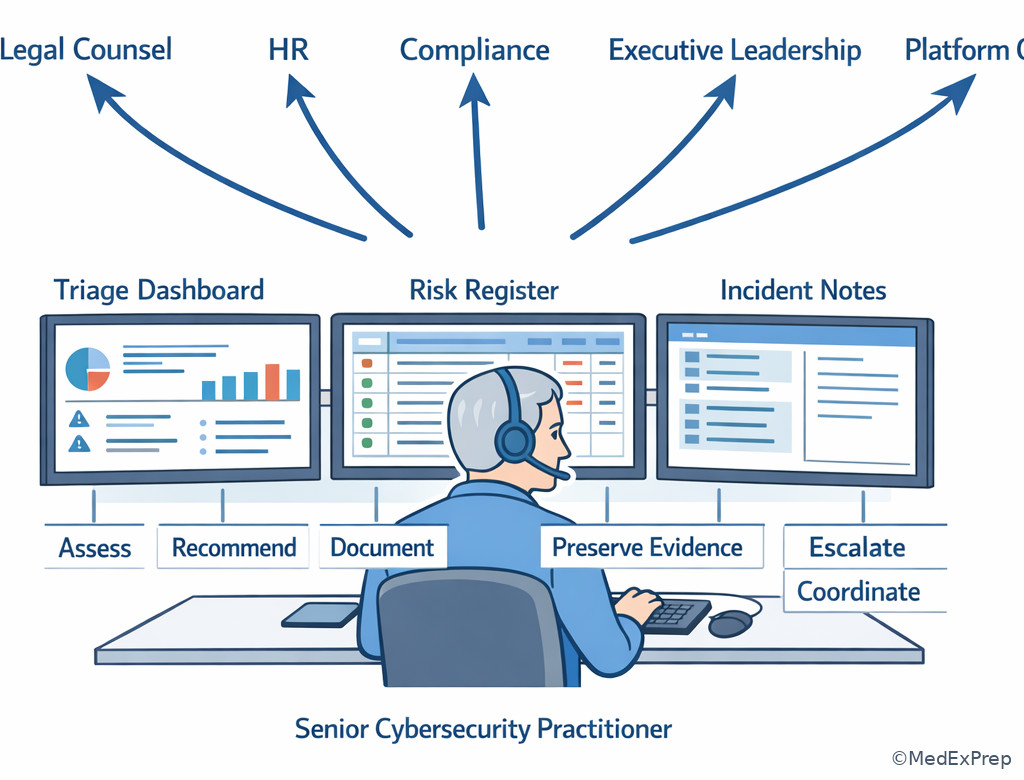
| Differential/classification | Category | Typical verbs | Exam interpretation |
|---|---|---|---|
| In-scope practitioner | Technical-advisory | assess, analyze, recommend, prioritize, coordinate, preserve, validate | Usually strong candidates for the correct answer |
| Shared/conditional | Cross-functional | brief, notify, collaborate, support, present, align | Often correct when paired with in-scope technical action |
| Out-of-scope legal | Authority-dependent | determine legality, issue legal opinion, declare privilege | Usually trap unless phrased as coordinate with counsel |
| Out-of-scope executive | Authority-dependent | approve budget, accept risk, override policy | Usually trap unless phrased as present recommendation to owner |
| Out-of-scope HR/law enforcement | Authority-dependent | terminate, discipline, file charges, seize | Usually trap; security supports but does not own |
| Out-of-scope audit | Independent assurance | certify, attest, issue binding audit opinion | Usually trap; practitioner may provide evidence only |
Exam takeaway: Spotting words like counsel, terminate, accept risk, audit, and charges helps eliminate out-of-role options quickly.
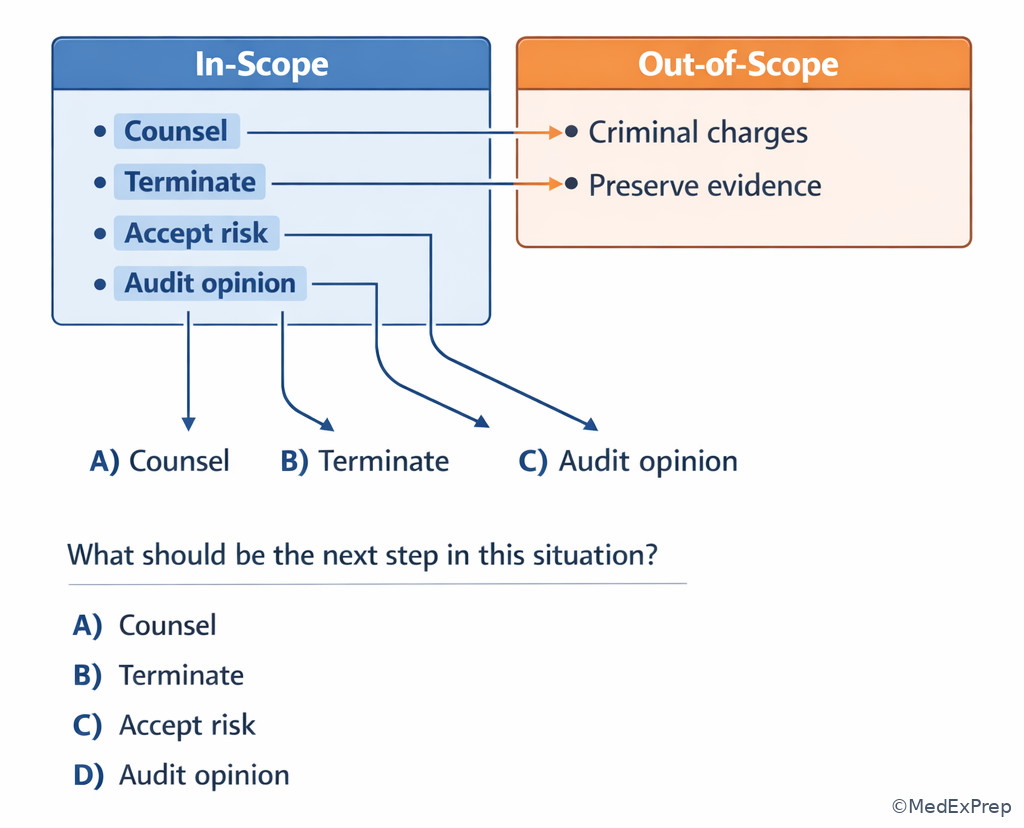
Algorithm / Approach
Exam takeaway: Translate every answer into owner plus action; if the owner is wrong, the option is usually wrong.
flowchart TD
A[Question asks best next step] --> B[Translate option into owner + action]
B --> C{Owner matches practitioner role?}
C -->|No| D[Reject or reinterpret as escalation support]
C -->|Yes| E{Action reduces risk and preserves governance?}
E -->|No| F[Reject as reckless or passive]
E -->|Yes| G[Best answer] Exam takeaway: In cloud, on-premises, and OT environments, role boundaries persist even when technical responsibility spans multiple platforms.
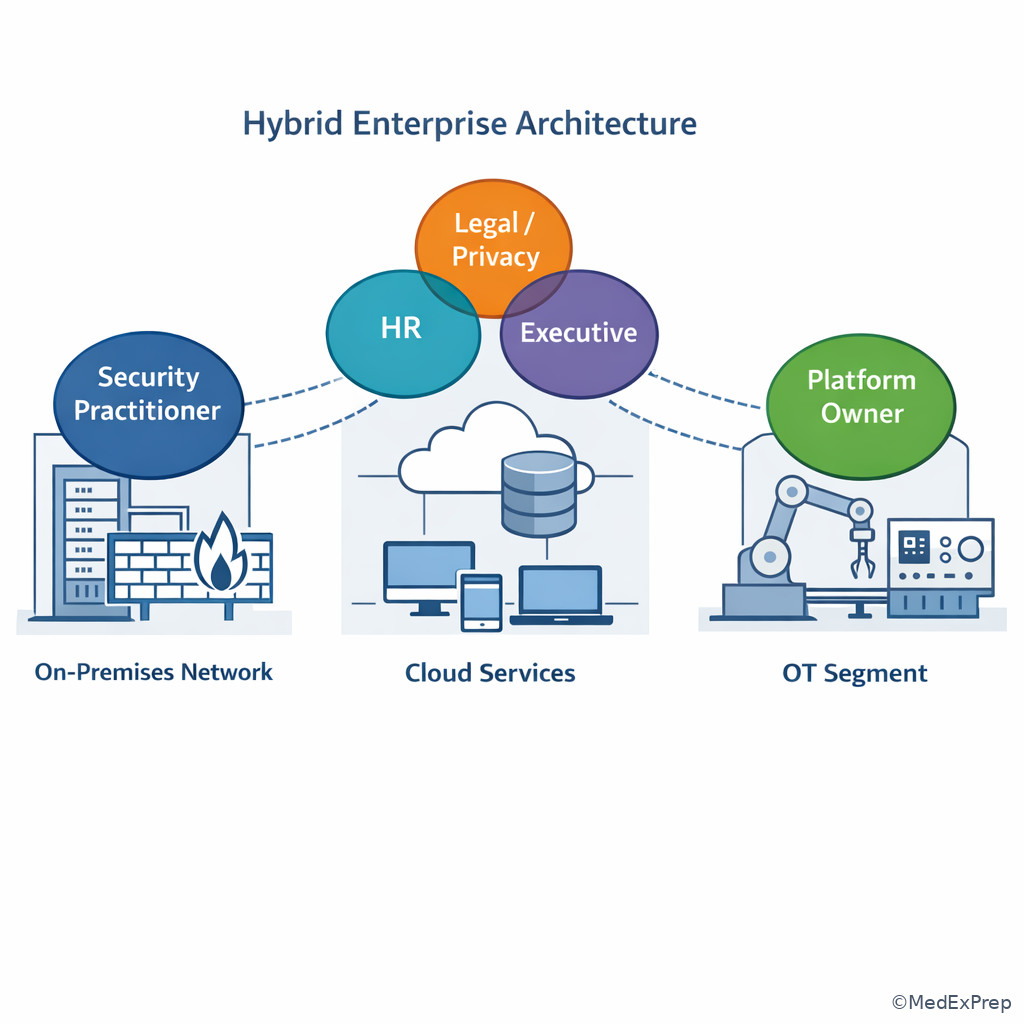
Rapid Review
- Practitioner scope - assess and recommend, not finally approve.
- Risk acceptance - owned by authorized business leadership, not assumed by security.
- Legal conclusion - counsel domain; security supplies facts.
- HR action - policy and personnel owners decide; security preserves evidence.
- Audit opinion - independent assurance role, not practitioner role.
- Law-enforcement action - support evidence handling, do not prosecute.
- Best next step - often preserve, document, recommend, coordinate.
- Executive pressure - does not expand your formal authority.
- Regulated scenario - increases need for documentation and escalation, not unilateral declaration.
- Insider threat clue - points to evidence preservation and controlled escalation, not immediate punishment by security.
- Operational sensitivity - choose proportionate containment, especially in OT or mission-critical systems.
- Strong answer style - effective and governance-aligned beats dramatic and overbroad.
Self-check quiz
1. A senior cybersecurity practitioner identifies a high-risk control gap in a cloud identity integration. Which action is the most appropriate next step?
- Unilaterally accept the residual risk because the issue affects availability.
- Recommend compensating controls and present residual risk to the authorized owner.
- Issue a binding legal opinion on data exposure implications.
- Approve off-cycle budget spending to replace the platform.
2. During review of suspicious privileged access logs in a regulated enterprise, which option contains the clearest out-of-role action for the practitioner?
- Correlate endpoint and IAM telemetry to validate the alert.
- Preserve logs and recommend temporary account restriction.
- File criminal charges against the user after confirming misuse.
- Brief leadership on likely impact and containment options.
3. A manufacturing company with legacy OT systems and a hybrid cloud analytics platform detects unusual outbound traffic from an engineering workstation. Production is time-sensitive, the maintenance vendor is due onsite tomorrow, and an unrelated vulnerability scan also flagged several low-severity browser plugins. Which action is the best initial response for the CASP candidate?
- Shut down the entire plant network immediately and announce that the event is confirmed sabotage.
- Validate telemetry, recommend targeted isolation that minimizes operational impact, preserve evidence, and brief operations leadership.
- Accept the risk until the board can decide whether production loss is worth containment.
- Serve as the external auditor and certify that current OT segmentation is sufficient.
4. A healthcare organization discovers possible exfiltration from a file share containing patient data and HR documents. The CEO wants a public statement within the hour, legal has not yet reviewed the event, and a distracting clue is that the storage array also reported a noncritical disk warning. What is the most defensible practitioner action?
- Declare publicly that no protected data was exposed because the evidence is incomplete.
- Preserve evidence, recommend containment, document affected data types, and coordinate with legal/privacy and management.
- Terminate the account owner immediately to show decisive action.
- Delay all technical investigation until counsel determines the legal posture.
5. In a financial-services environment, a contractor account tied to a merger project performs unusual after-hours database queries. The contractor recently changed devices, the COO wants certainty before market open, and unrelated certificate warnings appeared elsewhere overnight. Which is the best next step?
- Accuse the contractor of fraud and notify law enforcement directly.
- Snapshot relevant systems, review access paths, recommend temporary access restrictions, preserve evidence, and coordinate with counsel/compliance.
- Wait until the next maintenance window to avoid any business impact.
- Unilaterally disclose a reportable breach to regulators before analysis is complete.
6. A federal contractor discovers that a privileged admin may have accessed export-controlled project data from an unmanaged device. The administrator is also a top performer, the program office is under deadline pressure, and a distracting clue is that patch metrics improved this quarter. Which option is the most appropriate next step?
- Provide a final legal determination that export-control reporting is required and submit it immediately.
- Document findings, preserve relevant access artifacts, recommend immediate access review/containment, and coordinate with legal, compliance, and program leadership.
- Allow continued access because mission delivery currently outweighs the suspected misuse.
- Terminate the administrator’s employment to eliminate further exposure.
7. An enterprise SaaS provider suffers a suspected insider-assisted data exposure. The board chair asks the security lead to “make the risk call tonight,” compliance requests technical details, and a noisy clue is that a third-party scan also reported several medium-severity web findings unrelated to the exposed dataset. Which answer is the most defensible?
- Make the final residual risk acceptance decision because the security lead has the deepest technical knowledge.
- Recommend immediate control changes, quantify known and unknown impact, document residual risk, and present options to the authorized risk owner.
- Delay action until every uncertainty is resolved so the board receives a complete answer.
- Issue an external audit-style attestation that compensating controls were adequate at the time of exposure.
8. A global enterprise identifies a likely compromise involving employee PII in one region and customer data in another. Regional counsel are engaged, the HR director wants the suspected insider removed immediately, and the cloud team also reports a separate low-priority configuration drift alert. What action requires immediate clarification because it exceeds the CASP candidate role?
- Recommend preserving logs, reviewing identity paths, and coordinating with regional counsel and privacy teams.
- Propose targeted access suspension and document operational impact for leadership review.
- Sign off as the data protection authority for all impacted jurisdictions and issue the final notification determination.
- Summarize technical findings and residual uncertainty for management decision-making.
Answer key
1. Correct answer: B
- A: Tempting because availability tradeoffs are real in enterprise environments. Incorrect for this scenario because final residual risk acceptance belongs to the authorized owner, not the practitioner. Single clue: the stem asks what the practitioner should do after identifying the gap, which points to recommendation rather than acceptance.
- B: Tempting because it may feel less forceful than direct approval. Correct because recommending compensating controls and presenting residual risk is exactly within the practitioner’s advisory scope. Single clue: “identify a high-risk control gap” calls for technical recommendation and communication.
- C: Tempting because data exposure often has legal consequences. Incorrect because a binding legal opinion exceeds security-practitioner authority. Single clue: “legal opinion” is an out-of-role signal.
- D: Tempting because replacing the platform might fix the problem. Incorrect because unilateral budget approval is not assumed in the role. Single clue: “approve off-cycle budget spending” signals executive/procurement authority.
2. Correct answer: C
- A: Tempting because it is a common incident-analysis step. Incorrect to choose because telemetry correlation is squarely in scope. Single clue: validating suspicious access with logs is practitioner work.
- B: Tempting because access restriction affects a user. Incorrect to choose because preserving logs and recommending temporary restriction through approved channels is in scope. Single clue: recommendation plus evidence preservation is allowed.
- C: Tempting because confirmed misuse sounds criminal. Correct because filing criminal charges is a law-enforcement function, not a cybersecurity practitioner action. Single clue: “file criminal charges” is explicit out-of-role language.
- D: Tempting because leadership communication can feel managerial. Incorrect to choose because briefing leadership on impact and options is a core practitioner responsibility. Single clue: advisory communication remains in scope.
3. Correct answer: B
- A: Tempting because OT threats can justify urgent containment. Incorrect because shutting down the entire plant and declaring sabotage is both disproportionate and beyond the available evidence. Single clue: OT and production sensitivity require targeted, evidence-based action.
- B: Tempting because it balances security and operations rather than maximizing one. Correct because telemetry validation, targeted isolation, evidence preservation, and leadership briefing fit practitioner scope and mission-aware decision making. Single clue: the stem emphasizes time-sensitive production and hybrid OT complexity.
- C: Tempting because board awareness matters for major operational tradeoffs. Incorrect because the practitioner should not simply defer urgent security action until a board decision. Single clue: immediate technical triage is already warranted.
- D: Tempting because segmentation adequacy is relevant to the scenario. Incorrect because issuing an external audit certification is a separate role. Single clue: “serve as the external auditor” is explicit role overreach.
4. Correct answer: B
- A: Tempting because leaders often want immediate reassurance. Incorrect because incomplete evidence does not authorize a final public declaration about exposure. Single clue: legal has not yet reviewed the event.
- B: Tempting because it may seem slower than a public response. Correct because preserving evidence, recommending containment, classifying affected data, and coordinating with legal/privacy are exactly what the practitioner should do. Single clue: mixed patient and HR data creates privacy and governance implications that require coordination.
- C: Tempting because account misuse may be involved. Incorrect because immediate termination is an HR action, not a practitioner decision. Single clue: personnel action exceeds scope.
- D: Tempting because legal review matters in regulated incidents. Incorrect because delaying all technical work neglects in-scope incident response and evidence preservation. Single clue: you can act technically while legal evaluates obligations.
5. Correct answer: B
- A: Tempting because the timing and project sensitivity suggest intentional abuse. Incorrect because direct accusation and law-enforcement notification exceed the practitioner role and may precede sufficient validation. Single clue: suspicious queries do not equal your authority to prosecute.
- B: Tempting because it appears procedural rather than dramatic. Correct because it combines evidence preservation, technical investigation, temporary risk reduction, and proper coordination in a regulated setting. Single clue: merger-project data plus counsel/compliance involvement calls for disciplined escalation support.
- C: Tempting because maintenance windows reduce operational disruption. Incorrect because delaying investigation and temporary safeguards is not justified by the scenario. Single clue: unusual after-hours database activity implies an active risk.
- D: Tempting because prompt regulatory reporting can matter in finance. Incorrect because the practitioner does not unilaterally declare a reportable breach before technical analysis and governance review. Single clue: “before analysis is complete” removes defensibility.
6. Correct answer: B
- A: Tempting because export-controlled data can trigger strict obligations. Incorrect because final legal reporting determinations belong to legal/compliance authorities, not the practitioner. Single clue: “provide a final legal determination” is explicit overreach.
- B: Tempting because it does not claim certainty the evidence may not support. Correct because it preserves artifacts, recommends immediate access review and containment, and engages the proper stakeholders for a high-consequence regulated issue. Single clue: unmanaged-device access to controlled data creates both technical and compliance dimensions.
- C: Tempting because mission deadlines are a real enterprise pressure. Incorrect because the practitioner should not allow continued risky access solely due to schedule pressure. Single clue: suspected privileged misuse demands action, not passive deferral.
- D: Tempting because removing the person seems to reduce exposure fastest. Incorrect because employment termination is not the security practitioner’s call. Single clue: personnel action remains outside scope even in serious cases.
7. Correct answer: B
- A: Tempting because the security lead may understand the technical risk best. Incorrect because final residual risk acceptance belongs to the authorized risk owner, not automatically to the security lead. Single clue: the board chair asking does not transfer ownership.
- B: Tempting because it accepts uncertainty while still moving forward. Correct because recommending control changes, documenting impact and uncertainty, and presenting options to the risk owner is the most defensible practitioner response. Single clue: compliance wants technical details, which the practitioner should provide without becoming the final approver.
- C: Tempting because leaders want high-confidence decisions. Incorrect because waiting for complete certainty can neglect urgent control actions and communication. Single clue: suspected insider-assisted exposure requires immediate security response.
- D: Tempting because compensating controls are relevant to the exposure. Incorrect because issuing an audit-style attestation exceeds the practitioner’s role. Single clue: attestation language belongs to assurance roles, not the incident responder/adviser.
8. Correct answer: C
- A: Tempting because cross-region incidents are complex. Incorrect to flag because preserving logs, reviewing identity paths, and coordinating with counsel/privacy are appropriate practitioner actions. Single clue: the option keeps the practitioner in a technical-support role.
- B: Tempting because access suspension affects personnel. Incorrect to flag because proposing targeted access suspension and documenting impact for leadership review can be within security scope when handled through policy. Single clue: “propose” is different from “terminate” or “discipline.”
- C: Tempting because multinational privacy obligations are urgent and complex. Correct because signing off as the data protection authority and issuing the final notification determination clearly exceeds the practitioner role. Single clue: “sign off as the data protection authority” is an explicit out-of-role signal.
- D: Tempting because management summaries can sound executive. Incorrect to flag because summarizing findings and uncertainty is part of the practitioner’s advisory role. Single clue: decision support is allowed even when the final decision is not yours.
Keep going with the full CASP Prep Course (CASP)
You just studied the way members do, in the same lesson interface. Full access unlocks every lesson, the question bank and flashcards for a full year.
One payment · 1 year of access · No auto-renewal