1.1.1 - Shared Domain Map
Shared Domain Map
What you'll learn
- Map major exam questions to shared counseling domains such as screening, assessment support, planning, counseling, referral, documentation, ethics, and safety.
- Identify what the exam expects from an addiction counselor candidate versus actions reserved for medical or independently licensed providers.
- Use a simple domain-first strategy to decide what a question is really testing before choosing an answer.
- Recognize how safety, scope, confidentiality, documentation, and referral cut across every domain.
- Link this topic to upcoming lessons on Question Task Identification and Safest Next Step.
- Shared IC&RC/CASAC competency area: Exam framework orientation -> Identify counseling function being tested
- Shared IC&RC/CASAC competency area: Professional responsibility -> Stay within counselor scope and consult/escalate appropriately
- Shared IC&RC/CASAC competency area: Client welfare and ethics -> Prioritize safety, confidentiality, and documentation across functions
- Shared IC&RC/CASAC competency area: Treatment process overview -> Distinguish screening, assessment support, treatment planning, counseling, case management, referral, and discharge coordination
Why it matters
- Many wrong answers are not clinically absurd; they are wrong because they belong to the wrong domain or the wrong provider.
- On IC&RC/CASAC-style items, the best answer often comes from identifying the counselor function first, not from knowing the most facts.
- Safety and ethics can override routine counseling steps; if you miss that hierarchy, you will choose polished but unsafe answers.
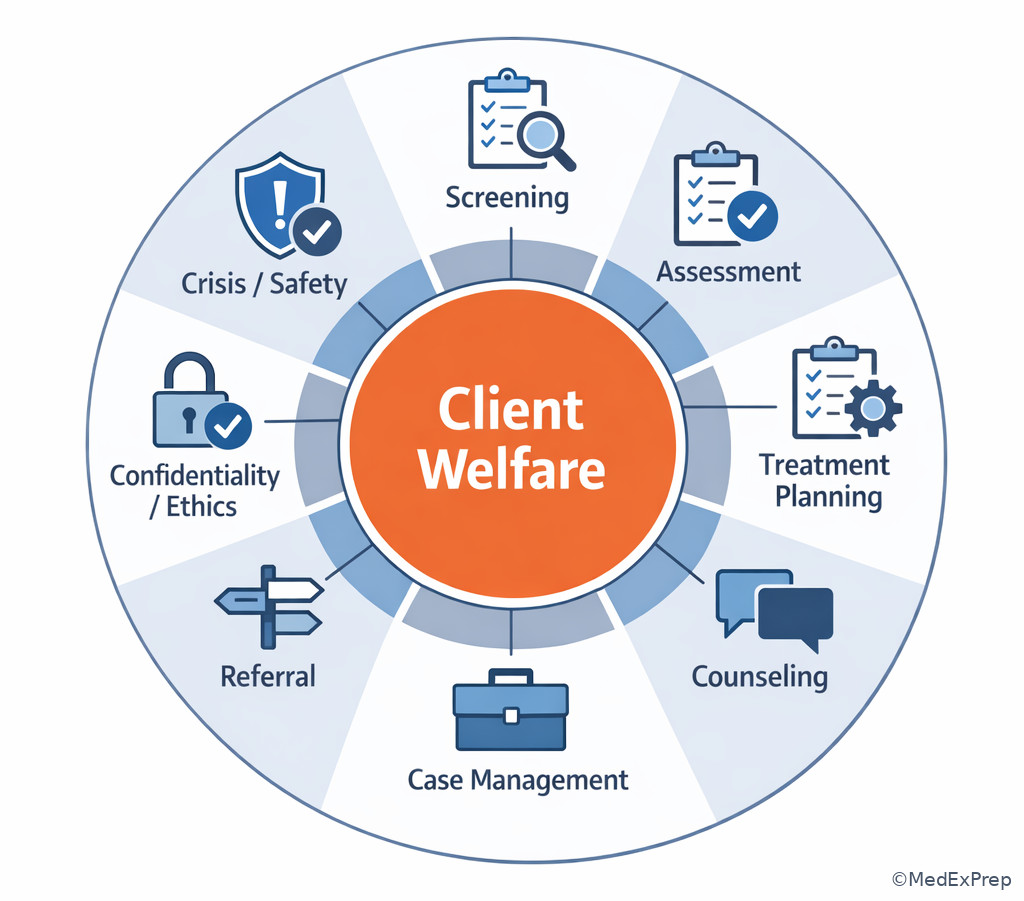
- This domain map becomes the backbone for later lessons on task identification, documentation, and safest next step. See Fig 1.
Exam takeaway: Classify the stem by counseling function first, then apply scope, safety, and ethics filters.
flowchart TD
A[Read the stem] --> B{What function is being tested?}
B --> C[Screening or intake]
B --> D[Assessment support]
B --> E[Treatment planning]
B --> F[Counseling intervention]
B --> G[Case management or referral]
B --> H[Documentation]
B --> I[Ethics or confidentiality]
B --> J[Safety or crisis]
C --> K[Then ask: what is within counselor scope?]
D --> K
E --> K
F --> K
G --> K
H --> K
I --> K
J --> K
K --> L[Choose safest next counselor action] Exam takeaway: Visual grouping of domains helps you sort stems faster under test pressure.
Key Terms & Must-Know Facts
1.1.1.1 Key terms
- Screening: Brief process to detect possible substance-related or related-risk concerns.
- Intake: Initial information gathering, orientation, and admission-related process.
- Assessment support: Collecting and organizing data within counselor role; not independent diagnosis when unauthorized.
- Treatment planning: Translating identified needs, strengths, and priorities into goals, objectives, and interventions.
- Counseling: Scope-appropriate therapeutic interaction, psychoeducation, motivational work, skill building, and relapse-prevention support.
- Case management: Coordinating services and removing barriers across systems.
- Referral: Connecting a client to a service, provider, or level of care outside current scope or program capacity.
- Documentation: Objective, timely record of observations, actions, client response, and follow-up.
- Confidentiality: Protecting client information except when disclosure is permitted or required.
- Informed consent: Client understanding of services, limits, risks, benefits, and information-sharing boundaries.
- Scope of practice: What the counselor may do based on credential, training, supervision, and jurisdiction.
- Consultation: Seeking supervisor or team input when risk, complexity, or authority limits are present.
- Escalation: Moving a concern to a higher level of care, supervision, or emergency response.
- Safest next step: The action that best protects client welfare within role and timing.
1.1.1.2 Must-know facts
- The exam tests counselor judgment, not physician-level diagnosis or prescribing authority.
- If risk is acute, safety steps come before routine counseling or paperwork.
- A technically helpful action can still be wrong if it exceeds scope.
- Documentation questions usually reward objectivity, relevance, and timeliness.
- Referral is not failure; it is often the correct answer when needs exceed authority.
- Confidentiality is strong but not absolute; safety and required reporting can override routine privacy expectations according to law and policy.
- When local rules vary, the exam-safe principle is protect the client, follow policy, consult, and document.
- Most stems can be solved by asking: what function is this, what is my role, what is safest now?
| Term | What it focuses on | Common exam confusion | Best discriminator |
|---|---|---|---|
| Screening | Detect possible concern quickly | Confused with full assessment | Brief, triage-oriented, not comprehensive |
| Assessment support | Gather and organize detailed data | Confused with diagnosis | Describes observations and patterns without unauthorized labeling |
| Treatment planning | Set priorities and actionable goals | Confused with counseling note writing | Future-oriented plan tied to client needs and strengths |
| Counseling | Help client build insight and change skills | Confused with crisis management | Ongoing therapeutic work after immediate risk is addressed |
| Case management | Coordinate practical services | Confused with referral only | Active follow-through across systems, not just giving a phone number |
| Referral | Link to outside service or higher expertise | Seen as abandonment | Appropriate when need exceeds scope or resources |
| Documentation | Record observations and actions | Confused with opinion or narrative drift | Objective facts, interventions, client response, plan |
Core content
1.1.1.3 Foundational map: what domains the exam is really testing
A Explanation
The first decision conflict on these exams is not “Which intervention sounds nicest?” It is “What type of task is this stem asking me to perform?” A stem about collecting initial use history is not the same as a stem about revising a treatment plan, and neither is the same as a confidentiality question. The single rule that resolves many items is this: identify the counseling function before evaluating the options. If the stem asks what the counselor should do first after a new disclosure, ask whether the task is screening, assessment support, counseling, documentation, referral, or ethics. WHY THIS IS TESTED: exam writers know candidates often choose a reasonable action from the wrong domain.
For example, giving relapse-prevention advice may sound helpful, but if the client is acutely intoxicated the domain is immediate safety/triage, not routine counseling. Similarly, asking a client to “explore feelings” may sound therapeutic, but if the question is about informed consent or record release, the domain is ethics/confidentiality. See Fig 2 for a domain sorting framework.
Exam takeaway: If you can name the function, you can eliminate many attractive but wrong answers.
flowchart TD
A[Client scenario] --> B{What is the main ask?}
B --> C[Need to detect problem? Screening]
B --> D[Need detailed data? Assessment support]
B --> E[Need goals or updates? Treatment planning]
B --> F[Need therapeutic response? Counseling]
B --> G[Need outside service? Referral or case management]
B --> H[Need record entry? Documentation]
B --> I[Need privacy decision? Ethics or confidentiality]
B --> J[Need urgent protection? Safety or crisis] B Worked example
A 42-year-old client presents for his first outpatient visit after a recent DUI. He reports daily alcohol use, denies withdrawal history, and says he is “only here because the court wants it.” He also mentions poor sleep, a recent separation, and chronic back pain treated by another provider. A lab slip in his file shows mildly elevated liver enzymes, and he asks the counselor, “So do I have alcohol use disorder or just stress?”
Reasoning chain: Identify task: the stem is testing domain recognition and scope. Extract key facts: first visit, initial data gathering, client asks for a diagnosis, medical clue present but not emergent. Apply rule: the counselor may gather substance use history and support assessment, but should not independently diagnose if not authorized. Eliminate distractors: prescribing advice or declaring a diagnosis exceeds role; jumping into treatment goals is premature before fuller information gathering. Verify: the best next step is to continue intake/assessment support, document observed patterns, explain role limits, and coordinate with authorized providers as needed.
C Exam trap
D Checkpoint
Question: A stem asks what the counselor should do after a client signs in for an initial appointment and discloses daily opioid misuse, unstable housing, and no current primary care provider. Which function is being tested most directly?
- A. Screening/intake — Tempting because the visit is initial; correct because the stem centers on first-step information gathering and triage before deeper planning.
- B. Treatment planning — Tempting because needs are obvious; wrong because planning usually follows initial data collection and problem clarification.
- C. Progress documentation — Tempting because charting always matters; wrong because no ongoing service has yet been delivered.
- D. Discharge coordination — Tempting because service linkage is mentioned; wrong because the client is entering care, not transitioning out.
Answer: A
1.1.1.4 Cross-cutting rules: safety, scope, ethics, and documentation apply to every domain
A Explanation
The second foundational conflict is choosing between a domain-specific action and a cross-cutting rule. Even when the stem seems to be about counseling or planning, four filters always sit above the domain: safety, scope, confidentiality/ethics, and documentation. The single rule that resolves difficult stems is: if one of these four is triggered, it can override the routine next step. WHY THIS IS TESTED: exam items often pair a routine counseling task with one destabilizing fact, such as intoxication, suicidal ideation, record-release pressure, or a request for medication advice.
In practice, that means you may pause routine rapport-building if the client appears medically unstable; decline to answer medication dosing questions beyond scope; clarify confidentiality limits before involving family; or document objectively rather than using labels or assumptions. These are not separate “ethics only” issues. They appear inside screening, counseling, referral, and discharge questions alike. See Fig 3.
Exam takeaway: Safety, scope, confidentiality, and documentation can outweigh the routine counseling task in the stem.
flowchart LR
A[Domain action] --> B{Safety issue?}
B -- Yes --> C[Stabilize or escalate]
B -- No --> D{Within scope?}
D -- No --> E[Consult or refer]
D -- Yes --> F{Confidentiality limit?}
F -- Yes --> G[Clarify consent or exception]
F -- No --> H[Proceed with service]
C --> I[Document objectively]
E --> I
G --> I
H --> I B Worked example
A 29-year-old client in outpatient treatment for stimulant use arrives late, appears flushed, speaks rapidly, and says she has not slept in 3 days. She asks whether the counselor thinks she should double her prescribed anxiety medication “just for tonight.” Her chart also notes a pending child-custody case, and her mother is in the waiting room asking for an update.
Reasoning chain: Identify task: this looks like counseling plus collateral communication, but the real test is cross-cutting rules. Extract key facts: possible acute instability, medication question, third-party request for information. Apply rule: do not give medication instructions, assess safety concerns within scope, consult/escalate if necessary, and do not disclose information without proper basis. Eliminate distractors: family reassurance without consent violates confidentiality; medication advice exceeds role; routine counseling can wait. Verify: the counselor should address immediate safety/consultation needs, maintain confidentiality, and document objectively.
C Exam trap
D Checkpoint
Question: Which cross-cutting rule most clearly overrides routine counseling when a client asks the counselor how to adjust a methadone dose?
- A. Documentation — Tempting because the interaction should be recorded; wrong because documentation is important but does not determine the immediate limit.
- B. Scope of practice — Tempting because medication adjustment is clinically important; correct because dosing advice is outside counselor authority.
- C. Treatment planning — Tempting because medication is part of care; wrong because the issue is who can give the instruction, not plan structure.
- D. Rapport building — Tempting because the client seeks trust; wrong because maintaining rapport does not allow out-of-scope advice.
Answer: B
- The four universal filters are safety, scope, confidentiality/ethics, and ________.
- True or False: A helpful action can still be wrong if it exceeds counselor authority.
- Name the one filter that most often overrides routine counseling when there is medical instability.
1.1.1.5 Applied mapping: connect common stem language to the correct function
A Explanation
Most candidates miss easier items because they react to topic words instead of task words. A stem may mention depression, housing, legal pressure, family conflict, or medication, but the tested function may still be something narrower such as intake triage, documentation, or referral. The single rule here is: anchor on the verb in the question and the action timing. “What should the counselor do first?” often points to triage or safety. “Which information is most important to document?” points to recordkeeping. “What is the best initial response?” usually tests engagement, scope, or informed consent. WHY THIS IS TESTED: stems intentionally include noisy details from multiple domains so that only one function truly fits the ask.
A practical way to solve this is to separate topic clues from task clues. Topic clues tell you what the case is about; task clues tell you what the exam wants you to do. If a client has unstable housing, missed appointments, and childcare barriers, the topic may sound psychosocial, but the task may be case management. If the stem asks about wording in the record, the same client facts suddenly become a documentation item. See Fig 4.
Exam takeaway: Marking task words and noise cues helps you identify the tested function quickly.
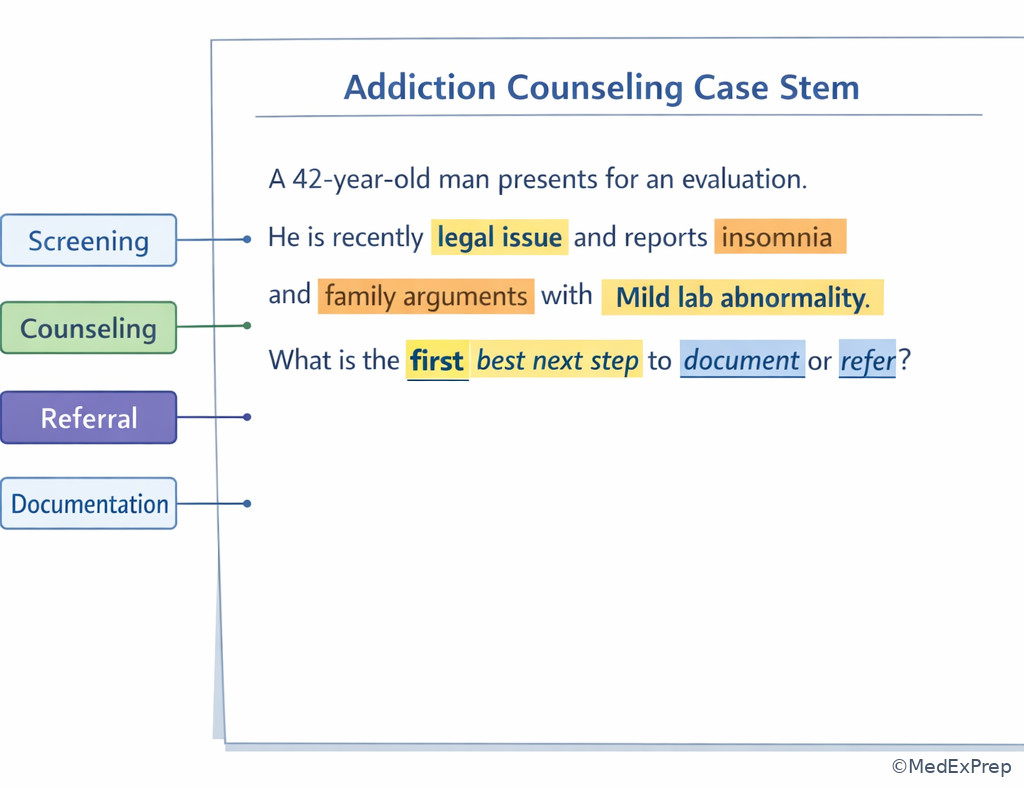
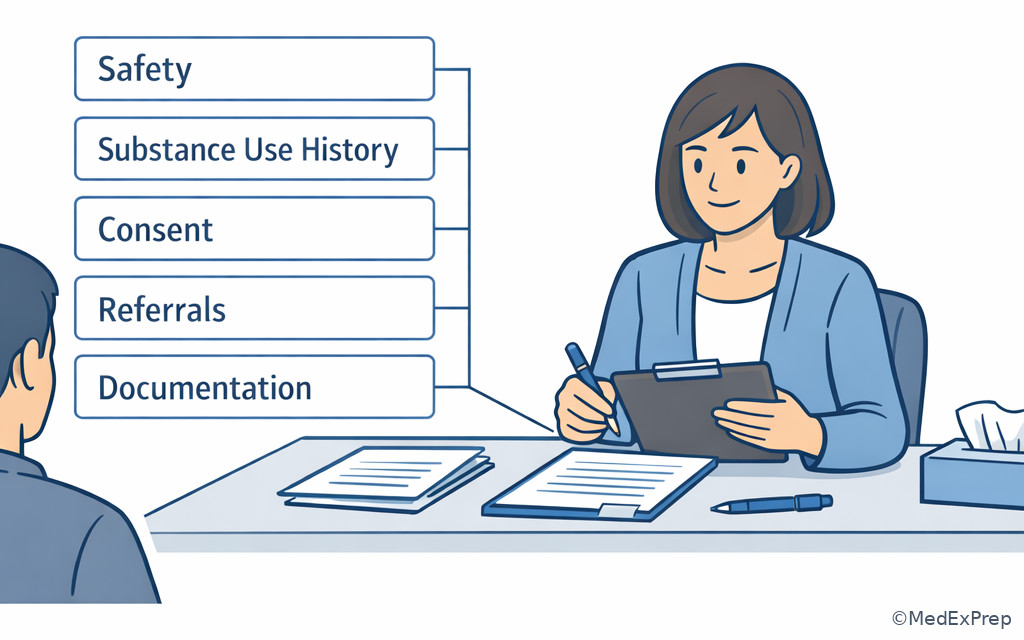
Exam takeaway: Initial visit stems often test whether you can distinguish intake tasks from later-phase counseling actions.
B Worked example
A 35-year-old client with alcohol and cannabis use, generalized anxiety history, and recent job loss tells the counselor, “I missed group because my car broke down and I’ve been couch-surfing.” He denies suicidal ideation. The question asks: “What is the most appropriate next step by the counselor to support treatment engagement?” A urine screen from last week is still positive for cannabis, which may distract you.
Reasoning chain: Identify task: support treatment engagement. Extract key facts: transportation and housing barriers, no immediate safety issue, positive screen is not the key driver here. Apply rule: engagement barriers point toward case management/service coordination rather than confrontation about substance use. Eliminate distractors: increasing abstinence education alone misses the barrier; diagnosing anxiety relapse exceeds the ask; discharge for noncompliance is premature. Verify: help connect to transportation and housing supports while maintaining counseling engagement.
C Exam trap
D Checkpoint
Question: Which phrase in a question stem most strongly suggests a documentation-domain item?
- A. “What is the best initial response?” — Tempting because responses are common in notes; wrong because this wording usually tests counseling or engagement.
- B. “Which statement should the counselor include in the record?” — Tempting because it sounds narrow; correct because it directly asks about chart language.
- C. “What service is most appropriate?” — Tempting because services get documented; wrong because it mainly tests planning or referral.
- D. “What should the counselor do first for client safety?” — Tempting because emergencies must be charted; wrong because the primary domain is crisis/safety.
Answer: B
1.1.1.6 Integration: counselor-role hierarchy from intake to referral and follow-up
A Explanation
Once you can identify domains, you must integrate them into a realistic care sequence. The exam often tests where the counselor is located in the process: beginning, middle, or transition. The single rule is: choose the next action that fits both the domain and the client’s phase of care. An answer may be appropriate eventually but still be wrong now. WHY THIS IS TESTED: board-style items frequently use correct interventions at the wrong time as distractors.
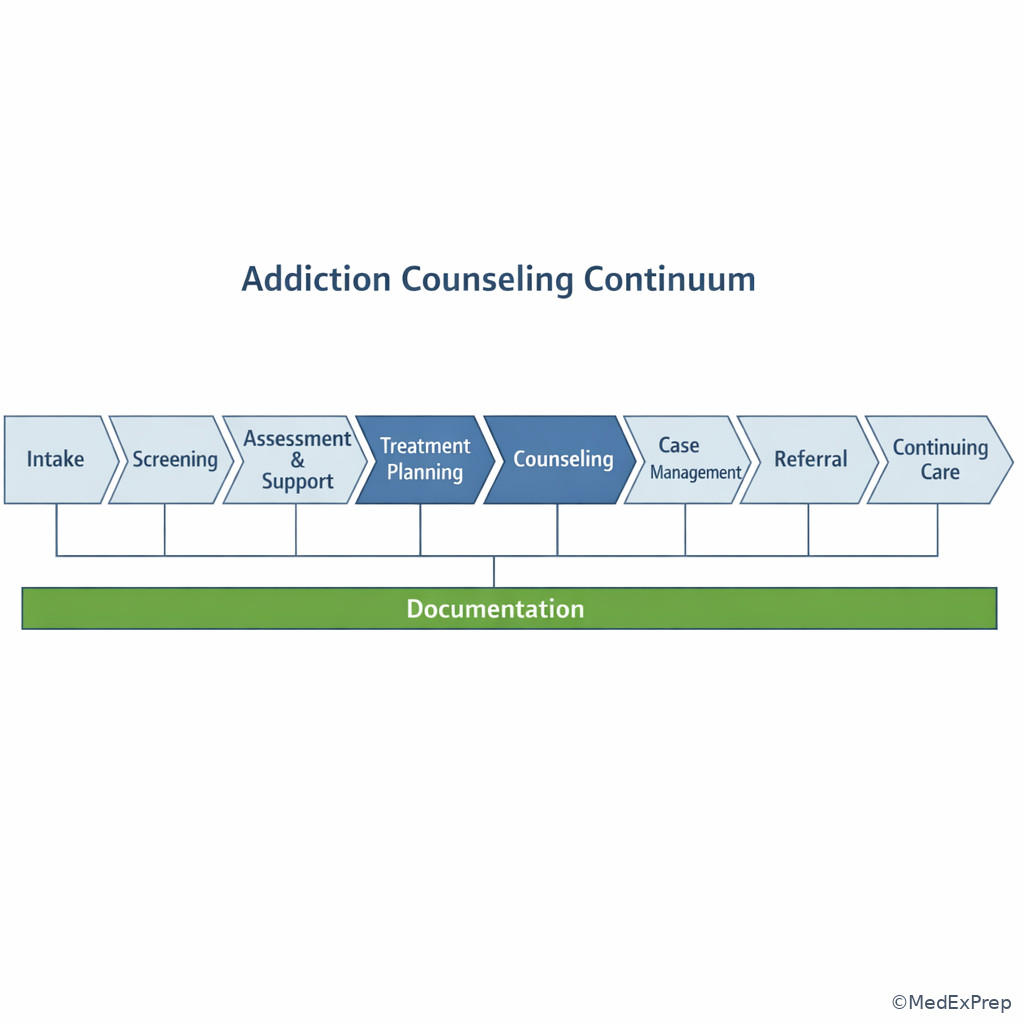
In early contact, think engagement, consent, triage, and data gathering. In active treatment, think counseling, progress monitoring, barriers, and plan updates. When new needs exceed program capacity or counselor authority, think consultation, referral, and continuity. Throughout, maintain objective documentation. This is also where the distinction between case management and referral begins to matter: referral names the outside service; case management helps the client access and use it. See Fig 5.
This lesson is foundational, so do not memorize every later-domain detail yet. Instead, build the process frame: engage -> gather -> prioritize -> act within scope -> connect -> document. Upcoming lessons on Question Task Identification and Safest Next Step will sharpen this sequence under time pressure.
Exam takeaway: Many wrong answers are correct actions at the wrong phase of care.
flowchart LR
A[Engagement and consent] --> B[Screen and triage]
B --> C[Assessment support]
C --> D[Treatment planning participation]
D --> E[Counseling and psychoeducation]
E --> F[Monitor progress and barriers]
F --> G{Need exceeds scope or resources?}
G -- Yes --> H[Consult and refer]
G -- No --> I[Continue plan]
H --> J[Document and coordinate follow-up]
I --> J Exam takeaway: Visualizing where the client is in care helps reject answers that are correct later but wrong now.
B Worked example
A 51-year-old client with alcohol use, hypertension, and recent homelessness completes intake. He expresses interest in recovery housing, reports two missed meals in the last 24 hours, and says he wants “a coping-skills worksheet today.” He denies current withdrawal symptoms, though he has shaky hands from drinking coffee. The question asks for the most appropriate next step in the counseling process.
Reasoning chain: Identify task: counseling process timing. Extract key facts: intake has just been completed, immediate housing and basic needs matter, no clear emergency in the stem, request for worksheet is real but not necessarily first. Apply rule: after intake, prioritize urgent barriers and next-step planning rather than jumping into generic skills material if foundational access needs threaten engagement. Eliminate distractors: discharging to self-help only is premature; diagnosing malnutrition is outside scope; deep trauma processing is wrong phase. Verify: coordinate appropriate supports and treatment planning/referral steps while maintaining engagement.
C Exam trap
D Checkpoint
Question: Which answer best reflects integrated counselor-role reasoning across the care process?
- A. Complete counseling interventions before clarifying immediate safety concerns — Tempting because therapeutic momentum matters; wrong because safety outranks routine counseling.
- B. Give medication-adjustment advice to support treatment retention — Tempting because retention matters; wrong because it exceeds scope.
- C. Match the action to the client’s phase of care, then apply safety and scope filters — Tempting because it sounds broad; correct because it reflects the exam’s integrated reasoning model.
- D. Focus only on rapport and defer documentation until discharge — Tempting because connection is important; wrong because documentation is ongoing and timely.
Answer: C
- Fill in the sequence: engage -> gather -> prioritize -> ________ -> connect -> document.
- True or False: A later-phase intervention can still be wrong if the client is earlier in the process.
- Name the difference between referral and case management in one line.
Exam Traps & Differentiators
- Most common wrong answer: a clinically helpful action from the wrong domain or wrong provider role.
- Why it happens: candidates focus on the case topic instead of the question task and scope boundary.
- Single best fix: ask “What function is being tested?” before comparing options.
Looks similar but isn’t:
| Confusable pair | Why they look similar | What separates them on the exam | Likely right answer pattern |
|---|---|---|---|
| Screening vs assessment support | Both involve asking questions | Screening is brief detection; assessment support is more detailed data gathering | “First visit, brief triage” -> screening; “organize patterns and severity data” -> assessment support |
| Counseling vs crisis response | Both involve talking with the client | Crisis response prioritizes safety over therapeutic exploration | Urgent risk cue -> protect and escalate first |
| Case management vs referral | Both connect clients to services | Referral names the service; case management supports access and coordination | Barrier removal and follow-through -> case management |
| Documentation vs treatment planning | Both use written records | Documentation records what happened; planning states future goals and interventions | “Include in note” -> documentation; “set goals/objectives” -> planning |
| Supportive counseling vs out-of-scope advice | Both may sound helpful and engaged | Medication, diagnosis, and medical clearance are role-limited | Consult or refer when asked for medical or diagnostic authority |
If the stem says ___, think ___:
- “Most appropriate next step at intake” -> triage, consent, initial data gathering, immediate risk check
- “What should the counselor document?” -> objective observations, client statements, actions taken, response
- “Client asks whether they have a disorder” -> scope boundary, assessment support, possible referral/consultation
- “Family member requests information” -> confidentiality, consent, exceptions, minimum necessary disclosure rules as applicable
- “Client asks about dose or medication change” -> do not prescribe/adjust; consult or refer appropriately
- “Most important barrier to engagement” -> case management/service coordination
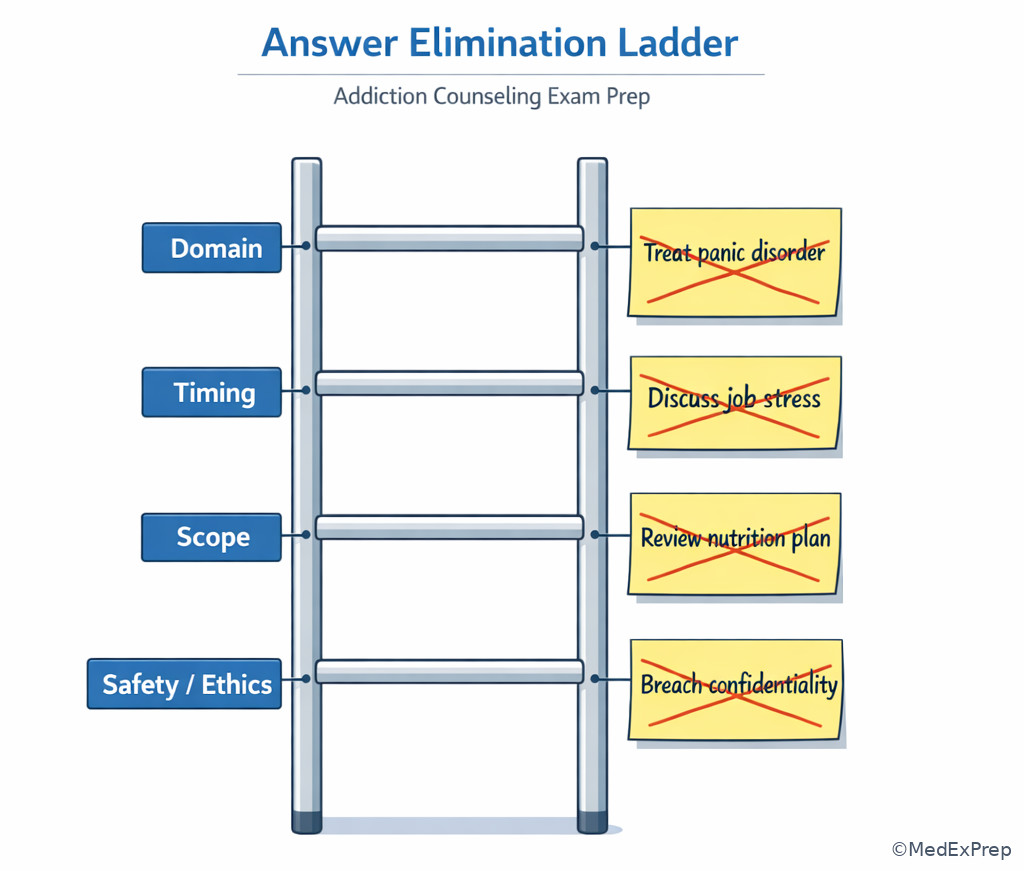
Exam takeaway: Reject options that fail domain, timing, safety, or scope before comparing stylistic differences.
flowchart TD
A[Option] --> B{Correct domain?}
B -- No --> X[Reject]
B -- Yes --> C{Correct timing?}
C -- No --> X
C -- Yes --> D{Within scope?}
D -- No --> X
D -- Yes --> E{Protects safety and ethics?}
E -- No --> X
E -- Yes --> F[Strong candidate answer] Exam takeaway: Eliminate by domain, timing, scope, and safety in that order when several choices sound reasonable.
Tables
| Shared domain | Main counselor task | Typical question wording | Out-of-role warning sign |
|---|---|---|---|
| Screening/intake | Brief detection, orientation, triage | Best initial step; what to ask first; immediate priority | Providing medical clearance |
| Assessment support | Gather and organize detailed information | Most relevant history; what data matter most | Independent diagnosis when unauthorized |
| Treatment planning | Identify goals, objectives, interventions | Most appropriate plan; next treatment target | Promising outcomes or coercing goals |
| Counseling | Motivational, psychoeducational, skill-building responses | Best response; how to support change | Specialized treatment beyond training/licensure |
| Case management/referral | Coordinate services, remove barriers, connect care | Most appropriate linkage; how to address barrier | Managing complex needs without consultation |
| Documentation | Record factual observations and actions | What should be documented; best chart wording | Backdating, opinion, omitted actions |
| Ethics/confidentiality | Protect rights, consent, privacy, boundaries | What may be disclosed; immediate ethical response | Release without valid basis |
| Safety/crisis | Protect client and others; escalate urgently | First action; safest next step | Continuing routine care during imminent risk |
| Question cue | Likely domain | What to choose | What to reject first |
|---|---|---|---|
| “First action” with intoxication or suicidal cue | Safety/crisis | Stabilize, consult, escalate, protect | Routine counseling discussion |
| “Include in the note” | Documentation | Objective behavior, quotes, action, response | Labels, assumptions, interpretations stated as fact |
| “Client asks if they have a disorder” | Assessment support/scope | Clarify role, gather data, refer/consult as needed | Unauthorized diagnosis |
| “Family requests an update” | Confidentiality | Check consent and permitted disclosure basis | Sharing because family seems supportive |
| “Barrier to attendance or engagement” | Case management | Problem-solve resources and access supports | Assuming resistance without addressing barriers |
| Scenario type | Best domain label | Why not the closest distractor? |
|---|---|---|
| Brief tool used to identify possible unhealthy alcohol use | Screening | Not assessment support because the goal is detection, not comprehensive synthesis |
| Collecting history of substances, consequences, supports, and barriers | Assessment support | Not counseling because the purpose is information gathering |
| Writing measurable goals tied to identified needs | Treatment planning | Not documentation alone because the content guides future intervention |
| Connecting client with housing and transportation resources | Case management | Not counseling alone because the main action is systems coordination |
| Linking client to medical detox because withdrawal risk exceeds program capacity | Referral | Not case management alone because a higher level service decision is central |
| Recording exact client quote and observed behavior after a missed session follow-up call | Documentation | Not treatment planning because no new plan element is being selected |
Algorithm / Approach
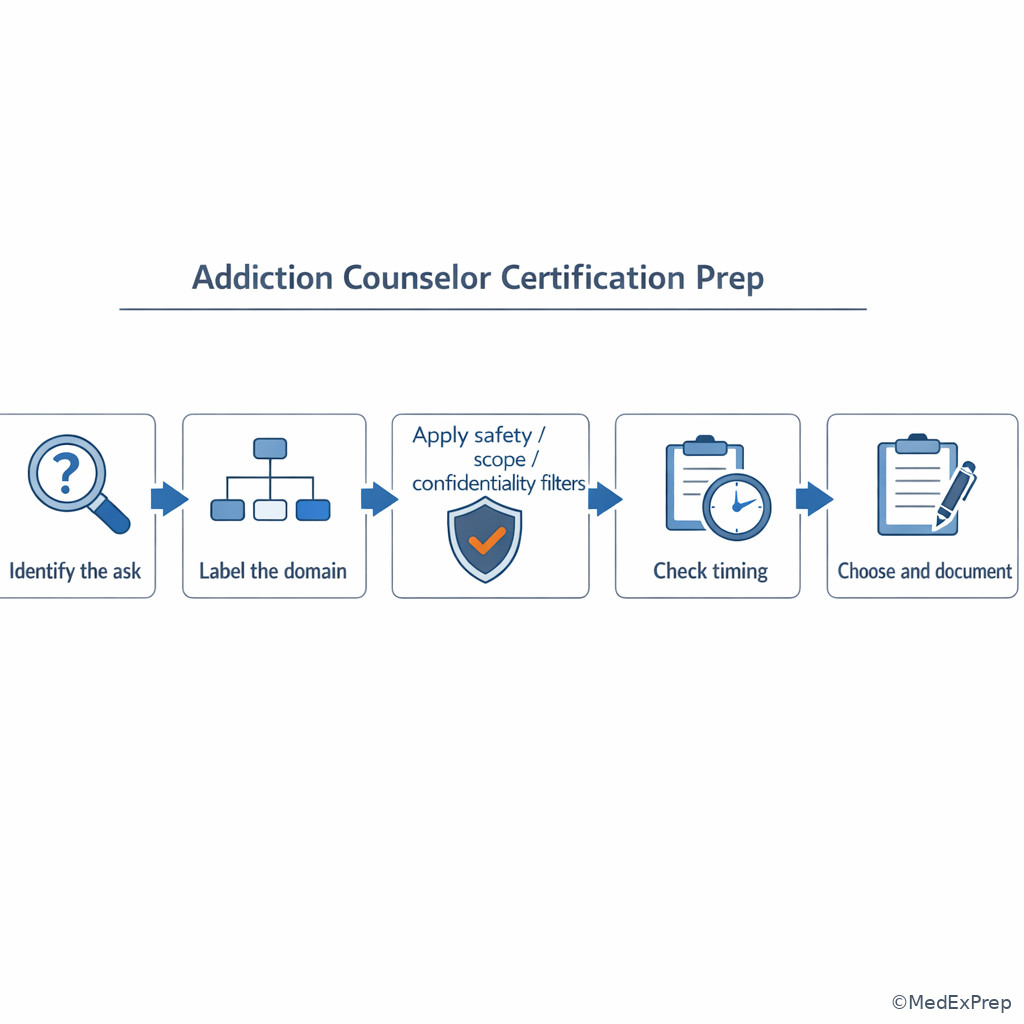
Exam takeaway: A fixed decision sequence reduces overthinking when several answers sound helpful.
Rapid Review
- Screening -> brief detection, not comprehensive synthesis
- Assessment support -> detailed information gathering without unauthorized diagnosis
- Treatment planning -> future action map, not merely a description of the session
- Counseling -> therapeutic response after immediate risk is handled
- Case management -> barrier removal and coordination, not just handing out referrals
- Referral -> best when need exceeds scope, authority, or program capacity
- Documentation -> objective facts and actions, not impressions presented as certainty
- Confidentiality -> do not disclose because a family member seems concerned; check authority first
- Safety -> one acute risk cue can outweigh the apparent main topic of the stem
- Scope -> reject medication adjustment and independent diagnosis unless clearly authorized
- Timing -> many distractors are good interventions at the wrong phase of care
- Question wording -> task verbs usually matter more than background topic words
- Best answer elimination -> domain, timing, scope, then safety/ethics
- Consultation -> when uncertain and risk is meaningful, involve supervisor rather than guess
Self-check quiz
1. A stem asks, “Which service should the counselor document after today’s visit?” The client is a 33-year-old with alcohol use, mild depression history, and recent job conflict; he is medically stable and denies current safety concerns. Which domain is being tested most directly?
- A. Documentation
- B. Counseling
- C. Assessment support
- D. Crisis response
2. A 40-year-old client in an initial appointment reports daily cannabis use, intermittent alcohol binges, and chronic knee pain treated elsewhere. She asks, “Can you tell me whether I need a medication change?” Which principle most directly determines the counselor’s response?
- A. Treatment planning sequence
- B. Scope of practice
- C. Discharge planning
- D. Rapport-building preference
3. A 27-year-old client with opioid use history, asthma, and unstable housing misses two sessions, then returns stating the bus route changed and his shelter bed was lost. He also says he feels “embarrassed” about asking for help. A negative urine screen today makes him look clinically improved. What is the most appropriate next step?
- A. Focus only on relapse-prevention counseling because the urine screen is negative
- B. Explore childhood trauma before addressing attendance barriers
- C. Address practical barriers through case management and coordinate supports for treatment engagement
- D. Close the case because repeated absence shows low motivation
4. A 31-year-old outpatient client with stimulant use history, panic symptoms, and probation involvement arrives agitated, says she has not slept in 48 hours, and asks whether she should double a prescribed medication dose tonight. Her sister calls the front desk asking whether the client attended treatment. What should the counselor do first?
- A. Provide the dosing recommendation, then return the sister’s call to build family support
- B. Address immediate safety and consultation needs within scope, while withholding disclosure without proper basis
- C. Begin motivational interviewing about long-term recovery goals before any other action
- D. Document the visit at the end of the week after more information is available
5. A 46-year-old client with alcohol use, hypertension, and recent eviction completes intake and asks for “something practical” to help immediately. He also reports no food at home and limited transportation. Mild tremor is attributed to coffee, and no acute withdrawal signs are described. Which is the most appropriate next step in the counseling process?
- A. Provide deep trauma-processing therapy because the client is ready for insight work
- B. Coordinate immediate resource linkage and begin treatment planning around identified barriers and goals
- C. Independently diagnose severe alcohol use disorder and document the diagnosis as final
- D. Delay all action until laboratory confirmation is obtained
6. A 24-year-old client with alcohol and cocaine use, prior emergency visits for panic symptoms, and a recent breakup presents for intake. He denies suicidality, but during the interview he becomes diaphoretic, confused about the date, and says he drank heavily this morning to stop shaking. He asks whether the counselor can “just help me get through tonight” in outpatient treatment because he fears losing his job. Which is the most appropriate next step?
- A. Begin relapse-prevention counseling and schedule him for group tomorrow
- B. Continue the full biopsychosocial interview so no information is missed
- C. Recognize possible urgent withdrawal/medical instability, escalate per policy, consult supervisor, and arrange appropriate medical evaluation
- D. Ask him to sign a treatment plan first so services can begin
7. A 38-year-old client in active outpatient treatment for opioid use disorder, diabetes, and depression tells the counselor that transportation problems led to missed medical appointments and a lapse in obtaining insulin supplies. He requests help “getting my life organized.” He is engaged in counseling, denies acute safety concerns, and asks whether the counselor can change his medication regimen to simplify things. Which option best matches the primary tested function and role?
- A. Case management focused on service coordination, while avoiding medication-management decisions outside scope
- B. Independent medical assessment with insulin adjustment to reduce barriers
- C. Discharge planning because medical complexity exceeds outpatient counseling
- D. Confidentiality counseling only, because transportation details are private
8. A 57-year-old client with alcohol use, chronic pain, and a pending divorce attends his first visit after hospital discharge. He says, “My daughter wants updates from you because she pays my rent,” and he asks the counselor whether the hospital record means he definitely has a psychiatric disorder. He appears calm, denies current suicidal ideation, and wants to discuss cravings. Which is the best initial response?
- A. Confirm the psychiatric diagnosis from the record and provide the daughter a general update because she supports him financially
- B. Clarify confidentiality and role limits, obtain or review proper consent before any disclosure, and continue within-scope assessment/counseling
- C. Avoid discussing confidentiality to preserve rapport and shift directly into craving-coping skills
- D. Refuse to speak with any family member under any circumstance, even with valid consent
Answer key
1. Correct answer: A. Documentation
- A. Documentation: Tempting because the phrase may seem too obvious, but it is correct for this scenario because the stem directly asks what should be recorded after a visit. The single stem clue is “should the counselor document.” Source support: objective and timely recordkeeping is a core counseling standard in substance use disorder treatment guidance and documentation texts.
- B. Counseling: Tempting because the visit itself may involve a counseling interaction, but incorrect because the task is not selecting an intervention; it is choosing chart content. The single clue is the wording about the record.
- C. Assessment support: Tempting because initial or ongoing visits often involve gathering data, but incorrect because no question asks what information to collect next. The discriminating clue is the document-focused verb.
- D. Crisis response: Tempting because exam items often hide risk, but incorrect because the client is described as medically stable and denying current safety concerns. The discriminating clue is absence of urgent risk plus the explicit documentation ask.
2. Correct answer: B. Scope of practice
- A. Treatment planning sequence: Tempting because medication questions can affect planning, but incorrect because the immediate issue is whether the counselor may advise on medication change. The discriminating clue is the request for a medication change.
- B. Scope of practice: Tempting and correct because the counselor must stay within role and avoid prescribing or adjusting medication advice. The single clue is “need a medication change?”
- C. Discharge planning: Tempting because medication needs can affect continuity, but incorrect because nothing in the stem suggests transition out of care. The discriminating clue is initial appointment context.
- D. Rapport-building preference: Tempting because the response should remain supportive, but incorrect because rapport does not permit out-of-scope actions. The single clue is that role authority, not style, is the main issue.
3. Correct answer: C. Address practical barriers through case management and coordinate supports for treatment engagement
- A. Focus only on relapse-prevention counseling because the urine screen is negative: Tempting because a negative screen suggests progress and relapse-prevention is always relevant, but incorrect because the immediate problem is attendance barriers threatening engagement. The discriminating clue is bus route change and loss of shelter bed.
- B. Explore childhood trauma before addressing attendance barriers: Tempting because shame and instability can connect to deeper issues, but incorrect because the best next step targets the obstacle preventing treatment access. The discriminating clue is missed sessions due to logistics.
- C. Address practical barriers through case management and coordinate supports for treatment engagement: Correct because the stem asks for the next step and highlights transportation and housing barriers rather than acute relapse or crisis. The key clue is the concrete access problem.
- D. Close the case because repeated absence shows low motivation: Tempting because missed sessions may look like disengagement, but incorrect because the stem provides modifiable barriers and a return to care. The discriminating clue is the client’s explanation plus expressed embarrassment about asking for help.
4. Correct answer: B. Address immediate safety and consultation needs within scope, while withholding disclosure without proper basis
- A. Provide the dosing recommendation, then return the sister’s call to build family support: Tempting because it seems efficient and supportive, but incorrect because medication advice exceeds scope and disclosure without proper basis may violate confidentiality. The discriminating clues are “double a prescribed medication dose” and “sister calls.”
- B. Address immediate safety and consultation needs within scope, while withholding disclosure without proper basis: Correct because the stem combines possible acute instability, a medication question, and a third-party request for information. The single discriminating clue is the simultaneous trigger of safety, scope, and confidentiality filters.
- C. Begin motivational interviewing about long-term recovery goals before any other action: Tempting because motivation work is central in addiction counseling, but incorrect because acute concerns must be handled first. The key clue is sleep deprivation with agitation and medication request.
- D. Document the visit at the end of the week after more information is available: Tempting because complete documentation matters, but incorrect because documentation should be timely and does not replace immediate action. The discriminating clue is urgent present-tense risk.
5. Correct answer: B. Coordinate immediate resource linkage and begin treatment planning around identified barriers and goals
- A. Provide deep trauma-processing therapy because the client is ready for insight work: Tempting because the client asked for practical help and therapy sounds active, but incorrect because the process is still early and immediate basic barriers are more pressing. The discriminating clue is recent intake plus food and transportation insecurity.
- B. Coordinate immediate resource linkage and begin treatment planning around identified barriers and goals: Correct because the client has completed intake, lacks acute withdrawal signs, and presents practical barriers that threaten engagement. The key clue is “no food at home and limited transportation.”
- C. Independently diagnose severe alcohol use disorder and document the diagnosis as final: Tempting because alcohol use is clearly relevant, but incorrect because unauthorized independent diagnosis exceeds role. The discriminating clue is counselor-candidate scope.
- D. Delay all action until laboratory confirmation is obtained: Tempting because objective data can be helpful, but incorrect because counseling, planning, and case management do not require waiting when urgent practical needs are known. The key clue is identifiable barriers already affecting care.
6. Correct answer: C. Recognize possible urgent withdrawal/medical instability, escalate per policy, consult supervisor, and arrange appropriate medical evaluation
- A. Begin relapse-prevention counseling and schedule him for group tomorrow: Tempting because he needs treatment and wants outpatient help, but incorrect because signs suggest acute instability requiring a higher-priority response. The discriminating clues are confusion, diaphoresis, morning drinking to stop shaking, and current symptoms.
- B. Continue the full biopsychosocial interview so no information is missed: Tempting because complete intake is often expected, but incorrect because unstable presentation interrupts routine assessment. The key clue is possible urgent withdrawal/medical concern.
- C. Recognize possible urgent withdrawal/medical instability, escalate per policy, consult supervisor, and arrange appropriate medical evaluation: Correct because safety outranks intake completion, and the counselor should not independently manage severe withdrawal. The single most important clue is drinking to stop shaking combined with confusion.
- D. Ask him to sign a treatment plan first so services can begin: Tempting because paperwork and continuity matter, but incorrect because planning comes after immediate stabilization. The discriminating clue is acute instability, not administrative delay.
7. Correct answer: A. Case management focused on service coordination, while avoiding medication-management decisions outside scope
- A. Case management focused on service coordination, while avoiding medication-management decisions outside scope: Correct because the primary need is organizing transportation and medical follow-up barriers, while medication-regimen change remains outside counselor authority. The discriminating clue is missed appointments and insulin access problems paired with a request to “get my life organized.”
- B. Independent medical assessment with insulin adjustment to reduce barriers: Tempting because simplifying treatment could help, but incorrect because medication adjustment belongs to authorized medical providers. The key clue is request to change medication regimen.
- C. Discharge planning because medical complexity exceeds outpatient counseling: Tempting because comorbidity is significant, but incorrect because the client remains engaged and the need is coordinated support, not exit from counseling. The discriminating clue is stable counseling engagement without acute safety concern.
- D. Confidentiality counseling only, because transportation details are private: Tempting because privacy is always relevant, but incorrect because no confidentiality conflict is the main issue in this stem. The key clue is practical service coordination need.
8. Correct answer: B. Clarify confidentiality and role limits, obtain or review proper consent before any disclosure, and continue within-scope assessment/counseling
- A. Confirm the psychiatric diagnosis from the record and provide the daughter a general update because she supports him financially: Tempting because records and family support may seem to justify action, but incorrect because diagnosis confirmation may exceed role and financial support does not create disclosure permission. The discriminating clues are request for updates and diagnostic confirmation.
- B. Clarify confidentiality and role limits, obtain or review proper consent before any disclosure, and continue within-scope assessment/counseling: Correct because this answer addresses both confidentiality and scope while allowing ongoing care. The key clue is daughter wants updates and client asks for diagnostic certainty.
- C. Avoid discussing confidentiality to preserve rapport and shift directly into craving-coping skills: Tempting because cravings are clinically relevant and rapport matters, but incorrect because the confidentiality question is active and must be handled accurately. The discriminating clue is explicit request for third-party information sharing.
- D. Refuse to speak with any family member under any circumstance, even with valid consent: Tempting because it sounds protective, but incorrect because properly authorized communication may be appropriate depending on consent and policy. The discriminating clue is that confidentiality is strong but not absolute or universally prohibitive.
Keep going with the full IC&RC / CASAC Prep Course (CASAC)
You just studied the way members do, in the same lesson interface. Full access unlocks every lesson, the question bank and flashcards for a full year.
One payment · 1 year of access · No auto-renewal