1.1.1 - Autologous Vs Allogeneic Transplant
Autologous vs Allogeneic Transplant
What you’ll learn
- Differentiate autologous from allogeneic transplant using source of cells, immune implications, and nursing priorities.
- Recognize how transplant type changes infection risk, graft-versus-host disease risk, relapse considerations, and education points.
- Choose the safest nursing action when a stem asks about monitoring, teaching, escalation, or coordination for auto versus allo recipients.
- Use transplant type to anticipate phase-based complications and supportive-care needs across inpatient and outpatient settings.
- Stay within RN scope when transplant type affects high-risk decisions that require provider escalation rather than independent regimen changes.
- FOUNDATIONS: Transplant type recognition → autologous vs allogeneic distinctions
- TRANSPLANT PROCESS: Product source and infusion context → nursing monitoring implications
- POST-TRANSPLANT: Immune recovery differences → complication surveillance
- COMPLICATIONS: GVHD risk, graft failure concepts, infection timing cues
- PSYCHOSOCIAL/EDUCATION: Patient and caregiver teaching by transplant type
- COORDINATION/PROFESSIONAL PRACTICE: RN recognition, documentation, escalation, and protocol adherence
Why it matters
- Many BMTCN questions hide the answer in one early clue: autologous versus allogeneic. That single detail changes the entire risk profile.
- The nurse’s monitoring priorities differ: autologous recipients often center on regimen toxicity, infection during aplasia, and engraftment support; allogeneic recipients add donor-cell immune complications, especially GVHD and graft-function concerns.
- Teaching differs by transplant type. A patient with their own cells needs different anticipatory guidance than a patient receiving donor cells and immunosuppression.
- Scope-of-practice questions often test whether the RN recognizes a concerning pattern and escalates rather than independently diagnosing or changing the treatment plan.
Key Terms & Must-Know Facts
1.1.1.1 Key terms
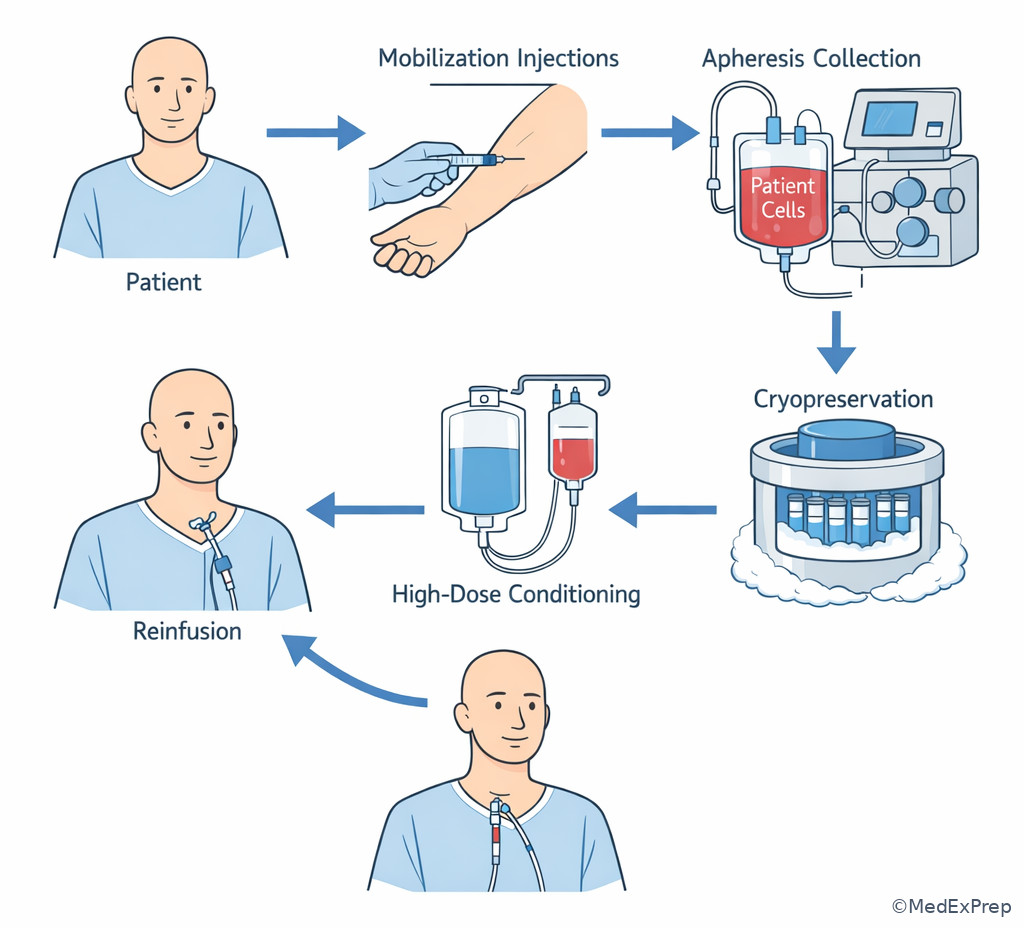
- Autologous transplant: reinfusion of the patient’s own previously collected stem cells
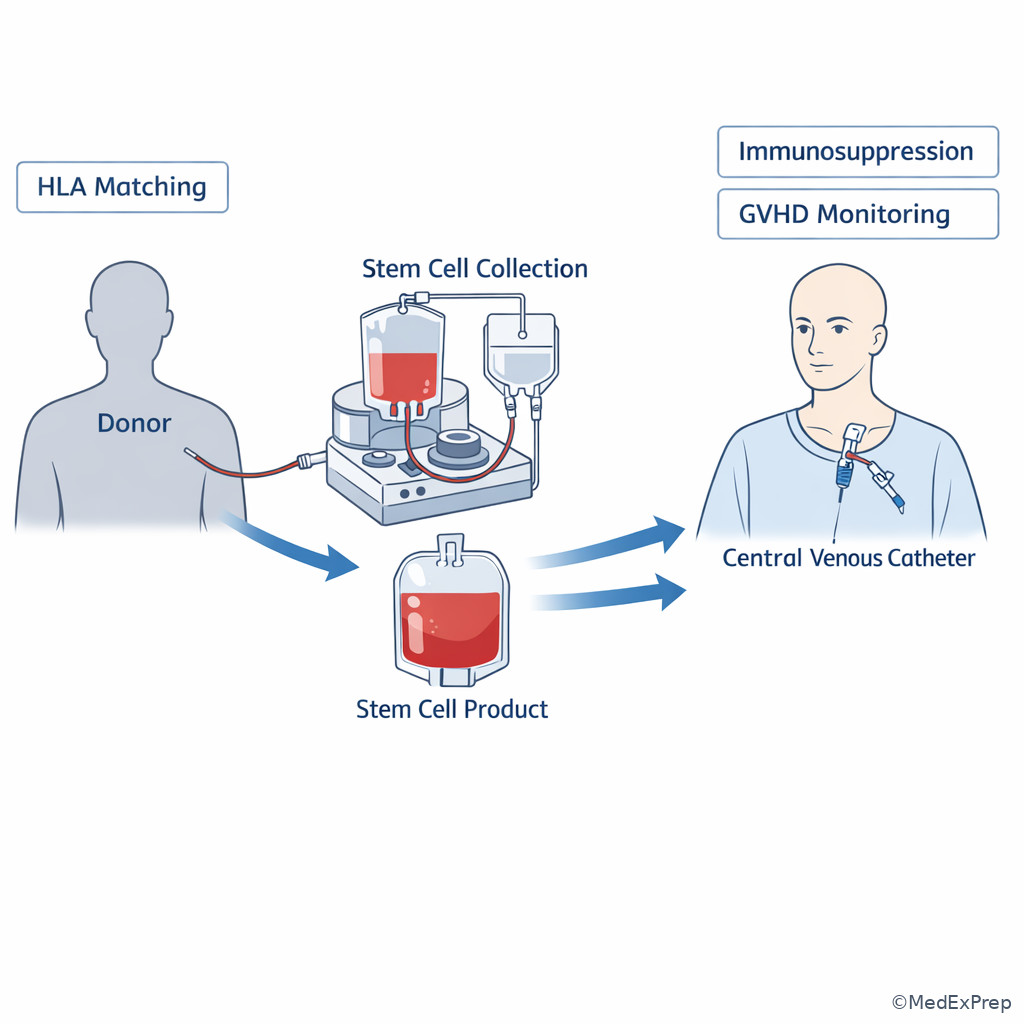
- Allogeneic transplant: infusion of stem cells from a donor
- Conditioning: chemotherapy with or without radiation given before stem cell infusion
- Engraftment: recovery of donor or autologous hematopoiesis after transplant
- GVHD: graft-versus-host disease; donor immune cells attack recipient tissues
- Graft-versus-tumor effect: donor immune benefit against residual malignant cells
- Aplasia: period of profound marrow suppression before count recovery
- Immunosuppression: medications used mainly in allogeneic settings to prevent or manage immune complications
- HLA matching: donor-recipient compatibility concept relevant to allogeneic transplant
- Relapse risk: return of underlying disease after transplant
- Graft failure: inadequate establishment of donor hematopoiesis
- Mobilization/collection: process of obtaining stem cells, often preceding autologous transplant
- DMSO exposure: preservative-related infusion effects common with cryopreserved products
1.1.1.2 Must-know facts
- Autologous transplant uses the patient’s own cells, so GVHD does not occur in the classic donor-versus-host sense.
- Allogeneic transplant introduces donor immune cells, so GVHD risk is a defining exam clue.
- Both transplant types can have neutropenia, infection risk, mucositis, and regimen toxicities.
- Autologous transplant is often used when marrow rescue is needed after high-dose therapy.
- Allogeneic transplant adds donor-related concepts: HLA match, chimerism, graft function, immunosuppressive therapy, and GVHD monitoring.
- A question asking about tacrolimus, cyclosporine, or donor matching strongly points toward allogeneic transplant.
- A question emphasizing stem-cell mobilization and later reinfusion of collected cells strongly points toward autologous transplant.
- RN priority remains safety: assess, stabilize, implement protocol, document, and notify the transplant team when findings suggest a serious complication.
Core content
Exam takeaway: Start with cell source and immune consequence to unlock the rest of the stem.
flowchart TD
A[Stem cell transplant stem] --> B{Whose cells?}
B -->|Patient's own cells| C[Autologous]
B -->|Donor cells| D[Allogeneic]
C --> E[No classic GVHD]
C --> F[Focus on regimen toxicity, infection, relapse]
D --> G[GVHD risk]
D --> H[Focus on immunosuppression, infection, graft function]
D --> I[HLA and donor concepts matter] Exam takeaway: The test often asks which complication is uniquely expected versus broadly shared.
flowchart LR
A[Autologous] --> B[Conditioning toxicity]
A --> C[Neutropenic infection]
A --> D[Relapse concern]
E[Allogeneic] --> F[Conditioning toxicity]
E --> G[Neutropenic infection]
E --> H[GVHD]
E --> I[Graft failure or poor donor function]
E --> J[Immunosuppressant monitoring]
Exam takeaway: Visualize the same-patient collection-to-reinfusion path to separate autologous from donor-based transplant.
Exam takeaway: Donor cells entering a recipient explain why GVHD and immunosuppression become central nursing concerns.
1.1.1.3 Foundational distinction: whose cells, whose immune system, whose risks?
A Explanation
The first exam decision conflict is simple but decisive: Is this the patient’s own stem cell product or a donor product? That one finding resolves most stems. If the product comes from the patient, think autologous transplant. If the product comes from a related, unrelated, or other donor source, think allogeneic transplant. See Fig 1.
WHY THIS IS TESTED: many questions present shared post-transplant problems such as fever, mucositis, diarrhea, or cytopenias. The distinguishing clue is not the symptom itself but the source of the graft. Choose autologous when the key issue is marrow rescue after high-dose therapy. Reject allogeneic if the stem gives no donor context, no HLA discussion, and no immunosuppressive plan. Choose allogeneic when the stem introduces donor cells, matching, GVHD prevention, or graft-function surveillance. Reject autologous when the question centers on donor immune effects.
From a nursing perspective, both groups need meticulous assessment, infection prevention, product verification, central-line safety, symptom management, hydration, and education. The difference is that allogeneic recipients carry a second layer of complexity: donor-versus-recipient immune interactions. That is why allogeneic care often includes prophylactic or therapeutic immunosuppression, closer surveillance for skin, liver, and GI changes, and awareness of graft failure or poor donor-cell establishment.
B Worked example
A 58-year-old man with relapsed multiple myeloma, hypertension, and peripheral neuropathy is admitted for stem cell infusion after high-dose melphalan. His chart notes stem cells were collected 3 weeks earlier after mobilization. He reports nausea and has a mild baseline creatinine elevation from prior therapy. A new nurse asks whether the team should monitor closely for acute GVHD after infusion because he will be profoundly immunocompromised.
Reasoning chain: Identify the task → determine the correct transplant-type implication. Extract key facts → multiple myeloma, prior mobilization, cells collected from the patient, planned reinfusion after high-dose therapy. Apply rule → this is autologous transplant. Eliminate distractors → severe immunocompromise is real, but it does not convert an autologous transplant into a GVHD-risk transplant. Verify → the RN should prioritize expected autologous issues such as infusion monitoring, mucositis, neutropenic risk during aplasia, hydration, and symptom control, not routine GVHD framing.
C Exam trap
D Checkpoint
Question: A patient on day +2 after stem cell infusion asks why the nurse keeps emphasizing infection prevention but not GVHD education. Which response is most appropriate if the patient received an autologous transplant for lymphoma?
- “GVHD is the main concern after all transplant types, but it usually starts much later.”
- “Because your own cells were reinfused, infection and regimen toxicity are expected priorities, while donor-cell GVHD is not.”
- “GVHD does not occur because conditioning fully removes immune complications from transplant.”
- “GVHD teaching is unnecessary only if your counts recover within 7 days.”
- A: Tempting because GVHD is a highly testable transplant complication; wrong because it incorrectly applies donor-cell risk to autologous transplant.
- B: Tempting because it directly addresses the patient’s question; correct because the discriminating fact is reinfusion of the patient’s own cells.
- C: Tempting because conditioning is central to transplant; wrong because conditioning does not eliminate infection or other complications.
- D: Tempting because timing matters in transplant; wrong because count recovery timing does not determine whether GVHD applies.
1.1.1.4 Foundational comparison: immune consequences, benefits, and tradeoffs
A Explanation
The second decision conflict is not just what transplant is this? but what advantage was the team seeking, and what cost comes with it? Autologous transplant is often used when the patient needs high-dose therapy followed by marrow rescue. The benefit is avoidance of donor immune complications; the tradeoff is lack of graft-versus-tumor effect and continued relapse risk from residual disease. Allogeneic transplant can provide donor immune activity against malignant cells, but the price is added immune toxicity, including GVHD and the need for immunosuppressive monitoring. See Fig 2.
WHY THIS IS TESTED: exam stems often ask the nurse to choose what to monitor or reinforce in teaching. Use choose-vs-reject framing: choose allogeneic when donor immune activity explains the plan, reject autologous if the stem discusses HLA matching, donor chimerism, or calcineurin inhibitor teaching. Choose autologous when prior collection and reinfusion of self-cells is the rescue strategy, reject allogeneic if no donor-derived immune issues appear.
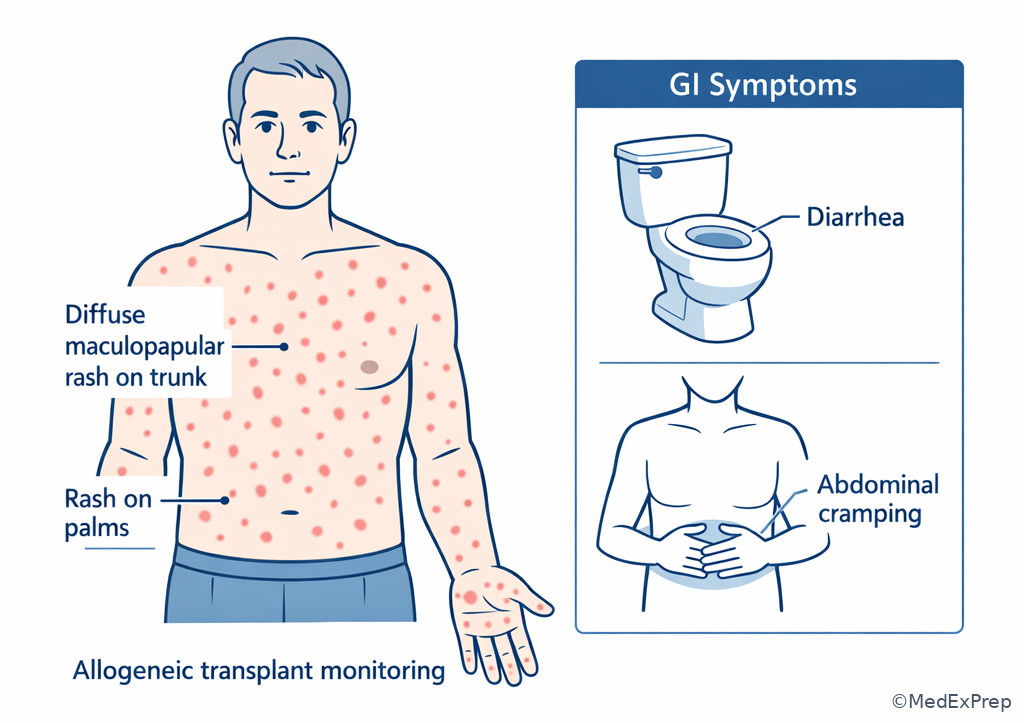
For nursing care, this means patient teaching changes. In autologous transplant, patients often need realistic education that transplant does not erase infection risk or regimen toxicity, and relapse surveillance still matters. In allogeneic transplant, the nurse must reinforce that new rash, diarrhea, abdominal pain, jaundice, or other symptom changes can require urgent communication because donor immune complications may evolve over time.
B Worked example
A 41-year-old woman with acute leukemia, type 2 diabetes, and anxiety is day +28 after a matched donor transplant. She calls the clinic with a new pruritic rash on the trunk and palms plus four loose stools today. She also mentions that she ate spicy food yesterday and had a similar but much milder rash from adhesive tape last month. The novice nurse focuses on the food history and mild adhesive sensitivity.
Reasoning chain: Identify the task → determine whether symptoms fit a transplant-type-specific complication requiring escalation. Extract key facts → matched donor transplant, day +28, new diffuse rash, diarrhea. Apply rule → allogeneic transplant adds GVHD risk; skin and GI findings in this context are concerning and should not be minimized. Eliminate distractors → spicy food and adhesive sensitivity are noise. Verify → the RN should assess severity, obtain focused symptom details per protocol, and notify the transplant team promptly rather than treating it as routine skin irritation.
C Exam trap
D Checkpoint
Question: Which teaching point is most important to reinforce for a patient receiving an allogeneic transplant, compared with an autologous transplant?
- Report new rash, diarrhea, or jaundice promptly because donor immune complications may require urgent evaluation.
- Expect no infection risk once the stem cells are infused because donor cells provide immediate immunity.
- Avoid all blood pressure checks after transplant because they can trigger GVHD.
- Counts usually recover before mucositis begins, so oral care becomes less important after infusion.
- A: Tempting because it sounds broader than a single symptom tip; correct because it targets the allogeneic-specific immune risk.
- B: Tempting because donor cells sound protective; wrong because immune recovery is not immediate and infection risk remains high.
- C: Tempting because skin injury matters in immunocompromised patients; wrong because blood pressure checks do not trigger GVHD.
- D: Tempting because phases can be confusing; wrong because mucositis and oral care remain important supportive-care concerns.
- The transplant type associated with classic GVHD is allogeneic.
- True or False: Autologous transplant eliminates neutropenic infection risk. False.
- Name the 3 high-yield allogeneic clues: donor cells, HLA/matching language, immunosuppression/GVHD monitoring.
| Feature | Autologous | Allogeneic |
|---|---|---|
| Cell source | Patient’s own collected stem cells | Donor stem cells |
| Classic GVHD risk | No | Yes |
| HLA matching relevance | Not central | Central concept |
| Immunosuppressant monitoring | Usually not defining feature | Common defining feature |
| Relapse consideration | Often prominent | Still present but modified by donor immune effect |
| Graft-versus-tumor effect | No donor immune effect | Potential benefit |
| Shared risks | Conditioning toxicity, neutropenia, infection, mucositis | Conditioning toxicity, neutropenia, infection, mucositis |
Exam takeaway: Prioritize shared supportive care first, then add the transplant-specific layer.
flowchart TD
A[All transplant patients] --> B[Monitor vitals, I&O, symptoms, counts]
A --> C[Protective infection precautions]
A --> D[Central line and infusion safety]
B --> E{Transplant type?}
E -->|Autologous| F[Emphasize toxicity support and infection surveillance]
E -->|Allogeneic| G[Add GVHD, immunosuppressant, graft-function surveillance] Exam takeaway: In allogeneic recipients, new rash and diarrhea should trigger focused assessment and prompt escalation.
1.1.1.5 Application: how transplant type changes routine nursing monitoring and teaching
A Explanation
Now move from definition to bedside application. The decision conflict here is: What should the RN monitor and teach first, based on transplant type? Start with what all patients share — product verification, infusion monitoring, central-line care, hydration, symptom control, counts, fever surveillance, mucositis prevention, nutrition support, and timely escalation. Then add the transplant-specific layer. See Fig 3.
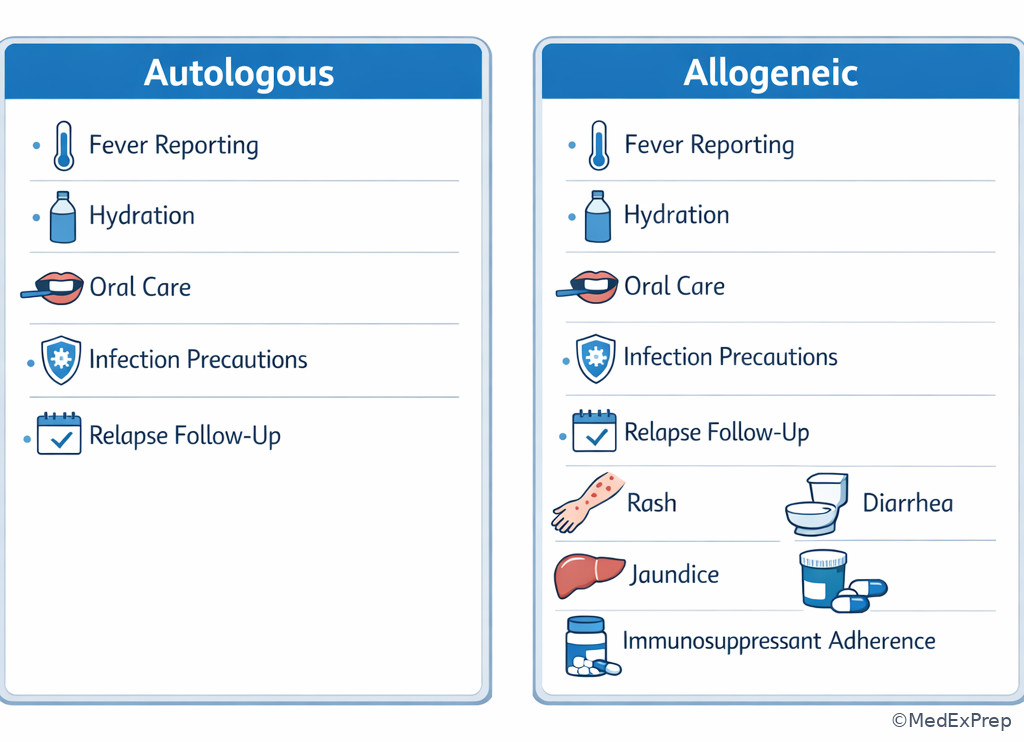
For autologous transplant, teaching often emphasizes the expected sequence: prior collection, conditioning, reinfusion, aplasia, infection precautions, count recovery, and symptom management. The nurse should reject false reassurance. Even though GVHD is not the expected issue, the patient can still develop significant toxicities, infection, bleeding from cytopenias, dehydration, renal stress, and prolonged fatigue. For allogeneic transplant, the nurse includes all of those plus donor-related teaching: strict adherence to immunosuppressive medications when prescribed, rapid reporting of rash or diarrhea, avoidance of unsupervised medication changes, and understanding that immune recovery may be prolonged and uneven.
WHY THIS IS TESTED: many stems ask for the most important teaching point, priority monitoring parameter, or best nursing action. The single rule is: start with universal transplant safety, then ask whether the transplant type adds an immune complication layer. If yes, allogeneic-specific teaching rises in priority.
B Worked example
A 63-year-old woman with lymphoma, chronic kidney disease stage 3, and atrial fibrillation is preparing for discharge after autologous transplant. She says, “My sister had a donor transplant and was warned about GVHD, so that must be the main thing I should watch for too.” She also reports mild mouth soreness and poor appetite. The distracting clue is the strong family comparison to a donor transplant.
Reasoning chain: Identify the task → choose the most appropriate discharge teaching emphasis. Extract key facts → autologous transplant, discharge teaching, mild mucositis, poor intake, comorbid renal disease. Apply rule → prioritize symptom reporting related to infection, dehydration, poor intake, fever, bleeding, and worsening regimen toxicities; GVHD is not the defining teaching point. Eliminate distractors → family anecdote about donor transplant is not applicable. Verify → the RN should correct the misunderstanding and reinforce autologous-specific expectations while still emphasizing general post-transplant precautions.
C Exam trap
D Checkpoint
Question: A nurse is preparing discharge teaching for two patients, one after autologous transplant and one after allogeneic transplant. Which added teaching item belongs most specifically to the allogeneic recipient?
- Report a temperature elevation promptly and follow protective infection precautions.
- Maintain central line care exactly as instructed and report redness or drainage.
- Report new rash, persistent diarrhea, or jaundice because these can signal donor-related immune complications.
- Use oral care measures consistently to reduce mucositis burden and support intake.
- A: Tempting because it is critical transplant teaching; wrong because it applies to both groups.
- B: Tempting because line safety is high priority; wrong because it is not specific to allogeneic transplant.
- C: Tempting because it is detailed and symptom-based; correct because it reflects donor-cell immune risk.
- D: Tempting because mucositis is common; wrong because it is shared supportive-care teaching, not allogeneic-specific.
1.1.1.6 Application: recognizing complications that are shared versus transplant-specific
A Explanation
Board questions often present a symptom and ask you to decide whether it is a broad transplant complication or one that should immediately push you toward allogeneic concern. The decision conflict is: Is this a shared toxicity/infection pattern, or does it point to donor-cell immune complications?
Shared complications include mucositis, nausea, vomiting, diarrhea from conditioning, neutropenic fever, fatigue, bleeding risk from thrombocytopenia, infusion reactions, fluid imbalance, renal stress, hepatic injury from therapy, and poor oral intake. These can happen in both autologous and allogeneic recipients. Transplant-specific clues to allogeneic complications include new rash, GI symptoms in a donor-recipient context, rising bilirubin/LFT concerns with compatible symptoms, immunosuppressive drug monitoring, and discussion of graft function or donor engraftment. See Fig 2.
WHY THIS IS TESTED: the exam wants pattern recognition. Choose broad supportive care answers when the symptom fits both transplants and no donor clue is present. Reject donor-specific answers if the stem is clearly autologous. Conversely, when donor clues are present, reject generic reassurance and escalate concern. The goal is not for the RN to make a medical diagnosis independently; the goal is to recognize when the pattern is concerning enough to notify the transplant team promptly.
B Worked example
A 52-year-old man is day +9 after autologous transplant for multiple myeloma. He has diabetes and obesity. He develops watery diarrhea, oral mucositis, and low-grade fever after conditioning; ANC is profoundly low. His spouse read online about GVHD and asks whether the diarrhea means donor cells are attacking the gut. The tempting but wrong clue is the word “diarrhea,” which many learners overassociate with GVHD.
Reasoning chain: Identify the task → choose the safest interpretation and nursing action. Extract key facts → autologous transplant, day +9, neutropenia, conditioning effects, mucositis. Apply rule → diarrhea here is more consistent with shared transplant complications such as conditioning toxicity or infection risk rather than donor immune attack. Eliminate distractors → there are no donor cells. Verify → the RN should assess stool pattern, hydration, abdominal symptoms, protocol needs, and escalate infection concerns as indicated, but not frame this as GVHD.
C Exam trap
D Checkpoint
Question: Which patient finding most strongly requires the nurse to add allogeneic-specific concern rather than routine shared post-transplant supportive care?
- Mucositis and poor oral intake on day +6 after autologous transplant
- Neutropenic fever on day +8 after autologous transplant
- New diffuse rash and worsening diarrhea on day +24 after matched donor transplant
- Nausea and fatigue on day +3 after autologous stem cell infusion
- A: Tempting because it is clinically significant; wrong because it is a shared toxicity pattern, not allogeneic-specific.
- B: Tempting because fever is urgent; wrong because it is urgent but not unique to allogeneic transplant.
- C: Tempting because it bundles multiple symptoms; correct because donor transplant plus skin and GI changes point to an allogeneic-specific immune concern.
- D: Tempting because early symptoms can be serious; wrong because nausea and fatigue are nonspecific shared issues.
- The most exam-relevant symptom trio that should raise allogeneic concern is rash, diarrhea, and jaundice/LFT change.
- True or False: Neutropenic fever after autologous transplant is still urgent. True.
- Name 2 complications shared by autologous and allogeneic recipients: mucositis and infection during cytopenia.
| Symptom or issue | Shared across both? | When transplant type changes interpretation |
|---|---|---|
| Fever | Yes | Always urgent; allogeneic context broadens differential but does not reduce sepsis priority |
| Mucositis | Yes | Usually conditioning-related rather than transplant-type specific |
| Diarrhea | Yes | In allogeneic recipient, add GVHD concern if compatible timing and symptoms |
| Rash | Can occur in both | In allogeneic recipient, diffuse new rash raises concern for immune complication |
| Need for tacrolimus monitoring | No | Strongly favors allogeneic transplant |
| Discussion of graft function/chimerism | No | Strongly favors allogeneic transplant |
Exam takeaway: Escalate by symptom severity first, then refine by autologous versus allogeneic context.
flowchart TD
A[New symptom after transplant] --> B{Unstable or febrile?}
B -->|Yes| C[Assess ABCs, stabilize, follow urgent protocol, notify team]
B -->|No| D[Identify transplant type]
D --> E{Autologous}
E -->|Yes| F[Focus on shared toxicity and infection causes]
E -->|No| G[Add GVHD, graft, immunosuppressant review]
F --> H[Document response and continue monitoring]
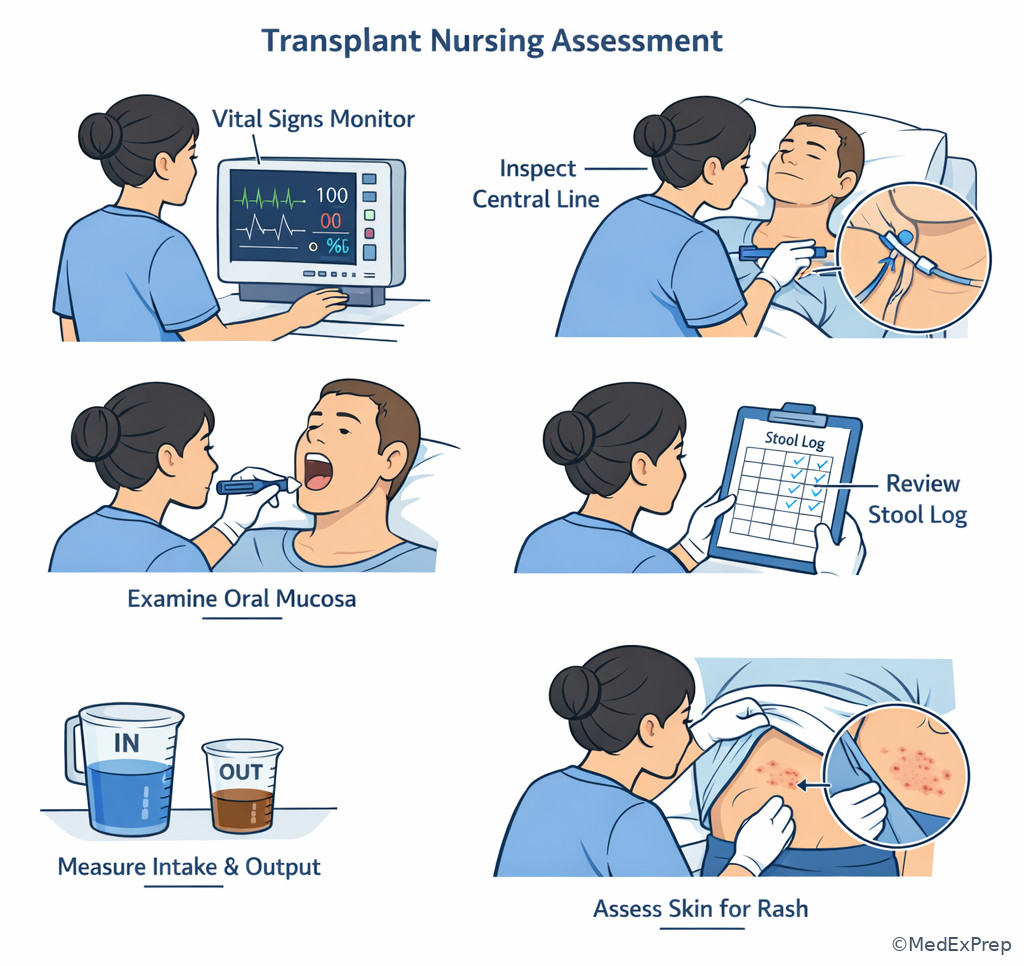
G --> H[Document response and continue monitoring] Exam takeaway: Visualize the bedside sequence of vitals, skin, oral cavity, stool pattern, intake, and line assessment to answer priority-action questions.
1.1.1.7 Integration: choosing the safest RN action and staying within scope
A Explanation
The final exam-level conflict is often not medical diagnosis but what the RN should do next. BMTCN items frequently separate strong candidates by scope judgment. The nurse may recognize that an allogeneic recipient with rash and diarrhea could have GVHD, but the safe nursing action is to assess, document focused findings, implement protocol-based support, and notify the transplant provider — not to independently diagnose, prescribe, or change immunosuppressant doses.
WHY THIS IS TESTED: the exam is designed for RN practice. Choose actions such as focused assessment, symptom triage, medication safety review, patient teaching, infection precautions, verification, and escalation. Reject provider-only actions such as independently selecting regimens, diagnosing graft failure, or changing tacrolimus dose without authorization. See Fig 4.
Autologous versus allogeneic transplant matters here because it changes what the RN is escalating for. In autologous settings, the nurse often escalates severe mucositis, neutropenic fever, dehydration, uncontrolled symptoms, or infusion reactions. In allogeneic settings, the nurse escalates those same urgent issues plus possible GVHD, graft dysfunction, and immunosuppressant-related problems. Institutional protocols vary, but the invariant exam principle is the same: identify risk pattern, act on nursing priorities, and communicate promptly.
B Worked example
A 47-year-old allogeneic transplant recipient with hypertension and steroid-induced hyperglycemia is seen in clinic on tacrolimus. She reports tremor, headache, and decreased oral intake. Her spouse asks whether the nurse can simply hold the next tacrolimus dose at home until she feels better. She also mentions a new mild hand rash that she thinks is soap irritation. The tempting wrong path is independent medication adjustment.
Reasoning chain: Identify the task → choose the safest nursing action within scope. Extract key facts → allogeneic transplant, tacrolimus use, possible medication toxicity symptoms, possible skin change, poor intake. Apply rule → the RN must assess severity, review timing and medication adherence, reinforce not changing prescribed immunosuppressants independently, and promptly notify the transplant team. Eliminate distractors → holding tacrolimus without authorization may be unsafe; minimizing the rash ignores allogeneic context. Verify → best action is focused assessment plus escalation, not independent dose change.
C Exam trap
D Checkpoint
Question: An allogeneic transplant recipient calls with new rash, six loose stools today, and difficulty taking prescribed tacrolimus because of nausea. What is the most appropriate nursing action?
- Advise stopping tacrolimus for 24 hours and restarting if the rash improves.
- Encourage oral fluids and routine follow-up at the next scheduled visit because GI upset is expected after transplant.
- Perform focused symptom assessment, reinforce not changing immunosuppressive therapy independently, and notify the transplant team promptly.
- Document the report and wait to see whether fever develops before escalating.
- A: Tempting because tacrolimus can cause adverse effects; wrong because independent medication changes are outside RN scope and unsafe here.
- B: Tempting because hydration is appropriate; wrong because the symptom cluster in an allogeneic patient requires prompt escalation.
- C: Tempting because it combines assessment, safety teaching, and escalation; correct because it is the safest RN-scope response.
- D: Tempting because fever is a major escalation trigger; wrong because waiting misses a concerning allogeneic symptom pattern.
Exam takeaway: Teaching stems are solved by identifying which message is shared and which is transplant-specific.
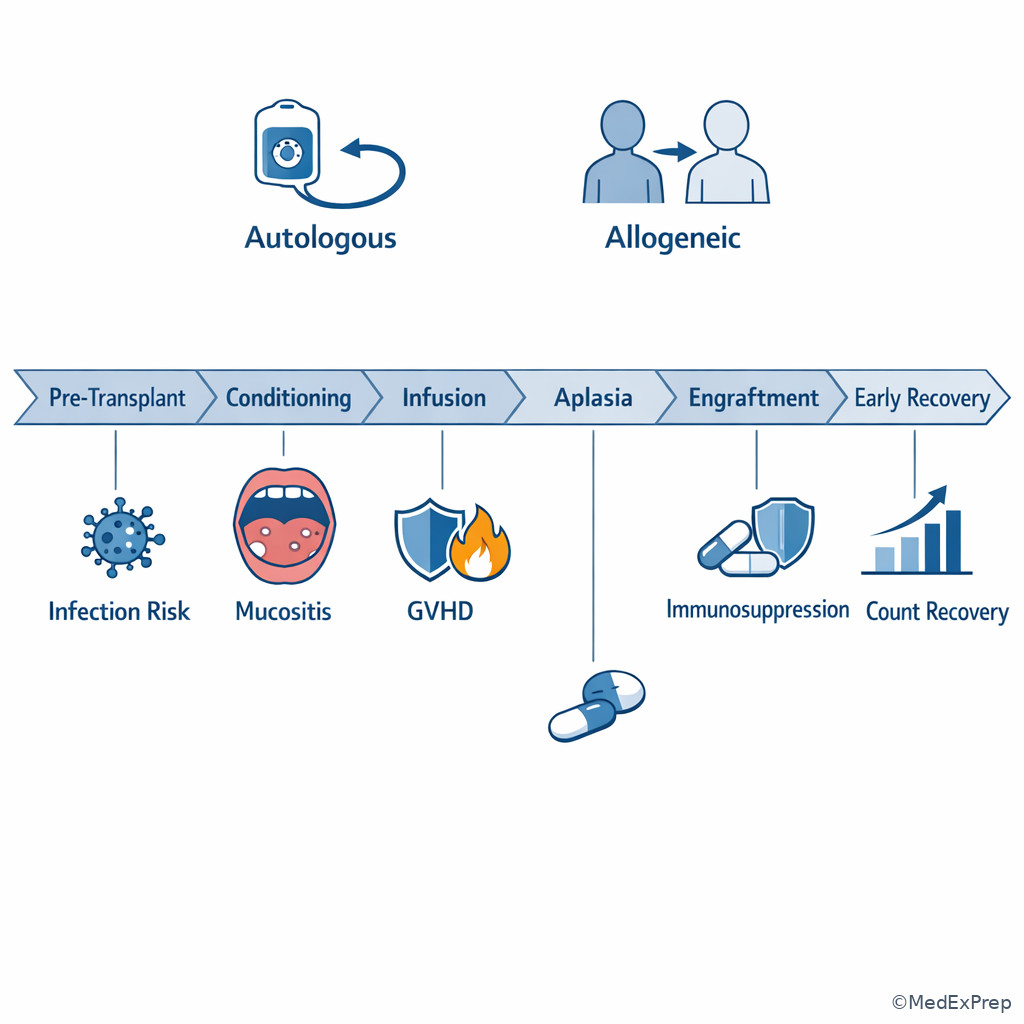
Exam takeaway: Pair transplant type with transplant phase to predict what the nurse should monitor next.
| Stem clue | Think | Best nursing framing |
|---|---|---|
| “Previously collected after mobilization” | Autologous | Reinforce shared transplant supportive care; do not default to GVHD framing |
| “Matched donor” or HLA language | Allogeneic | Add GVHD and graft-function surveillance |
| Tacrolimus/cyclosporine monitoring | Allogeneic | Assess adherence, adverse effects, and escalate concerns; do not change dose independently |
| Rash + diarrhea after donor transplant | Possible immune complication | Focused assessment and prompt provider notification |
| Mucositis + neutropenia after autologous transplant | Shared toxicity/infection pattern | Supportive care, infection surveillance, hydration, escalation by severity |
| Question asks for “most important teaching” | Differentiate shared from type-specific message | Choose the one that only fits the transplant type in the stem |
Exam Traps & Differentiators
See Fig 5 for a teaching-focused comparison and Fig 6 for the phase-plus-type framework that often decides board-style questions.
- Most common wrong answer and why: choosing a GVHD-focused answer for an autologous patient because the symptom sounds dramatic. The stem clue that defeats this is own previously collected cells.
- Looks similar but isn’t: diarrhea after conditioning can occur in both transplant types; diarrhea plus donor-transplant context raises allogeneic-specific concern.
- Wrong priority trap: selecting patient education before assessing instability. If the patient is febrile, hypotensive, or otherwise unstable, ABCs and urgent protocol-based action come first regardless of transplant type.
- Scope trap: independently changing tacrolimus or another immunosuppressant. The RN should assess, hold unsafe action if clearly required by policy, and notify the transplant team.
- Teaching trap: assuming all discharge messages are identical. Shared messages are broad, but allogeneic patients need added immune-complication and immunosuppressant teaching.
| Looks similar | Why it is tempting | What separates it |
|---|---|---|
| Autologous diarrhea vs GI GVHD | Both can present with frequent stools after transplant | Donor-cell context is required for classic GVHD concern |
| Shared infection risk vs allogeneic-specific immune issue | Both may have fever, malaise, poor intake | Allogeneic clues: donor graft, immunosuppression, rash, jaundice, graft terms |
| Appropriate medication concern vs unsafe dose change | Nurse recognizes toxicity symptoms and wants to act quickly | RN acts by assessment and escalation, not independent prescribing |
| General discharge teaching vs transplant-specific teaching | Fever and line care matter for everyone | The question often asks for the added teaching point unique to allo or auto |
| Routine symptom monitoring vs urgent escalation | Many transplant symptoms are common | ABCs, hemodynamics, neutropenic fever, or donor-specific red flags raise urgency |
1.1.1.8 If the stem says..., think...
- “Stem cells were collected after mobilization” → think autologous.
- “Matched sibling donor” or “unrelated donor” → think allogeneic.
- “Tacrolimus” or “GVHD prophylaxis” → think allogeneic monitoring priorities.
- “Rash, diarrhea, jaundice after donor transplant” → think prompt allogeneic-focused escalation.
- “High-dose therapy followed by stem cell rescue” → think autologous purpose.
- “What is the safest RN action?” → think assess, stabilize, educate, document, escalate within scope.
Algorithm / Approach
Rapid Review
- Autologous transplant → own previously collected stem cells
- Allogeneic transplant → donor cells with donor immune consequences
- GVHD clue → donor context, not just rash or diarrhea alone
- Mobilization mention → strongly supports autologous pathway
- Tacrolimus/cyclosporine mention → strongly supports allogeneic pathway
- Shared toxicity → mucositis does not tell you auto versus allo by itself
- Shared urgent issue → neutropenic fever is high priority in both types
- Teaching discriminator → allogeneic adds rash/diarrhea/jaundice reporting for immune complications
- Scope discriminator → RN escalates suspected GVHD; does not independently diagnose it
- Medication safety → concern about tacrolimus toxicity prompts assessment and notification, not independent dose adjustment
- Question stem shortcut → identify the cell source before reading the answer choices
- Auto vs allo trap → same symptom, different meaning when donor clues are present
Self-check quiz
1.1.1.9 Question 1
A 56-year-old patient with relapsed lymphoma, hypertension, and chronic back pain is preparing for stem cell infusion after high-dose chemotherapy. The chart states that stem cells were collected from the patient 1 month earlier after mobilization. Which nursing interpretation is most appropriate?
- This is an allogeneic transplant, so GVHD teaching should be the priority.
- This is an autologous transplant, so classic donor-derived GVHD is not the expected defining risk.
- This is an allogeneic transplant because high-dose chemotherapy always requires donor rescue.
- This is an autologous transplant, so infection precautions are unnecessary after infusion.
1.1.1.10 Question 2
A 49-year-old patient day +14 after matched sibling donor transplant has type 2 diabetes and anxiety. She calls the clinic about a new pruritic rash on the trunk and three loose stools since morning. Which teaching point is most appropriate for the nurse to reinforce?
- These symptoms are expected after any transplant, so routine home monitoring is sufficient.
- Because this is a donor transplant, new rash and diarrhea require focused assessment and prompt team notification.
- These symptoms matter only if the ANC has recovered.
- The best next step is to skip the next immunosuppressant dose and reassess tomorrow.
1.1.1.11 Question 3
A 61-year-old man day +8 after autologous transplant for multiple myeloma has chronic kidney disease and peripheral neuropathy. He develops mucositis, watery diarrhea, and a temperature of 38.3°C. His spouse asks whether the diarrhea most likely means GVHD. What is the most appropriate nursing response?
- Explain that donor-cell GVHD is not the expected issue in autologous transplant and prioritize assessment for shared toxicities and infection.
- Confirm that the diarrhea is most likely GVHD and prepare the patient for long-term immunosuppression teaching.
- Advise holding all oral medications until the diarrhea stops.
- Delay escalation unless a diffuse rash appears.
1.1.1.12 Question 4
A 44-year-old allogeneic transplant recipient with hypertension and steroid-related hyperglycemia reports tremor, headache, and nausea while taking tacrolimus. She asks whether she should reduce the dose tonight. Which action is most appropriate for the nurse?
- Advise reducing the dose by half because the symptoms suggest toxicity.
- Perform focused assessment, reinforce not changing the medication independently, and notify the transplant team.
- Tell the patient to stop the drug and restart only after lab confirmation.
- Reassure the patient that tremor and headache are unrelated to transplant medications.
1.1.1.13 Question 5
A nurse is comparing discharge education for two patients: one after autologous transplant for lymphoma and one after allogeneic transplant for leukemia. Both have central venous catheters and mild mucositis. Which teaching item should be emphasized as uniquely added for the allogeneic patient?
- Report line redness, drainage, or tenderness promptly.
- Use meticulous oral care and hydration to support intake.
- Report new rash, persistent diarrhea, or jaundice because these can signal donor immune complications.
- Monitor temperature and follow infection-prevention instructions.
1.1.1.14 Question 6
A 53-year-old patient day +22 after allogeneic transplant has psoriasis, chronic diarrhea-predominant IBS, and hypertension. She reports that today’s diarrhea is worse than baseline and she has a faint new erythematous rash. She is afebrile and hemodynamically stable. Which nursing action is the safest best next step?
- Attribute the symptoms to baseline IBS and psoriasis because there is no fever.
- Perform focused assessment of stool pattern and rash, review medication adherence, and notify the transplant provider promptly.
- Advise over-the-counter symptomatic treatment and routine follow-up next week.
- Document the call and wait for laboratory abnormalities before contacting the team.
1.1.1.15 Question 7
A 38-year-old patient day +3 after autologous transplant has nausea, poor intake, and mild hypotension after emesis. He also asks whether he should be watching for GVHD since a family member had a donor transplant. Which nursing priority is most appropriate?
- Begin detailed GVHD teaching because all post-transplant diarrhea and nausea can be early immune signs.
- Assess circulation and hydration status first, implement ordered supportive care, and clarify that GVHD is not the defining concern in autologous transplant.
- Focus on relapse education because that is the only remaining risk after autologous infusion.
- Delay intervention until count recovery patterns clarify the transplant type.
1.1.1.16 Question 8
A new RN caring for an allogeneic transplant recipient tells the charge nurse, “The patient has rash and diarrhea, so I already diagnosed acute GVHD and told the family we will probably increase tacrolimus.” The patient is stable, has CKD, and is anxious about medication changes. What is the best corrective response by the charge nurse?
- Support the RN’s plan because early independent decisions improve transplant outcomes.
- Instruct the RN to document a nursing diagnosis of GVHD and hold tacrolimus until the provider rounds.
- Redirect the RN to perform focused assessment, document objective findings, avoid provider-level diagnosis or dose changes, and notify the transplant team promptly.
- Tell the RN to avoid discussing rash or diarrhea with the family until biopsy results are available.
Answer key
1.1.1.17 Question 1: B
A: Tempting because GVHD is a famous transplant complication, but incorrect for this scenario because the patient’s own cells were collected and reinfused. The single stem clue is collected from the patient after mobilization. Priority-wise, the nurse should use accurate transplant-type recognition before planning teaching. Sources: NCSBN clinical judgment principles; Lewis Medical-Surgical Nursing.
B: Tempting because it requires attention to the exact wording of the stem; correct because own-cell reinfusion identifies autologous transplant, where classic donor-derived GVHD is not the defining complication. The single stem clue is patient’s own collected cells. Priority principle: assessment and correct interpretation come before planning education. Sources: Lewis; Saunders NCLEX review.
C: Tempting because high-dose therapy often sounds intense enough to require donor support, but incorrect because high-dose chemotherapy can be followed by autologous rescue. The clue that rules it out is again self-collected cells. Priority principle: do not infer donor transplant without donor evidence. Sources: Lewis; NCSBN.
D: Tempting because the absence of GVHD may feel like reduced risk, but incorrect because autologous recipients still face profound infection risk during cytopenia. The clue is after high-dose chemotherapy, which predicts immunocompromise. Priority principle: safety and infection prevention remain essential. Sources: Lewis; ANA Standards of Practice.
1.1.1.18 Question 2: B
A: Tempting because mild transplant symptoms can be common, but incorrect because matched donor transplant plus rash and diarrhea requires higher concern. The discriminating clue is matched sibling donor transplant. Priority principle: donor-related complications outrank routine reassurance. Sources: Lewis; Saunders.
B: Tempting because it sounds more urgent than some nurses prefer in outpatient triage; correct because donor transplant with rash and diarrhea requires focused assessment and prompt communication. The key clue is donor transplant context. Priority principle: early recognition and escalation prevent harm. Sources: NCSBN clinical judgment; ANA.
C: Tempting because ANC recovery is an important transplant milestone, but incorrect because these symptoms matter regardless of ANC when allogeneic immune complications are possible. The clue is new symptoms in an allogeneic recipient. Priority principle: do not delay action waiting for a less relevant parameter. Sources: Lewis; NCSBN.
D: Tempting because medication issues can contribute to symptoms, but incorrect because independent immunosuppressant changes are outside RN scope and unsafe. The clue is asks whether to skip the dose. Priority principle: assess and notify rather than independently alter therapy. Sources: ANA Standards; NCSBN.
1.1.1.19 Question 3: A
A: Tempting because it addresses both the spouse’s question and the urgent nursing issue; correct because autologous transplant does not create classic donor-cell GVHD, while fever, mucositis, and diarrhea require assessment for infection and toxicity. The clue is day +8 after autologous transplant. Priority principle: ABCs/infection safety before speculative immune labeling. Sources: Lewis; Saunders; NCSBN.
B: Tempting because diarrhea is associated with GI GVHD on exams, but incorrect because there is no donor graft in autologous transplant. The clue is autologous. Priority principle: accurate assessment precedes planning long-term teaching. Sources: Lewis; NCSBN.
C: Tempting because oral medications can worsen nausea, but incorrect because a blanket instruction to hold all oral medications is unsafe and outside protocol-based reasoning. The clue is fever and transplant context; medication decisions must be individualized. Priority principle: avoid unsafe, overly broad implementation without assessment or provider guidance. Sources: ANA; NCSBN.
D: Tempting because a rash would increase concern, but incorrect because neutropenic fever already requires prompt response. The clue is 38.3 degrees Celsius. Priority principle: sepsis/infection concerns outrank waiting for additional symptoms. Sources: Lewis; Saunders.
1.1.1.20 Question 4: B
A: Tempting because tremor and headache can suggest calcineurin inhibitor toxicity, but incorrect because the RN should not independently reduce the dose. The clue is asks whether she should reduce the dose tonight. Priority principle: assessment and escalation before independent treatment changes. Sources: ANA Standards; NCSBN; Lewis.
B: Tempting because it is more work than simply giving advice; correct because it keeps the RN within scope while addressing potential medication toxicity safely. The clue is allogeneic transplant recipient taking tacrolimus. Priority principle: assess first, then communicate urgent medication concerns. Sources: NCSBN; ANA.
C: Tempting because stopping the drug seems safer than continuing a possibly toxic medication, but incorrect because abrupt independent cessation may be harmful and requires authorized direction. The clue is critical immunosuppressant. Priority principle: do not replace focused assessment with unauthorized prescribing behavior. Sources: ANA; Lewis.
D: Tempting because some adverse effects may be nonspecific, but incorrect because tacrolimus-related concerns must not be dismissed. The clue is tacrolimus plus neurologic symptoms and nausea. Priority principle: symptom recognition and safety escalation. Sources: Lewis; Saunders.
1.1.1.21 Question 5: C
A: Tempting because line infection teaching is critical, but incorrect because it applies to both transplant types. The clue is the question asking for the uniquely added teaching point. Priority principle: choose the discriminator, not just an important general rule. Sources: Lewis; NCSBN.
B: Tempting because mucositis care is highly relevant here, but incorrect because both patients have mucositis and need this teaching. The clue is again uniquely added for the allogeneic patient. Priority principle: compare shared versus transplant-specific needs. Sources: Saunders; Lewis.
C: Tempting because it contains specific red-flag symptoms; correct because these symptoms in allogeneic recipients may reflect donor immune complications. The clue is allogeneic transplant. Priority principle: prioritize teaching that prevents delayed recognition of serious complications. Sources: Lewis; ANA.
D: Tempting because temperature monitoring is a universal post-transplant safety instruction, but incorrect because it is not unique to allogeneic transplant. The clue is both are at infection risk. Priority principle: the test asks for the differential teaching point. Sources: Lewis; NCSBN.
1.1.1.22 Question 6: B
A: Tempting because psoriasis and IBS provide alternative explanations, and the patient is afebrile, but incorrect because in an allogeneic recipient, change from baseline plus new rash requires prompt assessment and escalation. The clue is worse than baseline diarrhea with new rash after allogeneic transplant. Priority principle: do not let chronic comorbidities obscure transplant red flags. Sources: Lewis; NCSBN.
B: Tempting because it requires more nuanced judgment than simply recommending supportive care; correct because it applies focused assessment, considers adherence, and escalates appropriately within RN scope. The clue is allogeneic transplant context. Priority principle: analyze before implementing routine self-care advice. Sources: ANA; Lewis.
C: Tempting because symptomatic relief may be helpful, but incorrect because this is the right intervention at the wrong priority. The clue is transplant-specific red flags. Priority principle: assessment and provider communication outrank routine symptom-management advice. Sources: NCSBN; ANA.
D: Tempting because labs can clarify severity, but incorrect because waiting for labs delays evaluation of a concerning symptom cluster. The clue is new rash plus worsening diarrhea. Priority principle: timely escalation when early warning signs appear. Sources: Lewis; Saunders.
1.1.1.23 Question 7: B
A: Tempting because transplant patients need education, but incorrect because mild hypotension after emesis creates a circulation and hydration priority, and GVHD is not the defining concern in autologous transplant. The clue is autologous transplant with mild hypotension. Priority principle: ABCs before nonurgent teaching. Sources: NCSBN; Lewis.
B: Tempting because it combines physiologic stabilization with accurate teaching; correct because circulation and hydration come first, followed by clarification of transplant-specific risk. The clue is poor intake, emesis, hypotension, autologous transplant. Priority principle: Maslow/ABCs first, then education. Sources: NCSBN; ANA; Saunders.
C: Tempting because relapse remains a concern after autologous transplant, but incorrect because it ignores the immediate physiologic issue. The clue is current symptomatic hypotension. Priority principle: current stability outranks longer-term risk discussion. Sources: NCSBN; Lewis.
D: Tempting because engraftment timing does matter in transplant care, but incorrect because the transplant type is already known and the patient has an active priority problem now. The clue is day +3 after autologous transplant. Priority principle: act on existing data rather than delaying for unnecessary clarification. Sources: Lewis; NCSBN.
1.1.1.24 Question 8: C
A: Tempting because early recognition is valuable, but incorrect because independent provider-level decisions and implied dose changes exceed RN scope. The clue is I already diagnosed acute GVHD and told the family we will probably increase tacrolimus. Priority principle: nursing judgment includes recognition and escalation, not unauthorized medical decision-making. Sources: ANA Standards; NCSBN.
B: Tempting because documentation and medication safety matter, but incorrect because the RN still should not label a provider-level diagnosis or independently hold tacrolimus without direction unless policy clearly requires holding for safety. The clue is diagnosis and medication change without authorization. Priority principle: document objective findings, not unsupported provider conclusions. Sources: ANA; Lewis.
C: Tempting because it may feel less decisive than making a diagnosis, but correct because it matches RN scope: assess, document objective data, avoid unauthorized treatment changes, and notify the team promptly. The clue is stable patient with concerning allogeneic symptoms. Priority principle: safe escalation and communication. Sources: ANA Standards of Practice; NCSBN clinical judgment; Lewis.
D: Tempting because certainty matters, but incorrect because withholding all discussion is not therapeutic and delays appropriate triage and education. The clue is current concerning symptoms require prompt communication. Priority principle: honest, scope-appropriate communication supports safety. Sources: ANA; NCSBN.
Keep going with the full BMTCN Prep Course (BMTCN)
You just studied the way members do, in the same lesson interface. Full access unlocks every lesson, the question bank and flashcards for a full year.
One payment · 1 year of access · No auto-renewal