1.1.1 - Radionuclide Production Methods
Why it matters
- Production method explains why some radionuclides arrive as unit doses, some are milked from generators, and some must be used quickly after local manufacture.
- Many board questions hide the answer inside logistics: the correct choice is often the source that fits half-life, purity risk, and dispensing timeline.
- QC expectations differ by source; for example, generator products raise breakthrough concerns that are not the same as cyclotron target impurity concerns.
- The pharmacist's safest action depends on scope: recognize the source-related problem, then hold, clarify, reprepare, or escalate rather than improvising outside policy or package insert limits.
Key Terms & Must-Know Facts
1.1.1.1 Key terms
- Reactor production: Radionuclide creation primarily through neutron capture or fission in a nuclear reactor.
- Cyclotron production: Charged-particle bombardment of a target to create radionuclides.
- Generator system: Parent radionuclide decays to a daughter that is periodically eluted for use.
- Target material: Stable or enriched material bombarded to produce a radionuclide.
- Neutron activation: Production after neutron capture by a target nucleus.
- Fission product: Radionuclide formed when a heavy nucleus splits.
- Radionuclidic purity: Fraction of total radioactivity due to the intended radionuclide.
- Specific activity: Activity per unit mass of element or compound.
- No-carrier-added: Product with minimal stable isotope dilution, often associated with high specific activity.
- Carrier-added: Product containing appreciable stable isotope, lowering specific activity.
- Parent-daughter pair: Two radionuclides in which the parent decays to the clinically useful daughter.
- Elution: Removal of the daughter radionuclide from a generator column.
- Breakthrough: Unwanted parent radionuclide present in the daughter eluate.
- Enriched target: Target material enriched in a specific isotope to improve production efficiency and purity.
1.1.1.2 Must-know facts
- Reactor products are commonly formed by neutron activation or fission.
- Cyclotrons produce proton-rich radionuclides often used in PET.
- Generators are chosen when the daughter half-life is too short for practical shipment from a distant production site.
- Production route affects impurity profile, specific activity, and supply chain reliability.
- Technetium-99m is obtained from a molybdenum-99/technetium-99m generator rather than produced fresh at the point of routine use.
- Fluorine-18 is a classic cyclotron-produced radionuclide that requires strong timing discipline because of short half-life.
- Iodine-131 is classically associated with reactor/fission-based production.
- Generator questions often test breakthrough, elution timing, and release decisions.
- The exam usually wants the governing operational principle, not site-specific engineering details.
- If source-related quality or compliance is uncertain, the pharmacist action is to hold and clarify, not release on assumption.
| Production method | Typical mechanism | Common examples | High-yield operational consequence |
|---|---|---|---|
| Reactor | Neutron activation or fission | I-131, Mo-99, Lu-177 (route may vary by product) | Large-scale production; impurity/source route matters for downstream QC and supply |
| Cyclotron | Charged-particle bombardment | F-18, Tl-201, In-111, Ga-67 | Short-lived products drive rapid synthesis and delivery timing |
| Generator | In-growth of daughter from longer-lived parent | Tc-99m from Mo-99/Tc-99m; Ga-68 from Ge-68/Ga-68 | On-site availability but requires elution logic and breakthrough control |
| Linear accelerator/other accelerator | Photonuclear or particle reactions | Less commonly tested compared with reactor/cyclotron/generator | Know category recognition more than site-specific design details |
Core content
1.1.1.3 Foundational production categories: choose the source that fits the radionuclide
A Explanation
The first exam conflict is simple but high yield: Is this radionuclide most appropriately associated with reactor production, cyclotron production, or generator availability? The resolving rule is to identify how the nucleus is created or accessed. Reactor production usually means neutron-based reactions such as activation or fission. Cyclotron production means charged particles such as protons strike a target. Generator use means the clinically used radionuclide is not manufactured fresh each time at the point of use; instead, it is separated from a longer-lived parent. See Fig 1.
WHY THIS IS TESTED: board items often use source recognition as a shortcut for timing, impurity, and workflow decisions. If the stem mentions a PET tracer requiring same-day transport, think cyclotron. If it mentions daily elution and parent breakthrough, think generator. If it references fission-derived supply or reactor-produced stock, think reactor.
Choose generator when the daughter is short-lived but practical use requires repeated on-site access. Reject generator if the radionuclide is ordinarily made directly by particle bombardment and not obtained from a routine clinical parent-daughter device. Choose cyclotron when short-lived positron emitters or other charged-particle products are implied. Reject cyclotron if the stem emphasizes elution from a column or parent breakthrough testing. Choose reactor when large-scale neutron-based creation or fission-derived supply is central. Reject reactor if the question is actually about local daughter availability rather than original parent manufacture.
Exam takeaway: Match the clue in the stem—bombardment, fission/activation, or elution—to the production route before choosing any downstream action.
flowchart TD
A[Need radionuclide source] --> B{What clue is in the stem?}
B -->|Charged particle target bombardment| C[Cyclotron]
B -->|Neutron activation or fission supply| D[Reactor]
B -->|Parent decays to daughter then elution| E[Generator]
C --> F[Think PET timing and target impurities]
D --> G[Think large-scale supply and source route]
E --> H[Think elution schedule and breakthrough] B Worked example
A 67-year-old man with coronary artery disease, chronic kidney disease stage 3, and type 2 diabetes is scheduled for myocardial perfusion imaging. The order reaches the nuclear pharmacist with a note saying, “product available after daily column elution.” A technologist adds that the patient ate breakfast, which is distracting but not relevant to identifying the radionuclide source. Another note mentions “positron emission” from a prior unrelated chart entry, creating a tempting but wrong cyclotron association.
Reasoning chain: Identify task: determine the production method implied by the dispensing workflow. Extract key facts: daily column elution; daughter availability from a device; unrelated note about positron emission is not tied to this ordered product. Apply rule: a radionuclide obtained by periodic column elution from a parent source is generator-derived. Eliminate distractors: cyclotron is tempting because many learners anchor on advanced imaging language, but no target bombardment is described. Reactor is tempting if one recalls that the parent may ultimately come from reactor production, but the usable clinical source at the pharmacy is generator elution. Verify: the operational consequence is to think about elution schedule and breakthrough control rather than target irradiation logistics.
C Exam trap
WHY IT IS TEMPTING: learners associate modern nuclear medicine with PET and short half-life, so any sophisticated imaging stem feels cyclotron-produced.
SINGLE CLUE THAT ELIMINATES IT: the stem says the product is obtained after daily column elution, which identifies a generator workflow.
D Checkpoint
Question: A nuclear pharmacist reviews an order note stating that the intended daughter radionuclide will be isolated from a parent column just before preparation. Which production category best fits this description?
- Reactor production — tempting because many medically used radionuclides originate from reactor-produced parents, but wrong because the immediate usable source described is elution from a parent-daughter device.
- Cyclotron production — tempting because short-lived clinical products are often cyclotron-produced, but wrong because no target bombardment is described.
- Generator system — correct because the key clue is daughter separation from a parent column immediately before use.
- Linear accelerator direct production — tempting because accelerator wording sounds technical and plausible, but wrong because the stem specifically describes a generator workflow.
Answer: C. Generator system.
1.1.1.4 Reactor production: neutron activation and fission as different exam clues
A Explanation
The second decision conflict is activation versus fission inside the broader reactor category. The single rule is that neutron activation adds a neutron to a target nucleus, while fission splits a heavy nucleus and generates product radionuclides among many fragments. On exams, you are rarely asked to derive nuclear equations. You are asked to recognize what this means operationally: reactor routes are associated with centralized production, source-specific impurity considerations, and sometimes high-volume supply of medically important parents or therapeutic radionuclides. See Fig 2.
WHY THIS IS TESTED: it separates superficial memorization from useful judgment. If the item asks why a product has a certain impurity concern, specific activity profile, or supply-chain dependency, the source route is often the explanation. Fission-derived products can carry distinct impurity and processing implications because the desired radionuclide must be separated from many other species. Neutron-activation products may be more closely tied to target isotope composition and can be carrier-added depending on the process.
Choose reactor/fission when the stem refers to a heavy target splitting or classic fission-produced supply such as Mo-99. Choose reactor/activation when the stem emphasizes neutron irradiation of a stable target. Reject cyclotron if neutrons rather than charged particles are the operative clue. Reject generator if the stem is about original manufacture rather than point-of-use separation.
Exam takeaway: Within reactor production, distinguish neutron activation from fission because the route predicts impurity and supply implications.
flowchart LR
A[Reactor production] --> B[Neutron activation]
A --> C[Fission]
B --> D[Target captures neutron]
D --> E[Product depends on target isotope composition]
C --> F[Heavy nucleus splits]
F --> G[Desired radionuclide separated from many fission products]
G --> H[Think large-scale parent supply such as Mo-99]
Exam takeaway: Visualize activation versus fission so you can tie source clues to downstream handling and QC decisions.
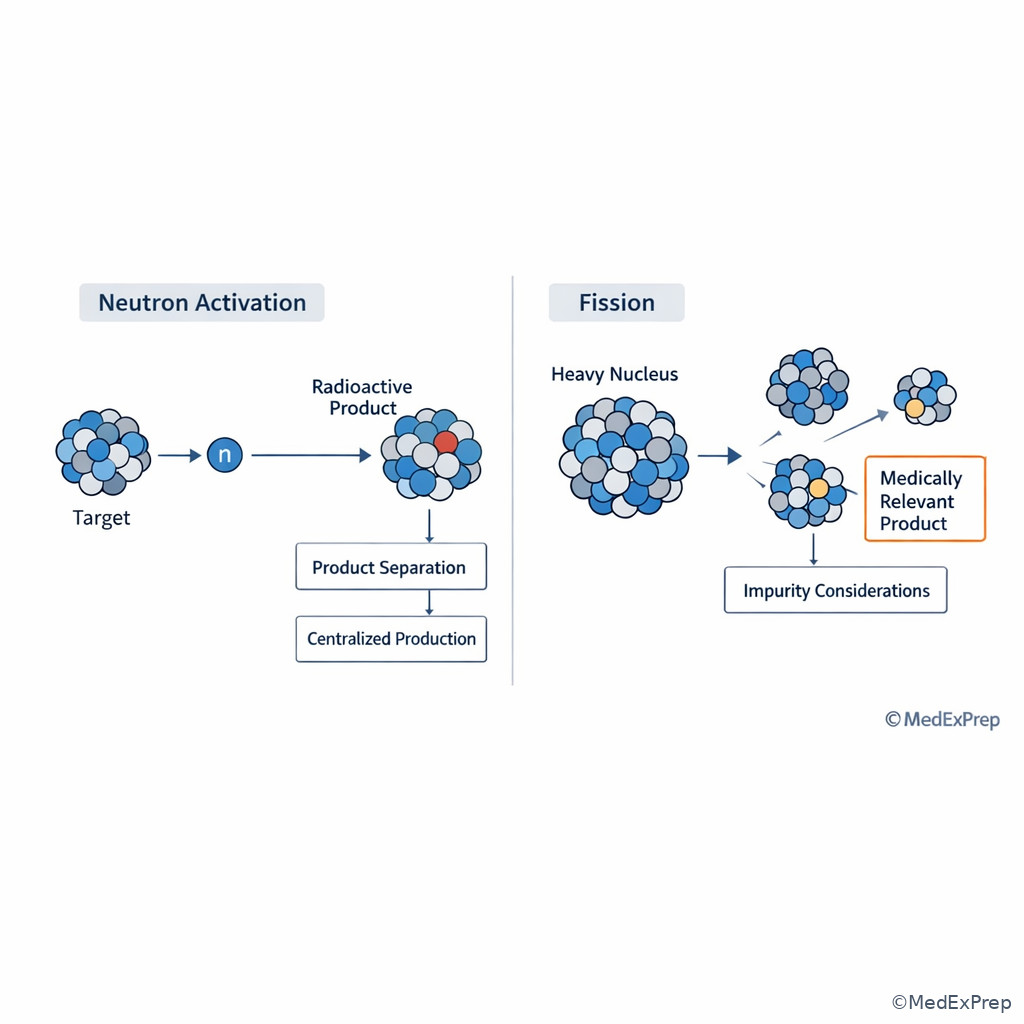
B Worked example
A 59-year-old woman with metastatic thyroid cancer, hypertension, and atrial fibrillation is scheduled for a radiopharmaceutical therapy-related consult. The nuclear pharmacist reviews inventory documentation showing that the radionuclide was obtained from centralized manufacture and that the raw source involved splitting a heavy nucleus. A distracting note in the chart mentions recent PET/CT scheduling for a different malignancy, making cyclotron seem plausible. Another tempting clue is that the product will ultimately be dispensed from the pharmacy in a patient-specific dose, which might incorrectly make a learner think “direct local production.”
Reasoning chain: Identify task: determine the production mechanism described. Extract key facts: centralized source; splitting of a heavy nucleus; no elution device, no charged-particle bombardment. Apply rule: splitting a heavy nucleus identifies fission, which is a reactor-based production route. Eliminate distractors: cyclotron requires charged-particle bombardment, not nuclear splitting. Generator requires parent-daughter elution at point of use. Verify: the correct takeaway is not treatment selection but recognition that source route may affect supply and impurity considerations.
C Exam trap
WHY IT IS TEMPTING: many learners know Mo-99 leads to Tc-99m and collapse all related stems into “generator.”
SINGLE CLUE THAT ELIMINATES IT: the stem asks about heavy nucleus splitting, which identifies the original production mechanism as fission in a reactor.
D Checkpoint
Question: Which stem clue most strongly supports reactor fission rather than neutron activation, cyclotron production, or generator availability?
- A stable target nucleus captures a neutron — tempting because it is reactor-based, but wrong because this describes neutron activation rather than fission.
- A daughter radionuclide is removed from a column before dispensing — tempting because it involves source access, but wrong because it describes generator use.
- A heavy nucleus is split and the desired radionuclide is separated from multiple products — correct because that is the defining pattern of fission.
- A proton beam strikes an enriched target — tempting because it is a real production method, but wrong because it describes cyclotron production.
Answer: C. A heavy nucleus is split and the desired radionuclide is separated from multiple products.
- The most common reactor clue for direct target irradiation is neutron activation.
- True or False: A generator daughter can originate from a reactor-produced parent upstream. True.
- Name the 2 main reactor-production patterns tested in basic BCNP review: activation and fission.
1.1.1.5 Cyclotron production: charged-particle bombardment and short-timeline logistics
A Explanation
The next decision conflict is cyclotron versus generator, especially for short-lived imaging radionuclides. The single resolving rule is this: if the radionuclide is made by bombarding a target with charged particles, it is cyclotron-produced. This matters because cyclotron products often have short half-lives, narrow distribution windows, and target-derived impurity considerations. In practice, the pharmacist should think not only “how was it made?” but also “what does that mean for calibration timing, product receipt, and release feasibility?” See Fig 3.
WHY THIS IS TESTED: many board stems are not really about nuclear physics; they are about whether a dose can be prepared, transported, and used on time. Cyclotron-produced radionuclides, especially PET radionuclides, make timing unforgiving. Delays in synthesis, QC, courier transport, or patient readiness can quickly convert an adequate activity into an unusable one. The source route also explains why local or regional manufacturing relationships matter operationally.
Choose cyclotron when the stem mentions proton bombardment, enriched targets, PET center manufacture, or same-day regional delivery. Reject cyclotron when the actionable clue is elution from a generator. Reject reactor when the focus is not neutron-based production. Source recognition sets up the upcoming lessons on half-life and emission type: production route tells you how the radionuclide appears in practice; decay mode and emission energy will later tell you how it behaves.
Exam takeaway: Cyclotron-produced radionuclides are identified by target bombardment and usually force tighter synthesis, QC, and transport timing.
flowchart LR
A[Enriched target] --> B[Charged-particle bombardment]
B --> C[Radionuclide produced]
C --> D[Chemical processing]
D --> E[QC and release]
E --> F[Rapid transport or on-site use]
F --> G[Short half-life increases timing pressure]
Exam takeaway: Associate cyclotron production with target bombardment, chemistry processing, and same-day dispensing pressure.
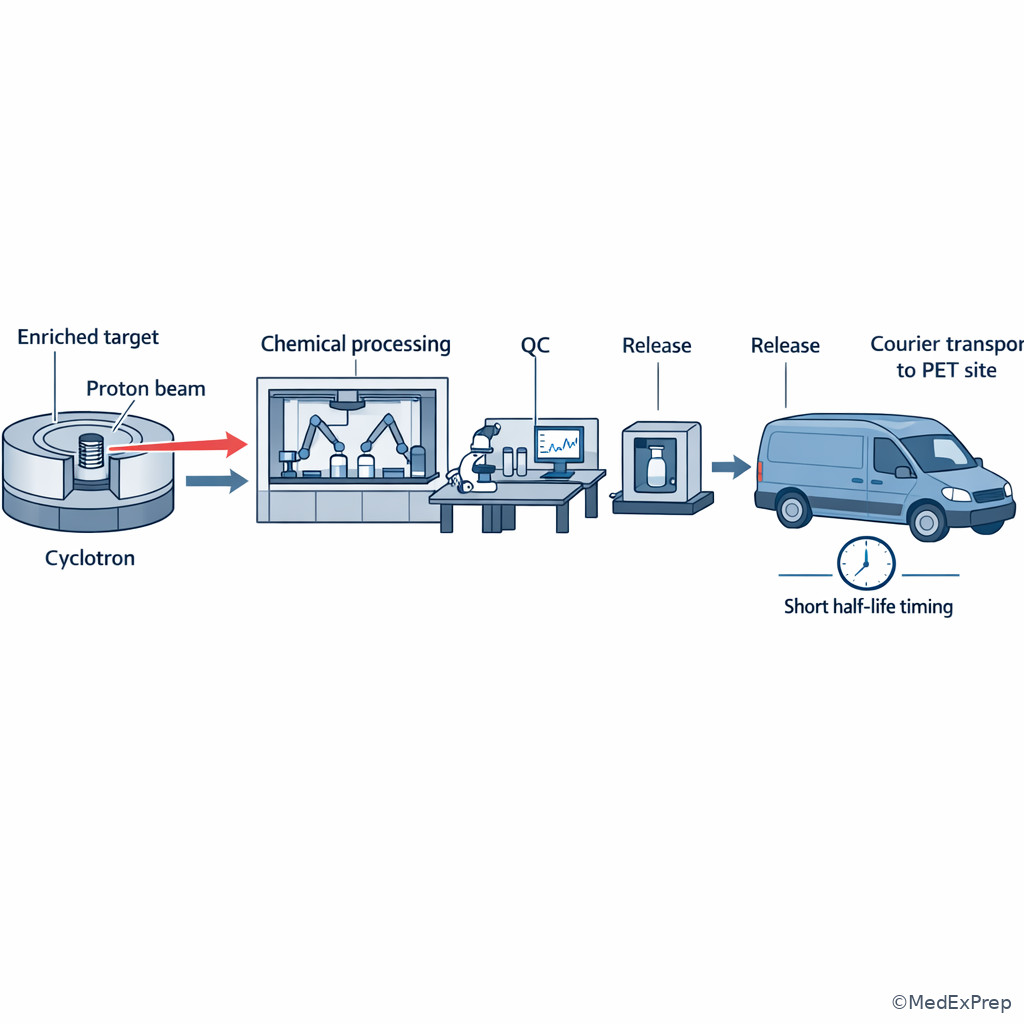
B Worked example
A 71-year-old man with lung cancer, chronic obstructive pulmonary disease, and obesity is scheduled for PET imaging. The nuclear pharmacist receives notice that the morning product was manufactured at a regional center after proton bombardment of an enriched target. A distracting chart detail notes mild anemia, which is not relevant to source identification. The courier reports a traffic delay, and the technologist asks whether the dose can still be used because “it was already assayed this morning.”
Reasoning chain: Identify task: determine what production route is implied and what operational consequence matters. Extract key facts: proton bombardment; enriched target; regional center manufacture; transport delay. Apply rule: this is cyclotron production, likely with meaningful decay over the transport interval. Eliminate distractors: generator is wrong because no parent-daughter elution is described. Reactor is wrong because no neutron irradiation or fission clue appears. Verify: source recognition tells the pharmacist to think about activity at administration time, not just at earlier assay. The safest action is not to promise adequacy based on the morning assay; it is to verify whether the dose remains suitable at the intended time.
C Exam trap
WHY IT IS TEMPTING: learners may anchor on the existence of a valid assay and forget that short-lived cyclotron products lose activity continuously.
SINGLE CLUE THAT ELIMINATES IT: the stem includes a transport delay, so the relevant question is activity at the intended administration time.
D Checkpoint
Question: A PET radiopharmaceutical is prepared from an enriched target after proton bombardment and then shipped to a nearby hospital. Which source-related concern is most important for the nuclear pharmacist to verify before release to the clinical team?
- Whether parent breakthrough testing from a generator was documented — tempting because breakthrough testing is a real QC issue, but wrong because the product is cyclotron-produced, not generator-eluted.
- Whether expected activity at administration time remains acceptable after transport delay — correct because short-lived cyclotron products are highly timing dependent.
- Whether the reactor target captured sufficient neutrons — tempting because production adequacy matters, but wrong because the source described is not reactor-based.
- Whether the daughter was allowed enough time to grow in after last elution — tempting because in-growth timing is important in generators, but wrong because no parent-daughter generator is involved.
Answer: B. Whether expected activity at administration time remains acceptable after transport delay.
1.1.1.6 Generator systems: why parent-daughter logic dominates pharmacy workflow
A Explanation
Generator questions are among the most practical in nuclear pharmacy because they directly affect daily preparation workflow. The decision conflict is use now versus wait, and release versus hold. The single finding that resolves many generator items is the relationship between parent decay, daughter in-growth, and elution timing. A generator provides repeated access to a short-lived daughter from a longer-lived parent. This solves supply problems for daughters that would be impractical to ship routinely from distant production. See Fig 4.
WHY THIS IS TESTED: generator logic sits at the intersection of production, half-life, QC, and release decisions. The pharmacist must recognize that a clinically useful daughter can be available on site even though the original parent came from elsewhere. The exam also likes the distinction between source category and downstream release criteria: knowing a product comes from a generator should immediately raise questions about elution schedule, expected yield, and parent breakthrough limits.
Choose generator as the governing framework when the stem mentions elution, parent-daughter pair, column, in-growth, or breakthrough. Reject a simplistic “always ready” assumption; daughters need time to regrow after elution. Reject source confusion: upstream reactor or accelerator manufacture of the parent does not change the pharmacy-facing workflow if the usable product is obtained by elution. Local protocols and manufacturer instructions vary, so the board-safe answer is to apply the governing principle and confirm specific procedural limits through authoritative references.
Exam takeaway: In generator systems, the practical question is not original manufacture but whether daughter in-growth, elution timing, and breakthrough control support safe release.
flowchart TD
A[Longer-lived parent on column] --> B[Daughter grows in over time]
B --> C[Elution performed]
C --> D[Daughter collected for preparation]
D --> E[Assess yield and breakthrough]
E --> F[Release if specifications met]
C --> G[Immediate re-elution gives low daughter yield]
Exam takeaway: Picture the parent fixed on the column and the daughter being eluted to understand why timing and breakthrough checks matter.
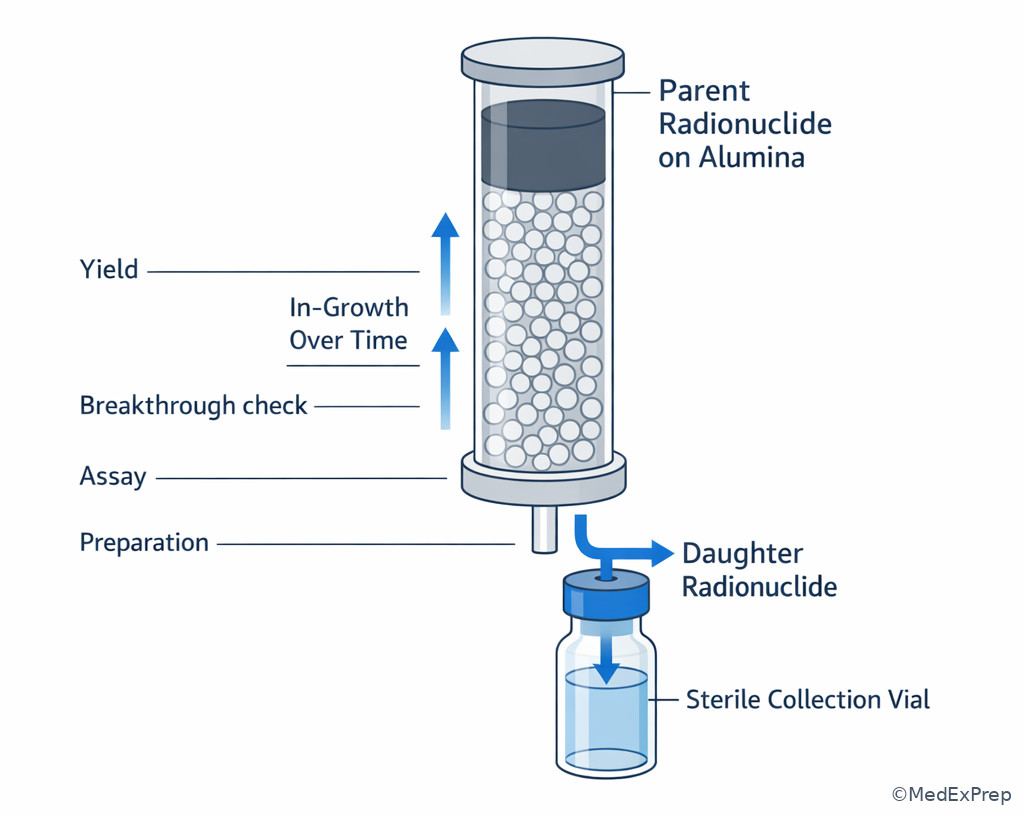
B Worked example
A 64-year-old woman with obesity, heart failure, and rheumatoid arthritis is scheduled for a same-morning nuclear study. The generator was eluted earlier for another patient, and a technologist asks the pharmacist to “just elute again now” because the procedure room is open. A distracting lab shows mildly elevated alkaline phosphatase, which is unrelated. Another tempting clue is that the parent radionuclide was originally reactor-produced, which might mislead a learner into focusing on reactor source instead of current generator behavior.
Reasoning chain: Identify task: decide what production-related principle governs immediate product availability. Extract key facts: recent elution; need for a second same-morning dose; generator source; no issue yet about diagnosis or protocol. Apply rule: daughter yield depends on in-growth after prior elution, so an immediate repeat elution may produce less daughter activity than expected. Eliminate distractors: reactor production of the parent is background knowledge, not the operational decision point. Cyclotron timing logic is wrong because the product is not arriving from target bombardment that day. Verify: the correct pharmacist response is to assess expected yield and suitability before promising release.
C Exam trap
WHY IT IS TEMPTING: the physical device is still present, so learners assume availability equals full yield.
SINGLE CLUE THAT ELIMINATES IT: the stem states the generator was already eluted earlier, so daughter in-growth time becomes the limiting factor.
D Checkpoint
Question: A generator was eluted one hour ago, and the clinical team requests another patient-specific dose immediately. Which is the most appropriate pharmacist interpretation of this source-related issue?
- The product should be treated like a cyclotron shipment, so transport time is the primary concern — tempting because short half-life always raises timing issues, but wrong because the key variable here is daughter regrowth after elution.
- The original parent production route determines current daughter yield more than elution timing — tempting because source history matters, but wrong because current availability depends on generator kinetics.
- A recent prior elution may reduce immediately available daughter activity, so suitability must be reassessed before release — correct because generator in-growth timing governs usable yield.
- Breakthrough risk is impossible after a second elution — tempting because fresh elution may feel cleaner, but wrong because breakthrough control remains relevant regardless of timing.
Answer: C. A recent prior elution may reduce immediately available daughter activity, so suitability must be reassessed before release.
- The most common reason generators are used is to provide short-lived daughters on site.
- True or False: Parent source history is usually the best predictor of immediate daughter yield after a recent elution. False.
- Name the 3 key generator clues in a stem: parent-daughter pair, elution, breakthrough.
1.1.1.7 Integrating production method with QC, procurement, and release decisions
A Explanation
The final foundational integration step is to answer the question the BCNP exam actually cares about: What does the production route make you do differently as the pharmacist? The single resolving rule is to connect each source with its most likely operational risk. Reactor products push you to think about centralized production source, route-specific impurity concerns, and supply dependency. Cyclotron products push you to think about timing pressure from manufacture through administration. Generator products push you to think about elution schedule, in-growth, and parent breakthrough. See Fig 5.
WHY THIS IS TESTED: candidates often know definitions but miss the release decision. The board exam rewards source-to-action thinking: source clue -> dominant risk -> safest pharmacist step. If a stem includes a source inconsistency, missing documentation, impossible timing, or failed source-specific QC, the correct answer is usually hold or clarify rather than proceed for convenience.
Choose release only when the product meets source-appropriate criteria and timing remains feasible. Reject release when a generator product lacks breakthrough documentation, when a cyclotron product may no longer provide required activity at administration time, or when source labeling/documentation does not align with the expected production pathway. This is still within pharmacist scope: you are not selecting the physician's imaging protocol or interpreting the scan; you are determining whether the product is suitable to dispense safely and compliantly.
Exam takeaway: Link each production method to its dominant pharmacist concern—reactor to source route, cyclotron to timing, and generator to elution plus breakthrough.
flowchart TD
A[Identify production method] --> B{Source type}
B -->|Reactor| C[Check source route and expected impurity context]
B -->|Cyclotron| D[Check timing from production to administration]
B -->|Generator| E[Check elution timing, yield, and breakthrough]
C --> F[Clarify documentation if inconsistent]
D --> G[Recalculate or verify usable activity]
E --> H[Hold if breakthrough or regrowth issues]
F --> I[Release only if source-appropriate criteria met]
G --> I
H --> I Exam takeaway: Remember the dominant release risk by pairing each production method with one operational checkpoint.
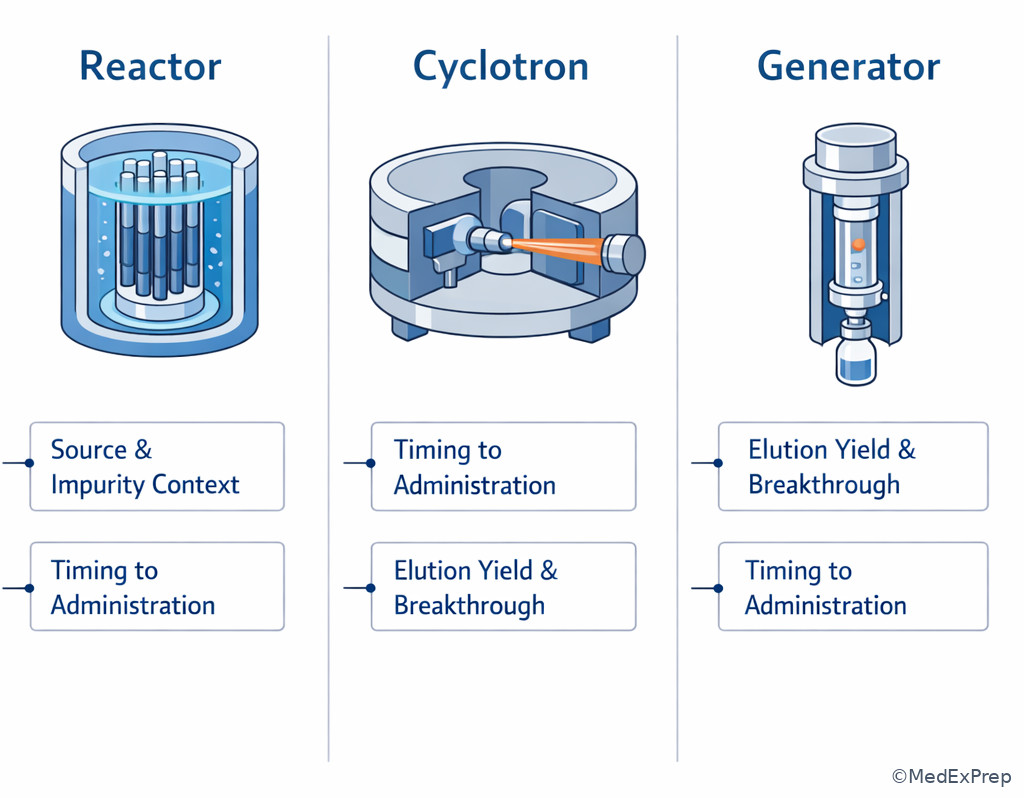
B Worked example
A 74-year-old man with prostate cancer, chronic kidney disease, and poorly controlled hypertension has a scheduled radiopharmaceutical appointment. The pharmacy receives a product record showing cyclotron manufacture, but the attached internal worksheet includes a generator breakthrough checkbox instead of transport timing verification. A distracting note states the patient recently had a bone scan, which does not solve the release question. A technologist argues that all radioactive products use “the same QC logic,” making release seem acceptable.
Reasoning chain: Identify task: determine the most appropriate pharmacist action when source-specific documentation does not match the production route. Extract key facts: cyclotron-manufactured product; generator-focused documentation field; missing timing verification; pressure to proceed. Apply rule: QC and release checks must match the source-related risk. For cyclotron products, timing to administration is critical; generator breakthrough documentation does not substitute for that review. Eliminate distractors: it is tempting to release because some QC element exists, but the wrong QC element does not verify the correct risk. Verify: safest pharmacist action is hold and clarify source-appropriate release documentation before dispensing.
C Exam trap
WHY IT IS TEMPTING: under operational pressure, learners may treat any signed form as evidence of adequacy.
SINGLE CLUE THAT ELIMINATES IT: the documentation is for a generator-specific check while the product is cyclotron-produced.
D Checkpoint
Question: A product record identifies cyclotron manufacture, but the only source-related QC documentation available is a generator parent-breakthrough form. What is the most appropriate pharmacist action?
- Release because any source-related QC form is sufficient for radioactive products — tempting because it avoids delay, but wrong because QC must address the actual source-dependent risk.
- Reclassify the product as reactor-derived because cyclotron and generator documentation are interchangeable — tempting because learners may confuse upstream and downstream source categories, but wrong because the record explicitly identifies cyclotron manufacture.
- Hold and clarify, because documentation does not match the production-related release concern — correct because source-specific adequacy has not been established.
- Ignore the source mismatch and rely only on patient weight and indication — tempting because patient-specific factors are important, but wrong because product suitability must be established before clinical use.
Answer: C. Hold and clarify, because documentation does not match the production-related release concern.
Exam Traps & Differentiators
Most common wrong answer and why: choosing reactor whenever the learner recognizes that the parent ultimately came from reactor production. That is tempting because it is scientifically true in many cases. It is wrong when the actual practice question is about a generator daughter being eluted on site or a cyclotron product being delivered same day.
| Looks similar | But isn't | Why confused | Single discriminator |
|---|---|---|---|
| Reactor-produced parent | Generator-supplied daughter at pharmacy | Learners focus on origin instead of point-of-use workflow | Elution/column language means generator for the dispensing decision |
| Cyclotron PET product | Generator daughter | Both may be short-lived | Target bombardment versus parent-daughter elution |
| Reactor activation | Reactor fission | Both are reactor-based | Neutron capture versus heavy nucleus splitting |
| Any QC form | Source-appropriate QC | Paperwork presence feels reassuring | The check must match the source-specific risk |
| Earlier assay value | Usable activity at administration time | An assay exists, so learners stop thinking | Timing matters most for short-lived cyclotron products |
If the stem says ___, think ___
- If the stem says proton bombardment of enriched target, think cyclotron production.
- If the stem says daughter eluted from column, think generator workflow.
- If the stem says heavy nucleus splitting, think reactor fission.
- If the stem says stable target exposed to neutrons, think reactor activation.
- If the stem says transport delay for same-day product, think verify activity at administration time.
- If the stem says recent generator elution, think daughter regrowth may limit immediate yield.
Related confusions will recur in upcoming topics. For example, in Half-Life And Decay Modes, the trap will shift from “where did it come from?” to “how fast is it disappearing?” In Emission Energy And Detection, a different confusable pair appears: source route versus emission suitability. Do not use production method as a substitute for emission knowledge; they answer different questions.
Tables
| Key fact/value type | High-yield point | Why it matters on BCNP-style items |
|---|---|---|
| Reactor activation | Neutron capture by target | Distinguishes from fission and cyclotron stems |
| Reactor fission | Heavy nucleus splits into multiple products | Explains classic parent supply questions and separation concepts |
| Cyclotron | Charged-particle bombardment of target | Flags short-timeline manufacture and delivery logic |
| Generator | Daughter eluted from longer-lived parent | Flags in-growth, elution schedule, and breakthrough checks |
| Point-of-use clue | Column/eluate language | Usually outweighs upstream source history for dispensing questions |
| Timing clue | Transport delay after regional manufacture | Usually signals cyclotron product decay concern |
| Production type | Typical exam clue | Dominant pharmacist concern | Most likely wrong assumption |
|---|---|---|---|
| Reactor | Neutrons, activation, fission | Source route and impurity context | Confusing reactor source with generator use |
| Cyclotron | Proton beam, enriched target, PET center | Timing from manufacture to administration | Assuming earlier assay alone guarantees usability |
| Generator | Parent-daughter, elution, breakthrough | Regrowth, yield, and breakthrough control | Assuming repeated immediate elution gives full yield |
| Accelerator other | Technical beam wording without classic cyclotron clues | Recognize category, then confirm product-specific handling | Overcommitting beyond the information provided |
| Scenario pattern | Most likely source classification | Best initial pharmacist action |
|---|---|---|
| Regional manufacturing center, courier delay, morning assay documented | Cyclotron | Verify activity at intended administration time before release |
| Column elution, parent breakthrough record pending | Generator | Hold until source-specific breakthrough requirement is addressed |
| Heavy nucleus splitting described in source certificate | Reactor fission | Recognize fission route; ensure documentation aligns with expected source |
| Stable target irradiated with neutrons | Reactor activation | Identify activation route; do not misclassify as cyclotron |
| Second generator elution requested shortly after first | Generator | Reassess daughter availability and suitability before promising dose |
| Generator QC form attached to non-generator product | Documentation mismatch | Hold and clarify because source-specific release support is inadequate |
Algorithm / Approach
Exam takeaway: On production-method questions, classify the source first, then check the one operational risk that most often determines release versus hold.
Use this algorithm on virtually every production-method item. Source-first thinking prevents a common exam error: jumping directly to a clinical or operational answer before identifying the underlying physical pathway. See Fig 6.
Rapid Review
- Reactor activation → neutron capture is the discriminator, not elution.
- Reactor fission → heavy nucleus splitting separates it from all other source routes.
- Cyclotron → charged-particle bombardment is the telltale phrase.
- Generator → parent-daughter elution beats upstream origin for workflow questions.
- Cyclotron logistics → earlier assay does not equal acceptable activity later.
- Generator yield → recent elution lowers immediate daughter availability.
- Generator QC → breakthrough concern is a source-specific release issue.
- Reactor versus generator → one may explain origin, the other current access.
- Regional same-day delivery → usually points toward cyclotron timing pressure.
- Column language → almost never belongs to cyclotron stems.
- Neutron wording → rules out cyclotron even if the product is familiar.
- QC paperwork → only helpful if it matches the actual source-dependent risk.
- Pharmacist scope → classify source, verify suitability, then hold or release appropriately.
Self-check quiz
1. A nuclear pharmacist reviews a source note for sodium fluoride F 18 injection, 10 mCi IV once for PET imaging, scheduled for same-day delivery from a regional production site. The note states the radionuclide was created by proton bombardment of an enriched target. Which production method best fits this product?
- Reactor neutron activation
- Cyclotron charged-particle production
- Generator daughter elution
- Reactor fission separation
2. A nuclear pharmacist verifies a technetium-99m sestamibi preparation, 25 mCi IV once, after a dose was drawn from an eluate obtained from a parent column earlier that morning. The patient has diabetes and hypertension, and a fasting-status note is present but does not determine source category. Which production source category is most relevant to this dispensing workflow?
- Generator system
- Cyclotron direct target production
- Reactor fission of the clinical daughter at point of use
- Linear accelerator-only manufacture with no parent-daughter relationship
3. A 68-year-old man with lymphoma, atrial fibrillation, and stage 3 chronic kidney disease is scheduled for fluorodeoxyglucose F 18 injection, 12 mCi IV once. The product was assayed at the regional PET center, but courier delay will push administration 90 minutes later than planned. The technologist asks for the most appropriate pharmacist next step. Which is best?
- Release immediately because cyclotron products do not require timing reassessment once assayed
- Hold and verify expected activity at the intended administration time before release
- Convert the source classification to generator because short half-life is the main issue
- Ignore the delay if sterility documentation is present
4. A 61-year-old woman with coronary artery disease and obesity is ordered technetium-99m tetrofosmin, 30 mCi IV once. The generator was eluted 45 minutes ago for another patient, and the imaging team requests another elution now. A mildly elevated glucose in the chart is distracting. Which source-based interpretation is most appropriate?
- The second elution should provide full daughter activity because the parent remains on the column
- The earlier elution is irrelevant because generator products behave like reactor stock
- Recent elution may reduce immediately available daughter yield, so suitability must be reassessed
- Generator source eliminates the need for parent breakthrough considerations
5. A nuclear pharmacist reviews lutetium Lu 177 dotatate documentation for a scheduled dose, 200 mCi IV once per authorized user order. The certificate describes neutron irradiation of target material rather than heavy nucleus splitting. Which production description is most accurate?
- Reactor neutron activation
- Reactor fission
- Cyclotron proton bombardment
- Generator daughter elution
6. A 72-year-old man with metastatic prostate cancer, chronic kidney disease, and anemia is scheduled for a radiopharmaceutical dose, 7.4 GBq IV once. The product record identifies cyclotron manufacture, but the attached release packet only contains a generator parent-breakthrough worksheet and no timing verification. A nurse asks whether the dose can be sent because “the paperwork is signed.” Which is the most appropriate pharmacist action?
- Release, because any source-related QC form is adequate when the dose has been assayed
- Hold and clarify, because the documentation does not match the production-related release risk
- Reclassify the product as generator-supplied and document a verbal correction
- Send the dose if the authorized user is available, since source mismatch is a physician issue
7. A 66-year-old woman with differentiated thyroid cancer, hypertension, and osteoarthritis is scheduled for sodium iodide I 131 capsules, 100 mCi orally once. The source discussion in the pharmacy notes mentions a heavy nucleus being split to generate the desired radionuclide upstream. Another note references a previous same-day PET study, creating distracting cyclotron language. Which production pathway should the pharmacist identify from the source note?
- Reactor fission
- Reactor neutron activation
- Cyclotron bombardment
- Generator elution
8. A 70-year-old man with Parkinson disease, coronary artery disease, and chronic constipation is scheduled for a generator-derived diagnostic dose, 5 mCi IV once. The source worksheet correctly lists a parent-daughter system, but the dose was drawn after an unexpectedly low-yield elution shortly after a prior use. A staff member argues that because the parent originally came from reactor production, the current low yield should not delay release. Which statement is most appropriate?
- The staff member is correct because original reactor source overrides current elution timing
- The dose should be released if target bombardment records from the producer are complete
- Current generator behavior determines immediate daughter availability, so low-yield elution requires reassessment before release
- Low yield affects only image interpretation, not pharmacist dispensing suitability
Answer key
1.1.1.8 Question 1
Correct answer: B. Cyclotron charged-particle production
- A. Reactor neutron activation — Tempting because many medical radionuclides come from reactors, but incorrect here because the single discriminating clue is proton bombardment of an enriched target, which defines cyclotron production. Authoritative source logic from nuclear pharmacy texts and PET drug labeling supports target bombardment as cyclotron manufacture.
- B. Cyclotron charged-particle production — Correct because the PK/PD-relevant operational implication is same-day use of a short-lived PET radionuclide created by charged-particle bombardment. The discriminating clue is proton bombardment. This is consistent with standard nuclear pharmacy references and FDA labeling for F-18 products.
- C. Generator daughter elution — Tempting because short-lived products can make learners think of generators, but incorrect because no parent-daughter column or elution is described. The eliminating fact is absence of elution language.
- D. Reactor fission separation — Tempting because centralized production can suggest reactor origin, but incorrect because fission requires heavy nucleus splitting rather than charged-particle bombardment. The discriminating clue is enriched target plus proton bombardment.
1.1.1.9 Question 2
Correct answer: A. Generator system
- A. Generator system — Correct because the medication context involves Tc-99m prepared from an eluate obtained from a parent column. That exact phrase is the discriminating clue. Standard nuclear pharmacy references describe Tc-99m access through parent-daughter generator elution.
- B. Cyclotron direct target production — Tempting because many imaging agents are associated with advanced production methods, but incorrect because the stem centers on eluate from a parent column, not bombardment.
- C. Reactor fission of the clinical daughter at point of use — Tempting because the upstream parent may be tied to reactor production, but incorrect because the pharmacy-facing workflow is generator access, not point-of-use fission.
- D. Linear accelerator-only manufacture with no parent-daughter relationship — Tempting because accelerator language sounds technical, but incorrect because the stem explicitly states a parent column.
1.1.1.10 Question 3
Correct answer: B. Hold and verify expected activity at the intended administration time before release
- A. Release immediately because cyclotron products do not require timing reassessment once assayed — Tempting because an assay was completed, but incorrect because short-lived cyclotron products continue to decay after assay. The single clue is 90-minute courier delay. Standard PET handling principles and labeling confirm that timing to administration matters.
- B. Hold and verify expected activity at the intended administration time before release — Correct because the governing pharmacologic/physical principle is decay over time. The discriminating clue is the delay before administration, which requires reassessment of usable activity.
- C. Convert the source classification to generator because short half-life is the main issue — Tempting because both generators and PET products involve timing, but incorrect because short half-life does not redefine the production source. The eliminating fact is regional PET center manufacture after bombardment.
- D. Ignore the delay if sterility documentation is present — Tempting because sterility is necessary for release, but incorrect because sterility documentation does not answer the timing adequacy question. The discriminating clue is transport delay.
1.1.1.11 Question 4
Correct answer: C. Recent elution may reduce immediately available daughter yield, so suitability must be reassessed
- A. The second elution should provide full daughter activity because the parent remains on the column — Tempting because the generator is still present, but incorrect because daughter activity requires regrowth after prior elution. The single clue is generator was eluted 45 minutes ago.
- B. The earlier elution is irrelevant because generator products behave like reactor stock — Tempting because reactor origin may be remembered, but incorrect because current yield depends on generator in-growth, not stock-like static inventory.
- C. Recent elution may reduce immediately available daughter yield, so suitability must be reassessed — Correct because the pharmacologic/physical rule is that daughter availability depends on time since prior elution. Standard generator practice confirms this source-dependent behavior.
- D. Generator source eliminates the need for parent breakthrough considerations — Tempting because the question focuses on yield, but incorrect because breakthrough remains relevant in generator systems. The eliminating fact is that generator source creates, not removes, breakthrough concerns.
1.1.1.12 Question 5
Correct answer: A. Reactor neutron activation
- A. Reactor neutron activation — Correct because the stem specifies neutron irradiation of target material, which is the defining clue for activation. Nuclear pharmacy references identify neutron capture/irradiation as activation-based reactor production.
- B. Reactor fission — Tempting because it is also reactor-based, but incorrect because fission requires heavy nucleus splitting, which the stem explicitly contrasts against.
- C. Cyclotron proton bombardment — Tempting because bombardment is a familiar production word, but incorrect because the stem specifies neutrons, not charged particles.
- D. Generator daughter elution — Tempting because many therapeutic radionuclide questions involve sourcing logistics, but incorrect because no parent-daughter column or elution is described.
1.1.1.13 Question 6
Correct answer: B. Hold and clarify, because the documentation does not match the production-related release risk
- A. Release, because any source-related QC form is adequate when the dose has been assayed — Tempting because signed documentation and assay data feel reassuring, but incorrect because the single clue is a generator worksheet attached to a cyclotron product. Source-specific risk has not been addressed. Authoritative practice standards require appropriate, not generic, release support.
- B. Hold and clarify, because the documentation does not match the production-related release risk — Correct because cyclotron production raises timing and route-appropriate release concerns, not generator breakthrough documentation alone. The discriminating clue is source-document mismatch.
- C. Reclassify the product as generator-supplied and document a verbal correction — Tempting because paperwork problems sometimes reflect clerical error, but incorrect because the pharmacist should not invent a new source classification without evidence. The eliminating fact is that the record explicitly says cyclotron manufacture.
- D. Send the dose if the authorized user is available, since source mismatch is a physician issue — Tempting because clinical urgency may push escalation to the physician, but incorrect because product release suitability is within pharmacist scope. The discriminating clue is that the problem is release documentation, not physician protocol selection.
1.1.1.14 Question 7
Correct answer: A. Reactor fission
- A. Reactor fission — Correct because the stem identifies a heavy nucleus being split. That is the exact discriminator for fission. Standard nuclear pharmacy texts use this wording to distinguish fission from activation.
- B. Reactor neutron activation — Tempting because the product is reactor-associated, but incorrect because activation means neutron capture, not splitting of a heavy nucleus. The discriminating clue is split.
- C. Cyclotron bombardment — Tempting because the chart contains PET language, but incorrect because that is explicit noise unrelated to this source note. The eliminating fact is upstream heavy nucleus splitting.
- D. Generator elution — Tempting because some radionuclides are used via parent-daughter systems, but incorrect because no column or daughter elution is described. The discriminating clue remains fission wording.
1.1.1.15 Question 8
Correct answer: C. Current generator behavior determines immediate daughter availability, so low-yield elution requires reassessment before release
- A. The staff member is correct because original reactor source overrides current elution timing — Tempting because upstream origin is scientifically true, but incorrect because the single clue is unexpectedly low-yield elution shortly after a prior use. That makes current generator behavior the relevant issue.
- B. The dose should be released if target bombardment records from the producer are complete — Tempting because complete manufacture records sound sufficient, but incorrect because target bombardment is irrelevant to a generator-derived product's current availability. The eliminating fact is parent-daughter system.
- C. Current generator behavior determines immediate daughter availability, so low-yield elution requires reassessment before release — Correct because the governing rule is daughter regrowth and yield after elution. Standard generator practice makes this the decisive factor for suitability.
- D. Low yield affects only image interpretation, not pharmacist dispensing suitability — Tempting because clinicians interpret image quality, but incorrect because insufficient activity directly affects product suitability for release. The discriminating clue is low-yield elution before dispensing.
Keep going with the full BCNP Prep Course (BCNP)
You just studied the way members do, in the same lesson interface. Full access unlocks every lesson, the question bank and flashcards for a full year.
One payment · 1 year of access · No auto-renewal