1.1.1 - Practice Task Identification
Practice Task Identification
What you'll learn
- Assessment, Problem Identification, and Intervention Planning → Teachable subskill: Identify the practice task hidden inside an exam stem.
- Professional Relationships, Values, and Ethics → Teachable subskill: Distinguish ethical clarification, assessment, intervention, consultation, and documentation tasks.
- Crisis, Safety, Abuse, Neglect, and Risk → Teachable subskill: Recognize when the practice task shifts immediately to safety action.
- Documentation, Evaluation, and Practice Management → Teachable subskill: Identify when the best answer is to document, reassess, consult, or coordinate care.
- Direct and Indirect Practice → Teachable subskill: Match common stem verbs to the correct category of social work action.
Blueprint mapping
- Assessment, Problem Identification, and Intervention Planning → identifying the immediate task in a practice scenario
- Professional Relationships, Values, and Ethics → selecting the ethically appropriate next step within role
- Crisis, Safety, Abuse, Neglect, and Risk → prioritizing urgent protective action over routine engagement
- Documentation, Evaluation, and Practice Management → consultation, documentation, and reassessment decisions
Why it matters
- Many ASWB Masters questions are not testing obscure content; they are testing whether you can identify the task before acting.
- The same facts can produce different correct answers depending on whether the stem asks for first assessment, priority response, best next step, or documentation.
- Wrong answers are often clinically reasonable but occur too early, too late, or outside role.
- When you identify the task correctly, you eliminate distractors faster and avoid the common trap of jumping to intervention before sufficient assessment.
Exam takeaway: Read the question stem for the action category before deciding what social work response is best.
flowchart TD
A[Read the stem] --> B{What is being asked?}
B -->|Best next step| C[Identify immediate task]
B -->|Priority response| D[Screen for safety or legal duty]
B -->|Most appropriate initial action| E[Choose assessment before intervention if no urgency]
B -->|Most important to monitor| F[Think follow-up, documentation, reassessment]
C --> G[Match answer to role and timing]
D --> G
E --> G
F --> G
Use this map on nearly every question. See Fig 1.
Exam takeaway: If no immediate danger is present, the exam usually rewards clarification and assessment before intervention.
flowchart TD
A[Client presents with problem] --> B{Immediate danger, abuse, or acute risk?}
B -->|Yes| C[Take safety-focused or protective action]
B -->|No| D{Do you have enough facts to act?}
D -->|No| E[Clarify timeline, severity, supports, functioning]
D -->|Yes| F[Choose intervention, referral, or planning step]
E --> G[Then reassess best next action]
F --> G
This distinction drives a large share of exam items. See Fig 2.
Exam takeaway: Visually separating task words, risk clues, and setting clues prevents premature action on exam questions.
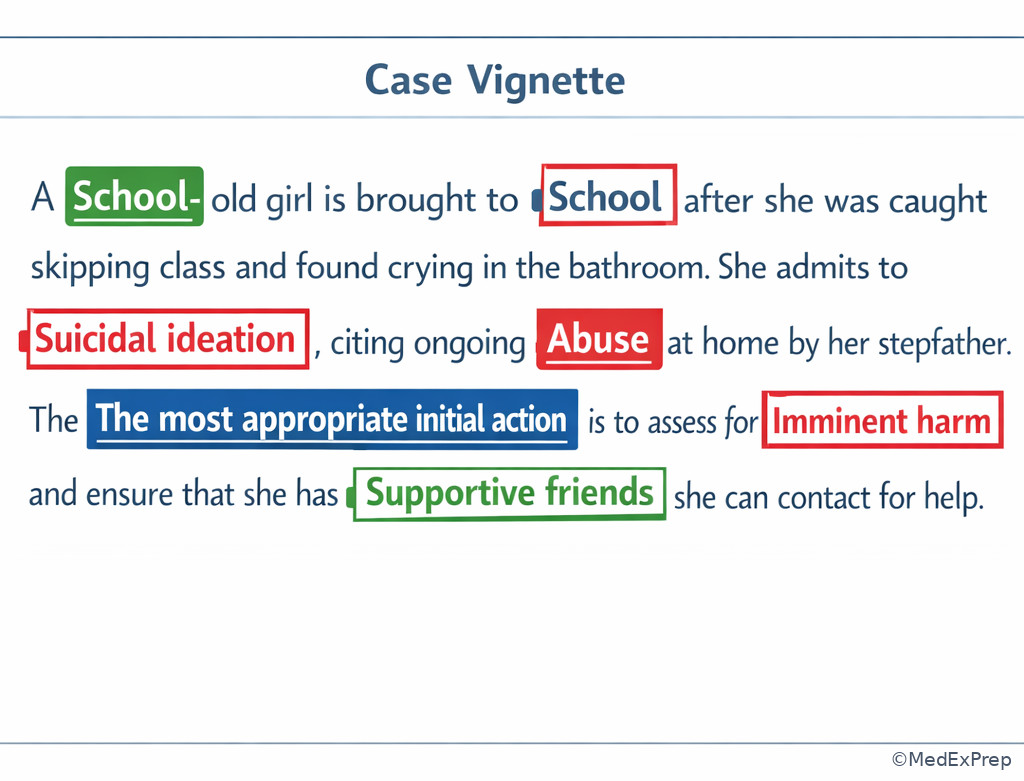
Exam takeaway: Sort answer choices into assess, intervene, protect, consult, refer, or document before picking the best one.
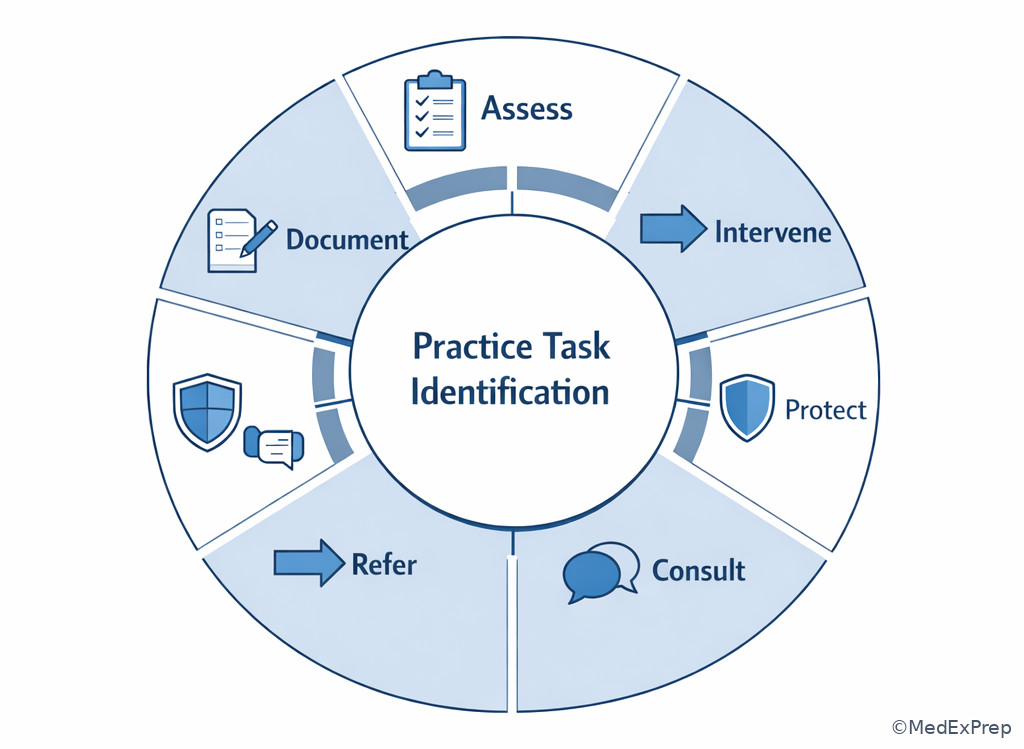
Key Terms & Must-Know Facts
1.1.1.1 Key terms
- Practice task: The specific kind of action the question is asking you to take.
- Best next step: The single most appropriate action now, not eventually.
- Initial action: The first response before later interventions.
- Priority response: The action that addresses the greatest immediate risk or obligation.
- Assessment: Gathering and clarifying biopsychosocial, functional, environmental, and risk information.
- Intervention: A purposeful social work action after sufficient assessment or when urgency requires action.
- Safety-first sequencing: Immediate danger overrides routine rapport building or resource discussion.
- Within scope: Consistent with master's-level social work role, agency policy, supervision, and law.
- Consultation: Seeking supervisory or interdisciplinary guidance when uncertainty, risk, or scope limits exist.
- Referral: Linking the client to a service or provider better matched to the identified need.
- Documentation: Recording observations, decisions, actions, rationale, and client response.
- Collateral information: Information from records, family, school, providers, or others when appropriate and permitted.
- Mandated reporting: Required protective reporting when abuse or neglect is suspected under applicable law.
- Least restrictive action: The safest effective response that respects client rights and self-determination.
1.1.1.2 Must-know facts
- If the stem includes imminent safety risk, the practice task is usually protective action, not extended exploration.
- If there is no immediate danger and facts are incomplete, the practice task is usually assessment or clarification.
- The best answer must fit both the task and the timing.
- Many wrong answers are correct actions for the wrong provider or the wrong stage.
- “Most appropriate” usually means best among plausible options, not globally perfect.
- On ASWB-style questions, do not exceed master's-level scope; consult, refer, collaborate, or escalate when needed.
- Client self-determination matters, but it does not override immediate safety duties or mandated reporting requirements.
- Documentation is often the right answer after a significant clinical or ethical action, but rarely before a safety response.
| Common stem phrase | Likely practice task | What to think first |
|---|---|---|
| Most appropriate initial action | Assessment or safety triage | Do I need more facts, or is there immediate danger? |
| Best next step | Sequencing decision | What has already been done? |
| Priority response | Safety/legal/ethical duty | What cannot wait? |
| Most important to clarify | Focused assessment | Which missing fact changes action? |
| Most appropriate intervention | Action planning | Has assessment already established the problem? |
| Requires immediate consultation | Supervisory or interdisciplinary escalation | Am I at a scope, safety, or policy threshold? |
| Most important to document | Record-keeping focus | What observation/action supports continuity and accountability? |
Core content
1.1.1.3 Foundational task categories: what kind of action is the stem testing?
A Explanation
The first job in any ASWB Masters item is to identify the category of task. The exam does not only test whether you know a concept; it tests whether you know what type of response belongs right now. Your decision conflict is usually: Should I assess, intervene, protect, consult, refer, or document? The single rule that resolves this is: match the answer choice to the task language in the stem before judging its content quality.
For example, if the stem asks for the most appropriate initial action, an answer that launches full treatment planning may be too advanced, even if it sounds caring and clinically thoughtful. If the stem asks for the priority response, an answer about building rapport may be too slow when risk is present. WHY THIS IS TESTED: the exam wants to see whether you can distinguish type of response from content knowledge.
Choose assessment when there is no urgent threat and a missing fact would change your plan. Choose intervention when the problem is sufficiently identified. Choose protection when immediate harm, abuse, neglect, suicidality, or violence risk is present. Choose consultation when scope, ethics, or policy uncertainty is the central issue. Choose documentation when the question explicitly focuses on record quality or follow-up accountability.
B Worked example
A 32-year-old client in an outpatient behavioral health program says, “Nothing is working anymore,” after losing housing. The client has diabetes, chronic pain, and a recent breakup. The chart notes two missed appointments and a prior hospitalization for depression three years ago. Today the client is tearful but cooperative and says, “I’m tired of everything.” A tempting clue is the history of hospitalization, which may push you toward immediate emergency referral. The stem asks: What is the most appropriate initial action by the social worker?
Identify task: “Initial action” signals first step, not full intervention plan. Extract key facts: distress is present, but there is not yet a direct statement of suicidal intent, plan, or imminent danger. Housing loss is acute; facts are incomplete. Apply rule: when risk is possible but not yet established, the immediate task is focused assessment. Eliminate distractors: arranging long-term housing services is premature; encouraging a support group may be helpful later; calling emergency services is too early without evidence of imminent danger. Verify: the best answer is to assess suicidality, timing, severity of hopelessness, supports, and immediate safety.
C Exam trap
D Checkpoint
Question: A social worker in a community clinic meets a 46-year-old client with hypertension and recent job loss who says, “My family would be better off without me.” The client also complains about insurance problems and asks for rent help. What is the most appropriate next step?
- Provide information on emergency rental assistance programs.
- Conduct a focused suicide risk assessment.
- Ask the client to complete a financial hardship application.
- Schedule the client for a support group next week.
Answer: B
- A: Tempting because job loss and rent concerns are immediate stressors; wrong because the self-harm statement changes the task to safety assessment first.
- B: Tempting because it may feel more intrusive; right because the statement suggests possible suicidal ideation and requires clarification before routine services.
- C: Tempting because paperwork seems like a practical first clinic step; wrong because administrative action is lower priority than possible imminent risk.
- D: Tempting because social support is protective; wrong because delayed intervention without present risk assessment skips the urgent task.
1.1.1.4 Sequencing: assessment before intervention unless risk changes the order
A Explanation
The most tested conflict in foundational social work items is assessment versus intervention. Students often lose points because they choose a compassionate intervention too early. The governing rule is simple: when there is no immediate danger and essential facts are missing, assess before acting. The exception is equally important: when there is imminent risk, abuse/neglect concern, or another urgent protective need, act on safety first.
This means you should ask: What fact is missing that would meaningfully change my next step? If the answer is severity, timeline, intent, supports, functioning, client preference, or decision-making ability, the likely task is further assessment. If the answer is nothing important because the problem is already established, then intervention may be appropriate. WHY THIS IS TESTED: many distractors are proper interventions, but the stem withholds one critical missing fact that makes clarification the better answer.
On social work exams, this often appears as a client reporting conflict, grief, refusal, substance use, school difficulty, or caregiver strain. The wrong answer jumps to treatment planning, referral, psychoeducation, or family meeting. The better answer clarifies what happened, how severe it is, how long it has been happening, what risk is present, and what supports exist. See Fig 2.
B Worked example
A school social worker meets with a 14-year-old student sent by a teacher for “defiance.” The student has asthma, a recent parental separation, and repeated tardiness. The student shrugs, says school is “pointless,” and has failing grades in math and science. A distracting detail is that the student has started wearing dark clothing and eating lunch alone, which may tempt overinterpretation. The stem asks for the best initial action.
Identify task: best initial action. Extract key facts: school decline, family stress, and social withdrawal are present, but the reasons are unclear. No direct safety disclosure is given. Apply rule: when school problems are described without sufficient functional and emotional detail, the first task is assessment. Eliminate distractors: calling the caregiver to demand discipline is premature and not collaborative; arranging tutoring alone misses psychosocial contributors; referring for immediate psychiatric hospitalization is unsupported by the facts. Verify: the best answer is to conduct a fuller assessment of mood, stressors, peer relationships, functioning, home changes, and safety.
C Exam trap
D Checkpoint
Question: A hospital social worker is consulted for a 71-year-old patient with heart failure and arthritis who repeatedly refuses discharge planning meetings. The nurse reports the patient is “difficult.” The patient says, “No one has explained what happens if I go home.” What is the most appropriate next step?
- Document noncompliance and close the referral.
- Explore the patient's understanding, concerns, and barriers regarding discharge.
- Arrange home care services without further discussion.
- Tell the interdisciplinary team the patient lacks motivation.
Answer: B
- A: Tempting because repeated refusal can look like a participation problem; wrong because the refusal may reflect confusion, fear, or lack of information that requires assessment.
- B: Tempting because it appears slower than immediate planning; right because understanding the patient's concerns is the missing fact that guides appropriate discharge intervention.
- C: Tempting because it seems proactive; wrong because services should be based on collaborative assessment rather than assumed need.
- D: Tempting because team communication matters; wrong because labeling the patient before clarifying the issue replaces assessment with judgment.
- The default when there is no immediate danger and facts are incomplete is assessment.
- True or False: A helpful intervention is always the best initial action. False.
- Name 3 missing facts that often change the plan: timeline, severity, supports.
1.1.1.5 Safety and legal duty: when the practice task becomes protective action
A Explanation
Some stems are designed to punish overuse of routine social work skills when the real task is protective action. The decision conflict becomes: continue assessment/rapport building, or shift immediately to safety response? The single rule is: credible immediate risk, abuse/neglect suspicion, or urgent inability to maintain safety changes the practice task from routine engagement to protection and escalation within role.
This does not mean you stop thinking. It means you conduct focused, safety-oriented action: assess immediacy, maintain client presence when possible, mobilize emergency or protective systems consistent with policy, consult supervisors as needed, and document objectively. On the ASWB Masters exam, common safety signals include suicidal statements with intent or plan, violent threats with immediate means, child or dependent adult maltreatment concerns, psychotic disorganization impairing safety, severe intoxication with danger, or inability to care for a vulnerable person. WHY THIS IS TESTED: candidates often default to empathy, psychoeducation, or scheduling follow-up when the exam expects immediate protection.
Be careful not to overcorrect. Not every concerning statement equals emergency action. The stem usually includes one discriminator: current plan, means, inability to ensure safety, a vulnerable child left unattended, escalating violence, or direct disclosure of abuse. That clue is what transforms the task. See Fig 3.
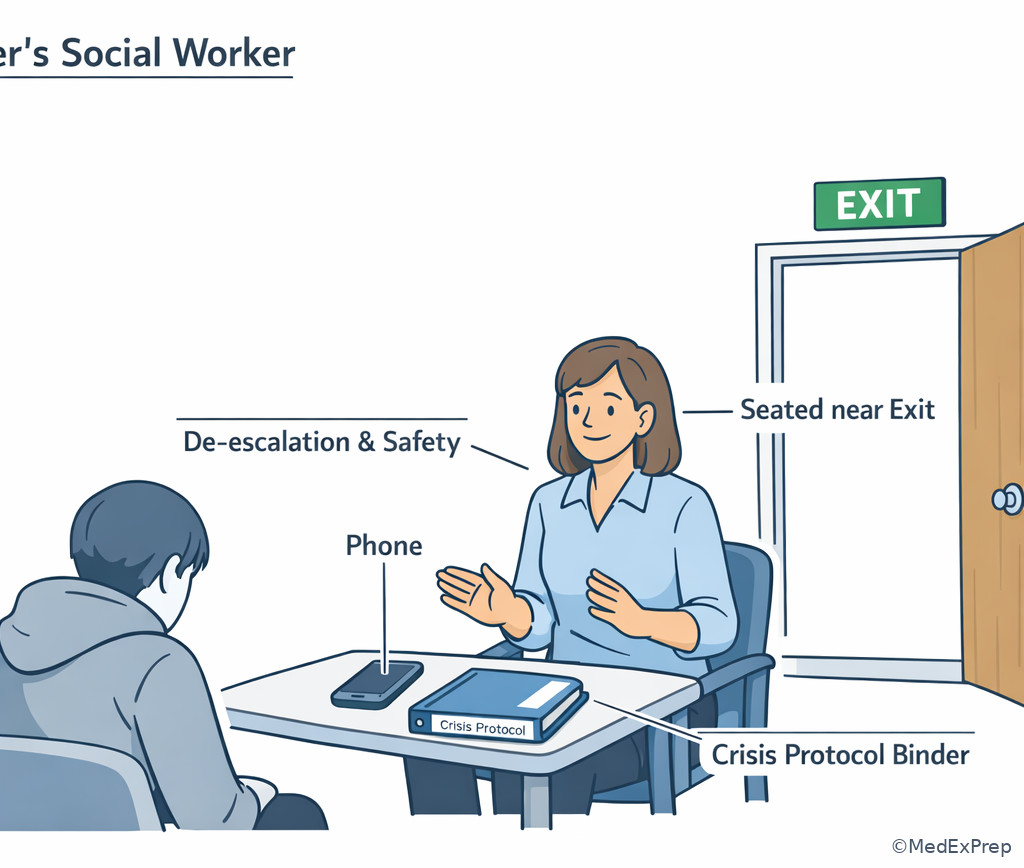
Exam takeaway: Immediate risk changes the task from routine assessment to protective action, consultation, and documentation.
flowchart TD
A[Concerning statement or observation] --> B{Immediate safety or abuse concern?}
B -->|No| C[Continue focused assessment]
B -->|Yes| D[Stay with client or maintain contact]
D --> E[Notify supervisor or follow agency protocol]
E --> F[Contact emergency or protective system if indicated]
F --> G[Document facts, actions, rationale, response] Exam takeaway: Recognize the visual shift from routine interview to active safety-oriented response when risk is disclosed.
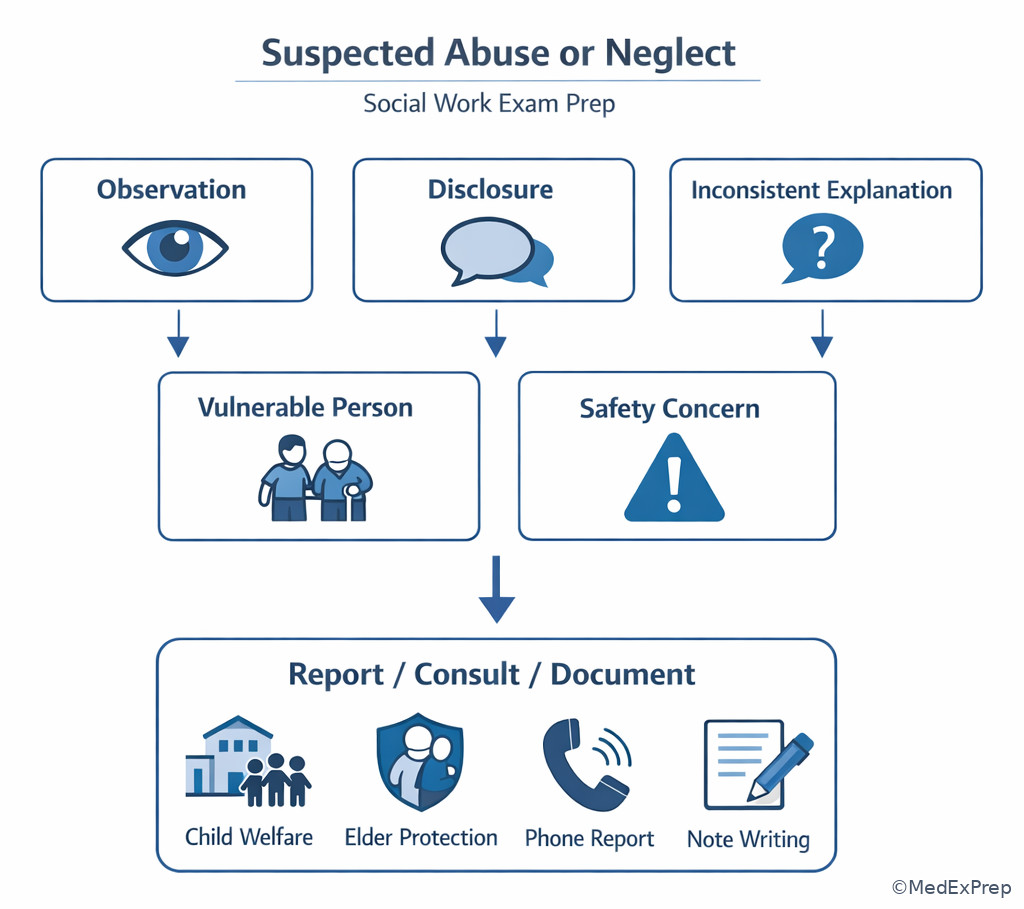
Exam takeaway: Abuse and neglect questions test suspicion thresholds and protective action, not certainty or full investigation.
B Worked example
A 39-year-old father in a child welfare-related community program presents for a routine benefits appointment. He has a history of alcohol misuse, recent eviction, and untreated back pain. During the meeting he says, “I bought a gun yesterday, and tonight I’m going to end this.” His 8-year-old daughter is at home with a neighbor. A distracting detail is his request for food assistance, which makes resource linkage feel urgent and familiar. The stem asks for the priority response.
Identify task: priority response. Extract key facts: direct suicidal intent, means, and timeline are present. Apply rule: immediate risk shifts the task to protective action, not routine problem-solving. Eliminate distractors: discussing food benefits, exploring long-term parenting stress, or asking him to sign a safety contract are all insufficient as first responses. Verify: the best action is to maintain safety, activate emergency protocol, consult as required, and ensure child safety concerns are addressed through proper channels.
C Exam trap
D Checkpoint
Question: A social worker in a nursing facility notices unexplained bruising on a resident with mild cognitive impairment. The nephew says the resident “falls a lot,” but staff documentation is inconsistent, and the resident appears fearful when the nephew enters. What is the most appropriate next step?
- Wait for proof before taking action to avoid making a false accusation.
- Privately assess immediate safety, follow reporting policy, and consult a supervisor as indicated.
- Confront the nephew in the hallway and demand an explanation.
- Offer the resident relaxation exercises and revisit the issue next week.
Answer: B
- A: Tempting because accusations should not be made lightly; wrong because abuse questions test action on reasonable suspicion, not certainty.
- B: Tempting because it may feel formal or escalatory; right because fearfulness, bruising, and inconsistent explanations shift the task to protection and reporting process.
- C: Tempting because direct confrontation can seem decisive; wrong because it may increase risk and bypass protocol.
- D: Tempting because calming the resident is supportive; wrong because supportive care does not replace protective action when abuse is suspected.
1.1.1.6 Role, setting, and scope: pick the action a master's social worker can actually take
A Explanation
Sometimes you identify the task correctly but still miss the question because you choose an option that belongs to another professional role or to a different setting. The conflict becomes: Which of these plausible actions fits my role, this setting, and this moment? The rule is: the best answer must be both clinically appropriate and within the master's-level social worker's authority and context.
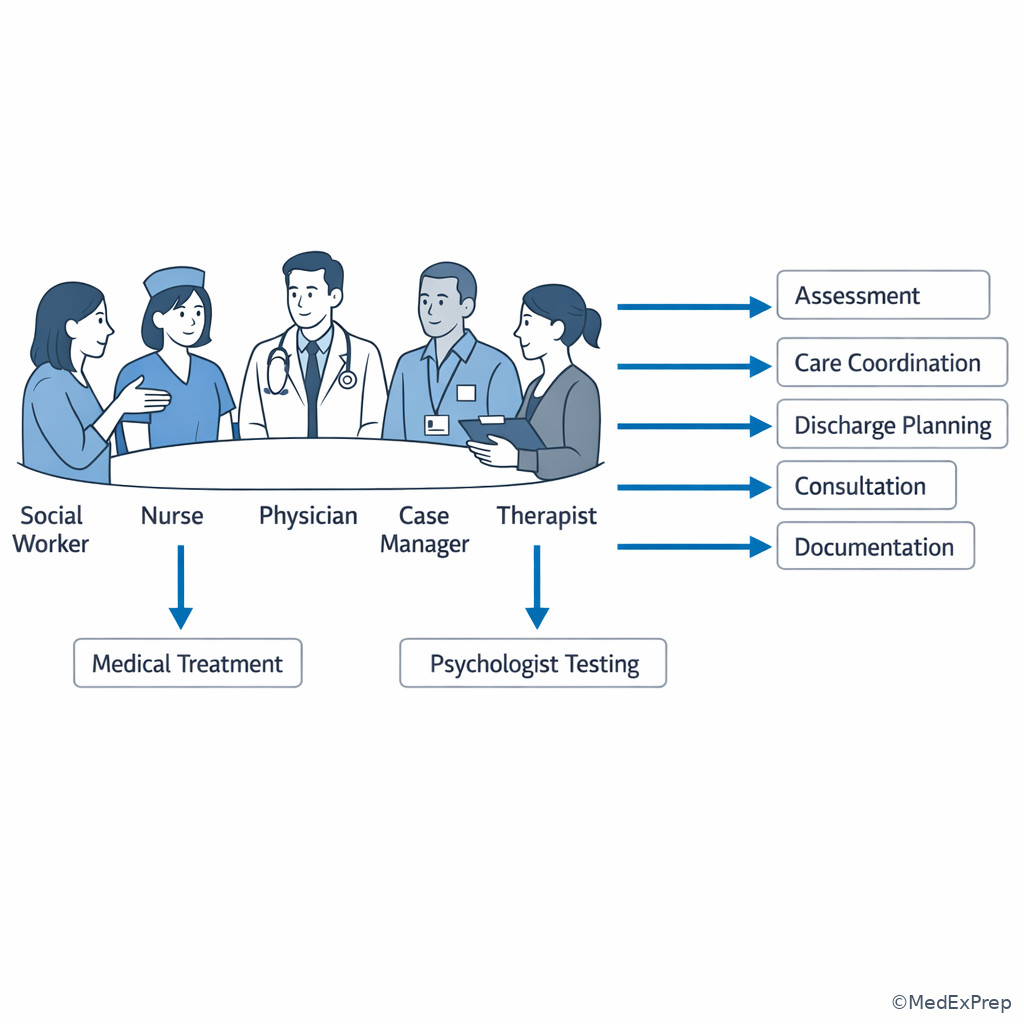
On ASWB Masters items, distractors often include actions that sound authoritative: ordering medical treatment, making definitive legal determinations, conducting specialized testing independently, or promising outcomes beyond role. These may be the right action for the team broadly, but not the direct action of the master's social worker. Your task is usually to assess, consult, refer, coordinate, advocate, document, or escalate appropriately rather than take the out-of-role action yourself. WHY THIS IS TESTED: the exam rewards role-aware judgment, not overfunctioning.
Setting matters too. In a hospital, you may coordinate discharge planning and clarify understanding. In a school, you may assess school functioning and collaborate with caregivers and staff. In community mental health, you may provide supportive counseling and resource linkage. In child welfare-related contexts, protective reporting and collaboration may become central. Upcoming topic Client System And Setting builds directly on this idea by asking who the client is and which environmental facts matter most.
Exam takeaway: Even a clinically sensible option is wrong if it exceeds the master's social worker role or ignores the setting.
flowchart TD
A[Possible answer choice] --> B{Within master's social work role?}
B -->|No| C[Reject: wrong provider or out of scope]
B -->|Yes| D{Fits this setting and stage?}
D -->|No| E[Reject: wrong timing or context]
D -->|Yes| F[Keep as contender]
F --> G{Addresses the asked task?}
G -->|Yes| H[Best answer candidate]
G -->|No| I[Helpful but not the asked task]
Run every strong distractor through this filter. See Fig 4.
Exam takeaway: Board questions often test whether the social worker should coordinate and consult rather than perform another professional's task.
B Worked example
A 67-year-old patient on a medical unit has chronic obstructive pulmonary disease, mild cognitive changes, and a recent fall. The patient tells the social worker, “I don't trust my son with my money anymore.” The chart also mentions missed bill payments. A tempting option is to declare the patient legally incapable and change decision-making authority immediately. The stem asks for the most appropriate next step.
Identify task: next step. Extract key facts: financial concern is present, but legal capacity has not been determined. Apply rule: the social worker should assess concerns, document observations, and consult appropriate professionals or supervisors rather than make a definitive legal determination. Eliminate distractors: changing legal authority independently is out of role; ignoring the issue until discharge is unsafe; telling the patient exactly how to alter legal documents may exceed scope. Verify: the best answer is to clarify the concern, assess for exploitation risk, consult the team/supervisor, and facilitate appropriate referral.
C Exam trap
D Checkpoint
Question: A social worker in an emergency department is concerned that a patient's confusion may be medication-related. Which action is most appropriate?
- Independently adjust the medication list and discontinue the likely cause.
- Note the concern, communicate it to the medical team, and continue psychosocial assessment within role.
- Tell the family the patient definitely has dementia and needs placement.
- Conduct specialized neuropsychological testing before speaking to the physician.
Answer: B
- A: Tempting because medication issues need rapid response; wrong because changing medical treatment is outside master's social work scope.
- B: Tempting because it may feel less decisive; right because it respects role boundaries while still acting on an important clinical observation.
- C: Tempting because confusion in an older adult raises concern about cognition; wrong because the social worker should not make a definitive medical diagnosis from limited data.
- D: Tempting because more data can be useful; wrong because specialized testing may be outside authority and delays appropriate team communication.
- If an option is clinically good but belongs to another licensed professional, reject it.
- True or False: The best answer must fit both the task and the setting. True.
- Name three within-scope actions: assess, coordinate, consult.
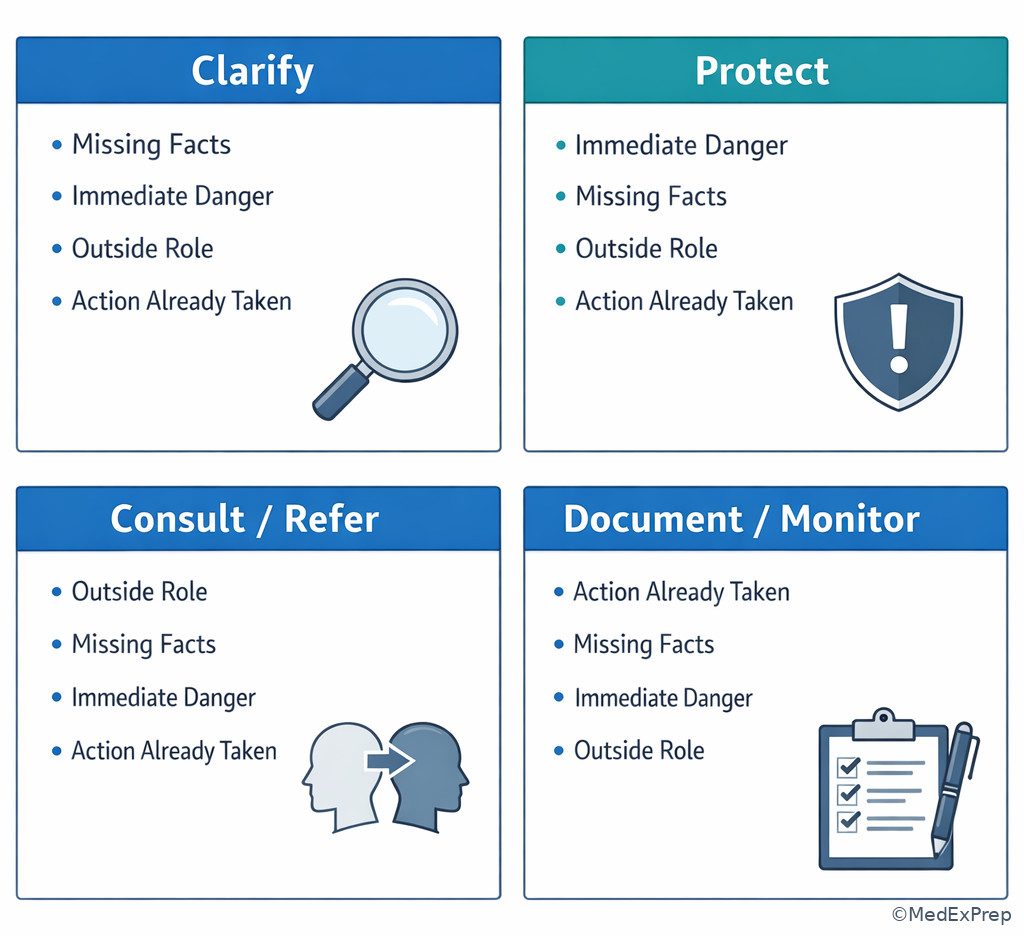
1.1.1.7 Common task patterns on exam day: clarify, act, consult, or document?
A Explanation
Once you know the major categories, the next layer is pattern recognition. Many stems fall into one of four repeat patterns: clarify, act for safety, consult/refer, or document/follow up. The decision conflict is choosing between two reasonable categories that both sound professional. The single rule is: pick the category that addresses the most immediate unresolved problem in the stem.
Choose clarify when ambiguity is the main barrier to action. Choose act for safety when risk is time-sensitive. Choose consult/refer when the case exceeds role, authority, or available competence/resources. Choose document/follow up when the action has already occurred and the stem asks about continuity, quality, or accountability. WHY THIS IS TESTED: the exam often gives a tempting answer from the wrong category, especially a “do something” answer when the real need is clarification.
A useful move is to restate the stem in one sentence: “The unresolved problem here is not lack of services; it is unclear risk,” or “The unresolved problem is not uncertainty; it is immediate danger,” or “The unresolved problem is not danger; it is a scope threshold.” That reframing makes the best answer easier to see. See Fig 5.
Exam takeaway: Most stems are solved by identifying whether the unresolved problem is ambiguity, danger, scope threshold, or continuity need.
flowchart TD
A[Identify unresolved problem] --> B{What is blocking good practice?}
B -->|Missing facts| C[Clarify and assess]
B -->|Immediate risk| D[Act for safety]
B -->|Out of role or authority| E[Consult or refer]
B -->|Action already taken; follow-up needed| F[Document or monitor]
C --> G[Choose best next step]
D --> G
E --> G
F --> G Exam takeaway: A simple visual dashboard helps sort similar answer choices by the unresolved problem they address.
B Worked example
A case manager in an aging services program works with an 82-year-old client who has diabetes, hearing impairment, and recent bereavement. The client missed two meals-on-wheels deliveries and now says, “I don't want strangers in my house.” The daughter lives out of state and requests immediate placement in assisted living. A distracting clue is the daughter's urgency, which can make referral feel like the obvious answer. The stem asks for the best next step.
Identify task: best next step. Extract key facts: service refusal is present, but the client's reasoning, functioning, safety, and preferences remain unclear. Apply rule: the unresolved problem is ambiguity, not yet placement. Eliminate distractors: arranging placement immediately overrides self-determination without sufficient assessment; terminating services for noncompliance is premature; documenting refusal alone is incomplete. Verify: the best answer is to assess the client's concerns, safety, functioning, and alternatives before acting.
C Exam trap
D Checkpoint
Question: A social worker has already completed a safety plan with a client after passive suicidal thoughts were assessed as non-imminent, consulted the supervisor, and arranged follow-up for the next day. The stem asks what the social worker should do next. Which answer best fits the practice task?
- Document the assessment findings, interventions, consultation, and client response.
- Restart the entire intake interview from the beginning.
- Refer the client for involuntary hospitalization despite no imminent risk finding.
- Ignore documentation until the follow-up visit is completed.
Answer: A
- A: Tempting because it can feel less urgent than direct care; right because the assessment and intervention are already completed, so continuity and accountability are the immediate tasks.
- B: Tempting because more information often helps; wrong because the needed initial and safety tasks have already been done.
- C: Tempting because suicidal content raises concern; wrong because the stem states non-imminent risk and completed safety planning, so hospitalization is not the best fit.
- D: Tempting because follow-up may provide a fuller picture; wrong because documentation should not be delayed after significant risk-related actions.
Exam Traps & Differentiators
- Helpful but premature intervention — tempting because it sounds active and client-centered; eliminated by a missing fact that must be assessed first.
- Rapport over safety — tempting because empathy is a core value; eliminated by a direct clue of imminent risk, abuse suspicion, or inability to maintain safety.
- Correct action by the wrong provider — tempting because the action itself is clinically sensible; eliminated by scope and role limits.
- Documentation before action — tempting because documentation is always necessary; eliminated when the client needs immediate protection or urgent assessment first.
- Major referral before client clarification — tempting because referral feels efficient; eliminated when the client’s actual need, preference, or level of functioning is still unclear.
Most common wrong answer and why: The most common wrong answer is a reasonable intervention offered too early. It wins because it sounds compassionate, organized, and practical. It loses because the stem is really asking for clarification, safety triage, or scope-aware consultation first.
1.1.1.8 Looks similar but isn't
| Looks similar | Actually different because... | Choose this when... | Reject this when... |
|---|---|---|---|
| Assessment vs intervention | Assessment resolves uncertainty; intervention assumes enough facts already exist | Key fact is missing and no immediate danger is present | The answer launches services before clarifying severity, timeline, or function |
| Supportive counseling vs safety response | Supportive counseling is routine care; safety response addresses time-sensitive risk | Risk is absent or non-urgent and the client can engage safely | The stem gives intent, means, direct threat, or abuse concern |
| Consultation vs deferring responsibility | Consultation is active, timely escalation; deferral is passive avoidance | Scope, policy, or ethical uncertainty exceeds independent judgment | The option simply delays action without reason |
| Referral vs handoff without assessment | Referral follows identified need; blind handoff avoids clinical thinking | The service gap is clear and within referral criteria | The client problem has not been adequately clarified |
| Documentation vs clinical next step | Documentation preserves continuity after action; it rarely substitutes for urgent response | The key action has occurred and the stem asks about follow-up | Immediate assessment or protection is still pending |
1.1.1.9 If the stem says..., think...
- If the stem says “best initial action”, think what must happen before planning or treatment?
- If the stem says “priority response”, think safety, protection, or urgent legal/ethical duty.
- If the stem says “most important to clarify”, think what missing fact changes the next step?
- If the stem says “already completed a safety plan / already consulted”, think documentation and follow-up sequencing.
- If the stem includes a medically or legally authoritative option, think is this correct for the social worker or for another professional?
- If the stem centers on client refusal, think assess the reason before labeling resistance.
| Trap pair | Why confused | Single discriminator |
|---|---|---|
| Build rapport vs assess suicidality | Both are interpersonal responses | Any statement suggesting self-harm requires focused risk clarification first |
| Report abuse vs investigate abuse | Both involve concern gathering | Suspicion triggers reporting process; full investigation is not the social worker's exam task |
| Refer for services vs assess service fit | Both move care forward | Referral follows identified need; unclear need requires assessment |
| Consult supervisor vs delay | Both pause independent action | Consultation actively addresses uncertainty; delay leaves the problem unresolved |
| Document now vs act now | Both are professional obligations | Urgent safety actions come before charting |
Related traps will return in upcoming topics, especially Assessment Before Action and Priority Response Rules. This topic gives you the lens; those topics will sharpen the thresholds.
Tables
| Task category | Typical stem cue | Best action shape | Common wrong move |
|---|---|---|---|
| Clarify / assess | Initial action, most important to clarify | Focused questions, risk screen, timeline, functioning, supports | Immediate referral or intervention without enough facts |
| Protect / safety act | Priority response, imminent risk, suspected abuse | Safety measures, consultation, emergency/protective escalation | Routine counseling or delayed follow-up |
| Consult / refer | Outside role, legal issue, specialized need | Supervisor/team consultation, link to appropriate provider/service | Acting beyond scope independently |
| Document / monitor | After intervention, most important to document, follow-up | Objective note, rationale, client response, next plan | Treating documentation as a substitute for urgent action |
| Comparison | Assessment first | Intervention first |
|---|---|---|
| When to choose | Facts missing; no immediate danger | Need established or urgent risk present |
| Question style | Clarify, initial action, gather more information | Best next step after assessment, priority response |
| Typical content | Timeline, severity, supports, function, client view | Safety plan, referral, team coordination, psychoeducation, reporting |
| Wrong-answer pattern | Helpful service started too early | Needless delay despite clear action threshold |
| Discriminator | One missing fact would change the plan | No key fact remains unresolved for immediate action |
| Differential task problem | Key clue | Best social work response category |
|---|---|---|
| Ambiguous distress | Emotion present but intent/severity unclear | Focused assessment |
| Imminent self-harm concern | Intent, plan, means, or near-term timeframe | Safety action and escalation |
| Suspected abuse or neglect | Disclosure, fear, inconsistent explanation, vulnerability | Protective response, consultation, reporting process |
| Out-of-scope service need | Medical, legal, specialized testing, formal determination | Consultation/referral |
| Already-completed intervention | Stem states action already occurred | Documentation/monitoring |
| Client refusal without clear reason | Resistance described but motive unknown | Clarify concerns and barriers |
Algorithm / Approach
Exam takeaway: Solve stems in a fixed order: task, acuity, missing facts, scope, then best next step.
Use this as your default exam routine. See Fig 6.
Rapid Review
- Best initial action → usually clarify before planning unless danger is immediate.
- Priority response → safety or legal duty outranks rapport and resources.
- Helpful intervention → wrong if one missing fact would change it.
- Strong distractor → often right idea, wrong timing.
- Out-of-scope option → reject even when clinically sensible.
- Client refusal → assess reason before labeling resistance.
- Abuse item → suspicion threshold matters more than certainty.
- Suicide cue → intent, means, and timeframe convert routine care to protection.
- Documentation → follows significant action; does not replace urgent action.
- Consultation → active escalation, not avoidance.
- Referral → after need is identified, not as a substitute for thinking.
- Setting clue → narrows which actions fit the role.
- Most important to clarify → ask which unanswered detail changes the plan.
- Best answer → fits task, timing, acuity, and scope at once.
Self-check quiz
1. A social worker in a community agency meets a 28-year-old client with anxiety and recent eviction who says, “I don't know what to do next.” The stem asks for the most appropriate initial action. Which option best matches the likely practice task when no immediate danger is described?
- Conduct a focused assessment of immediate needs, supports, functioning, and risk.
- Arrange long-term housing placement immediately.
- Advise the client to begin weekly group therapy.
- Document the visit and schedule a follow-up without further discussion.
2. A school social worker hears a 16-year-old student with asthma and family conflict say, “Sometimes I wish I could disappear.” The student also asks for help dropping a class. Which action is the most appropriate next step?
- Help the student change the class schedule immediately.
- Conduct a focused suicide risk assessment.
- Tell the student to discuss the issue with friends first.
- Wait to assess until the parent can attend a meeting.
3. A hospital social worker is asked to assist a 74-year-old patient with heart disease, hearing loss, and repeated refusal of discharge teaching. The nurse says the patient is “noncompliant.” The patient states, “Everyone is talking too fast, and I still don't know who will help me at home.” There is no immediate safety emergency. What is the best next step?
- Explore the patient's understanding, barriers, and home support before finalizing the plan.
- Document refusal and notify the team that the patient is choosing discharge failure.
- Arrange home services without discussing them further because discharge is scheduled today.
- Tell the physician the patient lacks capacity and needs a surrogate decision-maker.
4. A 45-year-old client in outpatient treatment for depression has diabetes and recent job loss. During session, the client says, “I bought pills, and after my kids go to school tomorrow, I'm done.” The client also asks whether the social worker knows any utility assistance programs. Which response is the priority action?
- Provide utility assistance resources because financial stress is the main trigger.
- Complete a safety-focused response, maintain contact, and activate emergency protocol according to agency policy.
- Begin a detailed exploration of childhood trauma to understand the crisis context.
- Ask the client to promise not to self-harm and return next week.
5. A social worker in an emergency department becomes concerned that an older adult's confusion may be due to medication interaction. The patient also reports loneliness and difficulty paying rent. Which action is most appropriate for the social worker?
- Discontinue the medication thought to be causing confusion.
- Communicate the concern to the medical team and continue psychosocial assessment within role.
- Provide the family with a definitive dementia diagnosis so planning can begin.
- Perform a specialized cognitive test battery independently before speaking to the team.
6. A case manager in an aging services program works with an 83-year-old client who has hypertension, arthritis, and recent bereavement. The client missed two meal deliveries and says, “I don't want strangers in my home.” The client's daughter, who lives in another state, demands immediate assisted living placement. The client is alert, denies self-harm, and says a neighbor has been checking in. What is the best next step?
- Arrange assisted living placement immediately because the daughter reports concern.
- Assess the client's reasons for refusal, current functioning, supports, and safety before changing services.
- Terminate meal services because the client declined them twice.
- File an emergency protective report solely because the client missed meals.
7. A 35-year-old father in a community program has alcohol misuse, chronic pain, and recent unemployment. He says, “My son would be better off without me,” but then adds, “I would never do that to him,” denies a plan, agrees to identify supports, and accepts follow-up tomorrow. The social worker has already completed a focused risk assessment and consulted a supervisor; both agree risk is not imminent at this time. What is the most appropriate next step?
- Initiate involuntary hospitalization because any suicidal statement requires emergency commitment.
- Document the assessment, consultation, plan, and client response, then implement follow-up.
- Ignore the suicidal content because the client denied a plan.
- Begin intensive family therapy immediately during the same visit.
8. A nursing facility social worker notes bruising on a resident with mild cognitive impairment. The resident appears anxious around a nephew who manages finances. The nephew states the bruises came from “clumsiness,” and a nurse mentions the resident has also missed a bank appointment. The social worker is unsure whether exploitation, physical abuse, or accidental injury is occurring. What is the most appropriate next step?
- Wait until clear proof is obtained to avoid reporting inaccurately.
- Privately assess safety and follow agency reporting and consultation procedures based on suspicion.
- Confront the nephew publicly to test whether he becomes defensive.
- Reassure the resident and postpone action until the next care conference.
Answer key
1. Correct answer: A
- A: Tempting because it may feel slower than taking direct action, but it is correct because the stem asks for the initial action and gives no immediate danger; the single clue is the absence of urgency paired with incomplete practical and psychosocial information.
- B: Tempting because eviction makes housing action feel urgent, but it is incorrect for this scenario because long-term placement assumes needs and preferences not yet assessed; the discriminating clue is “most appropriate initial action.”
- C: Tempting because therapy may help anxiety, but it is incorrect because referral to a specific treatment is premature before clarifying immediate needs, supports, and functioning; the key clue is lack of assessment detail.
- D: Tempting because documentation and follow-up are professional tasks, but it is incorrect because they do not address the immediate clinical need to assess; the key clue is that the visit has just begun and the problem remains undefined.
2. Correct answer: B
- A: Tempting because the student asked for class help, but it is incorrect because a possible self-harm statement shifts the immediate task to risk clarification; the key clue is “wish I could disappear.”
- B: Tempting because it may seem more urgent than the academic request, and it is correct because the statement raises possible suicidal thinking that must be assessed before routine school planning; the single discriminator is the self-harm cue.
- C: Tempting because peer support can be protective, but it is incorrect because outsourcing the assessment delays the social worker's immediate responsibility; the clue is that the concern is present now in session.
- D: Tempting because caregiver involvement can be important, but it is incorrect because waiting to assess a possible safety issue is not appropriate; the clue is immediacy of the student's statement.
3. Correct answer: A
- A: Tempting because it requires slowing down discharge momentum, and it is correct because the unresolved problem is unclear understanding and home support, not simple refusal; the clue is “I still don't know who will help me at home.”
- B: Tempting because repeated refusal can resemble nonadherence, but it is incorrect because labeling the patient ignores the missing assessment about hearing, comprehension, and support; the key clue is the patient's explanation.
- C: Tempting because discharge deadlines create pressure to act, but it is incorrect because arranging services without assessing fit and consent is premature; the clue is that the barrier has not been clarified.
- D: Tempting because confusion or refusal can raise capacity concerns, but it is incorrect because the stem points first to communication and discharge understanding, not a definitive incapacity finding; the clue is the hearing and explanation issue.
4. Correct answer: B
- A: Tempting because utility stress may contribute to suicidality, but it is incorrect because intent, means, and near-term timeframe require a safety response first; the clue is “I bought pills... tomorrow.”
- B: Tempting because it is the most escalated option, and it is correct because the client has given imminent-risk details that shift the task from routine support to protection; the single discriminator is the combination of means and timeframe.
- C: Tempting because trauma context can inform treatment, but it is incorrect because exploratory therapy is not the priority during acute danger; the clue is acute rather than historical risk.
- D: Tempting because no-harm promises can feel practical, but it is incorrect because a promise does not adequately address imminent risk; the clue is the high-acuity disclosure.
5. Correct answer: B
- A: Tempting because medication interaction may need rapid attention, but it is incorrect because independently altering medical treatment exceeds master's social work scope; the clue is that the social worker is noticing and communicating, not prescribing.
- B: Tempting because it may seem less direct than solving the medical issue, and it is correct because it fits the social worker's role: communicate observations to the appropriate team while continuing psychosocial assessment; the key clue is scope boundary.
- C: Tempting because confusion in an older adult can suggest dementia, but it is incorrect because a definitive diagnosis is not established and is not the social worker's role; the clue is possible medication interaction.
- D: Tempting because testing may clarify cognition, but it is incorrect because specialized testing may be outside authority and delays role-appropriate team communication; the clue is need for immediate within-role action.
6. Correct answer: B
- A: Tempting because missed meals and family concern make placement sound protective, but it is incorrect because the client is alert, has some support, and the reasons for refusal are still unclear; the clue is preserved engagement and absence of immediate danger.
- B: Tempting because it requires more work before solution planning, and it is correct because the unresolved problem is ambiguity about refusal, function, and safety rather than a clear placement need; the discriminator is the client's stated preference and available neighbor support.
- C: Tempting because repeated decline can look like service rejection, but it is incorrect because ending services without clarifying the barrier ignores assessment and self-determination; the clue is unexplored concern about strangers in the home.
- D: Tempting because missing meals in an older adult can raise neglect concerns, but it is incorrect because the stem does not yet provide suspicion of abuse or immediate inability to remain safe; the clue is absence of a clear protective trigger.
7. Correct answer: B
- A: Tempting because suicidal statements always deserve seriousness, but it is incorrect because the stem explicitly states a completed focused assessment, supervisor consultation, and a determination of non-imminent risk; the clue is that the emergency threshold has already been evaluated and not met.
- B: Tempting because documentation can feel secondary, and it is correct because the immediate assessment and consultation tasks are complete, so the best next step is to document and implement follow-up; the discriminator is the phrase that these steps have already occurred.
- C: Tempting because the client denied a plan, but it is incorrect because suicidal content should never be ignored; the clue is prior suicidal statement requiring documented response.
- D: Tempting because family context matters and family work may be useful later, but it is incorrect because the stem asks for the next step after assessment and consultation, which is documentation and planned follow-up rather than a new treatment modality; the clue is sequence.
8. Correct answer: B
- A: Tempting because false accusations are serious, but it is incorrect because suspected abuse or exploitation questions test action on suspicion rather than waiting for certainty; the clue is anxious behavior plus bruising and inconsistent context.
- B: Tempting because it requires formal action in uncertainty, and it is correct because the social worker should assess safety privately and follow reporting/consultation procedures when reasonable suspicion exists; the discriminator is the suspicious cluster of fear, bruising, and financial involvement.
- C: Tempting because confrontation may seem decisive, but it is incorrect because it can heighten risk and bypass protocol; the clue is the need for safety-focused, structured response.
- D: Tempting because team conferences are routine care points, but it is incorrect because delaying action is inappropriate when abuse or exploitation is reasonably suspected; the clue is current concern rather than routine review need.
Keep going with the full ASWB Masters Prep Course (ASWB Masters)
You just studied the way members do, in the same lesson interface. Full access unlocks every lesson, the question bank and flashcards for a full year.
One payment · 1 year of access · No auto-renewal