1.1.1 - Question Task Recognition
Question Task Recognition
What you’ll learn
- Domain: Assessment, Diagnosis-Informed Thinking, and Intervention Planning → Subskill: identify the exact exam task being asked before choosing an action.
- Domain: Interventions with Clients and Client Systems → Subskill: distinguish FIRST, NEXT, BEST, and MOST APPROPRIATE action prompts.
- Domain: Professional Relationships, Values, and Ethics → Subskill: recognize when the task is ethics, safety, scope, documentation, or therapeutic communication.
- Domain: Assessment, Diagnosis-Informed Thinking, and Intervention Planning → Subskill: separate missing-information tasks from intervention-selection tasks.
- Domain: Interventions with Clients and Client Systems → Subskill: eliminate answer choices that solve the wrong question even when they sound clinically reasonable.
Blueprint mapping
- Assessment, Diagnosis-Informed Thinking, and Intervention Planning → problem identification; biopsychosocial assessment interpretation; risk prioritization
- Interventions with Clients and Client Systems → evidence-informed response selection; crisis intervention sequencing; therapeutic communication
- Professional Relationships, Values, and Ethics → confidentiality exception analysis; supervision/consultation boundaries; law vs ethics vs policy vs best practice
Why it matters
- Many ASWB items are missed not because the candidate lacks knowledge, but because the candidate answers a different question than the one asked.
- Question task recognition is the first filter for all vignette reasoning: before safety triage, before ethics analysis, before intervention choice.
- Board-style distractors are often good social work actions in the wrong sequence, wrong scope, or wrong task category.
- When you can name the task precisely, you cut down the answer set fast and preserve time for harder stems.
Exam takeaway: First identify what the question wants you to do before judging which option sounds most helpful.
flowchart TD
A[Read final sentence first] --> B{What is being asked?}
B --> C[Assessment task]
B --> D[Intervention task]
B --> E[Risk or safety task]
B --> F[Ethics or confidentiality task]
B --> G[Documentation or consultation task]
C --> H[Choose information-gathering option]
D --> I[Choose scope-appropriate clinical response]
E --> J[Choose least restrictive safe response]
F --> K[Choose legal and ethical duty]
G --> L[Choose record, supervision, or referral step]
Use this as your opening move on every vignette. See Fig 1.
Key Terms & Must-Know Facts
1.1.1.1 Key terms
- Task recognition: Identifying the decision category the item is testing.
- FIRST question: The initial priority step in the current moment.
- NEXT question: The most appropriate follow-up after a prior action is already complete.
- BEST question: The strongest option among several reasonable choices.
- MOST APPROPRIATE: The option most consistent with safety, ethics, phase, and scope.
- Assessment-before-action: Gather needed information before intervening when the situation is nonemergent.
- Risk cue: Any detail suggesting possible danger to self, others, or a vulnerable person.
- Scope-aware choice: An answer a clinical social worker candidate can actually do.
- Premature intervention: Acting before enough information exists.
- Phase error: Choosing planning or intervention when the stem is still in engagement or assessment.
- Distractor: A plausible but inferior answer choice designed to exploit a reasoning mistake.
- Anchor clue: The single detail that tells you the task type.
1.1.1.2 Must-know facts
- Read the last sentence first; it usually names the task.
- If the stem asks for the first step, later-phase answers are usually wrong even if clinically sound.
- If there is a safety or abuse cue, the task may instantly shift from routine assessment to protection.
- When facts are missing and there is no emergency, the exam usually favors further assessment.
- An answer can be good practice but wrong now.
- Many wrong answers solve the client’s problem in theory but ignore the social worker’s scope.
- In ethics items, immediate safety and legal obligations outrank comfort and alliance-preserving responses.
- In nonemergent communication items, empathic exploration usually outranks reassurance, advice, or confrontation.
| Command word in stem | What the exam is testing | Best default lens | Common wrong move |
|---|---|---|---|
| First | Priority in the current moment | Safety, urgent assessment, immediate clarification | Choosing a full treatment plan too early |
| Next | Sequence after a prior step | Assume prior action happened; do not repeat it | Going backward to a finished step |
| Best | Most defensible among reasonable options | Compare on ethics, scope, client-centeredness | Picking the most active answer |
| Most appropriate | Broad judgment within role | Integrate phase, risk, and scope | Overfocusing on one clue |
| Most likely diagnosis | Diagnosis-informed reasoning within scope | Pattern recognition plus ruling out look-alikes | Treating instead of identifying |
| Requires immediate clarification | Critical missing information | Clarify the unsafe or decisive gap | Answering with psychoeducation first |
Core content
1.1.1.3 Read the task before the story
A Explanation
On ASWB-style items, the stem usually gives a rich story, but the score often depends on a single question-task signal in the final line. The decision conflict is simple: Do you answer the client story, or do you answer the exam task? The correct move is to answer the task. A stem may describe grief, conflict, trauma, medication nonadherence, or family strain, but if the question asks for the first action, you are being tested on sequence, not on your ability to list every reasonable intervention. The single rule that resolves this conflict is: the command word controls the answer category.
WHY THIS IS TESTED: Candidates often over-identify with the client narrative and pick the most compassionate-sounding or clinically rich option without checking whether it matches the ask. The exam rewards disciplined reading, not speed-driven intuition. In practice, this mirrors real work: the same case can require engagement, risk assessment, consultation, referral, or documentation depending on the moment.
Start by looking at the last sentence. Circle or mentally label the verb: assess, clarify, respond, document, consult, report, refer, plan, evaluate. Then ask: Is this an information-gathering task, an action task, a risk task, an ethics task, or a scope task? See Fig 1 and Fig 2. If your options include one empathic statement, one risk question, one referral, and one documentation step, the item is often testing whether you know which kind of step comes first.
Exam takeaway: The final verb in the question narrows the answer set before you evaluate clinical details.
flowchart LR
A[Question asks] --> B{Command}
B --> C[First]
B --> D[Next]
B --> E[Best]
B --> F[Clarify]
C --> G[Immediate priority]
D --> H[Follow sequence]
E --> I[Compare plausible options]
F --> J[Seek decisive missing data] B Worked example
A 34-year-old client in outpatient therapy presents after a breakup. She has major depressive disorder, type 2 diabetes, and chronic back pain. She says, “Nothing matters anymore,” and reports missing work twice this week. She also mentions that her sister has been supportive and that she has been sleeping 12 hours a day. Her affect is constricted. The question asks: What should the social worker do FIRST?
Reasoning chain: Identify task → the item asks for the first action, so sequence matters. Extract key facts → hopeless statement, functional decline, depression history; supportive sister and diabetes are noise unless they change urgency. Apply rule → because there is a possible suicide cue, the first task is risk assessment, not supportive counseling or treatment planning. Eliminate distractors → scheduling extra sessions is too late; asking about sleep hygiene addresses symptoms, not immediate risk; referral for medication evaluation may be appropriate later but does not answer the first-step task. Verify → direct suicide assessment best fits both the task word and the risk clue.
C Exam trap
D Checkpoint
Question: A client describes panic symptoms after losing housing, then says, “Sometimes I wonder whether everyone would be better off without me.” The question asks for the most appropriate first response. Which option best matches the task?
- Explore the meaning of the housing loss in depth.
- Ask directly about suicidal thoughts, plan, intent, and means.
- Provide immediate psychoeducation about panic attacks.
- Coordinate a referral for long-term case management.
- A: Tempting because the housing loss is a major stressor; wrong because it deepens narrative exploration before clarifying danger.
- B: Tempting because it feels more direct than supportive; right because the stem asks for the first response and includes a suicide cue.
- C: Tempting because the client has panic symptoms; wrong because symptom education does not address the immediate task.
- D: Tempting because housing instability needs intervention; wrong because referral is not the first step when safety is unclear.
1.1.1.4 Match the task to the practice action category
A Explanation
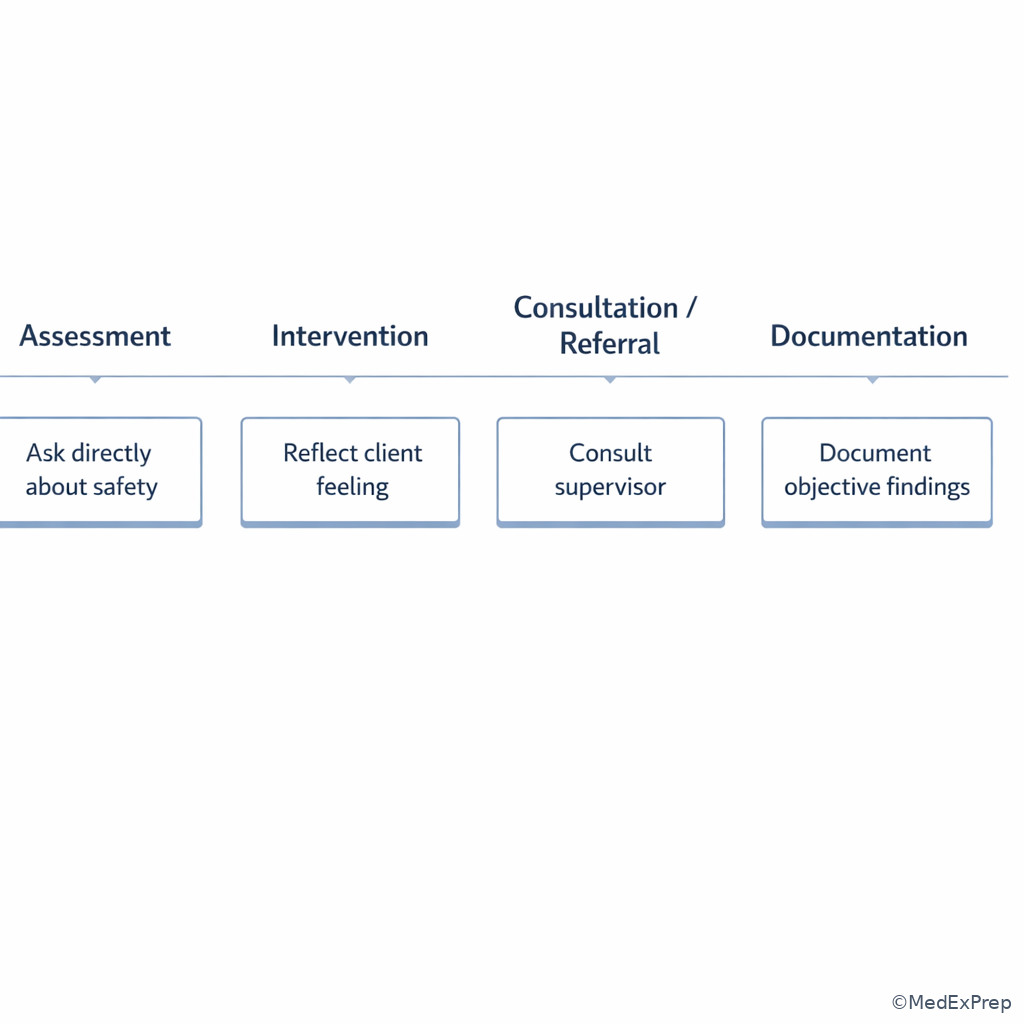
After naming the task, the next conflict is choosing between answer options that belong to different action categories. Many ASWB items mix categories on purpose: one option gathers information, one intervenes, one documents, and one consults. The question is not “Which answer is generally useful?” It is “Which action category fits this ask right now?” The single rule is: do not compare options until you sort them by category.
For social work candidates, the most common categories are: assessment (ask, clarify, evaluate, screen), direct response (support, safety plan, discuss, educate), systems action (consult, refer, coordinate), and professional process (document, obtain consent, report, review policy). If the stem asks what requires immediate clarification, only assessment options truly match. If it asks what the worker should document, even excellent clinical interventions are off-task. If it asks for the best response to a client statement, a therapeutic communication option often outranks case management, unless there is a safety or legal trigger.
WHY THIS IS TESTED: The exam wants candidates to think like practitioners who know the difference between gathering data, acting clinically, fulfilling ethical duties, and coordinating care. This is especially important because some distractors are actions another professional could do, or actions a social worker could do later. See Fig 3.
Exam takeaway: Sort answer choices into assessment, intervention, consultation, and documentation before choosing the best one.
B Worked example
A 15-year-old student meets with a school social worker after being sent out of class for yelling. He has ADHD and asthma, and his grandmother recently became his guardian. He says, “Don’t tell anyone, but sometimes my mom’s boyfriend hits my little brother.” He quickly adds, “But it’s probably not a big deal.” The question asks: Which information requires immediate clarification?
Reasoning chain: Identify task → this is not asking for the final intervention; it asks what must be clarified now. Determine action category → assessment. Extract key facts → disclosure suggesting possible child abuse; ADHD and asthma are distracting. Apply rule → clarify the abuse-related safety details first. Eliminate distractors → discussing school anger triggers is useful but not the task; contacting the guardian immediately may occur later depending on safety and reporting process; arranging family therapy is premature. Verify → the correct answer is the option that seeks immediate abuse-specific details.
C Exam trap
D Checkpoint
Question: A client reports escalating alcohol use after job loss and asks, “Can you help me figure out what to do?” The item asks which issue requires immediate clarification. Which option fits the task?
- Whether the client has current suicidal thoughts or withdrawal risk symptoms
- Whether the client would benefit from a community support group
- Whether the client is willing to create a long-term recovery plan
- Whether the client wants family involved in treatment next month
- A: Tempting because it focuses on urgent missing information; right because immediate clarification targets risk and acute complications.
- B: Tempting because support groups are relevant; wrong because referral planning is not the immediate clarification task.
- C: Tempting because motivation matters; wrong because long-term planning comes after urgent assessment.
- D: Tempting because systems involvement can help; wrong because it is neither urgent nor decisive now.
- The most common cause of an avoidable miss on this topic is answering the story instead of the task.
- True or False: If the question asks what requires immediate clarification, a referral answer is usually off-task. True.
- Name the 4 key answer categories: assessment, intervention, consultation/referral, documentation/professional process.
1.1.1.5 Recognize when safety or legal duty overrides routine sequencing
A Explanation
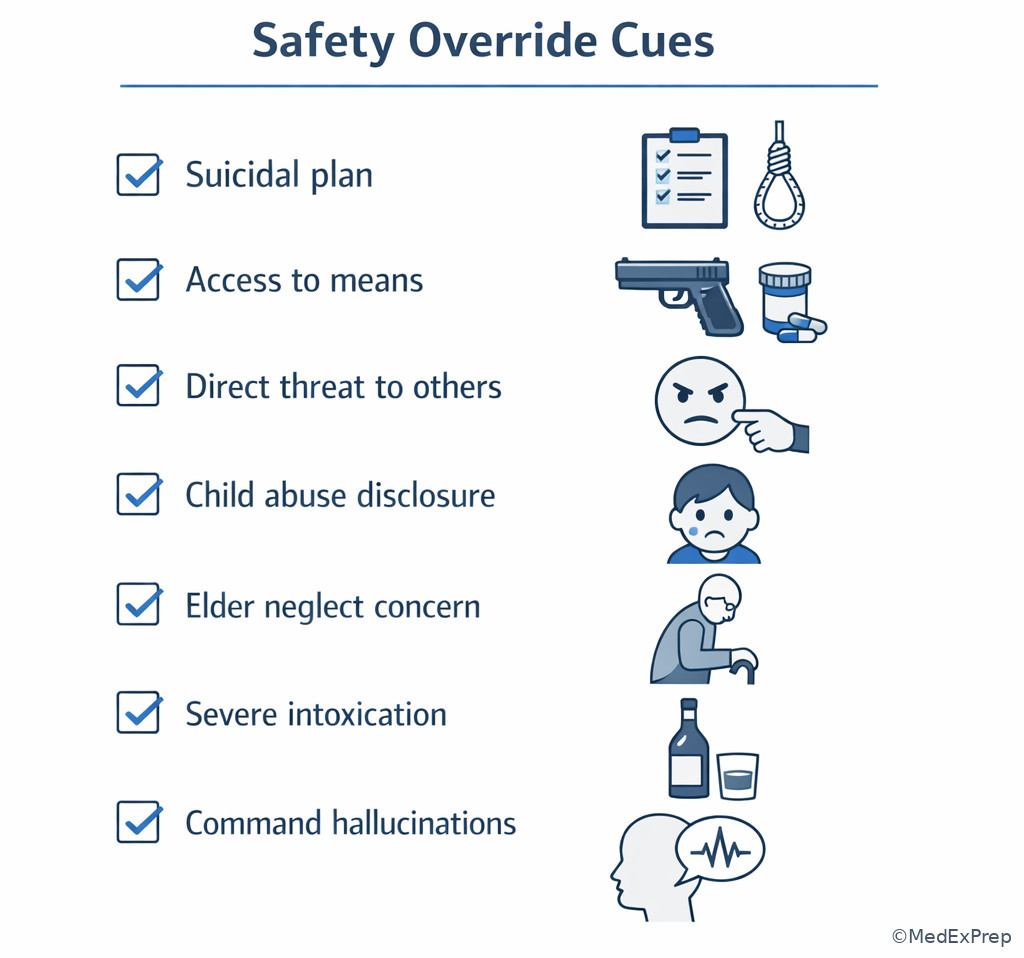
Most foundational ASWB logic follows assessment before action. But one major conflict can override that rule: credible immediate safety concern or legal protection duty. The question becomes, “Should I continue routine exploration, or has the task shifted to protection?” The single rule is: when a stem contains imminent risk, abuse/neglect concern, or a clear confidentiality exception trigger, the correct task may become urgent assessment, protective action, or reporting logic before ordinary therapeutic process.
This does not mean you skip assessment entirely. It means your assessment becomes focused and urgent. For example, a vague depression stem usually favors more exploration. Add a firearm, specific suicide plan, command hallucinations to harm another person, or a disclosure of abuse of a child or dependent adult, and the task changes. If the stem says the client asks the worker to promise secrecy before disclosing abuse, the item may be testing informed limits of confidentiality rather than pure rapport building. If the stem asks what to do first, the right move may be direct risk assessment or immediate protective consultation rather than reflective exploration.
WHY THIS IS TESTED: The exam expects the clinical social worker candidate to prioritize safety, mandated duties, and least restrictive protective response. Many distractors preserve alliance beautifully but fail legal or safety priorities. See Fig 4 and Fig 5.
Exam takeaway: Immediate risk or legal protection cues can change the task from routine helping to urgent assessment or protective action.
flowchart TD
A[Read stem] --> B{Safety or legal duty cue present?}
B -->|No| C[Continue standard task analysis]
B -->|Yes| D{Imminent risk or vulnerable person concern?}
D -->|Yes| E[Focused risk or protection step first]
D -->|Unclear| F[Clarify urgent details now]
E --> G[Consult/report/escalate within scope]
F --> G Exam takeaway: Visual cues such as weapon access, abuse disclosure, and direct threat statements should trigger a safety-first reading of the stem.
B Worked example
A 42-year-old man in integrated care is seen after his spouse left. He has alcohol use disorder, hypertension, and PTSD. He says, “I know where my supervisor parks, and he’ll be sorry.” He laughs afterward and says, “I’m just venting.” He also complains of insomnia and financial stress. The question asks for the most appropriate next step.
Reasoning chain: Identify task → next step. Extract key facts → direct threat toward identifiable person; substance use may increase risk; laughter is a tempting but weak minimizing detail. Apply rule → threat language creates a safety/protection task. Eliminate distractors → exploring job stress is too routine; asking about sleep addresses a symptom but not the threat; suggesting anger management later may be helpful but not now. Verify → focused violence-risk assessment and immediate protective consultation within agency protocol best fit the task.
C Exam trap
D Checkpoint
Question: During an intake, a parent says, “Sometimes I leave my 6-year-old alone overnight, but she sleeps through it.” The client then begins describing financial stress. What is the most appropriate first task?
- Explore the client’s stressors to strengthen rapport before discussing parenting
- Clarify the frequency, duration, and current safety of the child being left alone
- Recommend a parenting class and transportation support
- Ask about the client’s childhood experiences of being disciplined
- A: Tempting because rapport matters; wrong because the possible neglect cue changes the task to immediate safety clarification.
- B: Tempting because it may feel intrusive early in intake; right because urgent child-safety details must be clarified before routine exploration.
- C: Tempting because service linkage is practical; wrong because intervention comes after the safety facts are established.
- D: Tempting because intergenerational patterns can matter; wrong because it is clinically interesting but not the first task.
1.1.1.6 Separate social work scope from actions done by other professionals
A Explanation
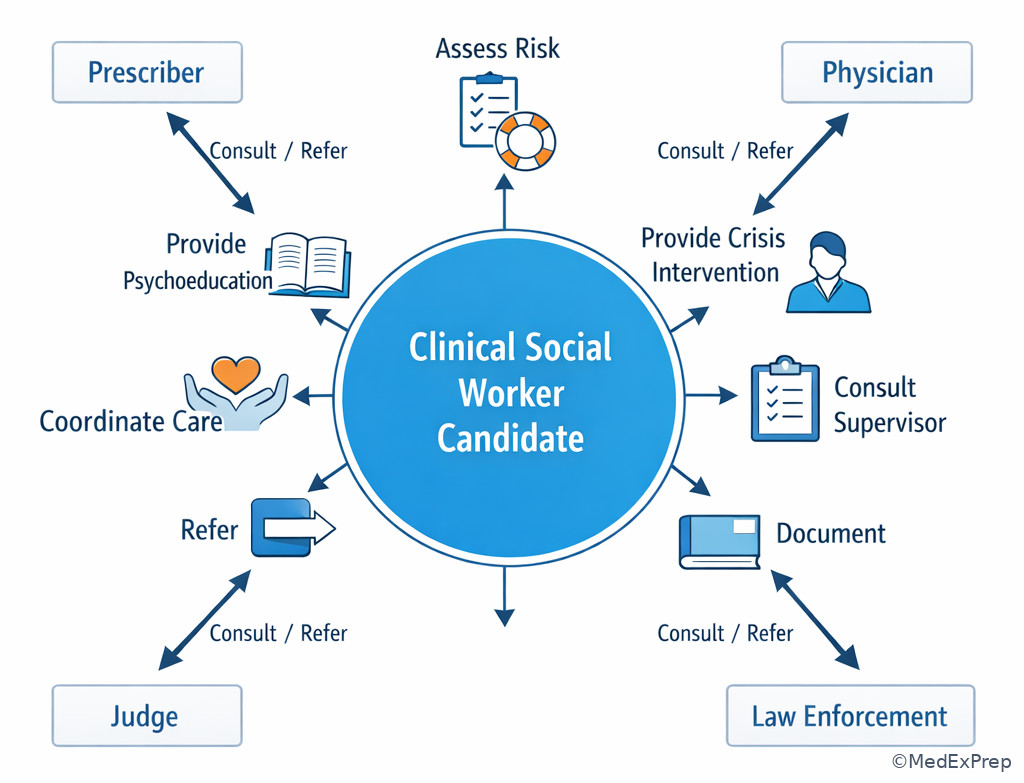
Some distractors are dangerous not because they are clinically absurd, but because they are actions the social worker candidate does not independently perform. The decision conflict is: Should I choose the most medically or legally definitive answer, or the best action within social work scope? The single rule is: when an option requires authority outside your role, reject it unless the answer frames consultation, referral, or collaboration.
Common out-of-role distractors include prescribing, independently ordering medical procedures, making legal determinations outside reporting responsibilities, or acting as the admitting physician. On this exam, candidates are expected to assess, respond therapeutically, coordinate care, document, consult, and report when required. They are not expected to write a prescription, authorize medication restraint independently, or provide legal representation. This matters for task recognition because some stems are really testing whether you notice that the “best treatment” is not the same as the “best social work action.”
WHY THIS IS TESTED: Board items often include one medically strong answer, one ethically polished but passive answer, one practical case-management answer, and one scope-appropriate clinical answer. Candidates who chase the most authoritative-sounding response miss the professional-role test. See Fig 5.
Exam takeaway: Reject options that require another professional’s authority unless the answer is to consult, refer, or collaborate.
B Worked example
A 67-year-old patient in primary care reports worsening depression, insomnia, and passive thoughts that “life is not worth much.” The patient has chronic kidney disease, atrial fibrillation, and recent bereavement. The stem asks for the most appropriate next step by the social worker. One option says to start an antidepressant; another says to complete a focused suicide assessment and notify the treatment team; a third says to order laboratory testing; a fourth says to tell the patient to return next month.
Reasoning chain: Identify task → most appropriate next step by the social worker. Extract key facts → passive death wish plus depression in integrated care. Apply rule → a social worker does not prescribe or order labs independently; the correct role is assessment and team communication. Eliminate distractors → starting medication and ordering tests are outside scope; delaying follow-up is unsafe. Verify → focused suicide assessment plus interdisciplinary notification is both clinically and professionally correct.
C Exam trap
D Checkpoint
Question: A client in outpatient therapy reports panic, insomnia, and escalating alcohol use. The stem asks for the most appropriate action by the social worker. Which option best fits the task and scope?
- Prescribe a short-term benzodiazepine and reassess in 2 weeks
- Order liver function testing to guide treatment decisions
- Assess immediate safety and substance-related risk, then coordinate referral as needed
- Authorize involuntary hospitalization without consultation
- A: Tempting because panic treatment feels urgent; wrong because prescribing is outside scope.
- B: Tempting because alcohol use may need medical workup; wrong because independent lab ordering is outside scope for the candidate role.
- C: Tempting because it sounds less decisive than medication; right because assessment and coordination are within scope and match the task.
- D: Tempting because alcohol risk can be serious; wrong because the option claims authority the social worker does not independently hold.
- True or False: The best treatment overall is always the best social work answer. False.
- If the option requires prescriber or physician authority, the better exam answer usually uses consultation or referral.
- Name the single discriminator: role authority.
1.1.1.7 Use a repeatable elimination framework on full vignettes
A Explanation
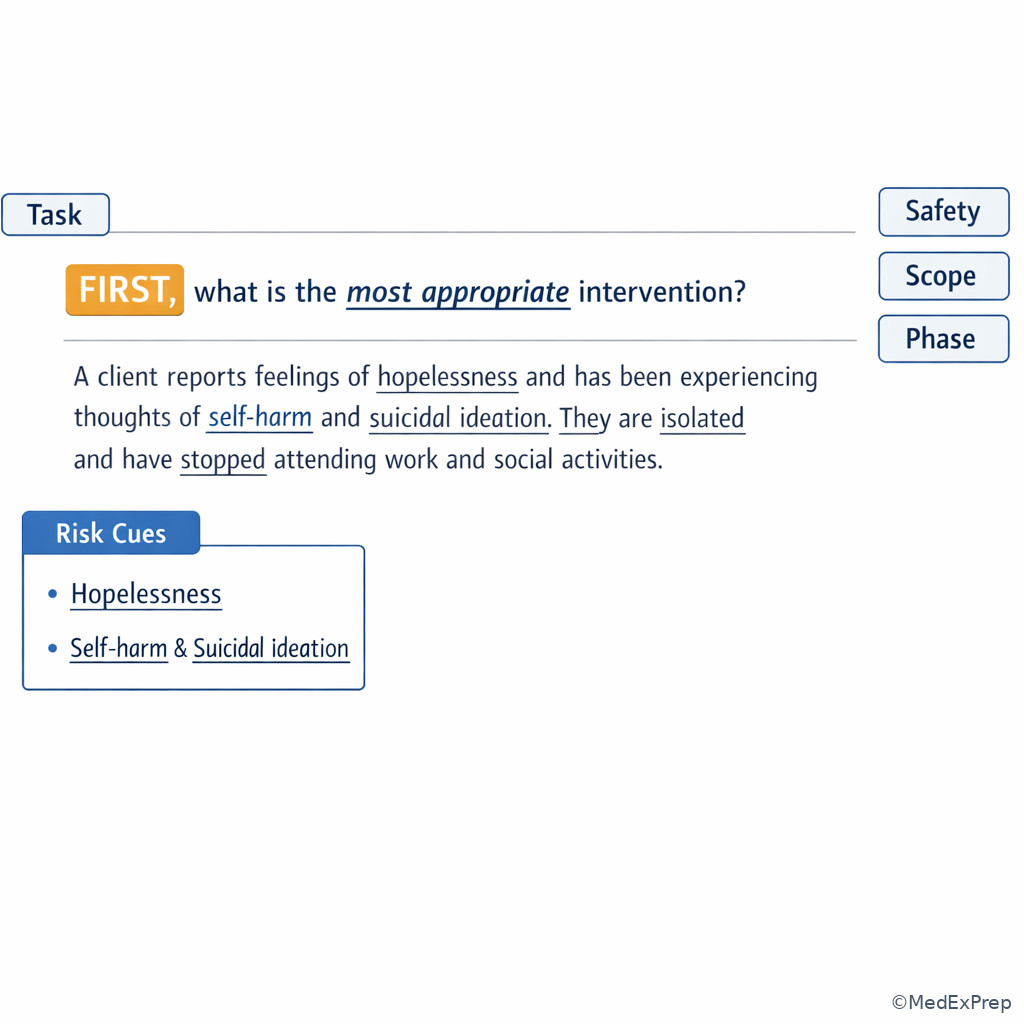
Once you can identify the task, category, safety override, and scope boundary, you need a repeatable method that works under time pressure. The decision conflict is between intuitive answer picking and structured elimination. The single rule is: eliminate answers in this order: wrong task, wrong sequence, wrong scope, wrong safety priority, wrong level of directiveness.
This structure matters because ASWB distractors are rarely silly. Two or three options often sound defensible. What makes one superior is usually a single discriminator: the stem asks for first; risk is still unclear; confidentiality has limits; the client is a minor; the worker must stay within role; or the option is not client-centered. When uncertain, ask: Which answer would I defend in supervision as the best fit for the exact question asked, at this moment, within role, with safety covered? That is usually the best exam answer.
WHY THIS IS TESTED: The exam assesses judgment under ambiguity. A disciplined elimination chain reduces error from emotional salience, overconfidence, and pattern-matching shortcuts. See Fig 6.
Exam takeaway: Eliminate wrong-task, wrong-sequence, wrong-scope, and wrong-priority answers before comparing the remaining choices.
flowchart TD
A[All four options] --> B[Remove wrong-task choices]
B --> C[Remove wrong-sequence choices]
C --> D[Remove wrong-scope choices]
D --> E[Remove unsafe or non-client-centered choices]
E --> F[Choose best remaining answer]
Exam takeaway: Marking command words, risk cues, and scope clues makes dense vignettes easier to solve accurately.
B Worked example
A 29-year-old postpartum client in community mental health reports tearfulness, conflict with her partner, poor sleep, and feeling like a “bad mother.” She has a history of generalized anxiety disorder and gestational diabetes. During the session she says, “Sometimes I think my baby would be better off without me, but I would never do anything.” The question asks for the best next step. Options include validating her stress, asking direct suicide questions, arranging a parenting class, and telling her partner to monitor her overnight.
Reasoning chain: Task → best next step. Sequence → there is a safety cue, so risk assessment comes before routine support or referral. Scope → all options except unilateral family directive may be within social work range, but not equally appropriate. Safety → direct assessment is needed despite the minimization. Client-centeredness → telling the partner to monitor her skips client engagement and assessment. Verify → ask direct suicide questions first, then proceed based on risk level.
C Exam trap
D Checkpoint
Question: Which elimination sequence is most reliable for solving a dense ASWB vignette?
- Choose the most compassionate option, then check scope
- Pick the answer that addresses the biggest problem in the story, then verify timing
- Eliminate wrong task, wrong sequence, wrong scope, then unsafe or non-client-centered options
- Ignore the final sentence until after reviewing all answer choices
- A: Tempting because compassion matters; wrong because empathy alone does not solve task-recognition errors.
- B: Tempting because the biggest story problem feels central; wrong because the exam tests the specific question asked, not the biggest narrative issue.
- C: Tempting because it is more mechanical; right because it reliably matches exam construction and reduces distractor pull.
- D: Tempting because some candidates want to read naturally; wrong because the final sentence often defines the task category.
Exam Traps & Differentiators
1.1.1.8 Most common wrong answer and why
The most common wrong answer is the premature intervention: safety planning before risk assessment, referral before clarification, treatment planning before completing assessment, or reassurance before direct exploration. It is tempting because it feels active, caring, and efficient. It is wrong because ASWB construction often places candidates earlier in the decision chain than the emotionally salient answer suggests.
1.1.1.9 Looks similar but isn’t
| If the stem asks... | Think... | Do not confuse with... | Single discriminator |
|---|---|---|---|
| What should the social worker do first? | Immediate sequence and priority | Best long-term treatment plan | Timing word: first |
| What requires immediate clarification? | Focused assessment of a decisive gap | Referral or education | Missing information language |
| Best response to the client | Therapeutic communication unless safety/legal duty overrides | Case management action | Conversation-level wording |
| Most appropriate next step | Sequence after what is already known or done | Repeating an earlier step | Prior action embedded in stem |
| What should be documented? | Objective, relevant charting | What should be said to the client | Documentation verb |
| Best action by the social worker | Scope-aware practice | Prescriber or physician action | Role named in question |
1.1.1.10 If the stem says ___, think ___
- If the stem says “first”, think priority and sequence, not comprehensive treatment.
- If the stem says “requires immediate clarification”, think question to ask, not service to arrange.
- If the stem says “most appropriate next step by the social worker”, think scope filter immediately.
- If the stem includes suicide, homicide, abuse, or neglect cues, think safety override.
- If the stem asks for the best response to a client statement and there is no emergency, think therapeutic communication before advice.
- If the stem says the worker has already assessed or already explained limits of confidentiality, think do not repeat a completed step.
| Trap pair | Why they look similar | What separates them |
|---|---|---|
| Empathic reflection vs direct suicide question | Both can be therapeutic | Risk cue present → direct assessment first |
| Consult supervisor vs report immediately | Both are protective professional actions | Jurisdiction and immediacy of mandated duty; when in doubt, safety and legal obligation lead |
| Referral vs further assessment | Both move care forward | Nonemergent missing data usually means assess first |
| Treatment planning vs clarifying symptoms | Both address the presenting problem | Uncertain diagnosis/risk means clarify before plan |
| Best medical step vs best social work step | Both may help the client | Role authority and scope boundaries |
Forward connection: in Practice Phase Identification, a major distractor will be phase confusion. A planning answer may be appropriate in the abstract but still wrong because the worker is still in engagement or assessment. Relatedly, Assessment Before Action will deepen the distinction between truly missing data and facts that are already sufficient to act.
Tables
| High-yield task clue | Likely best answer type | Reason this works on the exam |
|---|---|---|
| Requires immediate clarification | Focused question to gather missing critical data | Tests assessment-before-action logic |
| Best initial response | Empathic exploration or immediate risk screening | Tests communication versus safety prioritization |
| Most appropriate next step after assessment | Intervention, referral, or consultation | Tests sequence after data are already established |
| Best action by the social worker | Scope-appropriate clinical or coordination step | Tests role boundaries |
| Should document | Objective facts, actions, and response | Tests professional process logic |
| What should be done first when a threat is disclosed | Focused safety/violence assessment and protective consultation | Tests override of routine process |
| Question type | Best first mental move | Typical tempting distractor | Why distractor fails |
|---|---|---|---|
| FIRST/NEXT/BEST | Name the timing word | Comprehensive treatment plan | Wrong sequence |
| Clarification/assessment | Find the missing decisive fact | Psychoeducation | Action before data |
| Ethics/confidentiality | Check safety and legal exception first | Promise secrecy | Conflicts with duty |
| Scope-of-role | Ask who is authorized | Prescriber-only intervention | Outside role |
| Therapeutic communication | Choose empathy and exploration | Advice-giving | Too directive if no emergency |
Exam takeaway: A short checklist can turn a confusing vignette into a sequence of solvable steps.
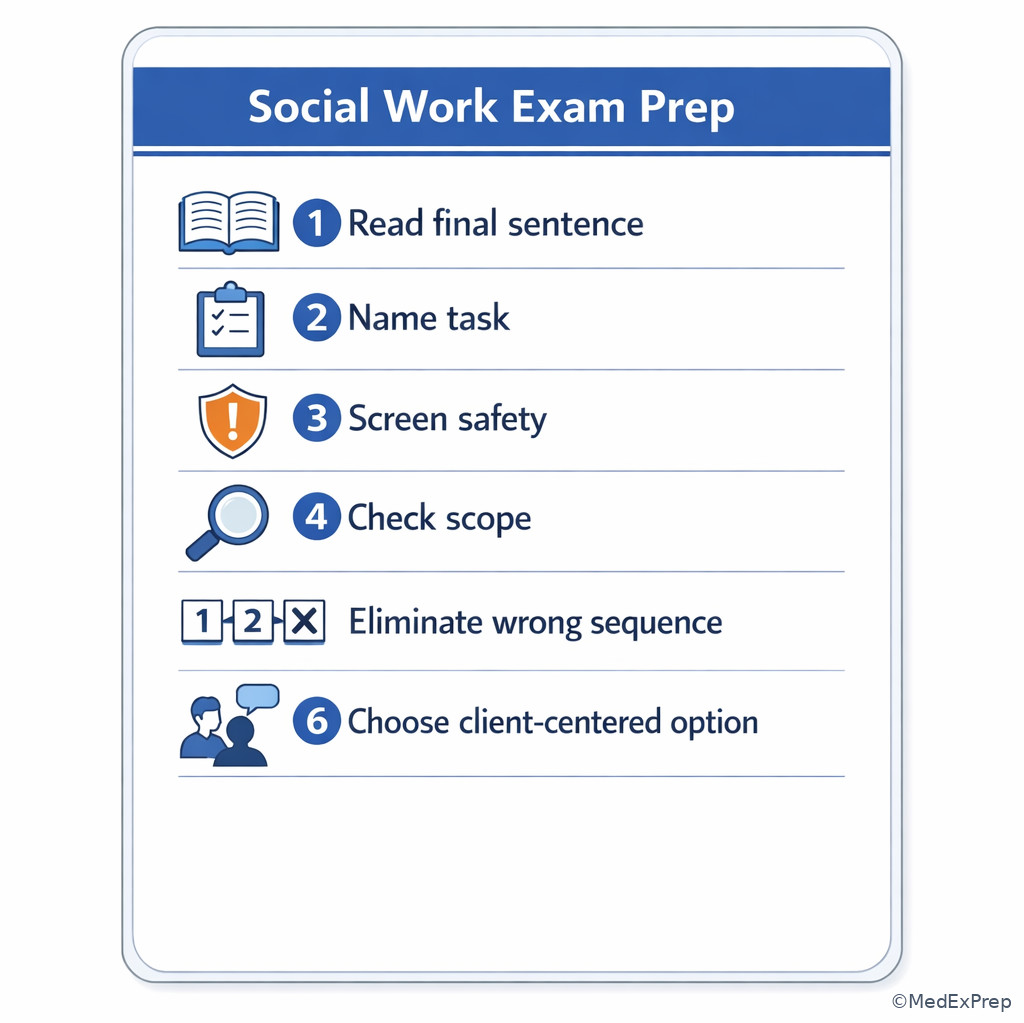
Algorithm / Approach
Exam takeaway: A reliable algorithm reduces misses caused by attractive but off-task answer choices.
flowchart TD
A[Final sentence] --> B[Name task]
B --> C[Sort options by category]
C --> D{Safety or legal override?}
D -->|Yes| E[Focused risk or protective step]
D -->|No| F[Continue with standard sequencing]
E --> G{Within social work scope?}
F --> G
G -->|Yes| H[Choose best client-centered answer]
G -->|No| I[Consult or refer] Rapid Review
- FIRST question → sequence outranks completeness
- Immediate clarification → ask for the missing decisive fact
- Best response → therapeutic communication unless safety cue present
- Safety cue in stem → routine exploration drops in priority
- Named worker role → apply scope filter before content filter
- Great intervention but wrong timing → eliminate as premature
- Great treatment but wrong profession → eliminate as outside scope
- Client asks for secrecy before abuse disclosure → think confidentiality limits
- Option repeats a completed step → reject on sequence grounds
- Two good answers remain → choose safer, less restrictive, more client-centered one
- Emotionally loud backstory → do not let it override the command word
- Assessment option on nonemergent stem → often beats intervention option
- Documentation task → choose objective facts, actions, and response
- Consultation answer → strongest when duty, uncertainty, or scope boundary is central
Self-check quiz
1.1.1.11 Question 1
A client describes family conflict and depressed mood. The final sentence asks, “What should the social worker do FIRST?” Which test-taking move is most appropriate before reviewing the options?
- Identify the command word and define the task as a sequence question
- Decide which intervention would likely help most over the next month
- Assume the question is primarily about diagnosis
- Ignore the final sentence until after reading all answer choices
1.1.1.12 Question 2
A school social worker hears that a student may be left alone overnight, but the facts are unclear. The question asks which issue requires immediate clarification. Which answer type best fits the task?
- A long-term family treatment recommendation
- A focused question about the child’s immediate safety circumstances
- A behavioral contract for school attendance
- A referral for extracurricular mentoring next semester
1.1.1.13 Question 3
A 38-year-old client in outpatient therapy has major depressive disorder, chronic pain, and recent job loss. During session, the client says, “Sometimes I think my family would be better off if I disappeared.” The client then starts discussing disability paperwork. The question asks for the most appropriate first response. What should the social worker do?
- Begin reviewing the disability paperwork to reduce stress
- Ask directly about suicidal thoughts, plan, intent, and access to means
- Explore the client’s feelings about unemployment in depth
- Refer the client for vocational rehabilitation services
1.1.1.14 Question 4
A 16-year-old student with ADHD and recent school suspension tells the social worker, “My mom’s boyfriend gets rough with my little sister, but don’t tell anyone.” The student then asks for help catching up on assignments. The item asks what requires immediate clarification. Which is the best answer?
- The specific facts about possible abuse and current child safety
- The student’s academic strengths and preferred learning style
- Whether the student would attend a conflict-resolution group
- Whether the caregiver is willing to join a school meeting next week
1.1.1.15 Question 5
A 71-year-old patient in integrated care has insomnia, bereavement, atrial fibrillation, and worsening anxiety. The patient says, “Sometimes I don’t see the point of waking up.” The question asks for the most appropriate next step by the social worker. Which option is best?
- Start an antidepressant and schedule a follow-up
- Order thyroid and metabolic laboratory tests
- Complete a focused suicide assessment and notify the interdisciplinary team as indicated
- Provide sleep-hygiene education and reassess next month
1.1.1.16 Question 6
A 27-year-old postpartum client with generalized anxiety disorder and recent relationship stress says, “My baby would be better off without me,” then quickly adds, “I would never actually do anything.” She has slept only 3 hours nightly and has a supportive aunt nearby. The question asks for the best next step. Which option is most appropriate?
- Validate that new parents often feel overwhelmed and normalize the stress
- Ask direct suicide-risk questions before proceeding with further support or planning
- Arrange for the aunt to stay with the client tonight without further assessment
- Refer immediately to a parenting support group and close the session
1.1.1.17 Question 7
A 45-year-old client in community mental health has alcohol use disorder, PTSD, and recent job loss. He says, “I know where my former supervisor lives, and he’ll regret what he did.” He then laughs and says, “I’m just blowing off steam.” The question asks for the most appropriate next step. Which option is best?
- Continue exploring the client’s feelings about unemployment to preserve rapport
- Conduct a focused violence-risk assessment and follow protective consultation procedures as indicated
- Advise the client to start anger management classes next month
- Tell the client that threatening statements are unacceptable and end the session immediately
1.1.1.18 Question 8
A 13-year-old in school counseling says, “Promise you won’t tell anyone, but sometimes my dad leaves my grandmother alone even though she can’t remember her medications.” The student also reports being worried about an upcoming exam and a recent friendship conflict. The item asks for the most appropriate first task. Which answer best fits?
- Promise confidentiality to preserve the student’s trust, then explore the friendship conflict
- Clarify the grandmother’s level of vulnerability and the immediate safety details before deciding next steps
- Call the father immediately and confront him about neglect
- Provide stress-management tips for test anxiety and revisit the disclosure later
Answer key
1.1.1.19 Question 1: A
A is correct. This is tempting because it feels mechanical, but that is exactly why it works: the word FIRST defines the task as a sequence question. The single stem clue is the command word “FIRST.” This is primarily clinical judgment and test-task recognition.
B is incorrect. It is tempting because candidates want to help the client quickly with a useful intervention. It is wrong for this item because the exam has not yet asked for the best long-term intervention; it asked for the first step. The single stem clue is again the sequence word “FIRST.”
C is incorrect. It is tempting because depressed mood appears in the story. It is wrong because the final sentence, not the presenting symptom, determines the task. The single clue is that the stem does not ask for a diagnosis.
D is incorrect. It is tempting because some candidates prefer to read everything naturally before deciding. It is wrong because on ASWB items the final sentence frequently names the task and should be read early. The single clue is that the exam is built around command-word recognition.
1.1.1.20 Question 2: B
A is incorrect. It is tempting because long-term family treatment may be appropriate if neglect is confirmed. It is wrong because the task is immediate clarification, not long-range planning. The single clue is the phrase “requires immediate clarification.” This is primarily assessment-before-action.
B is correct. It is tempting because it is direct and safety-focused. It is right because an immediate-clarification task calls for a focused question about the potentially unsafe circumstance. The single clue is the need for decisive missing safety data.
C is incorrect. It is tempting because school functioning matters. It is wrong because a behavioral contract does not clarify the child-safety issue raised in the stem. The single clue is that the question asks what must be clarified, not what school intervention might help later.
D is incorrect. It is tempting because mentoring is a helpful support. It is wrong because referral timing is premature when critical safety information is missing. The single clue is the urgent-assessment wording.
1.1.1.21 Question 3: B
A is incorrect. It is tempting because paperwork stress may worsen depression and solving a practical barrier can help. It is wrong because the statement about disappearing is a safety cue, so disability paperwork is off-sequence. The single discriminating clue is the passive self-harm language. This is primarily risk prioritization.
B is correct. It is tempting because it can feel abrupt, but it is correct because direct suicide assessment is the appropriate first response when the stem includes a possible self-harm cue. The single clue is “my family would be better off if I disappeared.”
C is incorrect. It is tempting because unemployment is clearly driving distress. It is wrong because in-depth exploration delays focused safety clarification. The single clue is the presence of a potential suicide statement.
D is incorrect. It is tempting because job loss is relevant and referral may eventually help. It is wrong because vocational services do not answer the immediate safety task. The single clue is that the question asks for the first response in the face of a risk cue.
1.1.1.22 Question 4: A
A is correct. It is tempting because it is the most serious-sounding option, and that instinct is appropriate here. The disclosure raises possible child abuse, so the immediate task is to clarify the facts and current safety. The single clue is the statement about the caregiver getting rough with the younger sibling. This is primarily safety/legal reasoning.
B is incorrect. It is tempting because school social workers often assess learning needs. It is wrong because academic strengths do not address the urgent protective concern. The single clue is the abuse-related disclosure.
C is incorrect. It is tempting because group support may benefit the student. It is wrong because group referral is a later intervention, not immediate clarification of a protection issue. The single clue is the phrase “requires immediate clarification.”
D is incorrect. It is tempting because a family meeting could help coordinate support. It is wrong because the stem still lacks critical child-safety facts. The single clue is that current safety must be established before scheduling routine systems work.
1.1.1.23 Question 5: C
A is incorrect. It is tempting because an antidepressant may ultimately be appropriate. It is wrong because prescribing is outside the social worker’s role and does not address the immediate assessment task. The single clue is the wording “by the social worker.” This is primarily scope-related clinical judgment.
B is incorrect. It is tempting because medical contributors to mood symptoms can matter. It is wrong because independently ordering laboratory tests is outside the candidate role on this exam. The single clue is again the role limitation.
C is correct. It is tempting because it sounds less dramatic than medication or testing, but it is exactly right: the worker should complete a focused suicide assessment and coordinate with the team as indicated. The single clue is the passive death statement plus the role-specific wording.
D is incorrect. It is tempting because sleep problems are present and psychoeducation is within scope. It is wrong because it ignores the safety cue and delays appropriate assessment. The single clue is “I don’t see the point of waking up.”
1.1.1.24 Question 6: B
A is incorrect. It is tempting because normalization and validation are often good therapeutic responses with postpartum clients. It is wrong here because the client voiced a self-harm-adjacent statement, which requires direct risk assessment before normalization. The single clue is “My baby would be better off without me.” This is primarily risk prioritization.
B is correct. It is tempting because it may feel more blunt than empathic reflection, but it is the best next step because the stem contains a safety cue despite the client’s minimization. The single clue is the self-negating statement paired with severe sleep deprivation.
C is incorrect. It is tempting because involving a supportive relative can increase safety. It is wrong because arranging family monitoring before assessing the level of risk skips a necessary clinical step. The single clue is that risk status remains unknown.
D is incorrect. It is tempting because support groups can help postpartum adjustment. It is wrong because referral is premature when the immediate concern is unresolved safety. The single clue is the active safety assessment still needed.
1.1.1.25 Question 7: B
A is incorrect. It is tempting because preserving rapport and exploring unemployment are valuable in ordinary therapy. It is wrong because the threat toward an identifiable person creates a violence-risk and protective-duty task. The single clue is the statement about knowing where the former supervisor lives and making him regret it. This is primarily safety and legal/ethical reasoning.
B is correct. It is tempting because it feels more escalated than empathic exploration, but it is correct because focused violence-risk assessment and protective consultation best match the task after a threat cue. The single clue is the identifiable target plus retaliatory language.
C is incorrect. It is tempting because anger management is clinically relevant. It is wrong because future classes do not address the current threat assessment need. The single clue is the immediate risk implication.
D is incorrect. It is tempting because firm limit-setting may sound decisive. It is wrong because abruptly ending the session is punitive and may worsen risk without first conducting an assessment or following procedure. The single clue is that the question asks for the most appropriate next step, not the most confrontational boundary statement.
1.1.1.26 Question 8: B
A is incorrect. It is tempting because preserving trust with adolescents matters. It is wrong because promising confidentiality before clarifying a vulnerable-person safety concern can conflict with ethical and legal duties. The single clue is the possible neglect of a cognitively impaired grandmother. This is primarily ethics/legal and safety reasoning.
B is correct. It is tempting because it may seem less action-oriented than immediately contacting family, but it is correct because the first task is to clarify the grandmother’s vulnerability and immediate safety facts. The single clue is the uncertainty about risk details paired with a potential dependent-adult concern.
C is incorrect. It is tempting because confronting the caregiver may feel protective. It is wrong because direct confrontation before clarification and procedure can be premature and may complicate safety planning. The single clue is that key facts are still missing.
D is incorrect. It is tempting because the student also presents with routine school stress. It is wrong because test anxiety is a distractor unrelated to the first task created by the possible neglect disclosure. The single clue is the vulnerable-person safety issue.
Keep going with the full ASWB Clinical Prep Course (ASWB Clin)
You just studied the way members do, in the same lesson interface. Full access unlocks every lesson, the question bank and flashcards for a full year.
One payment · 1 year of access · No auto-renewal