1.1.1 - Practice Tasks And Phases
Why it matters
- Many ASWB Bachelors questions are not testing obscure content; they are testing whether you can tell what task comes next.
- The most tempting wrong answers are often good actions at the wrong time: planning before assessment, referral before clarification, or intervention before safety screening.
- Phase recognition protects scope: entry-level social workers gather, assess, support, coordinate, document, and consult before jumping to advanced clinical or legal conclusions.
- When you know the phase, you can eliminate several options immediately and preserve time on exam day.
Key Terms & Must-Know Facts
1.1.1.1 Key terms
- Practice task — the immediate job the worker must do in the scenario.
- Phase of practice — where the helping process currently stands.
- Engagement — building rapport, clarifying purpose, and beginning a working relationship.
- Assessment — gathering and organizing relevant facts about strengths, needs, risks, resources, and context.
- Planning — developing goals and selecting services collaboratively.
- Intervention — carrying out agreed services, referrals, education, advocacy, or coordination.
- Monitoring — checking progress, barriers, and needed changes.
- Termination/transition — ending or transferring services responsibly.
- Best next action — the most appropriate immediate response, not the best eventual outcome.
- Premature action — acting before enough information or before addressing safety.
- Client self-determination — supporting client choice within safety, law, and policy limits.
- Person-in-environment — viewing problems through individual, family, community, and system context.
- Within scope — consistent with bachelor’s-level role, policy, and supervision.
1.1.1.2 Must-know facts
- On exam stems, clarify and assess before major intervention unless immediate safety risk is present.
- Safety outranks routine planning.
- A good answer can still be wrong if it belongs to a later phase.
- The first worker task is often not “solve the problem,” but “understand the problem accurately.”
- Collaborative planning usually follows assessment, not guesses.
- Monitoring means reassessing barriers, adherence, and fit of services, not automatically escalating services.
- Termination questions often test preparation, summary of gains, linkage, and follow-up planning.
- Out-of-role answers often sound decisive; exam-correct answers sound appropriately scoped and sequenced.
Exam takeaway: Identify the current phase before choosing the next action because the right intervention at the wrong phase is a wrong answer.
flowchart LR
A[Engagement] --> B[Assessment]
B --> C[Planning]
C --> D[Intervention]
D --> E[Monitoring]
E --> F[Termination or Transition]
B --> G[Immediate safety action if risk appears]
D --> G
E --> G
Exam takeaway: Use visual cues from intake, assessment, planning, and follow-up to quickly spot the phase described in the stem.
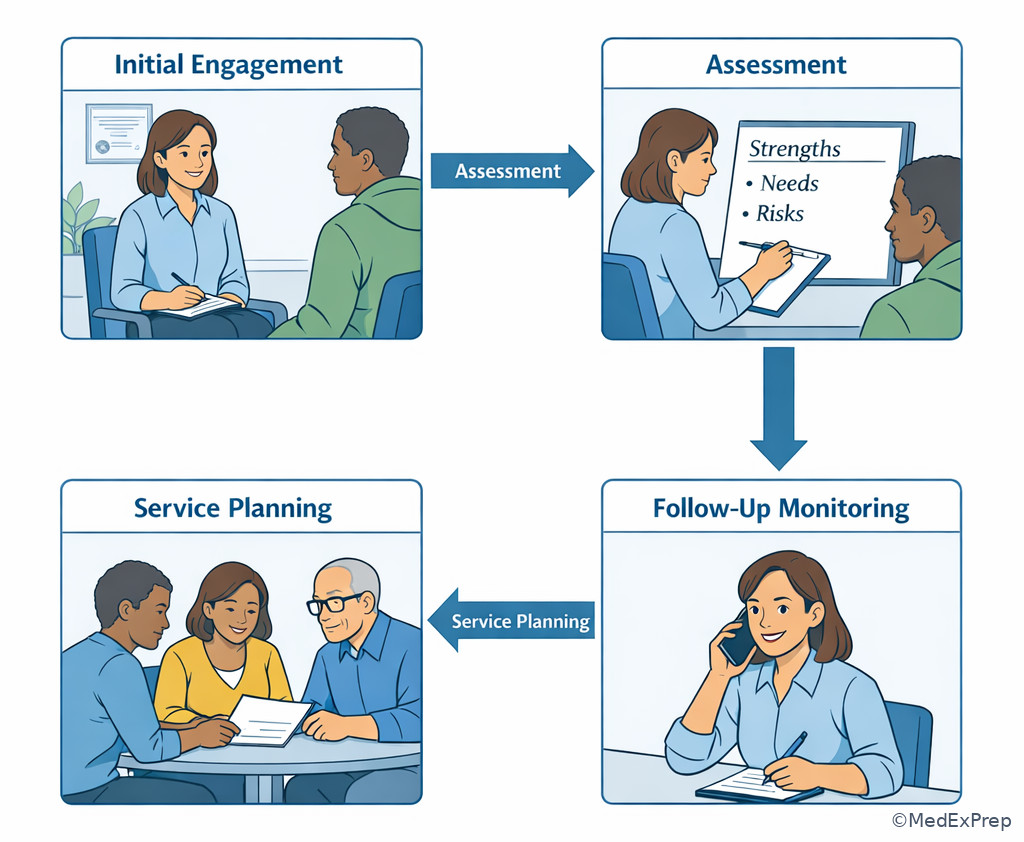
| Phase | Primary task | Common exam verbs | Wrong-phase distractor |
|---|---|---|---|
| Engagement | Build rapport and explain role | begin, introduce, clarify, respond | Setting formal goals too early |
| Assessment | Gather facts and identify strengths/risks | assess, explore, gather, determine | Making a referral before understanding need |
| Planning | Develop goals and select options | plan, prioritize, collaborate, identify | Jumping to intensive services without client input |
| Intervention | Implement services and supports | arrange, provide, educate, advocate | Reopening basic intake questions instead of acting |
| Monitoring | Review response and revise as needed | monitor, follow up, reassess, review | Terminating because one goal was met |
| Termination/transition | Prepare ending and maintain continuity | summarize, transition, close, transfer | Starting a new service plan without reason |
Core content
1.1.1.3 Foundational map: recognize the practice task before you choose an answer
A Explanation
The central decision conflict in many exam items is simple: Do you act now, or do you first clarify what task the situation requires? The single rule that resolves this is: name the current phase first. If the stem is early and facts are still thin, choose engagement or assessment. If the need is already established and options are being weighed, choose planning. If a plan already exists, choose implementation or monitoring. WHY THIS IS TESTED: exam writers know many candidates pick the most helpful-looking action rather than the phase-appropriate action.
Look for phase markers. A first meeting, unclear concern, or missing context points to engagement/assessment. A stem that says the client has agreed on goals points to planning or intervention. A stem that asks what to do after a referral failed, after attendance dropped, or after housing placement did not hold points to monitoring. If the service is ending or being transferred, think termination or transition.
Choose versus reject framing helps. Choose information gathering when the need is not yet well defined. Reject advanced problem-solving if the facts are still incomplete. Choose client-centered clarification when several interpretations are possible. Reject answers that assume motives, diagnosis, or legal conclusions beyond role. See Fig 1.
Key rule: The exam usually rewards the next correct task, not the most comprehensive long-term plan.
B Worked example
A 29-year-old client meets with a social worker at a community agency after missing rent. The client has type 1 diabetes, recently changed jobs, and is caring for a grandmother with mobility limitations. The client says, “I probably need emergency housing today,” but also reports that a cousin may allow temporary stay. A recent argument with a landlord is described in detail, and the client adds that they have been sleeping poorly. What is the most appropriate next step?
Reasoning chain: Identify task: this is an early contact with incomplete facts. Extract key facts: housing instability is present, but immediate homelessness is not yet confirmed; there may be family support; medical condition matters but is not the decision driver here; poor sleep is a distracting clue that may tempt a mental health response. Apply rule: in early phase, clarify current housing status, immediate safety, available supports, and time frame before making a major placement referral. Eliminate distractors: do not immediately arrange shelter if temporary safe housing exists and facts remain incomplete; do not begin counseling about landlord conflict as the primary next step; do not promise rental assistance that is not confirmed. Verify: the best next social work action is to assess immediate housing risk and available supports.
C Exam trap
Common wrong answer: “Arrange emergency housing immediately.”
Why it is tempting: Housing instability feels urgent, and decisive action sounds compassionate.
Single clue that eliminates it: The stem gives a possible safe temporary option with the cousin, so the immediate task is to clarify current risk and supports before selecting a placement.
D Checkpoint
Question: A client presents for the first time asking for help “getting back on track.” The client mentions eviction risk, recent job loss, and conflict with an adult sibling, but gives few specifics. Which is the most appropriate next step?
- A. Complete a focused assessment of immediate needs, strengths, risks, and available supports.
- B. Develop a written service plan with housing, employment, and family goals.
- C. Refer the client to multiple agencies immediately to speed up access.
- D. Contact the sibling to verify the client’s report.
Answer: A.
- A is tempting because it may feel less action-oriented, but it is right because the phase is still assessment and key facts are missing.
- B is tempting because goal setting seems organized, but it is wrong because planning should follow clearer assessment.
- C is tempting because referrals can help quickly, but it is wrong because referrals made before defining the problem are often mismatched.
- D is tempting because collateral can be useful, but it is wrong because there is no indication that third-party contact is yet necessary or authorized.
1.1.1.4 The helping phases: what actions belong where
A Explanation
Once you identify the phase, the next exam challenge is choosing which action belongs in that phase. The decision conflict is: Does this option match the phase, or is it borrowed from an earlier or later phase? The resolving rule is to link each phase to its typical worker task. \(Engagement = build the working relationship and clarify purpose\). \(Assessment = gather information and identify patterns\). \(Planning = set priorities and goals with the client\). \(Intervention = carry out the plan\). \(Monitoring = review what is working or not working\). \(Termination = prepare the ending and continuity\).
Questions often test this with near-miss options. For example, a planning-phase stem may include one assessment option, one intervention option, one coercive option, and one collaborative goal-setting option. The right answer is usually the collaborative option. If the stem says the client has already identified goals and consented to services, you are not still in broad assessment. If the stem says services are underway and attendance has declined, you are not at intake; you are monitoring barriers and fit.
See Fig 2 for a choose-vs-reject map. Also note the future connection: the upcoming lesson on Best Next Action Sequence will build on this by teaching what comes first when several good actions are possible.
Exam takeaway: Most distractors are phase-mismatch options, so reject answers that belong to a different point in the helping process.
flowchart TD
A[Stem clue] --> B{What phase?}
B -->|First contact or unclear facts| C[Engage or Assess]
B -->|Goals being chosen| D[Plan]
B -->|Services already underway| E[Intervene or Monitor]
B -->|Services ending or transferring| F[Terminate or Transition]
C --> G[Reject premature referral or full plan]
D --> H[Reject more broad intake unless new facts are missing]
E --> I[Reject restarting from zero unless situation changed]
F --> J[Reject opening new treatment track without reason]
B Worked example
A school social worker is supporting a 15-year-old student with frequent absences. The student has asthma, helps care for younger siblings, and recently moved between relatives’ homes. At a second meeting, the student says, “I want to graduate, but mornings are chaos.” The caregiver has already agreed to work with the school, and transportation options have been reviewed. The student also mentions failing algebra, which may tempt an academic referral answer. What is the most appropriate next step?
Reasoning chain: Identify task: not first contact; basic context is already known. Extract key facts: problem target is attendance; client has expressed a goal; caregiver is engaged; some assessment is already complete. Apply rule: this is planning moving toward intervention. The worker should collaborate on specific attendance goals and practical next steps. Eliminate distractors: repeating broad psychosocial history is too early-phase; immediately discharging after identifying the problem is too late-phase; focusing first on algebra tutoring ignores the client’s stated primary barrier. Verify: collaborative service planning around attendance is phase-appropriate.
C Exam trap
Common wrong answer: “Obtain a full academic evaluation for the failing algebra grade.”
Why it is tempting: The poor grade is concrete and school-related, so it feels like the school-based action.
Single clue that eliminates it: The client and caregiver have already identified attendance as the current target, and the stem asks for the most appropriate next step in that work.
D Checkpoint
Question: A client and social worker have completed assessment and identified transportation barriers, food insecurity, and missed medical appointments. The client says the top priority is keeping dialysis visits. Which action best fits the current phase?
- A. Ask open-ended questions about childhood experiences that may affect motivation.
- B. Collaboratively set a concrete goal and identify transportation resources for upcoming appointments.
- C. Close the case after giving the client a resource list.
- D. Wait two weeks to see whether the client solves the issue independently.
Answer: B.
- A is tempting because deeper assessment can be useful, but it is wrong because the assessment already identified the immediate barrier and priority.
- B is tempting because it is practical, and it is right because planning should now convert assessed needs into concrete collaborative steps.
- C is tempting because resource lists feel efficient, but it is wrong because the case is not yet appropriately resolved.
- D is tempting because self-determination matters, but it is wrong because passive delay is not collaborative planning.
- The phase after assessment is planning.
- True or False: A referral is always the best first step when a need is mentioned. False.
- Name the 3 middle phases of EAPIMT: Plan, Intervene, Monitor.
1.1.1.5 Assessment before intervention: when to gather more versus when to act
A Explanation
This is the most tested conflict in foundational social work items: Should you gather more information, or is it time to act? The single finding that resolves it is whether the stem already provides sufficient facts to support a safe, collaborative, within-scope next step. If not, assess. If yes, act. The exception is immediate safety risk: then protection and escalation may outrank fuller routine assessment.
Students often overlearn “always assess first.” That creates a new mistake: endless assessment when the problem is already clear. If a client has a known benefit lapse, a completed eligibility review, and transportation to the office, the next task may be helping complete a specific application rather than asking more background questions. But if the client says “I can’t cope” with no context, and answer choices include hospitalization, legal reporting, and a broad resource plan, the likely correct move is clarifying risk, precipitants, and supports.
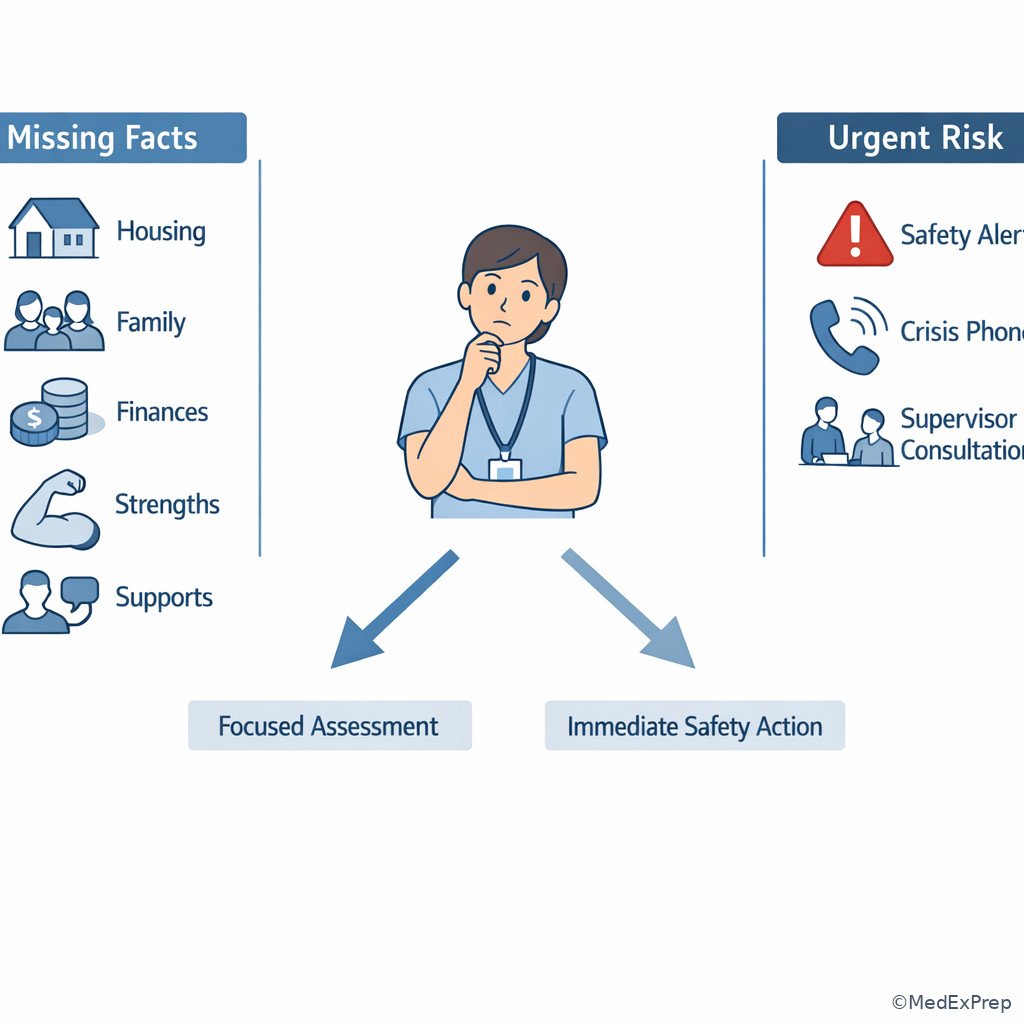
For ASWB Bachelors reasoning, ask three questions: What is known? What is missing? What risk level changes urgency? See Fig 3. In upcoming Best Next Action Sequence, you will use the same logic to rank several good actions in order.
Common pitfall: Mistaking emotional intensity for enough information. A distressed client may still require clarification before the worker selects a service response.
Exam takeaway: Choose more assessment only when essential facts are missing; once the need is clear, move forward unless immediate safety changes priority.
flowchart TD
A[Client problem appears in stem] --> B{Immediate safety concern?}
B -->|Yes| C[Safety action and follow policy]
B -->|No| D{Essential facts missing?}
D -->|Yes| E[Focused assessment]
D -->|No| F{Goal or service already identified?}
F -->|Yes| G[Plan or implement]
F -->|No| H[Collaboratively clarify priorities] Exam takeaway: Visualizing missing facts versus urgent risk helps separate routine assessment from immediate response.
B Worked example
A 41-year-old client in outpatient case management says, “I am done with everything.” The client has chronic pain, unemployment, and recent separation from a partner. The client also complains at length about a denied utility assistance application. The stem asks for the most appropriate next step. A tempting wrong answer is to help file an appeal immediately because the denial is concrete and solvable.
Reasoning chain: Identify task: the phrase “done with everything” introduces possible risk. Extract key facts: separation, unemployment, chronic pain, and hopeless wording all raise concern; utility denial is distracting but not first priority. Apply rule: when a statement suggests possible self-harm or serious safety concern, clarify risk directly before routine case-management tasks. Eliminate distractors: appealing benefits is helpful later but wrong now; offering generic emotional support without clarification is incomplete; scheduling a future visit delays safety assessment. Verify: the most appropriate next step is immediate risk-focused assessment and action per agency policy if risk is confirmed.
C Exam trap
Common wrong answer: “Assist with the utility appeal since that is the client’s practical stressor.”
Why it is tempting: Social work often addresses concrete resource barriers, and the denied application is a clear systems issue.
Single clue that eliminates it: The client’s statement suggests possible safety risk, which must be clarified before routine resource work.
D Checkpoint
Question: A case manager learns that an older adult client has missed two meal deliveries and says, “I just haven’t been up to answering the door.” The client also reports arthritis pain and recent grief after a sibling’s death. Which is the most appropriate next step?
- A. Explore immediate safety, functioning, and reasons for missed deliveries before changing the service plan.
- B. Increase meal services automatically to twice daily.
- C. Terminate services because the client is not engaging reliably.
- D. Refer for bereavement counseling without further assessment.
Answer: A.
- A is tempting because it may appear slower, but it is right because missed deliveries could reflect safety, access, mobility, mood, or preference issues that need clarification.
- B is tempting because more services seem helpful, but it is wrong because the reason for nonuse is unknown.
- C is tempting because engagement matters, but it is wrong because missed contact may signal need, not refusal.
- D is tempting because grief is relevant, but it is wrong because it jumps to a service before understanding the immediate problem.
1.1.1.6 Integration: safety, ethics, and scope can reorder the usual phase sequence
A Explanation
The helping phases are not rigid stairs. The decision conflict here is: Should you stay in the usual sequence, or does a safety/ethics/scope issue force a different immediate task? The single rule is that immediate safety, legal/ethical obligations, and scope boundaries can interrupt the ordinary order. For example, during planning or monitoring, new abuse indicators, medical instability, or imminent risk may require immediate protective action, consultation, or supervisor involvement. You do not continue ordinary goal-setting as if nothing changed.
This is especially important for bachelor’s-level exam reasoning. Your role is not to diagnose, provide advanced treatment, or give definitive legal opinions. Your role is to recognize the issue, stabilize immediate concerns within role, consult, follow policy, and document objectively. If a stem offers a bold, independent, clinically advanced option and a calmer, scoped, safety-aware option, the scoped option is usually better.
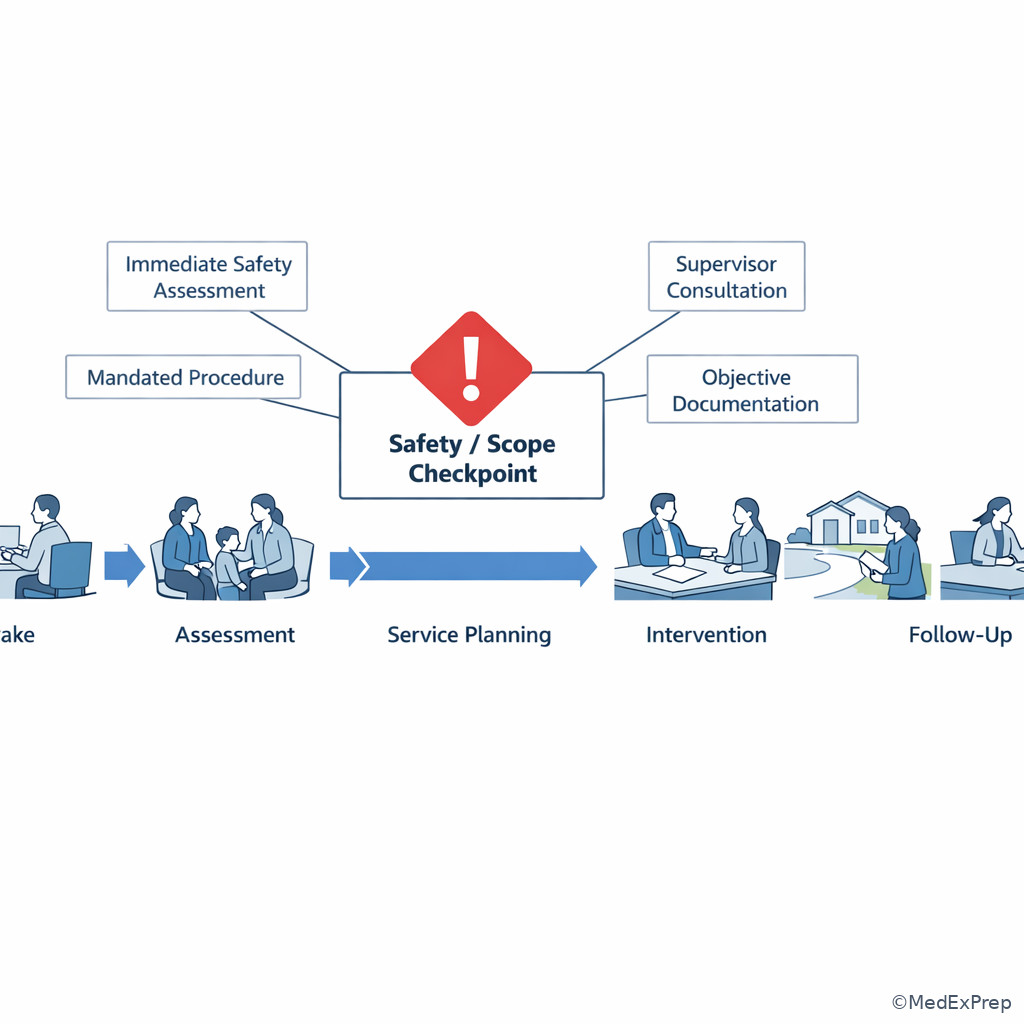
See Fig 4. This figure compresses a common exam logic: normal sequencing applies until a safety or role boundary changes the next step. This topic also connects forward to System Level Recognition, because some problems that look like individual noncompliance are actually transportation, school, agency, or benefit-system barriers.
Exam takeaway: Normal phase order applies until a safety concern or role boundary requires immediate assessment, consultation, or escalation.
flowchart LR
A[Current phase] --> B{New safety or scope issue?}
B -->|No| C[Continue phase-appropriate task]
B -->|Yes| D[Pause routine plan]
D --> E[Address immediate safety]
E --> F[Consult supervisor or follow policy]
F --> G[Document objectively]
G --> H[Return to plan when stabilized] Exam takeaway: A visual interruption cue helps you remember that risk and scope can override the standard helping sequence.
B Worked example
A residential program worker is meeting with a 17-year-old resident to review progress on school attendance and job-readiness goals. The youth has ADHD, a history of placement disruption, and recent conflict with peers. During the meeting, the youth says a staff member “gets too rough” when breaking up arguments, then shrugs and says it is “probably nothing.” The youth also asks for help replacing lost work documents. What is the most appropriate next step?
Reasoning chain: Identify task: the meeting started in monitoring/planning. Extract key facts: possible maltreatment or unsafe staff conduct is new and changes priority; the document replacement request is distracting but not first. Apply rule: when a safety or abuse concern emerges, routine goal review pauses. The worker should clarify the concern, ensure immediate safety, and follow agency policy including supervision/reporting requirements as applicable. Eliminate distractors: continuing the progress review ignores a safety issue; confronting the staff member immediately may bypass policy and investigation procedures; replacing work documents can wait. Verify: the best next action is safety-focused clarification and policy-based escalation within role.
C Exam trap
Common wrong answer: “Continue the scheduled review and note the comment for later.”
Why it is tempting: Staying on agenda feels organized, and the youth minimized the statement.
Single clue that eliminates it: A possible safety or abuse concern was disclosed, which changes the immediate task regardless of the youth’s minimization.
D Checkpoint
Question: During a routine benefits follow-up, a client says the partner has become “more controlling” and took the client’s phone last night. The client also wants help completing a food benefits renewal. Which is the most appropriate next step?
- A. Prioritize a focused safety assessment and discuss immediate options before routine paperwork.
- B. Complete the benefits renewal first to reduce financial stress.
- C. Tell the client to leave the relationship immediately.
- D. Call law enforcement without further discussion.
Answer: A.
- A is tempting because it redirects the visit, and it is right because possible interpersonal violence changes the immediate priority to safety-focused assessment.
- B is tempting because concrete assistance matters, but it is wrong because routine paperwork is no longer the priority.
- C is tempting because protecting the client matters, but it is wrong because it overrides self-determination and skips assessment and planning.
- D is tempting because it sounds protective, but it is wrong because the stem does not establish the threshold for immediate emergency reporting and the worker should first assess immediate danger and follow policy.
- The usual sequence can be interrupted by safety, ethics, or scope.
- True or False: If a client minimizes a possible abuse concern, routine planning should always continue. False.
- When new risk appears, the next task is often focused safety assessment and consultation.
1.1.1.7 Integration in real stems: a repeatable exam reasoning framework
A Explanation
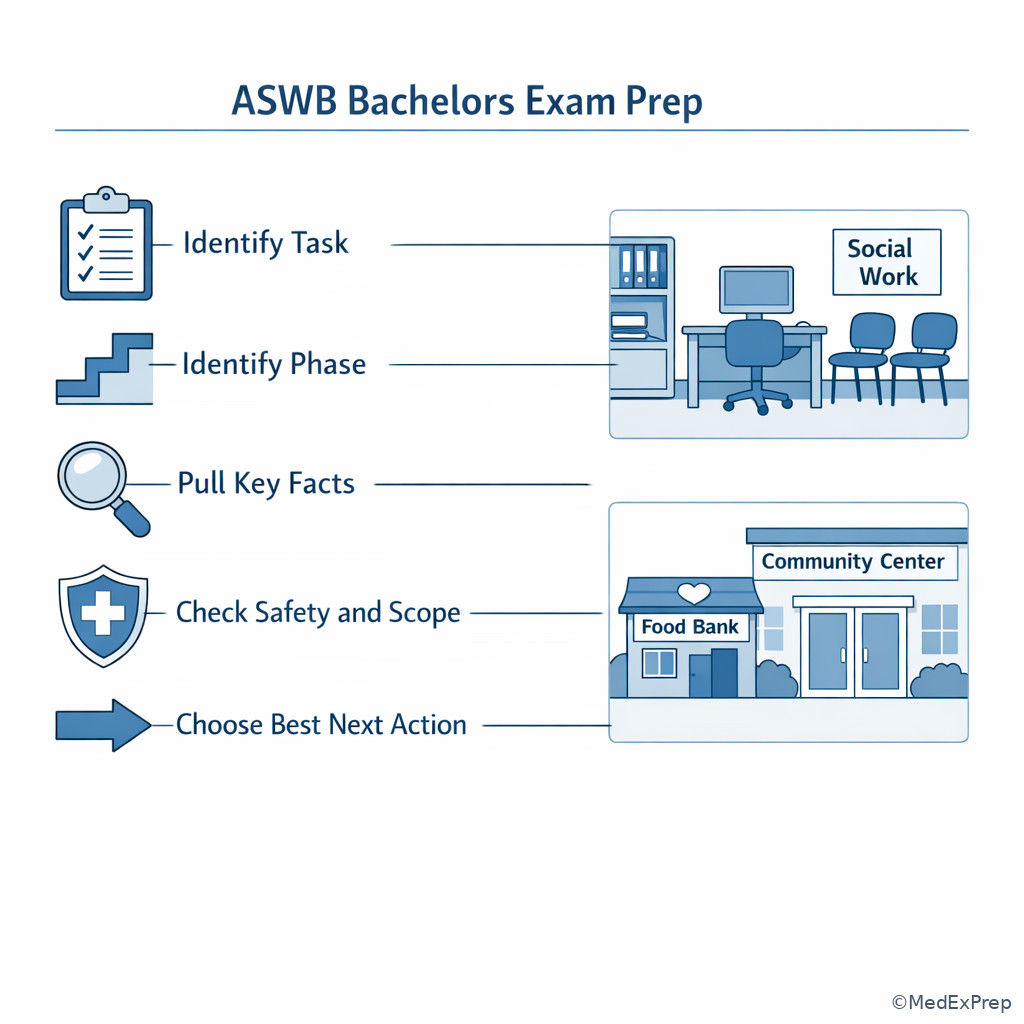
By this point, the decision conflict is no longer “What is the concept?” but How do I use it quickly under test pressure? The single rule is to run every scenario through a short framework: identify the practice task, determine the phase, extract key facts and risks, choose the least intrusive within-scope action, then verify against ethics and safety. This turns a broad social work vignette into a manageable exam task.
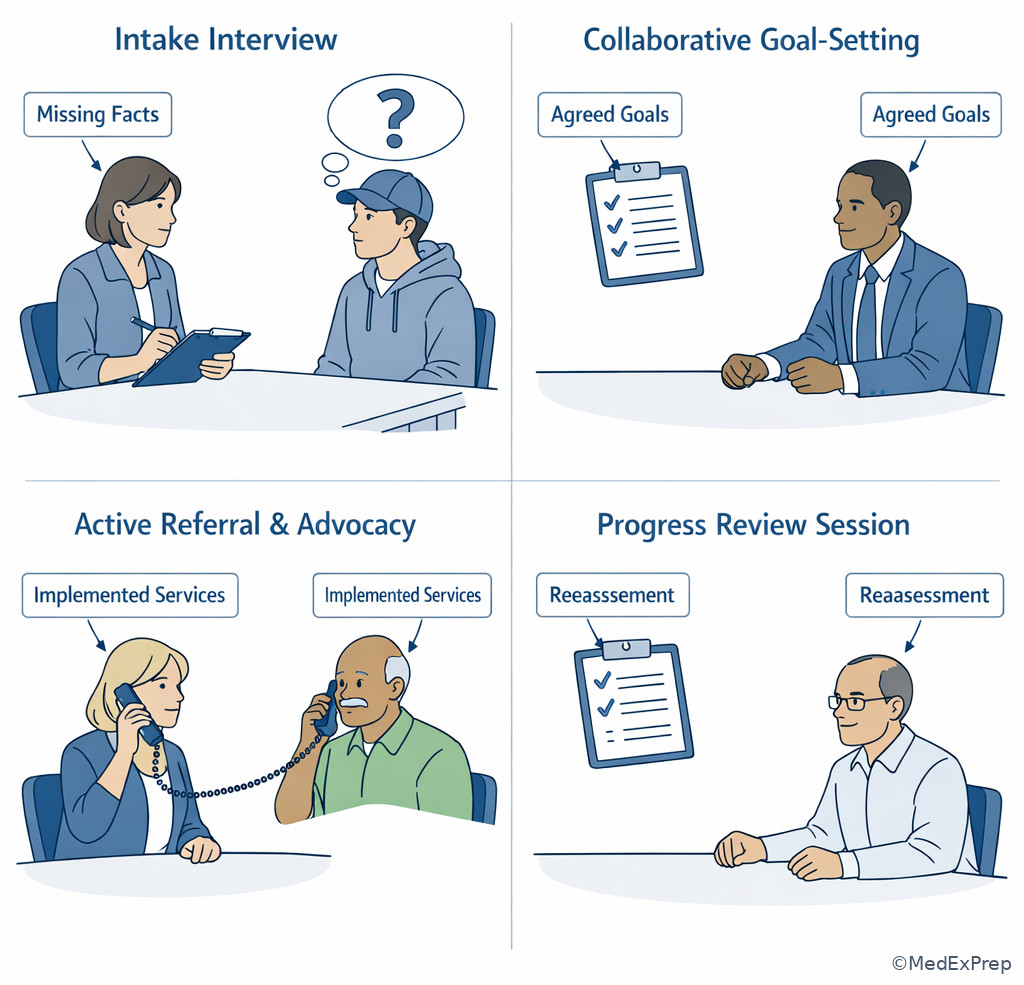
Board-style distractors often fall into four buckets: premature intervention, wrong phase, wrong provider, or ethically weak action. If an option is clinically intense, punitive, or outside role, question it. If an option assumes facts not in evidence, reject it. If an option respects self-determination but ignores safety, reject it. If an option sounds helpful but belongs to a later phase, reject it. See Fig 5.
This framework prepares you for the next topics in the section. System Level Recognition will ask whether the task belongs at the individual, family, school, agency, or community level. Best Next Action Sequence will ask which of several good actions comes first. Those lessons become much easier once practice task and phase recognition are automatic.
Exam takeaway: A fast mental checklist helps you reject wrong-phase, premature, and out-of-scope choices under timed conditions.
Exam takeaway: Comparing intake, planning, active service, and follow-up scenes improves rapid phase recognition on test stems.
B Worked example
A 36-year-old parent is referred by a pediatric clinic for missed well-child visits. The parent works nights, has no paid leave, cares for two children, and recently lost Medicaid transportation coverage. The parent says, “I know the visits matter, but I keep falling behind.” The chart notes a past episode of postpartum depression three years ago, which is a tempting but likely irrelevant clue. The clinic asks the social worker for the most appropriate next step.
Reasoning chain: Identify task: likely assessment moving into planning. Determine phase: concern has been identified, but barriers are not yet fully organized. Extract key facts: scheduling, transportation, caregiving, and employment barriers are active; old depression history is likely noise here. Apply rule: clarify present logistical barriers and strengths, then collaborate on a feasible plan such as transportation resources, scheduling supports, or clinic coordination. Eliminate distractors: sending a mental health referral based on old history is premature; warning the parent about noncompliance is punitive and weakly client-centered; demanding proof of motivation misreads a systems problem as character weakness. Verify: focused barrier assessment leading to collaborative planning is best.
C Exam trap
Common wrong answer: “Refer the parent for mental health treatment due to the history of postpartum depression.”
Why it is tempting: Mental health history stands out and offers a concrete referral pathway.
Single clue that eliminates it: The current stem centers on practical barriers to pediatric attendance, not current mood symptoms or mental health instability.
D Checkpoint
Question: A client has been receiving food assistance coordination for two months. The client says the pantry referral was helpful but the bus route changed, causing missed pickups. Which is the most appropriate next step?
- A. Reassess current transportation barriers and revise the service plan accordingly.
- B. Start the intake interview again from the beginning.
- C. Close the case because one referral already worked once.
- D. Tell the client to ask neighbors for rides before the agency does anything else.
Answer: A.
- A is tempting because it may seem repetitive, but it is right because this is a monitoring-phase problem requiring reassessment and plan adjustment.
- B is tempting because new information emerged, but it is wrong because full re-intake is unnecessary when the issue is a narrowed follow-up barrier.
- C is tempting because service episodes do end, but it is wrong because the client still has an active barrier.
- D is tempting because informal supports can matter, but it is wrong because it shifts responsibility without first collaboratively assessing options.
Exam Traps & Differentiators
Common traps & distractors: The exam frequently offers an action that would be reasonable later, by another provider, or after more assessment. Your job is to find the action that fits this exact phase, this exact level of urgency, and this exact role.
1.1.1.8 Most common wrong answer and why
The most common wrong answer in this topic is the premature intervention: referral, service plan, confrontation, or closure before the worker has clarified the task and phase. It is tempting because it sounds efficient and helpful. It is wrong because the stem is asking for the best next action, not the most ambitious action.
1.1.1.9 Looks similar but isn’t
| If the stem looks like... | Think... | Not this | Discriminator |
|---|---|---|---|
| Client presents a vague concern at first meeting | Engagement/assessment | Full service plan | Key facts still missing |
| Needs and priorities have been identified with client | Planning | Broad re-intake | Core problem already clarified |
| Referral or service is already underway | Intervention or monitoring | Start from zero | Active plan already exists |
| Client reports new danger or abuse cue during routine work | Safety assessment/consultation | Continue routine agenda | Risk changes the next task |
| Goals met and case ending is planned | Termination/transition | Open unrelated new services | Focus is continuity and closure |
1.1.1.10 If the stem says ___, think ___
- If the stem says “first meeting”, think engagement and focused assessment.
- If the stem says “the client has identified the top priority”, think collaborative planning.
- If the stem says “after two weeks of services”, think monitoring and reassessment.
- If the stem says “during routine follow-up, the client reports feeling unsafe”, think safety interrupts routine sequencing.
- If the stem says “the worker is asked what to do next after a referral failed”, think review barrier, fit, and revise plan.
- If the stem says “the case is closing”, think termination, transition, continuity, and summary.
| Trap type | Why it is tempting | What eliminates it |
|---|---|---|
| Premature referral | Action feels efficient and concrete | The problem is not yet clearly defined |
| Wrong-phase assessment | “More information” sounds safe | The stem already gives enough facts to plan or act |
| Scope leap | Independent expert action sounds decisive | Bachelor’s-level role requires consultation, coordination, or referral |
| Punitive response | Nonattendance or refusal may feel frustrating | Client-centered reassessment of barriers comes first |
| Routine action despite risk | Staying on agenda feels orderly | Safety cues immediately change the task |
Tables
| Reference summary | High-yield cue | Best next social work action |
|---|---|---|
| First contact, broad concern, little detail | Early phase | Engage and assess |
| Problem clarified, client names priority | Middle transition | Collaboratively plan |
| Referral/resource already underway | Active service | Implement or troubleshoot |
| Attendance drops, benefit denied, service not working | Follow-up problem | Monitor and revise plan |
| Goals met or case transfer approaching | Ending phase | Prepare termination/transition |
| Any phase plus imminent safety concern | Interruptor | Address safety and follow policy |
| Comparison | Assessment | Planning | Monitoring |
|---|---|---|---|
| Main question | What is happening? | What should we do about it? | Is it working? |
| Main worker action | Gather and clarify | Prioritize and choose | Review and adjust |
| Main client contribution | Describe concerns, history, strengths | Set goals and preferences | Report barriers and response |
| Typical wrong answer | Immediate full intervention | More vague intake questions | Closing the case too soon |
| Exam discriminator | Missing essential facts | Priority already identified | Service already in progress |
| Differential/classification | What the stem is really testing | Best lens |
|---|---|---|
| “Client is upset and requests help now” | Not urgency alone; often task clarification | Assessment unless risk is present |
| “Client and worker already discussed goals” | Phase transition | Planning/intervention |
| “Service has not worked as expected” | Reassessment of barriers | Monitoring |
| “Client mentions feeling unsafe during routine visit” | Priority shift | Safety-focused assessment |
| “Case will close next week” | Continuity responsibility | Termination/transition |
| “Answer choice diagnoses or prescribes” | Scope trap | Reject as beyond role |
Exam takeaway: Comparing phase-linked actions side by side reduces confusion between assessment, planning, and monitoring choices.
Algorithm / Approach
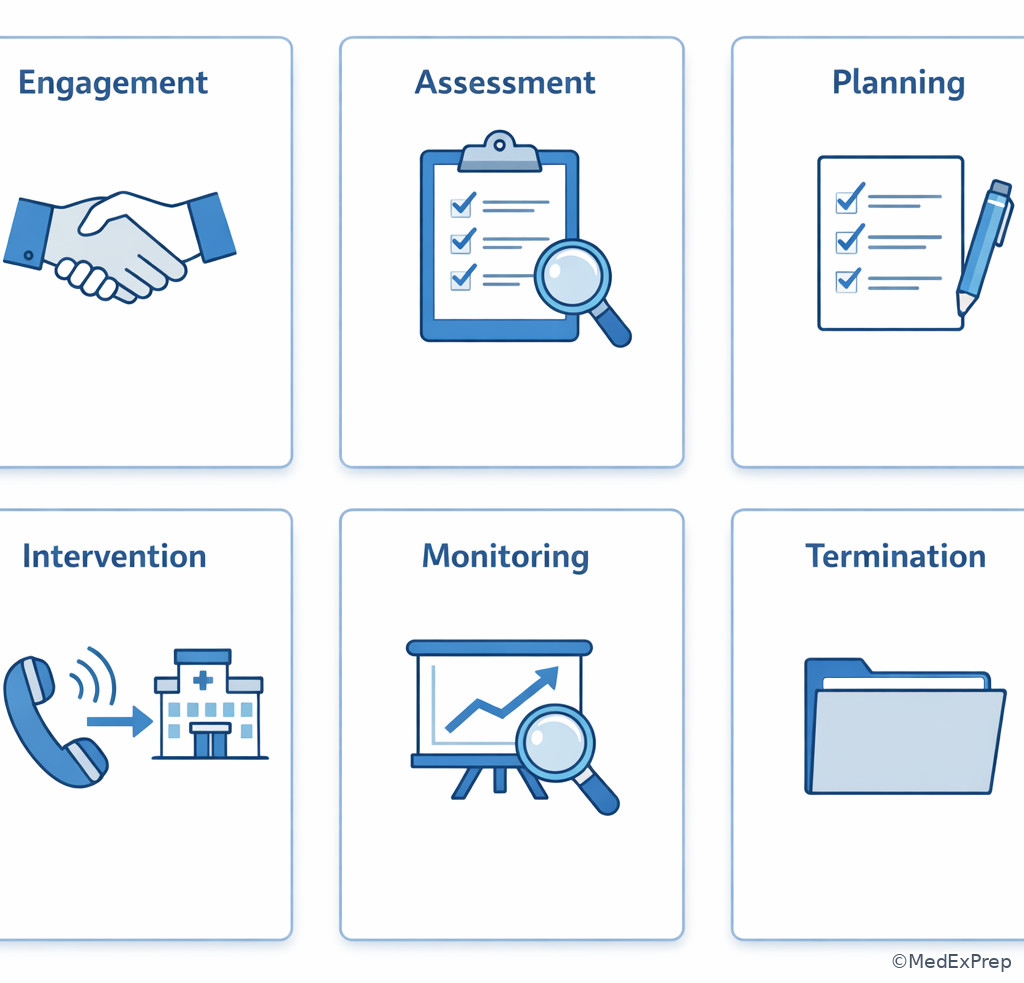
Exam takeaway: Use a fixed sequence—task, phase, safety, missing facts, action—to consistently choose the best next step.
See Fig 6. This is the core algorithm for the entire section. In the next topic, you will add a second filter: whether the barrier is mainly individual, family, school, agency, or community level.
Rapid Review
- First meeting + vague concern → assess before planning
- Client priority already stated → collaborative planning beats more broad intake
- Service already active → monitor and troubleshoot, do not restart from zero
- New abuse or safety cue → routine agenda pauses
- Helpful but advanced option → likely wrong-provider or scope trap
- Resource referral before clarification → premature action distractor
- Emotional intensity alone → not enough to skip assessment
- Concrete barrier with established goal → planning/intervention rather than exploration
- Missed appointments after services begin → monitor barriers, not punish nonadherence
- Case closing soon → transition and continuity, not new intake
- Self-determination with possible danger → safety-aware assessment first
- Best eventual solution → may be wrong if not the best next step
Self-check quiz
1.1.1.11 Question 1
A client arrives for an initial appointment and says, “Everything is falling apart,” but provides few details. The client mentions late rent, tension with a roommate, and missed work. What is the most appropriate next step?
- A. Complete a focused assessment of current needs, risks, strengths, and supports.
- B. Develop a formal service plan immediately.
- C. Close the visit by providing a general resource sheet.
- D. Contact the roommate for collateral information.
1.1.1.12 Question 2
A client and social worker have already identified transportation as the main reason for missed dialysis appointments. Which action is the most appropriate next step?
- A. Reopen the psychosocial history to search for earlier family conflict.
- B. Collaboratively identify transportation options and next appointment plans.
- C. Terminate services after giving the client a bus map.
- D. Wait to see whether the client resolves the problem independently.
1.1.1.13 Question 3
A 22-year-old client in a housing program meets with a social worker for the first time. The client has asthma, works part-time, and recently left an overcrowded family home. The client asks for help finding an apartment and casually mentions “staying wherever tonight.” The client also complains about a noisy job supervisor. What is the most appropriate next step?
- A. Explore immediate housing safety and available temporary supports before arranging routine referrals.
- B. Start a long-term employment counseling plan focused on supervisor conflict.
- C. Submit multiple apartment applications without further questions.
- D. Advise the client to return to the family home until stable housing opens.
1.1.1.14 Question 4
A school social worker has completed assessment with a 14-year-old student who has frequent absences related to caregiving demands at home and unreliable transportation. The caregiver agrees attendance is the top priority. The student also mentions wanting to join a sports team later in the year. What is the most appropriate next step?
- A. Collaboratively develop an attendance-focused plan with specific supports and follow-up steps.
- B. Shift the meeting to explore the student’s athletic interests in depth.
- C. Reassess the entire family history before making any plan.
- D. Discontinue school social work involvement until absences increase further.
1.1.1.15 Question 5
A 67-year-old client receiving meal delivery says during follow-up, “I just don’t care some days,” and has missed two recent deliveries. The client has diabetes, arthritis, and grief after a sibling’s death. The client also asks whether the worker can change the meal menu. What is the most appropriate next step?
- A. Clarify mood, functioning, and immediate safety before making routine service adjustments.
- B. Change the meal menu immediately because dissatisfaction likely caused the missed deliveries.
- C. Terminate meal services because the client is not using them consistently.
- D. Schedule a meeting next month to discuss grief resources.
1.1.1.16 Question 6
A 31-year-old parent is working with a social worker on childcare and employment goals. The parent has already completed intake, identified priorities, and begun using a transportation voucher. During a routine progress visit, the parent says a partner has started monitoring all phone calls and took the parent’s keys after an argument. The parent then asks for help updating a résumé. What is the most appropriate next step?
- A. Pause routine planning and conduct a focused safety assessment related to the partner’s behavior.
- B. Continue the employment plan first because the visit was scheduled for job support.
- C. Tell the parent to leave the partner immediately and relocate today.
- D. Call the employer to explain why the résumé update may be delayed.
1.1.1.17 Question 7
A client has been receiving community resource coordination for three months after discharge from a rehabilitation unit. The client has hypertension, limited mobility, and a daughter who helps intermittently. A previously effective transportation arrangement stopped working after a route change, and the client has now missed two therapy visits. The client also reports frustration with a neighbor. What is the most appropriate next step?
- A. Reassess the transportation barrier and revise the service plan to restore access to therapy.
- B. Start a new intake because a barrier has changed.
- C. Close the case and advise the daughter to manage transportation.
- D. Refer immediately for psychotherapy due to frustration with the neighbor.
1.1.1.18 Question 8
A residential program worker is preparing to transition a resident to a lower level of care next week. The resident has met most goals, identified a community mentor, and agreed to follow-up services. During the transition meeting, the resident reports that another resident has been threatening them at night and that staff “haven’t noticed.” The resident also asks for help replacing a lost ID. What is the most appropriate next step?
- A. Address the immediate safety concern and follow program policy before continuing transition tasks.
- B. Continue the discharge plan because the transition date is approaching.
- C. Focus on replacing the ID so the resident has documents for discharge.
- D. Delay action until the next shift can confirm the resident’s report.
Answer key
1.1.1.19 Question 1 Answer: A
- A. Tempting because it can feel less decisive than referral or planning; correct because the client is at an initial appointment with broad, unclear concerns, so assessment is the right phase. Single clue: “initial appointment” plus limited detail. Authority: NASW Code of Ethics supports competent, client-centered practice and appropriate information gathering before intervention.
- B. Tempting because service plans are practical and organized; incorrect because planning follows sufficient assessment, not vague opening statements. Single clue: the problem is not yet clearly defined. Authority: Generalist social work process texts place assessment before collaborative planning.
- C. Tempting because resource provision seems efficient; incorrect because generic resources without understanding the client’s actual situation are likely mismatched. Single clue: no specific need has yet been clarified.
- D. Tempting because collateral information can enrich assessment; incorrect because there is no indication that third-party contact is necessary or appropriate as the first step. Single clue: the worker has not yet completed direct assessment with the client.
1.1.1.20 Question 2 Answer: B
- A. Tempting because more information can feel safe; incorrect because the key barrier is already identified, so broad reopening of history is wrong-phase. Single clue: transportation is already established as the main reason for missed appointments. Authority: Standard practice sequencing moves from assessment to collaborative planning once the barrier is known.
- B. Tempting because it is concrete; correct because the case has moved into planning/intervention around a known barrier and client priority. Single clue: the main reason for missed dialysis has already been identified.
- C. Tempting because the client received a resource; incorrect because a single handoff does not complete the helping task when the barrier remains unresolved. Single clue: missed dialysis appointments are still occurring.
- D. Tempting because self-determination matters; incorrect because passive waiting is not collaborative practice when a high-priority medical access barrier is already clear. Single clue: ongoing missed dialysis creates urgency for action.
1.1.1.21 Question 3 Answer: A
- A. Tempting because it narrows the task before solving it; correct because the phrase “staying wherever tonight” raises immediate housing stability concerns that require focused clarification before routine referrals. Single clue: possible lack of safe housing tonight. Authority: Entry-level social work prioritizes immediate safety and stabilization before routine planning.
- B. Tempting because supervisor conflict may affect functioning; incorrect because it is a distracting detail, not the most urgent or central housing task in this first meeting. Single clue: the client asked for housing help and may not have safe lodging.
- C. Tempting because apartment applications feel action-oriented; incorrect because routine housing referrals come after clarifying immediate safety, supports, and constraints. Single clue: emergency status is not yet defined.
- D. Tempting because returning to family may sound practical; incorrect because it assumes safety and appropriateness without assessment. Single clue: the client recently left an overcrowded family home, which may not be a viable option.
1.1.1.22 Question 4 Answer: A
- A. Tempting because it sounds structured; correct because assessment is complete, the priority is known, and the next step is collaborative planning around attendance supports. Single clue: caregiver and student agree attendance is the top priority. Authority: Social work planning follows clarified needs and client/family priorities.
- B. Tempting because student interests matter; incorrect because sports are a later topic, not the current presenting priority identified by the client system. Single clue: attendance is explicitly named as the top priority.
- C. Tempting because family context matters; incorrect because the stem states assessment has already been completed. Single clue: “has completed assessment.”
- D. Tempting because services should be purposeful; incorrect because waiting despite a known attendance problem is not an appropriate next step. Single clue: there is already enough information to act.
1.1.1.23 Question 5 Answer: A
- A. Tempting because it delays the service request; correct because the statement “I just don’t care some days” plus missed deliveries requires clarification of mood, functioning, and safety before routine adjustments. Single clue: concerning statement plus decreased engagement. Authority: Risk-aware practice standards prioritize safety assessment when concerning statements emerge.
- B. Tempting because service fit can matter; incorrect because menu preference is not the key issue until safety and functioning are clarified. Single clue: the client’s statement raises broader concern than simple dissatisfaction.
- C. Tempting because inconsistent use can frustrate service systems; incorrect because nonuse may signal increased need, not grounds for termination. Single clue: grief and reduced functioning are present.
- D. Tempting because grief resources may help; incorrect because delaying a month skips the immediate need to assess current status and risk. Single clue: the concerning statement is current, not retrospective only.
1.1.1.24 Question 6 Answer: A
- A. Tempting because it changes the visit agenda; correct because the partner’s monitoring and taking keys suggest possible coercive control or violence risk, which interrupts routine employment planning. Single clue: controlling partner behavior affecting safety. Authority: NASW ethical obligations require attention to client safety and competent response within role; routine planning yields to immediate risk assessment.
- B. Tempting because the appointment was scheduled for employment support; incorrect because new safety information changes the immediate practice task. Single clue: the new disclosure emerged during the visit.
- C. Tempting because it sounds protective; incorrect because it is overly directive and bypasses assessment, self-determination, and safe planning. Single clue: the stem asks for the most appropriate next step, not a unilateral command.
- D. Tempting because job coordination may seem supportive; incorrect because contacting an employer is unrelated to the immediate safety concern and may raise confidentiality issues. Single clue: the current issue is partner control, not employer communication.
1.1.1.25 Question 7 Answer: A
- A. Tempting because it seems basic for a three-month case; correct because this is a monitoring-phase problem: a previously effective plan failed after circumstances changed, so the worker should reassess the specific barrier and revise the plan. Single clue: transportation was previously working and then changed. Authority: Generalist case management emphasizes monitoring outcomes and revising service plans when barriers shift.
- B. Tempting because new circumstances emerged; incorrect because a changed barrier does not require full re-intake when the overall case remains active and understood. Single clue: the client has been receiving coordination for three months.
- C. Tempting because informal supports can help; incorrect because closing the case ignores an active access barrier and shifts responsibility without collaborative problem-solving. Single clue: missed therapy visits are ongoing.
- D. Tempting because frustration with a neighbor may suggest emotional stress; incorrect because it is the distracting detail, not the service barrier causing missed therapy. Single clue: route change and missed visits identify the actual practice task.
1.1.1.26 Question 8 Answer: A
- A. Tempting because it disrupts a nearly completed transition; correct because a resident reporting threats at night presents an immediate safety concern that takes priority over routine discharge tasks. Single clue: current threat by another resident. Authority: Entry-level practice standards prioritize immediate safety and policy-based response over routine transition work.
- B. Tempting because discharge timing matters; incorrect because transition planning cannot proceed normally when a new safety issue is disclosed. Single clue: the report concerns present nighttime threats.
- C. Tempting because identification is important for transition; incorrect because document replacement is not the immediate priority once a safety concern is disclosed. Single clue: the lost ID is secondary to the threat report.
- D. Tempting because confirmation can matter in institutions; incorrect because waiting delays response to a possible active safety risk. Single clue: the threat is described as current and ongoing.
Keep going with the full ASWB Bachelors Prep Course (ASWB Bach)
You just studied the way members do, in the same lesson interface. Full access unlocks every lesson, the question bank and flashcards for a full year.
One payment · 1 year of access · No auto-renewal