1.1.1 - Advanced Generalist Scope
1.1.1 Advanced Generalist Scope
What you’ll learn
- Define the advanced generalist social worker’s role across individuals, families, groups, organizations, and communities. PROFESSIONAL PRACTICE: Role clarity -> Scope identification
- Choose actions that stay within scope while protecting safety, ethics, and client self-determination. ETHICS: Decision-making -> Best first/next action
- Separate assessment, intervention, consultation, referral, and escalation tasks from actions reserved to other professionals or the court. PRACTICE OPERATIONS: Collaboration -> Boundary awareness
- Use a board-style reasoning framework to answer first, next, or best action questions without going outside role. EXAM REASONING: Prioritization -> Scope-safe choice
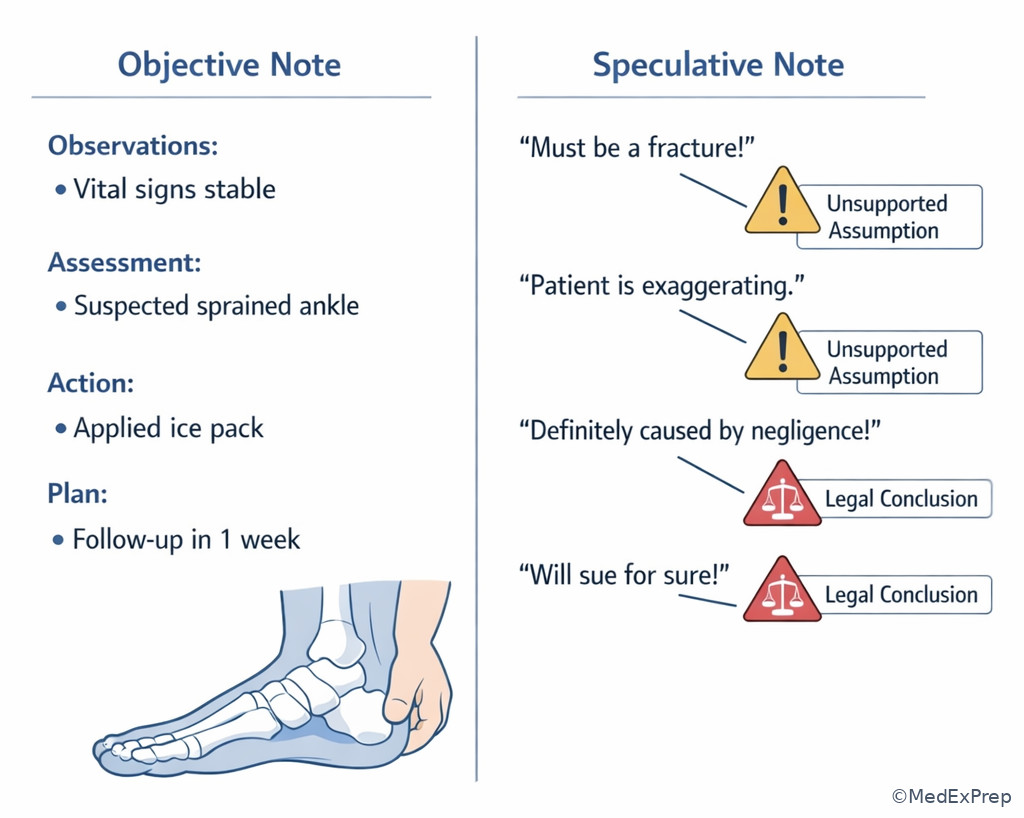
- Document and communicate role-appropriate actions objectively and promptly. DOCUMENTATION: Professional communication -> Objective record
Blueprint mapping
- PROFESSIONAL PRACTICE: Role clarity -> Identify the advanced generalist social worker’s scope across system levels
- ETHICS: Decision-making -> Select ethical, client-centered, feasible actions within authority
- RISK AND SAFETY: Prioritization -> Recognize when safety overrides routine assessment
- COLLABORATION: Consultation and referral -> Escalate or collaborate when beyond competence, authority, or setting role
- DOCUMENTATION: Professional communication -> Record actions, rationale, and follow-up without speculation
Why it matters
- Many ASWB items are not testing obscure policy; they are testing whether you stay within the social work role while still acting decisively.
- The most tempting wrong answers often sound caring, efficient, or definitive but skip assessment, ignore safety, or assume authority you do not have.
- Role clarity improves every downstream decision: consent, confidentiality, referral, crisis response, team communication, and documentation.
- On exam day, the winning pattern is usually: protect safety, clarify the task, assess within role, consult or collaborate when needed, then document.
Exam takeaway: Use this map to identify what belongs to direct social work action versus consultation, referral, or escalation.
flowchart TD
A[Client system identified] --> B{What is being asked?}
B --> C[Assess within social work role]
B --> D[Safety threat?]
D -->|Yes| E[Take protective action within role and escalate]
D -->|No| F[Clarify needs and context]
C --> G[Counseling, planning, coordination, advocacy, documentation]
F --> G
G --> H{Beyond authority or competence?}
H -->|Yes| I[Consult, refer, collaborate]
H -->|No| J[Proceed and document]
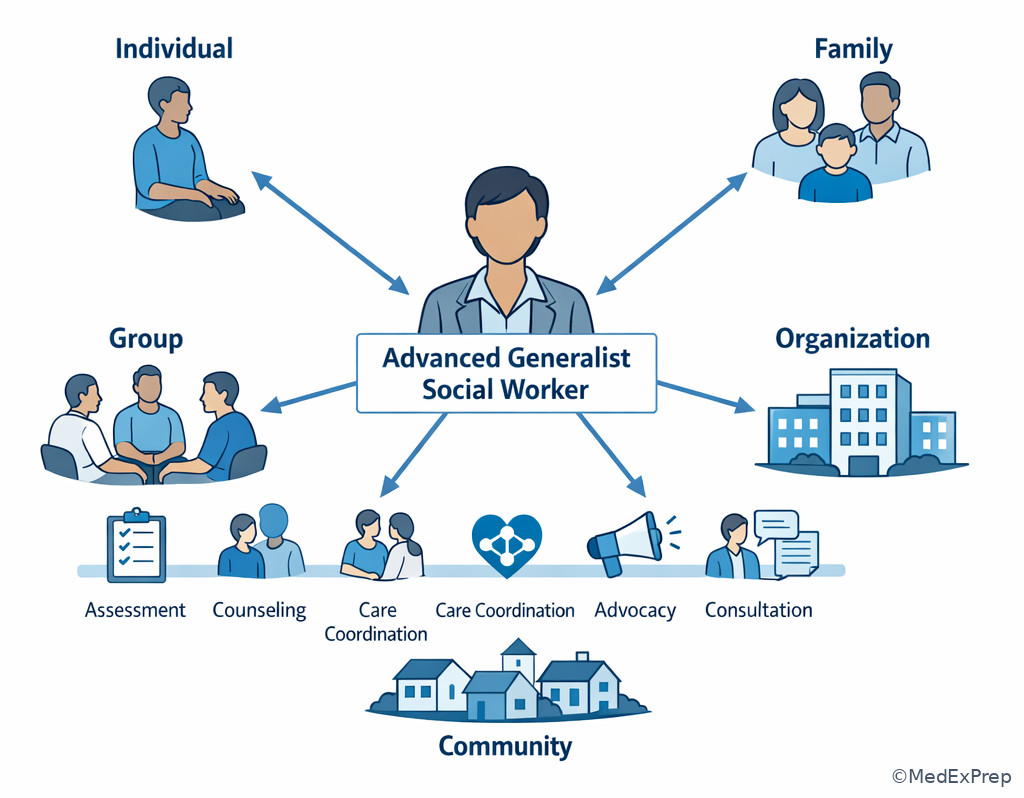
See Fig 1 for the core exam frame: not every helpful action is your action, and not every urgent-looking stem calls for the most intrusive response.
Exam takeaway: Picture the same scope principles applying whether the client system is an individual, family, team, organization, or community.
Key Terms & Must-Know Facts
1.1.1.1 Key terms
- Advanced generalist practice: Social work practice across multiple system levels and settings using broad assessment, intervention, coordination, and advocacy skills.
- Scope of practice: The range of activities permitted by role, competence, setting, supervision, ethics, and law.
- Authority: What the worker is actually permitted to do in the agency or jurisdiction.
- Competence: Knowledge and skill to perform a task safely and ethically.
- Client system: The level at which intervention is focused: individual, family, group, organization, or community.
- Least intrusive action: The safest effective response that does not exceed what is necessary.
- Immediate safety concern: Imminent risk of serious harm that must be addressed before routine planning.
- Consultation: Seeking guidance from a supervisor, colleague, or specialist when uncertainty or limits exist.
- Referral: Connecting the client to another provider or service better suited to the identified need.
- Care coordination: Organizing communication, services, and follow-up across systems.
- Collateral contact: Information obtained from others, when permitted, to support assessment or planning.
- Objective documentation: Timely, factual recording of observations, actions, statements, and rationale.
- Self-determination: Respecting the client’s right to participate in decisions unless limited by safety or legal exceptions.
- Boundary of role: The line between supportive social work functions and tasks reserved to other disciplines.
1.1.1.2 Must-know facts
- On exam items, safety comes before routine assessment, but routine uncertainty usually calls for more clarification, not more intrusion.
- The social worker may assess, counsel, educate, plan, coordinate, advocate, consult, and document within competence.
- The social worker should not diagnose medical conditions, prescribe, order medical treatment, or make legal rulings.
- If the task exceeds role, the best answer is often consult, collaborate, refer, or escalate.
- Ethically appealing is not the same as best first step; the exam rewards sequencing.
- Do not promise absolute confidentiality; explain limits when relevant.
- Document facts, risks, actions taken, consultation obtained, and plan; avoid speculation.
- Agency policy and laws vary, but the exam-safe principle is: confirm requirements and act within role.
| Domain of action | Usually within advanced generalist scope | Usually not within independent social work scope |
|---|---|---|
| Assessment | Biopsychosocial assessment, systems assessment, risk screening, strengths assessment | Medical diagnosis, specialized forensic conclusions, formal custody determination |
| Intervention | Supportive counseling, psychoeducation, safety planning, service planning, case management | Prescribing medication, performing medical procedures, court-ordered determinations |
| Coordination | Referral, care coordination, interdisciplinary communication, advocacy | Directing another profession’s licensed treatment decisions without authority |
| Documentation | Objective notes, risk documentation, plan updates, contact summaries | Speculation, altered records, legal conclusions beyond role |
| Legal/ethical action | Reporting within legal duty, consulting policy, protecting confidentiality within exceptions | Giving definitive legal advice, signing judicial orders, acting as the court |
Exam takeaway: When the need is outside social work authority, the correct move is often consultation, collaboration, or referral rather than independent action.
flowchart LR
A[Need identified] --> B{Within competence and authority?}
B -->|Yes| C[Act within role]
B -->|No| D{Urgent safety issue?}
D -->|Yes| E[Protect safety and escalate now]
D -->|No| F[Consult supervisor or team]
F --> G[Refer or collaborate with proper provider]
C --> H[Document]
E --> H
G --> H
See Fig 2 whenever an answer choice sounds useful but crosses authority lines.
Core content
1.1.1.3 Foundational role: what the advanced generalist social worker is expected to do
A Explanation
The exam often creates a decision conflict between doing something broadly helpful and doing the correct social work action. The resolving rule is simple: choose the action that fits the advanced generalist role across system levels and is feasible in the stated setting. That usually includes engagement, biopsychosocial and systems-oriented assessment, risk screening, counseling and supportive interventions, psychoeducation, service planning, resource linkage, advocacy, interdisciplinary collaboration, and documentation.
WHY THIS IS TESTED: Many stems test whether you recognize social work as both a direct-practice and systems-practice role. You are not confined to “just talking,” but you are also not authorized to do everything that might improve the situation. The exam rewards answers that identify the client system first: Is the target an individual, family, group, organization, or community? Once that is clear, pick the corresponding social work function.
Choose social work actions when the task is to assess psychosocial needs, identify strengths and barriers, facilitate services, support decision-making, improve coordination, or advocate for access. Reject answers that leap to medical, judicial, or specialized forensic authority. For example, in a hospital stem, arranging a family meeting, clarifying discharge barriers, screening for safety, and coordinating follow-up are within role; changing medication orders is not. In a school stem, engaging caregivers, assessing functioning, and coordinating support are within role; making disciplinary rulings by authority is not.
B Worked example
A 47-year-old client in an integrated care clinic has diabetes, depression, and recent housing instability. The client tells the social worker, “My medication makes me foggy, so I stopped it,” and asks which dose would be safer. He also reports missing work and increased conflict with his sister. Blood pressure values are mentioned in the chart, and the client says, “Maybe you can just change what I take.” The task asks for the most appropriate next step.
Reasoning chain: Identify task: this is a role/scope question disguised as a care question. Determine practice context: integrated care social work, not prescribing practice. Extract key facts: medication concern, psychosocial stressors, adherence issue, no stated imminent danger. Apply rule: assess impact, support adherence discussion, and coordinate with the prescribing provider; do not independently change medication recommendations. Eliminate distractors: directly advising a new dose is outside role; ignoring the medication concern to focus only on housing misses the immediate care barrier; sending the client to the emergency department without danger cues is overly intrusive. Verify: the best next step is to assess symptoms and barriers, encourage communication with the prescriber, and coordinate that contact.
C Exam trap
D Checkpoint
Question: A social worker in a community agency is asked by a family to explain service options for an older adult with falls, caregiver strain, and possible depression. Which action is most appropriate within advanced generalist scope?
- A. Conduct a biopsychosocial assessment, screen for safety and support needs, and coordinate referrals. Tempting because it is broad and practical; right because assessment and coordination are core social work functions.
- B. Diagnose major depressive disorder and advise the family on the correct antidepressant. Tempting because mood is part of the case; wrong because medical diagnosis and prescribing advice are outside role.
- C. Determine whether the older adult should legally lose decision-making authority. Tempting because safety concerns can raise decisional questions; wrong because legal determinations are not made by the social worker’s authority alone.
- D. Delay intervention until a physician completes all evaluations. Tempting because interdisciplinary care matters; wrong because the social worker can assess psychosocial needs and coordinate now.
Correct answer: A
1.1.1.4 Scope is shaped by competence, authority, setting, and supervision
A Explanation
Students often memorize a generic list of “social work tasks” and then miss a key nuance: scope is not just profession-wide; it is also shaped by competence, agency authority, setting, and supervision requirements. The decision conflict is whether a task sounds socially useful versus whether this social worker in this setting should do it now. The rule that resolves it: even if an action is theoretically related to social work, reject it if the stem shows insufficient competence, lack of role authority, or a need for supervision or collaboration.
WHY THIS IS TESTED: The exam wants you to avoid two extremes: under-functioning (“I can do nothing until someone else acts”) and over-functioning (“I should solve the entire problem myself”). Advanced generalist practice is broad, but it is not unlimited. When the setting narrows authority, the correct answer is often to consult a supervisor, use agency protocol, or coordinate with the designated professional.
Choose consultation when you face legal ambiguity, ethical conflict, unfamiliar specialty content, or unclear role expectations. Reject unilateral action when the task belongs to a prescriber, attorney, judge, forensic evaluator, or specialized clinician. Also reject paralysis: if a role-appropriate action is available, take it while consulting. In other words, “consult” is not an excuse to do nothing; it is a way to proceed safely within limits.
See Fig 2 for the core branch point: within competence and authority versus beyond one or both.
B Worked example
A newly hired social worker in a school-based program is working with a 15-year-old student who reports panic symptoms, conflict at home, and skipping lunch. The principal asks the social worker to determine whether the student’s parent is “psychologically unfit” and to provide a written recommendation for custody change. The student also has declining grades and one recent emergency department visit for stomach pain, which is a distracting clue toward medical overfocus. The question asks for the best response.
Reasoning chain: Identify task: respond to a request that sounds official. Determine context: school-based social work; administrative pressure present. Extract key facts: psychosocial distress is within role, legal custody determination is not. Apply rule: decline the out-of-role legal determination, provide role-appropriate assessment and support, and consult supervisor/agency policy regarding documentation and communication. Eliminate distractors: writing a custody opinion exceeds authority; refusing all involvement ignores the student’s needs; diagnosing the parent’s condition is outside role. Verify: the correct response is to clarify role limits, assess and support the student, and consult about appropriate school documentation and referral.
C Exam trap
D Checkpoint
Question: A social worker encounters a complicated confidentiality and family conflict issue that is not clearly addressed in agency orientation. What is the best next step if no immediate safety risk is present?
- A. Make an independent legal interpretation to avoid delay. Tempting because it seems decisive; wrong because uncertain legal-policy issues call for consultation, not unilateral legal judgment.
- B. Consult a supervisor and review applicable policy before taking further disclosure-related action. Tempting because it may feel slower; right because uncertainty plus no immediate danger favors consultation within role.
- C. Promise the client that nothing can ever be disclosed under any circumstance. Tempting because it seems reassuring; wrong because absolute confidentiality is inaccurate.
- D. Disclose broadly to all involved parties so everyone has the same information. Tempting because it sounds transparent; wrong because disclosure must be authorized or justified by a valid exception.
Correct answer: B
- The broadest role does not erase agency authority and competence.
- True or False: If a task is urgent, it is automatically within social work scope. False.
- Name the 4 scope filters: role, competence, authority, supervision/setting.
1.1.1.5 Safety first, but not everything urgent-looking requires the most intrusive action
A Explanation
Now move from foundation to application. The key conflict is choosing between routine clarification and protective action. The single rule that resolves it: if there is an immediate safety concern, address safety first within role; if safety is not immediate, continue assessment and choose the least intrusive appropriate step. This topic will connect directly to the upcoming lesson on Least Intrusive Action, but the scope lesson establishes the first screen: safety changes sequencing, not scope.
WHY THIS IS TESTED: ASWB-style stems frequently place emotionally intense details next to incomplete risk information. Some candidates overreact and hospitalize, report, or confront too quickly; others underreact and keep interviewing while imminent danger is present. The exam wants a calibrated response. Within scope, the social worker can conduct risk screening, assess immediacy, mobilize supervision or emergency response, engage protective supports, and document the risk rationale. The social worker should not ignore danger or perform functions reserved to emergency medical or law enforcement authorities.
Choose emergency or protective escalation when the stem shows imminent self-harm, threat to others, severe inability to maintain immediate safety, acute abuse danger, or another urgent risk requiring immediate action. Reject routine treatment planning first. If the stem lacks imminent indicators, do not jump to the highest level of intervention solely because the content is emotionally charged. The social worker’s role is to assess the threat, use policy, consult as needed, and take the least intrusive safe action.
See Fig 1 for the high-level safety branch, and see Fig 3 below for a decision tree you can use in stems.
Exam takeaway: Immediate danger changes the sequence to protection first; absence of imminence supports further assessment and least intrusive action.
flowchart TD
A[Concerning statement or behavior] --> B{Imminent risk cues present?}
B -->|Yes| C[Take protective action now]
C --> D[Consult supervisor or emergency protocol]
D --> E[Document risk, action, contacts]
B -->|No| F[Continue focused risk assessment]
F --> G[Identify supports, barriers, and plan]
G --> H[Use least intrusive appropriate intervention] B Worked example
A 62-year-old client in outpatient behavioral health with chronic pain, alcohol misuse history, and recent eviction says, “Sometimes everyone would be better off if I disappeared.” He arrives on time, denies current weapon access when first asked, and spends several minutes discussing insurance paperwork. A recent elevated glucose reading appears in the chart as distracting noise. The item asks for the most appropriate next step.
Reasoning chain: Identify task: risk prioritization within role. Determine context: outpatient setting; social worker is the immediate responder. Extract key facts: ambiguous self-harm statement, psychosocial stressors, incomplete risk data, no clear imminence yet. Apply rule: conduct focused suicide risk assessment now rather than shifting to paperwork or routine counseling. Eliminate distractors: calling emergency services immediately may be premature without imminent indicators; returning to insurance tasks ignores possible danger; promising secrecy would be unethical. Verify: the best next step is a focused, direct safety assessment, followed by protective action or further planning depending on what is learned.
C Exam trap
D Checkpoint
Question: A client states, “I can’t do this anymore,” after losing custody time with a child. The client is tearful but calm. Which action is most appropriate first for the social worker?
- A. Begin discharge planning for future support groups. Tempting because support matters; wrong because possible risk requires immediate clarification first.
- B. Conduct a focused safety assessment to determine intent, plan, means, and immediacy. Tempting because it is direct and may feel uncomfortable; right because risk screening comes before routine planning.
- C. Call law enforcement immediately based only on the statement. Tempting because the phrase sounds alarming; wrong because the stem has not yet established imminent danger.
- D. Reassure the client and avoid direct questions to preserve rapport. Tempting because rapport matters; wrong because avoiding direct assessment can miss urgent risk.
Correct answer: B
1.1.1.6 Collaboration, referral, and escalation: the right answer when the problem exceeds your role
A Explanation
Integration-level questions often hinge on this distinction: Do not stop at “outside scope”; instead, choose the best in-scope response to an out-of-scope need. The decision conflict is between passive refusal and active coordination. The resolving rule is: when the problem exceeds role, the social worker should still take the appropriate coordinating step—consult, refer, collaborate, escalate, or advocate—rather than attempting the specialty action or withdrawing completely.
WHY THIS IS TESTED: Many wrong answers are built around false binaries. Option A overreaches; Option B does nothing. The correct answer is often Option C: clarify limits, connect the right professional, and maintain continuity of care. Advanced generalist practice includes interdisciplinary bridge work. This is especially important in hospitals, schools, child welfare, behavioral health, and community agencies where multiple systems intersect.
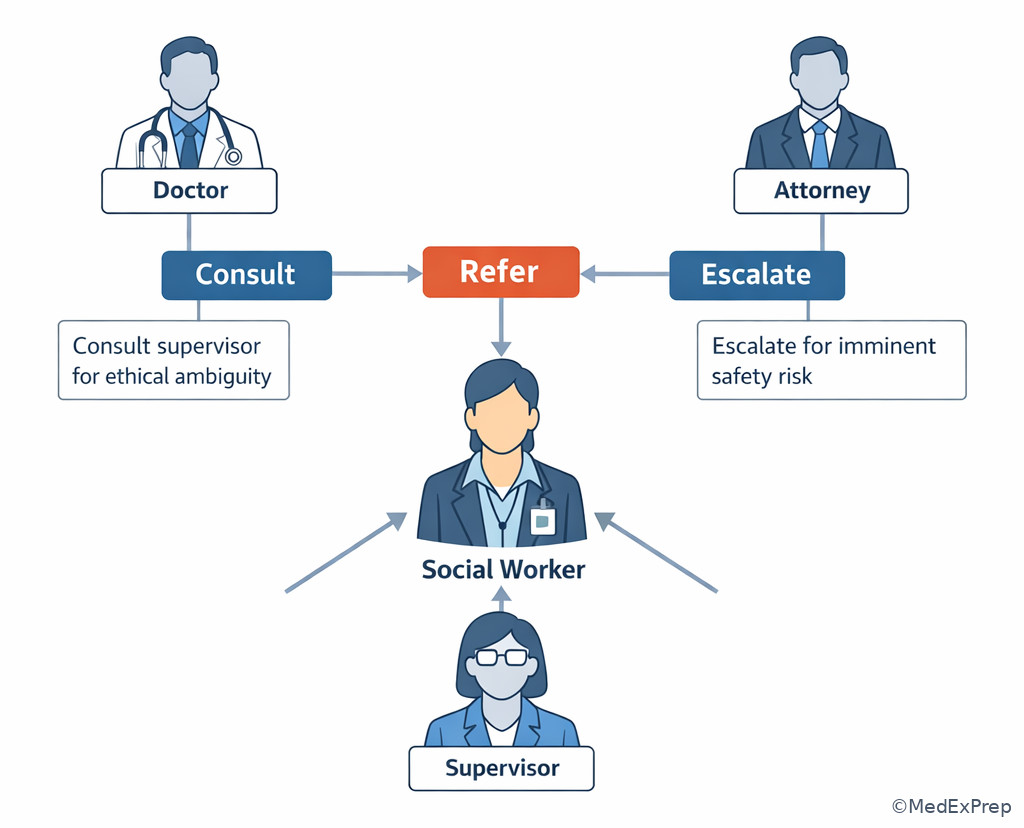
Choose referral when another discipline’s assessment or treatment is needed. Choose consultation when you remain involved but need guidance. Choose escalation when risk, legal significance, or organizational authority requires a higher-level response. Reject answers that attempt to independently resolve legal, medical, psychiatric prescribing, or court authority questions. Also reject answers that abandon the client under the guise of “not my role.” The social worker still engages, explains, coordinates, and follows up.
See Fig 4 for a practical consult-refer-escalate framework.
Exam takeaway: When a need exceeds scope, the best answer is usually active coordination to the right level of help, not independent specialty action or passive withdrawal.
B Worked example
A hospital social worker meets with a 71-year-old patient with heart failure, mild cognitive concerns, and caregiver conflict. The patient’s adult son demands that the social worker “declare him incompetent” so the son can take over finances. The chart includes medication names and ejection fraction values, which are noise for this question. The item asks for the best next step.
Reasoning chain: Identify task: respond to a demand for a legal/functional determination. Determine context: hospital social work, interdisciplinary team available. Extract key facts: possible decisional concerns exist, but the son is asking the social worker to make a legal-type authority move. Apply rule: assess psychosocial concerns, clarify role, consult team/supervisor, and coordinate appropriate evaluation rather than making the determination independently. Eliminate distractors: declaring incompetence is outside role; refusing to address concerns at all neglects the patient and family issue; transferring all decisions to the son without process violates self-determination. Verify: the best response is consultation and coordination for appropriate evaluation while continuing supportive assessment.
C Exam trap
D Checkpoint
Question: Which response best reflects advanced generalist scope when a client asks for help on an issue outside the worker’s authority?
- A. Decline any further involvement because the issue is outside scope. Tempting because it protects boundaries; wrong because social work still includes coordination and supportive follow-up.
- B. Attempt the specialty action to avoid delay in care. Tempting because it appears proactive; wrong because speed does not erase scope limits.
- C. Clarify limits, make the appropriate referral or consultation, and remain engaged around barriers and communication. Tempting because it is balanced; right because it combines role fidelity with continuity of care.
- D. Ask the client to decide entirely alone so self-determination is fully preserved. Tempting because autonomy matters; wrong because support and coordination are still part of the role.
Correct answer: C
- If a need exceeds role, the social worker should usually consult, refer, or escalate while staying engaged.
- True or False: “Outside scope” means “do nothing.” False.
- Name the three pathway verbs: consult, refer, escalate.
1.1.1.7 Documentation and communication within scope
A Explanation
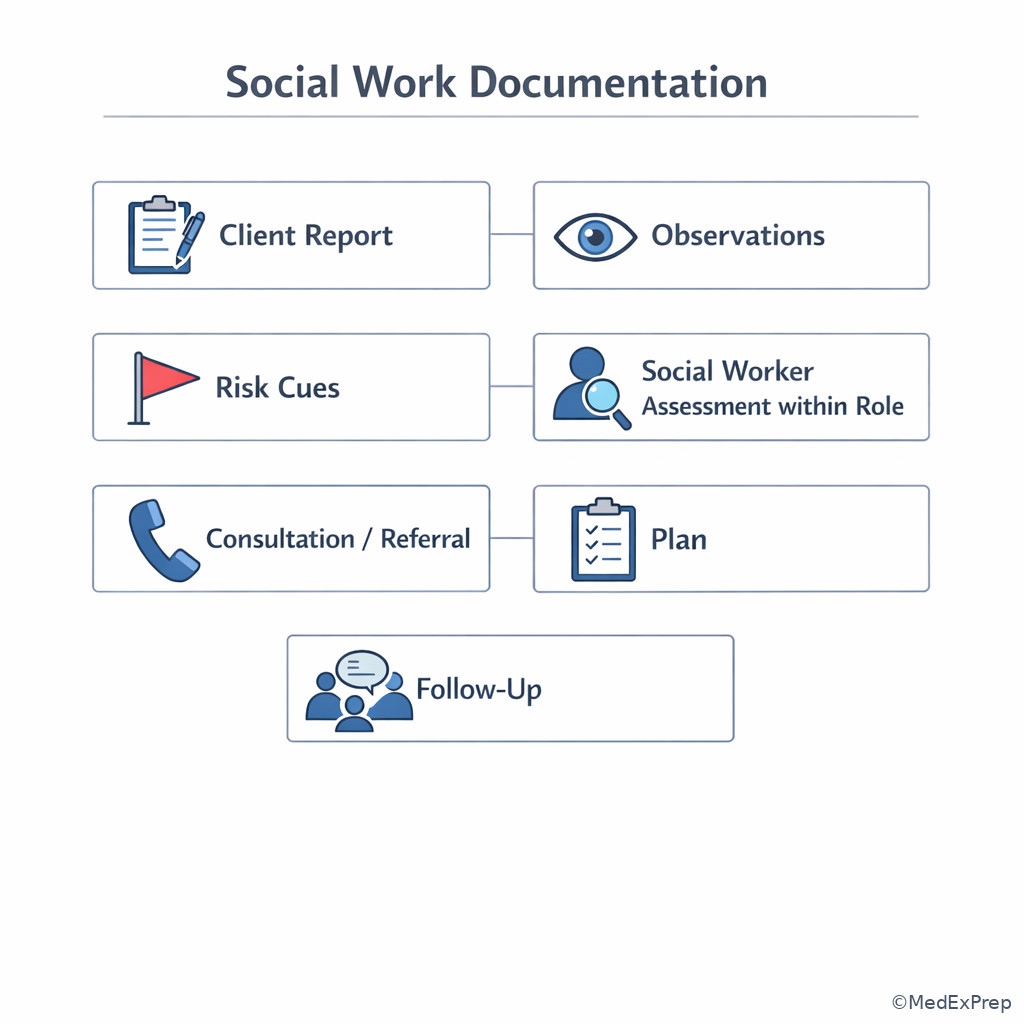
The final integration step is documentation and professional communication. The decision conflict is between being persuasive and being objective. The resolving rule: document what you observed, what was reported, what you assessed within role, what action you took, who you consulted, and what follow-up is planned. Do not document speculative diagnoses, legal conclusions, or certainty you do not have.
WHY THIS IS TESTED: Exam writers know that poor documentation often follows poor role boundaries. When a worker overreaches, notes may also overstate. Objective documentation preserves professionalism and supports continuity, safety, and accountability. Good notes are timely, relevant, neutral, and limited to needed facts. They also show your role: assessed risk, consulted supervisor, coordinated referral, informed client of limits, obtained consent when required, or followed policy.
Choose wording such as “client stated,” “observed,” “reported,” “social worker consulted,” “referral made,” and “follow-up planned.” Reject wording that attributes motives without basis, states legal conclusions as fact, or records unnecessary sensitive details unrelated to care. If jurisdiction or policy matters, note that requirements were reviewed or supervision was sought rather than pretending certainty.
See Fig 5 for a compact note-writing frame.
Exam takeaway: Document facts, role-appropriate assessment, consultation, action, and plan without speculation or unauthorized conclusions.
B Worked example
A community mental health social worker meets with a 29-year-old client with PTSD, recent job loss, and chronic migraines. The client reports, “My landlord is harassing me and I may snap,” but then denies intent to harm anyone and agrees to further discussion. The client also mentions a pending disability appeal, which is a tempting clue toward legal overdocumentation. The item asks what should be documented after the session.
Reasoning chain: Identify task: documentation choice. Determine context: behavioral health documentation within social work role. Extract key facts: threatening language was explored, no current intent established, assessment and planning occurred, legal conflict is present but not yours to decide. Apply rule: document the client’s statements, your risk assessment, consultation if obtained, interventions used, and agreed plan. Eliminate distractors: writing “client is dangerous” is speculative; documenting that the landlord definitely committed harassment is an unverified legal conclusion; omitting the concerning statement is unsafe. Verify: objective, relevant, timely documentation is the best answer.
C Exam trap
D Checkpoint
Question: Which documentation entry best fits advanced generalist scope?
- A. “Client is manipulative and probably exaggerating symptoms for benefits.” Tempting because it offers an explanation; wrong because it is speculative and pejorative.
- B. “Client stated, ‘I may snap’; denied current intent to harm self or others; social worker completed focused risk assessment, reviewed coping supports, and planned follow-up tomorrow.” Tempting because it is factual and specific; right because it documents statement, assessment, intervention, and plan objectively.
- C. “Landlord committed illegal harassment, and the client has a strong court case.” Tempting because advocacy matters; wrong because this is an unverified legal conclusion outside role.
- D. “No significant concerns discussed.” Tempting because the client denied intent; wrong because it omits clinically relevant content and assessment.
Correct answer: B
Exam Traps & Differentiators
- Most common wrong answer: Doing the correct task by the wrong profession. Why tempting: It sounds efficient and caring. Discriminator: If the action requires prescribing, medical diagnosis, legal authority, or court power, it is not the social worker’s independent action.
- Second common wrong answer: Doing nothing because the issue is “outside scope.” Why tempting: It feels boundary-safe. Discriminator: Social workers still assess, support, coordinate, consult, refer, and document.
- Third common wrong answer: Jumping to emergency action before clarifying immediacy. Why tempting: Emotional content creates urgency. Discriminator: Immediate risk changes sequence; emotional intensity alone does not.
- Fourth common wrong answer: Over-documenting conclusions instead of facts. Why tempting: Strong language feels protective. Discriminator: Objective notes record what happened, what was assessed, and what was done—not unsupported certainty.
| Looks similar | But isn’t | Single clue |
|---|---|---|
| Assessing medication adherence barriers | Changing the medication dose | Barrier assessment is in scope; dose changes require prescriber authority |
| Screening for decisional concerns | Declaring legal incompetence | Social worker may identify concerns and coordinate evaluation, not make the ruling |
| Focused suicide risk assessment | Immediate involuntary hospitalization based on vague distress alone | Imminent risk must be established or strongly indicated before the most intrusive action |
| Advocacy around legal stressors | Giving definitive legal advice | Support and referral fit scope; legal conclusions do not |
| Objective note on client statement and assessment | Labeling the client with motives or certainty | Documentation should describe facts, not unsupported character judgments |
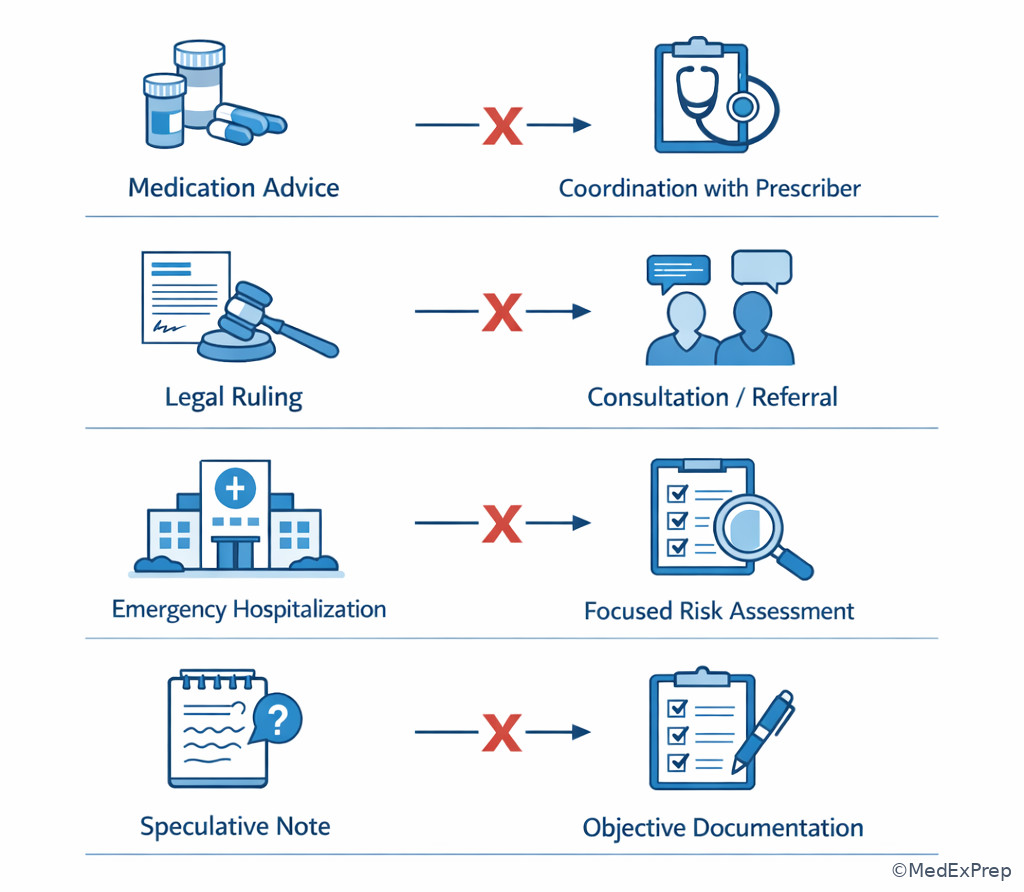
If the stem says “Which action is most appropriate within the social worker’s role,” think assess, clarify, coordinate, consult, refer, document.
If the stem says “the client asks what medication to take,” think explore concern and coordinate with prescriber.
If the stem says “administrator/family demands a legal or custody determination,” think clarify role limits and consult appropriate channels.
If the stem says “concerning statement with incomplete risk details,” think focused safety assessment first.
If the stem says “documentation choice,” think facts + assessment within role + action + follow-up.
If the stem says “outside scope,” think ahead to the upcoming topic Out-Of-Role Actions; if it says “safest effective next step,” think ahead to Least Intrusive Action.
Exam takeaway: The most dangerous distractors are the ones that are clinically sensible but assigned to the wrong professional or wrong level of urgency.
Tables
| Quick reference | High-yield rule | Best exam move |
|---|---|---|
| Task fits assessment/counseling/coordination | Usually in scope | Proceed within role and document |
| Task requires prescriber or medical authority | Outside independent scope | Coordinate with medical provider |
| Task requires legal ruling or court authority | Outside independent scope | Consult/referral through proper channels |
| Information incomplete, no immediate danger | Assessment before intervention | Clarify and gather key facts |
| Imminent danger present | Safety overrides routine sequencing | Protective action and escalation within role |
| Legal or policy ambiguity | Laws and agency policies vary | Consult supervisor/policy and confirm requirements |
| Action type | Choose when | Reject when | Monitor/document |
|---|---|---|---|
| Independent social work action | Issue is within role, competence, and authority | Specialty/legal/medical authority is required | Assessment, intervention, response, plan |
| Consultation | Ethical, legal, clinical, or role ambiguity exists | Used as a delay tactic in an emergency | Who was consulted, why, recommendations |
| Referral | Another professional is needed for specialized care | The social worker can fully handle the issue already | Referral details, barriers, follow-up plan |
| Escalation | Immediate safety risk or authority threshold is met | No imminent danger and less intrusive assessment is available | Risk cues, contacts, actions, timing |
| Scenario type | Most likely correct response | Common wrong answer | Discriminator |
|---|---|---|---|
| Client asks which psychiatric medication is best | Assess concern and coordinate with prescriber | Advise dose/class change | Medication selection is not the social worker’s independent function |
| Family demands custody or incompetence opinion | Clarify role and coordinate proper evaluation/consultation | Issue the determination | Legal authority is missing |
| Client makes concerning but unclear self-harm comment | Focused risk assessment first | Ignore or hospitalize immediately | Need to determine imminence |
| Agency policy unclear on disclosure issue | Consult supervisor and policy | Make absolute promise or broad disclosure | Uncertain confidentiality questions require consultation |
| Documentation item asks what to chart | Record facts, assessment, action, plan | Speculate or label motives | Objectivity is the rule |
Exam takeaway: Good social work notes describe observations, statements, and actions rather than motives, labels, or legal conclusions.
Algorithm / Approach
Exam takeaway: The best answer usually follows the sequence of task identification, safety screen, scope check, action selection, and documentation.
flowchart LR
A[Identify task] --> B[Find client system and setting]
B --> C{Immediate safety issue?}
C -->|Yes| D[Protect and escalate within role]
C -->|No| E[Focused assessment]
D --> F{Within role and authority?}
E --> F
F -->|Yes| G[Act]
F -->|No| H[Consult or refer]
G --> I[Document]
H --> I
Use Fig 6 as your test-day template for nearly every foundational scope item.
Rapid Review
- Advanced generalist scope -> broad across individual to community systems, but still bounded by authority and competence
- Best first move -> identify task, client system, and setting before choosing an action
- Immediate danger -> changes sequence to protection first, not necessarily to the most extreme option
- Medication question -> assess adherence/concern and coordinate with prescriber, not dose changes
- Legal/custody demand -> clarify role and consult appropriate channels, not issue determinations
- Outside scope -> consult/refer/escalate while staying engaged, not abandon the client
- Unclear policy -> supervisor and policy review before acting, unless immediate safety risk exists
- Objective note -> quote, observe, assess, act, plan
- Speculative note -> motive labels, legal conclusions, or unsupported certainty
- Client self-determination -> preserve participation unless safety or valid legal exception limits it
- Role confusion distractor -> right clinical idea performed by wrong professional
- Least intrusive principle -> safe, effective, and no more intrusive than necessary
- Scope filter -> role + competence + authority + setting/supervision
Self-check quiz
1. A social worker in an outpatient clinic is asked by a client with anxiety, hypertension, and insomnia to recommend the “best medication to start.” The client also reports conflict at work and limited transportation. What is the most appropriate next step?
- A. Recommend a medication class based on the client’s symptoms
- B. Explore the client’s concerns and coordinate communication with the prescribing provider
- C. Tell the client to stop all current medication until a full reassessment is complete
- D. Avoid discussing the question because medication is never relevant to social work practice
2. A hospital social worker is documenting a meeting with a patient who has COPD, grief after a spouse’s death, and financial stress. The patient says, “Sometimes I think my family would be better off without me,” then agrees to further assessment and denies current plan. Which documentation entry is best?
- A. “Patient is suicidal and dangerous.”
- B. “Patient manipulates staff with dramatic statements.”
- C. “Patient stated family may be better off without him; social worker completed focused risk assessment, patient denied current plan, supports reviewed, follow-up arranged.”
- D. “No significant concerns today because no plan was reported.”
3. A school social worker is asked by a parent to write a letter stating that the other parent is mentally unfit for custody. The student has asthma, recent absences, and escalating peer conflict; the parent insists the letter is “for the child’s safety.” What is the best response?
- A. Write the letter because child safety concerns override role limitations
- B. Clarify the school social work role, assess the student’s needs, and consult appropriate channels rather than making a custody determination
- C. Refuse to speak with either parent until a judge issues a formal order
- D. Diagnose the other parent based on the reporting parent’s description and document it
4. In a community agency, a 38-year-old client with depression, alcohol misuse history, and recent job loss says, “I’m done with all this,” while discussing eviction. He is tearful, arrives sober, and then asks about rental assistance forms. Which action is most appropriate first?
- A. Complete the housing forms because eviction is the root problem
- B. Conduct a focused safety assessment before returning to case management tasks
- C. Call emergency services immediately based only on the statement
- D. Reassure the client and avoid direct risk questions to preserve rapport
5. A social worker in integrated care is asked by a physician to “just tell the patient to double the dose if symptoms continue.” The patient has chronic pain, anxiety, and transportation barriers. What is the most appropriate social work action?
- A. Relay the dose change as your own clinical recommendation
- B. Clarify that medication management comes from the prescriber, reinforce the provider’s instructions as appropriate, and assess adherence barriers
- C. Modify the instruction based on the patient’s finances and likely tolerance
- D. Ignore the conversation because all medication-related discussion is out of scope
6. A 76-year-old client in a medical setting has mild memory problems, diabetes, and a recent fall. Her daughter demands that the social worker document that the client is incompetent so the daughter can take control of all decisions immediately. The client is alert, expresses preferences, and becomes anxious when excluded. What is the best next step?
- A. Document incompetence because the daughter appears credible and safety is a concern
- B. Assess current functioning and concerns, clarify role limits, and coordinate appropriate evaluation/consultation rather than making the determination independently
- C. Transfer all discussion to the daughter to reduce the client’s stress
- D. Decline involvement entirely because decisional questions are outside social work scope
7. A behavioral health social worker learns that a client with PTSD, chronic pain, and ongoing divorce litigation says, “If my ex keeps this up, someone will pay.” The client then denies intent, denies access to weapons, and agrees to continue discussing stressors. The question asks what the social worker should do first. Which answer is best?
- A. Immediately notify the court because divorce litigation makes any threat legally actionable
- B. Conduct a focused assessment of danger to others, clarify intent/immediacy, and follow policy based on the findings
- C. Document the client as violent and terminate services
- D. Shift to coping skills only because the client denied access to weapons
8. A community social worker is supporting a client with bipolar disorder, unstable housing, and recent missed appointments. During a visit, the client asks for legal advice about an upcoming eviction hearing, requests that the social worker “tell the judge I’m competent and should keep the apartment,” and mentions stopping medication because of nausea. No imminent safety cue is present. Which is the most appropriate overall response?
- A. Provide legal advice, write the competency statement, and suggest a lower medication dose
- B. Tell the client that all three issues are outside social work scope and end the visit
- C. Clarify role limits, assess immediate psychosocial needs and medication barriers, coordinate with the prescriber, and refer for legal assistance while documenting objectively
- D. Contact the landlord directly to negotiate a binding legal agreement on the client’s behalf
Answer key
1.1.1.8 1. Question 1 — Correct answer: B
A. Tempting because the stem centers on symptoms and many learners want to be immediately helpful. Incorrect because recommending a medication class is outside independent social work scope. Single stem clue: The client asks what medication to start.
B. Tempting because it may seem less decisive than giving direct advice. Correct because the social worker can explore concerns, assess barriers, and coordinate with the prescribing provider. Single stem clue: Transportation and work conflict suggest adherence and access issues that fit social work intervention.
C. Tempting because medication side effects can justify reassessment. Incorrect because stopping all medication is also a medication-management directive outside role and may be unsafe. Single stem clue: The option independently changes treatment.
D. Tempting because it protects scope boundaries. Incorrect because medication concerns are relevant to psychosocial assessment and care coordination even if the worker does not prescribe. Single stem clue: The question asks for the next step, not whether to ignore the issue.
1.1.1.9 2. Question 2 — Correct answer: C
A. Tempting because the statement sounds alarming. Incorrect because it overstates the conclusion and skips the nuance of the assessment. Single stem clue: The patient denied current plan after further assessment.
B. Tempting because repeated dramatic language can frustrate staff. Incorrect because it is pejorative and speculative. Single stem clue: Nothing in the stem establishes manipulation.
C. Tempting because it is detailed and neutral. Correct because it includes the direct quote content, the focused assessment, the denial of current plan, and the follow-up. Single stem clue: The stem asks for the best documentation entry, not the strongest label.
D. Tempting because no current plan was reported. Incorrect because the statement remains clinically relevant and required assessment. Single stem clue: “Better off without me” cannot be charted as “no significant concerns.”
1.1.1.10 3. Question 3 — Correct answer: B
A. Tempting because child safety language can push you toward decisive action. Incorrect because safety concern does not authorize the social worker to make custody determinations independently. Single stem clue: The parent is asking for a custody letter.
B. Tempting because it may feel less forceful than advocating for the parent. Correct because it stays within school social work scope, keeps the focus on the student, and uses consultation rather than legal overreach. Single stem clue: The task belongs to legal/court authority, not the school social worker.
C. Tempting because it avoids legal risk. Incorrect because the social worker can still assess the student and respond within role even without a court order. Single stem clue: The student has current school functioning concerns.
D. Tempting because the parent sounds convinced. Incorrect because diagnosing a third party based on collateral report alone is outside role and unsupported. Single stem clue: The “other parent” is not being clinically assessed by the worker.
1.1.1.11 4. Question 4 — Correct answer: B
A. Tempting because eviction is a major stressor and practical assistance matters. Incorrect because the self-harm cue must be clarified before routine case management tasks. Single stem clue: “I’m done with all this.”
B. Tempting because direct risk assessment may feel uncomfortable or intrusive. Correct because when safety is uncertain, the first role-appropriate step is focused assessment of intent, plan, means, and immediacy. Single stem clue: Risk information is incomplete, not absent.
C. Tempting because the statement is serious. Incorrect because immediate emergency action is premature without evidence of imminent danger. Single stem clue: The client is tearful and distressed, but the stem does not yet establish immediacy.
D. Tempting because preserving rapport is important in social work. Incorrect because avoiding direct questions can miss urgent danger. Single stem clue: The scenario asks for what is most appropriate first.
1.1.1.12 5. Question 5 — Correct answer: B
A. Tempting because the physician initiated the instruction, which can make it seem safe to repeat casually. Incorrect because the social worker should not present a dose change as an independent recommendation; communication should remain clearly tied to prescriber direction and role-appropriate support. Single stem clue: The issue is medication management.
B. Tempting because it balances teamwork with role clarity. Correct because the worker can reinforce the prescriber’s plan as appropriate, assess adherence barriers, and support understanding without taking over prescribing authority. Single stem clue: Transportation barriers and chronic pain create coordination needs within scope.
C. Tempting because finances and tolerance affect adherence. Incorrect because modifying dose instructions remains outside role. Single stem clue: The option changes treatment based on the worker’s own judgment.
D. Tempting because it protects boundaries. Incorrect because integrated care social work includes communication and adherence support around prescribed plans. Single stem clue: The stem asks for the social work action, not whether to withdraw from collaboration.
1.1.1.13 6. Question 6 — Correct answer: B
A. Tempting because falls and memory problems raise legitimate concerns. Incorrect because documenting “incompetence” as a definitive determination exceeds role and overstates available data. Single stem clue: The client is alert and expresses preferences.
B. Tempting because it may seem slower than decisive family action. Correct because the social worker should assess functioning concerns, clarify limits, and coordinate appropriate evaluation or consultation rather than independently deciding capacity-like or legal issues. Single stem clue: The daughter is asking for an authority judgment the worker does not independently hold.
C. Tempting because families often provide critical support. Incorrect because excluding the client prematurely undermines self-determination and is not justified by the current facts. Single stem clue: The client becomes anxious when excluded and can express preferences.
D. Tempting because it avoids overreach. Incorrect because outside scope does not mean no involvement; assessment and coordination remain appropriate. Single stem clue: The setting is medical and interdisciplinary, which supports collaboration.
1.1.1.14 7. Question 7 — Correct answer: B
A. Tempting because litigation makes the statement feel formally significant. Incorrect because the first step is to clarify danger, intent, target, and immediacy within policy, not jump directly to court notification. Single stem clue: The question asks what to do first.
B. Tempting because it is clinically active yet measured. Correct because the client made a concerning statement, but the available details do not yet establish imminent danger; focused assessment is needed before choosing further action. Single stem clue: The client denies intent and access to weapons but still requires clarification.
C. Tempting because strong documentation can feel protective. Incorrect because labeling the client as violent is speculative, and abrupt termination is not the first step. Single stem clue: One ambiguous statement is not enough for a definitive label.
D. Tempting because coping work is relevant in PTSD treatment. Incorrect because risk-related content must be assessed before routine intervention resumes. Single stem clue: “Someone will pay” is a danger cue requiring clarification.
1.1.1.15 8. Question 8 — Correct answer: C
A. Tempting because it addresses all three requests directly and may seem highly supportive. Incorrect because it combines multiple out-of-role actions: legal advice, competency statement, and medication dosing advice. Single stem clue: The option assumes legal and medical authority the social worker does not have.
B. Tempting because it strongly protects boundaries. Incorrect because the social worker still has a role in assessment, care coordination, referral, advocacy, and documentation. Single stem clue: No imminent safety cue means there is time for appropriate supportive action.
C. Tempting because it is comprehensive but role-safe. Correct because it addresses the psychosocial and coordination tasks within scope, routes legal and medical issues to the proper channels, and preserves objective documentation. Single stem clue: The stem mixes real client needs with requests outside authority; the correct answer separates them rather than accepting or rejecting everything together.
D. Tempting because housing advocacy is part of social work. Incorrect because negotiating a binding legal agreement on the client’s behalf oversteps what the scenario supports and bypasses legal referral and client-centered planning. Single stem clue: The issue is an eviction hearing requiring legal assistance, not unilateral legal negotiation by the worker.
Keep going with the full ASWB Advanced Generalist Prep Course (ASWB Adv)
You just studied the way members do, in the same lesson interface. Full access unlocks every lesson, the question bank and flashcards for a full year.
One payment · 1 year of access · No auto-renewal