1.1.1 - Phlebotomy Scope And Duties
Phlebotomy Scope And Duties
What you'll learn
- QUALITY, PROFESSIONALISM, AND REGULATORY-AWARE PRACTICE: Objective → Scope boundaries — choose actions that are within phlebotomy duties and reject tasks that require escalation.
- PATIENT ID, PREPARATION, AND ORDERS: Objective → Safe start of collection workflow — identify what the phlebotomist may verify before collecting a specimen.
- SPECIMEN COLLECTION PROCEDURES: Objective → Role-linked responsibilities — connect collection tasks to patient safety and specimen integrity.
- SAFETY AND INFECTION CONTROL: Objective → Duty-based risk control — identify when the technician should stop, protect, and notify.
- QUALITY, PROFESSIONALISM, AND REGULATORY-AWARE PRACTICE: Objective → Documentation and communication — determine what must be documented and escalated when a problem occurs.
- Quality, Professionalism, and Regulatory-Aware Practice → scope-aware escalation → role boundaries, documentation, confidentiality
- Patient ID, Preparation, and Orders → pre-collection verification → matching requisition, identifiers, resolving discrepancies
- Specimen Collection Procedures → routine collection duties → venipuncture/capillary collection, labeling, tube selection, order of draw
- Safety and Infection Control → hazard prevention and response → PPE, sharps safety, exposure protocol, unsafe-stop decisions
- Specimen Integrity and Preanalytical Errors → error prevention → recognizing unacceptable specimens, contamination, and recollection needs
Why it matters
- Many exam questions are really scope questions in disguise: the correct answer is often the safest phlebotomy action, not a diagnostic or treatment decision.
- Wrong-patient collection, mislabeled specimens, and unsafe collections usually begin with role confusion before the needle is ever used.
- Knowing what you must do, what you may do, and what you must not do protects the patient, the specimen, and your certification exam score.
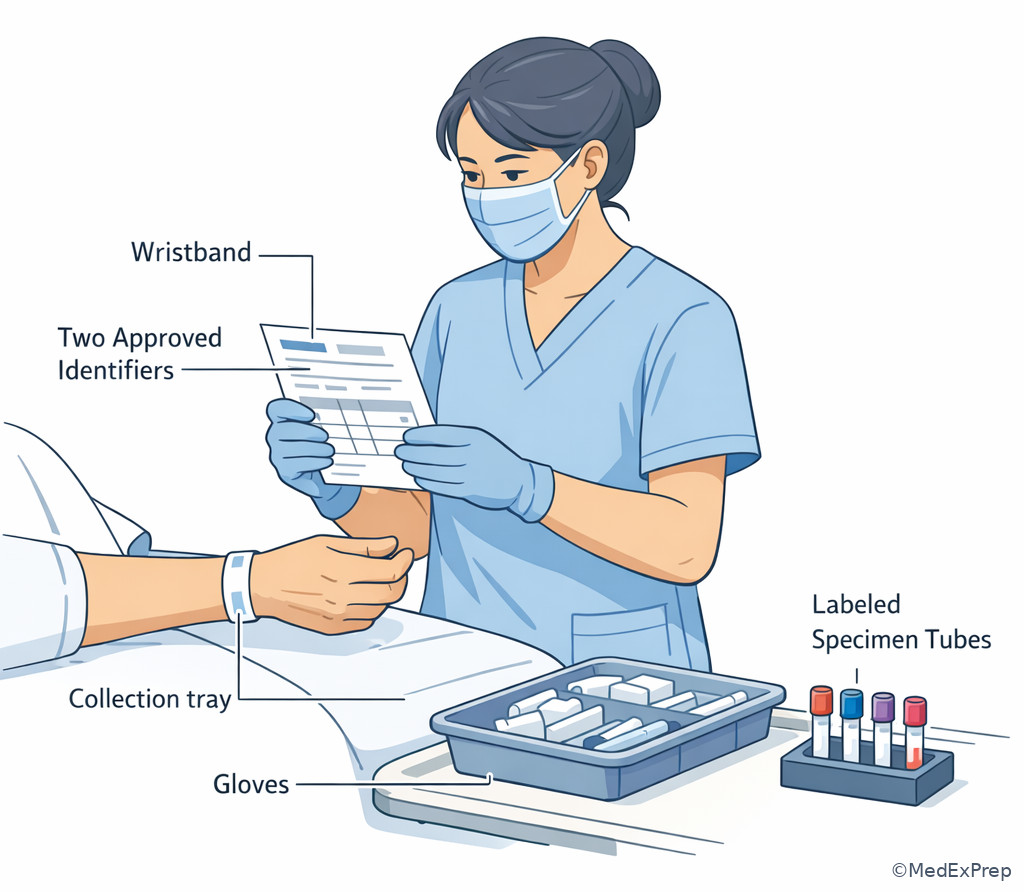
- This topic forms the decision frame for later lessons on workflow, identification, collection technique, and specimen rejection. See Fig 1.
Key Terms & Must-Know Facts
1.1.1.1 Key terms
- Scope of practice: the tasks permitted within training, policy, and role.
- Preanalytical phase: all steps before laboratory analysis.
- Requisition: authorized order information for specimen collection.
- Approved identifiers: institution-accepted patient identity elements.
- Bedside labeling: labeling in the patient’s presence at the time of collection.
- Specimen integrity: condition required for valid testing.
- Standard precautions: infection-control measures applied to all patients.
- Unacceptable specimen: sample unsuitable for testing under policy.
- Escalation: notifying appropriate staff when the issue exceeds phlebotomy authority.
- Chain of custody: documented specimen control for legally sensitive testing.
- Exposure incident: contact with blood or body fluids requiring protocol response.
- Order discrepancy: mismatch, omission, ambiguity, or conflict in the collection request.
1.1.1.2 Must-know facts
- The phlebotomy technician’s exam focus is patient safety, specimen quality, and correct procedure—not diagnosis or treatment planning.
- Never collect if patient identification cannot be resolved by approved policy.
- Never label tubes away from the patient or before collection unless policy explicitly directs otherwise for a specific setting.
- Recognizing a problem and escalating it is often the correct exam answer.
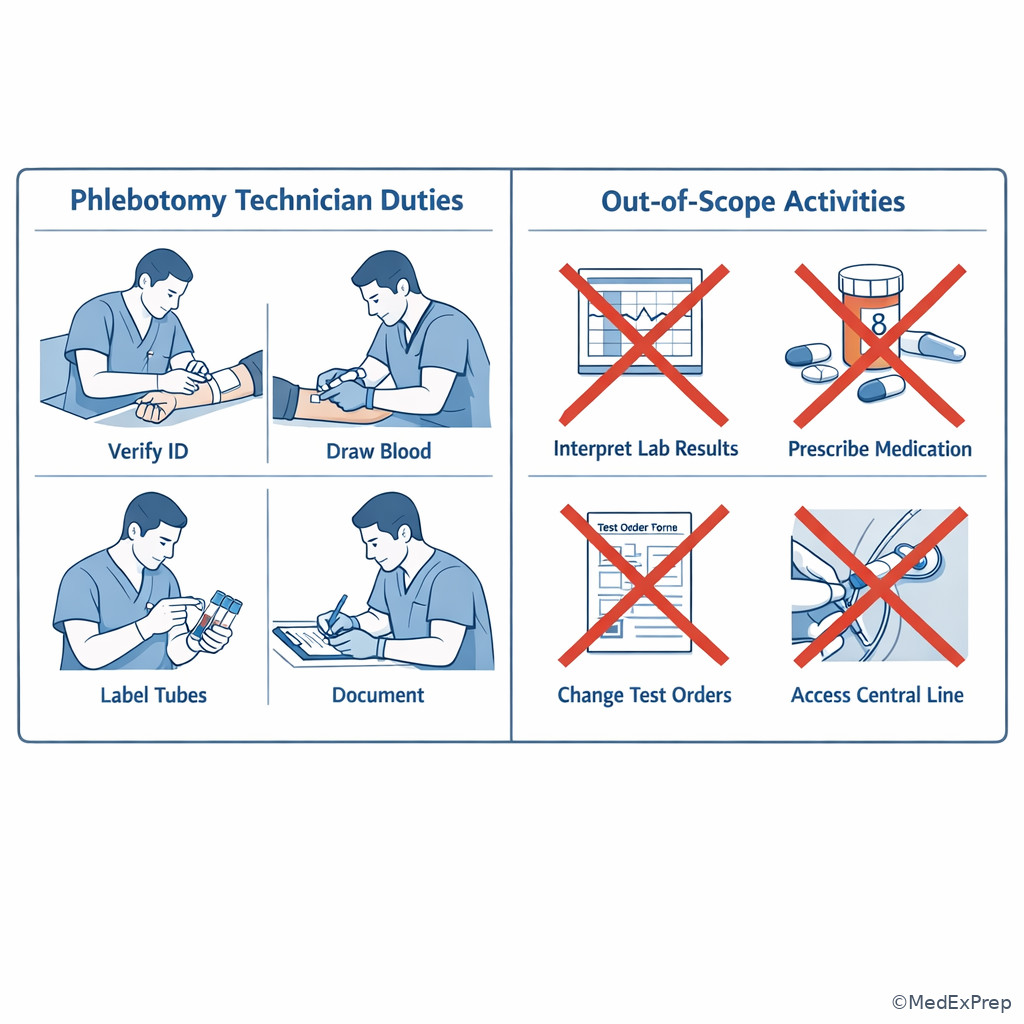
- Out-of-scope requests include interpreting results, ordering tests independently, starting IVs, and performing unauthorized line or arterial collections.
- Routine duties include verifying orders, preparing the patient, collecting appropriately, labeling accurately, handling specimens correctly, and documenting collection details.
- When patient condition becomes unsafe—syncope risk, severe distress, active bleeding, sharp injury risk—the technician should stop and follow protocol.
- Local protocols may vary; confirm with your institution or clinical site.
Exam takeaway: Start with role boundaries, then choose the safest collection, labeling, or escalation step.
flowchart TD
A[Task appears in workflow] --> B{Within phlebotomy scope?}
B -->|Yes| C{Safe and properly identified?}
C -->|Yes| D[Perform collection task per policy]
C -->|No| E[Stop and resolve safety or ID issue]
B -->|No| F[Escalate to nurse, provider, supervisor, or lab]
D --> G[Label, document, transport]
E --> F Exam takeaway: Identity verification before collection is a core duty and a frequent source of exam questions.
| Duty category | Within routine phlebotomy scope | Not within routine phlebotomy scope | Best exam action |
|---|---|---|---|
| Order and patient match | Verify requisition matches the correct patient using approved identifiers | Authorize missing or unclear orders independently | Pause and clarify discrepancy with authorized staff |
| Collection procedure | Perform routine venipuncture/capillary collection per policy | Perform unauthorized arterial or line draws | Escalate if requested task exceeds policy or training |
| Tube and handling | Select correct tubes and handle specimens properly | Override rejection criteria without authority | Notify lab/supervisor and recollect per protocol |
| Clinical interpretation | Recognize collection-related safety concerns | Interpret lab values for diagnosis or treatment | Document and refer clinical questions appropriately |
| Communication | Explain procedure, obtain cooperation, and report issues | Provide treatment advice or prescribe actions | Use professional, scope-appropriate communication |
Core content
1.1.1.3 Foundational role: what the phlebotomy technician is expected to do
A Explanation
The first exam decision is often a choose-between problem: perform the collection task versus pause because a prerequisite is missing. The single rule that resolves the conflict is this: a phlebotomy technician is responsible for the preanalytical collection process within policy. That includes verifying the order, confirming identity, preparing the patient, selecting proper equipment and tubes, collecting the specimen, labeling at the point of collection, handling/transporting correctly, and documenting what happened. It does not include independently ordering tests, interpreting results, diagnosing disease, prescribing treatment, or performing procedures outside authorized training.
WHY THIS IS TESTED: exam stems often make an out-of-scope action sound helpful or efficient. The right answer is the safest role-appropriate step, not the most medically advanced action.
Choose the option that protects specimen quality and patient safety without crossing professional boundaries. Reject any option that asks you to decide a diagnosis, change a treatment plan, or bypass identification and labeling rules. In early course topics, this role lens matters more than memorizing a thousand details because it determines the right next step in almost every workflow vignette. See Fig 2.
Exam takeaway: Know the sequence of responsibilities you own before, during, and after collection.
Exam takeaway: When the task shifts from collection workflow to diagnosis, treatment, or unauthorized procedure, escalate.
flowchart LR
A[Request received] --> B{Type of request}
B --> C[Verify order and patient]
B --> D[Perform routine blood collection]
B --> E[Label and document]
B --> F[Interpret result or diagnose]
B --> G[Start IV or access line]
F --> H[Escalate]
G --> H
C --> I[Within scope]
D --> I
E --> I B Worked example
A 67-year-old inpatient with diabetes and chronic kidney disease has a morning chemistry order. The nurse is busy, and the patient asks, “My potassium was high yesterday—should I skip breakfast and take an extra pill?” A handwritten note is clipped to the requisition, and the wristband is present. The tempting wrong clue is the abnormal lab mention, which can pull you toward interpretation. Identify task: determine the most appropriate phlebotomy action. Extract key facts: there is an order to collect, the patient is asking for treatment advice, and there may be unofficial handwritten information. Apply rule: within phlebotomy scope, verify the authorized order and patient identity, perform collection if all prerequisites are met, and do not interpret results or recommend medication changes. Eliminate distractors: giving advice about potassium or modifying treatment is out of scope; following an unclear handwritten note without authorized clarification is unsafe if it changes the order. Verify: proceed only with the authorized requisition details and refer the patient’s medication question to the nurse or provider.
C Exam trap
D Checkpoint
Question: A phlebotomy technician is asked by a provider’s assistant to draw a routine specimen, then “go ahead and tell the patient whether the result means infection.” Which action is most appropriate?
- A. Collect the specimen if properly ordered and identified, then refer result interpretation to the authorized clinician.
- B. Decline the collection because any discussion about test purpose makes the order invalid.
- C. Interpret the likely result in simple language because patient education is part of all collection visits.
- D. Change the ordered test to a more specific infection marker if the patient reports fever.
- A: tempting because it separates collection from clinical interpretation; right because it keeps the technician within scope and still completes a safe collection.
- B: tempting because it sounds cautious; wrong because the request for interpretation does not automatically invalidate an otherwise correct order.
- C: tempting because patient communication matters; wrong because interpreting what a result means is not the technician’s role.
- D: tempting because fever sounds clinically relevant; wrong because independent test selection is beyond phlebotomy authority.
1.1.1.4 Scope limits: when the correct answer is to stop and escalate
A Explanation
The second foundational conflict is keep going versus stop and escalate. The resolving rule is simple: when the task is beyond policy, beyond training, or unsafe for the patient/specimen, the phlebotomist should stop the process and notify the appropriate person. This applies to unresolved identity discrepancies, unclear or conflicting orders, requests for unauthorized line access or arterial collection, serious patient distress, and requests to interpret results or make clinical decisions.
WHY THIS IS TESTED: exam writers often present urgency, hierarchy pressure, or workflow inconvenience to see whether you will break safety rules. The safer delay is preferred over a fast unsafe collection.
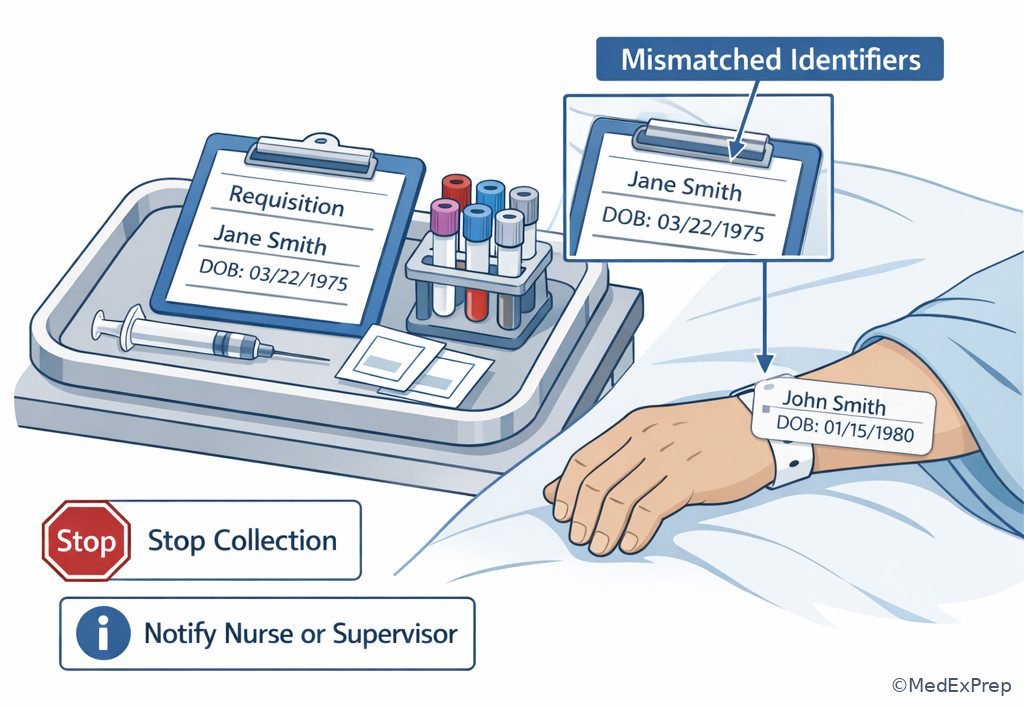
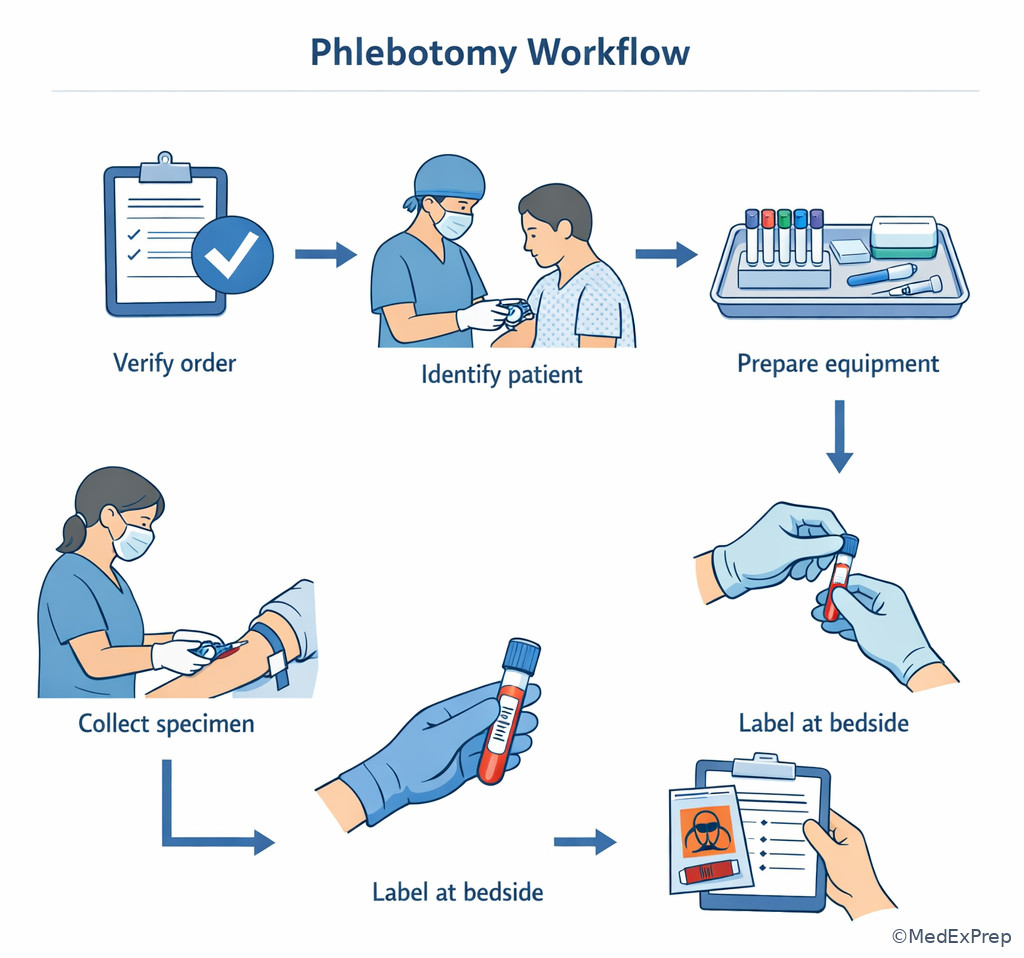
Choose escalation when a problem cannot be corrected within routine phlebotomy procedure. Reject choices that “work around” policy, such as collecting first and fixing identifiers later, drawing from a line because veins are difficult when not authorized, or accepting verbal reassurance instead of approved identification. See Fig 3. This topic also points forward to the upcoming lesson on Preanalytical Testing Workflow, where you will learn the exact sequence of verify → identify → collect → label → transport.
Exam takeaway: When identity, order, authorization, or patient safety is unresolved, stop before collection.
Exam takeaway: Pressure to hurry never overrides unresolved ID, order, authorization, or immediate safety concerns.
flowchart TD
A[Before collection] --> B{Patient identified with approved method?}
B -->|No| E[Stop and resolve]
B -->|Yes| C{Order clear and authorized?}
C -->|No| E
C -->|Yes| D{Task within policy and safe now?}
D -->|No| E
D -->|Yes| F[Proceed with collection]
E --> G[Escalate and document] Exam takeaway: A patient identification discrepancy is a stop sign, not a documentation detail to fix later.
B Worked example
An 81-year-old outpatient with COPD, heart failure, and mild confusion arrives for routine coagulation testing. He is wearing no wristband because this is an outpatient draw station. His daughter states his full name and birth date for him. The requisition is printed correctly, but the patient gives only his first name and says, “She handles all that.” A tempting wrong clue is the daughter’s confidence and the routine nature of the test. Identify task: decide whether to collect now. Extract key facts: the patient has not personally provided approved identifiers, there is no wristband, and another person is answering. Apply rule: use approved patient identification methods for that setting; do not substitute family confirmation if policy requires patient identifiers or another approved process. Eliminate distractors: collecting because the daughter knows the information is unsafe; asking the daughter to sign the tube label is irrelevant; skipping identification because the patient appears confused is not allowed. Verify: use the approved outpatient identification process or escalate if identity cannot be confirmed.
C Exam trap
D Checkpoint
Question: During morning rounds, a nurse asks the phlebotomy technician to draw blood from a central line because the patient has poor peripheral veins. The technician has not been trained or authorized for line draws. What is the most appropriate action?
- A. Perform the line draw because the nurse requested it and peripheral access is difficult.
- B. Ask the patient for verbal consent and then perform the line draw using aseptic technique.
- C. Explain that the request exceeds current authorization and notify the nurse or supervisor for an approved alternative.
- D. Flush the line first and collect a sample because it will reduce recollection.
- A: tempting because it respects urgency and team workflow; wrong because another staff member’s request does not expand your scope.
- B: tempting because it adds consent and technique; wrong because patient agreement does not authorize an unapproved procedure.
- C: tempting because it may delay care; right because scope and training limits require escalation to authorized personnel.
- D: tempting because it sounds procedural and efficient; wrong because it remains outside authorized phlebotomy duties and may violate policy.
- True or False: A verbal request from another staff member can expand phlebotomy scope. False.
- The safest action when patient identification is unresolved is to stop and resolve/escalate before collection.
- Name 3 out-of-scope signals: interpret results, authorize orders, perform unauthorized line or arterial access.
1.1.1.5 Professional communication, confidentiality, and patient rights in the phlebotomy role
A Explanation
Now move from “what can I do?” to “how should I do it?” The exam conflict here is usually obtain cooperation efficiently versus protect dignity, privacy, and rights. The resolving rule is that professional communication must support safe collection while maintaining confidentiality and respect. A phlebotomist should explain the procedure in plain language, confirm cooperation per policy, maintain privacy, and communicate calmly during anxiety, fear, or confusion. The technician should not discuss unrelated protected information, speak about one patient in front of another, or pressure a resisting patient into collection.
WHY THIS IS TESTED: communication errors can create both safety failures and professionalism failures. The best answer often combines respect with process control.
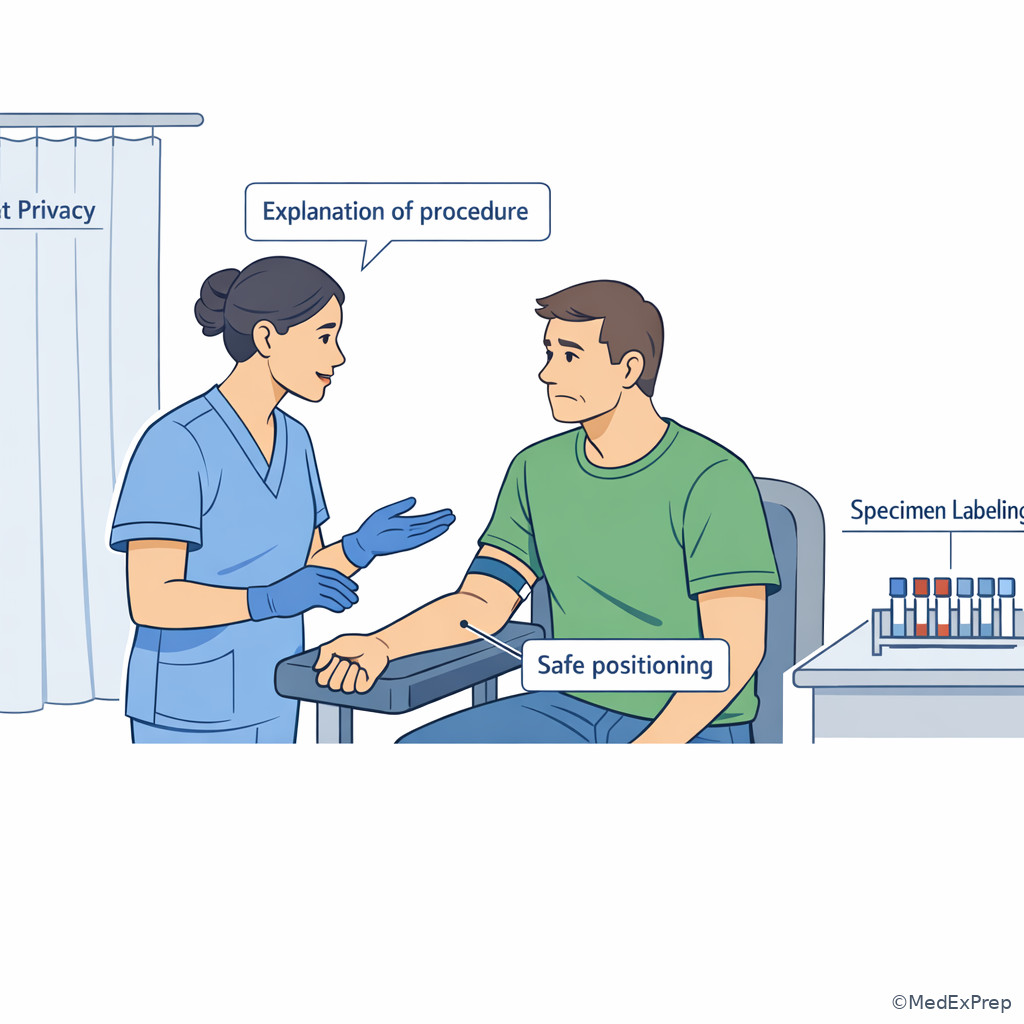
Choose options that preserve patient privacy and autonomy while keeping within the collection role. Reject options involving casual disclosure, hallway discussions of results, or coercive behavior. If a patient refuses or cannot cooperate safely, the technician should stop and notify the appropriate clinician or supervisor according to policy rather than forcing the collection. This lesson does not teach legal nuance beyond core exam-safe practice: protect confidentiality, explain what you are doing, and escalate if refusal or conflict prevents safe collection.
Exam takeaway: Explain, verify cooperation, protect privacy, and stop if safe collection cannot continue.
Exam takeaway: Professional communication reduces collection errors when it preserves dignity, privacy, and cooperation.
B Worked example
A 34-year-old outpatient with generalized anxiety disorder and a history of fainting during blood draws arrives fasting for routine testing. She asks loudly in the waiting area, “Is this for my pregnancy hormone test too?” Her partner answers additional questions for her, and another patient is seated nearby. The tempting wrong clue is the patient herself bringing up sensitive information in public. Identify task: choose the best phlebotomy response. Extract key facts: sensitive information is being discussed in a public area, the patient is anxious, and collection may still proceed if privacy and safety are restored. Apply rule: protect confidentiality and use calm, scope-appropriate explanation; move discussion to a more private setting if possible, then verify identity and proceed. Eliminate distractors: confirming the test list aloud in front of others breaches privacy; asking the partner to handle the conversation does not fix confidentiality; dismissing the patient’s anxiety undermines safety. Verify: respond professionally, maintain privacy, and monitor for syncope risk during the collection process per protocol.
C Exam trap
D Checkpoint
Question: A patient becomes upset and says, “I do not want this blood draw right now.” The order is routine and already printed. What is the most appropriate phlebotomy action?
- A. Proceed quickly before the patient changes position and makes collection harder.
- B. Stop the collection attempt, use calm communication, and notify appropriate staff per policy if refusal continues.
- C. Ask a family member to hold the patient’s arm still so the specimen can be obtained.
- D. Explain that refusal is not allowed once a provider has ordered the test.
- A: tempting because delay can disrupt workflow; wrong because proceeding without cooperation risks harm and violates patient rights.
- B: tempting because it may require extra work; right because safe collection depends on patient cooperation and professional escalation.
- C: tempting because it seems practical; wrong because restraining the patient for a routine draw is unsafe and inappropriate.
- D: tempting because provider orders carry authority; wrong because the technician should not coerce a routine collection.
1.1.1.6 Duty to prevent preanalytical error: specimen quality starts with role discipline
A Explanation
At the application level, the central conflict becomes finish the draw versus protect specimen integrity. The resolving rule is that specimen quality is part of the phlebotomist’s job from the moment the order is verified until the specimen is labeled, handled, and transported. A phlebotomist is expected to choose correct equipment and tubes, follow collection sequence rules, mix/handle tubes as required, recognize obvious unacceptable specimens, and take immediate steps to reduce preanalytical error.
WHY THIS IS TESTED: many test items describe a collection detail that seems minor but changes specimen validity. The correct answer frequently centers on prevention of contamination, hemolysis, clotting, short draw, wrong tube use, or labeling error.
Choose options that preserve specimen integrity even if they slow workflow. Reject shortcuts like filling whatever tube is available, labeling after leaving the room, or sending an obviously compromised specimen without notification. The technician does not interpret the medical significance of a result, but does recognize when the sample itself may be unsuitable. See Fig 4. This is a strong forward bridge to the upcoming lesson on Preanalytical Testing Workflow, where these duties become a stepwise collection sequence.
Exam takeaway: Every preanalytical checkpoint is part of the phlebotomist’s role, not an optional lab detail.
Exam takeaway: Most quality failures begin before analysis, so the phlebotomist’s process choices directly affect test validity.
flowchart LR
A[Correct order] --> B[Correct patient]
B --> C[Correct tube and method]
C --> D[Correct collection]
D --> E[Correct labeling]
E --> F[Correct handling and transport]
F --> G[Valid specimen]
C --> X[Wrong tube]
D --> Y[Hemolysis or clotting]
E --> Z[Mislabeled specimen]
B Worked example
A 58-year-old clinic patient with hypertension and rheumatoid arthritis is scheduled for a CBC and coagulation study. The patient is anxious, mentions a prior difficult draw, and the waiting room is busy. During setup, the technician notices that only a serum tube and one lavender tube are on the tray; the requisition includes a light blue tube test. A tempting wrong clue is the pressure to avoid sending the patient back for another stick. Identify task: determine the safest next step before collection. Extract key facts: required tube is missing, test accuracy depends on proper container, and workflow pressure is present. Apply rule: correct tube selection is part of the phlebotomist’s duty; do not substitute a wrong tube to save time. Eliminate distractors: collecting into a serum tube “for the lab to figure out” risks invalid testing; delaying labeling until after finding the right tube creates another error opportunity. Verify: obtain the correct supplies before collection or clarify/notify per policy.
C Exam trap
D Checkpoint
Question: Which action is most clearly within the phlebotomy technician’s quality-related duties?
- A. Decide whether an abnormal result is clinically significant before sending the specimen.
- B. Recognize that the wrong tube was used and notify appropriate personnel for recollection or correction per policy.
- C. Modify the ordered test to match the tube already collected.
- D. Release the specimen with no label if the patient is well known to staff.
- A: tempting because it sounds quality-focused; wrong because clinical interpretation is outside routine phlebotomy role.
- B: tempting because it may create extra work; right because recognizing and reporting preanalytical error is core phlebotomy responsibility.
- C: tempting because it avoids recollection; wrong because independent test modification is unauthorized.
- D: tempting because staff familiarity can create false confidence; wrong because unlabeled specimens violate core identification standards.
- The most common phase for laboratory error is the preanalytical phase.
- True or False: A phlebotomist may send an unlabeled specimen if the patient is well known on the unit. False.
- Name 3 phlebotomy-controlled quality threats: wrong tube, mislabeled specimen, improper handling.
1.1.1.7 Safety duties: standard precautions, sharps awareness, and unsafe-stop decisions
A Explanation
In integration questions, the conflict is often complete the task versus respond to a safety threat. The rule is that the phlebotomist’s duty includes infection prevention, sharps safety, and monitoring for collection-related complications. This means using PPE and standard precautions, disposing of sharps correctly, following exposure protocol, and stopping a collection when the patient becomes unsafe to continue—such as dizziness, fainting, uncontrolled movement, or heavy bleeding risk.
WHY THIS IS TESTED: the exam expects technicians to protect both patient and collector. Safety questions frequently hide inside routine collection stems by adding one destabilizing detail like sudden pallor, needle fear, or accidental exposure.
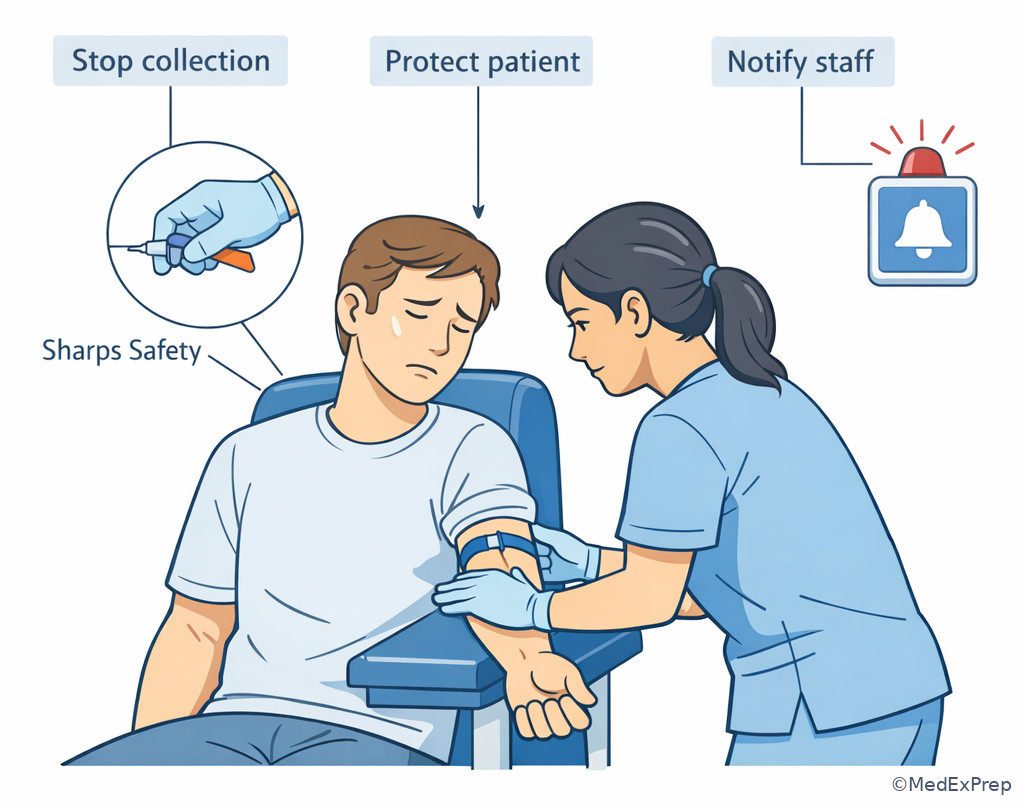
Choose the answer that first controls immediate risk. Reject options that prioritize specimen completion over immediate safety. Within phlebotomy scope, you do not diagnose the cause of syncope or manage medical treatment, but you do stop the draw, secure the patient and equipment, call for help per policy, and document the event. See Fig 5.
Exam takeaway: At the first sign of immediate risk, secure the patient and stop the unsafe part of the procedure.
Exam takeaway: When a patient shows presyncope during collection, the priority is immediate safety, not finishing the tube.
B Worked example
A 22-year-old college student with asthma and severe needle anxiety presents for routine screening. He has not eaten since early morning, jokes that he “always almost passes out,” and starts to look pale after the first tube begins filling. His hand twitches toward the needle. A tempting wrong clue is that only one tube remains and the draw is almost complete. Identify task: choose the most appropriate immediate action. Extract key facts: presyncope signs, movement toward the needle, and immediate sharps risk. Apply rule: patient safety comes before specimen completion; stop the collection and protect the patient. Eliminate distractors: finishing quickly increases injury risk; asking the patient to “hold still just a few more seconds” ignores the danger; diagnosing hypoglycemia is outside scope. Verify: follow the safety response protocol, obtain assistance, and document the event.
C Exam trap
D Checkpoint
Question: During venipuncture, a patient becomes pale and says, “I feel faint.” What is the most appropriate action within phlebotomy scope?
- A. Continue the draw while asking about the patient’s medical history.
- B. Stop the collection, ensure patient safety, and summon assistance according to protocol.
- C. Diagnose vasovagal syncope and document the diagnosis in the chart.
- D. Administer oral glucose because fasting may be the cause.
- A: tempting because more information can seem useful; wrong because immediate risk control comes before history gathering.
- B: tempting because it interrupts workflow; right because the technician’s safety duty is to stop and protect the patient.
- C: tempting because the presentation seems familiar; wrong because diagnosing the event exceeds phlebotomy scope.
- D: tempting because fasting may contribute; wrong because treatment decisions are not the routine phlebotomist’s role.
1.1.1.8 Integration: choosing the best next step when duties, quality, and scope collide
A Explanation
This final section combines the lesson into the most testable exam pattern: several answers may sound useful, but only one fits role + safety + specimen quality + policy at the same time. The resolving rule is to prioritize in this order: correct patient, correct order, correct authorization, safe collection conditions, proper specimen handling, and appropriate escalation. When a stem pushes you toward a medically advanced action, ask whether that action belongs to the phlebotomist’s role. When a stem pushes speed, ask whether any prerequisite remains unresolved.
WHY THIS IS TESTED: integration questions simulate real workflow pressure. The exam rewards the candidate who does not skip foundational safeguards when time, hierarchy, or patient emotion creates noise.
Use a simple mental script: What is my task? What facts matter? What rule governs? What must I reject? What do I do next? See Fig 6. In upcoming topics, this reasoning framework will attach to each technical step of the collection process.
Exam takeaway: The correct answer satisfies role, safety, and specimen integrity in that order.
Exam takeaway: In complex stems, patient ID and authorization outrank speed, convenience, and pressure from others.
flowchart TD
A[Need next action] --> B[Confirm patient and order]
B --> C{Any mismatch or missing authorization?}
C -->|Yes| D[Stop and escalate]
C -->|No| E{Safe to collect now?}
E -->|No| F[Protect patient and follow protocol]
E -->|Yes| G[Collect with correct tube and technique]
G --> H[Label in presence of patient]
H --> I[Handle, transport, document] B Worked example
A 76-year-old hospitalized patient with dementia, atrial fibrillation, and dehydration needs morning labs. The nurse says the patient is a “hard stick” and asks you to hurry before transport arrives. The patient’s wristband is present, but the requisition lists a room number that does not match the current room. The patient is sleepy and cannot clearly answer. A tempting wrong clue is the urgency of transport. Identify task: determine the best next step. Extract key facts: patient has a current wristband, but the order contains a discrepancy; the patient cannot reliably self-confirm; time pressure is present. Apply rule: unresolved discrepancies in patient/order information require resolution before collection. Eliminate distractors: collecting now and “fixing paperwork later” risks wrong-patient error; relying only on staff familiarity is not enough; asking transport to wait without clarifying the discrepancy still misses the central issue. Verify: stop, resolve the mismatch through approved channels, then proceed only when identification and order details align.
C Exam trap
D Checkpoint
Question: Which option best reflects the exam’s expected phlebotomy reasoning when several actions seem plausible?
- A. Choose the fastest action that avoids another needle stick, even if one identifier is missing.
- B. Choose the action that most directly protects correct patient identification, specimen integrity, and scope compliance.
- C. Choose the action that gives the patient the most complete interpretation of likely results before collection.
- D. Choose the action preferred by the highest-ranking staff member, even if local policy is unclear.
- A: tempting because efficiency and patient comfort matter; wrong because missing identification prerequisites cannot be ignored.
- B: tempting because it may seem slower; right because exam logic prioritizes identification, quality, and role-appropriate action.
- C: tempting because patient education sounds helpful; wrong because result interpretation is not the technician’s responsibility.
- D: tempting because hierarchy influences workflow; wrong because policy and safety outrank pressure from others.
Exam Traps & Differentiators
Most common wrong answer and why: the exam frequently offers a medically sophisticated answer that sounds helpful—interpreting a result, suggesting treatment, altering the order, or using an unapproved collection method. It is tempting because it seems to solve the broader clinical problem. It is wrong because the phlebotomist’s job is to protect the preanalytical process and escalate clinical or authorization issues rather than independently solving them.
| Looks similar | Actually within scope? | Why learners confuse it | Discriminating clue |
|---|---|---|---|
| Explain procedure to reduce anxiety | Yes | Can sound close to clinical counseling | Stays focused on the collection process, not diagnosis/treatment |
| Interpret what an abnormal result means | No | Feels like patient education | Requires clinical interpretation beyond specimen collection |
| Verify an order is present and matches the patient | Yes | May feel administrative rather than clinical | It is a core preanalytical safety duty |
| Change the ordered test to fit available supplies | No | Seems efficient and specimen-sparing | Alters medical orders without authority |
| Recognize an unacceptable specimen and notify staff | Yes | Can sound like laboratory interpretation | Decision is about specimen quality, not disease meaning |
| Perform a line draw when not trained/authorized | No | Requested by another clinician and may seem routine on the unit | Policy/training limit controls, not convenience |
If the stem says...
- “The patient asks what the result means” → think refer interpretation to authorized clinician.
- “The nurse asks you to use the line” → think scope/policy check first; if unauthorized, escalate.
- “Identifiers do not match” → think stop before collection.
- “Only the wrong tube is available” → think obtain correct supplies or clarify; do not substitute.
- “The patient becomes pale or dizzy” → think immediate safety action, not specimen completion.
- “Another person confirms the patient’s identity” → think use approved patient identification process, not informal reassurance.
Exam takeaway: Distinguish collection workflow responsibilities from diagnosis, treatment, and unauthorized procedures.
Related trap from upcoming topics: in Preanalytical Testing Workflow, the common error will be performing steps out of sequence; here, the trap is failing to realize that role boundaries determine whether the sequence should even continue.
Tables
| Key fact / rule | High-yield point | Why it matters on the exam |
|---|---|---|
| Verify requisition and patient before collection | Core preanalytical duty | Wrong-patient collection questions often start here |
| Label in the patient’s presence | Do not delay labeling | Mislabeled/unlabeled specimens are common distractors |
| Use correct tube and method | Do not substitute for convenience | Wrong-tube errors can invalidate testing |
| Do not interpret results | Refer clinical questions | Tests scope awareness under pressure |
| Stop for unresolved ID/order discrepancy | Resolve before collection | Safety outranks urgency |
| Stop if patient becomes unsafe | Protect patient and sharps | Specimen completion never outranks immediate safety |
| Comparison point | Routine phlebotomy action | Action requiring referral/escalation |
|---|---|---|
| Patient question | Explain the collection steps and what the patient should expect | Interpret test meaning or give treatment advice |
| Order problem | Verify that an authorized order is present and matches the patient | Authorize, create, or change the order independently |
| Collection access | Perform approved venipuncture or capillary puncture | Perform unauthorized arterial or line collection |
| Specimen issue | Recognize wrong tube, short draw, clotting, labeling error | Override rejection criteria without authority |
| Patient reaction | Stop, protect, summon help, document | Diagnose cause or administer treatment independently |
| Scenario type | Best first thought | Common wrong path | Discriminating rule |
|---|---|---|---|
| Patient cannot be confirmed | Stop and use approved identification process | Let family or staff familiarity substitute | No unresolved ID issue should pass to collection |
| Wrong tube on tray | Get correct supplies before draw | Collect anyway to avoid another stick | Container selection is part of specimen validity |
| Request to interpret a result | Refer question to authorized clinician | Offer likely meaning to reassure patient | Interpretation is outside routine phlebotomy scope |
| Line draw requested by another staff member | Check authorization/policy and escalate if not allowed | Assume request equals permission | Hierarchy does not expand scope |
| Patient becomes dizzy mid-draw | Stop the unsafe procedure first | Finish quickly because almost done | Immediate safety outranks task completion |
Algorithm / Approach
Exam takeaway: The safest next step is found by moving through verification, safety, collection, labeling, handling, and documentation in order.
Rapid Review
- Scope boundary → if the action changes diagnosis, treatment, or test ordering, it is not routine phlebotomy.
- Patient ID problem → unresolved discrepancy stops collection before equipment touches the patient.
- Hierarchy pressure → requests from other staff do not override policy or authorization limits.
- Wrong tube on tray → get the correct container first; do not improvise.
- Patient question about results → answer process questions, not interpretation questions.
- Collection refusal → do not force routine collection; notify per policy.
- Presyncope during draw → immediate safety beats finishing the tube.
- Unlabeled specimen → familiarity with the patient never rescues missing identification.
- Specimen quality issue → recognizing the problem is within scope; overriding rejection is not.
- Authorized routine duty → verify, prepare, collect, label, handle, document.
- Outpatient identification → family confirmation alone is not the default substitute for approved identification methods.
- Confidentiality question → patient privacy still matters even when the patient initiates the discussion publicly.
Self-check quiz
1. EASY. A phlebotomy technician in an outpatient lab receives an authorized requisition and confirms the patient with approved identifiers. Which action is most appropriate within routine phlebotomy scope?
- A. Explain the blood collection procedure, perform the draw, and label the tubes in the patient’s presence.
- B. Decide whether a different test would be more useful based on the patient’s symptoms.
- C. Tell the patient what the likely diagnosis will be if the result is abnormal.
- D. Access a central line because it may be more convenient than venipuncture.
2. EASY. A hospitalized patient’s requisition is present, but the identifiers on the wristband do not match the order. What is the most appropriate next step?
- A. Collect the specimen and ask the unit clerk to correct the order afterward.
- B. Ask a family member to confirm the patient’s identity and proceed.
- C. Stop the collection and resolve the discrepancy using approved protocol.
- D. Label the tubes with the requisition information first to save time.
3. MEDIUM. A 70-year-old inpatient with hypertension and chronic kidney disease has a routine chemistry order. He asks, “Should I skip my medicine today if my last test was high?” The nurse is not in the room, and the requisition is otherwise correct. Which action is most appropriate?
- A. Advise the patient to hold the medication until the result returns because that is the safest choice.
- B. Collect the specimen if all collection requirements are met and refer the medication question to the nurse or provider.
- C. Delay the collection until you can explain the likely meaning of the previous result.
- D. Add another test that might better explain the abnormal value.
4. MEDIUM. A 56-year-old outpatient with obesity and rheumatoid arthritis presents for coagulation testing and CBC. The tray contains a lavender tube and a serum tube, but the required light blue tube is missing. The patient says she is a difficult draw and does not want to come back. Which action is most appropriate?
- A. Use the serum tube for the coagulation test and let the laboratory decide whether it is acceptable.
- B. Draw the lavender tube only and cancel the coagulation test yourself.
- C. Obtain the correct tube before collection or notify appropriate staff if the order cannot be completed as requested.
- D. Collect all available tubes first, then relabel one later if needed.
5. MEDIUM. A 29-year-old fasting outpatient with a history of syncope during blood draws becomes pale and says, “I’m getting dizzy,” as the first tube begins to fill. Which action is most appropriate within phlebotomy scope?
- A. Finish the remaining tube quickly so the patient does not need another venipuncture.
- B. Stop the collection, ensure patient safety, and follow the facility’s assistance protocol.
- C. Diagnose vasovagal syncope and chart the diagnosis immediately.
- D. Give the patient juice before removing the needle so the episode resolves faster.
6. HARD. A 78-year-old inpatient with dementia, atrial fibrillation, and dehydration is scheduled for morning labs before transport. The wristband shows the correct full name and date of birth, but the requisition lists a different room number from the patient’s current room. A nurse says, “It’s the same patient; rooms change all the time.” What is the most appropriate next step?
- A. Proceed because the wristband identifiers are correct and room number is often outdated.
- B. Stop and resolve the discrepancy before collection, even if transport is delayed.
- C. Ask transport staff whether this is the right patient and proceed if they agree.
- D. Draw the specimen now and document afterward that the room number was likely wrong.
7. HARD. A 63-year-old patient with diabetes and poor peripheral veins is ordered for routine labs in the emergency department. A nurse asks the phlebotomy technician to collect from an indwelling line because “that is how we always do it when the department is busy.” The technician is not trained or authorized for line draws under local policy. Which action is most appropriate?
- A. Perform the line draw because the nurse’s request provides adequate authorization.
- B. Ask the patient for permission and then perform the line draw using sterile supplies.
- C. Explain that the request exceeds current authorization and notify the appropriate staff for an approved collection plan.
- D. Flush the line first and collect a discard sample so contamination is less likely.
8. HARD. A 38-year-old outpatient with severe anxiety arrives with her spouse for hormone testing. In the waiting area she loudly asks whether today’s draw includes “the fertility tests that came back abnormal last time.” Another patient is seated nearby. She is otherwise correctly identified and ready for collection. What is the most appropriate response?
- A. Review the test list and prior abnormal results out loud so she can be reassured before the draw.
- B. Ask the spouse to explain the testing so the interaction can move faster.
- C. Move the discussion to a more private setting, answer scope-appropriate process questions, and continue only if safe and cooperative.
- D. Tell the patient that confidentiality no longer applies because she asked in public.
Answer key
1.1.1.9 1. Question 1 — Correct answer: A
A is correct. It is tempting because it sounds basic, but that is exactly why it is right: routine phlebotomy scope includes explaining the collection process, performing the collection, and labeling specimens in the patient’s presence. The single discriminating clue is that every action listed remains inside the preanalytical collection role. Authoritative practice standards place patient identification, specimen collection, and accurate labeling squarely within phlebotomy responsibilities (Clinical and Laboratory Standards Institute; McCall and Tankersley).
B is incorrect. It is tempting because symptom-based thinking sounds clinically useful. It is wrong because selecting or changing the ordered test independently exceeds phlebotomy authority. The discriminating clue is “decide whether a different test would be more useful,” which changes medical decision-making rather than carrying out the authorized order (CLSI; Garcia).
C is incorrect. It is tempting because patient communication is encouraged. It is wrong because explaining what an abnormal result means moves into interpretation and diagnosis-related counseling. The discriminating clue is “likely diagnosis,” which is outside routine phlebotomy scope (CLSI; ASCP educational standards).
D is incorrect. It is tempting because it may seem easier than peripheral access. It is wrong because central line access is not a default phlebotomy duty and requires authorization/policy-specific training. The discriminating clue is “access a central line,” an out-of-scope procedure for the routine entry-level role unless specifically permitted (CLSI; institutional policy principle).
1.1.1.10 2. Question 2 — Correct answer: C
A is incorrect. It is tempting because it preserves workflow speed. It is wrong because wrong-patient error risk begins with unresolved identifiers, and correction after collection does not undo an unsafe draw. The discriminating clue is the mismatch between wristband and order before collection begins (CLSI GP41; WHO best practices for phlebotomy).
B is incorrect. It is tempting because family members often know patient information. It is wrong because informal confirmation does not replace approved identification procedures unless policy defines a specific alternate process. The discriminating clue is that the question asks for the most appropriate action when formal identifiers do not match (CLSI GP41).
C is correct. It is tempting because it seems slower and inconvenient, but it is right because collection must stop until the discrepancy is resolved using approved protocol. The discriminating clue is the direct identifier mismatch, which is a stop-point rather than a minor paperwork issue (CLSI GP41; WHO).
D is incorrect. It is tempting because prelabeling may feel efficient. It is wrong because labeling before a safe, confirmed collection increases identification error risk and does not solve the mismatch. The discriminating clue is “to save time,” which the exam often uses to bait unsafe shortcuts (McCall and Tankersley).
1.1.1.11 3. Question 3 — Correct answer: B
A is incorrect. It is tempting because holding medication may sound cautious after a high prior result. It is wrong because advising medication changes is treatment guidance beyond phlebotomy scope. The discriminating clue is the request for medication advice, not a problem with the collection order itself (CLSI; Garcia).
B is correct. It is tempting because it balances both patient needs; it is correct because the technician may perform the properly ordered collection while referring the medication question to the nurse or provider. The discriminating clue is that the requisition and collection prerequisites are otherwise correct, so the only out-of-scope element is the treatment question (CLSI; McCall and Tankersley).
C is incorrect. It is tempting because waiting to answer all questions can seem patient-centered. It is wrong because the technician should not delay appropriate collection in order to provide interpretation that is outside role boundaries. The discriminating clue is “explain the likely meaning,” which is result interpretation (ASCP educational scope emphasis).
D is incorrect. It is tempting because additional testing can sound thorough. It is wrong because independent test addition is an ordering decision outside phlebotomy authority. The discriminating clue is “add another test” (CLSI).
1.1.1.12 4. Question 4 — Correct answer: C
A is incorrect. It is tempting because it avoids another stick and keeps the visit moving. It is wrong because using the wrong tube for the ordered test creates a preanalytical error that may invalidate the specimen. The discriminating clue is that a required light blue tube is specifically missing (CLSI; McCall and Tankersley).
B is incorrect. It is tempting because it recognizes at least one test can still be drawn. It is wrong because the phlebotomist should not independently cancel part of the order without authorized direction. The discriminating clue is “cancel the coagulation test yourself,” which exceeds scope (CLSI).
C is correct. It is tempting because it may inconvenience the patient, but it is right because proper tube selection is part of the technician’s quality duty. If the correct supplies are unavailable, the issue must be corrected or communicated before collection. The discriminating clue is that specimen validity depends on the correct container (CLSI; WHO).
D is incorrect. It is tempting because it preserves a chance to salvage the visit. It is wrong because collecting first and relabeling later introduces both wrong-tube and labeling-error risk. The discriminating clue is “relabel one later,” which violates point-of-collection labeling principles (CLSI GP41).
1.1.1.13 5. Question 5 — Correct answer: B
A is incorrect. It is tempting because avoiding another venipuncture sounds kind and efficient. It is wrong because a patient becoming dizzy during collection presents an immediate safety concern. The discriminating clue is active presyncope as the first tube fills (CLSI; WHO).
B is correct. It is tempting because it interrupts collection and may lose the specimen, but it is right because immediate patient safety and procedural control are the technician’s priority during an adverse reaction. The discriminating clue is the patient’s dizziness and pallor during the draw (McCall and Tankersley).
C is incorrect. It is tempting because the presentation strongly suggests a familiar reaction. It is wrong because assigning a formal diagnosis is outside phlebotomy scope; the role is to respond safely and notify appropriate staff. The discriminating clue is “diagnose” (CLSI).
D is incorrect. It is tempting because fasting can contribute to lightheadedness. It is wrong because treatment decisions should not be made while the needle remains in place and are not routine phlebotomy actions absent protocol direction. The discriminating clue is the immediate need to stop the unsafe collection first (WHO best practices).
1.1.1.14 6. Question 6 — Correct answer: B
A is incorrect. It is tempting because the core identifiers on the wristband appear correct and room numbers do change. It is wrong because the exam tests a zero-tolerance approach to unresolved discrepancies in patient/order information before collection. The discriminating clue is the active mismatch between requisition details and current patient information while the patient cannot clearly self-confirm (CLSI GP41).
B is correct. It is tempting because it may delay transport and annoy staff, but it is right because any unresolved discrepancy must be corrected before the specimen is collected. The discriminating clue is that the issue remains unresolved at the moment of collection, not merely noted in hindsight (CLSI; WHO).
C is incorrect. It is tempting because transport staff may know the patient’s destination. It is wrong because transport agreement is not an approved substitute for resolving the requisition discrepancy. The discriminating clue is that patient/order reconciliation must use the proper protocol, not informal reassurance (CLSI).
D is incorrect. It is tempting because documentation is important and room number may be a clerical issue. It is wrong because documenting after collection does not correct a pre-collection identification discrepancy. The discriminating clue is “draw now and document afterward,” a classic unsafe shortcut (McCall and Tankersley).
1.1.1.15 7. Question 7 — Correct answer: C
A is incorrect. It is tempting because nurses often coordinate collection workflow and line access may be common in the setting. It is wrong because another professional’s request does not expand the technician’s authorization or training. The discriminating clue is that local policy does not authorize the technician for line draws (CLSI; institutional policy principle).
B is incorrect. It is tempting because patient permission and sterile supplies can make the action sound careful. It is wrong because consent does not cure an out-of-scope procedure. The discriminating clue is still lack of authorization and training (CLSI).
C is correct. It is tempting because it may slow care in a busy department, but it is right because the technician must recognize the boundary and notify appropriate staff for an approved plan. The discriminating clue is explicit lack of authorization under local policy (CLSI; ASCP scope emphasis).
D is incorrect. It is tempting because discarding and flushing sound technically knowledgeable. It is wrong because detailed line-draw procedure remains outside the technician’s permitted role in this scenario. The discriminating clue is not contamination risk alone; it is unauthorized line access itself (CLSI).
1.1.1.16 8. Question 8 — Correct answer: C
A is incorrect. It is tempting because reassurance and transparency seem patient-centered. It is wrong because reviewing sensitive test information and prior abnormalities out loud in a public area breaches confidentiality and moves toward result interpretation. The discriminating clue is the presence of another patient nearby in a public waiting area (WHO; professionalism standards in phlebotomy texts).
B is incorrect. It is tempting because spouses often help with anxious patients. It is wrong because shifting the explanation to the spouse does not solve the confidentiality issue and may bypass the patient’s own communication. The discriminating clue is that the patient herself is present and can be addressed directly in a more private setting (professional communication standards).
C is correct. It is tempting because it requires extra effort, but it is right because it protects confidentiality, keeps communication within scope, and supports safe continuation of the collection. The discriminating clue is that the patient is correctly identified and otherwise ready, so the main issue is privacy-appropriate communication (CLSI; McCall and Tankersley).
D is incorrect. It is tempting because the patient initiated the public discussion. It is wrong because confidentiality obligations do not disappear simply because a patient speaks loudly in public. The discriminating clue is that the technician still controls how they respond (professional standards; WHO).
Keep going with the full ASCP PBT Prep Course (PBT)
You just studied the way members do, in the same lesson interface. Full access unlocks every lesson, the question bank and flashcards for a full year.
One payment · 1 year of access · No auto-renewal