1.1.1 - DNA And RNA Architecture
DNA And RNA Architecture
What you'll learn
- FOUNDATIONS: Explain DNA and RNA structural architecture → sugar, base, phosphate, strand polarity, and backbone organization.
- FOUNDATIONS: Distinguish DNA from RNA → chemical stability, base composition, strandedness, and common laboratory implications.
- METHODOLOGIES: Predict how nucleic acid structure affects assay behavior → extraction, reverse transcription, amplification target choice, and degradation risk.
- INTERPRETATION: Choose the correct structural feature that explains a laboratory observation → template type, target abundance, or instability pattern.
- QUALITY: Recognize structural misconceptions that lead to invalid workflow decisions → wrong enzyme choice, wrong specimen handling assumption, or incorrect control logic.
- FOUNDATIONS: Nucleic acid structure → identify DNA and RNA components relevant to molecular testing
- METHODOLOGIES: Amplification and detection workflows → connect template architecture to method selection
- SPECIMENS: Nucleic acid integrity → relate structural differences to handling and preservation
- INTERPRETATION: Result validity → recognize when target type and template properties affect assay interpretation
Why it matters
- Many ASCP MB questions hide a basic structure problem inside a workflow stem: the correct answer depends on knowing whether the target is DNA, RNA, or cDNA.
- Preanalytic handling decisions often trace back to architecture: RNA is generally more labile, ribose chemistry differs from deoxyribose, and strandedness changes assay design.
- Amplification logic depends on polarity and backbone rules: primers extend from a free 3′ hydroxyl, polymerases read one direction, and assay targets must be structurally compatible.
- Interpretation errors begin early: if you confuse genomic DNA, messenger RNA, and complementary DNA, you can misread controls, choose the wrong reflex path, or accept an invalid explanation for assay failure.
Key Terms & Must-Know Facts
1.1.1.1 Key terms
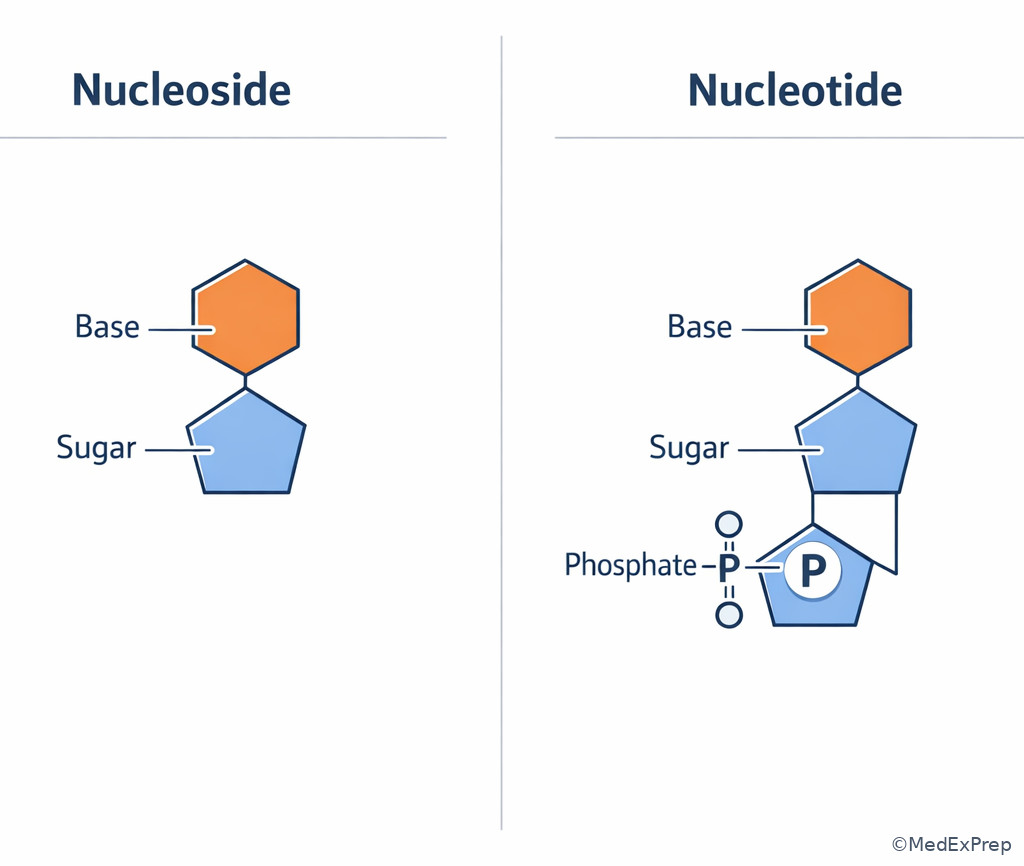
- Nucleotide: base + sugar + phosphate
- Nucleoside: base + sugar only
- Purine: adenine, guanine
- Pyrimidine: cytosine, thymine, uracil
- Deoxyribose: sugar in DNA lacking the 2′ hydroxyl
- Ribose: sugar in RNA containing the 2′ hydroxyl
- Phosphodiester bond: covalent linkage joining nucleotides within a strand
- Backbone: repeating sugar-phosphate chain
- 5′ end: terminal phosphate-side orientation
- 3′ end: terminal hydroxyl-side orientation used for extension
- Antiparallel: paired nucleic acid strands run in opposite directions
- Template: nucleic acid strand used to direct synthesis
- cDNA: DNA synthesized from an RNA template
- Primary transcript: initial RNA product before processing
- Single-stranded: one continuous nucleic acid strand
1.1.1.2 Must-know facts
- DNA usually contains thymine; RNA usually contains uracil.
- DNA usually exists as double-stranded; most cellular RNA is single-stranded.
- Polymerases add nucleotides to a free 3′ end; synthesis proceeds 5′ to 3′.
- The 2′ hydroxyl in RNA contributes to greater chemical lability compared with DNA.
- Backbone integrity matters more for amplification than memorizing base names alone.
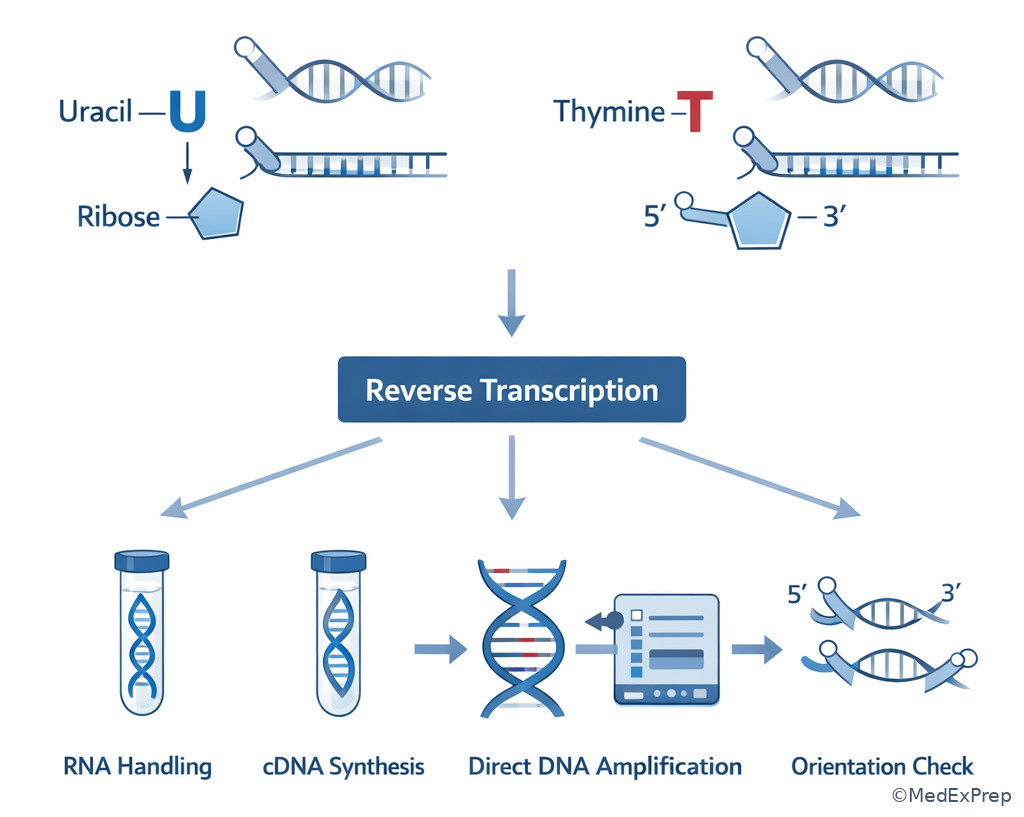
- Reverse transcription is required when the assay starts from RNA and the downstream chemistry needs DNA template.
- cDNA is not the same thing as genomic DNA; it reflects transcribed RNA-derived sequence.
- Target abundance can differ because some RNA targets are transient or highly expressed, whereas genomic DNA copy number is usually more stable per cell.
Exam takeaway: Use structure differences to choose the correct template, enzyme, and handling expectation.
flowchart TD
A[Nucleic acid] --> B[DNA]
A --> C[RNA]
B --> B1[Deoxyribose sugar]
B --> B2[Thymine present]
B --> B3[Usually double-stranded]
B --> B4[More chemically stable]
C --> C1[Ribose sugar]
C --> C2[Uracil present]
C --> C3[Usually single-stranded]
C --> C4[More labile]
B4 --> D[Common template for direct PCR]
C4 --> E[Often requires careful preservation and RT step]
Exam takeaway: Visualizing the backbone versus bases helps separate strand structure questions from pairing questions.
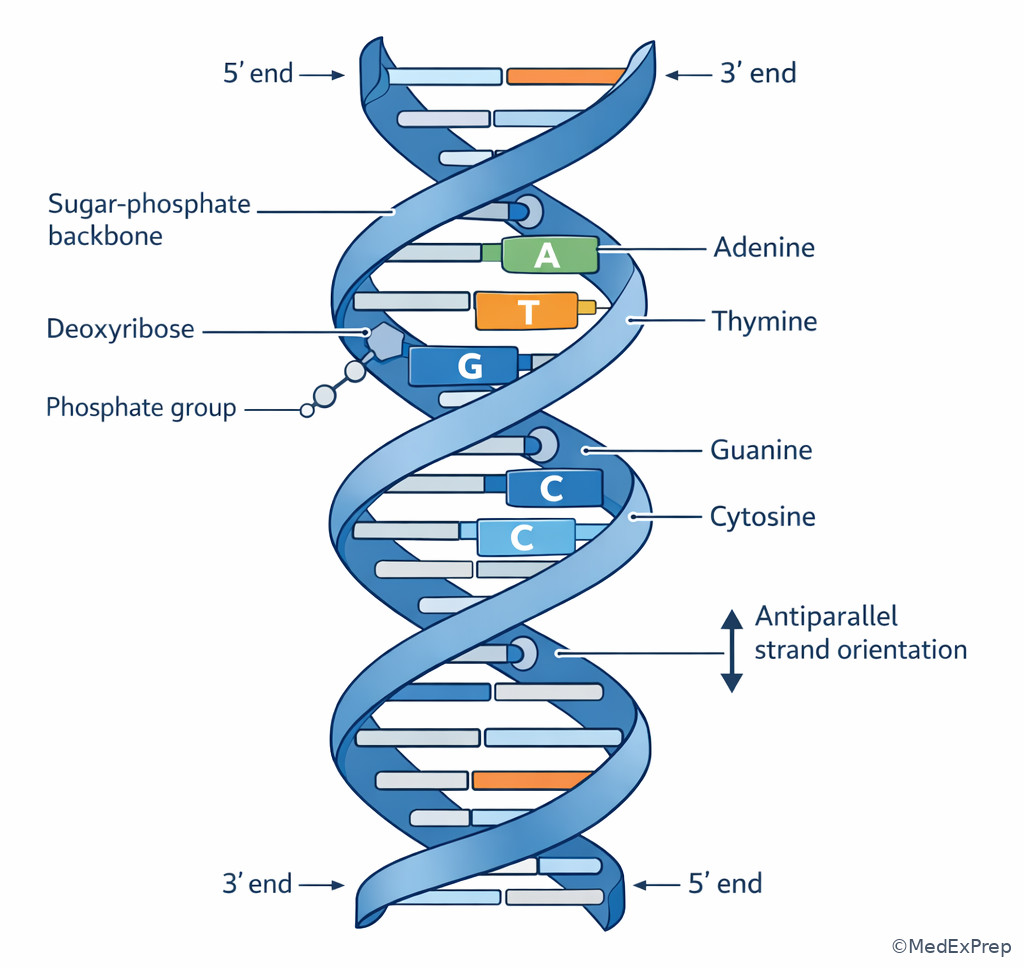
Core content
1.1.1.3 Foundational architecture: what a nucleotide is and what the strand is made of
A Explanation
The first decision conflict is simple but heavily tested: are you being asked about the building block or the assembled strand? A nucleotide contains three parts: nitrogenous base, pentose sugar, and phosphate. If the phosphate is missing, the molecule is a nucleoside, which is a classic distractor. Once nucleotides polymerize, the sugar and phosphate create the structural backbone, and the bases project from that backbone. In molecular testing, this matters because the backbone provides the directionality and chemical scaffold for extension, while the bases determine sequence identity and target specificity.
The rule that resolves many exam items is this: within a strand, nucleotides are linked by phosphodiester bonds; between complementary strands, bases interact noncovalently. If an answer choice says that the two DNA strands are held together by phosphodiester bonds, reject it. If it says the backbone is made of alternating base and phosphate units, reject it. The backbone is sugar-phosphate; the sequence information lies in the ordered bases. WHY THIS IS TESTED: exam writers often present a method question that seems procedural but actually turns on whether you know what is covalent within one strand and what is noncovalent between strands.
For laboratory logic, remember that a polymerase extends from an existing primer-template arrangement by adding nucleotides to the 3′ hydroxyl. That means orientation is not a memorization side note; it is the reason primer design and extension work at all. See Fig 1 for a structure-first comparison that helps separate DNA and RNA questions before you move into method logic.
B Worked example
A newly hired technologist reviews a validation worksheet for a PCR-based assay performed on whole blood DNA extracts. A 42-year-old transplant patient with renal insufficiency and recent broad-spectrum antibiotic exposure is listed in the case history. A distracting note says the patient had low albumin, and another comment mentions concern for RNA degradation in the transport delay. The worksheet asks which molecular statement best explains why the assay can proceed directly after extraction without reverse transcription.
Reasoning chain: Identify the task: this is a template-architecture question, not a disease question. Extract key facts: the assay is PCR-based, the material is a DNA extract, and reverse transcription is being discussed as a possible step. Apply the rule: reverse transcription is needed for RNA templates when DNA is required downstream; it is not needed when the target is already DNA. Eliminate distractors: low albumin and antibiotic exposure are noise; concern for RNA degradation is irrelevant if the assay target is genomic DNA. Verify: the correct structural explanation is that DNA already has the required nucleic acid form for DNA polymerase-based amplification after denaturation and primer annealing.
The tempting wrong answer is often “because DNA is single-stranded after extraction,” which sounds mechanistic but is incorrect. Extraction does not redefine DNA as fundamentally single-stranded; assay cycling creates temporary strand separation. The discriminating rule is template identity, not extraction status.
C Exam trap
D Checkpoint
Question: A bench technologist is asked to identify the feature that most directly distinguishes a nucleotide from a nucleoside in a reagent preparation question. Which choice is most appropriate?
- Presence of phosphate
- Presence of a nitrogenous base
- Presence of a pentose sugar
- Ability to pair with a complementary strand
Answer: A
- A: Tempting because it seems too simple; right because a nucleotide includes phosphate, whereas a nucleoside does not.
- B: Tempting because bases feel central to nucleic acid identity; wrong because both nucleotides and nucleosides contain a base.
- C: Tempting because sugar type distinguishes DNA from RNA; wrong because both nucleotides and nucleosides contain a sugar.
- D: Tempting because complementary binding is highly testable; wrong because pairing behavior does not define nucleotide versus nucleoside.
1.1.1.4 DNA versus RNA: the one structural difference that predicts many lab consequences
A Explanation
The highest-yield choose-vs-reject frame here is: when should you think “RNA is the problem” versus “DNA is the better explanation”? The resolving rule is the 2′ hydroxyl on ribose. RNA contains ribose, so it has a hydroxyl group at the 2′ position; DNA lacks that oxygen, using deoxyribose instead. This seemingly small chemical difference helps explain why RNA is generally more susceptible to degradation and often requires more careful preservation during collection, transport, and extraction.
A second testable distinction is base composition: DNA uses thymine, whereas RNA uses uracil in place of thymine. That means a sequence containing uracil points you toward RNA or an RNA-derived intermediate context, not genomic DNA. Be careful, though: a question may mention cDNA, which is a DNA copy of RNA and therefore behaves as DNA in amplification even though it represents an RNA-origin target.
Most cellular DNA is double-stranded; many functionally important RNAs are single-stranded, though RNA can form intramolecular secondary structures. For ASCP MB purposes, the major decision is not whether every RNA form has secondary structure but whether the stem expects you to recognize that RNA handling, target abundance, and RT requirements differ from DNA workflows. WHY THIS IS TESTED: many stems hide the answer inside one chemical clue such as uracil, ribose, or reverse transcriptase. See Fig 1 and Fig 2.
B Worked example
A respiratory specimen arrives for a molecular assay targeting a viral RNA genome. The patient is a 67-year-old with COPD, diabetes mellitus, and chronic kidney disease. The requisition includes a distracting note about elevated white blood cell count, and the specimen was held briefly during courier delay. The technologist is asked which additional enzymatic step is most appropriate before standard PCR amplification chemistry.
Reasoning chain: Identify the task: choose the step required by target architecture. Extract key facts: viral genome is RNA; the later workflow references standard PCR. Apply the rule: DNA polymerase-based PCR requires DNA template, so RNA must first be converted to complementary DNA using reverse transcriptase. Eliminate distractors: leukocytosis does not determine template chemistry; courier delay raises concern for RNA integrity but does not change the required step. Verify: reverse transcription is the appropriate upstream step because the target is RNA.
A subtle distractor is “add DNA ligase to stabilize the target,” which sounds biochemical but does not solve the core problem. The required answer is the step that converts template type, not a generic enzyme.
C Exam trap
D Checkpoint
Question: A technologist reviews a failed assay worksheet and notes the target material is messenger RNA. Which structural feature most strongly supports the need for reverse transcription before conventional PCR?
- The presence of uracil instead of thymine
- The presence of a 2′ hydroxyl on ribose
- The fact that RNA is transcribed from DNA
- The use of single-stranded templates in hybridization
Answer: A is tempting, but the best answer is C? No—the question asks what supports the need for reverse transcription before conventional PCR. The best operational answer is A? also not sufficient. The strongest direct method logic is that the target is RNA rather than DNA, but among these options the most appropriate structural cue is B.
- A: Tempting because uracil identifies RNA; wrong because uracil itself is a marker, not the principal structural basis for RNA's distinct chemistry in handling and conversion logic.
- B: Tempting because it looks overly chemical; right because ribose with the 2′ hydroxyl is the defining structural difference from DNA and anchors RNA-specific workflow implications.
- C: Tempting because it is biologically true; wrong because origin from DNA does not itself explain the need for reverse transcription in the assay.
- D: Tempting because hybridization uses single-stranded targets; wrong because single-strandedness alone does not establish the RT requirement.
- The base found in RNA instead of thymine is uracil.
- True or False: Most cellular DNA is single-stranded. False.
- Name the 3 parts of a nucleotide: base, sugar, phosphate.
Exam takeaway: Match the target nucleic acid to the enzyme sequence before deciding the next bench step.
flowchart LR
A[Unknown target] --> B{Template type?}
B -->|DNA| C[Direct PCR-compatible template]
B -->|RNA| D[Reverse transcription first]
D --> E[cDNA]
E --> F[PCR amplification]
C --> F
B -->|cDNA| F
F --> G[Detection and interpretation] Exam takeaway: A labeled RNA diagram makes the ribose 2-prime hydroxyl and uracil substitution easier to recall under time pressure.
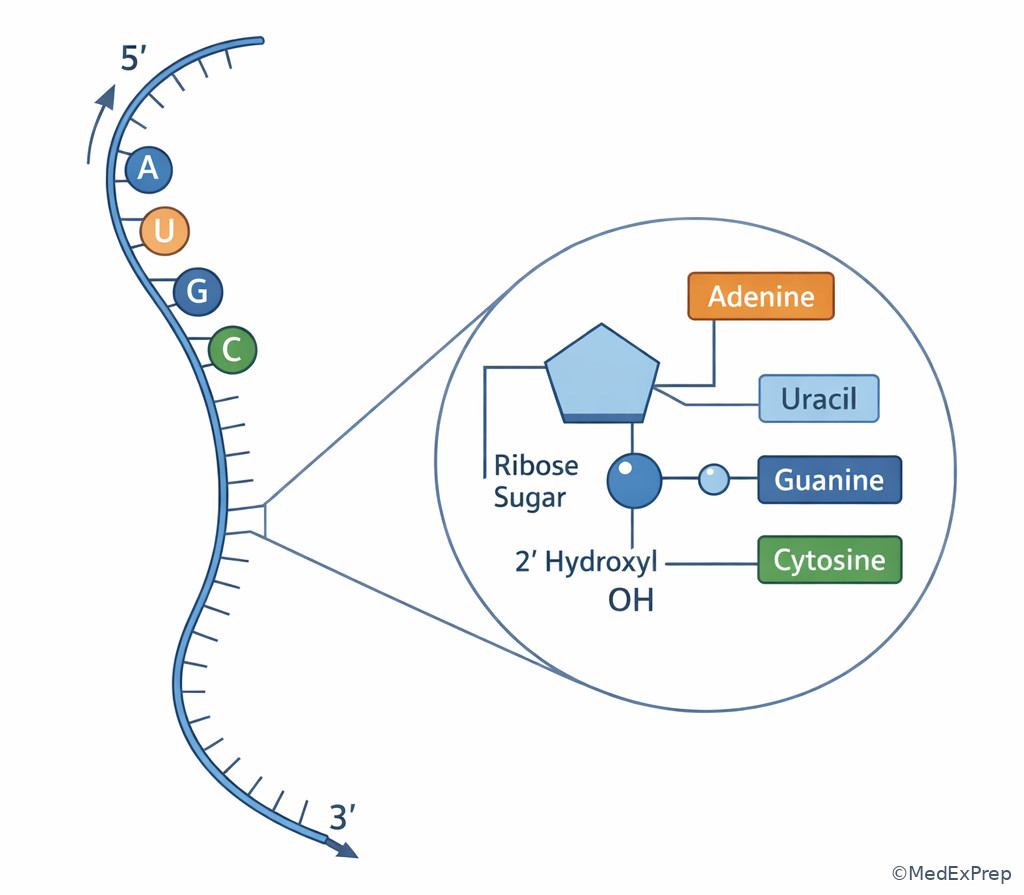
1.1.1.5 Strand polarity and antiparallel orientation: the rule behind primer extension
A Explanation
If the exam asks you to choose between two nearly plausible primer or strand statements, the single rule that resolves it is: nucleic acid synthesis proceeds 5′ to 3′ by addition to a free 3′ hydroxyl, and complementary strands run antiparallel. This is foundational for PCR, sequencing, reverse transcription, and probe logic. A surprisingly common distractor flips one of those directions.
Choose the option that correctly aligns polymerase action with strand polarity. Reject any answer that claims polymerase extends from the 5′ end, reads and synthesizes in the same physical orientation without antiparallel alignment, or treats strand ends as interchangeable labels. For bench-level exam questions, you usually will not need to calculate full primer design parameters in this lesson, but you do need to understand why orientation is not negotiable. Without correct antiparallel primer-template geometry and a free 3′ end, amplification cannot proceed correctly.
WHY THIS IS TESTED: orientation errors create believable distractors because they sound almost right and use correct words in the wrong order. See Fig 3 for a compact direction map. This section also prepares you for the upcoming topic on Base Pairing And Denaturation, where direction plus complementarity determines how strands separate and re-form during amplification cycles.
B Worked example
A 33-year-old patient with ulcerative colitis and iron deficiency anemia has a blood specimen submitted for a validated DNA assay. During training, a technologist reviews an educational note stating that a failed amplification likely occurred because the primer lacked a free 5′ hydroxyl for extension. The specimen also showed mild hemolysis, and the requisition includes a distracting family history note. Which statement best evaluates the note?
Reasoning chain: Identify the task: assess whether the structural explanation for assay failure is correct. Extract key facts: amplification failure is being attributed to the wrong chemical end of the primer. Apply the rule: polymerases extend from a primer's free 3′ hydroxyl, not the 5′ end. Eliminate distractors: hemolysis and family history may matter in other contexts but do not rescue a directionally incorrect mechanistic claim. Verify: the note is incorrect because the critical extension end is 3′.
This is a classic board-style move: add specimen noise so you chase inhibition or preanalytic issues, when the question is actually pure architecture.
C Exam trap
D Checkpoint
Question: Which statement is most appropriate when reviewing a primer-extension schematic in a molecular assay?
- Polymerase extends the template strand from its 5′ end.
- Polymerase adds nucleotides to the primer's 3′ end while synthesizing 5′ to 3′.
- Complementary strands in DNA run parallel so both are read left to right.
- Strand polarity affects sequencing but not amplification.
Answer: B
- A: Tempting because 5′ is often named first in sequence notation; wrong because extension occurs at the primer's 3′ hydroxyl.
- B: Tempting because it sounds mechanistically dense; right because this is the governing rule for nucleic acid synthesis direction.
- C: Tempting because diagrams are often drawn left to right; wrong because strands are antiparallel, not parallel.
- D: Tempting because sequencing emphasizes orientation; wrong because amplification also absolutely depends on polarity.
Exam takeaway: If the strand ends or primer direction are reversed, the amplification explanation is wrong.
flowchart TB
A[Top strand 5-prime to 3-prime] --- B[Bottom strand 3-prime to 5-prime]
B --> C[Primer anneals antiparallel]
C --> D[Polymerase extends from primer 3-prime end]
D --> E[New strand synthesized 5-prime to 3-prime]
Exam takeaway: A clear orientation diagram helps eliminate reversed-direction distractors in PCR questions.
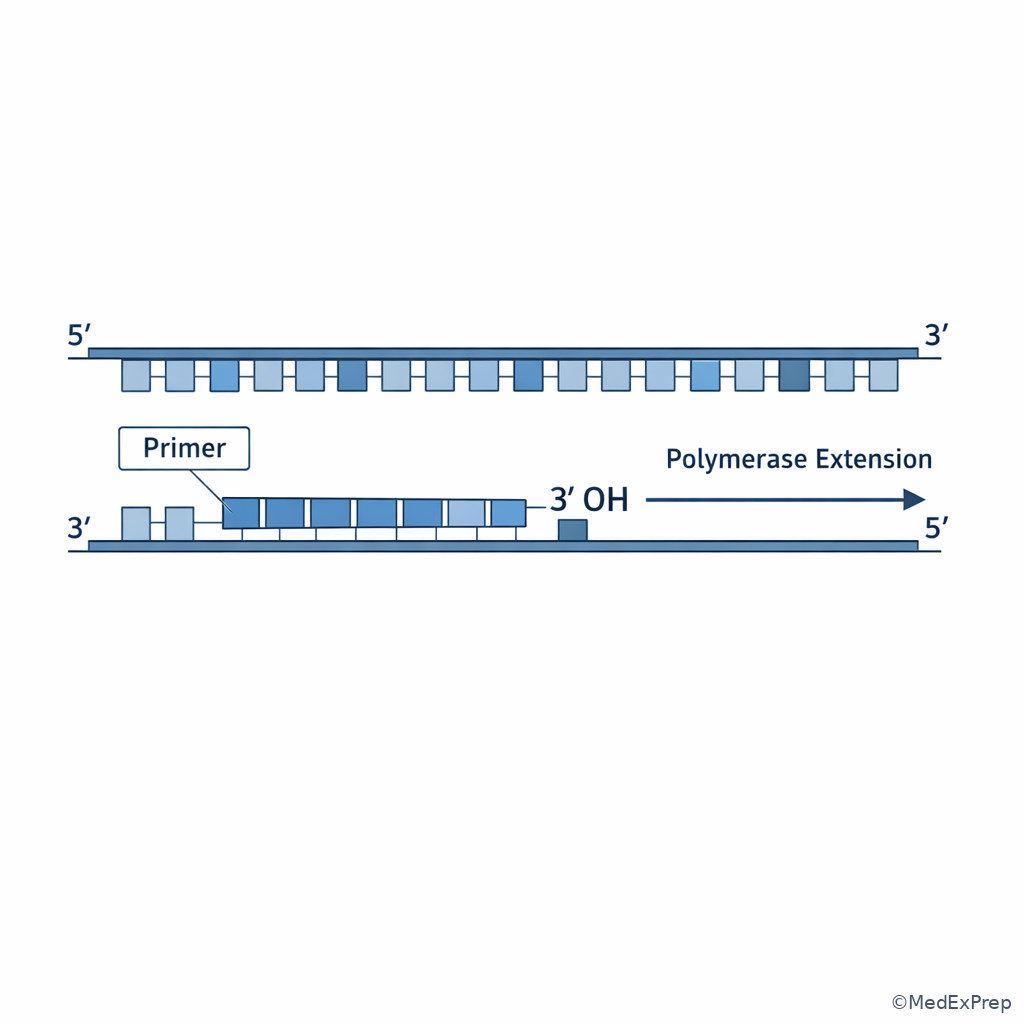
1.1.1.6 Functional forms in the lab: genomic DNA, RNA species, and cDNA
A Explanation
The exam often asks a workflow question that really tests whether you can distinguish genomic DNA, native RNA, and cDNA. The single finding that resolves the conflict is usually the target's role in the assay. If the assay detects a DNA virus, mutation, gene region, or inherited sequence variant directly from extracted DNA, think genomic DNA template. If the target is messenger RNA or an RNA virus, think native RNA, usually followed by reverse transcription if the downstream chemistry is PCR-based. If the stem says the target was reverse-transcribed already, you are working with cDNA, which behaves as DNA in subsequent amplification.
Choose cDNA when the assay needs an RNA-derived sequence but the amplification chemistry requires DNA. Reject the distractor that treats cDNA as naturally present in the specimen. cDNA is a laboratory-generated complementary DNA product, not the original patient nucleic acid target. This distinction matters because controls and failure points differ: RNA extraction quality, reverse transcription efficiency, and RNA degradation can affect cDNA yield even if later DNA amplification chemistry appears correctly configured.
WHY THIS IS TESTED: exam items frequently combine template identity with process order. The wrong answer is often one step off. See Fig 2. Also keep a forward reference in mind: in the upcoming topic on Genome Organization And Targets, you will build on this section to understand why some assays target exons, introns, or high-copy genomes rather than any random nucleic acid region.
B Worked example
A public health laboratory receives a nasopharyngeal swab from a 24-year-old healthcare worker with asthma and autoimmune thyroid disease. The requisition asks for detection of an RNA virus. A trainee says the technologist should extract DNA because PCR always amplifies DNA best. Another note mentions the specimen tube was slightly underfilled, and the patient had recent steroid use. What is the best explanation?
Reasoning chain: Identify the task: determine the correct molecular form workflow. Extract key facts: the analyte is an RNA virus, and PCR-style downstream chemistry is implied. Apply the rule: the lab must preserve and extract RNA target material, then convert RNA to cDNA if using RT-PCR. Eliminate distractors: underfilling may affect acceptability depending on assay instructions but does not change the nucleic acid identity; steroid use is clinical noise in this question. Verify: saying “extract DNA because PCR amplifies DNA” skips the required RNA handling and RT step, so it is incomplete and wrong.
The right answer respects template identity first and method compatibility second.
C Exam trap
D Checkpoint
Question: A molecular worksheet states that an extracted RNA target underwent reverse transcription and is now entering amplification. Which term most appropriately describes the product used as the immediate amplification template?
- Genomic DNA
- Complementary DNA
- Transfer RNA
- Double-stranded RNA
Answer: B
- A: Tempting because amplification now uses DNA chemistry; wrong because the DNA was synthesized from RNA and is not the specimen's genomic DNA.
- B: Tempting because it sounds like jargon; right because reverse transcription produces cDNA used for subsequent amplification.
- C: Tempting because it is a real RNA species; wrong because transfer RNA is not the product of reverse transcription in this context.
- D: Tempting because some viral genomes are RNA; wrong because the question asks for the post-RT amplification template, which is DNA.
- True or False: cDNA is directly extracted from the patient specimen. False.
- If the target starts as RNA and downstream amplification uses DNA polymerase, the bridging step is reverse transcription.
- The molecular form most likely to reflect transcriptional activity is RNA.
Exam takeaway: Distinguish native specimen nucleic acid from the laboratory-generated intermediate used for amplification.
flowchart TD
A[Specimen nucleic acid] --> B{What is the analyte?}
B -->|Genomic region| C[Extract DNA]
B -->|Transcript or RNA virus| D[Extract RNA]
D --> E[Reverse transcription]
E --> F[cDNA]
C --> G[Amplify DNA target]
F --> G
G --> H[Interpret with correct target limitations] Exam takeaway: Seeing the RNA-to-cDNA bridge reduces confusion between specimen analyte and assay template.
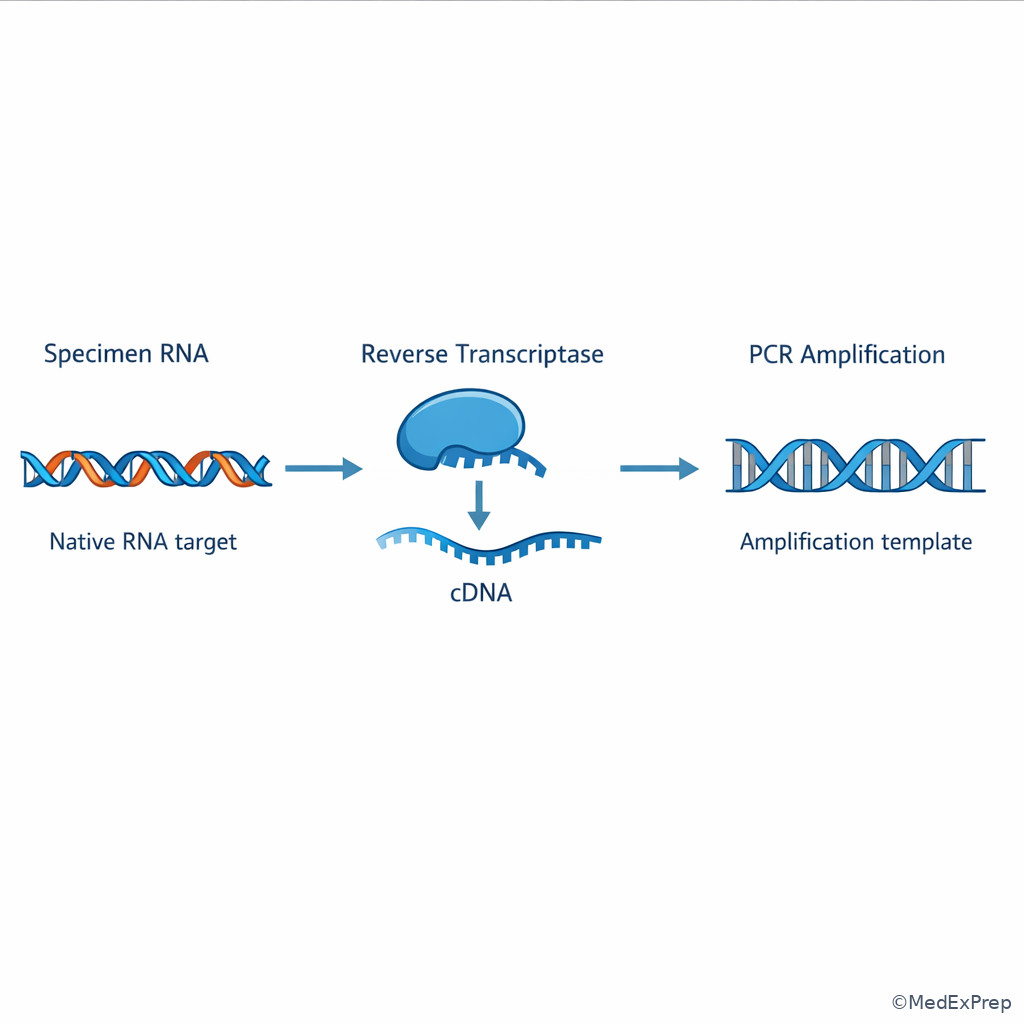
1.1.1.7 Architecture-based interpretation: how structure explains common bench decisions and errors
A Explanation
By the end of this lesson, the exam is no longer asking whether you can recite structures; it is asking whether you can use structure to choose the best laboratory explanation. The main conflict is often between a true statement that is too general and a more precise statement that directly governs the assay. For example, “RNA is involved in gene expression” is true, but if the stem asks what explains the need for an extra preamplification step, the more useful answer is “the target is RNA and must be reverse-transcribed into cDNA.”
Another recurring bench-level decision is whether a structural explanation is sufficient to invalidate a claimed mechanism. If someone attributes failed amplification to lack of a 5′ hydroxyl on the primer, reject it because the critical extendable end is 3′. If a sequence contains uracil, reject claims that it is standard genomic DNA. If the question compares DNA and RNA stability, choose the answer tied to ribose and the 2′ hydroxyl rather than a vague statement about “fragility.”
WHY THIS IS TESTED: ASCP MB questions often reward the single discriminating clue, not broad biological storytelling. Also stay in role. Your task is to interpret assay principles, specimen implications, controls, and workflow limits—not diagnose disease or select treatment. See Fig 5 for a decision framework that compresses the most common architecture-based choices.
B Worked example
A reference laboratory receives paired specimens from a 58-year-old patient with rheumatoid arthritis, chronic hepatitis history, and mild anemia. One assay targets a genomic mutation from extracted leukocyte DNA; another monitors an RNA transcript from preserved whole blood. The run sheet notes one sample sat at room temperature longer than expected. A tempting clue says both assays should still perform equally because nucleic acids are chemically similar. Which explanation is most appropriate?
Reasoning chain: Identify the task: compare structural consequences for two analyte types. Extract key facts: one assay depends on genomic DNA, the other on RNA transcript; there was a room-temperature delay. Apply the rule: RNA is generally more labile than DNA because of ribose chemistry and handling vulnerability, so the transcript-based assay is at greater preanalytic risk. Eliminate distractors: both are nucleic acids, but they are not operationally equivalent; mild anemia is irrelevant here. Verify: the RNA-based target warrants greater concern for degradation and possible impact on downstream RT-dependent workflow.
This question rewards choosing the structural fact that changes the practical lab consequence.
C Exam trap
D Checkpoint
Question: A run review note states that a specimen delay is more likely to compromise an RNA-target assay than a DNA-target assay. Which explanation is most appropriate?
- RNA contains ribose with a 2′ hydroxyl, contributing to greater lability.
- RNA lacks sequence specificity once removed from the cell.
- DNA cannot be degraded during transport delays.
- RNA is always double-stranded and therefore harder to amplify.
Answer: A
- A: Tempting because it is chemistry-heavy; right because the ribose 2′ hydroxyl underlies the greater instability concern.
- B: Tempting because degraded targets can lose assay signal; wrong because RNA does not lose all sequence specificity by simply being extracted.
- C: Tempting because DNA is more stable; wrong because DNA can still degrade under poor handling conditions.
- D: Tempting because strand structure affects amplification; wrong because most relevant cellular RNA is not “always double-stranded,” and that is not the best explanation for delay sensitivity.
Exam takeaway: When a stem gives a structural clue, use it to choose template handling, enzyme sequence, and validity logic.
flowchart TD
A[Read the stem] --> B{Key clue present?}
B -->|Uracil or ribose| C[Think RNA]
B -->|Thymine or genomic region| D[Think DNA]
B -->|5-prime/3-prime wording| E[Think polarity rule]
C --> F[Consider preservation and reverse transcription]
D --> G[Consider direct DNA amplification logic]
E --> H[Check antiparallel alignment and 3-prime extension]
F --> I[Choose valid workflow action]
G --> I
H --> I Exam takeaway: Converting structural clues into workflow choices improves speed on mixed-concept board stems.
Exam Traps & Differentiators
- Most common wrong answer and why: Choosing “DNA” whenever the stem mentions PCR. Tempting because PCR is strongly associated with DNA amplification; eliminated by the clue that the starting analyte is RNA, which requires reverse transcription first.
- Looks similar but isn't: cDNA versus genomic DNA. Both are DNA, but cDNA is generated from RNA and does not mean the original specimen target was DNA.
- Direction trap: Picking a 5′ extension statement because sequence notation is written 5′ to 3′. The single clue that eliminates it is that polymerase adds to the primer's free 3′ hydroxyl.
- Backbone trap: Attributing sequence specificity to the phosphate backbone. The bases, not the repeating phosphate groups, distinguish one sequence from another.
- Handling trap: Assuming all nucleic acids tolerate delay equally. RNA generally warrants more concern because of structural lability.
| Stem says... | Think... | Why |
|---|---|---|
| Uracil, ribose, transcript, RNA virus | RNA target | These clues point to RNA architecture and often an RT step |
| Mutation in genomic region, inherited variant, leukocyte DNA extract | Genomic DNA target | Direct DNA-based workflow is most likely |
| Reverse-transcribed product enters amplification | cDNA | RNA has already been converted to DNA form |
| Primer lacks extendable end | Check the 3′ hydroxyl | Polymerase extends from the 3′ end |
| Specimen delay affects transcript assay | RNA integrity concern | RNA is generally more labile than DNA |
| Looks similar | Key discriminator | Exam use |
|---|---|---|
| Nucleotide vs nucleoside | Phosphate present only in nucleotide | Building-block definition questions |
| DNA vs RNA | Deoxyribose/thymine versus ribose/uracil | Template choice and handling logic |
| RNA vs cDNA | cDNA is synthesized from RNA in the lab | Workflow order questions |
| Backbone bond vs strand pairing | Phosphodiester within strand; base interactions between strands | Architecture mechanism questions |
| 5′ end vs 3′ end | Extension requires free 3′ hydroxyl | Primer and polymerase questions |
If the stem says uracil, think RNA.
If the stem says reverse transcription, think RNA-to-cDNA bridge.
If the stem says primer extension, think free 3′ hydroxyl and 5′ to 3′ synthesis.
If the stem says the two strands are “held together,” think base pairing interactions, not phosphodiester bonds.
If the stem says room-temperature delay hurt a transcript assay, think RNA lability rather than immediate failure of all nucleic acid tests.
If the stem says genomic region from leukocyte DNA, think direct DNA workflow, not RT-PCR unless specified.
Related trap from upcoming topics: in Base Pairing And Denaturation, exam writers will tempt you to attribute melting behavior to the wrong feature. Architecture tells you what the molecule is; pairing and GC behavior will tell you how it separates and rebinds. In Genome Organization And Targets, you will face confusable pairs such as transcript target versus genomic target, where copy number, exon content, and specificity matter.
Tables
| Reference feature | DNA | RNA | Why it matters in the lab |
|---|---|---|---|
| Sugar | Deoxyribose | Ribose | Helps explain relative stability and target handling differences |
| 2′ hydroxyl | Absent | Present | Supports the greater lability concern for RNA |
| Base unique to molecule | Thymine | Uracil | Rapid clue for target identity |
| Typical strandedness | Double-stranded | Usually single-stranded | Affects how stems frame template and handling questions |
| Common workflow need before PCR-style amplification | Often none beyond extraction | Often reverse transcription first | Template form determines enzyme sequence |
| Item | Composition | Common distractor | How to eliminate it |
|---|---|---|---|
| Nucleoside | Base + sugar | Confused with nucleotide | Ask whether phosphate is present |
| Nucleotide | Base + sugar + phosphate | Confused with “any nucleic acid component” | Requires the complete monomer package |
| cDNA | DNA copy made from RNA | Confused with genomic DNA | Look for prior reverse transcription step |
| Backbone | Sugar-phosphate repeating chain | Confused with base sequence | Backbone gives structure; bases give identity |
| Antiparallel strands | Opposite 5′/3′ orientation | Confused with different chemistry | It describes direction, not composition |
| Differential question type | Best answer pattern | Plausible wrong answer | Single discriminator |
|---|---|---|---|
| Need for RT before PCR | RNA target | Any target with low copy number | RT is about template type, not just abundance |
| More vulnerable to handling delay | RNA-based assay | Any longer sequence target | Ribose 2-prime hydroxyl is the structural clue |
| Extendable primer feature | Free 3′ hydroxyl | Named 5′ end | Polymerase adds to 3-prime end only |
| Sequence identity determinant | Base order | Phosphate content | Backbone repeats; bases vary |
| DNA-like amplification template derived from RNA | cDNA | Genomic DNA | Lab-generated after reverse transcription |
Exam takeaway: Side-by-side structural comparison helps eliminate phosphate-related distractors quickly.
Algorithm / Approach
Exam takeaway: Identify the template clue first, then choose the matching workflow rule before considering distractors.
Use this algorithm whenever a nucleic acid structure question appears inside a larger assay stem. See Fig 6. The fastest path is to identify the single structural clue first and only then read the options for a method match. This prevents overthinking and protects you from attractive but nonspecific distractors.
Rapid Review
- Nucleotide → phosphate present; nucleoside lacks it
- Backbone → sugar-phosphate, not base-phosphate
- Sequence identity → base order, not repeating phosphate groups
- DNA → deoxyribose and thymine
- RNA → ribose and uracil
- RNA handling → higher degradation concern than DNA
- Most DNA assays → direct DNA template after extraction, no RT step
- RNA PCR workflow → RNA first, cDNA intermediate, amplification next
- cDNA → lab-generated DNA copy of RNA, not genomic DNA
- Antiparallel → opposite 5′ and 3′ orientation of paired strands
- Polymerase extension → adds to free 3′ hydroxyl
- Uracil clue → think RNA unless the stem explicitly describes a modified reagent context
- 5′ versus 3′ distractor → often the only difference separating right from wrong
- Bench scope → choose assay-validating action, not patient management
Self-check quiz
1. A trainee labels a reagent component as a nucleoside. Which additional feature would require relabeling it as a nucleotide?
- Phosphate group
- Uracil base
- Ribose sugar
- Complementary sequence
2. A preserved specimen is submitted for an assay targeting messenger RNA from a highly expressed transcript. The technologist is asked which base finding would be most consistent with the target molecule before reverse transcription.
- Thymine
- Uracil
- 5-methylcytosine only
- Deoxyadenosine only
3. A 54-year-old patient with systemic lupus erythematosus and chronic anemia has whole blood collected for a transcript-based molecular assay. The specimen experienced a transport delay, and a trainee asks why this target is more vulnerable than a leukocyte genomic DNA target collected at the same time. Which explanation is most appropriate?
- RNA contains ribose with a 2′ hydroxyl, increasing lability risk.
- RNA cannot be amplified once extracted from blood.
- DNA is immune to degradation during transport.
- RNA is always double-stranded and harder to recover.
4. A respiratory swab from a 71-year-old patient with COPD and heart failure is tested for an RNA virus using an RT-PCR workflow. A distracting note says the specimen also had visible mucus. Which step most appropriately bridges the native target and the DNA amplification phase?
- Restriction digestion
- Reverse transcription to generate cDNA
- DNA ligation of the viral genome
- Proteinase treatment to create complementary strands
5. A 39-year-old patient with Crohn disease and iron deficiency has a validated DNA assay performed. During review, a trainee states that primer extension fails when the primer lacks a free 5′ hydroxyl. Hemolysis is mild and controls are acceptable. Which response is most appropriate?
- The statement is correct because extension proceeds from the 5′ end.
- The statement is incorrect because extension requires a free 3′ hydroxyl.
- The statement is correct only for RNA templates.
- The statement is irrelevant because polarity affects sequencing but not PCR.
6. A 46-year-old patient with psoriasis and chronic kidney disease has two molecular tests ordered on separate specimens: one for a leukocyte genomic variant and one for a blood RNA transcript. Both were delayed in transit, and the trainee says both are equally compromised because nucleic acids are structurally interchangeable. Which laboratory interpretation is most appropriate?
- Both are equally stable because base pairing protects all nucleic acids to the same degree.
- The RNA-based assay is at greater preanalytic risk because RNA architecture is generally more labile.
- The DNA-based assay is at greater risk because DNA is usually double-stranded.
- Neither assay can be assessed until treatment history is reviewed by the clinician.
7. A molecular technologist reviews a training document for an assay detecting an RNA target after a reverse transcription step. The document states that the amplification template is genomic DNA because the product now contains thymine rather than uracil. The patient is a 62-year-old with diabetes and chronic lung disease; a distracting note mentions recent antiviral therapy. Which correction is most appropriate?
- The template is still native RNA because the original target was RNA.
- The template is cDNA because reverse transcription creates a DNA copy of the RNA target.
- The template is genomic DNA because all DNA in the assay is genomic by definition.
- The template cannot be identified without the treating physician's diagnosis.
8. A 29-year-old stem cell donor with asthma and hypothyroidism has a sample submitted for a validated DNA-based assay. In a competency assessment, the technologist must choose the statement that best explains why a sequence-specific primer must be oriented correctly relative to the target. A tempting note says directionality matters only when denaturation occurs. Which answer is most appropriate?
- Orientation matters because polymerase adds nucleotides to a free 3′ end and synthesis proceeds 5′ to 3′.
- Orientation matters because phosphates determine the target sequence readout.
- Orientation matters only after treatment decisions are selected for the patient.
- Orientation does not matter if the specimen contains enough nucleic acid.
Answer key
1. Correct answer: A
- A. Phosphate group: Tempting because it seems like a minor add-on, but it is exactly the defining difference. It is correct because a nucleotide is a nucleoside plus phosphate. The single discriminating clue is the structural definition of the monomer used in nucleic acids. Source: Buckingham and Flaws; Lodish et al.
- B. Uracil base: Tempting because uracil signals RNA-related chemistry. It is incorrect because either a nucleoside or a nucleotide may contain an RNA base; uracil does not distinguish the two. The discriminating clue is that base identity is not the defining difference. Source: Lodish et al.
- C. Ribose sugar: Tempting because ribose helps separate RNA from DNA. It is incorrect because both nucleosides and nucleotides can contain ribose. The discriminating clue is that sugar type identifies DNA versus RNA, not nucleoside versus nucleotide. Source: Buckingham and Flaws.
- D. Complementary sequence: Tempting because pairing is central to molecular testing. It is incorrect because complementarity does not define whether phosphate is present. The discriminating clue is that composition, not hybridization behavior, is being tested. Source: Lodish et al.
2. Correct answer: B
- A. Thymine: Tempting because many molecular assays ultimately use DNA-phase chemistry. It is incorrect for the native messenger RNA target because RNA uses uracil in place of thymine. The discriminating clue is that the question asks about the target before reverse transcription. Source: Lodish et al.; Buckingham and Flaws.
- B. Uracil: Tempting because it seems too direct. It is correct because native RNA contains uracil. The discriminating clue is the phrase “before reverse transcription,” which means the analyte is still RNA. Source: Lodish et al.
- C. 5-methylcytosine only: Tempting because RNA modifications exist and methylation sounds advanced. It is incorrect because this is not the core structural discriminator for messenger RNA identity in the stem. The discriminating clue is the straightforward RNA-versus-DNA base question. Source: Lodish et al.
- D. Deoxyadenosine only: Tempting because “deoxy” cues nucleic acid chemistry. It is incorrect because deoxyadenosine refers to DNA-associated sugar composition and does not match native mRNA architecture. The discriminating clue is that mRNA contains ribose, not deoxyribose. Source: Buckingham and Flaws.
3. Correct answer: A
- A. RNA contains ribose with a 2′ hydroxyl, increasing lability risk: Tempting because it sounds chemistry-heavy, but it is the correct molecular explanation. It is correct because RNA architecture contributes to greater preanalytic vulnerability. The discriminating clue is the comparison between transcript target and genomic DNA under transport delay. Source: Buckingham and Flaws; Molecular Pathology in Clinical Practice.
- B. RNA cannot be amplified once extracted from blood: Tempting because degraded RNA can produce failed assays. It is incorrect because RNA can be amplified after appropriate reverse transcription if integrity is preserved. The discriminating clue is that the question asks about relative vulnerability, not impossibility of testing. Source: Molecular Pathology in Clinical Practice.
- C. DNA is immune to degradation during transport: Tempting because DNA is more stable. It is incorrect because DNA is not immune to poor handling; it is simply generally more robust than RNA. The discriminating clue is the exaggerated absolute wording. Source: Buckingham and Flaws.
- D. RNA is always double-stranded and harder to recover: Tempting because some viral RNAs can be double-stranded. It is incorrect because most relevant cellular RNA is not “always” double-stranded, and that is not the main reason for transport vulnerability. The discriminating clue is the structural chemistry of ribose, not universal strandedness. Source: Lodish et al.
4. Correct answer: B
- A. Restriction digestion: Tempting because enzymes and nucleic acid processing often appear together. It is incorrect because digestion does not convert RNA into a PCR-compatible DNA template. The discriminating clue is the stated RT-PCR workflow for an RNA virus. Source: Buckingham and Flaws; Burmeister, Uhlenhaut, and Lou.
- B. Reverse transcription to generate cDNA: Tempting because it sounds like the obvious answer, and it is correct. It is correct because reverse transcriptase converts RNA into cDNA, which can then enter amplification. The discriminating clue is that the native target is an RNA virus and the assay is RT-PCR. Source: Buckingham and Flaws.
- C. DNA ligation of the viral genome: Tempting because ligases are real molecular enzymes. It is incorrect because ligation does not create the cDNA bridge needed for PCR from RNA. The discriminating clue is that the missing step is template conversion, not end-joining. Source: Lodish et al.
- D. Proteinase treatment to create complementary strands: Tempting because specimen processing may include proteolysis. It is incorrect because proteases do not generate complementary nucleic acid strands. The discriminating clue is that only reverse transcription addresses RNA-to-DNA conversion. Source: Molecular Pathology in Clinical Practice.
5. Correct answer: B
- A. The statement is correct because extension proceeds from the 5′ end: Tempting because sequence notation is commonly written 5′ to 3′. It is incorrect because polymerase adds to the primer's free 3′ hydroxyl. The discriminating clue is the specific chemistry of primer extension. Source: Buckingham and Flaws; Lodish et al.
- B. The statement is incorrect because extension requires a free 3′ hydroxyl: Tempting because it sounds highly technical, and it is correct. It is correct because the extendable primer end is 3′, not 5′. The discriminating clue is the erroneous orientation in the trainee's statement. Source: Buckingham and Flaws.
- C. The statement is correct only for RNA templates: Tempting because RNA workflows feel different. It is incorrect because primer extension polarity remains 3′-dependent in standard nucleic acid synthesis logic. The discriminating clue is that the issue is universal extension direction, not template class. Source: Lodish et al.
- D. The statement is irrelevant because polarity affects sequencing but not PCR: Tempting because sequencing is often associated with direction. It is incorrect because PCR depends just as critically on proper primer orientation and 3′ extension. The discriminating clue is that amplification itself fails if polarity is wrong. Source: Molecular Pathology in Clinical Practice.
6. Correct answer: B
- A. Both are equally stable because base pairing protects all nucleic acids to the same degree: Tempting because both molecules carry genetic information. It is incorrect because DNA and RNA are not structurally interchangeable from a handling standpoint; RNA is generally more labile. The discriminating clue is the delayed transport plus transcript target. Source: Buckingham and Flaws; Molecular Pathology in Clinical Practice.
- B. The RNA-based assay is at greater preanalytic risk because RNA architecture is generally more labile: Tempting because it narrows the issue to one structural principle, and it is correct. It is correct because RNA's ribose chemistry increases concern during preanalytic delay. The discriminating clue is the direct comparison between transcript assay and genomic DNA assay under the same delay. Source: Buckingham and Flaws.
- C. The DNA-based assay is at greater risk because DNA is usually double-stranded: Tempting because double-stranded molecules may sound more complex. It is incorrect because strandedness is not the best explanation for increased transport vulnerability here. The discriminating clue is that RNA's ribose chemistry, not DNA double-strandedness, drives the handling concern. Source: Lodish et al.
- D. Neither assay can be assessed until treatment history is reviewed by the clinician: Tempting because clinical context matters in medicine. It is incorrect and outside bench emphasis because the laboratory can assess structural preanalytic risk without waiting for clinical management review. The discriminating clue is that this is a laboratory validity question, not a treatment question. Source: ASCP role framing in course scope; Molecular Pathology in Clinical Practice.
7. Correct answer: B
- A. The template is still native RNA because the original target was RNA: Tempting because the assay began with RNA. It is incorrect because after reverse transcription, the immediate amplification template is no longer native RNA; it is the DNA copy made from it. The discriminating clue is the phrase “after a reverse transcription step.” Source: Buckingham and Flaws.
- B. The template is cDNA because reverse transcription creates a DNA copy of the RNA target: Tempting because it sounds like a workflow technicality, and it is correct. It is correct because cDNA is the immediate DNA-form template used after RT. The discriminating clue is that the document mislabels all DNA-phase product as genomic DNA. Source: Buckingham and Flaws; Burmeister, Uhlenhaut, and Lou.
- C. The template is genomic DNA because all DNA in the assay is genomic by definition: Tempting because genomic DNA is the commonest DNA term. It is incorrect because DNA produced from RNA in the lab is cDNA, not genomic DNA. The discriminating clue is the prior reverse transcription step. Source: Lodish et al.
- D. The template cannot be identified without the treating physician's diagnosis: Tempting because clinical interpretation may depend on diagnosis. It is incorrect and outside the decision need here because assay-template identity is determined by workflow, not physician diagnosis. The discriminating clue is that the question is analytic, not diagnostic. Source: Course scope and Buckingham and Flaws.
8. Correct answer: A
- A. Orientation matters because polymerase adds nucleotides to a free 3′ end and synthesis proceeds 5′ to 3′: Tempting because it is the most mechanistic option, and it is correct. It is correct because proper primer orientation is required for extension from the primer's 3′ hydroxyl. The discriminating clue is the question about why sequence-specific primer orientation matters. Source: Buckingham and Flaws; Lodish et al.
- B. Orientation matters because phosphates determine the target sequence readout: Tempting because the backbone is structurally essential. It is incorrect because sequence discrimination depends on base order, not on phosphate identity. The discriminating clue is that primer specificity and extension depend on complementary sequence and orientation, not variable phosphate chemistry. Source: Lodish et al.
- C. Orientation matters only after treatment decisions are selected for the patient: Tempting because downstream actions may depend on valid results. It is incorrect and outside scope because primer orientation is an analytic issue independent of clinical treatment choice. The discriminating clue is the bench-level competency assessment framing. Source: Course scope; Molecular Pathology in Clinical Practice.
- D. Orientation does not matter if the specimen contains enough nucleic acid: Tempting because adequate input can rescue some weak assays. It is incorrect because no amount of template corrects fundamentally wrong primer orientation. The discriminating clue is that directionality is a hard requirement, not a sensitivity preference. Source: Buckingham and Flaws.
Keep going with the full ASCP MB Prep Course (MB)
You just studied the way members do, in the same lesson interface. Full access unlocks every lesson, the question bank and flashcards for a full year.
One payment · 1 year of access · No auto-renewal