1.1.1 - Specimen Acceptability Criteria
Specimen Acceptability Criteria
What you'll learn
- Bacteriology Specimens: specimen receipt triage → decide whether a specimen should be accepted, rejected, recollected, or held for clarification.
- Quality Control: preanalytic quality control → recognize labeling, container, leakage, timing, and quantity errors that invalidate results.
- Biosafety: biosafety at accessioning → identify specimen conditions that create exposure risk and require containment or escalation.
- Laboratory Reasoning: workflow selection → match specimen source and collection method to the correct microbiology workup.
- Bacteriology Specimens: contamination prevention → distinguish poor specimen quality from a truly useful sample before culture is set up.
- Microbiology Foundations → Specimen Quality Principles → specimen acceptability, rejection criteria, and preanalytic troubleshooting
- Safety and Quality Systems → biosafety, contamination control, and documentation during specimen receipt
- Cross-domain laboratory logic → identify task, apply policy rule, verify specimen integrity before bench work
Why it matters
- A perfect identification algorithm cannot rescue a poor specimen; garbage in produces misleading culture, stain, and susceptibility results.
- The exam often hides the real task inside clinical noise: the best answer is not the organism or medium, but whether the specimen was acceptable in the first place.
- Specimen rejection protects both patient care and laboratory credibility by preventing false-negative, contaminated, or clinically uninterpretable results.
- Early recognition of preanalytic failure is a core bench skill and a frequent discriminator between strong and weak ASCP answers.
Key Terms & Must-Know Facts
1.1.1.1 Key terms
- Acceptability criteria — predefined rules that determine whether testing can proceed.
- Unlabeled specimen — specimen with no patient identifier on the container.
- Mislabeled specimen — identifiers on specimen and requisition do not match.
- Leaking specimen — container integrity failure creating contamination or exposure risk.
- QNS — quantity not sufficient for requested testing.
- Wrong container — specimen submitted in a device or preservative not validated for the test.
- Improper source — source/site missing or incorrect, preventing meaningful interpretation.
- Inappropriate specimen type — sample that should not be cultured because it poorly represents infection.
- Recollection — obtaining a new specimen because the original cannot yield reliable results.
- Chain of custody/documentation — recorded handling and decision trail at receipt.
- Sterile site — source where normal flora are not expected.
- Nonsterile site — source with expected commensal flora, requiring more cautious interpretation.
- Preanalytic error — failure occurring before testing begins.
- Specimen integrity — whether specimen identity, quality, and containment are preserved.
1.1.1.2 Must-know facts
- Unlabeled specimens are generally rejected; the key issue is identity, not organism recovery.
- A specimen in the wrong container may be unusable even if the sample itself looks adequate.
- Leaking containers are both a quality problem and a biosafety problem.
- Source information can change interpretation completely; “wound” is weaker than “left foot diabetic ulcer, deep aspirate.”
- Poor specimens from nonsterile sites often generate mixed flora that reflect collection quality, not disease.
- QNS matters more for some methods than others; always think whether the requested workup can be completed and repeated if needed.
- Accepting a bad specimen is often worse than delaying testing for recollection.
- Local laboratory protocols vary; when answers are close, choose the one most consistent with standard validated practice and proper escalation.
Core content
1.1.1.3 Foundational triage: the first accept-or-reject screen
A Explanation
The first decision at specimen receipt is not “what organism is present?” It is “can this specimen be trusted?” The main conflict is choosing between proceeding with bench work versus stopping because the specimen identity or integrity is compromised. The single rule that resolves many exam stems is this: identity and integrity come before microbiology yield. A rich specimen from the wrong patient is unusable; a dangerous leaking sample cannot simply be plated and ignored.
For foundational exam questions, triage begins with four high-yield checks: patient identifiers on the container, match with order/requisition, specimen source, and physical integrity of the container. If any of these are missing or clearly incorrect, the most appropriate next step is usually rejection or immediate clarification per policy rather than setup. This is especially true for unlabeled, mismatched, or leaking specimens.
WHY THIS IS TESTED: ASCP stems often present subtle clinical urgency to tempt you into accepting a compromised specimen. The tested pattern is whether you prioritize validated laboratory practice over emotional urgency in the stem.
See Fig 1 for the core triage sequence and Fig 2 for common acceptability branches.
Exam takeaway: Start with identity and integrity before considering culture setup or organism recovery.
flowchart TD
A[Specimen arrives] --> B{Labeled and matched?}
B -- No --> C[Reject or hold for clarification per policy]
B -- Yes --> D{Container intact and safe?}
D -- No --> E[Contain exposure risk and reject or escalate]
D -- Yes --> F{Source and specimen type appropriate?}
F -- No --> G[Request recollection or corrected order]
F -- Yes --> H{Quantity sufficient?}
H -- No --> I[Assess if limited testing possible or recollect]
H -- Yes --> J[Accept for setup] Exam takeaway: The best answer is often the earliest rule violation, not the most dramatic clinical clue.
flowchart LR
A[At receipt] --> B[Identity]
A --> C[Integrity]
A --> D[Source]
A --> E[Quantity]
B --> B1[Unlabeled or mismatch = reject]
C --> C1[Leak or break = biosafety + reject/escalate]
D --> D1[Missing or wrong source = clarify or recollect]
E --> E1[QNS = limit workup only if policy allows]
Exam takeaway: Visualizing the accessioning checkpoint helps you remember that labeling, packaging, and source verification happen before culture work.
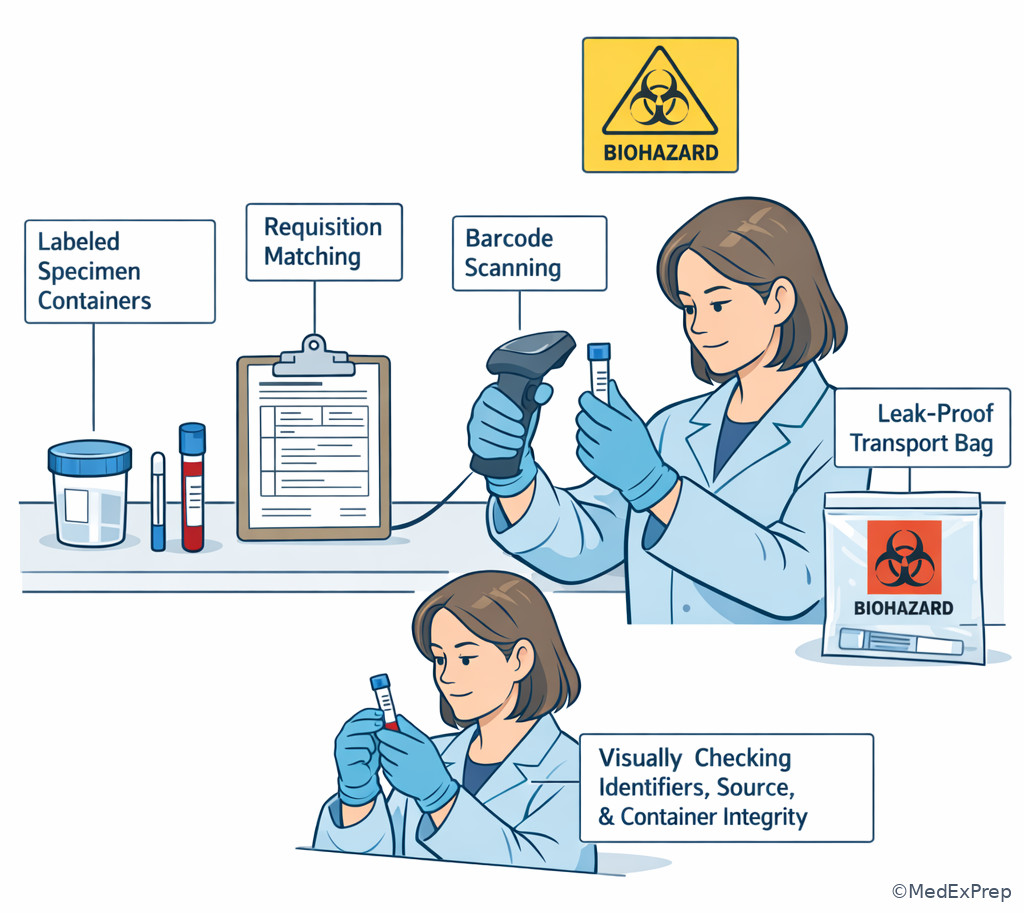
B Worked example
A 74-year-old man in the emergency department with diabetes, chronic kidney disease, and recent antibiotic exposure has a sputum specimen sent for culture. The requisition lists the correct patient name and medical record number, but the specimen cup has only the room number and no patient identifiers. The chart note mentions fever and bilateral infiltrates. A potassium of 5.8 mmol/L is also visible in the electronic record, and the nurse calls saying the patient is “very sick” and asks the lab to please run it quickly.
Reasoning chain: Identify task: specimen acceptability, not pneumonia workup. Extract key facts: unlabeled container, urgent clinical context, sputum source. Apply rule: unlabeled specimen identity is not reliable; urgency does not override identity standards. Eliminate distractors: setting up culture because pneumonia is suspected is tempting but wrong; Gram staining first is still testing an unidentified sample; calling a likely pathogen from the clinical note exceeds the actual specimen decision. Verify: the correct action is rejection/clarification per policy with documentation and request for recollection.
C Exam trap
D Checkpoint
Question: Which specimen defect most strongly requires rejection before microbiology setup under standard practice?
- A. Properly labeled wound swab with limited volume
- B. Sputum specimen with delayed transport but complete identifiers
- C. Unlabeled urine container accompanied by a complete requisition
- D. Stool specimen lacking full clinical history
Answer: C
- A is tempting because poor volume can reduce testing options, but it may still be processable depending on policy and requested workup.
- B is tempting because delay can impair recovery, but transport issues are evaluated in context and do not automatically outrank identity failure.
- C is correct because a specimen container without patient identifiers fails the identity rule even if the paperwork is complete.
- D is tempting because missing history weakens interpretation, but lack of history is usually less absolute than absent container identification.
1.1.1.4 Source, specimen type, and collection quality
A Explanation
The second major decision conflict is choosing between a specimen that represents the site of infection and a specimen that mainly reflects surface contamination or poor collection. The single rule here is: the more the sample resembles the actual infectious focus, the more acceptable and interpretable it becomes. Deep aspirates and tissues usually outrank superficial swabs. Sterile-site fluids outrank poorly defined surface specimens. “Wound” alone is less useful than a specific site and collection method.
This section is heavily tested because many exam answers look microbiologically plausible until you ask whether the submitted material is actually the right specimen. A poor specimen may produce growth, but the result may not answer the clinical question. The exam may tempt you to accept a swab because it is easy to collect, but the bench-level technologist must recognize when a better specimen type would have been preferred.
WHY THIS IS TESTED: Test writers want to see whether you can reject convenience specimens and favor representative specimens, especially when normal flora make interpretation difficult.
See Fig 3 for source hierarchy and Fig 4 for the specimen-quality comparison visual.
Exam takeaway: When answers compete, prefer the specimen that most directly samples the infection site and minimizes normal flora.
flowchart TB
A[Possible specimen choices] --> B[Deep aspirate or tissue]
A --> C[Sterile body fluid]
A --> D[Well-collected expectorated specimen]
A --> E[Superficial swab]
B --> F[Highest interpretive value]
C --> F
D --> G[Moderate value if quality acceptable]
E --> H[Lowest value when contamination risk is high]
Exam takeaway: Specimen quality depends on how closely the sample reflects the true site of infection rather than ease of collection.
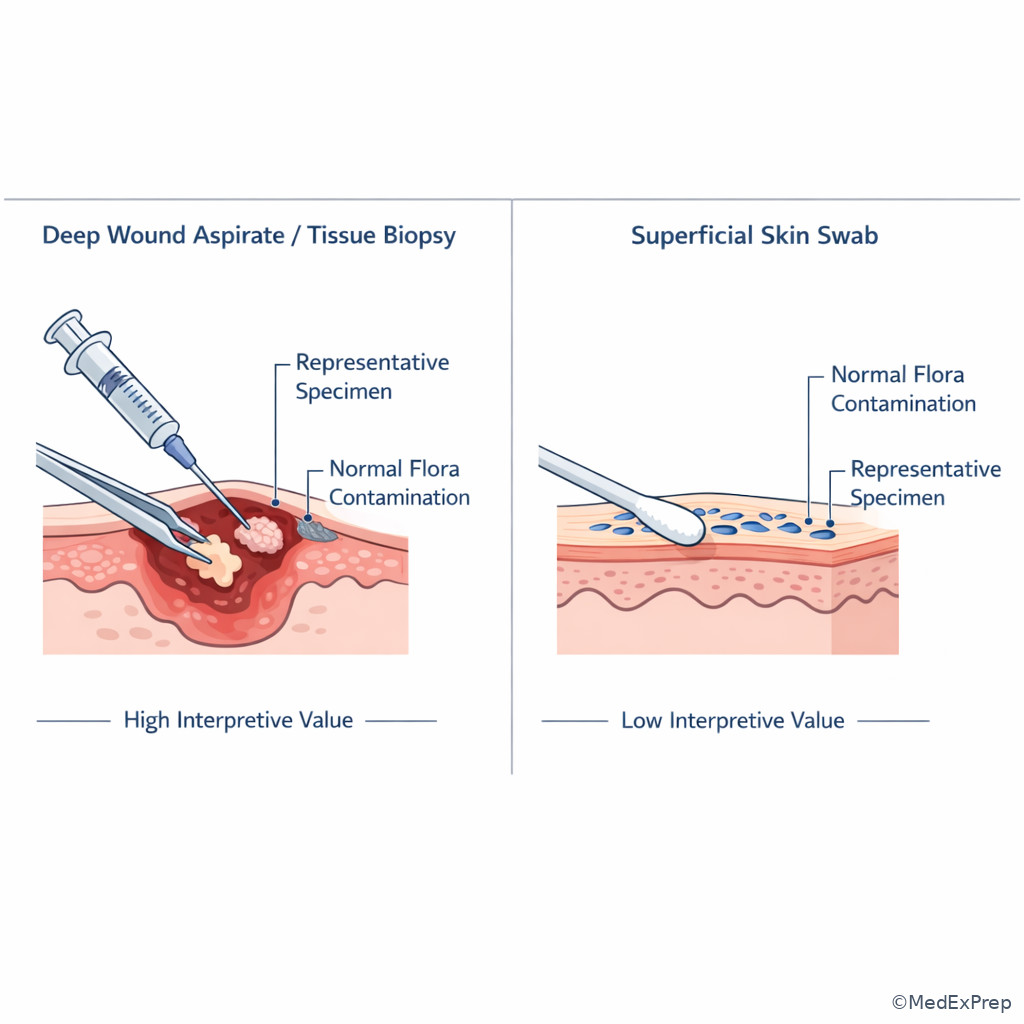
Exam takeaway: Many respiratory specimens are rejected because collection quality, not organism choice, determines whether culture will be meaningful.
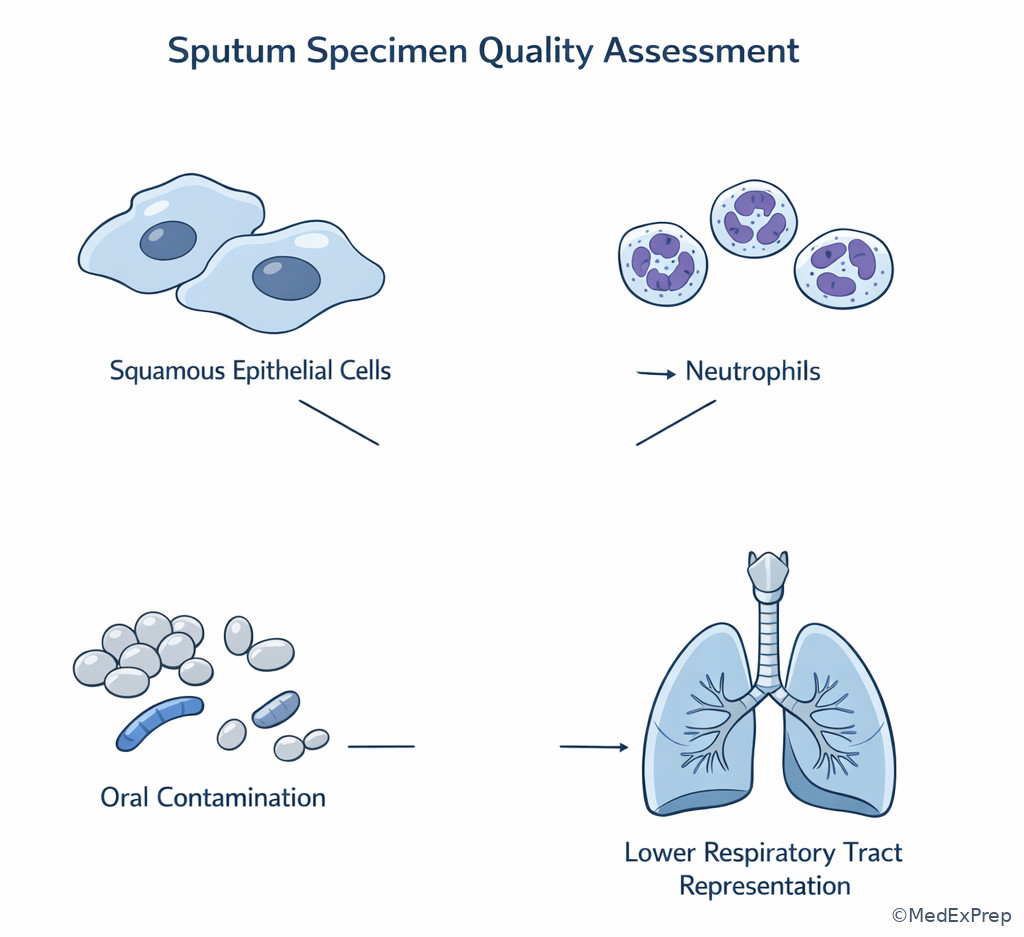
B Worked example
A 62-year-old woman with obesity, peripheral vascular disease, and poorly controlled diabetes has a chronic lower-extremity ulcer. Two specimens arrive: a superficial cotton swab labeled “wound,” and a second specimen labeled “left heel ulcer, deep aspirate.” The requisition mentions elevated C-reactive protein and a history of prior MRSA colonization. A mildly elevated alkaline phosphatase is also listed. The tempting clue is the MRSA history, which may push the learner toward focusing on pathogen recovery rather than specimen quality.
Reasoning chain: Identify task: determine which specimen is preferable/acceptable for culture interpretation. Extract key facts: chronic ulcer, superficial swab vs deep aspirate, source specificity. Apply rule: deeper, source-specific specimen better represents the infection and reduces surface flora interference. Eliminate distractors: accepting both as equivalent is wrong; choosing the swab because it is easier and less invasive is not a lab-quality rule; overcalling MRSA significance from prior history confuses patient history with specimen quality. Verify: the deep aspirate is the superior specimen for meaningful microbiology workup.
C Exam trap
D Checkpoint
Question: Which submitted specimen is most likely to provide the highest microbiologic value for culture of a suspected deep soft tissue infection?
- A. Superficial swab from drainage at skin surface
- B. Deep aspirate from the lesion bed with specific site noted
- C. Swab labeled only “wound” with no collection method
- D. Dressing material from the ulcer
Answer: B
- A is tempting because swabs are commonly submitted, but they over-sample surface colonizers.
- B is correct because a deep aspirate directly represents the infected focus and is better for interpretation.
- C is tempting because some information is present, but vague source labeling weakens clinical relevance and interpretation.
- D is tempting because visible exudate may seem informative, but dressing material is a poor, indirect specimen.
- The specimen generally preferred over a superficial swab for deep infection is a deep aspirate or tissue.
- True or False: A vague source label such as “wound” is as informative as a specific anatomic site. False.
- Name the 3 key quality questions: What site? What collection method? How much normal flora is expected?
1.1.1.5 Quantity, container, and collection device fit
A Explanation
A common exam conflict is choosing between a specimen that appears present and a specimen that is actually usable for the requested methods. The single rule is: acceptable quantity and proper container are method-dependent, not merely visual. A sample may exist but still be QNS, in the wrong preservative, or in a device that interferes with culture or downstream testing.
For microbiology, the wrong transport or collection device can distort recovery just as much as poor collection. Even in this lesson, before covering transport in the next topic, you should know that not every sample in every tube can simply be processed. Wrong anticoagulants, dry swabs for organisms needing special systems, or inadequate specimen volume may prevent full testing, repeat testing, or reliable interpretation. This is especially relevant when multiple procedures may be needed from a single specimen: Gram stain, culture, susceptibility, and possible reflex testing.
WHY THIS IS TESTED: The exam often gives a technically correct specimen source but hides that the sample volume or container makes the requested workup invalid or incomplete.
See Fig 5 for a container-fit decision framework.
Exam takeaway: Correct source does not rescue a specimen that is QNS or submitted in an incompatible collection device.
flowchart TD
A[Requested microbiology test] --> B{Correct container/device?}
B -- No --> C[Reject or clarify before setup]
B -- Yes --> D{Sufficient volume?}
D -- No --> E[Limited testing only if policy allows]
D -- Yes --> F[Proceed with full workup]
E --> G[Document QNS and notify if needed] Exam takeaway: Container choice is a preanalytic variable that directly affects whether microbiology testing is valid.
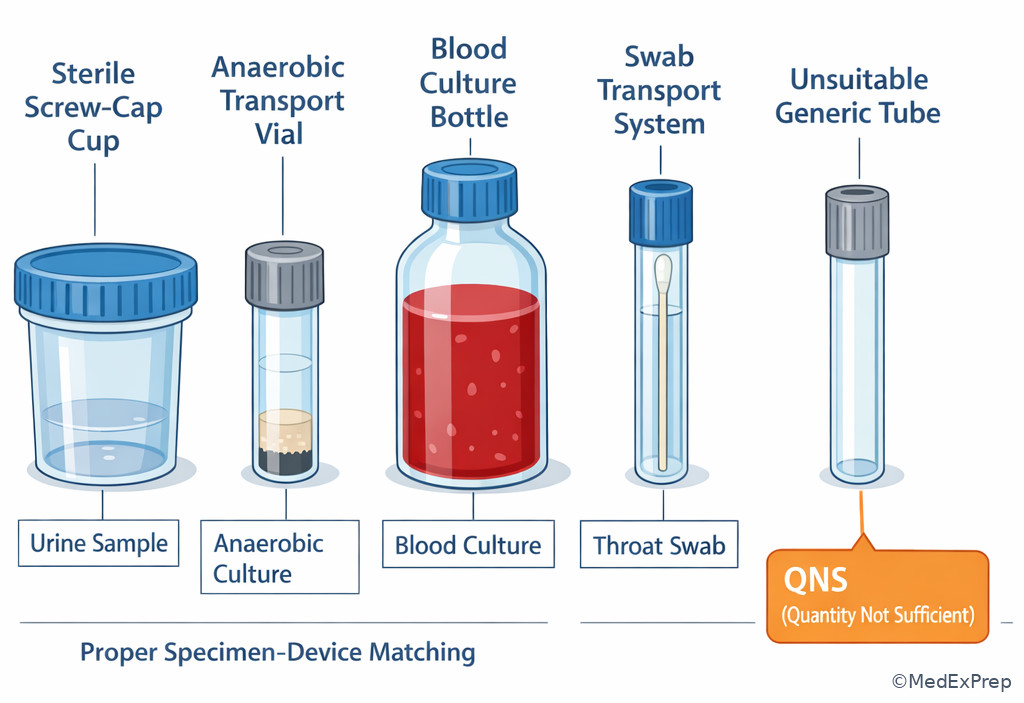
B Worked example
A 46-year-old man with cirrhosis, ascites, and hypertension has fluid sent to the lab after a bedside procedure. The order requests Gram stain and culture. The sample arrives in a nonsterile tube with only a trace amount of fluid. A note in the chart mentions prior spontaneous bacterial peritonitis, which may distract the learner into prioritizing urgency over specimen suitability. The bilirubin is elevated, but that finding is irrelevant to acceptance.
Reasoning chain: Identify task: assess whether the specimen is adequate for the ordered microbiology workup. Extract key facts: very low volume, nonsterile container, sterile-site fluid. Apply rule: sterile-site specimens require strict integrity; wrong container and QNS can invalidate or severely limit testing. Eliminate distractors: running at least a culture because the site is important is tempting, but wrong if the sample device itself compromises validity; relying on prior infection history does not fix a current preanalytic error. Verify: the best action is according to policy—reject or clarify/recollect, depending on local protocol and residual viability of testing.
C Exam trap
D Checkpoint
Question: A specimen from the correct source arrives with complete labeling but in an incompatible collection device. What is the best laboratory interpretation of acceptability?
- A. Accept it because source correctness outweighs container choice
- B. Accept it if the patient is immunocompromised
- C. Treat it as potentially unacceptable because device compatibility affects result validity
- D. Plate it first and document the problem later
Answer: C
- A is tempting because the source is correct, but correct site alone does not guarantee valid testing.
- B is tempting because urgency increases concern, yet patient status does not override specimen validation rules.
- C is correct because incompatible devices can make culture or stain results unreliable or unreportable.
- D is tempting because it preserves time, but setup before acceptability review defeats preanalytic quality control.
1.1.1.6 Biosafety, leakage, and exposure-driven unacceptability
A Explanation
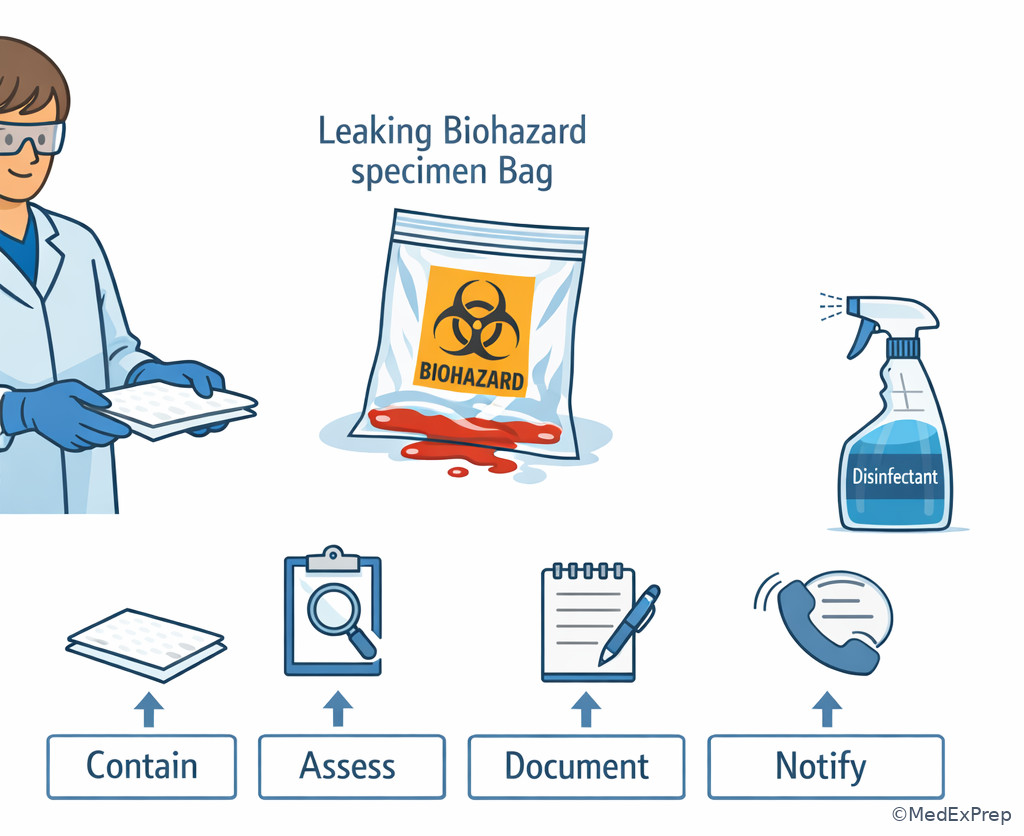
Another high-yield decision conflict is choosing between salvaging a specimen for testing and protecting staff and the environment from exposure. The single rule is: a specimen that creates an uncontained exposure risk cannot be handled as a routine acceptable specimen. Leakage, broken containers, visible contamination of outer packaging, or compromised seals move the problem beyond mere paperwork.
In bench practice, this is both a safety and quality issue. If a specimen leaked, not only may the outside be contaminated, but the specimen may also have lost sterility or volume. The exam may tempt you to focus on the rarity or urgency of the source, but the immediate laboratory responsibility is containment, proper PPE, decontamination per policy, and appropriate rejection or escalation. You are not deciding the patient’s treatment; you are deciding whether safe validated processing is possible.
WHY THIS IS TESTED: These questions assess whether you recognize when microbiology workflow must stop because biosafety principles now govern the next step.
See Fig 6 for the exposure-response algorithm.
Exam takeaway: When packaging or container integrity fails, containment and policy-directed escalation come before microbiology setup.
flowchart TD
A[Specimen received] --> B{Leak, break, or external contamination?}
B -- Yes --> C[Apply PPE and contain hazard]
C --> D[Follow decontamination and exposure policy]
D --> E{Specimen still valid and safe per policy?}
E -- No --> F[Reject/recollect and document]
E -- Yes --> G[Process under appropriate containment]
B -- No --> H[Continue routine acceptability review] Exam takeaway: Leakage is never just a paperwork issue; it combines specimen invalidity with immediate exposure control duties.
B Worked example
A 29-year-old transplant recipient with fever, neutropenia, and mucositis has a bronchoalveolar lavage specimen sent to microbiology. The double-bagged transport arrives with fluid visible inside the outer pouch, and the screw-cap container appears cracked. The requisition is complete and marked “STAT.” The stem also notes a chest CT with nodules, creating a tempting urge to recover a possible pathogen immediately. A mildly prolonged prothrombin time is included but does not affect acceptability.
Reasoning chain: Identify task: specimen safety and acceptability at receipt. Extract key facts: leaking packaging, cracked container, high-risk patient, urgent status. Apply rule: exposure containment and container integrity override routine setup. Eliminate distractors: rushing to culture because the patient is immunocompromised is tempting but unsafe; assuming a rare mold workup should proceed misses the immediate preanalytic hazard. Verify: the correct action is contain, follow spill/exposure procedure, and reject/escalate according to policy with documentation.
C Exam trap
D Checkpoint
Question: Which is the most appropriate first laboratory response to a leaking microbiology specimen arriving at receipt?
- A. Immediately inoculate media before viability decreases
- B. Place the specimen aside until the clinician calls back
- C. Contain the hazard using PPE and follow spill/exposure policy
- D. Relabel the outside bag and continue routine accessioning
Answer: C
- A is tempting because organism recovery matters, but safety takes priority when leakage has occurred.
- B is tempting because it delays action, yet leaving a contaminated item unmanaged is unsafe.
- C is correct because leakage converts the situation into a biosafety event that must be contained first.
- D is tempting because relabeling seems efficient, but external labeling does not correct exposure or specimen integrity failure.
- The first response to a leaking specimen is containment, not setup.
- True or False: A STAT designation overrides container integrity defects. False.
- Name 3 leakage consequences: exposure risk, specimen contamination, loss of integrity.
1.1.1.7 Documentation, exceptions, and when to clarify rather than reject
A Explanation
The final integration-level decision is choosing between automatic rejection and policy-based clarification or limited processing. The single rule is: not all specimen problems are equal; some invalidate identity or safety outright, while others require documentation, qualification, or recollection based on policy. This is where exam items become subtle.
Absolute-type failures usually include absent specimen identifiers and major integrity failures such as leakage or breakage. Relative defects may include incomplete history, suboptimal but still identifiable source wording, borderline volume, or specimens where a limited workup may still be valid. The bench professional’s job is not to invent exceptions but to recognize which problems allow controlled clarification. When the scenario asks what to do next, document the defect, follow local procedure, and escalate when necessary. You do not override policy because the provider wants a result.
WHY THIS IS TESTED: Strong candidates distinguish “reject now” from “clarify, document, and process under defined limits.” Weak candidates collapse all defects into one category.
This section also points forward: in the next topic, transport and stability will add time and temperature as another layer of acceptability. Later, contamination versus colonization versus infection will determine how to interpret cultures that came from marginal but accepted specimens.
Exam takeaway: Documentation is not a clerical extra; it is the quality record that supports the accept, reject, or clarify decision.
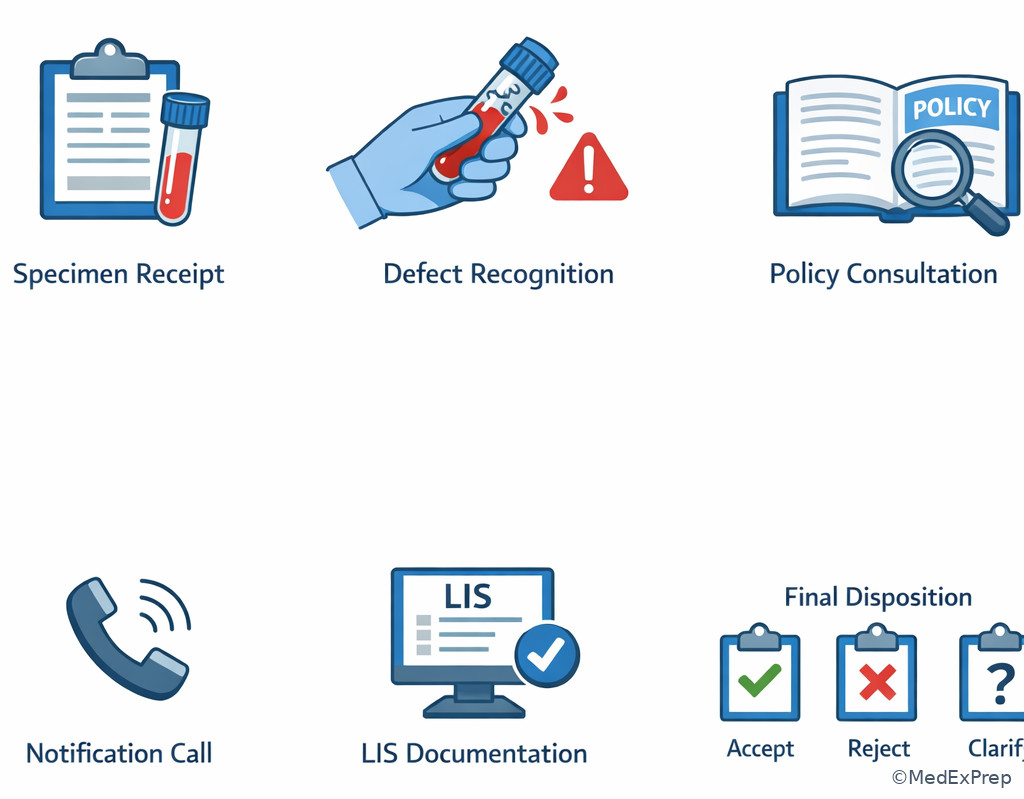
Exam takeaway: Not every specimen defect carries the same weight; classify the defect before choosing the next step.
flowchart LR
A[Specimen defect identified] --> B{Identity or safety compromised?}
B -- Yes --> C[Reject or escalate]
B -- No --> D{Can policy-based clarification resolve it?}
D -- Yes --> E[Clarify and document]
D -- No --> F[Request recollection]
E --> G[Proceed only within defined limits]
B Worked example
A 55-year-old woman with COPD, heart failure, and recent hospitalization submits a sputum sample for culture. The cup is correctly labeled and intact. The requisition requests respiratory culture but lists the source only as “specimen,” with no source detail. The patient also has leukocytosis and a recent positive influenza test, which may distract you toward immediate setup. On visual review, the sample appears mucoid and abundant.
Reasoning chain: Identify task: determine whether this is reject-now, clarify, or acceptable with next-step quality assessment. Extract key facts: identifiers are present, container intact, quantity sufficient, source wording incomplete. Apply rule: missing source detail may require clarification, but it is not the same as absent identity or leakage. Eliminate distractors: rejecting it as if it were unlabeled is too severe; fully ignoring the source issue is also weak because interpretation and routing may depend on source. Verify: the best action is clarification/documentation according to policy while proceeding only if the test request and specimen type can be confidently matched.
C Exam trap
D Checkpoint
Question: Which specimen problem is most appropriate for clarification rather than automatic rejection under standard practice?
- A. Leaking primary container inside the transport bag
- B. No patient identifiers on the specimen container
- C. Fully labeled intact specimen with incomplete source description
- D. Broken sterile container with loss of contents
Answer: C
- A is tempting because viability might still remain, but leakage creates a safety and integrity problem.
- B is tempting because paperwork may be present elsewhere, but absent container identification is typically a rejection-level defect.
- C is correct because the specimen remains identifiable and intact, so clarification may resolve the problem.
- D is tempting because some sample might remain, but broken integrity with content loss is not a routine clarification issue.
Exam Traps & Differentiators
- Most common wrong answer: process the specimen because the patient is very ill. Why: urgency biases the learner toward action. Fix: the lab answer is still governed by specimen identity and integrity.
- Looks similar but isn't: incomplete source detail versus missing patient identifier. The first may allow clarification; the second usually does not.
- Looks similar but isn't: poor specimen quality versus transport delay. This lesson centers on acceptability at receipt; the next topic adds time and temperature constraints.
- Looks similar but isn't: superficial swab growth versus true deep infection sampling. The upcoming contamination/colonization topic explains how poor collection leads to misleading mixed flora.
If the stem says “STAT” or “critical patient,” think do not override identity or safety rules.
If the stem says “deep aspirate” and “superficial swab” are both available, think choose the specimen that best represents the infection site.
If the stem says “correct source but wrong container,” think method compatibility defect.
If the stem says “leaking bag” or “cracked container,” think biosafety first, then disposition.
If the stem says “paperwork complete but container unlabeled,” think reject based on specimen identity failure.
If the stem says “source incomplete but specimen intact and labeled,” think clarify/document rather than assuming automatic rejection.
| Stem clue | Tempting wrong move | Correct discriminator | Best bench-level action |
|---|---|---|---|
| Unlabeled specimen container | Use requisition to infer identity | Container itself lacks verified patient ID | Reject/clarify per policy |
| Leaking primary container | Open in BSC and proceed | Integrity and exposure control already failed | Contain, document, reject/escalate |
| Superficial swab plus deep aspirate | Accept both as equal | Representativeness of infection site | Prefer deep aspirate |
| Correct source in wrong tube | Assume source correctness is enough | Container/device validity affects testing | Reject or clarify per policy |
| Incomplete source wording | Reject as if unlabeled | Identity intact; informational problem may be solvable | Clarify and document |
| Issue | Absolute defect? | Why it matters | Usual exam answer pattern |
|---|---|---|---|
| No patient identifier on container | Yes | Cannot verify specimen identity | Reject |
| Mismatch between specimen and order | Usually yes | Wrong-patient risk | Hold/reject pending policy |
| Leaking or broken container | Yes | Safety + integrity failure | Contain then reject/escalate |
| Insufficient volume | Context-dependent | May prevent complete testing | Limited workup or recollect |
| Incomplete source description | No, often relative | Impairs interpretation and routing | Clarify/document |
| Confusable pair | What makes them look similar | Single clue that separates them |
|---|---|---|
| Unlabeled vs incompletely sourced specimen | Both have missing information | Identity missing is higher-stakes than source detail missing |
| Superficial swab vs deep aspirate | Both come from the same general area | Depth and representativeness of the infectious focus |
| QNS vs wrong container | Both can limit testing | QNS is volume failure; wrong container is compatibility failure |
| Acceptable but suboptimal vs rejectable specimen | Both have defects | Ask whether identity/safety/integrity are still intact |
| Poor collection vs contamination/colonization | Both may produce mixed flora | This lesson asks if the specimen should be worked up; the later topic asks how to interpret the growth |
Algorithm / Approach
Rapid Review
- Unlabeled specimen → identity failure outranks clinical urgency
- Leaking container → biosafety event before microbiology event
- Deep aspirate → better than superficial swab for site representation
- Wrong container → compatibility defect even when source is correct
- QNS → ask whether full ordered workup is still possible
- Specific source label → stronger than vague “wound” or “specimen” wording
- Complete requisition only → does not rescue unlabeled container
- STAT request → never overrides specimen integrity rules
- Relative documentation defect → clarify if identity and safety remain intact
- Sterile-site specimen → important, but still rejectable if integrity fails
- Mixed flora risk → often begins with poor collection from nonsterile sites
- Best exam move → find the earliest rule violation in the workflow
Self-check quiz
1.1.1.8 Question 1
A urine specimen arrives in a sterile container with a complete requisition, but the container has no patient identifiers. What is the most appropriate next step?
- A. Accept and process because the source is low risk
- B. Reject or hold for clarification according to policy
- C. Relabel the specimen using the requisition
- D. Perform a Gram stain only
1.1.1.9 Question 2
A wound culture order is accompanied by both a superficial swab and a deep aspirate from the same lesion. Which specimen is most appropriate to prioritize for culture interpretation?
- A. The superficial swab because it collects the most drainage
- B. The deep aspirate because it better represents the infectious focus
- C. The superficial swab because swabs are standard for all wounds
- D. Both equally because they came from the same patient
1.1.1.10 Question 3
A 68-year-old woman with COPD and heart failure submits a sputum specimen for culture. The cup is correctly labeled, intact, and has adequate volume, but the requisition lists the source only as “specimen.” She also has a recent positive viral test and leukocytosis. Which laboratory action most appropriately follows standard practice?
- A. Reject immediately because any missing source information equals identity failure
- B. Clarify/document the source because the specimen remains identifiable and intact
- C. Ignore the source problem because respiratory cultures never require source details
- D. Perform full workup and add the source later from the chart without documentation
1.1.1.11 Question 4
A 51-year-old man with cirrhosis and ascites has fluid submitted for Gram stain and culture. The specimen source is correct and labeling is complete, but the sample arrives in a nonvalidated container with only a trace volume. His fever and prior peritonitis history are noted in the chart. Which issue most strongly affects acceptability?
- A. The patient’s prior infection history
- B. The correct source documentation
- C. The incompatible device and QNS status
- D. The presence of fever
1.1.1.12 Question 5
A 34-year-old transplant recipient with neutropenia has a bronchoalveolar lavage sent STAT. The primary container is cracked and fluid is visible within the outer transport bag. The requisition is complete, and a chest CT shows nodules. What is the most appropriate first laboratory response?
- A. Immediately inoculate culture media to preserve viability
- B. Contain the hazard using PPE and follow spill/exposure procedure
- C. Call the clinician to recommend empiric antifungal therapy
- D. Transfer the fluid into a new sterile container and continue accessioning
1.1.1.13 Question 6
A 72-year-old man with diabetes, chronic kidney disease, and recent hospitalization has a sputum specimen submitted for culture. The requisition contains correct patient demographics, but the specimen cup has only a bed number. The nurse states the patient is unstable and asks the lab to “just run it.” Which is the best next step?
- A. Reject or hold the specimen because the container lacks verified patient identifiers
- B. Process the specimen because the requisition provides matching demographics
- C. Gram stain the specimen but defer culture
- D. Accept the specimen if two staff members verify the bed number verbally
1.1.1.14 Question 7
A 59-year-old woman with peripheral vascular disease and poorly controlled diabetes has a chronic foot ulcer. The lab receives a properly labeled superficial swab with abundant material and a properly labeled deep aspirate with minimal but sufficient volume. A prior note documents MRSA colonization. Which specimen should the technologist consider the higher-value sample for routine culture interpretation?
- A. The superficial swab because the larger volume will grow more organisms
- B. The deep aspirate because sampling depth outweighs surface quantity
- C. The superficial swab because MRSA colonization increases its predictive value
- D. Both are equal because labeling and volume are acceptable
1.1.1.15 Question 8
A 64-year-old woman with bronchiectasis and steroid use submits a respiratory specimen. The specimen container is correctly labeled and intact; quantity is adequate. The order requests culture, but the specimen arrives in a device not validated for the requested routine workup. A chart note mentions persistent cough and a prior Pseudomonas isolate. Which choice best reflects standard microbiology bench reasoning?
- A. Accept because prior Pseudomonas history makes any specimen clinically valuable
- B. Reject or clarify because device compatibility affects result validity despite adequate labeling and quantity
- C. Process only susceptibility testing because organism history is known
- D. Change the test request to match the device without consultation
Answer key
1.1.1.16 Question 1: B
A. Tempting because urine is common and seems low complexity, but the scenario tests identity, not specimen type; the single clue is that the container has no patient identifiers. Incorrect.
B. Tempting because it may feel slow, but it is correct because absent container identification is a primary acceptability defect requiring rejection or policy-based hold; the discriminating clue is the unlabeled container. Correct.
C. Tempting because the requisition contains the needed data, but relabeling by the lab does not solve wrong-patient risk under standard policy; the discriminating clue is that the original specimen identity was never verified on the container. Incorrect.
D. Tempting because limited testing may seem safer than full culture, but any testing still uses an unidentified specimen; the discriminating clue is that identity failure blocks all setup. Incorrect.
1.1.1.17 Question 2: B
A. Tempting because visible drainage feels rich in material, but surface drainage often reflects colonizers rather than the infectious focus; the key clue is “superficial swab.” Incorrect.
B. Tempting because deep specimens may have less material, but it is correct because representativeness of the infection site outweighs convenience and superficial abundance; the key clue is “deep aspirate.” Correct.
C. Tempting because swabs are frequently seen in practice, but they are not the preferred sample when a deeper specimen is available; the key clue is the presence of a better specimen type. Incorrect.
D. Tempting because both came from the same patient and lesion, but equal patient origin does not equal equal specimen quality; the key clue is different collection depth. Incorrect.
1.1.1.18 Question 3: B
A. Tempting because strictness sounds safe, but incomplete source wording is not the same as absent patient identity; the clue is that the cup is correctly labeled and intact. Incorrect.
B. Tempting because it requires a nuanced response, and it is correct because clarification/documentation is appropriate when the specimen remains valid but source detail is incomplete; the clue is intact identity with an informational gap. Correct.
C. Tempting because a sputum cup looks obvious, but source information still matters for routing and interpretation; the clue is the order field is incomplete, not irrelevant. Incorrect.
D. Tempting because chart review may help, but undocumented backfilling bypasses formal clarification and quality documentation; the clue is the question asks for standard practice. Incorrect.
1.1.1.19 Question 4: C
A. Tempting because prior peritonitis sounds clinically important, but prior history does not determine current specimen validity; the clue is that the question asks what affects acceptability. Incorrect.
B. Tempting because correct source is necessary, but it does not overcome a wrong container and QNS problem; the clue is “nonvalidated container” plus “trace volume.” Incorrect.
C. Tempting because it requires focusing on preanalytic details over clinical urgency, and it is correct because incompatible device and insufficient volume directly affect whether the ordered workup can be performed reliably. Correct.
D. Tempting because fever signals infection, but symptoms do not rescue an unusable specimen; the clue is that acceptability is determined at the bench, not by severity of illness. Incorrect.
1.1.1.20 Question 5: B
A. Tempting because viability loss is a legitimate concern, but the first issue is now leakage and exposure control; the clue is “cracked” and “fluid visible within the outer bag.” Incorrect.
B. Tempting because it delays testing, and it is correct because PPE-based containment and spill/exposure procedure come before any accessioning or setup when integrity has failed. Correct.
C. Tempting because the patient is high risk, but recommending therapy is outside the technologist scope and does not address the specimen hazard; the clue is role boundaries plus safety priority. Incorrect.
D. Tempting because transfer seems like salvage, but the specimen already failed container integrity and chain validity; the clue is that the leak occurred before lab-controlled handling. Incorrect.
1.1.1.21 Question 6: A
A. Tempting because it feels rigid in an unstable patient, and it is correct because the specimen cup lacks verified patient identifiers; the single clue is “only a bed number” on the container. Correct.
B. Tempting because requisition demographics appear complete, but paperwork cannot substitute for labeled specimen identity; the clue is mismatch between complete order and unlabeled container. Incorrect.
C. Tempting because Gram stain seems less committal than full culture, but it is still testing an unidentified specimen; the clue is identity failure, not complexity of method. Incorrect.
D. Tempting because verbal confirmation sounds practical in a crisis, but it does not create a validated specimen identifier on the original container; the clue is the exam’s emphasis on policy-based specimen integrity. Incorrect.
1.1.1.22 Question 7: B
A. Tempting because larger volume seems more informative, but surface quantity does not equal site representativeness; the clue is “superficial swab.” Incorrect.
B. Tempting because minimal volume raises concern, and it is correct because the deep aspirate still has sufficient volume and better samples the infectious focus; the clue is “minimal but sufficient” plus “deep aspirate.” Correct.
C. Tempting because prior MRSA colonization can bias interpretation toward any surface sample, but prior colonization does not make a superficial specimen superior; the clue is that specimen quality, not historical organism name, is being tested. Incorrect.
D. Tempting because both are labeled and processable, but equal acceptability is not equal interpretive value; the clue is different sampling depth. Incorrect.
1.1.1.23 Question 8: B
A. Tempting because prior organism history makes the specimen feel high yield, but clinical relevance does not eliminate device incompatibility; the clue is “device not validated for the requested routine workup.” Incorrect.
B. Tempting because labeling and quantity are acceptable, and it is correct because device compatibility is a separate acceptability requirement that directly affects validity; the clue is that the specimen arrived in an incompatible device. Correct.
C. Tempting because a prior isolate suggests a shortcut, but you cannot skip identification workflow or assume organism continuity from history alone; the clue is that the current specimen still must be valid for the ordered test. Incorrect.
D. Tempting because it sounds efficient, but changing the order to fit the specimen without consultation exceeds routine bench authority and bypasses validation; the clue is scope and policy. Incorrect.
Keep going with the full ASCP Microbiology Prep Course (M)
You just studied the way members do, in the same lesson interface. Full access unlocks every lesson, the question bank and flashcards for a full year.
One payment · 1 year of access · No auto-renewal