1.1.1 - CT Exam Domain Map
CT Exam Domain Map
What you'll learn
- LABOPS: Workflow -> Exam-oriented organization of content by domain — group CT content into learner-facing exam buckets you can actually study from.
- INTERP: Pattern Recognition -> morphology-linked domain selection — decide whether a stem is mainly about adequacy, interpretation, preparation, QA, or role boundaries.
- SPECIMEN: Collection/Preparation -> preanalytic versus analytic distinction — separate specimen-handling problems from morphologic interpretation problems.
- QA: Quality Systems -> workflow safety and escalation triggers — identify when the best answer is rescreen, document, repeat, or escalate.
- PROF: Ethics -> CT role awareness — recognize where CT judgment ends and pathologist or clinician authority begins.
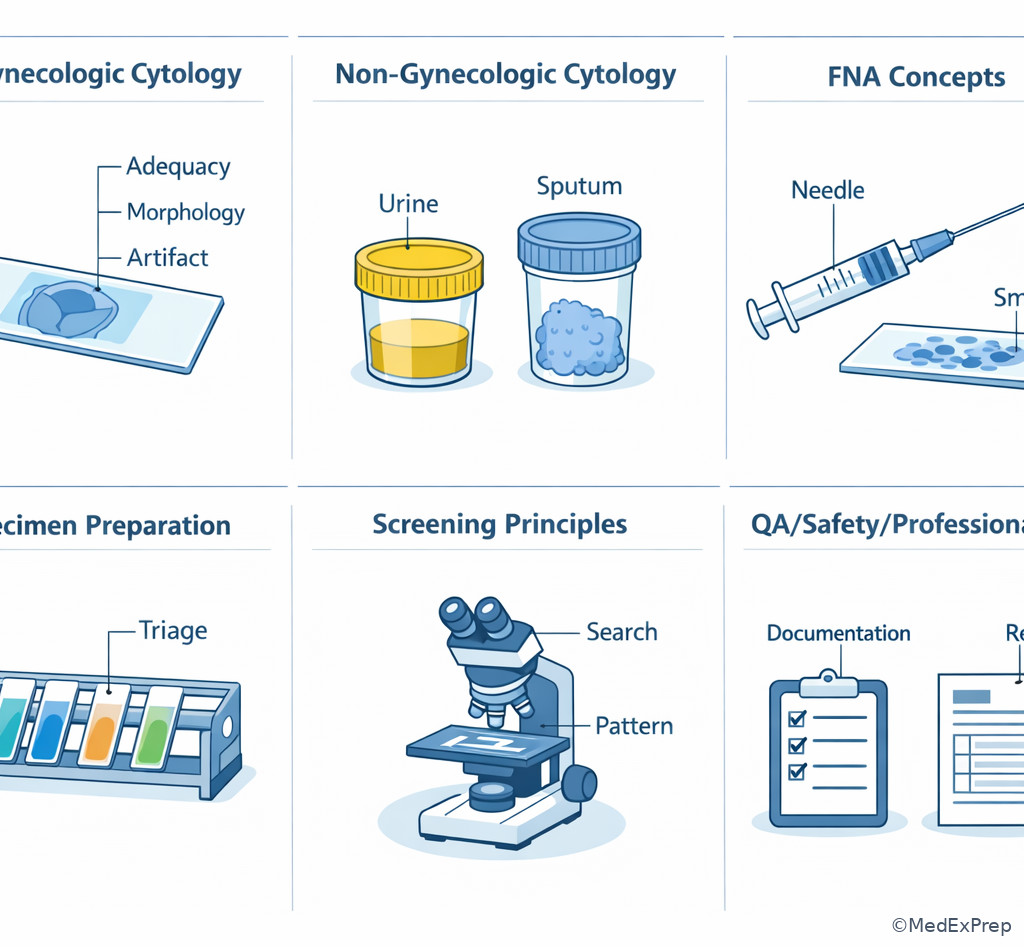
- Gynecologic Cytology → screening/interpretation, adequacy, preparation/collection
- Non-Gynecologic Cytology → respiratory, urinary, serous fluids, additional body sites
- Fine-Needle Aspiration Concepts/Correlation → site-based pattern recognition, adequacy, triage
- Specimen Collection and Preparation → labeling, fixation, transport, staining, artifacts
- Screening and Interpretation Principles → pattern recognition, differential discrimination, reporting logic
- Quality Assurance, Laboratory Operations, Safety, and Professionalism → QC/QA, documentation, biosafety, confidentiality, role boundaries
Why it matters
- Most missed early-study questions are not caused by lack of facts; they are caused by misclassifying what the stem is really testing.
- The CT exam mixes morphology, specimen adequacy, workflow, QA, and scope-of-role cues in the same vignette; your first job is to identify the dominant domain.
- Correct domain mapping improves speed: once you know the bucket, you know which rule set to apply.
- Good domain awareness prevents out-of-scope thinking, such as drifting into independent physician diagnosis or treatment decisions.
Key Terms & Must-Know Facts
1.1.1.1 Key terms
- Domain map: a study framework that groups tested content into major exam areas.
- Adequacy: whether the specimen is sufficient for reliable interpretation under accepted criteria and local protocol.
- Preanalytic phase: labeling, collection, transport, preservation, and accessioning steps before interpretation.
- Analytic phase: preparation, staining, screening, and interpretation steps.
- Postanalytic phase: reporting workflow, documentation, communication, and follow-up actions within protocol.
- Triage: routing a case for additional review, repeat sampling, ancillary processing, or pathologist escalation according to policy.
- Morphologic discriminator: the single cytologic feature that separates the best answer from close mimics.
- Mimic: a benign, reactive, infectious, or artifactual pattern that resembles a neoplastic one.
- Escalation trigger: a finding or workflow problem requiring pathologist review or protocol-driven action.
- QC: operational checks that monitor specific processes or materials.
- QA: system-level oversight that tracks quality across the testing pathway.
- Chain integrity: preserved specimen identity and traceability from collection to final workflow step.
- Within CT scope: screening, adequacy assessment, recognition, triage, documentation, and protocol-based escalation.
1.1.1.2 Must-know facts
- Do not memorize the exam as a random fact list; organize it by domain first.
- Many stems test two things at once, but one domain usually governs the best answer.
- Gynecologic and non-gynecologic cytology remain central, but specimen handling and QA often determine the correct response in case-based items.
- If the scenario asks you to diagnose, prescribe, stage, or manage treatment independently, it is outside CT role expectations.
- On exam day, “best next step” may be review, rescreen, document, repeat specimen, or escalate, not name a lesion.
- Artifacts and contaminants are tested because they create overcall and undercall errors.
- Role boundaries are not separate from morphology; they shape what action is appropriate after recognition.
- When blueprint wording is broad, use learner-safe subskills and confirm current exam emphasis with the latest ASCP BOC content guideline.
| Major domain | What it covers | Typical stem verbs | Most likely best answer type |
|---|---|---|---|
| Gynecologic Cytology | Normal, reactive, infectious, premalignant, malignant patterns; adequacy; reporting frameworks | Interpret, classify, identify, assess adequacy | Morphology-based interpretation or adequacy call |
| Non-Gynecologic Cytology | Respiratory, urinary, serous fluids, CSF, additional body sites | Differentiate, recognize, correlate, triage | Pattern recognition with site-specific differential |
| FNA Concepts/Correlation | Smear prep, triage, adequacy concepts, site-based patterns | Select next step, assess adequacy, correlate | Preparation/triage decision within CT scope |
| Specimen Collection & Preparation | Labeling, fixation, transport, staining, prep methods, artifacts | Prevent, identify, correct, document | Workflow correction or artifact recognition |
| Screening & Interpretation Principles | Search patterns, thresholds, differentials, reporting logic | Choose best interpretation, eliminate distractor | Rule-based differential discrimination |
| QA, Safety, Professionalism | Rescreening, workload, documentation, exposure response, confidentiality, role boundaries | Escalate, document, follow protocol, protect | Quality/safety action within scope |
Core content
Exam takeaway: Use the dominant task in the stem to choose the domain before applying detailed cytology rules.
flowchart TD
A[CT Exam Question] --> B[Gynecologic Cytology]
A --> C[Non-Gynecologic Cytology]
A --> D[FNA Concepts and Correlation]
A --> E[Specimen Collection and Preparation]
A --> F[Screening and Interpretation Principles]
A --> G[QA Safety Professionalism]
B --> B1[Adequacy]
B --> B2[Morphology]
C --> C1[Site-specific patterns]
D --> D1[Triage and adequacy]
E --> E1[Fixation artifact labeling]
F --> F1[Differentials thresholds]
G --> G1[Escalation documentation role]
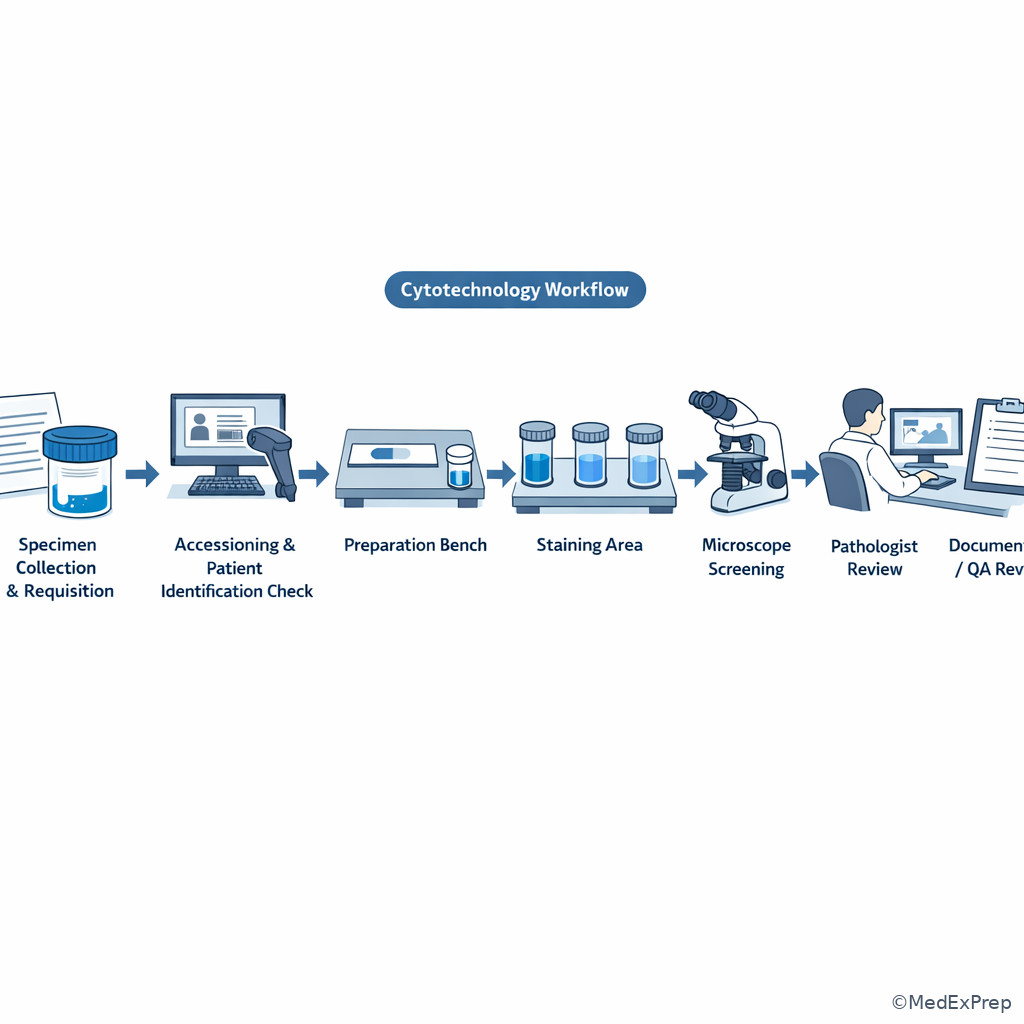
Exam takeaway: Visualize where collection, preparation, screening, and escalation fit so you can spot which phase the stem is testing.
1.1.1.3 Foundational domain buckets: what is actually being tested?
A Explanation
The first decision conflict in CT exam prep is not “What disease is this?” but “What kind of question is this?” A stem may mention atypical cells, bloody background, mislabeled specimen, and screening workflow in the same paragraph. You must choose between a morphology-driven response and a systems-driven response. The single rule that resolves this conflict is: identify the stem’s required action. If the action is classify or recognize cells, think interpretation. If the action is assess sufficiency, think adequacy. If the action is prevent error or maintain traceability, think specimen handling or QA. See Fig 1.
WHY THIS IS TESTED: exam writers build mixed stems so candidates who memorize isolated morphology but ignore workflow will select an attractive yet wrong answer. The best answer usually comes from the domain attached to the action verb.
Foundationally, use six buckets: gynecologic cytology, non-gynecologic cytology, FNA concepts/correlation, specimen collection/preparation, screening/interpretation principles, and QA/safety/professionalism. Gynecologic and non-gynecologic domains are specimen-centered. Specimen collection/preparation is process-centered. Screening/interpretation is rule-centered. QA/safety/professionalism is action-centered. FNA is hybrid: preparation, adequacy, and site correlation together. This lesson is the map, not the deep content of each bucket. The exam wants you to know where each later topic lives before you build detail.
Exam takeaway: Start with the task verb, then map the stem to morphology, adequacy, workflow, or escalation.
B Worked example
A 47-year-old patient with a history of prior abnormal Pap testing and lupus presents for cervical screening. The liquid-based vial arrives with scant volume, but the slide prepared from it shows scattered metaplastic squamous cells and inflammation. The requisition also notes postcoital spotting, which makes neoplasia feel tempting. The question asks for the most appropriate next step in evaluating the case.
Reasoning chain: identify task → this is not asking for the lesion type; it is asking for the next evaluative step. Extract key facts → scant specimen volume and limited cellularity are the high-yield clues; spotting is noise. Apply rule → adequacy domain governs before lesion classification. Eliminate distractors → jumping to HSIL-style interpretation is tempting because of the bleeding history, but there is no decisive morphology given. Verify → the best answer will involve adequacy assessment and protocol-based handling, not a diagnosis-first approach. See Fig 2.
C Exam trap
D Checkpoint
Question: A case stem includes a mislabeled specimen container, adequate cellular detail on the slide, and a request for the most appropriate next step. Which domain should control the answer?
- Gynecologic morphology — tempting because adequate cells are present, but wrong because identity error overrides cytomorphology.
- Non-gynecologic differential diagnosis — tempting if the stem mentions unusual cells, but wrong because specimen integrity is the dominant issue.
- Laboratory operations/QA — correct because chain integrity and labeling govern whether the specimen can proceed safely.
- Therapeutic patient management — tempting if serious disease is suspected, but wrong and outside CT scope.
1.1.1.4 Foundational workflow phases: preanalytic, analytic, and postanalytic cues
A Explanation
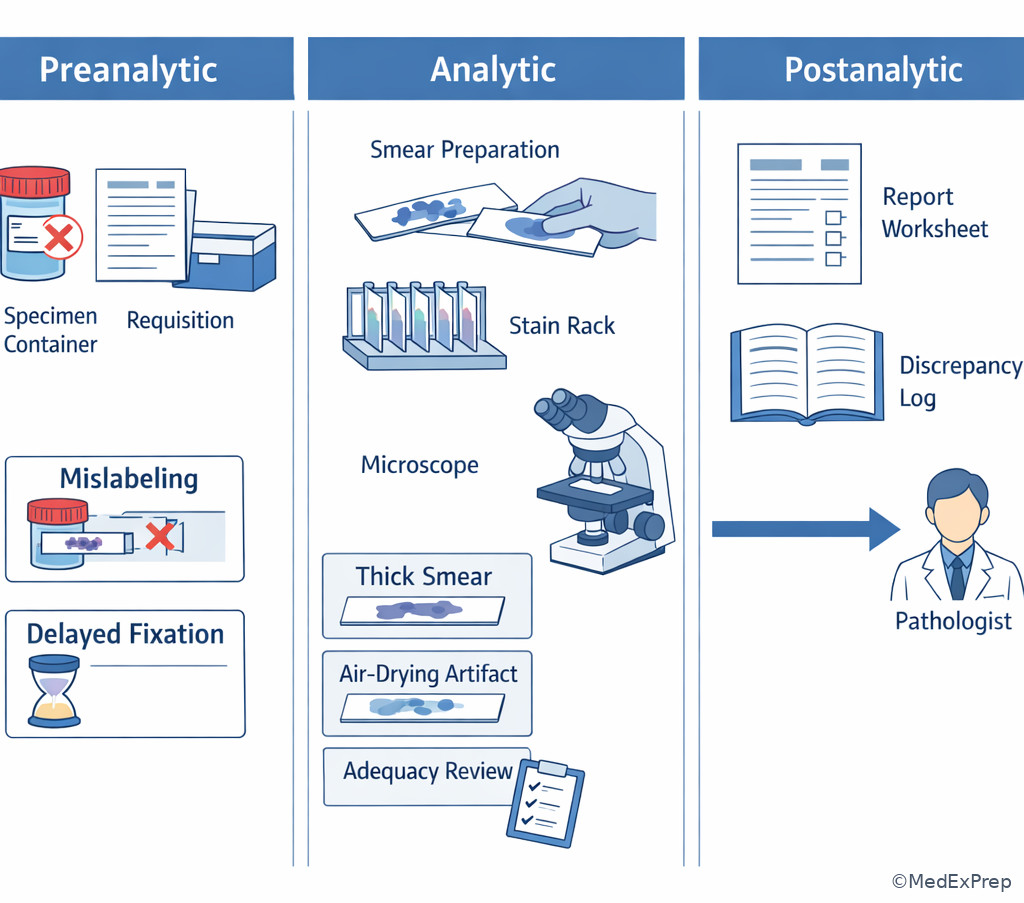
The second foundational split is between where in the workflow the problem occurs. Many CT questions hide the answer in phase recognition. Choose between preanalytic, analytic, and postanalytic. The single rule is: trace the error or decision to the earliest workflow point where it becomes actionable. If the issue is wrong patient identifiers, poor preservation, transport delay, or collection device, that is preanalytic. If the issue is smear quality, stain quality, screening pattern, or adequacy review, that is analytic. If the issue is documentation, discrepancy resolution, communication pathway, or release/escalation step, that is postanalytic.
WHY THIS IS TESTED: phase confusion creates attractive distractors. Candidates may try to “fix” an analytic interpretation problem when the true error began preanalytically and invalidated the specimen. Or they may chase a preanalytic detail when the real tested point is documentation after the slide has already been screened.
This distinction matters because the best action changes. Preanalytic problems often require rejection, recollection, relabeling procedures per policy, or preservation review. Analytic problems often require repeat preparation, rescreen, pathologist review, or artifact recognition. Postanalytic problems often require corrected documentation, discrepancy follow-up, communication within approved channels, or QA tracking.
Exam takeaway: Match the problem to the earliest actionable workflow phase before choosing the next step.
B Worked example
A 63-year-old patient with diabetes and chronic kidney disease has a urine cytology specimen sent after gross hematuria. The slide shows degenerative change and poor preservation. The requisition also mentions a prior bladder tumor, which makes a malignant interpretation tempting. The question asks which exam domain and workflow phase most directly govern the answer.
Reasoning chain: identify task → classify the governing issue. Extract key facts → poor preservation and degenerative change are process clues; prior tumor is distracting context. Apply rule → preanalytic handling or preservation likely drove the limitation; interpretation is secondary. Eliminate distractors → a non-gynecologic malignancy domain answer alone is incomplete because the specimen quality problem controls reliability. Verify → the best answer should pair specimen collection/preparation with a preanalytic emphasis.
C Exam trap
D Checkpoint
Question: Which finding most strongly signals a preanalytic-domain question rather than an analytic interpretation question?
- Hyperchromatic crowded groups on a well-fixed slide — tempting because abnormal cells can dominate attention, but this is analytic morphology.
- Absent patient identifiers on the container — correct because identity and accession integrity are preanalytic.
- Need for pathologist review after screening — tempting because it is a next step, but it is later in workflow.
- Borderline atypia versus reactive change — tempting because it often needs judgment, but it remains analytic interpretation.
- The earliest workflow phase involving labeling and transport is preanalytic.
- True or False: A specimen integrity problem can outweigh impressive morphology. True.
- Name the 3 workflow phases: preanalytic, analytic, postanalytic.
Exam takeaway: Distinguish specimen problems from interpretation problems because the best next step changes with the workflow phase.
flowchart LR
A[Preanalytic] --> A1[Labeling]
A --> A2[Collection]
A --> A3[Transport]
A --> A4[Fixation]
B[Analytic] --> B1[Preparation]
B --> B2[Staining]
B --> B3[Screening]
B --> B4[Adequacy]
C[Postanalytic] --> C1[Documentation]
C --> C2[Discrepancy review]
C --> C3[Communication]
C --> C4[QA tracking]
Exam takeaway: Anchor labeling, fixation, stain quality, and reporting errors to the correct phase to avoid choosing the wrong corrective action.
1.1.1.5 Application: sorting common CT exam stems by domain
A Explanation
Once you know the buckets, the practical question becomes: when a stem is short and noisy, how do you sort it quickly? Choose between several candidate domains and reject the ones that are only background. The rule is: the tested domain is the one that resolves the decision conflict posed in the final line of the stem. If the final line asks “most likely interpretation,” morphology rules. If it asks “best next step after screening,” QA or role/escalation may rule. If it asks “most appropriate handling of a compromised specimen,” specimen prep or workflow rules dominate.
WHY THIS IS TESTED: the CT exam often presents realistic mixed-context laboratory scenarios. You are expected to filter clinically interesting but non-governing details. This is especially important because CT candidates support diagnosis through accurate evaluation and escalation, not independent final sign-out.
Fast domain sorting can use cue clusters. Morphology cues: nuclear enlargement, chromatin pattern, koilocytosis, mesothelial windows, necrosis, tumor diathesis. Adequacy cues: scant cellularity, obscuring blood/inflammation, absent transformation zone component, low-volume specimen. Preparation cues: air-drying, poor fixation, thick smear, lubricant contamination, stain artifact. QA/professionalism cues: mislabeling, discrepancy review, confidential information exposure, workload or rescreen triggers, outside-scope requests. See Fig 3.
Exam takeaway: The last sentence usually reveals whether to apply morphology, adequacy, workflow, or escalation rules.
B Worked example
A 58-year-old patient with rheumatoid arthritis and a smoking history has a pleural fluid specimen. The slide shows large cells with prominent nucleoli, but also windows between cells and a two-tone cytoplasm. The final line asks for the best interpretation of the pattern. A distractor clue notes recent pneumonia.
Reasoning chain: identify task → interpretation, not specimen handling. Extract key facts → windows and mesothelial-style cytoplasm support a reactive mesothelial pattern. Apply rule → non-gynecologic interpretation domain is primary. Eliminate distractors → recent pneumonia is tempting because inflammation can explain atypia, but it is background context; labeling or QA answers do not fit the final ask. Verify → choose the non-gynecologic differential framework, not QA or preparation.
C Exam trap
D Checkpoint
Question: A stem describes air-drying artifact in a thyroid FNA smear and asks which factor most limits interpretation. What domain should you enter first?
- Thyroid neoplasm classification — tempting because the specimen source is thyroid, but wrong because artifact is the limiting issue.
- Specimen preparation/artifact recognition — correct because the question is about interpretive limitation from preparation error.
- Patient management planning — tempting because thyroid nodules lead to clinical decisions, but wrong and beyond CT role.
- Postanalytic reporting logistics — tempting if a report is pending, but wrong because the limiting factor occurs earlier.
1.1.1.6 Application: role boundaries and escalation as part of the domain map
A Explanation
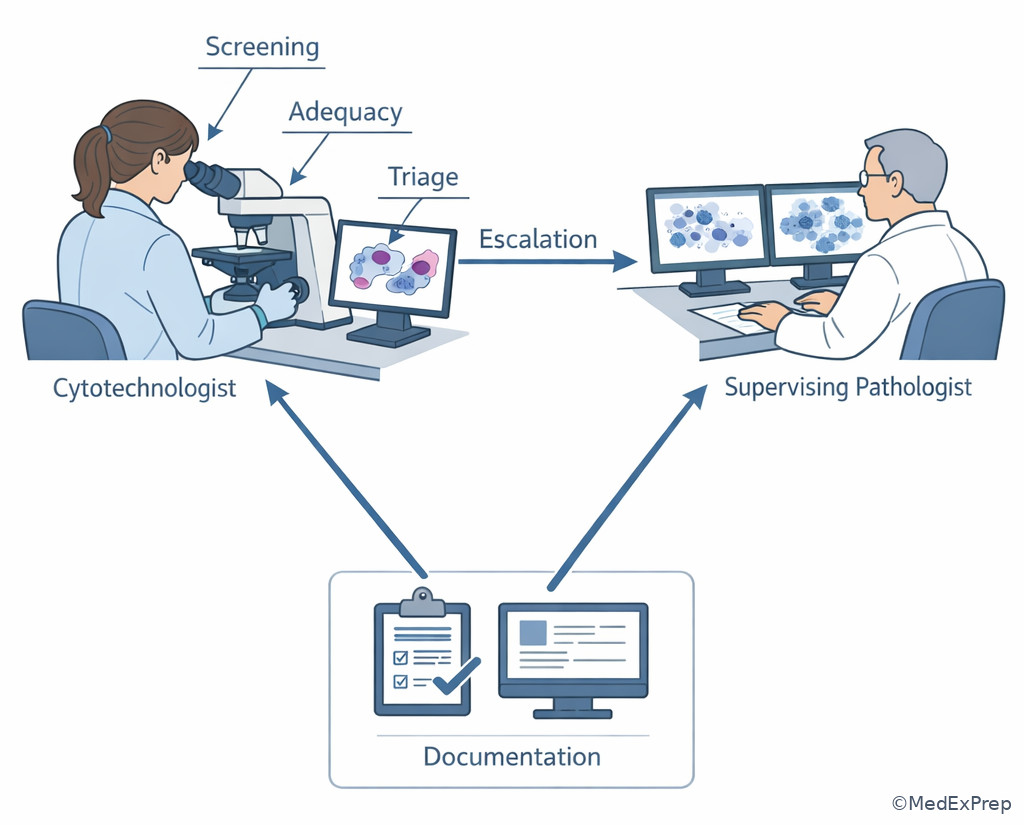
CT exam items do not test role boundaries as abstract ethics alone; they test them as part of the decision map. The conflict is often: should the CT candidate independently conclude, or should the case be escalated within protocol? The single rule is: if the action requires final physician authority, patient treatment direction, or independent clinical management, the CT candidate should escalate rather than act autonomously.
WHY THIS IS TESTED: candidates who know the morphology may still miss the safest and most exam-correct action because they overstep scope. Your role is to recognize significant findings, assess adequacy, and route appropriately. You do not independently stage cancer, prescribe therapy, sign out unrestricted final diagnoses, or direct patient care. This domain map matters because professionalism and workflow are integrated into technical questions.
High-yield out-of-role signals include requests to “write the final diagnosis,” “choose treatment,” “obtain informed consent,” or “decide overall clinical workup.” In CT-style exam logic, the correct move is usually pathologist review, protocol-based escalation, documentation, or communication through approved laboratory pathways. See Fig 4.
Exam takeaway: When the requested action exceeds screening, adequacy, or protocol-based triage, escalate rather than act independently.
B Worked example
A 39-year-old patient with HIV infection and recent weight loss has a lymph node FNA. The smear shows atypical discohesive cells suspicious for malignancy. A multiple-choice option says the cytotechnologist should inform the oncologist that metastatic carcinoma is present and recommend immediate staging workup. Another option says to route the case for pathologist review and document the triage step.
Reasoning chain: identify task → choose the most appropriate CT-level action. Extract key facts → suspicious findings are present, but definitive communication to treating clinicians exceeds CT scope. Apply rule → escalate rather than independently diagnose or manage. Eliminate distractors → direct oncology communication is tempting because it feels urgent, but authority and communication pathways matter. Verify → pathologist review with documentation is the best answer.
C Exam trap
D Checkpoint
Question: Which option best fits CT candidate scope when a specimen shows concerning atypia?
- Issue the final physician diagnosis in the report — tempting because it seems efficient, but wrong because final sign-out authority is not CT-level.
- Recommend chemotherapy based on likely tumor type — tempting because malignant cells are suspected, but wrong and outside laboratory role.
- Escalate for pathologist review and document the abnormal findings per protocol — correct because it matches CT triage authority.
- Call the patient directly with results — tempting if the finding seems serious, but wrong because result communication follows approved pathways.
- Fill in the blank: If a stem asks for treatment selection, the CT candidate should usually escalate.
- True or False: Severe atypia allows the CT candidate to bypass reporting pathways. False.
- Name the RED sequence: Recognize, Escalate, Document.
Exam takeaway: Link suspicious findings to the correct internal handoff pathway rather than physician-level independent action.
1.1.1.7 Integration: building a study plan from the domain map
A Explanation
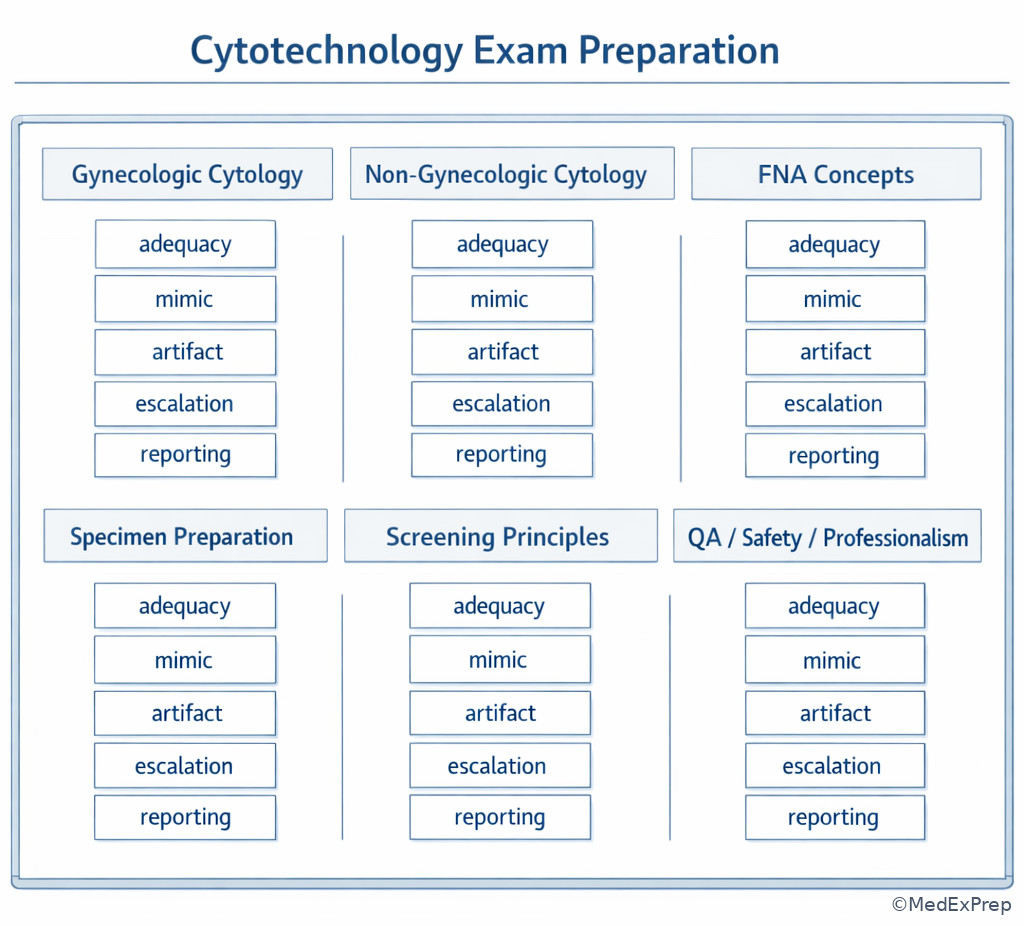
The final integration step is turning the domain map into a practical study system. The conflict is between studying by chapter title alone versus studying by retrieval-ready exam tasks. The single rule is: pair each domain with its common question types, specimen contexts, and traps. Do not study “respiratory cytology” as a static chapter. Study it as benign components versus malignancy, inflammatory/infectious patterns, contaminants, adequacy, and common distractors. Do the same for gyn cytology, urinary cytology, FNA, and preparation methods.
WHY THIS IS TESTED: the exam rewards flexible recognition. A domain map helps you review normal patterns, reactive changes, neoplastic features, preparation artifacts, and workflow responses together, which mirrors how stems are written.
At a foundational level, build review blocks that combine specimen type + adequacy rule + common mimic + escalation step. For example: “Bethesda adequacy + transformation zone + obscuring blood”; “urinary high-grade features + polyomavirus mimic”; “effusion reactive mesothelial cells + metastatic adenocarcinoma differential”; “FNA blood/drying artifact + triage adequacy.” This keeps details anchored to decisions. See Fig 5.
Exam takeaway: Study each topic as specimen type plus adequacy, differential, artifact, and escalation rather than as isolated facts.
B Worked example
A candidate reviews 100 missed questions and notices errors across Pap tests, effusions, urine, and FNA. At first this looks like a global morphology problem. But the missed items consistently involve scant cellularity, obscuring blood, air-drying artifact, mislabeled vials, and questions asking for the most appropriate next step. The distracting clue is that several stems also contained obviously atypical cells.
Reasoning chain: identify task → determine the weak study domain. Extract key facts → misses cluster around adequacy, preparation, and workflow, not pure lesion recognition. Apply rule → study by domain map, not by organ system alone. Eliminate distractors → “review all cancers again” is tempting but inefficient. Verify → the best plan is to build blocks around specimen preparation, adequacy, and QA-linked triage.
C Exam trap
D Checkpoint
Question: Which study block design best reflects the CT exam domain map?
- Study only malignant entities by organ system — tempting because cancer patterns are high yield, but wrong because adequacy, artifacts, and workflow are underrepresented.
- Study specimen type plus adequacy, mimic, preparation issue, and escalation step — correct because it mirrors exam-style integration.
- Memorize stain chemistry before screening principles — tempting because technical details matter, but wrong as a universal strategy because it ignores domain balance.
- Focus exclusively on QA because it is safest — tempting after workflow mistakes, but wrong because morphology domains remain central.
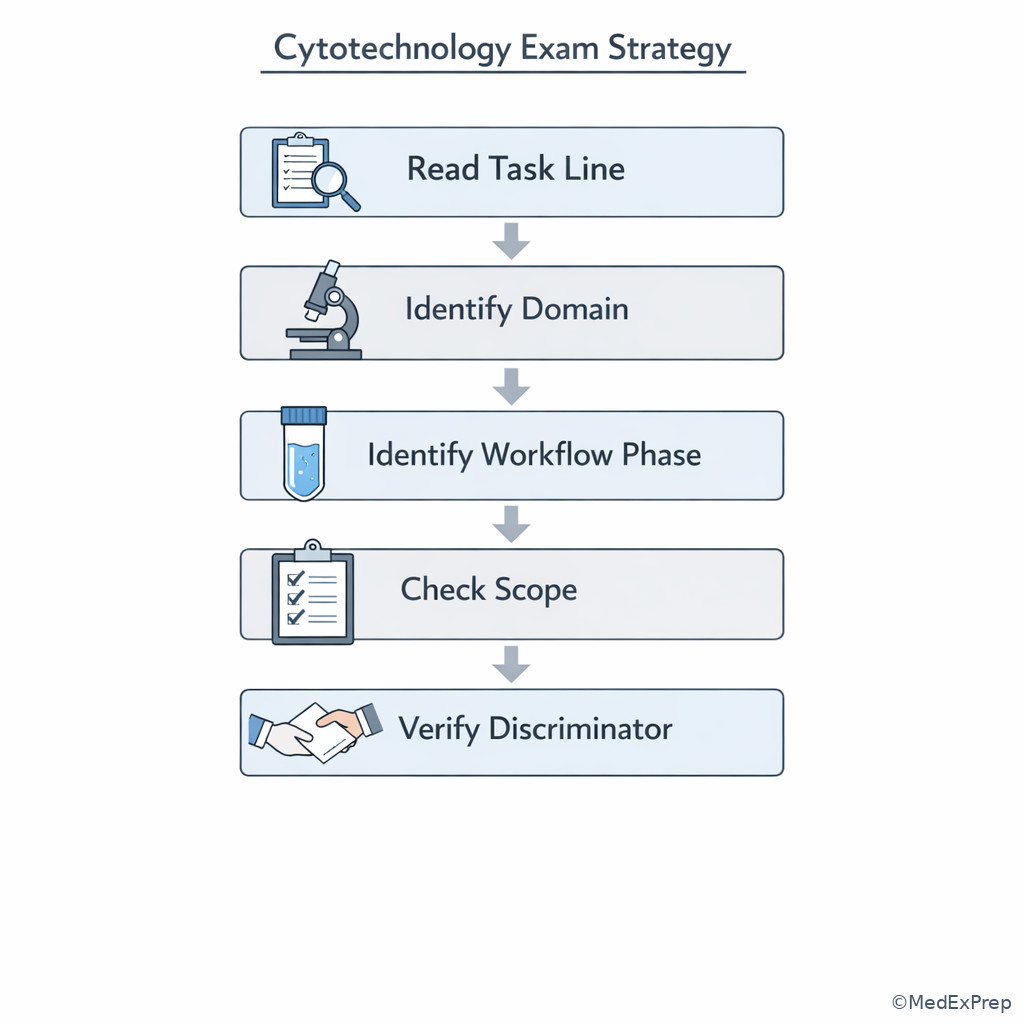
Exam takeaway: When a question mixes findings, use a fixed sequence to decide whether morphology, adequacy, workflow, or scope controls the answer.
flowchart TD
A[Read final question line] --> B{What is being asked?}
B -->|Interpretation| C[Morphology domain]
B -->|Adequacy| D[Adequacy rules]
B -->|Handling error| E[Specimen prep or QA]
B -->|Action beyond CT authority| F[Escalate per protocol]
C --> G[Apply site-specific differential]
D --> G
E --> G
F --> G[Verify within CT scope] Exam takeaway: Organize notes by domain and decision type so repeated weak patterns become visible across specimen sources.
Exam Traps & Differentiators
- Most common wrong answer and why: choosing a lesion interpretation when the stem is really about adequacy, labeling, artifact, or scope. This is tempting because morphologic clues are vivid.
- Looks similar but isn't: a high-risk clinical history does not automatically make the question a neoplasia question; a mislabeled specimen with beautiful cells is still a specimen integrity question.
- If the stem says “most appropriate next step” after a workflow defect, think protocol-driven handling, not diagnosis-first.
- If the stem says “best interpretation” and gives decisive cell features, think interpretation domain, not generalized QA.
- If the stem says “limited by poor fixation,” think specimen preparation/artifact before site-specific classification.
- If the stem asks you to tell a clinician the final diagnosis or treatment, think role boundary and escalation.
- If the stem mixes morphology and patient safety identifiers, think chain integrity first.
| Stem clue | Looks like | Actually tests | Discriminator |
|---|---|---|---|
| Prior cancer history + poor preservation | Malignancy recognition | Specimen handling/preanalytic limitation | Poor preservation limits reliable interpretation |
| Atypical cells + mislabeled container | Interpretation | Laboratory operations/QA | Identity error overrides morphology |
| Suspicious cytology + request to call treatment team | Urgent communication | Professionalism/role boundaries | Final diagnosis and management communication exceed CT scope |
| Scant specimen + bleeding history | High-grade lesion concern | Adequacy | Cellularity and obscuring factors govern first |
| Abnormal nuclei + final line asks “best interpretation” | QA or workflow | Screening/interpretation principles | The task line requests morphologic decision-making |
| Air-drying artifact in FNA | Site-based lesion classification | Preparation artifact recognition | Artifact is the limiting feature |
| Confusable pair | When to think the first | When to think the second |
|---|---|---|
| Morphology vs adequacy | Question asks for interpretation and provides decisive cell features | Question emphasizes scant cells, obscuring material, or specimen limitation |
| Preparation artifact vs true atypia | Uniform technical distortion, poor fixation, drying, stain issues | Coherent biologic pattern across well-preserved cells |
| QA/workflow vs lesion recognition | Labeling, accession, discrepancy, documentation, or policy cues dominate | The stem is asking what the cells represent |
| CT action vs pathologist action | Screen, assess adequacy, triage, document, escalate | Final sign-out, staging, treatment, independent clinical management |
Tables
| Reference cue | Domain to enter | Common answer type |
|---|---|---|
| Nuclear detail, chromatin, cell arrangement | Screening/interpretation or specimen-specific morphology domain | Best interpretation or differential |
| Scant cells, obscuring blood/inflammation, absent key component | Adequacy | Satisfactory vs limited/unsatisfactory action |
| Air-drying, thick smear, poor fixation, stain issue | Specimen preparation | Artifact recognition or corrective workflow step |
| Mislabeled specimen, accession mismatch | Laboratory operations/QA | Stop, verify, document, follow policy |
| Need for pathologist review or restricted communication | Professionalism/role boundaries | Escalate and document |
| Rapid on-site FNA adequacy or triage | FNA concepts/correlation | Adequacy/triage within protocol |
| Domain | Typical specimen examples | Core discriminators to study | Frequent distractors |
|---|---|---|---|
| Gynecologic | Pap tests, cervicovaginal specimens | Normal cell types, TZ component, adequacy, Bethesda-oriented interpretation | Atrophy, inflammation, therapy change, obscuring factors |
| Non-gynecologic | Sputum, urine, effusions, CSF | Site-specific benign/reactive/malignant frameworks | Degeneration, contaminants, reactive atypia, infectious patterns |
| FNA | Thyroid, lymph node, salivary, liver/pancreatobiliary aspirates | Smear quality, blood contamination, adequacy, cell block triage concepts | Drying artifact, cyst debris, overcalling scant atypia |
| Preparation | Smears, liquid-based, cytospin, cell block | Fixation, staining, transport, artifact formation | Misreading technical distortion as disease |
| QA/Safety/Professionalism | All specimen types | Rescreen triggers, discrepancy handling, confidentiality, exposure response | Independent diagnosis, wrong communication pathway, undocumented correction |
Exam takeaway: Compare domain tasks side by side so you can separate morphology questions from adequacy, workflow, and professionalism questions.
Algorithm / Approach
Exam takeaway: A fixed sequence prevents overreaction to dramatic clues and keeps answers within CT role expectations.
Rapid Review
- Task line → strongest clue for choosing the governing domain
- Labeling mismatch → chain integrity issue before morphology
- Scant cellularity → adequacy domain before lesion labeling
- Poor fixation/air-drying → preparation artifact before differential diagnosis
- “Best interpretation” wording → morphology rules if specimen integrity is intact
- Urgent-looking malignant cells → still may require escalation rather than independent reporting
- FNA adequacy + triage → hybrid domain combining specimen prep and interpretation
- Clinical risk factor → background unless it resolves the asked task
- Preanalytic defect → earliest actionable phase controls the answer
- Postanalytic discrepancy → documentation and QA pathway, not recollection of morphology facts
- Mixed stem with one glaring workflow error → workflow usually outranks interpretive detail
- Within CT scope → recognize, assess, triage, document
- Outside CT scope → final diagnosis, treatment selection, independent management
- Best study block → specimen + adequacy + mimic + artifact + escalation
Self-check quiz
1. A liquid-based Pap specimen arrives with all identifiers present, adequate processing, and a question asking which broad exam domain includes adequacy and Bethesda-oriented interpretation. Which is the most appropriate choice?
- Gynecologic Cytology
- Non-Gynecologic Cytology
- Quality Assurance only
- Fine-Needle Aspiration Concepts only
2. A respiratory specimen is technically well prepared, but the stem asks you to determine whether the cells are reactive or malignant. Which domain should you enter first?
- Specimen Collection and Preparation
- Screening and Interpretation Principles within a non-gynecologic context
- Postanalytic Documentation
- Therapeutic Management Planning
3. A 52-year-old patient with prior HSIL history and anticoagulant use has a Pap specimen with heavy blood obscuring most epithelial cells. The final line asks for the most appropriate next step in evaluating the case. Which answer is best?
- Classify the case as a high-grade squamous lesion because the history is concerning
- Enter the adequacy domain first because obscuring blood limits reliable interpretation
- Bypass adequacy review and focus on treatment recommendations
- Ignore the blood because clinical history is more predictive than specimen quality
4. A 67-year-old patient with chronic cystitis and renal stones has urine cytology showing degenerative cells after delayed transport. The requisition notes prior urothelial carcinoma, making malignancy a close distractor. Which governing exam domain best fits the limiting issue?
- Specimen Collection and Preparation
- Independent Oncologic Management
- Gynecologic Cytology
- Final Physician Sign-out
5. A 44-year-old patient with sarcoidosis and pleural effusion has a well-prepared fluid specimen. The slide shows large cells with windows and two-tone cytoplasm, and the stem asks for the best interpretation. Which approach is most appropriate?
- Use the non-gynecologic interpretation framework because the question is morphologic
- Reject the case for mislabeling even though identifiers are correct
- Call the treating team with a final malignant diagnosis
- Ignore cell pattern and answer based on the history of effusion alone
6. A 41-year-old patient with HIV infection and cervical lymphadenopathy undergoes FNA. The smear shows atypical cells suspicious for malignancy, but the stem asks for the most appropriate CT-level action after recognition. Which answer is best?
- Issue the final diagnosis of metastatic carcinoma in the report
- Escalate the case for pathologist review and document the triage step
- Recommend immediate chemotherapy because the cells are highly suspicious
- Call the patient directly because the finding is urgent
7. A 59-year-old patient with COPD and a smoking history submits sputum cytology. The slide shows abnormal-appearing cells, but the container label does not match the requisition. A tempting option offers morphology-based interpretation because the abnormality looks striking. What is the most appropriate governing action?
- Proceed with interpretation because abnormal cells are present
- Treat the case as a non-gynecologic differential only
- Follow laboratory policy for specimen identity discrepancy before interpretation
- Provide a provisional diagnosis directly to the pulmonologist
8. A candidate reviews missed questions from Pap tests, effusions, urine, and thyroid FNA. The misses cluster around low cellularity, obscuring inflammation, drying artifact, and outside-scope communication options; however, several stems also contained atypical nuclei, making a pure morphology review seem attractive. What is the best study adjustment?
- Restudy malignant entities only, because atypia appeared in many missed items
- Reorganize review by domain: adequacy, preparation/artifact, workflow, and role boundaries across specimen types
- Abandon case questions and memorize terminology lists only
- Focus only on FNA because one missed set involved thyroid aspirates
Answer key
1.1.1.8 1. Answer: A
A. Gynecologic Cytology — tempting because Pap adequacy and Bethesda interpretation are classic gynecologic tasks, and correct for this scenario because the specimen type and requested functions both sit in the gynecologic domain. Single stem clue: liquid-based Pap specimen with adequacy and Bethesda-oriented interpretation.
B. Non-Gynecologic Cytology — tempting because it is another specimen-based cytology domain, but incorrect because Pap tests are gynecologic rather than respiratory, urinary, or fluid specimens. Single stem clue: Pap specimen.
C. Quality Assurance only — tempting because adequacy has quality implications, but incorrect because the question asks for the broad content domain containing adequacy and interpretation, not a systems-only category. Single stem clue: adequacy plus Bethesda interpretation.
D. Fine-Needle Aspiration Concepts only — tempting because adequacy can be tested in FNA too, but incorrect because the specimen is not an aspirate. Single stem clue: liquid-based Pap.
1.1.1.9 2. Answer: B
A. Specimen Collection and Preparation — tempting because every specimen passes through preparation, but incorrect because the stem states the specimen is technically well prepared. Single stem clue: well prepared specimen.
B. Screening and Interpretation Principles within a non-gynecologic context — tempting for the right reason and correct because the task is to decide whether the cells are reactive or malignant in a respiratory specimen. Single stem clue: determine whether the cells are reactive or malignant.
C. Postanalytic Documentation — tempting if one assumes all reviewed cases need documentation emphasis, but incorrect because the decision point is interpretation rather than report handling. Single stem clue: asks you to determine the cell meaning.
D. Therapeutic Management Planning — tempting if malignancy is suspected, but incorrect and outside CT scope. Single stem clue: interpretation task rather than patient treatment decision.
1.1.1.10 3. Answer: B
A. Classify the case as a high-grade squamous lesion because the history is concerning — tempting because prior HSIL history makes overcalling feel safe, but incorrect because the specimen is heavily obscured by blood and the question asks for the next evaluative step. Single stem clue: heavy blood obscuring most epithelial cells.
B. Enter the adequacy domain first because obscuring blood limits reliable interpretation — tempting for the right reason and correct because adequacy governs before lesion classification when obscuring factors dominate. Single stem clue: obscuring blood limits interpretation.
C. Bypass adequacy review and focus on treatment recommendations — tempting if one reacts to the prior HSIL, but incorrect because treatment planning is outside CT role and adequacy cannot be ignored. Single stem clue: asks for evaluating the case, not managing the patient.
D. Ignore the blood because clinical history is more predictive than specimen quality — tempting because history matters, but incorrect because specimen quality directly affects reliability. Single stem clue: most epithelial cells are obscured.
1.1.1.11 4. Answer: A
A. Specimen Collection and Preparation — tempting because delayed transport and degeneration clearly point to handling, and correct because the limiting issue is preservation rather than pure urinary cytomorphology. Single stem clue: degenerative cells after delayed transport.
B. Independent Oncologic Management — tempting because the patient has prior urothelial carcinoma, but incorrect and outside CT role. Single stem clue: the question asks about the limiting issue in the specimen, not treatment.
C. Gynecologic Cytology — tempting only as another broad content bucket, but incorrect because urine cytology is non-gynecologic and the tested problem is handling. Single stem clue: urine cytology.
D. Final Physician Sign-out — tempting because prior cancer history can make definitive diagnosis feel urgent, but incorrect because sign-out authority is not the question and not CT scope. Single stem clue: delayed transport causing degeneration.
1.1.1.12 5. Answer: A
A. Use the non-gynecologic interpretation framework because the question is morphologic — tempting because the cell pattern given is classic for interpretation, and correct because the specimen is well prepared and the final line asks for the best interpretation. Single stem clue: well-prepared fluid specimen with request for best interpretation.
B. Reject the case for mislabeling even though identifiers are correct — tempting because QA is always important, but incorrect because no identity problem exists. Single stem clue: identifiers are correct.
C. Call the treating team with a final malignant diagnosis — tempting because the cells are atypical and clinical urgency feels high, but incorrect because final diagnosis communication is outside CT scope and the pattern may be reactive mesothelial. Single stem clue: windows and two-tone cytoplasm.
D. Ignore cell pattern and answer based on the history of effusion alone — tempting because pleural effusions have limited differential buckets, but incorrect because morphology is decisive here. Single stem clue: detailed cell pattern provided.
1.1.1.13 6. Answer: B
A. Issue the final diagnosis of metastatic carcinoma in the report — tempting because the smear is suspicious and final labeling feels efficient, but incorrect because unrestricted final diagnosis exceeds CT authority. Single stem clue: asks for the most appropriate CT-level action.
B. Escalate the case for pathologist review and document the triage step — tempting for the right reason and correct because CT scope includes recognition, triage, and documentation, not final physician sign-out. Single stem clue: suspicious for malignancy after recognition.
C. Recommend immediate chemotherapy because the cells are highly suspicious — tempting because the case sounds urgent, but incorrect because treatment selection is clinician-level management beyond CT scope. Single stem clue: asks for CT-level action, not patient treatment.
D. Call the patient directly because the finding is urgent — tempting because direct notification may feel compassionate, but incorrect because result communication follows approved laboratory pathways. Single stem clue: laboratory role and internal triage are being tested.
1.1.1.14 7. Answer: C
A. Proceed with interpretation because abnormal cells are present — tempting because striking morphology can dominate attention, but incorrect because specimen identity discrepancy compromises chain integrity. Single stem clue: container label does not match the requisition.
B. Treat the case as a non-gynecologic differential only — tempting because sputum is a non-gynecologic specimen, but incorrect because the workflow defect must be addressed before interpretation can proceed. Single stem clue: identity mismatch precedes differential diagnosis.
C. Follow laboratory policy for specimen identity discrepancy before interpretation — tempting for the right reason and correct because patient identification accuracy overrides impressive morphology. Single stem clue: mismatched identifiers.
D. Provide a provisional diagnosis directly to the pulmonologist — tempting because the cells appear abnormal and pulmonary care may seem urgent, but incorrect because both identity integrity and communication scope are violated. Single stem clue: label mismatch plus direct provider communication.
1.1.1.15 8. Answer: B
A. Restudy malignant entities only, because atypia appeared in many missed items — tempting because atypical nuclei are memorable and common in difficult questions, but incorrect because the true miss pattern clusters around adequacy, artifact, workflow, and scope. Single stem clue: low cellularity, obscuring inflammation, drying artifact, and outside-scope options.
B. Reorganize review by domain: adequacy, preparation/artifact, workflow, and role boundaries across specimen types — tempting for the right reason and correct because the errors are domain-mapping failures rather than purely lesion-label failures. Single stem clue: misses recur across multiple specimen types but share the same decision categories.
C. Abandon case questions and memorize terminology lists only — tempting because case complexity caused the misses, but incorrect because the exam is case-based and requires decision sorting, not list memorization alone. Single stem clue: repeated errors arise in noisy vignettes.
D. Focus only on FNA because one missed set involved thyroid aspirates — tempting because a vivid subgroup stands out, but incorrect because the misses span Pap tests, fluids, urine, and FNA. Single stem clue: errors occurred across several specimen domains.
Keep going with the full ASCP CT Prep Course (CT)
You just studied the way members do, in the same lesson interface. Full access unlocks every lesson, the question bank and flashcards for a full year.
One payment · 1 year of access · No auto-renewal