1.1.1 - Therapeutic Communication Principles
Why it matters
- Communication errors cause repeat images, delayed care, patient mistrust, and preventable safety events.
- On ARRT-style questions, the best answer is often the response that protects dignity, confirms understanding, and stays within radiographer scope.
- Clear instructions directly improve image quality by reducing motion, positioning confusion, and noncompliance.
- Therapeutic communication is not just “being nice”; it is a procedural skill tied to patient identification, consent communication, privacy, and documentation.
Key Terms & Must-Know Facts
1.1.1.1 Key Terms
- Therapeutic communication: purposeful, patient-centered interaction that supports care and safe imaging.
- Active listening: focused attention to patient words, tone, and nonverbal cues.
- Open-ended question: invites explanation rather than yes/no response.
- Closed-ended question: efficient question used to confirm specific facts.
- Reflection: restating emotion or meaning to show understanding.
- Clarification: requesting more precise information before acting.
- Validation: acknowledging the patient’s experience without promising outcomes.
- Nonverbal communication: body language, eye contact, posture, facial expression, touch, tone.
- Teach-back: asking the patient to repeat key instructions in their own words.
- Empathy: recognizing and verbally acknowledging patient feelings.
- Reassurance trap: false or premature reassurance that dismisses concern.
- Scope boundary: limit on what the radiographer may explain, decide, or interpret.
- Escalation: notifying the appropriate provider/supervisor when a concern exceeds radiographer role.
1.1.1.2 Must-Know Facts
- Best first response to fear or distress: acknowledge the feeling, then give concise procedural information.
- Do not promise results, diagnoses, or treatment implications.
- Use open-ended questions early; use closed-ended questions to verify identifiers, history, and instructions.
- A patient cue such as “I might be pregnant,” “I feel faint,” or “I don’t understand what this is for” requires immediate clarification before exposure.
- Therapeutic touch and eye contact are culturally variable; observe and adapt.
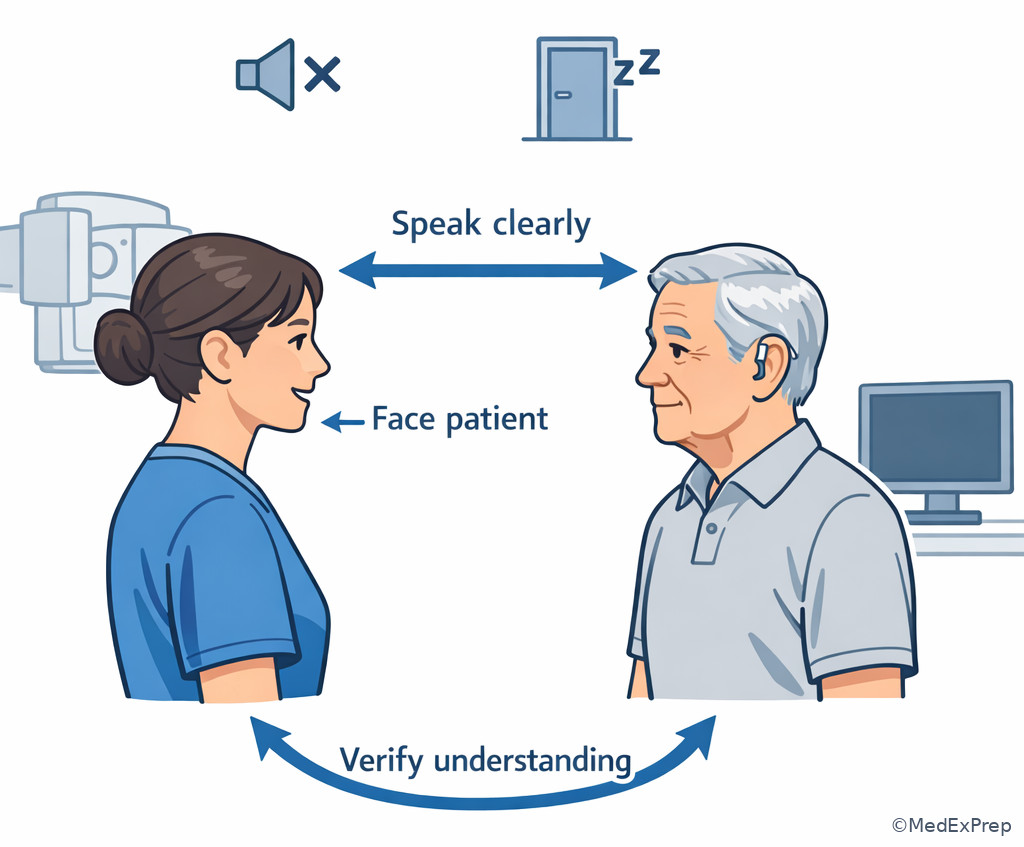
- For hearing difficulty, face the patient, reduce background noise, and confirm understanding.
- For limited English proficiency, follow facility interpreter policy; do not rely on guesswork.
- When the patient is upset, slow down your wording; shorter instructions improve compliance.
- Document objective communication-relevant events, such as inability to follow instructions, refusal, distress, or condition changes.
Core content
1.1.1.3 Foundational rule: what makes communication therapeutic vs nontherapeutic?
A Explanation
The exam usually turns this into a decision conflict: should the radiographer respond with empathy and clarification, or with advice, judgment, false reassurance, or diagnostic discussion? The single rule that resolves it is this: choose the response that supports the patient’s immediate ability to participate safely in the exam without stepping outside radiographer scope.
WHY THIS IS TESTED: testable pattern = multiple answer choices sound “caring,” but only one improves cooperation while avoiding diagnosis, promises, or dismissal.
Therapeutic communication has four core features: it is patient-centered, goal-directed, respectful, and scope-appropriate. In radiography, the goal is not psychotherapy. The goal is to gather relevant imaging information, reduce anxiety enough to complete the exam, give clear instructions, and recognize when a concern requires clarification or escalation. That means statements like “Tell me what worries you most about this exam” or “You’re saying the pain is worse when you raise your arm; I’ll move slowly and tell you each step before we reposition” are therapeutic. By contrast, “Don’t worry, it’s probably nothing,” “I know exactly how you feel,” or “This image looks abnormal” are nontherapeutic because they minimize, assume, or exceed role boundaries.
Use open-ended questions first to uncover the patient’s concern, then narrow with focused questions that affect the exam. Use reflection when emotion is the barrier; use clarification when safety information is incomplete. See Fig 1.
B Worked example
A 54-year-old outpatient presents for a shoulder series after a fall. She has rheumatoid arthritis, chronic anxiety, and hearing aids. As you prepare the AP shoulder, she says, “My doctor told me it might be torn or fractured. Is it bad? I’m scared this means surgery.” Her vital signs are stable. A distracting detail in the chart notes a remote contrast reaction from a CT years ago, which is not relevant to this plain radiographic exam.
Reasoning chain: Identify task: choose the most appropriate immediate communication response. Extract key facts: patient is anxious, asking about results, and has hearing difficulty. Apply rule: acknowledge emotion, provide scope-appropriate procedural support, avoid diagnosis. Eliminate distractors: “It probably isn’t serious” is false reassurance; “The radiologist will decide if you need surgery” still jumps to treatment planning; “Let me tell you what I see after the image” exceeds scope. Verify: best response is something like, “I can see you’re worried. I’ll explain each step so we can get the images your provider needs, and the radiologist/provider will discuss the results with you.” This reduces anxiety and preserves role boundaries.
C Exam trap
WHY IT IS TEMPTING: It sounds comforting and efficient when the patient is visibly anxious.
SINGLE CLUE THAT ELIMINATES IT: The patient is asking about severity and outcome; false reassurance dismisses concern and implies knowledge you do not have.
D Checkpoint
Question: A patient awaiting wrist radiographs says, “I’m terrified this means I’ll lose function in my hand.” Which response is most appropriate?
- “You shouldn’t assume the worst; many injuries are minor.”
- “I understand this is stressful. I’ll explain each step, and your provider will discuss the results with you.”
- “Once I see the images, I can tell you whether it looks fractured.”
- “If it helps, my family member had the same thing and recovered well.”
Answer: B
- A: Tempting because it tries to calm the patient; wrong because it minimizes concern instead of acknowledging it.
- B: Correct because it validates emotion, explains the immediate process, and stays within radiographer scope.
- C: Tempting because it sounds informative; wrong because it implies image interpretation beyond role.
- D: Tempting because it feels personal and reassuring; wrong because it shifts focus away from the patient and offers irrelevant comparison.
1.1.1.4 Listening, questioning, and nonverbal signals during patient preparation
A Explanation
Another frequent decision conflict is whether to gather information broadly or narrowly. The answer depends on the stage of the encounter. At first contact, broad questions uncover the real barrier; once the issue is identified, targeted questions confirm exam-relevant facts. The single rule: open first for meaning, close later for accuracy.
WHY THIS IS TESTED: testable pattern = answer choices mix open-ended, leading, judgmental, and yes/no questions, and only one sequence builds rapport while still obtaining usable imaging information.
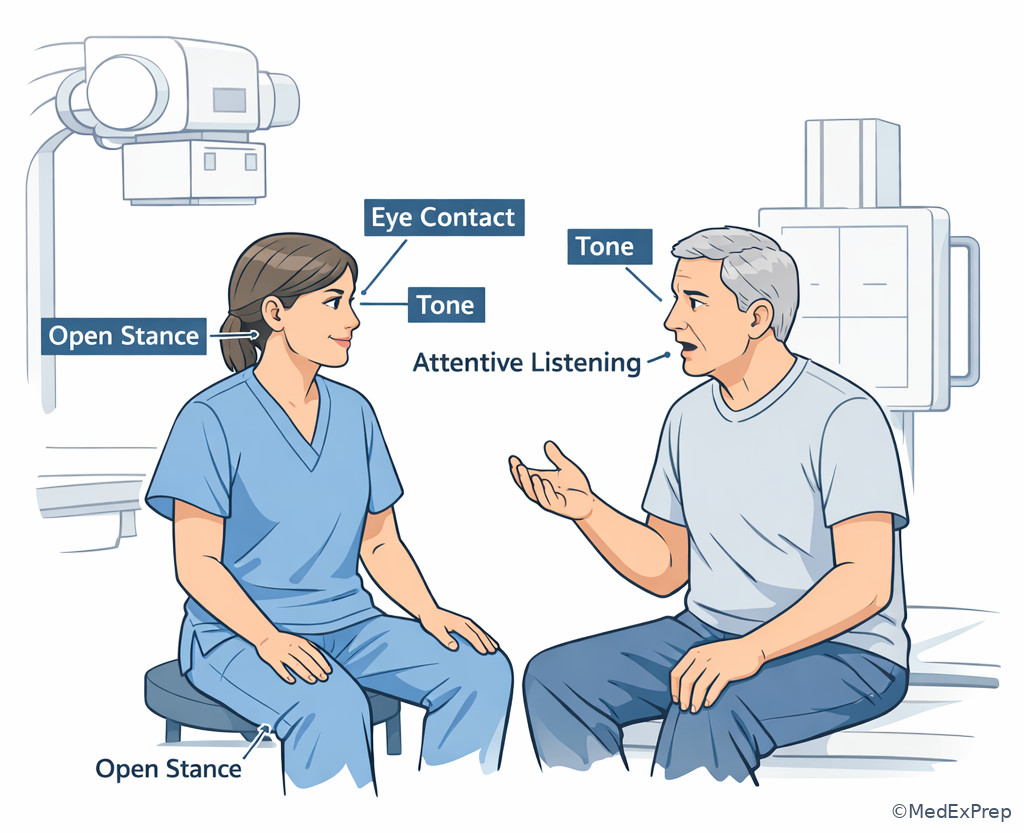
Active listening means more than silence. It includes eye contact appropriate to culture and comfort, facing the patient, allowing pauses, and noticing nonverbal cues that may contradict the spoken answer. A patient who says “I’m okay” while guarding the hip, grimacing, and avoiding movement is not truly communicating comfort. In radiography, nonverbal cues matter because they predict whether the patient can tolerate positioning, breath-holding, or transfer. Good questioning also avoids leading language. “You’re not pregnant, right?” pressures the patient toward one answer; “Is there any chance you could be pregnant?” is safer and more neutral.
Nonverbal communication by the radiographer also affects the encounter. Rushed posture, looking at the screen instead of the patient, or speaking while turning away increases confusion. If hearing is limited, face the patient and speak clearly without exaggerated shouting. If anxiety is high, reduce clutter in the message: one instruction at a time. See Fig 2.
B Worked example
A 79-year-old man arrives for chest radiographs from a skilled nursing facility. He has COPD, mild hearing loss, and osteoarthritis. He answers “yes” to every question while staring at your mask and avoiding eye contact. The transfer sheet mentions recent confusion overnight, but he is calm now. A tempting but wrong clue is his repeated smiling and nodding, which could falsely suggest understanding.
Reasoning chain: Identify task: determine the best communication technique before positioning. Extract key facts: hearing difficulty, possible confusion, unreliable yes/no responses. Apply rule: open and then verify understanding; do not assume nodding equals comprehension. Eliminate distractors: rapidly giving all instructions at once increases error; speaking louder from behind is ineffective; proceeding because he appears cooperative ignores comprehension risk. Verify: face the patient, speak clearly, use short statements, ask him to repeat the breath-hold instruction or demonstrate where to stand. This is safer than relying on assent without understanding.
C Exam trap
WHY IT IS TEMPTING: The patient appears agreeable, and the workflow feels faster.
SINGLE CLUE THAT ELIMINATES IT: He answers every question the same way despite hearing loss and recent confusion, so comprehension has not been verified.
D Checkpoint
Question: Which question is the best opening question when a patient appears anxious and guarded before an ankle exam?
- “You didn’t put weight on it after the injury, correct?”
- “Does it hurt right now?”
- “Tell me what happened and what movement is hardest for you.”
- “Is the pain a 10 out of 10?”
Answer: C
- A: Tempting because it seeks mechanism detail; wrong because it is leading and narrow.
- B: Tempting because pain matters; wrong because it is too limited as an opening question.
- C: Correct because it invites the patient’s story and identifies functional limitation relevant to positioning.
- D: Tempting because pain scoring is common; wrong because it jumps to a numeric scale before understanding the situation.
- The best first question type when the chief barrier is unclear is an open-ended question.
- True or False: Nodding always confirms understanding. False.
- Name 3 nonverbal cues that can change positioning strategy: guarding, grimacing, hesitation.
1.1.1.5 Adapting communication for pain, fear, age, sensory loss, and language barriers
A Explanation
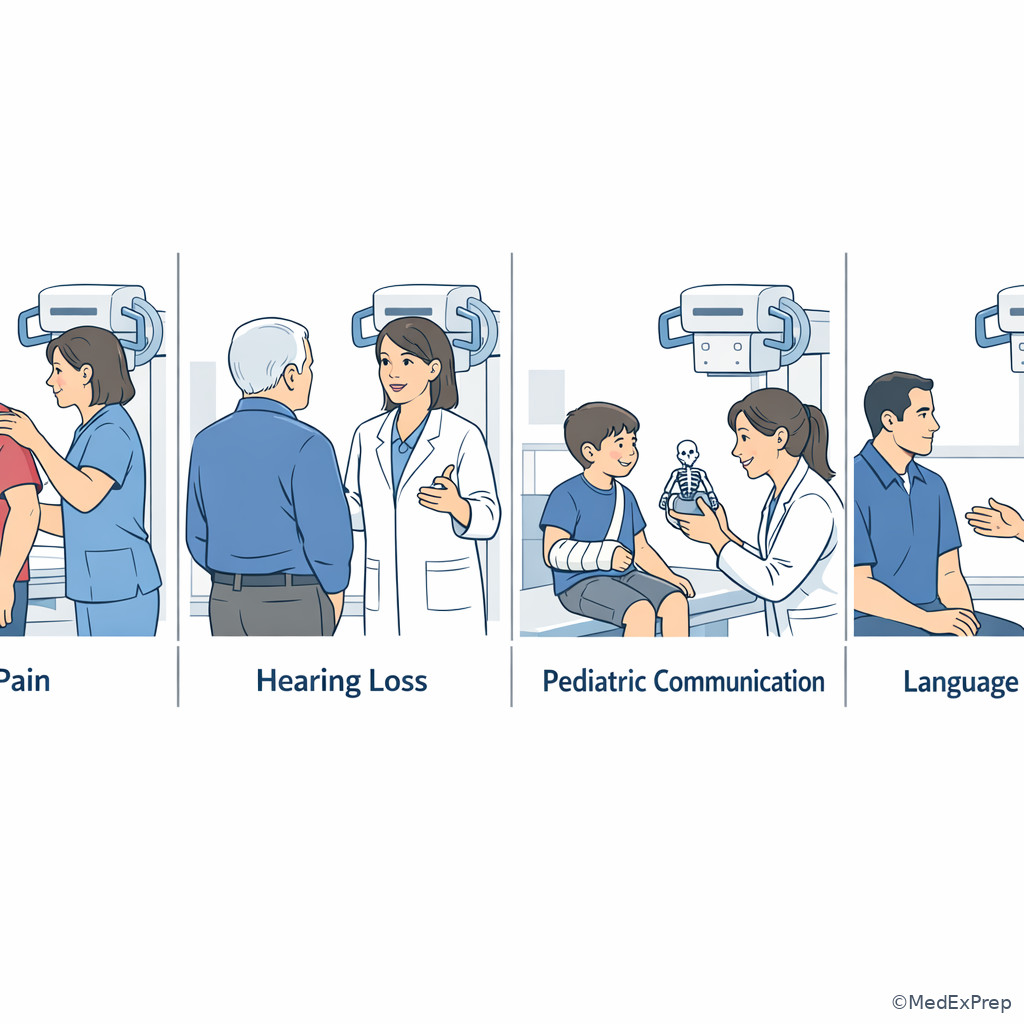
Once the baseline rules are clear, the next decision conflict is whether to keep your standard explanation or adapt it to the patient’s limitation. The single rule is simple: adapt the message so the patient can safely do the next required action. If a patient cannot hear well, understanding is the priority. If a patient is in pain, predictability and pacing matter most. If the patient is a child or older adult with mild confusion, use concrete, single-step instructions.
WHY THIS IS TESTED: testable pattern = several options are technically polite, but only one addresses the actual barrier preventing safe image acquisition.
For pain, state what movement is coming before touching or repositioning. For fear, acknowledge emotion and give a short roadmap: what the machine will do, where to stand or lie, and what sensations to expect. For older adults or confused patients, reduce multi-step commands. For hearing loss, face the patient, remove communication barriers when possible, and confirm understanding with demonstration or teach-back. For language differences, use approved interpreter resources according to facility policy. Family members may help with comfort, but they are not a substitute for formal interpretation when precise health communication is required and policy does not permit it.
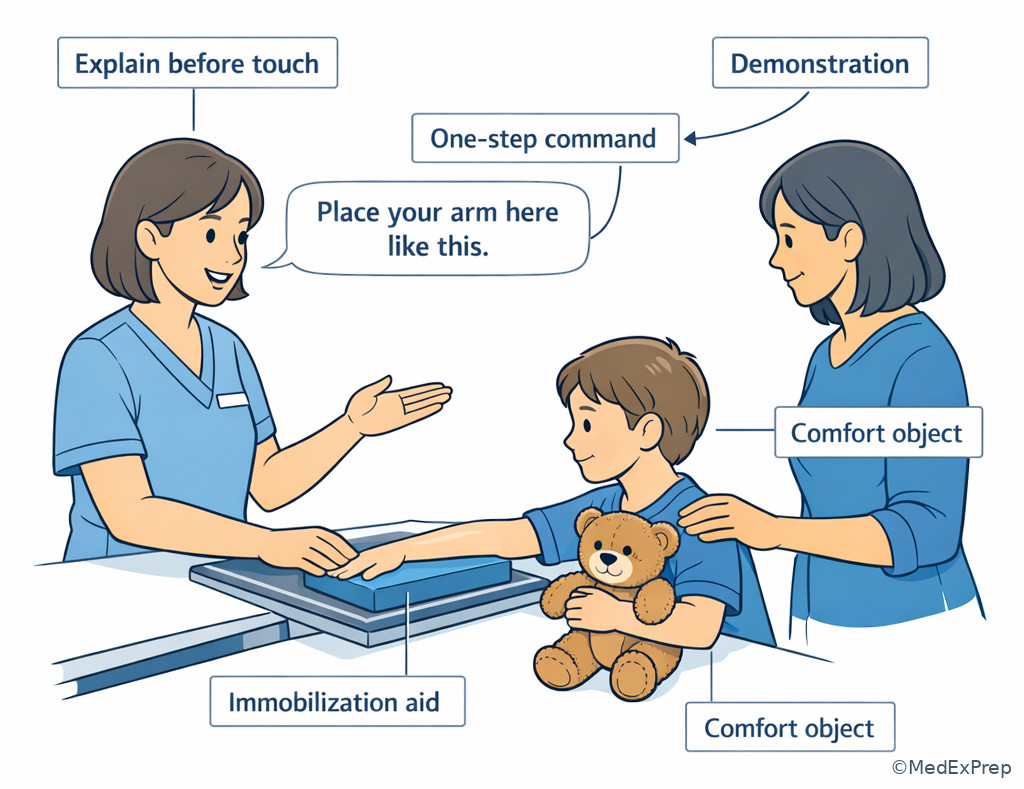
Children often respond better to concrete wording and choice within limits: “Keep your hand still like a statue” is more actionable than abstract explanations. For adults in pain, avoid saying “relax” unless you pair it with a practical plan. “I’ll support your elbow and move slowly” is much more useful. See Fig 3.
B Worked example
A 6-year-old child presents for forearm radiographs after a playground fall. She has asthma and autism spectrum disorder and becomes upset when strangers touch her unexpectedly. Her father says, “Just hold her down quickly and get it over with.” The child is crying, clutching a toy, and repeatedly asks if the machine will hurt her. A distracting detail is a mild wheeze that is baseline per the parent and not causing respiratory distress.
Reasoning chain: Identify task: choose the best communication approach to gain cooperation. Extract key facts: pediatric patient, sensory sensitivity, fear of pain, parent urging restraint. Apply rule: concrete language, predictable steps, least distressing approach first, maintain safety and dignity. Eliminate distractors: abruptly restraining first escalates fear; long technical explanations exceed what the child can use; ignoring the parent is unhelpful. Verify: best approach is to explain in simple terms, demonstrate with the toy or your own arm, tell the child exactly when you will touch, and involve the parent as a calming support according to policy. This improves cooperation and may reduce repeat imaging.
C Exam trap
WHY IT IS TEMPTING: More information feels thorough and respectful.
SINGLE CLUE THAT ELIMINATES IT: The barrier is not lack of technical knowledge; it is fear and sensory stress, so the patient needs brief, concrete, predictable instructions.
D Checkpoint
Question: A patient with moderate hearing loss presents for lumbar radiographs. Which action is most appropriate before giving breath or position instructions?
- Stand behind the patient and speak louder to avoid embarrassment.
- Face the patient, speak clearly, reduce background noise, and verify understanding.
- Skip verbal instruction and rely only on hand motions.
- Proceed normally because repeated exposure can be used if the patient misses the first instruction.
Answer: B
- A: Tempting because louder speech seems helpful; wrong because the patient cannot see your face and lip cues.
- B: Correct because it addresses the communication barrier directly and supports first-pass success.
- C: Tempting because gestures can help; wrong because gestures alone may be insufficient for precise instruction.
- D: Tempting because repeats seem available; wrong because avoidable repeats violate good practice and ALARA.
1.1.1.6 Scope boundaries: what to explain, what to clarify, and what to escalate
A Explanation
One of the most exam-heavy conflicts is choosing between answering a patient question directly or recognizing that the question exceeds radiographer scope. The single rule: you may explain the procedure, positioning, expected sensations, and immediate safety steps; you may not independently diagnose, interpret the radiograph for treatment decisions, prescribe therapy, or convert uncertainty into false certainty.
WHY THIS IS TESTED: testable pattern = the correct answer is often the one that communicates helpfully while redirecting result-based or treatment-based questions to the appropriate provider.
Examples of what you can explain: “You will need to hold still for a few seconds,” “I’m placing the detector here,” “The exam usually takes a few minutes,” or “I need to clarify that statement before we proceed.” Examples of what you should not do: “This definitely looks like pneumonia,” “You will need surgery,” “The biopsy will probably be next,” or “Your pain means the fracture has worsened.” If the patient discloses a safety issue such as possible pregnancy, syncope, severe pain preventing transfer, or inability to consent/understand, the best next step is clarification and escalation through the proper chain, not improvisation.
This is also where communication overlaps with future topics. In Patient Rights And Consent, you will separate procedural explanation from legal consent concepts. In Confidentiality And Documentation, you will learn exactly how to record these interactions objectively. See Fig 4.
B Worked example
A 28-year-old patient arrives for an abdomen series from the emergency department with abdominal pain, nausea, and a history of endometriosis. While you are positioning, she quietly says, “There’s a chance I could be pregnant, but I’m not sure. Should we still do this?” A distracting detail is that the order is marked “STAT,” which may tempt you to rush.
Reasoning chain: Identify task: choose the most appropriate next communication step. Extract key facts: possible pregnancy, uncertainty, imaging not yet performed, urgent order but unresolved safety concern. Apply rule: clarify and follow pregnancy-screening policy before exposure; do not dismiss or independently decide based on guesswork. Eliminate distractors: “It’s probably fine because it’s just one exam” minimizes risk; “That decision is up to your doctor, so we’ll proceed” bypasses safety workflow; “I can’t discuss that” is unhelpful. Verify: the correct action is to pause, clarify the statement, and follow facility policy by notifying the appropriate personnel before proceeding.
C Exam trap
WHY IT IS TEMPTING: Learners confuse “ordered” with “all safety questions resolved.”
SINGLE CLUE THAT ELIMINATES IT: The patient introduced new information that could affect radiation protection and requires clarification before exposure.
D Checkpoint
Question: During a chest exam, the patient asks, “Do you think this looks like pneumonia?” What is the best response?
- “Yes, chest infections usually look obvious on x-ray.”
- “I can’t say what the images show, but I can make sure we get the best images for the radiologist and provider to review.”
- “If you have a fever, it is probably pneumonia.”
- “Let me finish, and I’ll tell you whether I see anything abnormal.”
Answer: B
- A: Tempting because it sounds confident; wrong because it offers diagnostic interpretation.
- B: Correct because it redirects appropriately while reinforcing your role.
- C: Tempting because it ties symptoms to imaging; wrong because it speculates diagnostically.
- D: Tempting because it postpones rather than denies; wrong because it still promises interpretation.
- True or False: A radiographer may explain exam steps but should not provide the final read. True.
- If the patient says, “I may be pregnant,” the next step is clarify and follow policy before exposure.
- Name 3 question categories: procedure, safety, results/treatment.
1.1.1.7 Integrating communication with workflow, safety, and image quality
A Explanation
The final integration step is recognizing that therapeutic communication is part of image acquisition quality control. The decision conflict is whether to prioritize speed or understanding. The single rule: choose the communication strategy that gives the patient the highest chance of completing the exam safely and correctly on the first attempt.
WHY THIS IS TESTED: testable pattern = the best answer often reduces repeats, motion, wrong-side confusion, or incomplete anatomy by improving instructions rather than changing exposure factors.
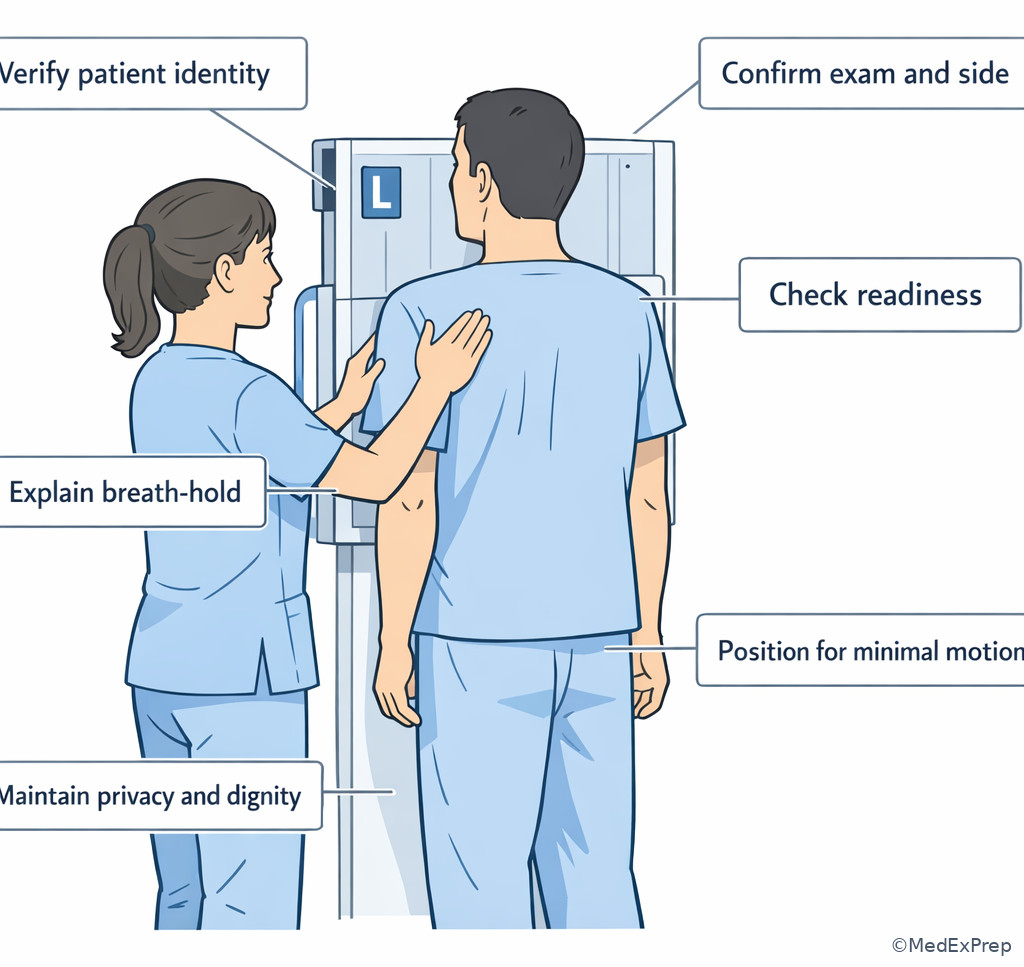
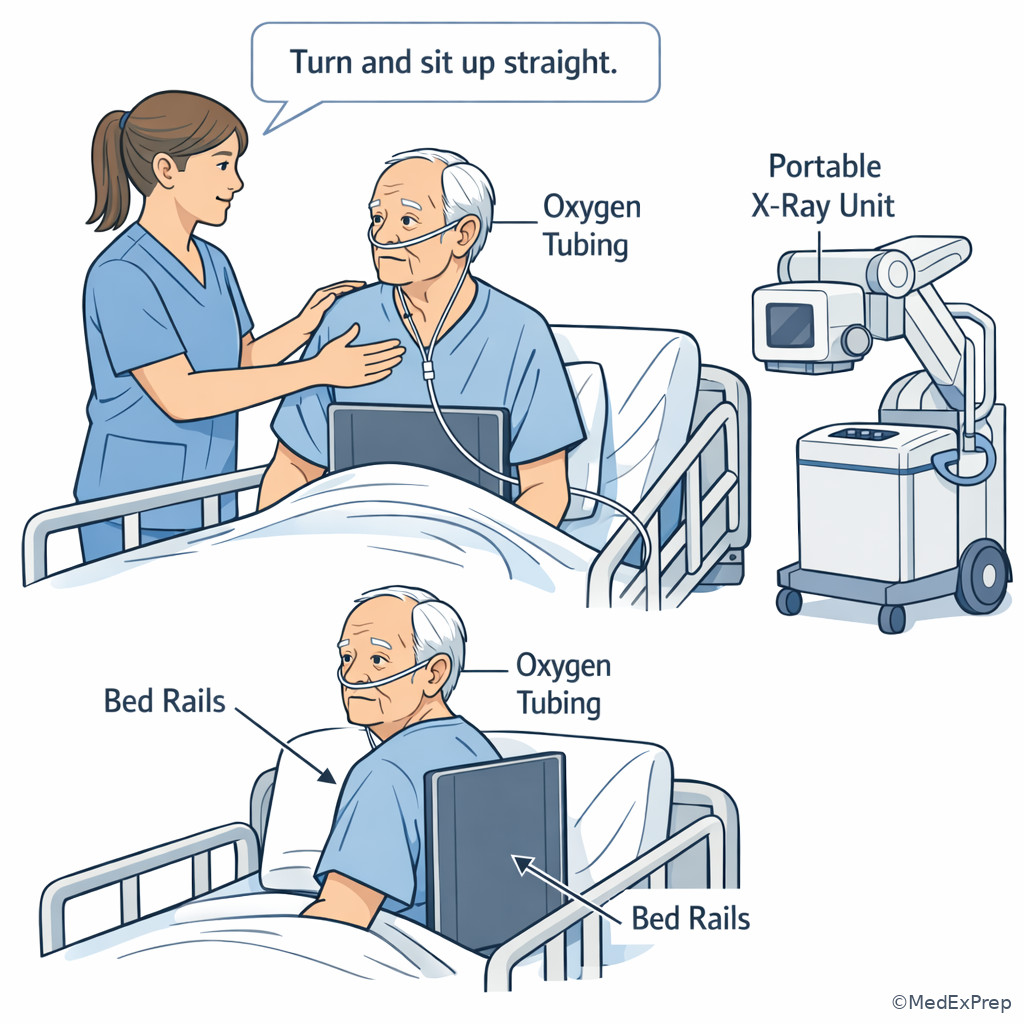
A concise communication sequence before exposure is often enough: identify the patient, verify the exam and side, explain what body part will move, state the stillness or breath-hold requirement, and confirm readiness. In trauma, the wording should match the limitation: “Do not move until I support your leg” is better than “Roll onto your side.” In mobile exams, communication with nursing staff and the patient matters because line safety, oxygen tubing, and isolation precautions affect positioning and exposure setup. If the patient cannot follow instructions despite your best attempt, that fact may justify adaptation, assistance, or escalation—not repeated guessing.
Communication also prevents ethical errors. If the patient looks uncertain about what exam is being done, stop and clarify. If family members begin answering over the patient, redirect respectfully to the patient when possible. If a patient refuses or hesitates, therapeutic communication explores the concern; it does not coerce. See Fig 5.
B Worked example
A 67-year-old inpatient needs a portable chest exam. He has heart failure, mild dementia, and a recent hip fracture repair. He repeatedly reaches for his oxygen tubing and asks, “Why are you here again?” The nurse is briefly away. A distracting detail is that the prior portable chest yesterday was slightly rotated, which may tempt you to focus only on positioning mechanics.
Reasoning chain: Identify task: best next communication action before exposure. Extract key facts: confused inpatient, portable setting, lines/tubing, unreliable understanding, prior positioning issue. Apply rule: clear reorientation and single-step explanation reduce both safety risk and technical error. Eliminate distractors: silently positioning him risks motion and line disturbance; discussing likely findings is irrelevant; waiting indefinitely without attempting communication is unnecessary. Verify: introduce yourself, explain the exam in one sentence, state the immediate instruction, ensure tubing safety, and confirm he can cooperate before exposing. If not, obtain help per policy.
C Exam trap
WHY IT IS TEMPTING: Portable workflow often feels time-pressured, and candidates think communication matters less when positioning options are limited.
SINGLE CLUE THAT ELIMINATES IT: The patient is confused and handling oxygen tubing, so communication is part of the safety setup.
D Checkpoint
Question: Which pre-exposure statement is best for reducing motion during a PA chest exam?
- “Take a normal breath and try not to move too much.”
- “Stand here. When I tell you, take a deep breath in, hold it, and stay very still.”
- “This will only take a second, so just relax.”
- “I need you to cooperate so I do not have to repeat the image.”
Answer: B
- A: Tempting because it includes breathing and motion; wrong because “normal breath” may not meet chest imaging criteria.
- B: Correct because it gives a direct, timed, actionable instruction.
- C: Tempting because it sounds calming; wrong because it is vague and non-instructional.
- D: Tempting because repeats are undesirable; wrong because it centers staff needs rather than giving useful patient action.
Exam takeaway: Choose the response that acknowledges the patient and supports the exam without diagnosing, judging, or falsely reassuring.
flowchart TD
A[Patient expresses fear or uncertainty] --> B{What is the main barrier?}
B -->|Emotion| C[Acknowledge feeling]
B -->|Missing fact| D[Clarify with neutral question]
B -->|Procedure confusion| E[Give brief step-by-step explanation]
C --> F[Stay in radiographer scope]
D --> F
E --> F
F --> G[Verify understanding]
G --> H[Avoid diagnosis, promises, or advice outside role] Exam takeaway: Start broad to uncover the real barrier, then narrow to facts that change safety, positioning, or instructions.
flowchart LR
A[Open question] --> B[Observe verbal and nonverbal cues]
B --> C[Targeted follow-up]
C --> D[Confirm understanding]
D --> E[Proceed or modify]
C --> F[If unclear safety issue]
F --> G[Pause and escalate per policy]
Exam takeaway: Match the communication method to the barrier that blocks safe patient cooperation.
Exam takeaway: Explain procedure and safety steps, but redirect diagnostic and treatment questions to the appropriate provider.
flowchart TD
A[Patient asks a question] --> B{Question type}
B -->|Procedure| C[Explain steps, timing, sensations]
B -->|Safety concern| D[Clarify and hold if needed]
B -->|Results| E[Do not interpret; redirect]
B -->|Treatment plan| F[Refer to provider]
D --> G[Notify appropriate team member]
E --> G
F --> G Exam takeaway: Brief verification and clear instructions reduce motion, repeats, and avoidable safety errors.
Exam takeaway: Body orientation, eye contact, and attentive posture communicate safety and improve patient cooperation.
Exam takeaway: Concrete, predictable instructions work better than abstract explanations for frightened children.
Exam takeaway: Facing the patient and reducing noise are more effective than simply speaking louder.
Exam takeaway: In confused inpatients, reorientation is part of both patient safety and technical success.
Exam takeaway: Many wrong answers sound kind, but dismissal, advice-giving, and role overreach are still wrong.
flowchart TB
A[Patient statement] --> B[False reassurance]
A --> C[Judgment]
A --> D[Premature advice]
A --> E[Scope overreach]
A --> F[Therapeutic response]
B --> G[Minimizes concern]
C --> G
D --> G
E --> G
F --> H[Acknowledges + clarifies + explains next step]
| Communication tool | Best use | Example | Exam risk if missed |
|---|---|---|---|
| Open-ended question | Uncover main concern or mechanism | “Tell me what happened.” | Missed history or positioning limitation |
| Closed-ended question | Confirm a specific fact | “Is the pain worse when you lift the arm?” | Unverified detail affects setup |
| Reflection | Address emotion | “You sound worried about the results.” | Anxiety remains high; poor cooperation |
| Clarification | Resolve ambiguous or safety-relevant information | “When you say you may be pregnant, can you tell me more?” | Unsafe exposure decision |
| Teach-back | Verify understanding | “Show me how you’ll hold still.” | Motion/repeat image |
| Brief procedural explanation | Support compliance | “Take a deep breath in and hold it.” | Inadequate image quality |
| Patient cue | Choose this response | Reject this response | Why |
|---|---|---|---|
| “I’m scared.” | Acknowledge and explain next step | “Don’t worry.” | Validation helps; dismissal blocks trust |
| “Do you think it’s broken?” | Redirect results to provider | Offer interpretation | Results discussion exceeds role |
| Nods but seems confused | Verify with demonstration/teach-back | Assume understanding | Assent is not comprehension |
| Hearing difficulty | Face patient, reduce noise | Speak from behind | Visual cues support understanding |
| Child in pain | Use simple concrete wording | Use long adult-style explanation | Concrete commands improve cooperation |
| Possible pregnancy disclosure | Pause and clarify per policy | Proceed because order exists | New safety data changes next step |
| Looks similar but isn’t | Therapeutic choice | Common distractor | Single discriminator |
|---|---|---|---|
| Empathy vs sympathy | Acknowledge patient feeling | Share your own similar story | Therapeutic focus stays on the patient |
| Clarification vs interrogation | Neutral question to resolve uncertainty | Rapid-fire accusatory questioning | Purpose is safety, not pressure |
| Explanation vs diagnosis | Describe the exam process | Predict what the image means | Radiographer explains process, not final findings |
| Validation vs reassurance | “I can see you’re worried.” | “It’s probably nothing.” | Validation accepts feeling without false certainty |
| Teach-back vs yes/no agreement | Patient repeats or demonstrates | Patient simply says “okay” | Performance confirms understanding |
Exam Traps & Differentiators
- Most common wrong answer and why: false reassurance. It sounds compassionate, but it dismisses fear and implies knowledge you do not have.
- Looks similar but isn’t: “explaining the exam” is allowed; “telling the patient what the image shows” is not.
- If the stem says the patient is anxious and asks about outcome, think acknowledge emotion + redirect results appropriately.
- If the stem says the patient keeps nodding but seems confused, think teach-back or demonstration rather than accepting agreement.
- If the stem says there is a possible pregnancy, faintness, severe pain, or inability to understand, think clarify before exposure.
- If the stem says the patient asks “what do you see?”, think stay in scope and ensure diagnostic images are obtained.
- If the stem says the patient is pediatric, fearful, or sensory-sensitive, think short, concrete, predictable wording.
| Stem clue | Think | Avoid |
|---|---|---|
| “I’m scared” | Empathy + next step | Minimization |
| “Do you think it’s cancer/fractured/pneumonia?” | Redirect diagnostic question | Interpretation |
| Nods, smiles, says “yes” to all questions | Verify understanding | Proceed on assumption |
| Possible pregnancy or unclear safety statement | Pause and clarify | Rush because order is placed |
| Portable/trauma/inpatient confusion | Reorient briefly, single-step instructions | Silent positioning |
Algorithm / Approach
Rapid Review
- Therapeutic response → validates feeling and supports the next imaging step.
- False reassurance → sounds kind but dismisses concern and implies certainty.
- Open-ended question → best when the main barrier is still unclear.
- Closed-ended question → best for confirming facts that alter safety or positioning.
- Reflection → addresses emotion; clarification → addresses ambiguity.
- Nodding/agreement → not the same as understanding.
- Teach-back → strongest quick check for comprehension.
- Hearing loss → face patient and reduce noise, not just volume increase.
- Pediatric fear → concrete one-step instruction beats long explanation.
- Pain-limited patient → explain before movement and pace the repositioning.
- Possible pregnancy disclosure → clarify before exposure.
- Question about image results → redirect to provider/radiologist; do not interpret.
- Portable/confused patient → reorientation is part of safety setup.
- Good communication → lowers motion and repeat rate, not just anxiety.
Self-check quiz
1. A patient says, “I’m really nervous about this exam.” Which response is most appropriate?
- “There is nothing to worry about.”
- “I understand this feels stressful. I’ll explain each step before we begin.”
- “Most patients do fine, so you will too.”
- “Let’s just get it over with quickly.”
2. Before a chest exam, which question is the best opening question to identify the patient’s main concern?
- “You do not have chest pain now, correct?”
- “Did your doctor tell you what is wrong?”
- “Can you tell me what brought you in today and what concerns you most?”
- “Are you ready to hold your breath?”
3. A 73-year-old woman presents for hip radiographs after a fall. She has hearing loss, hypertension, and osteoarthritis. She smiles and says “yes” to every question, but when asked to move her leg, she does the opposite motion. Her chart notes mild confusion last night after pain medication. What is the most appropriate next step?
- Proceed because she is cooperative and appears calm.
- Face her, use short one-step instructions, and verify understanding by demonstration.
- Speak much louder while standing near the control panel.
- Ask the family member to answer all questions so the exam can proceed faster.
4. A 31-year-old patient is being positioned for abdomen radiographs. She has nausea, anxiety, and a history of ovarian cysts. She quietly says, “There is a chance I could be pregnant.” The requisition is marked urgent, and transport is waiting. Which action is most appropriate?
- Proceed because the exam was ordered by the provider.
- Tell her one abdominal exam is unlikely to matter and continue.
- Pause the exam, clarify the statement, and follow facility pregnancy-screening policy.
- Ask her to sign that she accepts the risk and proceed.
5. A 45-year-old patient undergoing shoulder radiographs has diabetes and chronic anxiety. After the first image, he asks, “Can you tell if the bone is fractured?” He is grimacing but able to continue. Which response is most appropriate?
- “I cannot interpret the images, but I can continue getting the views needed for the radiologist and provider.”
- “Yes, fractures are usually easy to spot on this exam.”
- “If it hurts that much, it is probably fractured.”
- “I will tell you after I check the rest of the images.”
6. A 6-year-old child presents for elbow radiographs after falling from playground equipment. She has asthma, is crying, and pulls away when touched unexpectedly. Her father says, “Just hold her down and take the picture.” Which is the most appropriate initial communication approach?
- Use simple, concrete language, tell her before you touch her, and involve the parent as a calming support according to policy.
- Ignore the child’s crying and complete the exam quickly before she becomes more upset.
- Give a detailed technical explanation of all projections so she knows exactly what will occur.
- Tell the father to restrain her immediately because motion is the biggest imaging problem.
7. A 68-year-old inpatient needs a portable chest exam. He has heart failure, mild dementia, and a recent stroke with residual weakness. He repeatedly asks why you are in the room and reaches toward his oxygen tubing. The nurse stepped out briefly. Which action is the best next step?
- Proceed silently with detector placement to avoid further confusion.
- Reorient the patient, give one-step instructions, secure the immediate setup safely, and obtain assistance if cooperation remains inadequate.
- Tell him the image will show whether his lungs are filling with fluid so he understands the urgency.
- Wait outside until the nurse returns without communicating further.
8. A 58-year-old outpatient presents for lumbar spine radiographs. He has severe low back pain, hearing aids, and limited English proficiency. His adult daughter begins answering all questions for him and asks you privately whether the exam will show cancer because he has lost weight recently. Which response is most appropriate?
- Answer the daughter privately because she is helping with communication.
- Direct all questions to the daughter since she appears to know the history best.
- Use approved communication support per policy, address the patient directly when possible, explain only the exam process, and redirect result questions to the provider.
- Proceed without further discussion because pain control and positioning matter more than conversation.
Answer key
1. Correct answer: B
- A: Tempting because it sounds reassuring. Incorrect because it dismisses the patient’s emotion rather than acknowledging it. The discriminating clue is the word “nervous,” which calls for validation, not minimization. Source support: patient-centered communication standards emphasize empathy and acknowledgment over false reassurance.
- B: Correct because it validates the feeling and gives immediate, useful procedural support. The discriminating clue is the patient’s anxiety about the exam, making empathy plus explanation the best next step. Scope is preserved because no diagnostic promise is made.
- C: Tempting because it normalizes the situation. Incorrect because it still offers generic reassurance without addressing the individual patient’s concern. The clue is the need for a patient-specific response, not a population-based statement.
- D: Tempting because efficiency matters. Incorrect because rushing increases anxiety and may worsen cooperation or motion. The clue is that communication should reduce barriers before the exam, not bypass them.
2. Correct answer: C
- A: Tempting because it seeks symptom detail. Incorrect because it is leading and too narrow for the opening of the interaction. The clue is “best opening question,” which favors a broad, non-leading format.
- B: Tempting because it probes prior explanation. Incorrect because it shifts focus to the provider’s words rather than the patient’s current concern and can invite diagnostic discussion.
- C: Correct because it uses an open-ended structure to uncover both reason for visit and main concern. The clue is the need to identify the patient’s main concern, not merely confirm one fact.
- D: Tempting because breath-hold instructions are important for a chest exam. Incorrect because it jumps to task instruction before understanding the patient’s barrier.
3. Correct answer: B
- A: Tempting because the patient appears agreeable. Incorrect because her actions do not match verbal agreement, so understanding is not established. The single clue is that she performs the opposite motion.
- B: Correct because it directly addresses hearing loss and possible confusion using short, visible, verifiable instruction. The clue is unreliable yes/no responses plus incorrect movement, which require teach-back or demonstration.
- C: Tempting because louder speech seems practical. Incorrect because standing away and only increasing volume does not solve the need for visual and comprehension cues.
- D: Tempting because family often provides useful history. Incorrect because handing all communication to the family bypasses direct assessment of the patient’s own understanding; it may help later but is not the best first step here.
Authority: Patient-centered communication and radiographic patient care texts support direct, adapted instruction and verification of understanding for sensory and cognitive barriers.
4. Correct answer: C
- A: Tempting because the provider already ordered the exam. Incorrect because new safety information disclosed by the patient must be clarified before exposure. The clue is “there is a chance I could be pregnant.”
- B: Tempting because it sounds practically reassuring. Incorrect because it minimizes risk and bypasses policy-based screening steps. The clue is unresolved uncertainty, not a confirmed low-risk situation.
- C: Correct because the radiographer should pause, clarify, and follow facility pregnancy-screening procedure. This is the safest, scope-appropriate action before exposure.
- D: Tempting because consent documentation may sound protective. Incorrect because a signed acceptance does not replace required screening and safety workflow.
Authority: ARRT-style radiation safety expectations and radiography practice standards prioritize pregnancy clarification and ALARA-based decision processes before exposure.
5. Correct answer: A
- A: Correct because it states the radiographer’s role accurately: obtain needed images without independently interpreting them. The key clue is the patient asking whether the bone is fractured, which is a diagnostic question.
- B: Tempting because fractures can appear obvious. Incorrect because it offers interpretation and certainty beyond role.
- C: Tempting because severe pain can accompany fracture. Incorrect because it uses symptom severity to suggest a diagnosis, which is not appropriate here.
- D: Tempting because it delays the answer rather than giving it immediately. Incorrect because it still promises interpretation after the exam.
Authority: Radiographer scope standards support procedural explanation and image acquisition, not independent diagnostic communication to patients.
6. Correct answer: A
- A: Correct because it matches the child’s actual barriers: fear, sensory sensitivity, and pain. The clue is that she pulls away when touched unexpectedly, so predictability and concrete wording are essential.
- B: Tempting because speed may seem humane. Incorrect because bypassing communication often worsens distress and motion, increasing repeat risk.
- C: Tempting because detailed explanation can seem respectful. Incorrect because the child is unlikely to benefit from adult-level technical detail when upset and in pain.
- D: Tempting because motion control matters in extremity imaging. Incorrect because immediate restraint as the first communication approach ignores lower-distress, more therapeutic options and may violate policy if not indicated.
Authority: Pediatric imaging communication principles and radiography patient care texts emphasize concrete language, preparation before touch, and family-supported calming strategies within policy.
7. Correct answer: B
- A: Tempting because too much talking can confuse some patients. Incorrect because silent setup ignores confusion and line/tubing safety. The clue is that he is reaching toward oxygen tubing.
- B: Correct because brief reorientation and one-step instruction are the safest path, with assistance obtained if cooperation is still inadequate. This integrates communication, line safety, and image quality.
- C: Tempting because urgency might improve compliance. Incorrect because it inappropriately discusses likely findings and exceeds the immediate need for simple instruction.
- D: Tempting because the nurse can assist. Incorrect because it delays care without first attempting scope-appropriate communication and immediate safety stabilization.
Authority: Patient care and portable radiography best practices emphasize reorientation, line awareness, and assistance when cognition affects safe imaging.
8. Correct answer: C
- A: Tempting because the daughter is trying to help. Incorrect because private discussion of possible cancer with the family member bypasses the patient and enters diagnostic territory. The clue is the daughter asking about what the exam will “show.”
- B: Tempting because the daughter may communicate more fluently. Incorrect because the patient should still be addressed directly when possible, with approved support used according to policy.
- C: Correct because it addresses both barriers—hearing and language—while maintaining patient-centered communication and proper scope. It also correctly redirects result questions to the provider.
- D: Tempting because positioning is important in lumbar imaging. Incorrect because inadequate communication here raises safety, dignity, and understanding concerns that can also impair positioning quality.
Authority: Patient-centered radiography standards support direct communication with the patient, approved interpreter use per policy, privacy protection, and avoidance of diagnostic disclosure by the radiographer.
Keep going with the full ARRT Radiography Prep Course (ARRT Rad)
You just studied the way members do, in the same lesson interface. Full access unlocks every lesson, the question bank and flashcards for a full year.
One payment · 1 year of access · No auto-renewal