1.1.1 - Patient Identity Verification
Patient Identity Verification
What you'll learn
- PATIENT CARE AND COMMUNICATION: Verification workflow → confirm the correct patient before any mammographic preparation or imaging begins.
- PATIENT CARE AND COMMUNICATION: Identity discrepancy handling → choose the safest next step when names, dates of birth, wristbands, or orders do not match.
- WORKFLOW JUDGMENT WITHIN TECHNOLOGIST SCOPE: Scope-safe escalation → know when to stop, clarify, document, and notify rather than proceed.
- DOCUMENTATION AND SAFETY: Pre-imaging checklist behavior → integrate identity checks with order verification, prior imaging matching, and patient communication.
- IMAGE ACQUISITION SAFETY: Error prevention → distinguish efficient workflow from unsafe shortcuts that create wrong-patient risk.
- Patient care and communication → patient identification and preparation → identity confirmation before exam start
- Workflow judgment within technologist scope → safe next-step selection → stop-and-clarify response for discrepancies
- Documentation and scope boundaries → accurate record linkage → match patient, order, and prior study identifiers
- Radiation protection and safety → prevent unnecessary exposure → do not image until identity is verified
Why it matters
- Wrong-patient imaging creates preventable exposure, record contamination, repeat exams, and serious safety events.
- ARRT-style questions often test the first safe action, not the fastest action: verify before changing clothes, positioning, or acquiring images.
- Identity errors can hide inside routine workflow noise such as similar names, prior images in the system, or a patient who confidently answers a leading question.
- The technologist is expected to detect mismatches early, stop the process, and escalate according to protocol rather than “fix it later.”
Key Terms & Must-Know Facts
1.1.1.1 Key terms
- Identifier: a data element used to confirm the patient, such as full name or date of birth.
- Two-identifier check: use of two approved identifiers before proceeding.
- Order verification: matching the requested exam to the correct patient and indication according to protocol.
- Active identification: asking the patient to state identifiers rather than confirming a guessed answer.
- Wrong-patient event: imaging or documentation performed on the incorrect individual.
- Mismatch: any conflict among patient statement, order, wristband, chart, or worklist.
- Near miss: an error caught before imaging occurs.
- Escalation: notifying the supervisor, radiologist, registration, or ordering source per protocol when a discrepancy cannot be resolved immediately.
- Prior-study matching: ensuring previous mammograms belong to the same patient before comparison or import.
- Scope boundary: limit of technologist authority; proceed only within policy and role.
- Leading question: a prompt that suggests the answer, such as “Are you Mary Smith?”
- Alias/alternate name: a variation that may require formal verification, not assumption.
1.1.1.2 Must-know facts
- Use at least two approved identifiers before imaging begins.
- Room number and physical appearance are not reliable identifiers.
- Do not proceed when any critical identifier conflicts with the order or chart.
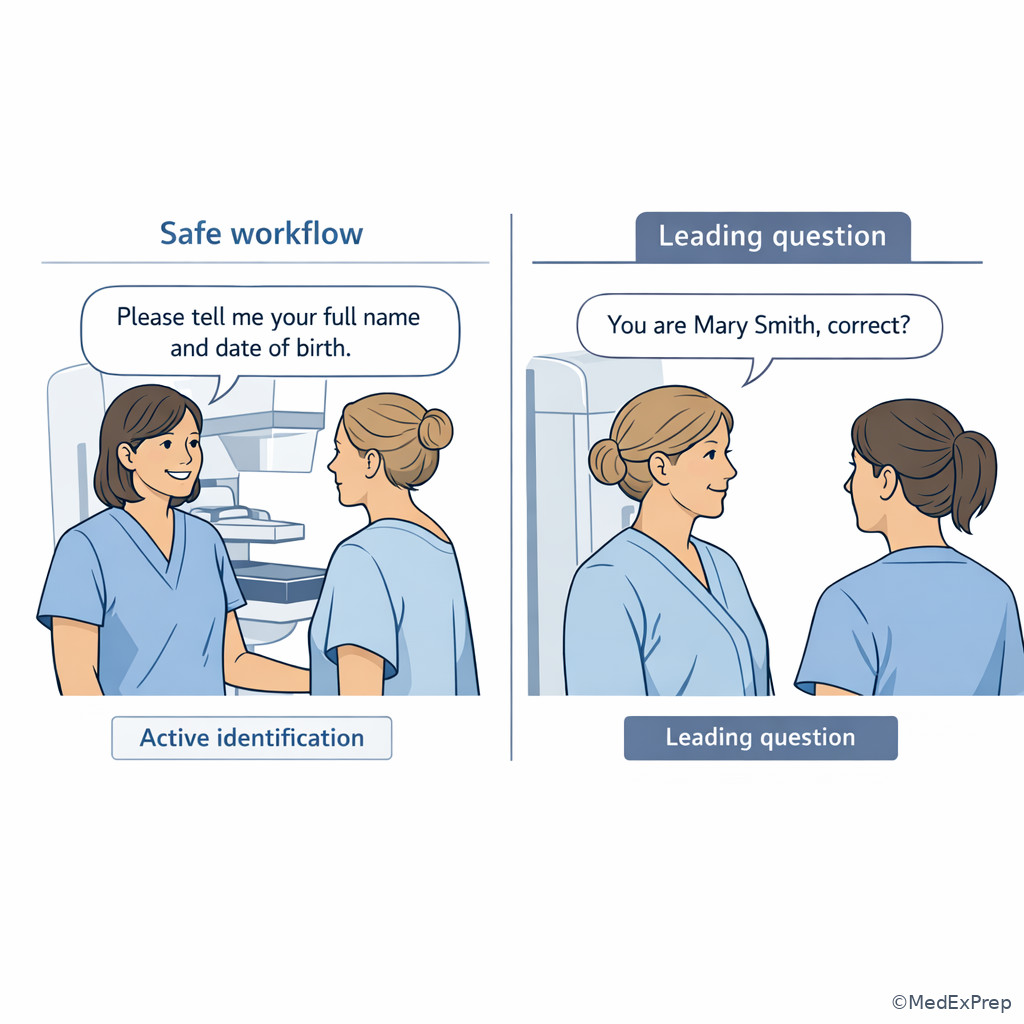
- Ask open-ended questions: “Please tell me your full name and date of birth.”
- A confident patient response does not override a documentation mismatch.
- Prior images must match the same patient; similar names are a classic trap.
- Verification happens before exposure, not after the first image.
- When unresolved, stop, clarify, document, and escalate according to departmental policy.
- The technologist verifies identity; the technologist does not independently rewrite physician intent or guess missing order details.
Core content
Exam takeaway: Start with active two-identifier confirmation, then match the order and records before any imaging step.
flowchart TD
A[Patient arrives] --> B[Ask patient to state full name and DOB]
B --> C{Do identifiers match order/chart?}
C -- Yes --> D[Verify exam and laterality if applicable]
D --> E[Match priors to same patient]
E --> F[Proceed with preparation and imaging]
C -- No --> G[Stop workflow]
G --> H[Clarify with registration/order source/supervisor]
H --> I[Document discrepancy and resolution] Exam takeaway: The safest workflow repeats identity confirmation at the point of care rather than relying only on registration.
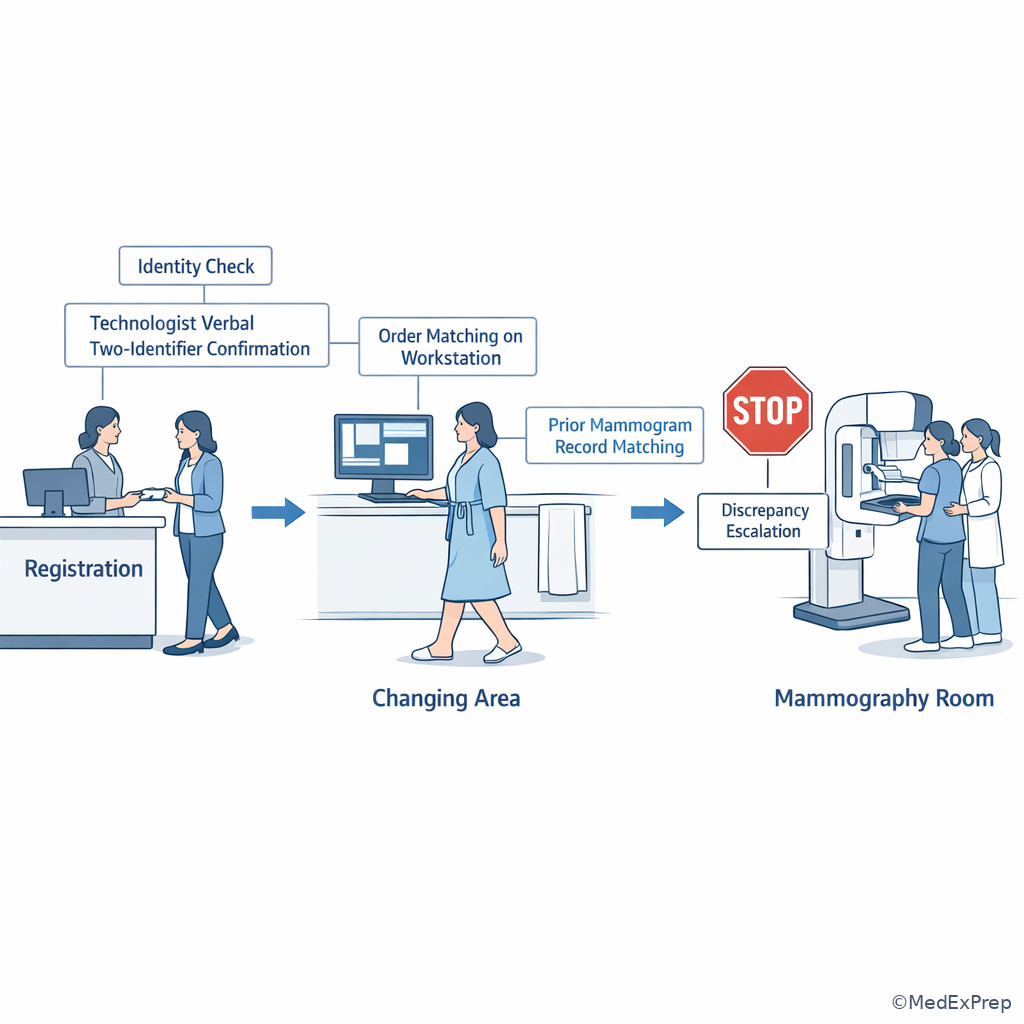
Exam takeaway: A single unresolved identifier conflict is enough to pause the exam and clarify before exposure.
flowchart TD
A[Found mismatch] --> B{Type of mismatch}
B --> C[Name or DOB conflict]
B --> D[Order absent or wrong patient]
B --> E[Prior images uncertain]
C --> F[Do not proceed]
D --> F
E --> F
F --> G[Recheck source documents]
G --> H{Resolved?}
H -- Yes --> I[Document correction and continue]
H -- No --> J[Escalate per protocol and hold exam] Exam takeaway: Similar names, leading questions, and assumed prior-image matches are high-yield wrong-patient traps.
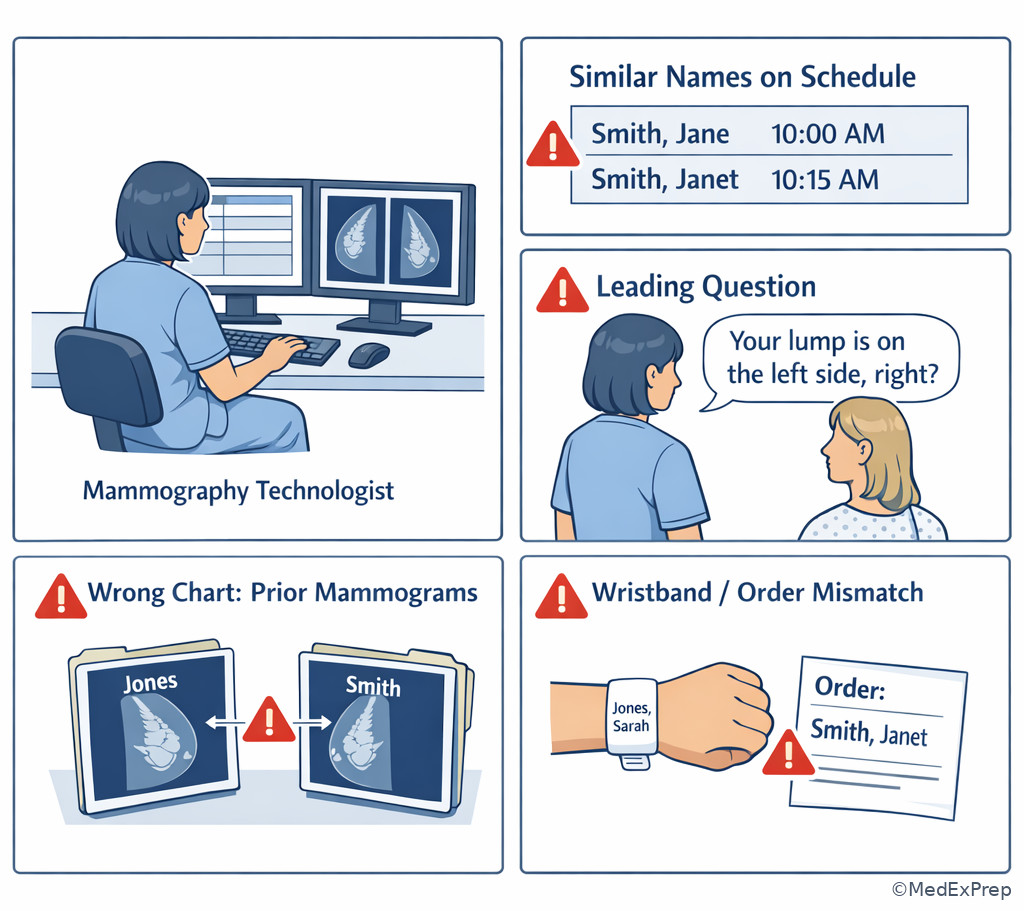
Exam takeaway: Asking the patient to state identifiers is stronger than asking the patient to agree with identifiers you supply.
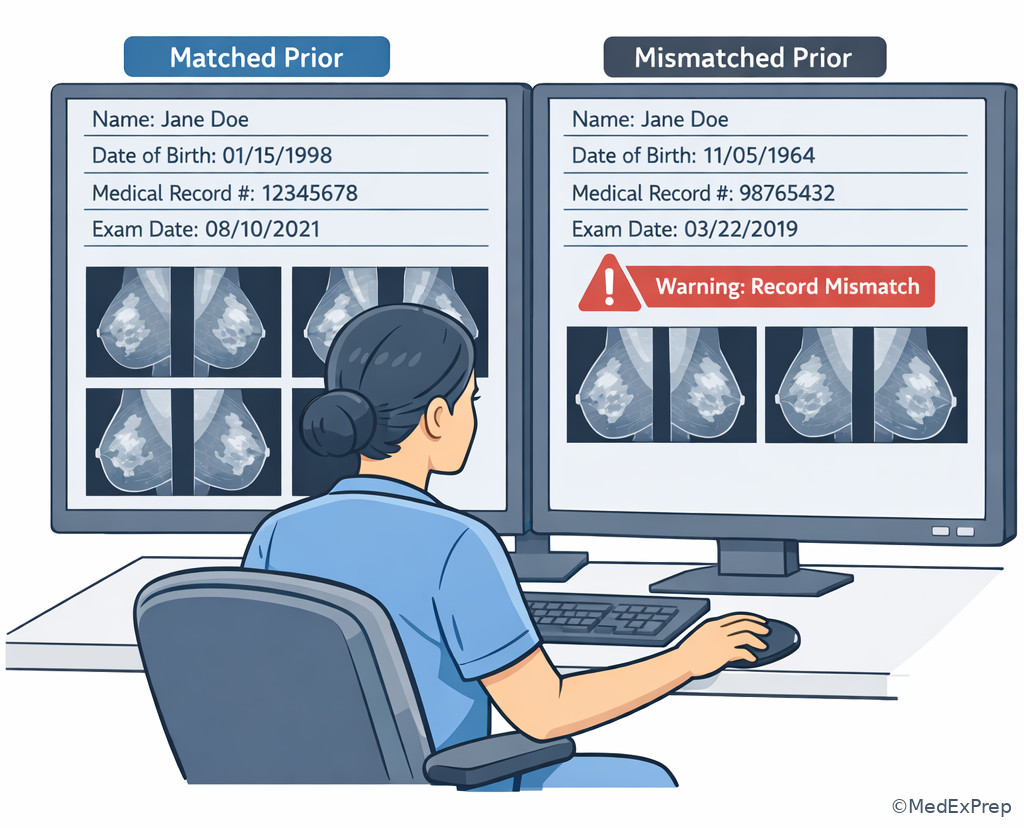
Exam takeaway: Match identifiers on previous studies before relying on them for comparison or workflow decisions.
Exam takeaway: Identity confirmation should occur before preparation, before positioning, and again whenever workflow changes create uncertainty.
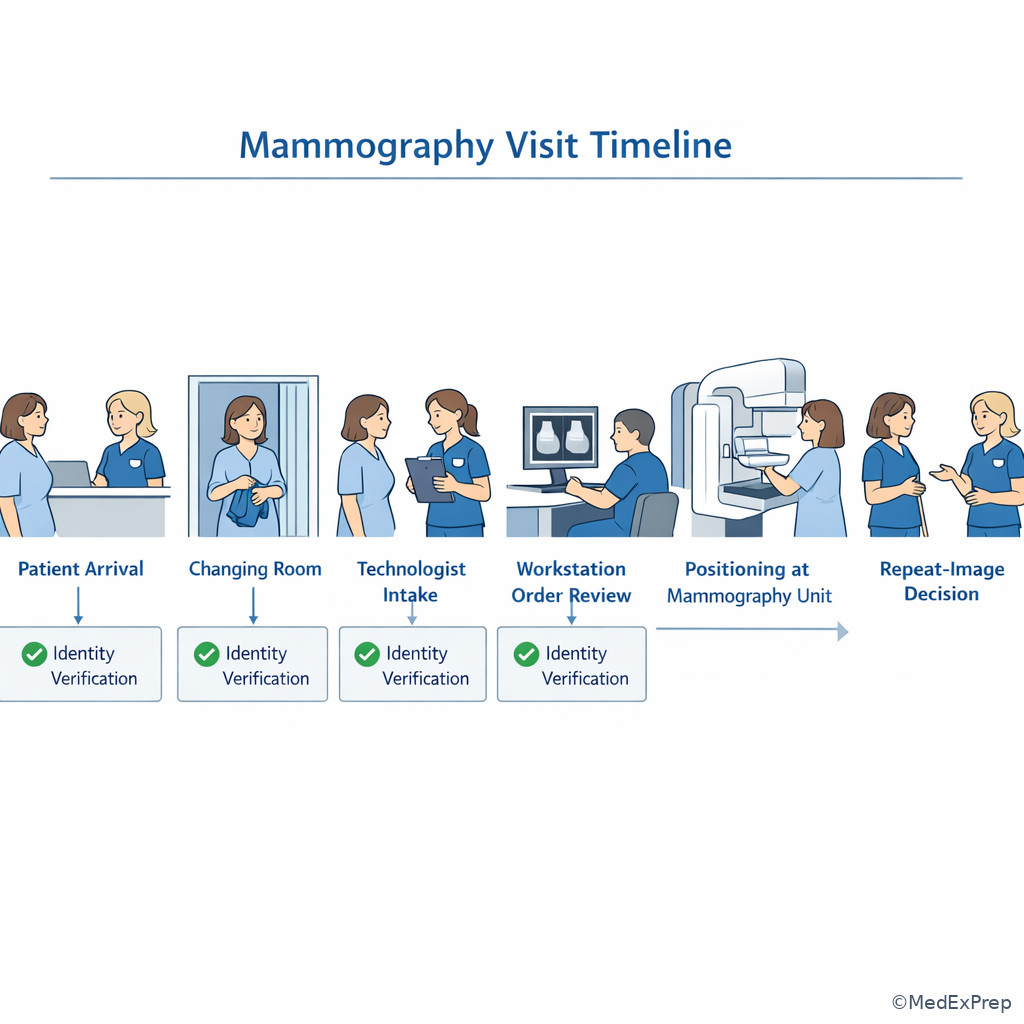
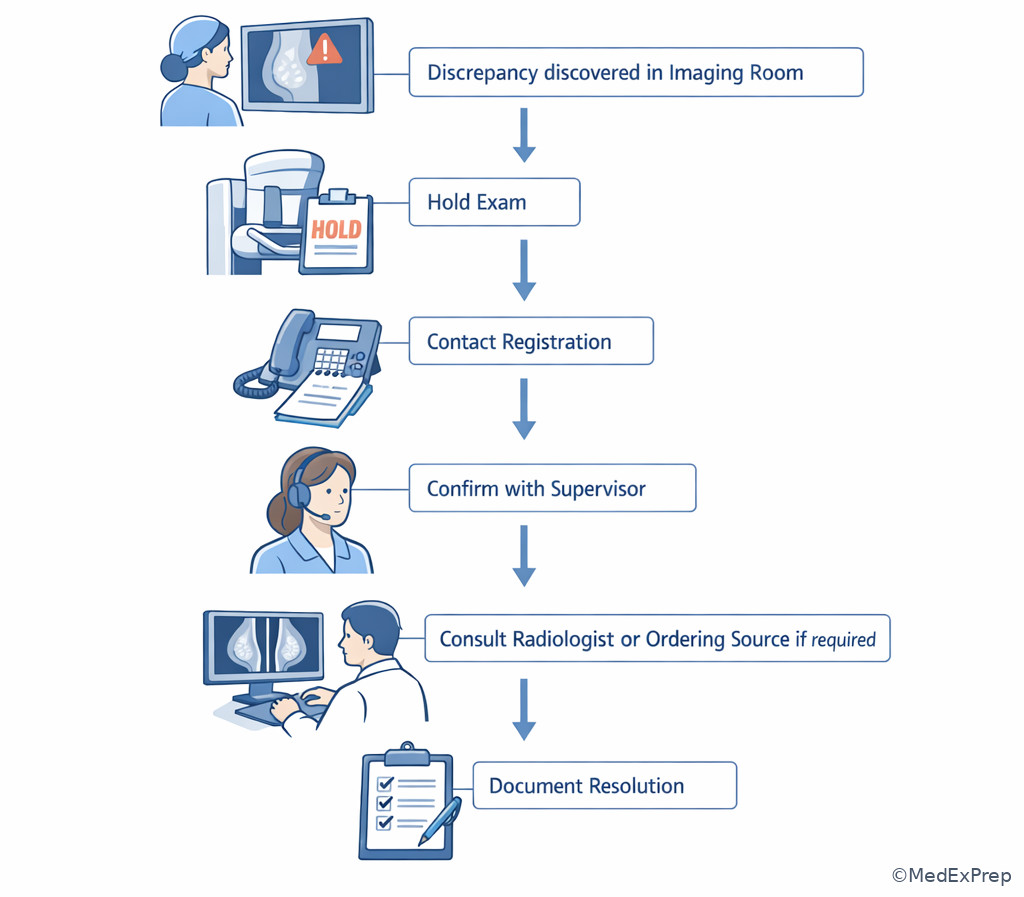
Exam takeaway: When the technologist cannot reconcile a mismatch, the correct action is hold, notify, and document according to protocol.
| Verification element | What the technologist should do | Why it matters | Unsafe shortcut to reject |
|---|---|---|---|
| Full name | Ask the patient to state it | Primary identity anchor | Reading the name and asking “correct?” |
| Date of birth | Ask the patient to state it | Separates similar names | Assuming age from appearance |
| Order match | Confirm the order belongs to the same patient | Prevents wrong-patient or wrong-exam workflow | Proceeding because the schedule “looks right” |
| Prior studies | Verify priors belong to the same person | Avoids record contamination | Assuming prior images are correct because the last name matches |
| Discrepancy handling | Stop and clarify before exposure | Prevents a reportable event | Taking one image first, then checking later |
| Documentation | Record the mismatch and resolution per policy | Supports safety and traceability | Fixing it verbally without chart documentation |
1.1.1.3 Foundational verification rule: active two-identifier confirmation
A Explanation
The first decision conflict is simple but highly tested: Do you trust the schedule/worklist, or do you actively verify the patient in front of you? The correct choice is active verification. The single rule that resolves the conflict is this: before any mammographic preparation or exposure, obtain at least two approved patient identifiers directly from the patient whenever possible and match them to the order/chart. In exam language, choose the option that starts with the patient stating full name and date of birth; reject choices that rely on room location, appearance, or a yes/no question.
WHY THIS IS TESTED: wrong-patient events often begin with a rushed assumption, especially in high-volume screening settings. The exam wants to know whether you protect the patient at the first point of care. See Fig 1 and Fig 5.
The strongest workflow is active rather than passive. “Please tell me your full name and date of birth” is safer than “Are you Ms. Taylor?” because leading questions invite automatic agreement. This matters even when the patient seems familiar, arrives from the same clinic, or registration already completed an intake check. A previous checkpoint does not replace the point-of-care verification performed by the technologist who is about to proceed.
Within mammography scope, identity verification is part of patient care and radiation safety. It is not merely clerical. If you expose the wrong patient, you have performed unnecessary imaging and corrupted the record. The safe technologist response is to confirm identifiers first, then continue to the next preparation step.
B Worked example
A 57-year-old woman presents for a screening mammogram at a busy outpatient center. She has hypertension and osteoarthritis, uses a cane, and says, “I come here every year, you know me.” The worklist shows “M. Johnson,” and the technologist says, “You’re Mary Johnson, right?” The patient nods yes. A prior mammogram is visible in the system under a similar name. A distracting detail is that the patient is late and anxious about transportation home.
Reasoning chain: Identify task → confirm correct patient before any imaging. Extract key facts → similar-name worklist entry, leading question used, prior study present but not yet matched, busy workflow pressure. Apply rule → active two-identifier confirmation is required; agreement to a suggested name is not enough. Eliminate distractors → proceeding because the patient is familiar is unsafe; relying on the visible prior is unsafe until identifiers match; sending her straight to change clothes before clarification delays but does not solve the risk. Verify → ask the patient to state full name and date of birth, then match them to the order and prior study before moving forward.
C Exam trap
D Checkpoint
Question: Before beginning a screening mammogram, which action is most appropriate?
- A. Ask the patient, “You are Linda Perez, correct?” and proceed if she nods.
- B. Compare the schedule name to the order and proceed if both show the same last name.
- C. Ask the patient to state her full name and date of birth, then match them to the order.
- D. Use room assignment and prior visit familiarity as confirmation.
Answer: C
- A is tempting because it sounds like verification, but wrong because it is a leading question and does not require the patient to actively identify herself.
- B is tempting because schedule-to-order matching is part of workflow, but wrong because document matching alone does not replace patient confirmation and a last name is insufficient.
- C is right because it uses active two-identifier confirmation and record matching before the exam proceeds.
- D is tempting in a familiar outpatient setting, but wrong because location and recognition are not reliable identifiers.
1.1.1.4 Matching the patient to the order, worklist, and prior studies
A Explanation
The next decision conflict is not just “Who is the patient?” but “Do all records involved in this exam belong to the same patient?” The technologist must choose between trusting the electronic workflow and deliberately reconciling the patient, the order, and any prior studies. The single rule is: every document or image used in the encounter must align to the same verified patient before you rely on it.
WHY THIS IS TESTED: mammography questions often add workflow noise—similar names, imported priors, annual follow-up language, or a chart that appears complete. The exam wants you to catch the hidden mismatch. See Fig 2 and Fig 6.
In practice, this means the order must belong to the patient who is physically present. If prior mammograms are in the system, you must verify they are truly hers before using them as comparison references or assuming that the exam history is accurate. Similar names are especially dangerous in breast imaging because annual screening creates repeated, routine visits that feel familiar. That familiarity is precisely why the trap works.
Do not overstep your role by independently editing physician intent or substituting a different exam because the order appears close enough. Your role is to verify that the correct patient is attached to the correct order and to escalate discrepancies. Upcoming lessons on Breast History Collection and Pre-Exam Patient Instructions build on this same principle: history and preparation are only useful if attached to the correct person.
B Worked example
A 49-year-old patient presents for annual screening. She has type 2 diabetes and a history of benign cyst aspiration. The order lists “screening mammogram,” and the workstation automatically pulls prior images for “Angela M. Rivera.” The patient states her name is “Angelina Rivera,” with the same month and day of birth but a different year than the prior images. A distracting clue is that the prior images show surgical clips, and the patient says she had “some sort of breast procedure years ago,” making the prior seem plausible.
Reasoning chain: Identify task → determine whether the priors belong to the current patient before relying on them. Extract key facts → name similarity but not exact match, date-of-birth conflict, uncertain procedure history, auto-pulled priors. Apply rule → prior-study use requires identifier agreement, not narrative similarity. Eliminate distractors → using the priors because the history sounds close is unsafe; asking the patient whether the clips look familiar is not a valid identity check; proceeding and letting the radiologist sort it out is too late. Verify → hold the workflow, confirm identifiers in the chart/system, and use priors only after exact reconciliation per protocol.
C Exam trap
D Checkpoint
Question: The patient’s verbal identifiers match the order, but the prior mammograms auto-loaded in the system show a slightly different first name and a different birth year. What is the most appropriate next step?
- A. Proceed with the current exam and let the radiologist decide whether the priors are usable.
- B. Use the priors if the patient reports any prior breast procedure.
- C. Hold the workflow and verify whether the priors belong to the same patient before using them.
- D. Delete the priors from the workstation and continue without documenting the issue.
Answer: C
- A is tempting because the radiologist ultimately reviews images, but wrong because the technologist must prevent wrong-record linkage before the exam progresses.
- B is tempting because prior procedures may make the images look plausible, but wrong because a history similarity does not override identifier mismatch.
- C is right because unresolved record mismatch requires clarification before the priors are used.
- D is tempting because removing the confusing images seems practical, but wrong because the discrepancy still requires formal verification and documentation per protocol.
- The safest identification prompt is: “Please tell me your ___ and ___.”
- True or False: A matching last name is enough to attach prior mammograms to the current patient.
- Name the 3 records that must align before you rely on priors: patient statement, ___, and ___.
| Scenario | Proceed? | Best technologist action | Why |
|---|---|---|---|
| Patient states name and DOB; both match order | Yes | Continue to next preparatory step | Required identifiers align |
| Patient agrees to a name the technologist says first | No | Repeat with active identifier request | Leading question is weak verification |
| Name matches but DOB conflicts | No | Stop and clarify discrepancy | One mismatch is enough to hold the exam |
| Order present but priors have mismatched birth year | No | Do not use priors until reconciled | Prevents wrong-record use |
| Patient cannot answer due to confusion | Not until protocol verification completed | Use approved alternate verification process per policy | Still requires formal identity confirmation |
| Wristband and verbal response differ | No | Hold, reconcile, document, escalate if needed | Conflicting identifiers require resolution |
1.1.1.5 What counts as an acceptable identifier, and what does not
A Explanation
This section asks a frequent exam question in disguise: which pieces of information are acceptable identity evidence, and which are unsafe stand-ins? Choose patient-specific approved identifiers; reject convenience clues. The single rule is: use identifiers tied directly to the patient record, not contextual cues.
WHY THIS IS TESTED: exam writers like to offer one correct safety step and three workflow shortcuts that look efficient. The candidate must know the difference. See Fig 4.
Reliable identifiers usually include full legal name and date of birth, with any additional approved institutional identifier used according to protocol. By contrast, room number, appointment time, physical appearance, clothing description, or “she comes here every year” are not acceptable as primary identity tools. Even a wristband alone is insufficient if the patient can participate and the verbal check has not yet been done. In other words, good workflow adds layers; it does not substitute one weak check for another.
Be careful with partial matches. A last name plus exam type is not enough. A first name plus age estimate is not enough. A patient saying, “Yes, that sounds right,” is weaker than asking for a full stated response. In mammography, the environment can feel outpatient and routine, which tempts staff to rely on familiarity. Exam questions exploit that exact habit.
B Worked example
A 66-year-old patient arrives from a long-term care facility for diagnostic mammography. She has mild cognitive impairment and chronic kidney disease. The transport form lists a name, but her wristband is smudged and partly unreadable. She smiles and says, “I’m here for my breast pictures again.” A tempting but wrong clue is that the transport aide states, “This is definitely Ms. Cooper; I bring her all the time.”
Reasoning chain: Identify task → determine whether the patient has been adequately verified. Extract key facts → patient may not provide a complete reliable response, wristband is unclear, transport aide statement is contextual, order exists but still must be matched through approved process. Apply rule → contextual reassurance from another person is not enough by itself; formal alternate verification must follow policy. Eliminate distractors → proceeding because the aide knows the patient is unsafe; relying on exam purpose alone is unsafe; cancelling immediately may be premature if formal verification can be completed. Verify → use the approved institutional alternate identity process and hold imaging until that process confirms the patient.
C Exam trap
D Checkpoint
Question: Which item is the weakest basis for patient identity verification before mammography?
- A. Patient-stated full name
- B. Patient-stated date of birth
- C. Matching chart order to patient-stated identifiers
- D. Recognition of the patient from last year’s visit
Answer: D
- A is tempting as a single identifier only, but not the weakest because it is an approved patient-specific element.
- B is tempting because it may seem secondary, but not the weakest because it is a high-value patient-specific identifier.
- C is tempting because it involves records, but not the weakest since record matching is necessary once identifiers are obtained.
- D is right because familiarity is contextual, not an approved primary identity check.
1.1.1.6 Handling discrepancies: stop, clarify, escalate, document
A Explanation
Now the exam moves from recognition to action: What should the technologist do the moment a discrepancy appears? The correct response is not to improvise. The single rule is: one unresolved discrepancy means hold the exam until the issue is clarified through approved channels. See Fig 3.
WHY THIS IS TESTED: board-style stems often include pressure—an anxious patient, a busy room, a radiologist waiting, or a schedule delay—to see whether you choose safety over speed. The technologist’s role is not to guess which source is “probably” right. The role is to pause, clarify, and escalate appropriately.
Common discrepancies include name mismatch, date-of-birth conflict, wrong order attached to the chart, uncertain prior studies, or a patient statement that does not match registration. When that happens, stop before exposure. Recheck available source documents. If the issue resolves within established protocol, document the correction and continue. If it does not resolve, escalate to the appropriate party such as registration, lead technologist, supervisor, radiologist, or ordering source according to department policy.
The key scope point is this: you are responsible for safe acquisition workflow, not for independently rewriting the patient’s chart or redefining the intended exam. If the solution requires authority beyond your role, escalation is the right answer. This same decision pattern appears later in QC and artifact topics: when the problem is not safely solvable within technologist control, do not continue as if nothing happened.
B Worked example
A 44-year-old woman arrives for diagnostic mammography after a callback. She has a history of reduction mammoplasty and hypothyroidism. She becomes tearful and says she took time off work and cannot stay long. Her chart shows one birth date, but the wristband shows another. The order is present, and the patient insists registration “always enters things wrong.” A tempting-but-wrong clue is that the callback urgency may make proceeding feel justified.
Reasoning chain: Identify task → choose the most appropriate next step when identifiers conflict. Extract key facts → diagnostic exam, emotional pressure, chart and wristband discrepancy, patient assertion without resolution. Apply rule → unresolved identity conflict means hold the exam; urgency does not erase the safety rule. Eliminate distractors → proceeding because the order is already in place is unsafe; taking limited images first is unsafe; asking the patient which birth date to use is not adequate reconciliation. Verify → stop, reconcile through approved sources, escalate as needed, and document the discrepancy and its resolution.
C Exam trap
D Checkpoint
Question: A patient’s stated name matches the order, but her stated date of birth does not match the chart. She is already changed and ready for imaging. What is the most appropriate next step?
- A. Begin imaging because one identifier matches and the patient is already prepared.
- B. Ask the patient which date of birth should be used and update the chart yourself.
- C. Hold the exam, clarify the discrepancy through approved sources, and document the resolution.
- D. Proceed with only noncompressed positioning images until the chart is corrected.
Answer: C
- A is tempting because workflow momentum and one matching identifier feel “close enough,” but wrong because one unresolved mismatch is enough to stop.
- B is tempting because the patient seems like the direct source, but wrong because the technologist should not independently overwrite records without formal reconciliation.
- C is right because the discrepancy must be resolved before imaging proceeds.
- D is tempting because it seems like a compromise, but wrong because any imaging before verification still creates wrong-patient risk.
- True or False: A patient already changed into a gown can be imaged while identity clarification happens in parallel.
- The safest response to a DOB mismatch is stop, ___, escalate, and document.
- Name one pressure cue that should not change your identity-verification standard.
| Potential identifier/source | Use as primary check? | Exam value | Key limitation |
|---|---|---|---|
| Patient-stated full name | Yes | Core approved identifier | Needs pairing with another approved identifier |
| Patient-stated date of birth | Yes | Separates similar names | Must match records |
| Order/chart | Supports primary check | Confirms record linkage | Does not replace patient confirmation |
| Wristband | Supports primary check | Useful record-linked source | Not enough alone if verbal confirmation is possible |
| Room number | No | Workflow locator only | Not patient-specific enough |
| Recognition from prior visits | No | May support suspicion of mismatch | Familiarity is not formal verification |
| Transport aide statement | No, not by itself | May assist alternate process per policy | Cannot replace approved verification process |
1.1.1.7 Integrating identity verification into the full mammography workflow
A Explanation
The final integration question is not merely “Can you verify identity?” but “Can you place identity verification at the correct point in the mammography workflow and preserve scope boundaries?” The deciding rule is: identity verification comes before history collection, pre-exam instruction, positioning, labeling, and exposure, and it should be rechecked whenever workflow uncertainty is introduced.
WHY THIS IS TESTED: later mammography tasks depend on a correct patient-workflow match. If the wrong person is attached to the record, every subsequent step becomes unreliable. See Fig 2 and Fig 6.
Once identity is confirmed, the technologist can safely continue to the next topics in this course: collecting relevant breast history and providing pre-exam instructions. Forward reference matters here: the quality of history about symptoms, surgery, implants, or prior procedures only helps if it belongs to the correct patient. Similarly, instructions about removing deodorant, powders, jewelry, and preparing for compression only belong after you know the right chart and right patient are linked.
Integrated workflow also means rechecking identity when a handoff, room change, chart correction, or imported prior-study issue occurs. The exam may ask for the “most appropriate next step” after an interruption. If the interruption creates uncertainty, the safe answer usually includes re-verification. This is not redundant; it is a control point.
Within scope, the technologist verifies, documents, and escalates. The technologist does not independently determine diagnostic significance or promise the patient a result based on chart familiarity or prior images. A correct patient-verification habit protects both safety and scope compliance.
B Worked example
A 52-year-old woman arrives for routine screening. She has rheumatoid arthritis and limited shoulder mobility. After initial verification, she changes into a gown. During a workstation restart, another patient with a nearly identical last name is checked in, and the current worklist refreshes. A tempting wrong clue is that the technologist remembers the first patient’s mobility issues and thinks that makes misidentification unlikely.
Reasoning chain: Identify task → choose the most appropriate next step after a workflow interruption that may affect record linkage. Extract key facts → verification was previously done, but the worklist changed; similar names are present; chart/workstation context may no longer be reliable. Apply rule → interruptions that create uncertainty warrant re-verification before proceeding. Eliminate distractors → relying on memory of the patient’s mobility is contextual; proceeding because the patient is already gowned is unsafe; asking registration to sort it out later is too late. Verify → repeat active identifier confirmation and ensure the reopened chart and order belong to the patient before imaging begins.
C Exam trap
D Checkpoint
Question: After identity was verified and the patient changed into a gown, the workstation refreshed and now displays two patients with similar last names. What is the most appropriate next step?
- A. Proceed because the patient was already verified at intake.
- B. Re-verify the patient’s identifiers and confirm the correct chart/order before imaging.
- C. Ask the patient which chart appears to be hers on the monitor.
- D. Complete the exam and correct any charting issue afterward.
Answer: B
- A is tempting because it avoids repeating work, but wrong because the workflow interruption created new uncertainty.
- B is right because re-verification is appropriate when chart linkage may have changed.
- C is tempting because the patient may recognize details, but wrong because chart assignment is not determined by patient screen selection.
- D is tempting under time pressure, but wrong because imaging before clarification risks a wrong-patient event.
Exam Traps & Differentiators
- Most common wrong answer and why: proceeding after a yes/no identity question. It is tempting because it sounds like efficient communication; it fails because the patient did not actively state identifiers.
- Looks similar but isn't: a matching schedule and a matching patient are not the same thing. A schedule is a workflow tool, not a patient-stated identifier.
- Looks similar but isn't: a plausible prior study is not a confirmed prior study. Similar history does not override identifier mismatch.
- Looks similar but isn't: a patient already in a gown is not a reason to continue. Preparation status does not reduce wrong-patient risk.
- Looks similar but isn't: urgency of a callback is not permission to bypass verification. Safety checks still apply.
| If the stem says... | Think... | Reject... |
|---|---|---|
| “Are you Ms. ___?” | Leading question; use active identification | Proceeding based on a nod or yes |
| “Similar name” or “auto-loaded priors” | Risk of wrong-record linkage | Using priors before reconciliation |
| “Already changed into a gown” | Workflow momentum is a trap | Imaging first, clarifying later |
| “Patient insists registration made an error” | Still requires formal reconciliation | Letting the patient choose the record correction alone |
| “Busy screening day” or “late patient” | Safety over speed | Skipping a repeated identifier check |
| “Transport aide confirms identity” | Use approved alternate protocol | Informal third-party assurance as the only check |
Related confusable pairs from upcoming topics are important. In Breast History Collection, you will ask about symptoms, surgery, and implants; in Pre-Exam Patient Instructions, you will explain deodorant removal and clothing change. A classic test trap is to offer one of those correct future steps too early. If identity is not yet verified, even a good preparation step is still the wrong answer for now.
Algorithm / Approach
Rapid Review
- Active identification → patient states identifiers; technologist does not supply them first.
- Two-identifier rule → one matching item is not enough when another conflicts.
- Worklist accuracy → helpful workflow tool, not proof of identity.
- Prior mammograms → use only after exact patient match is confirmed.
- Leading question → sounds efficient, increases wrong-patient risk.
- Familiar patient → recognition does not replace formal verification.
- Busy clinic pressure → never a reason to skip re-checking identifiers.
- Diagnostic urgency → does not override unresolved mismatch.
- Wristband conflict → hold and reconcile, do not guess.
- Transport aide reassurance → may support workflow, cannot serve as sole check.
- Patient already gowned → still stop if identity is uncertain.
- Workstation refresh/handoff → re-verify if chart linkage may have changed.
Self-check quiz
1. A 55-year-old woman presents for annual screening mammography. She has hypertension and seasonal allergies and says she is late for work. Which action is the most appropriate first step by the technologist?
- A. Ask her to confirm the name displayed on the schedule
- B. Ask her to state her full name and date of birth
- C. Have her change into a gown before verifying identity
- D. Open prior images first to confirm who she is
2. Which item is least appropriate as a primary patient identifier before mammography?
- A. Full name
- B. Date of birth
- C. Room location
- D. Chart order matched to patient-stated identifiers
3. A 61-year-old patient with diabetes and limited mobility arrives from a skilled nursing facility for mammography. Her transport aide states her name confidently, but the patient gives only a partial response and the wristband is difficult to read. What is the most appropriate next step?
- A. Proceed because the transport aide knows the patient well
- B. Delay the exam and use the approved alternate verification process per protocol
- C. Ask the aide to sign the requisition in place of the patient
- D. Continue if the exam type on the order matches the transport slip
4. A 48-year-old woman presents for screening. She has asthma and a history of benign breast biopsy. The current order matches her verbal identifiers, but the auto-loaded prior mammograms show a different birth year. What is the most appropriate next step?
- A. Use the priors because the patient reports a past biopsy
- B. Proceed with imaging and let the radiologist decide later
- C. Hold the case and verify that the priors belong to the same patient
- D. Delete the priors and continue without mentioning the mismatch
5. A patient’s stated name matches the order, but her stated date of birth differs from the chart by one year. She is anxious, has already changed into a gown, and says registration always makes mistakes. Which action is most appropriate?
- A. Proceed because the name matches and the DOB difference is minor
- B. Ask the patient which birth year should be documented and update it
- C. Hold the exam, reconcile the discrepancy through approved sources, and document the resolution
- D. Begin positioning while a clerk corrects the chart in the background
6. A 53-year-old woman with rheumatoid arthritis and limited shoulder range of motion is verified at intake and sent to change. During a workstation restart, another patient with a similar last name is added to the schedule. The technologist reopens the chart and is about to begin imaging. What is the most appropriate next step?
- A. Proceed because identity was already checked earlier in the visit
- B. Re-verify the patient’s identifiers and confirm the chart/order before imaging
- C. Ask the patient to point to her name on the monitor
- D. Complete the exam and correct the chart afterward if needed
7. A 46-year-old woman presents for diagnostic mammography after callback. She has hypothyroidism and prior reduction mammoplasty. Her wristband matches the order name, but her stated date of birth differs from both the wristband and the chart. She is tearful and says she took unpaid time off work to come today. Which action requires immediate clarification before any exposure?
- A. Diagnostic urgency from the callback
- B. Emotional distress about missing work
- C. Date-of-birth mismatch among patient, wristband, and chart
- D. History of prior breast surgery
8. A 59-year-old patient with hypertension and obesity arrives for annual screening. She states her full name and date of birth, which match the order. A prior study with the same last name and same month/day of birth but a different year appears in the archive. The patient says, “That might be mine; I can’t remember.” What is the most appropriate technologist action?
- A. Use the prior because the patient believes it may be hers
- B. Ignore the prior and proceed without documenting the discrepancy
- C. Verify whether the prior belongs to the patient before using it for comparison
- D. Ask the patient whether the breast images on screen look familiar
Answer key
1.1.1.8 1. Answer: B
A. This is tempting because schedule-based workflow feels efficient in a busy screening center. It is incorrect because confirming a displayed name is a leading format and does not require active patient identification; the discriminating clue is that the question asks for the first appropriate step before imaging. Source support: identity verification standards in patient safety emphasize active identifier confirmation before care delivery.
B. This is correct because asking the patient to state full name and date of birth uses active two-identifier verification at the point of care. The discriminating clue is that this step occurs before gowning, positioning, or chart-dependent actions. Source support: ARRT-aligned patient care expectations and safety standards require patient identification before procedures.
C. This is tempting because gowning is a routine early workflow step. It is incorrect because preparation should not proceed before identity is confirmed; the single clue is “first step.”
D. This is tempting because priors can help orient workflow. It is incorrect because prior images are record-dependent and cannot be used to establish identity before the patient has been verified.
Sources: American College of Radiology practice standards; patient identification safety guidance from accrediting/safety organizations.
1.1.1.9 2. Answer: C
A. Tempting to dismiss because it is only one identifier, but it is still an approved primary identifier when paired appropriately. The discriminating clue is that the question asks for the least appropriate primary basis.
B. Tempting because some learners underestimate its value, but date of birth is a core patient-specific identifier. It is not the least appropriate.
C. Correct because room location is contextual rather than patient-specific. The discriminating clue is that room location can apply to workflow but not identity. Patient safety standards reject location as a primary identifier.
D. Tempting because it involves a chart rather than the patient alone, but chart matching supports proper identity verification once patient-stated identifiers are obtained. It is not the weakest choice.
Sources: National patient identification safety principles; mammography patient care workflow recommendations.
1.1.1.10 3. Answer: B
A. Tempting because the aide appears confident and may truly know the patient. It is incorrect because informal third-party reassurance alone does not satisfy approved verification when the patient cannot fully participate; the discriminating clue is incomplete patient response plus unreadable wristband.
B. Correct because when the standard verbal process cannot be completed reliably, the technologist should delay imaging and use the approved alternate verification pathway according to protocol. This stays within scope and prioritizes safe patient identification. Authoritative guidance supports formal alternate processes rather than ad hoc workarounds.
C. Tempting because signatures feel official. It is incorrect because a transport aide signing in place of the patient does not itself verify identity and may exceed or misapply workflow authority.
D. Tempting because matching exam paperwork suggests consistency. It is incorrect because paperwork concordance does not replace patient verification through approved alternate means.
Sources: ACR practice parameters for mammography services; institutional patient identification standards consistent with national safety guidance.
1.1.1.11 4. Answer: C
A. Tempting because the reported biopsy history makes the prior appear clinically plausible. It is incorrect because plausible history does not overcome a birth-year mismatch; the discriminating clue is conflicting identifiers on the prior.
B. Tempting because radiologists ultimately review comparisons. It is incorrect because the technologist must prevent wrong-record use before the case proceeds. Scope-of-practice reasoning places safe record linkage within technologist workflow responsibility.
C. Correct because prior studies should not be used until identity matching confirms they belong to the patient. This is the safest and exam-aligned technologist action.
D. Tempting because continuing without the prior may seem harmless. It is incorrect because the discrepancy still requires acknowledgment, clarification, and documentation according to policy.
Sources: ACR standards for image management and patient safety; breast imaging workflow texts emphasizing correct prior-study matching.
1.1.1.12 5. Answer: C
A. Tempting because a one-year discrepancy can feel minor and the patient is already ready for imaging. It is incorrect because a date-of-birth mismatch is still an unresolved identity discrepancy; the discriminating clue is that the mismatch has not been formally reconciled.
B. Tempting because the patient seems confident and the fix seems simple. It is incorrect because the technologist should not independently alter official records based only on patient preference without the approved reconciliation process.
C. Correct because the exam must be held while the discrepancy is reconciled through approved channels, then documented. This is the safest scope-compliant response.
D. Tempting because it appears efficient to let clerical correction occur in parallel. It is incorrect because imaging before verification still creates wrong-patient exposure risk.
Sources: National patient safety goals on identification; mammography patient care workflow guidance.
1.1.1.13 6. Answer: B
A. Tempting because the patient was correctly checked earlier. It is incorrect because the worklist interruption introduced new uncertainty; the discriminating clue is the addition of a similar-name patient after a workstation restart.
B. Correct because interruptions or chart changes that can alter record linkage justify re-verification before imaging. This preserves safe workflow and is fully within technologist scope.
C. Tempting because involving the patient seems participatory. It is incorrect because asking the patient to select a chart on the monitor is not a formal identity control.
D. Tempting because corrections can sometimes be made later in the electronic record. It is incorrect because exposure should not occur while chart identity is uncertain.
Sources: ACR workflow and patient safety expectations; general healthcare identification safety standards applied to imaging settings.
1.1.1.14 7. Answer: C
A. Tempting because callbacks feel urgent and clinically important. It is incorrect because urgency does not override identity safety. The discriminating clue is an unresolved identifier conflict.
B. Tempting because patient distress deserves attention and support. It is incorrect because distress alone does not determine whether imaging must stop; it should be managed compassionately, but the identity conflict is the immediate safety issue.
C. Correct because a DOB mismatch across patient, wristband, and chart is a direct identity discrepancy that requires immediate clarification before exposure. This is exactly the type of stem clue the exam uses to test stop-the-line judgment.
D. Tempting because prior surgery can affect workflow and positioning. It is incorrect because surgical history does not prevent proceeding once identity is confirmed; it is not the immediate hold factor here.
Sources: National patient identification safety guidance; mammography practice standards on patient preparation and safe workflow.
1.1.1.15 8. Answer: C
A. Tempting because the patient thinks the prior might be hers and some identifiers overlap. It is incorrect because uncertainty plus a different birth year means the prior must be verified before use. The discriminating clue is the conflicting year of birth.
B. Tempting because you can technically continue current imaging without the prior. It is incorrect because silently ignoring the discrepancy fails the documentation and safety expectation surrounding questionable record linkage.
C. Correct because the technologist should verify that the prior belongs to the patient before using it for comparison. This matches safe record handling and prevents wrong-record contamination.
D. Tempting because image familiarity might seem useful for memory. It is incorrect because patient visual recognition is not a reliable identity verification tool for archived studies.
Sources: ACR breast imaging practice standards; radiology workflow texts on patient and prior-study matching.
Keep going with the full ARRT Mammography Prep Course (ARRT Mammo)
You just studied the way members do, in the same lesson interface. Full access unlocks every lesson, the question bank and flashcards for a full year.
One payment · 1 year of access · No auto-renewal