1.1.1 - Patient Identification Standards
Patient Identification Standards
What you'll learn
- Patient Care and Safety: Screening and preparation -> identity verification — apply the minimum identifiers required before any CT action begins.
- Patient Care and Safety: Workflow safety -> mismatch recognition — identify when a name-band, verbal response, requisition, or chart detail does not align and the exam must stop.
- Procedures, Positioning, and Protocol Logic: Pre-scan setup -> order-to-patient matching — confirm the correct patient, correct exam, and correct laterality/body region before positioning.
- Patient Care and Safety: Communication -> special situations — adapt identification standards for pediatric, confused, sedated, trauma, language-barrier, and unconscious patients.
- Patient Care and Safety: Documentation and escalation -> safety-first response — know when clarification, escalation, or re-identification is the most appropriate next step.
- DOMAIN: Patient Care and Safety -> Screening and preparation -> patient identification before CT
- DOMAIN: Patient Care and Safety -> Communication and documentation -> discrepancy escalation
- DOMAIN: Procedures, Positioning, and Protocol Logic -> Exam setup -> order/patient/exam matching
- DOMAIN: Calculations and Exam Problem Solving -> Safety-first decision framework -> stop vs proceed logic
Why it matters
- Wrong-patient and wrong-exam errors happen before the scan is even started; the safest technologist catches them during identification, not after image review.
- On the ARRT CT exam, the best answer is often the action that stops the workflow and clarifies a discrepancy rather than the action that maximizes speed.
- Patient identification is tied directly to contrast safety, pregnancy screening, protocol selection, and documentation; a bad ID check contaminates every later decision.
- Identity verification is within technologist scope; guessing, assuming, or relying on room schedule alone is not.
Key Terms & Must-Know Facts
1.1.1.1 Key terms
- Two-identifier check — confirming identity with two accepted patient identifiers before care.
- Active identification — patient states identifiers when able, rather than agreeing to a prompted yes/no question.
- Passive confirmation — patient only confirms information offered by staff; weaker than active identification.
- Armband verification — matching the patient wristband with the order and verbal confirmation when possible.
- Requisition/order match — checking that the ordered exam belongs to the identified patient.
- Wrong-patient error — imaging or preparing a different patient than the one on the order.
- Wrong-exam error — performing the wrong study or body part on the correct patient.
- Discrepancy — any mismatch among patient statement, armband, chart, order, or scheduled exam.
- Escalation — notifying the radiologist, supervisor, nurse, or ordering provider when clarification is required.
- Unconscious/nonverbal patient workflow — ID process relying on band, staff confirmation, and record cross-checks.
- Time-out mindset — deliberate pause before irreversible or risk-bearing steps such as scanning or contrast injection.
- Scope boundary — technologist may verify and escalate, but does not independently rewrite unclear orders.
1.1.1.2 Must-know facts
- Use at least two patient identifiers; room number is not an acceptable identifier.
- Ask the patient to state identifiers when possible; do not lead with “Are you Mr. Jones?”
- If the patient cannot respond, verify using the armband plus chart/order plus caregiver or staff confirmation per policy.
- A matching name alone is not enough when other information conflicts.
- If any identifier mismatch appears, stop before scanning.
- Correct patient identification must occur before positioning, contrast administration, or scan initiation.
- Order verification includes patient, exam, body part, indication, and laterality/phase details when relevant.
- For similar names, same-day multiple exams, or trauma workflows, the risk of error is higher and the check must be more deliberate.
- The technologist should escalate unclear or conflicting information rather than “fixing” the discrepancy alone.
Exam takeaway: Use a stop-before-scan sequence whenever any patient identifier or order element does not match.
flowchart TD
A[Receive CT order] --> B[Use two identifiers]
B --> C{Patient can state identity?}
C -->|Yes| D[Ask patient to state name and DOB]
C -->|No| E[Check armband and chart and staff/caregiver confirmation]
D --> F{Order and identifiers match?}
E --> F
F -->|Yes| G[Confirm exam and body part]
F -->|No| H[Stop and clarify before scan]
G --> I{Any remaining discrepancy?}
I -->|No| J[Proceed with preparation]
I -->|Yes| H Exam takeaway: Visual matching of band, verbal response, and order reduces wrong-patient CT errors.
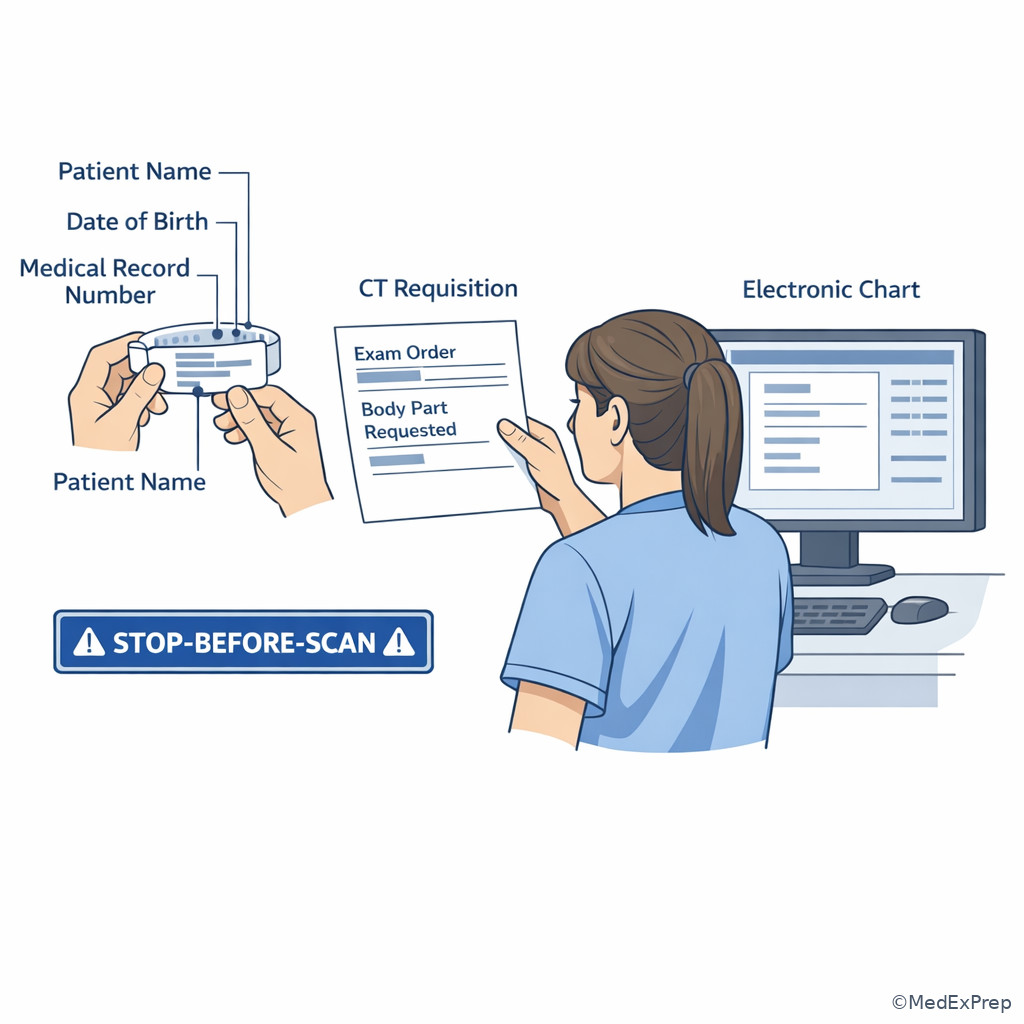
Core content
1.1.1.3 Foundational rule: what counts as proper patient identification?
A Explanation
The decision conflict is simple but heavily tested: Do you proceed because the schedule seems right, or do you stop until identity is verified with accepted identifiers? The single rule that resolves it is this: before any CT action, verify the patient using at least two accepted identifiers and match them to the order. The exam often gives one reassuring clue such as “the patient answers when called” or “the room assignment matches,” but those are not substitutes for proper identification.
WHY THIS IS TESTED: wrong-patient imaging is a preventable safety event, and board-style stems reward the technologist who chooses verification over convenience. The best answer is often “pause and clarify” rather than “continue to maintain throughput.” Choose active identification when possible: ask the patient to state full name and date of birth or another approved identifier. Reject weak identification methods such as room number, bed number, or a prompted yes/no question that lets the patient simply agree.
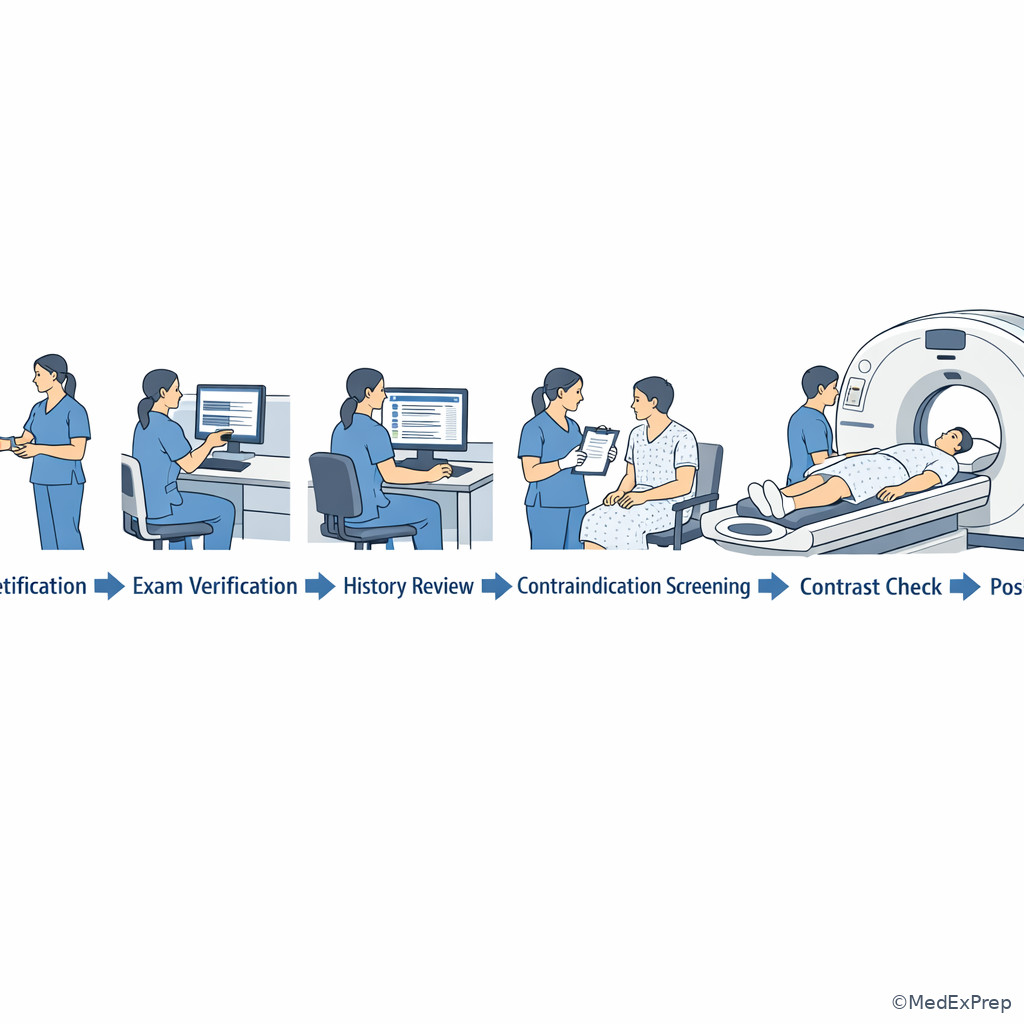
For CT specifically, identity verification anchors everything that follows: whether the contrast questionnaire belongs to the right person, whether renal-risk information corresponds to the actual patient, and whether the ordered exam is the correct study. See Fig 1 for the safest sequence. The minimum correct workflow is: identify the patient, match the armband or official record, confirm the order, then continue with history and contraindication review.
Key rule: A patient who says “yes” to a prompted name is not the same as a patient who independently states two identifiers.
Clinician Action: Diagnose an identity-safe situation by finding two matching identifiers plus a matched order. Order no additional scan steps until that match is complete. Treat the discrepancy by stopping the workflow and re-verifying. Refer/Escalate to nursing, registration, the supervisor, or ordering team if identity remains uncertain.
B Worked example
A 67-year-old man arrives for CT abdomen/pelvis from the ED with hypertension, chronic kidney disease, and hearing impairment. The transport slip says “Robert Miller,” and the schedule lists CT abdomen/pelvis with contrast. The patient nods when you ask, “Are you Robert Miller?” The armband reads “Robin Miller,” same birth month and year but a different day. A creatinine result is visible in the chart, and the ED is calling for the patient urgently.
Reasoning chain: Identify task — decide whether to proceed with CT preparation. Extract key facts — verbal confirmation was prompted, not active; the armband name differs; DOB also differs. Apply rule — two accepted identifiers must match the order before continuing. Eliminate distractors — urgency, similar name, and visible lab results do not overcome an ID discrepancy. Verify — the most appropriate next step is to stop and clarify identity with ED staff/registration and the chart before any scan or contrast preparation.
C Exam trap
Common wrong answer: Proceed because the patient responded to the name and the ED sent him for the exam.
Why it is tempting: In real workflow, transport timing and a crowded department make arrival source feel trustworthy.
Single clue that eliminates it: The patient did not actively state identifiers, and the armband does not match the order.
D Checkpoint
Question: A communicative outpatient presents for CT sinus without contrast. Which action is the most appropriate identification step before positioning?
- Ask, “You are Maria Lopez here for a sinus CT, correct?”
- Confirm the room assignment and compare it with the printed schedule.
- Ask the patient to state full name and date of birth, then match them to the order and wristband.
- Use the indication on the requisition as the second identifier after checking the wristband name.
Answer: C
- A: Tempting because it feels efficient, but it is weak passive confirmation and can allow acquiescent error.
- B: Tempting because schedule flow seems operationally reliable, but room location is not an accepted patient identifier.
- C: Correct because it uses active patient identification with two identifiers and matches them to formal records.
- D: Tempting because indication is on the order, but exam reason is not a patient identifier.
1.1.1.4 Matching the patient to the correct CT exam
A Explanation
After confirming the patient, the next tested conflict is correct patient but wrong exam. The single rule is: patient identification and exam verification are separate checks, and both must be right before scanning. A technologist may identify the right patient yet still perform the wrong study if the requisition, body part, contrast phase, or laterality is not confirmed.
WHY THIS IS TESTED: exam stems often hide the error in ordering details rather than identity details. The patient may be correctly identified, but the order may say noncontrast head while the verbal history sounds like CTA head/neck, or the schedule may list chest while the requisition lists PE study. Your role is not to independently rewrite the medical plan. Your role is to recognize the mismatch and clarify through proper channels before proceeding.
Choose the action that verifies patient + exam + body region + contrast status + special detail. Reject answers that leap into scanning because “the indication makes more sense” or because another team member verbally requested a different exam. See Fig 2 for the order-matching checkpoints most likely to prevent wrong-exam errors.
Recall: This is the first topic in the section, so build a habit now: identity verification comes before the upcoming topics on history review and contrast risk screening. If the wrong patient or wrong exam enters the workflow, those later checks become meaningless.
High-Yield Connection: This concept is tested alongside Contrast Risk Screening. Know both order matching and contrast-route/contrast-need verification for exam day — they are frequently paired in stems where the patient is correct but the requested contrast workflow is not.
Memory anchor: ID-EXAM — Identify patient, Double-check identifiers, then verify Exam, body region, contrast, Additional details, and Match the order. If any letter fails, stop.
Clinician Action: Diagnose a correct setup by aligning patient identity with the exact ordered CT study. Order clarification if body part, phase, or contrast status conflicts. Treat the workflow error by pausing before positioning. Refer/Escalate to the radiologist, ordering provider, or supervisor when the exam request is ambiguous.
B Worked example
A 54-year-old woman with diabetes and prior lumbar fusion arrives from clinic for “CT abdomen/pelvis.” The patient correctly states her name and date of birth, and the armband matches. The electronic order reads “CT renal stone protocol without contrast,” but the printed schedule says “CT urogram with contrast.” She reports flank pain and says her doctor told her “there might be contrast later.” A recent urinalysis result is visible, and a family member asks why the contrast is taking so long.
Reasoning chain: Identify task — choose the most appropriate next step before scanning. Extract key facts — identity is confirmed, but the scheduled exam and actual order conflict on contrast use and protocol. Apply rule — correct patient is not enough; the exact exam must be verified. Eliminate distractors — the patient expectation, family comments, and urinary symptoms do not authorize protocol substitution. Verify — pause and clarify the correct exam/protocol according to department process before proceeding.
C Exam trap
Common wrong answer: Perform the contrast study because it seems more complete and the patient expected it.
Why it is tempting: CT candidates often equate “more information” with “better exam.”
Single clue that eliminates it: The order itself does not match the scheduled contrast exam, so the technologist must clarify rather than upgrade the study independently.
D Checkpoint
Question: A patient is correctly identified, but the order says “CT chest without contrast” and the schedule says “CTA chest PE protocol.” What is the most appropriate next step?
- Proceed with CTA because pulmonary embolism is time-sensitive.
- Proceed with noncontrast CT chest because that is what appears on the written order.
- Clarify the discrepancy through the department’s protocol pathway before scanning.
- Ask the patient which test the referring provider intended.
Answer: C
- A: Tempting because urgency can bias action, but exam escalation without clarification exceeds technologist authority.
- B: Tempting because written orders matter, but conflicting scheduling information can signal a workflow error requiring clarification.
- C: Correct because the patient is identified but the exam is not fully verified; safe practice is to resolve the mismatch first.
- D: Tempting because the patient may know the indication, but patient recollection does not replace formal order clarification.
- The most appropriate identifier pair is usually full name + date of birth when the patient can state them.
- True or False: If the patient is correct, the technologist may choose the exam that sounds clinically best. False.
- Name the 3 minimum matches before scan start: patient, order, exam details.
Exam takeaway: A correct patient can still receive the wrong study if body part, contrast status, or protocol details are not verified separately.
flowchart LR
A[Patient verified] --> B[Check order text]
B --> C[Confirm body region]
C --> D[Confirm contrast or noncontrast]
D --> E[Confirm special protocol detail]
E --> F{Everything aligned?}
F -->|Yes| G[Proceed]
F -->|No| H[Clarify before scan] Exam takeaway: Wrong-exam errors are prevented by verifying protocol details, not just the patient name.
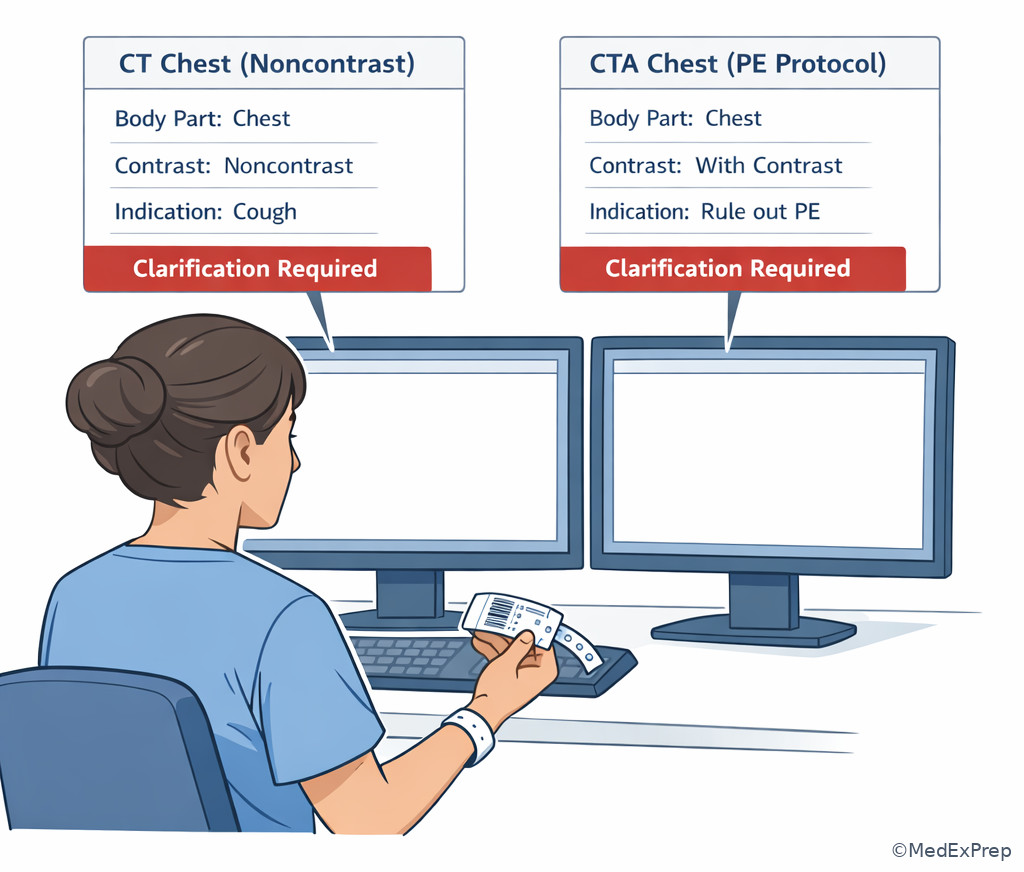
1.1.1.5 Special situations: nonverbal, confused, pediatric, trauma, and language-barrier patients
A Explanation
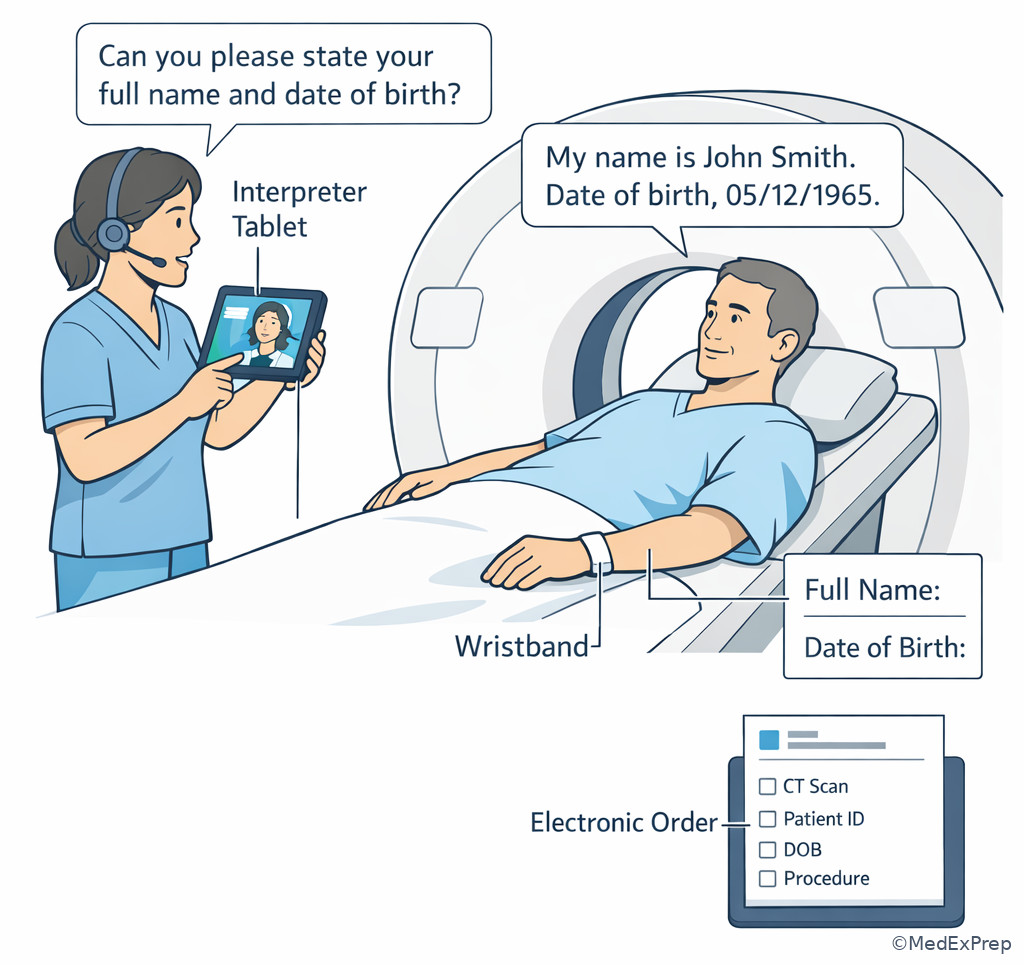
The high-yield conflict here is how to maintain the same safety standard when the patient cannot reliably state identifiers. The resolving rule is: the standard does not disappear; the verification method changes. For unconscious, intubated, sedated, confused, very young, or language-barrier patients, rely on approved alternate sources such as the armband, chart, caregiver/parent confirmation, interpreter-assisted communication, and bedside team confirmation per policy.
WHY THIS IS TESTED: stems often tempt you to lower the standard in urgent settings. A trauma patient arriving on a backboard, a child crying during transport, or a dementia patient who answers inconsistently creates time pressure. The exam wants you to choose a structured alternate identification process, not a guess. In pediatrics, verify with the wristband and parent/guardian when appropriate. With language barriers, use interpreter resources or approved communication support rather than pretending a nod is adequate. In trauma, temporary identifiers may be used per facility policy, but they still must match across the band, record, and order.
Choose the answer that preserves verification through alternate methods. Reject answers that rely on appearance, family reassurance alone without matching records, or transport handoff without record comparison. See Fig 3 for a practical branch pathway by patient communication ability.
Common pitfall: Confusion or urgency changes how you verify identity; it does not justify skipping verification.
High-Yield Connection: This concept overlaps with Communication And Instructions and Patient Transfer And Immobilization. On exam day, the patient who cannot follow commands is often also the patient at higher risk for motion, positioning challenges, or incomplete history.
Clinician Action: Diagnose whether the patient can reliably participate in identification. Order interpreter support or alternate verification steps when needed. Treat the safety risk by using armband-record-caregiver/staff matching instead of weak assumptions. Refer/Escalate when temporary trauma identifiers, absent wristbands, or conflicting handoff information create uncertainty.
B Worked example
A 6-year-old boy presents for CT facial bones after a playground injury. He is crying, has autism spectrum disorder, and will not answer questions. His mother gives his full name and date of birth. The wristband matches the mother’s information, but the printed outpatient label on one transport sheet contains a transposed digit in the birth date. The order in the electronic record matches the wristband exactly. The child has a visible facial bruise and is moving constantly.
Reasoning chain: Identify task — choose whether to proceed or stop. Extract key facts — patient cannot reliably self-identify; mother and wristband match; one transport sheet contains conflicting data. Apply rule — alternate verification is allowed, but all formal records used for the exam must align. Eliminate distractors — visible injury and motion issues matter later, not before identity is resolved. Verify — pause and correct the discrepant transport label/documentation before proceeding with the exam workflow.
C Exam trap
Common wrong answer: Proceed because the parent knows the child’s identity and the injury is obvious.
Why it is tempting: Family presence feels reassuring, especially in pediatric imaging.
Single clue that eliminates it: One formal document still conflicts, and documentation mismatch must be resolved before scan start.
D Checkpoint
Question: An intubated trauma patient arrives for CT. Which identification approach is most appropriate?
- Proceed based on the trauma team verbal handoff alone.
- Use the room number and mechanism of injury as identifiers.
- Match the trauma armband/temporary identifier to the order and chart, confirming with the care team per policy.
- Wait until the patient awakens and can state his name.
Answer: C
- A: Tempting because trauma handoffs are urgent, but verbal transfer alone is insufficient.
- B: Tempting because those details feel specific, but they are not accepted patient identifiers.
- C: Correct because alternate identification using matched official identifiers and team confirmation is the safe trauma workflow.
- D: Tempting because direct patient confirmation is ideal, but it is not feasible and should not delay appropriate alternate verification.
Exam takeaway: When the patient cannot reliably self-identify, switch to alternate approved sources rather than lowering the safety standard.
flowchart TD
A[Need patient identification] --> B{Can patient reliably state identifiers?}
B -->|Yes| C[Use active verbal ID]
B -->|No| D[Check armband]
D --> E[Match chart or order]
E --> F[Confirm with caregiver or staff or interpreter support]
F --> G{All agree?}
G -->|Yes| H[Proceed]
G -->|No| I[Stop and resolve discrepancy] Exam takeaway: For children or nonverbal patients, combine wristband matching with caregiver-confirmed identity and record verification.
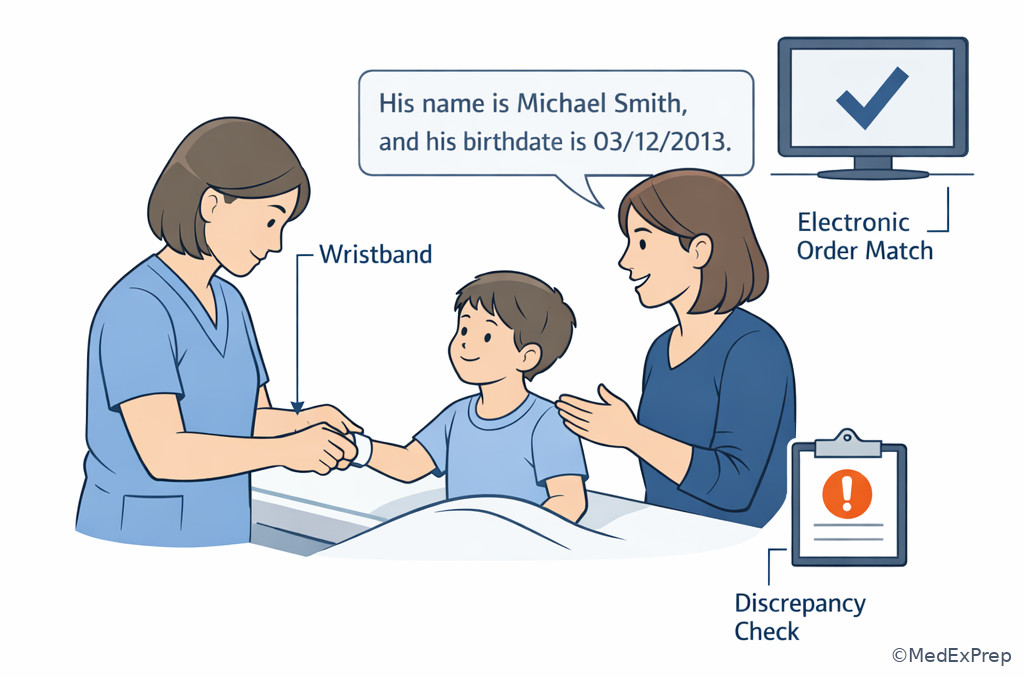
1.1.1.6 What to do when information does not match: stop, clarify, escalate
A Explanation
The exam frequently asks for the most appropriate next step when there is an identifier or order discrepancy. The rule is: the technologist stops the process, prevents the next irreversible step, and escalates through the proper channel. This is especially important before contrast administration, because a mistaken identity converts into a medication and documentation error as well as a wrong exam.
WHY THIS IS TESTED: candidates sometimes choose actions that feel helpful but exceed role boundaries, such as editing the order, assuming a nickname is acceptable without confirmation, or scanning first and “fixing the chart later.” Choose answers that preserve safety and chain-of-command. Reject answers that normalize a discrepancy. A discrepancy can involve spelling, DOB, MRN, exam type, side, phase, or the presence/absence of a wristband. One mismatch is enough to pause.
Clarification pathways vary locally, but the exam-safe principle is consistent: compare source documents, involve registration or nursing if band/chart data are wrong, and involve the ordering provider or radiologist if the exam itself is unclear. See Fig 4 for a practical mismatch algorithm. This same stop-and-clarify habit will directly support the next upcoming topics on history review and contrast risk screening.
Recall: In the upcoming topic History And Contraindication Review, you will screen symptoms, surgery, trauma, and implants. Here, we build on that by deciding whether the history even belongs to the right patient and the right order before you ask those questions.
Memory anchor: STOP — See the mismatch, Thalt the workflow, Obtain clarification, Proceed only after resolution.
Clinician Action: Diagnose a discrepancy by actively comparing identifiers and order details, not by assuming equivalence. Order clarification from the correct source. Treat the risk by halting scan prep or contrast steps. Refer/Escalate to the radiologist, ordering team, supervisor, nurse, or registration staff depending on whether the conflict is exam-related or identity-related.
B Worked example
A 73-year-old woman from a nursing facility presents for CT head without contrast after a fall. She has dementia, atrial fibrillation, and a prior stroke. Her armband is missing because she was transferred from a stretcher after ED triage. The paper packet lists one DOB, the electronic chart lists another, and the facility caregiver says, “This is definitely Ms. Carter.” The patient is sleepy but opens her eyes to voice. The nurse asks whether you can just scan quickly because transport is delayed.
Reasoning chain: Identify task — determine the most appropriate next step. Extract key facts — nonreliable historian, missing wristband, conflicting DOBs, caregiver reassurance only, pressure to hurry. Apply rule — no scan should proceed without resolved identification. Eliminate distractors — the fall indication and the urge to avoid delay do not override missing and conflicting identifiers. Verify — stop, obtain proper identification reconciliation and wristband/record confirmation through the care team before scanning.
C Exam trap
Common wrong answer: Scan first because a noncontrast head CT is quick and low risk.
Why it is tempting: Candidates may downgrade the seriousness of an ID problem when no contrast is planned.
Single clue that eliminates it: The patient still lacks verified identity; low-risk protocol does not make wrong-patient imaging acceptable.
D Checkpoint
Question: Which situation most clearly requires immediate clarification before the patient enters the scanner?
- The patient asks how long the scan will take.
- The patient has a prior CT at another hospital not yet in the archive.
- The wristband and the order match on name but differ on date of birth.
- The patient has mild anxiety about the gantry opening.
Answer: C
- A: Tempting because communication matters, but timing questions do not block safe identification.
- B: Tempting because priors can aid comparison, but lack of prior images is not an identity discrepancy.
- C: Correct because a DOB mismatch means two identifiers do not align, so the workflow must stop.
- D: Tempting because anxiety can affect cooperation, but it does not invalidate identity verification.
- True or False: A missing wristband in a confused patient can be ignored if a caregiver is confident. False.
- The single best action for a DOB mismatch is stop and clarify before scanning.
- Name the two broad destinations for escalation: identity/documentation source and exam/protocol source.
Exam takeaway: The safest next step for any unresolved identification mismatch is to halt the workflow and route clarification to the correct source.
flowchart TD
A[Discrepancy noticed] --> B{Identity issue or exam issue?}
B -->|Identity| C[Check armband, chart, registration, nursing]
B -->|Exam| D[Check order, protocol pathway, provider clarification]
C --> E{Resolved?}
D --> E
E -->|No| F[Do not scan or inject]
E -->|Yes| G[Document and continue] Exam takeaway: A deliberate stop-and-clarify response is the correct action when wristband and order details conflict.
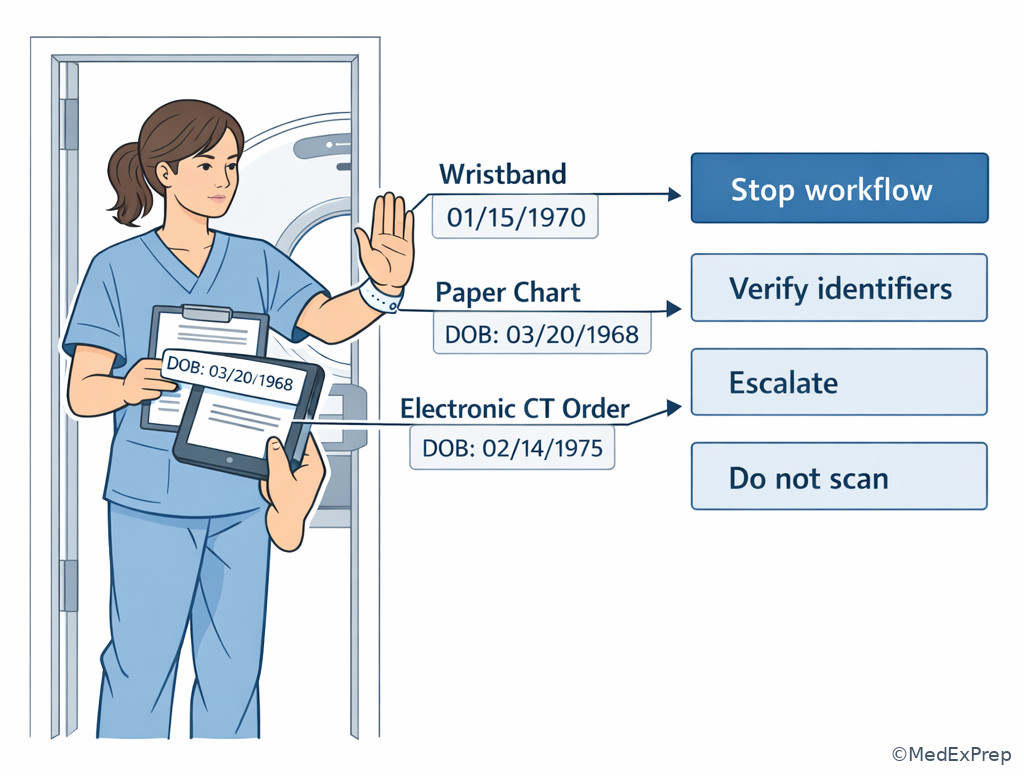
1.1.1.7 Integrating identification with CT safety workflow
A Explanation
This final integration step asks you to choose between thinking of identification as a single front-desk task versus treating it as the gateway to all later CT safety checks. The single resolving idea is: patient identification is the first link in a chain that includes history review, contraindication screening, contrast safety, positioning, documentation, and image labeling. A break at the first link compromises the entire study.
WHY THIS IS TESTED: ARRT-style questions often combine several safety issues. For example, a patient may be correctly prepped for contrast but not correctly identified; or the identity may be correct but the questionnaire belongs to another patient with the same last name. The technologist must prioritize the earliest failed safety step. Identification comes before contrast, before scan planning, and before image acquisition. See Fig 5 for how ID check sits upstream of the full CT preparation sequence.
On exam day, choose answers that keep workflow ordered: identity first, then history/contraindications, then contrast-specific checks if needed, then positioning and scanning. Reject answers that start solving downstream problems before upstream safety is confirmed. Forward reference: this structure will matter immediately in the next topics, where you will review symptoms, surgeries, implants, pregnancy risk, and contrast history only after the patient and exam are definitively matched.
Key rule: When multiple issues appear in a stem, fix the earliest upstream safety failure first. Identification comes before contrast and positioning decisions.
Clinician Action: Diagnose whether the workflow has cleared the identity gate. Order downstream screening only after that gate is passed. Treat multi-step errors by returning to the earliest failed checkpoint. Refer/Escalate if any later safety form, consent element, or contrast screen appears to belong to a different patient.
B Worked example
A 61-year-old woman arrives for CT angiography of the chest. She has COPD, prior iodinated contrast reaction history noted in an old chart, and limited English proficiency. The patient’s wristband and spoken identifiers through an interpreter match the order, but the printed contrast questionnaire in the room shows a different middle initial and different birth year. The IV is already placed by another department, and the injector is ready. Staff members suggest proceeding because “the important part is the IV access.”
Reasoning chain: Identify task — decide the most appropriate next step before contrast administration. Extract key facts — verbal/armband ID appears correct, but a downstream safety document may belong to another patient. Apply rule — if any safety form is mismatched, return to identification/document matching before proceeding. Eliminate distractors — having IV access and a time-sensitive protocol do not excuse document mismatch. Verify — stop, reconcile the questionnaire to the correct patient, then continue with contrast risk screening according to protocol.
C Exam trap
Common wrong answer: Continue because the patient herself was identified correctly, so the questionnaire error can be fixed later.
Why it is tempting: It separates identity from documentation, even though CT safety documents are part of the active workflow.
Single clue that eliminates it: The form used to clear contrast may belong to someone else, so the workflow is not safely matched end-to-end.
D Checkpoint
Question: Which sequence is most appropriate before a contrast-enhanced CT begins?
- Place IV, review allergy history, then confirm patient identifiers.
- Verify patient identity and order, then review history/contraindications, then continue with contrast and positioning workflow.
- Position the patient, perform the scout, then verify the contrast questionnaire.
- Use the schedule and transport note to identify the patient, then let nursing verify the rest.
Answer: B
- A: Tempting because it feels efficient, but it performs downstream steps before the upstream identity gate.
- B: Correct because it preserves the proper CT safety sequence and prevents error propagation.
- C: Tempting because some tasks seem reversible, but scout and positioning still occur too early if identity/workflow documents are not verified.
- D: Tempting because teamwork matters, but the technologist still owns the pre-scan identification check within scope.
Exam takeaway: Identification is the first gate in CT safety, and downstream screening steps are only valid when linked to the correct patient and exam.
flowchart LR
A[Identify patient] --> B[Verify exact exam]
B --> C[Review history and contraindications]
C --> D[Review contrast risk if needed]
D --> E[Position and scan]
E --> F[Evaluate images and document]
Exam takeaway: The pre-scan workflow must stay in order, with identity verification completed before contrast and positioning tasks.
Exam takeaway: Language barriers require supported communication, not reduced identification standards.
Exam Traps & Differentiators
Most common wrong answer and why: “Proceed because the patient appears to match the schedule.” This is tempting because it mimics fast workflow, but the exam rewards accepted identifiers and discrepancy resolution, not operational assumptions.
| Looks similar | But is not enough because | What the exam wants |
|---|---|---|
| Patient nods when name is stated | That is passive confirmation and can conceal wrong-patient error | Patient actively states identifiers when able |
| Correct room or transport destination | Location is not an accepted identifier | Two identifiers matched to official records |
| Family says “this is the right patient” | Helpful but incomplete if records conflict | Caregiver confirmation plus matched band/order |
| Urgent ED or trauma context | Urgency changes tempo, not safety standard | Alternate approved verification pathway |
| Correct patient but conflicting exam details | Wrong-exam error remains possible | Verify exam/protocol separately |
If the stem says...
- “The patient answers yes when asked if he is Mr. X” — think weak passive ID; ask the patient to state identifiers.
- “The patient is confused/intubated/nonverbal” — think alternate approved identification, not skipped identification.
- “The schedule and order do not match” — think clarify the exact exam before scanning.
- “One identifier matches but another differs” — think stop before scan; mismatch is unresolved.
- “The patient is already IV-started and ready for contrast” — think upstream identity and order verification still come first.
- “Transport staff insists this is the right patient” — think handoff is supportive, not definitive.
| Trap pair | Why they are confused | Single differentiator |
|---|---|---|
| Correct patient vs correct exam | Both feel like “verification” | Exam details must also match body part/contrast/protocol |
| Helpful handoff vs adequate identification | Both involve staff communication | Handoff supports but does not replace accepted identifiers |
| Urgent imaging vs safe imaging | Time pressure makes shortcuts attractive | Urgency never erases mismatch resolution |
| Parent/caregiver statement vs full pediatric identification | Family usually knows the patient | Statement must match formal band/order data |
| Old chart questionnaire vs current patient document | Forms may look routine and prefilled | Every active document must belong to the verified patient |
Related cross-topic trap: in the upcoming Contrast Risk Screening lesson, a common error is using a contrast questionnaire that belongs to the wrong patient. The identification mistake happens first; the contrast mistake is only the downstream consequence.
Tables
| Reference point | High-yield standard | Exam implication |
|---|---|---|
| Minimum identification approach | Use two accepted patient identifiers | One identifier alone is not enough |
| Best patient interaction | Active statement of identifiers | Reject yes/no prompting when avoidable |
| Room/bed number | Not an identifier | Do not use as substitute |
| Patient unable to speak | Use armband + record + caregiver/staff confirmation per policy | Alternate method, same safety standard |
| Any mismatch | Stop and clarify | No scan or contrast until resolved |
| Correct patient, wrong exam concern | Clarify order/protocol | Do not independently substitute exams |
| Urgent setting | Verification still required | Urgency changes pace, not standard |
| Method | Use or avoid | Why |
|---|---|---|
| Ask patient to state name and DOB | Use | Strong active verification |
| Check armband against order | Use | Formal record matching |
| Ask “Are you John Smith?” | Avoid as sole method | Prompts agreement without true verification |
| Use room number/schedule slot | Avoid | Operational detail, not patient identity |
| Use caregiver plus armband/order for nonverbal patient | Use | Appropriate alternate pathway |
| Rely on transport handoff alone | Avoid | Supportive but insufficient by itself |
| Scenario type | Likely best next step | Key discriminator |
|---|---|---|
| Name matches, DOB differs | Stop and clarify | Two identifiers do not align |
| Patient correct, schedule and order differ on contrast | Clarify exam/protocol | Wrong-exam risk despite correct patient |
| Nonverbal child, parent and wristband match, chart matches | Proceed with remaining workflow | Alternate approved identification completed |
| Intubated trauma patient with temporary identifier matching band and order | Proceed per trauma protocol | Temporary ID is acceptable if consistently matched |
| Missing wristband and conflicting paperwork | Stop and reconcile identity | No secure formal identifier chain |
| Correct patient, wrong questionnaire attached | Reconcile documents before contrast | Downstream safety form may belong to another patient |
Algorithm / Approach
Exam takeaway: The best next step is usually determined by whether identifiers and exam details fully match before the scan pathway advances.
See Fig 6 as your exam-day approach whenever a stem asks for the most appropriate next step before CT scan start.
Rapid Review
- Active verbal ID → stronger than yes/no confirmation
- Room number → never an accepted patient identifier
- Correct patient only → still insufficient without correct exam match
- DOB mismatch → stop, even if name matches
- Trauma urgency → alternate verification, not skipped verification
- Pediatric ID → caregiver support plus formal record matching
- Language barrier → interpreter-assisted identification, not assumption
- Transport handoff → supportive detail, not final proof
- Missing wristband → reconciliation before scan
- Conflicting schedule/order → clarify protocol, do not choose independently
- Questionnaire for wrong patient → downstream document mismatch blocks progress
- Contrast readiness → never outranks upstream identification
- Similar patient names → slow down and compare full identifiers
- Any unresolved discrepancy → no scan, no contrast
Memory anchor: “Name, date, match — or detach.” If name/date/order do not match, detach from the workflow and clarify before proceeding.
Self-check quiz
1. A 45-year-old woman presents for outpatient CT of the sinuses. She is alert, ambulatory, and states she is “here for the CT my doctor ordered.” Which identification approach is most appropriate before positioning?
- Ask whether she is Angela Ruiz and confirm that she is scheduled today.
- Ask her to state her full name and date of birth, then match them to the order and wristband.
- Use the exam indication and arrival time as the two identifiers.
- Confirm her address only, because the exam is noncontrast.
2. A 70-year-old man from the ED arrives for CT head after dizziness. He is alert but hard of hearing. The wristband name matches the order, but the date of birth differs by one digit. What is the most appropriate next step?
- Proceed because the exam is urgent and the name matches.
- Proceed if the nurse confirms this is the right patient.
- Stop and clarify the discrepancy before scanning.
- Scan first and document the mismatch after the images are sent.
3. A 58-year-old woman with nephrolithiasis history and hypertension arrives for CT. She correctly states her full name and date of birth, and the wristband matches. The order in the chart is CT renal stone protocol without contrast, but the printed schedule says CT urogram with contrast. She says, “My doctor mentioned dye might be needed.” What is the most appropriate next step?
- Proceed with CT urogram because it provides more information.
- Proceed with the noncontrast stone protocol because it appears in the charted order.
- Clarify the exam discrepancy through the department’s protocol pathway before scanning.
- Ask the patient to choose which exam she expected.
4. A 6-year-old boy presents for CT facial bones after trauma. He is crying and nonverbal, with autism and asthma. His mother states his full name and date of birth, and the wristband matches the electronic order. A transport sticker on the stretcher shows a different birth year. Which action is most appropriate?
- Proceed because the parent and wristband agree, and the sticker is probably old.
- Stop and resolve the documentation discrepancy before the scan starts.
- Ignore the parent and wait until the child can self-identify.
- Proceed only if the child points to his own name on the sticker.
5. A 39-year-old woman with limited English proficiency presents for CTA chest. She has asthma and a prior ED visit for chest pain. Using an interpreter device, she states her full name and date of birth, and the wristband matches. The printed contrast questionnaire in the room belongs to a patient with a similar last name and a different birth year. What is the most appropriate next step?
- Proceed because the patient herself was identified correctly.
- Use the incorrect questionnaire temporarily and correct it after the scan.
- Stop and reconcile the questionnaire to the correct patient before continuing the contrast workflow.
- Skip the questionnaire because the interpreter-assisted verbal ID was complete.
6. A 64-year-old man with COPD and atrial fibrillation arrives from the ICU, intubated and sedated, for CT chest/abdomen/pelvis after a fall. He has a temporary trauma identifier wristband that matches the electronic chart and the CT order. The bedside nurse verbally confirms the patient identity. No family is present. What is the most appropriate next step?
- Delay the study until a family member can verify the patient’s full legal name.
- Proceed using the matched temporary identifier workflow per policy.
- Cancel the exam because the patient cannot actively state two identifiers.
- Proceed only if the transport note also includes the same room number and mechanism of injury.
7. A 72-year-old woman with dementia, diabetes, and recent stroke is sent for CT head without contrast after a fall. She is sleepy and cannot answer reliably. The paper packet lists one date of birth, the electronic chart lists another, and no wristband is present after transfer. The caregiver insists she is the correct patient and asks to “just do the quick head scan.” What is the most appropriate next step?
- Proceed because the caregiver confirms identity and the exam is low risk.
- Proceed if the patient responds to her last name when called.
- Stop and obtain formal identity reconciliation before scanning.
- Scan the head only and defer documentation until after image review.
8. A 51-year-old man presents for CT abdomen/pelvis with contrast for abdominal pain. He has chronic kidney disease and prior bowel surgery. The technologist verifies full name and date of birth, and the wristband matches the order. As IV contrast setup begins, the renal-risk screening form on the counter shows a different medical record number but the same last name. Which action is most appropriate?
- Continue because the patient himself has already been identified correctly.
- Stop and reconcile the screening document before contrast administration.
- Proceed with scanning but omit contrast until the form is corrected later.
- Ask the patient whether the other MRN might belong to a relative.
Answer key
1. Correct answer: B
- A: Tempting because it is fast and common in busy imaging areas, but it uses a prompted yes/no format that can produce false confirmation. The discriminating clue is that the patient is alert and able to self-identify, so the stronger method is required. Source: American College of Radiology patient safety principles; Bontrager’s handbook approach to patient identification.
- B: Correct because active verbal identification with two accepted identifiers matched to formal records is the safest standard before CT positioning. The discriminating clue is that the patient is communicative, making active identification possible. Source: Joint Commission National Patient Safety Goal framework; Bontrager and Lampignano.
- C: Tempting because the indication and timing seem specific, but neither is an accepted patient identifier. The discriminating clue is that exam-related details describe the order, not the patient identity. Source: Joint Commission identification standards.
- D: Tempting because an address can be used in some systems, but using only one item and relaxing the standard because the exam is noncontrast is unsafe. The discriminating clue is that contrast status does not change the requirement for proper patient identification. Source: ACR Manual on MR/CT safety concepts applied to workflow; standard patient safety practice.
2. Correct answer: C
- A: Tempting because urgency can bias toward action, but one matching identifier does not overcome a DOB mismatch. The discriminating clue is the date-of-birth discrepancy. Source: Joint Commission National Patient Safety Goals.
- B: Tempting because team confirmation feels reassuring, but verbal reassurance does not resolve a formal mismatch in identifiers. The discriminating clue is conflict between official patient data elements. Source: standard radiology patient safety workflow references.
- C: Correct because any unresolved mismatch in accepted identifiers requires the technologist to stop and clarify before scanning. The discriminating clue is that the patient is alert enough for re-verification and the record conflict is active. Source: Joint Commission; ACR quality and safety resources.
- D: Tempting because documentation could theoretically be corrected later, but wrong-patient imaging cannot be undone. The discriminating clue is that the mismatch occurs before scan start, when prevention is still possible. Source: radiology safety literature on wrong-patient error prevention.
3. Correct answer: C
- A: Tempting because contrast studies can seem more comprehensive, especially in abdominal complaints, but the technologist may not independently upgrade a study. The discriminating clue is the direct conflict between the charted order and scheduled exam. Source: ACR practice parameters and ARRT-safe scope boundaries.
- B: Tempting because the charted order is formal, but the conflict still must be clarified rather than assumed resolved. The discriminating clue is that two workflow sources disagree on the exact exam. Source: radiology workflow safety standards.
- C: Correct because correct patient identification does not resolve wrong-exam risk; formal clarification is required before scan start. The discriminating clue is the mismatch in contrast use and protocol type. Source: Joint Commission wrong-procedure prevention concepts; CT protocol safety practice.
- D: Tempting because patient recollection can help describe the indication, but the patient does not determine the authorized protocol. The discriminating clue is that provider intent must be clarified through formal channels. Source: ARRT scope-based reasoning and ACR practice patterns.
4. Correct answer: B
- A: Tempting because the parent, wristband, and order align, making the stray sticker seem trivial. However, any active documentation mismatch should be reconciled before proceeding. The discriminating clue is the conflicting birth year on a transport-associated identifier source. Source: radiology patient safety workflow guidance.
- B: Correct because the child cannot self-identify, so alternate verification is appropriate, but all active records used in the workflow must be aligned. The discriminating clue is the documentation conflict despite otherwise strong alternate ID sources. Source: Joint Commission patient identification principles applied to pediatric imaging.
- C: Tempting because self-identification is ideal, but nonverbal pediatric patients are routinely identified using alternate approved methods. The discriminating clue is that waiting for self-identification is unnecessary and unrealistic. Source: pediatric imaging safety practice.
- D: Tempting because it seeks child participation, but pointing behavior is not a reliable formal identifier. The discriminating clue is that approved record matching already provides the proper path once discrepancies are resolved. Source: standard patient ID guidance.
5. Correct answer: C
- A: Tempting because the patient herself was properly identified, but contrast workflow documents must also belong to that patient. The discriminating clue is the incorrect questionnaire tied to a similar-name patient. Source: ACR contrast safety workflow concepts.
- B: Tempting because it seems administratively fixable later, but using another patient’s form during active screening is unsafe. The discriminating clue is that the wrong document could misdirect allergy or renal-risk decisions. Source: ACR Manual on Contrast Media; patient safety standards.
- C: Correct because identification must remain consistent through downstream safety documentation before contrast begins. The discriminating clue is the different birth year on the active questionnaire. Source: ACR Manual on Contrast Media and radiology workflow safety principles.
- D: Tempting because interpreter-assisted ID was valid, but it does not eliminate the need for correct contrast screening documentation. The discriminating clue is that this is now a document-matching problem, not just a communication problem. Source: ACR contrast safety guidance.
6. Correct answer: B
- A: Tempting because family confirmation feels more personal and certain, but trauma and ICU workflows often rely on temporary identifiers before family is available. The discriminating clue is that the temporary identifier already matches the band, chart, and order. Source: trauma imaging workflow safety practice and Joint Commission-compatible alternate identification principles.
- B: Correct because an intubated patient who cannot self-identify may be safely verified through a matched temporary identifier system plus care-team confirmation per policy. The discriminating clue is complete formal alignment of temporary identifier sources. Source: standard hospital trauma patient identification practices; Joint Commission patient identification framework.
- C: Tempting because active verbal identification is ideal, but it is not required when the patient cannot participate and approved alternatives exist. The discriminating clue is that inability to speak does not cancel needed imaging when official alternate identification is secure. Source: radiology safety standards.
- D: Tempting because additional matching details seem safer, but room number and mechanism are not the key determinants once the official temporary identifier chain is complete. The discriminating clue is that accepted formal identifiers outrank operational details. Source: Joint Commission patient identification guidance.
7. Correct answer: C
- A: Tempting because a caregiver is often helpful and the exam seems fast, but caregiver reassurance cannot replace a missing wristband plus conflicting DOB records. The discriminating clue is the absence of a secure formal identifier chain. Source: Joint Commission patient identification standards.
- B: Tempting because some response from the patient may feel validating, but a sleepy dementia patient responding to a surname is not reliable two-identifier verification. The discriminating clue is the patient’s inability to answer reliably. Source: radiology patient safety practice.
- C: Correct because missing wristband plus conflicting DOB data creates unresolved identity uncertainty, and the scan must stop until formal reconciliation occurs. The discriminating clue is simultaneous failure of both record alignment and patient self-identification. Source: Joint Commission; ACR quality and safety resources.
- D: Tempting because a quick noncontrast head CT seems low risk, but wrong-patient imaging remains a serious safety error regardless of exam simplicity. The discriminating clue is unresolved identification before the scanner. Source: wrong-patient imaging prevention literature.
8. Correct answer: B
- A: Tempting because the patient’s initial ID check was correct, but the renal-risk screening form now in active use may belong to someone else. The discriminating clue is the different medical record number on a document that will guide contrast decisions. Source: ACR Manual on Contrast Media.
- B: Correct because identification must remain intact across the entire pre-contrast workflow; a mismatched MRN on the screening form requires reconciliation before injection. The discriminating clue is that the error affects a downstream safety step tied to contrast administration. Source: ACR Manual on Contrast Media; radiology workflow safety standards.
- C: Tempting because withholding contrast may seem like a compromise, but the underlying workflow/document mismatch still must be resolved before continuing. The discriminating clue is that the question asks about the most appropriate action at the moment the discrepancy is found. Source: ARRT-safe sequencing principles.
- D: Tempting because family-name confusion is common, but the patient’s speculation does not replace formal reconciliation of the record. The discriminating clue is the different MRN, which is a strong sign the form may belong to another patient. Source: Joint Commission identification principles; ACR contrast safety workflow.
Keep going with the full ARRT Computed Tomography Prep Course (ARRT CT)
You just studied the way members do, in the same lesson interface. Full access unlocks every lesson, the question bank and flashcards for a full year.
One payment · 1 year of access · No auto-renewal