1.1.1 - Frequency, Period, And Cycles
Frequency, Period, and Cycles
What you'll learn
- DOMAIN: Wave physics foundations - relate frequency, period, and cycles using correct units and inverse relationships.
- DOMAIN: Formula selection - choose the correct equation when the exam asks for frequency from period or period from frequency.
- DOMAIN: Image and system reasoning - predict how changing frequency affects cycle timing without confusing it with amplitude, power, or wavelength.
- DOMAIN: Technical decision-making - identify which parameter is determined by the system versus the transducer in SPI-style stems.
- DOMAIN: Unit interpretation - convert between hertz, kilohertz, megahertz, and seconds, milliseconds, and microseconds without dropping powers of ten.
- Wave Physics Foundations → Wave parameters and units → Frequency, period, and cycles
- Ultrasound physics relationships → Formula selection and proportional reasoning
- Instrumentation knowledge → Predicting the effect of parameter changes on emitted sound
Why it matters
- Frequency and period are among the first formulas tested because they set up later topics such as wavelength, pulse duration, axial resolution, and Doppler shift.
- SPI items often hide a simple inverse relationship inside noisy wording, mixed units, or a tempting distractor like power or amplitude.
- If you miss the difference between how often a wave repeats and how strong a wave is, you will miss chained questions in later chapters.
- Operator decisions about transducer selection depend heavily on frequency, so this topic becomes practical quickly even though it starts with basic physics.
Key Terms & Must-Know Facts
1.1.1.1 Key terms
- Frequency - number of cycles occurring each second
- Period - time required for one cycle to occur
- Cycle - one complete repetition of a wave
- Hertz (Hz) - cycles per second
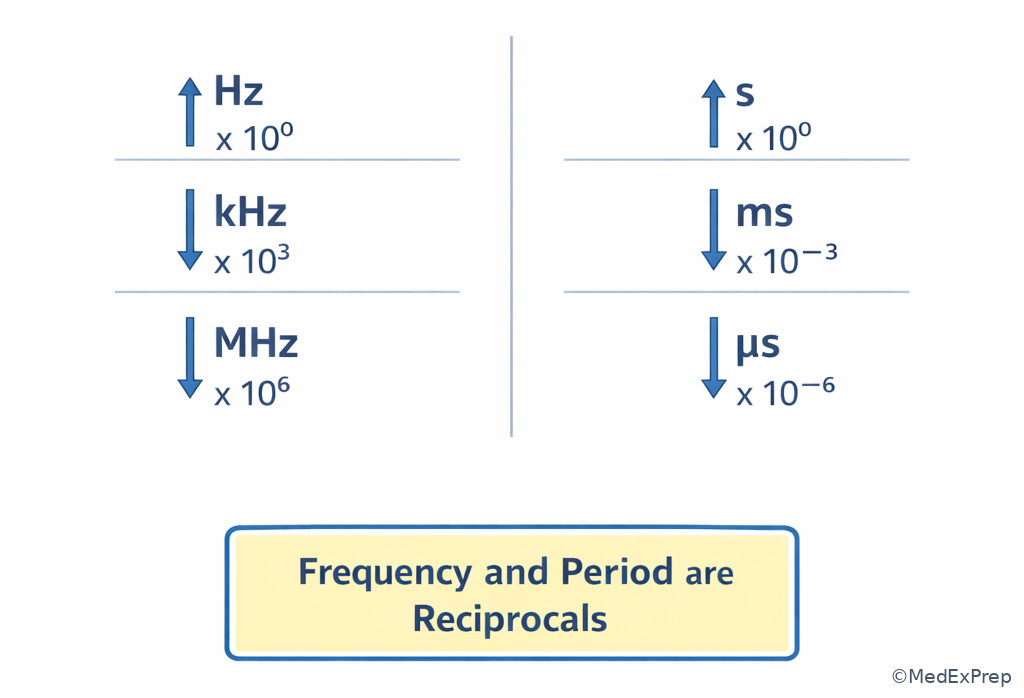
- Kilohertz (kHz) - \(10^3\) Hz
- Megahertz (MHz) - \(10^6\) Hz
- Seconds (s) - base unit for period
- Milliseconds (ms) - \(10^{-3}\) s
- Microseconds (µs) - \(10^{-6}\) s
- Inverse relationship - when one variable increases, the other decreases proportionally
- Transmit frequency - the emitted frequency produced by the source and transducer system
- Operating frequency range - the usable frequencies available from a broadband transducer
1.1.1.2 Must-know facts
- \(f = \frac{1}{T}\)
- \(T = \frac{1}{f}\)
- Frequency and period are reciprocals.
- Higher frequency means more cycles per second.
- Higher frequency means shorter period.
- Period describes one cycle, not a whole pulse unless the pulse has only one cycle.
- Frequency is set by the sound source; it does not change as sound travels from one medium to another.
- SPI stems often test unit conversion more than the physics itself.
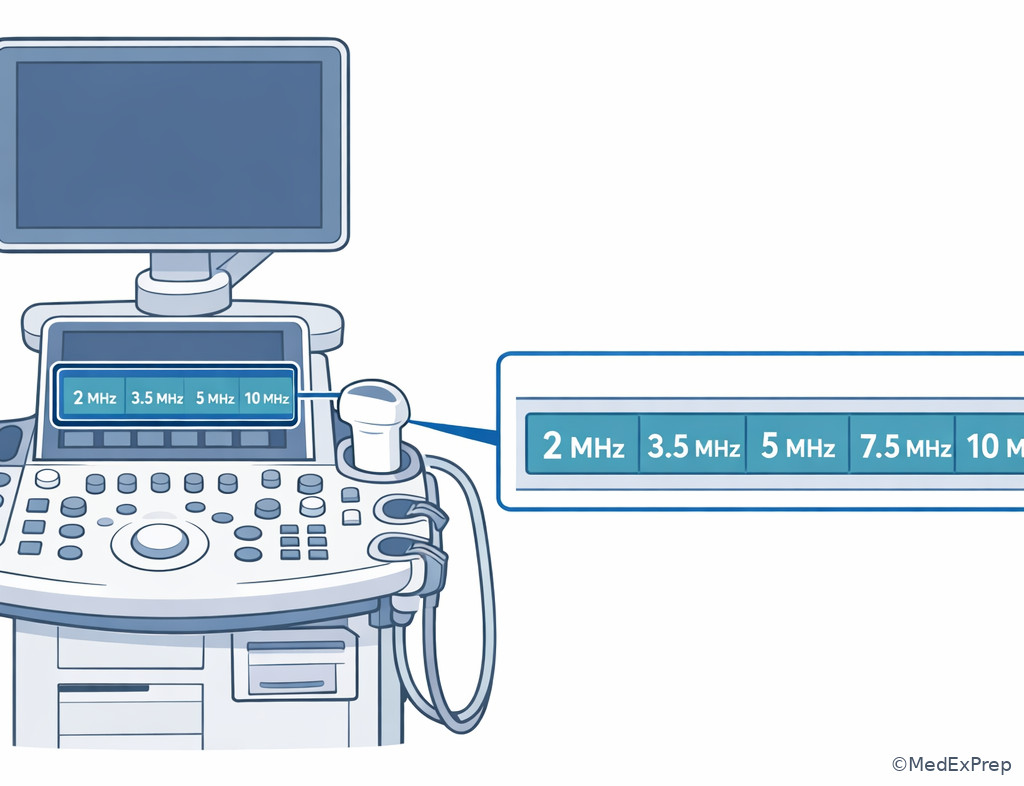
- Diagnostic ultrasound frequencies are typically in the MHz range, not Hz or kHz.
- Do not confuse number of cycles in a pulse with frequency; one is a count, the other is a rate.
| Quantity | Meaning | Unit | What the exam usually asks |
|---|---|---|---|
| Frequency | Cycles per second | Hz, kHz, MHz | Calculate from period or compare probes |
| Period | Time for one cycle | s, ms, µs | Calculate from frequency |
| Cycle | One full oscillation | No separate SI unit; simple count | Count cycles within a pulse description |
| Reciprocal pair | Inverse mathematical partners | Conceptual | Predict increase/decrease direction |
Exam takeaway: Use the reciprocal relationship first before considering any other wave variable in a stem.
flowchart LR
A[Given frequency?] --> B[Take reciprocal]
B --> C[Get period]
D[Given period?] --> E[Take reciprocal]
E --> F[Get frequency]
C --> G[Check units]
F --> G
G --> H[Reject amplitude or power distractors]
See Fig 1 for the core test-day move: identify whether the stem gives a rate or a time-per-cycle, then take the reciprocal before reading farther.
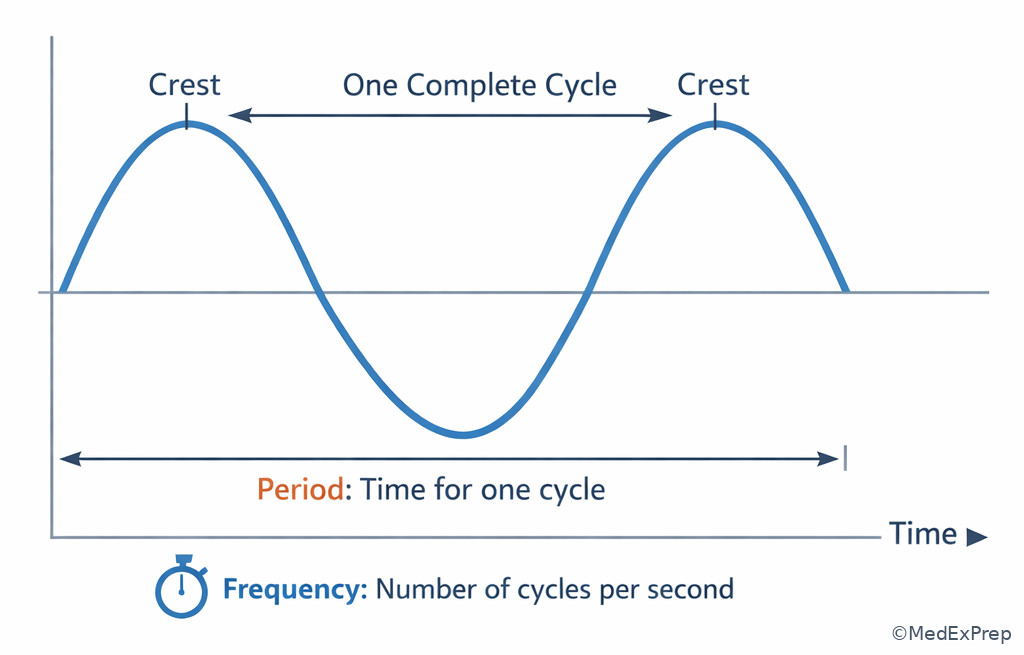
Exam takeaway: Visualizing one complete cycle helps separate a cycle count from frequency, which is cycles per second.
Exam takeaway: On exam stems, transducer frequency selections are typically given in MHz and connect directly to period and later to wavelength.
Core content
1.1.1.3 Foundational definitions: what the stem is really asking
A Explanation
The first decision conflict in this topic is simple but heavily tested: is the question asking for a count, a rate, or a time? A cycle is one complete repetition of the wave. Frequency is how many of those cycles occur in 1 second. Period is how long one cycle takes. The single rule that resolves most stems is this: frequency and period are reciprocals. If one goes up, the other must go down.
WHY THIS IS TESTED: ARDMS SPI writers use these terms early to see whether you can organize wave variables correctly before they combine them with wavelength, pulse duration, or Doppler. Choose frequency when the wording says cycles per second. Reject frequency when the wording says time for one cycle; that is period. Choose cycle when the stem asks how many repetitions occur within a pulse. Reject cycle when the stem asks about a rate over time.
Frequency is measured in hertz. In ultrasound, practical values are typically megahertz. Period is measured in seconds, usually microseconds in SPI calculations. One complete cycle includes a compression and a rarefaction, or one crest-to-crest sequence on a sinusoidal drawing. Many distractors try to pull you toward amplitude, power, or intensity. Those describe strength or energy transfer, not repetition timing.
B Worked example
A 24-year-old sonography student in vascular lab orientation is reviewing a system physics worksheet after scanning a patient with obesity and poorly controlled hypertension. A note on the worksheet says the emitted wave has a period of 0.2 microseconds. Another line mentions that the selected preset increased output power, which makes one answer choice look attractive. The question asks for the most appropriate frequency.
Reasoning chain: Identify task: find frequency from period. Extract key facts: period \(= 0.2\ \mu s = 0.2 \times 10^{-6}\ s\). Apply rule: \(f = \frac{1}{T}\). So \(f = \frac{1}{0.2 \times 10^{-6}} = 5 \times 10^6\) Hz = 5 MHz. Eliminate distractors: output power is irrelevant because power is not reciprocal to period; 0.2 MHz is wrong because it treats the number as already a frequency; 50 MHz is a power-of-ten error. Verify: a diagnostic ultrasound transmit frequency of 5 MHz is realistic.
C Exam trap
D Checkpoint
Question: An ultrasound system emits sound with a period of 0.5 microseconds. Which frequency is most appropriate?
- A. 0.5 MHz - Tempting because it repeats the given number, but wrong because period must be inverted rather than relabeled.
- B. 1 MHz - Tempting because learners remember a reciprocal relationship but miss the microsecond conversion; wrong for this period.
- C. 2 MHz - Tempting only if the reciprocal is applied correctly, and it is right because \(1 / 0.5\ \mu s = 2\) MHz.
- D. 5 MHz - Tempting because 5 MHz is a common probe frequency, but wrong because it would correspond to 0.2 microseconds, not 0.5 microseconds.
1.1.1.4 Units and conversions: where easy points are lost
A Explanation
The next decision conflict is not physics but notation: did the stem change the scale? Many wrong answers come from correct setup but incorrect powers of ten. In SPI questions, frequency is often reported in MHz and period in microseconds. These pair naturally because \(1\ \text{MHz}\) corresponds to \(1\ \mu s\) only when the values are exact reciprocals in that scale. This gives you a fast mental check, but only after you understand the unit structure.
WHY THIS IS TESTED: Unit conversion errors can hide inside otherwise easy reciprocal problems. Choose the answer that matches both the math and the unit scale. Reject answers that are mathematically reciprocal but expressed in the wrong magnitude. For example, if the period is 0.25 microseconds, the frequency is 4 MHz, not 4 Hz or 4 kHz.
Useful conversions: \(1\ \text{MHz} = 10^6\ \text{Hz}\), \(1\ \mu s = 10^{-6}\ \text{s}\), \(1\ \text{ms} = 10^{-3}\ \text{s}\). Since diagnostic frequencies are usually several MHz, periods are usually fractions of a microsecond. If a calculation gives a period of 5 seconds or a frequency of 5 Hz for a diagnostic transducer, the setup or units are wrong.
See Fig 2 for a unit bridge that compresses the usual conversions into one quick-reference pathway.
Exam takeaway: Match MHz with microseconds as a quick check, but verify the reciprocal before finalizing.
flowchart TD
A[Frequency in Hz] --> B[divide by 1,000]
B --> C[kHz]
C --> D[divide by 1,000]
D --> E[MHz]
F[Period in s] --> G[multiply by 1,000]
G --> H[ms]
H --> I[multiply by 1,000]
I --> J[us]
E --> K[Diagnostic ultrasound often in MHz]
J --> L[Corresponding periods often in fractions of us]
B Worked example
A 31-year-old outpatient with diabetes and chronic kidney disease is being scanned for a technical abdominal study. The student operator switches from a lower-frequency to a higher-frequency preset. A worksheet asks: if the transmit frequency is 4 MHz, what is the period? The stem also mentions that overall gain was increased to improve brightness, a distracting detail because gain changes display amplification, not wave timing.
Reasoning chain: Identify task: solve for period from frequency. Extract key facts: \(f = 4\ \text{MHz} = 4 \times 10^6\ \text{Hz}\). Apply rule: \(T = \frac{1}{f}\). Therefore \(T = \frac{1}{4 \times 10^6}\ s = 0.25 \times 10^{-6}\ s = 0.25\ \mu s\). Eliminate distractors: 4 µs confuses reciprocal direction; 0.25 ms misses the magnitude by \(10^3\); gain is irrelevant. Verify: higher diagnostic frequencies should correspond to short periods, so 0.25 µs is sensible.
C Exam trap
D Checkpoint
Question: A transducer operates at 8 MHz. Which period is most appropriate?
- A. 8 µs - Tempting because it copies the frequency number into time units, but wrong because period is the reciprocal.
- B. 0.125 µs - Tempting because the number is less familiar, yet it is right since \(1/8 = 0.125\) in the MHz-µs reciprocal pair.
- C. 1.25 µs - Tempting because it resembles a reciprocal estimate, but wrong by a factor of 10.
- D. 125 µs - Tempting only if the learner misreads mega as kilo or forgets the practical ultrasound range; wrong by orders of magnitude.
- The reciprocal of frequency gives period.
- True or False: 1 MHz equals \(10^6\) Hz. True.
- Name the 3 categories a stem may be asking for here: count, rate, time.
1.1.1.5 Frequency, cycles, and pulses: counts versus rates
A Explanation
This section resolves another common SPI conflict: the exam says “cycles,” but the learner thinks “frequency.” A cycle is a count of one complete oscillation. Frequency is the number of cycles occurring each second. Those are related but not interchangeable. A pulse may contain multiple cycles, so the number of cycles in a pulse is a count, not a rate. Later in the course, pulse duration will depend on both period and number of cycles, which is why the distinction starts here.
WHY THIS IS TESTED: This is one of the first places ARDMS can check whether you distinguish a variable itself from the number of times it occurs within another event. Choose “cycles” when the question asks how many wave repetitions occur inside a pulse. Reject “frequency” unless the question explicitly refers to cycles per second. The single rule is: count within a pulse is not the same thing as rate over one second.
Suppose a pulse contains 3 cycles. That does not tell you the frequency unless you also know timing. Likewise, a frequency of 3 MHz does not tell you how many cycles are in a pulse unless pulse duration or another pulse variable is given. This separation becomes essential when you later learn that pulse duration equals number of cycles times period.
See Fig 3 for a visual separation of cycle count, frequency, and period.
Exam takeaway: Count cycles inside a pulse separately from frequency, which always requires a time basis.
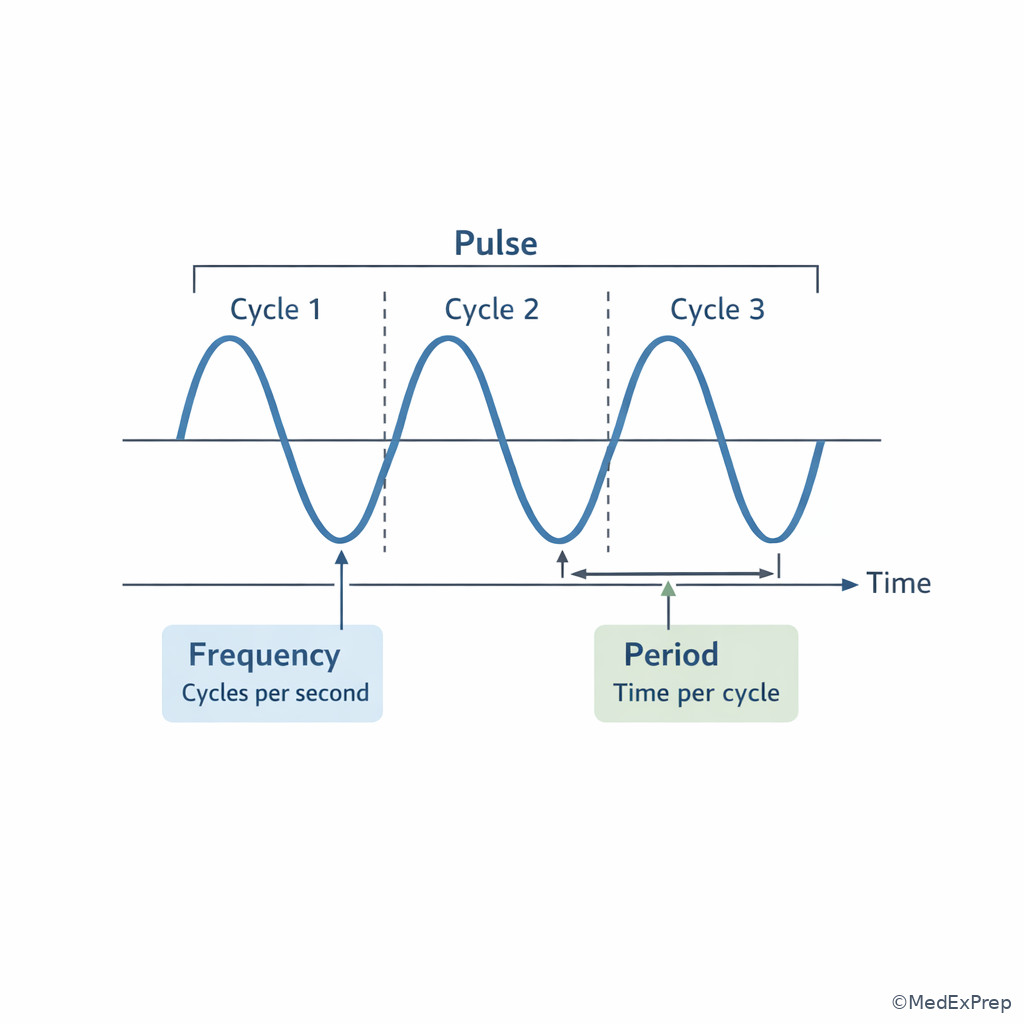
Exam takeaway: Counting cycles becomes clinically useful later when pulse duration and duty factor are introduced.
flowchart LR
A[Cycles in pulse] --> B[Count only]
C[Period] --> D[Time for one cycle]
A --> E[Pulse duration later]
D --> E
F[Frequency] --> G[Cycles per second]
G -. not same as .-> B
B Worked example
A 67-year-old patient with COPD and atrial fibrillation is scanned in a busy inpatient unit. The supervising sonographer notes that a transmitted pulse contains 4 cycles. The machine preset is 2 MHz, and the stem asks which statement is most accurate. A tempting clue says the patient has tachycardia, which may distract a learner into thinking any “rate” mentioned must be frequency.
Reasoning chain: Identify task: choose the statement that correctly distinguishes terms. Extract key facts: pulse contains 4 cycles; transmit frequency is 2 MHz. Apply rule: cycle count within a pulse is not the same as cycles per second. Eliminate distractors: “the pulse frequency is 4” is wrong because 4 is a count; “the period is 4 µs” is unsupported without reciprocal calculation from 2 MHz; “tachycardia changes sound frequency” is unrelated. Verify: the correct conclusion is that the pulse contains 4 cycles, while the frequency remains 2 million cycles per second.
C Exam trap
D Checkpoint
Question: A pulse contains 5 cycles, and the transmit frequency is 5 MHz. Which statement is most appropriate?
- A. The pulse contains 5 cycles, and the frequency is 5 MHz - Tempting because both numbers match, and it is right because the count and rate are separate but both provided.
- B. The pulse period is 5 microseconds - Tempting because a 5 appears in the stem, but wrong because 5 MHz corresponds to 0.2 µs period.
- C. The pulse frequency is 5 cycles - Tempting because of similar language, but wrong because cycles alone are not a rate.
- D. The system emits 1 cycle per second - Tempting only if the learner abandons the given MHz information; wrong by several orders of magnitude.
1.1.1.6 Applied SPI reasoning: choosing the right relationship under noise
A Explanation
In actual SPI items, the hard part is often not the formula but the presence of irrelevant details. A stem may mention output power, attenuation, gain, patient body habitus, or probe type when all you really need is a reciprocal. The decision conflict becomes: which variable actually governs the answer? The single rule is to isolate the tested relationship first. If the task is frequency-period, every other variable is secondary unless the question explicitly asks how they interact.
WHY THIS IS TESTED: ARDMS does not want pure memorization; it wants disciplined selection of the governing rule. Choose the variable pair directly named or implied by the stem. Reject superficially familiar variables if they do not enter the equation. Frequency and period are linked mathematically; amplitude, power, intensity, and gain are not part of that reciprocal pair.
This is where a structured approach helps: identify task, extract relevant fact, apply rule, eliminate distractors, verify reasonableness. See Fig 4 for a comparison chart that shows what changes frequency-period answers and what does not.
Exam takeaway: When the item tests timing, reject strength variables unless the stem explicitly asks about them.
flowchart TD
A[Question asks about frequency or period] --> B[Use reciprocal relationship]
A --> C[Check units]
D[Stem mentions power or gain] --> E[Possible distractor]
D --> F[Do not use unless question asks about output strength or display amplification]
B --> G[Compute answer]
C --> G
E --> H[Reject if unrelated]
B Worked example
A 54-year-old patient with cirrhosis and ascites is scanned with a 3.5 MHz curvilinear transducer. The sonographer increases overall gain and decreases depth to improve visualization. A practice item then asks which parameter change necessarily occurs if transmit frequency is increased while everything else in the calculation is ignored. One option says “period increases,” another says “period decreases,” and others mention output power and gain.
Reasoning chain: Identify task: effect of increasing frequency. Extract key facts: only frequency-period relation is relevant; gain and depth are noise. Apply rule: because \(T = \frac{1}{f}\), increasing frequency decreases period. Eliminate distractors: power may or may not change depending on system settings and is not determined by the reciprocal pair; gain is receiver amplification, not emitted timing. Verify: more cycles each second means each cycle must take less time.
C Exam trap
D Checkpoint
Question: During a physics review, a student increases transmit frequency from 2 MHz to 4 MHz while ignoring all other controls. Which change is most appropriate?
- A. Period doubles - Tempting because the frequency doubled, but wrong because reciprocal variables move in opposite directions.
- B. Period is cut in half - Tempting because it follows the inverse relationship, and it is right for a doubling of frequency.
- C. Gain is cut in half - Tempting because learners may think every system change has a matched display change, but gain is independent here.
- D. Power necessarily doubles - Tempting because higher frequency sounds “more energetic,” but wrong because that is not the tested relationship.
- If frequency doubles, period is cut in half.
- True or False: Gain is part of the reciprocal equation between frequency and period. False.
- The most important clue in noisy stems is the variable pair explicitly being asked about: frequency and period.
1.1.1.7 Integration with upcoming topics: frequency as a foundation for probe choice and later formulas
A Explanation
This final section shifts from pure definition to integration. Frequency does not stand alone in SPI. It connects forward to wavelength, attenuation, resolution, and transducer selection. The decision conflict becomes: when should you treat frequency as just a number, and when should you recognize that it predicts other behaviors? For this lesson, the single resolving rule is to master the direct relationship first: frequency and period are reciprocal. Then attach the future consequences without mixing formulas prematurely.
WHY THIS IS TESTED: The exam often asks a basic fact in one sentence and then expects you to use it in a different form later. For example, if frequency increases, period decreases now; in the next lesson, wavelength will also decrease in the same medium. If you confuse those chains, you will miss integration items.
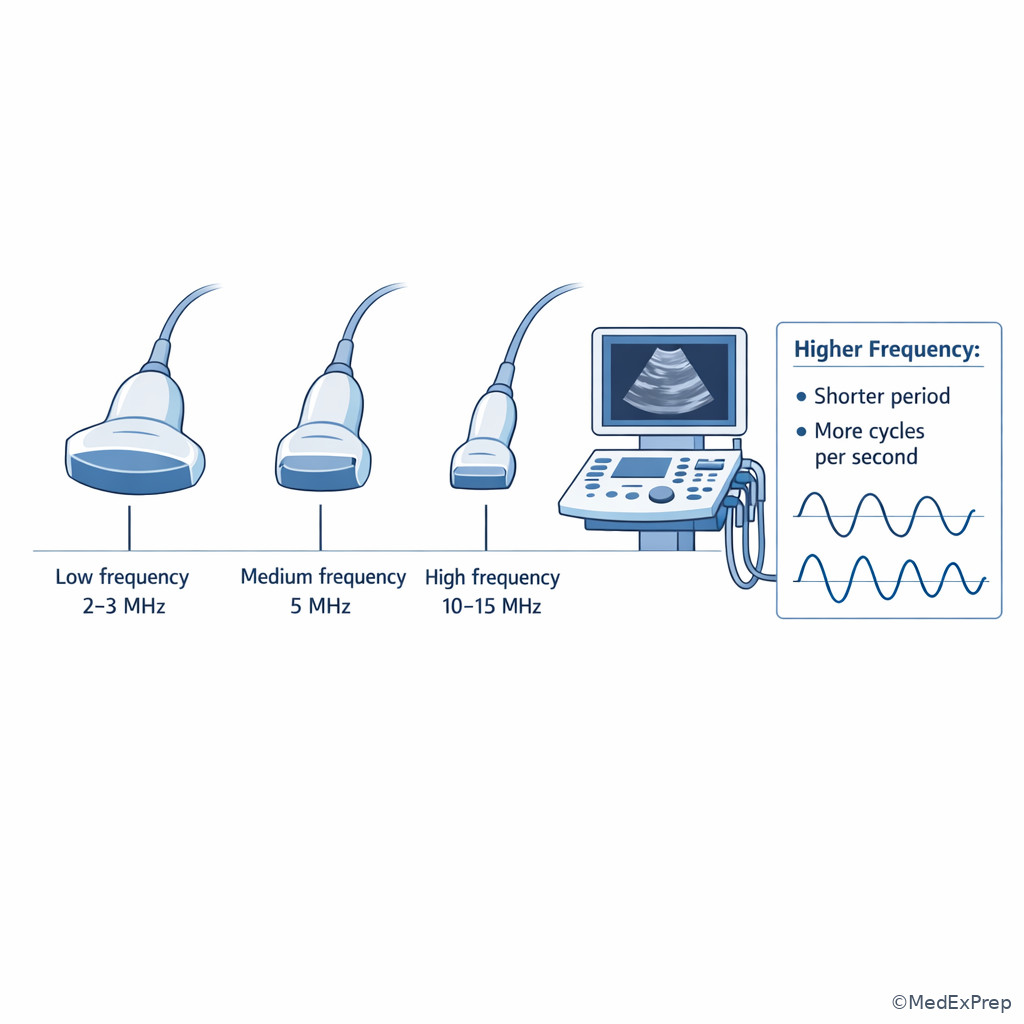
Forward reference: in Wavelength and Propagation Speed, wavelength is given by \( \lambda = \frac{c}{f} \). Because soft tissue propagation speed is assumed constant for routine calculations, higher frequency leads to shorter wavelength. In Amplitude, Power, and Intensity, you will study wave strength variables, which are not reciprocal with period. Keep those families separate. See Fig 5 for the future linkage map and Fig 6 for a clean visual of transducer frequency options.
Exam takeaway: Frequency is a foundational bridge variable that links timing now and wavelength, attenuation, and resolution later.
flowchart LR
A[Frequency] --> B[Period inverse]
A --> C[Wavelength inverse in same medium]
A --> D[Transducer selection]
A --> E[Attenuation trend later]
F[Amplitude/Power/Intensity] -. separate family .-> A
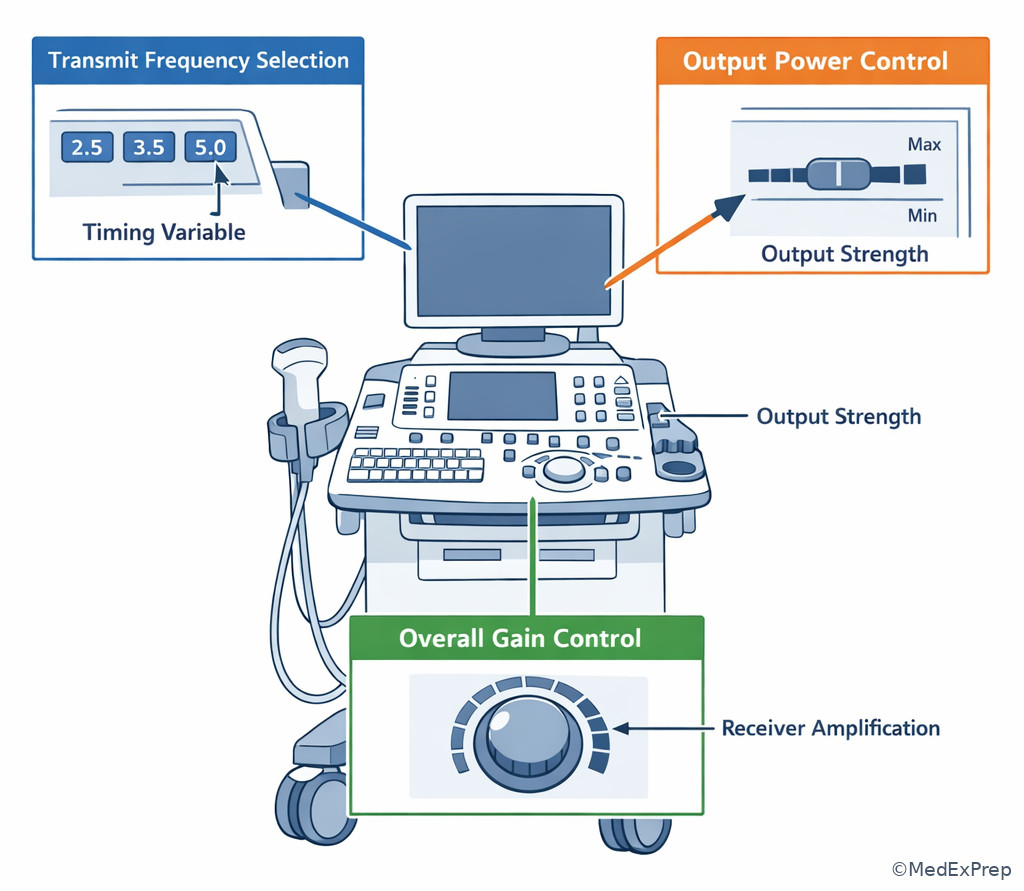
Exam takeaway: Probe frequency choices on the console represent emitted timing differences before they become penetration-resolution tradeoffs in later lessons.
Exam takeaway: A visual unit ladder helps prevent scale errors when moving between MHz and microseconds.
Exam takeaway: Control labels may sit near each other on a console, but they affect different physical concepts and should not be conflated.
B Worked example
A 42-year-old patient with obesity and prior abdominal surgery is being imaged in an outpatient lab. The learner switches from a 3 MHz preset to a 6 MHz preset to compare technical effects. The stem asks which statement is most appropriate before considering penetration or attenuation. A tempting wrong clue mentions that lower depth settings improved frame rate, which is unrelated to the direct question.
Reasoning chain: Identify task: isolate the immediate physical relationship tied to frequency itself. Extract key facts: frequency doubled from 3 to 6 MHz. Apply rule: period must decrease by half. Eliminate distractors: any statement about gain or output power is outside the tested relationship; any detailed discussion of attenuation or diagnosis goes beyond the immediate question. Verify: doubling cycles per second means each cycle takes half as long.
C Exam trap
D Checkpoint
Question: A sonographer selects a higher-frequency transducer, moving from 4 MHz to 8 MHz, and the stem asks for the most immediate correct statement. Which answer is best?
- A. The period doubles - Tempting because the transducer change sounds larger, but wrong because period moves inversely.
- B. The period is halved - Tempting because it reflects the reciprocal rule, and it is correct for a doubling in frequency.
- C. The wave amplitude must double - Tempting if frequency is confused with wave strength, but amplitude is a separate parameter.
- D. The propagation speed in soft tissue must double - Tempting because multiple wave properties are being learned together, but speed is medium-dependent, not frequency-determined.
Exam Traps & Differentiators
Most common wrong answer and why: Copying the number from the stem into the answer choice without taking a reciprocal. This happens because learners memorize terminology but do not pause to ask whether the variable is a time or a rate.
| Looks similar | But actually means | Why it tempts learners | Single clue that separates it |
|---|---|---|---|
| Frequency | Cycles per second | It sounds like any repeated pattern | Needs a time basis |
| Period | Time for one cycle | It is also about repetition | Single-cycle time, not rate |
| Cycle | One full repetition | Used in the same diagrams as frequency | Simple count, no per-second unit |
| Amplitude | Maximum variation from baseline | May be listed in the same answer set | Describes strength, not timing |
| Power | Energy transfer rate | Includes the word rate | Not reciprocal with period |
| If the stem says... | Think... |
|---|---|
| Time required for one repetition | Period |
| Number of repetitions each second | Frequency |
| One complete oscillation | Cycle |
| Higher frequency selected | Shorter period |
| Question includes gain or power but asks for frequency-period relation | Likely distractor |
| Answer choice in ms for a MHz probe | Check magnitude error immediately |
Related cross-topic confusion: In the upcoming topic on Amplitude, Power, and Intensity, a common trap is thinking “larger number” always means “higher frequency.” It does not. Frequency belongs to timing; amplitude, power, and intensity belong to output magnitude. In the upcoming topic on Wavelength and Propagation Speed, another trap is assuming frequency changes propagation speed. It does not in routine soft tissue assumptions; instead, frequency changes wavelength.
Tables
| Reference value | Equivalent statement | Use on test day |
|---|---|---|
| 1 MHz | \(1 \times 10^6\) Hz | Base unit conversion |
| 1 µs | \(1 \times 10^{-6}\) s | Common period unit |
| 2 MHz | 0.5 µs period | Fast reciprocal pair |
| 4 MHz | 0.25 µs period | Fast reciprocal pair |
| 5 MHz | 0.2 µs period | Common abdomen example |
| 10 MHz | 0.1 µs period | Common superficial example |
| Parameter | What changes if it increases | What does not automatically change |
|---|---|---|
| Frequency | Cycles per second increase; period decreases | Gain, power, medium propagation speed |
| Period | Time per cycle increases; frequency decreases | Amplitude, gain, power |
| Cycle count in a pulse | Pulse composition changes | Frequency unless time basis also changes |
| Gain | Display amplification changes | Frequency and period |
| Power | Energy transfer rate may change | The reciprocal relation between frequency and period |
| Differential problem type | Clue in stem | Correct move | Wrong move to avoid |
|---|---|---|---|
| Frequency from period | Time for one cycle given | Take reciprocal | Copy the number into MHz |
| Period from frequency | Cycles per second given | Take reciprocal | Assume same numeric value |
| Cycle count question | Pulse contains x repetitions | Count cycles | Report MHz without time basis |
| Unit trap | MHz, kHz, µs, or ms in options | Check powers of ten | Trust the first reciprocal-looking choice |
| Noise-heavy scenario | Gain/power/depth mentioned but question asks about timing | Ignore irrelevant variables | Use every detail provided |
Algorithm / Approach
Exam takeaway: A clean decision tree prevents the most common SPI errors: wrong direction of reciprocal and wrong unit scale.
flowchart TD
A[Question on wave timing] --> B{Given period or frequency?}
B -->|Period| C[Take reciprocal to get frequency]
B -->|Frequency| D[Take reciprocal to get period]
C --> E[Convert to Hz/kHz/MHz]
D --> F[Convert to s/ms/us]
E --> G[Reality check]
F --> G
G --> H[Finalize answer] Rapid Review
- Frequency → cycles per second, not wave strength
- Period → time for one cycle, not time for one pulse unless only one cycle exists
- Cycle → one complete oscillation, simple count only
- Higher frequency → shorter period
- Longer period → lower frequency
- MHz answer choice → usually pairs with microsecond thinking for period checks
- Power listed in the stem → usually irrelevant to a frequency-period calculation
- Gain listed in the stem → display amplification, not emitted timing
- Same number in different units → common distractor, not a shortcut
- Diagnostic frequencies → typically MHz, so Hz-only answers are often scale traps
- Frequency source → set by the transmitter/transducer system
- Propagation speed → medium-dependent, not frequency-determined in routine SPI assumptions
- Cycle count in pulse → does not equal frequency without time basis
- Reciprocal question under noise → strip to the tested pair first
Self-check quiz
1. A transducer emits sound at 5 MHz during a routine abdominal study on a 58-year-old patient with obesity and hypertension. The sonographer also adjusts gain for brightness, but the question asks for the most appropriate period. Which answer is best?
- A. 5 µs
- B. 0.2 µs
- C. 2 µs
- D. 0.02 µs
2. A physics worksheet describes a wave with a period of 0.25 µs during a lab session involving a patient with diabetes and chronic kidney disease. One answer choice mentions power output, but the item asks for the most appropriate frequency. Which answer is best?
- A. 0.25 MHz
- B. 2 MHz
- C. 4 MHz
- D. 25 MHz
3. A 63-year-old inpatient with COPD and atrial fibrillation is scanned with a phased-array probe. The sonographer switches from a 2 MHz setting to a 4 MHz setting while depth, gain, and power remain unchanged. Which change is the most appropriate immediate consequence?
- A. Period doubles
- B. Period is halved
- C. Propagation speed doubles
- D. Cycle count per pulse must double
4. During SPI review, a student reads that a pulse contains 3 cycles and is transmitted at 3 MHz while scanning a 47-year-old patient with ascites and prior abdominal surgery. The stem asks which statement requires immediate clarification because it misuses terminology. Which answer is best?
- A. The pulse contains 3 cycles
- B. The transmit frequency is 3 million cycles per second
- C. The pulse frequency is 3 cycles
- D. The period is determined from the reciprocal of frequency
5. A 35-year-old outpatient with obesity and fatty liver is scanned using a 4 MHz setting. The supervising sonographer increases overall gain and lowers the output power because image brightness was excessive. A practice item asks for the most appropriate period. Which answer is best?
- A. 4 µs
- B. 0.4 µs
- C. 0.25 µs
- D. 2.5 µs
6. A 71-year-old patient with CHF and chronic renal disease is scanned in a teaching lab. A worksheet states that the period is 0.1 µs, the pulse contains 4 cycles, and the output power was increased for penetration. Which is the most appropriate frequency?
- A. 1 MHz
- B. 4 MHz
- C. 10 MHz
- D. 40 MHz
7. A sonographer compares two transducer presets while imaging a 29-year-old patient with a technically limited body habitus and recent postoperative abdominal tenderness. Preset A is 3 MHz and preset B is 6 MHz. The stem asks which statement is most appropriate before considering attenuation, penetration, or resolution. Which answer is best?
- A. Preset B has twice the period of preset A
- B. Preset B has half the period of preset A
- C. Preset B must have twice the propagation speed of preset A
- D. Preset B must have twice the amplitude of preset A
8. During a QA teaching session, an instructor describes a waveform with a period of 0.5 µs and a pulse containing 2 cycles while scanning a 66-year-old patient with COPD, diabetes, and a distracting note that the wall filter is elevated. Which statement is the most appropriate synthesis?
- A. The frequency is 2 MHz, and the cycle count in the pulse is a separate quantity
- B. The frequency is 0.5 MHz, and the pulse therefore contains 0.5 cycles
- C. The period is 2 MHz, and the pulse count determines propagation speed
- D. The wall filter setting changes the reciprocal relation between frequency and period
Answer key
1.1.1.8 1. Answer: B. 0.2 µs
A. 5 µs - Tempting because it repeats the 5 from 5 MHz and keeps the units in the time family. Incorrect for this scenario because period must be the reciprocal of frequency, not the same numeric value. The single stem clue is 5 MHz, which corresponds to 0.2 µs, not 5 µs. Source support: Edelman explains the reciprocal relation \(T = 1/f\) and standard unit use in ultrasound physics.
B. 0.2 µs - Tempting because it may seem too small, but it is correct because \(1 / 5\ \text{MHz} = 0.2\ \mu s\). The single stem clue is that the question asks for period, not gain, so the gain adjustment is noise. Source support: Edelman; Kremkau.
C. 2 µs - Tempting because it looks reciprocal-like and remains in microseconds. Incorrect because 2 µs would correspond to 0.5 MHz, not 5 MHz. The discriminating clue is the high diagnostic frequency of 5 MHz. Source support: Edelman.
D. 0.02 µs - Tempting because it recognizes an inverse relation, but it is off by a factor of 10. The discriminating clue is the exact reciprocal of 5. Source support: Kremkau.
1.1.1.9 2. Answer: C. 4 MHz
A. 0.25 MHz - Tempting because it copies the given number into frequency units. Incorrect because period requires a reciprocal, not relabeling. The single clue is that the stem gives a period of 0.25 µs. Source support: Edelman.
B. 2 MHz - Tempting because reciprocal calculations are often rounded mentally. Incorrect because \(1 / 0.25 = 4\), not 2. The discriminating clue is the exact period value. Source support: Kremkau.
C. 4 MHz - Tempting because it follows the reciprocal rule, and it is correct because \(f = 1/T = 4\ \text{MHz}\). The single stem clue is the given 0.25 µs period. Source support: Edelman; ARDMS content outline themes on physics calculations.
D. 25 MHz - Tempting because 0.25 may trigger a misplaced decimal inversion. Incorrect because it introduces a power-of-ten error. The discriminating clue is that 0.25 µs corresponds specifically to 4 MHz. Source support: Edelman.
1.1.1.10 3. Answer: B. Period is halved
A. Period doubles - Tempting because both variables may seem to rise together when a setting increases. Incorrect because frequency and period are inverse. The single clue is the change from 2 MHz to 4 MHz. Source support: Edelman.
B. Period is halved - Tempting because it requires trust in the inverse relation, and it is correct because doubling frequency halves period. The discriminating clue is the exact doubling of frequency. Source support: Kremkau.
C. Propagation speed doubles - Tempting because multiple wave properties are learned together. Incorrect because propagation speed depends on medium properties, not source frequency in routine soft tissue assumptions. The key clue is that only the frequency setting changed. Source support: Kremkau; AIUM educational physics standards.
D. Cycle count per pulse must double - Tempting because more cycles per second sounds like more cycles everywhere. Incorrect because pulse cycle count is a separate variable unless pulse composition is specified. The clue is that the stem did not say pulse cycles changed. Source support: Edelman.
1.1.1.11 4. Answer: C. The pulse frequency is 3 cycles
A. The pulse contains 3 cycles - Tempting because it sounds basic, and it is correct because the stem directly states the pulse contains 3 cycles. The clue is the explicit cycle count. Source support: Edelman.
B. The transmit frequency is 3 million cycles per second - Tempting because it restates the MHz value in full words, and it is correct because 3 MHz means 3 million cycles per second. The clue is the 3 MHz transmit frequency. Source support: Kremkau.
C. The pulse frequency is 3 cycles - Tempting because cycles and frequency both involve repetition. Incorrect because cycles are a count, whereas frequency is a rate per second. The single discriminating clue is the lack of a time denominator. Source support: Edelman.
D. The period is determined from the reciprocal of frequency - Tempting because it states a formula relationship, and it is correct for this topic. The clue is the reciprocal rule. Source support: Edelman; Kremkau.
1.1.1.12 5. Answer: C. 0.25 µs
A. 4 µs - Tempting because it mirrors the 4 MHz frequency value. Incorrect because period is the reciprocal, not the same number. The clue is that the stem asks for period from 4 MHz. Source support: Edelman.
B. 0.4 µs - Tempting because it looks reasonably small for ultrasound timing. Incorrect because 0.4 µs corresponds to 2.5 MHz, not 4 MHz. The discriminating clue is the exact frequency given. Source support: Kremkau.
C. 0.25 µs - Tempting because it is the correct reciprocal and is right here: \(1/4\ \text{MHz} = 0.25\ \mu s\). The clue is the unchanged 4 MHz setting; gain and power are distractors. Source support: Edelman.
D. 2.5 µs - Tempting because 2.5 is mathematically familiar from 4, but it is in the wrong direction and wrong scale. The clue is the MHz-µs reciprocal pair. Source support: Edelman.
1.1.1.13 6. Answer: C. 10 MHz
A. 1 MHz - Tempting because the period 0.1 may be misread as “one tenth of a megahertz.” Incorrect because 0.1 µs corresponds to 10 MHz. The discriminating clue is the decimal reciprocal. Source support: Edelman.
B. 4 MHz - Tempting because the pulse contains 4 cycles, and learners may substitute that count for frequency. Incorrect because cycle count is separate from frequency. The clue is that 4 refers to pulse composition, not cycles per second. Source support: Kremkau.
C. 10 MHz - Tempting because it requires ignoring the distracting power increase and pulse-cycle count; it is correct because \(1 / 0.1\ \mu s = 10\ \text{MHz}\). The single stem clue is the given period. Source support: Edelman; ARDMS-style physics emphasis.
D. 40 MHz - Tempting because it multiplies the 10 MHz reciprocal by the 4 cycles in the pulse. Incorrect because cycle count does not multiply frequency unless another time relation is specified. The clue is that pulse cycles are a different quantity. Source support: Edelman.
1.1.1.14 7. Answer: B. Preset B has half the period of preset A
A. Preset B has twice the period of preset A - Tempting because learners may think all settings increase together. Incorrect because a 6 MHz wave has a shorter period than a 3 MHz wave. The clue is the direct frequency doubling. Source support: Edelman.
B. Preset B has half the period of preset A - Tempting because it uses the clean inverse rule, and it is correct because doubling frequency halves period. The single stem clue is “before considering attenuation, penetration, or resolution,” which tells you to answer the immediate reciprocal relation only. Source support: Kremkau.
C. Preset B must have twice the propagation speed of preset A - Tempting because learners expect frequency and speed to scale together. Incorrect because propagation speed is medium-dependent. The key clue is that only transducer preset frequency changed. Source support: Kremkau.
D. Preset B must have twice the amplitude of preset A - Tempting because higher-frequency probes are often associated mentally with “more.” Incorrect because amplitude is not determined by frequency alone. The clue is that amplitude belongs to a different variable family. Source support: Edelman.
1.1.1.15 8. Answer: A. The frequency is 2 MHz, and the cycle count in the pulse is a separate quantity
A. The frequency is 2 MHz, and the cycle count in the pulse is a separate quantity - Tempting because it combines two ideas, and it is correct because \(1 / 0.5\ \mu s = 2\ \text{MHz}\), while the 2-cycle pulse count remains a separate descriptor. The single stem clue is the presence of both a period and a pulse cycle count. Source support: Edelman; Kremkau.
B. The frequency is 0.5 MHz, and the pulse therefore contains 0.5 cycles - Tempting because it copies the period value into frequency units and then forces the cycle count to match. Incorrect because both moves misuse the variables. The key clue is that 0.5 µs is a time, not a frequency. Source support: Edelman.
C. The period is 2 MHz, and the pulse count determines propagation speed - Tempting because it uses familiar wave terms. Incorrect because the units are mismatched and propagation speed is not set by pulse cycle count. The clue is that period must be in time units. Source support: Kremkau.
D. The wall filter setting changes the reciprocal relation between frequency and period - Tempting because wall filter is a real sonographic control and may sound technical. Incorrect because wall filter affects Doppler display of low-frequency shifts, not the basic emitted frequency-period reciprocal. The discriminating clue is that wall filter is unrelated noise in this item. Source support: AIUM educational resources; Edelman.
Keep going with the full ARDMS SPI Prep Course (SPI)
You just studied the way members do, in the same lesson interface. Full access unlocks every lesson, the question bank and flashcards for a full year.
One payment · 1 year of access · No auto-renewal