1.1.1 - Acoustic Parameters And Units
Acoustic Parameters And Units
What you’ll learn
- DOMAIN: Physics, Doppler Principles, and Hemodynamics - Subskill: Identify the major acoustic parameters of a sound wave and their correct units.
- DOMAIN: Instrumentation, Optimization, Artifacts, and Quality - Subskill: Predict which parameters are set by the transducer versus the operator versus the propagation medium.
- DOMAIN: Physics, Doppler Principles, and Hemodynamics - Subskill: Choose the correct relationship among amplitude, power, and intensity when interpreting exam stems.
- DOMAIN: Instrumentation, Optimization, Artifacts, and Quality - Subskill: Link parameter changes to practical sonography consequences such as output strength, penetration, and safety.
- DOMAIN: Integrated Case-Based Reasoning - Subskill: Eliminate tempting but wrong answers involving unit confusion, proportional thinking, and source-of-control errors.
- DOMAIN: Physics, Doppler Principles, and Hemodynamics → Acoustic wave descriptors and relationships
- DOMAIN: Instrumentation, Optimization, Artifacts, and Quality → Output concepts and parameter control
- DOMAIN: Integrated Case-Based Reasoning → Unit-based distractor elimination and applied reasoning
Why it matters
- Acoustic parameters are the language behind SPI-style physics items and explain why one answer choice changes output while another changes propagation.
- RVT exam stems often hide the real task inside unit confusion: amplitude versus intensity, watts versus decibels, or pulse descriptors versus beam descriptors.
- Vascular technologists do not prescribe treatment, but they must understand how system output and wave behavior affect exam quality, ALARA practice, and technical interpretation.
- These parameters are the foundation for the next topics on wavelength, propagation speed, and attenuation; if this section is weak, later Doppler and image optimization logic becomes harder.
Key Terms & Must-Know Facts
1.1.1.1 Key terms
- Acoustic variable: quantity that changes as sound propagates
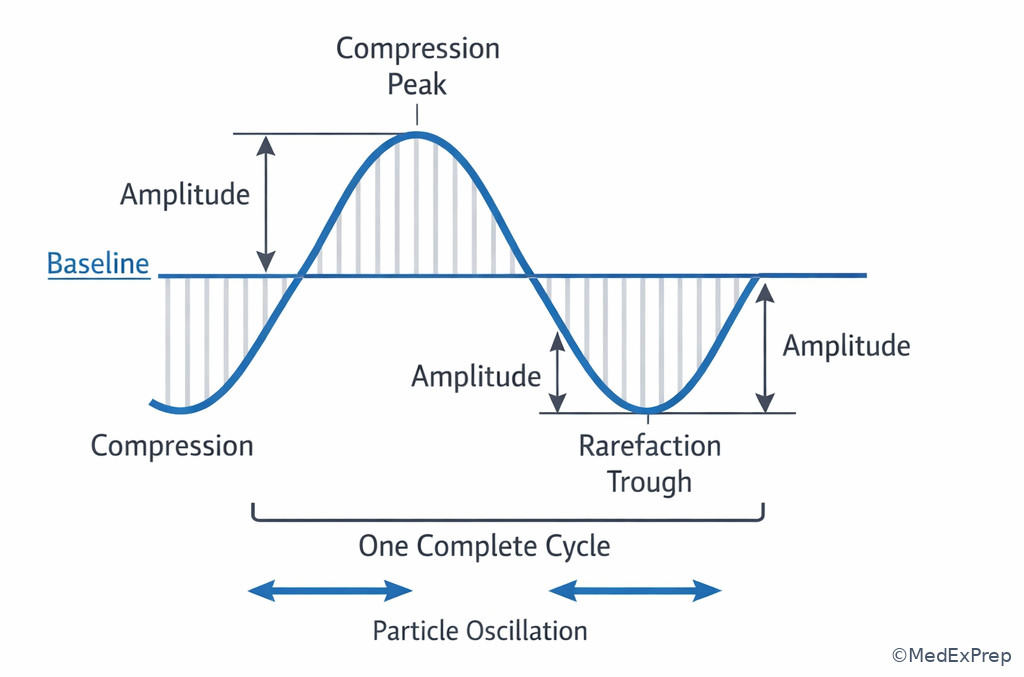
- Amplitude: maximum change in an acoustic variable from baseline
- Pressure: compression/rarefaction force per unit area
- Density: concentration of particles in a medium
- Particle motion: back-and-forth vibration of particles around equilibrium
- Power: rate of energy transfer
- Intensity: power per unit area
- Decibel: logarithmic unit comparing ratios
- Frequency: number of cycles per second
- Period: time for one cycle
- Wavelength: spatial length of one cycle
- Propagation speed: distance sound travels per unit time
- Rarefaction: low-pressure phase
- Compression: high-pressure phase
1.1.1.2 Must-know facts
- Amplitude can describe pressure, density, particle motion, power, or intensity.
- Frequency is measured in hertz; medical ultrasound uses megahertz.
- Period and frequency are reciprocals: \( T = \frac{1}{f} \).
- Power is measured in watts; intensity is measured in watts per square centimeter.
- Intensity depends on both power and beam area: \( I = \frac{P}{A} \).
- Power and intensity rise when amplitude rises.
- The source determines frequency; the medium determines propagation speed.
- Wavelength depends on both speed and frequency: \( \lambda = \frac{c}{f} \).
- Decibels compare ratios; they are not a direct unit of power or intensity.
- On exams, “largest amplitude” means “strongest wave,” not “highest frequency.”
| Parameter | Meaning | Typical unit | High-yield exam note |
|---|---|---|---|
| Amplitude | Maximum change from baseline | Depends on variable | Not a single universal unit |
| Frequency | Cycles per second | Hz, MHz | Set by source/transducer |
| Period | Time for one cycle | seconds, microseconds | Inverse of frequency |
| Power | Rate of energy transfer | watts | Related to amplitude squared |
| Intensity | Power per area | W/cm² | Affected by beam size |
| Propagation speed | Travel rate through medium | m/s or mm/µs | Depends on medium, not source frequency alone |
| Wavelength | Distance of one cycle | mm | Shortens as frequency rises |
| Decibel | Ratio unit | dB | Comparison, not absolute output |
Exam takeaway: Separate source-controlled, medium-controlled, and beam-area-dependent quantities before choosing an answer.
flowchart TD
A[Acoustic quantity in stem] --> B{What is being described?}
B -->|Cycles per second| C[Frequency]
B -->|Time for one cycle| D[Period]
B -->|Rate of energy transfer| E[Power]
B -->|Power spread over area| F[Intensity]
B -->|Distance of one cycle| G[Wavelength]
C --> H[Controlled by source]
D --> I[Inverse of frequency]
E --> J[Measured in watts]
F --> K[Measured in W per cm squared]
G --> L[Depends on speed and frequency]
Use this map to sort the question before doing any calculation. See Fig 1.
Exam takeaway: Pressure amplitude is read as the maximum excursion above or below baseline, not the distance between adjacent peaks.
Core content
1.1.1.3 Foundational acoustic variables: what is actually changing?
A Explanation
In ultrasound physics, the first exam decision conflict is usually this: Is the stem asking about the wave itself, or about the energy carried by the wave? The single rule that resolves it is to identify the acoustic variable. Sound is a mechanical longitudinal wave that travels through matter by alternating compressions and rarefactions. The variables that can oscillate include pressure, density, and particle motion. Amplitude is not its own physical substance; it is the maximum change in whichever acoustic variable you are discussing.
WHY THIS IS TESTED: Exam writers know candidates often memorize “amplitude means height of wave” without asking height of what? That leads to errors when a question switches from pressure amplitude to power amplitude or intensity amplitude.
Choose pressure when the stem describes force per area or compression/rarefaction. Reject pressure if the stem is clearly asking about energy transfer per time; that is power. Choose density when the focus is on particle crowding in the medium. Choose particle motion when the stem asks how far particles move back and forth around resting position. On exam day, the safest move is to translate vague wording into a precise category before looking at units.
Another common conflict is peak-to-peak distance versus amplitude. The single finding that resolves it: amplitude is measured from baseline to peak, not peak to trough and not peak to next peak. Peak-to-peak distance in space is related to wavelength; peak-to-peak height is not a standard physics shortcut for amplitude in these questions.
Key rule: “Amplitude” only becomes meaningful when tied to a specific variable: pressure amplitude, density amplitude, particle motion amplitude, power amplitude, or intensity amplitude.
Memory anchor: “PDPPI” = Pressure, Density, Particle motion, Power, Intensity. These are the common acoustic variables/amplitude pairings tested early in physics.
Recall: This is the first topic in the course, so build a base here: later lessons on propagation speed, wavelength, and attenuation will assume you can already sort “what is oscillating” from “what is being transmitted.”
B Worked example
A vascular sonography trainee is reviewing an SPI-style practice item during a carotid lab downtime session. The question stem says: “A transducer emits a wave with greater amplitude than before. Which quantity most directly describes the rate at which acoustic energy is transferred?” The trainee is distracted by a note on the side of the worksheet about a 7.5 MHz probe and by a handwritten comment saying “higher waves = longer wavelength.”
Identify task: The item asks for the quantity describing rate of energy transfer.
Extract key facts: “Rate” and “energy transfer” point to power. The mention of 7.5 MHz is noise because frequency is not the asked quantity. The “longer wavelength” note is a tempting but unrelated clue.
Apply rule: Power is the rate of energy transfer, measured in watts. Amplitude increase may raise power, but the requested term is still power, not frequency or wavelength.
Eliminate distractors: Pressure is tempting because amplitude is often shown as wave height. Intensity is tempting because it also involves energy, but intensity includes beam area; the question did not mention area. Frequency is wrong because it counts cycles, not transferred energy.
Verify: If the stem had asked “power per unit area,” intensity would win. Because it asked only “rate of energy transfer,” power is correct.
C Exam trap
Common wrong answer: Intensity.
Why it is tempting: Candidates remember that stronger sound raises intensity and assume any energy-related question must be intensity.
Single clue that eliminates it: The stem does not mention area. Without area, choose power rather than intensity.
D Checkpoint
Question: In an ultrasound physics item, which quantity is best defined as power distributed over beam area?
- A. Intensity
- B. Pressure amplitude
- C. Frequency
- D. Period
- A. Intensity: Tempting because many candidates mix it with power, but it is right because intensity specifically equals power per unit area.
- B. Pressure amplitude: Tempting because amplitude sounds like “strength,” but it is wrong because it describes pressure excursion, not energy rate per area.
- C. Frequency: Tempting because it is a core wave descriptor, but it is wrong because it counts cycles per second rather than beam power density.
- D. Period: Tempting because it is paired with frequency, but it is wrong because it measures the duration of one cycle.
Practitioner Action: ASSESS the wording of the physics concept precisely; INTERVENE by matching the acoustic quantity to its correct unit and operational meaning; REFER questions about machine output policy or lab safety thresholds to supervising faculty/medical physics guidance; DOCUMENT your interpretation logic during study review so repeated unit errors are visible and correctable.
1.1.1.4 Units and reciprocal relationships: how exam stems force precision
A Explanation
The next decision conflict is which unit belongs to which parameter. This is one of the highest-yield test zones because exam writers can create four plausible options that all sound technical. The single resolving rule is: identify whether the parameter is about time, cycles, energy, area-normalized energy, or a ratio.
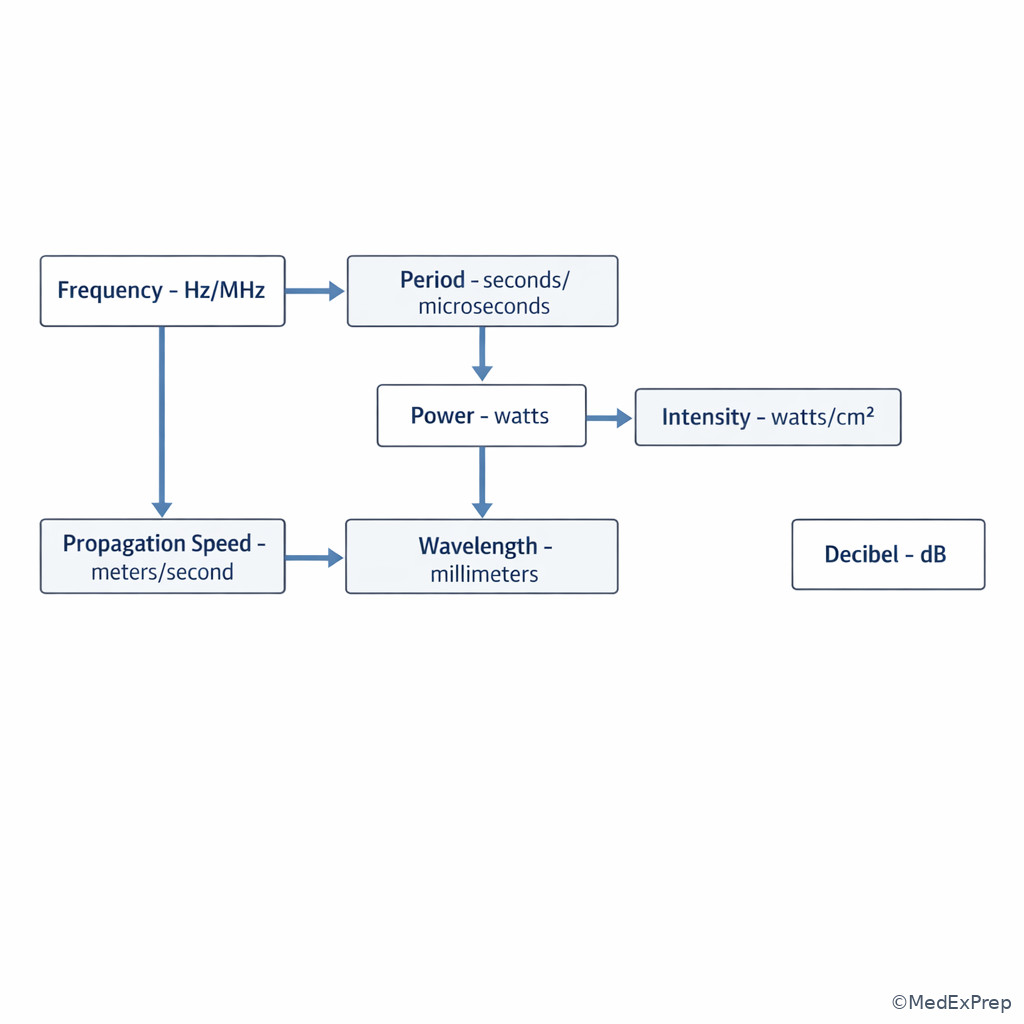
Frequency is cycles per second, so the unit is hertz. In medical ultrasound, megahertz is common. Period is time for one cycle, so it is measured in seconds or microseconds. These two are reciprocals: \( f = \frac{1}{T} \) and \( T = \frac{1}{f} \). When frequency rises, period falls. This is a favorite “opposite direction” exam pair.
Power uses watts. Intensity uses watts per square centimeter. Wavelength uses distance units such as millimeters. Propagation speed uses distance per time, often meters per second or millimeters per microsecond. Decibel is different: it is a logarithmic comparison unit for ratios, not an absolute label for frequency, power, or intensity by itself.
WHY THIS IS TESTED: The testable pattern is not arithmetic difficulty; it is whether you can reject a close distractor that belongs to the right family but wrong level of description. “Watts” and “watts/cm²” are both energy-related. “Hz” and “s” are both timing-related. The winning move is exact matching, not vague familiarity.
Choose decibel only when the stem discusses a ratio or relative change, such as gain comparisons or attenuation expressions. Reject decibel when asked for direct output strength. Choose watts for total power, but reject it if the stem clearly normalizes to beam cross-sectional area.
| Asked in stem | Correct parameter | Correct unit | Tempting wrong unit |
|---|---|---|---|
| Cycles per second | Frequency | Hz | seconds |
| Time for one cycle | Period | s | Hz |
| Rate of energy transfer | Power | W | dB |
| Power spread over area | Intensity | W/cm² | W |
| Length of one cycle | Wavelength | mm | MHz |
| Relative change | Ratio comparison | dB | W/cm² |
Exam takeaway: When two answer choices sound related, the unit usually reveals the intended parameter.
flowchart LR
A[Stem wording] --> B{Time or energy?}
B -->|Time| C{Cycle count or cycle duration?}
C -->|Count per second| D[Frequency: Hz]
C -->|Duration of one cycle| E[Period: s]
B -->|Energy| F{Area included?}
F -->|No| G[Power: W]
F -->|Yes| H[Intensity: W per cm squared]
A --> I{Ratio mentioned?}
I -->|Yes| J[Decibel: dB]
In rapid exam review, a ladder like this is faster than memorizing separate lists. See Fig 2.
Exam takeaway: Pairing each parameter with its unit reduces careless misses more than memorizing definitions alone.
B Worked example
A 28-year-old sonography student with asthma and migraine history is taking a timed quiz before a vascular lab rotation. One item asks: “The reciprocal of pulse frequency in this simplified wave question is best expressed in which unit?” A sticky note nearby says “MHz probe for carotids,” and the student is tempted by hertz because the stem mentions frequency. Another distracting note says “gain measured in dB.”
Identify task: The task is not to name frequency; it is to identify the reciprocal of frequency.
Extract key facts: Reciprocal of frequency equals period. Period measures one cycle in time.
Apply rule: Period is expressed in seconds, often microseconds in ultrasound.
Eliminate distractors: Hertz is tempting because it is frequency’s native unit, but reciprocal means the opposite quantity. Decibel is tempting because it is another common ultrasound unit, but it applies to ratios, not cycle time. Millimeters would fit wavelength, not period.
Verify: If the question had asked for cycles per second, Hz would be correct. Because it asks for the reciprocal, seconds is the best unit.
C Exam trap
Common wrong answer: Hertz.
Why it is tempting: Candidates see “frequency” and stop reading before processing the word “reciprocal.”
Single clue that eliminates it: Reciprocal means the answer must flip from cycles-per-time to time-per-cycle.
D Checkpoint
Question: Which unit most appropriately corresponds to total acoustic power output?
- A. W/cm²
- B. W
- C. dB
- D. Hz
- A. W/cm²: Tempting because it reflects beam strength, but it is wrong because it represents intensity, not total power.
- B. W: Tempting because it seems too simple, but it is right because power is the rate of energy transfer measured in watts.
- C. dB: Tempting because output changes are often described logarithmically, but it is wrong because dB is a comparison unit.
- D. Hz: Tempting because frequency is central in ultrasound, but it is wrong because Hz measures cycles per second rather than energy rate.
- The reciprocal of frequency is period.
- True or False: decibel is an absolute unit of acoustic output. False.
- Power is measured in watts; intensity is measured in watts per unit area.
Practitioner Action: ASSESS unit-language carefully in physics questions and machine documentation; INTERVENE by translating every unit back to its physical meaning before selecting an answer or describing system output; REFER equipment-specific output specification questions to the manufacturer manual or supervising physicist/educator; DOCUMENT recurring unit confusions in your study log, especially watts versus watts per area and Hz versus seconds.
1.1.1.5 Relationships among amplitude, power, and intensity: choose the right “strength” concept
A Explanation
This section addresses a classic exam conflict: When the sound becomes “stronger,” which parameter should increase? The single resolving rule is to ask whether the stem means pressure excursion, total transmitted energy rate, or energy concentration within beam area.
Amplitude is the maximum deviation of an acoustic variable from baseline. As amplitude increases, both power and intensity increase. The relationship is not merely linear recall; conceptually, larger wave excursions carry more energy. In many SPI physics frameworks, power and intensity are proportional to amplitude squared. You do not always need the equation; you do need the directional rule: higher amplitude means higher power and higher intensity, assuming other relevant factors are unchanged.
The choose-versus-reject framing matters here. Choose power if the machine emits more total acoustic energy per unit time. Reject power if the stem explicitly narrows the beam and asks about energy concentration across area; then choose intensity. Choose amplitude when discussing the size of the oscillation itself. Reject amplitude if the question asks for a derived consequence such as output energy rate.
WHY THIS IS TESTED: Candidates often memorize one relationship and overapply it. For example, they may say “higher amplitude means higher frequency” because both seem like “bigger sound.” That is false. Frequency is source-determined and independent of amplitude in standard exam framing.
There is another subtle test point: intensity can rise either because power rises or because area shrinks. That is why “stronger beam” can be interpreted differently depending on whether the stem focuses on output or concentration. If beam area changes but power does not, intensity still changes. This distinction becomes more important later in focusing and beam geometry topics.
Key rule: Bigger amplitude does not automatically mean higher frequency. It means greater excursion and, under otherwise similar conditions, greater power and intensity.
Exam takeaway: Stronger waves raise power and intensity, but frequency changes only if the source changes.
flowchart TD
A[Amplitude increases] --> B[Wave excursion increases]
B --> C[Power increases]
C --> D{Beam area same?}
D -->|Yes| E[Intensity increases]
D -->|No, area larger| F[Intensity may rise less or remain similar]
D -->|No, area smaller| G[Intensity rises more]
A --> H[Frequency unchanged unless source changes]
See Fig 3 whenever a question uses the vague word “stronger.”
Exam takeaway: A narrower beam can increase intensity even when total power is unchanged.
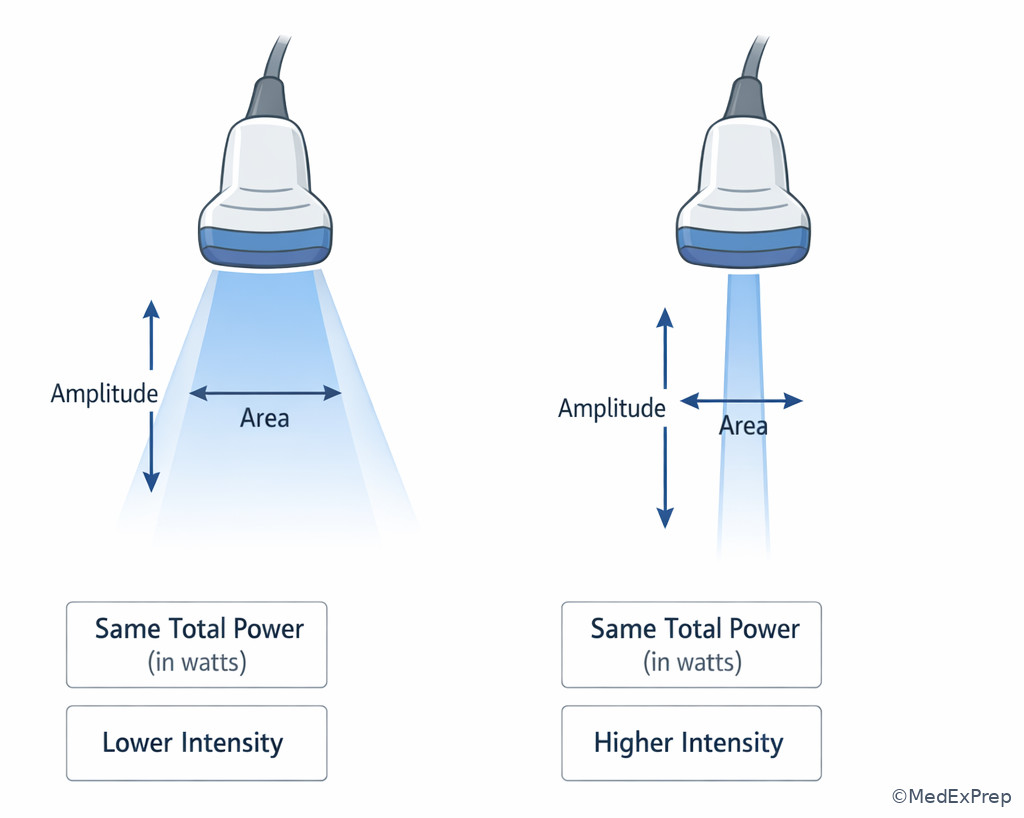
High-Yield Connection: This concept is tested alongside Beam Shape And Focusing. Know both the physics relation between amplitude, power, and intensity and the later beam-area effect on intensity, because exam stems frequently pair output language with focusing language.
B Worked example
A 67-year-old patient with hypertension, diabetes, and prior femoral endarterectomy is undergoing lower extremity arterial duplex. During a teaching pause, a student is asked a physics question unrelated to the patient’s disease: “If acoustic amplitude doubles and beam area remains constant, which parameter must increase?” The student is distracted by a monophasic waveform on screen and by a comment from another learner that “higher frequency gives more power.”
Identify task: The question is about the consequence of increased amplitude with constant area.
Extract key facts: Amplitude increase raises output strength. Constant area means intensity tracks power changes without extra beam-area confounding. Frequency was not changed.
Apply rule: Power increases, and intensity increases as well. If a single best answer lists intensity under constant area conditions, it is acceptable; if both power and intensity appear, read the wording carefully for “per area.”
Eliminate distractors: Frequency is tempting because ultrasound users associate stronger signals with higher MHz probes, but that confuses penetration/resolution choice with output strength. Propagation speed is tempting because it sounds physical, but it depends on medium. Period is wrong because no frequency change occurred.
Verify: The trigger in the stem is amplitude, not source frequency or medium type. Therefore, reject any answer that changes frequency, period, or speed.
C Exam trap
Common wrong answer: Frequency.
Why it is tempting: In practice, sonographers talk about selecting a higher-frequency transducer for better detail, so candidates equate “better/stronger” with frequency.
Single clue that eliminates it: The stem changes amplitude only; source frequency is not altered.
D Checkpoint
Question: If acoustic power remains constant but the beam cross-sectional area decreases, which parameter most directly increases?
- A. Frequency
- B. Intensity
- C. Period
- D. Propagation speed
- A. Frequency: Tempting because beam changes are often discussed with probe choice, but it is wrong because area reduction does not itself change cycles per second.
- B. Intensity: Tempting because it sounds like a derived quantity, and it is right because the same power concentrated into less area produces greater intensity.
- C. Period: Tempting because it is linked to frequency, but it is wrong because no change in source frequency is described.
- D. Propagation speed: Tempting because it is a physical wave property, but it is wrong because speed depends on the medium, not beam area.
Practitioner Action: ASSESS whether a machine-related question is describing source output or beam concentration; INTERVENE by choosing language that stays within sonographer scope, such as optimizing acquisition and recognizing output concepts rather than prescribing treatment; REFER safety/output policy concerns to supervising personnel and established ALARA guidance; DOCUMENT the technical settings used when image quality or Doppler quality is affected by output-related adjustments.
1.1.1.6 Source-controlled versus medium-controlled parameters: who determines what?
A Explanation
One of the most reliable exam differentiators is identifying what is controlled by the source and what is controlled by the medium. The decision conflict is simple: when a parameter changes, should you blame the transducer or the tissue? The single rule that resolves it is to remember that frequency is set by the source, while propagation speed is set by the medium.
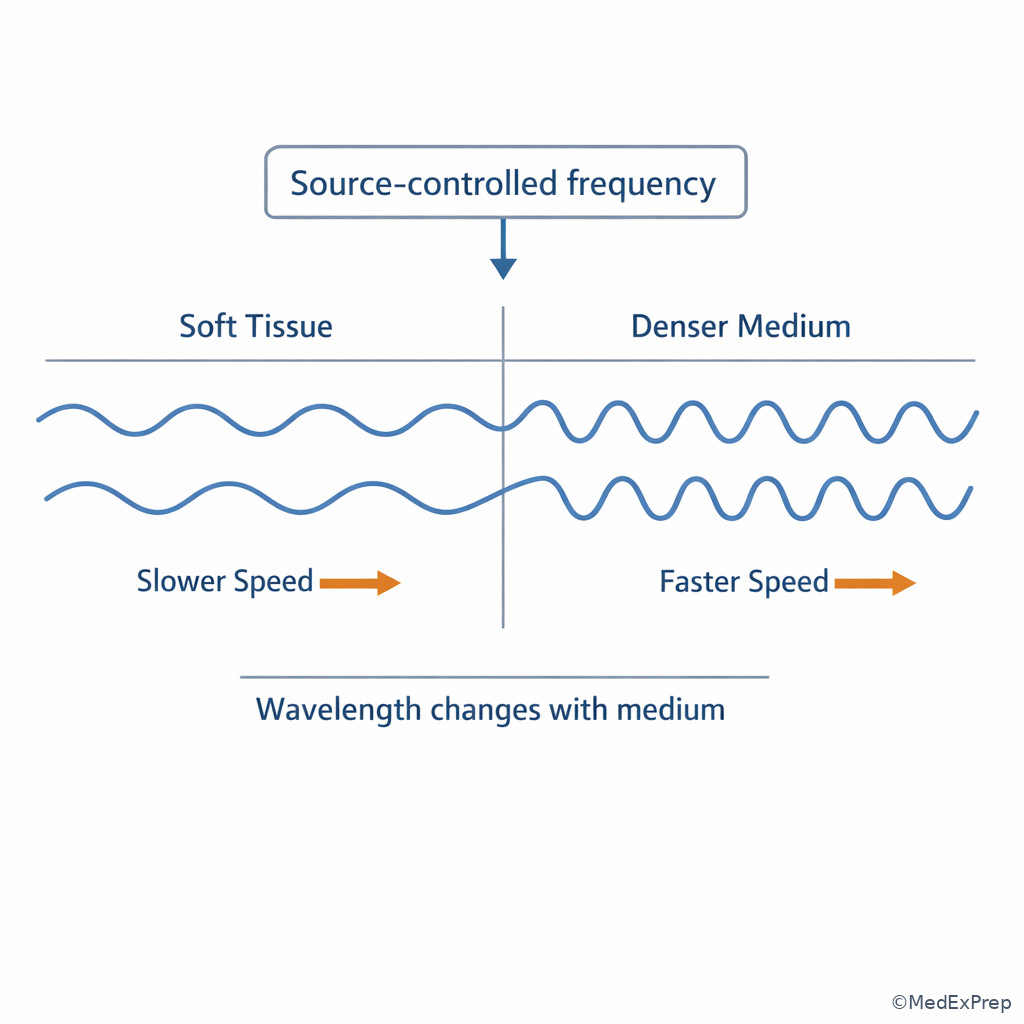
This distinction prevents many later mistakes. If the wave travels from soft tissue into a new medium, frequency remains the same across the boundary, but speed and wavelength may change. Because wavelength depends on both speed and frequency, wavelength changes when speed changes in a new medium. In contrast, when the sonographer selects a different transducer frequency, the source changes frequency and wavelength adjusts accordingly in a given medium.
WHY THIS IS TESTED: ARDMS-style physics items often present two true statements and ask for the one that best explains a behavior at a tissue boundary. Candidates who think “faster wave = higher frequency” will miss these items.
Choose source-controlled for frequency. Reject source-controlled explanations for propagation speed when the medium changes. Choose medium-controlled for speed. Reject medium-controlled explanations for frequency unless the question is actually about received Doppler shifts, which is a separate later concept. In foundational non-Doppler wave propagation, the emitted frequency does not change just because the medium changes.
This topic also connects directly to the next lesson. You do not need every detail yet, but you should be ready for the forward rule: higher frequency in a given medium means shorter wavelength; different medium means different speed, which also alters wavelength.
Recall: In 1.1.1.2, we separated units by meaning. Here, we build on that by assigning control: the source controls frequency, while the medium controls speed. The next topic on propagation speed and wavelength extends exactly this rule.
Exam takeaway: Frequency follows the source across boundaries, whereas speed and wavelength respond to the medium.
flowchart TD
A[Wave enters new medium] --> B[Frequency stays the same]
A --> C[Speed changes to match medium]
C --> D[Wavelength changes]
E[Source changes transducer frequency] --> F[Frequency changes]
F --> G[In same medium, wavelength changes]
B --> H[Do not blame medium for emitted frequency]
C --> I[Do not blame source for propagation speed]
This figure is a bridge to the next topic. See Fig 4.
Exam takeaway: At a boundary, the emitted frequency remains constant while speed and wavelength adapt to the new medium.
B Worked example
A student in an outpatient vascular lab is scanning a patient with obesity and chronic kidney disease using a lower-frequency probe for depth. During teaching, the instructor asks: “If an ultrasound wave enters a different tissue and its speed changes, which parameter remains unchanged?” A distracting clue on the machine display shows a frequency preset shift from 9 MHz to 5 MHz used earlier in the day, and the student starts to think wavelength must stay fixed.
Identify task: The question is about crossing into a different medium, not changing the probe preset.
Extract key facts: Medium change affects speed. The source still emits the same frequency unless the operator changes transducers or settings. The earlier preset shift is irrelevant noise.
Apply rule: Frequency remains unchanged at a medium boundary in basic propagation physics.
Eliminate distractors: Speed is wrong because the question explicitly says it changes. Wavelength is wrong because wavelength follows speed when frequency is held constant. Period is tied to frequency, so if period appears, it also remains unchanged; if only one option is allowed, read carefully whether the test expects the direct named parameter “frequency.”
Verify: The phrase “enters a different tissue” should trigger “medium-controlled speed,” not “source-controlled frequency.”
C Exam trap
Common wrong answer: Wavelength.
Why it is tempting: Candidates remember wavelength as a length property and assume the “shape” of the wave stays the same across tissues.
Single clue that eliminates it: Wavelength depends on speed; if speed changes and frequency stays fixed, wavelength must change too.
D Checkpoint
Question: In a physics stem, which parameter is primarily determined by the medium through which sound is traveling?
- A. Frequency
- B. Propagation speed
- C. Period
- D. Pulse repetition frequency
- A. Frequency: Tempting because candidates think tissue “changes the wave,” but it is wrong because emitted frequency is set by the source.
- B. Propagation speed: Tempting because it seems almost too direct, and it is right because sound speed is governed by medium properties.
- C. Period: Tempting because it is related to frequency, but it is wrong because it is source-linked through frequency, not medium-linked in this context.
- D. Pulse repetition frequency: Tempting because it includes the word frequency, but it is wrong because it is a system timing parameter rather than a property determined by tissue stiffness and density.
- True or False: entering a new medium changes emitted frequency. False.
- The parameter set by the source is frequency.
- Name the parameter that changes when medium changes: propagation speed.
High-Yield Connection: This concept is tested alongside Propagation Speed And Wavelength and later Doppler Equation Variables. Know the non-Doppler rule now—source sets emitted frequency, medium sets speed—so you can later separate ordinary propagation from Doppler-shift reasoning in moving blood.
Practitioner Action: ASSESS whether a technical limitation arises from transducer selection or tissue propagation characteristics; INTERVENE within scope by selecting the appropriate probe or optimizing windows rather than mislabeling physics behavior as pathology; REFER unresolved equipment performance concerns to lab leadership or technical support; DOCUMENT study limitations clearly when habitus or tissue conditions affect penetration and image quality.
1.1.1.7 Practical exam integration: translating acoustic parameters into sonography decisions
A Explanation
Foundational physics becomes useful only when you can translate it into an exam or lab decision. The final conflict is which parameter matters most for the question being asked: resolution, penetration, output strength, or safety language? The single resolving rule is to map the requested consequence to the correct underlying parameter instead of choosing the parameter you personally notice most on the machine.
If the question asks about detail or later axial resolution concepts, think frequency and wavelength. If it asks about penetration limits, think frequency, attenuation, and medium effects. If it asks about how strong the emitted beam is, think amplitude, power, and intensity. If it asks about relative changes such as amplification or attenuation reporting, think decibels.
WHY THIS IS TESTED: Many stems mix an image-quality complaint with a physics variable and one irrelevant machine clue. For example, a vascular study may mention calcified plaque shadowing, a deep vessel, and a frequency change in the same vignette. The tested skill is choosing the governing parameter for the specific question, not listing every concept you know.
Within sonographer scope, the practical action is not to treat disease but to optimize acquisition and accurately document study quality. When a deeper vessel is difficult to visualize, you may choose a lower-frequency probe because lower frequency improves penetration in later lessons. When output language is tested, you should recognize that total power and beam intensity are not interchangeable. When relative signal changes are expressed in dB, do not confuse that with a direct measure of frequency or absolute power.
Memory anchor: “FITS” = Frequency for detail, Intensity for power per area, Time for period, Speed for medium. Use it to triage mixed-concept stems.
Exam takeaway: Match the clinical or technical complaint to the governing parameter before deciding what changed.
flowchart TD
A[Question asks about practical consequence] --> B{What is the consequence?}
B -->|Detail or resolution| C[Think frequency and wavelength]
B -->|Beam output strength| D[Think amplitude, power, intensity]
B -->|Travel in tissue| E[Think speed and medium]
B -->|Relative gain or loss| F[Think decibels]
D --> G{Area mentioned?}
G -->|Yes| H[Intensity]
G -->|No| I[Power]
For mixed stems, this matcher prevents overthinking. See Fig 5.
Exam takeaway: Machine settings are interpreted correctly only when tied to the underlying acoustic parameter they influence.
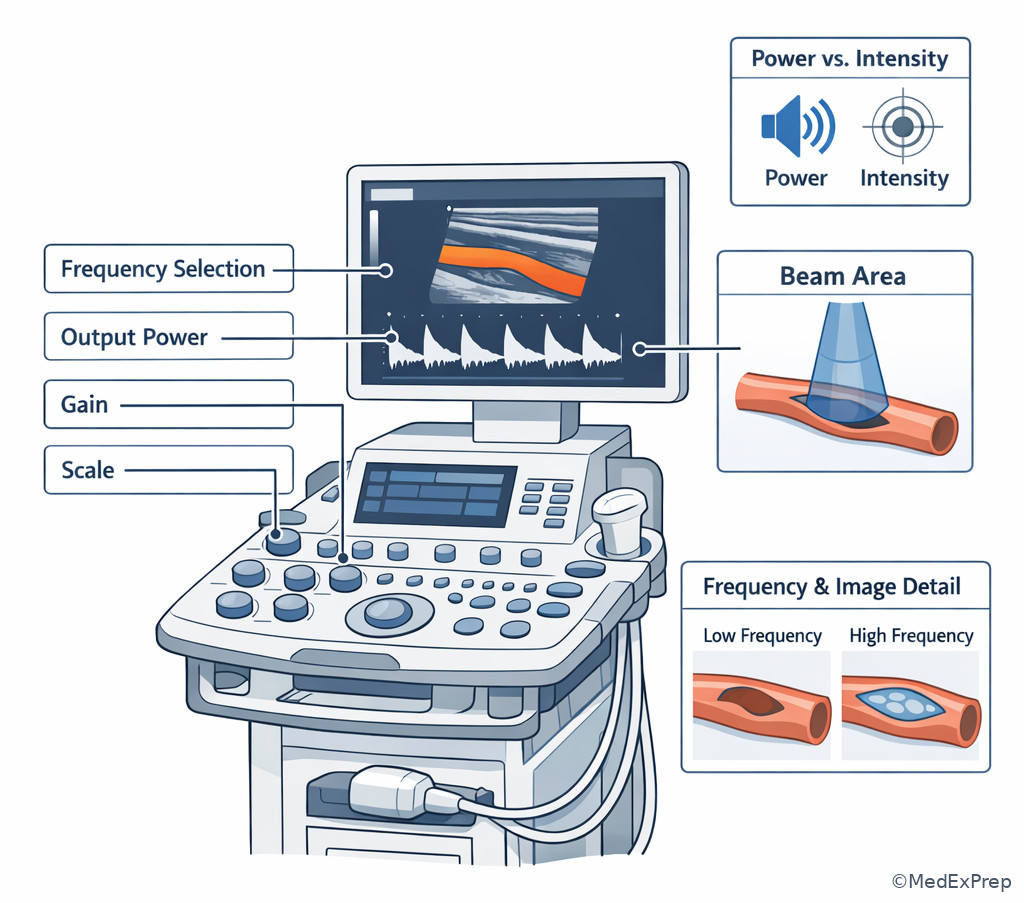
B Worked example
A 74-year-old man with atrial fibrillation, COPD, and a prior EVAR presents for abdominal vascular follow-up. During image optimization, the technologist switches from a high-frequency linear probe to a lower-frequency curvilinear probe for deeper penetration. A board-style teaching question asks: “Which acoustic parameter was most directly changed by selecting a different transducer preset?” The distracting clues include respiratory motion artifact and a comment about reduced signal strength at depth.
Identify task: Determine what the operator changed directly by selecting a different transducer frequency preset.
Extract key facts: Changing probes/presets directly changes transmitted frequency. Deeper penetration and attenuation are consequences, not the directly selected parameter. Respiratory motion is irrelevant.
Apply rule: Frequency is source-controlled and directly changed by transducer selection.
Eliminate distractors: Propagation speed is tempting because the beam travels through abdominal tissues, but speed is medium-controlled. Intensity may vary with other settings but was not the primary stated change. Wavelength changes as a consequence of frequency in a given medium, but again it is not the directly selected parameter.
Verify: The wording “most directly changed” is the clue. Choose the parameter the operator selected, not a downstream consequence.
C Exam trap
Common wrong answer: Wavelength.
Why it is tempting: Candidates know wavelength changes when frequency changes and choose the downstream effect instead of the directly manipulated variable.
Single clue that eliminates it: The stem asks what was changed most directly by the operator’s transducer selection.
D Checkpoint
Question: A board-style stem reports that acoustic output is being compared before and after a machine adjustment using a logarithmic ratio scale. Which unit is most appropriate for that comparison?
- A. dB
- B. W
- C. MHz
- D. m/s
- A. dB: Tempting because it may seem too general, and it is right because logarithmic ratio comparisons are expressed in decibels.
- B. W: Tempting because output is mentioned, but it is wrong because watts describe absolute power rather than a logarithmic comparison.
- C. MHz: Tempting because transducer adjustments often involve frequency selection, but it is wrong because MHz does not express output ratio.
- D. m/s: Tempting because sound propagation is involved in ultrasound, but it is wrong because speed is not a ratio unit for output change.
Practitioner Action: ASSESS whether a study problem is primarily one of penetration, detail, output, or documentation language; INTERVENE within scope by optimizing transducer choice and system settings appropriately; REFER urgent patient findings to the interpreting physician per policy rather than conflating technical optimization with management; DOCUMENT study limitations, selected probe, and key setting changes when image quality affects interpretability.
Exam Traps & Differentiators
Common traps & distractors: Physics questions at this level rarely test hard math; they test whether you confuse related quantities that belong to the same conceptual family.
1.1.1.8 Most common wrong answer and why
The most common wrong answer is intensity when the correct answer is power. It is attractive because both describe acoustic energy. The discriminator is whether the stem includes area. If area is absent, do not upgrade the concept to intensity.
1.1.1.9 Looks similar but isn’t
| Confusable pair | Why they look similar | What separates them | Exam-safe trigger |
|---|---|---|---|
| Power vs Intensity | Both describe acoustic energy strength | Intensity includes area | “Per unit area” → intensity |
| Frequency vs Period | Both describe cycle timing | Reciprocals | “One cycle time” → period |
| Frequency vs Propagation speed | Both are wave descriptors | Source controls one; medium controls the other | “Depends on tissue” → speed |
| Amplitude vs Wavelength | Both can be visualized on a wave drawing | Amplitude is vertical excursion; wavelength is horizontal cycle length | “Maximum change from baseline” → amplitude |
| dB vs W | Both appear in output discussions | dB is ratio; W is absolute power | “Logarithmic comparison” → dB |
1.1.1.10 If the stem says ___, think ___
- If the stem says “rate of energy transfer”, think power.
- If the stem says “power per unit area”, think intensity.
- If the stem says “reciprocal of frequency”, think period.
- If the stem says “logarithmic ratio”, think decibel.
- If the stem says “depends on the medium”, think propagation speed.
- If the stem says “changed by selecting a different transducer frequency”, think source-controlled frequency first, then downstream wavelength effects.
Exam takeaway: One stem word—area, reciprocal, ratio, or medium—usually eliminates the best distractor.
flowchart TD
A[Physics stem] --> B{Area mentioned?}
B -->|Yes| C[Intensity]
B -->|No| D{Reciprocal mentioned?}
D -->|Yes| E[Period if starting from frequency]
D -->|No| F{Ratio/logarithmic mentioned?}
F -->|Yes| G[Decibel]
F -->|No| H{Medium dependence mentioned?}
H -->|Yes| I[Propagation speed]
H -->|No| J[Reassess for power or frequency]
Use this late in review to sharpen elimination speed. See Fig 6.
Exam takeaway: Vertical height reflects amplitude, while horizontal cycle length reflects wavelength.
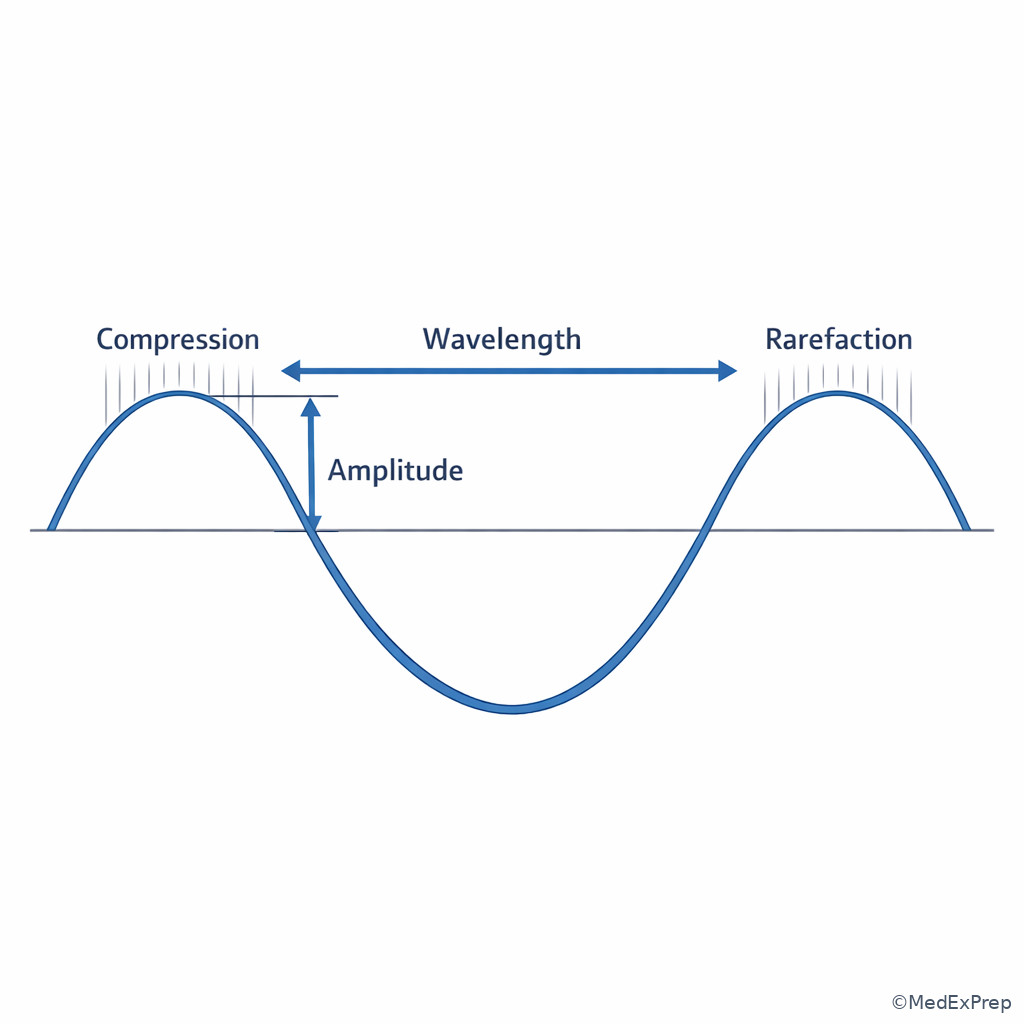
Related trap from upcoming topics: in Propagation Speed And Wavelength, the exam will again tempt you to blame frequency changes on the medium. The pair is confusable, so keep the control rule from 1.1.1.4 active.
Another related trap from Attenuation And Tissue Interactions: decibel language may appear in loss statements. Do not misread a dB comparison as direct proof of a specific absolute power or frequency value.
Algorithm / Approach
| Question wording clue | Best first thought | Best distractor to check | Final discriminator |
|---|---|---|---|
| Rate of energy transfer | Power | Intensity | Area absent |
| Per unit area | Intensity | Power | Area present |
| Reciprocal | Frequency ↔ Period | Same-family unit swap | Cycles/time flips to time/cycle |
| Depends on tissue | Speed | Frequency | Medium versus source |
| Logarithmic comparison | Decibel | Watt | Ratio versus absolute quantity |
Rapid Review
- Amplitude → maximum change from baseline, not horizontal cycle length
- Frequency → cycles per second, source-controlled
- Period → time for one cycle, reciprocal of frequency
- Power → energy transfer rate, unit is watts
- Intensity → power normalized to area, unit is W/cm²
- Propagation speed → set by medium, not by transducer frequency alone
- Wavelength → one cycle length in space, changes with speed and frequency
- Decibel → ratio unit, not absolute power output
- “Stronger wave” → think amplitude first, then power/intensity consequences
- “Reciprocal” in stem → stop and flip the quantity before selecting units
- “Per unit area” → eliminates power, favors intensity
- “Medium change” → frequency stays same, speed can change
- “Directly changed by transducer selection” → frequency before downstream effects
- Amplitude vs wavelength → vertical excursion versus horizontal distance
Memory anchor: “WASP” = Watts for power, Area added gives intensity, Source sets frequency, Period is reciprocal. Use it for rapid elimination.
Self-check quiz
1.1.1.11 Question 1
A sonography student reviews a physics flashcard before a carotid lab session. The card asks which unit is most appropriate for acoustic frequency in diagnostic ultrasound. Which answer is best?
- A. dB
- B. W
- C. Hz
- D. W/cm²
1.1.1.12 Question 2
During SPI review, a trainee is asked for the quantity that represents time required for one acoustic cycle. Which answer is most appropriate?
- A. Frequency
- B. Period
- C. Intensity
- D. Power
1.1.1.13 Question 3
A 63-year-old man with diabetes and hypertension presents for lower extremity arterial duplex. During a teaching pause, the student is asked: “If total acoustic power remains unchanged but the beam cross-sectional area decreases, which parameter most likely increases?” A distracting note on the screen mentions 5 MHz imaging depth. What is the best answer?
- A. Period
- B. Frequency
- C. Intensity
- D. Propagation speed
1.1.1.14 Question 4
A 47-year-old woman with obesity and chronic venous insufficiency is being scanned for reflux symptoms. The student changes to a different transducer preset for better penetration. The instructor asks which acoustic parameter was most directly changed by selecting the new transducer frequency. A color gain adjustment is also visible on the screen and is a tempting clue. Which answer is best?
- A. Frequency
- B. Propagation speed
- C. Intensity
- D. Decibel attenuation ratio
1.1.1.15 Question 5
A 29-year-old trainee with no prior physics degree is taking a timed practice test after scanning a patient with carotid plaque shadowing. One item asks: “The reciprocal of frequency is best described by which parameter?” The plaque discussion in the room is distracting but irrelevant. Which answer is most appropriate?
- A. Wavelength
- B. Period
- C. Power
- D. Speed
1.1.1.16 Question 6
A 71-year-old man with COPD, coronary artery disease, and prior EVAR undergoes abdominal vascular ultrasound. The technologist notes limited penetration and switches to a lower-frequency transducer. A practice question then asks: “As sound enters a different medium, which parameter remains unchanged if the source is unchanged?” A classmate points to altered wavelength on the diagram, making one distractor attractive. Which answer is best?
- A. Propagation speed
- B. Frequency
- C. Wavelength
- D. Intensity
1.1.1.17 Question 7
A 55-year-old woman with chronic kidney disease and peripheral arterial disease is scanned with a stable power setting. The beam is narrowed for technical reasons, and the instructor asks for the best explanation of why the beam may become more concentrated. A tempting wrong clue is that the machine also displays a PRF value. Which answer is most appropriate?
- A. Frequency must increase because the beam is narrower
- B. Intensity may increase because the same power is distributed over less area
- C. Propagation speed must increase because the beam is more focused
- D. Period must decrease because power concentration increased
1.1.1.18 Question 8
A 64-year-old patient with hypertension, hyperlipidemia, and prior carotid endarterectomy returns for duplex surveillance. During study review, a trainee reads a question asking for the most appropriate unit to express a logarithmic comparison of acoustic signal change rather than an absolute output value. A note on the worksheet about watts and output power makes one wrong answer appealing. Which answer is best?
- A. dB
- B. W
- C. Hz
- D. m/s
Answer key
1.1.1.19 Question 1 Answer: C. Hz
- A. dB: Tempting because decibels are common in ultrasound physics, but incorrect here because the question asks for frequency, not a logarithmic ratio. Single clue: “frequency in diagnostic ultrasound.” Source: AIUM physics terminology and standard ultrasound physics texts support Hz for frequency.
- B. W: Tempting because power is another core output concept, but incorrect because watts measure energy transfer rate rather than cycles per second. Single clue: “frequency.”
- C. Hz: Correct because frequency is defined as cycles per second, measured in hertz, typically megahertz in medical ultrasound. Single clue: direct request for the unit of frequency.
- D. W/cm²: Tempting because it sounds like beam strength, but incorrect because it measures intensity, not frequency. Single clue: no mention of power per area.
1.1.1.20 Question 2 Answer: B. Period
- A. Frequency: Tempting because it is the partner concept to period, but incorrect because frequency counts cycles per second rather than measuring the duration of one cycle. Single clue: “time required for one acoustic cycle.”
- B. Period: Correct because period is the time for one cycle. Single clue: direct time-per-cycle wording.
- C. Intensity: Tempting because it is a memorized acoustic parameter, but incorrect because it concerns power per area, not cycle timing. Single clue: no energy or area language.
- D. Power: Tempting because physics questions often ask about output, but incorrect because power is energy transfer rate. Single clue: no energy transfer wording.
1.1.1.21 Question 3 Answer: C. Intensity
- A. Period: Tempting because timed system settings are common in ultrasound, but incorrect because beam area change does not directly change one-cycle duration. Single clue: “power remains unchanged but beam area decreases.”
- B. Frequency: Tempting because the screen note mentions 5 MHz, but incorrect because that is distracting noise; the physics relationship tested is area-dependent intensity. Single clue: area change, not source change.
- C. Intensity: Correct because intensity equals power per unit area, so decreasing area with constant power increases intensity. Single clue: explicit area decrease with stable power.
- D. Propagation speed: Tempting because it is another wave property, but incorrect because speed depends on medium, not beam width. Single clue: no medium change is described.
1.1.1.22 Question 4 Answer: A. Frequency
- A. Frequency: Correct because selecting a different transducer frequency directly changes emitted frequency. Single clue: “most directly changed by selecting the new transducer frequency.”
- B. Propagation speed: Tempting because penetration is mentioned, but incorrect because speed is controlled by tissue properties, not by probe selection alone. Single clue: operator changed the transducer, not the medium.
- C. Intensity: Tempting because machine settings can affect output concentration, but incorrect for this stem because the direct, named action was changing transducer frequency. Single clue: “most directly changed.”
- D. Decibel attenuation ratio: Tempting because deeper penetration often leads learners to think about attenuation, but incorrect because the question asks about the operator-selected acoustic parameter, not downstream loss comparisons. Single clue: transducer preset selection.
1.1.1.23 Question 5 Answer: B. Period
- A. Wavelength: Tempting because it is another basic wave descriptor, but incorrect because wavelength is spatial length of one cycle, not reciprocal of frequency. Single clue: “reciprocal of frequency.”
- B. Period: Correct because period and frequency are reciprocals. Single clue: the reciprocal relationship itself.
- C. Power: Tempting because it is a commonly tested acoustic term, but incorrect because it is unrelated to the frequency-period inverse pair. Single clue: no energy language.
- D. Speed: Tempting because all are wave properties, but incorrect because speed is distance per time and depends on the medium. Single clue: reciprocal of frequency points to time per cycle.
1.1.1.24 Question 6 Answer: B. Frequency
- A. Propagation speed: Tempting because medium entry is central to the stem, but incorrect because speed is precisely the parameter that may change with medium. Single clue: “enters a different medium.”
- B. Frequency: Correct because if the source is unchanged, emitted frequency remains constant across a boundary in basic propagation physics. Single clue: “source is unchanged.”
- C. Wavelength: Tempting because the classmate points to changed spacing on the diagram, and that temptation is realistic; however, wavelength changes when speed changes while frequency stays fixed. Single clue: medium change with constant source.
- D. Intensity: Tempting because tissue interactions can alter beam strength, but incorrect because the core boundary rule being tested here is the constancy of frequency, not output concentration. Single clue: emphasis on medium transition rather than area or power setting.
1.1.1.25 Question 7 Answer: B. Intensity may increase because the same power is distributed over less area
- A. Frequency must increase because the beam is narrower: Tempting because learners link narrower beams with high-frequency imaging, but incorrect because narrowing beam area does not require a frequency change. Single clue: “stable power setting” and no source-frequency change stated.
- B. Intensity may increase because the same power is distributed over less area: Correct because intensity is power per unit area, so reducing area can raise intensity even without changing power. Single clue: “beam is narrowed” while power is stable.
- C. Propagation speed must increase because the beam is more focused: Tempting because focus sounds like travel efficiency, but incorrect because speed is medium-determined, not beam-area-determined. Single clue: no medium change.
- D. Period must decrease because power concentration increased: Tempting because stronger output may be mistaken for faster cycling, but incorrect because period depends on frequency, which was not changed. Single clue: concentration changed, not cycle timing.
1.1.1.26 Question 8 Answer: A. dB
- A. dB: Correct because decibel expresses logarithmic comparison of signal change rather than a direct absolute output value. Single clue: “logarithmic comparison.”
- B. W: Tempting because the worksheet mentions output power, but incorrect because watts measure absolute power, not a ratio scale. Single clue: the stem contrasts comparison versus absolute value.
- C. Hz: Tempting because ultrasound frequency is often central, but incorrect because hertz measures cycles per second, not signal change ratio. Single clue: no cycle language appears.
- D. m/s: Tempting because propagation is part of ultrasound physics, but incorrect because meters per second describe speed, not logarithmic comparison. Single clue: ratio language excludes speed.
Keep going with the full ARDMS Vascular Prep Course (ARDMS RV)
You just studied the way members do, in the same lesson interface. Full access unlocks every lesson, the question bank and flashcards for a full year.
One payment · 1 year of access · No auto-renewal