1.1.1 - Chief Complaint Framing
Chief Complaint Framing
What you'll learn
- DOMAIN: Patient Assessment and Clinical Evaluation → Focused history-taking — Convert a vague opening statement into a podiatry-relevant chief complaint.
- DOMAIN: Diagnosis and Clinical Decision-Making → Problem representation — Identify the minimum complaint elements that drive the next diagnostic step.
- DOMAIN: Urgent and Emergent Recognition → Red-flag triage — Recognize when the wording of a complaint suggests limb- or life-threatening disease requiring immediate escalation.
- DOMAIN: Patient Safety and Risk Management → Safe initial prioritization — Avoid harmful delay by separating stable discomfort from urgent pain, infection, ischemia, bleeding, or postoperative complications.
- DOMAIN: Communication, Ethics, and Professionalism → Patient-centered interviewing — Reframe the complaint in the patient’s words while preserving medically actionable detail.
- Patient Assessment and Clinical Evaluation → Focused history → chief complaint extraction
- Diagnosis and Clinical Decision-Making → Problem representation → symptom framing for differential building
- Urgent and Emergent Recognition → Early triage → identify complaint wording that signals immediate threat
- Patient Safety and Risk Management → Avoid unsafe delay → prioritize high-risk complaint patterns
- Communication, Ethics, and Professionalism → Accurate patient communication → document and restate the concern clearly
Why it matters
- The chief complaint is the first sorting step in board-style cases; a poorly framed complaint leads to the wrong differential before the exam stem is even half read.
- On APMLE Part III, many errors come from under-triaging vague complaints that actually hide infection, ischemia, compartment syndrome, or postoperative complications.
- Good complaint framing narrows what to ask next: location, timing, provoking event, red flags, neurovascular symptoms, and postoperative context.
- In practice and on exam day, the safest candidate is the one who recognizes when the complaint itself already justifies urgent assessment or escalation.
Key Terms & Must-Know Facts
1.1.1.1 Key terms
- Chief complaint (CC): The patient’s main reason for seeking care, ideally in their own words.
- Problem representation: A one-line clinical summary that includes the discriminating features of the complaint.
- Localization: Exact anatomic site of symptoms, not just “foot pain.”
- Chronology: Onset, duration, course, and tempo of change.
- Provoking event: Trauma, surgery, new footwear, overuse, wound, puncture, or spontaneous onset.
- Symptom quality: Pain, numbness, swelling, drainage, discoloration, instability, or inability to bear weight.
- Severity/functional impact: Limits ambulation, weight-bearing, sleep, or daily function.
- Red flags: Complaint features suggesting urgent or emergent disease.
- Triage frame: Stable outpatient issue versus urgent office assessment versus emergency transfer/escalation.
- Associated symptoms: Fever, chills, calf pain, dyspnea, rapidly spreading erythema, weakness, paresthesias.
- Postoperative complaint: Symptoms arising after a procedure, requiring expected-versus-concerning judgment.
- Neurovascular symptoms: Numbness, coolness, pallor, delayed capillary refill, pulselessness, severe pain.
1.1.1.2 Must-know facts
- A chief complaint should be recorded in the patient’s language first, then medically reframed.
- The minimum high-yield complaint frame is: location + symptom type + time course + trigger/context + severity/functional effect.
- “Pain” alone is not enough; the question is what kind of pain, where, since when, and what changed.
- Rapid progression is often more important than absolute duration.
- Postoperative pain with escalating swelling, neurologic change, or tense compartments is not “routine recovery.”
- New drainage, foul odor, skin discoloration, or systemic symptoms should move the complaint into urgent-risk thinking.
- Inability to bear weight changes triage and differential even before exam findings are known.
- Board stems often include distracting chronic findings; the chief complaint should prioritize the new dangerous change.
- Framing errors commonly come from anchoring on diagnosis words supplied by the patient, such as “just a bunion flare” or “my gout is back.”
- If the complaint suggests disease beyond podiatric scope or medical instability, stabilize if needed and escalate appropriately.
Exam takeaway: Use a fixed sequence to convert vague symptoms into a triage-ready problem representation.
flowchart TD
A[Vague patient statement] --> B[Localize exact site]
B --> C[Identify symptom type]
C --> D[Define onset and tempo]
D --> E[Add trigger or context]
E --> F[Screen for red flags]
F --> G[Assign triage urgency]
G --> H[One-line problem representation]
Exam takeaway: Precise localization often separates the best answer from a tempting nearby differential.
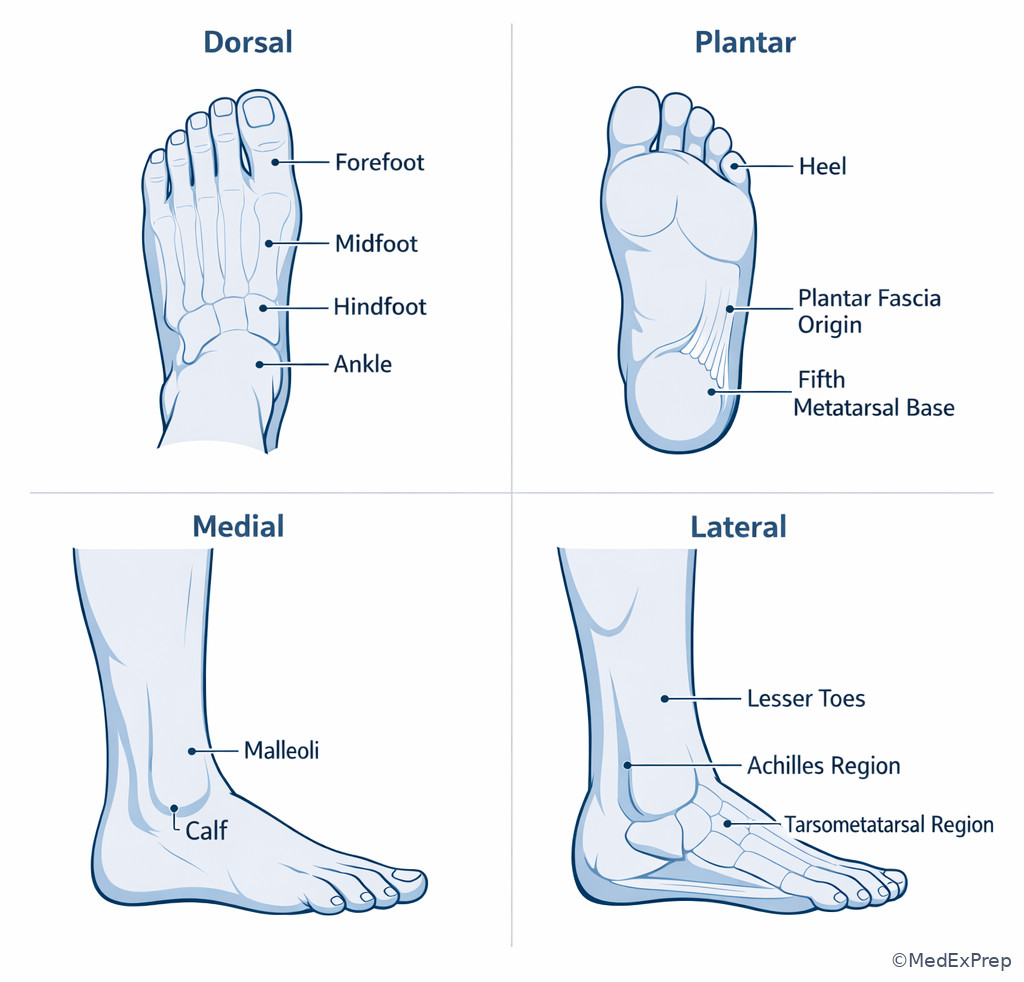
Core content
1.1.1.3 Build the complaint from five required elements
A Explanation
The first exam conflict is simple but high stakes: Do you accept the patient’s broad wording, or do you reconstruct it into a testable clinical problem? The correct move is reconstruction. For podiatric decision-making, a usable complaint contains five elements: exact location, primary symptom, timing/tempo, context or trigger, and functional impact. “My foot hurts” becomes “progressive plantar heel pain for 3 weeks, worst with first steps, no trauma, limiting walking.” That single reframing immediately changes what you ask next and what diagnoses rise or fall.
WHY THIS IS TESTED: Exam stems reward candidates who identify the governing rule early. If the complaint is too broad, you will chase the wrong data. The key resolving rule is: complaint framing must make the next decision obvious. If your one-liner does not tell you what to ask or rule out next, it is too vague.
Choose the patient’s words for rapport; reject the patient’s self-diagnosis as your frame. A patient may say “my arthritis is acting up,” “my bunion is infected,” or “my gout came back.” Those labels are clues, not conclusions. On the exam, using them uncritically is a classic anchoring error. Instead, extract the objective complaint features first, then consider diagnoses. See Fig 1 for the sequence that prevents premature closure.
B Worked example
A 57-year-old man with obesity, hypertension, and chronic low back pain presents saying, “My foot is killing me and I think my plantar fasciitis is back.” He works on concrete floors, recently bought new work boots, and notes mild morning stiffness. The distracting detail is that he also has a known history of plantar heel pain 2 years ago. However, today his pain is actually at the posterior heel near the Achilles insertion, worsened by stairs, and started 5 days after increasing activity. He can bear weight but limps.
Reasoning chain: Identify task: frame the complaint correctly. Extract key facts: posterior heel, not plantar heel; activity-related; subacute; exertional trigger; preserved weight-bearing. Apply rule: location outranks the patient’s diagnostic label. Eliminate distractors: prior plantar fasciitis history is tempting noise, but the pain site does not match. Verify: the reframed complaint is “subacute posterior heel pain after increased activity at the Achilles insertion, worse with push-off, limiting gait.” That frame leads toward insertional Achilles pathology rather than plantar fasciitis.
C Exam trap
D Checkpoint
Question: A 46-year-old woman with obesity and hypothyroidism presents with “foot pain” for 1 month. Which complaint framing is most appropriate to guide the next step?
- Chronic foot pain likely due to overuse.
- Left lower-extremity pain with possible arthritis.
- Progressive medial midfoot pain for 4 weeks after increased walking, worse with push-off, no trauma, now limiting ambulation.
- Possible tendon problem in the foot.
Answer: C
- A: Tempting because it identifies duration and a broad mechanism, but it is wrong because it lacks exact site and functional effect; “overuse” is an early conclusion, not a neutral frame.
- B: Tempting because it localizes generally and suggests a common chronic diagnosis, but it is wrong because “arthritis” is diagnostic anchoring and the location remains too broad.
- C: Correct because it includes site, time course, trigger, quality pattern, absence of trauma, and function loss; this is enough to direct exam and differential.
- D: Tempting because tendon disorders are common, but it is wrong because it substitutes a suspected diagnosis for the chief complaint and leaves out the key complaint structure.
1.1.1.4 Separate symptom language from diagnosis language
A Explanation
The second decision conflict is whether to chart and think in symptoms or in diagnostic labels. On exam questions, the safe rule is: choose symptom language first, then test diagnosis language against the findings. The patient can report “burning,” “shooting,” “tight,” “cold,” “popping,” “draining,” “giving way,” or “numb.” These words are highly useful. In contrast, patient-supplied diagnoses such as “gout,” “sprain,” “cellulitis,” or “bone spur” should not become your frame without corroboration.
WHY THIS IS TESTED: Board questions often tempt you to accept a familiar label and stop thinking. The single rule that resolves the conflict is this: symptom descriptors expand the differential; premature diagnoses collapse it too early. Complaint framing should preserve uncertainty until the next discriminating finding is known.
For example, “my toe is infected” may actually mean drainage from an ingrown nail, postoperative serous drainage, an abscess, ischemic tissue breakdown, or a deep diabetic foot infection. “Ankle sprain” may hide fracture, syndesmotic injury, tendon rupture, or neurovascular compromise. “Gout flare” may hide septic arthritis if systemic symptoms, warmth, and severe acute pain are present in the right context. The exam expects you to be disciplined: record what is felt, seen, and timed, not what is presumed.
See Fig 2 when localization and symptom language start to overlap. “Heel pain” is not as useful as “plantar medial heel pain with first-step pain” or “posterior heel pain with push-off.” That difference changes the answer choice set substantially.
Exam takeaway: Preserve raw symptom data first because diagnosis labels are frequent anchoring traps in board stems.
flowchart LR
A[Patient statement] --> B{Type of wording?}
B -->|Symptom words| C[Keep and clarify]
B -->|Diagnosis words| D[Translate into objective findings]
C --> E[Use for differential building]
D --> F[Do not anchor]
F --> E Exam takeaway: Distinct symptom qualities such as burning, coldness, popping, or drainage point toward different next-step evaluations.
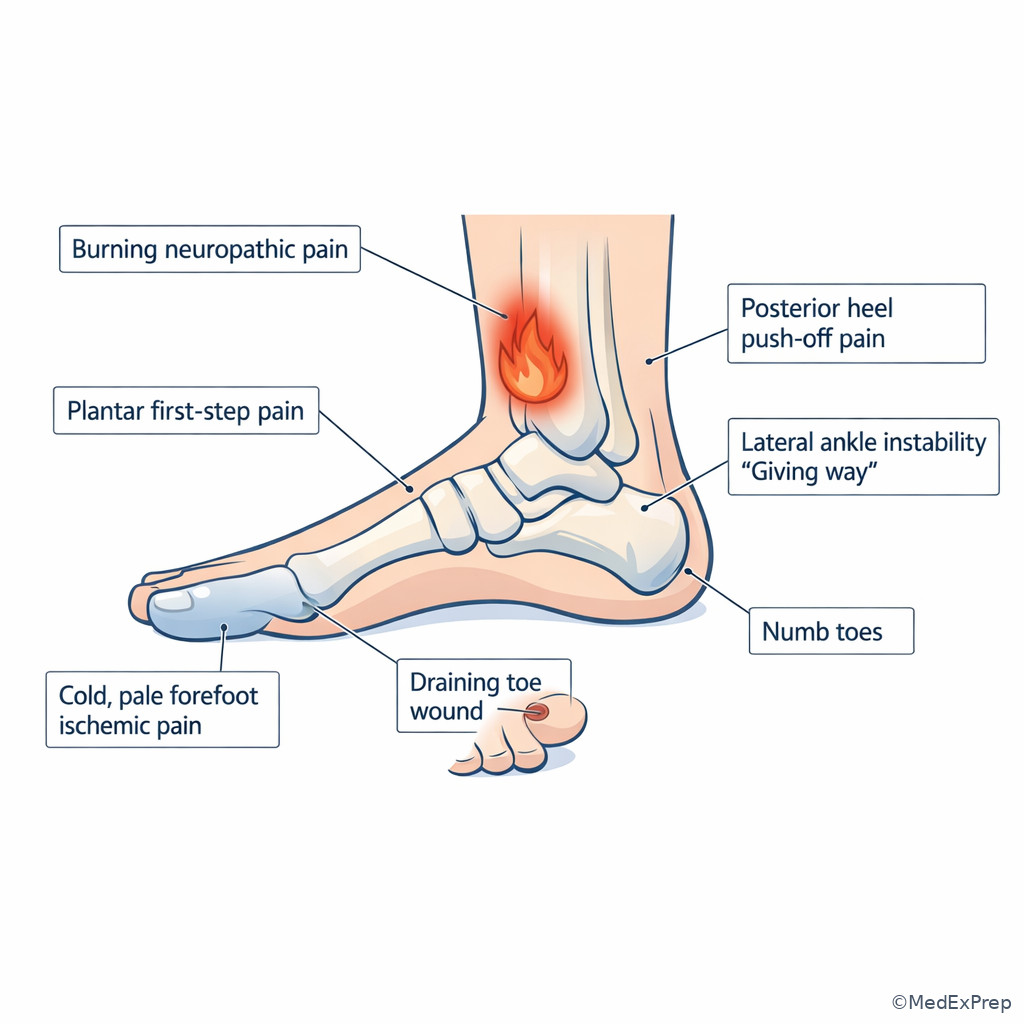
B Worked example
A 63-year-old woman with diabetes, stage 3 chronic kidney disease, and prior hallux valgus surgery says, “My gout is back in my big toe.” She reports 2 days of severe great toe pain and redness. A distracting clue is that she ate shellfish the weekend before. On further questioning, she also has a plantar ulcer beneath the first metatarsal head with new malodor, and her daughter says she felt chilled yesterday. The reasoning chain is critical: identify task — frame the complaint without anchoring. Extract key facts — severe toe pain/redness plus ulcer with odor and possible systemic symptoms. Apply rule — symptom plus associated findings outrank the patient’s diagnosis label. Eliminate distractors — dietary trigger makes gout tempting, but infection cues are stronger and safety-relevant. Verify — the complaint is better framed as “acute great toe/forefoot pain and erythema with concurrent plantar wound changes and possible systemic symptoms,” which demands infection-focused evaluation.
C Exam trap
D Checkpoint
Question: A 29-year-old man with obesity and prior ankle sprains presents after basketball saying, “I rolled my ankle again.” Which response best reflects correct chief complaint framing?
- Document recurrent ankle sprain and proceed to management.
- Reframe as acute lateral ankle pain and swelling after inversion injury with immediate difficulty bearing weight.
- Document instability syndrome because he has prior sprains.
- Reframe as sports injury requiring x-ray because all inversion injuries need imaging.
Answer: B
- A: Tempting because prior sprains make recurrence likely, but it is wrong because it anchors on diagnosis rather than the present complaint.
- B: Correct because it uses symptom and mechanism language, adds function loss, and leaves diagnostic options open.
- C: Tempting because chronic instability is plausible, but it is wrong because that is a syndrome-level conclusion not yet established by the complaint alone.
- D: Tempting because it anticipates a next step, but it is wrong because imaging decisions follow appropriate complaint framing and exam criteria rather than replacing them.
- The most useful replacement for a patient diagnosis label is a symptom-based one-line complaint.
- True or False: If a patient has a prior history of the same diagnosis, that diagnosis should be used as the chief complaint. False.
- Name the 3 highest-yield things to keep when translating a self-diagnosis: site, symptom quality, and time course.
1.1.1.5 Use timing, tempo, and context to set urgency
A Explanation
After you know what the symptom is and where it is, the next conflict is urgency: Is this complaint acute, subacute, chronic, suddenly worsening, postoperative, or rapidly progressive? The same symptom means different things depending on time course. Chronic stable plantar pain points to one bucket; sudden severe forefoot pain with pallor points to another. The exam often hides urgency inside tempo words: sudden, rapidly worsening, overnight change, immediately after surgery, progressive over hours, or new inability to bear weight.
WHY THIS IS TESTED: Candidates miss serious disease when they anchor on symptom type and ignore speed of change. The governing rule is: tempo can outrank diagnosis familiarity. A complaint that is common in one setting can be dangerous in another if the onset or progression is unusual.
Context matters equally. Ask whether the complaint follows trauma, puncture, ulceration, surgery, immobilization, increased activity, new footwear, or no clear trigger. Postoperative complaints deserve a lower threshold for concern when the patient reports increasing pain instead of expected improvement, new numbness, drainage, expanding redness, or bleeding. In the nonoperative setting, “spontaneous” onset of severe pain may raise concern for ischemia, infection, crystal disease, or stress injury depending on other clues. See Fig 4 for a triage-oriented timeline approach.
Exam takeaway: The rate of symptom progression often determines whether the safest next step is routine evaluation or urgent escalation.
flowchart TD
A[Complaint begins] --> B{Timing pattern}
B -->|Chronic stable| C[Routine focused workup]
B -->|Acute after trauma| D[Injury pathway]
B -->|Postoperative worsening| E[Complication pathway]
B -->|Rapid swelling redness drainage| F[Infection concern]
B -->|Sudden severe pain cool pale foot| G[Ischemia concern]
F --> H[Urgent assessment]
G --> H
E --> H Exam takeaway: Matching symptom tempo to context helps prioritize the safest next step before a full differential is built.
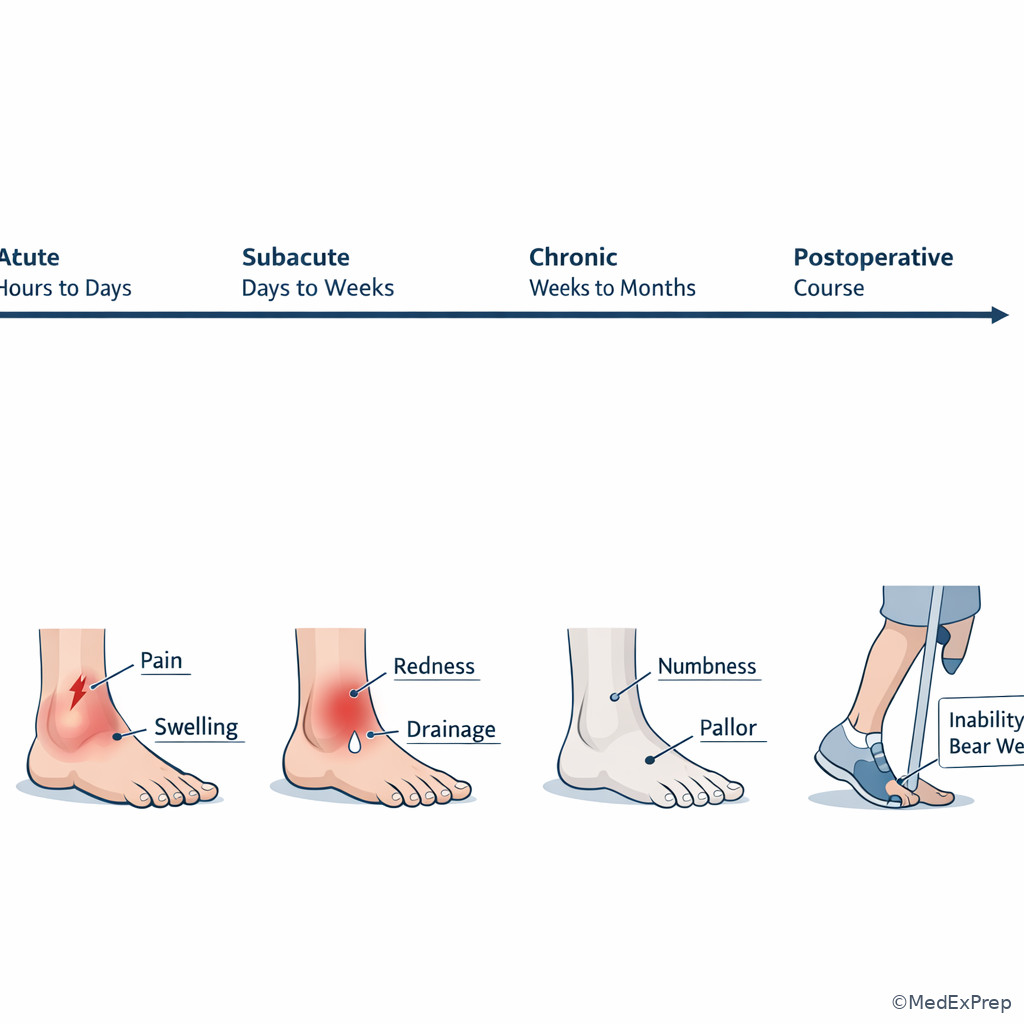
B Worked example
A 68-year-old man with atrial fibrillation, chronic kidney disease, and remote bunion surgery calls saying, “My left foot pain is acting up again.” He adds that he has had intermittent forefoot soreness for months. The distracting detail is his long history of metatarsalgia. On further questioning, however, the current episode began abruptly 3 hours ago with severe forefoot pain, numbness, and a colder foot than the other side. The reasoning chain is: identify task — frame the current complaint, not the chronic backdrop. Extract key facts — sudden onset, severe pain, numbness, coolness. Apply rule — acute tempo plus neurovascular features outrank chronic soreness history. Eliminate distractors — metatarsalgia and bunion recurrence are not sudden cold painful numb feet. Verify — the correct frame is an acute neurovascular complaint requiring urgent ischemia-focused escalation, not routine chronic pain follow-up.
C Exam trap
D Checkpoint
Question: A 54-year-old woman 2 days after bunion surgery reports increasing pain, progressive swelling, numbness of the hallux, and dressings that feel “too tight.” Which complaint frame best supports the safest next step?
- Expected postoperative pain after forefoot surgery.
- Acute postoperative hallux pain with worsening swelling and sensory change since surgery.
- Likely anxiety-related overreporting of pain after a recent procedure.
- Incisional discomfort typical of recovery.
Answer: B
- A: Tempting because early postoperative pain is common, but it is wrong because the complaint includes progression and neurologic change.
- B: Correct because it highlights postoperative timing, worsening course, and neurovascular concern without prematurely naming a complication.
- C: Tempting if the stem includes anxiety history, but it is wrong because symptom progression and numbness are objective warning features.
- D: Tempting because incisional pain is expected, but it is wrong because “typical recovery” ignores the key red-flag trajectory.
1.1.1.6 Identify complaint features that signal urgent or emergent risk
A Explanation
The next exam conflict is the most safety-critical: Which complaints are routine enough for standard evaluation, and which require immediate escalation? Chief complaint framing is not just documentation; it is triage. Certain complaint elements should instantly raise the urgency level even before the full physical exam. These include pain out of proportion, rapidly progressive swelling, new drainage or foul odor, tissue color change, coolness, numbness, inability to move toes, uncontrolled bleeding, fever with foot findings, confusion, dyspnea, and severe postoperative deterioration.
WHY THIS IS TESTED: APMLE Part III rewards safe recognition of podiatric emergencies and unsafe delay. The single rule is: when the complaint suggests limb threat, systemic illness, or deep complication, your next move is escalation, not diagnostic complacency. You are an entry-level podiatric candidate, not an all-specialty physician; your role is to recognize, stabilize if needed, and mobilize the correct urgent pathway.
Red-flag complaint framing should remain syndrome-based. For example: “rapidly progressive plantar wound pain with malodor and fever,” “sudden painful pale foot with numbness,” or “postoperative calf pain and shortness of breath.” These are stronger and safer than forcing a narrow diagnosis too early. The upcoming topic Red-Flag Symptom Clusters will expand these patterns, but the framing skill begins here. See Fig 5.
Exam takeaway: Certain symptom clusters should trigger immediate reassessment or escalation before routine workup continues.
flowchart TD
A[Chief complaint] --> B{Any red-flag words?}
B -->|Severe out-of-proportion pain| C[Consider ischemia compartment deep infection]
B -->|Drainage odor fever confusion| D[Consider systemic or deep infection]
B -->|Cool pale numb foot| E[Consider vascular compromise]
B -->|Bleeding syncope postop decline| F[Consider urgent complication]
B -->|None| G[Standard focused evaluation]
C --> H[Urgent escalation]
D --> H
E --> H
F --> H Exam takeaway: Visual recognition of pallor, dusky discoloration, marked swelling, drainage, and tense compartments supports safer triage decisions.
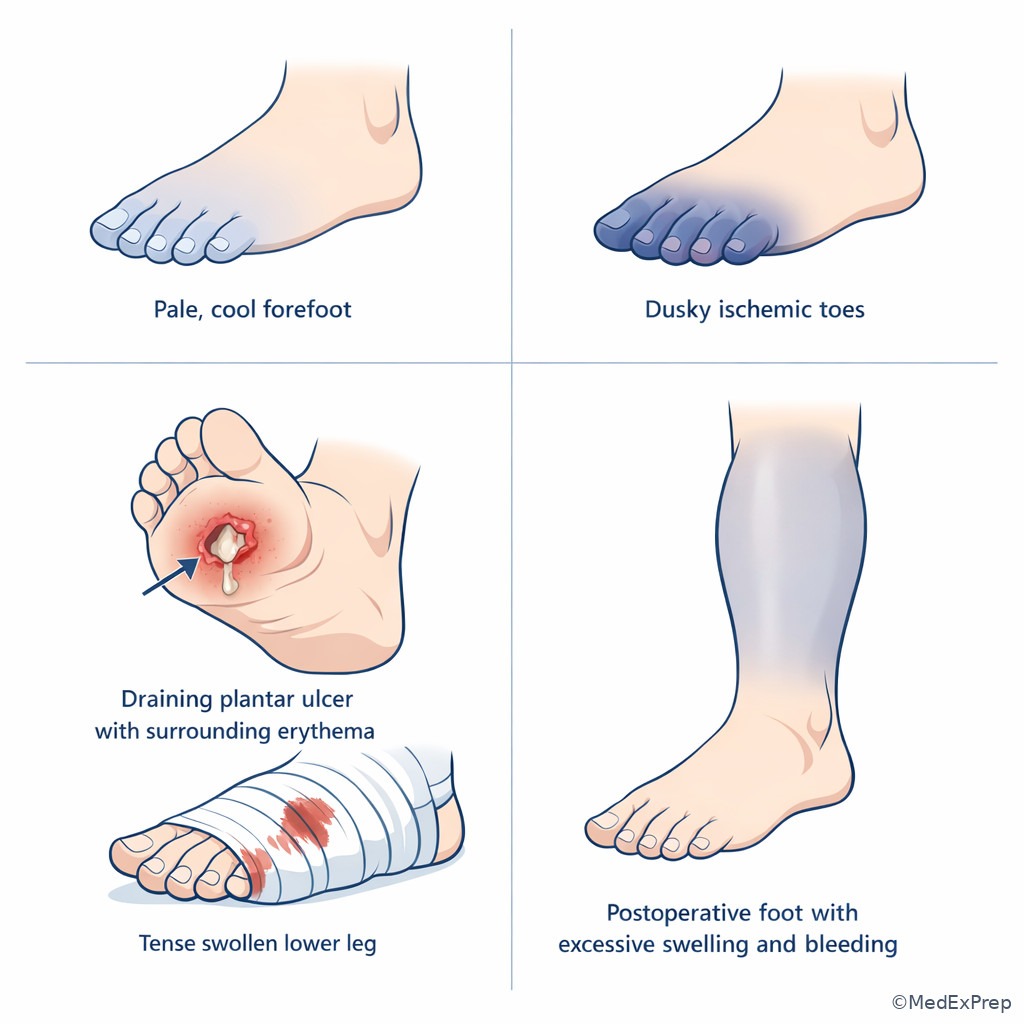
B Worked example
A 72-year-old man with diabetes, peripheral neuropathy, and a history of smoking reports “a sore on my foot.” He says it has been present “for a while,” which is the distracting chronic detail. But his wife adds that over the last 24 hours he has developed foul odor, increasing redness, weakness, and chills. His complaint must be reframed from “chronic ulcer” to “chronic plantar wound with acute malodor, spreading inflammation, and systemic symptoms.” Reasoning chain: identify task — determine complaint urgency. Extract key facts — acute change, odor, erythema, chills. Apply rule — acute worsening and systemic features override chronicity. Eliminate distractors — routine wound follow-up is unsafe. Verify — urgent infection-focused assessment and escalation are required.
C Exam trap
D Checkpoint
Question: Which chief complaint requires the most immediate escalation?
- Three months of plantar heel pain worse with first steps, improved after walking.
- Two weeks of dorsal midfoot aching after new exercise, mild swelling, still ambulatory.
- Six hours of severe foot pain with new coolness, numbness, and pale toes.
- One month of hallux valgus pain worsened by tight shoes.
Answer: C
- A: Tempting because it is painful and common, but it is wrong because the pattern is chronic and mechanically suggestive rather than emergent.
- B: Tempting because new swelling after exercise raises concern for stress injury, but it is wrong because there is no neurovascular or systemic threat signal.
- C: Correct because sudden severe pain plus coolness, numbness, and pallor strongly suggests acute vascular compromise needing urgent escalation.
- D: Tempting because shoe-related deformity pain is common in podiatry, but it is wrong because it lacks limb-threatening features.
- The most dangerous complaint pairing for acute limb threat is severe pain plus coolness/pallor/numbness.
- True or False: Chronic ulcers are always nonurgent unless they bleed. False.
- Name 3 complaint features that should raise concern for deep infection: rapid swelling, foul drainage/odor, fever or chills.
1.1.1.7 Create a one-line problem representation and choose the next question
A Explanation
The final integration step is to compress the complaint into a one-line problem representation that points directly to the next best question or action. This is where board-style reasoning becomes efficient. A good one-liner includes the most discriminating features, not every detail. “A 61-year-old woman with diabetes and neuropathy has 2 days of worsening plantar forefoot swelling, malodor, and reduced weight-bearing” is far better than a long disorganized summary. From that frame, the next question is obvious: systemic symptoms, drainage depth, and urgent exam findings. Likewise, “acute lateral ankle pain and immediate inability to bear weight after inversion” points toward injury assessment rather than wound review.
WHY THIS IS TESTED: The exam asks for the most appropriate next step, not a maximal data dump. The resolving rule is: your one-line frame should determine the next branch of history, exam, testing, or escalation. If it does not, it is too broad or cluttered.
The best next question usually targets the missing discriminator. If the complaint is pain-heavy, ask what changes urgency: weight-bearing ability, neurovascular symptoms, infection signs, postoperative timing, or trauma mechanism. If the complaint is wound-focused, ask about drainage, odor, fever, rapidly spreading erythema, or perfusion symptoms. If postoperative, ask whether symptoms are improving or worsening versus expected recovery.
See Fig 6 for a comparison of stable versus urgent frames. This is also where upcoming topics connect: Targeted Risk Factor Review changes pretest probability, and Red-Flag Symptom Clusters sharpens urgency once the complaint has been framed correctly.
Exam takeaway: A high-quality one-line summary should immediately reveal the single most useful next discriminating question.
flowchart LR
A[Complaint one-liner] --> B{Main pattern}
B -->|Pain after trauma| C[Ask weight-bearing and mechanism]
B -->|Wound or drainage| D[Ask odor fever spread]
B -->|Postoperative worsening| E[Ask trend neurovascular change bleeding]
B -->|Sudden cold painful foot| F[Ask onset pulses sensation]
B -->|Chronic mechanical pain| G[Ask activity and location pattern] Exam takeaway: Organizing the complaint into a concise summary prevents overreading distractors and improves next-step decisions.
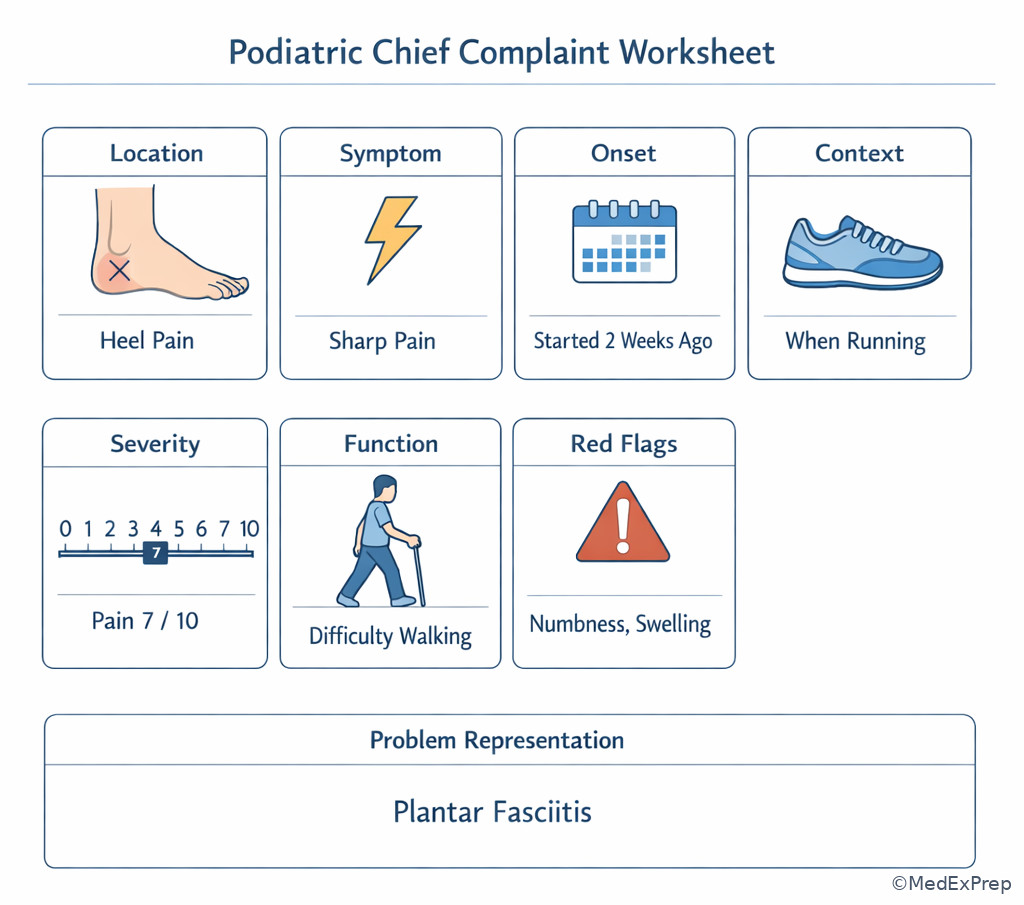
B Worked example
A 41-year-old woman with rheumatoid arthritis and obesity presents 10 days after hammertoe surgery saying, “My toe still hurts and looks bad.” A distracting detail is that she has been worried about her cosmetic result since surgery. On further questioning, the toe pain is not simply persistent; it is increasing, with new drainage and progressive redness extending beyond the incision. The reasoning chain: identify task — create a one-line representation and ask the next best question. Extract key facts — postoperative day 10, worsening pain, new drainage, expanding redness. Apply rule — one-line frame should reveal the next discriminator. Her frame is “postoperative digital pain with worsening erythema and new drainage 10 days after surgery.” Eliminate distractors — cosmetic concern is noise; expected postoperative discomfort should improve, not worsen with drainage. Verify — the next question targets fever, wound separation, odor, and systemic symptoms, and the patient needs prompt complication assessment.
C Exam trap
D Checkpoint
Question: A 64-year-old man with diabetes and neuropathy reports “a foot sore” for several weeks. Today he notes new drainage and trouble walking. After framing the complaint, what is the most appropriate next question?
- Whether he prefers open-toed shoes or sneakers.
- Whether he has had fever, chills, rapidly spreading redness, or foul odor.
- Whether he has ever had bunion pain.
- Whether the pain is worse in the morning than at night.
Answer: B
- A: Tempting because footwear matters in podiatry, but it is wrong because it does not answer the urgent infection discriminator in this scenario.
- B: Correct because wound drainage with functional decline requires immediate clarification for deep or systemic infection.
- C: Tempting as past foot history, but it is wrong because it does not change the immediate triage branch.
- D: Tempting because pain timing can be useful in mechanical complaints, but it is wrong because the dominant concern here is an acutely changing wound.
Exam Traps & Differentiators
Most common wrong answer and why: The most common error is choosing a benign, familiar interpretation because the patient has had a similar diagnosis before. This is tempting because prior history creates narrative comfort. The discriminator is the current change from baseline.
| Complaint wording in stem | Tempting but incomplete interpretation | Better exam framing | Discriminator |
|---|---|---|---|
| “My plantar fasciitis is back” | Recurrent plantar fasciitis | Localize heel pain precisely before naming it | Posterior vs plantar site |
| “I rolled my ankle again” | Simple sprain | Acute ankle pain/swelling after inversion with weight-bearing status | Immediate inability to bear weight or focal bony tenderness |
| “My gout is acting up” | Crystal flare | Acute toe/forefoot pain with infection screen | Drainage, ulcer, fever, or malodor |
| “My wound looks the same” | Chronic stable ulcer | Chronic wound with acute change assessment | New odor, drainage, redness, weakness, chills |
| “Post-op pain” | Normal recovery | Postoperative symptom trend and neurovascular check | Worsening rather than improving |
| “My foot feels funny” | Nonspecific paresthesia | Clarify numbness, coldness, weakness, or pain out of proportion | Neurovascular threat words |
1.1.1.8 Looks similar but isn’t
| Pair | Shared superficial feature | Key difference in complaint framing |
|---|---|---|
| Plantar fasciitis vs insertional Achilles pain | Heel pain | Plantar first-step pain vs posterior push-off pain |
| Simple wound follow-up vs deep infection concern | Ulcer or drainage | Stable chronicity vs acute odor, spread, systemic symptoms |
| Routine postoperative discomfort vs urgent complication | Pain after surgery | Expected improvement vs worsening swelling, numbness, drainage, bleeding |
| Mechanical chronic pain vs acute ischemia | Foot pain | Activity-related chronicity vs sudden pain with pallor/coolness/numbness |
| Recurrent sprain vs fracture/high-risk injury | Ankle pain after inversion | Prior history vs current weight-bearing failure and exact tenderness |
1.1.1.9 If the stem says ___, think ___
- If the stem says “my usual problem”, think current baseline vs new dangerous change.
- If the stem says “suddenly”, think acute triage and urgency before routine differential refinement.
- If the stem says “after surgery”, think expected course versus complication trend.
- If the stem says “foul odor”, think infectious severity until proven otherwise.
- If the stem says “cool,” “pale,” or “numb” foot, think vascular compromise or severe neurovascular threat.
- If the stem says “can’t bear weight”, think the complaint has functional significance and needs injury/urgent framing.
Tables
| Required complaint element | Best question | Why it matters on exam |
|---|---|---|
| Location | “Show me exactly where it hurts or where the problem is.” | Refines differential immediately |
| Primary symptom | “Is it pain, numbness, drainage, swelling, weakness, discoloration, or instability?” | Separates category of disease |
| Onset | “When did this begin?” | Acute vs chronic frame |
| Tempo | “Is it improving, stable, or getting worse?” | Worsening often raises urgency |
| Context/trigger | “Did this start after trauma, surgery, a wound, overuse, or without a trigger?” | Selects next pathway |
| Functional impact | “Can you bear weight and walk as usual?” | Severity and disposition clue |
| Associated red flags | “Any fever, chills, color change, numbness, odor, drainage, or bleeding?” | Identifies urgent complications |
| Complaint frame type | Use when | Reject when | Best immediate next step |
|---|---|---|---|
| Symptom + location frame | Initial vague complaint | Never reject as first step | Clarify tempo and context |
| Diagnosis label frame | Only after supporting evidence exists | Patient self-diagnosis or incomplete data | Translate back to objective findings |
| Urgent syndrome frame | Red-flag terms present | Stable chronic patterns without danger signs | Escalate and assess urgently |
| Postoperative trend frame | Symptoms after procedure | Nonoperative complaints | Compare expected recovery with worsening features |
| Complaint category | Common close-call differential | Single discriminating complaint clue |
|---|---|---|
| Plantar heel pain | Insertional Achilles disorder | First-step plantar pain vs posterior push-off pain |
| Acute red toe | Gout vs infection | Drainage/ulcer/systemic symptoms suggest infection pathway |
| Chronic wound visit | Stable ulcer vs deep infection | New odor, spread, or systemic decline |
| Post-op pain | Expected pain vs complication | Improving vs worsening with neurovascular or wound changes |
| Acute foot pain | Mechanical flare vs ischemia | Coolness/pallor/numbness point to ischemia |
| Ankle inversion injury | Sprain vs fracture | Weight-bearing failure and focal tenderness shift concern |
Algorithm / Approach
Rapid Review
- Vague foot pain → incomplete until exact location is stated.
- Patient diagnosis label → symptom translation before acceptance.
- Location → often more discriminating than symptom intensity.
- Sudden onset → urgency rises even with a familiar chronic condition.
- Rapid worsening → triage clue, not just a descriptive detail.
- Post-op complaint → judge by trend, not by presence of pain alone.
- Chronic problem with acute change → frame the new change first.
- Drainage plus odor → think complication pathway, not routine follow-up.
- Cool pale numb foot → neurovascular emergency until proven otherwise.
- Inability to bear weight → function loss that changes next-step reasoning.
- Best one-liner → includes why the case is urgent or why it is not.
- Chief complaint framing → should make the next question obvious.
Self-check quiz
1.1.1.10 Question 1
A 52-year-old woman with obesity and hypertension presents with “foot pain” for 2 weeks after starting a walking program. Which chief complaint frame is most appropriate?
- Likely overuse injury of the foot.
- Progressive dorsal midfoot pain for 2 weeks after increased walking, worse with push-off, no trauma, now limiting exercise.
- Possible arthritis flare in the lower extremity.
- Chronic foot pain with unclear cause.
1.1.1.11 Question 2
A 35-year-old man with prior ankle sprains says, “I sprained my ankle again” after basketball. Which response best reflects proper complaint framing?
- Document recurrent ankle sprain because the mechanism is classic.
- Document acute ankle pain and swelling after inversion injury with immediate weight-bearing difficulty.
- Document chronic instability syndrome because he has had this before.
- Document probable ligament tear because he heard a pop.
1.1.1.12 Question 3
A 67-year-old man with diabetes, neuropathy, and prior plantar ulcer calls saying, “My foot sore looks about the same.” His wife adds that he has a new foul odor and chills today. What is the most appropriate next step?
- Schedule routine follow-up in one week and advise local wound care.
- Ask targeted red-flag questions and arrange urgent same-day assessment/escalation for possible infection progression.
- Recommend changing shoes first because chronic ulcers often worsen from pressure.
- Document chronic wound pain and wait for culture results before changing the plan.
1.1.1.13 Question 4
A 58-year-old woman 3 days after forefoot surgery reports pain, swelling, and “tingling” in the toes. She also has anxiety and had difficult pain control after a prior surgery. What is the most appropriate next step in complaint framing?
- Reassure her that postoperative pain is expected and document typical recovery.
- Frame the complaint as postoperative foot pain with worsening swelling and sensory change, then perform urgent neurovascular-focused assessment.
- Document anxiety-related symptom amplification because of her history.
- Wait to see if symptoms improve by the postoperative visit next week.
1.1.1.14 Question 5
A 49-year-old runner with hypothyroidism and obesity says, “My plantar fasciitis is back.” He has 1 week of heel pain after hill training. Which next question is most appropriate after hearing this complaint?
- “Is the pain exactly on the plantar heel or at the posterior Achilles insertion?”
- “Do you prefer night splints or taping?”
- “Did you have plantar fasciitis five years ago as well?”
- “Would you like to discuss surgery if it is plantar fasciitis again?”
1.1.1.15 Question 6
A 71-year-old man with atrial fibrillation, smoking history, and chronic forefoot discomfort says his “usual foot pain” suddenly became severe 4 hours ago. He now notes numb toes and that the foot feels colder than the other side. He also mentions a bunion deformity present for years. Which is the most appropriate complaint frame?
- Chronic bunion pain flare with neuropathic symptoms.
- Acute severe foot pain with numbness and coolness superimposed on chronic forefoot symptoms, concerning for vascular compromise.
- Metatarsalgia worsened by footwear.
- Progressive hallux valgus pain requiring routine imaging.
1.1.1.16 Question 7
A 62-year-old woman with diabetes, CKD, and prior gout says, “My gout is back in my big toe.” She reports 2 days of severe great toe pain. She ate shellfish recently, but also has a plantar ulcer under the first metatarsal head with new drainage and reports chills. Which is the most appropriate next step?
- Manage as recurrent gout because the dietary trigger and prior history are classic.
- Frame as acute forefoot pain with concurrent wound change and systemic symptoms, then prioritize urgent infection assessment.
- Order routine outpatient uric acid testing before changing management.
- Advise rest and reassessment after the toe pain subsides.
1.1.1.17 Question 8
A 44-year-old woman with rheumatoid arthritis and obesity presents 10 days after hammertoe surgery saying, “My toe looks ugly and still hurts.” She is worried about the cosmetic result. Exam is not yet performed. She reports increasing pain, new drainage, and redness spreading beyond the incision. Which question requires immediate clarification because it most changes triage?
- Whether she is satisfied with the appearance of the toe alignment.
- Whether the pain is worse in the morning than in the evening.
- Whether she has fever, chills, or malodor with the drainage.
- Whether she has had previous dissatisfaction with surgical outcomes.
Answer key
1.1.1.18 Question 1: B
Why B is correct: This answer follows the diagnosis-mechanism-treatment logic of complaint framing. It identifies the symptom pattern as mechanical foot pain with exact location, time course, trigger, and functional impact, which is the mechanism by which the complaint becomes actionable. The single discriminating clue is the complete symptom-based frame rather than a diagnostic guess. This is the safest next-step approach in board-style evaluation. Sources: UpToDate; McGee, Evidence-Based Physical Diagnosis.
- A: Tempting because increased walking suggests overuse, but incorrect because it jumps to mechanism without exact localization or function loss. Discriminating clue: no precise site.
- B: Tempting and correct because it sounds detailed yet neutral. It is correct because it preserves diagnostic openness while guiding the next exam branch. Discriminating clue: exact site plus trigger plus limitation.
- C: Tempting because arthritis is common in midlife adults, but incorrect because it substitutes a diagnosis label for a symptom frame. Discriminating clue: “arthritis flare” is unverified.
- D: Tempting because it acknowledges uncertainty, but incorrect because it is too vague to direct any specific next question or exam. Discriminating clue: absent localization and context.
1.1.1.19 Question 2: B
Why B is correct: The mechanism-based complaint frame stays at the symptom level and adds weight-bearing difficulty, which is the feature that influences injury triage. The exam tests whether you can reject the patient’s self-diagnosis and reframe objectively. Sources: UpToDate; Hoppenfeld, Physical Examination of the Spine and Extremities.
- A: Tempting because the history sounds classic for sprain, but incorrect because recurrence does not prove the present injury is the same diagnosis. Discriminating clue: need for objective framing first.
- B: Correct because it preserves mechanism, symptoms, and function without overcommitting to diagnosis. Discriminating clue: weight-bearing difficulty is included.
- C: Tempting because repeated sprains can cause instability, but incorrect because chronic syndrome language should not replace the acute complaint. Discriminating clue: acute onset after inversion.
- D: Tempting because a pop can suggest ligament injury, but incorrect because “probable tear” is still a diagnosis-level assumption too early. Discriminating clue: the task is framing, not final diagnosis.
1.1.1.20 Question 3: B
Why B is correct: The mechanism-to-treatment logic here is safety triage. A chronic ulcer with new foul odor and chills suggests possible deep or systemic infection progression. The single discriminating stem clue is the acute change superimposed on a chronic wound. That change converts the complaint from routine follow-up to urgent assessment. Sources: IDSA diabetic foot infection guidance; UpToDate.
- A: Tempting because the patient initially says the sore is unchanged, but incorrect because the wife provides new red-flag symptoms that raise urgency. Discriminating clue: foul odor and chills today.
- B: Correct because it asks the missing discriminator and escalates appropriately for possible infection progression within podiatric scope. Discriminating clue: acute systemic/infectious change.
- C: Tempting because pressure is important in ulcers, but incorrect because off-loading does not address potential acute infection or systemic illness. Discriminating clue: odor/chills outrank chronic pressure history.
- D: Tempting because cultures can matter, but incorrect because waiting is unsafe when the complaint already indicates urgent reassessment. Discriminating clue: triage precedes culture-directed refinement.
1.1.1.21 Question 4: B
Why B is correct: Postoperative worsening with swelling and sensory change triggers a neurovascular complication pathway until proven otherwise. The correct action is to frame the complaint by trend and symptom change, then assess urgently. Anxiety is background noise unless proven to explain the symptoms after safety threats are excluded. Sources: UpToDate; Campbell’s Operative Orthopaedics principles of postoperative neurovascular assessment.
- A: Tempting because some postoperative pain is expected, but incorrect because worsening swelling plus tingling suggests more than routine recovery. Discriminating clue: sensory change.
- B: Correct because it integrates timing, progression, and neurovascular symptoms into a safe complaint frame. Discriminating clue: worsening rather than improving trend.
- C: Tempting because anxiety can amplify symptom reporting, but incorrect because psychiatric attribution should not precede exclusion of surgical complications. Discriminating clue: objective postoperative warning pattern.
- D: Tempting because many post-op complaints resolve, but incorrect because delay is unsafe when neurovascular concerns are present. Discriminating clue: new tingling and increased swelling.
1.1.1.22 Question 5: A
Why A is correct: The best next question identifies the missing discriminator that most changes the differential. For heel pain, exact location separates major close-call entities. The mechanism is complaint refinement, not treatment choice. Sources: UpToDate; McGee, Evidence-Based Physical Diagnosis.
- A: Correct because it clarifies the precise heel location, which is the single most useful discriminator after hearing “plantar fasciitis is back.” Discriminating clue: plantar versus posterior site.
- B: Tempting because it anticipates conservative management, but incorrect because treatment choices come after correct complaint framing. Discriminating clue: differential is not yet secure.
- C: Tempting because recurrence history matters, but incorrect because previous episodes are less useful than current localization. Discriminating clue: present pain site changes the pathway.
- D: Tempting because chronic heel pain can lead to procedural discussion, but incorrect because surgery is far downstream from initial complaint framing. Discriminating clue: first clarify complaint anatomy.
1.1.1.23 Question 6: B
Why B is correct: The pathophysiologic concern is acute vascular compromise: sudden severe pain, numbness, and coolness indicate a neurovascular emergency pattern rather than chronic mechanical forefoot pain. The key treatment logic is urgent escalation, not routine deformity care. The single discriminating clue is the abrupt onset of cool numb symptoms. Sources: AHA/ACC PAD guidance; UpToDate.
- A: Tempting because bunions and neuropathic symptoms can cause chronic discomfort, but incorrect because chronic deformity pain does not typically become suddenly cold and numb. Discriminating clue: sudden coolness.
- B: Correct because it frames the complaint around the dangerous acute change superimposed on chronic background symptoms. Discriminating clue: severe onset 4 hours ago with numbness/coolness.
- C: Tempting because forefoot pain is common and footwear can worsen it, but incorrect because metatarsalgia does not explain pallor/coolness/numbness. Discriminating clue: neurovascular features.
- D: Tempting because the bunion history is longstanding, but incorrect because routine imaging is unsafe in the setting of acute vascular warning signs. Discriminating clue: emergency-level symptom cluster.
1.1.1.24 Question 7: B
Why B is correct: The mechanistic issue is that acute toe pain in a patient with a prior gout history is being confounded by concurrent wound change and systemic symptoms. Those added findings raise concern for infection beyond a routine crystal flare. The single discriminating clue is the plantar ulcer with new drainage and chills. Sources: IDSA diabetic foot infection guidance; UpToDate.
- A: Tempting because prior gout and shellfish exposure fit a classic story, but incorrect because the concurrent wound and systemic symptoms create a more dangerous competing explanation. Discriminating clue: drainage plus chills.
- B: Correct because it reframes the complaint objectively and prioritizes the more dangerous pathway. Discriminating clue: coexisting ulcer change with systemic features.
- C: Tempting because uric acid is associated with gout, but incorrect because it would delay urgent assessment of a potentially infected diabetic foot. Discriminating clue: immediate triage issue, not outpatient confirmation issue.
- D: Tempting because some gout flares self-resolve, but incorrect because observation is unsafe with wound drainage and chills. Discriminating clue: systemic illness concern.
1.1.1.25 Question 8: C
Why C is correct: The mechanism-to-treatment logic is postoperative complication triage. Increasing pain, drainage, and spreading redness already suggest a concerning wound process; fever, chills, or malodor would further increase concern for infection severity and urgency. The single discriminating clue is that this question changes immediate triage most. Sources: UpToDate; standard postoperative wound assessment principles in surgical texts.
- A: Tempting because cosmetic concern is present in the stem, but incorrect because appearance satisfaction does not determine urgency. Discriminating clue: the problem is worsening symptoms, not preference.
- B: Tempting because pain timing helps with some chronic mechanical diagnoses, but incorrect because postoperative drainage and redness require infection-oriented clarification. Discriminating clue: new wound changes dominate.
- C: Correct because systemic symptoms and malodor would most change triage toward urgent complication evaluation. Discriminating clue: infection severity clarification.
- D: Tempting because past dissatisfaction may shape communication, but incorrect because it does not change the urgent clinical branch. Discriminating clue: does not affect immediate safety decision.
Keep going with the full APMLE Part III Prep Course (APMLE III)
You just studied the way members do, in the same lesson interface. Full access unlocks every lesson, the question bank and flashcards for a full year.
One payment · 1 year of access · No auto-renewal