1.1.1 - AOCNP Role Boundaries
Why it matters
- The AOCNP exam often tests the best next step, not encyclopedic knowledge; the correct answer is frequently the safest action within NP scope.
- In oncology, delayed escalation can harm patients with sepsis, spinal cord compression, airway compromise, hemorrhage, tumor lysis syndrome, or severe treatment toxicity.
- Many distractors are appealing because they are clinically relevant but belong to another discipline or to a later step after stabilization.
- Role-boundary questions are also patient-safety questions: they test whether you can recognize instability, activate collaboration, and still perform the NP work that must happen immediately.
Key Terms & Must-Know Facts
1.1.1.1 Key terms
- Scope of practice — the legal and professional boundaries of NP practice in a jurisdiction and setting.
- Collaborative practice — coordinated care with other clinicians according to local rules and institutional policy.
- Escalation trigger — a finding that requires urgent notification, consultation, transfer, or emergency activation.
- Safest next step — the immediate action that best protects the patient before lower-priority tasks.
- Stabilize and escalate — begin supportive care within scope while activating higher-level evaluation.
- Protocol-concordant care — care delivered under current guideline and institutional pathways.
- Definitive intervention — specialty treatment that resolves the underlying emergency.
- Urgent triage — rapid sorting of emergent, urgent, and routine oncology complaints.
- Red-flag symptom — a feature that raises concern for life-threatening or function-threatening pathology.
- Independent management boundary — the point beyond which the NP should not proceed without consultation or protocol support.
- Care coordination — organizing referrals, handoffs, monitoring, and follow-up across settings.
- Shared decision support — counseling patients while aligning plans with team roles and goals of care.
1.1.1.2 Must-know facts
- Answers that require physician-only procedures or specialty-only tasks are usually wrong unless the NP role is to recognize, stabilize, and consult.
- On this exam, the NP should not ignore instability while arranging routine follow-up.
- When a stem suggests sepsis, spinal cord compression, TLS, airway compromise, or major bleeding, think urgent escalation first.
- Patient education, symptom management, lab interpretation, follow-up planning, and toxicity monitoring are core NP functions.
- Institution-specific chemotherapy selection or protocol override is outside learner-safe exam framing; use follow guideline recommendations and local protocols.
- A correct option may be a good intervention but still wrong if it occurs at the wrong priority level.
- When a complex diagnostic interpretation exceeds routine NP management, the NP should synthesize concern and facilitate consultation, not substitute for the specialist.
- Documentation of assessment, escalation, teaching, and response is part of safe NP practice.
| Role task | Usually within oncology NP scope | Boundary / caution |
|---|---|---|
| Advanced symptom assessment | Yes | Must escalate unstable findings |
| Interpret common labs in context | Yes | Do not delay emergency action for perfect data |
| Start supportive care per protocol | Yes | Confirm local standing orders and authority |
| Provide urgent red-flag education | Yes | Teaching never replaces escalation when red flags are present |
| Select institution-specific chemotherapy regimen independently | No learner-safe assumption | Use collaborative and protocol-based framing |
| Perform surgery or radiation planning | No | Recognize need and consult promptly |
| Manage ICU procedures outside privilege | No | Stabilize within scope and escalate |
Exam takeaway: Use this filter to reject answers that skip stabilization, exceed NP scope, or ignore urgent escalation.
flowchart TD
A[Read the stem task] --> B{Is the patient unstable or high risk?}
B -- Yes --> C[Assess urgent ABC or oncologic red flags]
C --> D[Initiate supportive actions within NP scope]
D --> E[Escalate or consult per protocol]
B -- No --> F{Is the action within NP role and local policy?}
F -- Yes --> G[Manage, monitor, teach, document, follow up]
F -- No --> H[Choose consult, referral, or collaborative plan]
See Fig 1 for the quickest exam filter: first decide whether the patient is unstable, then decide whether the proposed action is truly within oncology NP scope.
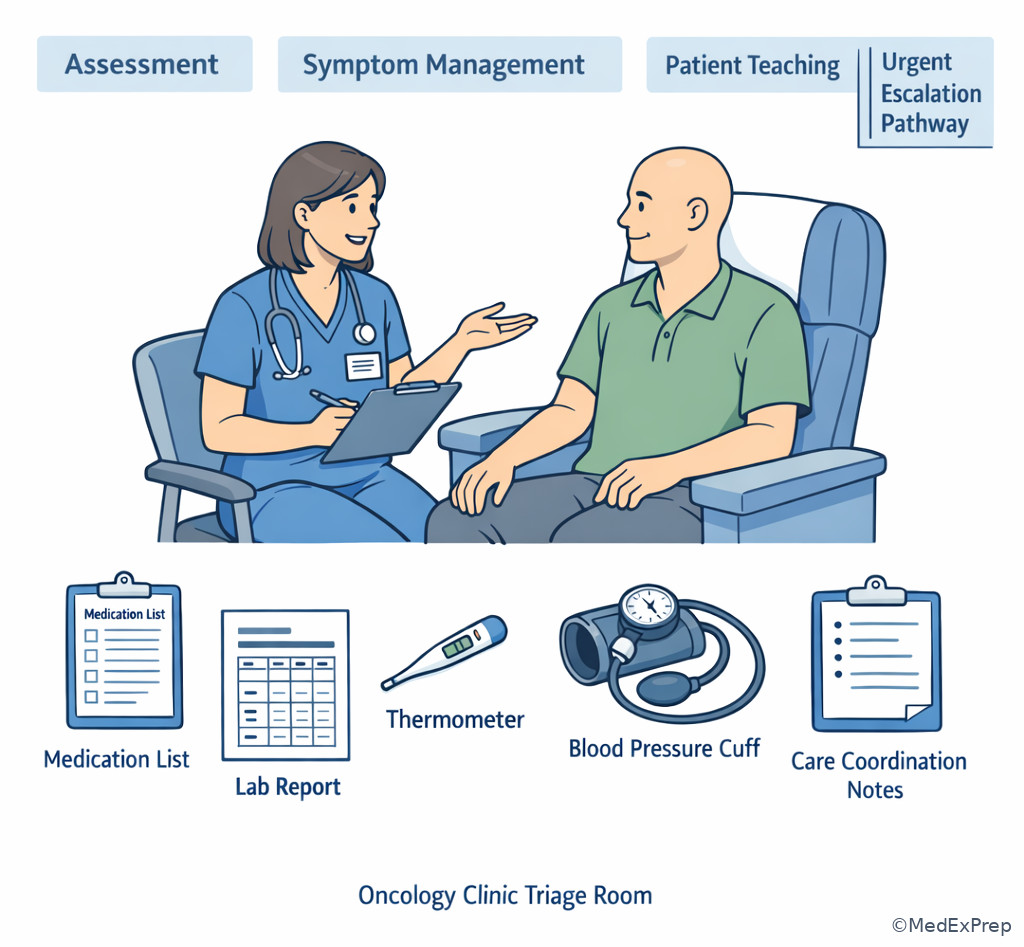
Exam takeaway: Visualize the NP role as assessment, symptom triage, teaching, and coordination rather than physician-only procedures.
Core content
1.1.1.3 Foundational boundary: what the oncology NP should do first
A Explanation
The exam conflict here is usually act independently now versus assess, stabilize within scope, and escalate. The resolving rule is simple: if the stem contains instability, red-flag oncology findings, or a need for definitive specialty intervention, the oncology NP's best answer is not to perform the specialist task; it is to recognize the problem, initiate immediate supportive care within protocol, and activate the right team. The NP is expected to perform advanced assessment, interpret common data, begin symptom-focused interventions, educate the patient, coordinate care, and document the response. The NP is not expected to perform surgery, radiation planning, pathology sign-out, independent critical-care procedures outside privilege, or institution-specific chemotherapy decisions without protocol context.
WHY THIS IS TESTED: Board items hide scope in realistic choices. A wrong answer often sounds medically sophisticated but skips the NP responsibility to prioritize safety and collaboration.
Choose an answer that matches this sequence: assess severity, identify whether the problem is emergent versus nonemergent, intervene within scope, then escalate when definitive treatment or higher-level evaluation is required. Reject answers that jump to definitive specialty action, ignore urgent deterioration, or postpone action for convenience. See Fig 1.
B Worked example
A 63-year-old man with metastatic non-small cell lung cancer on pembrolizumab presents to clinic with 2 days of worsening dyspnea, dry cough, and fatigue. He also has COPD and type 2 diabetes. Pulse oximetry is 88% on room air, temperature is 37.6°C, and he mentions that he “probably just needs an inhaler refill” because pollen has been bad. His sodium is mildly low from prior chronic SIADH, which distracts from the current issue. The task asks for the most appropriate next step.
Identify task: priority action, not diagnosis trivia. Extract key facts: cancer therapy with checkpoint inhibitor, hypoxemia, new dyspnea, cough, possible pneumonitis versus COPD flare versus infection. Apply rule: unstable respiratory finding means assess/stabilize and urgent escalation; do not manage as a routine refill request. Eliminate distractors: giving routine outpatient education alone is too low priority; independently choosing high-dose inpatient treatment without evaluation exceeds role framing; delaying until next imaging is unsafe. Verify: the NP should urgently evaluate oxygenation needs, initiate protocol-based supportive steps, and escalate for same-day urgent workup and management.
C Exam trap
D Checkpoint
Question: A 58-year-old woman with breast cancer receiving docetaxel calls the infusion triage line with fever to 101.8°F, chills, severe fatigue, and mouth sores. She has hypertension and osteoarthritis. Her husband asks whether she can wait until morning because she has a clinic visit scheduled. What is the most appropriate next step for the oncology NP?
- Advise acetaminophen, oral fluids, and arrival for the scheduled morning visit
- Initiate urgent neutropenic fever evaluation pathway and direct immediate same-day escalation per protocol
- Wait for the CBC result from last week before deciding whether fever is concerning
- Provide mucositis education and schedule a nutrition consult
- A: Tempting because home comfort measures sound practical, but wrong because fever during recent chemotherapy is a potential emergency and must not wait.
- B: Tempting because it feels aggressive, and correct because suspected neutropenic fever requires immediate evaluation and escalation rather than watchful waiting.
- C: Tempting because data review matters, but wrong because the current fever is actionable even before a new lab is available.
- D: Tempting because mouth sores are present, but wrong because supportive teaching is lower priority than fever triage.
1.1.1.4 Foundational boundary: what belongs to collaboration, consultation, or referral
A Explanation
The next exam conflict is manage alone versus co-manage with the right specialist. The resolving rule is: if the needed action requires specialist procedure, subspecialty interpretation, or service-level resources beyond routine NP management, choose consultation or escalation while continuing the NP work of assessment, symptom support, communication, and follow-up coordination. This includes surgery, radiation planning, urgent decompression, complex pathology interpretation, central line procedures outside privilege, and ICU-level interventions. It also includes situations where the patient is stable enough for planned referral but the next step still belongs to another discipline.
WHY THIS IS TESTED: Oncology care is interprofessional. The exam wants you to know not only what is dangerous, but who must become involved and how fast. Choosing the correct consultant is as testable as recognizing the syndrome.
Board stems often pair a correct clinical recognition with four actions: one exceeds scope, one is right but too late, one is routine teaching, and one properly consults or refers. The best answer is the one that keeps the patient safe and moves care toward definitive management without role overreach. See Fig 2.
Exam takeaway: Match the clinical problem to NP management versus urgent specialty involvement instead of choosing the most technical-sounding action.
flowchart LR
A[New oncology problem] --> B{Immediate instability?}
B -- Yes --> C[Emergency pathway + team escalation]
B -- No --> D{Needs procedure or specialty-only interpretation?}
D -- Yes --> E[Consult or refer appropriate service]
D -- No --> F{Protocol-based symptom management possible?}
F -- Yes --> G[NP manages, teaches, monitors]
F -- No --> H[Collaborative decision with oncology team]
See Fig 2 when deciding whether the next step belongs to NP management, collaborative oncology management, or urgent specialty escalation.
B Worked example
A 71-year-old woman with metastatic breast cancer reports 1 week of increasing mid-back pain, new leg heaviness, and difficulty starting urination. She also has chronic lumbar arthritis and diabetic neuropathy, which make benign explanations tempting. She is afebrile and says she is mostly worried because her granddaughter's wedding is in 3 days. The stem asks for the best initial management.
Identify task: action, not merely naming the syndrome. Extract key facts: metastatic cancer, back pain, leg heaviness, urinary symptoms, possible spinal cord compression. Apply rule: this needs urgent evaluation and specialty escalation; the NP should not treat it as routine pain titration alone or defer to outpatient physical therapy. Eliminate distractors: adjusting oral analgesics may be supportive but is not enough; arranging routine MRI next week is unsafe; performing definitive decompression is outside role. Verify: urgent escalation for emergent evaluation, imaging per protocol, and appropriate oncology/neurosurgical/radiation involvement is the safest answer.
C Exam trap
D Checkpoint
Question: A 66-year-old man with head and neck cancer has rapidly worsening stridor, visible neck swelling, and anxiety during clinic intake. He also has GERD and chronic sinusitis. Which action is the highest priority for the oncology NP?
- Arrange outpatient speech therapy evaluation for swallowing
- Activate urgent airway/emergency escalation and remain with the patient while initiating immediate supportive measures per protocol
- Teach humidification and oral hydration strategies
- Request a routine CT neck for the next available imaging slot
- A: Tempting because swallowing issues matter in head and neck cancer, but wrong because stridor signals airway risk that takes priority.
- B: Tempting because it appears intensive, and correct because airway compromise is an immediate escalation problem, not an outpatient education problem.
- C: Tempting because supportive care is helpful, but wrong because it does not address imminent airway deterioration.
- D: Tempting because imaging may be needed, but wrong because the patient requires stabilization and emergency pathway first.
- Fill in the blank: If the needed next step is a physician-only procedure, the NP should ______ and ______. Recognize/escalate.
- True or False: A technically correct intervention can still be the wrong answer if it occurs at the wrong priority. True.
- Name 3 classic escalation domains in oncology: airway compromise, neurologic compromise, sepsis/infection risk.
1.1.1.5 Applied boundary: medication, protocol, and treatment-plan limits
A Explanation
This section tests the conflict between being proactive and overstepping protocol or authority. The resolving rule is: the oncology NP may initiate or recommend therapies, supportive medications, monitoring, and adjustments when consistent with licensure, collaborative agreement, institutional policy, and local prescriptive authority. On exam day, use learner-safe wording: follow current guideline recommendations and local protocols. Reject answers that assume unrestricted authority to independently alter complex anticancer regimens, bypass chemotherapy verification, ignore required monitoring, or override black-box warnings.
WHY THIS IS TESTED: Real oncology care depends on protocol, verification, and team safety systems. Questions often tempt you with an answer that sounds efficient but violates safety checks.
Within scope, the NP can assess toxicity, trend labs, determine whether findings are concerning, hold or flag treatment per protocol, provide supportive care, educate the patient, and coordinate urgent review. The NP should not casually “continue treatment as planned” when toxicity red flags are present, and should not bypass policies that exist to prevent catastrophic harm. This is especially important with chemotherapy, immunotherapy toxicities, anticoagulation, transfusion support, opioids, growth factors, and oral anticancer therapy monitoring.
Exam takeaway: Distinguish supportive NP actions from regimen-level decisions that require collaborative or protocol-defined review.
flowchart TD
A[Toxicity or medication question] --> B{Supportive care within policy?}
B -- Yes --> C[Assess, intervene, teach, monitor]
B -- No --> D{Unsafe to continue treatment now?}
D -- Yes --> E[Hold or flag per protocol and escalate]
D -- No --> F[Clarify protocol before proceeding]
E --> G[Collaborative plan and documentation]
See Fig 3 for the high-yield divide between supportive NP action and regimen-level overreach.
B Worked example
A 49-year-old woman with hormone receptor-positive metastatic breast cancer on oral targeted therapy reports new severe diarrhea, lightheadedness, and reduced oral intake. She has hypothyroidism and migraines. Her spouse says she “never wants to miss a cancer pill,” making continuation emotionally appealing. A recent cholesterol elevation in the chart distracts from the acute issue. The stem asks which action requires immediate clarification before the patient continues therapy.
Identify task: safety decision about continuation. Extract key facts: severe acute toxicity, dehydration symptoms, oral therapy, patient motivation to continue. Apply rule: the NP should not encourage ongoing use through severe toxicity without protocol-guided review; supportive care plus escalation/clarification is safer. Eliminate distractors: adherence praise is not enough; waiting for the next routine visit is too late; independently redesigning the regimen exceeds safe general framing. Verify: hold/clarify per local protocol, treat dehydration risk, teach red flags, and coordinate prompt oncologic review.
C Exam trap
D Checkpoint
Question: A patient receiving clinic-administered chemotherapy arrives with platelets well below the treatment parameter listed in the standing protocol and reports new gum bleeding. Which action is the most appropriate for the oncology NP?
- Proceed with treatment to avoid delaying cancer control
- Hold and escalate according to treatment parameters, assess bleeding severity, and document the safety concern
- Tell the infusion nurse to continue because the patient signed consent previously
- Advise a soft toothbrush and recheck next month
- A: Tempting because treatment continuity matters, but wrong because active bleeding plus out-of-parameter labs make continuation unsafe.
- B: Tempting because it may delay treatment, and correct because protocol and patient safety override routine scheduling.
- C: Tempting because prior consent and workflow pressures exist, but wrong because consent does not override current safety parameters.
- D: Tempting because bleeding precautions are appropriate, but wrong because teaching alone misses immediate treatment safety action.
1.1.1.6 Applied boundary: communication, documentation, and patient teaching responsibilities
A Explanation
Some stems test the opposite problem: not overreach, but under-owning the NP role. The resolving rule is that assessment alone is not enough. The oncology NP must translate findings into patient teaching, return precautions, documentation, follow-up timing, and coordinated handoff. If the patient is safe for outpatient management, the best answer often includes explicit education about red flags, symptom self-management, when to call, and what monitoring is required. If escalation is needed, the NP still documents focused findings, actions taken, response, and whom the patient was transferred to or discussed with.
WHY THIS IS TESTED: Exam items reward complete, safety-oriented NP practice rather than a narrow diagnostic answer. Communication failures are a major cause of oncology harm.
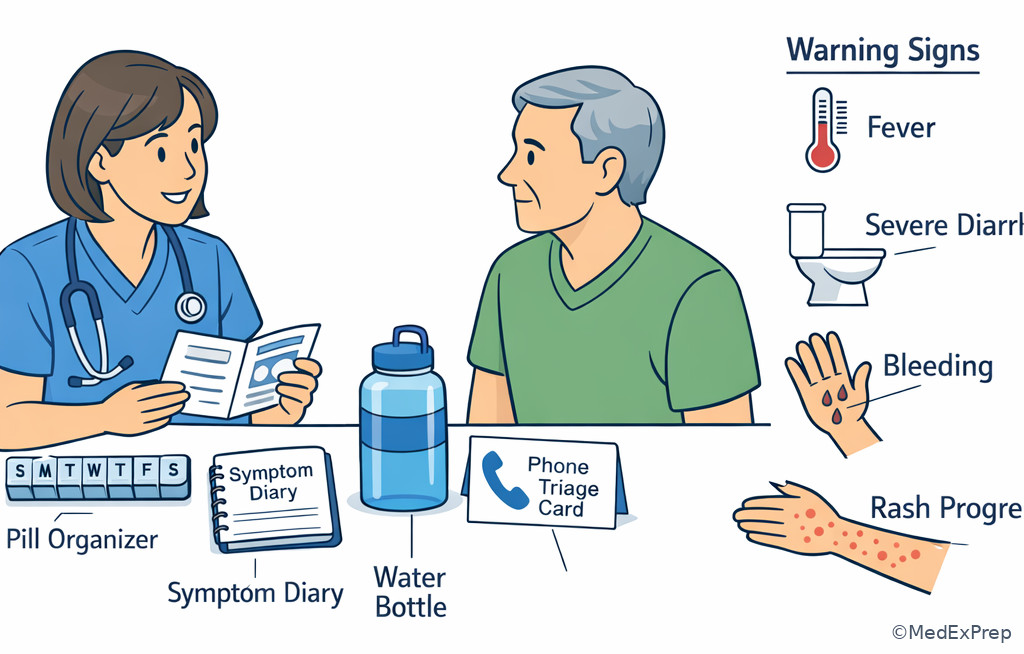
Patient teaching is especially high-yield around fever, bleeding, dyspnea, new weakness, confusion, uncontrolled vomiting/diarrhea, dehydration, mucositis preventing intake, rash progression, and oral therapy adherence/safe handling. Documentation should be concise but defensible: symptom onset, severity, associated findings, relevant treatment context, interventions, escalation, and patient understanding. See Fig 4 for a communication-centered care map.
Exam takeaway: The correct answer often includes explicit return precautions, documentation, and care coordination rather than assessment alone.
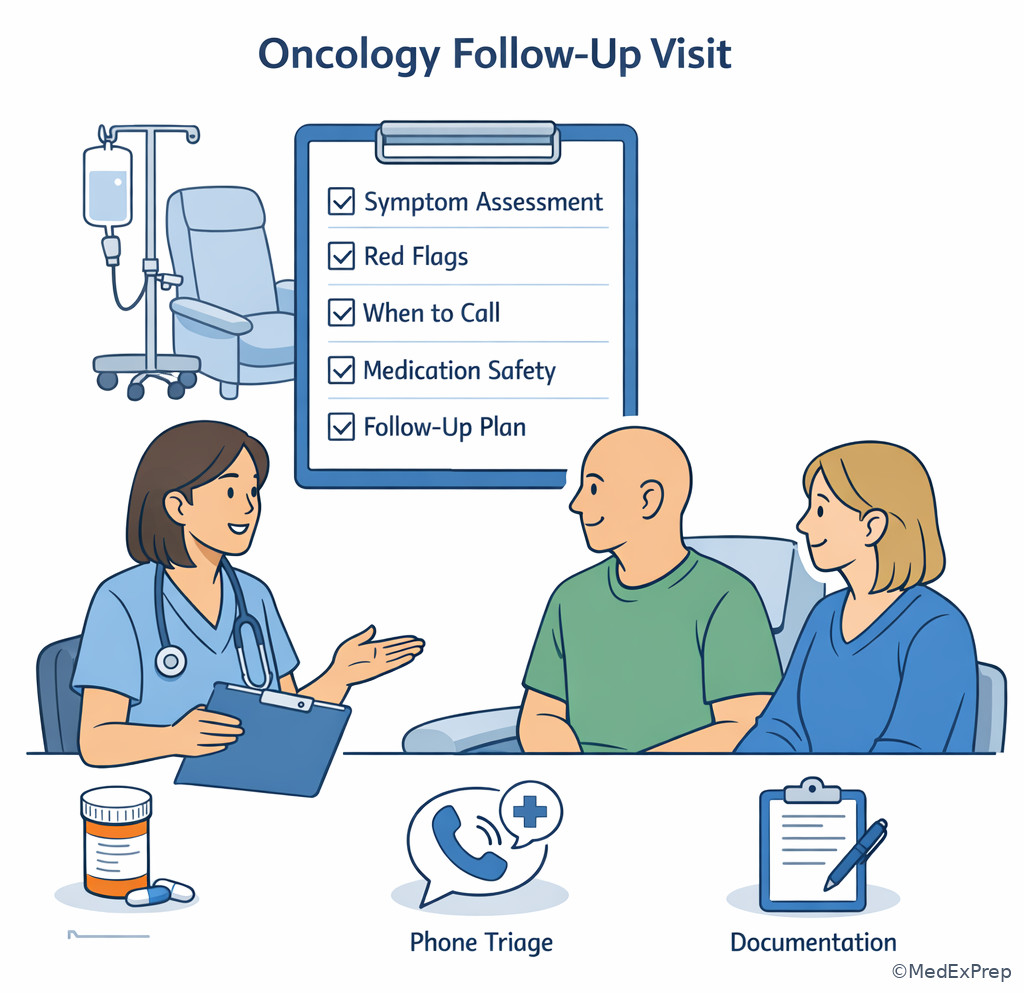
See Fig 4 to remember that the NP role is not finished until the patient knows what to do next and the team knows what was done.
B Worked example
A 56-year-old man on palliative chemotherapy calls with mild nausea and reduced appetite for 1 day. He also has chronic anxiety and stage 2 CKD. He denies fever, dyspnea, bleeding, or inability to keep fluids down. The distracting clue is that he says, “Last time this happened I ended up in the ED,” but review shows that prior episode involved fever and dehydration after several days of vomiting. The current question asks for the best initial management.
Identify task: outpatient symptom management within scope. Extract key facts: mild symptoms, no current red flags, oral intake still possible, anxiety increasing perceived risk. Apply rule: when stable, the NP should manage supportively within protocol, teach escalation triggers, and arrange appropriate follow-up. Eliminate distractors: automatic ED referral is not necessary without danger signs; no teaching is incomplete; independently changing the full chemotherapy plan is beyond the immediate task. Verify: supportive antiemetic guidance per protocol, hydration teaching, callback precautions, and close reassessment are appropriate.
C Exam trap
D Checkpoint
Question: A stable patient on oral anticancer therapy reports a grade of fatigue that is bothersome but unchanged for 2 weeks, with normal oral intake and no dyspnea, fever, or bleeding. Which response best reflects the oncology NP role?
- Provide education on energy conservation, review red flags that require urgent contact, assess contributors, and arrange follow-up reassessment
- Tell the patient fatigue is expected and no follow-up is needed
- Directly discontinue the cancer therapy permanently without protocol review
- Transfer the patient to the emergency department for same-day evaluation
- A: Tempting because it seems basic, and correct because stable symptom management with teaching and reassessment is core NP work.
- B: Tempting because fatigue is common, but wrong because dismissive reassurance fails to assess or educate.
- C: Tempting because therapy may contribute, but wrong because permanent regimen decisions require collaborative or protocol-based review.
- D: Tempting because cancer patients can decline quickly, but wrong because this vignette lacks urgent features.
- True or False: “Reassure and monitor” is usually enough wording for a safe outpatient oncology answer. False.
- Fill in the blank: In a stable outpatient scenario, the NP should assess, teach, document, and ______. arrange follow-up/reassessment.
- Name 3 red flags patients should be taught to report urgently: fever, worsening dyspnea, new weakness/bleeding.
1.1.1.7 Integration: how to eliminate out-of-role distractors on exam day
A Explanation
The final integration skill is test-taking: choose between several plausible actions that are all “good” in some context. The resolving rule is to rank options using three screens: priority, scope, and setting fit. First, ask what threatens life, organ function, or treatment safety right now. Second, ask whether the action is truly an oncology NP action or a specialist/procedural action. Third, ask whether the care setting supports the action: clinic, phone triage, infusion center, urgent evaluation, ED transfer, or inpatient consult. The right answer is the earliest safe action that fits all three screens.
WHY THIS IS TESTED: Many AOCNP-style questions contain one correct intervention at the wrong time, one correct diagnosis with the wrong next step, one unsafe delay, and one answer that is perfectly aligned with NP scope and patient priority.
Out-of-role distractors tend to use high-status verbs: perform, design, independently determine, override, sign out, or directly deliver specialty therapy. In-role answers use safety verbs: assess, recognize, hold, initiate supportive care, notify, consult, coordinate, monitor, teach, document, transfer. See Fig 5 for an exam-day elimination grid.
Exam takeaway: Apply priority, scope, and setting screens in sequence to find the safest NP-level next step.
flowchart TD
A[Plausible answer choices] --> B[Priority screen]
B --> C{Ignores urgent risk?}
C -- Yes --> X[Eliminate]
C -- No --> D[Scope screen]
D --> E{Requires unsupported specialty action?}
E -- Yes --> X
E -- No --> F[Setting screen]
F --> G{Can this be done now in this setting?}
G -- No --> X
G -- Yes --> H[Choose option with teaching, monitoring, or escalation closure]
See Fig 5 as your final answer ladder when two options both sound clinically reasonable.
B Worked example
A 68-year-old man with multiple myeloma on therapy presents to infusion with confusion, constipation, thirst, and weakness. He also has chronic atrial fibrillation and mild baseline anemia. His daughter focuses on his missed bowel regimen, which tempts a simple constipation answer. Blood pressure is borderline low, and the staff asks whether to proceed with treatment because transportation was difficult today. The task asks for the most appropriate next step.
Identify task: prioritize action in clinic. Extract key facts: confusion, weakness, thirst, constipation, possible hypercalcemia or dehydration, borderline hemodynamics. Apply rule: potential metabolic emergency and instability push the answer toward urgent assessment, supportive action within protocol, and escalation; treatment should not simply proceed for convenience. Eliminate distractors: bowel teaching is too narrow; routine hydration advice is insufficient; independent full inpatient management plan may exceed current setting/role. Verify: urgent evaluation, hold unsafe routine processes, and escalate appropriately.
C Exam trap
D Checkpoint
Question: Which option is most likely to be the best answer on an AOCNP exam when a stem includes a suspected oncologic emergency?
- An answer that performs the definitive specialty procedure immediately
- An answer that starts with education and routine follow-up only
- An answer that recognizes the emergency, begins supportive measures within scope, and escalates promptly
- An answer that waits for every confirmatory result before acting
- A: Tempting because it sounds decisive, but wrong because it often exceeds NP scope or ignores team processes.
- B: Tempting because patient teaching matters, but wrong because emergencies require more than education.
- C: Tempting because it seems less dramatic than definitive intervention, and correct because it matches NP role and patient-safety priority.
- D: Tempting because confirmation feels thorough, but wrong because time-sensitive emergencies require prompt action.
Exam Traps & Differentiators
- Most common wrong answer: a technically correct intervention that belongs to a specialist or later phase of care. Why: it sounds impressive. Fix: ask whether the NP's immediate job is recognition, stabilization, and escalation instead.
- Correct action, wrong priority: education, pain adjustment, imaging order, or referral can all be reasonable but lose if they delay emergency management.
- Anchoring on common symptoms: COPD, arthritis, constipation, anxiety, or chronic pain may distract from airway compromise, cord compression, hypercalcemia, or sepsis.
- Assuming unlimited authority: answers that override protocol, continue unsafe treatment, or redesign complex regimens independently are usually wrong in learner-safe exam framing.
Exam takeaway: Distinguish stable outpatient symptom management from red-flag findings that demand urgent escalation.
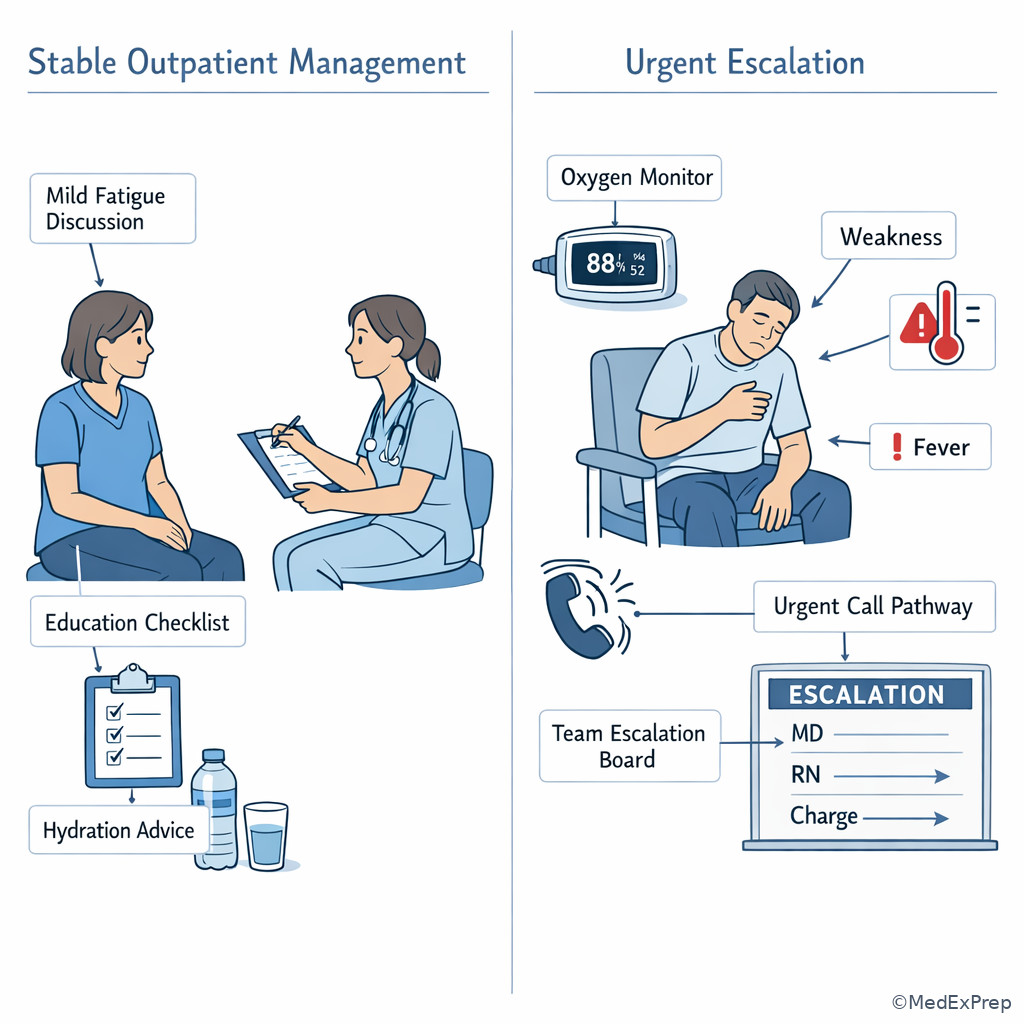
See Fig 6 for the visual contrast between routine NP symptom management and escalation-trigger presentations.
| Looks similar | Actually means | Discriminator | Best NP framing |
|---|---|---|---|
| Cancer pain flare | Possible spinal cord compression | New weakness, gait change, bladder/bowel symptoms | Urgent evaluation and specialty escalation |
| COPD or allergy symptoms | Possible pneumonitis or airway issue | Hypoxemia, treatment context, rapid progression | Assess oxygenation, urgent workup/escalation |
| Benign constipation/fatigue | Possible hypercalcemia or dehydration | Confusion, thirst, weakness, hemodynamic change | Hold routine plans and escalate |
| Expected mucositis | Possible neutropenic fever context | Fever after recent cytotoxic therapy | Emergency fever pathway |
| Routine med refill question | Protocol/authority issue | Would continuation violate treatment parameter or policy? | Clarify, hold, or escalate per protocol |
| If the stem says... | Think... |
|---|---|
| “New weakness,” “urinary retention,” “band-like back pain” | Neurologic emergency; NP recognizes and escalates |
| “Stridor,” “rapid neck swelling,” “cannot lie flat” | Airway compromise; urgent emergency pathway |
| “Fever after chemotherapy” | Neutropenic fever until proven otherwise |
| “Continue treatment despite parameter violation” | Protocol boundary; safety outranks convenience |
| “NP performs decompression/procedure/planning” | Out-of-role distractor; choose consult/escalation |
| “Stable symptom, no red flags” | Assess, manage within scope, teach, document, follow up |
Tables
| High-yield situation | Within NP role | Requires escalation / collaboration | What to monitor or teach |
|---|---|---|---|
| Stable nausea without red flags | Symptom assessment, antiemetic/supportive plan per protocol | If refractory, dehydrated, or unable to take PO | Intake, emesis count, dehydration signs, callback thresholds |
| Fever after chemotherapy | Rapid triage and emergency pathway activation | Immediate oncology/emergency evaluation | Do not self-treat and wait at home |
| New focal neurologic deficit | Focused neuro assessment, urgent safety action | Emergency imaging pathway and specialty involvement | Weakness progression, bladder/bowel changes |
| Oral therapy diarrhea | Toxicity assessment, hydration guidance, hold/clarify per protocol | If severe, persistent, or causing instability | Stool frequency, dizziness, intake, when to call |
| Bleeding with out-of-parameter platelets | Assess severity, stop unsafe continuation, document | Collaborative review and acute evaluation as needed | Bleeding precautions and urgent symptoms |
| Need for radiation planning or surgery | Recognize indication, prepare handoff, support symptoms | Radiation oncology / surgical consultation | Reason for referral, urgency, interim precautions |
| Comparison | Appropriate NP answer pattern | Wrong but tempting pattern |
|---|---|---|
| Stable symptom question | Assess + manage within scope + teach + follow up | Dismissive reassurance with no plan |
| Possible emergency | Assess + stabilize + escalate | Wait for routine clinic visit or complete confirmation |
| Protocol conflict | Hold/clarify per policy + document + notify | Continue for convenience or because consent exists |
| Needs specialty procedure | Consult/refer appropriate service promptly | Perform or independently order definitive specialty care beyond role |
| Phone triage | Structured assessment + return precautions + disposition | Casual advice without documentation or safety net |
| Differential exam scenario | Best discriminator | Likely best next step |
|---|---|---|
| Mild fatigue versus urgent cardiopulmonary issue | Dyspnea, hypoxemia, chest symptoms, instability | Urgent escalation if present; outpatient teaching if absent |
| Routine pain versus cord compression | Neurologic deficit or urinary retention | Emergency evaluation pathway |
| Expected GI toxicity versus dehydration emergency | Orthostasis, inability to keep fluids down, confusion | Urgent evaluation and supportive action |
| Adherence issue versus unsafe continuation | Severe toxicity or lab parameter violation | Hold/clarify rather than encourage continued use |
| Education need versus specialist handoff need | Would definitive care require procedure/planning outside NP role? | Consult/referral with NP support tasks |
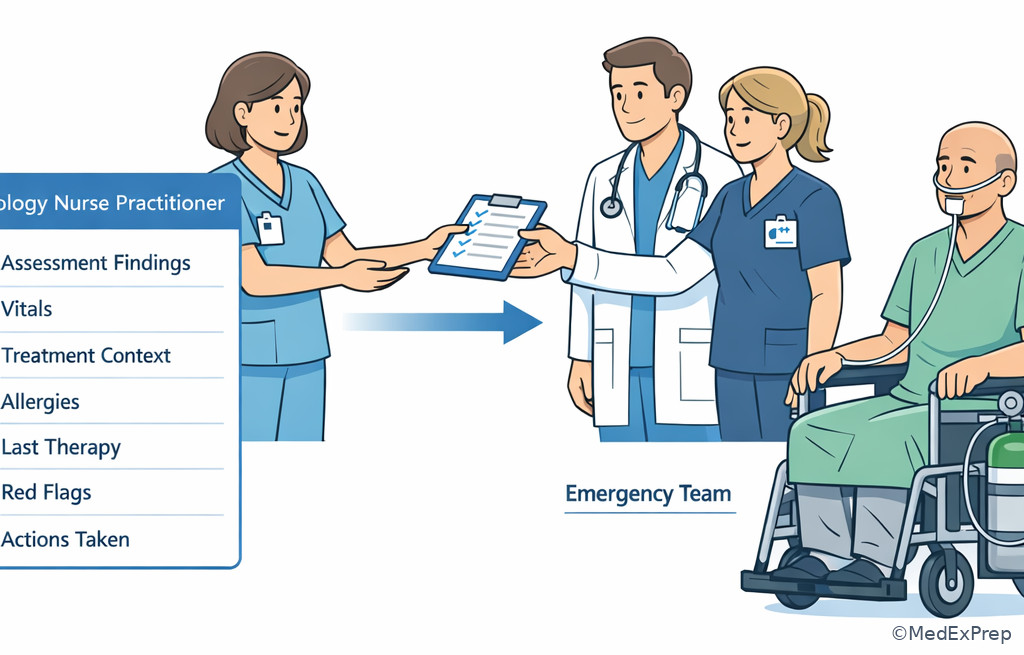
Exam takeaway: Safe NP practice includes efficient handoff, concise documentation, and monitoring during transfer for unstable oncology patients.
Exam takeaway: Stable outpatient management still requires explicit teaching on toxicity reporting, adherence, and when to hold or call.
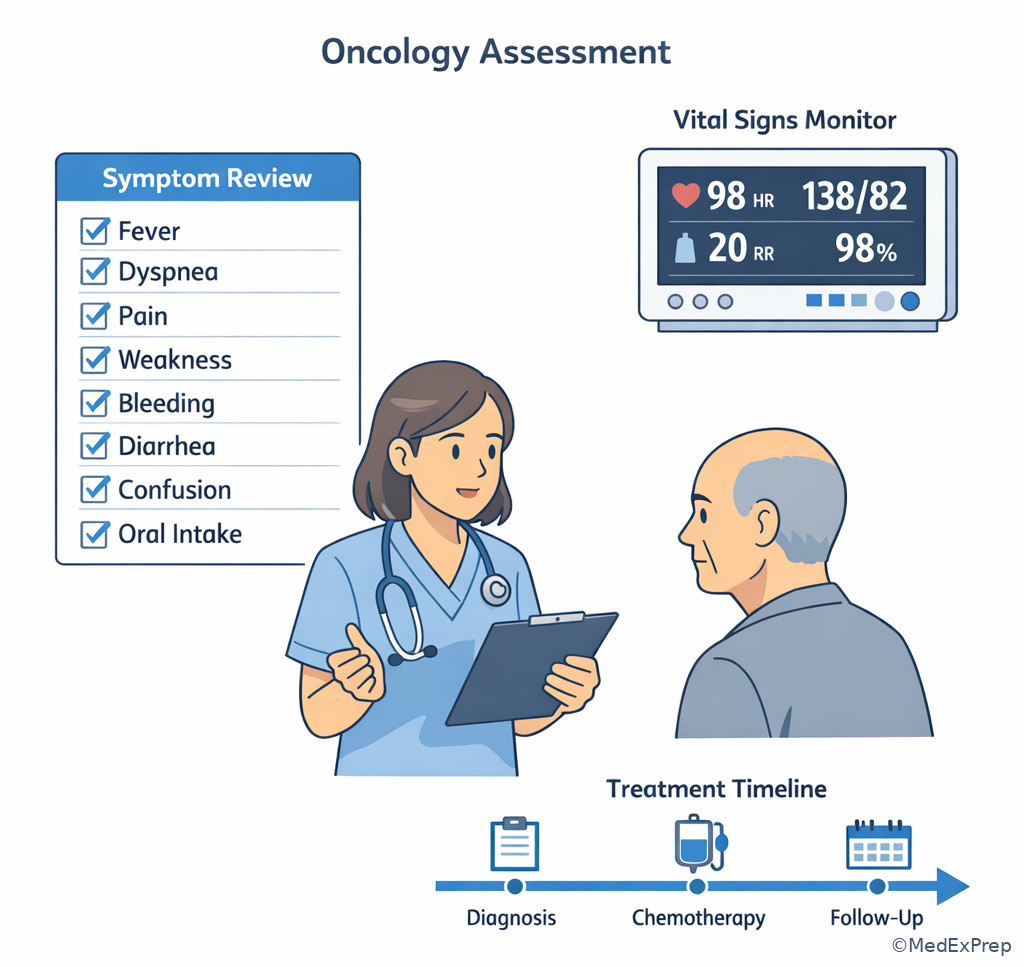
Exam takeaway: The strongest answers begin with targeted assessment that immediately screens for instability and treatment-related emergencies.
Algorithm / Approach
Exam takeaway: The best answer is the earliest safe NP-level action that addresses urgency, respects scope, and ensures follow-through.
flowchart TD
A[Stem asks for next step] --> B{Emergency signs present?}
B -- Yes --> C[Immediate supportive action within scope]
C --> D[Urgent escalation or transfer]
B -- No --> E{Can NP manage under protocol?}
E -- Yes --> F[Manage symptom or toxicity]
F --> G[Teach red flags and document]
E -- No --> H[Consult or refer]
H --> G Rapid Review
- Unstable oncology symptom → assess/stabilize/escalate beats routine teaching
- Specialist-only procedure → consult/referral beats independent action
- Protocol violation → hold/clarify beats convenience-based continuation
- Stable outpatient symptom → manage within scope plus explicit return precautions
- Hypoxemia in clinic → respiratory urgency beats common benign explanation
- Back pain + urinary symptoms → think cord compression, not routine analgesic adjustment
- Fever after cytotoxic therapy → emergency triage beats next-day follow-up
- Education-only answer → wrong if red flags are present
- Definitive technical answer → wrong if it exceeds NP scope in the stem
- Phone triage → needs disposition, documentation, and callback thresholds
- Consent on file → does not override current safety concerns
- Adherence counseling → secondary when toxicity makes continuation unsafe
- Best answer tone → safety verbs beat heroic verbs
Self-check quiz
1. A 60-year-old woman receiving adjuvant chemotherapy calls about a temperature of 101.5°F, shaking chills, and new fatigue. She also has hypertension and seasonal allergies. Which action is the most appropriate next step for the oncology NP?
- Advise fluids and recheck temperature in the morning
- Initiate urgent same-day fever evaluation/escalation per protocol
- Recommend acetaminophen and document the call only
- Schedule a routine clinic visit in 48 hours
2. A stable 54-year-old man on oral anticancer therapy reports mild fatigue for 1 week with normal intake, no dyspnea, no bleeding, and no fever. He also has mild depression and controlled GERD. Which response best reflects the oncology NP role?
- Provide focused assessment, self-management teaching, return precautions, and planned follow-up
- Send him to the emergency department for immediate evaluation
- Permanently stop the therapy without protocol review
- Reassure him that fatigue never requires follow-up
3. A 72-year-old woman with metastatic breast cancer presents with worsening thoracic back pain, new leg weakness, and difficulty voiding. She also has osteoarthritis and chronic constipation. Which action is the highest priority?
- Increase long-acting opioid dosing and reassess tomorrow
- Arrange routine outpatient physical therapy
- Urgently escalate for evaluation of possible spinal cord compression
- Teach bowel regimen changes because constipation may worsen pain
4. A 67-year-old man receiving immunotherapy reports new dyspnea and dry cough. He has COPD and type 2 diabetes. Oxygen saturation is 89% on room air, and he says pollen usually bothers him this time of year. Which action is the most appropriate?
- Call in a routine inhaler refill and follow up next week
- Urgently assess, initiate supportive measures within protocol, and escalate for same-day evaluation
- Provide allergy avoidance teaching and home monitoring only
- Wait for the next scheduled scan before acting
5. A patient arrives for infusion with platelets below the standing treatment threshold and reports new gum bleeding. The patient also has chronic neuropathy and is worried about transportation if treatment is delayed. What is the best next step?
- Proceed with treatment because the patient already consented
- Hold treatment per parameter, assess bleeding severity, and escalate/document according to protocol
- Advise a soft toothbrush and continue as planned
- Ignore the lab because platelet values often fluctuate
6. A 64-year-old man with lymphoma in the infusion center develops new confusion, weakness, constipation, and increased thirst. He also has controlled atrial fibrillation and chronic anemia. His daughter says he probably just missed his laxatives. Which action is the most appropriate next step?
- Proceed with treatment, then reinforce constipation teaching
- Provide oral fluids and discharge with next-week follow-up
- Hold routine treatment flow, perform urgent assessment/supportive actions within scope, and escalate for possible metabolic emergency
- Request routine outpatient nutrition counseling
7. A 59-year-old woman with head and neck cancer develops audible stridor, anxiety, and rapidly increasing neck swelling during clinic check-in. She also has hypothyroidism and chronic xerostomia. Which action requires immediate prioritization by the oncology NP?
- Teach humidification and oral care measures
- Activate urgent airway/emergency escalation while remaining with the patient and initiating supportive measures per protocol
- Arrange the next available outpatient CT scan
- Refer to speech therapy for swallowing evaluation
8. A 51-year-old woman on oral targeted therapy reports severe diarrhea, dizziness, and poor oral intake since yesterday. She also has migraine history and well-controlled hypothyroidism. She insists she does not want to miss any cancer pills. Which response is the best initial management?
- Encourage strict adherence and discuss symptoms at the next routine visit
- Hold or clarify continuation according to protocol, address dehydration risk, teach urgent warning signs, and coordinate prompt oncology review
- Tell her to halve the dose on her own until she feels better
- Focus on adherence counseling only because missed doses reduce efficacy
Answer key
1.1.1.8 1. Question 1
Correct answer: B
- A: Tempting because hydration and observation are common self-care advice. Incorrect because fever with recent chemotherapy raises concern for neutropenic fever, which is a time-sensitive emergency. Single clue: 101.5°F with chills after chemotherapy. Priority principle: safety/ABCs and infection risk outrank home observation. Source: NCSBN clinical judgment emphasis; Lewis Medical-Surgical Nursing.
- B: Tempting because it may feel resource-intensive, and correct because the oncology NP should recognize possible neutropenic fever and activate urgent evaluation per protocol. Single clue: fever plus chills in a chemotherapy patient. Priority principle: prevent rapid deterioration through immediate escalation. Source: NCSBN; Saunders Comprehensive Review.
- C: Tempting because antipyretics feel helpful and documentation is necessary. Incorrect because supportive advice alone delays emergency assessment. Single clue: fever is the urgent finding, not the documentation task. Priority principle: assessment and urgent action come before routine symptom relief. Source: ANA Standards of Practice; Lewis.
- D: Tempting because clinic follow-up seems organized. Incorrect because 48-hour delay is unsafe in suspected neutropenic fever. Single clue: same-day urgency. Priority principle: acute infection risk overrides scheduling convenience. Source: NCSBN; Saunders.
1.1.1.9 2. Question 2
Correct answer: A
- A: Tempting because it sounds basic, and correct because stable symptoms without red flags are appropriate for NP assessment, teaching, follow-up, and monitoring. Single clue: no dyspnea, bleeding, or fever. Priority principle: use the nursing process to assess and plan before escalating unnecessarily. Source: ANA Standards; Saunders.
- B: Tempting because oncology patients can worsen quickly. Incorrect because this patient is stable and lacks emergency findings. Single clue: mild fatigue only. Priority principle: least restrictive safe setting. Source: NCSBN; Lewis.
- C: Tempting because treatment may contribute to fatigue. Incorrect because permanent therapy discontinuation exceeds the immediate safe outpatient response and bypasses protocol/collaboration. Single clue: no severe toxicity described. Priority principle: do not overreact beyond scope or authority. Source: ANA; Saunders.
- D: Tempting because fatigue is common. Incorrect because patient education and reassessment are still required. Single clue: persistent symptom for 1 week. Priority principle: evaluation and follow-up are part of safe care even when stable. Source: ANA Standards; Lewis.
1.1.1.10 3. Question 3
Correct answer: C
- A: Tempting because pain management is within oncology NP practice and may be needed. Incorrect because analgesic escalation alone delays urgent evaluation of possible cord compression. Single clue: leg weakness and difficulty voiding. Priority principle: neurologic preservation outranks routine symptom titration. Source: Lewis; NCSBN.
- B: Tempting because back pain and weakness may suggest deconditioning. Incorrect because new neurologic and bladder findings are red flags, not rehab-first features. Single clue: progressive neurologic symptoms. Priority principle: urgent neurologic threat supersedes long-term therapy planning. Source: Saunders; ANA.
- C: Tempting because it may seem alarmist, and correct because metastatic cancer with back pain, weakness, and voiding difficulty requires urgent evaluation for spinal cord compression. Single clue: combined pain + weakness + urinary change. Priority principle: prevent irreversible neurologic loss. Source: Lewis; NCSBN.
- D: Tempting because constipation can worsen discomfort. Incorrect because bowel education is lower priority than possible cord compression. Single clue: weakness is not explained by constipation. Priority principle: ABCs/neurologic emergency before comfort teaching. Source: ANA; Saunders.
1.1.1.11 4. Question 4
Correct answer: B
- A: Tempting because COPD makes inhaler refill plausible. Incorrect because hypoxemia and new respiratory symptoms in a patient on immunotherapy require urgent evaluation. Single clue: oxygen saturation 89% on room air. Priority principle: breathing comes before routine outpatient refill management. Source: Lewis; NCSBN.
- B: Tempting because it may feel aggressive, and correct because the NP should recognize a potential serious treatment-related pulmonary problem and escalate same-day. Single clue: new dyspnea with hypoxemia. Priority principle: stabilize and escalate respiratory compromise. Source: Saunders; ANA.
- C: Tempting because the patient reports a seasonal pattern. Incorrect because the objective oxygen deficit makes home teaching alone unsafe. Single clue: measurable hypoxemia, not just subjective symptoms. Priority principle: objective instability overrides benign narrative. Source: NCSBN; Lewis.
- D: Tempting because imaging may clarify diagnosis. Incorrect because waiting delays urgent care in a symptomatic hypoxemic patient. Single clue: need for immediate action now. Priority principle: treat urgency before routine diagnostic scheduling. Source: ANA; Saunders.
1.1.1.12 5. Question 5
Correct answer: B
- A: Tempting because the patient wants to stay on schedule and has already consented. Incorrect because consent does not permit treatment against current safety parameters. Single clue: platelet threshold violation plus active gum bleeding. Priority principle: safety and protocol override convenience. Source: ANA Standards; Saunders.
- B: Tempting because it may disrupt the day, and correct because holding unsafe treatment, assessing bleeding, escalating, and documenting are exactly the NP safety responsibilities. Single clue: lab parameter plus bleeding symptom. Priority principle: prevent harm before implementation. Source: NCSBN; Lewis.
- C: Tempting because bleeding precautions are appropriate. Incorrect because teaching alone misses the immediate treatment-safety issue. Single clue: the patient is about to receive therapy. Priority principle: assess/analyze before routine education. Source: ANA; Saunders.
- D: Tempting because labs can vary. Incorrect because active bleeding confirms the abnormal platelet count is clinically relevant. Single clue: gum bleeding. Priority principle: do not dismiss objective risk data. Source: Lewis; NCSBN.
1.1.1.13 6. Question 6
Correct answer: C
- A: Tempting because constipation is common and the daughter offers a simple explanation. Incorrect because confusion, weakness, thirst, and constipation together suggest a possible metabolic emergency such as hypercalcemia or dehydration. Single clue: confusion. Priority principle: altered mental status elevates priority above routine infusion flow. Source: Lewis; NCSBN.
- B: Tempting because oral fluids are supportive and the patient is not yet crashing. Incorrect because discharge with delayed follow-up is insufficient in a patient with neurologic change and systemic symptoms. Single clue: acute confusion with multiple concerning findings. Priority principle: potential instability requires more than home advice. Source: Saunders; ANA.
- C: Tempting because it interrupts planned care, and correct because the NP should stop routine progression, urgently assess, start supportive measures within scope, and escalate. Single clue: change in mentation plus dehydration-type symptoms. Priority principle: circulation/metabolic safety before scheduled treatment. Source: NCSBN; Lewis.
- D: Tempting because nutrition matters in oncology. Incorrect because counseling is too low priority for possible metabolic decompensation. Single clue: current acute symptoms, not chronic intake concerns. Priority principle: urgent physiology before long-range supportive services. Source: ANA; Saunders.
1.1.1.14 7. Question 7
Correct answer: B
- A: Tempting because humidification and oral care are useful for head and neck symptom burden. Incorrect because audible stridor and rapidly increasing neck swelling indicate possible airway compromise. Single clue: stridor. Priority principle: airway before comfort teaching. Source: Lewis; NCSBN.
- B: Tempting because it may feel dramatic, and correct because airway risk requires immediate emergency escalation while the NP remains engaged in supportive actions and monitoring. Single clue: rapidly worsening airway signs. Priority principle: ABCs, especially airway, always come first. Source: Saunders; ANA Standards.
- C: Tempting because imaging can help define anatomy. Incorrect because routine CT scheduling is not the first step when airway compromise is possible. Single clue: urgency is clinical, not scheduling-based. Priority principle: stabilize before diagnostics. Source: NCSBN; Lewis.
- D: Tempting because swallowing dysfunction is common in this population. Incorrect because speech therapy does not address immediate airway threat. Single clue: neck swelling with stridor is not a rehab-first problem. Priority principle: life-threatening risk outranks supportive referral. Source: ANA; Saunders.
1.1.1.15 8. Question 8
Correct answer: B
- A: Tempting because adherence is essential in oral therapy. Incorrect because severe diarrhea, dizziness, and poor intake suggest unsafe continuation without protocol-guided review. Single clue: dehydration risk symptoms. Priority principle: safety before adherence reinforcement. Source: ANA; Lewis.
- B: Tempting because holding or clarifying therapy can feel like loss of cancer control, and correct because the NP must address toxicity, dehydration risk, teaching, and prompt collaborative review according to policy. Single clue: severe acute toxicity rather than mild nuisance symptoms. Priority principle: assess and intervene before continuing a potentially harmful process. Source: Saunders; NCSBN.
- C: Tempting because dose reduction may eventually be part of management. Incorrect because instructing self-directed dose changes without protocol review is unsafe. Single clue: no authority or protocol support in the stem. Priority principle: do not bypass medication safety systems. Source: ANA Standards; Saunders.
- D: Tempting because fear of missed doses is real. Incorrect because adherence counseling alone ignores current instability and toxicity. Single clue: dizziness and poor intake shift the issue from compliance to safety. Priority principle: physiologic stability before long-term adherence goals. Source: Lewis; NCSBN.
Keep going with the full AOCNP Prep Course (AOCNP)
You just studied the way members do, in the same lesson interface. Full access unlocks every lesson, the question bank and flashcards for a full year.
One payment · 1 year of access · No auto-renewal