1.1.1 - AMB-BC Domain Map
AMB-BC Domain Map
What you’ll learn
- DOMAIN: Clinical Practice and Assessment -> Subskill: Identify focused outpatient assessment tasks most often tested in ambulatory RN scenarios.
- DOMAIN: Triage, Telehealth, and Access -> Subskill: Distinguish remote urgency recognition, disposition thinking, and access barriers from routine education tasks.
- DOMAIN: Care Coordination and Transitions -> Subskill: Map follow-up, referral, result tracking, and transition safety tasks to exam stems.
- DOMAIN: Patient Education and Self-Management -> Subskill: Recognize teaching, reinforcement, and adherence-support questions without drifting into provider-only management.
- DOMAIN: Quality, Safety, Risk Reduction, Population Health, and Professional Practice -> Subskill: Use RN scope, documentation, prevention, and systems thinking to reject unsafe distractors.
- Exam framework overview → learner-facing domain map for ambulatory nursing practice
- Primary mapping → Professional Practice and Leadership -> standards, scope, and test blueprint organization
- Secondary mapping → Triage, Telehealth, and Access -> urgency framing in outpatient questions
- Secondary mapping → Quality, Safety, and Risk Reduction -> safest initial RN action and escalation logic
- Weighting note → Official ANCC weighting details not provided here; use learner-facing domains without inventing percentages
Why it matters
- The AMB-BC exam rewards pattern recognition: not just knowing facts, but recognizing whether the stem is really about triage, teaching, follow-up, population outreach, or RN scope.
- Many wrong answers are attractive because they are clinically reasonable but belong to the wrong domain, wrong priority level, or outside the ambulatory RN role.
- A domain map gives you a fast filter for board-style stems: identify the task, identify the setting, then choose the safest RN action within scope.
- Early mastery of the map improves later studying because you can place every future lesson into a stable framework instead of memorizing isolated facts.
Exam takeaway: Sort each stem by the main nursing task before choosing the action.
flowchart TD
A[AMB-BC exam stem] --> B[Clinical Practice and Assessment]
A --> C[Triage Telehealth and Access]
A --> D[Care Coordination and Transitions]
A --> E[Patient Education and Self-Management]
A --> F[Quality Safety and Risk Reduction]
A --> G[Population Health and Prevention]
A --> H[Professional Practice and Leadership]
B --> B1[Focused assessment]
C --> C1[Urgency and disposition]
D --> D1[Referrals follow-up closed loop]
E --> E1[Teach-back adherence warning signs]
F --> F1[Documentation safety systems]
G --> G1[Screening outreach risk gaps]
H --> H1[Scope ethics teamwork]
Use this figure as your first mental index. See Fig 1. When an item feels broad, ask: “What is the nursing task?” That question often separates the right answer from a tempting distractor that belongs to another domain.
Key Terms & Must-Know Facts
1.1.1.1 Key terms
- Domain map: A learner-facing structure that groups exam content by major practice area.
- Subskill: A concrete, testable nursing task nested under a domain.
- Focused assessment: Targeted symptom review and data gathering to guide safe ambulatory action.
- Disposition: The urgency-based next setting or follow-up pathway.
- Red flag: A finding that raises urgency and may require same-day evaluation or emergency escalation.
- Care coordination: Actions that connect the patient to services, results, appointments, and follow-up.
- Teach-back: A method used to confirm understanding by having the patient restate instructions.
- Closed-loop communication: Sending, confirming, and documenting that a message or task was received and acted on.
- Population health: Managing preventive and chronic care needs across a panel, not only one encounter.
- Scope boundary: The line between safe RN actions and provider-only decisions.
- Triage protocol: Organization-approved process guiding urgency recognition and disposition support.
- Continuity risk: Harm created by delays, missed follow-up, lost results, or failed handoffs.
- Priority action: The safest first nursing step, often based on ABCs, safety, or missing critical data.
1.1.1.2 Must-know facts
- AMB-BC-style questions are commonly about what the RN should do first, not about the definitive medical diagnosis.
- In outpatient and remote settings, recognizing instability and escalating often outranks routine teaching.
- A correct clinical action can still be the wrong answer if it is outside RN scope as an independent decision.
- Many stems mix multiple issues; the winning move is to identify the single governing domain.
- Documentation and follow-up are not “extra”; they are often part of the best answer in ambulatory safety questions.
- Questions about test results, referrals, and discharge calls usually live in care coordination and transitions, even when symptoms are mentioned.
- Questions about understanding, adherence barriers, and home action plans usually live in patient education and self-management.
- Questions about outreach gaps, screening, and prevention workflow usually live in population health and prevention.
- When a stem asks for the safest action under uncertainty, the RN should prefer assessment, escalation, protocol use, and documentation.
| Domain | Primary exam task | Common stem language | RN focus |
|---|---|---|---|
| Clinical Practice and Assessment | Gather and interpret focused data | best initial assessment, key finding, what to ask first | symptom review, trend recognition, safety cues |
| Triage, Telehealth, and Access | Set urgency and access pathway | same-day visit, emergency guidance, phone call, portal message | red flags, remote limits, safest disposition |
| Care Coordination and Transitions | Close the follow-up loop | post-discharge call, referral, pending result, no-show | handoff safety, reconciliation, tracking |
| Patient Education and Self-Management | Improve understanding and daily management | teach, reinforce, warning signs, adherence barrier | teach-back, literacy, self-monitoring |
| Quality, Safety, and Risk Reduction | Prevent harm and system failures | documentation, error, near miss, critical value | reporting, process reliability, safety response |
| Population Health and Prevention | Address gaps across a panel | screening gap, outreach, immunization, prevention | risk stratification, equity-minded outreach |
| Professional Practice and Leadership | Stay within role and standards | delegate, scope, confidentiality, advocate | RN-only judgments, escalation, ethics |
Core content
1.1.1.3 Foundational domain map: what kind of exam problem is this?
A Explanation
In this first concept, the decision conflict is simple but crucial: Do you treat the stem as a content question or as a task-identification question? On AMB-BC-style items, the safer move is usually to identify the task first. A patient with symptoms may still be testing triage rather than diagnosis. A patient with a chronic illness may still be testing education rather than treatment selection. The single rule that resolves this conflict is: name the nursing job hidden in the stem before choosing the answer.
WHY THIS IS TESTED: Test writers compress multiple ambulatory responsibilities into one scenario. The candidate who notices the dominant task—assessment, urgency recognition, teaching, coordination, prevention, or scope—can reject answers that are clinically plausible but misaligned.
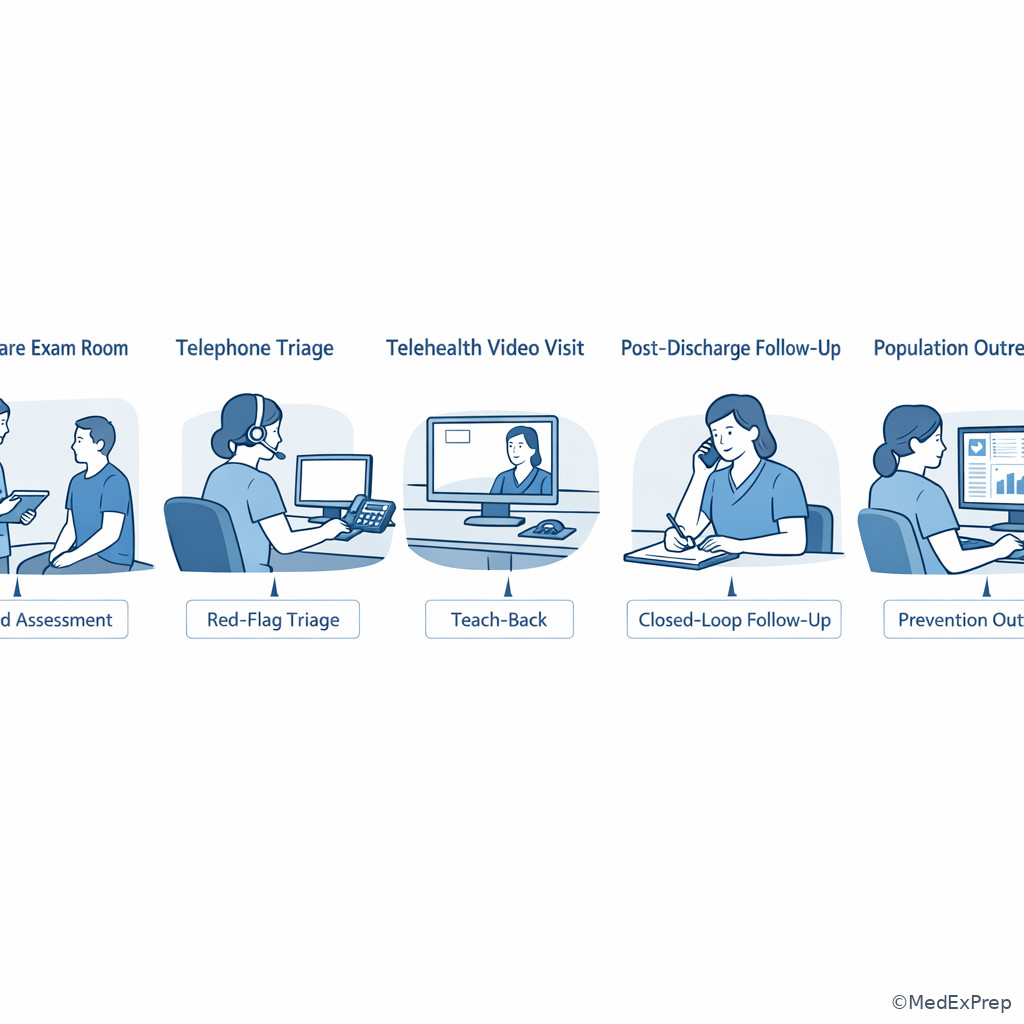
At this level, think of domains as folders. The stem gives clues about which folder to open. “Calls the clinic after hours,” “portal message,” or “telehealth follow-up” points toward triage and access. “Recently discharged,” “specialist referral,” or “critical result not acknowledged” points toward care coordination and transition safety. “Teach-back,” “new inhaler,” or “difficulty understanding instructions” points toward education and self-management. “Can the RN independently decide this?” points toward professional practice and scope. See Fig 1.
B Worked example
A 67-year-old patient with hypertension, type 2 diabetes, and chronic kidney disease sends a portal message saying, “My feet are swelling more and I’m more tired this week. Also, I need a refill.” The chart also notes a missed retinal screening and that the patient recently transferred pharmacies. A novice test-taker may focus on the refill, the chronic disease burden, or the prevention gap. Identify task → extract key facts → apply rule → eliminate distractors → verify:
- Identify task: This is not primarily a refill-management question for an RN. It is an ambulatory symptom-and-urgency screen within a remote message.
- Extract key facts: Worsening edema and fatigue are active symptoms; the setting is remote; the refill request is distracting noise.
- Apply rule: \(Domain = Triage\), Telehealth, and Access, with possible coordination after urgency is addressed.
- Eliminate distractors: Scheduling routine prevention outreach first is wrong priority. Independently adjusting treatment is outside scope. Sending generic refill instructions without assessment delays care.
- Verify: The best RN action is focused assessment using organization-approved triage workflow and escalation or same-day evaluation if indicated.
C Exam trap
D Checkpoint
Question: A clinic RN reviews a portal message from a 54-year-old patient with asthma and obesity who writes, “My inhaler is almost empty and I have been waking up more at night coughing.” The patient also asks whether the annual flu shot is still needed. What is the most appropriate first frame for this item?
- Treat it mainly as a prevention question because immunization is mentioned.
- Treat it mainly as a patient education question because inhaler use is implied.
- Treat it mainly as a triage and access question because worsening symptoms are present.
- Treat it mainly as a care coordination question because a refill is requested.
Answer: C
- A: Tempting because vaccination gaps matter in ambulatory care; wrong because symptom worsening takes priority over routine prevention.
- B: Tempting because inhaler teaching is common; wrong because urgency must be sorted before routine teaching.
- C: Correct because nighttime cough worsening in a remote message requires triage framing first.
- D: Tempting because refills are frequent outpatient tasks; wrong because refill logistics do not outrank active symptom review.
1.1.1.4 Foundational subskills: what each domain really tests
A Explanation
The next decision conflict is: Do you study domains as broad labels, or do you study the specific subskills that generate answer choices? Exams are passed at the subskill level. “Care coordination” is too vague. “Closed-loop referral tracking after an abnormal result” is testable. “Education” is too broad. “Use teach-back to confirm understanding of warning signs and follow-up” is testable.
WHY THIS IS TESTED: Board items rarely ask about a domain in the abstract. They ask the RN to perform a concrete action within a domain. If you know the subskills, answer choices become easier to sort.
For example, Clinical Practice and Assessment includes focused history, symptom characterization, medication review, functional cues, and risk cues. Triage and Telehealth includes red-flag recognition, urgency categorization, phone safety advice within protocol, limits of remote assessment, and access barriers. Care Coordination includes referral logistics, medication reconciliation after transition, pending result follow-up, and documentation of outreach attempts. Professional Practice includes delegation boundaries, confidentiality, role clarity, and using protocols appropriately rather than improvising outside scope.
See Fig 2 for a comparison of domains by trigger cues and best-first actions. This is a high-yield decision figure because it compresses what often takes several pages of prose.
Exam takeaway: Match stem clues to the subskill the RN is being tested on.
flowchart LR
A[Stem clue] --> B{Best domain}
B --> C[Assessment
Ask focused symptom questions]
B --> D[Triage
Determine urgency and disposition]
B --> E[Coordination
Close follow-up loop]
B --> F[Education
Use teach-back and warning signs]
B --> G[Safety
Document report and escalate]
B --> H[Population health
Address screening or prevention gap]
B --> I[Professional practice
Stay within RN scope] B Worked example
A 42-year-old patient with rheumatoid arthritis, depression, and limited English proficiency calls the specialty clinic two days after an ED visit. She says the discharge papers were confusing, she has not picked up one medication because the pharmacy text was in English, and she is unsure when to see her PCP. Her mild hand swelling is unchanged. A distracting clue is that she also asks whether she can start exercising again.
Reasoning chain: Identify task: this stem is mainly about transition support and coordination, not exercise counseling. Extract key facts: recent ED discharge, confusion about instructions, unfilled medication, uncertain follow-up. Apply rule: \(domain = Care Coordination and Transitions\); \(subskills = medication reconciliation support\), follow-up coordination, and health literacy-sensitive reinforcement. Eliminate distractors: independent medication changes are outside scope; broad lifestyle teaching is not the first task; reassurance without closed-loop follow-up is unsafe. Verify: the RN should review discharge understanding, reconcile what the patient received versus obtained, clarify follow-up logistics, and escalate questions requiring provider interpretation.
C Exam trap
D Checkpoint
Question: A patient reports, “I was told I need a heart monitor, but no one has called me, and I do not know where to go.” Which subskill is most directly being tested?
- Focused symptom assessment
- Referral and test coordination
- Preventive care outreach
- Remote red-flag recognition
Answer: B
- A: Tempting because symptoms may still matter; wrong because the stem centers on completing an ordered next step.
- B: Correct because the missing link is coordination of testing logistics and follow-up.
- C: Tempting because it involves system tracking; wrong because this is not a routine preventive gap.
- D: Tempting because phone communication is involved; wrong because no urgent symptom cues drive the problem.
- The most common first mistake in a broad ambulatory stem is failing to identify the dominant task.
- True or False: A symptom question that also mentions a refill is usually first a medication-management question. False.
- Name the 3 key follow-up subskills in transition questions: reconciliation, coordination, confirmation.
| Domain | High-yield subskills | Typical wrong turn | Single discriminator |
|---|---|---|---|
| Assessment | Focused history, trend check, medication/context review | Teaching before enough data | Key assessment data are still missing |
| Triage | Red flags, urgency, remote disposition | Routine appointment or reassurance | Instability or worsening symptom cue |
| Coordination | Referrals, results, transitions, closed loop | Assuming “someone else will call” | Gap in continuity pathway |
| Education | Teach-back, warning signs, self-monitoring | One-way instructions without verification | Stem asks about understanding or self-management |
| Quality/Safety | Documentation, reporting, critical response | Fixing the issue informally without system follow-up | Harm prevention or process failure is central |
| Population Health | Panel review, preventive gaps, outreach barriers | Waiting for the patient to request care | Question involves a group or care gap list |
| Professional Practice | Scope, delegation, confidentiality, advocacy | Choosing the most medically definitive option | Action exceeds RN authority |
1.1.1.5 Applied lens: how domains show up in real ambulatory stems
A Explanation
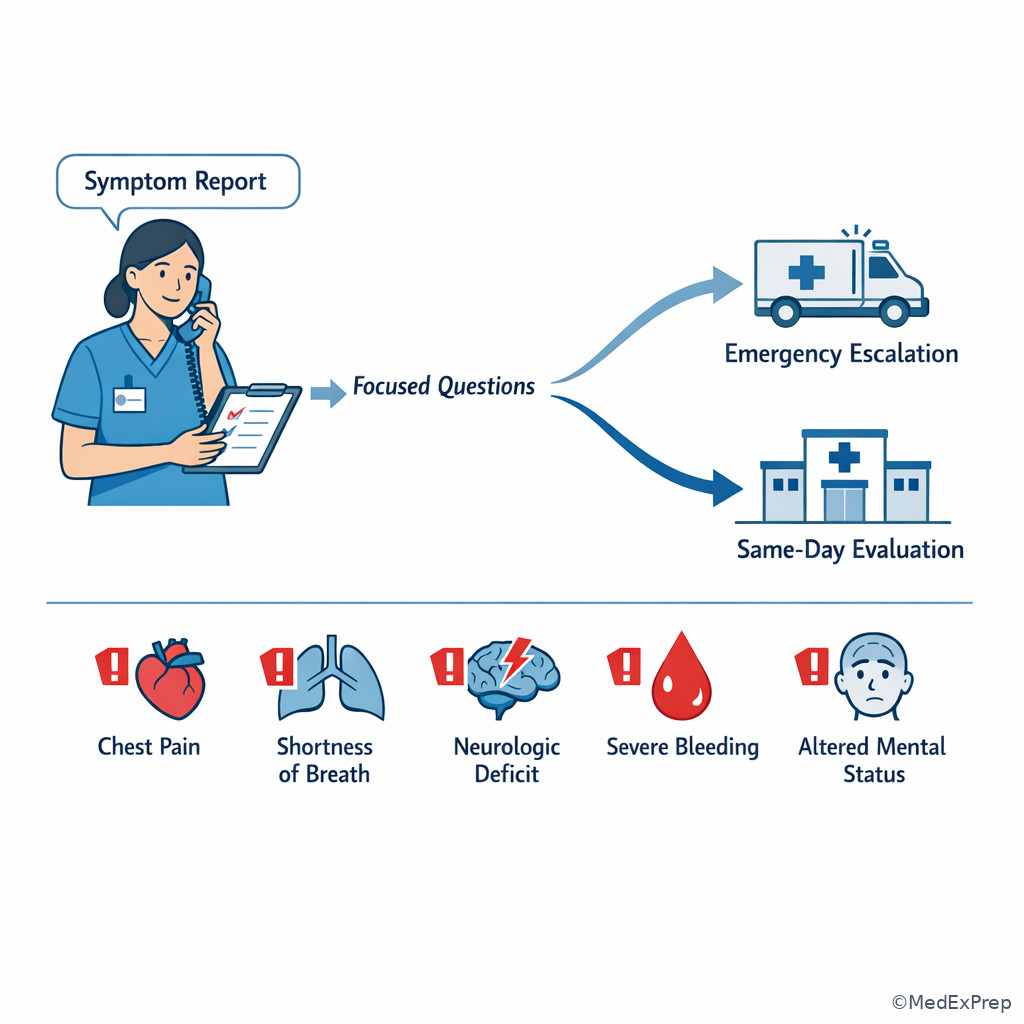
Now move from labels to exam appearances. The decision conflict becomes: Should you respond to the content noun in the stem or to the setting-and-urgency cues around it? In ambulatory exams, the setting often determines the safer answer. “Chest discomfort” in a remote after-hours call is a triage problem before it is a cardiology problem. “A1c overdue” in a panel report is a population health problem before it is an endocrine teaching problem.
WHY THIS IS TESTED: Ambulatory nursing work is setting-sensitive. The same symptom, medication, or diagnosis leads to different nursing priorities depending on whether the encounter is in clinic, by phone, via portal, in a post-discharge call, or in a preventive outreach workflow.
When you see board-style stems, use three quick filters: setting, timing, and continuity risk. Setting tells you whether remote limitations matter. Timing tells you whether this is immediate triage, recent transition, routine chronic care, or planned prevention. Continuity risk tells you whether harm may come from a failed handoff, missed result, lost referral, or absent follow-up. See Fig 3 and Fig 4.
Exam takeaway: The same complaint changes priority depending on whether the RN is in clinic, by phone, or managing follow-up.
Exam takeaway: In remote care, recognize instability early and escalate before routine teaching or scheduling.
B Worked example
A 71-year-old patient with heart failure, atrial fibrillation, and limited transportation calls after hours saying she gained 4 lb in 3 days, feels more short of breath when walking to the bathroom, and also wants to know whether her colon screening referral was approved. The distracting clue is the referral question. The tempting wrong answer is to route the insurance/approval issue first because it is concrete and administrative.
Reasoning chain: Identify task: after-hours symptom call. Extract key facts: weight gain, worsening dyspnea, high-risk cardiac history, limited access. Determine urgency/setting: remote triage with possible decompensation. Apply rule: triage outranks routine coordination. Eliminate distractors: referral status can wait; generic heart failure teaching alone is incomplete; telling the patient to discuss it at the next visit delays evaluation. Verify: the RN uses approved triage protocol, gives emergency guidance if indicated, and documents escalation.
C Exam trap
D Checkpoint
Question: Which cue most strongly shifts an otherwise routine ambulatory question into a triage-focused domain?
- A request for educational materials
- A note that the patient missed last year’s screening
- A report of worsening symptoms in a phone or portal encounter
- A request for help with transportation to a future appointment
Answer: C
- A: Tempting because education is common; wrong because it does not create immediate urgency.
- B: Tempting because preventive care is high-yield; wrong because a screening gap is usually population-health or coordination work.
- C: Correct because symptom worsening in a remote setting raises urgency and disposition questions.
- D: Tempting because access barriers are important; wrong because access planning is not the immediate priority without a red flag.
1.1.1.6 Integration lens: scope boundaries, priority hierarchy, and safer answer selection
A Explanation
The most tested integration conflict is: Which answer sounds clinically sophisticated, and which answer is actually the safest RN action within ambulatory scope? On this exam, those are not always the same. A distractor may sound advanced because it names a drug change, a diagnosis, or a definitive treatment pathway. But if the RN lacks authority to do that independently, it is wrong unless the option explicitly says to implement a valid order or protocol.
WHY THIS IS TESTED: AMB-BC questions distinguish strong ambulatory nursing judgment from provider-level decision making. Safe practice means recognizing limits, escalating appropriately, and not delaying care while trying to solve a provider-level problem alone.
Use a hierarchy: ABCs and instability first; then urgent safety threats; then missing critical assessment data; then coordination, education, and routine prevention. Add the scope filter on top of that hierarchy. A lower-priority action within scope can still beat a higher-detail action outside scope. For example, “notify the provider using SBAR and arrange same-day evaluation per protocol” is often better than “increase the diuretic dose,” even if the latter would be medically sensible in a different role.
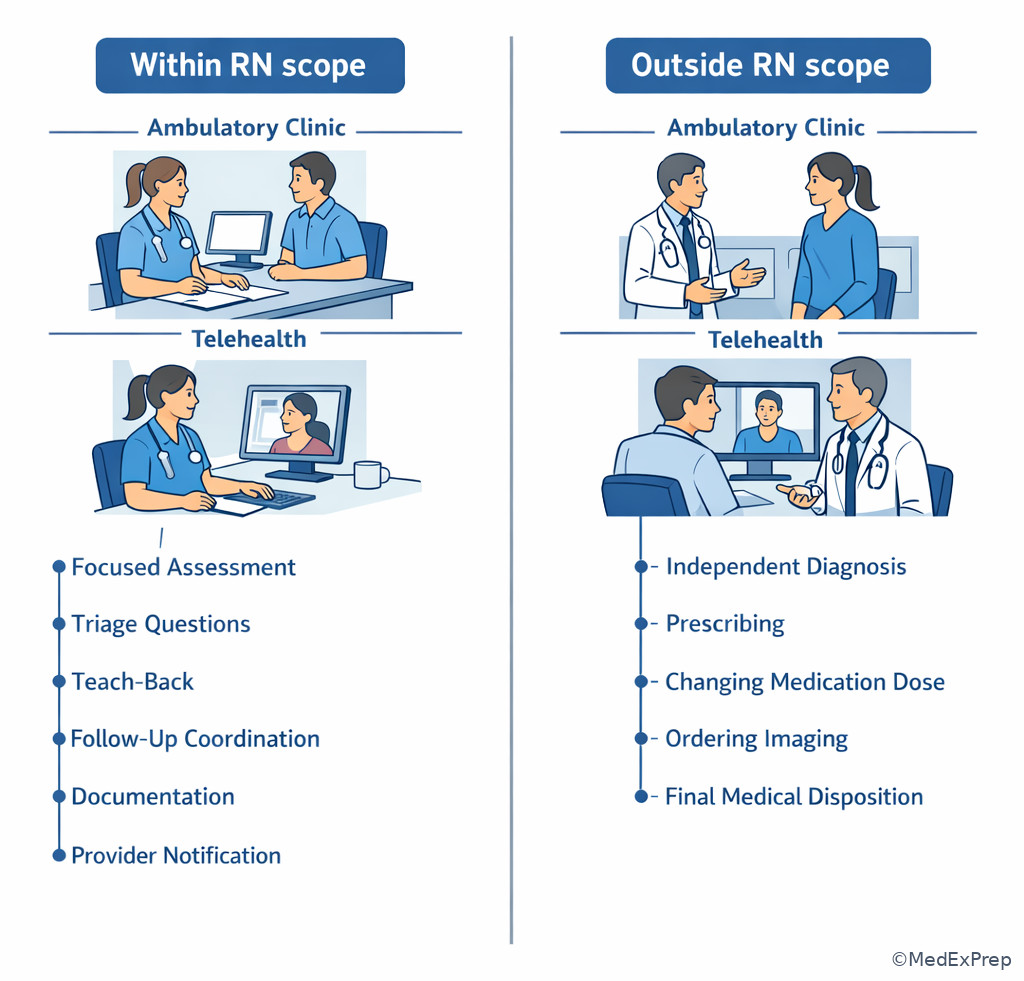
See Fig 5 for the algorithm that merges urgency and scope. Also see Fig 6 for a visual comparison of within-role versus outside-role actions in ambulatory settings.
Exam takeaway: The best answer is the highest-priority action that stays within RN scope.
flowchart TD
A[Read the stem] --> B{Immediate instability or red flag?}
B -- Yes --> C[Emergency guidance or same-day escalation per protocol]
B -- No --> D{Critical assessment data missing?}
D -- Yes --> E[Focused RN assessment first]
D -- No --> F{Does the action exceed RN scope?}
F -- Yes --> G[Notify provider use protocol document]
F -- No --> H[Proceed with education coordination or follow-up]
G --> I[Close the loop and document]
H --> I[Close the loop and document] Exam takeaway: Reject options that require independent prescribing, diagnosis, or provider-only disposition decisions.
B Worked example
A 63-year-old patient with COPD, coronary artery disease, and anxiety calls the clinic reporting increased cough and more shortness of breath over 24 hours. Home pulse oximeter readings “look a little lower,” though the patient cannot state the exact number. The patient also says, “I doubled one inhaler last night and it seemed to help.” A tempting wrong answer is to advise a medication increase because the patient already tried it and improved somewhat.
Reasoning chain: Identify task: triage of worsening respiratory symptoms. Extract key facts: increasing dyspnea, uncertain oxygen trend, high-risk comorbidities, remote setting. Apply rule: instability and missing critical data come before routine advice; medication changes are outside independent RN role unless protocol-based. Eliminate distractors: approving the doubled dose exceeds scope; scheduling a routine visit delays care; calming reassurance misreads anxiety as the main issue. Verify: focused symptom assessment, urgent evaluation guidance per protocol, provider escalation, and documentation are safest.
C Exam trap
D Checkpoint
Question: Which answer pattern should an AMB-BC candidate reject first, even when it sounds clinically reasonable?
- An option that gathers missing focused assessment data
- An option that implements emergency guidance per protocol
- An option that independently changes a medication dose
- An option that notifies the provider and documents the interaction
Answer: C
- A: Tempting and often correct because assessment is central when critical information is missing.
- B: Tempting and often correct because protocol-based emergency guidance fits ambulatory RN safety practice.
- C: Correct as the option to reject because independent dose changes exceed standard RN scope unless explicitly protocol-driven.
- D: Tempting and often correct because escalation plus documentation protects patient safety and continuity.
- The highest-priority filter in ambulatory questions is often instability and red flags.
- True or False: The most clinically detailed option is usually the correct RN answer. False.
- Name the 2 mandatory filters before selecting an action: priority and scope.
1.1.1.7 Integration lens: using the domain map to plan studying and test-day execution
A Explanation
The final decision conflict is practical: Do you study by diseases, or do you study by recurring ambulatory nursing actions? For this exam, action-based organization usually performs better. Diseases matter, but the AMB-BC RN is tested heavily on cross-cutting outpatient functions: assessment, triage, education, follow-up, prevention, documentation, and scope-safe escalation. A domain map helps you distribute study time across these functions.
WHY THIS IS TESTED: Foundational framework questions assess whether the candidate can organize later content efficiently. On the real exam, one stem may combine chronic disease, communication, and safety. The domain map prevents cognitive overload by giving you a consistent route through the question.
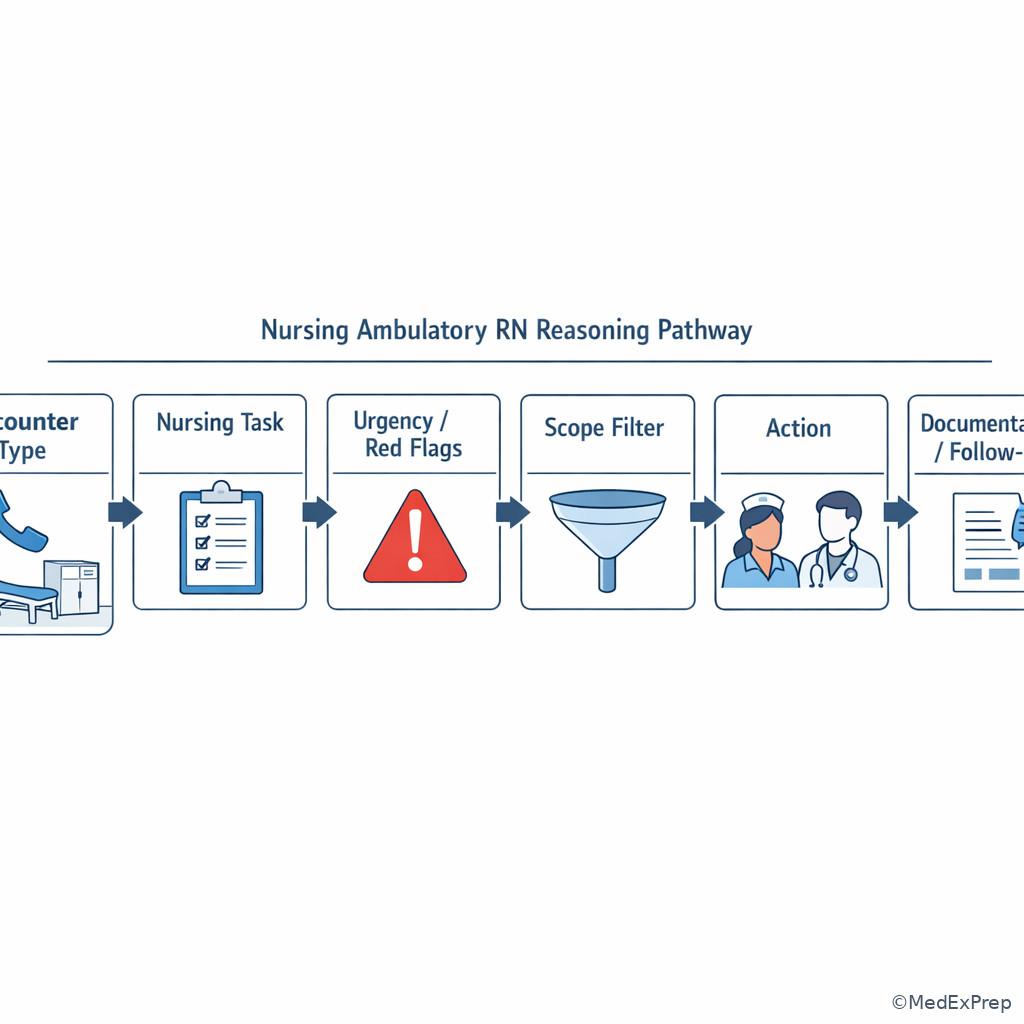
On test day, use a repeatable sequence: identify the setting, identify the task, rank urgency, filter for scope, select the best nursing action, then verify whether documentation or follow-up is implied. When studying, keep a grid of weak areas by domain and subskill. If you repeatedly miss items because you under-recognize red flags, that is a triage deficit. If you miss items because you choose provider-level options, that is a professional-practice and scope deficit. This topic points directly toward the upcoming Subskill Coverage Grid, where you will turn the domain map into a personal study plan.
Exam takeaway: Track errors by subskill so study time targets the real decision rule you are missing.
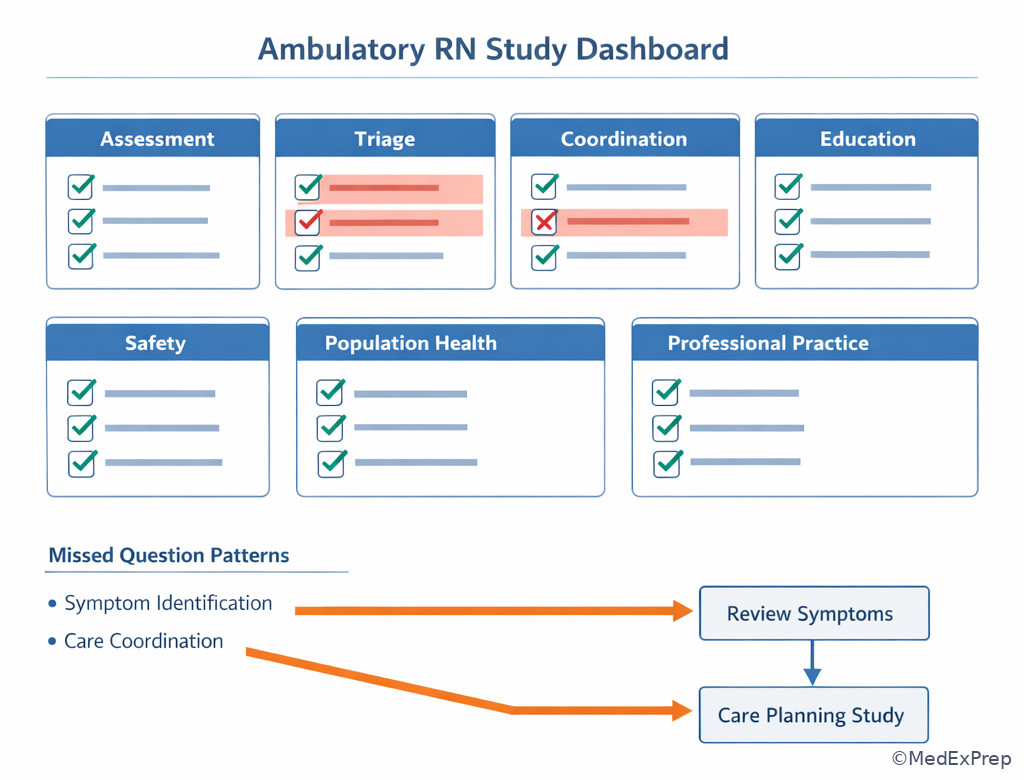
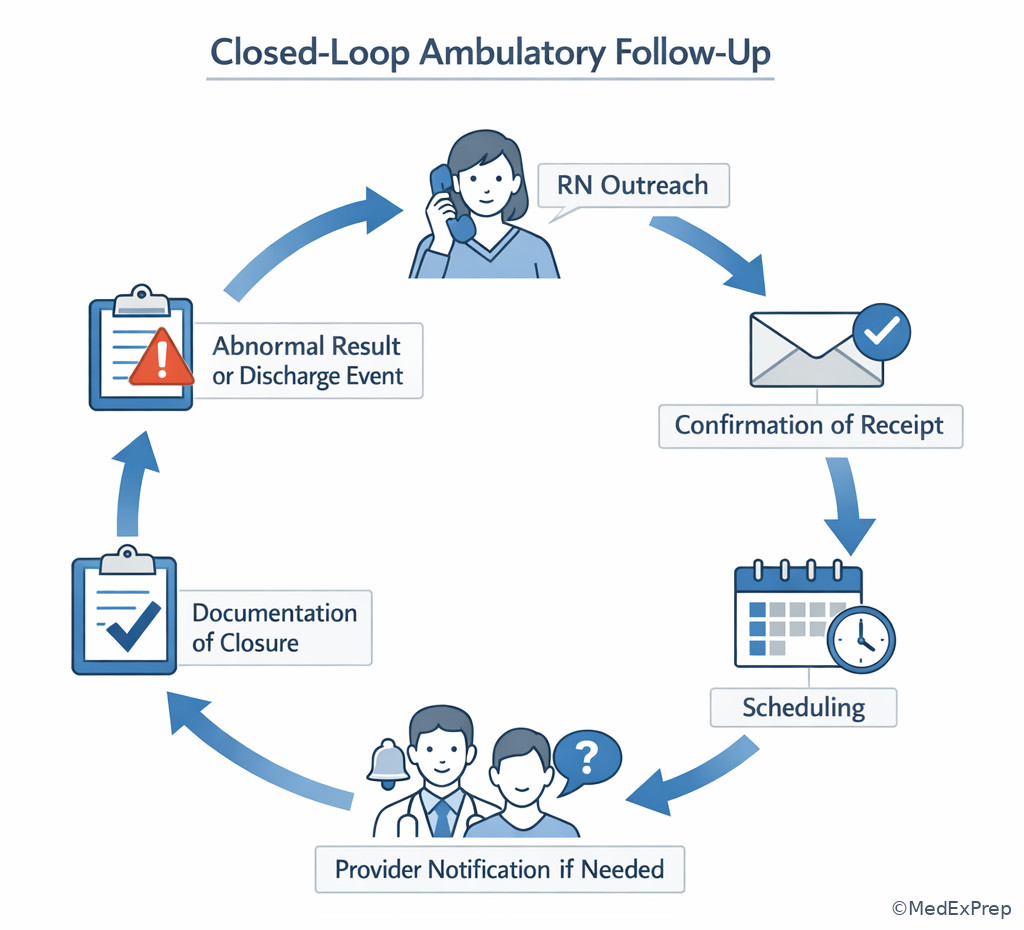
Exam takeaway: Questions about lost referrals, missed results, or discharge confusion usually test coordination rather than diagnosis.
B Worked example
A learner reviews 25 missed practice questions. Ten involved telehealth or phone messages with worsening symptoms, six involved post-discharge follow-up failures, five involved medication-teaching misunderstandings, and four involved choosing options that changed treatment without authority. The distracting pattern is to label all of these as “medical knowledge gaps.” That is too vague.
Reasoning chain: Identify task: study diagnosis, not patient diagnosis. Extract key facts: misses cluster by triage, coordination, education, and scope. Apply rule: domain-mapped review is more efficient than random rereading. Eliminate distractors: focusing only on diseases misses cross-cutting outpatient actions; doing more questions without error categorization repeats the same mistakes. Verify: build a study grid by domain and subskill, then prioritize high-frequency misses.
C Exam trap
D Checkpoint
Question: Which study adjustment best uses the AMB-BC domain map?
- Group all missed questions by organ system only
- Review only questions answered incorrectly because correct answers do not matter
- Track misses by domain and subskill, especially urgency, coordination, education, and scope errors
- Memorize treatment protocols before learning the nursing decision point
Answer: C
- A: Tempting because disease categories are familiar; wrong because they do not capture the recurring ambulatory nursing task.
- B: Tempting because it seems efficient; wrong because even correct answers may reflect shaky reasoning.
- C: Correct because it targets the exact decision rules tested across settings and conditions.
- D: Tempting because protocols feel actionable; wrong because without the decision point, protocol knowledge is misapplied.
Exam Traps & Differentiators
- Most common wrong answer and why: Choosing education or routine coordination before addressing active symptom worsening. This is tempting because ambulatory nursing includes lots of teaching and logistics, but worsening symptoms shift the question to triage.
- Looks similar but isn’t: A refill request plus symptoms can be a triage question, not a medication management question.
- Looks similar but isn’t: Discharge confusion can look like an education issue, but if the stem centers on missed follow-up and unfilled medications, it is a transition-safety question.
- Looks similar but isn’t: A preventive gap in a chart review is a population-health workflow issue, not a same-day clinical crisis unless red flags are also present.
- Looks similar but isn’t: A detailed treatment option may be medically sound but wrong because it exceeds RN scope.
| If the stem says... | Think... | Reject... |
|---|---|---|
| after-hours call, portal message, worsening symptoms | Triage and access | routine teaching or later scheduling first |
| recent hospitalization, unclear discharge plan, med confusion | Care coordination and transitions | one-way reassurance without closed-loop follow-up |
| teach-back, warning signs, self-monitoring, literacy barrier | Patient education and self-management | dense instruction without comprehension check |
| panel list, outreach gap, overdue screen or vaccine | Population health and prevention | waiting passively for patient-initiated care |
| critical result, near miss, incomplete documentation | Quality, safety, and risk reduction | informal fix without system reporting or tracking |
| change dose, diagnose cause, order imaging independently | Professional practice and scope boundary | provider-only actions framed as RN actions |
Related confusable pair to remember for upcoming lessons: Subskill Coverage Grid will help you separate primary from secondary mappings, and Board-Style Question Patterns will sharpen recognition of stems that look educational but are actually urgency-based.
Algorithm / Approach
Exam takeaway: A consistent setting-to-scope sequence prevents errors from attractive but wrong answer choices.
Rapid Review
- Domain map → organizes questions by nursing task, not disease label
- Assessment stem → missing focused data is the discriminator
- Triage stem → worsening symptoms in a remote setting outrank routine tasks
- Coordination stem → continuity gap is the key clue
- Education stem → comprehension check beats one-way instruction
- Population health stem → panel gap or outreach list signals prevention workflow
- Quality/safety stem → system reliability and documentation matter, not just informal correction
- Professional practice stem → reject provider-only actions dressed up as “decisive” nursing care
- Portal message with symptom plus refill → treat as triage first if symptoms are worsening
- Post-discharge confusion → think reconciliation and follow-up closure, not generic teaching alone
- Best answer on AMB-BC → safest first RN action within scope
- Setting cue → often more important than diagnosis cue
- Wrong-priority distractor → usually a good action done too early or too late
- Test-day sequence → setting → task → urgency → scope → action → document
Self-check quiz
1. A clinic RN reviews a question stem about a patient who sends a portal message requesting a refill and also reports increased shortness of breath since yesterday. Which action best reflects the correct initial domain frame?
- Address refill workflow first because medication access is an outpatient priority.
- Use triage and access framing first because worsening symptoms may change urgency.
- Provide medication teaching first because symptom worsening suggests poor inhaler technique.
- Route the message to population outreach because chronic disease monitoring is due.
2. A 39-year-old patient with hypothyroidism and iron-deficiency anemia says, “I never got called for the ultrasound my provider mentioned.” The patient denies worsening symptoms and asks what to do next. Which domain is the best primary fit?
- Care coordination and transitions
- Triage, telehealth, and access
- Clinical practice and assessment
- Population health and prevention
3. A 74-year-old patient with heart failure, diabetes, and chronic kidney disease calls after hours reporting a 3-day weight gain, new ankle swelling, and waking up short of breath. He also asks whether the clinic received his disability paperwork. What is the most appropriate initial RN action?
- Review the paperwork status because unresolved administrative barriers often worsen adherence.
- Use organization-approved triage protocol to assess severity and arrange urgent escalation based on red flags.
- Reinforce sodium restriction and ask him to call back in the morning if symptoms continue.
- Advise him to increase his diuretic for one day and document the recommendation.
4. A 58-year-old patient with COPD, anxiety, and hypertension completes a telehealth follow-up. She says she understands the plan, but when asked how she will use the rescue inhaler and when to seek care, her answers are inconsistent. What is the best domain-based nursing response?
- Shift to teach-back and warning-sign reinforcement because the primary issue is self-management understanding.
- End the visit because the patient initially stated she understood the plan.
- Document the concern and wait for the provider to repeat the full visit.
- Change the inhaler schedule to simplify the regimen without new instructions.
5. During panel review, an RN identifies several patients overdue for colorectal screening. One 62-year-old patient also sent a message today reporting new rectal bleeding and fatigue. Which is the most appropriate way to frame this patient’s needs first?
- Population-health outreach first because the patient is on the screening-gap list.
- Care coordination first because screening completion logistics are overdue.
- Triage first because active concerning symptoms outweigh routine preventive workflow.
- Patient education first because the patient may not understand screening importance.
6. A 66-year-old patient with atrial fibrillation, recent pneumonia, and limited English proficiency calls the ambulatory clinic saying he “feels weaker,” has more shortness of breath, and is not sure whether to take “the blood thinner” because he missed yesterday’s dose. A family member asks the RN to just tell them how many tablets to take tonight. What is the best RN action?
- Tell the family member to double the missed dose because adherence is essential in atrial fibrillation.
- Use focused assessment and triage protocol for current symptoms, then escalate medication questions to the provider or protocol pathway with interpreter support as needed.
- Schedule the next available clinic visit and advise the patient to resume the usual routine tomorrow.
- Provide general education about anticoagulants and ask the family member to decide based on the pill bottle directions.
7. A post-discharge follow-up call reaches a 70-year-old patient with heart failure, depression, and mild cognitive impairment. She reports that home health has not visited, one discharge medication is missing, and she has gained 2 lb since yesterday but denies distress. Her daughter adds that the patient becomes confused with long instructions. What is the most appropriate first RN priority?
- Give a full review of heart failure diet and exercise because weight gain suggests poor self-management.
- Focus on transition-safety tasks: reconcile the missing medication, assess for worsening symptoms, clarify follow-up supports, and escalate if red flags are present.
- Wait for home health to assess the patient because multiple agencies are already involved.
- Change the medication schedule to reduce confusion and send the new plan through the portal.
8. A 51-year-old patient with asthma, obesity, and recent urgent-care treatment messages the clinic: “I’m coughing more again, finished the prednisone, and my chest feels tight at night. Also, my mammogram reminder came through.” Which answer best reflects expert AMB-BC test-taking using the domain map?
- Address the mammogram reminder because prevention outreach should be completed whenever a gap appears.
- Focus first on symptom triage and urgency; preventive reminders can be handled after the active issue is safely addressed.
- Instruct the patient to restart prednisone because the recent urgent-care treatment likely needs extending.
- Send asthma education materials first and ask the patient to schedule routine follow-up next month.
Answer key
1. Correct answer: B
- A: Tempting because refill workflow is a real ambulatory nursing task. Incorrect for this scenario because ABCs/safety and urgency outrank medication logistics when worsening shortness of breath is present. The single stem clue is increased shortness of breath since yesterday. Source support: NCSBN clinical judgment and ambulatory safety principles prioritize assessment of instability before routine coordination.
- B: Correct because the nursing process begins with assessment and triage when active symptom worsening is reported in a remote encounter. The single discriminator is the combination of portal message plus worsening symptom, which makes triage the primary domain. Source support: ANA scope and standards emphasize assessment, prioritization, and coordination within RN role.
- C: Tempting because poor inhaler technique can worsen symptoms. Incorrect because education is a reasonable intervention at the wrong priority; the RN must first determine urgency. The single clue is worsening symptom timing, not a demonstrated knowledge deficit.
- D: Tempting because chronic disease follow-up often includes registry work. Incorrect because population outreach does not outrank an active symptom complaint from an individual patient. The single clue is current dyspnea.
2. Correct answer: A
- A: Correct because the problem is a gap in completion of an intended diagnostic next step, which is a coordination function. The single discriminator is never got called for the ultrasound. Source support: ANA standards support coordination, follow-up, and continuity as core RN responsibilities.
- B: Tempting because access barriers and phone communication are involved. Incorrect because there is no urgent symptom cue requiring disposition or immediate triage. The single clue is denies worsening symptoms.
- C: Tempting because assessment always matters. Incorrect because the question does not center on missing symptom data; it centers on a lost follow-up step. The single clue is the missing callback for imaging.
- D: Tempting because system-based preventive workflows also involve outreach. Incorrect because this is not a panel screening gap but a patient-specific pending diagnostic action. The single clue is provider mentioned an ultrasound, which implies coordination of a planned step.
3. Correct answer: B
- A: Tempting because administrative barriers can affect care continuity. Incorrect by priority because the nursing process and ABC/safety principles require addressing worsening heart failure symptoms first. The single clue is waking up short of breath. Source support: NCSBN prioritization framework and ambulatory triage principles.
- B: Correct because after-hours worsening dyspnea, rapid weight gain, and edema in a high-risk patient require triage assessment and urgent escalation per protocol. The single discriminator is the cluster of heart failure symptoms with nocturnal dyspnea.
- C: Tempting because sodium teaching is appropriate heart failure education. Incorrect because it is the right concept at the wrong priority and delays evaluation of possible decompensation. The single clue is the patient is actively worsening now.
- D: Tempting because medication adjustment may ultimately occur. Incorrect because independently increasing a diuretic exceeds standard RN scope unless explicitly protocol-based; the stem does not state that. The single clue is absence of protocol/order language.
4. Correct answer: A
- A: Correct because inconsistent answers during teach-back reveal that the primary issue is not completion of the visit but inadequate understanding of self-management and warning signs. The single discriminator is answers are inconsistent. Source support: ANA patient education standards and teach-back best practices.
- B: Tempting because the patient verbally said she understood. Incorrect because evaluation of understanding in the nursing process requires verification, not acceptance of a generic statement. The single clue is failure to accurately restate instructions.
- C: Tempting because interprofessional communication matters. Incorrect because the RN should first use nursing-scope education strategies already available, rather than defaulting all clarification back to the provider. The single clue is that the issue is teach-back failure, not an unanswered provider-only question.
- D: Tempting because simplification can improve adherence. Incorrect because changing the regimen independently exceeds RN scope unless protocol-based, and there is no such indication in the stem. The single clue is change the inhaler schedule.
5. Correct answer: C
- A: Tempting because the patient is on a screening-gap list, which clearly fits population health. Incorrect because active concerning symptoms move the immediate task to triage. The single clue is new rectal bleeding and fatigue. Source support: NCSBN prioritization and ambulatory red-flag recognition.
- B: Tempting because screening logistics may indeed need coordination. Incorrect because coordination is not first priority in the presence of active possible warning signs. The single clue is the symptom report, not the overdue screening alone.
- C: Correct because new bleeding with fatigue suggests an active issue requiring symptom-focused triage before routine prevention workflow. The single discriminator is the shift from panel review to a real-time symptom message.
- D: Tempting because education helps screening uptake. Incorrect because education is lower priority than triage when new concerning symptoms are reported. The single clue is today reporting symptoms.
6. Correct answer: B
- A: Tempting because missed-dose correction feels urgent and anticoagulation adherence matters. Incorrect because instructing a double dose is a medication-management decision outside standard RN independent role, especially with current shortness of breath and weakness. The single clue is both current symptoms and specific dosing request. Source support: ANA scope standards and safe escalation principles.
- B: Correct because the RN must first assess and triage the patient’s current respiratory symptoms, use interpreter support to reduce communication risk, and route medication-specific management through provider/protocol pathways. The single discriminator is the combination of symptom instability plus provider-level dose question.
- C: Tempting because next-day evaluation may fit stable medication questions. Incorrect because delaying evaluation is unsafe with increasing shortness of breath and weakness. The single clue is the patient is symptomatic now.
- D: Tempting because education remains within nursing role. Incorrect because general education does not answer the immediate safety problem and inappropriately shifts responsibility to the family member for a complex dosing decision. The single clue is the need for current triage plus protected communication.
7. Correct answer: B
- A: Tempting because heart failure teaching is always relevant and weight gain may reflect self-management gaps. Incorrect because the nursing process requires addressing transition failures and screening for worsening symptoms before delivering broad education. The single clue is missing medication and absent home health visit. Source support: ANA care coordination standards and NCSBN prioritization.
- B: Correct because this is a classic transition-safety question: medication reconciliation, symptom assessment, support confirmation, and escalation if needed. The single discriminator is the cluster of post-discharge follow-up gaps with possible early symptom change.
- C: Tempting because home health may soon assess the patient. Incorrect because waiting passively breaks closed-loop ambulatory safety and ignores current unresolved risks. The single clue is no home health visit has occurred yet.
- D: Tempting because simplification may help a cognitively vulnerable patient. Incorrect because changing a medication schedule independently exceeds RN authority and fails to address the immediate reconciliation problem. The single clue is change the medication schedule.
8. Correct answer: B
- A: Tempting because preventive reminders are important and mammography outreach is a valid ambulatory task. Incorrect by priority because active respiratory symptoms take precedence. The single clue is coughing more again and chest tight at night. Source support: NCSBN prioritization and ambulatory triage safety.
- B: Correct because expert domain-map use means recognizing that an active symptom issue overrides a routine prevention gap in the same message. The single discriminator is symptom recurrence after recent urgent-care treatment.
- C: Tempting because recent prednisone use suggests a familiar treatment pathway. Incorrect because restarting steroids independently is outside RN scope unless directed by protocol/order, and the stem does not provide that authority. The single clue is the option requires treatment selection.
- D: Tempting because education and follow-up are appropriate in asthma care. Incorrect because it delays triage of worsening symptoms and schedules too far out for an active issue. The single clue is current nighttime chest tightness.
Keep going with the full AMB-BC Prep Course (AMB-BC)
You just studied the way members do, in the same lesson interface. Full access unlocks every lesson, the question bank and flashcards for a full year.
One payment · 1 year of access · No auto-renewal