1.1.1 - Primary Care NP Scope
Primary Care NP Scope
What you'll learn
- Define the tested outpatient adult-gerontology primary care NP role and separate it from inpatient, emergency, and specialty-only roles.
- Choose the most appropriate next step when a stem mixes routine care details with red flags, instability, or scope boundaries.
- Identify what actions are within primary care NP scope: assessment, common diagnostics, first-line management, prevention, education, referral, and follow-up.
- Recognize when the safest answer is urgent escalation, ED referral, or specialty co-management rather than office-based treatment.
- Apply a scope-aware reasoning framework to board-style stems that test age, comorbidity, safety, and outpatient follow-through.
- DOMAIN: Assessment and clinical decision-making -> Objective: determine appropriate outpatient evaluation -> Subskill: identify what the primary care NP can assess and manage initially
- DOMAIN: Diagnosis and management -> Objective: choose best next step -> Subskill: distinguish office management from urgent referral or ED transfer
- DOMAIN: Health promotion and prevention -> Objective: deliver longitudinal ambulatory care -> Subskill: screening, counseling, follow-up, and chronic disease monitoring
- DOMAIN: Professional role, quality, and safety -> Objective: practice within scope and evidence-informed boundaries -> Subskill: safe prescribing, referral, consultation, and escalation
Why it matters
- Many missed board questions happen because the learner answers as a hospitalist, specialist, or emergency clinician instead of as an outpatient primary care NP.
- Scope errors create tempting distractors: the intervention may sound medically reasonable but is not the best next step in ambulatory NP practice.
- Primary care board items reward safe triage: when instability or red flags appear, escalation beats office-based overmanagement.
- This topic sets the decision frame used across the course: identify task -> filter by outpatient scope -> choose safest next action.
Key Terms & Must-Know Facts
1.1.1.1 Key terms
- Primary care NP scope: ambulatory assessment, prevention, common diagnosis, first-line management, education, follow-up, referral
- Best next step: the single safest and most appropriate outpatient action for the specific stem
- Red flag: finding that shifts the answer toward urgent evaluation, ED referral, or specialist involvement
- Routine outpatient management: stable presentation appropriate for clinic-based workup and treatment
- Urgent referral: same-day or rapid evaluation when outpatient delay is unsafe but ED-level instability is not yet clear
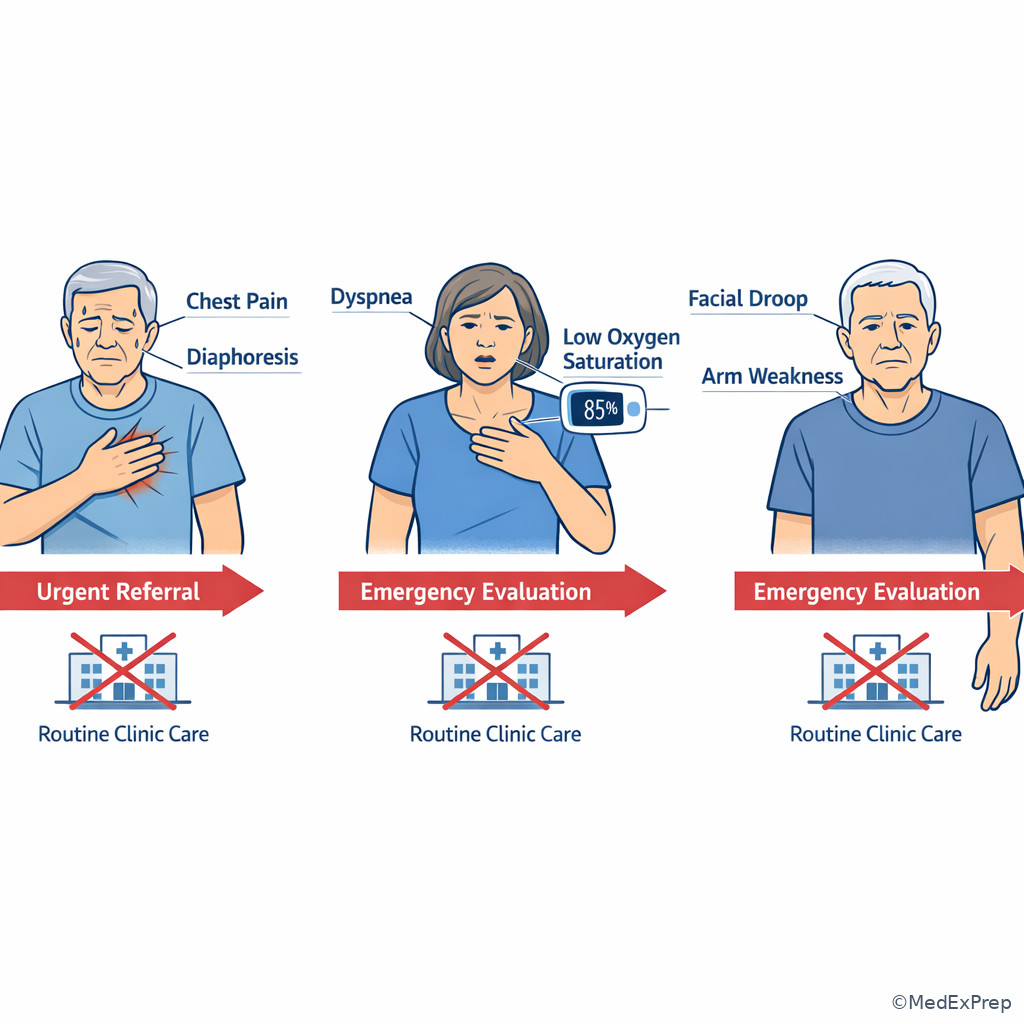
- ED transfer: immediate escalation for possible life-threatening instability, time-sensitive ischemia, stroke, sepsis, severe respiratory compromise, or similar emergencies
- Co-management: ongoing shared care with a specialist while primary care continues monitoring and coordination
- Within scope: actions consistent with ambulatory NP assessment, diagnostics, treatment, counseling, and coordination
- Out-of-role signal: clue that an option asks you to act as an emergency, procedural, or inpatient specialist
- Prescribing boundary: medication choices limited by safety, evidence, and local authority or protocol
- Follow-up plan: interval, monitoring target, return precautions, and referral threshold
- Safety first logic: unstable patient -> escalate before expanding office workup
1.1.1.2 Must-know facts
- The board tests outpatient primary care judgment, not definitive inpatient or emergency management.
- If a stem suggests severe instability, the correct move is escalation, not a detailed office treatment plan.
- The NP can initiate first-line workups and management for stable common conditions within scope.
- The NP should recognize when specialty referral is appropriate even if the diagnosis is suspected.
- Screening, prevention, chronic disease follow-up, patient education, and care coordination are core tested functions.
- When two choices are both clinically reasonable, prefer the one that best matches ambulatory safety and role boundaries.
- Board stems often add distracting chronic disease details; red flags outrank background comorbidities.
- Do not select an answer that requires ICU, operative, catheter-based, or specialist-only treatment authority.
Exam takeaway: Start every stem by deciding whether the patient is stable for primary care management before choosing any test or treatment.
flowchart TD
A[Patient presents in primary care] --> B{Stable or unstable?}
B -->|Stable| C[Assess history exam risk meds]
C --> D[Order common outpatient tests]
D --> E[Start first-line management education follow-up]
E --> F[Refer or co-manage if needed]
B -->|Unstable or red flags| G[Urgent referral or ED transfer]
G --> H[Do not build complex office treatment plan] Exam takeaway: Use a visual triage mindset: stable ambulatory problems stay in clinic, but obvious instability requires escalation.
Core content
1.1.1.3 Foundational role: what the primary care NP is expected to do
A Explanation
The first decision conflict on exam stems is simple: Is this asking for routine ambulatory NP care, or is it drifting into another clinician's role? The resolving rule is this: choose the action that fits longitudinal outpatient primary care. That includes focused and comprehensive assessment, preventive care, screening, interpretation of common office findings, initiation of first-line care for stable conditions, medication safety review, education, and follow-up planning. Reject answers that require emergency resuscitation, operative procedure planning, ICU-level management, or specialist-only definitive treatment.
WHY THIS IS TESTED: exam items frequently include one answer that sounds more aggressive or more comprehensive but exceeds ambulatory NP scope. The best answer is not the fanciest intervention; it is the safest role-appropriate next step.
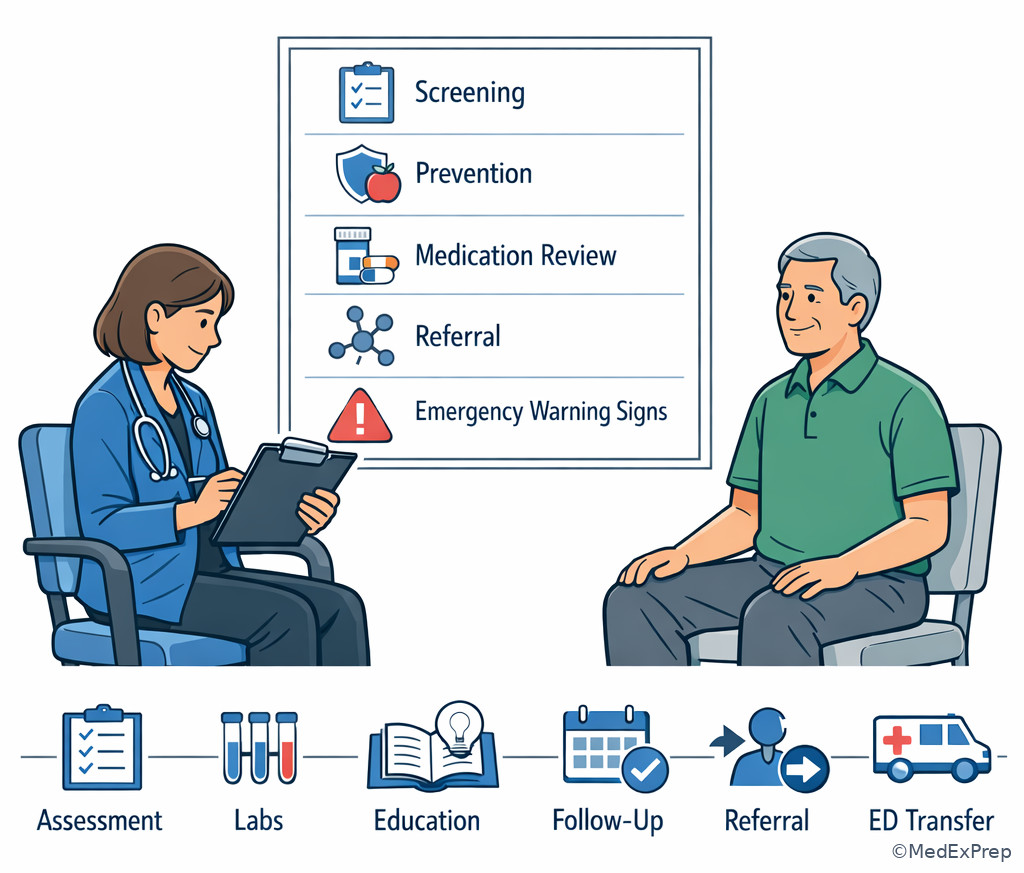
In this course, think like an adult-gerontology primary care NP managing adolescents transitioning to adulthood, adults, and older adults in clinic. You can identify likely diagnoses, order common diagnostics, start evidence-informed first-line therapy when the patient is stable, provide counseling, and arrange referral or co-management. You are also expected to recognize when not to continue outpatient workup because instability changes the priority. See Fig 1.
B Worked example
A 68-year-old man presents for a same-day visit for worsening cough. He has hypertension, type 2 diabetes, and osteoarthritis. He requests “a stronger antibiotic” because azithromycin helped him years ago. He is afebrile, BP 132/78 mm Hg, HR 86/min, RR 16/min, oxygen saturation 97% on room air, and speaks in full sentences. Lung exam shows scattered rhonchi that improve after coughing. The tempting clue is his age and diabetes, which may push you toward over-escalation.
Identify task: determine what the outpatient NP should do next within scope.
Extract key facts: stable vitals, no hypoxia, no respiratory distress, outpatient setting, common symptom.
Apply rule: stable common presentations remain in primary care scope for focused assessment, targeted testing if indicated, supportive care or first-line treatment, and follow-up instructions.
Eliminate distractors: sending him automatically to the ED is excessive without instability; admitting him is outside role and unsupported; broad specialty-only management is premature.
Verify: the best answer would be a focused outpatient evaluation and evidence-informed management plan, not reflexive escalation.
C Exam trap
D Checkpoint
Question: A 61-year-old woman with hyperlipidemia and hypothyroidism presents for follow-up of chronic knee pain and asks whether she should “just get admitted for a full workup” because pain has lasted months. She walks independently, has no fever, no trauma, normal vitals, and mild crepitus on exam. What is the most appropriate NP action?
- Arrange emergency transfer for inpatient pain evaluation
- Perform focused outpatient assessment and initiate or adjust first-line ambulatory management
- Schedule operative intervention directly from the clinic visit
- Defer all care until specialist imaging is completed
Answer: B
- A: Tempting because persistent pain can feel serious; wrong because chronic stable symptoms without red flags do not require ED-level escalation.
- B: Tempting because it may feel less decisive than hospital referral; right because stable chronic outpatient problems are core primary care NP work.
- C: Tempting because direct procedural action sounds efficient; wrong because operative planning exceeds routine ambulatory primary care scope.
- D: Tempting because imaging can clarify diagnosis; wrong because primary care management should not stop while awaiting nonurgent specialist input when no red flags exist.
1.1.1.4 Foundational boundaries: when to reject an answer because it is outside outpatient NP scope
A Explanation
The second decision conflict is not “Can I think of a diagnosis?” but “Does this answer choice ask me to function outside ambulatory NP role?” Reject options that place you as the emergency physician, procedural specialist, inpatient manager, or ICU decision-maker. Board writers use these as bright distractors because they appear authoritative. The single resolving rule: if the action requires hospital-level stabilization, invasive specialty intervention, or definitive specialty-only management, the NP's correct move is referral, consultation, or transfer rather than personal execution of that intervention.
WHY THIS IS TESTED: safe scope recognition is a quality-and-safety competency, not just a legal footnote. On boards, a scope-aware answer is often more correct than a disease-specific but role-inappropriate answer.
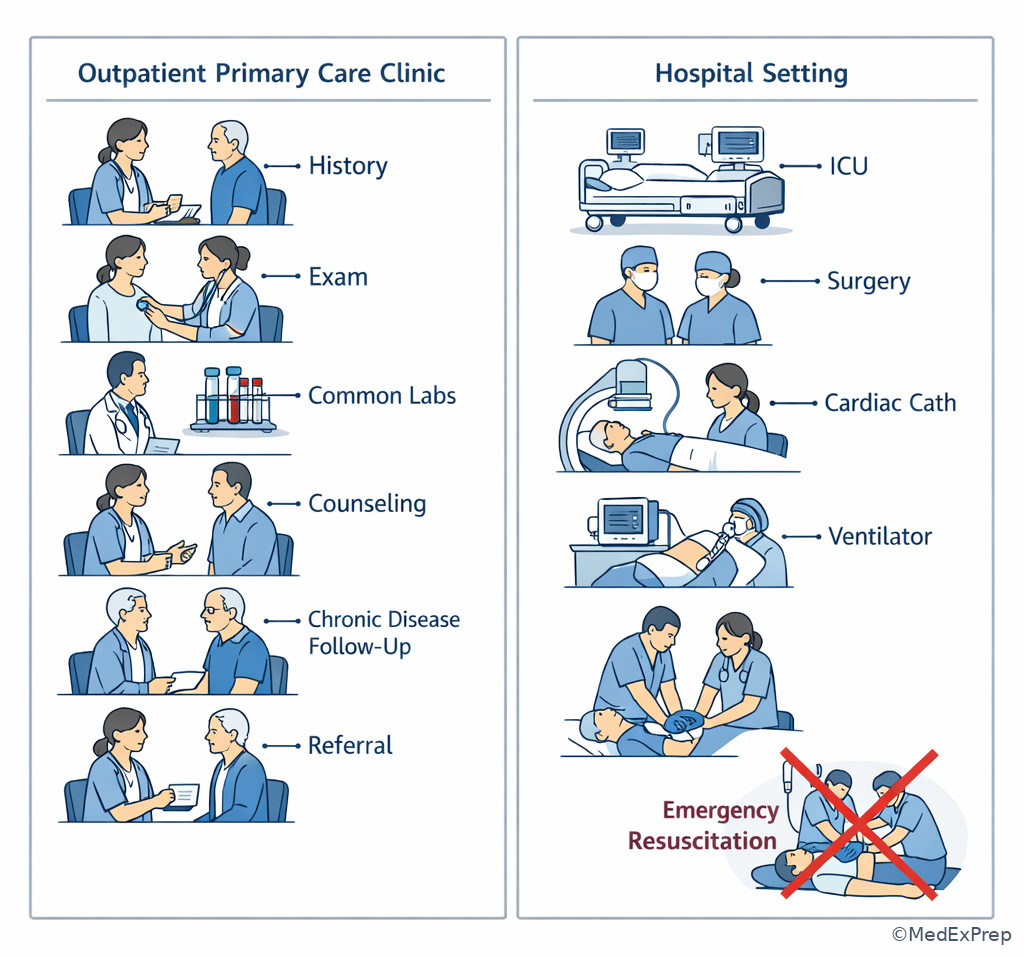
Examples of out-of-role signals include ventilator management, ICU admission planning, cardiac catheterization, operative procedures, definitive trauma resuscitation, and complex specialty-only treatment plans. In contrast, it is within role to recognize the need for those services and activate referral or emergency transfer. See Fig 2.
B Worked example
A 72-year-old woman with chronic kidney disease stage 3, atrial fibrillation, and GERD presents with intermittent chest pressure for 2 days that became constant over the last hour. She also reports mild nausea after lunch, which is a distracting clue. BP is 148/84 mm Hg, HR 104/min, oxygen saturation 95% on room air. She appears anxious and diaphoretic. One answer choice says to arrange outpatient stress testing; another says to activate emergency evaluation for possible acute coronary syndrome.
Identify task: choose the most appropriate next step within outpatient NP role.
Extract key facts: active chest pressure, diaphoresis, tachycardia, possible ACS.
Apply rule: the NP does not manage definitive ACS in the office; the correct action is immediate emergency referral or EMS activation per setting and protocol.
Eliminate distractors: outpatient stress testing is tempting because she has chronic risk factors and intermittent prior symptoms, but the current presentation is potentially unstable; GI-focused treatment is too narrow; cath-lab style answers are out of role.
Verify: the best answer is emergency escalation, not expanded clinic workup.
C Exam trap
D Checkpoint
Question: A 66-year-old man with diabetes and tobacco use presents with sudden unilateral leg swelling and pleuritic chest discomfort. He is mildly tachycardic. Which option best fits primary care NP scope?
- Begin definitive inpatient thrombolytic management in clinic
- Arrange emergency evaluation for possible venous thromboembolism
- Schedule a routine follow-up in 3 months to reassess symptoms
- Focus on smoking cessation counseling before addressing current symptoms
Answer: B
- A: Tempting because urgent disease demands urgent action; wrong because definitive thrombolytic management is not office-based primary care NP treatment.
- B: Tempting because it may feel less active than direct treatment; right because recognizing a dangerous condition and escalating promptly is the proper NP role.
- C: Tempting if symptoms are minimized as musculoskeletal; wrong because acute potentially life-threatening findings cannot wait.
- D: Tempting because prevention matters in primary care; wrong because current cardiopulmonary risk outranks counseling.
- The outpatient NP should personally perform common ambulatory assessment and first-line management, but should refer/transfer for ICU-, OR-, or cath-lab-level care.
- True or False: A more aggressive answer is usually better on boards. False.
- Name the two first filters for any stem: setting and stability.
Exam takeaway: Compare the action verb in each option to the outpatient NP role before deciding which choice is safest.
flowchart LR
A[Within scope] --> A1[Focused history and exam]
A --> A2[Order common outpatient tests]
A --> A3[Start first-line treatment]
A --> A4[Educate and follow up]
A --> A5[Refer or co-manage]
B[Out of role] --> B1[ICU management]
B --> B2[Operative procedure]
B --> B3[Cardiac catheterization]
B --> B4[Definitive trauma resuscitation]
B --> B5[Specialty-only therapy]
Exam takeaway: Distinguish outpatient actions from hospital-only actions by setting, urgency, and resource needs.
1.1.1.5 Application: stable outpatient problems versus urgent escalation
A Explanation
This section asks you to choose between two plausible NP actions: continue clinic-based care or escalate the patient the same day. The rule that resolves the conflict is red flags outweigh routine details. Stable outpatient features support focused office evaluation, appropriate testing, first-line treatment, and follow-up. Unstable vital signs, new neurologic deficits, severe dyspnea, concerning chest pain, active GI bleeding, sepsis clues, syncope with injury risk, or rapidly progressive symptoms shift the answer away from office management.
WHY THIS IS TESTED: exam stems often include background chronic disease, medication lists, or prior similar episodes to make a serious presentation look routine. The tested skill is recognizing the threshold where the care setting changes.
For this course, avoid two extremes. First, do not under-triage a dangerous presentation because the patient has a known chronic condition. Second, do not over-triage every older adult with comorbidities if the current presentation is stable. The discriminating clue is the current severity and safety profile. See Fig 3.
B Worked example
A 74-year-old woman with COPD, hypertension, and osteoporosis presents for “bronchitis.” She notes increased cough for 4 days, but today she is too breathless to finish sentences. She used her rescue inhaler twice overnight. She also mentions chronic reflux, a distracting clue that could pull you toward GERD. Vitals: BP 154/90 mm Hg, HR 112/min, RR 28/min, oxygen saturation 88% on room air. Mild wheezing is present.
Identify task: decide whether to treat in office or escalate.
Extract key facts: tachypnea, hypoxia, inability to speak full sentences, acute worsening.
Apply rule: red flags and respiratory compromise override the familiar label of “bronchitis” or stable chronic COPD.
Eliminate distractors: routine antibiotics, home inhaler teaching, or delayed chest x-ray all underweight the current severity. The best next step is urgent higher-level evaluation.
Verify: the NP's role is to recognize unstable outpatient respiratory symptoms and escalate safely.
C Exam trap
D Checkpoint
Question: A 58-year-old man with GERD and obesity presents with epigastric burning after a large meal. He also has diaphoresis and new exertional chest pressure walking from the parking lot. Vitals show HR 102/min. What is the most appropriate next step?
- Treat presumptive reflux and reassess in 4 weeks
- Recommend dietary modification and routine follow-up
- Arrange emergency evaluation for possible acute coronary syndrome
- Order outpatient H. pylori testing before deciding on referral
Answer: C
- A: Tempting because epigastric burning after meals fits GERD; wrong because associated exertional chest pressure and diaphoresis are red flags.
- B: Tempting because obesity and reflux often improve with lifestyle change; wrong because urgent ischemic symptoms outrank chronic risk counseling.
- C: Tempting because it seems more acute-care oriented; right because the NP must recognize a potentially life-threatening outpatient presentation and escalate.
- D: Tempting because dyspepsia workup is appropriate in stable patients; wrong because the current clue pattern is not stable dyspepsia first.
1.1.1.6 Application: what falls inside daily primary care management
A Explanation
Once you determine the patient is stable and the action is within role, the next conflict is choosing among several acceptable outpatient actions. The tested rule is to prefer the action that advances safe ambulatory care now: focused assessment, common testing, first-line treatment, prevention, medication review, counseling, monitoring, and follow-up. This is the ordinary substance of primary care NP practice and therefore a major testing target.
WHY THIS IS TESTED: some learners over-refer stable common problems. Boards reward confident first-line primary care management when referral is unnecessary or premature.
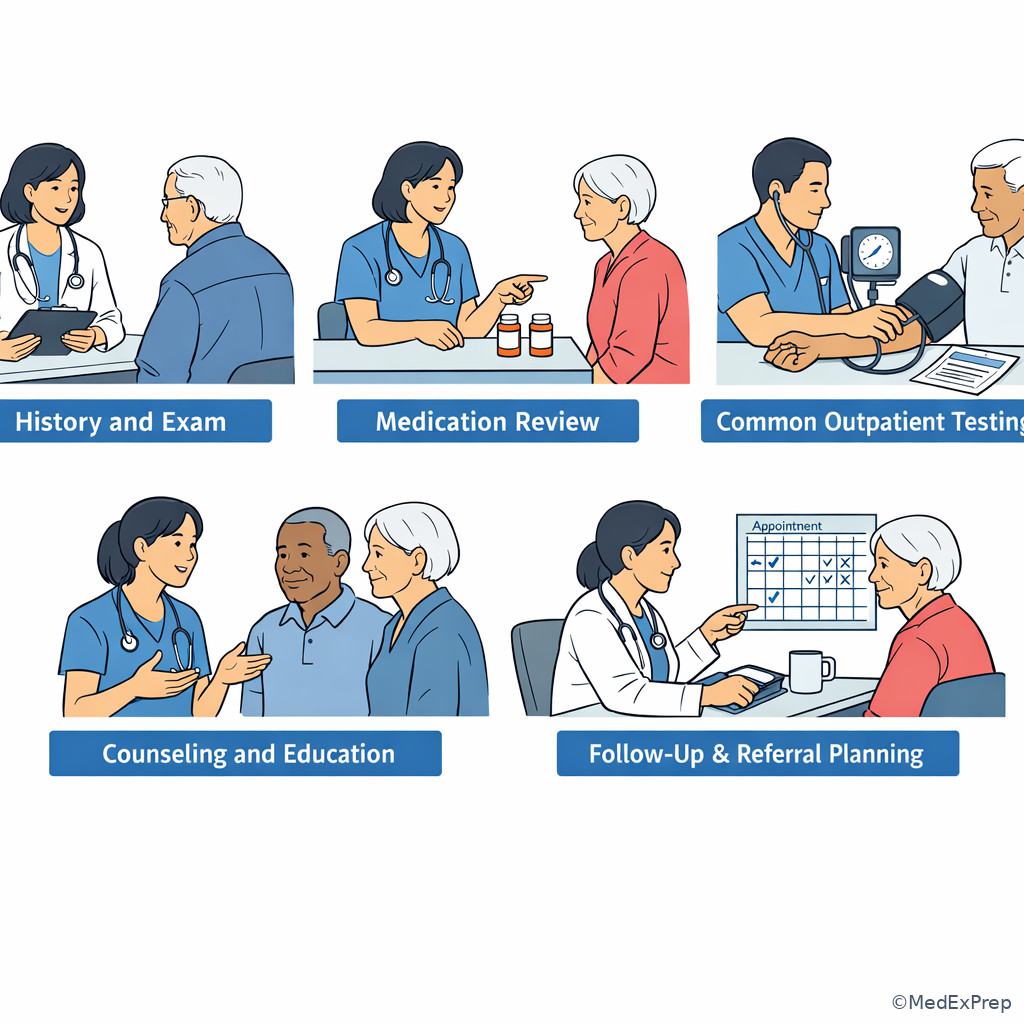
Examples include managing uncomplicated hypertension follow-up, initiating guideline-based screening, evaluating common urinary symptoms, reviewing medication adherence, counseling on tobacco cessation, adjusting stable chronic disease treatment, and setting return precautions. Referral remains appropriate when the case is refractory, atypical, diagnostically uncertain, or outside scope. The question is not “Can a specialist also help?” but “What is the best next step from primary care today?” See Fig 4.
B Worked example
A 56-year-old woman with obesity, prediabetes, and depression presents for follow-up of elevated blood pressure readings from home. She also mentions occasional mild headaches after stressful workdays, a distracting clue that could push you toward imaging. BP today is 148/92 mm Hg; repeat is 146/90 mm Hg. She denies neurologic symptoms, chest pain, or dyspnea. She takes sertraline and no antihypertensive medication.
Identify task: decide what the primary care NP should do now in clinic.
Extract key facts: stable patient, ambulatory chronic disease issue, no red flags, repeat elevated readings.
Apply rule: this is classic primary care NP management territory: confirm pattern, assess lifestyle and risk factors, initiate evidence-informed plan, and arrange follow-up.
Eliminate distractors: urgent neuroimaging is not supported; automatic specialist referral is premature; delaying all action until months later misses an outpatient management opportunity.
Verify: the best answer is role-appropriate chronic disease management in primary care.
C Exam trap
D Checkpoint
Question: A 63-year-old man with hyperlipidemia and tobacco use presents for preventive follow-up. He is asymptomatic and asks if he needs screening and medication review. Which action most clearly fits routine primary care NP scope?
- Provide preventive counseling, assess risk, review medications, and order appropriate common screening tests
- Delay preventive care because he has no symptoms today
- Send him directly to multiple subspecialists before performing primary care evaluation
- Plan definitive inpatient cardiac testing despite no acute symptoms
Answer: A
- A: Tempting because it seems broad rather than disease-specific; right because prevention, risk assessment, and medication review are core primary care NP functions.
- B: Tempting because asymptomatic patients can feel low priority; wrong because preventive care is central to ambulatory practice.
- C: Tempting because risk factors may justify referral later; wrong because primary care should lead the initial preventive assessment.
- D: Tempting because cardiovascular risk is important; wrong because inpatient testing is neither indicated nor role-appropriate here.
- The most common board error in stable primary care stems is premature referral.
- True or False: Prevention and screening are peripheral to NP board questions. False.
- Name 3 routine NP actions for stable ambulatory care: assessment, first-line management, follow-up.
Exam takeaway: A single red flag can outweigh otherwise routine outpatient details and change the best next step to urgent escalation.
flowchart TD
A[Ambulatory complaint] --> B{Red flags or instability?}
B -->|No| C[Routine clinic workup]
C --> D[First-line treatment]
D --> E[Follow-up and return precautions]
B -->|Yes| F[Same-day urgent evaluation or ED]
F --> G[Do not rely on routine outpatient timeline] Exam takeaway: Remember the clinic workflow of assessment, common testing, treatment, education, and follow-up when selecting the best next step.
1.1.1.7 Integration: referral, co-management, follow-up, and documentation thinking
A Explanation
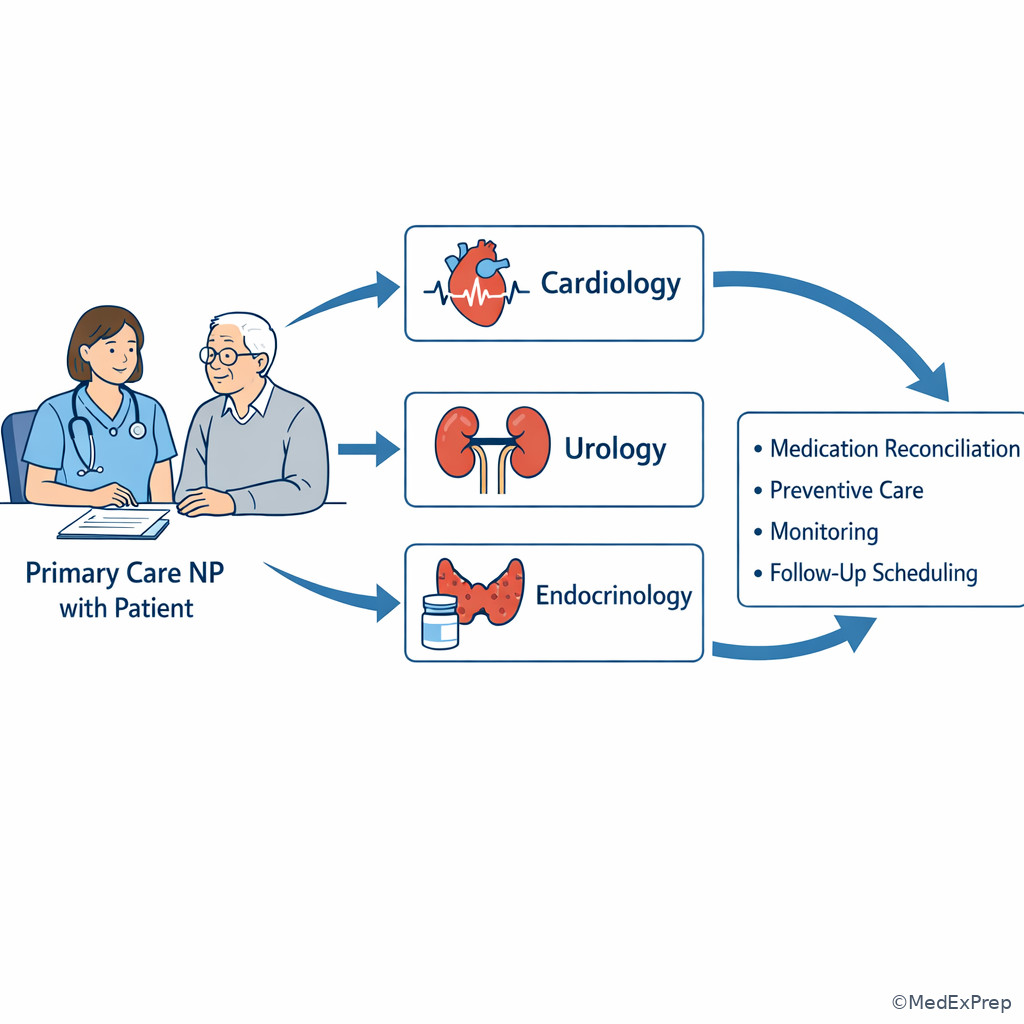
The most advanced scope questions do not ask whether the NP can do something, but whether the NP should manage alone, co-manage, or refer. The conflict is often between staying too narrow in clinic and referring too early or too late. The rule: stable common problems with clear first-line pathways are usually managed in primary care; atypical, refractory, diagnostically uncertain, procedure-dependent, or high-risk conditions may need specialty input. Even when referral is correct, primary care usually continues coordination, medication reconciliation, preventive care, and follow-up.
WHY THIS IS TESTED: longitudinal care is a defining feature of primary care. The board wants you to think beyond the single visit: what should be monitored, when should the patient return, and what threshold should trigger referral or escalation?
Good outpatient answers often include return precautions, follow-up interval, medication monitoring, and what to track. Poor answers stop after choosing a test. In exam logic, the NP is the coordinator of safe continuity. This section also includes documentation thinking: communicate the reason for referral, urgency, patient education, and contingency plan. See Fig 5.
B Worked example
A 70-year-old man with hypertension, benign prostatic symptoms, and chronic back pain presents for persistent microscopic hematuria found on two recent visits. He feels well and denies fever or flank pain. He recently started an exercise program, a distracting detail that may make you attribute the finding to benign exertion alone. Vitals are stable. One option suggests reassurance only; another suggests specialist evaluation while continuing primary care follow-up.
Identify task: decide whether to manage fully in primary care or refer/co-manage.
Extract key facts: persistent abnormal finding, older adult, needs structured evaluation, currently stable.
Apply rule: stable but potentially significant abnormalities often need referral or workup pathways beyond simple reassurance, while primary care continues coordination.
Eliminate distractors: ED transfer is unnecessary without instability; reassurance alone underweights persistence; inpatient management is out of role.
Verify: best answer is appropriate outpatient referral/co-management with documented follow-up.
C Exam trap
D Checkpoint
Question: A 64-year-old woman with well-controlled diabetes and hyperlipidemia has stable chronic disease follow-up but now reports a symptom pattern that is atypical, persistent, and not improving despite first-line care. Which approach best fits primary care NP scope?
- Continue the same plan indefinitely without reassessment
- Refer or co-manage as appropriate while maintaining follow-up and care coordination
- Transfer to the ED solely because first-line care was unsuccessful
- Perform definitive specialty-only intervention from the office
Answer: B
- A: Tempting because many chronic issues improve slowly; wrong because persistent atypical nonresponse requires reassessment.
- B: Tempting because it balances multiple steps; right because referral/co-management is appropriate when outpatient first-line care is no longer enough, while primary care still coordinates.
- C: Tempting because failure of treatment can sound urgent; wrong because refractoriness alone is not the same as instability.
- D: Tempting because decisive intervention feels efficient; wrong because specialist-only definitive care exceeds the outpatient NP role.
1.1.1.8 Integration: test-taking framework for scope-based board questions
A Explanation
The final integration skill is operational: when you face a board-style stem, you need a repeatable framework that prevents common errors. The decision conflict is often between an answer that matches the disease label and an answer that matches the clinical role and safety priority. The resolving rule is: choose the option that best fits task, setting, stability, role, and follow-up. If an answer fails even one of those filters, eliminate it.
WHY THIS IS TESTED: scope questions are rarely labeled as such. They are embedded inside symptom, chronic disease, prevention, pharmacology, or referral stems.
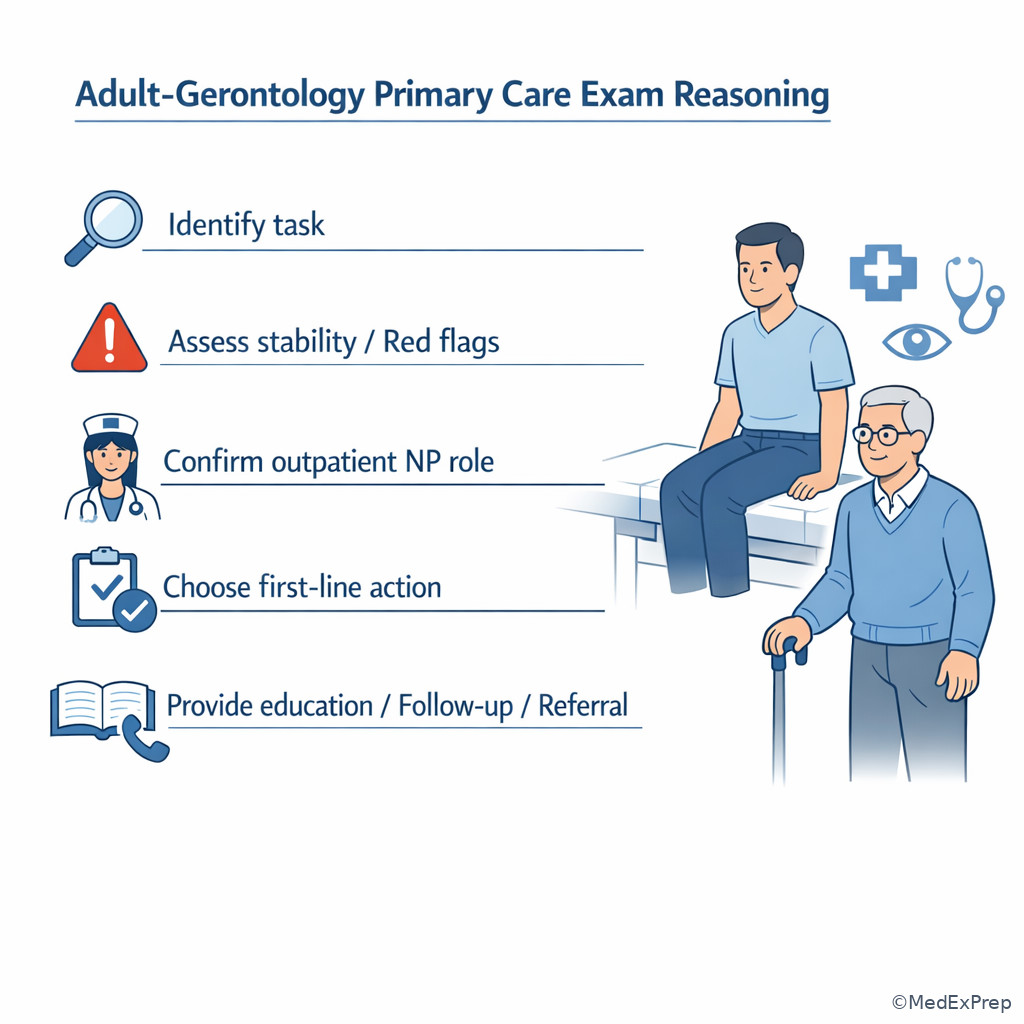
Use this sequence: identify what the question is asking; determine whether the patient is stable; eliminate out-of-role actions; choose the highest-priority ambulatory step; verify education, monitoring, and referral needs. This framework helps when two answers both sound clinically educated. On exam day, the winning answer is usually the one that a safe outpatient NP would actually do next. See Fig 6.
B Worked example
A 67-year-old man with coronary artery disease, chronic constipation, and insomnia presents for medication follow-up. He mentions brief dizziness when standing quickly and one episode of near-syncope last week after missing breakfast. BP is 128/74 mm Hg sitting and 110/68 mm Hg standing; pulse rises modestly. He is speaking normally and denies chest pain or focal deficits. The tempting clue is coronary artery disease, which can trigger over-escalation.
Identify task: choose best next step in outpatient NP practice.
Extract key facts: likely orthostatic symptoms, stable currently, no acute ischemic or neurologic red flags, medication review visit.
Apply rule: stable ambulatory symptoms with plausible outpatient cause favor office-based assessment, medication review, hydration counseling, and follow-up rather than automatic ED transfer.
Eliminate distractors: inpatient monitoring is out of proportion; specialist procedure planning is outside role; ignoring the symptom is unsafe.
Verify: the best answer is a focused outpatient evaluation and safety plan within primary care scope.
C Exam trap
D Checkpoint
Question: Which reasoning sequence best matches high-yield outpatient NP board logic?
- Choose the most specialized intervention first, then decide if the patient was stable
- Focus on the most dramatic comorbidity and ignore the current presentation
- Identify task, assess stability, eliminate out-of-role options, then select the safest ambulatory next step
- Order every possible test before deciding whether referral is needed
Answer: C
- A: Tempting because specialist-level care can sound definitive; wrong because stability and setting must be decided before intervention level.
- B: Tempting because comorbidities matter; wrong because current symptom severity and safety drive priority.
- C: Tempting because it feels methodical rather than disease-specific; right because it mirrors how scope-based board stems are solved.
- D: Tempting because broad testing may seem thorough; wrong because shotgun testing ignores prioritization and setting.
- STARR stands for Setting, Task, Alarm features, Role fit, Return plan.
- True or False: A stable patient may still need referral. True.
- The single best eliminator for out-of-scope options is the action verb.
Exam takeaway: Stable common problems stay in primary care, but refractory, atypical, or procedure-dependent issues need referral with continued follow-up ownership.
flowchart TD
A[Stable outpatient problem] --> B{Clear first-line path?}
B -->|Yes| C[Manage in primary care]
C --> D[Monitor response]
B -->|No or limited response| E[Refer or co-manage]
E --> F[Continue education med review follow-up]
D --> G{Worsens or red flags?}
G -->|Yes| H[Urgent escalation]
G -->|No| I[Continue outpatient plan] Exam takeaway: A visual checklist of task, stability, role, and follow-up helps avoid choosing aggressive but out-of-scope answers.
Exam takeaway: When alarming symptoms appear in clinic, the safest answer is escalation rather than a longer office workup.
Exam takeaway: Referral does not replace primary care follow-up; it adds specialty input while the NP continues coordination.
Exam Traps & Differentiators
- Most common wrong answer: selecting a specialist-level intervention because it sounds more definitive. Why: learners confuse “medically sophisticated” with “best next step.” Discriminator: if it exceeds outpatient NP role, choose referral or transfer instead.
- Looks similar but isn't: stable chronic symptom flare versus unstable acute deterioration. Discriminator: today's vitals and red flags, not the familiar diagnosis label.
- False reassurance trap: minimizing a serious symptom because the patient has had “similar episodes before.” Discriminator: active concerning features now change the setting.
- Premature referral trap: sending a stable common problem to a specialist before first-line primary care management. Discriminator: if the condition is common, stable, and guideline-based, primary care should usually start the workup or treatment.
- Shotgun testing trap: ordering extensive diagnostics before deciding if the patient is safe to stay in clinic. Discriminator: stability always comes before breadth of workup.
| Stem says... | Think... | Why it matters |
|---|---|---|
| “Diaphoretic, worsening chest pressure, tachycardic” | Urgent escalation | Current red flags outrank routine clinic evaluation |
| “Stable vitals, chronic issue, no alarm features” | Outpatient first-line management | Do not over-refer common stable problems |
| “Procedure-dependent solution” | Refer, do not personally perform | Scope boundary is being tested |
| “Persistent atypical symptoms despite first-line care” | Co-manage or refer | Primary care continues coordination |
| “Asymptomatic prevention visit” | Risk assessment, screening, counseling | Prevention is core primary care content |
| “Known chronic disease plus new severe symptom” | Reassess severity now | Do not anchor on baseline diagnosis |
| Confusable pair | Looks similar because... | Single clue that separates them |
|---|---|---|
| Routine GERD visit vs possible ACS | Both may involve chest or epigastric discomfort | Diaphoresis, exertional component, or active chest pressure favors emergency evaluation |
| Stable COPD follow-up vs urgent respiratory compromise | Both include cough and wheeze | Hypoxia or inability to speak full sentences changes the setting |
| Primary care management vs premature specialty referral | Specialist care sounds thorough | Stable common conditions should usually receive first-line NP care first |
| Referral/co-management vs ED transfer | Both move care beyond routine clinic action | Instability requires ED; stable complexity supports outpatient referral |
If the stem says “best next step” think setting and safety first.
If the stem says “primary care follow-up” think prevention, monitoring, adherence, education, and common diagnostics.
If the stem says “sudden,” “new,” “worsening,” or “cannot speak in full sentences” think escalation threshold.
If the stem says “persistent despite first-line care” think reassess, refer, or co-manage.
If the stem says “procedure,” “ICU,” “operative,” or “catheterization” think out-of-role answer.
Tables
| Core scope area | What the NP can do in primary care | What usually requires escalation or referral |
|---|---|---|
| Assessment | Focused and comprehensive histories, physical exams, risk review | Hospital-based stabilization beyond ambulatory resources |
| Diagnostics | Order and interpret common outpatient labs and studies | Definitive inpatient diagnostics for unstable emergencies |
| Management | Initiate first-line treatment for stable common conditions | ICU-level, operative, or specialist-only definitive treatment |
| Prevention | Screening, immunization, counseling, risk reduction | Not typically escalated unless abnormal results or urgent findings emerge |
| Medication care | Prescribing within evidence, protocol, and jurisdictional limits | Specialty-only regimens or unsafe prescribing beyond scope/authority |
| Care coordination | Referral, co-management, follow-up, patient education | Abandoning follow-up after referral |
| Comparison point | Routine outpatient management | Urgent referral / same-day escalation | ED transfer |
|---|---|---|---|
| Vitals | Stable | Concerning trend, may still be compensating | Marked instability or high-risk presentation |
| Symptoms | Mild to moderate, no alarm features | Worsening, persistent, concerning evolution | Severe, rapidly progressive, time-sensitive emergency pattern |
| Setting need | Clinic resources are adequate | Needs expedited higher-level assessment | Needs emergency resources now |
| NP role | Assess, test, treat, educate, follow up | Recognize risk and arrange urgent evaluation | Recognize danger and activate emergency response/transfer |
| Example pattern | Stable hypertension follow-up | Persistent abnormal finding needing rapid specialist review | Possible ACS, stroke, severe hypoxia, sepsis concern |
| Differential category | Best board interpretation | Typical wrong move | Discriminator |
|---|---|---|---|
| Stable common complaint | Manage initially in primary care | Immediate subspecialty referral | No red flags; clear first-line pathway |
| Unstable presentation | Escalate urgently | Lengthy office workup | Current instability or alarm features |
| Procedure-dependent condition | Refer appropriately | Personally perform definitive treatment | Action exceeds outpatient NP role |
| Persistent atypical issue | Co-manage or refer while continuing follow-up | Reassure only | Failure of first-line care or unclear diagnosis |
| Preventive visit | Screen, counsel, review meds, monitor risk | Do nothing because no symptoms | Primary care includes prevention, not just complaint management |
| Monitoring / follow-up task | What to track | Why exam writers care |
|---|---|---|
| Symptom follow-up | Improved, unchanged, worse, new red flags | Primary care is longitudinal, not one-time triage only |
| Medication monitoring | Adherence, adverse effects, response | Safe prescribing is part of scope |
| Referral loop closure | Whether appointment occurred and results returned | Referral does not end NP responsibility |
| Patient education | Return precautions and self-management understanding | Boards favor safe outpatient instructions |
| Risk modification | Smoking, weight, exercise, screening completion | Prevention is core NP practice |
Algorithm / Approach
This mini-algorithm is the lens for the entire course. In the next lessons, organ-system content will change, but this structure remains constant: setting, stability, role, next step, follow-up.
Rapid Review
- Primary care NP scope -> stable outpatient assessment, common diagnostics, first-line care, referral coordination
- Best next step -> safest ambulatory action, not the most aggressive intervention
- Red flag -> changes setting before it changes diagnosis depth
- Out-of-role option -> often identified by ICU, operative, cath, or specialist-only action verb
- Stable chronic complaint -> usually manage first in primary care before referring
- Persistent atypical problem -> refer or co-manage, but keep follow-up ownership
- Chest discomfort with diaphoresis -> think escalation, not reflux-first management
- Known chronic disease plus new severe finding -> current severity outranks baseline label
- Prevention visit -> still active management, not “nothing to do”
- Referral -> adds specialist input; does not end primary care responsibility
- Scope question -> solve by setting, stability, role fit, and return plan
- Tempting wrong answer -> often right for a different, more unstable or more specialized patient
Self-check quiz
1. A 59-year-old woman with obesity and hyperlipidemia presents for an annual visit. She has no acute symptoms, normal vital signs, and asks what the visit should include. Which action is the most appropriate next step?
- Provide risk-based preventive assessment, medication review, counseling, and appropriate screening planning
- Delay care until she develops a symptomatic condition
- Arrange inpatient cardiac testing because of age alone
- Refer to multiple subspecialists before completing primary care evaluation
2. A 65-year-old man with type 2 diabetes and chronic back pain reports severe new chest pressure with sweating while checking in for a follow-up visit. Which action most appropriately reflects primary care NP scope?
- Arrange emergency evaluation immediately
- Complete the routine chronic care visit before deciding
- Start definitive inpatient management from the clinic
- Schedule a routine stress test next month
3. A 54-year-old woman with hypertension and anxiety presents with several home blood pressure readings above goal. She denies chest pain, dyspnea, neurologic deficits, or vision change. Today's repeat BP is 144/92 mm Hg. She worries because her father had a stroke, a distracting clue. What is the most appropriate next step?
- Perform focused outpatient reassessment and initiate or adjust first-line management with follow-up
- Transfer her to the ED solely because of the family history
- Refer immediately for operative treatment
- Ignore the readings because she has no symptoms today
4. A 73-year-old man with COPD, GERD, and hypertension presents for cough. He is using accessory muscles, cannot speak full sentences, and oxygen saturation is 87% on room air. He says “it is probably just my usual bronchitis.” What is the most appropriate next step?
- Provide routine outpatient cough counseling and follow-up in 1 week
- Arrange urgent higher-level evaluation rather than continuing standard office management
- Defer action because COPD often fluctuates
- Order extensive nonurgent clinic testing before deciding whether to escalate
5. A 69-year-old woman with osteoarthritis, hypothyroidism, and controlled depression presents with persistent but stable knee pain that worsens on stairs. She has no fever, trauma, or inability to bear weight. She asks whether she needs immediate orthopedic surgery. What is the most appropriate next step?
- Initiate focused primary care assessment and first-line ambulatory management
- Send her to the ED because she is older
- Schedule operative intervention directly from the office without initial management
- Provide no evaluation because the problem is chronic
6. A 71-year-old man with BPH, hypertension, and former tobacco use has persistent microscopic hematuria on repeated outpatient testing. He feels well, has stable vitals, and has no gross hematuria or flank pain. He recently increased exercise, a distracting detail. Which action is the most appropriate next step?
- Reassure without further action because he is asymptomatic
- Arrange appropriate outpatient referral or workup pathway while continuing follow-up coordination
- Transfer him to the ED immediately because hematuria can be serious
- Perform definitive specialist procedure planning independently in the clinic
7. A 62-year-old woman with coronary artery disease, insomnia, and constipation reports brief dizziness on standing and one near-fall after skipping breakfast. She is currently alert, has no chest pain, no focal neurologic deficits, and mild orthostatic vital sign change. Which action is the most appropriate next step?
- Send her to the ED solely because of her cardiac history
- Ignore the symptom because she is asymptomatic now
- Perform focused outpatient evaluation of orthostatic symptoms, medications, hydration, and safety follow-up
- Arrange inpatient cardiac procedure planning directly
8. A 67-year-old man with diabetes, hyperlipidemia, and CKD stage 3 presents for follow-up of a condition treated in primary care for several weeks. He is stable today, but symptoms remain atypical and have not improved despite appropriate first-line therapy. Creatinine is mildly elevated at baseline, a distracting chronic detail. What is the most appropriate next step?
- Continue the identical plan indefinitely without reassessment
- Arrange co-management or referral while maintaining primary care monitoring and education
- Transfer him to the ED because first-line therapy did not work
- Provide a specialist-only definitive intervention from the clinic
Answer key
1. Answer: A
- A: Tempting because it may seem broad rather than urgent; correct because preventive assessment, medication review, counseling, and screening are central outpatient NP responsibilities. Single clue: annual visit with no acute symptoms points toward longitudinal primary care work.
- B: Tempting if you think primary care is complaint-driven; incorrect because prevention is tested core content, not optional filler. Single clue: annual visit framing.
- C: Tempting because age and hyperlipidemia increase cardiac risk; incorrect because age alone without acute symptoms does not justify inpatient testing. Single clue: asymptomatic patient with normal vitals.
- D: Tempting because multiple specialists can address risk factors; incorrect because the primary care NP should lead the initial preventive evaluation. Single clue: this is a routine annual visit, not a failed management case.
2. Answer: A
- A: Tempting because it shifts out of clinic rapidly; correct because severe new chest pressure with diaphoresis suggests a time-sensitive emergency requiring escalation. Single clue: active chest pressure plus sweating.
- B: Tempting because chronic disease follow-up is the scheduled purpose of the visit; incorrect because current red flags outrank routine care. Single clue: symptoms began during check-in and are severe.
- C: Tempting because urgent disease needs urgent treatment; incorrect because definitive inpatient management is outside ambulatory NP scope. Single clue: clinic setting.
- D: Tempting because stress testing is a familiar outpatient cardiac tool; incorrect because it applies to a stable patient, not a potentially unstable one. Single clue: active severe symptoms now.
3. Answer: A
- A: Tempting because it may feel less aggressive than ED referral; correct because she is stable, has repeat elevated readings, and no hypertensive emergency features. Single clue: no chest pain, dyspnea, neuro deficits, or vision change.
- B: Tempting because her father's stroke history raises concern; incorrect because family history does not turn stable outpatient hypertension into an emergency. Single clue: absent acute red flags.
- C: Tempting because severe hypertension can need escalation in other contexts; incorrect because operative treatment is not relevant or role-appropriate. Single clue: chronic outpatient BP issue.
- D: Tempting because she has no symptoms; incorrect because asymptomatic chronic disease still warrants management. Single clue: repeated readings remain above goal.
4. Answer: B
- A: Tempting because cough is commonly managed outpatient; incorrect because the patient has respiratory distress and hypoxia. Single clue: oxygen saturation 87% with inability to speak full sentences.
- B: Tempting because it interrupts routine workflow; correct because this presentation exceeds safe office-based routine management. Single clue: accessory muscle use and hypoxia.
- C: Tempting because COPD symptoms often fluctuate; incorrect because current severity, not diagnosis label, drives triage. Single clue: marked work of breathing.
- D: Tempting because more testing sounds thorough; incorrect because instability should be addressed before nonurgent office diagnostics. Single clue: urgent physiologic compromise.
5. Answer: A
- A: Tempting because it is a plain primary care answer; correct because stable chronic knee pain without red flags is appropriate for focused outpatient assessment and first-line treatment. Single clue: no trauma, fever, or inability to bear weight.
- B: Tempting because older age can increase fracture risk; incorrect because age alone without acute danger does not require ED transfer. Single clue: stable chronic symptom pattern.
- C: Tempting because the patient herself asks about surgery; incorrect because operative intervention is neither first-line nor the NP's direct office action here. Single clue: no initial management attempt and no red flags.
- D: Tempting because chronic pain can seem low urgency; incorrect because chronic problems still require assessment and management. Single clue: worsening functional pain on stairs.
6. Answer: B
- A: Tempting because he feels well and recently exercised more; incorrect because persistent microscopic hematuria warrants structured outpatient evaluation rather than reassurance alone. Single clue: repeated persistent abnormal finding.
- B: Tempting because it includes both referral and follow-up; correct because stable but potentially significant persistent abnormalities often need outpatient referral or workup while primary care maintains coordination. Single clue: persistent hematuria without instability.
- C: Tempting because hematuria can reflect serious disease; incorrect because seriousness does not automatically equal emergency when the patient is stable. Single clue: no gross hematuria, flank pain, or instability.
- D: Tempting because definitive action seems efficient; incorrect because specialist procedure planning is outside routine outpatient NP scope. Single clue: office primary care setting.
7. Answer: C
- A: Tempting because coronary artery disease increases concern for serious causes; incorrect because the stem supports stable orthostatic symptoms rather than active cardiac instability. Single clue: no chest pain, no neuro deficit, mild orthostatic change.
- B: Tempting because symptoms are brief and absent at the moment; incorrect because near-fall risk still requires outpatient evaluation and counseling. Single clue: one near-fall plus orthostatic findings.
- C: Tempting because it seems less dramatic than ED transfer; correct because this is the appropriate ambulatory response to a stable symptom pattern. Single clue: stable exam with plausible outpatient cause.
- D: Tempting because of her cardiac history; incorrect because inpatient procedure planning is neither indicated nor scope-congruent here. Single clue: no evidence of active ischemic event.
8. Answer: B
- A: Tempting because some outpatient conditions improve slowly; incorrect because persistent atypical nonresponse requires reassessment beyond repeating the same plan indefinitely. Single clue: symptoms remain atypical and unimproved despite appropriate first-line therapy.
- B: Tempting because it adds complexity; correct because stable but refractory cases often move to co-management or referral while primary care continues monitoring and education. Single clue: stable today but failing first-line care.
- C: Tempting because nonresponse sounds serious; incorrect because failure of outpatient therapy alone does not equal emergency instability. Single clue: stable presentation today.
- D: Tempting because the NP wants to solve the problem definitively; incorrect because specialist-only intervention exceeds primary care scope. Single clue: definitive specialty action from clinic is outside role.
Keep going with the full AGPCNP-BC / AGNP-C Prep Course (AGNP)
You just studied the way members do, in the same lesson interface. Full access unlocks every lesson, the question bank and flashcards for a full year.
One payment · 1 year of access · No auto-renewal