1.1.1 - Adult-Gerontology Population Limits
Adult-Gerontology Population Limits
What you'll learn
- DOMAIN: Professional, Legal, Ethical & Systems Practice → Population scope boundaries: Identify which patients fall within adult-gerontology acute care NP certification preparation.
- DOMAIN: Assessment & Clinical Reasoning → Scope recognition in acute settings: Distinguish adult/older adult acute care scenarios from pediatric, obstetric, neonatal, and primary-care-dominant scenarios.
- DOMAIN: Acute Illness & Critical Care Management → Safe next-step reasoning: Choose stabilize-versus-consult-versus-transfer decisions when the patient or setting exceeds role boundaries.
- DOMAIN: Professional, Legal, Ethical & Systems Practice → Role-appropriate action: Separate what the AGACNP candidate may assess, initiate, monitor, and coordinate from what requires specialty escalation or other population-specific referral.
- DOMAIN: Transitions of Care & Health Promotion → Continuity decisions: Recognize where the acute care role ends and where handoff to primary care, specialty, pediatric, obstetric, or long-term management begins.
- DOMAIN: Professional, Legal, Ethical & Systems Practice → Scope of population served
- DOMAIN: Assessment & Clinical Reasoning → Determine patient fit for adult-gerontology acute care evaluation
- DOMAIN: Acute Illness & Critical Care Management → Stabilize within scope and escalate when outside scope
- DOMAIN: Transitions of Care & Health Promotion → Hand off to appropriate service when ongoing needs exceed acute care population boundaries
Why it matters
- Board questions often hide the real task: not the diagnosis alone, but whether the patient belongs to the adult-gerontology acute care population and setting.
- Many wrong answers are attractive because they are medically sensible but unsafe for the role, population, or care environment.
- Population limits protect patients with age-specific physiology, obstetric needs, pediatric disease patterns, or specialty-dependent interventions that require different training pathways.
- In practice and on the exam, the high-yield move is often: stabilize what you can, then consult, transfer, or redirect care appropriately.
Key Terms & Must-Know Facts
1.1.1.1 Key terms
- Adult-gerontology: Adults across the lifespan from late adolescence/adulthood through older age, with emphasis on adult and older adult care.
- Acute care: Management of episodic, unstable, critical, peri-hospital, or complex illness in inpatient or closely related high-acuity settings.
- Population focus: The patient group a certification prepares the NP to manage.
- Role scope: What the NP may do based on education, certification, licensure, privileging, and policy.
- Setting: The clinical environment, such as ICU, step-down, ED observation, specialty inpatient service, or transitional acute follow-up.
- Stabilize first: Address immediate threats before transfer or consultation when within role and privileges.
- Escalation: Involving a higher-acuity team, specialist, or transfer destination when care exceeds scope or patient stability.
- Primary management: Ongoing responsibility for diagnosis and treatment planning within the clinician’s population focus.
- Consultative overlap: Situations where the AGACNP may contribute to adult inpatient care while another service owns population-specific management.
- Transition of care: Handoff across settings, teams, or phases of illness.
- Frailty: Age-related vulnerability with reduced physiologic reserve; highly relevant in older adults.
- Polypharmacy: Multiple medications increasing adverse-effect and interaction risk in older adults.
- Board distractor: An answer option that is clinically plausible but wrong because of scope, priority, or role mismatch.
1.1.1.2 Must-know facts
- AGACNP scope is for adults and older adults, not routine independent pediatric or obstetric management.
- Acute care certification emphasizes hospital, urgent stabilization, critical illness, and complex episodic care.
- The exam tests role-appropriate next steps, not physician-only authority or bedside-RN-only task thinking.
- If a patient is unstable and outside population scope, the right move is usually stabilize within ability, then escalate urgently.
- Older adults are in scope, including frailty, multimorbidity, delirium, and atypical presentations.
- Long-term primary care management without acute complexity is not the center of AGACNP preparation.
- The words newborn, child, pregnant, laboring, or postpartum obstetric complication are major out-of-population clues.
- Questions may test whether a specialty procedure or service-dependent decision requires consultation rather than independent completion.
Exam takeaway: Start by asking whether the patient is an adult/older adult in an acute-care context before choosing any intervention.
flowchart TD
A[Patient scenario] --> B{Adult or older adult?}
B -- No --> C[Outside AGACNP population focus]
B -- Yes --> D{Acute or complex episodic setting?}
D -- No --> E[Likely primary care or other outpatient focus]
D -- Yes --> F{Need is within NP acute care role and privileges?}
F -- Yes --> G[Assess, interpret, initiate, monitor]
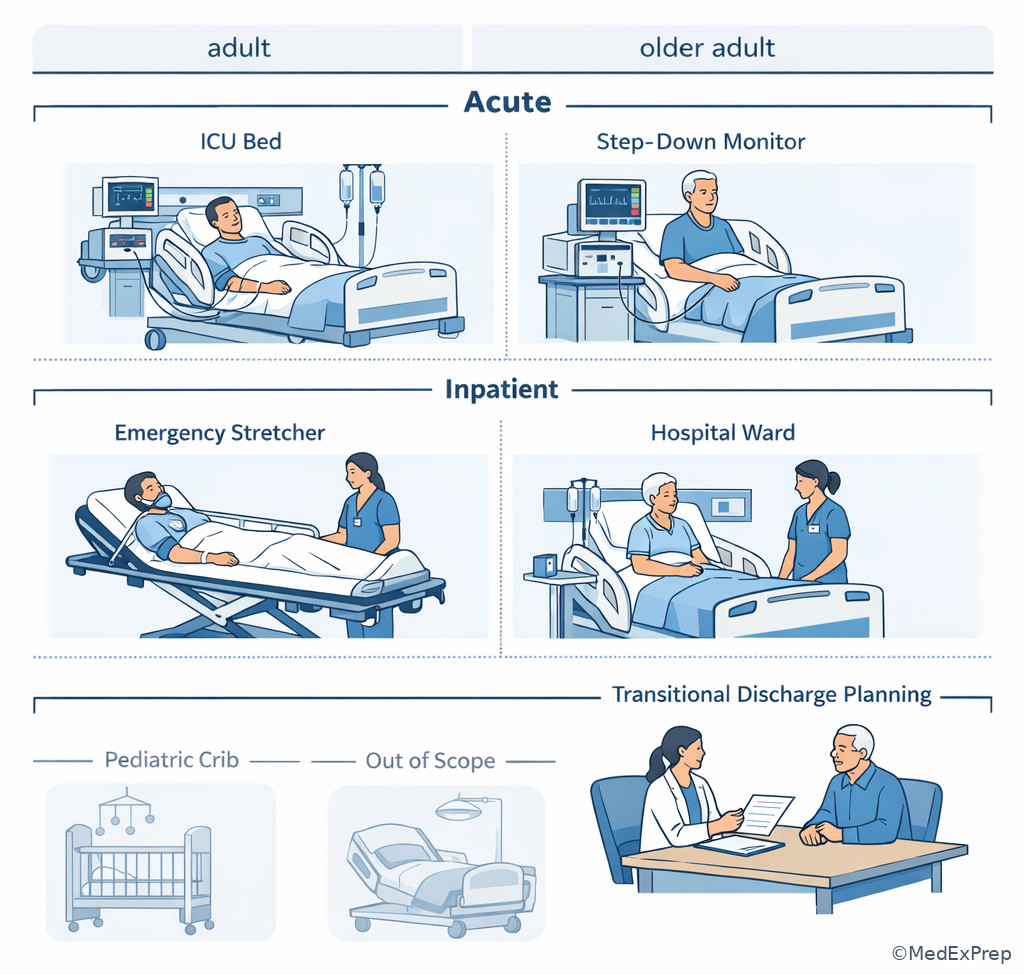
F -- No --> H[Stabilize and escalate or consult] Exam takeaway: Visualize adult and older adult acute settings as the core AGACNP testing environment.
Core content
1.1.1.3 Foundational population boundaries: who is in, who is out
A Explanation
The first decision conflict on this topic is simple but heavily tested: Is this patient inside the adult-gerontology acute care population, or is the question baiting you into managing a patient group that belongs to another certification pathway? The single rule that resolves most stems is this: adult and older adult acute/critical care is in scope; routine independent pediatric, neonatal, and obstetric management is not. That sounds obvious until the exam adds a medically familiar condition such as asthma, sepsis, appendicitis, or trauma. If the patient is a child, neonate, or laboring/pregnant obstetric patient requiring population-specific management, reject the tempting “treat the disease” answer if it assumes primary management outside AGACNP population preparation.
WHY THIS IS TESTED: The test wants to know whether you can separate disease recognition from role-appropriate care. A correct medical idea can still be the wrong exam answer if it ignores population boundaries.
Choose the AGACNP frame when the stem involves hospitalized adults, complex older adults, ICU deterioration, ED stabilization of an adult, postoperative adult complications, adult specialty consult services, or discharge after acute illness. Reject AGACNP ownership when the stem centers on pediatric developmental physiology, neonatal instability, pregnancy-specific maternal-fetal issues, labor/delivery decisions, or child-focused dosing/assessment frameworks.
B Worked example
A 17-year-old patient is brought to the ED with fever, hypotension, and diffuse petechiae. History includes repaired congenital heart disease and asthma. Lactate is elevated, and the patient’s mother says he “usually gets admitted to the children’s hospital.” A tempting clue is the obvious need for sepsis management. Identify task: determine whether the AGACNP candidate should manage this as a population-fit case. Extract key facts: age 17, pediatric care history, likely pediatric population pathway despite critical illness. Apply rule: the instability does not erase the age/population mismatch. Eliminate distractors: do not select an answer that assumes routine independent AGACNP primary management of this patient as if he were an adult ICU patient. Verify: the safe answer is to stabilize per emergency principles within team structure and ensure transfer or involvement of the appropriate pediatric-capable service.
The distracting elevated lactate is real and urgent, but it does not answer the population-scope question. The exam often hides that distinction.
C Exam trap
D Checkpoint
Question: Which patient most clearly fits the AGACNP population focus for board-style management reasoning?
- A. A 14-year-old with diabetic ketoacidosis transferred to the ICU after fluid resuscitation
- B. A 28-year-old at 34 weeks’ gestation with severe hypertension and headache admitted for maternal-fetal monitoring
- C. A 76-year-old with pneumonia, delirium, CKD, and rising oxygen needs on a step-down unit
- D. A 2-day-old newborn with bilious emesis and lethargy in the emergency department
Best answer: C.
- A: Tempting because ICU acuity fits acute care, but wrong because the patient is pediatric.
- B: Tempting because the patient is an adult by age, but wrong because the primary issue is obstetric population management.
- C: Correct because this is an older adult with acute inpatient deterioration squarely within adult-gerontology acute care.
- D: Tempting because emergency stabilization is needed, but wrong because neonatal management is outside population focus.
1.1.1.4 Foundational setting boundaries: acute care versus primary or longitudinal care
A Explanation
The second decision conflict is not age but care setting and care purpose: should the AGACNP candidate think like an acute care NP, or is the stem really about ongoing primary management? The single rule is: AGACNP preparation centers on acute, critical, complex episodic, and hospital-linked care; it is not built around routine longitudinal wellness or stable chronic disease follow-up. See Fig 1.
That means hospitalized adults with decompensated heart failure, new sepsis, postoperative complications, chest pain observation, ICU vent management, or transitional post-discharge reassessment after recent acute illness fit well. In contrast, stable outpatient diabetes maintenance, annual hypertension screening, childhood vaccination, prenatal continuity care, and uncomplicated health maintenance do not represent the core tested environment for this exam.
WHY THIS IS TESTED: Many stems look like internal medicine knowledge checks, but the answer choice hinges on whether the task is acute stabilization, inpatient diagnostic synthesis, or chronic longitudinal planning. On the exam, choose the answer that matches the acute care episode, not the broadest possible medical plan.
Exam takeaway: Distinguish acute episodic management from routine longitudinal care before selecting the next step.
flowchart LR
A[Adult patient encounter] --> B{Current need}
B -- Unstable, hospitalized, peri-acute --> C[AGACNP-centered reasoning]
B -- Stable chronic maintenance --> D[Primary or longitudinal care focus]
C --> E[Assess trends, complications, disposition]
D --> F[Screening, prevention, long-term management]
E --> G[Acute diagnostics and escalation]
F --> H[Ongoing outpatient follow-up] B Worked example
A 69-year-old with COPD, CAD, and type 2 diabetes presents to an observation unit 2 days after discharge for pneumonia. She has fatigue, dizziness, mild hypotension, and rising creatinine compared with discharge labs. A distracting clue is that her A1c is 9.2%, making long-term diabetes optimization seem attractive. Identify task: determine whether this is acute care or routine chronic management. Extract key facts: recent hospitalization, new symptoms, hemodynamic concern, renal trend, transition-linked instability. Apply rule: this is an acute transitional care problem within AGACNP reasoning. Eliminate distractors: do not prioritize outpatient diabetes regimen redesign as the main answer. Verify: the right next-step logic addresses volume status, medication contributors, renal perfusion, and need for readmission or escalation.
The A1c matters eventually, but it is not the board-tested priority in an acute post-discharge reassessment stem.
C Exam trap
D Checkpoint
Question: Which scenario best matches the acute care focus of AGACNP preparation?
- A. Annual lipid screening for a stable 52-year-old with no symptoms
- B. Medication refills and long-term blood pressure adjustment for a stable outpatient
- C. Reassessment of a 73-year-old 24 hours after ICU transfer with new confusion and increased oxygen requirement
- D. Routine prenatal follow-up at 30 weeks without acute complaints
Best answer: C.
- A: Tempting because it involves adult preventive medicine, but wrong because it is routine screening.
- B: Tempting because medication management is within NP practice generally, but wrong because the scenario is stable longitudinal care.
- C: Correct because it requires acute reassessment, trend interpretation, and deterioration management in an older adult.
- D: Tempting because the patient is an adult, but wrong because it is obstetric continuity care.
- The core AGACNP setting is ___, inpatient, critical, or urgent stabilization linked to hospitalization.
- True or False: A stable annual wellness exam is a core AGACNP board-prep scenario.
- Name the 3 common out-of-fit clues: pediatric age, obstetric primary issue, and ___ longitudinal stable care.
1.1.1.5 Applied boundary decisions: what to do when the patient is outside population scope
A Explanation
Once you identify a mismatch, the next tested conflict is choose immediate action: do you fully manage, do nothing, or stabilize and escalate? The single rule is: if the patient is outside population scope but has urgent needs, provide role-appropriate stabilization and involve the correct service without delay. This avoids two dangerous errors: overreaching beyond certification focus and underreacting because “it is not my population.”
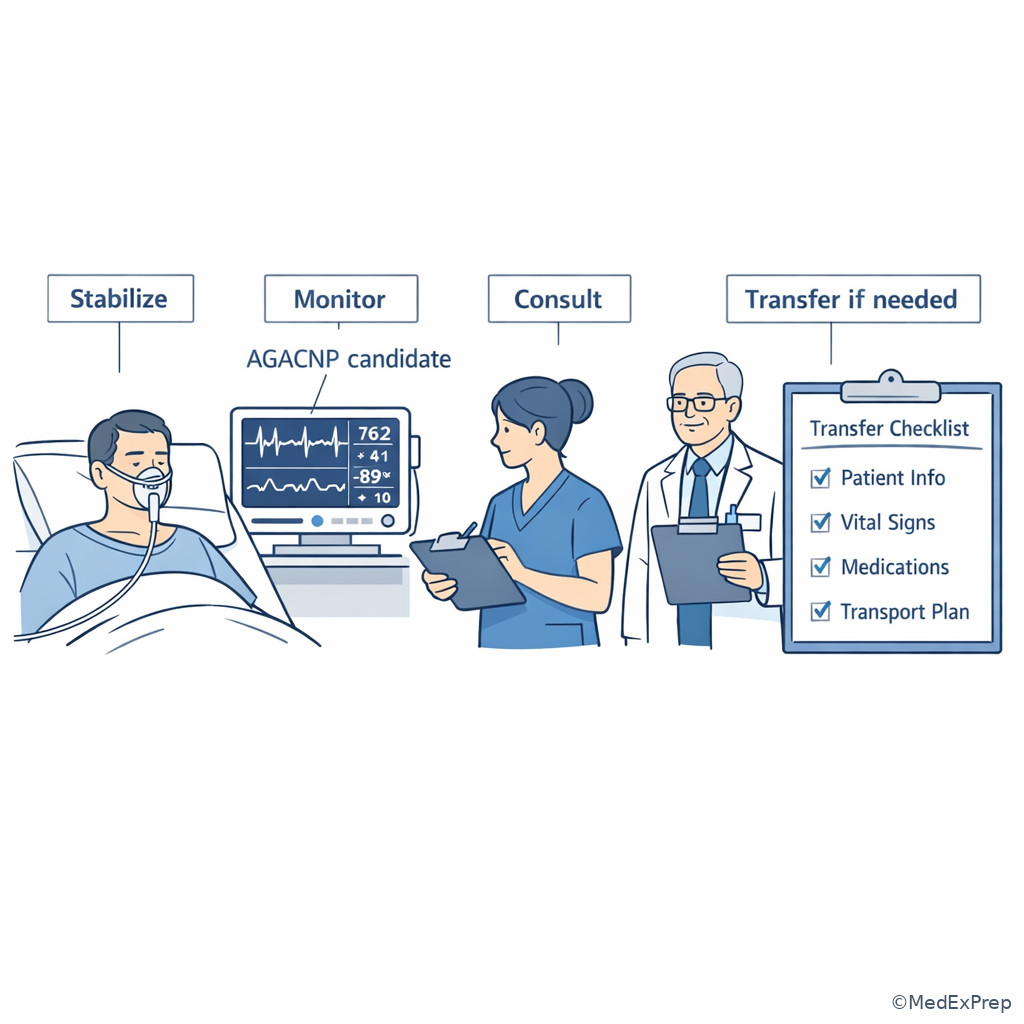
WHY THIS IS TESTED: Real practice requires safe boundary management, not abandonment. The exam rewards candidates who protect the patient first, then secure the correct consultation or transfer. See Fig 2 for the acute-versus-longitudinal lens that feeds this decision.
Choose stabilization steps that fit general emergency principles and your institutional role: airway support, oxygen, monitoring, IV access, hemodynamic support, sepsis bundle initiation where team structure permits, obtaining urgent diagnostics, and activating the appropriate specialty pathway. Reject answer choices that imply either independent ownership of a clearly outside-population condition or passive delay while waiting for another service despite obvious instability.
Exam takeaway: When the patient is outside population scope, the safest answer is usually immediate stabilization plus urgent consultation or transfer.
flowchart TD
A[Patient outside AGACNP population fit] --> B{Currently unstable?}
B -- Yes --> C[Stabilize ABCs and obtain urgent support]
C --> D[Activate correct specialty or transfer pathway]
B -- No --> E[Arrange appropriate consultation or handoff]
D --> F[Continue monitoring until transfer]
E --> F Exam takeaway: Acute care scope questions often test stabilizing an adult patient while coordinating the correct service and level of care.
B Worked example
A 31-year-old postpartum patient 2 days after cesarean delivery arrives in the ED with dyspnea, tachycardia, and pleuritic chest pain. She has obesity and preeclampsia history. D-dimer is elevated, and the intern notes possible pulmonary embolism. A distracting clue is that PE is an adult acute condition the AGACNP candidate will study later. Identify task: determine the role-appropriate next step in an adult patient whose primary context is postpartum obstetric care. Extract key facts: postpartum status, acute cardiopulmonary symptoms, high-risk obstetric physiology, need for urgent evaluation. Apply rule: she needs emergency stabilization and rapid diagnostic escalation, but the obstetric context means the correct service must be engaged. Eliminate distractors: reject answers that imply isolated independent ownership without obstetric or emergency collaboration. Verify: the best response is immediate cardiopulmonary stabilization, PE workup per emergency pathway, and urgent obstetric/appropriate specialist involvement.
C Exam trap
D Checkpoint
Question: A patient clearly falls outside routine AGACNP population management but is deteriorating. What is the most appropriate next step?
- A. Avoid intervention until the population-specific team evaluates the patient
- B. Provide immediate stabilization within role and activate the correct consultation or transfer pathway
- C. Assume full independent ongoing management because the physiology is familiar
- D. Focus documentation first and delay treatment until all history is complete
Best answer: B.
- A: Tempting because it sounds scope-conscious, but wrong because unstable patients require immediate safety actions.
- B: Correct because it balances patient safety with role and population limits.
- C: Tempting because familiarity with acute physiology feels sufficient, but wrong because population-specific management may require other expertise.
- D: Tempting because documentation matters, but wrong because acute deterioration makes treatment priority higher.
1.1.1.6 Adult-gerontology emphasis: older adults, frailty, and atypical presentation stay in scope
A Explanation
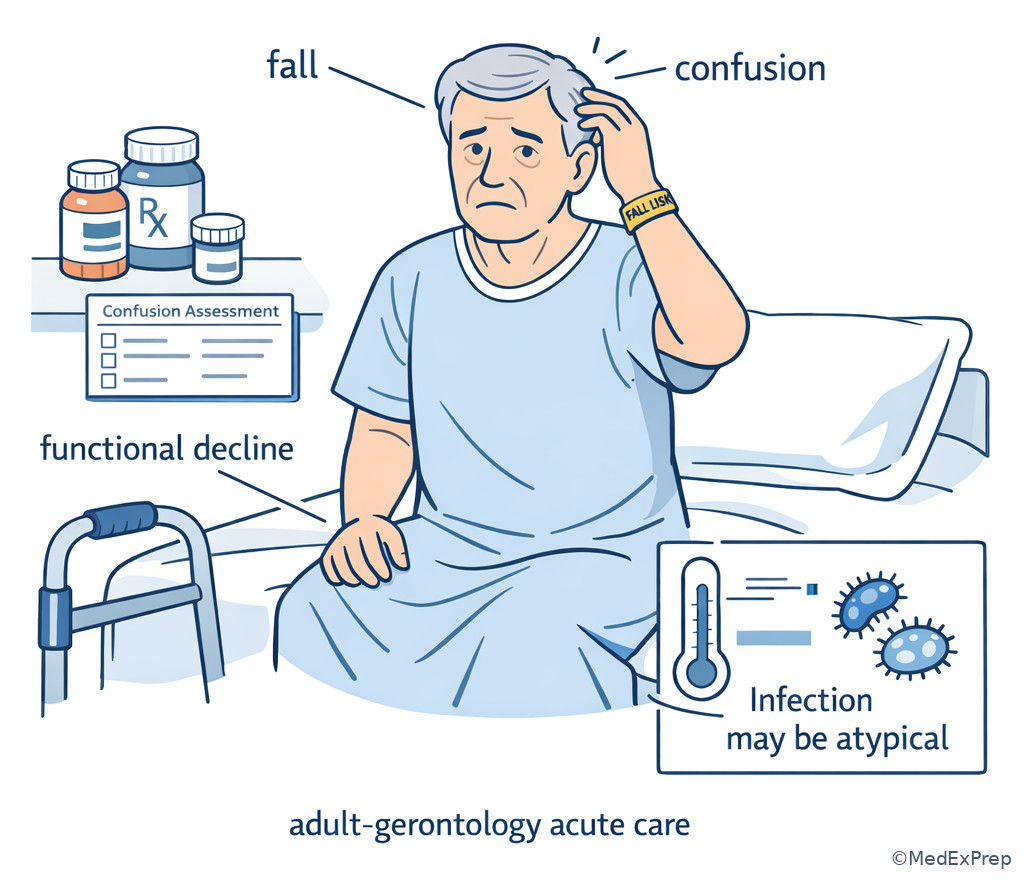
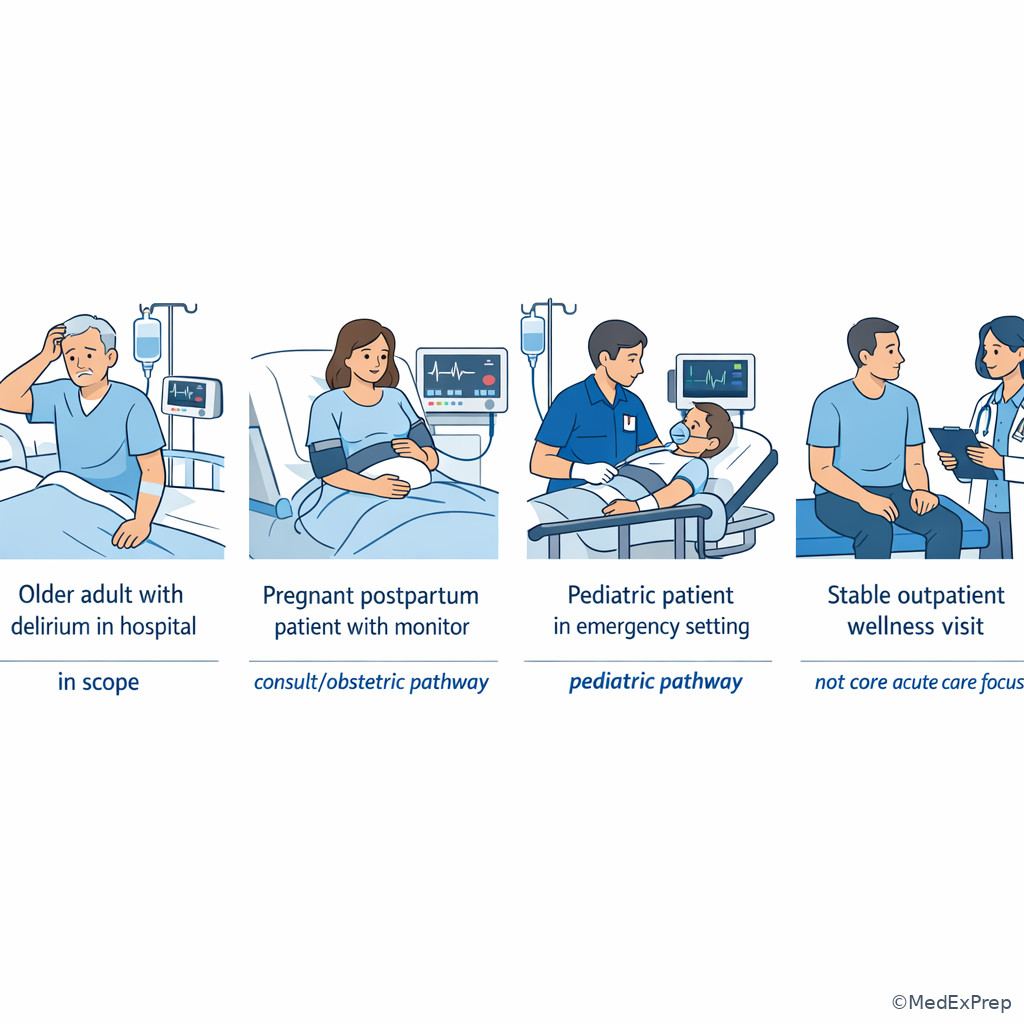
A common reverse error is assuming that very old, frail, cognitively impaired, or multimorbid patients are somehow “too specialized” and therefore outside AGACNP scope. The single rule here is the opposite: older adults are central to adult-gerontology practice, including atypical presentation, polypharmacy, delirium risk, falls, and functional decline. See Fig 3 for how stabilization and escalation still apply when complexity is high.
WHY THIS IS TESTED: exam writers know candidates may overfocus on ICU technology and forget that frail older adults are the signature population in adult-gerontology care. Atypical symptoms such as confusion instead of fever, weakness instead of chest pain, or falls instead of overt sepsis do not push the patient out of scope; they make the case more representative.
Choose AGACNP ownership when the older adult’s issue is acute and complex: delirium on the floor, acute decompensated heart failure, sepsis, postoperative ileus, syncope, hypercapnic respiratory failure, or medication-related encephalopathy. Reject answer choices that imply automatic handoff simply because the patient has dementia, multiple comorbidities, or residence in long-term care. Those features increase complexity; they do not remove population fit.
Exam takeaway: Frailty, delirium, polypharmacy, and atypical symptoms strengthen adult-gerontology relevance rather than exclude it.
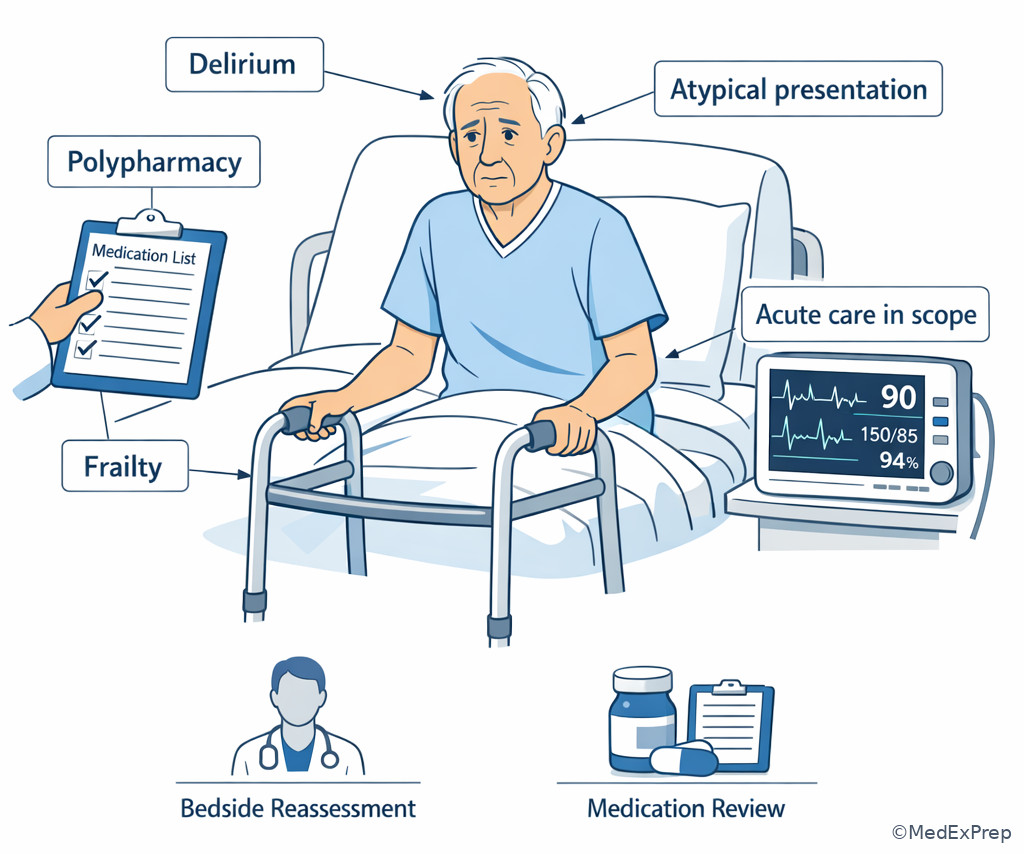
Exam takeaway: Older adults may present with falls, confusion, or functional decline instead of classic symptoms, but they remain in scope.
B Worked example
An 88-year-old nursing-home resident with dementia, HFpEF, CKD, and chronic benzodiazepine use is admitted for decreased oral intake and a fall. Temperature is 37.6°C, oxygen saturation is 91% on room air, and family reports new confusion. UA shows bacteriuria, which tempts a reflex “just UTI” interpretation. Identify task: determine whether this patient fits AGACNP acute care scope and what lens to use. Extract key facts: very old age, frailty, atypical symptoms, possible infection or hypoxia, multiple medications. Apply rule: this is highly representative of adult-gerontology acute care. Eliminate distractors: do not reject the case as “geriatric specialty only” and do not anchor on asymptomatic bacteriuria without broader acute assessment. Verify: the candidate should evaluate delirium triggers, oxygenation, medication contributors, volume status, and infection sources.
C Exam trap
D Checkpoint
Question: Which feature most strongly supports that a case remains within AGACNP population focus?
- A. The patient is 90 years old with polypharmacy and new delirium during hospitalization
- B. The patient is 12 years old but physiologically large for age
- C. The patient is pregnant and requires labor management in the ICU
- D. The patient is a healthy adult seen only for routine preventive screening
Best answer: A.
- A: Correct because older adult complexity is central to adult-gerontology acute care.
- B: Tempting because body size may resemble an adult, but wrong because age and pediatric population focus govern.
- C: Tempting because ICU acuity is high, but wrong because the primary population issue is obstetric.
- D: Tempting because the patient is an adult, but wrong because the encounter is routine preventive care rather than acute care.
- The older adult with frailty and atypical symptoms is ___ scope for AGACNP.
- True or False: Delirium in a hospitalized 86-year-old is less relevant to AGACNP than a classic ICU diagnosis.
- Name 3 common older-adult acute clues: delirium, fall, and ___ decline.
1.1.1.7 Integration: role, population, and specialty dependence in board-style stems
A Explanation
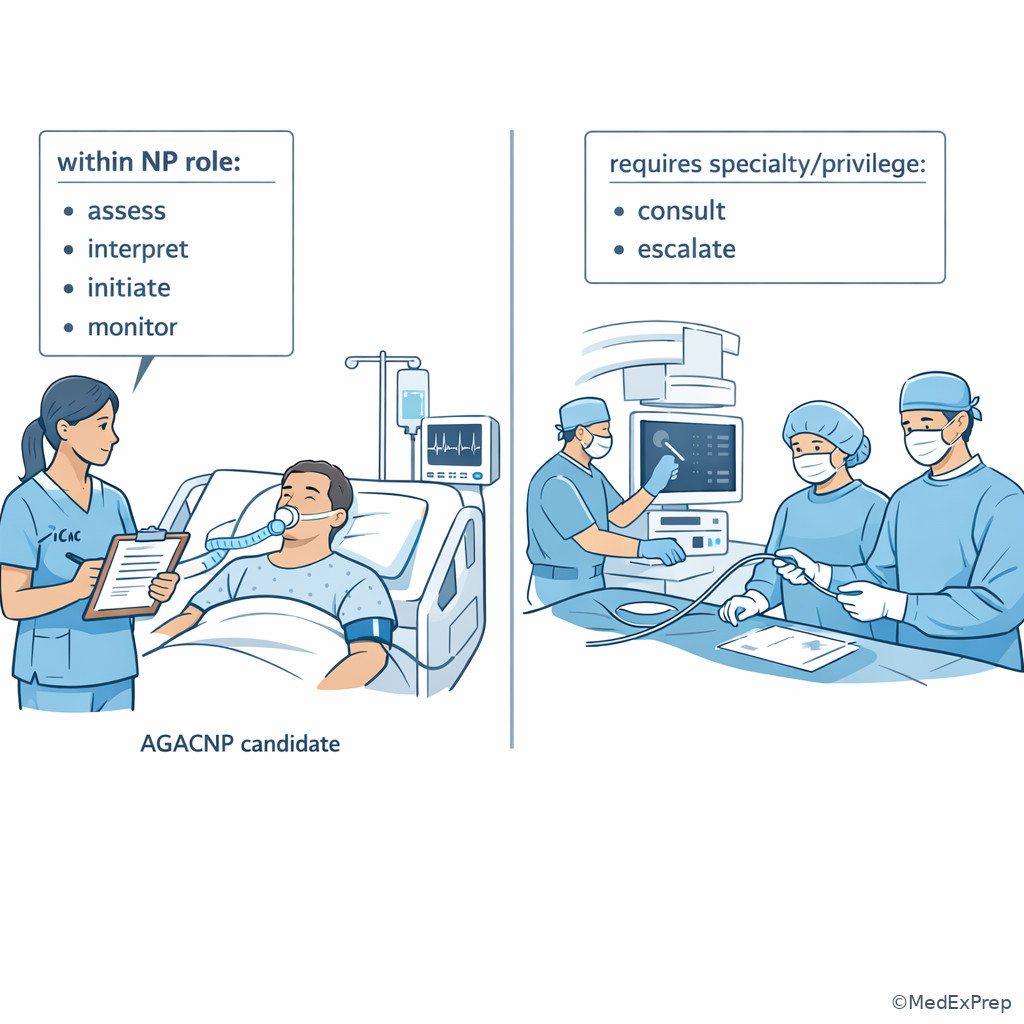
The highest-yield integration step is combining three screens at once: population fit, acute setting fit, and specialty/privilege dependence. A stem may involve an adult in an ICU, which seems in scope, yet the specific action requested may still be wrong if it requires surgeon-only management, physician-only authority, or institutional privileges not implied by the scenario. The resolving rule is: being in the right population does not authorize every possible intervention; choose the safest NP-level assessment, initiation, monitoring, consultation, or escalation step.
WHY THIS IS TESTED: board items reward role clarity. The AGACNP candidate manages acute illness, orders and interprets common diagnostics, initiates evidence-based therapies within licensure and privileging, and coordinates escalation. The candidate does not “become the surgeon” or bypass specialty-dependent care. See Fig 4 for the adult-gerontology complexity frame; the same patient may still require services beyond NP authority or the institution’s granted privileges.
Exam takeaway: A patient can fit AGACNP scope while a requested action still requires consultation, transfer, or credentialed supervision.
flowchart TD
A[Adult acute patient] --> B{Population fit?}
B -- No --> C[Redirect to correct population service]
B -- Yes --> D{Task within NP role and privileges?}
D -- Yes --> E[Assess, order, initiate, monitor]
D -- No --> F[Stabilize and consult specialty]
E --> G[Reassess response]
F --> G Exam takeaway: Board questions often test the difference between managing the patient and independently performing a specialty-dependent intervention.
B Worked example
A 64-year-old man in the SICU has worsening abdominal pain, tachycardia, leukocytosis, and rigid abdomen 2 days after bowel surgery. He also has CKD and atrial fibrillation. Lactate is 3.8 mmol/L. A tempting answer is “take the patient to the operating room immediately.” Identify task: choose the AGACNP’s most appropriate next step. Extract key facts: adult patient in scope, acute surgical complication, possible perforation or ischemia, high acuity. Apply rule: patient fit and episode fit are present, but the operative act is not the AGACNP’s independent role. Eliminate distractors: reject any option that casts the NP as the surgeon. Verify: the correct response is immediate resuscitative assessment, sepsis/instability management, urgent surgical notification, and higher-level support as needed.
C Exam trap
D Checkpoint
Question: Which statement best captures the integrated rule for this lesson?
- A. If the disease is familiar, population and task boundaries are secondary
- B. Any adult in the hospital automatically falls within every AGACNP action
- C. The correct answer must fit the patient population, the acute care episode, and the NP role/privilege level
- D. When unsure about scope, the safest approach is to avoid intervention entirely
Best answer: C.
- A: Tempting because knowledge of disease matters, but wrong because board items also test boundaries.
- B: Tempting because hospitalized adults are generally in population scope, but wrong because some tasks still require consultation or privileges.
- C: Correct because the best next step must match patient fit, episode fit, and task fit.
- D: Tempting because it avoids overreach, but wrong because safety requires timely stabilization and escalation.
Exam Traps & Differentiators
Most common wrong answer and why: choosing the most medically definitive action without checking whether the patient population and NP role fit. This is tempting because it rewards disease recognition, but the board tests role-appropriate clinical judgment.
| Stem clue | Think | Do not assume | Board discriminator |
|---|---|---|---|
| Older adult, delirium, multiple comorbidities | Still central AGACNP population | “Too geriatric” means outside scope | Complexity increases relevance |
| Adult in ICU needing operative source control | Stabilize and notify surgery | NP independently performs definitive surgery | Task fit may fail even when patient fit succeeds |
| Pregnant/postpartum patient with acute illness | Stabilize and involve obstetric-capable team | Routine primary obstetric ownership | Population-specific maternal care changes answer |
| Child or neonate with severe illness | Emergency support plus pediatric pathway | Independent AGACNP primary management | Age/population outranks disease familiarity |
| Stable chronic outpatient follow-up | Not the core acute care testing frame | Acute-care board logic is the main issue | Episode fit matters |
1.1.1.8 Looks similar but isn’t
| Look-alike pair | Why they get confused | What separates them |
|---|---|---|
| Adult acute patient vs. adult stable primary-care patient | Same age group | Acute episodic complexity versus routine longitudinal maintenance |
| Older adult frailty vs. out-of-scope specialty patient | Both look complex | Frailty is in-scope adult-gerontology complexity; specialty dependence concerns the task, not the age |
| Postpartum adult vs. nonobstetric adult | Both are adults | Postpartum maternal physiology may require obstetric co-management or ownership |
| Teen nearly adult-sized vs. adult patient | Physical size and familiar disease patterns mislead | Population focus follows age/developmental pathway, not body habitus |
If the stem says...
- “Laboring,” “fetal monitoring,” or “postpartum hemorrhage” → think obstetric population pathway, even if acute stabilization starts immediately.
- “Newborn,” “2-month-old,” or “pediatric congenital issue” → think outside AGACNP population focus.
- “Admitted from nursing home with new confusion and hypoxia” → think older adult acute care squarely in scope.
- “Stable annual follow-up” → think longitudinal outpatient care rather than acute-care board framing.
- “Needs emergent operation” → think stabilize and urgent surgical consultation, not independent operative action.
- “Recent discharge, now worse” → think acute transitional care and reassessment, not routine primary management.
Exam takeaway: Age, pregnancy status, care episode, and required procedure type are the fastest clues for rejecting scope-mismatch distractors.
Tables
| Reference item | High-yield rule | Exam use |
|---|---|---|
| Adult patient | Usually fits population focus | Still confirm acute setting and task fit |
| Older adult with frailty | Definitely in scope | Watch for atypical presentation and polypharmacy |
| Pediatric/neonatal patient | Outside routine population focus | Stabilize if urgent; activate pediatric pathway |
| Pregnant/postpartum primary obstetric issue | Needs obstetric-aware management pathway | Do not treat as routine nonobstetric adult case |
| Stable chronic outpatient follow-up | Not core AGACNP acute setting | Reject chronic-maintenance distractors in acute stems |
| Hospitalized adult needing surgery | Patient in scope; definitive procedure may not be | Choose stabilize plus urgent consult |
| Comparison | In scope for AGACNP exam reasoning | Outside routine AGACNP ownership |
|---|---|---|
| Population | Adults and older adults | Neonates, children, routine obstetric populations |
| Care episode | Acute, critical, complex episodic, transitional after acute illness | Stable wellness, prevention, uncomplicated long-term follow-up |
| Primary question | Deterioration, diagnosis, stabilization, monitoring, disposition | Routine screening schedule, developmental counseling, prenatal continuity care |
| Action style | Assess, interpret, initiate, monitor, escalate | Provide care outside population training or procedural privileges |
| Differential category | Typical clue | Best scope interpretation | Typical wrong turn |
|---|---|---|---|
| True AGACNP fit | 78-year-old with sepsis on step-down | Manage acute adult-gerontology illness | Over-referring because of age complexity |
| Population mismatch | 8-year-old with status asthmaticus | Pediatric pathway | Picking familiar respiratory treatment without age check |
| Episode mismatch | Stable adult annual medication review | Not core acute-care board framing | Applying ICU-style reasoning to routine follow-up |
| Task mismatch | Adult with perforated viscus needing surgery | Resuscitate and urgent surgical consult | Choosing physician/surgeon-only definitive action |
| Population plus urgency | Postpartum patient with dyspnea | Stabilize and involve obstetric-capable team | Waiting passively because of scope concern |
Algorithm / Approach
- Patient fit: adult or older adult?
- Episode fit: acute/critical/complex/transitional after acute illness?
- Task fit: within NP role and privileges?
- Action: proceed, co-manage, or stabilize plus escalate.
- Verification: reassess and document handoff or consultant involvement.
Rapid Review
- Population fit → adult or older adult outranks disease familiarity
- Teen patient → near-adult size does not equal adult population fit
- Pregnancy/postpartum → adult age does not erase obstetric pathway needs
- Frailty → adds relevance to adult-gerontology, not exclusion
- Delirium in hospitalized elder → classic AGACNP complexity pattern
- Stable annual visit → not the core acute-care exam frame
- Recent discharge now worse → acute transitional care, not routine outpatient follow-up
- Definitive surgery needed → NP stabilizes and escalates, does not become the surgeon
- Outside population but unstable → treat immediate threats first, then transfer/consult
- Board distractor → correct treatment for the wrong population is still wrong
- Older adult atypical symptoms → think infection, delirium, medication effect, or decompensation within scope
- Best-answer screen → patient fit + episode fit + task fit
Self-check quiz
1. A 79-year-old hospitalized patient with CHF, CKD, and new delirium after treatment for pneumonia is being reassessed for worsening confusion and poor oral intake. Which interpretation best supports AGACNP population fit?
- A. The patient is outside AGACNP scope because frailty makes the case primarily long-term care
- B. The patient is within AGACNP scope because older-adult acute complexity is central to adult-gerontology care
- C. The patient is outside AGACNP scope because delirium should be managed only in psychiatry settings
- D. The patient is outside AGACNP scope because chronic comorbidities outweigh the acute issue
2. A 26-year-old at 35 weeks’ gestation presents to triage with severe headache, hypertension, and visual changes. Which action frame is most appropriate for AGACNP board reasoning?
- A. Treat as a routine adult medical patient without obstetric involvement
- B. Recognize primary obstetric population needs; support immediate safety while activating the appropriate obstetric-capable team
- C. Defer all assessment until an obstetric clinician arrives
- D. Manage the patient as a stable outpatient chronic hypertension follow-up
3. A 68-year-old man with CAD, COPD, and recent hospitalization for NSTEMI presents to the observation unit 18 hours after discharge with dizziness, low blood pressure, and increased creatinine. He also asks whether his long-term statin dose should be increased. Which is the most appropriate next step framework?
- A. Prioritize chronic lipid management because secondary prevention after NSTEMI has the greatest long-term benefit
- B. Treat this as acute transitional deterioration and assess hemodynamics, medications, renal perfusion, and need for readmission
- C. Refer back to primary care because all discharge medication questions are outpatient issues
- D. Delay evaluation until complete outpatient records are available
4. A 16-year-old with severe asthma, obesity, and repaired VSD arrives with accessory muscle use and hypoxemia. The respiratory pattern is familiar to the adult ICU team. Which response best matches this lesson?
- A. Assume independent AGACNP primary management because the pathophysiology matches adult status asthmaticus
- B. Recognize pediatric population mismatch, support immediate stabilization, and activate pediatric-capable care
- C. Provide no intervention because pediatric patients are outside AGACNP scope
- D. Focus first on long-term home inhaler education rather than the acute episode
5. A 74-year-old woman in the surgical ICU has fever, tachycardia, rigid abdomen, rising lactate, and worsening pain 1 day after bowel resection. She also has atrial fibrillation and mild chronic anemia. Which option is the most appropriate NP-level action?
- A. Independently take the patient to the operating room because bowel ischemia is likely
- B. Initiate urgent reassessment and stabilization, then notify surgery immediately for probable postoperative catastrophe
- C. Wait for the next routine surgical rounds because the definitive step is not within NP scope
- D. Focus on chronic anticoagulation counseling before escalating care
6. A 33-year-old postpartum patient 3 days after vaginal delivery presents with dyspnea, pleuritic chest pain, tachycardia, and oxygen saturation of 89% on room air. She has obesity, recent preeclampsia, and a mildly elevated WBC count. Which response is most appropriate?
- A. Delay action until obstetrics confirms whether this is a maternal complication
- B. Manage entirely as a routine nonobstetric adult pulmonary embolism patient without involving obstetric-capable services
- C. Provide cardiopulmonary stabilization and urgent PE evaluation while involving the appropriate obstetric/emergency pathway
- D. Reassure the patient because postpartum tachycardia and dyspnea are usually expected findings
7. A 91-year-old assisted-living resident with dementia, HFpEF, CKD, and polypharmacy is hospitalized after a fall. Overnight she becomes somnolent, mildly hypoxemic, and newly incontinent. The urine culture later grows bacteria. Which interpretation is most appropriate?
- A. Because the patient is very old and frail, the case falls outside AGACNP population focus
- B. The positive urine culture proves this is only a routine long-term care issue, not an acute care problem
- C. This is a core AGACNP scenario requiring evaluation of delirium, hypoxemia, medication effect, and infection rather than reflex closure
- D. Transfer all decision-making to psychiatry because altered mentation is the central issue
8. A 62-year-old man in the ICU after trauma has increasing abdominal distention, hypotension, oliguria, and escalating ventilator pressures. The trauma surgeon is in another procedure. Which is the most appropriate next step for the AGACNP candidate?
- A. Perform definitive surgical management independently because delay could be harmful
- B. Recognize task mismatch, initiate immediate resuscitative support within role, and urgently escalate to the trauma/surgical team
- C. Wait without intervention because the definitive action is outside NP scope
- D. Focus on discharge planning because trauma disposition will eventually matter
Answer key
1.1.1.9 1. Answer: B
A: Tempting because frailty and chronic illness often involve long-term care planning. It is incorrect because the stem centers on an older adult with acute hospitalized deterioration, which is classic adult-gerontology acute care. The single stem clue is new delirium during hospitalization.
B: Tempting because it may feel too broad, but it is correct: older-adult acute complexity is exactly within AGACNP scope. The discriminating clue is older adult plus acute inpatient change. Source support: ANA standards and adult-gerontology acute care role frameworks emphasize care of acutely and complexly ill adults and older adults.
C: Tempting because altered mentation can trigger psychiatric association. It is incorrect because delirium in a medically ill hospitalized older adult is primarily acute medical assessment, not default psychiatry ownership. The clue is medical hospitalization and poor intake.
D: Tempting because multiple chronic diseases can dominate the chart. It is incorrect because chronic comorbidity does not remove acute care population fit. The clue is worsening confusion now.
1.1.1.10 2. Answer: B
A: Tempting because severe hypertension and headache invite general adult emergency reasoning. It is incorrect because the pregnancy context creates primary obstetric population needs. The discriminating clue is 35 weeks’ gestation.
B: Correct because it balances immediate safety with the proper maternal-obstetric pathway. The clue is adult age but obstetric primary issue. This follows safety and collaboration principles in acute care practice.
C: Tempting because it sounds boundary-respectful. It is incorrect because acute symptoms still require immediate assessment and safety action rather than passivity. The clue is severe headache with hypertension and visual changes.
D: Tempting because chronic hypertension is common. It is incorrect because this stem is acute and obstetric, not routine outpatient follow-up. The clue is triage with severe symptoms.
1.1.1.11 3. Answer: B
A: Tempting because statin intensification is valid after NSTEMI. It is incorrect because ABCs, circulation, and acute instability outrank long-term prevention in a patient with hypotension and renal worsening. The clue is 18 hours after discharge with low blood pressure and rising creatinine. Priority reasoning aligns with acute care assessment standards.
B: Correct because the case is acute transitional deterioration. The clue is recent discharge plus new hemodynamic/renal change. This is the best fit for AGACNP acute reasoning.
C: Tempting because medication questions often belong outpatient. It is incorrect because this patient has new instability requiring immediate acute evaluation, not simple referral. The clue is dizziness and hypotension.
D: Tempting because chart completeness helps. It is incorrect because nursing-process and safety principles require acting on current instability first. The clue is current symptoms and renal decline.
1.1.1.12 4. Answer: B
A: Tempting because the airway physiology is familiar and urgent. It is incorrect because population focus follows age, not disease familiarity. The clue is 16-year-old.
B: Correct because it combines immediate stabilization with the appropriate pediatric-capable pathway. The discriminating clue is severe distress in a pediatric-aged patient.
C: Tempting because it avoids scope overreach. It is incorrect because acute hypoxemia still requires immediate supportive action within role. The clue is accessory muscle use and hypoxemia.
D: Tempting because education matters in asthma. It is incorrect because it is the right concept at the wrong priority; airway/breathing come first. The clue is acute respiratory distress.
1.1.1.13 5. Answer: B
A: Tempting because the patient may need emergent surgery. It is incorrect because the NP does not independently perform definitive operative management. The clue is probable postoperative catastrophe requiring surgery service.
B: Correct because it is the role-appropriate acute response: reassess, stabilize, and urgently notify surgery. The discriminating clue is adult acute fit but specialty-dependent definitive treatment.
C: Tempting because the definitive step is outside NP scope. It is incorrect because waiting violates circulation and sepsis priorities in an unstable patient. The clue is rigid abdomen and rising lactate.
D: Tempting because atrial fibrillation and anticoagulation matter perioperatively. It is incorrect because it is the correct topic at the wrong priority; current abdominal catastrophe outranks chronic counseling. The clue is fever, tachycardia, rigid abdomen.
1.1.1.14 6. Answer: C
A: Tempting because postpartum complications need obstetric input. It is incorrect because breathing and oxygenation concerns require immediate action before confirmation. The clue is oxygen saturation 89%.
B: Tempting because PE evaluation is a familiar adult acute pathway. It is incorrect because the postpartum context makes obstetric-capable involvement important; ignoring that over-simplifies population needs. The clue is 3 days after delivery.
C: Correct because it preserves ABC priorities while respecting maternal population context. The discriminating clue is acute hypoxemia plus postpartum state.
D: Tempting because physiologic postpartum changes occur. It is incorrect because pleuritic pain, tachycardia, and hypoxemia are red flags, not expected reassurance findings. The clue is dyspnea with low oxygen saturation.
1.1.1.15 7. Answer: C
A: Tempting because age 91, dementia, and assisted living can feel outside hospital acute focus. It is incorrect because older adults with acute change are central to adult-gerontology acute care. The clue is hospitalized with overnight somnolence and hypoxemia.
B: Tempting because bacteriuria offers an easy explanation. It is incorrect because culture positivity alone does not close the case in a delirious older adult with hypoxemia and polypharmacy. The clue is somnolence plus mild hypoxemia.
C: Correct because the scenario demands broad acute evaluation of delirium triggers rather than premature closure. The discriminating clue is multiple plausible acute contributors in an in-scope older adult.
D: Tempting because mental-status change is prominent. It is incorrect because altered mentation here is most likely medical until proven otherwise. The clue is medical hospitalization and physiologic changes.
1.1.1.16 8. Answer: B
A: Tempting because the patient may have life-threatening abdominal compartment or intra-abdominal crisis requiring definitive intervention. It is incorrect because independent surgical management exceeds the NP role. The clue is trauma ICU patient needing surgical-team response.
B: Correct because it matches task-fit logic: initiate immediate resuscitative support and urgent escalation. The discriminating clue is hypotension, oliguria, and escalating ventilator pressures with surgeon temporarily unavailable.
C: Tempting because it avoids overstepping scope. It is incorrect because waiting without intervention violates ABCs and circulation priorities in an unstable patient. The clue is current hemodynamic compromise.
D: Tempting because trauma patients will need complex disposition. It is incorrect because discharge planning is wholly wrong priority in active instability. The clue is ICU deterioration now.
Keep going with the full ACNP-BC Prep Course (ACNP)
You just studied the way members do, in the same lesson interface. Full access unlocks every lesson, the question bank and flashcards for a full year.
One payment · 1 year of access · No auto-renewal