1.1.1 - Domain Map And Coverage
Domain Map And Coverage
What you'll learn
- UROLOGY DOMAIN: Exam Strategy and Framework -> Course map interpretation - Organize study using the major ABU-relevant urology domains rather than isolated facts.
- UROLOGY DOMAIN: Exam Strategy and Framework -> Blueprint-aware prioritization - Map topics to broad objectives without inventing proprietary exam percentages.
- UROLOGY DOMAIN: Exam Strategy and Framework -> Reasoning pathway selection - Decide whether a stem is primarily testing diagnosis, urgency, risk stratification, treatment, or surveillance.
- UROLOGY DOMAIN: Exam Strategy and Framework -> Cross-domain pattern recognition - Recognize where oncology, stones, infection, reconstruction, pediatrics, and perioperative care overlap in real board-style cases.
- UROLOGY DOMAIN: Exam Strategy and Framework -> Gap-safe study planning - Use learner-safe coverage planning when exact blueprint detail is unknown.
- Domain: Exam Strategy and Framework → Objective: Build a board-prep map of core urology content → Subskill: Assign topics to major clinical domains.
- Domain: Exam Strategy and Framework → Objective: Apply board-style reasoning structure → Subskill: Identify whether the stem demands workup, stabilization, treatment, or follow-up.
- Domain: Perioperative Care and General Clinical Management → Objective: Integrate safety-first thinking → Subskill: Escalate emergencies before definitive diagnosis.
- Domain: Cross-domain coverage → Objective: Maintain full topic mapping across the course → Subskill: Avoid leaving any domain unmapped.
Why it matters
- Board questions rarely test isolated memorization; they test whether you can identify which framework applies first.
- Many wrong answers are not false in general; they are wrong because they belong to a different domain, time point, or urgency tier.
- A clear course map prevents under-studying major areas such as emergencies, perioperative reasoning, pediatric urology, and reconstructive complications.
- The exam rewards structured physician-level thinking: stabilize, localize the problem, choose the rule set, then verify contraindications and follow-up.
Key Terms & Must-Know Facts
1.1.1.1 Key terms
- Domain map: Broad organizational structure of tested content areas.
- Objective: What the learner must be able to do clinically.
- Subskill tag: Precise mapping label in the format domain → objective → subskill.
- Best next step: The single most appropriate immediate action for the scenario given.
- Stabilization: Urgent action taken before definitive workup in unsafe patients.
- Risk stratification: Sorting patients by severity, stage, or complication risk to guide management.
- Differential discriminator: One clue that separates two plausible choices.
- Confirmatory finding: Data that supports the leading diagnosis or pathway.
- Distractor noise: Irrelevant or lower-priority findings that should not redirect the answer.
- Cross-topic overlap: A concept tested simultaneously with another domain.
- Coverage gap: A domain or objective that has not yet been linked to content.
- Surveillance: Planned follow-up after treatment or observation.
1.1.1.2 Must-know facts
- When exact exam weighting is unknown, use broad learner-safe domain mapping rather than invented percentages.
- Emergency decompression, drainage, hemorrhage control, and torsion logic outrank complete diagnostic refinement.
- Most board stems can be classified into one of five tasks: diagnose, stage/risk stratify, treat, manage complication, or plan follow-up.
- Wrong answers are commonly correct for a slightly different patient, stage, or urgency tier.
- Urology board preparation must include adult and pediatric care, outpatient and inpatient reasoning, and operative plus postoperative decision-making.
- A strong study plan tracks not just diseases, but also workup rules, contraindications, complications, and surveillance pathways.
- Cross-domain stems are common: infection with obstruction, oncology with renal function, trauma with catheter decisions, pediatrics with long-term follow-up.
- The safest framework is: identify the task → extract key facts → assign domain → apply governing rule → verify urgency and contraindications.
| Major domain | What it usually tests | Typical stem verbs | Common ABU-style decision point |
|---|---|---|---|
| Exam Strategy and Framework | Reasoning structure, task recognition, prioritization | most appropriate next step, best initial approach | Choose the right rule set before acting |
| Urologic Oncology | Risk, stage, treatment selection, surveillance | most likely stage, best management, follow-up | Match disease extent to therapy |
| Stone Disease and Endourology | Urgency, imaging, medical vs procedural care | requires decompression, best initial imaging | Recognize obstruction plus infection or renal threat |
| Voiding Dysfunction and FPMRS | Symptom patterns, bladder drainage, treatment sequencing | most likely cause, next test, best therapy | Separate storage from emptying disorders |
| Male Sexual and Reproductive Health | ED, infertility, scrotal emergencies | most likely diagnosis, immediate intervention | Do not miss torsion or ischemic priapism |
| Pediatric Urology | Congenital anomalies, reflux, testis issues | most appropriate evaluation, timing of repair | Age and long-term renal/testicular risk matter |
| Reconstructive Urology and Trauma | Injury patterns, strictures, diversion/fistula problems | best next step, avoid what maneuver | Instrument safely and image before harmful passage |
| Infections and Inflammation | Source control, severity, antibiotic context | best initial therapy, admit vs outpatient | Drain infected obstruction early |
| Perioperative and General Clinical Management | Anticoagulation, antibiotics, devices, complications | most important to monitor, likely complication | Recognize postoperative deterioration patterns |
Exam takeaway: Classify the stem into a major domain first so you apply the right diagnostic or management rule.
flowchart TD
A[ABU Urology Prep] --> B[Exam Strategy and Framework]
A --> C[Urologic Oncology]
A --> D[Stone Disease and Endourology]
A --> E[Voiding Dysfunction and FPMRS]
A --> F[Male Sexual and Reproductive Health]
A --> G[Pediatric Urology]
A --> H[Reconstructive Urology and Trauma]
A --> I[Infections and Inflammation]
A --> J[Perioperative and General Management]
C --> C1[Risk and staging]
C --> C2[Treatment selection]
D --> D1[Urgent decompression]
D --> D2[Procedure choice]
I --> I1[Source control]
J --> J1[Complication triage]
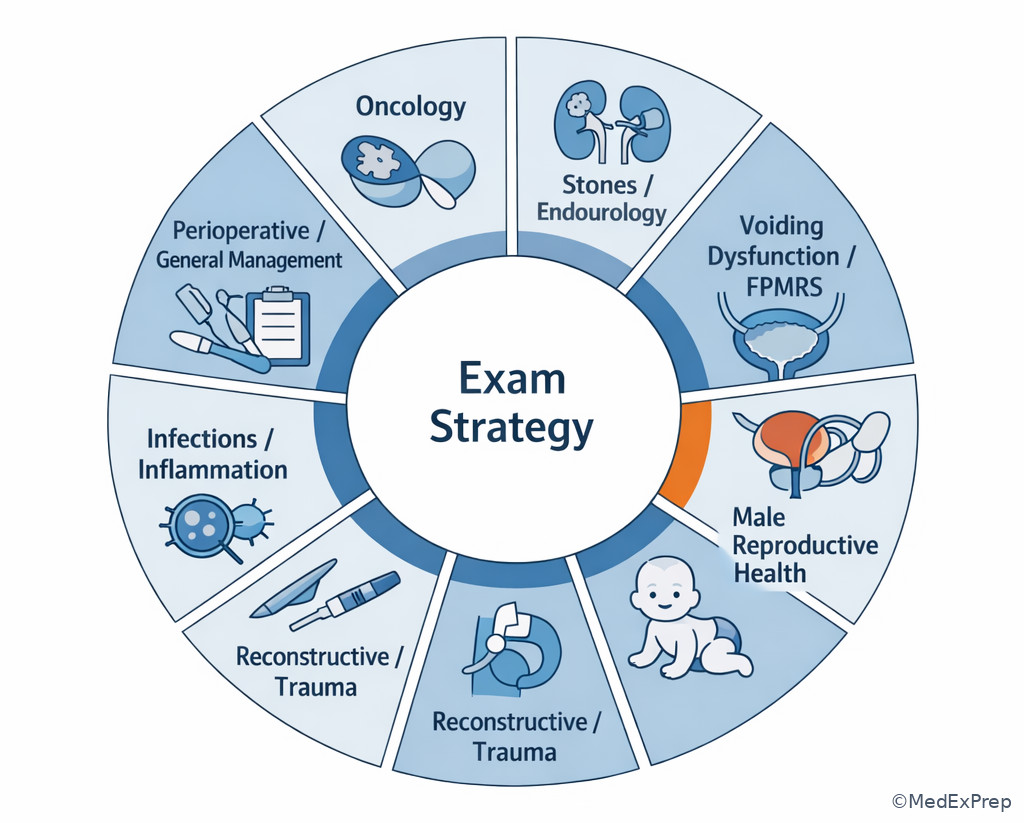
Exam takeaway: Use a visual domain wheel to spot under-studied areas before they become repeat misses.
Core content
1.1.1.3 Foundational map: the major tested urology domains
A Explanation
The first decision conflict is simple but decisive: is this stem asking you to recall a fact, or to enter the correct clinical domain? On the ABU-style exam, many misses happen because the learner starts solving the wrong problem. A hematuria stem may really be about malignancy workup, postoperative catheter management, infection, or anticoagulation. A scrotal pain stem may be andrology, pediatrics, infection, or emergency surgery. The single rule that resolves this conflict is: name the domain before naming the answer. See Fig 1.
WHY THIS IS TESTED: Board stems often compress several details into one vignette; the candidate must recognize the governing domain quickly and ignore lower-yield noise. Foundational domains for this course are broad and learner-safe: Exam Strategy and Framework; Urologic Oncology; Stone Disease and Endourology; Voiding Dysfunction and FPMRS; Male Sexual and Reproductive Health; Pediatric Urology; Reconstructive Urology and Trauma; Infections and Inflammation; Perioperative and General Clinical Management.
Choose the domain by asking: What kind of harm is being prevented? If the answer is sepsis or renal loss, think infection/obstruction/perioperative urgency. If the answer is understaging or undertreating cancer, think oncology. If the answer is infertility, testicular viability, or erectile function, think male reproductive health. If age is pediatric and anatomy/development dominate, think pediatric urology. If catheters, drains, stents, anticoagulation, or postoperative changes are central, perioperative management may be the true domain even if the organ is the same.
B Worked example
A 72-year-old man with diabetes, atrial fibrillation on apixaban, prior pelvic radiation for rectal cancer, and chronic LUTS presents with gross hematuria and clot retention. He is afebrile, creatinine is mildly elevated from baseline, urinalysis shows numerous RBCs and few WBCs, and his spouse reports he passed a small stone 10 years ago. The tempting wrong move is to frame this as either stone disease or delayed radiation cystitis only.
Reasoning chain: Identify task: this is not simply “name the cause,” but “what domain governs the next decision?” Extract key facts: gross hematuria, clot retention, anticoagulation, prior radiation, older age, cancer-risk context, and an acute bladder drainage issue. Apply rule: perioperative/general management and hematuria malignancy evaluation overlap, but immediate management domain is bladder drainage and stabilization first, not etiologic finalization. Eliminate distractors: prior stone history is noise because the current presentation is lower tract clot retention without classic renal colic. Radiation history is relevant but does not remove the need for clot evacuation and subsequent standard hematuria workup. Verify: the best next step lives in the urgency/drainage framework first, then oncology evaluation.
C Exam trap
D Checkpoint
Question: A board-style stem describes a 35-year-old man with sudden severe unilateral scrotal pain, nausea, a normal urinalysis, and mild fever after he lifted boxes at work. Which major domain should you assign first to choose the best next step?
- Male Sexual and Reproductive Health/Emergency andrology - Tempting because acute scrotum belongs here; correct because testicular viability and torsion logic dominate the next step.
- Infections and Inflammation - Tempting because fever can suggest epididymitis; wrong because mild fever does not outweigh sudden onset plus nausea and likely torsion pattern.
- Stone Disease and Endourology - Tempting because flank and groin pain can radiate to the scrotum; wrong because the stem localizes to acute scrotum rather than ureteral colic.
- Perioperative Care - Tempting because urgent action is needed; wrong because there is no procedure-related context, and the core domain is acute scrotal diagnosis/emergency management.
Answer: A
1.1.1.4 Blueprint-safe coverage: how to map topics without inventing percentages
A Explanation
The next decision conflict is precision versus overclaiming: should you build study plans around exact assumed board weights, or use a broad, defensible map? For this course, the correct move is broad learner-safe mapping. You should not invent official ABU percentages or proprietary wording when they are not provided. Instead, map every chapter, section, and topic to at least one domain/objective/subskill tag and ensure no major content area is left uncovered.
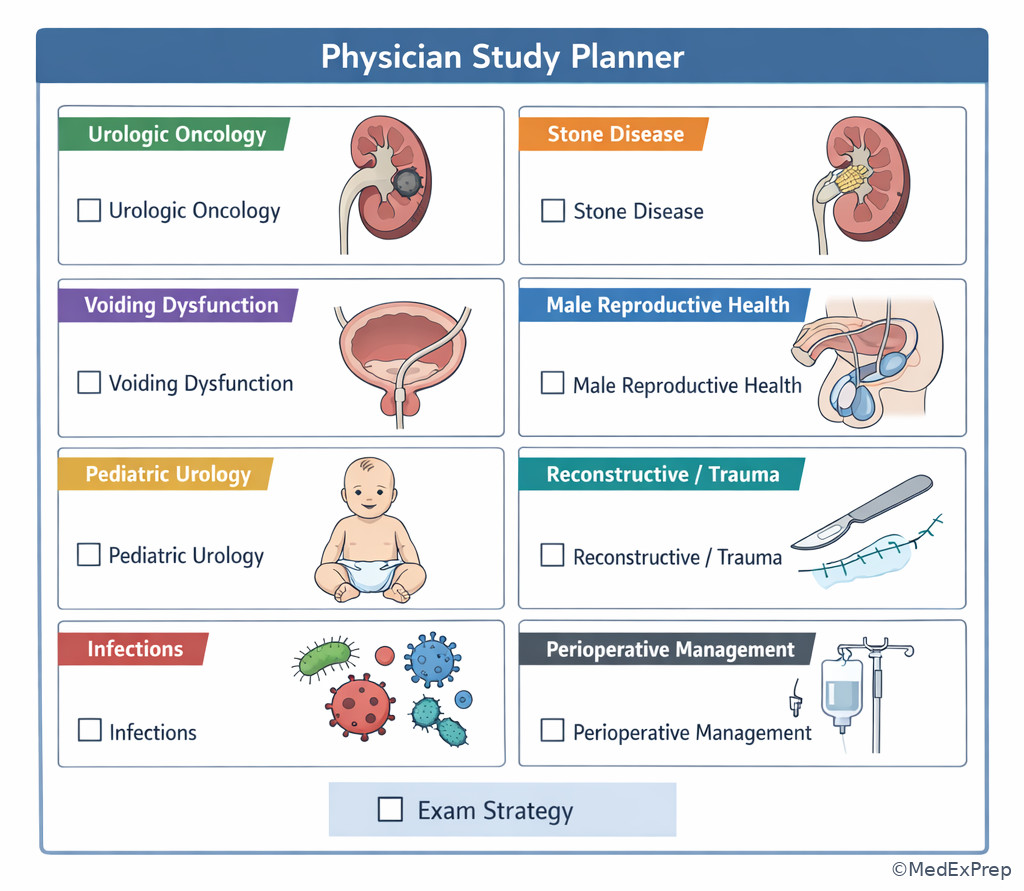
WHY THIS IS TESTED: Candidates often underprepare “low glamour” domains such as devices, drainage, complications, pediatric anomalies, or reconstructive trauma because they overestimate oncology-only weighting. Real board performance improves when coverage is complete, not when one domain is overfit. See Fig 2.
Coverage mapping should answer four questions: What domain is this? What objective is being trained? What subskill can be named? Is there any blueprint uncertainty that should be flagged learner-safely? A sound map does not require percentages. It requires completeness. For example, “Urinalysis and Urine Culture” maps naturally to Diagnostics and Safety, infection triage, and complication recognition. “Posterior Urethral Valves” maps to Pediatric Urology, congenital obstruction, renal preservation, and long-term follow-up. “Postoperative Complication Triage” maps to Perioperative Care, safety escalation, and device/drain management.
This approach also prevents studying topics in isolation. A single lesson may map to multiple domains, and that is a strength, not a flaw. In practice, obstructed infected stones sit at the intersection of endourology, infection, and emergency care. Gross hematuria after pelvic surgery sits at the intersection of oncology, perioperative management, and reconstructive issues. The exam rewards this layered view.
Exam takeaway: Build study completeness by linking each lesson to a domain, objective, and subskill instead of guessing exam percentages.
flowchart LR
A[Lesson topic] --> B[Assign domain]
B --> C[Assign objective]
C --> D[Name subskill]
D --> E[Check overlap]
E --> F{Gap?}
F -- Yes --> G[Add missing domain coverage]
F -- No --> H[Study plan is balanced]
H --> I[Learner-safe note: weighting unknown] B Worked example
A senior resident builds a study calendar that gives 40% of time to prostate and bladder cancer, 30% to stones, and the remaining 30% to “everything else.” He has strong tumor board exposure but repeatedly misses questions on postoperative obstruction, pediatric reflux, urethral injury, and catheter problems. He argues these are “probably low-yield.”
Reasoning chain: Identify task: this is a study strategy failure, not a disease question. Extract key facts: repeated misses cluster in neglected domains, not in his strong area. Apply rule: when official weight is unknown, complete coverage beats assumption-based weighting. Eliminate distractors: a heavier oncology emphasis is reasonable, but not at the expense of leaving domains effectively unmapped. Verify: the best correction is to restructure by domain and objective, ensuring each area has baseline coverage with explicit subskills and review loops.
C Exam trap
D Checkpoint
Question: Which study-planning principle best fits this course’s blueprint-safe approach?
- Assign exact percentages to each domain based on personal estimates - Tempting because it feels precise; wrong because the course explicitly avoids inventing unpublished blueprint weights.
- Map each topic to at least one domain, objective, and subskill, then check for gaps - Tempting because it is systematic; correct because completeness and explicit mapping are the intended framework.
- Prioritize only common outpatient diagnoses - Tempting because frequency matters clinically; wrong because the exam also tests emergencies, complications, trauma, and pediatric conditions.
- Study oncology first and return to the rest if time remains - Tempting because oncology feels broad and important; wrong because incomplete domain coverage leaves predictable blind spots.
Answer: B
- The safest alternative to unknown blueprint percentages is complete domain mapping.
- True or False: A single lesson may map to more than one domain. True.
- Name the 3 mapping layers after domain: objective, subskill, gap check.
Exam takeaway: A balanced review plan should visibly distribute study time across all major clinical domains, not just favored subspecialties.
1.1.1.5 Applied classification: identifying what the stem is really asking
A Explanation
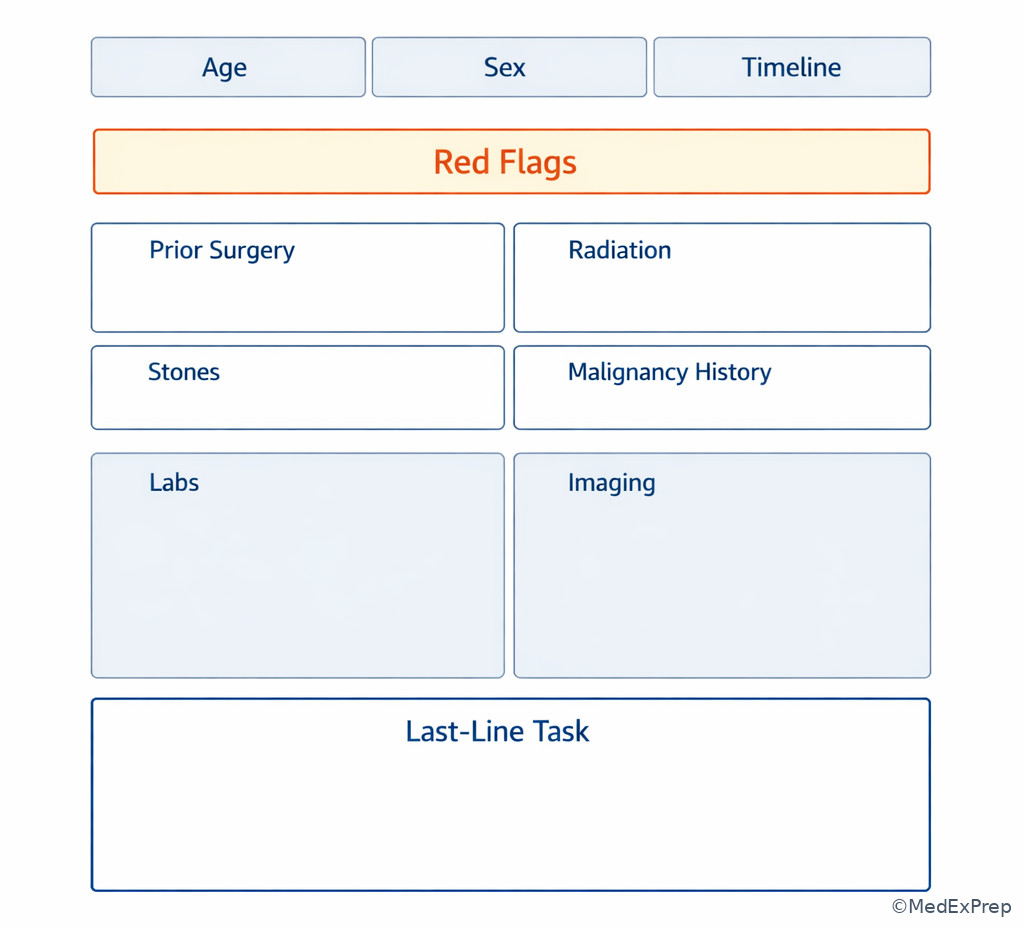
Once the domain is identified, the next conflict is what exact task is being tested? Many stems present enough data for a diagnosis, but ask for management. Others include an obvious emergency but ask for the most appropriate initial study only if the patient is stable. The single rule that resolves this is: read the question stem last line as the command verb, then classify the task into one of five buckets — diagnosis, workup, stabilization, treatment selection, or follow-up/surveillance.
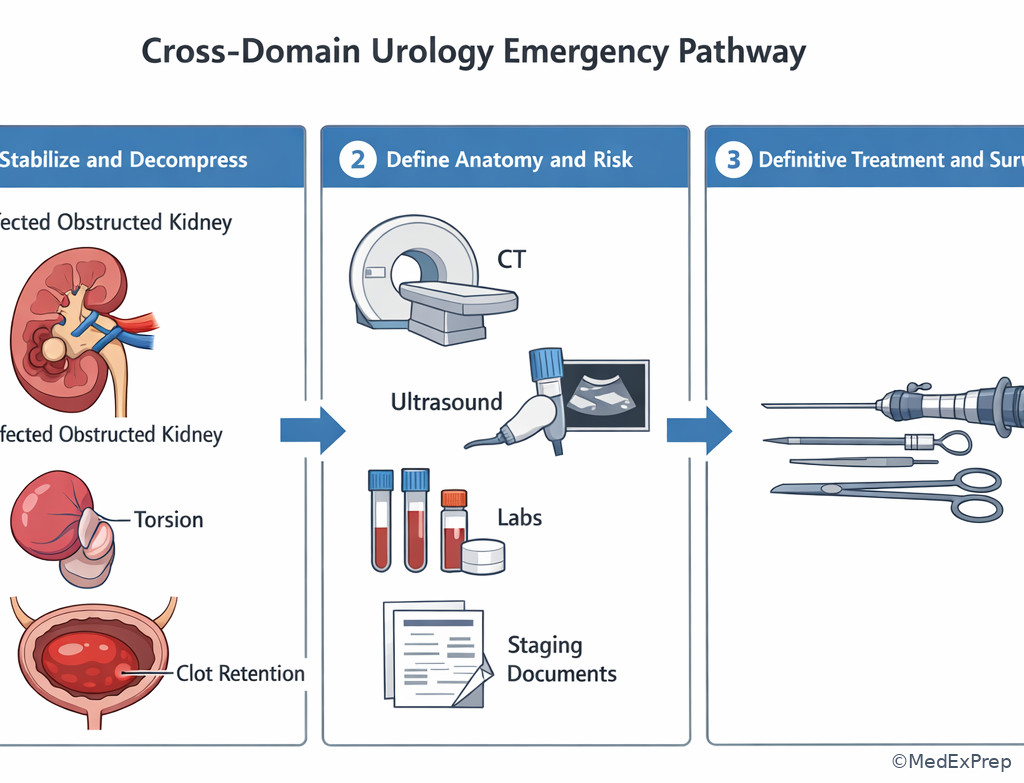
WHY THIS IS TESTED: Most high-level distractors are built from correct answers to the wrong task. A choice may be the best confirmatory test but not the best initial action; the best definitive treatment but not the safest first step; the correct surveillance schedule but for the wrong risk category. See Fig 3.
Practical sorting questions: Is the patient unstable? If yes, stabilization outranks detailed diagnosis. Is the diagnosis effectively established, and the stem now asks for staging or risk? If yes, do not circle back to low-yield confirmatory testing. Is the key issue time-sensitive tissue loss, sepsis, urinary drainage, or hemorrhage control? If yes, act. Is the scenario postoperative or device-related? Then your task may be complication recognition rather than primary disease diagnosis. Is the patient asymptomatic after treatment? Then the exam may be testing surveillance rather than recurrence management.
In this course, this task-recognition step becomes the bridge from content map to answer choice selection. The upcoming topic Board Style Case Parsing will train how to separate command clues from distractor noise, but the essential structure begins here: do not answer a diagnosis question with a treatment, and do not answer a stabilization question with a perfect differential.
Exam takeaway: The best answer usually matches the exact task type in the final sentence, not just the likely diagnosis.
flowchart TD
A[Stem] --> B{Unstable or threatened organ?}
B -- Yes --> C[Stabilize / decompress / operate]
B -- No --> D{What is the ask?}
D -- Diagnosis --> E[Choose discriminator]
D -- Workup --> F[Select next test]
D -- Treatment --> G[Select management pathway]
D -- Follow-up --> H[Choose surveillance]
D -- Complication --> I[Recognize postop/device issue] B Worked example
A 59-year-old woman with recurrent nephrolithiasis, obesity, and CKD stage 3 presents with fever, tachycardia, flank pain, and CT-confirmed 8 mm proximal ureteral stone with hydronephrosis. A distractor lab is a mildly elevated calcium level from known hyperparathyroidism workup. The stem asks for the most appropriate next step.
Reasoning chain: Identify task: management, not stone composition diagnosis or metabolic workup. Extract key facts: fever, obstruction, hydronephrosis, CKD, systemic illness. Apply rule: infected obstructed system requires urgent decompression; definitive stone treatment waits. Eliminate distractors: metabolic evaluation, shock wave planning, and outpatient antibiotics are all real but belong to later or safer scenarios. Verify: the answer must be decompression plus antibiotics, because the task bucket is urgent treatment.
C Exam trap
D Checkpoint
Question: A stable 68-year-old man has elevated PSA, abnormal DRE, and a biopsy already confirming prostate adenocarcinoma. The stem asks, “Which factor most strongly guides treatment selection?” What task bucket is being tested?
- Primary diagnosis - Tempting because PSA and DRE appear diagnostic; wrong because biopsy has already established diagnosis.
- Risk stratification/treatment planning - Tempting and correct because once diagnosis is confirmed, management depends on risk and patient factors.
- Emergency stabilization - Tempting if one overreacts to malignancy; wrong because there is no acute threat requiring immediate rescue action.
- Post-treatment surveillance - Tempting because oncology often includes follow-up; wrong because treatment has not yet been selected or delivered.
Answer: B
1.1.1.6 Integration across domains: emergencies, overlap, and sequencing
A Explanation
The hardest foundational conflict is single-domain thinking versus overlap thinking. Real urology cases cross boundaries. The exam uses this deliberately. An obstructing ureteral stone with fever is not “just stones”; it is stones plus infection plus emergency decompression. A postoperative pelvic patient with oliguria may involve perioperative management, urinary drainage, ureteral injury, or sepsis. A child with febrile UTI and hydronephrosis can bring together pediatrics, imaging, infection, and congenital obstruction. The single rule that resolves this is: when domains overlap, sequence them by immediate threat, then by definitive diagnosis, then by long-term management.
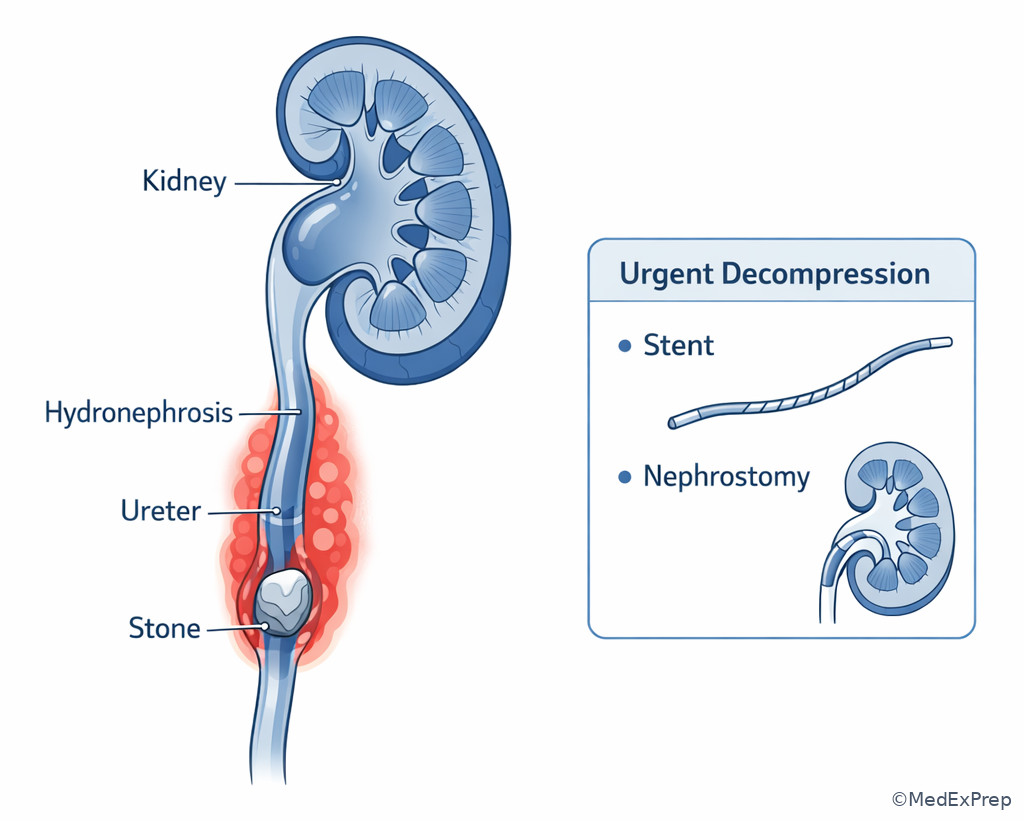
WHY THIS IS TESTED: Board-level decision-making is not merely naming the right disease. It is putting the right action at the right time. Many close-call distractors are correct at step 2 or step 3, but the stem asks for step 1. See Fig 4 and Fig 5.
Overlap sequencing usually follows a pattern. First: is there a need for stabilization, drainage, detorsion, hemorrhage control, or urgent exploration? Second: once safe, what diagnostic clarification or risk stratification is needed? Third: what definitive treatment follows? Fourth: what surveillance, device management, or complication monitoring comes next? This sequence is broadly valid across oncology, stones, trauma, infections, pediatrics, and perioperative care.
This is also where cognitive discipline matters most. Do not let a familiar subspecialty lens override basic safety. The board answer is rarely the fanciest operation; it is the safest correct sequence. In that sense, the domain map is not just a study organizer. It is a patient-safety hierarchy for test solving.
Exam takeaway: In multi-domain stems, prioritize the action that prevents immediate harm before pursuing definitive diagnosis or treatment.
flowchart TD
A[Cross-domain case] --> B{Immediate threat present?}
B -- Sepsis/obstruction --> C[Urgent decompression + antibiotics]
B -- Torsion/ischemia --> D[Immediate exploration]
B -- Bleeding/retention --> E[Drainage / control / resuscitation]
B -- No immediate threat --> F[Clarify diagnosis or risk]
F --> G[Choose definitive management]
G --> H[Plan surveillance and follow-up] Exam takeaway: Visualize overlapping emergencies as a sequence of stabilize first, define second, and treat definitively third.
B Worked example
A 14-year-old boy with intermittent flank pain, prenatal hydronephrosis history, and a recent febrile UTI presents with worsening pain and vomiting. Ultrasound shows severe hydronephrosis. He has mild leukocytosis, normal blood pressure, and a distracting family history of kidney stones. The stem asks for the most appropriate next step in management.
Reasoning chain: Identify task: management in an overlapping pediatric congenital obstruction/infection scenario. Extract key facts: pediatric age, known hydronephrosis history, febrile UTI, severe hydronephrosis, symptomatic obstruction. Apply rule: sequence by threat; if infection with obstruction is active or strongly suspected, decompression and infection management come before elective reconstructive planning. Eliminate distractors: metabolic stone workup is tempting because of family history, but the history is noise against the stronger congenital obstruction pattern. Elective pyeloplasty planning may eventually be correct, but not before acute assessment and stabilization. Verify: the answer belongs to pediatric obstructive urgency first, definitive reconstruction second.
C Exam trap
D Checkpoint
Question: Which sequencing rule is most appropriate for a patient with known bladder cancer who presents after TURBT with fever, suprapubic pain, retention, and worsening hematuria?
- Complete oncologic restaging first - Tempting because cancer is known; wrong because postoperative infection/retention may require immediate intervention before restaging.
- Prioritize the immediate complication and stabilize, then return to oncologic planning - Tempting and correct because the acute perioperative problem now dominates safety.
- Start long-term surveillance scheduling - Tempting because cancer follow-up matters; wrong because surveillance is downstream from current instability/complication management.
- Assume expected postoperative symptoms and observe without intervention - Tempting because mild dysuria can be normal after TURBT; wrong because fever plus retention plus worsening hematuria suggests a higher-risk complication.
Answer: B
- Fill in the blank: In overlap cases, the first rule is rank by immediate threat.
- True or False: The most definitive treatment is always the best next step. False.
- Name the sequence: Stabilize, Define, Treat, Follow.
Exam takeaway: Source control and drainage take priority over definitive stone treatment when obstruction and infection coexist.
1.1.1.7 Building a high-yield study system from the domain map
A Explanation
The final foundational-to-integration conflict is passive review versus deliberate coverage tracking. Many candidates read chapters but cannot tell which objective they have mastered, which differential they miss, or which urgency pathway they consistently mishandle. The solution is to study by domain x task x error type. That means you do not just say “I reviewed stones.” You say: “I reviewed stone imaging selection, urgent decompression criteria, medical expulsive therapy, and definitive procedure selection, and I still miss infected obstruction versus elective ureteroscopy.”
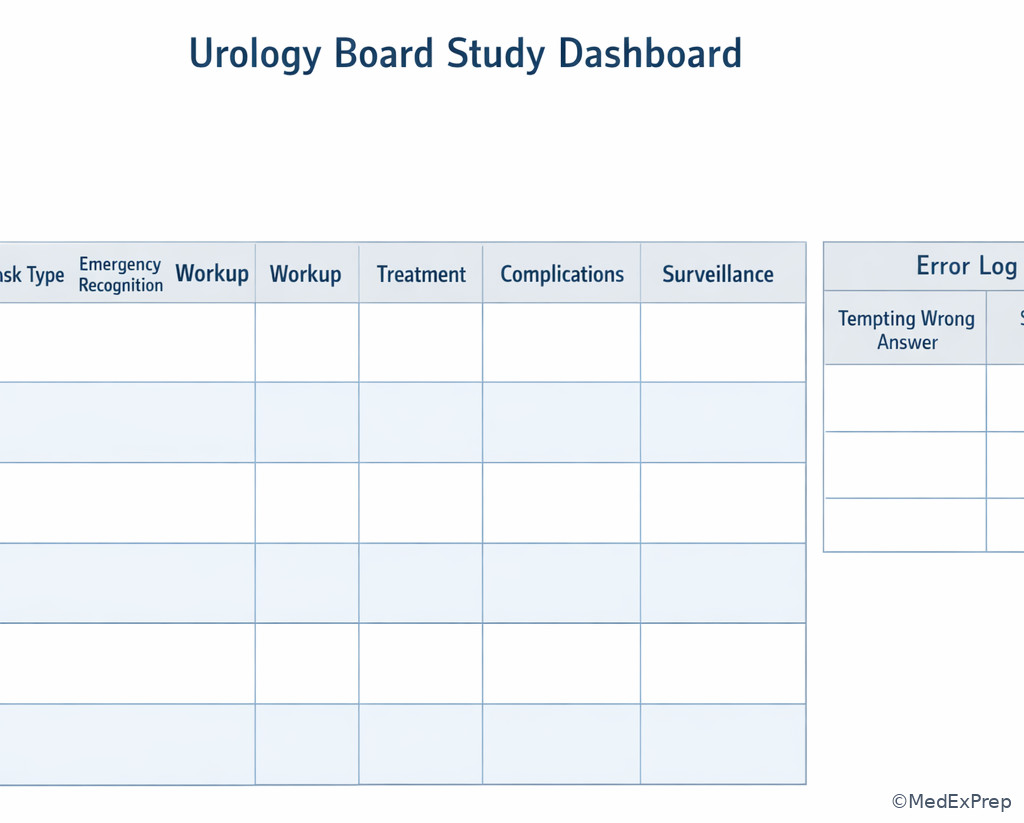
WHY THIS IS TESTED: The ABU-style challenge is not only knowledge acquisition but retrieval under pressure. A study system should therefore mirror test logic: domains, tasks, discriminators, traps, and follow-up rules. See Fig 6.
Use a simple dashboard. For each domain, track whether you can: identify the classic presentation, recognize the emergency variant, choose the next test, choose first-line management, identify the contraindication, and outline follow-up. Then add an error log with one column for “tempting wrong answer” and one for “single clue that eliminates it.” This converts misses into reusable discriminators instead of repeated frustration.
In practical terms, your weekly structure should include: one domain review block, one cross-domain comparison block, one emergency/complication block, one case-parsing block, and one mixed self-test. This avoids the common failure mode of becoming excellent inside one silo while underperforming on integrated questions.
Exam takeaway: Track misses by domain, task type, and discriminator so weak patterns become visible and correctable.
B Worked example
A fellow reviews 300 oncology flashcards but continues missing questions on renal trauma imaging, postoperative stent symptoms, and pediatric torsion. His score report shows errors scattered across “miscellaneous” topics. He thinks he just needs more volume.
Reasoning chain: Identify task: improve study system, not content volume alone. Extract key facts: misses cluster in neglected domains and in management/urgency questions rather than diagnosis questions. Apply rule: a dashboard organized by domain x task x discriminator is needed. Eliminate distractors: simply adding more oncology flashcards increases a strength instead of correcting the weak pattern. Verify: the next best adjustment is structured mixed-domain review with explicit trap tracking.
C Exam trap
D Checkpoint
Question: Which review metric is most useful for converting misses into board gains?
- Total questions completed per week - Tempting because it is easy to track; wrong because volume alone does not reveal decision-pattern weaknesses.
- Percent correct in favorite domain only - Tempting because it provides confidence; wrong because it hides coverage gaps elsewhere.
- Error log organized by domain, task type, and discriminating clue - Tempting and correct because it identifies exactly what rule failed and how to fix it.
- Hours spent reading guidelines - Tempting because it sounds rigorous; wrong because passive time does not necessarily translate into improved stem selection.
Answer: C
| Task type | What the stem usually asks | Best mindset | Common wrong move |
|---|---|---|---|
| Diagnosis | Most likely diagnosis | Find the discriminator | Answer with treatment instead |
| Workup | Most appropriate next test | Confirm what changes management | Order exhaustive testing |
| Urgent management | Best next step, immediate intervention | Stabilize first | Delay for definitive diagnosis |
| Definitive treatment | Best therapy or procedure | Match risk/stage/patient factors | Choose a therapy from the wrong severity tier |
| Complication management | Most likely complication, initial response | Recognize timing and device clues | Reopen the primary diagnosis |
| Surveillance/follow-up | Most appropriate monitoring | Use disease and risk context | Overtreat normal surveillance settings |
Exam takeaway: Structured case parsing separates command clues from distracting details before you commit to an answer.
Exam Traps & Differentiators
Most common wrong answer and why: The classic miss is choosing a technically true option from the wrong phase of care. For example, definitive stone removal instead of emergent decompression, cystoscopy scheduling instead of bladder drainage for clot retention, or surveillance planning instead of acute complication management. The wrong answer is tempting because it matches the disease label but not the time point.
| Looks similar but isn't | Why learners confuse them | Single discriminator | Correct framework |
|---|---|---|---|
| Known diagnosis vs best next step | Both use the same facts | Last-line command asks for action, not label | Task classification |
| Definitive treatment vs urgent stabilization | Definitive therapy sounds more complete | Presence of sepsis, ischemia, obstruction, or bleeding | Stabilize first |
| Oncology workup vs perioperative complication | Cancer history dominates attention | Postoperative timing/device clue redirects the problem | Complication management first |
| Adult stone logic vs pediatric congenital logic | Both may have hydronephrosis and pain | Age plus developmental history | Pediatric obstruction framework |
| Infectious process vs inflammatory/noise finding | Mild fever or pyuria can appear in many cases | Systemic illness plus source-control need | Infection/severity pathway |
| Routine follow-up vs urgent reassessment | Stable disease pathways are familiar | New symptom, abnormal drain/catheter output, or acute retention | Complication triage |
Exam takeaway: Reject answer choices that belong to a different time point even when they are medically reasonable in general.
flowchart LR
A[Option is medically true] --> B{Right phase of care?}
B -- No --> C[Reject]
B -- Yes --> D{Matches task in last line?}
D -- No --> C
D -- Yes --> E{Safe given urgency/contraindication?}
E -- Yes --> F[Choose]
E -- No --> C - If the stem says fever plus obstructed system, think drainage before definitive stone treatment.
- If the stem says sudden scrotal pain plus nausea and normal urinalysis, think torsion pathway before infection pathway.
- If the stem says postoperative catheter problem with oliguria or retention, think device/complication framework before reopening the original diagnosis.
- If the stem says biopsy-proven cancer and asks treatment, think stage/risk and patient factors rather than further diagnostic confirmation.
- If the stem says child with prenatal hydronephrosis history, think congenital/pediatric framework before importing adult stone logic.
- If the stem says gross hematuria with clot retention, think drainage/stabilization before etiologic closure.
Algorithm / Approach
| Step | Question to ask yourself | What good performance looks like |
|---|---|---|
| 1. Task | What is the exam asking me to do? | You can label the stem before looking at options |
| 2. Danger | Will delay cause sepsis, ischemia, renal loss, bleeding, or retention harm? | You move urgent rescue steps ahead of elegant workup |
| 3. Domain | Which urology framework governs this case? | You place the case into the correct clinical bucket |
| 4. Rule | What discriminator or pathway decides the answer? | You know the single clue that separates choices |
| 5. Verify | Is this answer right for this patient, now? | You reject close-call answers from the wrong stage or timing |
Rapid Review
- Domain map → organizes by clinical decision frameworks, not organ names alone
- Unknown blueprint weight → use complete domain coverage, not invented percentages
- Best next step → determined by task plus urgency, not diagnosis alone
- Septic obstruction → drainage outranks definitive stone treatment
- Acute scrotum with torsion clues → emergency andrology pathway, not infection-first logic
- Postoperative symptom cluster → think complication/device framework before primary disease
- Biopsy-proven cancer asking treatment → risk/stage pathway, not diagnostic reconfirmation
- Pediatric hydronephrosis history → congenital framework beats adult stone assumptions
- Clot retention → bladder drainage first, etiology second
- Overlap case → rank domains by immediate threatened harm
- Strong distractor → often correct for a different time point
- Error log → best organized by domain, task type, and single discriminator
- Mixed review blocks → prevent silo learning and improve overlap-case performance
Self-check quiz
1. A 41-year-old man is reviewing for boards after a busy trauma rotation and asks how to organize the course. Which framework is most appropriate for this lesson?
- Memorize diseases in alphabetical order
- Organize study by major urology domains and decision tasks
- Study only the cases most common in personal practice
- Focus on operative procedures before diagnostic frameworks
2. A 67-year-old man with hypertension and prior TURP has a stem that asks, “What is the most appropriate next step?” Which element should be identified first to avoid a task mismatch?
- The exact pathology subtype
- The final sentence’s task command
- The patient’s insurance setting
- The longest answer choice
3. A 63-year-old woman with diabetes and recurrent stones presents with fever, leukocytosis, flank pain, and CT-confirmed obstructing ureteral calculus. She also mentions months of urinary urgency and has a mildly elevated serum calcium under outpatient evaluation. Which is the most appropriate next step?
- Urgent decompression of the collecting system with antibiotics
- Immediate definitive ureteroscopic stone extraction
- Outpatient metabolic stone evaluation with 24-hour urine testing
- Antimuscarinic therapy for urgency and delayed follow-up imaging
4. A 70-year-old man with prior smoking history, coronary disease, and new gross hematuria presents with clot retention and suprapubic discomfort. He takes rivaroxaban and had pelvic radiation years ago. Which framework should govern the immediate next step?
- Hematuria malignancy evaluation and bladder drainage/stabilization first
- Delayed outpatient stone prevention counseling first
- Routine surveillance only because radiation history explains the bleeding
- Pediatric congenital anomaly workup first
5. A 15-year-old boy with sudden severe left scrotal pain, vomiting, and a normal urinalysis presents 3 hours after symptom onset. He has asthma and a recent upper respiratory infection. Which is the best initial reasoning frame?
- Infectious epididymitis pathway because of recent illness
- Emergency torsion pathway because threatened testicular viability dominates
- Stone pathway because nausea can occur with renal colic
- Observation pathway because symptoms began only a few hours ago
6. A 58-year-old man underwent TURBT 2 days ago and now has fever, worsening hematuria, suprapubic pain, and minimal catheter output. He has diabetes, CKD stage 3, and a history of bladder cancer. Which is the most appropriate next step?
- Prioritize postoperative complication assessment and bladder drainage before oncologic restaging
- Schedule repeat cystoscopy in several weeks because hematuria is expected postoperatively
- Begin long-term intravesical planning before evaluating the catheter issue
- Assume stent discomfort and discharge with oral analgesics
7. A 9-year-old boy with prenatal hydronephrosis history, intermittent flank pain, and a recent febrile UTI presents with vomiting and severe hydronephrosis on ultrasound. His father has nephrolithiasis, and the child drinks little water at school. Which study approach best reflects the correct board logic for this kind of case?
- Use an adult stone template because family history is present
- Use a pediatric congenital obstruction framework, then layer infection urgency and definitive repair planning
- Ignore hydronephrosis because urinary infection alone explains the symptoms
- Jump directly to definitive reconstruction without assessing acute risk
8. A fellow’s practice quiz data show high scores in localized prostate cancer but repeated misses in pediatric reflux, urethral trauma, infected obstruction, and postoperative device problems. He plans to solve this by doing more prostate cancer flashcards because those are his fastest questions. What is the most appropriate adjustment?
- Increase question volume in the strongest domain to build confidence
- Reorganize review using a domain-by-task error log with targeted mixed-case practice
- Stop doing mixed cases and return to textbook reading only
- Ignore score clustering because “miscellaneous” misses are random
Answer key
1.1.1.8 1. Question 1
Correct answer: B. Organize study by major urology domains and decision tasks. The mechanism here is efficient retrieval: the board tests clinical frameworks, not alphabetical disease lists. A domain-plus-task system improves diagnosis-mechanism-treatment reasoning across cases and prevents missed coverage.
- A: Tempting because lists feel complete; incorrect because alphabetical memorization ignores urgency, workup, treatment sequencing, and cross-domain overlap. Discriminating clue: the question asks how to organize board study, not how to catalog disease names. Source: Campbell-Walsh-Wein Urology; AUA guideline-based educational principles.
- B: Tempting because it seems more abstract than memorization; correct because domains and tasks mirror physician decision-making and the structure emphasized in this lesson. Discriminating clue: “organize the course” calls for a framework-level answer. Source: Campbell-Walsh-Wein Urology; Smith & Tanagho’s General Urology.
- C: Tempting because practice experience feels relevant; incorrect because ABU preparation spans adult, pediatric, reconstructive, perioperative, infectious, and oncologic urology beyond one practice’s case mix. Discriminating clue: board preparation requires full-scope coverage. Source: Campbell-Walsh-Wein Urology.
- D: Tempting because surgery is central to urology; incorrect because operative choices depend on first understanding diagnosis, urgency, and selection frameworks. Discriminating clue: the lesson is about domain mapping, not procedural sequencing alone. Source: Campbell-Walsh-Wein Urology.
1.1.1.9 2. Question 2
Correct answer: B. The final sentence’s task command. The mechanism is task alignment: the same factual stem can ask for diagnosis, next test, emergency action, or surveillance, and the answer changes accordingly.
- A: Tempting because pathology often matters in oncology; incorrect because the first anti-error step is identifying what the question wants, not jumping to a content subtype. Discriminating clue: the phrase “most appropriate next step” is a command-type clue. Source: Smith & Tanagho’s General Urology.
- B: Tempting because it sounds test-taking oriented rather than medical; correct because board questions are designed around command verbs that define the task bucket. Discriminating clue: the final sentence sets the required action. Source: Campbell-Walsh-Wein Urology.
- C: Tempting only if one overreads systems-based practice issues; incorrect because insurance setting is not the governing ABU clinical discriminator here. Discriminating clue: nothing in the stem suggests resource-allocation framing. Source: ABU-style clinical reasoning principles as reflected in standard urology texts.
- D: Tempting under poor test habits; incorrect because answer length has no clinical relevance. Discriminating clue: the lesson emphasizes structure, not guessing heuristics. Source: Standard exam-prep reasoning aligned with clinical texts.
1.1.1.10 3. Question 3
Correct answer: A. Urgent decompression of the collecting system with antibiotics. Pathophysiologically, obstruction plus infection threatens sepsis, renal injury, and rapid deterioration. Treatment logic is source control first, definitive stone therapy later.
- A: Tempting because it may seem less definitive than stone removal; correct because infected obstruction requires urgent drainage plus antibiotics. Discriminating clue: fever and leukocytosis in the setting of an obstructing stone. Source: AUA/EAU stone and urologic infection guidance; Campbell-Walsh-Wein Urology.
- B: Tempting because ureteroscopy resolves the stone directly; incorrect for this specific scenario because active infection in an obstructed system makes definitive manipulation unsafe as the initial step. Discriminating clue: systemic infection signs. Source: Campbell-Walsh-Wein Urology.
- C: Tempting because recurrent stones and hypercalcemia invite metabolic workup; incorrect because metabolic evaluation belongs after acute source control. Discriminating clue: the patient is currently septic-risk, not in outpatient prevention mode. Source: AUA Medical Management of Kidney Stones guideline.
- D: Tempting because urgency symptoms are present; incorrect because lower urinary tract urgency is noise compared with an infected obstructed upper tract. Discriminating clue: fever plus obstructing calculus dominates the decision. Source: Campbell-Walsh-Wein Urology.
1.1.1.11 4. Question 4
Correct answer: A. Hematuria malignancy evaluation and bladder drainage/stabilization first. Mechanistically, clot retention creates an acute bladder drainage problem, while gross hematuria in a high-risk adult still requires standard malignancy-oriented evaluation after immediate stabilization.
- A: Tempting because it combines two frameworks; correct because both are present, but drainage and stabilization occur first within the broader hematuria evaluation pathway. Discriminating clue: gross hematuria with clot retention. Source: AUA hematuria guidance; Campbell-Walsh-Wein Urology.
- B: Tempting because hematuria can coexist with stones; incorrect because there is no renal colic pattern and the immediate issue is retention. Discriminating clue: suprapubic discomfort with clots rather than colicky flank pain. Source: Campbell-Walsh-Wein Urology.
- C: Tempting because prior radiation may explain bleeding; incorrect because presumed cause does not eliminate the need to stabilize retention or evaluate hematuria appropriately. Discriminating clue: acute retention and cancer-risk age/smoking history. Source: AUA hematuria guidance.
- D: Tempting only if one ignores age/context; incorrect because pediatric congenital frameworks do not apply here. Discriminating clue: older adult with malignancy risk factors. Source: Standard urology texts.
1.1.1.12 5. Question 5
Correct answer: B. Emergency torsion pathway because threatened testicular viability dominates. The mechanism is spermatic cord twist causing ischemia; treatment logic is urgent surgical evaluation and detorsion/exploration rather than infectious management.
- A: Tempting because recent viral illness can bias toward epididymal causes; incorrect because sudden onset, severe pain, vomiting, and normal urinalysis better fit torsion. Discriminating clue: abrupt pain with emesis. Source: Campbell-Walsh-Wein Urology; pediatric acute scrotum literature.
- B: Tempting because it requires decisive emergency action; correct because threatened testicular viability outranks less urgent alternatives. Discriminating clue: symptom pattern classic for torsion. Source: Campbell-Walsh-Wein Urology.
- C: Tempting because nausea can accompany renal colic; incorrect because the pain localizes to the acute scrotum without stone-pattern urinary findings. Discriminating clue: scrotal rather than flank-predominant presentation. Source: Standard urology texts.
- D: Tempting because early presentation may seem reassuring; incorrect because earlier presentation is exactly when salvage is most possible and delay is most harmful. Discriminating clue: 3-hour window supports urgent rescue, not observation. Source: Campbell-Walsh-Wein Urology.
1.1.1.13 6. Question 6
Correct answer: A. Prioritize postoperative complication assessment and bladder drainage before oncologic restaging. The mechanism is a likely early postoperative complication, possibly catheter obstruction, clot retention, infection, or bladder-related issue. Immediate management targets drainage and stabilization before cancer-pathway decisions.
- A: Tempting because it feels less “oncology-focused”; correct because the current physiology is driven by a postoperative complication, not by staging. Discriminating clue: fever, suprapubic pain, worsening hematuria, and minimal catheter output 2 days after TURBT. Source: Campbell-Walsh-Wein Urology; perioperative urology management principles.
- B: Tempting because mild hematuria may occur after TURBT; incorrect because the symptom cluster exceeds expected routine recovery. Discriminating clue: fever and poor catheter output. Source: Standard postoperative urology care references.
- C: Tempting because bladder cancer treatment planning matters; incorrect because intravesical or oncologic planning is downstream from the acute complication. Discriminating clue: immediate safety problem is unresolved. Source: Campbell-Walsh-Wein Urology.
- D: Tempting if one mistakes any lower urinary discomfort for stent symptoms; incorrect because the case centers on post-TURBT hematuria, fever, and poor catheter drainage, not routine stent discomfort. Discriminating clue: minimal catheter output with systemic symptoms. Source: Standard urology texts.
1.1.1.14 7. Question 7
Correct answer: B. Use a pediatric congenital obstruction framework, then layer infection urgency and definitive repair planning. Mechanistically, this stem suggests congenital upper tract pathology with superimposed infection risk and symptomatic obstruction. The correct management logic is pediatric and sequenced, not adult-stone reflexive.
- A: Tempting because family history of stones and low fluid intake are real stone risks; incorrect because prenatal hydronephrosis and severe persistent hydronephrosis point more strongly to congenital obstructive disease. Discriminating clue: prenatal hydronephrosis history. Source: Pediatric urology chapters in Campbell-Walsh-Wein Urology.
- B: Tempting because it acknowledges more than one issue; correct because pediatric anatomy/development sets the base framework, while infection and urgency determine immediate sequencing. Discriminating clue: child with congenital history plus current febrile/obstructive features. Source: Campbell-Walsh-Wein Urology.
- C: Tempting because UTI can explain pain and vomiting; incorrect because severe hydronephrosis and congenital history suggest structural disease needing broader thinking. Discriminating clue: severe hydronephrosis on ultrasound. Source: Standard pediatric urology references.
- D: Tempting because reconstruction may eventually be required; incorrect because acute risk and current status must be assessed before definitive elective surgery. Discriminating clue: present illness may require urgent stabilization first. Source: Campbell-Walsh-Wein Urology.
1.1.1.15 8. Question 8
Correct answer: B. Reorganize review using a domain-by-task error log with targeted mixed-case practice. The mechanism of improvement is deliberate correction of weak domains and repeated task-type errors rather than reinforcing existing strengths.
- A: Tempting because confidence and speed feel productive; incorrect because more work in the strongest area does not repair documented weaknesses. Discriminating clue: misses cluster in other domains. Source: Exam-prep learning science applied to clinical education; standard board-review principles.
- B: Tempting because it requires more structure; correct because the data show patterned weaknesses by domain and scenario type, which are best fixed with targeted mixed practice. Discriminating clue: repeated misses in pediatric, trauma, infection, and perioperative/device questions. Source: Campbell-Walsh-Wein Urology; educational best practices.
- C: Tempting because reading feels safer after poor scores; incorrect because passive review alone often fails to address decision discrimination under pressure. Discriminating clue: the problem is not lack of exposure alone but failure to classify and sequence. Source: Standard medical education principles.
- D: Tempting because “miscellaneous” categories can look random; incorrect because the pattern is clearly nonrandom and tied to undercovered domains. Discriminating clue: repeated misses cluster in specific neglected areas. Source: Exam-prep methodology consistent with board-review pedagogy.
Keep going with the full ABU Urology Prep Course (Urology)
You just studied the way members do, in the same lesson interface. Full access unlocks every lesson, the question bank and flashcards for a full year.
One payment · 1 year of access · No auto-renewal