1.1.1 - Psychiatric History Components
Psychiatric History Components
What you'll learn
- PSY Domain: Psychiatric evaluation → History structure — organize a complete psychiatric history in a board-ready sequence.
- PSY Domain: Differential diagnosis → Data gathering — identify which history elements most strongly separate primary psychiatric illness from substance-induced, medical, or neurologic causes.
- PSY Domain: Risk assessment → Safety screening — collect the minimum necessary suicide, violence, and functional-risk history on every evaluation.
- PSY Domain: Treatment planning → Longitudinal context — use past episodes, treatment response, and family history to choose the next diagnostic or therapeutic step.
- PSY Domain: Professionalism and ethics → Interview process — know when collateral, confidentiality framing, and documentation-oriented questions are essential.
- PSY Domain: Psychiatric evaluation → comprehensive history taking and formulation support
- PSY Domain: DSM-based diagnostic reasoning → symptom chronology, exclusion of mimics, and syndrome clarification
- PSY Domain: Emergency psychiatry → immediate safety and level-of-care screening during interview
- PSY Domain: Ethics/legal/professionalism → confidentiality, collateral information, and decision-making context
Why it matters
- Board questions often hide the diagnosis in chronology: onset, duration, episodic pattern, and relationship to substances or medical illness.
- A strong psychiatric history prevents dangerous errors such as missing delirium, intoxication/withdrawal, mania, psychosis, or imminent suicide risk.
- The most appropriate management decision often depends less on symptom labels and more on past treatment response, adherence, adverse effects, and collateral history.
- Psychiatry boards test whether the psychiatrist gathers data that support diagnosis, safety, level of care, and treatment selection in one interview.
Key Terms & Must-Know Facts
1.1.1.1 Key terms
- Chief concern — patient’s reason for presentation, ideally in the patient’s own words.
- History of present illness (HPI) — symptom chronology, severity, associated features, triggers, and functional effect.
- Past psychiatric history — prior diagnoses, episodes, hospitalizations, self-harm, violence, and treatments.
- Substance history — current and past use, timing, pattern, intoxication, withdrawal, and complications.
- Medical history — illnesses, neurologic conditions, medications, allergies, surgeries, reproductive history when relevant.
- Family psychiatric history — mood, psychotic, substance, suicide, and neurocognitive disorders in relatives.
- Social/developmental history — upbringing, trauma, education, work, relationships, housing, legal issues, supports.
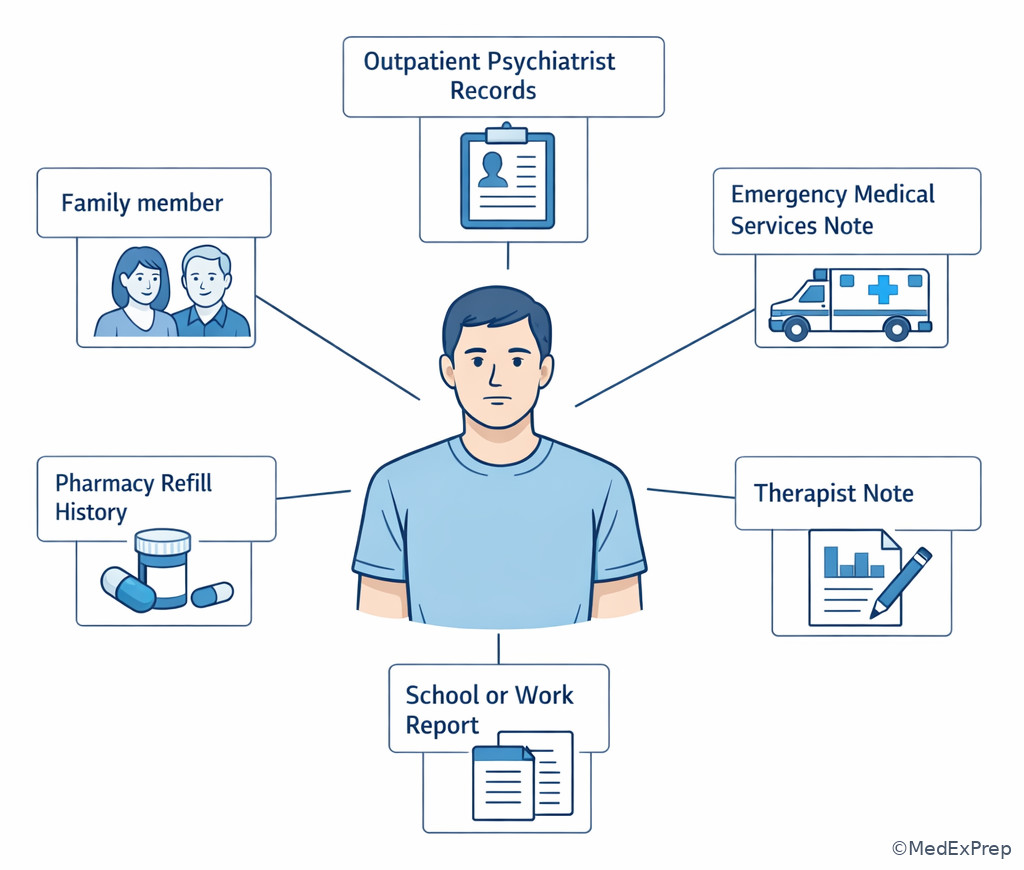
- Collateral information — history from family, staff, EMS, records, or other clinicians when reliability is limited.
- Reliability — degree to which the history is likely accurate and complete.
- Functional impairment — effect of symptoms on work, school, self-care, relationships, and safety.
- Review of psychiatric symptoms — structured screening for mood, anxiety, psychosis, trauma, OCD, substance, eating, sleep, and cognitive symptoms.
- Chronology — temporal sequence of symptoms relative to life events, substances, medications, and medical illness.
1.1.1.2 Must-know facts
- The first task in any psychiatric interview is not naming a diagnosis; it is determining safety and medical stability.
- The single best discriminator between many primary and substance-induced conditions is timing.
- Prior manic episode changes treatment logic for depression-like presentations.
- Past suicide attempts are among the strongest predictors of future suicide risk.
- Past medication response is often more useful than theoretical drug matching.
- In psychosis, collateral history may be more accurate than the patient’s account.
- Family history of bipolar disorder, psychosis, or suicide changes pretest probability in ambiguous stems.
- Functional decline helps distinguish severe syndromic illness from transient distress.
- Psychiatric history should always include substance use, medical contributors, and trauma screening.
Exam takeaway: Start with safety and chronology before refining diagnosis or treatment planning.
flowchart TD
A[Start interview] --> B{Immediate safety or medical instability?}
B -->|Yes| C[Stabilize, assess suicide violence delirium intoxication, escalate level of care]
B -->|No| D[Clarify chief concern and HPI chronology]
D --> E[Screen psychiatric syndromes and functional impairment]
E --> F[Add past psychiatric, substance, medical, family, social history]
F --> G[Judge reliability and obtain collateral]
G --> H[Formulate diagnosis, differential, and next step]
Use this structure repeatedly throughout the lesson. See Fig 1.
Core content
1.1.1.3 Foundational structure: what belongs in a psychiatric history and in what order
A Explanation
The decision conflict here is simple but high yield: Do you start broad and narrative, or structured and safety-first? On board exams, choose the approach that first identifies whether the patient is safe, medically stable, and reliable enough to continue a standard interview. The resolving rule is: urgent risk or medical red flags outrank comprehensive chronology. If the patient is stable, then build the history in layers: chief concern, HPI with chronology, psychiatric review of systems, past psychiatric history, substance history, medical history, medications/allergies, family history, and social/developmental history.
WHY THIS IS TESTED: exam stems frequently present incomplete interviews and ask which additional history element is most important. The correct answer is the one that changes immediate safety, diagnosis, or treatment selection, not the most interesting background fact.
In psychiatry, history is not just background collection. It is the primary diagnostic instrument. Unlike many other specialties, the psychiatrist often relies on reported experiences, observed behavior, and collateral context more than procedures. That means interview order matters. If a patient arrives with agitation, confusion, or active suicidal intent, a full developmental history can wait. If stable, however, a rushed interview misses bipolar spectrum clues, trauma contributors, medication nonadherence, or substance timing that completely change the formulation.
Exam takeaway: Ask safety-first, then chronology, then causes and context, then prior course and supports.
B Worked example
A 29-year-old man with asthma and daily cannabis use is brought by his sister for “acting strange.” He has slept 2 hours nightly for 5 days, has been pacing, spent most of his savings on “an app that will fix the stock market,” and insists he does not need help. His sister asks whether childhood bullying may explain everything. In triage he is tachycardic after several energy drinks. The task is to identify the most appropriate first history priority.
Reasoning chain: Identify task: this is not yet a final diagnosis question; it is an interview-priority question. Extract key facts: reduced need for sleep, grandiosity, impulsive spending, poor insight, stimulant-like noise from energy drinks, and a collateral informant available. Apply rule: immediate priorities are safety, capacity to cooperate, and chronology including substance timing. Eliminate distractors: childhood bullying is relevant later but does not determine acute disposition; full developmental history is lower yield than suicide/violence risk and substance timing; asthma history matters for medication choice but not before safety. Verify: the next best history step is targeted assessment of dangerousness, recent substances, and collateral-confirmed symptom timeline.
C Exam trap
D Checkpoint
Question: A 41-year-old woman with hypothyroidism and panic disorder presents for urgent evaluation after telling her PCP she “cannot go on.” She is tearful, sleeping poorly, and recently separated from her spouse. Which history element is the most appropriate first priority?
- A. Detailed childhood attachment history — tempting because developmental patterns can inform later psychotherapy, but wrong because it does not clarify immediate safety.
- B. Current suicidal ideation, plan, intent, means, and past attempts — correct because the phrase “cannot go on” requires immediate suicide-risk clarification before deeper diagnostic exploration.
- C. Full family genogram for mood disorders — tempting because family history shifts diagnostic probability, but wrong because it does not determine emergent disposition.
- D. Prior response to SSRIs — tempting because treatment history matters in a likely depressive episode, but wrong because treatment planning follows safety assessment.
1.1.1.4 The HPI: chronology, symptom clusters, and functional impact
A Explanation
The central choice in the HPI is between collecting a symptom list and constructing a time-linked syndrome narrative. Board questions reward the second approach. The single rule that resolves many diagnostic conflicts is: anchor every major symptom to onset, duration, episodicity, precipitating factors, and impairment. That is how you separate grief from major depression, panic attacks from generalized anxiety, bipolar depression from unipolar depression, or substance-induced psychosis from schizophrenia-spectrum illness.
High-yield HPI elements include what changed first, what symptoms cluster together, whether symptoms are continuous or episodic, whether there are trigger-free episodes, whether sleep need decreased versus sleep was interrupted by anxiety, whether psychotic symptoms occurred only during mood episodes, and how the syndrome affected work, school, relationships, self-care, and legal status. Functional effect matters because psychiatry board questions often test disorder severity, need for hospitalization, and disability of illness rather than mere symptom presence.
Choose-vs-reject framing: choose a mood-disorder pathway when low mood or elevated mood occurs in sustained episodes with neurovegetative and behavioral changes; reject it as a primary explanation when symptoms are brief, purely situational, or only during intoxication. Choose panic when attacks are abrupt and peak within minutes; reject primary panic disorder when anxiety is constant and diffuse. Choose mania when sleep need drops without fatigue and goal-directed activity rises; reject “just stress” when behavior clearly causes impairment or risky consequences.
Exam takeaway: Link symptoms to time course and impairment to separate similar-looking syndromes.
B Worked example
A 52-year-old woman with rheumatoid arthritis, prednisone bursts, and remote alcohol use disorder presents with “depression.” She reports low mood for 10 days, decreased sleep, increased cleaning at night, irritability, and unusually confident plans to start three businesses. She emphasizes marital stress as the cause. Her TSH was normal last month, and she denies current alcohol use. A tempting wrong turn is to code this as adjustment disorder because of the marital stressor.
Reasoning chain: Identify task: determine the most likely syndrome from the HPI. Extract key facts: decreased need for sleep, increased activity, expansive planning, irritability, possible steroid exposure history, and a short but distinct episode. Apply rule: episodic mood change plus reduced need for sleep and activation suggests mania/hypomania spectrum, not ordinary stress response. Eliminate distractors: adjustment disorder is tempting because of the stressor, but it does not explain classic activation signs; pure major depression is wrong because energy and drive are increased rather than reduced; generalized anxiety does not produce discrete episodic grandiosity. Verify by asking chronology around prednisone and any prior similar episodes.
C Exam trap
D Checkpoint
Question: A 24-year-old graduate student with migraines and occasional cannabis use reports “panic attacks.” Which HPI detail most strongly supports panic attacks rather than generalized anxiety disorder?
- A. Worries about grades and finances on most days — tempting because anxiety disorders commonly involve impairment, but wrong because this pattern suggests chronic generalized worry.
- B. Abrupt episodes peaking within minutes with palpitations and fear of dying — correct because sudden, time-limited surges with autonomic symptoms point to panic attacks.
- C. Poor concentration during finals week — tempting because it reflects anxiety-related dysfunction, but wrong because it is nonspecific.
- D. Lifelong shyness in unfamiliar groups — tempting because social anxiety can coexist and confuse the picture, but wrong because it does not define panic attacks.
- The single best discriminator between panic attacks and generalized anxiety is abrupt episodic surge vs persistent diffuse worry.
- True or False: A clear stressor automatically makes adjustment disorder the best diagnosis. False.
- Name the 3 HPI anchors: onset, pattern, impairment.
1.1.1.5 Past psychiatric history, treatment response, and the longitudinal course
A Explanation
The major interview choice here is whether to treat the patient as a new case or as a person with a pattern across time. Boards reward the latter. The deciding rule is: past episodes, hospitalizations, suicide attempts, violence, and prior treatment response often predict current diagnosis and next treatment better than the current symptom snapshot alone. This section is where you ask about previous diagnoses, outpatient care, hospitalizations, self-harm, aggression, trauma treatment, psychotherapy, medication trials, adverse effects, adherence, and somatic treatments such as ECT.
Choose antidepressant augmentation vs reject it? You need to know whether the patient ever became manic on an antidepressant, had a spontaneous manic episode, or failed adequate prior trials. Choose outpatient treatment vs reject it? Ask about prior lethal attempts, recent hospitalizations, inability to adhere, or rapid decompensation. Choose a medication the patient once did well on vs reject novelty? Prior documented benefit is a powerful exam clue unless a contraindication has emerged.
Longitudinal history is also where boards test whether you ask about the most consequential past event rather than the most common one. Example: a remote inpatient stay after a serious suicide attempt is more important than several unsuccessful counseling episodes. Similarly, akathisia after an antipsychotic, lithium toxicity, serotonin syndrome, or past ECT response can dramatically redirect current care.
Exam takeaway: Prior episodes and treatment response narrow both diagnosis and safest next treatment.
B Worked example
A 37-year-old woman with obesity, migraine, and prior postpartum depression presents with low mood, anergia, and insomnia. She requests the SSRI that helped her sister. She denies current substance use. Her chart reveals a psychiatric hospitalization at age 23 after 6 days of no sleep, pressured speech, and reckless driving; she was discharged on lithium but stopped it after “feeling fine.” A distracting clue is her current depressive symptom burden, which invites a unipolar depression reflex.
Reasoning chain: Identify task: what past history item most changes current management? Extract key facts: clear prior manic-like hospitalization, lithium exposure, current depressive presentation, and family anecdote about SSRIs. Apply rule: any credible past manic episode moves the case into bipolar-spectrum management logic. Eliminate distractors: family SSRI response is lower yield than the patient’s own manic history; postpartum depression history is relevant but does not override prior mania; obesity matters for drug selection but only after diagnosis is placed correctly. Verify: the interview should now focus on bipolar longitudinal course, prior lithium response/toxicity, and antidepressant-induced switching risk.
C Exam trap
D Checkpoint
Question: A 33-year-old man with major depressive symptoms is being evaluated for outpatient treatment. Which past psychiatric history item most strongly increases concern that standard antidepressant monotherapy may be the wrong initial choice?
- A. His mother had recurrent depression — tempting because family history matters, but wrong because it does not specifically alter monotherapy safety.
- B. He once stopped sertraline because of nausea — tempting because tolerability affects adherence, but wrong because it does not shift diagnosis.
- C. He had a prior week of euphoric mood, minimal sleep, pressured speech, and overspending — correct because a prior manic syndrome suggests bipolar disorder, changing treatment logic.
- D. He previously improved with CBT — tempting because prior benefit is useful, but wrong because it does not identify a bipolar-spectrum risk.
1.1.1.6 Substance, medical, and medication history: when to suspect a mimic
A Explanation
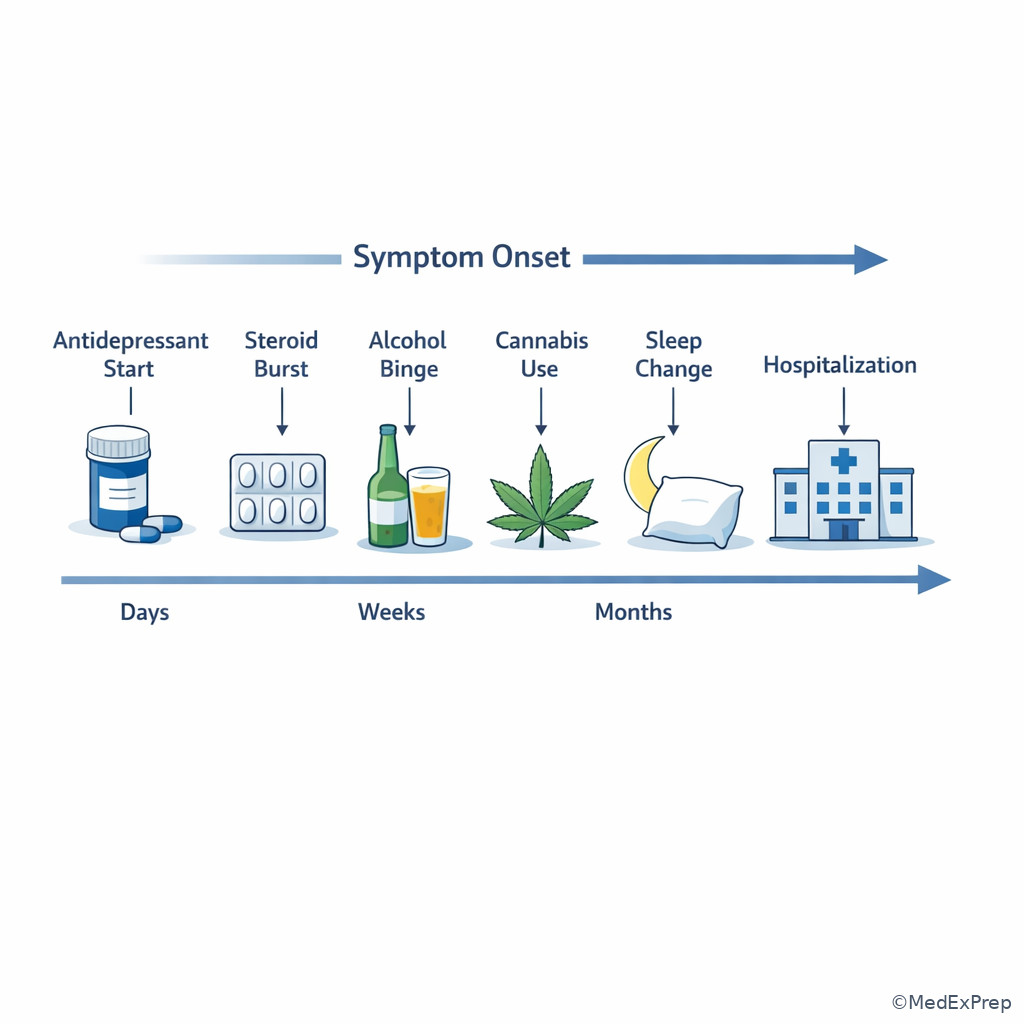
This is one of the most board-tested conflicts in psychiatry: primary psychiatric disorder vs substance-induced or medical/medication-related presentation. The rule that resolves it is: if symptom onset is temporally linked to intoxication, withdrawal, medication exposure, or medical change, you must investigate the mimic before settling on a primary psychiatric diagnosis. Ask what substances are used, how much, how often, when last used, whether symptoms occur during abstinence, and whether withdrawal symptoms are present. Ask about prescribed agents that alter mood, sleep, energy, or psychosis risk: corticosteroids, stimulants, dopaminergic agents, anticholinergics, sedative-hypnotics, antidepressants, thyroid drugs, and others.
Medical history is not a formality. Late-life first psychosis, fluctuating attention, visual hallucinations with confusion, seizures, head trauma, endocrine disease, autoimmune illness, infection, or acute neurologic symptoms all push the psychiatrist to widen the workup. Choose a primary psychiatric pathway only when the timeline and overall picture support it. Reject premature psychiatric closure when red flags appear.
Substance history also affects level of care. Alcohol or benzodiazepine withdrawal risk, opioid intoxication, stimulant-induced psychosis, or cannabis-associated exacerbation of psychosis can change both diagnosis and immediate management. Board questions commonly include a misleading long-standing anxiety or depression history to tempt you into ignoring a more recent substance or medication trigger.
Exam takeaway: A tight temporal link to substances, medications, or medical change requires you to rule out a mimic first.
See Fig 3 for the core decision rule.
B Worked example
A 68-year-old man with COPD, type 2 diabetes, and chronic insomnia is brought in for new paranoia and seeing “small animals” in the room. His daughter says symptoms started 2 days after he was prescribed high-dose prednisone for an exacerbation. He drinks two glasses of wine nightly, and his sodium is mildly low at 132 mEq/L. The tempting wrong answer is primary psychotic disorder because of hallucinations and paranoia.
Reasoning chain: Identify task: determine the most likely contributor and next interview focus. Extract key facts: late-life first psychotic symptoms, visual hallucinations, acute onset, recent corticosteroid exposure, mild hyponatremia as distracting noise, and no prior psychotic history. Apply rule: abrupt onset after a medication change strongly suggests medication-induced symptoms or delirium-spectrum medical concern, not a primary schizophrenia-spectrum disorder. Eliminate distractors: nightly wine use may matter but does not fit the precise timing; schizophrenia spectrum is less likely with first onset at 68 and visual hallucinations; low sodium is mildly abnormal but the steroid timing is the most discriminating clue. Verify by expanding medication, attention, orientation, and medical review.
C Exam trap
D Checkpoint
Question: A 47-year-old man with ADHD and hypertension presents with 3 days of insomnia, racing thoughts, and suspiciousness after “borrowing” extra stimulant pills from a friend. Which additional history question is most likely to clarify whether this is substance-induced?
- A. Whether his father had bipolar disorder — tempting because family history changes risk, but wrong because it does not determine this episode’s temporal relationship to exposure.
- B. Whether symptoms began only after the increased stimulant use and improve when he is off it — correct because temporal coupling to exposure is the key discriminator.
- C. Whether he had separation anxiety as a child — tempting because developmental history can matter, but wrong because it is remote and nondiscriminating here.
- D. Whether he prefers individual or group therapy — tempting as a treatment-planning question, but wrong because diagnosis is not yet secure.
- The single best discriminator between primary and substance-induced syndromes is temporal relationship to use or withdrawal.
- True or False: New visual hallucinations in an older adult should make you think broadly about medical causes. True.
- Name 3 exposure categories to ask about: substances, prescribed medications, over-the-counter/supplements.
1.1.1.7 Family, social, developmental, trauma, and collateral history: building context without losing the board question
A Explanation
The board-style tension here is between two errors: ignoring context and overprioritizing background details that do not change the next decision. The resolving rule is: ask contextual history in a way that explains predisposition, precipitants, perpetuating factors, protective factors, and reliability. Family history matters because bipolar disorder, schizophrenia-spectrum disorders, substance use disorders, suicide, and neurocognitive illnesses cluster in families. Social history matters because housing, employment, relationships, trauma exposure, legal problems, and supports affect both diagnosis and disposition. Developmental history matters especially in child/adolescent, personality, trauma, neurodevelopmental, and longitudinal cases.
Trauma history should be approached carefully and purposefully. Boards may test whether trauma explains some symptoms, but trauma does not erase the need to assess current safety, psychosis, substance use, or mood episodes. Collateral history is especially high yield when reliability is limited by mania, psychosis, intoxication, cognitive impairment, or poor insight. The psychiatrist should clarify confidentiality limits in a general-principles way, obtain permission when possible, and recognize that emergency safety situations can justify broader information gathering under standard clinical principles; local laws and protocols vary, so confirm with your institution/jurisdiction.
Choose collateral vs reject it? Choose it when the patient denies obvious symptoms observed by others, when memory is poor, or when danger is possible. Reject waiting for collateral if the patient already clearly meets criteria for emergency safety action. Context informs but does not delay urgent decisions.
Exam takeaway: Gather family, trauma, social supports, and collateral when they alter risk, diagnosis, or reliability.
B Worked example
A 19-year-old college student with type 1 diabetes and a history of ADHD presents after sending alarming texts about being “done.” In the interview she minimizes everything and says she was “just venting.” She recently failed two classes, drinks heavily on weekends, and has had conflict with her roommate. Her mother reports by phone that the patient gave away jewelry yesterday and previously cut herself in high school. A tempting but wrong clue is the patient’s calm demeanor during the interview.
Reasoning chain: Identify task: determine whether collateral materially changes risk assessment. Extract key facts: suicidal texts, minimizing self-report, recent academic and interpersonal stressors, substance use, prior self-harm, and giving away possessions. Apply rule: when reliability is limited and risk may be high, collateral is essential and may outweigh the patient’s minimizing account. Eliminate distractors: calm appearance does not eliminate suicide risk; ADHD history is background; roommate conflict explains stress but does not negate the alarming behaviors. Verify: the mother’s collateral changes both risk formulation and likely disposition.
C Exam trap
D Checkpoint
Question: A 22-year-old man with no prior formal psychiatric care presents with suspiciousness and poor sleep. He insists nothing is wrong. His father reports the patient has spent weeks responding to unseen stimuli and stopped attending classes. Which interview principle is most important?
- A. Rely on the patient’s account because confidentiality prevents collateral use — tempting because confidentiality is central in psychiatry, but wrong because standard clinical practice permits and often requires collateral gathering in safety or reliability concerns.
- B. Obtain collateral because poor insight and possible psychosis limit reliability — correct because collateral can clarify timeline, impairment, and risk when self-report is compromised.
- C. Delay collateral until a full personality assessment is completed — tempting because background formulation matters, but wrong because reliability and safety come first.
- D. Focus only on family history because genetics best predicts psychosis — tempting because family loading matters, but wrong because current behavior and collateral timeline are more actionable.
Exam Traps & Differentiators
- Most common wrong answer and why: choosing an interesting psychosocial detail instead of the history element that changes immediate safety or diagnosis.
- Another common trap: accepting the patient’s diagnostic label (“panic,” “depression,” “ADHD”) rather than reconstructing the syndrome through chronology and associated features.
- Reliability trap: treating calm affect or cooperative behavior as proof of low risk even when collateral or behavior suggests otherwise.
- Mimic trap: diagnosing primary psychiatric illness before asking about recent substances, steroids, stimulants, withdrawal, head injury, seizure history, or fluctuating attention.
| Looks similar but isn’t | Tempting overlap | Single discriminator from history | Best next interview move |
|---|---|---|---|
| Primary psychosis vs substance-induced psychosis | Both can present with paranoia and hallucinations | Symptoms tightly linked to use/withdrawal or medication exposure | Clarify timing of exposure and periods of abstinence |
| Major depression vs bipolar depression | Both may present with low mood and insomnia | Any past mania/hypomania, antidepressant switching, or decreased need for sleep | Expand past psychiatric history before choosing treatment |
| Panic attacks vs generalized anxiety | Both include anxiety and autonomic symptoms | Abrupt minutes-long episodes vs persistent excessive worry | Map timing and peak intensity |
| Adjustment disorder vs full syndrome disorder | Both may follow a stressor | Classic syndrome features and severity exceed simple stress response | Ask about episode-specific criteria and impairment |
| Primary psychiatric illness vs delirium/medical mimic | Both may include agitation, hallucinations, or bizarre behavior | Acute onset, fluctuating attention, medical trigger, older age | Shift to medical review and urgent workup |
If the stem says “I can’t go on,” think suicide risk details before diagnosis.
If the stem says “first episode at age 68,” think medical/medication/substance causes before primary schizophrenia-spectrum disorder.
If the stem says “only sleeps 2 hours and feels great,” think mania/hypomania history, not ordinary stress.
If the stem says “family says he has changed, patient says nothing is wrong,” think limited reliability and need for collateral.
If the stem says “symptoms began after steroids/stimulants/withdrawal,” think temporal relationship first.
If the stem says “sudden attacks peaking in minutes,” think panic, not generalized anxiety.
Exam takeaway: The best next question is the one that changes safety, diagnosis, or disposition—not the most comprehensive-sounding one.
flowchart LR
A[Incomplete interview stem] --> B{What answer choice changes immediate management?}
B --> C[Safety question if suicide violence delirium intoxication possible]
B --> D[Chronology question if diagnosis hinges on timing]
B --> E[Past mania or treatment response if treatment choice is at stake]
B --> F[Collateral if reliability is limited]
C --> G[Disposition changes]
D --> G
E --> G
F --> G
When a question asks for the “most important additional history,” use the logic in Fig 4.
Tables
| Psychiatric history domain | Key questions | Why it matters on boards |
|---|---|---|
| Chief concern | Why now? What brought you in today? | Clarifies the task and acuity |
| HPI chronology | When did it start? Continuous or episodic? What changed first? | Separates syndromes that look similar |
| Functional impact | Effect on work, school, self-care, relationships, legal status? | Determines severity and level of care |
| Past psychiatric history | Prior episodes, attempts, hospitalizations, violence, treatment response? | Changes diagnosis and management |
| Substance history | What, how much, how often, last use, withdrawal? | Identifies intoxication/withdrawal and substance-induced states |
| Medical/medication history | Recent illness, steroids, stimulants, thyroid, seizures, head injury? | Finds mimics and contraindications |
| Family history | Mood, psychosis, suicide, substance disorders? | Raises or lowers pretest probability |
| Social/trauma history | Housing, supports, work, trauma, legal stressors? | Shapes formulation and disposition |
| Collateral/reliability | Who else can confirm the history? Is self-report trustworthy? | Essential in psychosis, mania, intoxication, neurocognitive disorder |
| Comparison | Primary question to ask | Correct choice pattern | Reject pattern |
|---|---|---|---|
| Primary mood disorder vs substance-induced mood symptoms | Did symptoms appear only during use, withdrawal, or medication change? | Temporal independence from substances favors primary disorder | Tight exposure-linked timing favors substance/medication cause |
| Unipolar depression vs bipolar depression | Any past mania/hypomania or antidepressant activation? | Past spontaneous or treatment-emergent mania changes diagnosis | No such history does not prove unipolar, but lowers concern |
| Panic disorder vs generalized anxiety | Abrupt attacks or chronic diffuse worry? | Brief intense peaks favor panic | Most-day pervasive worry favors GAD |
| Psychotic disorder vs delirium/medical mimic | Acute fluctuation, attention problem, or medical trigger? | Stable consciousness with organized timeline may support primary illness | Fluctuation and medical trigger demand medical assessment |
| Low suicide risk vs underreported high risk | Any collateral contradiction, giving away possessions, past attempts? | Consistent denial plus no concerning behaviors lowers concern | Contradictory collateral means self-report alone is not enough |
| Differential/classification trigger | History clue | What diagnosis or action it points toward |
|---|---|---|
| Reduced need for sleep without fatigue | Feels rested after very little sleep | Mania/hypomania screening |
| Visual hallucinations with acute confusion | Fluctuating awareness, older age, recent illness | Delirium/medical evaluation |
| Symptoms after steroid burst | Clear timing after corticosteroid exposure | Medication-induced mood/psychotic symptoms |
| Prior serious suicide attempt | Past high-lethality behavior | Higher baseline suicide risk and lower threshold for admission |
| Psychosis with poor insight | Patient denies observed impairment | Need for collateral/reliability check |
| Weekend binge drinking with Monday panic | Symptoms tied to substance pattern | Substance-related anxiety assessment |
| Late-life first psychiatric presentation | No prior history, new onset after age 60 | Broader medical/neurologic workup |
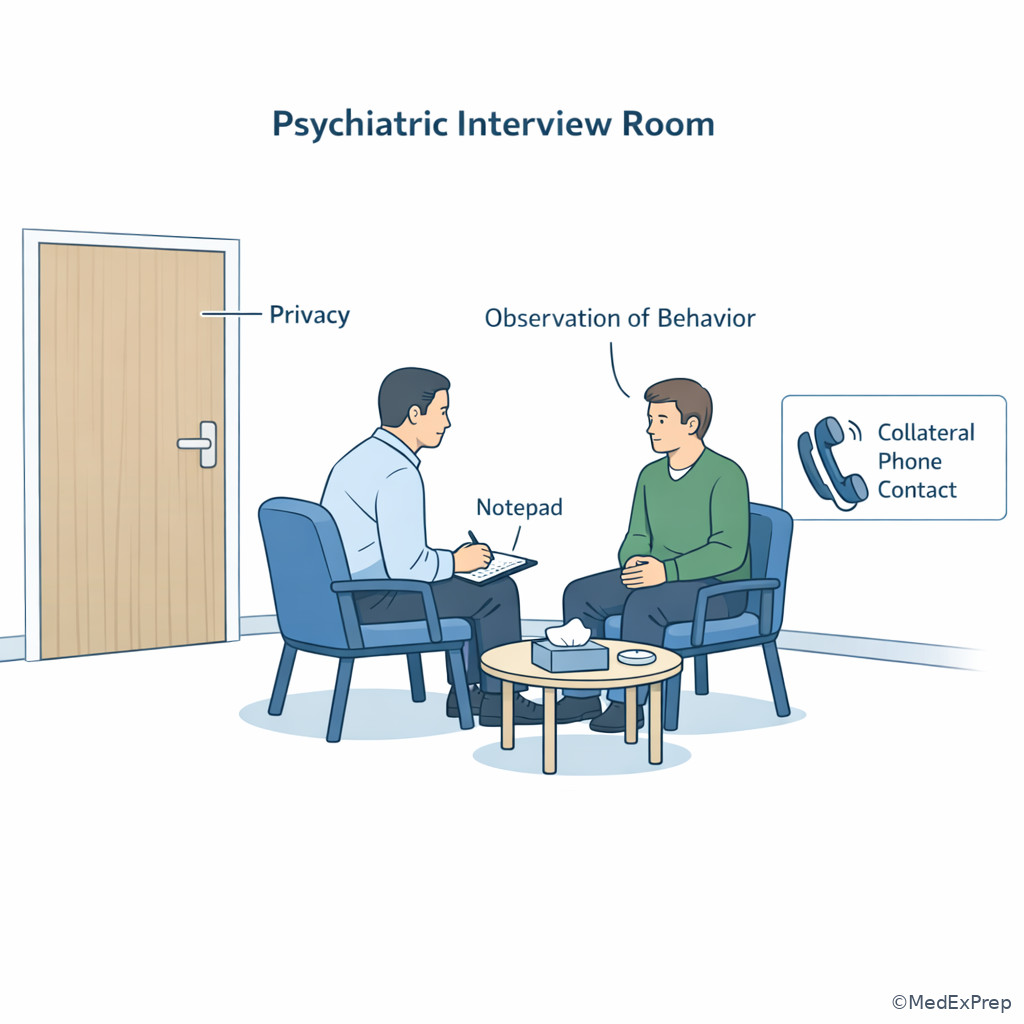
Exam takeaway: Use a calm, private, structured environment to improve reliability and allow safety-focused questioning.
Exam takeaway: Mapping symptoms against substances, medications, and stressors prevents premature primary psychiatric labeling.
Exam takeaway: Family, EMS, prior records, and pharmacy history become essential when reliability is limited.
Algorithm / Approach
Exam takeaway: Move from immediate risk to chronology to causes and context, then verify reliability before finalizing disposition.
Use this decision framework when a board stem asks for the most appropriate next question or the best next step in evaluation. See Fig 5.
Exam takeaway: Different history domains feed directly into diagnosis, risk, and level-of-care choices.
flowchart TB
A[Safety history] --> D[Disposition]
B[HPI chronology] --> E[Diagnosis]
C[Past treatment response] --> F[Treatment plan]
G[Substance and medical review] --> E
H[Collateral and reliability] --> D
I[Social supports and function] --> D
E --> D
F --> D
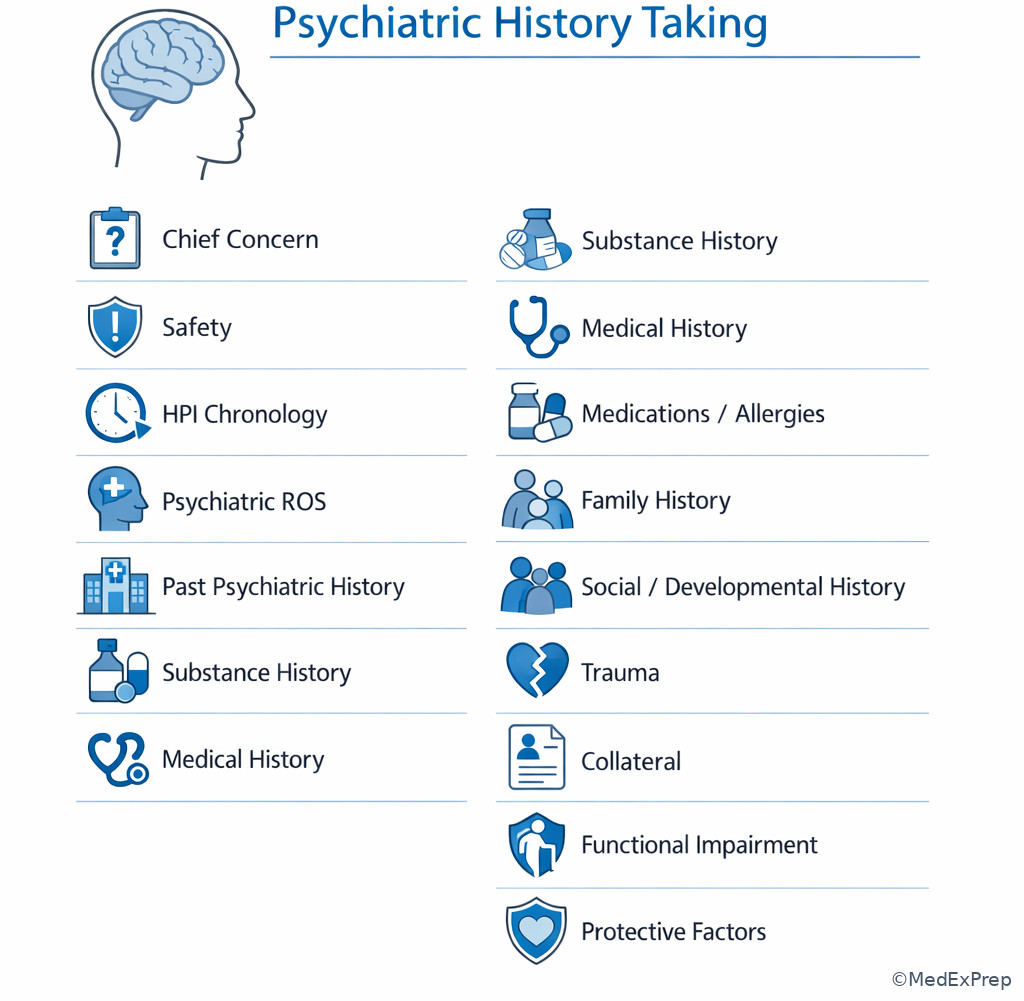
Exam takeaway: A visual checklist reduces omissions during pressured exam stems and real interviews.
Exam takeaway: Prior admissions, attempts, and medication changes should be placed on the same timeline as symptoms.
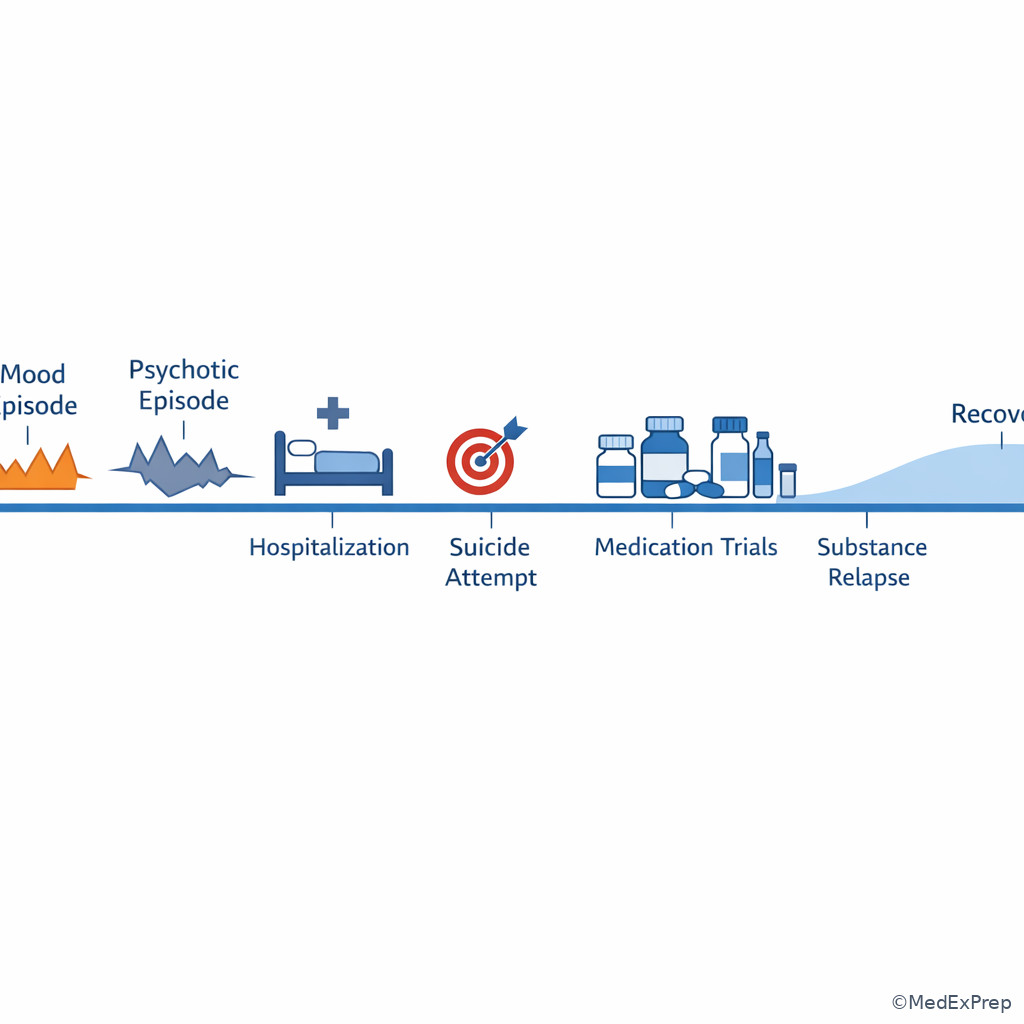
Rapid Review
- “I can’t go on” → suicide history before diagnostic nuance.
- Reduced need for sleep → mania clue, not just insomnia.
- First psychosis in older adult → think medical/medication/substance workup first.
- Patient label vs syndrome → chronology beats self-diagnosis.
- Prior manic episode → changes depression treatment logic.
- Past serious attempt → stronger suicide-risk marker than many current verbal denials.
- Visual hallucinations plus confusion → delirium/medical mimic until proven otherwise.
- Symptoms only after exposure → substance/medication-induced pathway.
- Calm interview affect → does not rule out acute suicide risk.
- Poor insight + psychosis → collateral becomes high yield.
- Function collapse → severity and disposition clue.
- Family bipolar history → raises suspicion but does not replace asking about personal mania.
- Weekend use pattern → link symptoms to intoxication or withdrawal windows.
- Most important additional history → choose the item that changes safety, diagnosis, or management now.
Self-check quiz
1. A 31-year-old woman with insomnia and recent job loss says, “Nothing matters anymore.” She has no medical complaints in the stem. Which history question most appropriately comes first?
- A. Ask about suicidal ideation, plan, intent, means, and past attempts
- B. Ask about early attachment disruptions
- C. Ask about preferred psychotherapy modality
- D. Ask about family history of panic disorder
2. A 26-year-old man with episodic anxiety and no prior admissions reports “panic attacks.” Which history detail best supports panic attacks rather than generalized anxiety disorder?
- A. Fear surges abruptly and peaks within minutes
- B. He worries most days about several life domains
- C. He is irritable during stressful months
- D. He avoids networking events
3. A 45-year-old woman with lupus, chronic pain, and prednisone bursts presents with new irritability, 3 nights of little sleep, and expansive business plans. She says this started after a difficult conversation with her spouse. Which is the most appropriate next history clarification?
- A. Detailed childhood social development
- B. Timing of symptoms relative to corticosteroid exposure and prior similar episodes
- C. Whether she prefers CBT or supportive therapy
- D. Whether her sister has anxiety
4. A 67-year-old man with hypertension and COPD is evaluated for first-time hallucinations. His wife says he started seeing animals 1 day after a medication change; he is intermittently inattentive. Which is the best next step in the interview?
- A. Focus on lifetime personality style
- B. Clarify recent medications, attention fluctuation, and acute medical symptoms
- C. Ask only about family history of schizophrenia
- D. Proceed directly to chronic antipsychotic selection
5. A 20-year-old college student with ADHD and alcohol binges is brought after texting friends that goodbye messages were “just jokes.” She is calm in the interview, but her roommate reports she gave away keepsakes yesterday. What interview approach is most appropriate?
- A. Accept the patient’s denial because she is calm and cooperative
- B. Defer suicide assessment until toxicology returns
- C. Incorporate collateral because reliability is limited and risk cues conflict with self-report
- D. Focus on developmental history before risk formulation
6. A 34-year-old man with recurrent depressive episodes, obesity, and alcohol use in remission presents with low mood and hypersomnia. He requests sertraline, which helped a cousin. Records show one prior 5-day period of decreased need for sleep, rapid speech, and reckless investing after he stopped alcohol and was not taking antidepressants. Which historical detail most strongly changes current treatment planning?
- A. Family member response to sertraline
- B. The prior episode of decreased need for sleep and activation
- C. Current hypersomnia
- D. Past alcohol use disorder in remission
7. A 58-year-old woman with breast cancer on recent high-dose dexamethasone, hypothyroidism, and no psychiatric admissions presents with insomnia, irritability, and persecutory ideas for 4 days. She has mild grief after a recent loss. Which diagnosis framework should guide the interview first?
- A. Primary delusional disorder because persecutory thinking is present
- B. Medication-induced mood or psychotic symptoms because timing after steroid exposure is the key clue
- C. Adjustment disorder because grief is present
- D. Schizophreniform disorder because symptoms have psychotic content
8. A 23-year-old man with no formal psychiatric history is brought by parents for bizarre behavior, poor sleep, and saying professors are sending coded messages. He denies symptoms and wants to leave. Parents report 3 weeks of talking to himself and not bathing. He used cannabis twice last semester but none in the last month by report. Which additional history element is most important for immediate disposition?
- A. His preschool language milestones
- B. Detailed family tree of anxiety disorders
- C. Ability to care for basic needs, recent dangerous behavior, and access to supervision
- D. Preferred long-term psychotherapy format
Answer key
1.1.1.8 1. Answer: A
Why A is correct: The pathophysiologic and clinical priority is immediate suicide-risk assessment because the phrase “Nothing matters anymore” may indicate hopelessness and possible suicidal intent. The single discriminating clue is the potential self-harm signal, which must be clarified before broader formulation or treatment planning. Authoritative sources emphasize suicide-risk assessment as a first priority in psychiatric evaluation. Source: American Psychiatric Association; Sadock, Sadock, and Ruiz.
Why B is tempting but wrong: Attachment history can inform longitudinal psychotherapy formulation, especially in personality or trauma frameworks. The clue that rules it out is that it does not change immediate safety today.
Why C is tempting but wrong: Treatment preference matters in routine care, but only after the patient is shown to be safe and appropriate for outpatient management. The clue that rules it out is the urgent hopelessness statement.
Why D is tempting but wrong: Family history can raise diagnostic probability for anxiety or mood disorders, but it is not the first-priority question in a possibly suicidal patient. The clue that rules it out is that family panic history does not determine imminent disposition.
1.1.1.9 2. Answer: A
Why A is correct: Panic attacks are characterized by abrupt surges that peak within minutes, often with intense autonomic symptoms and catastrophic fear. The discriminating clue is the rapid rise-and-peak time course, which separates panic attacks from chronic diffuse anxiety. Source: DSM-5-TR; American Psychiatric Association.
Why B is tempting but wrong: Worry across multiple domains is classic anxiety content, which makes this option plausible. The clue that rules it out is that it supports generalized anxiety disorder rather than panic attacks.
Why C is tempting but wrong: Irritability can occur in many anxiety states, making it a realistic distractor. The clue that rules it out is that it lacks the defining episodic surge pattern.
Why D is tempting but wrong: Avoidance of social situations suggests social anxiety and may coexist, so it is not absurd. The clue that rules it out is that it does not identify sudden panic episodes.
1.1.1.10 3. Answer: B
Why B is correct: New activation symptoms in a patient exposed to prednisone require clarification of timing relative to corticosteroid use and any prior spontaneous mood episodes. The mechanism-to-treatment logic is that steroid-induced mood symptoms or unmasked bipolar-spectrum illness changes management and prevents premature diagnostic closure. The single clue is recent steroid exposure plus decreased sleep and expansiveness. Source: APA; Kaplan & Sadock’s Synopsis of Psychiatry.
Why A is tempting but wrong: Developmental background can be relevant in a comprehensive workup, but it does not address the immediate diagnostic fork between medication effect and primary mood disorder. The timing clue eliminates it.
Why C is tempting but wrong: Therapy preference feels patient-centered and practical, but diagnosis must be clarified before modality selection. The steroid-linked activation makes this premature.
Why D is tempting but wrong: Family anxiety history is plausible because mood and anxiety disorders cluster in families. The clue that rules it out is that exposure timing is more informative than distant family loading in this scenario.
1.1.1.11 4. Answer: B
Why B is correct: Acute visual hallucinations with intermittent inattention after a medication change strongly suggest a medical or medication-related syndrome, including delirium-spectrum illness. The next interview step should clarify medication exposure, fluctuating attention, and associated acute medical symptoms. The discriminating clue is first-onset symptoms in older age with attentional fluctuation. Source: American Psychiatric Association; Harrison’s Principles of Internal Medicine.
Why A is tempting but wrong: Personality can influence presentation, but not in an abrupt first-onset syndrome. The acute fluctuation rules it out.
Why C is tempting but wrong: Family schizophrenia history could matter diagnostically, but it is less urgent and less specific than acute medication/medical review in this older patient. The first-onset late-life presentation discriminates against it.
Why D is tempting but wrong: Antipsychotics may eventually be considered in some settings, making this superficially practical. The clue that rules it out is that diagnosis and medical assessment are not yet settled.
1.1.1.12 5. Answer: C
Why C is correct: Contradictory collateral, giving away possessions, suicidal texts, and substance use all limit the reliability of the patient’s minimizing account. The correct psychiatric action is to incorporate collateral immediately into risk formulation. The discriminating clue is conflict between self-report and concerning observed behavior. Source: APA Practice Guideline for the Assessment and Treatment of Patients With Suicidal Behaviors; Sadock, Sadock, and Ruiz.
Why A is tempting but wrong: Calm demeanor may falsely suggest stability. The clue that eliminates it is the roommate’s report of preparatory behavior.
Why B is tempting but wrong: Toxicology can be useful, so delaying until objective data returns may seem cautious. The clue that rules it out is that suicide-risk assessment cannot wait for ancillary tests.
Why D is tempting but wrong: Developmental history contributes to broader formulation, but it does not resolve the immediate contradiction in risk data. The current warning signs make it lower priority.
1.1.1.13 6. Answer: B
Why B is correct: A prior spontaneous episode of decreased need for sleep, rapid speech, and reckless behavior strongly suggests mania or hypomania and therefore changes current depression treatment planning toward bipolar-spectrum logic rather than routine antidepressant monotherapy. The discriminating clue is that the prior activation occurred outside antidepressant exposure. Source: DSM-5-TR; APA; Kaplan & Sadock’s Synopsis of Psychiatry.
Why A is tempting but wrong: Family medication response is commonly used in practice and feels clinically relevant. The clue that rules it out is that it does not outweigh the patient’s own probable manic history.
Why C is tempting but wrong: Hypersomnia helps characterize the current depressive episode and may sway symptomatic treatment choices. The clue that eliminates it is that it does not determine whether antidepressant monotherapy is diagnostically appropriate.
Why D is tempting but wrong: Past alcohol use disorder matters because substances can mimic mood symptoms and influence adherence. The clue that rules it out is the specific bipolar-spectrum episode history, which is more decisive here.
1.1.1.14 7. Answer: B
Why B is correct: High-dose dexamethasone is a classic medication exposure associated with mood activation, insomnia, and psychotic symptoms. The interview should therefore first use a medication-induced framework rather than jumping to a primary psychotic or adjustment diagnosis. The single discriminating clue is the tight onset after steroid exposure. Source: Harrison’s Principles of Internal Medicine; APA.
Why A is tempting but wrong: Persecutory ideas make delusional disorder plausible on the surface. The clue that rules it out is abrupt onset in temporal association with a known provoking medication.
Why C is tempting but wrong: Grief and recent stress can bias the candidate toward adjustment disorder. The clue that eliminates it is that steroids better explain the activated and psychotic features.
Why D is tempting but wrong: Schizophreniform disorder includes psychosis of intermediate duration, so it is not an absurd distractor. The clue that rules it out is both the brief 4-day duration and the medication-linked timing.
1.1.1.15 8. Answer: C
Why C is correct: Immediate disposition in a patient with likely psychosis hinges on whether he can care for himself, whether there has been dangerous behavior, and whether there is adequate supervision. The mechanism-to-management link is that functional inability and unsafe behavior may require hospitalization or urgent containment. The discriminating clue is recent deterioration in bathing, self-care, and reality testing. Source: APA; Sadock, Sadock, and Ruiz.
Why A is tempting but wrong: Developmental milestones can matter if neurodevelopmental disorders are in the differential. The clue that rules it out is that they do not determine today’s safety or disposition.
Why B is tempting but wrong: Family history of anxiety is homogeneous within psychiatry and could influence vulnerability. The clue that eliminates it is that it does not answer whether the patient is safe to leave.
Why D is tempting but wrong: Long-term psychotherapy planning may eventually be relevant after stabilization. The clue that rules it out is that acute psychosis and impaired self-care require immediate disposition-focused history first.
Exam takeaway: The best psychiatric history integrates safety, chronology, causes, past course, context, and reliability into one disposition-ready formulation.
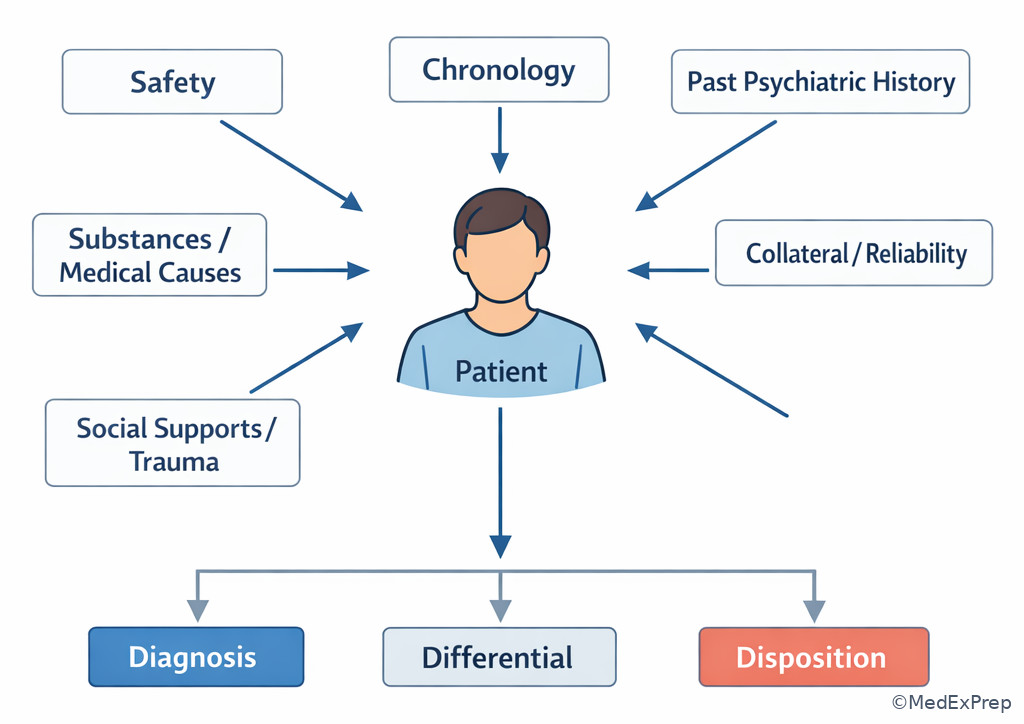
For final review, connect the whole lesson back to Fig 6: every high-yield question asks which missing history element changes what the psychiatrist should do next.
Keep going with the full ABPN Psychiatry Prep Course (Psychiatry)
You just studied the way members do, in the same lesson interface. Full access unlocks every lesson, the question bank and flashcards for a full year.
One payment · 1 year of access · No auto-renewal