1.1.1 - ICF Domains And Definitions
ICF Domains And Definitions
What you'll learn
- PMR-DOMAIN: Functional Assessment → Distinguish body functions/structures, activity, participation, environmental factors, and personal factors.
- PMR-DOMAIN: Ethics/Safety/Systems → Choose function-centered language that separates impairment from disability and participation restriction.
- PMR-DOMAIN: Functional Assessment → Map common PM&R findings to the correct ICF domain in board-style stems.
- PMR-DOMAIN: Neurologic Rehabilitation → Connect ICF classification to rehabilitation goals, prognosis framing, and interdisciplinary planning.
- PMR-DOMAIN: Functional Assessment → Avoid frequent exam traps, especially confusing activity limitation with participation restriction.
- Domain: PMR-DOMAIN: Functional Assessment → Subskill: classify findings using ICF domains
- Domain: PMR-DOMAIN: Functional Assessment → Subskill: relate impairment to activity and participation
- Domain: PMR-DOMAIN: Ethics/Safety/Systems → Subskill: document function with precise, nonconflated terminology
- Domain: PMR-DOMAIN: SCI/TBI/Stroke Rehabilitation → Subskill: frame rehab goals across body, task, and life-role levels
Why it matters
- ABPMR questions often hide the real task by mixing diagnosis, function, and social context; ICF lets you separate what is wrong from what the patient cannot do and from what role is affected.
- Rehabilitation plans fail when clinicians treat only impairments and ignore the activity or participation target that actually matters to the patient.
- Accurate ICF language improves documentation, team communication, goal setting, prognostic counseling, and disposition planning.
- Many board distractors are attractive because they target the right diagnosis but the wrong ICF level.
Key Terms & Must-Know Facts
1.1.1.1 Key terms
- Body functions: physiologic functions of body systems
- Body structures: anatomic parts of the body
- Impairment: problem in body function or structure
- Activity: execution of a task or action by an individual
- Activity limitation: difficulty executing a task
- Participation: involvement in a life situation
- Participation restriction: problem with life-role involvement
- Environmental factors: physical, social, and attitudinal external context
- Personal factors: internal individual context not coded in detail by ICF
- Capacity: what the patient can do in a standardized or optimal setting
- Performance: what the patient does in the real environment
- Contextual factors: environmental and personal influences on function
- Participation goal: desired role or life-situation outcome
1.1.1.2 Must-know facts
- Weakness, spasticity, aphasia, contracture, and pain are usually impairments.
- Dressing, transferring, toileting, walking, and stair negotiation are activities.
- Returning to work, parenting, school attendance, and community reintegration are participation issues.
- Wheelchair access, caregiver availability, transport, and workplace design are environmental factors.
- Motivation, coping style, education, and premorbid fitness are personal factors.
- Capacity and performance are not interchangeable; the gap often reveals the barrier.
- The exam commonly tests activity versus participation more than body function versus body structure.
- In PM&R, goals should link domains: impairment target → activity gain → participation outcome.
Exam takeaway: Use the domain map to classify each stem detail before choosing a diagnosis or rehabilitation plan.
flowchart TD
A[Health condition] --> B[Body functions and structures]
B --> C[Activity]
C --> D[Participation]
E[Environmental factors] --> C
E --> D
F[Personal factors] --> C
F --> D
B --> G[Impairment]
C --> H[Task difficulty]
D --> I[Life role restriction]
Exam takeaway: Visualize how the same patient problem can be described at impairment, activity, and participation levels.
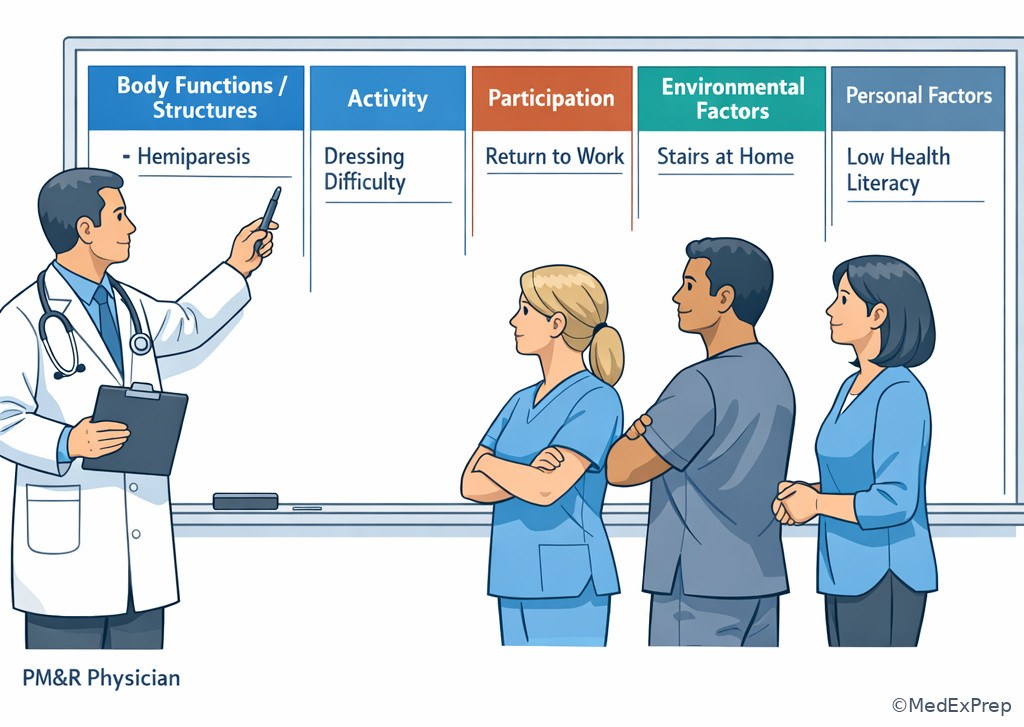
| ICF element | What it asks | Typical PM&R examples | Common test trap |
|---|---|---|---|
| Body function | What physiologic function is altered? | Strength, tone, sensation, memory, language, pain | Confusing weakness with inability to dress |
| Body structure | What anatomic part is affected? | Rotator cuff tear, SCI level, amputation level | Labeling anatomy alone as disability |
| Activity | What task is hard to perform? | Transfers, feeding, bathing, gait, wheelchair propulsion | Confusing task difficulty with job loss |
| Participation | What life role is limited? | Employment, parenting, school, sports, community role | Calling “cannot return to work” an ADL issue |
| Environmental factor | What external context helps or hinders? | Ramps, insurance, family support, transport, employer accommodations | Treating an inaccessible home as an impairment |
| Personal factor | What internal context influences function? | Age, coping, beliefs, literacy, fitness, goals | Using personal factors as diagnosis |
Core content
1.1.1.3 Foundational framework: what belongs in each ICF domain?
A Explanation
The first board-style decision conflict is simple but high yield: when a stem lists weakness, inability to transfer, inability to return to work, and a home with stairs, which item defines the actual question? The rule is to classify each statement before solving the case. Weakness is an impairment under body functions. Inability to transfer is an activity limitation. Inability to return to work is a participation restriction. Stairs at home are an environmental factor. If a question asks for the best functional goal or most important barrier to community discharge, choosing an impairment-level answer when the stem is really asking about activity or participation is the classic miss. See Fig 1.
WHY THIS IS TESTED: the exam wants to know whether you can choose the correct level of rehabilitation reasoning rather than simply identify pathology.
Key rule: In PM&R, impairments explain why function is limited, activities describe what task is limited, and participation states which life role is affected.
Memory anchor: I-A-P-C = Impairment, Activity, Participation, Context. On exam day, move from body problem to task to life role to barriers/supports.
Clinician Action: Diagnose the ICF level being tested by sorting findings into body, task, role, and context. Order focused functional assessment when the task level is unclear. Treat the impairment when it is the rate-limiting issue, but do not stop there; pair it with a task-level intervention. Refer/Escalate to therapy, social work, case management, or psychology when contextual barriers drive participation loss.
B Worked example
A 67-year-old man with left MCA stroke, diabetes, and chronic knee OA is admitted to inpatient rehabilitation. He has mild expressive aphasia, right hemiparesis, and shoulder pain. He can stand with moderate assistance, but his spouse reports that their second-floor apartment has no elevator. The stem asks which factor most directly limits community discharge to home. A tempting clue is the shoulder pain because it is symptomatic and clinically real. The reasoning chain is: identify task → this is a discharge planning question; extract key facts → he has impairments (hemiparesis, aphasia, shoulder pain), an activity limitation (standing/transfers), and an environmental barrier (second-floor apartment without elevator); apply the rule → community discharge is often blocked by contextual and task mismatch; eliminate distractors → shoulder pain and aphasia matter, but the single most direct discharge barrier is inaccessible housing; verify → even with improving strength, no elevator creates immediate participation and environmental limitation.
C Exam trap
Common wrong answer: choosing the most medically dramatic impairment.
Why it is tempting: weakness, pain, aphasia, and spasticity feel “more clinical” than social or architectural barriers.
Single clue that eliminates it: when the stem asks about discharge, return to work, or community reintegration, the tested domain is often activity or participation plus contextual factors, not just impairment severity.
D Checkpoint
Question: A 59-year-old woman with incomplete cervical SCI, obesity, and hypertension reports hand weakness, difficulty buttoning shirts, inability to resume her bookkeeping job, and limited caregiver help at home. Which finding is a participation restriction?
- Hand weakness
- Difficulty buttoning shirts
- Inability to resume bookkeeping work
- Limited caregiver help at home
Answer: C
- A: Tempting because it is the root clinical problem, but it is an impairment in body function.
- B: Tempting because it reflects real daily disability, but buttoning is an activity limitation.
- C: Correct because work role involvement is participation.
- D: Tempting because it clearly affects outcomes, but caregiver help is an environmental factor.
Exam takeaway: If the stem names a task, think activity; if it names a life role, think participation.
flowchart LR
A[Patient statement] --> B{What is described?}
B -->|Task| C[Activity limitation]
B -->|Life role| D[Participation restriction]
C --> E[Examples: dressing transfers gait]
D --> F[Examples: work school parenting]
G[Context clues] --> H[Home access transport employer support]
H --> D Exam takeaway: Separate bedside tasks from community roles to avoid the most common ICF mistake.
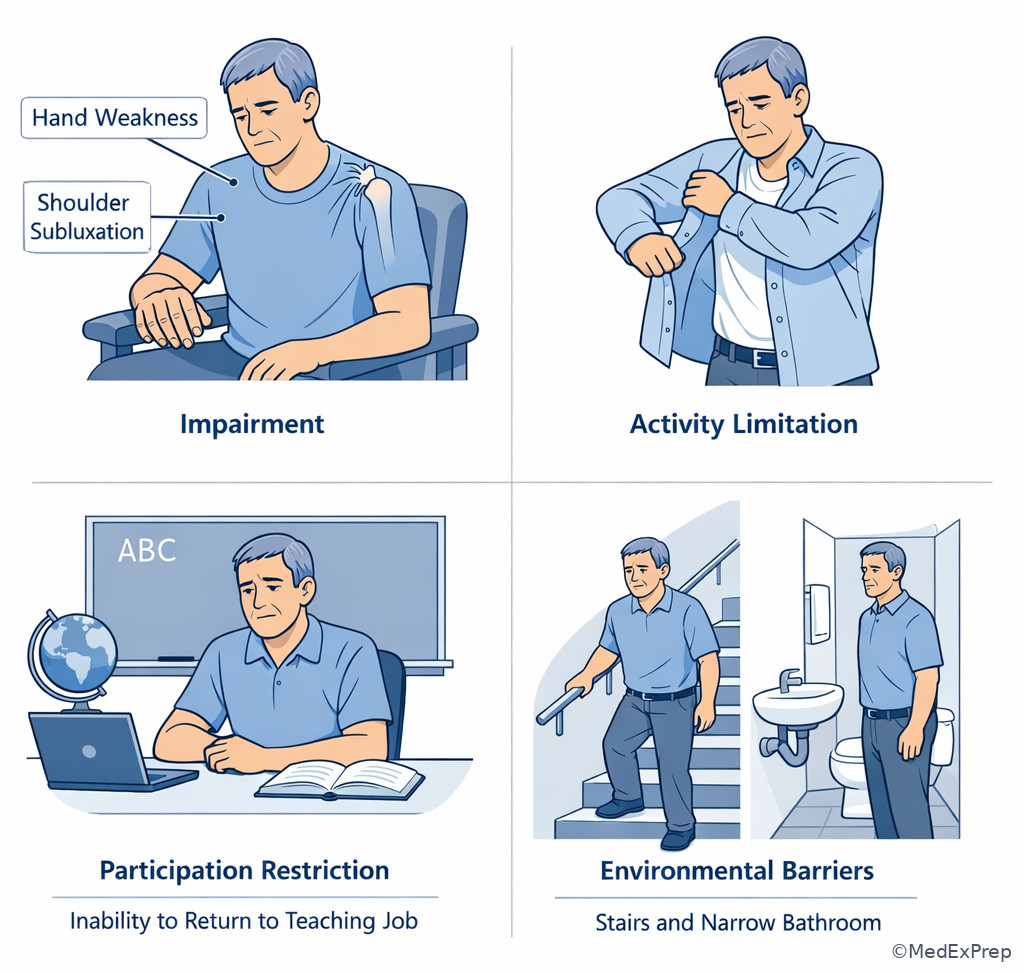
1.1.1.4 Capacity, performance, and contextual factors: why the environment changes the answer
A Explanation
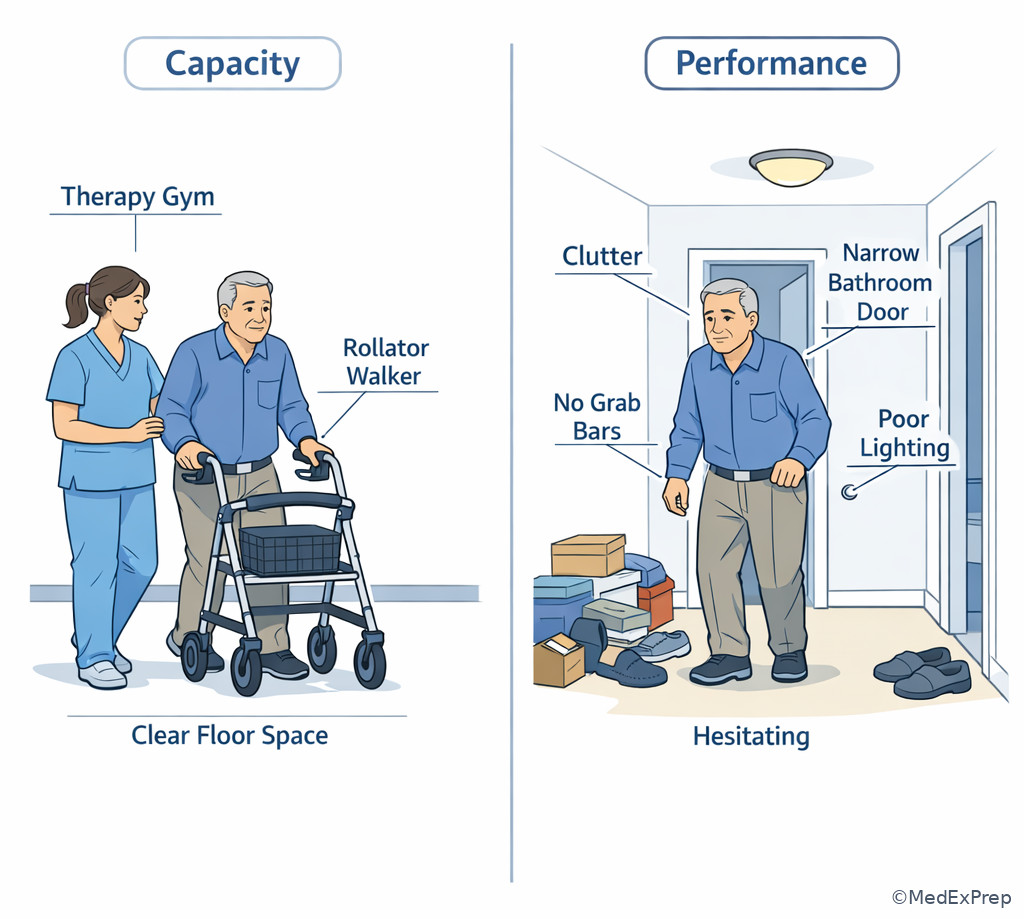
The second foundational conflict is choosing between what the patient can do in a controlled setting and what the patient actually does in real life. That is the capacity-performance distinction. Capacity is measured in standardized conditions: clinic, therapy gym, with cueing, optimal setup, and safety supervision. Performance is real-world execution in the home, workplace, street, or school. A patient may have capacity to walk 150 feet with a rolling walker in therapy but performance limited to bed-to-chair transfers only at home because of clutter, fatigue, poor insight, or lack of caregiver support. When capacity exceeds performance, look for contextual barriers. When performance seems higher than clinic capacity, the test may be underestimating usual adaptive behavior or assistive device use. See Fig 2.
WHY THIS IS TESTED: rehabilitation questions often hinge on whether the correct next step is more strengthening, better environmental modification, different equipment, or caregiver training.
Recall: In Functional History And Examination, we will build on this by asking not only what the patient can do on exam, but what they actually do at baseline, with what device, under what supervision, and in what environment.
Key rule: If the patient succeeds only in structured therapy conditions, do not assume equal home performance without confirming setup, endurance, cognition, and support.
High-Yield Connection: This concept is tested alongside Rehabilitation Prognosis Principles. Know both present function and trajectory: a patient may have poor current performance because of remediable barriers rather than poor biologic recovery potential.
Clinician Action: Diagnose a capacity-performance gap by comparing standardized testing with real-world function. Order caregiver interview, home setup review, therapy functional notes, and fall history when the gap is unexplained. Treat with environmental modification, device optimization, cueing strategy, or energy conservation if context is the limiter. Refer/Escalate to home health, social work, or neuropsychology when cognition, support, or access drives poor performance.
B Worked example
A 74-year-old woman with Parkinson disease, mild cognitive impairment, osteoporosis, and urinary urgency is seen after two falls. In clinic she ambulates 120 feet with a rollator and close supervision. Her daughter says that at home she “mostly furniture walks,” freezes in the bathroom doorway, and avoids bathing when alone. A distractor is urinary urgency because it explains rushing and falls. The reasoning chain is: identify task → the question asks for the most important reason home function is worse than clinic performance; extract key facts → freezing in narrow spaces, inconsistent device use, likely environmental crowding, and limited supervision; apply rule → clinic capacity exceeds home performance due to contextual and behavioral barriers; eliminate distractors → urgency contributes but does not explain doorway freezing and device abandonment; verify → home safety intervention and caregiver training fit the capacity-performance gap.
C Exam trap
Common wrong answer: concluding that clinic walking distance alone establishes safe household ambulation.
Why it is tempting: numeric gait performance feels objective and decisive.
Single clue that eliminates it: the stem gives real-world failure points such as narrow bathroom access, freezing, absent supervision, or poor device adherence, which convert a capacity result into a performance problem.
D Checkpoint
Question: A 63-year-old man with TBI, depression, and obesity can complete dressing independently during morning OT with extra time and cueing, but at home he misses work because he cannot organize the steps quickly enough before transport arrives. Which term best captures the home-versus-clinic difference?
- Body structure deficit
- Capacity-performance gap
- Participation without activity limitation
- Personal factor only
Answer: B
- A: Tempting because TBI implies brain injury, but anatomy does not explain the observed setting-specific difference.
- B: Correct because he can perform the task under structured conditions but not in real-world time and environmental demands.
- C: Tempting because work loss is participation, but the stem also clearly describes an activity problem.
- D: Tempting because depression may matter, but the scenario is broader than an isolated personal factor.
- The most common reason performance is worse than capacity is a mismatch between patient ability and context.
- True or False: A patient who walks in therapy is automatically a community ambulator. False.
- Name the 3 common contextual barriers to check first: home setup, caregiver support, and device/access issues.
Exam takeaway: When standardized ability and real-world function differ, look first for contextual barriers rather than assuming the exam was wrong.
flowchart TD
A[Patient performs better in therapy than at home] --> B{What is different?}
B --> C[Environment: stairs clutter doorway]
B --> D[Support: caregiver absent]
B --> E[Cognition/insight]
B --> F[Endurance/fatigue]
C --> G[Modify home or device]
D --> G
E --> H[Add cueing supervision training]
F --> I[Energy conservation pacing] Exam takeaway: A standardized therapy success may fail at home because real-world barriers alter performance.
| Finding in stem | Most likely ICF classification | Best first rehab response |
|---|---|---|
| Can transfer in therapy but not at home | Capacity-performance gap | Check setup, caregiver training, and surface height |
| Cannot use stairs to apartment | Environmental barrier affecting activity/participation | Home modification or alternate discharge plan |
| Poor adherence to walker despite adequate strength | Personal/contextual factor affecting performance | Education, cueing, simplify device plan |
| Fatigues after 50 feet though gait pattern is safe initially | Activity limitation with endurance impairment | Pacing, conditioning, distance-specific planning |
| Cannot resume job due to lack of transport | Participation restriction plus environmental factor | Transport planning, social work, vocational support |
A Explanation
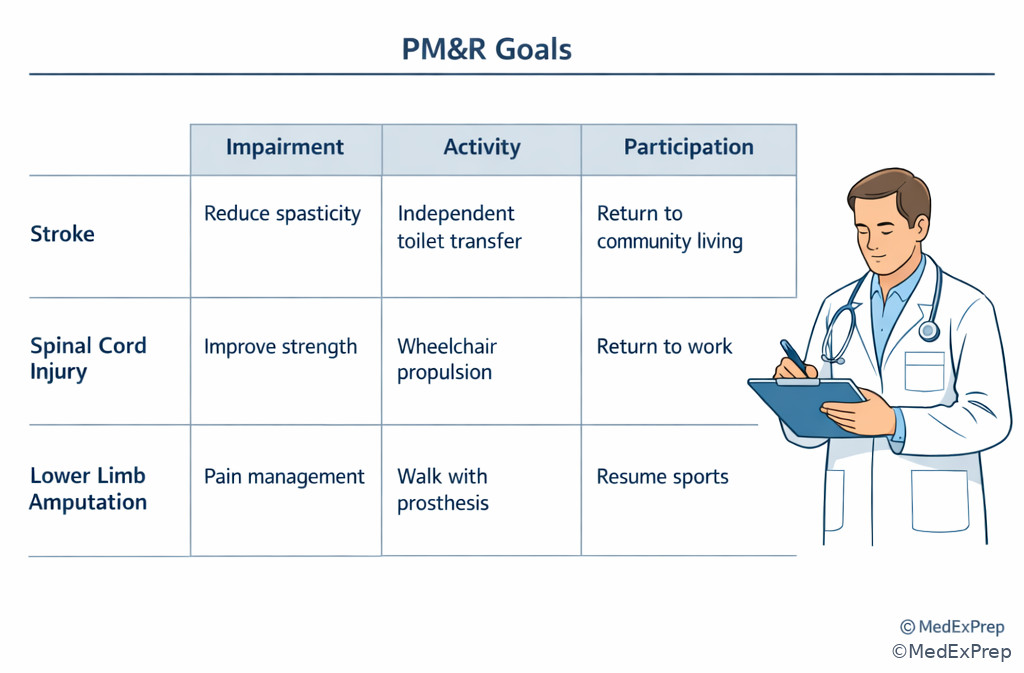
The next application-level conflict is deciding how specific a rehab goal should be. Board questions often present a patient with a diagnosis and ask for the most appropriate rehabilitation goal. The correct answer usually aligns the ICF chain rather than stopping at impairment reduction. For example, “improve hip flexor strength” is a body function goal; “independent car transfer with sliding board” is an activity goal; “return to work as a school counselor” is a participation goal. In physiatry, the strongest plan links these levels: treat spasticity or weakness because it improves transfers, which then supports home discharge or work re-entry. See Fig 3.
Documentation should also distinguish them clearly. Saying “patient is disabled because of stroke” is weak and imprecise. Better documentation identifies impairment, task limitation, and role effect separately. This matters for team communication because PT may target gait mechanics, OT may target self-care sequencing, SLP may target communication, social work may address transport and benefits, and the physiatrist integrates all of these into a coherent functional plan.
WHY THIS IS TESTED: the exam rewards answers that connect diagnosis to a realistic rehabilitation objective with measurable function and safety relevance.
Key rule: The best PM&R goal is usually written as a functional task in a real context, with assist level, device, and time frame.
Memory anchor: PAIR = Problem, Activity, Involvement, Real-world context. Use it to build goals that move beyond impairment-only wording.
High-Yield Connection: This concept is tested alongside outcome measures. Once you know the ICF level, choose the matching measure: impairment scales for body function, ADL scales for activity, and reintegration/work outcomes for participation.
Clinician Action: Diagnose which domain is the rate-limiting target for the current rehab phase. Order the outcome measure that matches that domain rather than using one generic score for everything. Treat by pairing impairment management with explicit functional training. Refer/Escalate to the right discipline when the main blocker is communication, cognition, equipment, social support, or community access.
B Worked example
A 46-year-old teacher with relapsing multiple sclerosis, migraine, and generalized anxiety disorder reports worsening fatigue and left foot drop. She asks for a “goal to get my leg stronger.” She also says she has missed six weeks of work because she cannot safely walk from the parking lot to her classroom by afternoon. A tempting but incomplete answer is “increase ankle dorsiflexion strength to 4/5.” The reasoning chain is: identify task → the exam asks for the best rehab goal; extract key facts → impairment is dorsiflexion weakness and fatigue, activity issue is prolonged walking, participation issue is inability to work; apply rule → best goal links these domains; eliminate distractors → strength alone does not state function or context; verify → “ambulate from parking lot to classroom with AFO and energy-conservation strategy without loss of balance to support return to work” is the strongest PM&R-aligned goal.
C Exam trap
Common wrong answer: an isolated impairment target written as if it were the rehab endpoint.
Why it is tempting: impairment measures look objective, measurable, and therapy-friendly.
Single clue that eliminates it: if the stem gives a meaningful role outcome such as work, school, or community mobility, the best answer should usually include that context or the task required to reach it.
D Checkpoint
Question: A 58-year-old man with right transfemoral amputation, CAD, and peripheral neuropathy wants to return to his job as a church custodian. Which goal is most aligned with ICF-based rehab planning?
- Increase residual limb hip extension strength
- Improve standing balance to fair-plus
- Independently don prosthesis and ambulate job-required distances with safe stair strategy
- Reduce phantom pain from 6/10 to 3/10
Answer: C
- A: Tempting because hip strength matters for prosthetic control, but it remains impairment-level.
- B: Tempting because balance is a meaningful functional precursor, but it is still not tied to the actual role demand.
- C: Correct because it links task performance with the patient’s participation goal and work environment.
- D: Tempting because pain reduction matters, but it does not directly specify the functional outcome needed for return to work.
Exam takeaway: The best rehabilitation goals connect impairment treatment to a measurable task and a meaningful life-role outcome.
Exam takeaway: Match each discipline to the domain it addresses so the rehabilitation plan stays coherent.
flowchart TB
A[Physiatrist] --> B[Integrates all domains]
C[PT] --> D[Mobility transfers gait endurance]
E[OT] --> F[Self-care UE function cognition in tasks]
G[SLP] --> H[Communication swallowing cognition]
I[Social work/case management] --> J[Benefits discharge support access]
K[Psychology] --> L[Coping motivation adjustment]
B --> M[Participation outcome]
- Fill in the blank: “Return to driving” is usually a ______ issue. Participation.
- True or False: “Independent toilet transfer with grab bar” is an impairment-level goal. False.
- Name the 3 pieces of a strong PM&R goal: task, context, and assistance/device level.
| Weak goal wording | Why it is weak | Better ICF-aligned wording |
|---|---|---|
| Improve strength | Impairment only; no task or context | Stand pivot transfer with minimal assist using walker |
| Decrease pain | No functional consequence specified | Tolerate seated wheelchair propulsion for school distances with pain less than 4/10 |
| Walk better | Too vague | Ambulate 150 feet household distances with AFO and supervision |
| Be independent | No domain or measurable outcome | Complete morning dressing in under 20 minutes using adaptive equipment |
| Return to normal life | Participation stated without task path | Resume half-day clerical work after safe computer setup and seated tolerance training |
1.1.1.6 Differential thinking: impairment vs activity vs participation in board-style stems
A Explanation
The first integration task is differential classification. Many stems contain mixed data on purpose, and the question may ask for the best example of one domain. To solve these, ignore the emotional weight of the detail and classify by wording. If the phrase is a physical or cognitive deficit, think impairment. If it is a task with an observable action verb such as transfer, dress, feed, climb, or propel, think activity. If it is a social role or life situation such as employment, marriage role, school attendance, driving for community access, or recreation, think participation. Environmental and personal factors modify function but are not themselves the functional act or life role.
A useful exam heuristic is to ask, “Could I directly watch this happen in a therapy session?” If yes, it is often an activity. “Could I code this as body-system abnormality on exam?” Then it is likely impairment. “Does it describe whether the patient occupies a valued social role?” Then it is participation. See Fig 4.
WHY THIS IS TESTED: classification errors drive wrong choices in diagnosis, goal writing, outcome measure selection, and discharge planning.
Recall: Because this is the first lesson in the course, there is no earlier topic to build from. Use this framework as the base vocabulary for every upcoming lesson, especially Functional History And Examination and Rehabilitation Prognosis Principles.
Clinician Action: Diagnose the dominant ICF level in the question stem before choosing a measure or intervention. Order task-specific assessment when the distinction between impairment and activity is unclear. Treat the bottleneck domain rather than the most obvious symptom. Refer/Escalate when unresolved contextual barriers prevent participation despite adequate medical stabilization.
B Worked example
A 35-year-old man with T12 paraplegia, obesity, and healed sacral pressure injury wants to resume caring for his 3-year-old daughter independently. He has full manual wheelchair mobility on level surfaces, but cannot access the child’s bedroom because the apartment hallway is too narrow and the crib setup requires prolonged unsupported reach. The stem asks which issue is the primary participation restriction. A tempting clue is shoulder pain from wheelchair propulsion. The reasoning chain is: identify task → classify the life-role issue; extract key facts → manual wheelchair skill is activity, shoulder pain is impairment, narrow hallway is environmental factor, inability to independently care for his daughter is participation restriction; apply rule → participation refers to involvement in life situations; eliminate distractors → the environmental barrier explains the restriction but is not itself the participation outcome; verify → parenting role loss is the participation restriction.
C Exam trap
Common wrong answer: selecting the environmental barrier when the question asks for the participation restriction.
Why it is tempting: the environmental barrier is highly actionable and often feels like the “real problem.”
Single clue that eliminates it: if the stem asks what life situation is limited, answer with the role outcome, not the barrier causing it.
D Checkpoint
Question: A 29-year-old woman with mild traumatic brain injury, ADHD, and migraine can cook a simple meal but cannot keep up with college coursework because she becomes overwhelmed in noisy classrooms and misses deadlines. Which is the best example of an environmental factor?
- Reduced processing speed
- Difficulty managing coursework
- Noisy classroom environment
- Student role disruption
Answer: C
- A: Tempting because cognition is central to the case, but processing speed is impairment.
- B: Tempting because it describes the practical problem, but it is an activity/academic task issue.
- C: Correct because classroom noise is an external environmental feature affecting performance.
- D: Tempting because it captures the high-level consequence, but that is participation.
Exam takeaway: Most errors come from choosing the cause of a limitation rather than the domain explicitly asked in the stem.
flowchart LR
A[Impairment] --> B[Activity limitation]
B --> C[Participation restriction]
D[Environmental factor] --> B
D --> C
E[Personal factor] --> B
E --> C
F[Exam trap] --> G[Question asks for role]
G --> H[Wrong: choose weakness]
G --> I[Wrong: choose stairs]
G --> J[Right: choose inability to work]
Exam takeaway: Board stems often contain multiple true statements, but only one matches the domain asked.
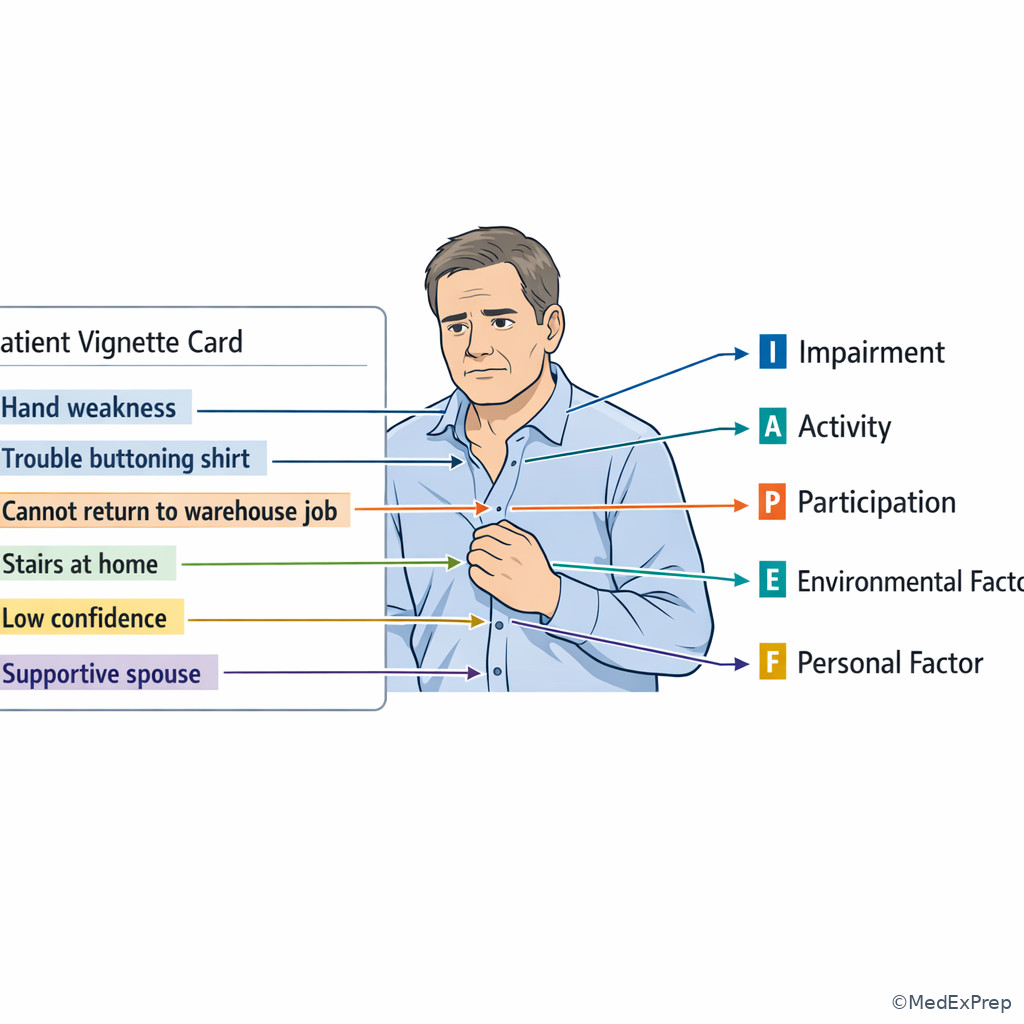
| If the stem says... | Think... | Not this |
|---|---|---|
| Cannot dress, transfer, or toilet independently | Activity limitation | Participation restriction |
| Cannot return to work or school | Participation restriction | ADL impairment |
| Spasticity, weakness, neglect, aphasia | Impairment | Task-level function |
| Home with stairs, no ramp, poor transport | Environmental factor | Body function problem |
| Low motivation, fear of falling, coping style | Personal factor | External barrier |
1.1.1.7 Integration for the physiatrist: choosing interventions by ICF level
A Explanation
The final integration conflict is therapeutic: should the next step target the impairment, the activity, the participation barrier, or the context? The answer is to identify the rate-limiting domain. If severe spasticity prevents hygiene or transfers, treat the impairment first. If strength is adequate but the patient cannot sequence dressing, task-specific OT is the priority. If household mobility is safe but the patient cannot return to work because of transport loss, social/worksite intervention becomes the key step. In PM&R, the best answer often combines levels, but one level usually deserves priority. See Fig 5.
This is where board questions become more realistic. They may ask for the most appropriate next step after a patient plateaus in one setting. Plateaus are not always biologic ceilings; sometimes the next gain requires changing the environment, introducing assistive technology, or shifting from impairment treatment to participation planning. Forward reference: in Rehabilitation Prognosis Principles, you will use this same logic to judge whether slow progress reflects severity, timing, barriers, or mismatch between intervention and target domain.
WHY THIS IS TESTED: PM&R is defined by selecting the intervention that best improves function and safety in the patient’s actual life context.
Key rule: Treat the rate-limiting level first; the wrong intervention can be reasonable in general but wrong for this patient at this time.
Clinician Action: Diagnose which single domain most limits the target outcome right now. Order focused reassessment if the barrier is unclear: therapy observation, home evaluation, caregiver interview, or work demands review. Treat at the rate-limiting level and pair with downstream task practice. Refer/Escalate when medical red flags, unsafe home setup, or specialty issues exceed routine PM&R scope.
B Worked example
A 61-year-old man with right hemispheric stroke, atrial fibrillation, and chronic low back pain has mild left neglect, good antigravity strength, and can walk 200 feet with contact guard in therapy. He still cannot be left alone at home because he forgets to lock wheelchair brakes during transfers and leaves the stove on. The tempting answer is more gait strengthening because walking distance remains imperfect. The reasoning chain is: identify task → choose the most appropriate next rehab focus; extract key facts → strength is not the main bottleneck, ambulation already exceeds basic household need, safety failures reflect cognition/neglect in task performance; apply rule → when impairment is no longer rate-limiting, shift to activity and contextual safety training; eliminate distractors → more strengthening does not address unsafe sequencing; verify → caregiver training, home safety strategies, and OT/neuropsych-focused task practice best fit the current barrier.
C Exam trap
Common wrong answer: choosing the treatment that addresses the most visible neurologic deficit rather than the domain blocking safe discharge.
Why it is tempting: greater measured impairment often feels more “serious” than a contextual or sequencing problem.
Single clue that eliminates it: if the stem shows adequate body recovery for the task but persistent real-world failure, the next step should target activity performance or context.
D Checkpoint
Question: A 72-year-old woman with bilateral knee OA, COPD, and recent pelvic fracture now has sufficient leg strength for transfers but remains unable to attend church because paratransit is unreliable and she cannot navigate the church entry steps with her walker. Which next step best targets the current rate-limiting ICF domain?
- Increase quadriceps strengthening intensity
- Start neuropathic pain medication
- Address transportation and access barriers while training community mobility strategy
- Repeat manual muscle testing in 2 weeks
Answer: C
- A: Tempting because knee OA often benefits from strengthening, but the stem says transfer strength is already adequate and the bottleneck is community access.
- B: Tempting because pain can limit mobility, but neuropathic pain treatment is mismatched to the described problem.
- C: Correct because participation is limited by environmental and access barriers, not by primary impairment progression.
- D: Tempting because reassessment is safe, but it delays intervention despite a clearly identified barrier.
- The rate-limiting domain determines the best next rehab intervention.
- True or False: If impairment improves, participation automatically improves. False.
- When safe walking exists but return to work fails, think participation barriers and context.
Exam takeaway: Choose the intervention that matches the domain currently blocking the patient’s real-world goal.
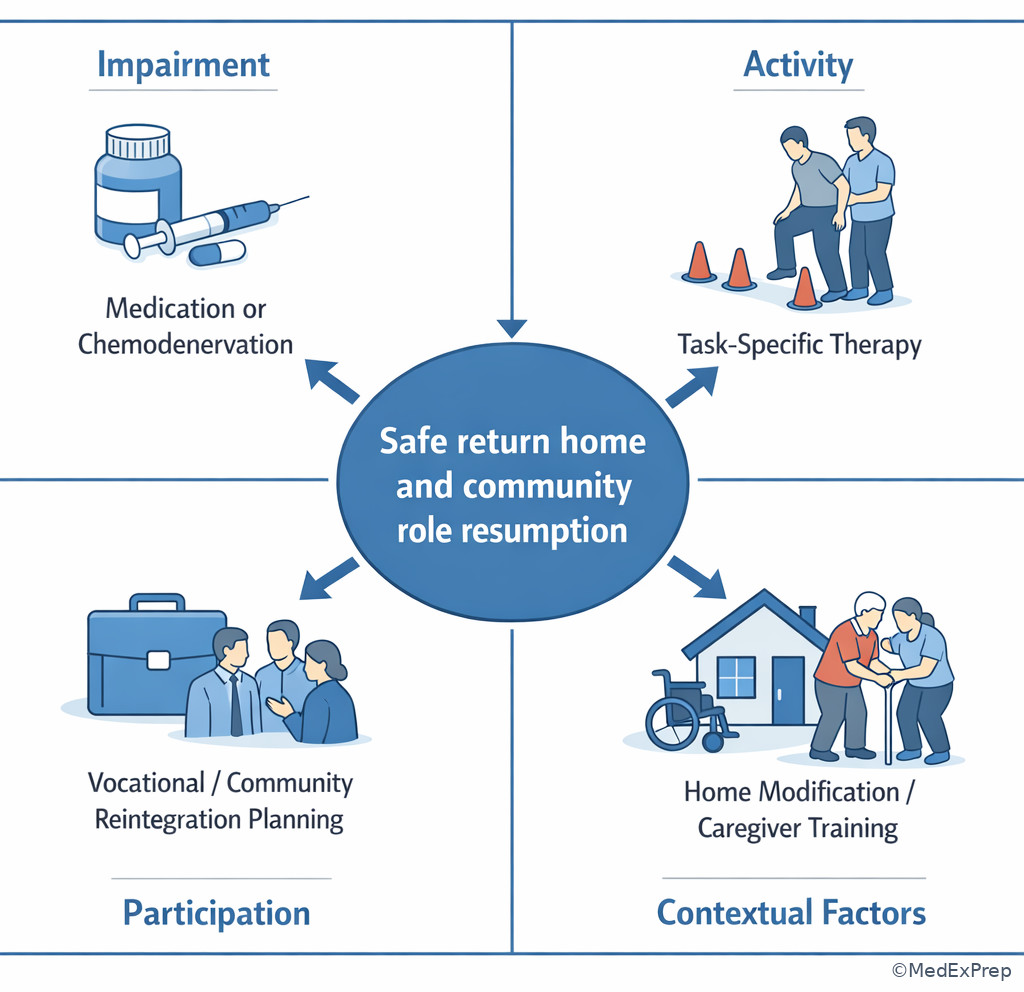
Exam takeaway: External barriers can remain the main limitation even after major physical recovery.
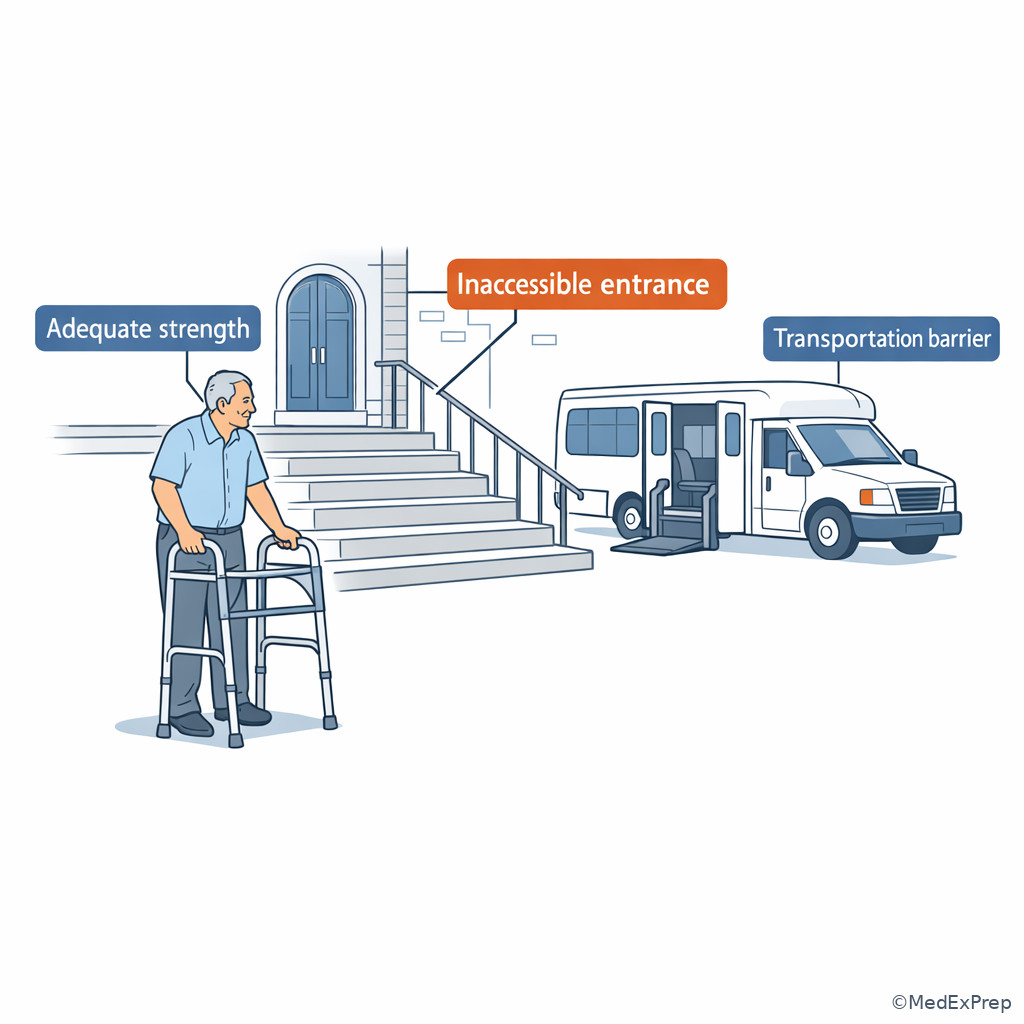
Exam Traps & Differentiators
Most common wrong answer and why: choosing the impairment because it feels most “medical.” This fails when the stem asks about discharge, work, school, parenting, or community mobility. The exam often rewards the domain explicitly asked, not the pathology that caused it.
| Looks similar | Actually means | Discriminator |
|---|---|---|
| Cannot dress independently | Activity limitation | Observable task performance |
| Cannot return to work | Participation restriction | Life role involvement |
| Weak shoulder abductors | Impairment | Body-system abnormality |
| Home has stairs and no railing | Environmental factor | External context |
| Fear of falling | Personal factor | Internal individual context |
| Walks in therapy but not at home | Capacity-performance gap | Different setting changes function |
- If the stem says “best example of participation restriction” think role loss such as work, school, parenting, community membership.
- If the stem says “difficulty toileting, dressing, or transferring” think activity limitation.
- If the stem says “barrier to home discharge” think environmental context plus functional task demands.
- If the stem says “can do in therapy but not at home” think capacity-performance gap.
- If the stem says “which factor most affects real-world function” think contextual factors, not just measured impairment.
- If the stem says “best rehabilitation goal” think measurable task tied to a meaningful role outcome.
Common distractor pair: environmental factor versus participation restriction. Related future traps appear in Functional History And Examination, where home setup and caregiver support may explain poor performance but are not the same as the activity or role outcome being tested.
Algorithm / Approach
Rapid Review
- Impairment → body-system problem such as weakness, spasticity, pain, aphasia
- Activity limitation → task failure such as transfer, dressing, toileting, stair climbing
- Participation restriction → life-role loss such as work, school, parenting, community access
- Environmental factor → external barrier/support such as stairs, transport, caregiver availability
- Personal factor → internal context such as coping, motivation, health beliefs, literacy
- Capacity → best-case standardized ability
- Performance → real-world function in actual environment
- Best rehab goal → task in context with assist/device and timeline
- Discharge question → often context plus activity, not just impairment
- Return-to-work question → participation unless asking about the enabling task
- Therapy gym success → does not prove home safety
- Action verb in stem → usually activity clue
- Role noun in stem → usually participation clue
- Most attractive distractor → true impairment that answers the wrong ICF level
Self-check quiz
1. A 68-year-old man with left hip OA, hypertension, and obesity reports groin pain, difficulty putting on socks, and inability to resume gardening club activities. Which option is the best example of an activity limitation?
- Groin pain
- Difficulty putting on socks
- Inability to resume gardening club activities
- Obesity
2. A 52-year-old woman with transverse myelitis, neurogenic bladder, and depression can propel a manual wheelchair on level surfaces during therapy but cannot enter her home because of three entrance steps and no ramp. Which option is the environmental factor most responsible for her current limitation?
- Neurogenic bladder
- Depression
- Three entrance steps without a ramp
- Manual wheelchair propulsion
3. A 64-year-old man with right MCA stroke, diabetes, and mild CKD has improving left hemiparesis. He can ambulate 100 feet with a hemiwalker in PT, but his wife reports he still cannot safely transfer to the toilet at night because he neglects the left side and parks the walker out of reach. Which is the most appropriate next step?
- Increase lower-extremity strengthening because gait distance is limited
- Focus on task-specific transfer training with safety cueing and caregiver education
- Clear him for independent bathroom mobility because he can walk 100 feet
- Delay intervention until repeat brain imaging clarifies neglect severity
4. A 43-year-old woman with relapsing multiple sclerosis, fatigue, and left foot drop asks for the best rehabilitation goal because she wants to return to her office job. She can walk short clinic distances but fatigues crossing the parking lot and misses afternoon meetings. Which goal is most appropriate?
- Increase ankle dorsiflexion strength by one manual muscle grade
- Reduce fatigue score by 2 points
- Ambulate from parking area to office safely using energy-conservation strategy and orthotic support to sustain work attendance
- Improve tandem stance to 20 seconds
5. A 26-year-old graduate student with mild TBI, migraine, and anxiety completes cognitive testing well in a quiet clinic room but fails to attend full classes because noise and time pressure overwhelm her. Which concept best explains the discrepancy?
- Participation restriction without activity limitation
- Capacity-performance gap due to contextual factors
- Body structure deficit as the sole explanation
- Pure environmental factor without impairment
6. A 58-year-old man with C6 incomplete SCI, obesity, and healed rotator cuff tendinopathy can perform level slide-board transfers with supervision in therapy. He still cannot live alone because his bathroom doorway is too narrow for his wheelchair and his landlord refuses grab-bar installation. Which option best identifies the primary current rate-limiting domain for independent home living?
- Body function impairment from upper-extremity weakness
- Activity limitation in transfers
- Participation restriction caused by unresolved environmental barriers
- Personal factor due to low self-efficacy
7. A 47-year-old warehouse worker with right transtibial amputation, CAD, and lumbar spondylosis can don his prosthesis and walk short household distances. He remains unable to return to work because the job requires prolonged uneven-surface ambulation and ladder negotiation, while employer accommodations have not been discussed. Which is the most appropriate physiatric next step?
- Increase residual limb desensitization only
- Document maximum medical improvement and stop rehabilitation planning
- Advance work-specific gait training and address vocational/environmental accommodations
- Prescribe bed rest until phantom pain fully resolves
8. A 76-year-old woman with Parkinson disease, osteoarthritis, and mild cognitive impairment walks 150 feet with a rollator in clinic. At home she freezes at bathroom thresholds, leaves the walker behind in tight spaces, and has fallen twice while rushing to the toilet at night. Which single detail most strongly argues that home performance is limited primarily by contextual and task-execution factors rather than inadequate gait capacity alone?
- She has osteoarthritis
- She can walk 150 feet in clinic
- She leaves the walker behind and freezes at thresholds in tight spaces
- She has urinary urgency at night
Answer key
1. Correct answer: B
- A. Groin pain: Tempting because it is the symptom driving dysfunction; incorrect here because pain is an impairment in body function, not the task difficulty itself. Single clue: pain is a body-level problem. Source: WHO ICF; Braddom.
- B. Difficulty putting on socks: Tempting because it may seem too simple compared with larger life impacts; correct because dressing-related task execution is an activity. Single clue: it is a specific observable task. Source: WHO ICF; DeLisa.
- C. Inability to resume gardening club activities: Tempting because it reflects meaningful disability; incorrect because club participation is a life situation, so this is participation restriction. Single clue: social/recreational role involvement. Source: WHO ICF.
- D. Obesity: Tempting because it influences function and outcomes; incorrect because it is a personal/health context factor, not the activity itself. Single clue: internal patient factor rather than a task. Source: WHO ICF.
2. Correct answer: C
- A. Neurogenic bladder: Tempting because it affects independence after myelitis; incorrect because it is an impairment/body function issue. Single clue: physiologic dysfunction. Source: WHO ICF; Braddom.
- B. Depression: Tempting because it can worsen function; incorrect because it is a personal factor, not the external barrier named in the stem. Single clue: internal rather than environmental context. Source: WHO ICF.
- C. Three entrance steps without a ramp: Correct because this is a classic environmental barrier preventing home access despite wheelchair capacity. Single clue: external architectural obstacle. Source: WHO ICF; DeLisa.
- D. Manual wheelchair propulsion: Tempting because it is related to mobility; incorrect because it is a functional activity/capacity, not the barrier causing failure. Single clue: patient ability rather than environmental hindrance. Source: WHO ICF.
3. Correct answer: B
- A. Increase lower-extremity strengthening because gait distance is limited: Tempting because post-stroke weakness is common and gait distance is not yet normal; incorrect because the discriminating clue is unsafe transfer execution from neglect and poor setup, not insufficient motor recovery alone. Single clue: walker out of reach and nighttime transfer failure. Source: Braddom; ACRM stroke rehabilitation principles.
- B. Focus on task-specific transfer training with safety cueing and caregiver education: Correct because the patient has enough capacity to ambulate but poor real-world performance in a specific task due to neglect and setup errors. Single clue: toilet transfer safety is the actual bottleneck. Source: WHO ICF; Braddom.
- C. Clear him for independent bathroom mobility because he can walk 100 feet: Tempting because distance walking can falsely suggest independence; incorrect because clinic capacity does not equal nighttime home performance. Single clue: neglect-related unsafe behavior. Source: WHO ICF.
- D. Delay intervention until repeat brain imaging clarifies neglect severity: Tempting because localization feels objective; incorrect because the functional problem is already clear and requires rehab intervention now. Single clue: enough bedside data already identify the activity-level barrier. Source: Braddom.
4. Correct answer: C
- A. Increase ankle dorsiflexion strength by one manual muscle grade: Tempting because foot drop is real and measurable; incorrect because it is impairment-only and does not address the work-related function asked in the stem. Single clue: patient’s stated goal is return to office attendance. Source: WHO ICF; Braddom.
- B. Reduce fatigue score by 2 points: Tempting because fatigue drives MS disability; incorrect because it still lacks a real-world task and participation target. Single clue: no work-context function specified. Source: Braddom.
- C. Ambulate from parking area to office safely using energy-conservation strategy and orthotic support to sustain work attendance: Correct because it links impairment management to a meaningful activity and participation outcome. Single clue: work attendance depends on parking-lot mobility endurance. Source: WHO ICF; DeLisa.
- D. Improve tandem stance to 20 seconds: Tempting because balance is functionally relevant; incorrect because it is still a surrogate clinic metric rather than the best contextual goal. Single clue: no direct tie to office participation. Source: Braddom.
5. Correct answer: B
- A. Participation restriction without activity limitation: Tempting because school attendance is a participation problem; incorrect because the stem also shows activity-level cognitive performance difficulties under real-world demands. Single clue: failure occurs in executing school tasks under noise/time pressure. Source: WHO ICF.
- B. Capacity-performance gap due to contextual factors: Correct because testing in a quiet clinic overestimates real-world classroom function under distraction and time pressure. Single clue: good quiet-room performance but poor classroom performance. Source: WHO ICF; Braddom.
- C. Body structure deficit as the sole explanation: Tempting because TBI is structural injury; incorrect because anatomy alone does not explain setting-specific discrepancy. Single clue: context changes outcome. Source: WHO ICF.
- D. Pure environmental factor without impairment: Tempting because noise is an environmental issue; incorrect because the patient also has cognitive symptoms after TBI. Single clue: both impairment and context are present. Source: Braddom.
6. Correct answer: C
- A. Body function impairment from upper-extremity weakness: Tempting because incomplete tetraplegia commonly limits independence; incorrect because the stem says he can already do level slide-board transfers with supervision, so weakness is not the primary current bottleneck. Single clue: bathroom doorway width and denied installation request. Source: WHO ICF; SCI rehab texts.
- B. Activity limitation in transfers: Tempting because supervision means he is not fully independent; incorrect because the dominant barrier to living alone is inaccessible bathroom setup, not transfer mechanics on a level surface. Single clue: home access barrier exceeds clinic transfer limitation. Source: WHO ICF.
- C. Participation restriction caused by unresolved environmental barriers: Correct because independent home living is the role outcome, and the rate-limiting cause is inaccessible housing context. Single clue: narrow doorway and no grab-bar permission. Source: WHO ICF; Braddom.
- D. Personal factor due to low self-efficacy: Tempting because confidence matters after SCI; incorrect because no confidence issue is described and an objective housing barrier is present. Single clue: specific architectural obstacles. Source: WHO ICF.
7. Correct answer: C
- A. Increase residual limb desensitization only: Tempting because residual limb comfort matters for prosthetic use; incorrect because the discriminating clue is mismatch between household ability and job-specific demands, not primarily skin sensitivity. Single clue: uneven surfaces and ladder-related work tasks. Source: Braddom; prosthetics rehabilitation principles.
- B. Document maximum medical improvement and stop rehabilitation planning: Tempting because return to full job duty may seem remote; incorrect because there are still modifiable activity and vocational barriers. Single clue: employer accommodations have not been addressed. Source: PM&R rehab planning standards.
- C. Advance work-specific gait training and address vocational/environmental accommodations: Correct because the patient has basic household activity capacity but needs higher-level task training and participation-focused work planning. Single clue: return-to-work role depends on task-specific demands and worksite context. Source: WHO ICF; Braddom.
- D. Prescribe bed rest until phantom pain fully resolves: Tempting because phantom pain can distract from gait training; incorrect because bed rest worsens function and is not the appropriate rehab response. Single clue: he is already ambulatory and requires progression, not withdrawal from activity. Source: Braddom.
8. Correct answer: C
- A. She has osteoarthritis: Tempting because OA can worsen gait and transfers; incorrect because it does not explain why clinic walking exceeds home safety in narrow spaces. Single clue: OA is nonspecific relative to threshold freezing. Source: Braddom.
- B. She can walk 150 feet in clinic: Tempting because this suggests preserved capacity; incorrect as the best answer because it does not itself identify why home function fails. Single clue: it shows capacity, not the discriminating home barrier. Source: WHO ICF.
- C. She leaves the walker behind and freezes at thresholds in tight spaces: Correct because this directly identifies context-dependent task-execution failure rather than inadequate straight-path gait capacity. Single clue: threshold freezing and device abandonment in constrained home spaces. Source: WHO ICF; Parkinson rehabilitation literature.
- D. She has urinary urgency at night: Tempting because rushing is a common fall trigger; incorrect because urgency is contributory but less discriminating than the specific doorway and device-use pattern. Single clue: freezing in tight spaces is the stronger contextual/task marker. Source: Braddom.
Keep going with the full ABPMR Physical Medicine Prep Course (PM&R)
You just studied the way members do, in the same lesson interface. Full access unlocks every lesson, the question bank and flashcards for a full year.
One payment · 1 year of access · No auto-renewal