1.1.1 - Well-Child Visit Structure
Why it matters
- ABP questions often hide the real task inside a “routine well visit” stem; the correct answer depends on knowing what should happen at baseline before chasing incidental details.
- Preventive visits test sequencing: address immediate danger first, then complete age-appropriate screening, immunization, counseling, and follow-up.
- A child with a subtle abnormality at a preventive visit may need reassurance, targeted workup, referral, or emergency action; the visit structure helps you choose correctly.
- Many distractors exploit confusion between universal recommendations, risk-based screening, and one-time surveillance tasks.
Key Terms & Must-Know Facts
1.1.1.1 Key terms
- Health supervision: longitudinal preventive care across childhood.
- Well-child visit: scheduled preventive encounter for assessment, counseling, immunizations, and screening.
- Surveillance: ongoing skilled observation and parent-centered inquiry over time.
- Screening: use of a standardized tool or test at specified ages or when risk indicates.
- Anticipatory guidance: age-based counseling on safety, development, nutrition, behavior, and family routines.
- Previsit planning: review of interval history, immunizations, prior abnormal results, and forms before entering the room.
- Risk assessment: targeted questioning that determines whether additional screening is needed.
- Confidentiality: protected discussion, especially in adolescent care, within legal and safety limits.
- Red flag: finding that requires urgent evaluation rather than routine completion of preventive tasks.
- Catch-up immunization: vaccination schedule adjusted for delayed doses.
- Developmental surveillance: milestone and behavior review at every visit.
- Social determinants screening: assessment of food, housing, transportation, safety, and caregiver stress.
1.1.1.2 Must-know facts
- Every well visit begins with deciding whether the child is actually stable enough for routine care.
- Growth parameters, development, immunization status, and anticipatory guidance are core elements of preventive visits.
- Standardized screening is not the same as surveillance; exams often test this distinction.
- Abnormal findings during a routine visit do not automatically mean emergency referral; severity and context decide the next step.
- Adolescent visits require attention to confidentiality, mental health, substance use, and sexual health counseling.
- Risk-based screening is triggered by history, exposure, family history, environment, or symptoms.
- Missed vaccines are usually a reason for catch-up planning, not restarting a series.
- Parents’ concerns about behavior, language, sleep, or school performance should be taken as data, not dismissed as reassurance-only complaints.
- Any concern for abuse, neglect, suicidality, severe respiratory distress, dehydration, sepsis, or unstable vitals overrides routine preventive flow.
Exam takeaway: Use a stable-versus-unstable first split before doing routine preventive tasks.
flowchart TD
A[Patient arrives for well visit] --> B{Stable and routine?}
B -->|No| C[Address urgent issue first]
C --> D[Escalate, treat, or transfer]
B -->|Yes| E[Review interval history and concerns]
E --> F[Growth, vitals, development, exam]
F --> G[Screening and immunizations]
G --> H[Anticipatory guidance]
H --> I[Plan follow-up and referrals] Exam takeaway: Choose surveillance for continuous observation and screening for standardized age- or risk-triggered testing.
flowchart LR
A[Parent concern or clinician observation] --> B[Surveillance]
B --> C[Ongoing each visit]
D[Specified age or risk factor] --> E[Screening]
E --> F[Standardized tool or test]
C --> G{Abnormal?}
F --> G
G -->|Yes| H[Further evaluation or referral]
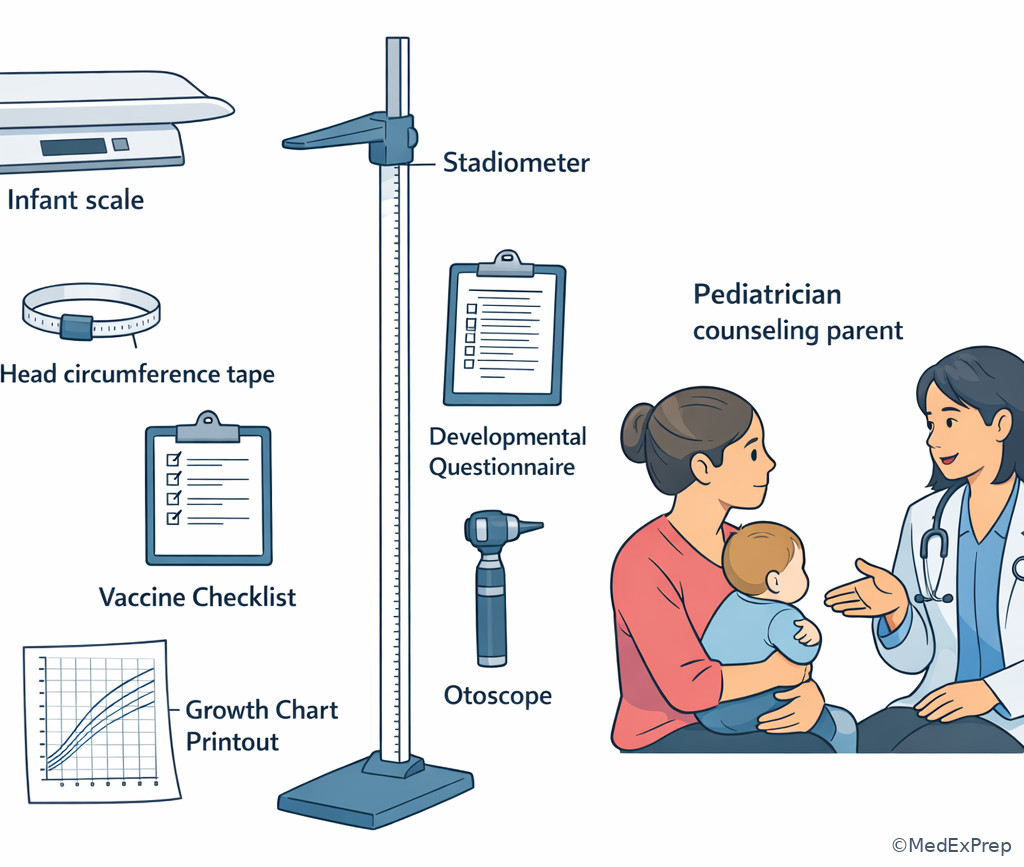
G -->|No| I[Continue routine follow-up] Exam takeaway: Visualize the flow from intake measurements to counseling so you do not miss required preventive elements.
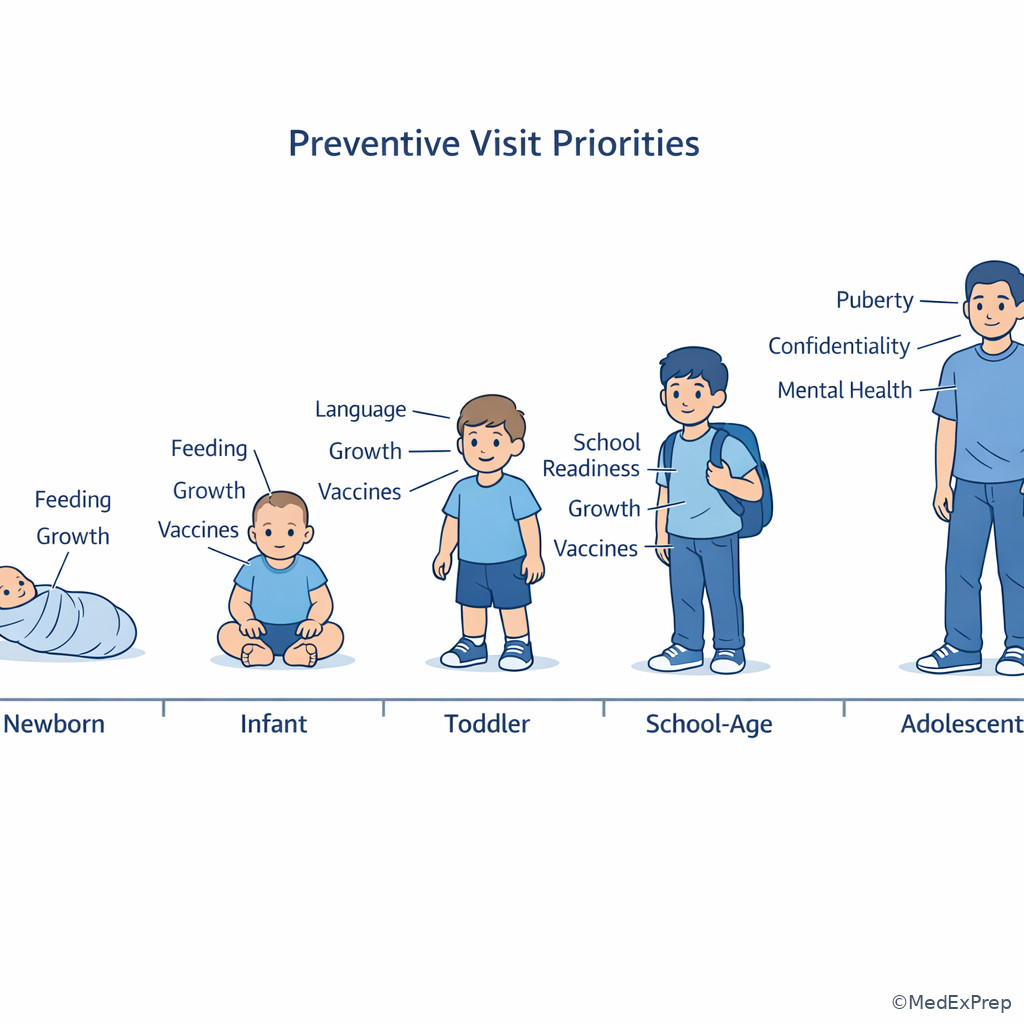
Exam takeaway: Board questions often hinge on knowing that visit content changes with age even when the structure stays the same.
Core content
1.1.1.3 Foundational workflow: what happens in every well-child visit
A Explanation
The board-style conflict is not “Can you list everything in preventive care?” It is “What is the most appropriate next step in a visit that seems routine but contains competing tasks?” The resolving rule is simple: first decide whether this is truly a routine preventive encounter. If the child is unstable, toxic, dehydrated, in respiratory distress, or has a safeguarding emergency, routine flow stops and urgent care begins. If stable, the standard sequence is previsit review, interval history, growth/vitals, developmental and psychosocial assessment, physical examination, screening/immunizations, anticipatory guidance, and follow-up planning. See Fig 1.
WHY THIS IS TESTED: exam stems commonly add distracting details—mild URI symptoms, a remote family history, a parental vaccine concern, or a school issue—to force you to decide between proceeding with routine care, adding targeted evaluation, or escalating.
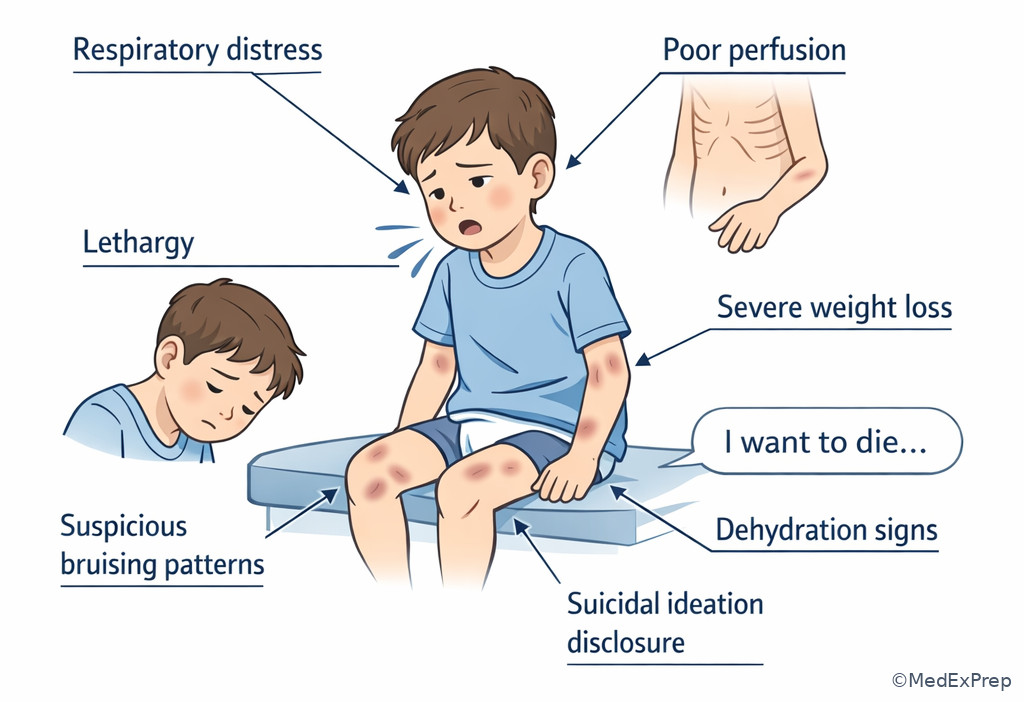
Choose routine completion when the child is well appearing and the concern fits preventive care. Reject routine completion when a red flag changes disposition: lethargy, severe weight loss, respiratory distress, suicidal ideation, suspicious bruising, or abnormal vital signs that suggest urgent illness. The visit is not just a checklist; it is a triage-plus-prevention encounter.
B Worked example
A 2-year-old boy presents for a routine checkup. He has mild rhinorrhea for 2 days, eczema, and a history of prematurity at 35 weeks without chronic lung disease. His mother also mentions he “doesn’t use many words,” but he is playful in the room, afebrile, and well hydrated. A recent urgent care note documented bilateral middle-ear effusions 3 weeks ago. The tempting wrong move is to focus only on the URI and defer the visit or to anchor on the effusions as the sole explanation.
Reasoning chain: identify task: this is a preventive visit with a developmental concern. Extract key facts: well appearing, minor illness only, language concern, age 2 years. Apply rule: mild uncomplicated illness does not invalidate routine preventive care; parent developmental concern requires attention during the visit. Eliminate distractors: emergency evaluation is unnecessary because there is no distress or toxicity; “reassure and wait only” is weak because parent concern itself is meaningful. Verify: proceed with routine exam, growth review, developmental surveillance, age-appropriate screening tool use as indicated, immunization review, and counseling, while planning follow-up or referral for language delay if concern is confirmed.
C Exam trap
D Checkpoint
Question: A 6-year-old girl presents for a well visit. She has a mild cough, normal work of breathing, normal oxygen saturation, and normal hydration. Her father wants to postpone everything until she is “100% healthy.” What is the most appropriate next step?
- Reschedule the visit and all immunizations until symptoms fully resolve.
- Proceed with the well visit, including routine preventive care, because mild illness alone is not a reason to defer most care.
- Send her to the emergency department for chest imaging before any preventive care.
- Limit the encounter to the acute complaint and defer growth, screening, and counseling.
Answer: B
- A: Tempting because clinicians worry about vaccine timing during illness; wrong because mild uncomplicated illness without instability usually does not require deferral.
- B: Correct because the child is stable and the symptoms are minor, so the preventive visit should proceed.
- C: Tempting if you overreact to cough alone; wrong because there is no respiratory distress, hypoxemia, or focal severe finding.
- D: Tempting because acute complaints can hijack a visit; wrong because nothing here prevents completing routine preventive tasks.
1.1.1.4 Foundational content: surveillance, screening, and age-specific priorities
A Explanation
The central decision conflict here is choosing between doing what happens at every visit and adding age- or risk-based tasks. The single rule that resolves this is: surveillance is universal and continuous; screening is standardized and scheduled or risk-triggered. See Fig 2. At every visit, ask about parent concerns, interval illness, nutrition, elimination, sleep, behavior, development, school or daycare performance when relevant, medications, social stressors, and safety. Then layer on age-specific priorities: feeding and jaundice concerns in infancy, language and behavior in toddlers, school performance in school-age children, and confidentiality plus mood/substance/sexual health in adolescents.
WHY THIS IS TESTED: the exam rewards the candidate who can distinguish “observe and continue surveillance,” “apply a validated screening tool now,” and “initiate diagnostic evaluation because a screen or concern is abnormal.”
Choose surveillance when you are gathering longitudinal information: parental concerns about speech, social reciprocity, sleep, attention, or school. Choose screening when the age or risk profile calls for a standardized process: hearing, vision, lead, anemia, lipid, depression, or other guideline-based screening depending on age and risk. Reject the answer that jumps directly from a mild concern to subspecialty referral without the intermediate steps of structured assessment and context.
B Worked example
A 13-year-old girl presents for an annual visit. She has obesity, mild persistent asthma, and migraine headaches. Her mother wants to stay in the room for the entire discussion. The patient says school is “fine,” but hesitates when asked about mood. She also recently changed schools after bullying. A distracting clue is that she has mild acne and asks about a topical medication refill, which could pull attention toward a narrow dermatology plan.
Reasoning chain: identify task: adolescent preventive visit structure. Extract key facts: age 13, psychosocial transition, possible mood concern, parent present, chronic disease follow-up needs. Apply rule: adolescents need routine confidential time within appropriate legal and safety limits; mood and risk assessment are part of preventive care. Eliminate distractors: completing the visit entirely through the parent misses confidentiality; referring to psychiatry before private assessment is premature; focusing only on asthma and acne misses the highest-yield preventive step. Verify: create confidential discussion time, assess mood, safety, substance use, and sexual health as appropriate, then continue routine preventive counseling.
C Exam trap
D Checkpoint
Question: During a 12-year-old boy’s annual visit, his mother says he is doing well, but he has recently withdrawn from sports after a move. What is the most appropriate next step in structuring the visit?
- Assume adjustment is normal and move directly to vaccines.
- Conduct confidential adolescent time and assess mood, stressors, and safety as part of preventive care.
- Refer immediately for formal psychiatric evaluation before asking more questions.
- Skip psychosocial assessment because there is no stated chief complaint.
Answer: B
- A: Tempting because vaccines are a concrete preventive task; wrong because psychosocial screening is also routine and may reveal risk.
- B: Correct because adolescent well visits should include confidential assessment of mood and safety concerns.
- C: Tempting if you fear missing depression; wrong because the next step is private assessment, not automatic referral.
- D: Tempting when the visit is “routine”; wrong because prevention includes mental health and risk review, especially in adolescents.
- Surveillance happens at every visit; screening happens at scheduled or risk-based points.
- True or False: A mild acute illness automatically requires deferral of all preventive care. False.
- Name 3 universal well-visit pillars: growth review, developmental/psychosocial assessment, anticipatory guidance.
1.1.1.5 Applied visit structure: history, physical examination, and preventive priorities by age
A Explanation
Once the visit is confirmed as routine, the next conflict is how to prioritize limited time. The resolving rule is: collect universal history and exam elements first, then emphasize the age-linked priorities most likely to change management today. In infants, feeding, elimination, sleep position, growth trajectory, and caregiver coping dominate. In toddlers and preschoolers, behavior, language, toilet readiness, injury prevention, and routines matter. In school-age children, school performance, peer function, activity, and habits become central. In adolescents, puberty, confidentiality, mood, substance use, sexual health, body image, and risk behaviors move forward.
WHY THIS IS TESTED: exam writers commonly present the wrong answer as a technically true recommendation that is mismatched to the child’s age. The issue is not whether the advice is good; it is whether it is the best fit now.
Choose age-matched counseling over generic counseling. Choose targeted focused exam elements when a symptom or parental concern arises during the visit. Reject broad low-yield counseling that ignores the developmental stage. This is also where you document vitals, physical exam, growth measures, and parent concerns in a way that supports subsequent screening and follow-up decisions.
Exam takeaway: Match counseling and assessment priorities to developmental stage rather than using a one-size-fits-all script.
flowchart TD
A[Infant] --> A1[Feeding, sleep safety, elimination, growth]
B[Toddler/Preschool] --> B1[Language, behavior, routines, injury prevention]
C[School-age] --> C1[School, activity, nutrition, peer function]
D[Adolescent] --> D1[Confidentiality, mood, substance use, sexual health]
A1 --> E[Age-matched guidance]
B1 --> E
C1 --> E
D1 --> E
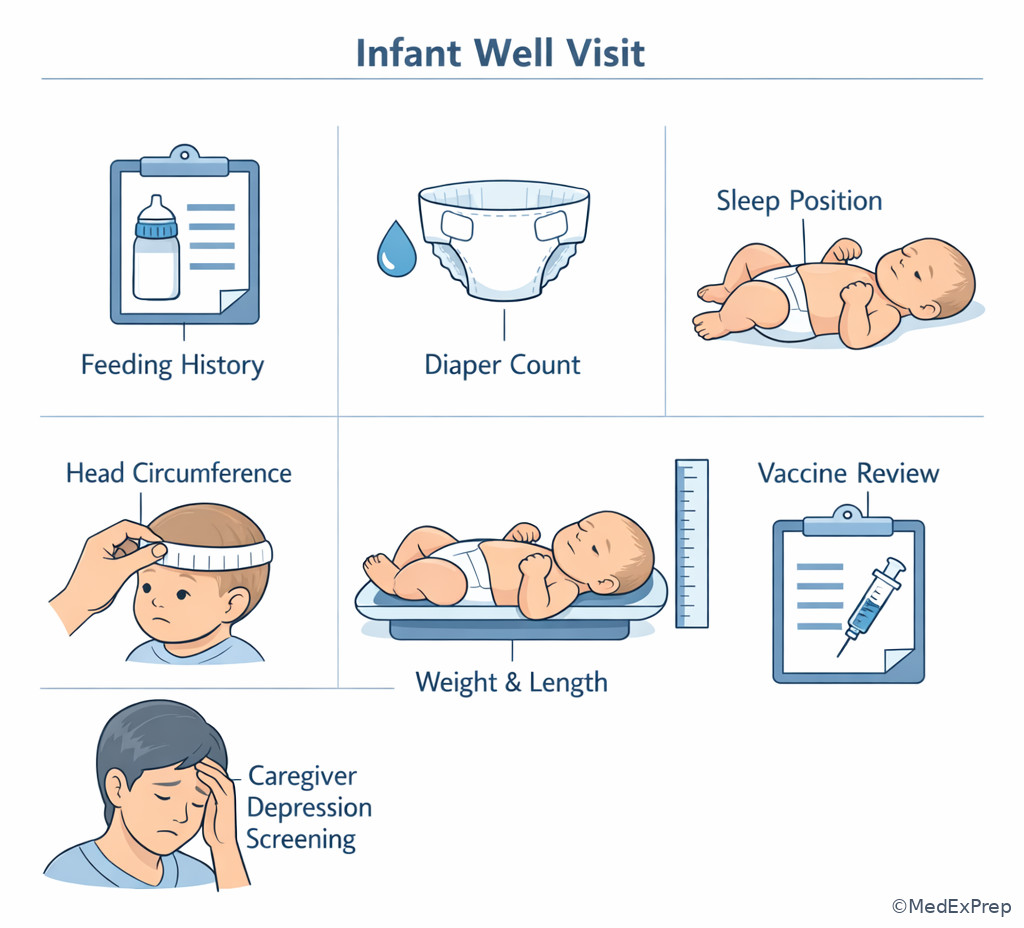
Exam takeaway: In infancy, feeding, growth, elimination, and safe sleep questions often resolve the most testable preventive decisions.
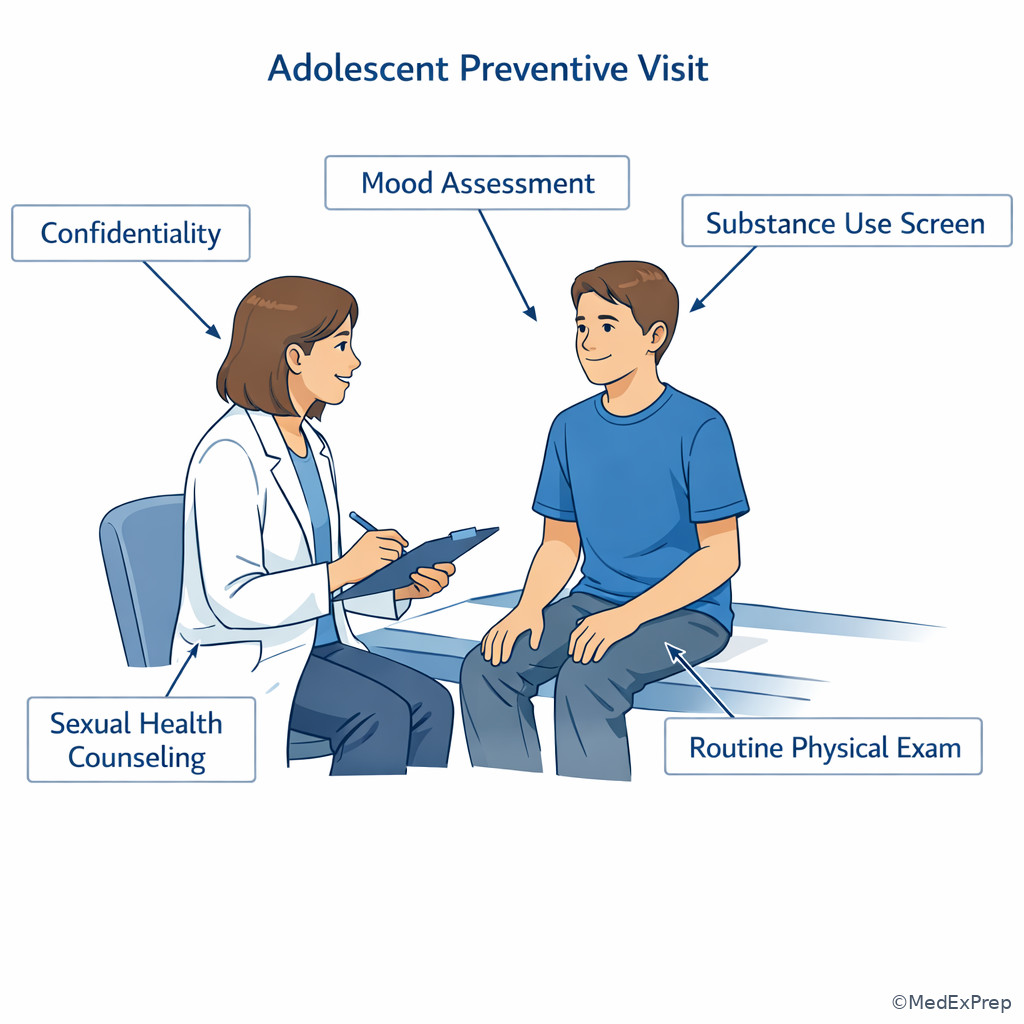
Exam takeaway: Confidential interviewing, mental health review, and risk counseling are core preventive tasks in teens.
B Worked example
A 9-month-old girl comes for a preventive visit. She was born at term, has mild reflux symptoms, and has a sibling with autism spectrum disorder. Parents report she rolls and sits but “is not babbling much.” She recently had one night of fever after a viral illness, which is the tempting distracting detail. She is afebrile, interactive, and growing well.
Reasoning chain: identify task: age-prioritized preventive visit. Extract key facts: infant, developmental/language concern, family history, otherwise stable. Apply rule: in infants, preventive focus includes growth, feeding, development, sleep safety, and surveillance for early communication concerns. Eliminate distractors: acute sepsis workup is wrong because she is well appearing and fever has resolved; extensive neurologic testing is premature without broader abnormalities. Verify: perform developmental surveillance, review social communication milestones, examine hearing-related clues, complete routine preventive care, and arrange appropriate follow-up or formal screening at indicated ages/risk-based intervals.
C Exam trap
D Checkpoint
Question: Which counseling focus is most appropriate to prioritize during a routine 16-year-old well visit for an otherwise healthy patient?
- Rear-facing car seat duration and formula intake
- Pubertal development, confidential mental health/risk assessment, and substance/sexual health counseling
- Toilet training readiness and tantrum management
- School readiness and phonologic awareness screening
Answer: B
- A: Tempting because safety and nutrition are always relevant; wrong because these are infant-focused priorities.
- B: Correct because adolescent preventive visits center on confidentiality, mood, puberty, and risk behavior review.
- C: Tempting because behavior is always part of pediatrics; wrong because toilet training belongs to toddler years.
- D: Tempting because education matters; wrong because school readiness is a preschool concern, not a 16-year-old priority.
1.1.1.6 Integration: abnormal findings, safety concerns, and when routine care must pivot
A Explanation
The hardest preventive-care questions ask you to abandon the routine script. The decision conflict is whether to finish the well visit versus pivot to urgent evaluation, protective action, or targeted workup. The single rule is: red flags outrank preventive completeness. If the child is in distress, appears septic, has severe dehydration, new neurologic deficit, concerning weight loss, suspicious injuries, or a major mental health safety issue, that becomes the primary problem. See Fig 1.
WHY THIS IS TESTED: ABP-style stems often disguise danger inside a prevention context because safe pediatric practice requires recognizing instability and safeguarding obligations even during “routine” appointments.
Choose immediate escalation for respiratory distress, shock signs, altered mental status, seizures, suicidal intent, or probable abuse. Choose targeted outpatient evaluation when the finding is important but not emergent, such as an elevated BMI trend, mild speech delay, or failed vision screening. Reject answers that continue counseling while ignoring danger or, conversely, send every abnormality to the emergency department without severity-based reasoning.
Exam takeaway: A well-visit stem becomes an urgent problem when instability, abuse concern, or safety risk is present.
flowchart TD
A[Well visit begins] --> B{Red flag present?}
B -->|Yes| C[Stop routine sequence]
C --> D{Type of red flag}
D --> E[Medical instability -> emergency evaluation]
D --> F[Safety or abuse concern -> protective action/report]
D --> G[Mental health danger -> immediate safety assessment]
B -->|No| H[Continue preventive care and plan follow-up] Exam takeaway: Learn to spot the findings that convert a routine visit into urgent medical or safeguarding action.
B Worked example
A 15-year-old boy presents for a sports physical. He has ADHD and obesity. During confidential time, he quietly reports feeling hopeless for months and says he has thought about “not being here,” with access to his stepfather’s firearm. His blood pressure is mildly elevated, and he also asks about acne treatment. The tempting wrong answer is to address the blood pressure, complete the sports clearance, and schedule follow-up for mood later.
Reasoning chain: identify task: this is no longer routine preventive care. Extract key facts: adolescent, suicidality with access to lethal means, confidential disclosure, distracting chronic issues present. Apply rule: immediate safety assessment and urgent mental health intervention supersede sports clearance and routine counseling. Eliminate distractors: outpatient reassurance is inappropriate; acne management and blood pressure follow-up are secondary. Verify: maintain safety, involve guardians appropriately within safety/legal framework, and arrange urgent mental health evaluation.
C Exam trap
D Checkpoint
Question: A 4-year-old girl presents for a routine visit. She is tachypneic, has intercostal retractions, speaks in short phrases, and has oxygen saturation of 90% on room air. What is the most appropriate next step?
- Complete the routine well-child exam quickly before addressing the breathing issue.
- Provide anticipatory guidance and ask the family to schedule a separate sick visit later today.
- Initiate urgent evaluation and treatment for respiratory distress rather than continue routine preventive care.
- Proceed with immunizations first so she does not fall behind.
Answer: C
- A: Tempting because preventive visits can be hard to reschedule; wrong because respiratory distress takes precedence.
- B: Tempting if you think the visit setting limits action; wrong because hypoxemia and retractions require immediate care.
- C: Correct because instability converts the encounter into an urgent medical problem.
- D: Tempting due to vaccine catch-up pressure; wrong because stabilization comes before routine prevention.
- If the stem says “well visit” but the child has respiratory distress, think urgent evaluation first.
- True or False: Suspicious bruising can be deferred to a later follow-up because the visit is preventive. False.
- The single clue that overrides routine care in adolescent preventive visits is often immediate safety risk.
1.1.1.7 Integration: counseling, immunization planning, documentation, and follow-up
A Explanation
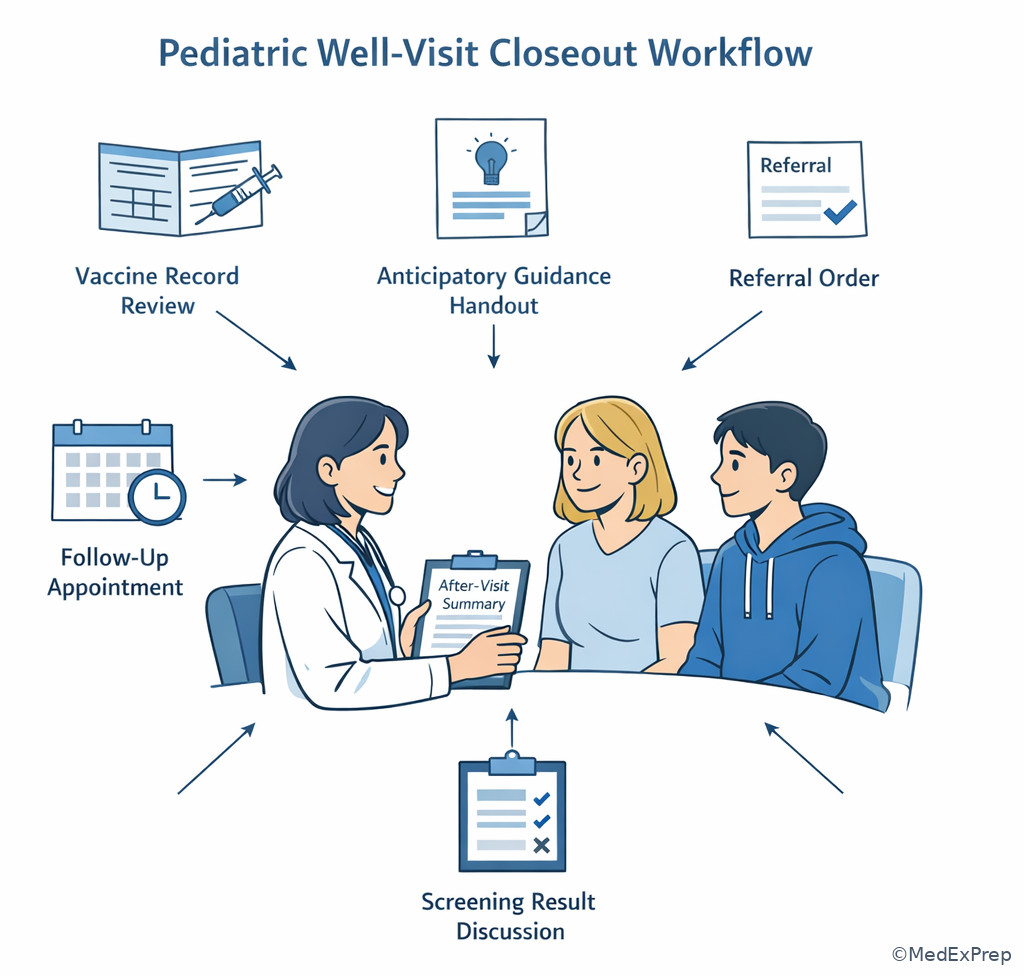
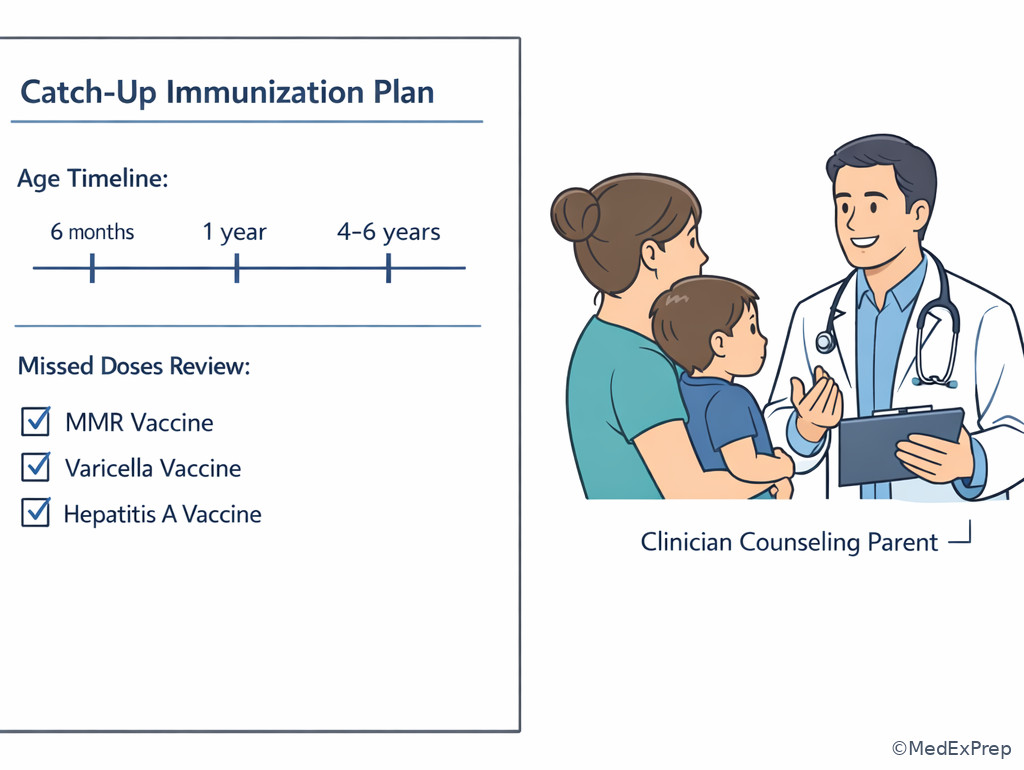
The final preventive-care decision conflict is how to end the visit: should you reassure and discharge, vaccinate now, create a follow-up plan, or refer? The rule is: close every well visit with explicit action items tied to today’s findings. A preventive encounter is incomplete if there is no clear plan for immunizations, screening results, counseling, and return timing. Missed vaccines usually require catch-up planning rather than restarting series. Abnormal but nonurgent findings need specific follow-up intervals. Counseling should be both age-based and problem-linked: safe sleep for infants, routines and reading for toddlers, nutrition and activity for school-age children, and confidentiality, mood, substance, and sexual health counseling for adolescents. See Fig 3 and Fig 4.
WHY THIS IS TESTED: exam stems may ask for the “most appropriate next step” after the visit findings are already known. The right answer is often not another diagnostic test but a concrete preventive action plan.
Choose a specific follow-up when the finding needs reassessment. Choose same-day vaccine update when appropriate. Reject vague advice such as “monitor” without timing, or “refer everyone” without severity. Documentation also matters conceptually: record parental concerns, screens performed, abnormal findings, counseling given, vaccines administered or deferred, and the reason for return or referral.
Exam takeaway: End every visit with vaccines, counseling, documented abnormalities, and a specific follow-up plan.
flowchart LR
A[Findings reviewed] --> B[Immunization plan]
A --> C[Counseling plan]
A --> D[Screening follow-up]
B --> E[Document and schedule]
C --> E
D --> E
Exam takeaway: The correct board answer often depends on choosing the clearest documented follow-up plan for today’s preventive findings.
Exam takeaway: Delayed vaccines usually call for catch-up scheduling rather than restarting a series.
B Worked example
An 11-year-old boy presents for an annual visit. He has allergic rhinitis, overweight status, and a history of delayed vaccines due to missed appointments. He feels well today. His mother asks whether the vaccine series must be restarted because “it’s been too long.” He also failed a school vision screen last month, but the family has not scheduled follow-up. A tempting wrong clue is that he has seasonal congestion today, which may distract from preventive planning.
Reasoning chain: identify task: closeout planning in a stable well visit. Extract key facts: delayed vaccines, failed vision screen, nonurgent weight concern, mild rhinitis only. Apply rule: mild illness does not usually defer vaccines; delayed immunizations generally require catch-up, not restarting; failed screening requires specific follow-up. Eliminate distractors: emergency ophthalmology referral is unnecessary without acute eye symptoms; “wait until next year” is unsafe because the abnormal screen is already known. Verify: update vaccines as appropriate, counsel on healthy habits, arrange eye evaluation, and document follow-up timing.
C Exam trap
D Checkpoint
Question: A stable 7-year-old presents for a preventive visit and is found to have a failed vision screen but otherwise normal exam findings. What is the most appropriate next step?
- Ignore the result because screening tests are often falsely positive.
- Document the failed screen and arrange appropriate follow-up evaluation rather than simply waiting until the next annual visit.
- Send the child to the emergency department for urgent ophthalmology consultation.
- Repeat no further screening until symptoms develop.
Answer: B
- A: Tempting because screening can overcall problems; wrong because a failed screen requires follow-up, not dismissal.
- B: Correct because screening is useful only if abnormal results trigger action.
- C: Tempting if you fear missing a vision-threatening disorder; wrong because a routine failed screen in a stable child is not an emergency.
- D: Tempting because the child is asymptomatic; wrong because screening abnormalities are meant to identify problems before symptoms are obvious.
Exam Traps & Differentiators
Most common wrong answer and why: “Complete the usual well-visit checklist and address the other issue later.” This is tempting because preventive care is checklist-driven. It is wrong when a red flag, safety concern, or important abnormality changes the priority.
| Look similar | Actually means | Single discriminator | Most appropriate next step |
|---|---|---|---|
| Parent mentions mild cough at checkup | Routine visit can usually continue | Child is well appearing, no distress | Proceed with preventive care |
| Parent mentions breathing issue at checkup | May be urgent visit instead | Retractions, hypoxemia, tachypnea | Urgent evaluation/treatment |
| Parent concern about development | Surveillance concern | Concern itself is meaningful even before formal testing | Assess further and plan follow-up/screening |
| Scheduled standardized tool | Screening task | Age or risk-triggered structured test | Perform and act on results |
| Teen with parent always present | Incomplete adolescent structure | No confidential time | Create private discussion space |
| Missed vaccines for months or years | Catch-up planning issue | Delay does not erase prior valid doses | Continue series; do not restart |
If the stem says ___, think ___:
- If the stem says “well visit” plus respiratory distress, think this is no longer a routine visit.
- If the stem says “parent is worried about language”, think developmental surveillance concern requiring action, not automatic reassurance.
- If the stem says “adolescent annual visit”, think confidential interview and mental health/risk assessment.
- If the stem says “failed screening test”, think follow-up plan, not dismissal.
- If the stem says “mild illness today”, think preventive care often still proceeds.
- If the stem says “missed vaccines”, think catch-up schedule, not restart.
| Confusable pair | Why they are confused | How to separate them |
|---|---|---|
| Surveillance vs screening | Both aim to detect early problems | Surveillance is continuous clinical observation; screening uses standardized tools/tests at defined times or risk states |
| Routine follow-up vs urgent escalation | Both follow abnormal findings | Urgency depends on instability, danger, or safeguarding risk |
| General counseling vs age-matched guidance | Both are preventive | The best answer matches the child’s developmental stage and current risk |
| Delayed series vs invalid vaccine dose | Both involve scheduling confusion | Delay usually requires catch-up; validity depends on prior dose timing and intervals |
Related future trap: in Growth Charts And Percentiles, the wrong answer will often focus on a single percentile rather than longitudinal trend. In Pediatric Screening Recommendations, the wrong answer will often apply a universal screen when only risk-based screening is indicated.
Tables
| Core visit element | Do at every well visit? | Exam significance |
|---|---|---|
| Assess stability/urgent red flags | Yes | First split: routine vs urgent care |
| Interval history and parent concerns | Yes | Drives surveillance and targeted follow-up |
| Growth and vital signs | Yes | Required foundation for future interpretation |
| Developmental/behavioral review | Yes | Surveillance is universal |
| Standardized screenings | Not always | Age- or risk-based, not automatic every time |
| Immunization review | Yes | Catch-up opportunities are commonly tested |
| Anticipatory guidance | Yes | Must be age-matched |
| Follow-up/referral planning | Yes | Abnormal findings need a clear next step |
| Age group | Highest-yield visit priorities | Classic distractor to reject |
|---|---|---|
| Infant | Feeding, elimination, sleep safety, growth, caregiver adjustment | Adolescent confidentiality counseling |
| Toddler/Preschool | Language, behavior, routines, injury prevention, toilet readiness | School sports clearance focus |
| School-age | School performance, peer function, activity, diet, screen habits | Formula feeding guidance |
| Adolescent | Confidentiality, mood, substance use, sexual health, body image | Rear-facing car seat counseling as primary focus |
| Finding during well visit | Category | Best next step |
|---|---|---|
| Mild URI symptoms, well appearing | Routine variation | Proceed with preventive care |
| Failed vision or hearing screen, stable child | Nonurgent abnormal screening result | Arrange follow-up evaluation |
| Parental concern for speech delay | Surveillance concern | Further assessment and appropriate follow-up/referral |
| Suicidal ideation with access to lethal means | Immediate safety risk | Urgent mental health safety intervention |
| Retractions and low oxygen saturation | Medical instability | Immediate urgent evaluation |
| Suspicious patterned bruising | Safeguarding red flag | Protective evaluation and mandated reporting per protocol |
Algorithm / Approach
Rapid Review
- Routine visit vs urgent visit → distress or safety risk overrides preventive flow.
- Surveillance → every-visit concern review, not a one-time formal test.
- Screening → standardized, age- or risk-triggered task.
- Mild illness → usually not a reason to defer most preventive care.
- Adolescent structure → confidential time is the discriminator.
- Missed vaccines → think catch-up, not restart.
- Failed screen → needs follow-up plan, not reassurance alone.
- Infant counseling → feeding and safety beat school-performance counseling.
- Toddler concern → language/behavior questions are higher yield than puberty counseling.
- School-age visit → school function and habits separate it from toddler preventive priorities.
- Teen disclosure of self-harm → immediate safety evaluation before routine completion.
- Parent developmental worry → counts as clinically meaningful surveillance data.
Self-check quiz
1. A 5-year-old boy presents for a routine visit with mild nasal congestion for 1 day. He is afebrile, playful, well hydrated, and breathing comfortably. Which is the most appropriate next step?
- Defer the preventive visit and all vaccines until symptoms fully resolve.
- Proceed with routine preventive care because mild uncomplicated illness does not usually require deferral.
- Send him for chest radiography before completing preventive care.
- Convert the visit entirely to an acute visit and skip counseling, growth review, and immunization review.
2. A 14-year-old girl presents for an annual visit with controlled eczema and no acute complaints. Which structural element is most appropriate to include?
- Confidential interview time with assessment of mood and risk behaviors
- Primary emphasis on toilet training readiness
- Exclusive counseling on formula preparation
- Routine omission of psychosocial questions if the parent reports no concerns
3. A 22-month-old boy presents for a preventive visit. He has a history of recurrent otitis media, mild eczema, and a resolved febrile illness last week. His parents say he uses only 3 words and mostly points to communicate. He is afebrile and active today. What is the most appropriate next step?
- Reassure the parents and defer further discussion until the next annual visit because boys often talk late
- Proceed with the preventive visit and address the language concern with developmental surveillance and appropriate follow-up planning
- Cancel the visit because the recent fever makes developmental assessment unreliable
- Order immediate brain MRI before completing preventive care
4. A 12-year-old boy presents for a well visit after changing schools. He has obesity and allergic rhinitis. His mother says he is quieter lately but denies major problems. He shrugs when asked about school and looks down. What is the most appropriate next step?
- Finish the physical exam and avoid sensitive topics because the parent is present
- Obtain confidential time and assess mood, bullying, safety, and adjustment as part of routine preventive care
- Refer directly to psychiatry without private assessment
- Focus only on diet and exercise counseling because obesity is the main preventive issue
5. A healthy 8-year-old girl presents for her annual visit. Her visual acuity screening is abnormal, but she reports no vision complaints and the rest of the exam is normal. What is the most appropriate next step?
- Ignore the result because asymptomatic children rarely have important visual deficits
- Repeat screening at next year’s visit only
- Arrange appropriate follow-up evaluation because an abnormal screen requires action even in an asymptomatic child
- Send her to the emergency department for urgent ophthalmology evaluation
6. A 16-year-old boy presents for a sports clearance visit. He has well-controlled asthma and acne. During confidential time, he says he has felt hopeless for 2 months, has thought about killing himself, and knows where a handgun is stored at home. He is medically stable. What is the most appropriate next step?
- Complete the sports form first, then schedule mental health follow-up within 1 month
- Perform routine counseling and ask him to return if the thoughts worsen
- Initiate immediate safety assessment and urgent mental health intervention rather than continue routine preventive tasks
- Address only asthma control because it is the chronic disease most relevant to sports participation
7. A 4-year-old girl presents for a routine checkup. She has a history of intermittent wheezing and atopic dermatitis. Today she is tachypneic with subcostal retractions, speaks in short phrases, and has oxygen saturation of 91% on room air. Her mother mainly wants school forms completed. What is the most appropriate next step?
- Complete the school forms and then discuss a follow-up for wheezing later this week
- Proceed with immunizations because she may miss school-based requirements otherwise
- Provide anticipatory guidance and ask the family to return for an acute visit if symptoms persist
- Stop the routine visit and initiate urgent evaluation and treatment for respiratory distress
8. An 11-year-old boy presents for a preventive visit after several missed appointments. He has allergic rhinitis, overweight status, and no acute illness beyond mild nasal congestion. Review of records shows he is behind on several vaccines. His mother asks whether he must restart the vaccine series because more than 2 years have passed since some prior doses. What is the most appropriate next step?
- Restart all vaccine series from the first dose because prior doses are no longer valid after long delay
- Defer all immunizations today because mild congestion is a contraindication
- Use catch-up scheduling and continue the series rather than restarting previously valid doses
- Wait until next year’s well visit to avoid administering multiple vaccines at one encounter
Answer key
1. Correct answer: B
Why B is correct: Mild uncomplicated illness without instability does not usually require postponing a well-child visit or routine immunizations. The mechanism-to-management logic is prioritization: the child remains appropriate for preventive care because there is no red-flag physiology. Sources: American Academy of Pediatrics preventive care guidance; CDC immunization best practices.
- A: Tempting because clinicians often remember “don’t vaccinate during illness,” but that rule applies to moderate/severe illness more than mild URI symptoms. Discriminating clue: playful, afebrile, well hydrated.
- B: Correct because the child is clinically stable and the congestion is minor. Discriminating clue: no respiratory distress or systemic illness.
- C: Tempting because cough/nasal symptoms can trigger concern for pneumonia, but there are no lower respiratory findings. Discriminating clue: no distress, no fever, no focal severe symptoms.
- D: Tempting because acute symptoms can distract from prevention, but the mild illness does not replace core preventive tasks. Discriminating clue: routine visit remains appropriate.
2. Correct answer: A
Why A is correct: Adolescents require confidential interview time for preventive care because mood, safety, substance use, and sexual health concerns may only emerge privately. The mechanism is not pathology but structure: confidentiality increases valid disclosure and changes management. Sources: AAP Bright Futures; Society for Adolescent Health and Medicine confidentiality recommendations.
- A: Correct because confidential psychosocial assessment is a core structural component of adolescent preventive visits. Discriminating clue: age 14.
- B: Tempting because behavior counseling is preventive, but toilet training is developmentally mismatched. Discriminating clue: adolescent, not toddler.
- C: Tempting because nutrition counseling matters at all ages, but formula preparation is infant-specific. Discriminating clue: age 14.
- D: Tempting because parents may report things accurately, but adolescent psychosocial risk often requires private discussion. Discriminating clue: annual adolescent visit structure.
3. Correct answer: B
Why B is correct: Parent concern about language delay at a toddler well visit is clinically meaningful surveillance data and should be addressed now with structured assessment and follow-up planning. The mechanism-to-management logic is early recognition: speech/language concerns are not dismissed simply because the child is otherwise well. Sources: AAP developmental surveillance and screening policy; Bright Futures.
- A: Tempting because some late talking is benign, but reassurance alone misses a meaningful developmental concern. Discriminating clue: only 3 words at 22 months plus parent concern.
- B: Correct because the visit should continue and the developmental issue should be actively evaluated within preventive care. Discriminating clue: afebrile, active child with surveillance concern.
- C: Tempting if recent illness is overemphasized; wrong because a resolved fever does not invalidate developmental assessment. Discriminating clue: well today.
- D: Tempting because serious neurologic causes exist, but MRI is not the first general pediatric step for isolated language delay in a stable child. Discriminating clue: no regression, focal deficits, or acute neurologic signs.
4. Correct answer: B
Why B is correct: A school change, withdrawal, and affective cues in a preteen create a preventive-care need for private psychosocial assessment. The mechanism is early detection of depression, bullying, anxiety, or safety concerns through confidential interviewing. Sources: AAP Bright Futures; USPSTF/AAP adolescent mental health preventive guidance.
- A: Tempting because discussing sensitive topics in front of a parent can feel easier to avoid, but that misses the critical structural step. Discriminating clue: possible mood/social concern.
- B: Correct because confidential assessment is the best next step before deciding whether referral is needed. Discriminating clue: quieter lately, recent move, limited verbal engagement.
- C: Tempting because psychiatry referral sounds proactive; wrong because immediate private assessment should come first unless there is already clear acute danger. Discriminating clue: concern is present but safety crisis not yet established.
- D: Tempting because obesity is important preventive content; wrong because it does not explain the key psychosocial clue and should not crowd out mood/safety review. Discriminating clue: behavioral change after school transition.
5. Correct answer: C
Why C is correct: Screening is useful only if abnormal results trigger follow-up. An asymptomatic child may still have clinically significant refractive or other visual issues detectable by screening. The mechanism-to-management logic is prevention of missed impairment through timely evaluation. Sources: AAP/AAO pediatric vision screening recommendations; Bright Futures.
- A: Tempting because asymptomatic children often compensate well, but that is exactly why screening exists. Discriminating clue: abnormal visual acuity screen.
- B: Tempting because symptoms are absent; wrong because waiting a full year defeats the purpose of screening. Discriminating clue: objective abnormal result now.
- C: Correct because a failed screen requires an action plan. Discriminating clue: stable child with nonurgent but abnormal screening.
- D: Tempting because vision problems can sound serious; wrong because there is no acute eye pain, trauma, sudden vision loss, or other emergency feature. Discriminating clue: routine annual visit, asymptomatic.
6. Correct answer: C
Why C is correct: Suicidal ideation with access to a firearm represents immediate safety risk that supersedes preventive completion. The mechanism-to-management logic is risk containment: access to lethal means sharply increases urgency, so same-visit safety intervention is required. Sources: AAP suicide risk guidance; Joint Commission/NIMH pediatric suicide safety principles.
- A: Tempting because sports clearance feels time-sensitive and follow-up sounds responsible; wrong because safety cannot wait. Discriminating clue: active suicidal thoughts plus firearm access.
- B: Tempting because supportive counseling matters, but routine counseling alone is inadequate for current danger. Discriminating clue: lethal means access.
- C: Correct because the visit has pivoted from preventive care to immediate mental health safety management. Discriminating clue: suicidality with lethal means.
- D: Tempting because sports visits often emphasize chronic disease clearance; wrong because asthma is not the urgent problem here. Discriminating clue: mood disclosure is the priority.
7. Correct answer: D
Why D is correct: Tachypnea, retractions, short-phrase speech, and hypoxemia indicate clinically significant respiratory distress. The mechanism-to-management logic is immediate stabilization: the child is no longer in a routine preventive category. Sources: AAP asthma and emergency recognition guidance; pediatric respiratory distress standards.
- A: Tempting because families often prioritize school forms and logistics; wrong because medical instability must be addressed first. Discriminating clue: retractions and low oxygen saturation.
- B: Tempting because vaccine timeliness matters; wrong because urgent respiratory care takes precedence over preventive tasks. Discriminating clue: respiratory distress.
- C: Tempting because outpatient follow-up works for mild symptoms; wrong because this child has objective signs of severity. Discriminating clue: speaks in short phrases with saturation 91%.
- D: Correct because the visit must pivot to urgent evaluation and treatment. Discriminating clue: multiple signs of increased work of breathing and hypoxemia.
8. Correct answer: C
Why C is correct: Previously valid vaccine doses generally remain valid despite long delays, so catch-up scheduling is used rather than restarting the series. Mild congestion alone is not usually a contraindication to vaccination. The mechanism-to-management logic is prevention efficiency: continue protection without unnecessary repetition. Sources: CDC Child and Adolescent Immunization Schedule and General Best Practice Guidelines; AAP Red Book.
- A: Tempting because long intervals feel like lost immunity, but prior valid doses are not erased by delay. Discriminating clue: behind schedule, not invalidly vaccinated.
- B: Tempting because illness can make families anxious about vaccines; wrong because mild congestion is not a typical contraindication. Discriminating clue: no moderate/severe acute illness.
- C: Correct because catch-up planning is the appropriate preventive response to missed appointments. Discriminating clue: long delay since some doses, but stable today.
- D: Tempting because spacing can feel gentler, but unnecessary delay prolongs underimmunization. Discriminating clue: preventive opportunity available today.
Keep going with the full ABP Pediatrics Prep Course (ABP Peds)
You just studied the way members do, in the same lesson interface. Full access unlocks every lesson, the question bank and flashcards for a full year.
One payment · 1 year of access · No auto-renewal