1.1.1 - Pregnancy Dating Principles
Why it matters Incorrect gestational age shifts every downstream decision: aneu…
- 1 Why it matters Incorrect gestational age shifts every downstream decision: aneu… 0:58
- 2 Key Terms & Must-Know Facts Key terms Gestational age (GA): pregnancy age count… 2:22
- 3 Body 1:41
- 4 Core content 1.1.1.1 Foundational rule: What date should you trust first? 1:48
- 5 3 Anchor the EDD Use the best source once, document the basis, and apply it to… 1:47
- 6 Checkpoint Question: A 24-year-old G1 presents with a positive pregnancy test. 1:52
- 7 If the ultrasound date differs from LMP beyond accepted thresholds, revise the… 1:49
- 8 Body 1:36
- 9 Checkpoint Question: A patient with regular 28-day cycles has a certain LMP. 1:58
- 10 High-Yield Connection: This concept is tested alongside Routine Prenatal Survei… 1:43
- 11 Body 2:05
- 12 Verify: keep the EDD and evaluate for fetal growth restriction. 1:37
- 13 Refer/Escalate for maternal-fetal medicine input if significant growth restrict… 1:32
- 14 Body 1:43
- 15 Eliminate distractors: fundal height is too imprecise to solve chronology, and… 2:09
- 16 A pregnancy without confirming or revising ultrasound before 22 0/7 weeks is su… 1:49
- 17 Body 1:45
- 18 Reasoning chain: Identify task: determine which date should guide delivery timi… 1:36
- 19 If you missed this: Review 1.1.1.5 Using pregnancy dates in real management dec… 0:51
- 20 Exam Traps & Differentiators Most common wrong answer and why: Redating a well-… 1:15
- 21 Uncertain LMP, irregular cycles, early scan available Use ultrasound dating Use… 2:05
- 22 The trap is not the screening test itself; it is the mistaken gestational calen… 0:50
- 23 Tables Dating source Typical use Strength Board pearl Known ART or conception t… 1:42
- 24 uncertain dates Suboptimally dated pregnancy No ultrasound before 22 weeks Use… 0:54
- 25 Algorithm / Approach Concept flow: Practical ABOG approach to pregnancy dating… 1:17
- 26 Rapid Review First-trimester CRL → most accurate routine ultrasound dating meth… 1:31
- 27 Self-check quiz 1. 2:20
- 28 Keep the LMP-based EDD because her cycles are regular Revise the EDD to the ult… 2:49
- 29 Use the LMP because it gives the earlier and safer date Use the 9-week ultrasou… 1:42
- 30 Answer key 1. 1:44
- 31 Sources: ACOG methods for estimating due date; Williams Obstetrics. 1:44
- 32 Use the reported LMP because she remembers the month: Tempting because any mens… 1:57
- 33 Obtain serial beta-hCG levels before assigning the EDD: Tempting because hCG is… 1:51
- 34 The LMP should replace the ultrasound because it may now fit better: Tempting b… 1:45
- 35 This pregnancy cannot be dated at all until delivery confirms maturity: Temptin… 2:04
- 36 Use the current estimated fetal weight to recalculate the due date: Tempting be… 1:54
- 37 Whether she prefers a spontaneous vaginal delivery: Tempting as an important co… 0:58
Why it matters
- Incorrect gestational age shifts every downstream decision: aneuploidy screening windows, anatomy ultrasound timing, growth assessment, antenatal testing, and induction planning.
- Board questions commonly hinge on one rule: the earliest reliable ultrasound is more accurate than later studies.
- Misdated pregnancies create false diagnoses of growth restriction, postterm pregnancy, or failed early pregnancy.
- ABOG-style stems often test whether you should trust a certain LMP, keep the original EDD, or redated the pregnancy based on the size-date discrepancy.
Key Terms & Must-Know Facts
1.1.1.1 Key terms
- Gestational age (GA): pregnancy age counted from the first day of the last menstrual period.
- Estimated due date (EDD): projected date of delivery at 40 weeks gestation.
- Estimated gestational age (EGA): GA on the date of clinical evaluation.
- LMP dating: dating based on a certain first day of last menstrual period and a regular cycle.
- Crown-rump length (CRL): first-trimester sonographic measurement with highest dating accuracy.
- Biometry: second- or third-trimester measurements such as BPD, HC, AC, and FL.
- Suboptimally dated pregnancy: no ultrasound confirming or revising EDD before 22 0/7 weeks.
- Certain LMP: patient is confident of the date and cycles are predictable enough to support use.
- Naegele rule: \(EDD = LMP + 280 days\); often taught as subtract 3 months and add 7 days.
- Conception dating: less commonly used; relevant in assisted reproduction with known fertilization timing.
- Discordant dating: meaningful difference between clinical/LMP age and ultrasound age.
- Redating: changing the assigned EDD to the ultrasound-based EDD when discrepancy meets threshold.
1.1.1.2 Must-know facts
- First-trimester ultrasound is the most accurate method for establishing or confirming gestational age.
- If LMP is uncertain, irregular, or conflicts with early ultrasound, trust the ultrasound.
- CRL is preferred for dating up to 13 6/7 weeks.
- Later ultrasounds are progressively less accurate for dating and better for growth assessment.
- Once an EDD is assigned appropriately, do not keep changing it based on later scans.
- A pregnancy without ultrasound dating before 22 weeks is considered suboptimally dated.
- Screening and surveillance windows are anchored to the assigned EDD, not to repeated size estimates.
- Irregular cycles weaken LMP reliability even when the patient recalls the bleeding date.
- Assisted reproductive technology usually provides the most precise dating because the conception timeline is known.
Exam takeaway: Use the earliest reliable dating data, with first-trimester ultrasound outranking uncertain menstrual history.
flowchart TD
A[Pregnant patient presents] --> B{Reliable known conception date or ART?}
B -->|Yes| C[Use ART or known conception dating]
B -->|No| D{Certain LMP and regular cycles?}
D -->|Yes| E[Compare LMP with ultrasound]
D -->|No| F[Use ultrasound-based dating]
E --> G{First-trimester CRL matches closely?}
G -->|Yes| H[Keep LMP-consistent EDD]
G -->|No| I[Redate using ultrasound if discrepancy meets threshold]
F --> J[Document ultrasound-based EDD and dating basis] Exam takeaway: Recognize that crown-rump length in the first trimester is the highest-yield dating measurement.
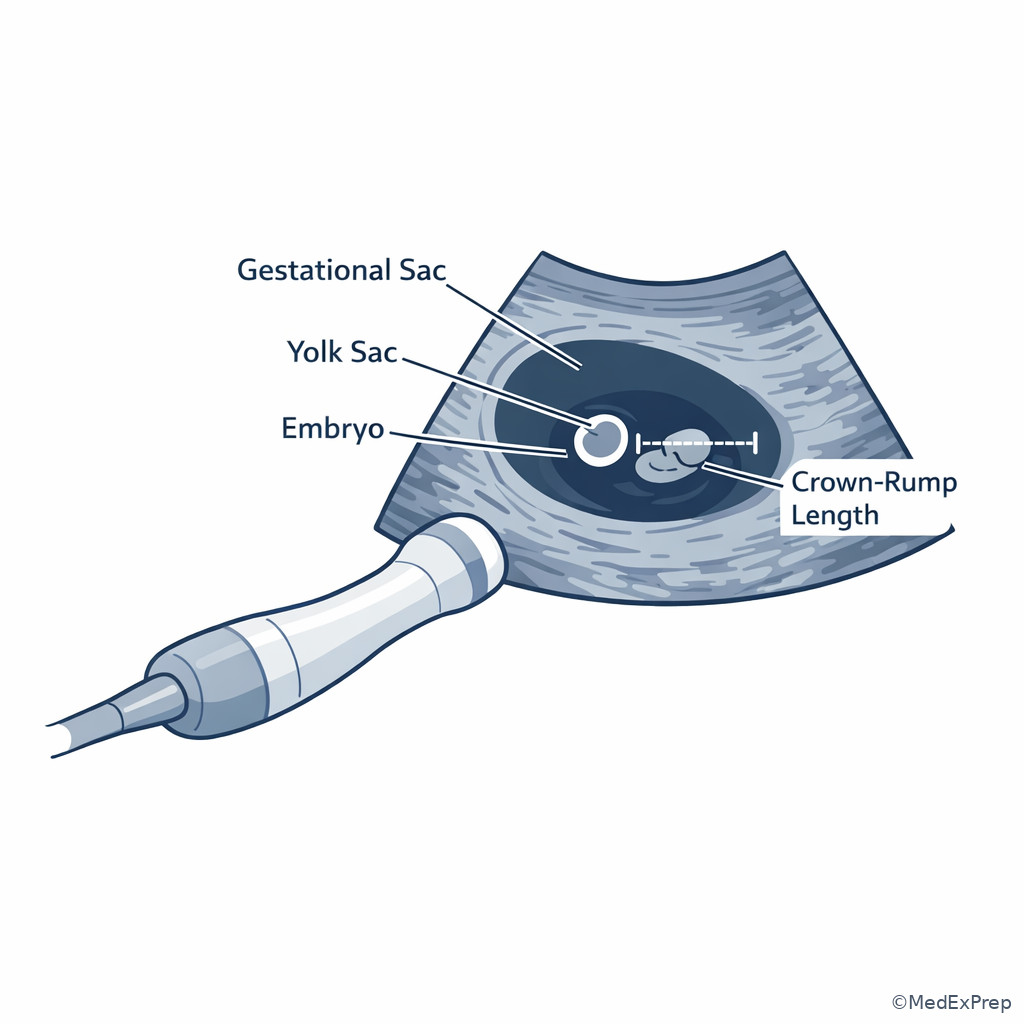
Core content
1.1.1.3 Foundational rule: What date should you trust first?
A Explanation
The decision conflict is simple but heavily tested: Should you date the pregnancy by LMP or by ultrasound? The single rule that resolves it is the reliability of the source, with first-trimester ultrasound as the most accurate standard when dates are uncertain or discrepant. A certain LMP can be used if the patient clearly recalls the first day, cycles are reasonably regular, and there is no conflicting early sonographic evidence. If cycles are irregular, recent hormonal contraception obscured bleeding patterns, postpartum menses were not established, breastfeeding altered ovulation, or the patient is unsure of timing, LMP becomes weaker.
WHY THIS IS TESTED: exams want you to choose the most accurate anchor for all later obstetric decisions. The board is not asking whether multiple dating methods exist; it is asking which one governs management today. See Fig 1.
In practice, there is a hierarchy. Known conception timing from assisted reproduction is highly precise. After that, first-trimester ultrasound using CRL is the strongest general method. Certain LMP is acceptable when it aligns with early ultrasound. The common wrong move is overvaluing a remembered menstrual date without checking whether the cycle pattern made that date meaningful.
Key rule: If LMP is uncertain or menstrual cycles are irregular, do not force LMP dating; use ultrasound-based dating, ideally from the earliest scan.
B Worked example
A 29-year-old G2P0010 presents for her first prenatal visit. She has obesity, polycystic ovary syndrome, and stopped combined oral contraceptives 2 months before conception. She reports vaginal spotting 7 weeks ago and thinks that was her last period. She also notes nausea and breast tenderness. Transvaginal ultrasound today shows a single live intrauterine pregnancy with CRL consistent with 9 weeks 2 days. The task is to determine the best dating method.
Reasoning chain: Identify task: assign EDD. Extract key facts: PCOS with irregular ovulation risk, recent hormonal contraception, uncertain bleeding event, and a first-trimester ultrasound with CRL. Apply rule: uncertain LMP plus irregular cycles means do not trust the menstrual date. Eliminate distractors: breast tenderness and nausea confirm pregnancy symptoms but do not improve date reliability; spotting can be implantation or breakthrough bleeding and is a tempting false LMP anchor. Verify: use the CRL-based EDD.
C Exam trap
Common wrong answer: Date by the reported LMP because the patient remembers a specific bleeding date.
Why it is tempting: Board takers often equate “patient recalls a date” with “certain LMP.”
Single clue that eliminates it: Irregular ovulation risk or abnormal bleeding pattern means that remembered bleeding may not represent a true ovulatory cycle start.
D Checkpoint
Question: A 24-year-old G1 presents with a positive pregnancy test. She is sure her LMP was 10 weeks ago, but she has cycles every 35 to 60 days after stopping depot medroxyprogesterone. Ultrasound shows CRL consistent with 8 weeks 5 days. What is the most appropriate dating method?
- Use the LMP because she remembers the exact date.
- Use the CRL-based ultrasound dating.
- Average the LMP and ultrasound estimates.
- Wait for the anatomy scan to assign the EDD.
Answer: B. A is tempting because recall seems precise, but the irregular cycles and recent depot use make LMP unreliable. B is correct because first-trimester CRL is the most accurate method when LMP is uncertain. C is tempting when clinicians want to “split the difference,” but averaging is not the dating rule. D is wrong because later scans are less accurate for dating than first-trimester CRL.
Clinician Action: Diagnose dating reliability by asking whether LMP is certain and cycle length is predictable. Order early ultrasound if dates are uncertain. Treat by assigning one best EDD source rather than averaging estimates. Refer/Escalate only if pregnancy viability or location is uncertain, not merely for routine dating.
1.1.1.4 First-trimester ultrasound: When should it override LMP?
A Explanation
This section asks a narrower question: Even if you have an LMP, when should ultrasound replace it? The resolving rule is the size-date discrepancy threshold, which depends on gestational age because earlier scans are more precise. In the first trimester, CRL dating is highly accurate. If the ultrasound date differs from LMP beyond accepted thresholds, revise the EDD to the ultrasound-based date. The exact discrepancy thresholds are less important than the principle for many board stems, but you should know the high-yield structure: small discrepancy thresholds early, wider thresholds later because later scans are less accurate for dating.
The first trimester is where dating is strongest because biologic variation in embryonic size is relatively narrow. This is why a patient who “should be 10 weeks” by uncertain LMP but measures 8 weeks 4 days on a quality CRL scan is usually redated rather than labeled abnormal on that basis alone. Conversely, once a well-dated early ultrasound exists, a later fetus measuring bigger or smaller does not trigger EDD revision; that raises questions about growth, diabetes, error, or constitution, not chronology.
WHY THIS IS TESTED: stems often give both LMP and CRL and ask for the most appropriate EDD, or they tempt you to update the due date based on a later anatomy or growth scan. See Fig 2.
Exam takeaway: Earlier discrepancy matters more, so first-trimester ultrasound should drive EDD revision when dates do not match.
flowchart LR
A[LMP-based estimate] --> B[Early ultrasound obtained]
B --> C{Timing of scan}
C -->|First trimester| D[Highest accuracy]
C -->|Second trimester| E[Moderate accuracy]
C -->|Third trimester| F[Lowest dating accuracy]
D --> G{Meaningful discrepancy?}
G -->|Yes| H[Redate to ultrasound EDD]
G -->|No| I[Keep original EDD]
E --> J[Use broader discrepancy thresholds]
F --> K[Avoid redating unless no earlier reliable data]
Memory anchor: “CRL comes first, late scans are for growth.” If you remember one dating sentence for the exam, make it this one.
B Worked example
A 37-year-old G3P1011 with chronic hypertension and migraine presents after a positive home pregnancy test. She reports a certain LMP suggesting 12 weeks 1 day and has 28-day cycles. She had one day of light spotting 4 weeks ago that worried her. Ultrasound today shows a viable singleton with CRL consistent with 10 weeks 5 days. The tempting wrong answer is to ignore the scan because the LMP seems certain.
Reasoning chain: Identify task: decide whether to revise the EDD. Extract key facts: first-trimester CRL, viable singleton, discrepancy greater than a small early threshold. Apply rule: when first-trimester discrepancy exceeds threshold, redated to ultrasound. Eliminate distractors: her regular cycles support LMP but do not overrule a sufficiently discordant early CRL; spotting is noise. Verify: assign EDD by ultrasound.
C Exam trap
Common wrong answer: Keep the LMP because the patient’s cycles are regular.
Why it is tempting: Regular cycles usually strengthen LMP reliability, so learners overapply that rule.
Single clue that eliminates it: A sufficiently discordant first-trimester CRL outranks even a seemingly reliable LMP.
D Checkpoint
Question: A patient with regular 28-day cycles has a certain LMP. At her first visit, transvaginal ultrasound in the first trimester shows a viable pregnancy several days smaller than expected beyond accepted discrepancy threshold. What is the best next step?
- Maintain the LMP-based EDD because cycles are regular.
- Revise the EDD to the ultrasound-based date.
- Repeat ultrasound in the third trimester before deciding.
- Use fundal height at the next visit to choose the final EDD.
Answer: B. A is tempting because regular cycles usually support LMP, but early CRL discrepancy beyond threshold overrides. B is correct because first-trimester ultrasound is most accurate for dating. C is wrong because third-trimester scans are less accurate for dating and should not be used to settle an early discrepancy. D is tempting in low-resource thinking, but fundal height is not a primary dating method.
- The most accurate routine dating measurement before 14 weeks is crown-rump length.
- True or False: A later growth scan should routinely replace a well-established early EDD. False.
- Name the three factors that weaken LMP reliability: uncertain date, irregular cycles, abnormal/recent hormone-related bleeding.
Clinician Action: Diagnose whether the discrepancy crosses a threshold meaningful enough to redated. Order a high-quality early ultrasound with CRL when possible. Treat by revising the EDD once if criteria are met. Refer/Escalate if discordance raises concern for nonviable pregnancy or structural abnormality rather than simple dating error.
High-Yield Connection: This concept is tested alongside Routine Prenatal Surveillance. Know both the dating rule and the timing windows for nuchal translucency, anatomy ultrasound, glucose screening, and postterm management; a wrong EDD cascades into wrong screening decisions.
1.1.1.5 Second- and third-trimester dating: When should you avoid changing the EDD?
A Explanation
The major decision conflict here is size versus time. In later pregnancy, fetal size reflects both gestational age and biologic growth variation. As a result, ultrasound becomes less precise for dating as pregnancy advances. Second-trimester biometry can still establish or revise dating if no earlier reliable study exists, but the acceptable discrepancy threshold is broader than in the first trimester. Third-trimester ultrasound is the least accurate for dating and is mainly useful for growth, presentation, placental assessment, and anatomy follow-up.
The single rule that resolves most board questions is: do not redated a well-dated pregnancy based on a later scan. If a patient had a reliable first-trimester CRL or solid early dating, and a 32-week scan measures 2 weeks small, think fetal growth restriction or constitution, not a new due date. If a fetus measures large late, think diabetes, macrosomia risk, or dating error only if no earlier reliable information exists.
WHY THIS IS TESTED: stems deliberately give a normal early dating scan, then present a later discrepancy to see whether you chase the due date instead of recognizing a growth issue. See Fig 3.
Exam takeaway: A later scan in a well-dated pregnancy should trigger growth interpretation, not routine EDD revision.
flowchart TD
A[Second or third trimester scan] --> B{Earlier reliable dating exists?}
B -->|Yes| C[Keep original EDD]
C --> D{Fetus small or large?}
D -->|Small| E[Assess growth restriction, placenta, fluid, Doppler as indicated]
D -->|Large| F[Assess diabetes/macrosomia risk]
B -->|No| G[Use available biometry to assign best possible EDD]
G --> H[Document that dating is less precise if late] Exam takeaway: Biparietal diameter, head circumference, abdominal circumference, and femur length support dating when no earlier reliable study exists.
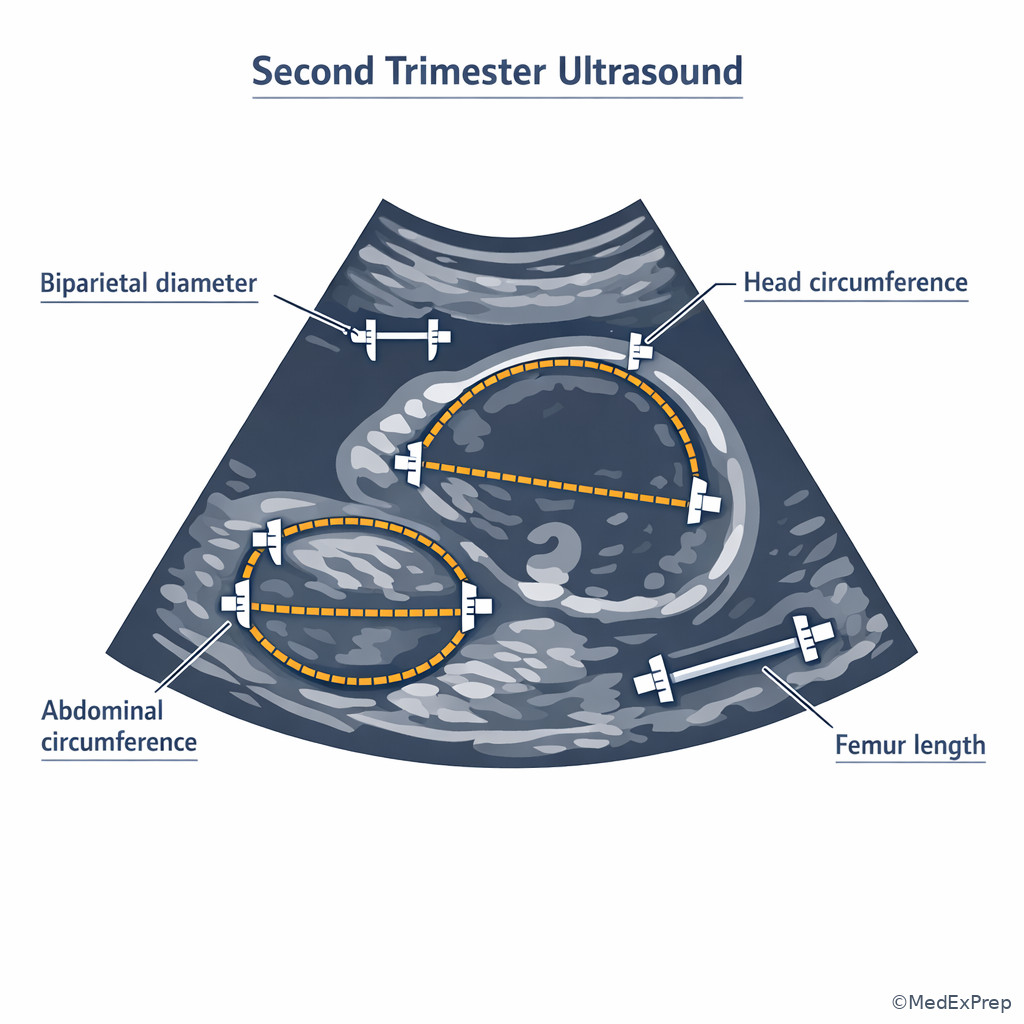
B Worked example
A 32-year-old G4P2012 with chronic hypertension and tobacco use had a first-trimester ultrasound that established her EDD. At 31 weeks, ultrasound estimates fetal size at the 8th percentile, with abdominal circumference lagging by 2 weeks. Amniotic fluid is low-normal. Her glucose testing was normal. The tempting wrong answer is to change the due date later to make the fetus “appropriately grown.”
Reasoning chain: Identify task: interpret the size-date discrepancy. Extract key facts: already well-dated pregnancy, third-trimester scan, growth lag, maternal vascular risk factors. Apply rule: late scans do not reset a reliable EDD. Eliminate distractors: normal glucose does not explain the small size; the size lag itself is not permission to redated. Verify: keep the EDD and evaluate for fetal growth restriction.
C Exam trap
Common wrong answer: Move the due date later because the fetus measures small in the third trimester.
Why it is tempting: Learners assume any size-date mismatch reflects incorrect dating.
Single clue that eliminates it: The pregnancy was already dated reliably in the first trimester, so late size differences point to growth biology, not clock error.
D Checkpoint
Question: A patient had a documented first-trimester CRL-based EDD. At 34 weeks, ultrasound biometry is 2 weeks behind. What is the most appropriate interpretation?
- Change the EDD to match the current biometric estimate.
- Maintain the EDD and evaluate fetal growth.
- Switch back to the original LMP if it differs less than the current scan.
- Disregard the scan because third-trimester ultrasound has no clinical value.
Answer: B. A is tempting because matching size to date feels tidy, but this ignores the loss of late dating precision. B is correct because the earlier CRL locked the chronology; the current finding is a growth question. C is wrong because once the EDD is assigned appropriately, you do not toggle among methods. D is wrong because late ultrasound is clinically valuable for growth and fluid assessment even though it is poor for dating.
Clinician Action: Diagnose whether the issue is dating uncertainty or abnormal growth. Order growth evaluation tools if a well-dated pregnancy measures small or large. Treat the late scan as a growth management problem, not a chronology reset. Refer/Escalate for maternal-fetal medicine input if significant growth restriction, abnormal Dopplers, or complex fetal findings emerge.
1.1.1.6 Assisted reproduction, uncertain dates, and suboptimally dated pregnancy
A Explanation
Now the decision conflict is not LMP versus ultrasound alone, but what to do when the pregnancy timeline is either exceptionally precise or frustratingly vague. Assisted reproduction gives known chronology: embryo transfer date or insemination timing can be used to assign EDD accurately. On the other end, a patient presenting late without an earlier ultrasound creates a suboptimally dated pregnancy. This is defined as no ultrasound confirming or revising the EDD before 22 0/7 weeks.
Why does this matter? Because timing-sensitive decisions become less certain: antenatal corticosteroid timing, postterm induction labeling, and even interpretation of “size less than dates” become harder. In a suboptimally dated pregnancy, you still assign the best EDD using the earliest available ultrasound, but you document that precision is limited and avoid casual assumptions about exact gestational age. This is a classic exam safety concept: best possible estimate, clearly documented, without false precision. See Fig 4.
WHY THIS IS TESTED: board stems may ask whether a patient is truly postterm, whether induction for “41 weeks” is justified, or whether additional follow-up is needed when no early dating exists. The key is recognizing the suboptimally dated label and managing carefully.
Exam takeaway: If no dating ultrasound exists before 22 weeks, manage with the best estimate while acknowledging reduced precision.
flowchart TD
A[Pregnant patient presents late to care] --> B{Ultrasound before 22 weeks available?}
B -->|Yes| C[Use earliest reliable study to assign EDD]
B -->|No| D[Suboptimally dated pregnancy]
D --> E[Use earliest available ultrasound now]
E --> F[Document uncertainty]
F --> G[Use caution with postterm labeling and timing-based interventions] Exam takeaway: Known embryo transfer timing provides highly accurate pregnancy dating and should anchor the EDD.
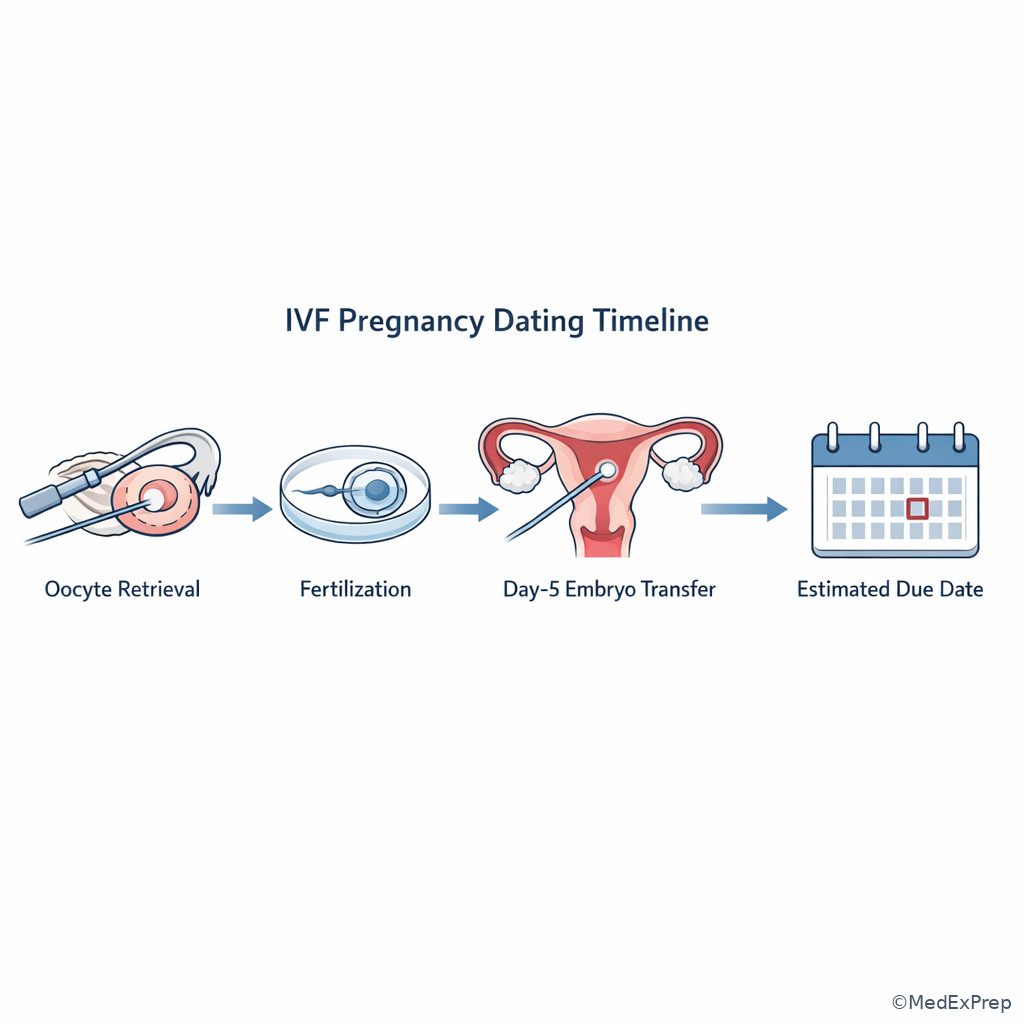
Key rule: “Suboptimally dated” does not mean “undated.” It means the best available estimate exists, but precision is lower because no confirming or revising ultrasound was done before 22 weeks.
B Worked example
A 41-year-old G5P3013 with obesity and limited prenatal care presents for the first time, reporting an LMP “about 7 months ago.” She has a history of irregular menses and is unsure whether she conceived spontaneously or shortly after a failed infertility cycle. Ultrasound suggests 30 weeks. Blood pressure is normal; fundal height appears 2 cm less than expected. The board-style task is not to achieve impossible precision but to identify the correct classification and next step.
Reasoning chain: Identify task: assign dating status. Extract key facts: no ultrasound before 22 weeks, uncertain LMP, irregular cycles, late presentation. Apply rule: this is a suboptimally dated pregnancy. Eliminate distractors: fundal height is too imprecise to solve chronology, and the failed infertility cycle does not provide a known conception date unless actual ART timing is documented. Verify: use the earliest available ultrasound as the best estimate and document reduced dating certainty.
C Exam trap
Common wrong answer: State the pregnancy is exactly 30 weeks and treat all future timing decisions as fully precise.
Why it is tempting: Learners confuse “best available estimate” with “gold-standard certainty.”
Single clue that eliminates it: No confirming or revising ultrasound occurred before 22 weeks, so the pregnancy is suboptimally dated by definition.
D Checkpoint
Question: Which patient should be classified as having a suboptimally dated pregnancy?
- A patient with IVF conception and documented embryo transfer date.
- A patient with certain LMP and a concordant 9-week CRL ultrasound.
- A patient first seen at 27 weeks with no prior ultrasound and uncertain LMP.
- A patient with a 13-week ultrasound that confirmed dates.
Answer: C. A is tempting because ART seems complicated, but known conception timing is actually highly precise. B is wrong because early concordant dating is ideal. C is correct because no ultrasound was obtained before 22 weeks and LMP is uncertain. D is wrong because a pre-22-week confirming ultrasound prevents the suboptimally dated designation.
- True or False: ART pregnancies are often the least accurate to date because cycles are manipulated. False.
- A pregnancy without confirming or revising ultrasound before 22 0/7 weeks is suboptimally dated.
- The best phrase for late-entry dating is: best available estimate without false precision.
High-Yield Connection: This concept overlaps with postterm pregnancy management and fetal growth restriction later in the course. On exam day, know when a dating problem changes the confidence of those later diagnoses.
Clinician Action: Diagnose whether the chronology is precise, approximate, or suboptimal. Order the earliest possible ultrasound if patient presents with uncertain dates. Treat by using the best estimate and avoiding repeated casual redating. Refer/Escalate if late entry to care also raises issues of growth, anomalies, or high-risk maternal disease.
1.1.1.7 Using pregnancy dates in real management decisions
A Explanation
The final integration step is this: What does accurate dating actually change? On the board exam, it changes almost everything. Screening windows depend on gestational age. A first-trimester nuchal translucency study is only useful in the proper interval. Anatomy ultrasound is targeted to the mid-trimester window. Glucose screening, GBS collection, antenatal surveillance in selected conditions, and postterm induction all depend on the assigned EDD. The resolving rule is that once the best EDD is established, all future timing decisions are referenced to that date.
This means a due date is not clerical trivia. It is a management instrument. If the EDD is wrong by 10 to 14 days, you can mislabel a pregnancy postterm, deliver before actual term, or miss the correct timing of screening. That is why dating is foundational in obstetrics and why it precedes the next lessons on physiologic adaptation and prenatal surveillance. See Fig 5 and Fig 6.
WHY THIS IS TESTED: many stems are not “about dating” on the surface. They are about a screening test “done too early,” a growth scan interpreted incorrectly, or an induction question that depends on whether the pregnancy is truly 41 weeks.
Exam takeaway: Accurate EDD assignment determines the correct windows for screening, surveillance, and delivery planning.
flowchart LR
A[Assign EDD] --> B[First-trimester screening window]
B --> C[Anatomy ultrasound window]
C --> D[Glucose screening period]
D --> E[GBS screening window]
E --> F[Antenatal testing or delivery timing as indicated]
F --> G[Postterm management if truly beyond due date]
Exam takeaway: The due date is a management timeline, not just a chart field.
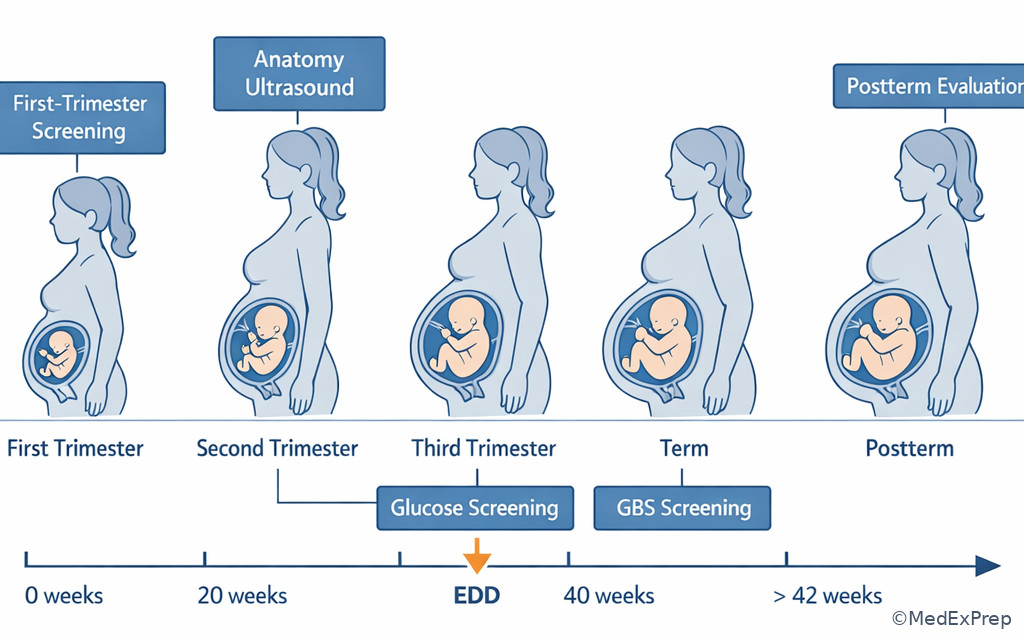
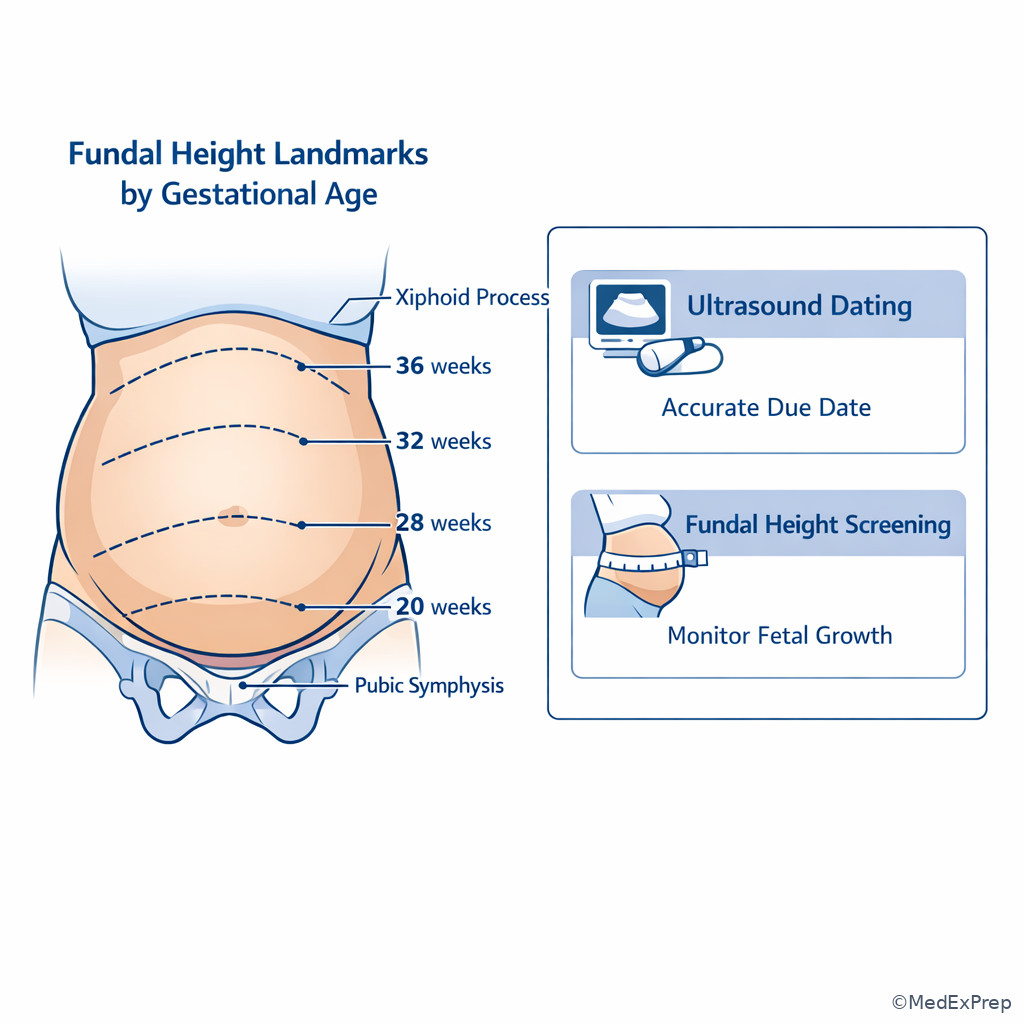
Exam takeaway: Fundal height helps screen growth trends but should not replace high-quality dating methods.
B Worked example
A 35-year-old G2P1001 with chronic hypertension and prior cesarean delivery presents for transfer of care at a new practice. Her chart lists two different due dates: one from LMP and one from a 9-week ultrasound. A current note proposes induction for “41 weeks” next week based on LMP. She also has a normal anatomy scan and normal fetal growth. The distracting clue is her complaint of pelvic pressure, which may tempt urgency.
Reasoning chain: Identify task: determine which date should guide delivery timing. Extract key facts: prior 9-week ultrasound exists, which is highly accurate; competing chart dates; current late symptoms are nonspecific. Apply rule: early CRL-based EDD should anchor management. Eliminate distractors: pelvic pressure does not redefine gestational age; a normal anatomy scan does not create a new EDD; LMP loses when discordant with early reliable ultrasound. Verify: use the 9-week ultrasound EDD and reassess whether induction is actually indicated.
C Exam trap
Common wrong answer: Proceed with induction because the chart says 41 weeks somewhere.
Why it is tempting: Learners may prioritize the highest gestational age listed, thinking it is safest.
Single clue that eliminates it: Timing-sensitive decisions must follow the assigned EDD derived from the strongest dating source, not the most alarming calendar entry.
D Checkpoint
Question: A patient has an established EDD from a 10-week CRL ultrasound. Which decision should be based on that date?
- The timing of anatomy ultrasound and later postterm management.
- Only the patient’s maternity leave paperwork.
- Only whether fetal heart tones should be checked in clinic.
- Only whether fundal height should be measured after 20 weeks.
Answer: A. A is correct because the assigned EDD governs major prenatal timing decisions. B is tempting because due dates are commonly discussed administratively, but the board tests clinical timing. C and D are too narrow; routine prenatal assessments still matter, but the EDD specifically anchors screening and management windows.
Memory anchor: DATE = Document one EDD, Anchor all testing to it, Trust the earliest reliable study, Evaluate growth later without redating.
Clinician Action: Diagnose whether all charted dates agree with the assigned EDD. Order time-sensitive testing according to the established gestational calendar. Treat discordant chart dates as a documentation safety issue. Refer/Escalate if uncertain dating affects high-risk management, delivery timing, or consultant recommendations.
Exam Traps & Differentiators
Most common wrong answer and why: Redating a well-dated pregnancy using a later ultrasound. It is tempting because late fetal size appears objective. The flaw is that late size increasingly reflects growth variation, not precise age.
Common traps & distractors: (1) A remembered spotting episode is not automatically a valid LMP. (2) Regular cycles help, but they do not overrule a sufficiently discordant first-trimester CRL. (3) A third-trimester small fetus in a well-dated pregnancy suggests growth restriction, not a new due date. (4) “Suboptimally dated” means lower precision, not absence of all dating information.
| Stem says... | Think... | Do not think... |
|---|---|---|
| Uncertain LMP, irregular cycles, early scan available | Use ultrasound dating | Use the remembered bleeding date because it is specific |
| Certain LMP but first-trimester CRL differs beyond threshold | Redate to ultrasound | Keep LMP because cycles are regular |
| Well-dated pregnancy measures small at 32 weeks | Evaluate growth | Move the due date later |
| No ultrasound before 22 weeks | Suboptimally dated pregnancy | Exact gestational precision is available |
| IVF embryo transfer documented | Use ART dating | Treat manipulated cycles as unreliable dating only |
| Looks similar but isn't | Shared features | Single discriminator | Correct board move |
|---|---|---|---|
| Incorrect late dating vs fetal growth restriction | Size less than expected | Reliable early dating already exists | Keep EDD; assess growth |
| Certain LMP vs uncertain LMP | Patient recalls bleeding date | Cycle regularity and confidence in true menses | Use LMP only if truly reliable |
| Suboptimally dated pregnancy vs no dating information | Late prenatal entry | Earliest available ultrasound still gives best estimate | Assign best EDD but document reduced precision |
| Late discrepancy due to dating error vs diabetes/macrosomia | Fetus measures large | Earlier dating quality and maternal metabolic history | Interpret growth context before changing dates |
If the stem says...
- “Irregular menses” → think ultrasound over LMP.
- “CRL in the first trimester” → think highest routine dating accuracy.
- “Prior early ultrasound established EDD” → think do not redated later.
- “No ultrasound before 22 weeks” → think suboptimally dated pregnancy.
- “Embryo transfer date known” → think conception timing is the dating anchor.
Related topic trap: In the upcoming lesson on Routine Prenatal Surveillance, timing windows will be tested. A wrong EDD can make a correct screening test appear wrong or vice versa. The trap is not the screening test itself; it is the mistaken gestational calendar underneath it.
Tables
| Dating source | Typical use | Strength | Board pearl |
|---|---|---|---|
| Known ART or conception timing | IVF or clearly documented conception | Very high precision | Use when available; do not replace casually |
| First-trimester CRL ultrasound | Routine most accurate dating | Highest routine ultrasound accuracy | Best general method when dates are uncertain |
| Certain LMP with regular cycles | Initial estimate or concordant dating | Good if history is reliable | Can be used, but early discordant ultrasound may override |
| Second-trimester biometry | Dating when no earlier scan exists | Moderate accuracy | Accept broader thresholds for redating |
| Third-trimester biometry | Growth and interval assessment | Lowest dating accuracy | Avoid routine EDD changes if early dating exists |
| Fundal height | Growth screening after 20 weeks | Low dating precision | Not a primary dating tool |
| Reliable dating feature | Choose | Reject |
|---|---|---|
| Patient sure of LMP and cycles are regular | Use LMP initially and compare with early ultrasound | Assuming every recalled bleed is a true menses |
| Irregular cycles or recent hormonal contraception | Favor ultrasound | Trusting LMP as if ovulation were predictable |
| First-trimester CRL discordant with LMP beyond threshold | Redate to ultrasound | Keeping LMP for convenience |
| Late scan in well-dated pregnancy | Interpret growth | Changing EDD |
| No scan before 22 weeks | Classify as suboptimally dated | Pretending late dating is exact |
| Dating problem | Most likely issue | Key clue | Best next step |
|---|---|---|---|
| LMP and early CRL do not match | Incorrect menstrual dating | First-trimester discrepancy beyond threshold | Use ultrasound EDD |
| 32-week fetus measures small with prior early dating | Growth abnormality, not date shift | Reliable prior EDD already assigned | Growth evaluation |
| Patient enters care at 28 weeks, uncertain dates | Suboptimally dated pregnancy | No ultrasound before 22 weeks | Use best available ultrasound and document uncertainty |
| IVF pregnancy with known transfer date | Precisely dated pregnancy | Documented embryo transfer timing | Anchor EDD to ART chronology |
| Large fetus on third-trimester scan, early dating known | Growth issue or diabetes consideration | Late scan in already dated pregnancy | Keep EDD and evaluate growth context |
Algorithm / Approach
Rapid Review
- First-trimester CRL → most accurate routine ultrasound dating method.
- Certain LMP → useful only if bleeding truly represents menses and cycles are regular.
- Irregular cycles → weaken LMP reliability even when a date is remembered.
- Known embryo transfer → more precise than guessed ovulation timing.
- Later ultrasound in well-dated pregnancy → growth question, not chronology reset.
- Third-trimester biometry → least accurate for assigning EDD.
- Suboptimally dated pregnancy → no confirming or revising ultrasound before 22 0/7 weeks.
- Discordant early CRL and LMP → ultrasound can replace LMP if discrepancy threshold is met.
- Fundal height → screening tool for growth trend, not primary dating tool.
- Chart with two EDDs → follow the one based on the strongest dating source.
- Postterm label → only meaningful if dating is reliable.
- Screening windows → only as accurate as the EDD behind them.
Self-check quiz
1. A 26-year-old G1 presents at her first prenatal visit with nausea and a positive home pregnancy test. She has regular 28-day cycles and a certain LMP, but the practice wants the most accurate routine ultrasound method to confirm or revise gestational age in the first trimester. Which measurement is most appropriate?
- Crown-rump length
- Biparietal diameter
- Abdominal circumference
- Femur length
2. A 31-year-old G2P1 conceived by IVF after male factor infertility. She has hypothyroidism and mild asthma. Her outside records include a documented day-5 embryo transfer date and an uncertain recalled LMP because she bled during hormone treatment. Which dating source should most appropriately anchor the EDD?
- Last menstrual period
- Fundal height at 20 weeks
- Documented embryo transfer timing
- Third-trimester estimated fetal weight
3. A 28-year-old G1 with obesity and PCOS presents with uncertain LMP and cycles ranging from 35 to 70 days. She stopped oral contraceptives 3 months ago. Transvaginal ultrasound shows a viable singleton with CRL dating 8 weeks 6 days. What is the most appropriate next step?
- Assign the EDD from the CRL ultrasound
- Use the reported LMP because she remembers the month
- Average the LMP-based and ultrasound-based dates
- Wait for the anatomy scan to determine the final EDD
4. A 34-year-old G3P1011 with chronic hypertension has a certain LMP suggesting 11 weeks 5 days. She has regular cycles and no fertility treatment. First-trimester ultrasound shows a viable pregnancy with CRL corresponding to 10 weeks 1 day, differing beyond the accepted early discrepancy threshold. What is the best next step?
- Keep the LMP-based EDD because her cycles are regular
- Revise the EDD to the ultrasound-based date
- Obtain serial beta-hCG levels before assigning the EDD
- Use the larger gestational age to avoid missing postterm pregnancy
5. A 25-year-old G2P1 had a first-trimester CRL ultrasound that established the EDD. At 32 weeks, she is found to have fetal biometry 2 weeks behind with normal glucose testing and mild chronic hypertension. What is the most appropriate interpretation?
- The EDD should be moved later to match the new biometry
- The original EDD should be maintained and fetal growth assessed
- The LMP should replace the ultrasound because it may now fit better
- The discrepancy is clinically irrelevant because late ultrasound is useless
6. A 39-year-old G4P2012 presents at 29 weeks by outside ultrasound. She has obesity, tobacco use, and limited prior care. She is unsure of her LMP and had no ultrasound before this visit. The current scan suggests 29 weeks 4 days. Which statement best guides management?
- This is a well-dated pregnancy because ultrasound gives an exact gestational age at any trimester
- This is suboptimally dated because no confirming or revising ultrasound was obtained before 22 weeks
- This pregnancy cannot be dated at all until delivery confirms maturity
- The due date should be based on fundal height because late ultrasound is too inaccurate to use in any way
7. A 33-year-old G2P1001 with type 2 diabetes and prior cesarean delivery transfers care at what her chart lists as 40 weeks 6 days by LMP. A 9-week ultrasound in the records assigned an EDD 9 days later than the LMP-based EDD. Current fetal testing is reassuring, and estimated fetal weight is large for gestational age. What is the most appropriate next step before labeling this pregnancy postterm?
- Use the LMP because it gives the earlier and safer date
- Use the 9-week ultrasound-based EDD to determine whether she is truly postterm
- Use the current estimated fetal weight to recalculate the due date
- Average the charted EDDs to reduce error
8. A 30-year-old G1 conceived spontaneously after recent lactational amenorrhea. She has a history of irregular cycles, one episode of spotting 11 weeks ago, and no chronic disease except controlled epilepsy on levetiracetam. Ultrasound today shows a viable singleton at 9 weeks 0 days by CRL. Which option most requires immediate clarification before using the charted date for prenatal screening windows?
- Whether the patient had nausea beginning 2 weeks ago
- Whether the spotting episode was incorrectly entered as the LMP
- Whether she prefers a spontaneous vaginal delivery
- Whether her partner knows the pregnancy test result
Answer key
1.1.1.8 1. Question 1
Correct answer: A. Crown-rump length
Mechanism-to-management: In the first trimester, embryonic size varies least, so CRL provides the most accurate routine sonographic dating and is the preferred method to confirm or revise gestational age. This dating then anchors screening and management timing. Sources: ACOG Committee Opinion on methods for estimating the due date; Cunningham et al., Williams Obstetrics.
- A. Crown-rump length: Tempting because it is the classic early pregnancy measurement; correct because first-trimester CRL is the highest-yield routine dating method. Single clue: “first trimester.”
- B. Biparietal diameter: Tempting because it is an obstetric biometric measurement; incorrect here because it is more useful later and is less accurate than CRL early in pregnancy. Single clue: early gestation.
- C. Abdominal circumference: Tempting because it is used in fetal biometry; incorrect because it is mainly used in growth assessment and later composite dating, not best first-trimester dating. Single clue: the question asks for the most accurate early routine method.
- D. Femur length: Tempting because it is another standard biometric parameter; incorrect because it is not the preferred first-trimester dating measurement. Single clue: first-trimester context.
1.1.1.9 2. Question 2
Correct answer: C. Documented embryo transfer timing
Mechanism-to-management: Assisted reproductive technology provides known conception chronology, making it highly precise for EDD assignment. Hormone-associated bleeding during IVF cycles makes LMP especially unreliable. Sources: ACOG methods for estimating due date; Williams Obstetrics.
- A. Last menstrual period: Tempting because LMP is commonly used in spontaneous conceptions; incorrect because hormonal bleeding in IVF cycles may not reflect true ovulatory timing. Single clue: documented day-5 embryo transfer.
- B. Fundal height at 20 weeks: Tempting as a simple clinic tool; incorrect because fundal height screens growth and is not a primary dating source. Single clue: the question asks what should anchor the EDD.
- C. Documented embryo transfer timing: Tempting and correct because it provides known pregnancy chronology and should govern dating. Single clue: IVF with transfer date documented.
- D. Third-trimester estimated fetal weight: Tempting because ultrasound sounds objective; incorrect because late fetal size is poor for precise dating. Single clue: later pregnancy measurements lose dating precision.
1.1.1.10 3. Question 3
Correct answer: A. Assign the EDD from the CRL ultrasound
Mechanism-to-management: PCOS and recent contraceptive use make ovulation timing unpredictable, so uncertain LMP should not drive dating. A viable first-trimester CRL provides the best basis for EDD assignment. Sources: ACOG; Cunningham et al.
- A. Assign the EDD from the CRL ultrasound: Tempting because it uses objective imaging; correct because irregular cycles make LMP unreliable and CRL is best early dating. Single clue: cycles ranging from 35 to 70 days.
- B. Use the reported LMP because she remembers the month: Tempting because any menstrual history feels useful; incorrect because remembering the month is not the same as having a certain, reliable LMP. Single clue: uncertain LMP with highly irregular cycles.
- C. Average the LMP-based and ultrasound-based dates: Tempting as a compromise; incorrect because averaging is not the accepted dating rule. Single clue: board questions reward choosing the strongest source, not averaging sources.
- D. Wait for the anatomy scan to determine the final EDD: Tempting because more data feels safer; incorrect because later scans are less accurate for dating than a first-trimester CRL. Single clue: viable 8-week 6-day CRL is already available.
1.1.1.11 4. Question 4
Correct answer: B. Revise the EDD to the ultrasound-based date
Mechanism-to-management: Even with a certain LMP and regular cycles, a first-trimester CRL that differs beyond the accepted discrepancy threshold should replace the menstrual estimate because early ultrasound is more accurate. Sources: ACOG Committee Opinion; Williams Obstetrics.
- A. Keep the LMP-based EDD because her cycles are regular: Tempting because regular cycles usually increase LMP reliability; incorrect because sufficiently discordant early CRL outranks LMP. Single clue: “differing beyond the accepted early discrepancy threshold.”
- B. Revise the EDD to the ultrasound-based date: Tempting and correct because this is the standard response to meaningful first-trimester discordance. Single clue: first-trimester CRL discrepancy beyond threshold.
- C. Obtain serial beta-hCG levels before assigning the EDD: Tempting because hCG is used in early pregnancy evaluation; incorrect because a viable ultrasound with CRL already provides superior dating information. Single clue: viable intrauterine pregnancy already visualized.
- D. Use the larger gestational age to avoid missing postterm pregnancy: Tempting as a safety argument; incorrect because dating should follow accuracy, not fear of future late-term management. Single clue: EDD is assigned by the strongest method, not the most conservative calendar estimate.
1.1.1.12 5. Question 5
Correct answer: B. The original EDD should be maintained and fetal growth assessed
Mechanism-to-management: A pregnancy already dated by first-trimester CRL should not be redated based on later size differences. Third-trimester discrepancy in a well-dated pregnancy points to growth biology, placental function, or constitution rather than chronology. Sources: ACOG; Williams Obstetrics.
- A. The EDD should be moved later to match the new biometry: Tempting because it normalizes the size-date mismatch; incorrect because late biometry is not used to redated a well-dated pregnancy. Single clue: first-trimester CRL already established the EDD.
- B. The original EDD should be maintained and fetal growth assessed: Tempting and correct because the management issue is growth, not dating. Single clue: later scan at 32 weeks with prior early dating.
- C. The LMP should replace the ultrasound because it may now fit better: Tempting because it seems to align with current size; incorrect because you do not toggle among dating methods once a reliable EDD is assigned. Single clue: established early CRL-based dating.
- D. The discrepancy is clinically irrelevant because late ultrasound is useless: Tempting because third-trimester dating is poor; incorrect because late ultrasound remains highly useful for growth and fluid assessment. Single clue: poor for dating does not mean useless overall.
1.1.1.13 6. Question 6
Correct answer: B. This is suboptimally dated because no confirming or revising ultrasound was obtained before 22 weeks
Mechanism-to-management: A pregnancy without ultrasound confirmation or revision of the EDD before 22 0/7 weeks is suboptimally dated. The clinician should still use the earliest available ultrasound as the best estimate but acknowledge reduced precision for timing-based decisions. Sources: ACOG Committee Opinion on methods for estimating due date.
- A. This is a well-dated pregnancy because ultrasound gives an exact gestational age at any trimester: Tempting because ultrasound appears objective; incorrect because dating accuracy declines with advancing gestation. Single clue: first ultrasound is at 29 weeks.
- B. This is suboptimally dated because no confirming or revising ultrasound was obtained before 22 weeks: Tempting and correct because this matches the formal definition. Single clue: “no ultrasound before this visit.”
- C. This pregnancy cannot be dated at all until delivery confirms maturity: Tempting due to the uncertainty; incorrect because late ultrasound still provides a best estimate, just not precise early-level dating. Single clue: suboptimal dating is not zero dating.
- D. The due date should be based on fundal height because late ultrasound is too inaccurate to use in any way: Tempting if one overreacts to the limitations of late ultrasound; incorrect because fundal height is less precise than sonographic biometry. Single clue: ultrasound remains the best available estimate even when late.
1.1.1.14 7. Question 7
Correct answer: B. Use the 9-week ultrasound-based EDD to determine whether she is truly postterm
Mechanism-to-management: A 9-week ultrasound is a highly accurate dating study and should govern later timing decisions, including postterm labeling and delivery planning. Choosing the earlier LMP because it seems safer is a common but incorrect exam trap. Sources: ACOG dating guidance; Cunningham et al.
- A. Use the LMP because it gives the earlier and safer date: Tempting because delayed delivery can feel risky in diabetes; incorrect because timing decisions must follow the most accurate assigned EDD, not the earliest possible date. Single clue: a 9-week ultrasound assigned a different EDD.
- B. Use the 9-week ultrasound-based EDD to determine whether she is truly postterm: Tempting and correct because early ultrasound is the strongest routine dating anchor. Single clue: “9-week ultrasound in the records.”
- C. Use the current estimated fetal weight to recalculate the due date: Tempting because the fetus is large for gestational age; incorrect because late size reflects growth and diabetes effects, not reliable chronology. Single clue: type 2 diabetes and large fetus.
- D. Average the charted EDDs to reduce error: Tempting as a compromise; incorrect because averaging is not a guideline-supported dating strategy. Single clue: board approach is source hierarchy, not mathematical blending.
1.1.1.15 8. Question 8
Correct answer: B. Whether the spotting episode was incorrectly entered as the LMP
Mechanism-to-management: In a patient with lactational amenorrhea, irregular cycles, and one spotting episode, the biggest dating hazard is mistaking nonmenstrual bleeding for a true LMP. The current 9-week CRL likely provides the better dating anchor, but clarifying the charting error is essential because screening windows often autopopulate from the wrong date. Sources: ACOG methods for estimating due date; Williams Obstetrics.
- A. Whether the patient had nausea beginning 2 weeks ago: Tempting because symptoms seem time-linked; incorrect because nausea onset is too variable to assign gestational age reliably. Single clue: symptoms do not date pregnancy accurately.
- B. Whether the spotting episode was incorrectly entered as the LMP: Tempting and correct because this is the highest-risk dating error in the stem and directly affects prenatal timeline decisions. Single clue: recent lactational amenorrhea with irregular cycles and one spotting episode.
- C. Whether she prefers a spontaneous vaginal delivery: Tempting as an important counseling issue; incorrect because it does not determine screening windows. Single clue: question asks what requires immediate clarification for timing.
- D. Whether her partner knows the pregnancy test result: Tempting as a psychosocial concern; incorrect because it does not affect gestational age assignment. Single clue: not a dating determinant.
Keep going with the full ABOG OB/GYN Prep Course (ABOG)
You just studied the way members do, in the same lesson interface. Full access unlocks every lesson, the question bank and flashcards for a full year.
One payment · 1 year of access · No auto-renewal