1.1.1 - Atomic Structure And Nuclides
Atomic Structure And Nuclides
What you'll learn
- DOMAIN: Physics/Instrumentation → Atomic fundamentals → determine how protons, neutrons, and electrons define an element and a nuclide.
- DOMAIN: Physics/Instrumentation → Nuclear notation → read and write standard nuclide symbols and infer charge, atomic number, and mass number.
- DOMAIN: Physics/Instrumentation → Nuclide classification → distinguish isotopes, isotones, isobars, and nuclear isomers in exam stems.
- DOMAIN: Radiopharmacy principles → Radionuclide identity → connect nuclide structure to later tracer selection and decay behavior.
- DOMAIN: Quantitative reasoning → Foundational setup → prepare for later half-life, activity, and photon-interaction problems by mastering atomic bookkeeping.
- Physics and instrumentation → Atomic and radiation basics → Atomic structure, elemental identity, nuclear notation
- Physics and instrumentation → Foundational quantitative reasoning → Particle counts, charge logic, nuclide relationships
- Radiopharmacy principles → Tracer identity fundamentals → Stable versus radioactive nuclides, metastable states
- Weighting: Official ABNM percentage not publicly specified; treat as unspecified.
Why it matters
- Nuclear medicine questions often hide a simple atomic-structure rule inside a more complex tracer, decay, or instrumentation problem.
- If you cannot identify what changes when proton number versus neutron number changes, later questions on decay mode, daughter products, and radionuclide selection become error-prone.
- Many ABNM-style distractors rely on confusion between element identity and nuclide identity; one particle count resolves the conflict.
- This topic is the platform for the next two nearby topics: decay/half-life and photon-matter interactions. See Fig 1 for the map of how these ideas connect.
Exam takeaway: Separate element identity, nuclide identity, and decay behavior before choosing an answer.
flowchart TD
A[Count protons] --> B[Determine element]
B --> C[Add neutrons]
C --> D[Determine nuclide and mass number]
D --> E[Compare related nuclides]
E --> F[Predict later decay questions]
F --> G[Apply to tracer and imaging physics]
Exam takeaway: Protons define the element, neutrons modify the nuclide, and electrons determine charge state.
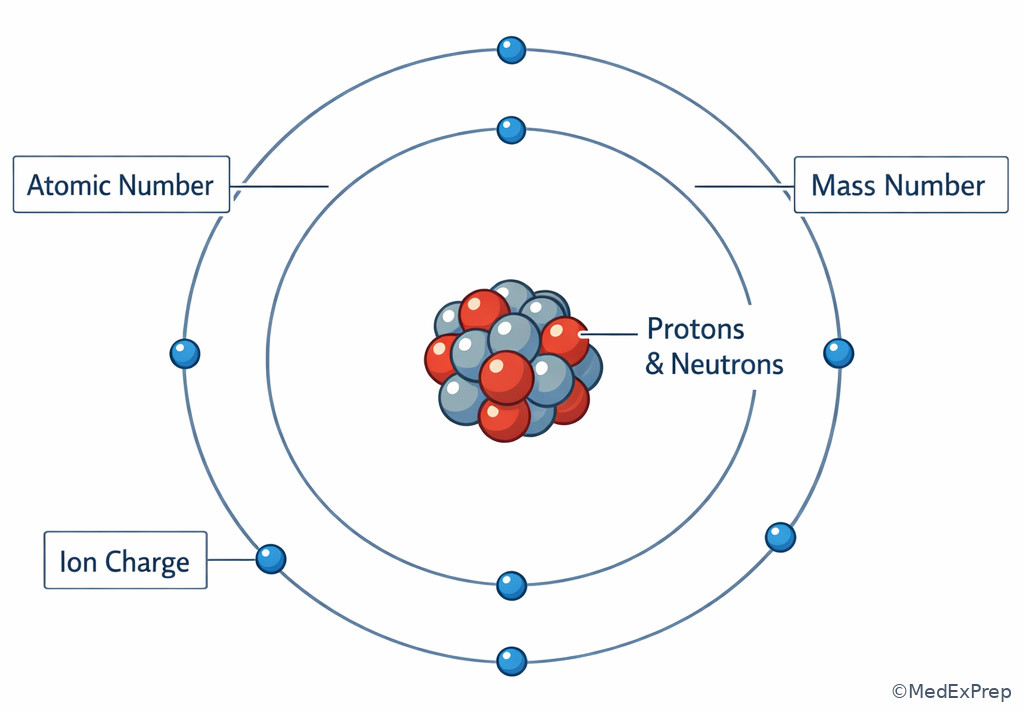
Key Terms & Must-Know Facts
1.1.1.1 Key terms
- Atom: Smallest unit of an element retaining chemical identity.
- Nucleus: Central core containing protons and neutrons.
- Proton: Positively charged nucleon; determines element.
- Neutron: Neutral nucleon; changes nuclide and nuclear stability.
- Electron: Negatively charged extranuclear particle; determines ion charge with proton count.
- Nucleon: Proton or neutron.
- Atomic number \(Z\): Number of protons.
- Mass number \(A\): Protons + neutrons.
- Nuclide: Atom specified by proton and neutron number.
- Isotope: Same \(Z\), different neutron number.
- Isobar: Same \(A\), different \(Z\).
- Isotone: Same neutron number, different \(Z\).
- Nuclear isomer: Same \(Z\) and \(A\), different nuclear energy state.
- Metastable state: Long-lived excited nuclear state, often written with m.
- Ion: Atom with unequal protons and electrons.
1.1.1.2 Must-know facts
- Element identity changes only if proton number changes.
- Changing neutron number does not change the element; it changes the isotope.
- A = Z + N, where \(N\) is neutron number.
- Neutral atoms have electrons = protons.
- Positive ion: electrons fewer than protons; negative ion: electrons more than protons.
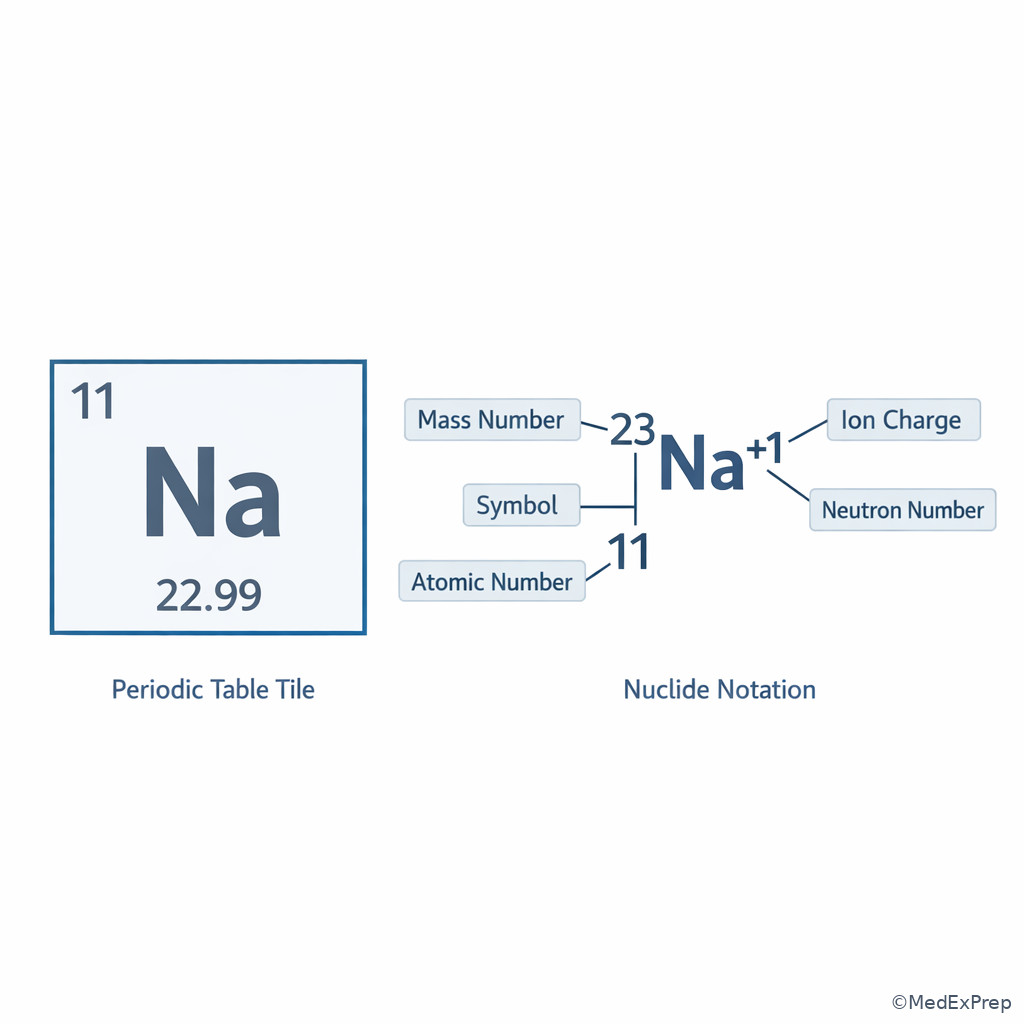
- Nuclide notation commonly appears as \(^{A}_{Z}X\).
- Technetium-99m and technetium-99 are nuclear isomers of the same nuclide family, not different elements.
- Nuclear medicine exam stems often ask what particle count changes after a process; start by tracking \(Z\), \(N\), and \(A\).
- Chemical behavior depends mainly on electron configuration; nuclear behavior depends on nucleus composition and energy state.
| Quantity | Symbol | What it counts | Exam use |
|---|---|---|---|
| Atomic number | \(Z\) | Protons | Defines the element |
| Mass number | \(A\) | Protons + neutrons | Defines the nuclide with \(Z\) |
| Neutron number | \(N\) | \(A-Z\) | Distinguishes isotopes/isotones |
| Net charge | — | Protons minus electrons | Determines ionization state |
Exam takeaway: Read the notation correctly before deciding whether the stem is testing chemistry, charge, or nuclear identity.
Core content
1.1.1.3 Foundational particle bookkeeping: what defines the element?
A Explanation
The central decision conflict in atomic-structure questions is simple: does the stem describe a change in element identity or only a change in nuclide/charge state? The single rule that resolves the conflict is this: proton number defines the element. If \(Z\) changes, you have a different element. If \(Z\) stays the same and neutrons change, you still have the same element but a different isotope. If electrons change while \(Z\) stays fixed, you have the same element in a different ionization state.
For ABNM preparation, this matters because radionuclide questions often embed elemental identity inside decay logic. Before you can reason through beta decay, electron capture, or isomeric transition in later topics, you must first know what quantity each process affects. WHY THIS IS TESTED: board questions reward candidates who separate nuclear bookkeeping from radiopharmaceutical memorization. When a stem mentions Tc-99m, I-123, or F-18, the exam expects you to know that the letter symbol identifies the element, while the number identifies the mass number of the nuclide.
Choose-versus-reject framing: choose “same element” only when proton number is unchanged. Reject “same element” if the proton count changes, even if mass number looks similar. Choose “same ionization state” only when electrons match the charge described. Reject a charge-based answer if the stem is actually asking about nuclear identity.
B Worked example
A 61-year-old man with metastatic thyroid cancer, chronic kidney disease, and atrial fibrillation is discussed during a didactic review before radioiodine imaging. A faculty member asks which change would create a different element: adding one neutron to iodine-123, removing one electron from iodine-123, adding one proton to iodine-123, or changing it from an excited to ground nuclear state. A distracting clue in the discussion is that the patient recently received iodinated CT contrast.
Reasoning chain: Identify the task: the stem asks about element identity, not imaging protocol. Extract key facts: element identity depends on proton count. Apply the rule: only adding one proton changes \(Z\). Eliminate distractors: adding a neutron gives a different isotope of iodine; removing an electron creates an ion; changing excited state creates an isomeric state if applicable, but not a new element. Verify: iodinated contrast is irrelevant noise for the atomic-structure question.
C Exam trap
Common wrong answer: “Adding one neutron creates a different element.”
Why it is tempting: The mass number visibly changes, so the stem appears to describe a “new atom.”
Single clue that eliminates it: The proton number is unchanged; unchanged \(Z\) means same element.
D Checkpoint
Question: A neutral atom has 43 protons, 56 neutrons, and later loses one electron. Which statement is most appropriate?
- It becomes a different element because charge changed.
- It remains the same element and same nuclide but becomes a positive ion.
- It becomes an isotope of the original atom because electron number changed.
- It becomes an isobar of the original atom because neutron number is unchanged.
- A: Tempting because the atom is “different” after ionization, but wrong because element identity tracks protons, not charge.
- B: Correct because proton and neutron counts are unchanged, so the nuclide is unchanged, while one fewer electron makes a cation.
- C: Tempting because “isotope” is a common label for variant atoms, but wrong because isotopes differ by neutrons.
- D: Tempting because the answer uses a real nuclear term, but wrong because isobars require the same mass number in different elements.
1.1.1.4 Nuclear notation and atomic arithmetic
A Explanation
The decision conflict here is whether the stem is asking you to read notation correctly or to perform a hidden particle-count calculation. The single resolving rule is to convert every symbol into \(Z\), \(A\), \(N\), and electrons before interpreting anything else. Standard notation \(^{A}_{Z}X\) tells you the element \(X\), atomic number \(Z\), and mass number \(A\). Then neutron number is \(N = A - Z\).
WHY THIS IS TESTED: ABNM questions often present nuclides in shorthand and expect immediate translation. For example, Tc-99m means technetium with \(A=99\) in a metastable state; the element technetium fixes \(Z\), while the 99 sets total nucleons. The “m” does not alter proton or neutron count; it flags a higher nuclear energy state. See Fig 2 for the notation workflow. When stems later ask about daughter products, radiation type, or imaging photons, the first error candidates make is misreading the starting nuclide.
Choose-versus-reject framing: choose arithmetic when the symbol is incomplete but enough information exists to derive the missing count. Reject overcomplication: you do not need quantum chemistry or orbital detail for most ABNM introductory physics items. Monitor for one common pitfall: a superscript mass number is not a charge. Charge is written separately, often as a right superscript.
Exam takeaway: Translate every symbol into protons, neutrons, and electrons before answering any decay or identity question.
flowchart LR
A[Nuclide symbol] --> B[Element symbol X]
A --> C[Atomic number Z]
A --> D[Mass number A]
C --> E[Protons]
D --> F[Total nucleons]
E --> G[Neutrons = A - Z]
A --> H[Charge if shown]
H --> I[Electrons vs protons]
B Worked example
A 47-year-old woman with differentiated thyroid cancer, Hashimoto thyroiditis, and remote breast cancer is scheduled for follow-up imaging. During board review, the question asks: “For \(^{131}_{53}\text{I}\), what is the neutron number?” A distracting detail is that her TSH is elevated after thyroid hormone withdrawal, which may push learners toward clinical management rather than atomic arithmetic.
Reasoning chain: Identify the task: calculate neutrons. Extract key facts: \(A=131\), \(Z=53\). Apply rule: \(N = A - Z = 131 - 53 = 78\). Eliminate distractors: 53 is proton number, not neutrons; 131 is total nucleons, not neutrons; any answer using TSH is irrelevant. Verify: correct neutron count is 78.
C Exam trap
Common wrong answer: “131 neutrons.”
Why it is tempting: Learners see the large superscript and mistake it for neutron count.
Single clue that eliminates it: The superscript is mass number, which includes both protons and neutrons.
D Checkpoint
Question: Which notation most specifically identifies a metastable nuclear state rather than a different element or isotope family?
- Tc-99m
- I-123
- F-18
- Xe-133
- A: Correct because the “m” denotes a metastable excited nuclear state of technetium-99.
- B: Tempting because iodine nuclides are common in nuclear medicine, but this is simply a specific iodine isotope.
- C: Tempting because fluorine-18 is highly testable, but the notation describes a mass number only, not metastability.
- D: Tempting because xenon studies involve distinctive physics, but this is also only isotope notation.
- The quantity that defines the element is proton number.
- True or False: Changing electrons changes the isotope. False.
- Name the formula for neutron number: \(N = A - Z\).
| Nuclide | Known value(s) | Derived value | High-yield note |
|---|---|---|---|
| \(^{131}_{53}\text{I}\) | \(A=131\), \(Z=53\) | \(N=78\) | Classic neutron-count setup |
| Tc-99m | \(A=99\) | Metastable state | Same element as Tc-99 ground state |
| \(^{18}_{9}\text{F}^{-}\) | \(A=18\), \(Z=9\) | 10 electrons | Charge changes electrons, not nucleus |
| \(^{123}_{53}\text{I}\) | \(A=123\), \(Z=53\) | \(N=70\) | Same element as I-131, different isotope |
1.1.1.5 Isotopes, isotones, isobars, and isomers: choose the right relationship
A Explanation
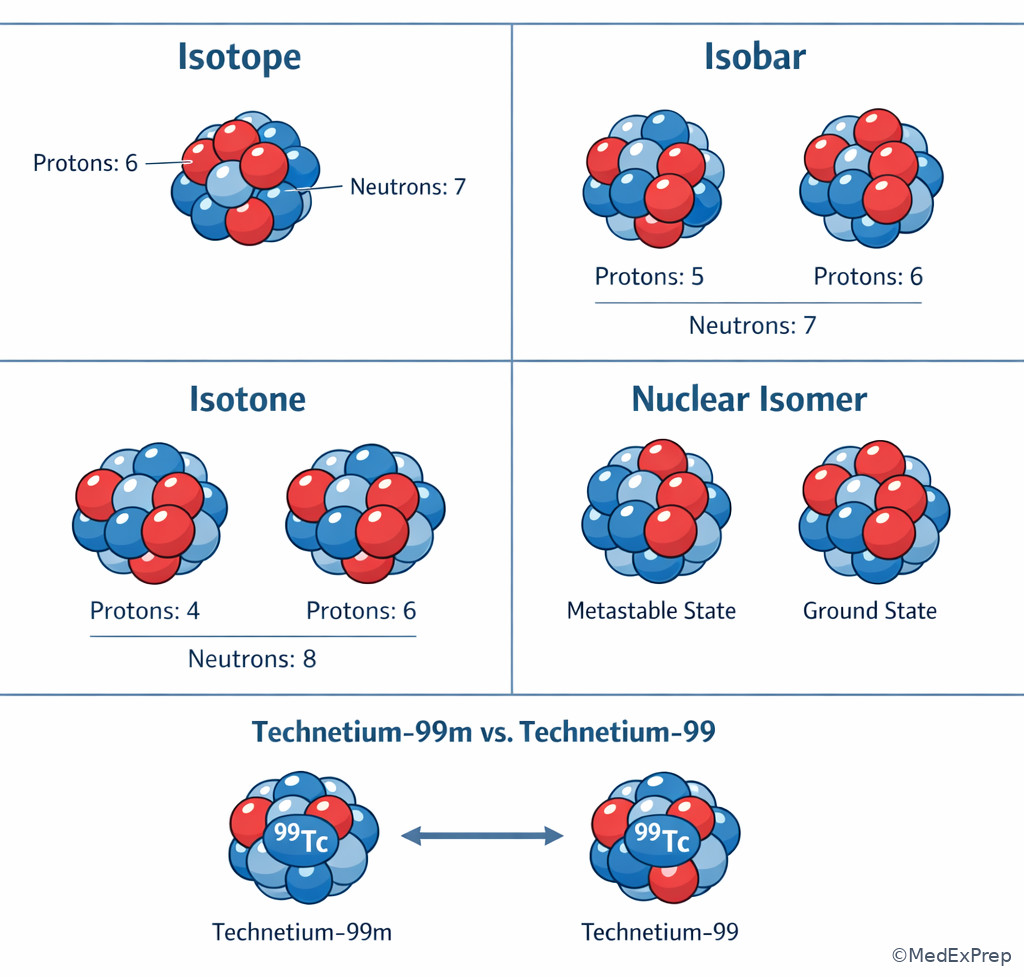
This is the most common classification trap in introductory nuclear medicine physics. The decision conflict is which relationship label applies when two nuclei share one count but differ in another. The single rule is to anchor each term to the one quantity that stays the same: \(isotopes = same protons\), \(isobars = same mass number\), \(isotones = same neutrons\), and \(isomers = same protons and same mass number\), different energy state. See Fig 3.
WHY THIS IS TESTED: these terms appear in physics, radiopharmacy, and decay stems, and the options are intentionally look-alike. In nuclear medicine, isotopes matter because different isotopes of the same element can have distinct imaging or therapeutic uses. Nuclear isomers matter because technetium-99m is foundational to SPECT imaging; it is not just “another isotope” in the loose everyday sense of the word, but specifically a metastable energy state related to Tc-99.
Choose-versus-reject framing: choose isotope when the chemical symbol is unchanged but mass number differs. Reject isotope if mass number is the same but element differs; that pattern suggests isobar. Choose isomer only when both \(Z\) and \(A\) are unchanged and the difference is energy state. Reject isomer if neutron count changed at all.
Exam takeaway: Match each relationship term to the one particle count or property that stays the same.
flowchart TD
A[Compare two nuclei] --> B{Same proton number?}
B -->|Yes| C{Same mass number?}
B -->|No| D{Same mass number?}
C -->|No| E[Isotopes]
C -->|Yes| F{Same energy state?}
F -->|No| G[Isomers]
F -->|Yes| H[Same nuclide]
D -->|Yes| I[Isobars]
D -->|No| J{Same neutron number?}
J -->|Yes| K[Isotones]
J -->|No| L[Unrelated classification] Exam takeaway: Visual comparison reduces the classic terminology mix-up that drives easy board misses.
B Worked example
A 54-year-old woman with Graves disease, type 2 diabetes, and prior cervical fusion is reviewed for a board-style question: “I-123 and I-131 are best classified as which pair?” A distracting clue is that she recently had a low-iodine diet discussion, which may pull attention toward thyroid management.
Reasoning chain: Identify task: classify relationship between two nuclides. Extract key facts: both are iodine, so proton number is the same. Mass numbers differ: 123 versus 131. Apply rule: same \(Z\), different \(A\) means isotopes. Eliminate distractors: not isobars because \(A\) differs; not isotones because neutron counts differ; not isomers because the mass numbers differ and no energy-state notation is given. Verify: correct classification is isotopes.
C Exam trap
Common wrong answer: “Isomers.”
Why it is tempting: Both nuclides are iodine and both are used in thyroid-related nuclear medicine, so they seem like alternate energy forms of the same atom.
Single clue that eliminates it: Their mass numbers differ; isomers must have the same \(A\) and \(Z\).
D Checkpoint
Question: Which pair is best classified as nuclear isomers?
- I-123 and I-131
- Tc-99m and Tc-99
- C-11 and N-11
- F-18 and O-18
- A: Tempting because both are iodine nuclides, but wrong because they are isotopes with different mass numbers.
- B: Correct because they have the same atomic and mass numbers but different nuclear energy states.
- C: Tempting because the mass number is identical, but wrong because these are different elements and therefore isobars.
- D: Tempting because both are oxygen-region light nuclides used in nuclear science, but wrong because proton number differs.
1.1.1.6 Stability, binding logic, and why some nuclides are radioactive
A Explanation
The decision conflict in foundational stability questions is whether a nuclide should be thought of as stable enough to persist or unstable enough to decay. The single resolving idea is that nuclear stability depends on the balance of protons and neutrons and the energy state of the nucleus. Too many or too few neutrons relative to protons, or a nucleus trapped in a higher-energy configuration, can make the nuclide radioactive. You are not expected at this stage to memorize the full valley of stability; you are expected to recognize that nuclear instability is a property of the nucleus, not of the electron shell.
WHY THIS IS TESTED: candidates often confuse chemical reactivity with radioactive behavior. An ionized atom is not radioactive just because it lost an electron, and a neutral atom can still be radioactive if its nucleus is unstable. In nuclear medicine, this distinction underlies why a radiopharmaceutical can behave chemically like one compound but emit radiation because of its nuclide. See Fig 4 for the stability concept map.
Choose-versus-reject framing: choose a nuclear explanation when the question concerns emitted radiation, half-life, or metastable transitions. Reject electron-based explanations unless the stem specifically addresses ionization or bonding. Monitor for another board trap: metastable states are unstable because of excess nuclear energy, even if proton and neutron counts match the ground state.
Exam takeaway: Radioactivity reflects nuclear instability or excess energy, not electron-shell chemistry.
flowchart TD
A[Nucleus] --> B[Proton-neutron balance]
A --> C[Energy state]
B --> D[Stable enough]
B --> E[Unstable]
C --> F[Ground state]
C --> G[Metastable excited state]
E --> H[Radioactive decay]
G --> H
H --> I[Next topic: decay mode and half-life]
B Worked example
A 69-year-old man with coronary artery disease, COPD, and prostate cancer asks why a radioactive tracer can be injected if the chemical compound resembles a routine pharmaceutical. In conference, the board-style question asks which property explains radioactivity most directly: loss of one electron, abnormal nuclear composition/energy state, hydration shell, or plasma protein binding. A distracting clue is that the tracer is highly protein bound.
Reasoning chain: Identify task: determine what causes radioactivity. Extract key facts: radioactivity is a nuclear phenomenon. Apply rule: unstable proton-neutron balance or excess nuclear energy causes spontaneous decay. Eliminate distractors: electron loss creates an ion; hydration and protein binding affect pharmacokinetics, not nuclear emissions. Verify: abnormal nuclear composition or energy state is the best answer.
C Exam trap
Common wrong answer: “Loss of an electron.”
Why it is tempting: Electron loss makes the atom charged and seems “energetically abnormal.”
Single clue that eliminates it: The stem asks about radioactivity, which arises from the nucleus, not the electron shell.
D Checkpoint
Question: A board-style stem asks why Tc-99m can emit a gamma photon without changing its element identity. Which explanation is best?
- It loses an orbital electron and becomes ionized.
- It is a metastable nuclear isomer with excess nuclear energy.
- It gains a neutron and becomes a different isotope first.
- Its chemical bonds release stored energy as photons.
- A: Tempting because ionization can involve energy changes, but wrong because this does not explain nuclear gamma emission.
- B: Correct because a metastable nucleus can release excess nuclear energy by isomeric transition without changing elemental identity.
- C: Tempting because isotope change affects nuclei, but wrong because the question asks about emission from Tc-99m itself.
- D: Tempting because photons can be associated with energy release, but wrong because chemical bond energies are not the source of nuclear gamma photons.
- The most common reason a metastable nuclide emits radiation is excess nuclear energy.
- True or False: Ionization alone makes a stable nuclide radioactive. False.
- Name the 3 high-yield causes of “different atom behavior” to separate: different element, different isotope, different ion charge.
| Relationship / concept | What stays the same | What changes | Classic example |
|---|---|---|---|
| Isotope | Atomic number \(Z\) | Neutron number, mass number | I-123 vs I-131 |
| Isobar | Mass number \(A\) | Atomic number | C-11 vs B-11 or N-11 |
| Isotone | Neutron number | Atomic number, often mass number | Context-dependent pair with equal \(N\) |
| Isomer | \(Z\) and \(A\) | Nuclear energy state | Tc-99m vs Tc-99 |
| Ion | Nucleus | Electron number | \(^{18}_{9}\text{F}^{-}\) |
1.1.1.7 Applied nuclear medicine framing: from atomic structure to tracer choice and later decay questions
A Explanation
The final foundational decision conflict is this: when a stem names a radionuclide, are you supposed to think first about its chemical targeting, its nuclear identity, or its later decay properties? The single resolving rule is to work in layers. First identify the nuclide correctly; then link it to expected decay behavior; then connect that behavior to imaging utility. For this lesson, your job is the first layer. The upcoming lesson on decay adds the second layer, and photon-matter interactions add the third layer about how emitted radiation behaves in tissue and detectors. See Fig 5.
WHY THIS IS TESTED: ABNM stems often present a clinically realistic context with irrelevant noise, then ask a foundational physics question hidden underneath. For example, a PET question may mention FDG uptake, but the tested concept could be that F-18 is an isotope of fluorine with a specific nuclear identity. A SPECT question may mention Tc-99m MDP, but the hidden concept is that technetium-99m is metastable and useful because of its nuclear properties. Choose-versus-reject framing: choose atomic-structure reasoning when the answer choices are particle-count or classification terms; reject pharmacology-only reasoning when the stem asks what the radionuclide is rather than where the compound goes.
Forward reference: in the next topic, you will ask what changes after alpha decay, beta minus decay, beta plus decay, electron capture, or isomeric transition. Those questions are easy if you already track \(Z\), \(A\), and nuclear energy state. See Fig 6 for the progression into later physics concepts.
Exam takeaway: Start with the nuclide itself, then connect to decay behavior, then connect to imaging application.
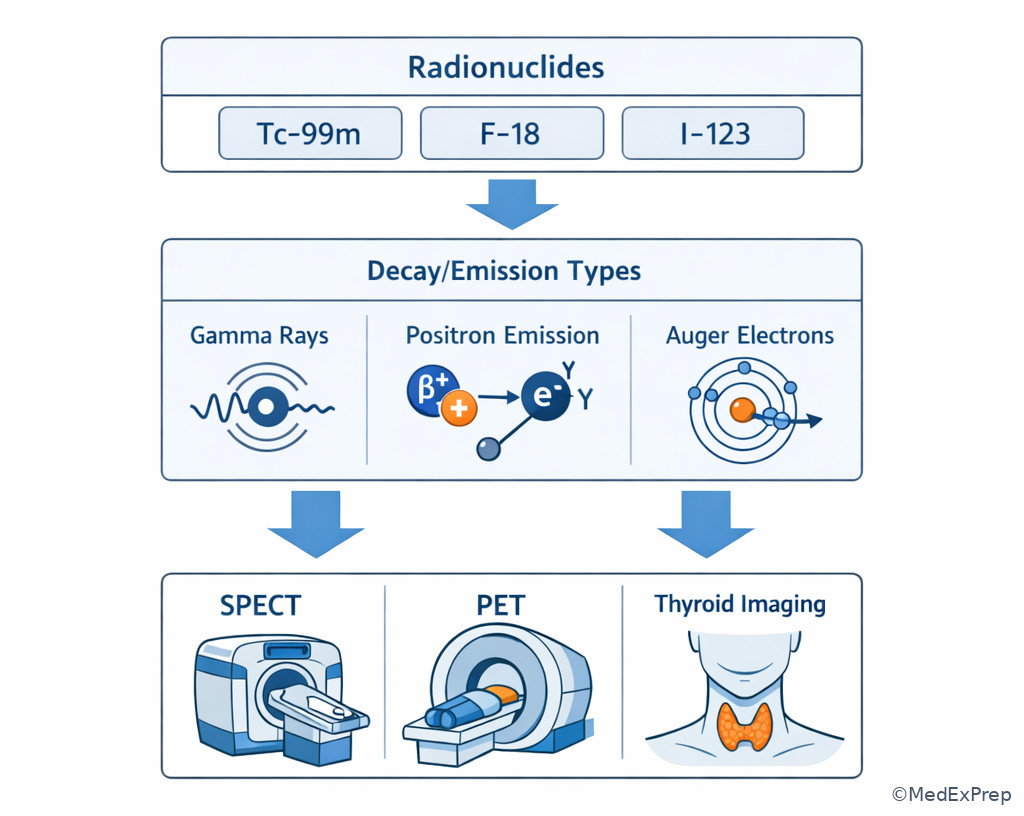
Exam takeaway: Atomic bookkeeping is the gateway step before solving decay, half-life, and photon-interaction questions.
flowchart LR
A[Atomic structure and nuclides] --> B[Decay modes]
B --> C[Half-life and activity]
B --> D[Emitted photons/particles]
D --> E[Photon-matter interactions]
E --> F[Detector response and image quality]
F --> G[Clinical study interpretation]
Exam takeaway: Similar tracer names do not imply the same nuclide relationship, so classify before interpreting use.
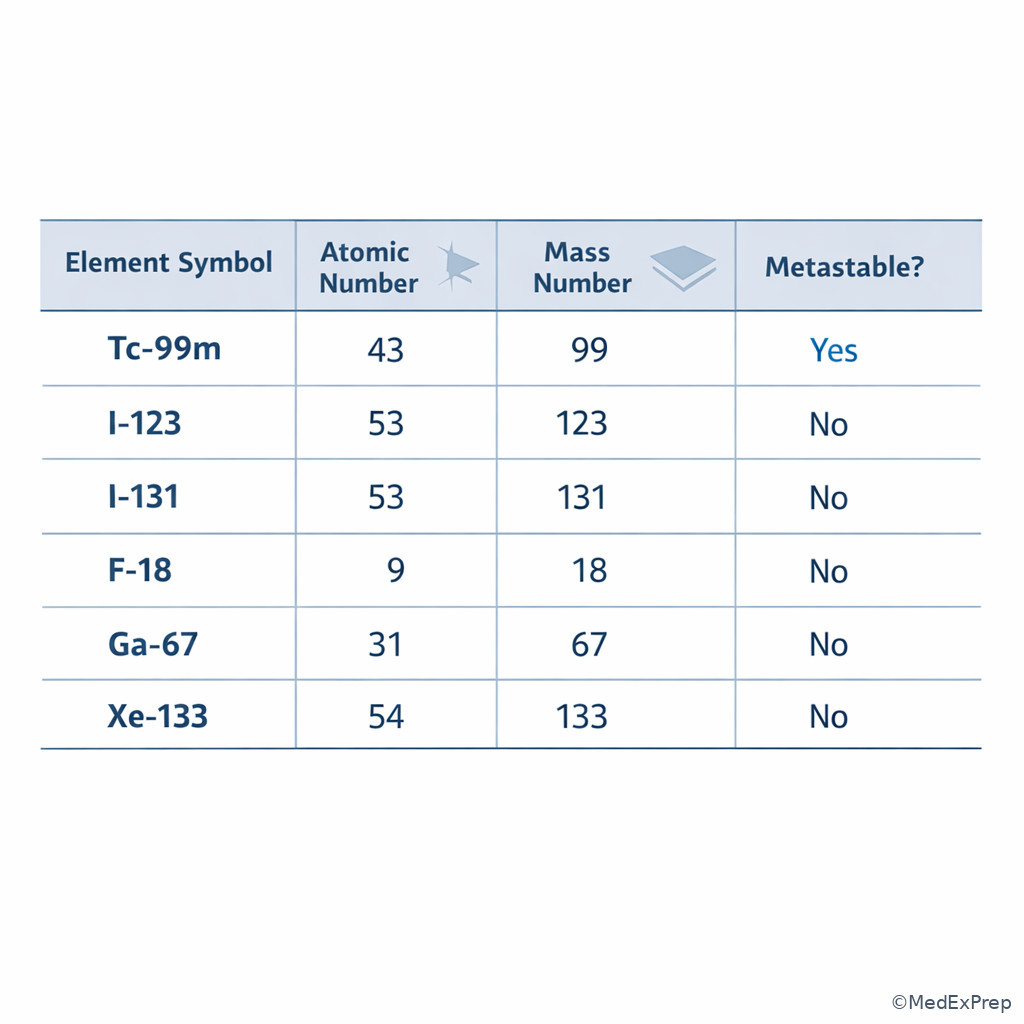
B Worked example
A 58-year-old woman with obesity, rheumatoid arthritis, and recent iodinated contrast exposure is referred for a thyroid-related nuclear medicine question during board prep. The stem asks which statement is most appropriate: “Tc-99m and Tc-99 are different elements,” “I-123 and I-131 are isobars,” “F-18 fluoride and neutral F-18 differ only by electron count,” or “changing proton number leaves the element unchanged.” The recent contrast history is a tempting clue because it is clinically important in thyroid imaging but irrelevant to nuclide classification.
Reasoning chain: Identify task: determine the correct atomic statement. Extract key facts: Tc-99m/Tc-99 are isomers, not different elements; I-123/I-131 are isotopes, not isobars; fluoride ion versus neutral F-18 changes electron count only; changing proton number changes the element. Eliminate distractors one by one. Verify: the only correct statement is that F-18 fluoride and neutral F-18 differ only by electron count.
C Exam trap
Common wrong answer: “I-123 and I-131 are isobars.”
Why it is tempting: Both are clinically linked to thyroid imaging and therapy, making them seem like same-mass alternatives.
Single clue that eliminates it: Their mass numbers are different, so they cannot be isobars.
D Checkpoint
Question: Which statement best prepares you to solve the next lesson on radioactive decay?
- Electron-shell changes are the main determinant of decay mode.
- Mass number alone determines whether two nuclides are the same element.
- Tracking proton number, neutron number, and energy state allows correct prediction of many daughter relationships.
- Isotopes and isomers are interchangeable labels in nuclear medicine.
- A: Tempting because electron capture sounds electron-based, but wrong because decay behavior is fundamentally nuclear bookkeeping.
- B: Tempting because mass number is prominent in notation, but wrong because element identity depends on proton number.
- C: Correct because decay questions are largely solved by tracking \(Z\), \(N\), \(A\), and nuclear energy state.
- D: Tempting because both terms describe related nuclei, but wrong because they describe distinct relationships.
Exam Traps & Differentiators
Most common wrong answer and why: Calling any two related nuclei “isotopes.” This is tempting because isotope is the everyday umbrella term, but board questions require the exact relationship term. Same proton number supports isotope; same mass number supports isobar; same proton and mass numbers with different energy state supports isomer.
| Looks similar but isn't | Why they are confused | Single differentiator | ABNM-style implication |
|---|---|---|---|
| Isotope vs isomer | Both involve “same element” language | Isomers keep both \(Z\) and \(A\) the same; isotopes do not | Tc-99m vs Tc-99 isomer question |
| Mass number vs charge | Both may appear as superscript-like notation | Mass number counts nucleons; charge depends on electron-proton imbalance | Ionization is not radioactivity |
| Element identity vs nuclide identity | Both use the same symbol | Element needs only \(Z\); nuclide needs \(Z\) and \(A\) | I-123 and I-131 are same element, different nuclides |
| Nuclear instability vs chemical reactivity | Both involve energy changes | Radioactivity comes from the nucleus, not orbitals | Supports decay and imaging-emission logic |
- If the stem says “same chemical symbol but different mass number,” think isotopes.
- If the stem says “same mass number, different element,” think isobars.
- If the stem says “same \(Z\) and \(A\), excited state,” think nuclear isomer.
- If the stem says “lost an electron,” think ionization, not decay.
- If the stem says “different proton count,” think different element immediately.
- If the stem says “metastable,” think excess nuclear energy and upcoming isomeric transition.
Cross-topic confusable pair to watch: in the upcoming Radioactive Decay And Half-Life topic, candidates often confuse electron capture with ordinary changes in electron number. The trap is that decay involves a nuclear transformation; it is not the same as simple ionization discussed here. In the upcoming Photon Matter Interactions topic, do not confuse emitted radiation source with how photons later interact in tissue or the detector.
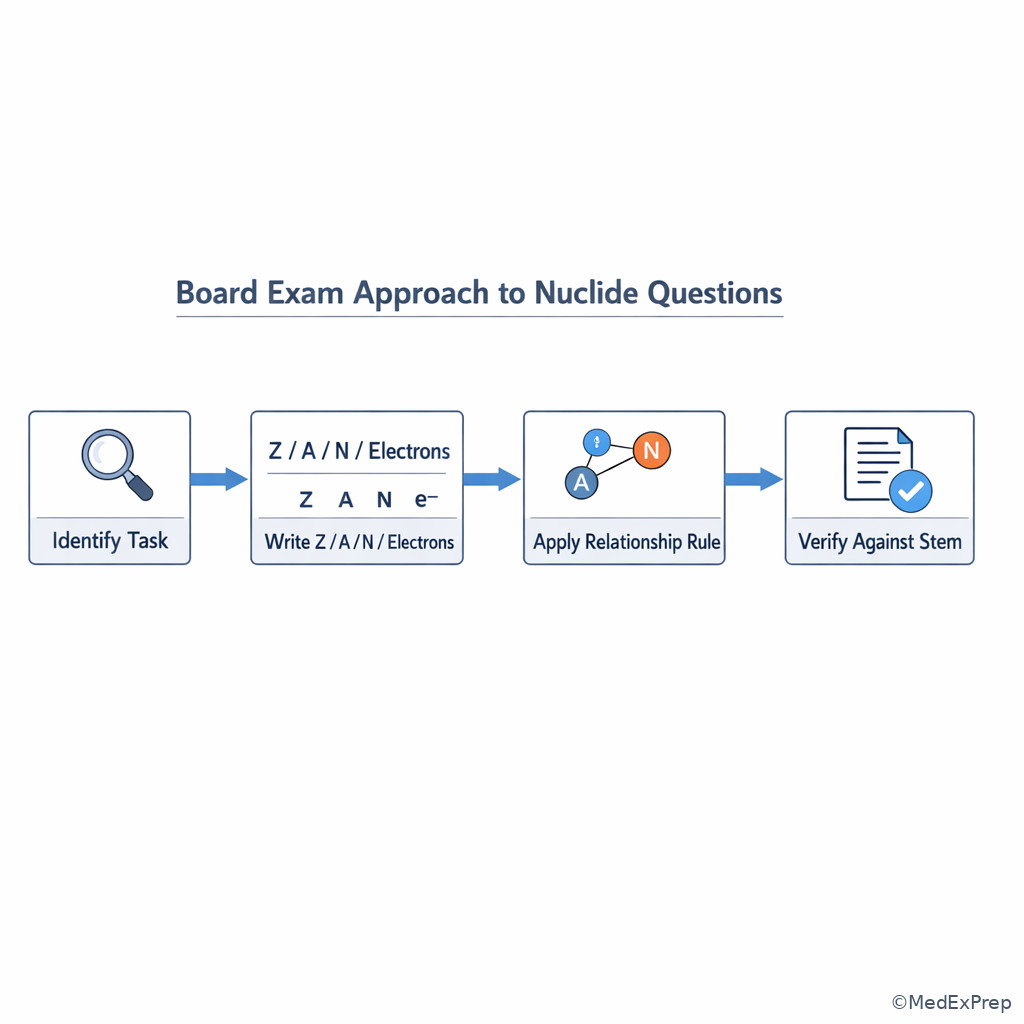
Algorithm / Approach
Exam takeaway: A fixed four-step method prevents misses from notation confusion and stem noise.
Rapid Review
- Element identity → proton number only
- Nuclide identity → needs both \(Z\) and \(A\)
- Neutron count → \(A-Z\)
- Neutral atom → electrons equal protons
- Cation → fewer electrons than protons
- Anion → more electrons than protons
- Isotopes → same element, different neutron count
- Isobars → same mass number, different element
- Isotones → same neutron number, different proton number
- Isomers → same \(Z\) and \(A\), different nuclear energy state
- Metastable suffix “m” → excited nuclear state, not different element
- Ionization → electron-shell change, not radioactivity
- Radioactivity → nuclear instability or excess energy
- Tracer name in stem → first identify nuclide before clinical use
Self-check quiz
1. A 35-year-old woman with migraine and asthma is discussed in physics conference before a PET lecture. The instructor asks which quantity most directly determines whether an atom is carbon versus nitrogen. Which is the most appropriate answer?
- Number of protons
- Number of neutrons
- Number of electrons
- Mass number
2. A neutral atom of iodine-123 is compared with iodine-131 during board review. Which relationship best describes these two nuclides?
- Isobars
- Isotopes
- Isomers
- Isotones
3. A 64-year-old man with coronary artery disease, chronic kidney disease, and recent pneumonia undergoes a teaching session before a Tc-99m SPECT study. The stem asks which statement about Tc-99m is most appropriate. He also has mild anemia, a distracting detail. Which is the best answer?
- It is a different element from Tc-99 because it emits photons.
- It is a nuclear isomer of Tc-99 because the proton and mass numbers are unchanged but energy state differs.
- It is an isotope of iodine because metastable nuclides are grouped by emission type.
- It is an ionized form of technetium caused by electron loss.
4. A 52-year-old woman with differentiated thyroid cancer, hypertension, and prior contrast-enhanced CT is asked in conference to interpret \(^{131}_{53}\text{I}\). The stem asks for the neutron number and includes her elevated TSH as distracting noise. Which is the most appropriate answer?
- 53
- 78
- 131
- 184
5. A 57-year-old man with diabetes, obesity, and recent chemotherapy is reviewed for radionuclide classification. Two nuclei have the same mass number but different proton numbers. Which relationship most likely applies?
- Isotopes
- Isomers
- Isobars
- Ions
6. A 46-year-old woman with hyperthyroidism, atrial fibrillation, and chronic sinusitis is presented with a comparison of four pairs of nuclei. The stem asks which pair are isotones. A distracting clue mentions she may need thyroid imaging, but the actual task is classification. Which is the best answer?
- Two nuclei with the same proton number but different mass numbers
- Two nuclei with the same neutron number but different proton numbers
- Two nuclei with the same mass number and same proton number but different energy states
- Two nuclei with the same mass number but different proton numbers
7. A 71-year-old man with metastatic prostate cancer, COPD, and prior pacemaker placement is asked why a radiopharmaceutical can be radioactive even when its electron configuration is unchanged from a chemically similar stable compound. Mild hyponatremia is included as a distracting lab. Which explanation is most appropriate?
- Radioactivity is caused mainly by missing orbital electrons.
- Radioactivity reflects an unstable or excited nucleus, independent of routine electron-shell chemistry.
- Radioactivity requires a positive ionic charge.
- Radioactivity occurs only when the atom has an odd mass number.
8. A 60-year-old woman with rheumatoid arthritis, stage 3 CKD, and remote thyroidectomy is discussed during review for the upcoming decay lesson. The instructor asks which statement requires immediate clarification because it would lead to a wrong daughter-nuclide prediction. Which is the best answer?
- Changing proton number changes the element.
- Changing electron number changes charge state but not nuclear identity.
- Changing neutron number changes isotope but not element identity.
- Changing mass number without changing proton number always means the nucleus is an isomer.
Answer key
1. Correct answer: A — Number of protons.
- A: Tempting because proton count is the classic atomic-structure fact, and it is correct here because atomic number defines the element. Single stem clue: the question asks what distinguishes carbon from nitrogen. Source: Cherry, Sorenson, and Phelps; Bushberg et al.
- B: Tempting because neutrons affect nuclear stability and isotope identity, but incorrect because changing neutrons does not change carbon into nitrogen. Single clue: different element was asked, not different isotope. Source: Cherry, Sorenson, and Phelps.
- C: Tempting because electrons drive chemistry and ions, but incorrect because electron number can change without changing elemental identity. Single clue: element identity is nuclear, not electronic. Source: Bushberg et al.
- D: Tempting because mass number appears prominently in nuclide notation, but incorrect because different elements can share a mass number. Single clue: mass number alone does not specify the element. Source: Cherry, Sorenson, and Phelps.
2. Correct answer: B — Isotopes.
- A: Tempting because both nuclides are clinically linked and easy to confuse with same-mass pairs, but incorrect because isobars require the same mass number. Single stem clue: 123 and 131 are different mass numbers. Source: Cherry, Sorenson, and Phelps.
- B: Correct because iodine-123 and iodine-131 share the same proton number but differ in neutron count and mass number. Single stem clue: both are iodine. Source: Bushberg et al.; Mettler and Guiberteau.
- C: Tempting because both are related iodine nuclides, but incorrect because isomers require identical \(Z\) and \(A\) with different energy states. Single stem clue: mass numbers differ. Source: Cherry, Sorenson, and Phelps.
- D: Tempting because isotope terminology is often mixed up, but incorrect because equal neutron number is not given and is not true here. Single stem clue: same element, not same neutron count, is the defining pattern. Source: Bushberg et al.
3. Correct answer: B — It is a nuclear isomer of Tc-99.
- A: Tempting because emission can make it seem like a fundamentally different atom, but incorrect because emitting photons does not by itself define a different element. Single stem clue: both names are technetium. Source: Mettler and Guiberteau; Cherry, Sorenson, and Phelps.
- B: Correct because Tc-99m and Tc-99 share the same element and mass number, differing primarily by nuclear energy state. Single stem clue: the suffix “m.” Source: Cherry, Sorenson, and Phelps; Bushberg et al.
- C: Tempting because metastable terminology sounds specialized and can distract learners, but incorrect because Tc is technetium, not iodine. Single stem clue: element symbol Tc. Source: Bushberg et al.
- D: Tempting because ions and metastable states both involve energy differences, but incorrect because isomerism is nuclear, not an electron-loss phenomenon. Single stem clue: the question is about Tc-99m notation, not charge. Source: Cherry, Sorenson, and Phelps.
4. Correct answer: B — 78.
- A: Tempting because 53 is visibly present in the notation, but incorrect because 53 is the proton number. Single stem clue: the question asks for neutrons. Source: Cherry, Sorenson, and Phelps.
- B: Correct because neutron number is \(131 - 53 = 78\). Single stem clue: notation provides both \(A\) and \(Z\). Source: Bushberg et al.
- C: Tempting because 131 is the large superscript, but incorrect because that is total nucleons, not neutrons. Single stem clue: mass number includes protons plus neutrons. Source: Cherry, Sorenson, and Phelps.
- D: Tempting only if the learner adds rather than subtracts, but incorrect because neutron count is not \(A+Z\). Single stem clue: use \(N=A-Z\). Source: Bushberg et al.
5. Correct answer: C — Isobars.
- A: Tempting because isotopes are the most familiar relationship term, but incorrect because isotopes share proton number, not mass number. Single stem clue: the proton numbers are different. Source: Cherry, Sorenson, and Phelps.
- B: Tempting because isomers can be confused with closely related nuclei, but incorrect because isomers require the same proton and mass numbers with different energy states. Single stem clue: different proton numbers are given. Source: Bushberg et al.
- C: Correct because same mass number with different proton numbers defines isobars. Single stem clue: “same mass number but different proton numbers.” Source: Cherry, Sorenson, and Phelps.
- D: Tempting because ions are another “different version” of an atom, but incorrect because ionization involves electrons, not proton/mass-number comparisons between nuclei. Single stem clue: the stem compares nuclei, not charge states. Source: Bushberg et al.
6. Correct answer: B — Two nuclei with the same neutron number but different proton numbers.
- A: Tempting because same proton number is a familiar pattern, but incorrect because that defines isotopes when mass number differs. Single stem clue: the question asks specifically for isotones. Source: Cherry, Sorenson, and Phelps.
- B: Correct because isotones are nuclei with equal neutron number and differing proton number. Single stem clue: “same neutron number.” Source: Bushberg et al.
- C: Tempting because it describes a real relation, but incorrect because that is the definition of nuclear isomers. Single stem clue: “different energy states” points away from isotones. Source: Cherry, Sorenson, and Phelps.
- D: Tempting because it also describes a real relation, but incorrect because same mass number with different proton number defines isobars. Single stem clue: mass-number sameness alone is not the isotone criterion. Source: Bushberg et al.
7. Correct answer: B — Radioactivity reflects an unstable or excited nucleus.
- A: Tempting because electrons influence chemical behavior and ion charge, but incorrect because missing orbital electrons do not by themselves create radioactivity. Single stem clue: electron configuration is unchanged yet radioactivity persists. Source: Mettler and Guiberteau; Bushberg et al.
- B: Correct because nuclear instability or excess nuclear energy explains spontaneous radioactive emission independent of routine chemical valence behavior. Single stem clue: the question contrasts radioactivity with electron-shell chemistry. Source: Cherry, Sorenson, and Phelps; Bushberg et al.
- C: Tempting because charged particles and ions sound energetic, but incorrect because neutral radionuclides can be radioactive. Single stem clue: radioactivity is not conditioned on ionic charge. Source: Bushberg et al.
- D: Tempting because some odd-mass nuclides are unstable, but incorrect because radioactivity is not limited to odd mass numbers. Single stem clue: the answer choice is too absolute. Source: Cherry, Sorenson, and Phelps.
8. Correct answer: D — Changing mass number without changing proton number always means the nucleus is an isomer.
- A: Tempting to overthink because later decay changes can be complex, but this statement is correct: a proton-number change means a different element. Single stem clue: daughter-nuclide prediction depends critically on proton changes. Source: Cherry, Sorenson, and Phelps.
- B: Tempting because electron capture in the next lesson could confuse the issue, but as stated this is correct for ordinary ionization: electron changes alter charge, not the starting nuclear identity. Single stem clue: the statement explicitly says electron number. Source: Bushberg et al.
- C: Tempting because some learners think neutron change implies a new element, but this statement is correct: different neutron number means different isotope of the same element. Single stem clue: proton number is unchanged. Source: Cherry, Sorenson, and Phelps.
- D: Correct as the statement requiring clarification because changing mass number while proton number stays the same indicates a different isotope, not an isomer. Isomers keep both \(Z\) and \(A\) the same and differ only in energy state. Single stem clue: “changing mass number.” Source: Bushberg et al.; Cherry, Sorenson, and Phelps.
Keep going with the full ABNM Nuclear Medicine Prep Course (Nuc Med)
You just studied the way members do, in the same lesson interface. Full access unlocks every lesson, the question bank and flashcards for a full year.
One payment · 1 year of access · No auto-renewal