1.1.1 - Dysphagia Pattern Recognition
Why it matters
- Dysphagia is one of the highest-yield symptom-pattern questions in esophageal board content because the stem often gives enough history to identify the best next test before any procedure is performed.
- The exam repeatedly tests the difference between structural narrowing and motility dysfunction; one history detail often decides the answer.
- Missing alarm features can delay diagnosis of esophageal cancer, food impaction risk, or complicated eosinophilic esophagitis.
- Several close distractors overlap with upcoming topics: GERD can coexist with dysphagia, but dysphagia changes management; motility disorders require manometric confirmation, but not as the first step when a structural lesion is still plausible.
Key Terms & Must-Know Facts
1.1.1.1 Key terms
- Oropharyngeal dysphagia: Difficulty initiating a swallow, often with coughing, choking, or nasopharyngeal regurgitation.
- Esophageal dysphagia: Sensation of food sticking after swallow initiation.
- Odynophagia: Pain with swallowing; suggests inflammatory/infectious/pill injury more than pure mechanical obstruction.
- Progressive dysphagia: Worsening over time, especially solids first, concerning for malignancy or peptic stricture.
- Intermittent dysphagia: Episodic symptoms, classically rings/webs or eosinophilic esophagitis.
- Mechanical obstruction: Dysphagia for solids more than liquids.
- Motility disorder: Dysphagia for solids and liquids from the outset.
- Food impaction: Inability to clear a bolus; often associated with ring or eosinophilic esophagitis.
- Schatzki ring: Distal mucosal ring causing intermittent solid-food dysphagia.
- Peptic stricture: Acid-related distal narrowing, usually with chronic GERD history.
- Achalasia: Impaired LES relaxation and aperistalsis causing dysphagia to solids and liquids.
- Pseudoachalasia: Achalasia-like pattern due to malignancy, often with older age and weight loss.
- Eosinophilic esophagitis: Immune-mediated esophageal disease with dysphagia, impaction, rings, furrows, and atopic history.
- Barium esophagram: Contrast study useful when subtle rings, proximal lesions, or aspiration risk are concerns.
- High-resolution manometry: Confirmatory test for esophageal motility disorders after structural disease is excluded.
1.1.1.2 Must-know facts
- Dysphagia itself is an alarm symptom; uncomplicated empiric PPI alone is not the best next step when true dysphagia is present.
- Solids only points toward mechanical narrowing until proven otherwise.
- Solids and liquids from onset points toward motility disorder.
- Progression suggests malignancy or evolving stricture more than a stable ring.
- Intermittent steakhouse dysphagia strongly suggests Schatzki ring or eosinophilic esophagitis.
- Weight loss in a dysphagia stem raises concern for malignancy, but can also occur in advanced achalasia; age and rapid progression help separate them.
- Endoscopy is usually the best initial test for esophageal dysphagia, especially with alarm features.
- Manometry is not the first test when an obstructing lesion remains possible.
- Oropharyngeal symptoms favor swallow evaluation and often modified barium swallow rather than routine EGD first.
Core content
1.1.1.3 Foundational localization: oropharyngeal vs esophageal dysphagia
A Explanation
The first decision conflict is simple but decisive: Is the patient unable to initiate swallowing, or does food stick after the swallow starts? That single distinction usually separates oropharyngeal from esophageal dysphagia. Choose oropharyngeal dysphagia when the stem gives coughing immediately after swallowing, choking, drooling, repeated throat clearing, aspiration, or nasal regurgitation. Reject esophageal localization if the difficulty occurs before the bolus has clearly left the pharynx. Choose esophageal dysphagia when the swallow starts normally and the patient feels food hang up in the chest or lower neck.
WHY THIS IS TESTED: Board questions often hide the key clue in symptom timing. Examinees over-focus on the patient's finger pointing to the throat; many patients localize distal esophageal obstruction to the neck. The exam wants the functional description, not the patient's anatomic guess.
Key rule: Difficulty initiating a swallow suggests oropharyngeal dysfunction; sensation of food sticking after initiation suggests esophageal disease.
Recall: This is the first topic in the course, so the main skill we build now is the course-wide board method: identify the task → extract key facts → localize the problem → choose the governing rule → verify against distractors.
When oropharyngeal dysphagia is suspected, the practical exam-safe move is to think about neurologic disease, frailty, prior stroke, Parkinson disease, myasthenia, structural head-and-neck lesions, or cricopharyngeal dysfunction. The most useful initial evaluation is often a swallowing assessment such as a modified barium swallow or videofluoroscopic swallow study, not routine diagnostic EGD. By contrast, true esophageal dysphagia usually moves you toward EGD, sometimes with barium esophagram depending on the pattern and aspiration concern. See Fig 1.
Exam takeaway: The single best discriminator is difficulty initiating swallowing versus food sticking after a completed swallow.
flowchart TD
A[Dysphagia complaint] --> B{When does the problem occur?}
B -->|Before or at swallow initiation| C[Oropharyngeal pattern]
B -->|After swallow begins| D[Esophageal pattern]
C --> E[Coughing choking nasal regurgitation aspiration]
D --> F[Food sticking chest or lower neck]
E --> G[Think swallow study and neurologic causes]
F --> H[Think EGD based strategy] Clinician Action: Diagnose by separating initiation difficulty from post-swallow sticking. Order swallow evaluation for aspiration-pattern symptoms and EGD-oriented workup for esophageal symptoms. Treat immediate aspiration risk with diet modification and urgent speech/swallow input when needed. Refer/Escalate urgently if recurrent aspiration, inability to handle secretions, or suspected head-and-neck malignancy is present.
B Worked example
A 72-year-old man with prior lacunar stroke, type 2 diabetes, hypertension, and chronic GERD reports that for 2 months he coughs when trying to swallow water and occasionally has liquid come out of his nose. He says, "Food gets stuck in my throat," and he has lost 3 kg because he avoids meals. Hemoglobin is normal. A tempting clue is the history of chronic reflux, which may push you toward peptic stricture. The task is the best initial evaluation.
Reasoning chain: Identify task: choose the next diagnostic step. Extract key facts: difficulty with liquids, coughing immediately after swallowing, nasal regurgitation, prior stroke. Apply rule: this is oropharyngeal dysphagia, not classic esophageal obstruction. Eliminate distractors: peptic stricture causes solid-food sticking after swallow initiation; achalasia causes chest-level dysphagia to solids and liquids but not nasal regurgitation; empiric PPI ignores aspiration risk. Verify: the best next step is a swallowing evaluation such as modified barium swallow.
C Exam trap
Common wrong answer: Upper endoscopy first.
Why it is tempting: The patient says food is "stuck in the throat," and dysphagia often prompts EGD.
Single clue that eliminates it: Coughing and nasal regurgitation at swallow initiation localize the problem to the oropharynx, where aspiration-focused swallow assessment is the safer first step.
D Checkpoint
Question: A 68-year-old woman with Parkinson disease, chronic constipation, and osteoarthritis reports 3 weeks of coughing immediately after swallowing pills and thin liquids. She has no chest pain and no history of food impaction. Which is the most appropriate next step?
- Upper endoscopy
- Modified barium swallow study
- Empiric proton pump inhibitor trial
- High-resolution esophageal manometry
Answer: B. Modified barium swallow study.
- A is tempting because dysphagia often leads to EGD, but wrong because immediate coughing with liquids suggests aspiration from oropharyngeal dysfunction rather than a luminal lesion.
- B is tempting because Parkinson disease commonly causes transfer-phase swallowing dysfunction, and right because the stem localizes the problem to swallow initiation.
- C is tempting because reflux can coexist with swallowing complaints, but wrong because true dysphagia with aspiration features is not managed by empiric acid suppression alone.
- D is tempting because motility disorders can involve liquids, but wrong because manometry evaluates esophageal peristalsis after esophageal disease is suspected, not oropharyngeal aspiration symptoms.
If you missed this: Review 1.1.1.1 Foundational localization: oropharyngeal vs esophageal dysphagia — focus on the discriminating rule that coughing/choking at swallow initiation localizes to the oropharynx.
1.1.1.4 Foundational pattern recognition: mechanical obstruction vs motility disorder
A Explanation
The next decision conflict is: Is this a lumen that is too narrow, or a tube that cannot propel? Choose mechanical obstruction when dysphagia is initially limited to solids. Choose motility disorder when the patient has trouble with solids and liquids from the beginning. This rule is one of the highest-yield pattern-recognition tools in the entire esophageal section. It does not require you to know the exact final diagnosis yet; it tells you which branch of the workup to pursue first.
WHY THIS IS TESTED: Many board stems present a patient with chest discomfort, regurgitation, or weight loss and ask for the next step. Examinees often jump directly to achalasia when they see liquid dysphagia, but the sequence matters: solids first then later liquids still favors a progressive mechanical lesion.
Key rule: Solids-only dysphagia suggests a structural lesion; solids-and-liquids dysphagia from onset suggests motility dysfunction.
Mechanical causes include Schatzki ring, peptic stricture, eosinophilic esophagitis with fixed narrowing, radiation stricture, caustic injury, and cancer. Motility causes include achalasia, distal esophageal spasm, ineffective esophageal motility, and opioid-related esophageal dysfunction. On the exam, the time course then refines the mechanical category: intermittent and nonprogressive suggests ring; chronic reflux history suggests peptic stricture; younger patient with atopy and impactions suggests eosinophilic esophagitis; older patient with rapid progression and weight loss suggests malignancy. See Fig 2.
Exam takeaway: The initial food consistency pattern is the fastest way to separate structural narrowing from motility disease.
flowchart TD
A[Esophageal dysphagia] --> B{Pattern}
B -->|Solids only or solids first| C[Mechanical obstruction]
B -->|Solids and liquids from onset| D[Motility disorder]
C --> E[Ring stricture EoE cancer]
D --> F[Achalasia spasm opioid related]
C --> G[EGD usually first]
D --> H[Exclude structural lesion then manometry] | Pattern clue | Most likely category | Typical examples | Preferred initial direction |
|---|---|---|---|
| Solids only | Mechanical obstruction | Ring, peptic stricture, tumor | EGD |
| Solids then later liquids | Progressive mechanical lesion | Cancer, worsening stricture | Urgent EGD |
| Solids and liquids from onset | Motility disorder | Achalasia, spasm | EGD then manometry |
| Intermittent solid-food episodes | Fixed but episodic narrowing | Schatzki ring, EoE | EGD ± biopsies |
| Painful swallowing | Inflammatory/infectious injury | Pill esophagitis, candida, HSV | Cause-specific evaluation |
Exam takeaway: Visualize narrowing versus failed peristalsis to remember why solids-only and solids-plus-liquids histories point in different directions.
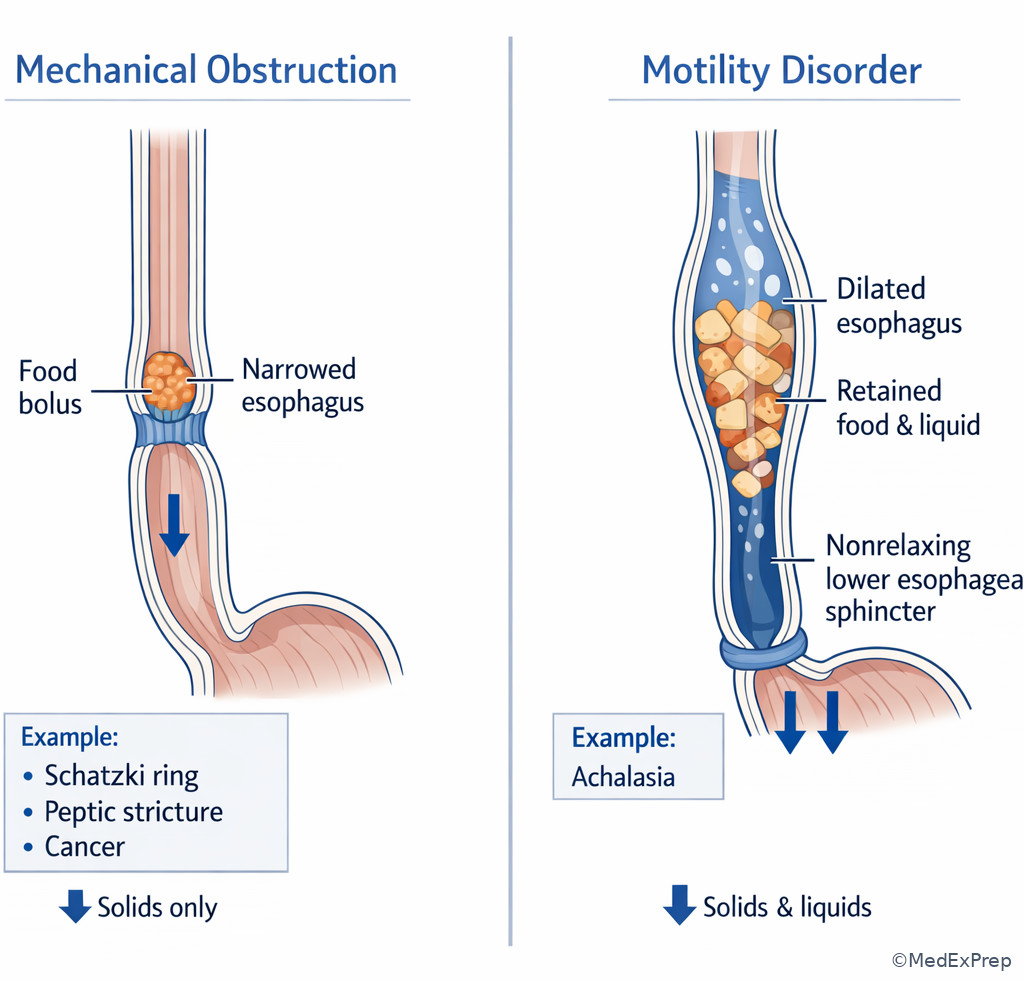
Memory anchor: \(SOLID = Stuck lumen\); \(BOTH = Broken motion\). If liquids are involved from the start, think movement problem, not just a narrow hole.
Clinician Action: Diagnose by asking whether liquids were difficult from the beginning. Order EGD when a structural lesion is plausible, even if a motility disorder is in the differential. Treat food impaction urgently and avoid empiric-only therapy in alarm scenarios. Refer/Escalate for urgent endoscopic evaluation when progressive obstruction or inability to tolerate intake is present.
B Worked example
A 59-year-old woman with long-standing heartburn, obesity, and a remote smoking history reports that bread and meat have become progressively difficult to swallow over 8 months. She now occasionally struggles with liquids near the end of meals. She denies coughing with swallowing. Her weight is down 5 kg, and a recent TSH is mildly elevated, a distracting abnormality that does not explain progressive dysphagia. The task is to identify the most likely pattern and next diagnostic direction.
Reasoning chain: Identify task: localize the category. Extract key facts: solids first, progression over months, later liquids, weight loss, chronic reflux. Apply rule: this is a mechanical obstruction pattern, not primary motility from the outset. Eliminate distractors: achalasia usually affects solids and liquids early; hypothyroidism is noise; empiric PPI misses an alarm symptom. Verify: EGD is indicated to evaluate for peptic stricture versus malignancy.
C Exam trap
Common wrong answer: Achalasia.
Why it is tempting: The patient eventually has trouble with liquids and has weight loss.
Single clue that eliminates it: Solids were affected first and the dysphagia progressed, which points to a structural lesion until proven otherwise.
D Checkpoint
Question: A 46-year-old man with seasonal allergies and eczema reports intermittent episodes of food sticking after he swallows steak or dry bread. Liquids usually pass normally unless a food bolus is already stuck. Which category best fits this pattern?
- Primary motility disorder
- Mechanical obstruction
- Oropharyngeal dysphagia
- Functional globus sensation
Answer: B. Mechanical obstruction.
- A is tempting because liquids can feel difficult during an impaction, but wrong because the baseline problem is intermittent solid-food dysphagia.
- B is tempting and right because rings or eosinophilic esophagitis produce episodic solid-food obstruction with otherwise normal liquid transit.
- C is tempting if the patient points to the neck, but wrong because there is no choking or initiation difficulty.
- D is tempting because symptoms may be intermittent, but wrong because true food sticking with impaction-type episodes is not globus.
If you missed this: Review 1.1.1.2 Foundational pattern recognition: mechanical obstruction vs motility disorder — focus on the discriminating rule that solids-only or solids-first dysphagia signals a structural process.
- The most useful first history split in dysphagia is initiation difficulty versus post-swallow sticking.
- True or False: Liquids involved from the very beginning strongly supports a primary motility disorder. True.
- Name 3 mechanical causes of esophageal dysphagia: ring, peptic stricture, malignancy.
1.1.1.5 Application: time course and associated clues that identify the likely lesion
A Explanation
Once you localize dysphagia to the esophagus and decide structural versus motility, the board exam asks you to refine the cause using time course, associated symptoms, and host factors. Choose Schatzki ring when dysphagia is intermittent, nonprogressive, and triggered by poorly chewed meats or bread. Choose peptic stricture when there is long-standing reflux with slowly progressive solid-food dysphagia. Choose eosinophilic esophagitis when a younger or middle-aged patient with atopy has intermittent dysphagia, food impactions, or endoscopic rings/furrows. Choose esophageal cancer when the patient is older, has rapid progression, weight loss, iron deficiency, or tobacco/alcohol exposures. Choose achalasia when both solids and liquids are difficult early, regurgitation occurs, and endoscopy is unrevealing or shows retained saliva/food with a tight LES.
WHY THIS IS TESTED: The exam rewards pattern matching under noisy conditions. A single distracting clue such as heartburn, asthma, mild anemia, or chest pain can lure you away from the dominant pattern. Use the stem’s strongest discriminator, not the most dramatic symptom.
Another high-yield clue is odynophagia. Painful swallowing should push inflammatory and infectious causes upward, especially pill esophagitis, candida, HSV, or CMV in the right host. Odynophagia is not the usual headline feature of Schatzki ring, peptic stricture, or uncomplicated achalasia. See Fig 3.
Exam takeaway: Time course plus one associated clue usually identifies the leading cause among ring, stricture, eosinophilic esophagitis, cancer, and achalasia.
flowchart TD
A[Esophageal dysphagia] --> B{Intermittent or progressive?}
B -->|Intermittent solids| C[Schatzki ring or EoE]
B -->|Progressive solids| D[Peptic stricture or cancer]
B -->|Both solids and liquids early| E[Achalasia or other motility]
C --> F{Atopy or impaction history?}
F -->|Yes| G[EoE]
F -->|No| H[Schatzki ring]
D --> I{Weight loss older age rapid course?}
I -->|Yes| J[Cancer concern]
I -->|No| K[Peptic stricture likely] | Likely diagnosis | Pattern clue | Associated clues | Best next step on exam |
|---|---|---|---|
| Schatzki ring | Intermittent solid-food dysphagia | Steakhouse syndrome, episodic impaction, little progression | EGD or barium esophagram |
| Peptic stricture | Progressive solids dysphagia | Long GERD history, distal lesion | EGD |
| Eosinophilic esophagitis | Intermittent solids dysphagia | Atopy, food impaction, rings/furrows | EGD with biopsies |
| Esophageal cancer | Rapidly progressive solids then liquids | Older age, weight loss, iron deficiency | Urgent EGD with biopsy |
| Achalasia | Solids and liquids from onset | Regurgitation, chest pain, weight loss, retained food | EGD then manometry |
Exam takeaway: Matching the visual lesion type to the history pattern helps eliminate close structural distractors quickly.
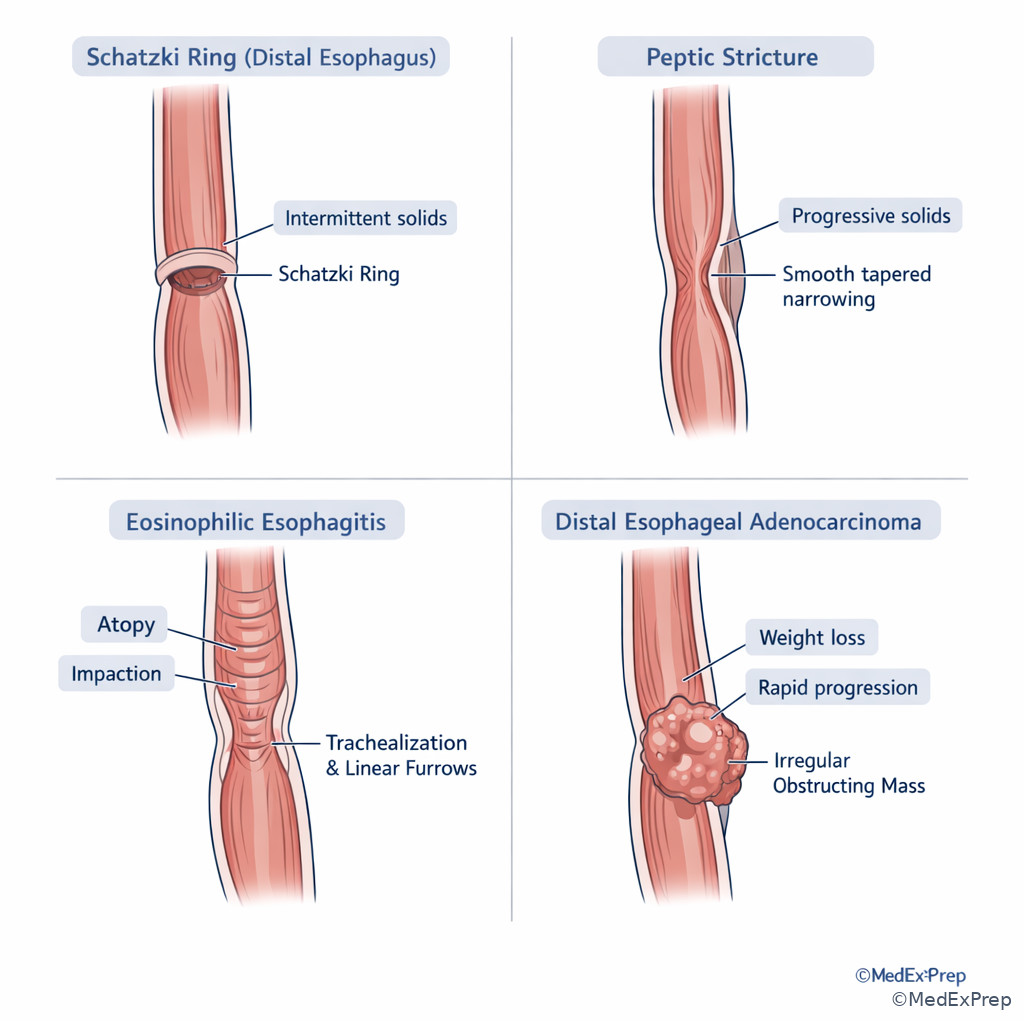
High-Yield Connection: This concept is tested alongside GERD Diagnostic Strategy. Know both the reflux story that suggests peptic stricture and the rule that dysphagia is an alarm symptom requiring endoscopic evaluation rather than empiric-only therapy.
Clinician Action: Diagnose using pattern plus one defining clue: atopy, chronic GERD, rapid progression, or early liquid involvement. Order EGD with biopsies when EoE is possible and urgent EGD with biopsy when malignancy is concerning. Treat based on confirmed cause, not symptom overlap alone. Refer/Escalate urgently for significant weight loss, complete obstruction, or suspected cancer.
B Worked example
A 34-year-old man with asthma, allergic rhinitis, and eczema presents after a second steak impaction in 1 year that resolved spontaneously in the emergency department. He reports several years of intermittent solid-food dysphagia but drinks liquids easily between episodes. He also has occasional heartburn, which is the tempting but incomplete clue. CBC shows mild eosinophilia, though that finding alone is neither required nor diagnostic. What is the most likely underlying disorder and best next test?
Reasoning chain: Identify task: choose the leading diagnosis and diagnostic strategy. Extract key facts: young man, atopy, recurrent impactions, intermittent solids dysphagia, relative preservation of liquid swallowing. Apply rule: this pattern strongly favors eosinophilic esophagitis. Eliminate distractors: peptic stricture usually progresses and is more strongly linked to long-standing reflux without atopic pattern; achalasia affects liquids early; Schatzki ring causes intermittent solids dysphagia but atopy and recurrent impactions strongly push EoE. Verify: EGD with esophageal biopsies is the best next step.
C Exam trap
Common wrong answer: Schatzki ring.
Why it is tempting: Ring and EoE both cause intermittent solid-food dysphagia and food impaction.
Single clue that eliminates it: Atopic disease with recurrent impactions in a younger patient strongly favors eosinophilic esophagitis, and biopsies are essential even if the endoscopy is not dramatically abnormal.
D Checkpoint
Question: A 67-year-old man with prior tobacco use, hypertension, and coronary disease has 3 months of rapidly progressive dysphagia that started with meats and now includes liquids. He has unintentionally lost 8 kg and has new iron deficiency anemia. Which diagnosis should be considered most likely until proven otherwise?
- Peptic stricture
- Achalasia
- Esophageal malignancy
- Schatzki ring
Answer: C. Esophageal malignancy.
- A is tempting because chronic reflux can produce progressive solid dysphagia, but wrong because rapid course, weight loss, and iron deficiency are stronger cancer signals.
- B is tempting because liquids are now involved, but wrong because achalasia classically affects liquids from the outset rather than after progressive solid obstruction.
- C is tempting and right because older age with rapid progression and weight loss is malignant until proven otherwise.
- D is tempting because rings cause meat dysphagia, but wrong because Schatzki ring is usually intermittent and nonprogressive.
If you missed this: Review 1.1.1.3 Application: time course and associated clues that identify the likely lesion — focus on the discriminator that rapid progression plus weight loss shifts the differential toward cancer, not benign obstruction.
1.1.1.6 Application: choosing the best initial test
A Explanation
After pattern recognition comes the board-tested operational question: What is the most appropriate next test? For most adults with esophageal dysphagia, the answer is upper endoscopy because it directly identifies mucosal lesions, strictures, rings, malignancy, retained food, and allows biopsy and therapy. Choose barium esophagram first when subtle rings/webs are suspected, when there is concern for a proximal lesion, when perforation risk or anatomy warrants a nonendoscopic outline first, or when aspiration-focused localization is needed in an oropharyngeal pattern. Choose high-resolution manometry when EGD and often barium evaluation do not explain dysphagia and a motility disorder remains likely.
WHY THIS IS TESTED: Examinees often know the disease but choose the wrong sequence. The board usually rewards a stepwise rule: exclude structural disease before manometry. It also tests the alarm-symptom rule by making empiric PPI look appealing in a patient with reflux symptoms plus dysphagia.
Key rule: In a patient with true esophageal dysphagia, especially with alarm features, do not stop at empiric reflux therapy; EGD is usually the best initial test.
If the stem suggests food impaction with inability to handle secretions, that is not an outpatient testing question; it is an urgent endoscopic management situation. If EGD is normal but suspicion for achalasia remains, then manometry becomes the confirmatory test. Upcoming lessons will expand this in Motility Testing Concepts, but the current exam-safe principle is that manometry is a downstream test after structural evaluation. See Fig 4.
Exam takeaway: Most esophageal dysphagia goes to EGD first, while manometry is reserved for suspected motility disorders after obstruction is excluded.
flowchart TD
A[Dysphagia] --> B{Oropharyngeal or esophageal?}
B -->|Oropharyngeal| C[Modified barium swallow or swallow evaluation]
B -->|Esophageal| D{Alarm or structural concern?}
D -->|Yes usually| E[EGD first]
D -->|Subtle ring proximal lesion aspiration nuance| F[Barium esophagram may help]
E --> G{EGD explains symptoms?}
G -->|No and motility suspected| H[High-resolution manometry]
G -->|Yes| I[Treat cause] | Clinical scenario | Best initial test | Why this test wins | Common wrong option |
|---|---|---|---|
| Progressive esophageal dysphagia with weight loss | EGD | Detects cancer/stricture and allows biopsy | Empiric PPI |
| Intermittent steakhouse dysphagia, subtle ring suspected | EGD or barium esophagram | Rings may be well characterized on contrast study | Manometry |
| Normal EGD but solids and liquids from onset | Manometry | Confirms achalasia or major motility disorder | Repeat PPI escalation |
| Coughing immediately with swallowing | Modified barium swallow | Assesses aspiration/oropharyngeal phase | Routine EGD first |
| Acute complete food impaction with drooling | Urgent EGD | Therapeutic and diagnostic | Outpatient barium study |
Exam takeaway: Remember test order by matching each modality to the problem it answers best.
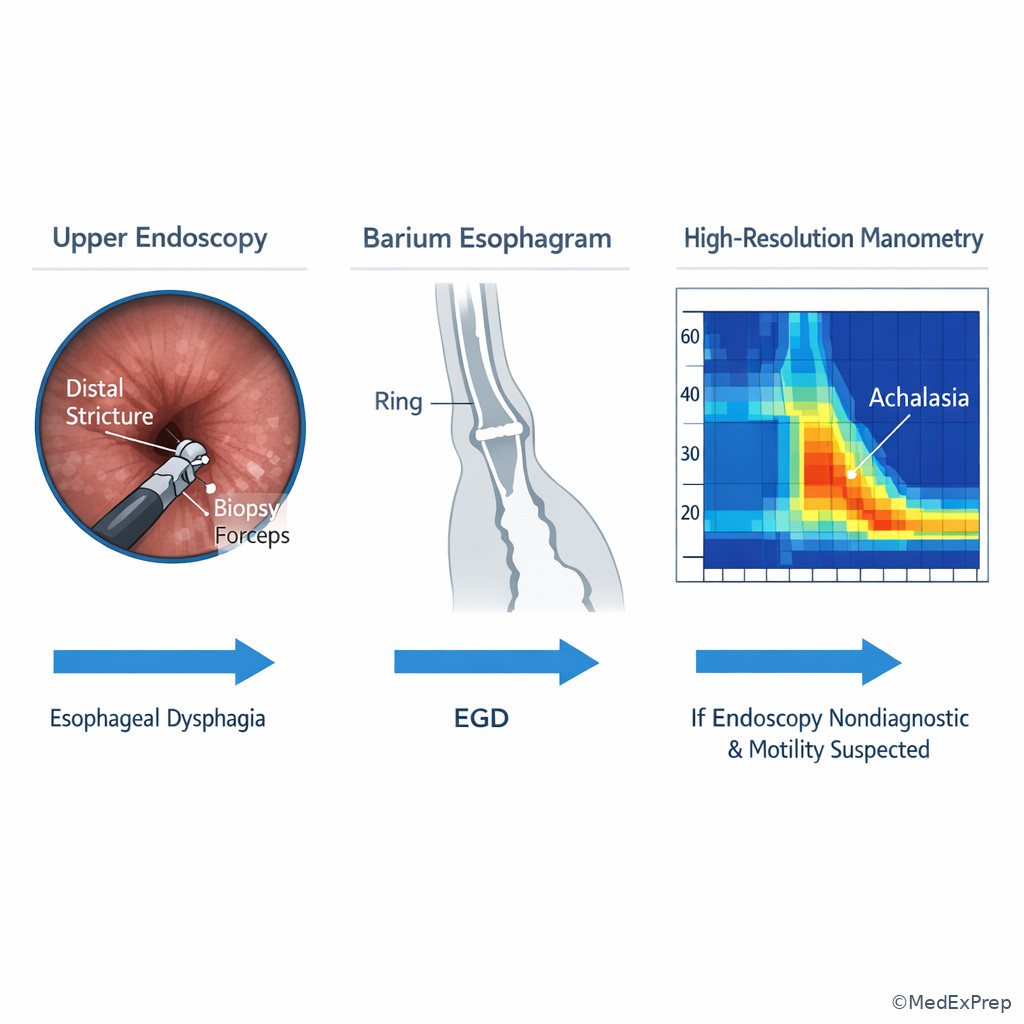
High-Yield Connection: This topic overlaps directly with Motility Testing Concepts. On exam day, pair the symptom pattern here with the confirmatory role of high-resolution manometry there; the common trap is using manometry too early.
Clinician Action: Diagnose the dominant pattern before choosing a test. Order EGD for most esophageal dysphagia, barium-based swallow testing for oropharyngeal aspiration or selected ring/proximal concerns, and manometry only after structural disease is excluded. Treat complete obstruction urgently rather than scheduling elective testing. Refer/Escalate to emergency endoscopy for food impaction with drooling or inability to handle secretions.
B Worked example
A 51-year-old woman with Sjogren syndrome, chronic opioid use for degenerative spine disease, and depression reports 6 months of dysphagia to both solids and liquids from the start, with nocturnal regurgitation and chest pressure. She has no weight loss. A prior EGD done 2 weeks ago was normal except retained saliva. The tempting wrong clue is the opioid use, which can indeed affect motility but does not itself establish the exact disorder. The task is the next diagnostic step.
Reasoning chain: Identify task: choose the next test. Extract key facts: solids and liquids from onset, regurgitation, normal EGD, retained saliva. Apply rule: structural disease has been reasonably excluded and motility remains likely. Eliminate distractors: repeat EGD is low yield; barium may support but is not the definitive next confirmatory test in this sequence; empiric PPI is not targeted. Verify: high-resolution manometry is the best next step.
C Exam trap
Common wrong answer: Immediate manometry in any patient with solids-and-liquids dysphagia.
Why it is tempting: Early liquid involvement is strongly associated with motility disorders.
Single clue that eliminates it: Structural disease must still be excluded first; the sequence matters, so EGD usually precedes manometry.
D Checkpoint
Question: A 63-year-old man with obesity, chronic heartburn, and new 4-month progressive solid-food dysphagia presents for evaluation. He has lost 4 kg and now avoids meat. What is the most appropriate next step?
- Empiric twice-daily proton pump inhibitor therapy for 8 weeks
- Upper endoscopy
- High-resolution manometry
- Ambulatory pH impedance testing
Answer: B. Upper endoscopy.
- A is tempting because chronic GERD can cause peptic stricture, but wrong because dysphagia is an alarm symptom requiring endoscopic evaluation.
- B is tempting and right because progressive esophageal dysphagia with weight loss requires direct visualization and possible biopsy.
- C is tempting because motility disorders can cause dysphagia, but wrong because the pattern is solids-first progression suggesting obstruction.
- D is tempting in reflux evaluation, but wrong because pH testing does not evaluate obstructing lesions and is not the initial answer for alarm dysphagia.
If you missed this: Review 1.1.1.4 Application: choosing the best initial test — focus on the rule that true dysphagia is an alarm symptom, making EGD the usual first test for esophageal complaints.
- Most adults with esophageal dysphagia → EGD first.
- True or False: High-resolution manometry is usually the best initial test when achalasia is suspected clinically. False.
- If the stem includes inability to handle secretions with food impaction, think urgent endoscopy rather than outpatient testing.
1.1.1.7 Integration: alarm features, dangerous mimics, and when to escalate
A Explanation
The final integration step is deciding how urgently to act and which dangerous mimic to avoid missing. Choose urgent endoscopic evaluation when dysphagia is progressive, associated with significant weight loss, iron deficiency, recurrent aspiration, complete obstruction, or inability to tolerate oral intake. Choose urgent therapeutic endoscopy for food impaction with drooling or inability to handle secretions. Consider pseudoachalasia when the history sounds like achalasia but the patient is older, symptoms are rapidly progressive, and weight loss is prominent; these patients may have malignancy at the GE junction causing impaired LES opening.
WHY THIS IS TESTED: ABIM-style stems often place achalasia and cancer side by side. Both can cause dysphagia to solids and liquids, regurgitation, and weight loss. The single resolving feature is often tempo: longstanding gradual symptoms favor primary achalasia; short, rapidly progressive symptoms in an older patient favor cancer-related pseudoachalasia.
Key rule: Older age, short symptom duration, and major weight loss should make you reject uncomplicated primary achalasia as the default answer and prioritize malignancy exclusion.
Another dangerous mimic is assuming that odynophagia equals obstruction. In reality, odynophagia shifts you toward ulcerative or infectious esophagitis, especially in immunocompromised patients or after pill injury. A third practical escalation point is aspiration risk in frail neurologic patients. Even if the stem is "about dysphagia," the safest answer may be hospitalization or urgent swallow protection when recurrent aspiration pneumonia, dehydration, or failure to handle secretions is present. See Fig 5.
Exam takeaway: Urgency is driven by cancer features, complete obstruction, aspiration risk, and pseudoachalasia clues rather than by dysphagia alone.
flowchart TD
A[Dysphagia recognized] --> B{Immediate danger?}
B -->|Drooling cannot handle secretions| C[Urgent therapeutic EGD]
B -->|Aspiration pattern with instability| D[Urgent swallow protection evaluation]
B -->|No immediate danger| E{Cancer or pseudoachalasia clues?}
E -->|Older age weight loss rapid progression anemia| F[Expedited EGD and biopsy]
E -->|No| G[Pattern-based routine workup]
G --> H[If EGD negative and motility likely proceed to manometry] Exam takeaway: Older age and rapidly progressive obstructive symptoms should trigger malignancy exclusion even when the story resembles achalasia.
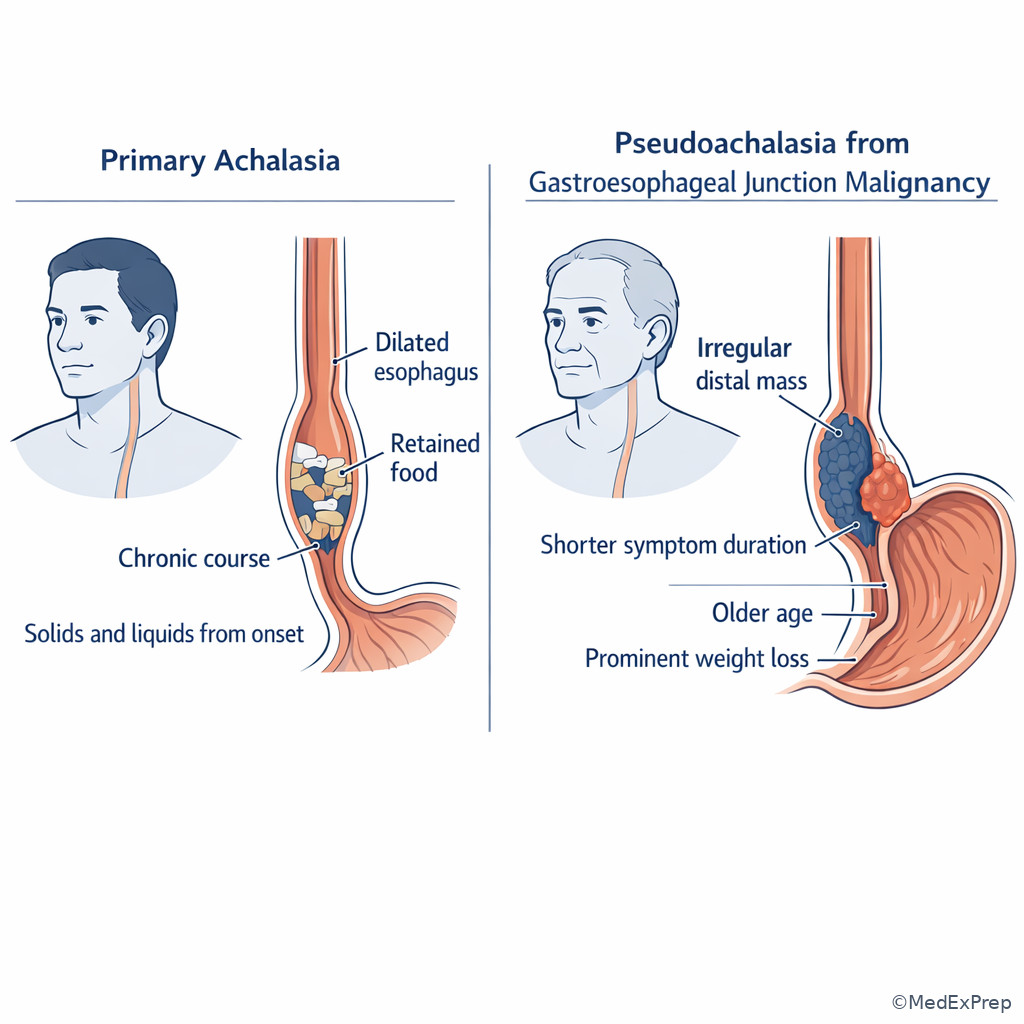
Memory anchor: WARP for high-risk dysphagia needing escalation: Weight loss, Aspiration, Rapid progression, Pooling secretions.
Clinician Action: Diagnose urgency by screening for complete obstruction, aspiration, and malignancy clues. Order expedited or urgent EGD when weight loss, anemia, rapid progression, or secretions pooling are present. Treat food impaction and aspiration risk immediately rather than delaying for outpatient confirmation. Refer/Escalate to emergency endoscopy or hospital admission when the patient cannot manage secretions or maintain hydration.
B Worked example
A 74-year-old woman with diabetes, chronic kidney disease, and remote breast cancer presents with 6 weeks of worsening dysphagia that began with solids and now includes liquids. She has lost 9 kg, wakes at night regurgitating undigested food, and recently developed microcytic anemia. A chest CT performed for cough shows a patulous esophagus, which may tempt you toward achalasia. The task is the best next step and most important diagnostic concern.
Reasoning chain: Identify task: determine urgency and likely dangerous cause. Extract key facts: older age, very short course, rapid progression, major weight loss, anemia. Apply rule: although achalasia-like retention is possible, this profile is classic for pseudoachalasia from malignancy until proven otherwise. Eliminate distractors: routine outpatient manometry is too slow and premature; empiric therapy misses a potentially malignant obstructing lesion; chronic primary achalasia usually evolves over longer time. Verify: expedited EGD with biopsy is the best next step.
C Exam trap
Common wrong answer: Primary achalasia with outpatient manometry.
Why it is tempting: Regurgitation of undigested food and a dilated esophagus are classic achalasia clues.
Single clue that eliminates it: Short duration with major weight loss in an older adult should trigger concern for pseudoachalasia and expedited malignancy evaluation.
D Checkpoint
Question: A 58-year-old man arrives in the emergency department after eating steak. He is spitting into a cup, cannot swallow saliva, and has a history of prior intermittent solid-food dysphagia and asthma. What is the most appropriate next step?
- Discharge with proton pump inhibitor therapy and outpatient endoscopy
- Barium esophagram to define the obstructing lesion
- Urgent upper endoscopy
- High-resolution manometry after symptom improvement
Answer: C. Urgent upper endoscopy.
- A is tempting because reflux may contribute and the patient is otherwise stable, but wrong because inability to handle secretions indicates complete or near-complete obstruction.
- B is tempting because ring or EoE is likely, but wrong because this is a therapeutic emergency rather than a diagnostic contrast-study question.
- C is tempting and right because acute food impaction with drooling requires urgent endoscopic management.
- D is tempting because a motility disorder remains possible, but wrong because acute obstruction takes priority and manometry is not the immediate test.
If you missed this: Review 1.1.1.5 Integration: alarm features, dangerous mimics, and when to escalate — focus on the discriminator that inability to handle secretions converts dysphagia into an urgent endoscopic problem.
Exam Traps & Differentiators
Common traps & distractors: Dysphagia stems are designed to punish reflexive answers. Use the single strongest discriminator in the history before choosing a test or diagnosis.
Most common wrong answer and why: Empiric PPI therapy. It is tempting because heartburn and reflux history are common in dysphagia stems. The problem is that true dysphagia is already an alarm symptom, so empiric reflux treatment alone is usually not the best next step.
| Looks similar | Why it seems right | Single clue that separates it | Exam-safe response |
|---|---|---|---|
| Oropharyngeal dysphagia vs esophageal dysphagia | Patients often point to the neck in both | Coughing/choking/nasal regurgitation at initiation = oropharyngeal | Swallow study rather than routine EGD first |
| Achalasia vs pseudoachalasia | Both can cause regurgitation, weight loss, retained food | Older age + rapid course + marked weight loss = pseudoachalasia concern | Expedited malignancy exclusion with EGD |
| Schatzki ring vs eosinophilic esophagitis | Both cause intermittent solid-food dysphagia and impactions | Atopy/recurrent impaction/younger patient = EoE | EGD with biopsies |
| Peptic stricture vs cancer | Both can cause progressive solid dysphagia | Rapid progression, anemia, substantial weight loss = malignancy until proven otherwise | Urgent EGD with biopsy |
| GERD symptom stem vs dysphagia stem | Both may include heartburn and regurgitation | Presence of dysphagia changes the pathway to endoscopy | Do not use empiric-only GERD strategy |
If the stem says...
- "Coughs when swallowing water" → think oropharyngeal dysphagia.
- "Steak gets stuck every few months" → think ring or eosinophilic esophagitis.
- "Solids and liquids since the beginning" → think motility disorder.
- "Started with solids, now liquids too" → think progressive mechanical obstruction.
- "Older patient with 2 months of rapid worsening and weight loss" → think malignancy or pseudoachalasia.
- "Can’t swallow saliva" → think urgent therapeutic endoscopy.
Cross-topic note: in the upcoming GERD Diagnostic Strategy lesson, typical reflux without alarm symptoms can be managed empirically. That shortcut does not apply once dysphagia appears. In the upcoming Motility Testing Concepts lesson, manometry becomes central, but only after structural disease has been reasonably excluded.
Exam takeaway: Weight loss, rapid progression, anemia, aspiration, and pooling secretions are the red flags that change routine dysphagia evaluation into urgent escalation.
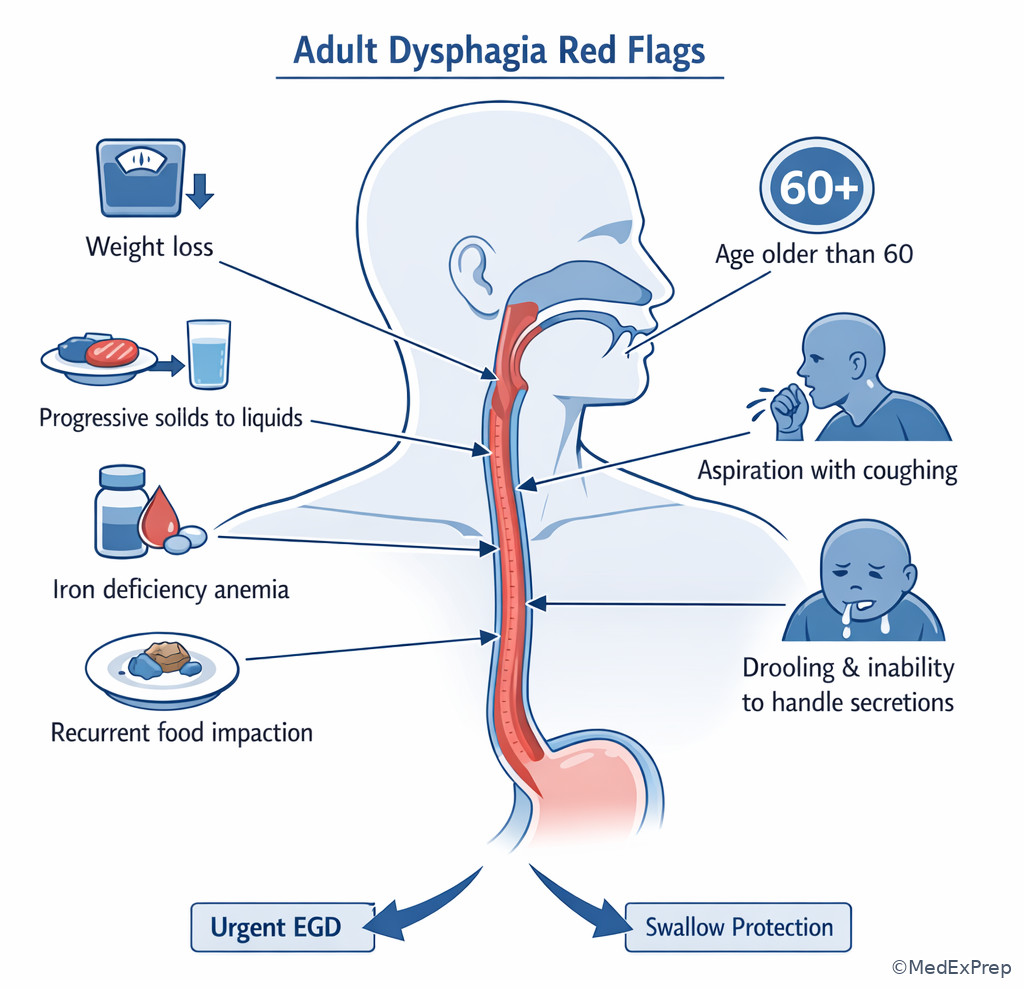
Review connection: The traps above test symptom localization and test sequencing. If any felt unfamiliar, revisit 1.1.1.2 Foundational pattern recognition: mechanical obstruction vs motility disorder and 1.1.1.4 Application: choosing the best initial test before attempting the Self-check quiz.
Algorithm / Approach
Rapid Review
- Oropharyngeal dysphagia → trouble initiating swallow with coughing/aspiration, not chest sticking.
- Esophageal dysphagia → swallow starts normally, then food hangs up.
- Mechanical obstruction → solids only or solids first.
- Motility disorder → solids and liquids from the beginning.
- Schatzki ring → intermittent steak-and-bread dysphagia without steady progression.
- Peptic stricture → chronic GERD plus slowly progressive solid-food dysphagia.
- Eosinophilic esophagitis → atopy plus recurrent food impaction or intermittent solids dysphagia.
- Esophageal malignancy → older age, rapid progression, weight loss, iron deficiency.
- Primary achalasia → early solids-and-liquids dysphagia with regurgitation and later weight loss.
- Pseudoachalasia → achalasia-like symptoms with short duration and marked weight loss in older patient.
- Odynophagia → think inflammatory/infectious or pill injury more than fixed obstruction.
- Most esophageal dysphagia → EGD first.
- Manometry → confirmatory test after structural disease is excluded.
- Dysphagia plus inability to handle secretions → urgent endoscopy, not outpatient workup.
Memory anchor: START the dysphagia stem by asking: Swallow initiated? Type of food? Alarm features? Rate of progression? Test sequence?
Self-check quiz
1. A 76-year-old man with prior stroke, hypertension, and mild cognitive impairment reports coughing and choking immediately when trying to swallow water. He says food feels "stuck in the throat." Which pattern is most likely?
- Oropharyngeal dysphagia
- Mechanical esophageal obstruction
- Primary achalasia
- Functional globus
2. A 42-year-old woman with no neurologic disease reports 6 months of dysphagia to meats and bread, but liquids have been normal from the beginning. Which category best fits this presentation?
- Mechanical obstruction
- Primary motility disorder
- Oropharyngeal transfer dysfunction
- Infectious esophagitis
3. A 64-year-old man with obesity, chronic reflux, and remote tobacco use has 4 months of progressive solid-food dysphagia and 5-kg weight loss. He asks whether he should just increase his acid suppression. What is the most appropriate next step?
- Increase proton pump inhibitor dosing and reassess in 8 weeks
- Upper endoscopy
- High-resolution manometry
- Ambulatory pH monitoring
4. A 33-year-old man with asthma, allergic rhinitis, and eczema has recurrent food impactions and intermittent dysphagia to solid foods. Heartburn occurs once weekly. Which is the most appropriate next step?
- Empiric proton pump inhibitor therapy alone
- Upper endoscopy with esophageal biopsies
- High-resolution manometry
- Speech and swallow evaluation
5. A 55-year-old woman with diabetes, chronic back pain on long-term opioids, and anxiety reports dysphagia to solids and liquids since symptom onset 7 months ago. EGD yesterday was normal except retained saliva. Which is the most appropriate next diagnostic test?
- Repeat EGD with empiric dilation
- High-resolution manometry
- Ambulatory pH impedance monitoring
- Modified barium swallow study
6. A 71-year-old man with hypertension, stage 3 chronic kidney disease, and former tobacco use reports 2 months of worsening dysphagia that began with solids and now includes liquids. He has lost 10 kg and has microcytic anemia. CT chest notes a dilated esophagus with retained material. Which diagnosis is most likely?
- Primary achalasia
- Pseudoachalasia due to malignancy
- Schatzki ring
- Eosinophilic esophagitis
7. A 49-year-old man with seasonal allergies and no weight loss describes 5 years of intermittent solid-food dysphagia, especially with steak, and two prior self-limited food impactions. Liquids are normal between episodes. Which diagnosis is most likely?
- Esophageal adenocarcinoma
- Eosinophilic esophagitis
- Primary achalasia
- Peptic stricture
8. A 60-year-old man presents after eating meat and now cannot swallow saliva. He has a history of intermittent solid-food dysphagia and atopic dermatitis. Oxygenation is normal, and he is hemodynamically stable. What is the most appropriate next step?
- Urgent upper endoscopy
- Barium esophagram
- Outpatient manometry after discharge
- Empiric swallowed topical steroid therapy without further testing
Answer key
1. Correct answer: A. Oropharyngeal dysphagia.
- A: Tempting because prior stroke strongly suggests a transfer-phase swallowing problem; correct because coughing immediately with liquids indicates impaired initiation and aspiration risk. The single clue is choking at swallow initiation. Source: Yadlapati et al.; Harrison's.
- B: Tempting because the patient says food is "stuck," but incorrect because mechanical esophageal obstruction causes post-swallow sticking, usually with solids more than liquids. The discriminating clue is immediate coughing. Source: Harrison's Principles of Internal Medicine.
- C: Tempting because liquids can be difficult in achalasia, but incorrect because achalasia does not cause nasal/oropharyngeal misdirection at the moment swallowing begins. The discriminating clue is initiation difficulty. Source: ACG clinical guidance on esophageal physiologic testing.
- D: Tempting because some patients describe throat symptoms vaguely, but incorrect because globus does not cause true choking with liquids. The discriminating clue is objective aspiration-pattern symptoms. Source: Harrison's.
If you missed this: Review 1.1.1.1 Foundational localization: oropharyngeal vs esophageal dysphagia — focus on initiation difficulty and aspiration cues as the key discriminator.
2. Correct answer: A. Mechanical obstruction.
- A: Tempting because solids-only symptoms classically imply a narrowed lumen; correct because preserved liquid swallowing from the beginning fits structural disease. The single clue is solids only. Source: Harrison's; ASGE/ACG dysphagia approaches.
- B: Tempting because any dysphagia could reflect motility, but incorrect because motility disorders typically involve liquids from the outset. The discriminating clue is normal liquids. Source: ACG physiologic testing guideline.
- C: Tempting if the patient localizes symptoms to the throat, but incorrect because no coughing or initiation trouble is present. The clue is food-specific post-swallow dysphagia. Source: Harrison's.
- D: Tempting because esophagitis can cause discomfort with swallowing, but incorrect because infectious esophagitis more often presents with odynophagia than isolated solids-only dysphagia. The clue is food consistency pattern, not pain. Source: Harrison's.
If you missed this: Review 1.1.1.2 Foundational pattern recognition: mechanical obstruction vs motility disorder — focus on the solids-only versus solids-and-liquids rule.
3. Correct answer: B. Upper endoscopy.
- A: Tempting because chronic reflux suggests peptic stricture, and intensifying acid suppression can be useful later; incorrect because progressive dysphagia with weight loss is an alarm pattern requiring direct evaluation. The discriminating clue is dysphagia plus weight loss. Source: ACG GERD and dysphagia principles; Harrison's.
- B: Tempting because it can diagnose both benign stricture and cancer; correct because EGD directly visualizes the lesion and allows biopsy. The clue is progressive esophageal dysphagia. Source: ACG/ASGE guideline-based evaluation.
- C: Tempting because motility disorders can cause dysphagia, but incorrect because the history is structural until proven otherwise and manometry comes after structural exclusion. The clue is solids-first progression. Source: ACG physiologic testing guideline.
- D: Tempting because reflux symptoms are present, but incorrect because pH testing does not evaluate obstructing lesions and is not the priority in alarm dysphagia. The clue is alarm symptom overrides reflux workup. Source: ACG GERD guidance.
If you missed this: Review 1.1.1.4 Application: choosing the best initial test — focus on the rule that dysphagia is an alarm symptom, so EGD is usually first.
4. Correct answer: B. Upper endoscopy with esophageal biopsies.
- A: Tempting because reflux is common and PPI may eventually be part of EoE-directed care in some contexts; incorrect because recurrent impaction and atopy require diagnostic evaluation, not empiric monotherapy alone. The clue is recurrent impactions. Source: ACG eosinophilic esophagitis guideline principles.
- B: Tempting because it addresses both structural lesions and tissue diagnosis; correct because EoE is strongly suspected and biopsy is required. The clue is young atopic patient with intermittent solid dysphagia and impactions. Source: ACG EoE guideline.
- C: Tempting because liquids can be involved during impactions, but incorrect because the baseline pattern is intermittent mechanical-type solid dysphagia, not primary motility failure. The clue is normal liquids between episodes. Source: Harrison's.
- D: Tempting if one misclassifies the complaint as transfer dysfunction, but incorrect because there is no coughing or aspiration at initiation. The clue is post-swallow food sticking. Source: Harrison's.
If you missed this: Review 1.1.1.3 Application: time course and associated clues that identify the likely lesion — focus on atopy and recurrent food impaction as the key EoE discriminator.
5. Correct answer: B. High-resolution manometry.
- A: Tempting because empiric dilation is sometimes used for certain obstructive lesions, but incorrect because the EGD was not showing a fixed narrowing and the history suggests motility. The clue is normal EGD with solids and liquids from onset. Source: ACG physiologic testing guideline.
- B: Tempting because it is the confirmatory test for achalasia and major motility disorders; correct because structural disease has been reasonably excluded. The clue is persistent motility-pattern symptoms after nondiagnostic EGD. Source: Yadlapati et al.
- C: Tempting because chest symptoms can overlap with reflux, but incorrect because pH testing does not establish a motility diagnosis. The clue is solids and liquids dysphagia, not unexplained reflux. Source: ACG GERD guidance.
- D: Tempting because contrast swallow studies are useful in some settings, but incorrect because modified barium swallow is for oropharyngeal transfer dysfunction, not established esophageal motility workup. The clue is completed swallow with esophageal symptoms. Source: Harrison's.
If you missed this: Review 1.1.1.4 Application: choosing the best initial test — focus on the sequencing rule that manometry follows exclusion of structural disease.
6. Correct answer: B. Pseudoachalasia due to malignancy.
- A: Tempting because retained material and a dilated esophagus mimic classic achalasia; incorrect because the symptom duration is short and weight loss/anemia are too concerning for cancer. The discriminating clue is older age with rapid progression and microcytic anemia. Source: Harrison's; ACG physiologic testing guideline.
- B: Tempting because the board often tests this mimic in older adults; correct because malignancy at the GE junction can produce achalasia-like obstruction. The clue is rapid tempo plus cancer features. Source: Harrison's.
- C: Tempting because meat dysphagia can suggest ring disease, but incorrect because rings are intermittent and nonprogressive, not associated with major weight loss and anemia. The clue is rapid progression. Source: Harrison's.
- D: Tempting because EoE can cause impactions, but incorrect because this patient lacks the age pattern and atopic history, and EoE does not explain the malignant tempo. The clue is older patient with anemia and marked weight loss. Source: ACG EoE guidance.
If you missed this: Review 1.1.1.5 Integration: alarm features, dangerous mimics, and when to escalate — focus on the pseudoachalasia discriminator of older age, short symptom duration, and marked weight loss.
7. Correct answer: B. Eosinophilic esophagitis.
- A: Tempting because any chronic dysphagia raises cancer concern, but incorrect because the long intermittent course without weight loss argues strongly against malignancy. The clue is five-year intermittent pattern. Source: Harrison's.
- B: Tempting because allergies and recurrent impactions are classic; correct because the combination of atopy and episodic solid-food dysphagia strongly favors EoE. The clue is seasonal allergies plus impactions. Source: ACG EoE guideline.
- C: Tempting because achalasia can present with dysphagia for years, but incorrect because liquids are normal between episodes and the symptoms are not solids-and-liquids from onset. The clue is liquids normal between episodes. Source: ACG physiologic testing guideline.
- D: Tempting because GERD-related narrowing can cause solid dysphagia, but incorrect because peptic stricture is usually progressive rather than episodic and is less tied to atopy. The clue is intermittent impaction pattern. Source: Harrison's.
If you missed this: Review 1.1.1.3 Application: time course and associated clues that identify the likely lesion — focus on atopy plus recurrent impaction as the discriminator for eosinophilic esophagitis over ring or peptic stricture.
8. Correct answer: A. Urgent upper endoscopy.
- A: Tempting because it both diagnoses and relieves obstruction; correct because inability to swallow saliva indicates complete or near-complete food impaction requiring urgent therapeutic intervention. The clue is cannot swallow secretions. Source: ASGE guidance on foreign body/food impaction; Harrison's.
- B: Tempting because a ring or EoE-related narrowing is likely, but incorrect because barium study delays definitive treatment and is not appropriate in a patient with acute obstructive symptoms and pooled secretions. The clue is urgent therapeutic need. Source: ASGE guidance.
- C: Tempting because manometry may later clarify the cause in select patients, but incorrect because acute obstruction must be managed first and the pattern already suggests structural disease or EoE. The clue is active impaction. Source: ACG physiologic testing guideline.
- D: Tempting because his atopic dermatitis suggests EoE, and swallowed steroid may be used after diagnosis; incorrect because medical therapy does not address immediate obstruction. The clue is secretions pooling now. Source: ACG EoE guidance; ASGE guidance.
If you missed this: Review 1.1.1.5 Integration: alarm features, dangerous mimics, and when to escalate — focus on the rule that inability to handle secretions requires urgent endoscopic management.
Keep going with the full ABIM Gastroenterology Prep Course (GI)
You just studied the way members do, in the same lesson interface. Full access unlocks every lesson, the question bank and flashcards for a full year.
One payment · 1 year of access · No auto-renewal