1.1.1 - Cancer Screening Frameworks
Cancer Screening Frameworks
What you'll learn
- DOMAIN: Preventive Care → Adult screening and immunization decisions: Choose when screening is appropriate, when it is not, and when shared decision-making changes the answer.
- DOMAIN: Population Health → Evidence-based prevention and social context: Apply age, sex, smoking history, family history, life expectancy, and patient values to screening selection.
- DOMAIN: Adult Medicine → Diagnostic reasoning and management: Distinguish average-risk from increased-risk patients and pick the correct first screening test or referral pathway.
- DOMAIN: Women’s Health → Gynecologic/obstetric/preventive care: Separate breast, cervical, colorectal, lung, and prostate screening frameworks without mixing age cutoffs or follow-up logic.
- DOMAIN: Ethics/Communication → Shared decision-making, confidentiality, professionalism, and safety: Counsel patients on benefits, harms, false positives, overdiagnosis, and when to stop screening.
- DOMAIN: Preventive Care → Adult cancer screening decisions
- DOMAIN: Population Health → Risk-based prevention and counseling
- DOMAIN: Women’s Health → Cervical and breast screening pathways
- DOMAIN: Adult Medicine → Colorectal, lung, and prostate screening interpretation
- DOMAIN: Ethics/Communication → Shared decision-making for preference-sensitive screening
Why it matters
- ABFM questions often test one overlooked detail that changes screening from appropriate to inappropriate: symptoms, risk level, prior history, or life expectancy.
- In family medicine, cancer screening decisions are longitudinal: you must balance benefit, harm, follow-up burden, comorbidity, and patient preference.
- Many wrong answers are real tests ordered at the wrong age, wrong interval, wrong risk category, or wrong clinical setting.
- Primary care board questions reward framework thinking more than memorizing every interval detail; durable logic is the exam-safe strategy.
Key Terms & Must-Know Facts
1.1.1.1 Key terms
- Screening: testing asymptomatic people to detect disease early.
- Average risk: no major personal or family history that changes the routine pathway.
- Increased risk: personal history, high-risk syndrome, or strong family history requiring earlier or different screening.
- Shared decision-making: patient-clinician discussion when benefits and harms are closely balanced.
- False positive: abnormal screening result without disease.
- Overdiagnosis: detection of disease that would not have become clinically important.
- Life expectancy: expected remaining years of life; used when deciding whether screening benefit is likely to occur.
- Pack-year: smoking exposure calculation used for lung screening eligibility.
- USPSTF framework: population screening guidance emphasizing balance of benefit and harm.
- High-risk genetic syndrome: inherited condition such as Lynch syndrome or BRCA-associated hereditary cancer risk.
- Primary HPV testing: cervical screening method using high-risk HPV detection.
- LDCT: low-dose CT for lung cancer screening.
- PSA: prostate-specific antigen used in prostate cancer screening discussions.
1.1.1.2 Must-know facts
- Screening applies to asymptomatic patients; symptoms change the question from screening to diagnostic evaluation.
- Age alone is never enough; risk factors and prior results matter.
- Average-risk colorectal screening begins at 45 in current common U.S. frameworks.
- Cervical cancer screening depends on age, test type, and hysterectomy status.
- Lung cancer screening requires age plus smoking history; smoking exposure is the discriminator.
- Breast cancer screening in average-risk women is common exam territory because interval details vary slightly by organization; use durable shared decision logic.
- Prostate screening is preference-sensitive; do not treat PSA as automatic population screening for all men.
- Do not continue routine screening when prior removal of the organ or limited life expectancy makes benefit unlikely.
| Screening area | Core average-risk framework | Key discriminator | Common board error |
|---|---|---|---|
| Breast | Routine mammography in appropriate age range; confirm current interval guidance | Average risk vs BRCA-level risk | Applying average-risk screening to a strong hereditary-risk patient |
| Cervical | Age-based screening with cytology and/or HPV depending on age | Age and cervix present? | Screening after total hysterectomy for benign disease |
| Colorectal | Begin at 45 in average-risk adults | Screening test choice and follow-up of positive stool test | Repeating stool test after a positive FIT instead of colonoscopy |
| Lung | Annual LDCT for eligible current/recent heavy smokers | Pack-years and quit date | Ordering chest x-ray or screening never-smokers |
| Prostate | Individualized PSA discussion in relevant age range | Shared decision-making | Automatic PSA in a very elderly man with limited life expectancy |
Core content
1.1.1.3 Foundational screening logic: start with the right patient, not the right test
A Explanation
The first board-style decision conflict is simple: Is this a screening question or a diagnostic workup question? The single rule that resolves it is whether the patient is asymptomatic and average-risk. Screening frameworks are built for asymptomatic populations. Once the stem includes rectal bleeding, a breast mass, postcoital bleeding, hemoptysis, unexplained weight loss, or iron deficiency anemia, you are no longer choosing a screening test. You are choosing a diagnostic evaluation.
Next conflict: average risk vs increased risk. Family history, hereditary syndromes, inflammatory bowel disease, prior high-grade lesions, prior cancer, chest radiation, or major smoking exposure may move the patient off the routine pathway. The board often hides this in one line of history. WHY THIS IS TESTED: the exam wants to see whether you can reject a familiar average-risk screening answer when one risk clue requires earlier screening, a different test, or specialist referral.
Third conflict: benefit now vs benefit too late. Screening only helps when life expectancy and functional status are sufficient for early detection to matter. In frail older adults with major comorbidity, continuing routine screening may create more harm than benefit.
Key rule: Ask these in order: Is the patient asymptomatic? Is this average risk? Is the organ present? Is the patient in the age/risk group where benefit exceeds harm? If any answer changes, the screening pathway changes.
Recall: This is the first topic in the course, so use it as your template for later lessons. In upcoming Cardiometabolic Risk Screening, the same logic returns: asymptomatic screening framework first, then risk modifiers, then confirmation testing.
See Fig 1 for the board-ready sequence that prevents most screening errors.
Exam takeaway: Start with symptoms, risk level, organ status, and life expectancy before choosing any test.
flowchart TD
A[Patient encounter] --> B{Symptoms or red flags?}
B -->|Yes| C[Diagnostic evaluation, not screening]
B -->|No| D{Average risk?}
D -->|No| E[Use earlier or different risk-based pathway]
D -->|Yes| F{Age and organ still eligible?}
F -->|No| G[Do not screen routinely]
F -->|Yes| H[Choose recommended screening test and interval] Exam takeaway: One overlooked qualifier usually explains why the tempting test is wrong.
Exam takeaway: Screening begins with symptom review, family history, and risk categorization before ordering tests.
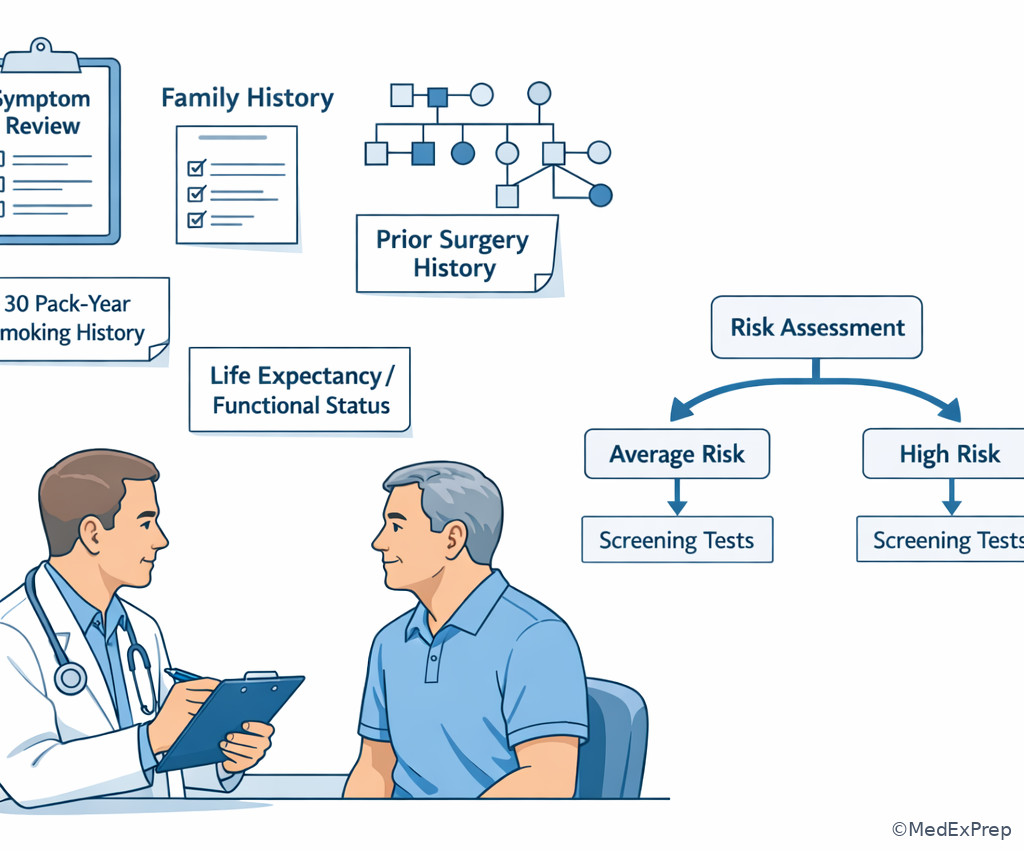
Clinician Action: Diagnose: determine whether this is truly an asymptomatic screening visit. Order: only guideline-concordant screening tests matched to age and risk. Treat: counsel on benefits, harms, and follow-up if abnormal. Refer/Escalate: shift to diagnostic evaluation or specialist referral when symptoms, hereditary syndromes, or prior high-risk lesions are present.
B Worked example
A 52-year-old man presents for an annual visit. He has obesity, well-controlled hypertension, and chronic GERD. He asks for “whatever cancer tests I’m due for.” He reports intermittent bright red blood on toilet paper for 2 months, attributed to hemorrhoids, and a 10-pack-year smoking history that ended 25 years ago. His father had colon cancer at age 81. CBC shows mild microcytosis discovered incidentally. The task is to identify the best next step, not list every test due.
Reasoning chain: Identify task: screening vs diagnostic evaluation. Extract key facts: age 52 would ordinarily qualify for average-risk colorectal screening, but rectal bleeding plus microcytosis means this is no longer a pure screening scenario. Apply rule: symptoms or anemia shift the question to diagnostic colon evaluation. Eliminate distractors: annual FIT is tempting because he is screening-age, but positive-symptom context invalidates stool-based screening logic. LDCT is wrong because smoking exposure is too low and quit date too remote. PSA may be discussed, but it is not the priority raised by the stem. Verify: colonoscopy is the correct next step because the clue that changes everything is symptomatic bleeding with anemia.
C Exam trap
Common wrong answer: Order a stool-based colorectal screening test because the patient is over 45.
Why it is tempting: The age trigger is correct for average-risk screening, and hemorrhoids provide a plausible benign explanation for bleeding.
Single clue that eliminates it: Overt rectal bleeding with microcytosis means this is a diagnostic colon evaluation question, not routine screening.
D Checkpoint
Question: A 67-year-old woman with osteoarthritis and well-controlled type 2 diabetes presents for a preventive visit. She had a total hysterectomy for fibroids at age 49, no history of CIN2+, and no vaginal bleeding. Which screening test is most appropriate to continue routinely?
- Cervical cytology every 3 years
- Primary HPV testing every 5 years
- No cervical cancer screening
- Annual pelvic ultrasound
Answer: C. No cervical cancer screening.
- A: Tempting because it matches a common cervical screening interval; wrong because total hysterectomy for benign disease with no high-grade history removes the screening target.
- B: Tempting because HPV-based strategies are modern and high-yield; wrong because there is no cervix to screen in this scenario.
- C: Correct because benign total hysterectomy without prior CIN2+ means routine cervical screening should stop.
- D: Tempting because learners confuse gynecologic surveillance with cervical screening; wrong because pelvic ultrasound is not a screening substitute for cervical cancer.
If you missed this: Review 1.1.1.1 Foundational screening logic: start with the right patient, not the right test — focus on organ status as the discriminator.
1.1.1.4 Organ-specific frameworks: breast, cervical, colorectal, lung, and prostate
A Explanation
This section is about separating five common screening frameworks that students blend together under pressure. The decision conflict is not “which cancer test is good?” but “which test fits this patient’s organ-specific risk logic?” The single resolving rule is different for each cancer:
- Breast: age and risk category drive mammography decisions; MRI enters for selected very high-risk patients, not routine average-risk screening.
- Cervical: age, test type, and presence of the cervix decide the pathway.
- Colorectal: age 45 starts average-risk screening; stool tests are acceptable screening tools, but a positive stool test requires colonoscopy.
- Lung: age plus sufficient smoking exposure and quit history determine annual LDCT eligibility.
- Prostate: PSA is generally a shared decision conversation, not automatic one-size-fits-all testing.
WHY THIS IS TESTED: the board likes “almost eligible” patients. The wrong answer is often the right test for a slightly different person: a never-smoker getting LDCT, a woman after total hysterectomy still getting Pap tests, or a stool test offered even though colonoscopy is required after a positive result.
See Fig 2 for a compressed comparison grid that is faster to retrieve than paragraphs.
Exam takeaway: Each cancer screening decision hinges on one discriminator—risk, organ status, smoking exposure, or shared decision-making.
flowchart LR
A[Breast] --> A1[Age + risk]
B[Cervical] --> B1[Age + cervix present]
C[Colorectal] --> C1[Age 45+ average risk]
D[Lung] --> D1[Age + pack-years + quit date]
E[Prostate] --> E1[Shared decision-making]
C --> C2[Positive stool test = colonoscopy]
B --> B2[Benign total hysterectomy = stop]
D --> D2[Use LDCT, not chest x-ray]
Exam takeaway: Match the screening test to the organ-specific rule instead of using a generic “screen more” instinct.
Exam takeaway: Visual comparison reduces mix-ups between breast, cervical, colorectal, lung, and prostate screening triggers.
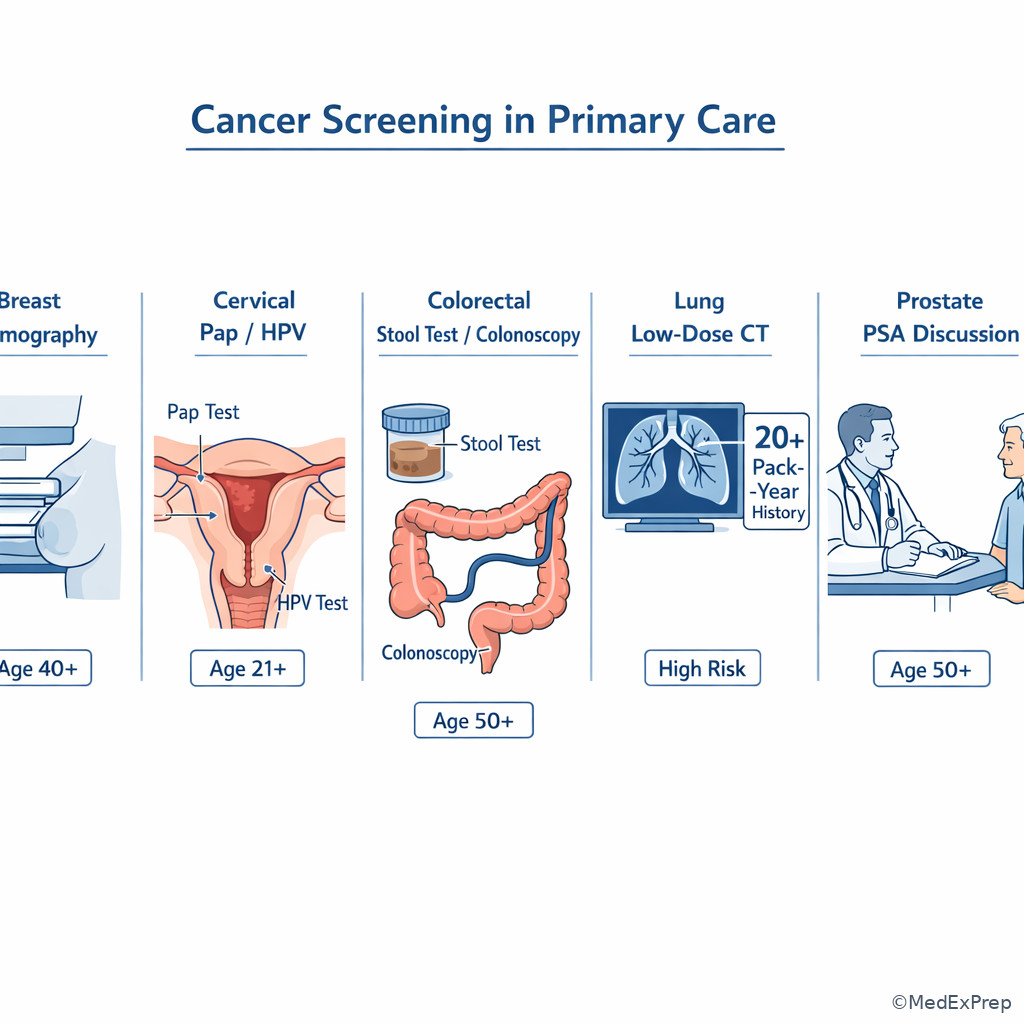
Memory anchor: “B-C-C-L-P” = Breast risk, Cervix present, Colon at 45, Lung pack-years, Prostate preference. When stuck, identify which of these five discriminators the stem is testing.
High-Yield Connection: This concept is tested alongside Infectious Disease Screening. On exam day, distinguish organ-based cancer screening from exposure-based infection screening; one depends mainly on age/risk framework, the other on behavior, pregnancy status, and exposure history.
Clinician Action: Diagnose: define average-risk versus increased-risk status for each organ system. Order: mammography, cervical testing, colorectal screening, LDCT, or PSA discussion only when criteria fit. Treat: counsel on adherence and next-step follow-up after abnormal results. Refer/Escalate: refer high-risk hereditary patients for genetics or specialty screening pathways when indicated.
B Worked example
A 59-year-old woman presents for follow-up of hypertension and asks for “all my screening.” She has obesity, chronic insomnia, and a 30-pack-year smoking history; she quit 10 years ago. She had a normal mammogram 1 year ago and a total hysterectomy for benign fibroids at age 43. A friend told her to request a chest x-ray because she feels fine and “wants a baseline.” The board task is to choose the most appropriate screening test now.
Reasoning chain: Extract key facts: asymptomatic, significant smoking exposure, quit within a window where screening benefit remains relevant, no cervix, recent breast screening already done. Apply rule: lung screening eligibility depends on age plus smoking history, and the correct test is LDCT, not chest x-ray. Eliminate distractors: Pap or HPV testing is wrong because she no longer has a cervix after benign hysterectomy. Chest x-ray is a classic outdated distractor. Repeat mammography immediately is unnecessary because the stem does not indicate she is overdue. Verify: annual LDCT is the best current screening action.
C Exam trap
Common wrong answer: Chest x-ray for lung cancer screening.
Why it is tempting: It sounds simpler, cheaper, and familiar from older practice habits.
Single clue that eliminates it: The evidence-based screening modality is low-dose CT; chest x-ray is not the recommended screening test.
D Checkpoint
Question: A 46-year-old asymptomatic man with obesity and dyslipidemia presents for a routine visit. He has no family history of colorectal cancer, no inflammatory bowel disease, and no prior colonoscopy. Which is the most appropriate statement?
- He should begin average-risk colorectal cancer screening now
- Screening should wait until age 50 because he has no symptoms
- Colorectal screening is only indicated if he chooses colonoscopy over stool testing
- Screening is unnecessary if the digital rectal exam is normal
Answer: A. He should begin average-risk colorectal cancer screening now.
- A: Correct because average-risk colorectal screening now begins at age 45 in common U.S. frameworks.
- B: Tempting because older age 50 cutoffs remain familiar; wrong because this is an outdated threshold.
- C: Tempting because colonoscopy is highly effective; wrong because stool-based screening is also acceptable for average-risk screening.
- D: Tempting because learners overvalue office exam findings; wrong because digital rectal exam does not replace colorectal screening.
If you missed this: Review 1.1.1.2 Organ-specific frameworks: breast, cervical, colorectal, lung, and prostate — focus on the age 45 colorectal starting point for average-risk adults.
- The most common testable reason to stop cervical screening is benign total hysterectomy with no history of CIN2+.
- True or False: Chest x-ray is an acceptable lung cancer screening test in an eligible smoker. False.
- Name the 3 key lung-screening clues: age, pack-years, quit timing.
1.1.1.5 Increased-risk patients: when average-risk screening no longer applies
A Explanation
The decision conflict here is choosing between a familiar routine screening recommendation and a more aggressive risk-based pathway. The resolving rule is this: strong personal or family risk changes both timing and test selection. The board often tests this by giving a patient just old enough for routine screening but also adding one line that should trigger earlier action.
Examples include first-degree relatives with early colorectal cancer, known Lynch syndrome, BRCA-associated hereditary risk, prior chest radiation at a young age, inflammatory bowel disease involving the colon, prior advanced adenomas, prior CIN2+, or heavy tobacco exposure. In these settings, routine “average-risk” timing can be wrong even if the patient technically meets an age threshold.
WHY THIS IS TESTED: it forces you to notice when the more general recommendation should be rejected. Family medicine candidates are expected to recognize who can stay in primary care screening pathways and who needs genetics referral, high-risk surveillance, or specialty co-management.
See Fig 3 for a risk-upgrade map. This figure compresses a high-yield rule: risk factors do not merely add concern; they often switch the entire pathway.
Exam takeaway: A strong personal or family risk factor changes the pathway, not just the level of concern.
flowchart TD
A[Asymptomatic patient] --> B{Any high-risk feature?}
B -->|No| C[Use average-risk screening]
B -->|Yes| D[Reject routine pathway]
D --> E[Consider earlier start]
D --> F[Consider different test]
D --> G[Consider genetics or specialty referral]
D --> H[Document family history precisely] Exam takeaway: One precise family history detail can convert a routine screening question into a referral or earlier-screening question.
Exam takeaway: Detailed family history can move a patient from average-risk screening to genetics referral or earlier surveillance.
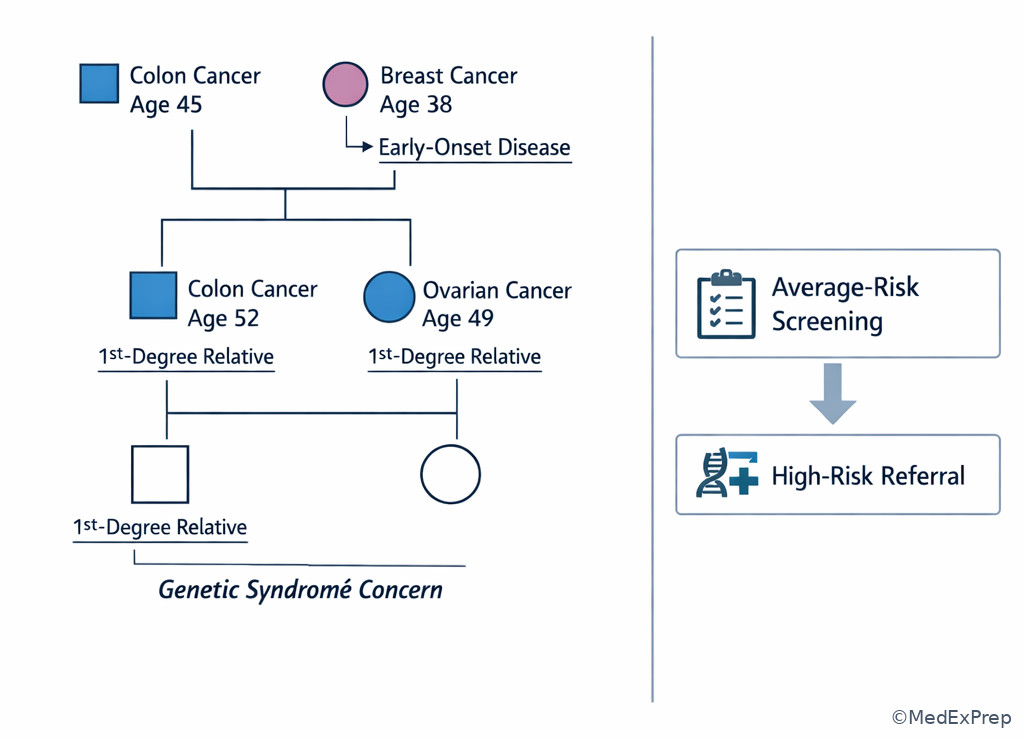
Key rule: “Family history positive” is not enough. The exam cares about which relative, which cancer, and age at diagnosis. A first-degree relative diagnosed young is far more consequential than a distant relative diagnosed late in life.
High-Yield Connection: This logic overlaps with Family History and Risk Assessment later in Population Health. On exam day, screening questions often become pedigree questions in disguise.
Clinician Action: Diagnose: identify high-risk features from personal history and pedigree. Order: choose earlier screening, colonoscopy instead of stool-based options when appropriate, or formal genetic risk evaluation. Treat: counsel the patient that “more risk” often means “different pathway,” not simply “same test sooner.” Refer/Escalate: refer for genetics, gastroenterology, breast specialty, or gynecology when hereditary patterns or prior high-grade lesions are present.
B Worked example
A 38-year-old woman presents for preventive care. She has migraines, hypothyroidism, and generalized anxiety disorder. She feels well and asks whether she can “wait until regular screening age” for colon cancer because she is busy with work. Her mother developed colorectal cancer at age 44, and her maternal uncle had endometrial cancer at age 48. CBC and CMP are normal. A tempting clue is that she is asymptomatic and under age 45.
Reasoning chain: Identify task: risk-based colorectal screening. Extract key facts: first-degree relative with early colorectal cancer and another Lynch-associated cancer in the family. Apply rule: this is not average-risk screening; the family pattern suggests increased hereditary risk and requires earlier, not routine, management. Eliminate distractors: waiting until age 45 is wrong because average-risk timing does not apply. FIT is tempting because it is noninvasive, but stool testing is not the preferred path when hereditary risk is suspected. Verify: the best next step is risk-based colon screening planning and genetics/gastroenterology referral rather than routine deferral.
C Exam trap
Common wrong answer: Reassure her and start routine colorectal screening at age 45.
Why it is tempting: She is asymptomatic, and 45 is the memorable starting age for average-risk screening.
Single clue that eliminates it: A first-degree relative with early colorectal cancer shifts her to a high-risk pathway.
D Checkpoint
Question: Which patient most clearly requires departure from an average-risk screening pathway?
- A 51-year-old man whose grandfather developed colon cancer at age 84
- A 44-year-old woman whose mother developed colon cancer at age 43
- A 56-year-old woman with no family history and a normal FIT last year
- A 62-year-old man with well-controlled hypertension and no symptoms
Answer: B. A 44-year-old woman whose mother developed colon cancer at age 43.
- A: Tempting because any family history raises attention; wrong because a grandfather at advanced age is less likely to change to a high-risk pathway.
- B: Correct because a first-degree relative with early-onset colorectal cancer is a major risk upgrade.
- C: Tempting because ongoing screening always requires thought; wrong because this is still average-risk context.
- D: Tempting because older age invites more testing; wrong because no high-risk feature is given.
If you missed this: Review 1.1.1.3 Increased-risk patients: when average-risk screening no longer applies — focus on the first-degree relative plus early age-at-diagnosis discriminator.
1.1.1.6 Shared decision-making, counseling, and when to stop screening
A Explanation
The final foundational conflict is choosing between “screen because screening is good” and “do not screen because benefit is low or uncertain in this patient.” The single rule is whether the patient is likely to benefit from early detection enough to outweigh harms. This is where shared decision-making, prior results, functional status, and life expectancy matter.
Prostate cancer screening is the classic exam example. Routine PSA screening is not a reflex order for all men. It is a conversation balancing possible mortality benefit against false positives, biopsy complications, anxiety, and overdiagnosis. Similarly, routine screening in older adults with severe frailty, limited life expectancy, or inability to undergo treatment may not be appropriate even if they once met age criteria.
WHY THIS IS TESTED: many learners memorize starting ages but ignore stopping logic and counseling burdens. ABFM expects family physicians to practice evidence-informed prevention, not test maximalism. A patient-centered screening decision includes whether the patient would pursue diagnostic follow-up and treatment if cancer were found.
See Fig 4 for the stop-or-continue framework that often resolves geriatrics-style preventive questions.
Exam takeaway: Continue screening only when the patient is likely to benefit and would reasonably undergo follow-up and treatment.
flowchart TD
A[Eligible by age?] --> B{Average or high risk?}
B --> C{Reasonable life expectancy and function?}
C -->|Yes| D{Would patient accept workup/treatment?}
D -->|Yes| E[Continue screening]
D -->|No| F[Do not screen routinely]
C -->|No| F
B -->|Needs special pathway| G[Individualize with referral or shared decision] Exam takeaway: Screening is appropriate only when benefit, follow-up, and patient goals align.
Exam takeaway: Preference-sensitive screening requires discussion of benefit, harm, and whether the patient would pursue follow-up.
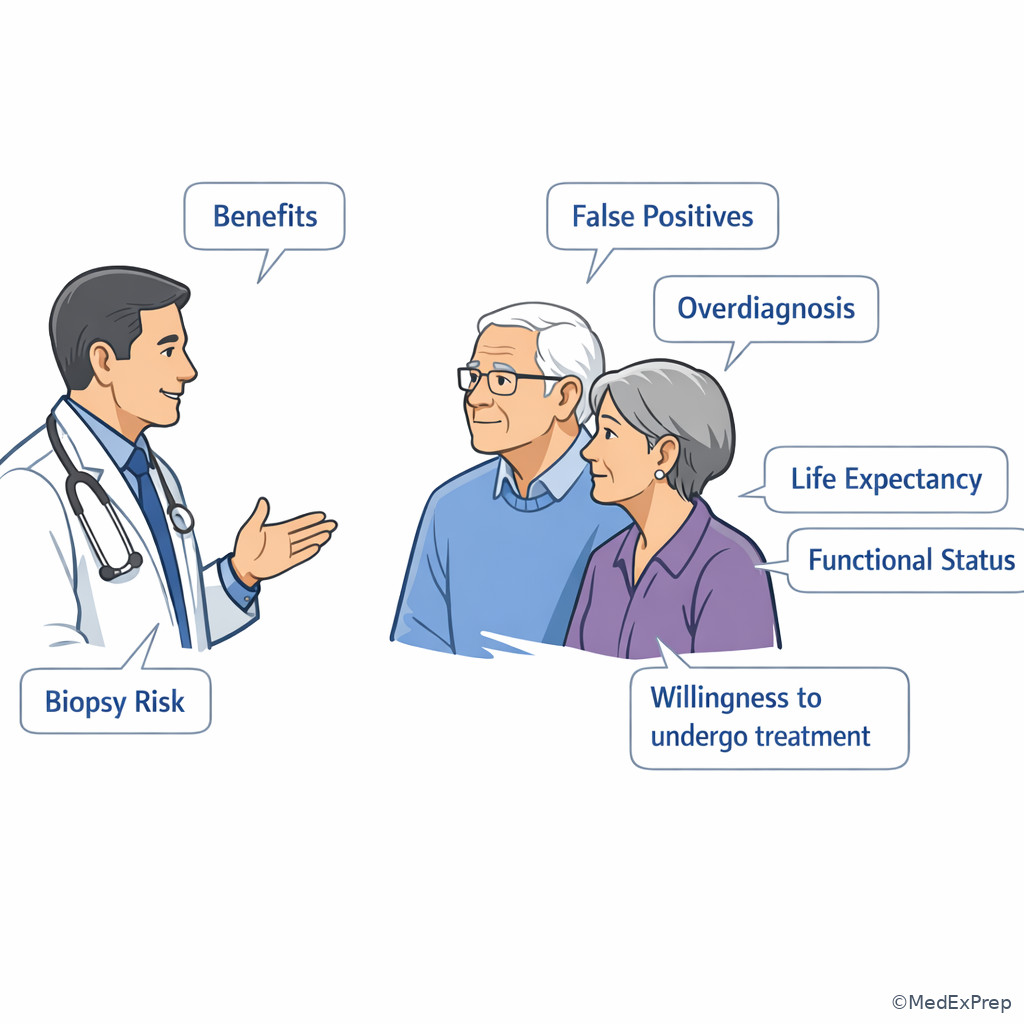
Memory anchor: For stop/continue decisions, use “BFT” — Benefit window, Follow-up willingness, Treatment candidacy.
Forward reference: In upcoming Cardiometabolic Risk Screening, you will use the same counseling structure when deciding whether borderline findings justify more testing, medication, or watchful follow-up.
Clinician Action: Diagnose: identify preference-sensitive screening decisions and limited-benefit situations. Order: only screening likely to change outcomes meaningfully. Treat: counsel on benefits, harms, and downstream procedures before ordering the test. Refer/Escalate: involve specialists when high-risk history or abnormal results exceed routine primary care follow-up.
B Worked example
An 83-year-old man in continuity clinic has severe COPD on home oxygen, heart failure with frequent exacerbations, chronic kidney disease, and progressive functional decline. He lives with his daughter, needs help with bathing, and says he would not want surgery or chemotherapy if cancer were found. He asks if he still “needs all the usual cancer tests,” especially PSA and colon screening, because his neighbor just had both. A normal hemoglobin last month is included as distracting reassurance.
Reasoning chain: Identify task: continue versus stop routine screening. Extract key facts: advanced age alone is not the key; severe comorbidity, limited life expectancy, poor functional status, and explicit unwillingness to pursue treatment are the discriminators. Apply rule: routine screening is unlikely to provide net benefit when the patient is unlikely to live long enough to benefit or would decline treatment. Eliminate distractors: ordering tests because he is male or because prior labs were normal misses the real issue. Verify: the best next step is shared decision-making leading away from routine screening rather than reflex PSA or colon testing.
C Exam trap
Common wrong answer: Continue screening because “screening saves lives” and age alone does not stop it.
Why it is tempting: Learners correctly remember that some healthy older adults may still benefit from individualized screening.
Single clue that eliminates it: He would not pursue treatment and has major competing mortality risk, so screening benefit is unlikely.
D Checkpoint
Question: Which factor most strongly supports stopping routine cancer screening in an older adult?
- Controlled hypertension on one medication
- Strong desire for more testing
- Limited life expectancy with unwillingness to undergo treatment
- Prior normal screening results
Answer: C. Limited life expectancy with unwillingness to undergo treatment.
- A: Tempting because comorbidity affects decisions; wrong because mild controlled disease alone does not strongly argue for stopping.
- B: Tempting because patient preference matters; wrong because preference alone does not overcome very low expected benefit without informed discussion.
- C: Correct because low benefit and no intention to pursue treatment undermine the purpose of screening.
- D: Tempting because normal history reassures; wrong because prior normal results are not the main determinant here.
If you missed this: Review 1.1.1.4 Shared decision-making, counseling, and when to stop screening — focus on benefit window plus treatment willingness.
- True or False: Screening should continue even if the patient would refuse diagnostic workup and treatment. False.
- The most common reason PSA appears on exams is shared decision-making.
- Name the 3 stop/continue factors in BFT: Benefit window, Follow-up willingness, Treatment candidacy.
1.1.1.7 Abnormal screening results: what the family physician does next
A Explanation
Screening questions do not end when the test is ordered. The decision conflict is choosing between repeating another screening test and moving to diagnostic follow-up. The single rule is: an abnormal screening result usually requires a defined diagnostic next step, not a different screening shortcut.
High-yield examples: a positive FIT leads to colonoscopy, not another FIT; an abnormal mammogram leads to diagnostic breast imaging pathway, not “repeat screening later”; an abnormal cervical screen follows risk-based colposcopy or surveillance guidance rather than random repetition; an abnormal LDCT enters a nodule-management algorithm rather than immediate dismissal because the patient is asymptomatic.
WHY THIS IS TESTED: the board wants to know whether you understand the purpose of screening. Screening only helps if positive results are acted on correctly. Many tempting wrong answers use delay or repetition to avoid invasive follow-up, but that undermines the screening strategy.
See Fig 5 for the most important “positive screening result” transitions in primary care. These transitions are common ABFM next-step items.
Exam takeaway: Positive screening tests usually require diagnostic follow-up rather than repeat screening.
flowchart TD
A[Positive FIT or stool DNA] --> B[Colonoscopy]
C[Abnormal mammogram] --> D[Diagnostic breast imaging pathway]
E[Abnormal cervical screen] --> F[Risk-based colposcopy or surveillance]
G[Abnormal LDCT] --> H[Nodule follow-up algorithm]
I[Elevated PSA after discussion] --> J[Shared follow-up and urology pathway as appropriate]
Exam takeaway: Once the screen is abnormal, your task changes from detection to confirmation and triage.
Exam takeaway: The family physician must connect a positive screen to the correct diagnostic pathway without delay.
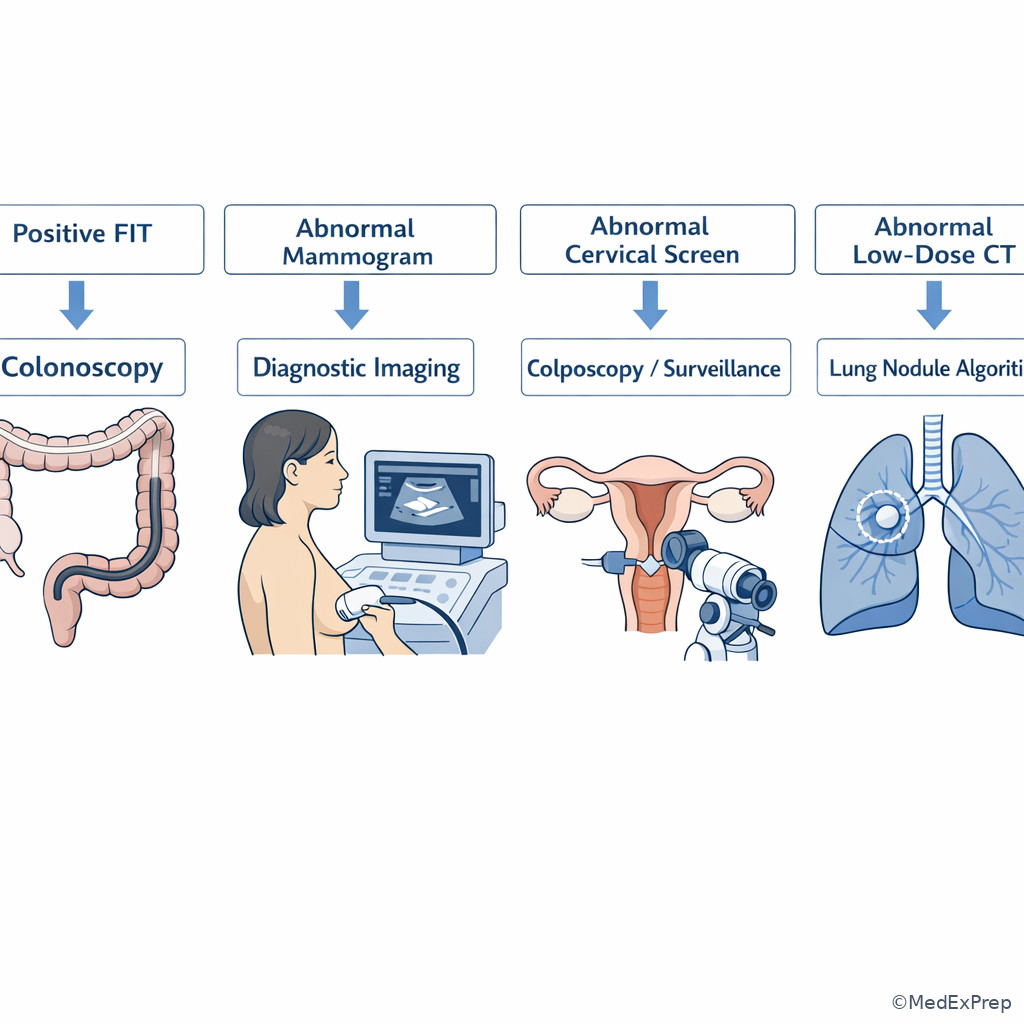
Key rule: A positive stool test does not mean “repeat stool testing for confirmation.” It means colonoscopy.
Clinician Action: Diagnose: interpret the screening result correctly as abnormal but not necessarily diagnostic. Order: the defined next step such as colonoscopy or colposcopy. Treat: manage anxiety and clarify the distinction between screening positivity and confirmed cancer. Refer/Escalate: expedite specialty evaluation when the abnormal result requires procedural confirmation or high-risk imaging follow-up.
B Worked example
A 49-year-old asymptomatic school bus driver with obesity and tobacco use disorder completes an annual FIT as part of colorectal screening. He has external hemorrhoids, uses ibuprofen for knee pain, and feels well. The FIT returns positive. He asks whether he can repeat the FIT after stopping NSAIDs because he cannot miss work for a colonoscopy. The tempting clue is the hemorrhoid history.
Reasoning chain: Identify task: manage a positive screening result. Extract key facts: asymptomatic average-risk screening led to a positive FIT; hemorrhoids and NSAID use are distractions. Apply rule: positive stool-based colorectal screening requires colonoscopy. Eliminate distractors: repeating FIT is tempting because the patient prefers a noninvasive option, but repeat stool testing delays required diagnostic evaluation. Switching to stool DNA is equally wrong. Verify: colonoscopy is the correct next step.
C Exam trap
Common wrong answer: Repeat FIT in a few weeks because hemorrhoids may have caused the result.
Why it is tempting: The explanation sounds biologically plausible and seems less invasive.
Single clue that eliminates it: The screening algorithm after a positive FIT is colonoscopy, regardless of a plausible benign bleeding source.
D Checkpoint
Question: A 58-year-old asymptomatic woman has a positive stool DNA colorectal screening test. Which is the most appropriate next step?
- Repeat stool DNA testing in 1 month
- Order colonoscopy
- Switch to annual FIT instead
- Observe and repeat screening next year
Answer: B. Order colonoscopy.
- A: Tempting because clinicians often confirm unexpected lab results; wrong because positive stool-based colorectal screens require colonoscopy.
- B: Correct because diagnostic colonoscopy is the required follow-up after a positive stool DNA test.
- C: Tempting because FIT is another accepted screening test; wrong because once the screen is positive, the next step is no longer another screening modality.
- D: Tempting because the patient is asymptomatic; wrong because asymptomatic status is why screening was done, not why follow-up should be delayed.
If you missed this: Review 1.1.1.5 Abnormal screening results: what the family physician does next — focus on the positive stool test to colonoscopy rule.
Exam Traps & Differentiators
Most common wrong answer and why: applying an average-risk screening rule to a patient with symptoms or increased risk. This is tempting because the age cutoff is easier to remember than the exclusion criteria.
| Looks similar but isn't | Why learners confuse them | Single clue that separates them | Best next step |
|---|---|---|---|
| Average-risk colorectal screening vs diagnostic colonoscopy | Both may involve colon testing in midlife adults | Bleeding, iron deficiency anemia, or other symptoms | Diagnostic colonoscopy, not stool screening |
| LDCT vs chest x-ray for lung screening | Both image the chest | Only LDCT is the recommended screening modality | Order LDCT if eligible |
| Cervical screening after hysterectomy vs routine Pap | Age-based Pap rules are memorable | No cervix after benign total hysterectomy and no prior CIN2+ | Stop routine cervical screening |
| Routine PSA testing vs PSA discussion | PSA is widely known and easy to order | Preference-sensitive decision with benefit-harm discussion | Shared decision-making |
| Routine screening in healthy older adult vs stop screening in frail older adult | Both patients may be above standard screening ages | Life expectancy, functional status, and treatment willingness | Individualize; often stop if benefit unlikely |
- If the stem says rectal bleeding, iron deficiency anemia, breast lump, hemoptysis, or postcoital bleeding, think diagnostic workup, not routine screening.
- If the stem says first-degree relative with early-onset cancer, think increased-risk pathway, not average-risk schedule.
- If the stem says benign total hysterectomy, think no routine cervical screening unless prior high-grade disease changes it.
- If the stem says heavy smoking history and quit within the relevant screening window, think annual LDCT, not chest x-ray.
- If the stem says positive FIT or positive stool DNA, think colonoscopy next.
- If the stem says severe frailty, competing mortality risk, or refusal of treatment, think low net benefit from continued screening.
Exam takeaway: Most screening errors come from missing one disqualifying detail such as symptoms, hysterectomy status, or heavy smoking criteria.
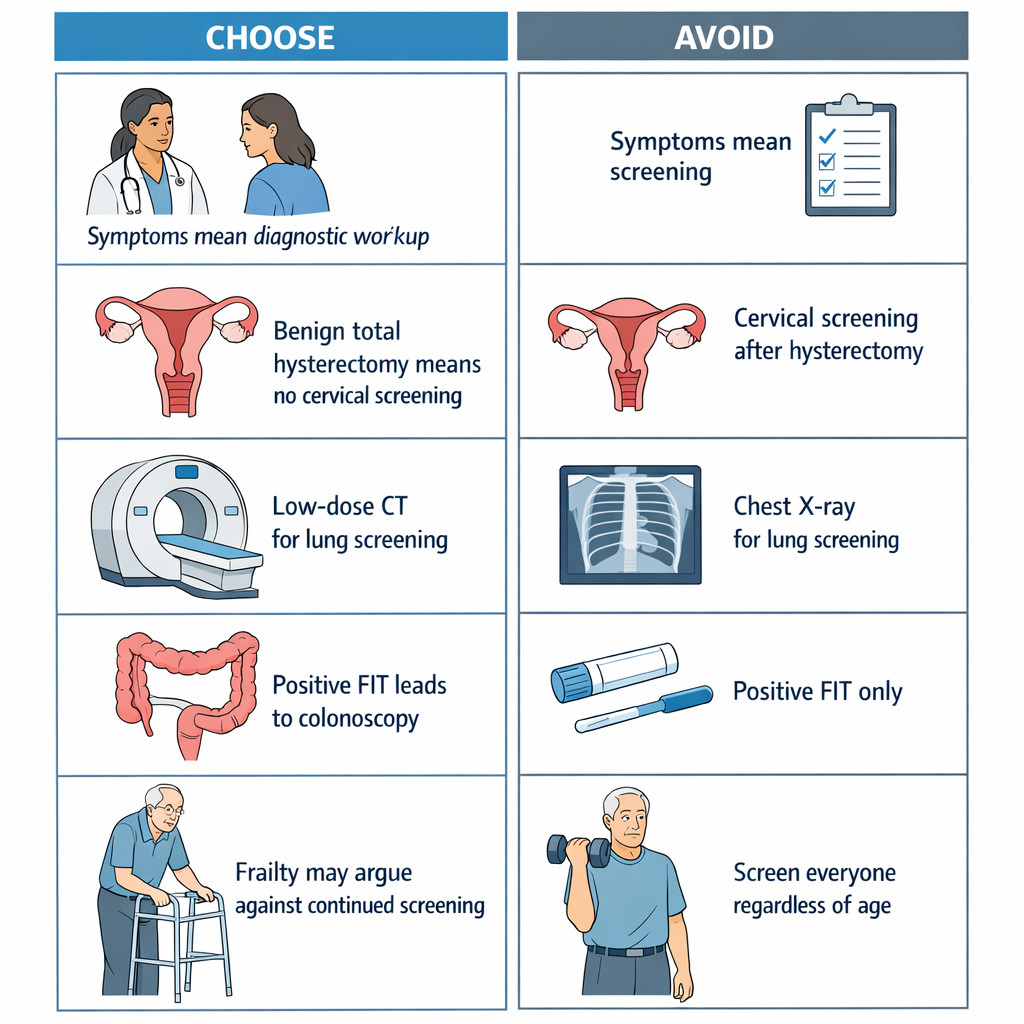
Related-topic trap: In upcoming Infectious Disease Screening, the confusable error is different: patients may be asymptomatic but still need testing because exposure risk, pregnancy, or sexual history changes the pathway. Cancer screening is more organ- and age-structured; infectious screening is more behavior- and exposure-structured.
Review connection: The traps above test framework selection. If any felt unfamiliar, revisit 1.1.1.1 Foundational screening logic: start with the right patient, not the right test and 1.1.1.5 Abnormal screening results: what the family physician does next before attempting the Self-check quiz.
Tables
| Screening target | Typical board-ready average-risk entry point | Usual first test(s) | When to rethink the routine pathway |
|---|---|---|---|
| Breast | Appropriate adult age range per current guideline set | Mammography | Hereditary risk, prior chest radiation, known BRCA-related risk |
| Cervical | Age-based framework beginning in early adulthood | Cytology and/or HPV-based testing depending on age | No cervix, prior CIN2+, immunocompromise, symptoms |
| Colorectal | 45 years for average-risk adults | Stool-based testing or colonoscopy | Symptoms, anemia, first-degree relative with early cancer, IBD |
| Lung | Eligible older adults with sufficient smoking exposure | Annual LDCT | Never-smoker, too few pack-years, quit too long ago, symptoms |
| Prostate | Preference-sensitive adult discussion in relevant age range | PSA after shared decision-making | Limited life expectancy, patient declines workup/treatment |
| Comparison point | Average-risk patient | Increased-risk patient | Symptomatic patient |
|---|---|---|---|
| Clinical goal | Detect occult disease early | Use intensified or earlier prevention | Find the cause of current symptoms |
| Test selection | Routine screening options | Earlier, more specific, or more frequent pathway | Diagnostic evaluation |
| Typical stem clue | Asymptomatic annual visit | Strong family or personal history | Bleeding, weight loss, mass, anemia, hemoptysis |
| Common wrong answer | Overtesting | Using routine timing anyway | Ordering a screening test instead of diagnostic workup |
| Primary care role | Offer appropriate screening | Risk stratify and refer when needed | Initiate workup and escalate appropriately |
| Differential screening scenario | Tempting but wrong choice | Correct choice | Discriminating clue |
|---|---|---|---|
| Positive FIT | Repeat FIT | Colonoscopy | Positive stool-based screen requires diagnostic colon evaluation |
| Eligible smoker wants lung screening | Chest x-ray | LDCT | Recommended screening modality is low-dose CT |
| Older woman after benign total hysterectomy | Pap test | No routine cervical screening | No cervix and no prior high-grade lesion |
| Asymptomatic 46-year-old average-risk adult | Wait until 50 for colon screening | Begin screening now | Average-risk colorectal screening starts at 45 |
| Frail older adult who would refuse treatment | Continue all screening | Stop or individualize screening | No realistic net benefit from early detection |
Algorithm / Approach
Exam takeaway: Use symptoms, risk category, eligibility, and follow-up willingness to choose or reject screening safely.
See Fig 6 as your default office approach. If you use this sequence under exam pressure, you will avoid most wrong-setting and wrong-patient errors.
Rapid Review
- Screening vs diagnosis → symptoms convert the question to diagnostic workup
- Average-risk colorectal → begin at 45, not 50
- Positive FIT → colonoscopy, not repeat FIT
- Lung screening modality → LDCT, not chest x-ray
- Lung eligibility → age plus pack-years plus quit timing
- Cervical after benign total hysterectomy → stop routine screening if no prior CIN2+
- PSA testing → shared decision, not automatic reflex order
- High-risk pedigree → changes pathway, not just urgency
- Frailty and limited life expectancy → may outweigh screening benefit
- Would not accept treatment → weak reason to continue screening
- Screening test choice → organ-specific rule beats generic “more testing” instinct
- Abnormal screen → defined diagnostic follow-up pathway
- Family history detail → first-degree relative and age at diagnosis matter most
- Benign explanation for positive screen → does not erase required follow-up
Memory anchor: “S-R-O-B-F” for any screening stem: Symptoms? Risk level? Organ present? Benefit window? Follow-up test if positive?
Self-check quiz
Question 1 (Easy): A 47-year-old asymptomatic man with obesity and seasonal allergies presents for an annual visit. He has no family history of colorectal cancer, no inflammatory bowel disease, and no prior screening. Which is the most appropriate recommendation?
- Begin average-risk colorectal screening now
- Wait until age 50 to begin screening
- Delay screening until symptoms develop
- Perform annual digital rectal examination instead
Question 2 (Easy): A 64-year-old woman with osteoarthritis and hyperlipidemia had a total hysterectomy for fibroids 15 years ago. She has no history of CIN2+ and no vaginal bleeding. Which is the most appropriate cervical cancer screening plan?
- Continue cytology every 3 years
- Continue primary HPV testing every 5 years
- Stop routine cervical screening
- Obtain annual pelvic ultrasound
Question 3 (Medium): A 60-year-old woman with hypertension, obesity, and tobacco use disorder quit smoking 8 years ago after a 35-pack-year history. She feels well and asks for “a lung cancer screening test, maybe an x-ray.” Which is the most appropriate next step?
- Order annual low-dose CT screening
- Order screening chest x-ray
- Order sputum cytology
- No lung cancer screening is indicated because she quit smoking
Question 4 (Medium): A 50-year-old asymptomatic man with GERD and hypertension completes a FIT for colorectal screening, and the result is positive. He reports hemorrhoids and asks to repeat the FIT after using topical treatment. Which is the most appropriate next step?
- Repeat FIT in 1 month
- Order colonoscopy
- Switch to stool DNA testing
- Observe and repeat screening next year
Question 5 (Medium): A 39-year-old woman with anxiety and hypothyroidism presents for preventive care. Her mother developed colon cancer at age 42, and she has no GI symptoms. Which is the most appropriate approach?
- Reassure her that routine screening starts at age 45
- Use average-risk stool-based screening beginning at age 45
- Treat her as increased-risk and arrange earlier risk-based colorectal evaluation
- Delay any action unless she develops rectal bleeding
Question 6 (Hard): A 76-year-old woman lives independently, walks daily, and manages all medications without help. She has well-controlled hypertension and mild osteopenia. She asks whether she should continue breast cancer screening. Which factor most strongly supports continuing an individualized screening discussion rather than stopping automatically?
- Her age is above common routine screening ranges
- Good functional status and likely ability to benefit from early detection
- She had a normal mammogram 2 years ago
- Screening should be stopped in all adults older than 75
Question 7 (Hard): A 68-year-old man with severe COPD on home oxygen, systolic heart failure, chronic kidney disease, and progressive frailty presents for follow-up. He says he would decline surgery, radiation, or chemotherapy if cancer were found. Which is the most appropriate counseling regarding PSA screening?
- Order PSA because all older men benefit from prostate cancer screening
- Order PSA because he has multiple chronic illnesses
- Recommend against routine PSA screening because net benefit is unlikely in his context
- Order PSA first and discuss harms only if it is elevated
Question 8 (Hard): A 53-year-old man with obesity, type 2 diabetes, and chronic constipation presents for a preventive visit. He mentions intermittent rectal bleeding for 3 months and new fatigue. Hemoglobin is 10.8 g/dL with microcytosis. He has never had colorectal screening. Which is the most appropriate next step?
- Order annual FIT because he is due for average-risk screening
- Order stool DNA testing because it is more sensitive than FIT
- Order diagnostic colonoscopy
- Repeat hemoglobin in 3 months before deciding
Answer key
1.1.1.8 Question 1
Correct answer: A. Begin average-risk colorectal screening now.
- A: Tempting because it matches current preventive practice and is correct here. It is correct because an asymptomatic average-risk adult age 45 or older should begin colorectal screening. Discriminating clue: he is 47 and average risk. Source: USPSTF colorectal cancer screening recommendation; American Cancer Society guidance.
- B: Tempting because age 50 was the older historical threshold. It is incorrect for this scenario because current common U.S. frameworks begin average-risk screening at 45. Discriminating clue: age 47 already qualifies. Source: USPSTF; ACS.
- C: Tempting because many patients seek care only when symptomatic. It is incorrect because screening is specifically for asymptomatic adults to detect disease earlier. Discriminating clue: annual preventive visit without symptoms. Source: USPSTF.
- D: Tempting because office exam feels like a simpler alternative. It is incorrect because digital rectal examination does not replace evidence-based colorectal cancer screening. Discriminating clue: the question asks for screening, not office bedside assessment. Source: Harrison’s Principles of Internal Medicine; USPSTF.
If you missed this: Review 1.1.1.2 Organ-specific frameworks: breast, cervical, colorectal, lung, and prostate — focus on the age 45 average-risk colorectal entry point.
1.1.1.9 Question 2
Correct answer: C. Stop routine cervical screening.
- A: Tempting because cytology every 3 years is a familiar screening schedule. It is incorrect because this patient has had a total hysterectomy for benign disease and no history of high-grade precancer. Discriminating clue: no cervix remains to screen. Source: USPSTF cervical cancer screening recommendation; ACOG practice guidance.
- B: Tempting because HPV-based screening is now commonly emphasized. It is incorrect because organ status overrides modality choice. Discriminating clue: prior benign total hysterectomy. Source: USPSTF; ACOG.
- C: Correct because benign total hysterectomy without prior CIN2+ or cervical cancer is a standard reason to stop routine cervical screening. Discriminating clue: no history of CIN2+. Source: USPSTF; ACOG.
- D: Tempting because learners may confuse pelvic organ surveillance with cervical cancer screening. It is incorrect because pelvic ultrasound is not a routine cervical cancer screening test. Discriminating clue: screening target is cervical cancer. Source: ACOG; Harrison’s.
If you missed this: Review 1.1.1.1 Foundational screening logic: start with the right patient, not the right test — focus on organ status as the key discriminator.
1.1.1.10 Question 3
Correct answer: A. Order annual low-dose CT screening.
- A: Correct because she is an asymptomatic adult in the relevant age range with substantial smoking exposure and quit recently enough for lung screening benefit. Discriminating clue: 35 pack-years and quit 8 years ago. Source: USPSTF lung cancer screening recommendation; American Cancer Society guidance.
- B: Tempting because chest x-ray sounds like a reasonable imaging screen and many patients request it. It is incorrect because chest x-ray is not the recommended screening modality for lung cancer. Discriminating clue: the stem asks for screening in an eligible smoker. Source: USPSTF; Harrison’s.
- C: Tempting because sputum relates to lung pathology and seems noninvasive. It is incorrect because sputum cytology is not the standard population screening tool. Discriminating clue: board-style screening pathway points to LDCT. Source: USPSTF.
- D: Tempting because quitting smoking lowers risk. It is incorrect because former smokers may still qualify if exposure is sufficient and quit timing falls within the screening window. Discriminating clue: quit only 8 years ago. Source: USPSTF.
If you missed this: Review 1.1.1.2 Organ-specific frameworks: breast, cervical, colorectal, lung, and prostate — focus on LDCT as the correct modality when age and smoking criteria fit.
1.1.1.11 Question 4
Correct answer: B. Order colonoscopy.
- A: Tempting because hemorrhoids provide a benign alternate explanation and repeating tests is a common clinical reflex. It is incorrect because a positive FIT requires diagnostic colonoscopy. Discriminating clue: already positive stool-based screen. Source: USPSTF colorectal cancer screening guidance; American College of Gastroenterology screening recommendations.
- B: Correct because colonoscopy is the required follow-up after a positive FIT in an asymptomatic screening patient. Discriminating clue: positive FIT changes the pathway from screening to diagnostic evaluation. Source: USPSTF; ACG.
- C: Tempting because stool DNA is another accepted screening modality. It is incorrect because once one stool screen is positive, another screening test is not the next step. Discriminating clue: abnormal result already present. Source: USPSTF.
- D: Tempting because the patient feels well and has a possible benign source. It is incorrect because delay undermines the purpose of screening. Discriminating clue: positive FIT mandates follow-up. Source: USPSTF.
If you missed this: Review 1.1.1.5 Abnormal screening results: what the family physician does next — focus on the rule that positive stool testing leads to colonoscopy.
1.1.1.12 Question 5
Correct answer: C. Treat her as increased-risk and arrange earlier risk-based colorectal evaluation.
- A: Tempting because age 45 is the well-known average-risk threshold. It is incorrect because a first-degree relative with early-onset colon cancer moves her off the routine pathway. Discriminating clue: mother diagnosed at 42. Source: ACG colorectal screening guidelines; Harrison’s.
- B: Tempting because stool-based tests are convenient and accepted for average risk. It is incorrect because suspected increased hereditary risk typically requires a different strategy than average-risk stool screening. Discriminating clue: strong first-degree family history. Source: ACG; UpToDate.
- C: Correct because the family history suggests increased risk requiring earlier, individualized evaluation and likely referral. Discriminating clue: early cancer in a first-degree relative. Source: ACG; USPSTF framework for risk modification.
- D: Tempting because symptoms would certainly increase urgency. It is incorrect because screening and risk-based prevention do not wait for symptoms when hereditary risk is present. Discriminating clue: preventive visit with high-risk family history. Source: ACG; Harrison’s.
If you missed this: Review 1.1.1.3 Increased-risk patients: when average-risk screening no longer applies — focus on first-degree relative plus early age at diagnosis.
1.1.1.13 Question 6
Correct answer: B. Good functional status and likely ability to benefit from early detection.
- A: Tempting because age limits are easy to memorize and many frameworks become less routine later in life. It is incorrect because age alone does not automatically end screening for a healthy older adult. Discriminating clue: she is independent and functional. Source: USPSTF breast screening framework; geriatric preventive care principles in Harrison’s.
- B: Correct because good function and likely sufficient life expectancy support an individualized discussion about continued screening benefit. Discriminating clue: independent living and daily walking. Source: USPSTF; geriatric prevention guidance.
- C: Tempting because prior normal tests influence timing. It is incorrect because the central decision here is benefit window, not the reassurance of a prior normal result. Discriminating clue: question asks what supports continuing discussion. Source: USPSTF.
- D: Tempting because learners seek a hard stop age. It is incorrect because individualized decisions remain appropriate in selected healthy older adults. Discriminating clue: healthy functional status. Source: USPSTF; AAFP preventive care principles.
If you missed this: Review 1.1.1.4 Shared decision-making, counseling, and when to stop screening — focus on functional status and likely benefit window rather than age alone.
1.1.1.14 Question 7
Correct answer: C. Recommend against routine PSA screening because net benefit is unlikely in his context.
- A: Tempting because prostate cancer becomes more common with age. It is incorrect because not all older men benefit, especially those with heavy competing illness burden and poor treatment candidacy. Discriminating clue: severe frailty and refusal of treatment. Source: USPSTF prostate cancer screening recommendation; Harrison’s.
- B: Tempting because multiple illnesses may make clinicians feel they should “check everything.” It is incorrect because competing mortality risk usually reduces the net benefit of screening. Discriminating clue: serious comorbidities do not strengthen PSA benefit. Source: USPSTF.
- C: Correct because routine PSA screening offers little expected benefit when life expectancy is limited and the patient would decline treatment even if cancer were found. Discriminating clue: he would refuse definitive treatment. Source: USPSTF; geriatric preventive care principles.
- D: Tempting because some clinicians discuss harms after abnormal findings. It is incorrect because shared decision-making should occur before ordering a preference-sensitive screening test. Discriminating clue: counseling comes before PSA, not after. Source: USPSTF.
If you missed this: Review 1.1.1.4 Shared decision-making, counseling, and when to stop screening — focus on treatment willingness and competing mortality risk as the discriminator.
1.1.1.15 Question 8
Correct answer: C. Order diagnostic colonoscopy.
- A: Tempting because he is older than 45 and overdue for routine screening. It is incorrect because rectal bleeding and microcytic anemia make this a diagnostic evaluation question rather than routine screening. Discriminating clue: symptomatic bleeding plus anemia. Source: ACG colorectal evaluation guidance; Harrison’s.
- B: Tempting because stool DNA is more sensitive than FIT in some screening contexts. It is incorrect because a symptomatic patient with anemia requires direct diagnostic evaluation, not another screening test. Discriminating clue: not an asymptomatic screening scenario. Source: USPSTF screening principles; Harrison’s.
- C: Correct because overt bleeding with iron deficiency pattern in an age-eligible adult requires colonoscopic diagnostic workup. Discriminating clue: microcytic anemia plus rectal bleeding. Source: ACG; Harrison’s.
- D: Tempting because repeat labs may confirm persistence and chronic constipation sounds benign. It is incorrect because waiting delays evaluation of potentially significant colorectal pathology. Discriminating clue: current alarm features are already present. Source: ACG; Harrison’s.
If you missed this: Review 1.1.1.1 Foundational screening logic: start with the right patient, not the right test — focus on the rule that symptoms and anemia convert screening to diagnostic workup.
Keep going with the full ABFM Family Medicine Prep Course (ABFM)
You just studied the way members do, in the same lesson interface. Full access unlocks every lesson, the question bank and flashcards for a full year.
One payment · 1 year of access · No auto-renewal